1. Introduction
The forestry sector comprises activities based on technical operations within an ecological environment. These activities are associated with ecological, technical, and economic aspects as well as ergonomic, environmental, and sociological factors [
1,
2]. As is known, forest management involves sustainable practices, mainly the preservation of renewable natural resources, implemented in open-air conditions and over extensive areas, with the complex structure of forests playing a vital role. In this context, timber production, which is a crucial component of sustainability in forestry, refers to the process of harvesting raw wood materials from mature forests to meet the increasing demand for timber in this age [
3,
4].
Landslides significantly impact forest ecosystems by causing soil erosion, vegetation loss, and displacement of nutrient-rich topsoil, which reduces soil fertility and impairs natural regeneration processes [
5,
6]. These mass movements lead to slope instability, fragmentation of forested areas, and habitat disruption, directly threatening forest productivity and resource management. In steep and mountainous forest regions, frequent landslides exacerbate these issues, highlighting the importance of understanding landslide dynamics within forested landscapes [
7].
Given these challenges, careful planning is required in forestry operations to minimize risk to forest infrastructure and optimize the location of critical facilities such as forest depots. Türkiye has a total of approximately 23.3 million hectares of forest area [
8]. In Türkiye, state forest subdistricts have been established to meet the public’s needs for timber and nonwood forest products. These regions continue to be the main suppliers of wood raw material. It should be noted that the production from the General Directorate of Forestry (GDF) meets approximately 84.2% of the wood raw material demand of the forest products industry of Türkiye. The significant role of forest depot offices in the timber supply chain has been demonstrated in various studies [
9,
10]. By the end of 2023, 472 forest depot offices were reportedly established in Türkiye [
11]. Although the number of depots has decreased due to the increasing implementation of standing sales practices, their importance within the supply chain persists owing to their role in ensuring regular supply throughout the year and performing value-added functions [
12].
In Türkiye, state forests are managed through a hierarchical structure consisting of Forest Management Directorates affiliated with Regional Directorates. Forest Management Directorate represents the operational unit where silvicultural treatments, forest road construction and timber depot planning are implemented. Most of these units are located in mountainous terrain, where steep slopes and intensive road networks make forest areas highly susceptible to landslides. Landslide events frequently damage forest roads, depots and stands, leading to economic losses and operational disruptions. Therefore, assessing landslide susceptibility at the scale of Forest Management Directorate is essential for integrating natural hazard information into forest planning and infrastructure siting. In this context, the present study focuses on the Ayancık Forest Management Directorate and develops a landslide susceptibility model to support safer planning of forest depots and related activities.
Storage operations are of pivotal significance in determining the quality and, by extension, the value of forest products, particularly log assortments. Forest depot offices are specific locations designated for the storage of raw wood materials obtained from forestry sources. After storage, these materials are sold and dispatched to purchasers. As wood is an organic material, preventing its degradation during storage is imperative prior to marketing it to industrial buyers [
12]. In this context, the selection of the depot site plays a vital role in ensuring the successful delivery of forest products to the market [
9]. Forest depots are established on the basis of structural characteristics, ownership status, duration of use, and the type and class of wood to be stored [
13,
14,
15].
The direct costs of natural disasters typically stem from the physical damage inflicted by them on capital infrastructure. Regarding the situation in Türkiye, floods and flash floods are the most devastating natural disasters after earthquakes, causing an estimated annual economic loss of 100 million USD [
16]. During the period of 1970 to 2012, Türkiye experienced 237 flood events, with Erzurum recording the highest number at 40. These events led to 180 deaths and 52 injuries. The coastal areas of the Black Sea Region are particularly prone to natural disasters, such as floods and landslides, which often result in both human casualties and material damage [
17].
A severe flood disaster occurred in the Ayancık district of Sinop Province on 10–11 August 2021, with the amount of rainfall attaining a value of 2227.9 mm/m2. As a consequence of this event, the forest depot of the Ayancık Forest Management Directorate was destroyed and rendered unusable. Approximately 36,000 m3 of forest products were swept into the sea, causing substantial environmental and infrastructural damage, including blockage of culverts and bridges, which intensified the loss of life and property. Considering the substantial annual production of the Ayancık Forest Management Directorate, a critical need for the establishment of a permanent and adequately sized depot has emerged.
Approximately 80% of the local economy of Ayancık relies on forestry activities, and the storage of forest products is of vital importance to its local communities and cooperatives. Therefore, this study aims to identify suitable locations for the construction of a new forest depot that will be resilient to recurring natural disasters. As both qualitative and quantitative parameters must be considered in such decisions, multicriteria decision-making (MCDM) techniques were employed. Within this specific context, the AHP, which is recognized as one of the most well-known and widely utilized techniques, is a structured technique for organizing and analyzing such complex decisions [
18,
19,
20].
In determining new forest depot sites, various factors considered important as per expert opinions were also included in the AHP for this study. The expert group consisted of 10 professionals, including forest engineers employed by the General Directorate of Forestry (GDF) and academic forest engineers actively engaged in forestry-related research and education. Their insights and professional judgments were instrumental in identifying and prioritizing the relevant criteria for evaluating suitable forest depot sites. These factors include flood susceptibility map, landslide susceptibility map, distance to road (forest area, village and highway roads), forest stand structure, proximity to faults, slope, and distance to power transmission lines.
In the LR-based landslide susceptibility models used herein, conditioning factors such as altitude, aspect, distance to drainage, distance to faults, Corine, lithology, curvature, plan curvature, profile curvature, slope, and topographic wetness index (TWI) were considered. The results obtained revealed that the Corine land cover and distance to drainage factors significantly contribute to the occurrence of landslides in the study area Furthermore, to better represent the relative vertical position of candidate depot sites with respect to the drainage network, a Height Above the Nearest Drainage (HAND) index was derived from the DEM and used as an additional flood-related topographic factor in the multi-criteria evaluation. The HAND index is a DEM-derived terrain variable that represents the vertical distance of each cell above its nearest drainage channel and is widely used as a simple proxy for identifying flood-prone low-lying areas [
21]. In addition, the factor of distance to the river was used in the flood susceptibility map. The LR model was selected because it provides interpretable coefficients and facilitates integration with AHP outputs in GIS-based planning, rather than for its predictive superiority. Moreover, LR has been widely used in similar applications and remains a robust and explainable tool in landslide susceptibility studies [
22].
Furthermore, recent studies have emphasized the importance of integrating sustainability and multi-criteria approaches in forest management and infrastructure planning. For example, the assessment of small-scale cooking and sanitation technologies demonstrates the significance of considering environmental, social, and economic criteria together [
23]. Decision-making models that prioritize sustainable practices provide insights into the structured evaluation of resource management projects [
24]. Moreover, the use of adaptive artificial intelligence (AI) learning models in decision support systems has been shown to enhance planning and resource allocation in smart regions [
25]. These approaches closely align with the methodology of the present study and underscore the necessity of a holistic evaluation in forest depot site selection.
This study provides a reference for using reliable factors for the selection of forest depot areas in different regions that are exposed to the risk of landslides and floods worldwide. Hence, this study is expected to make a significant contribution to the literature with respect to taking preventive measures against disasters.
2. Materials and Methods
2.1. Study Area
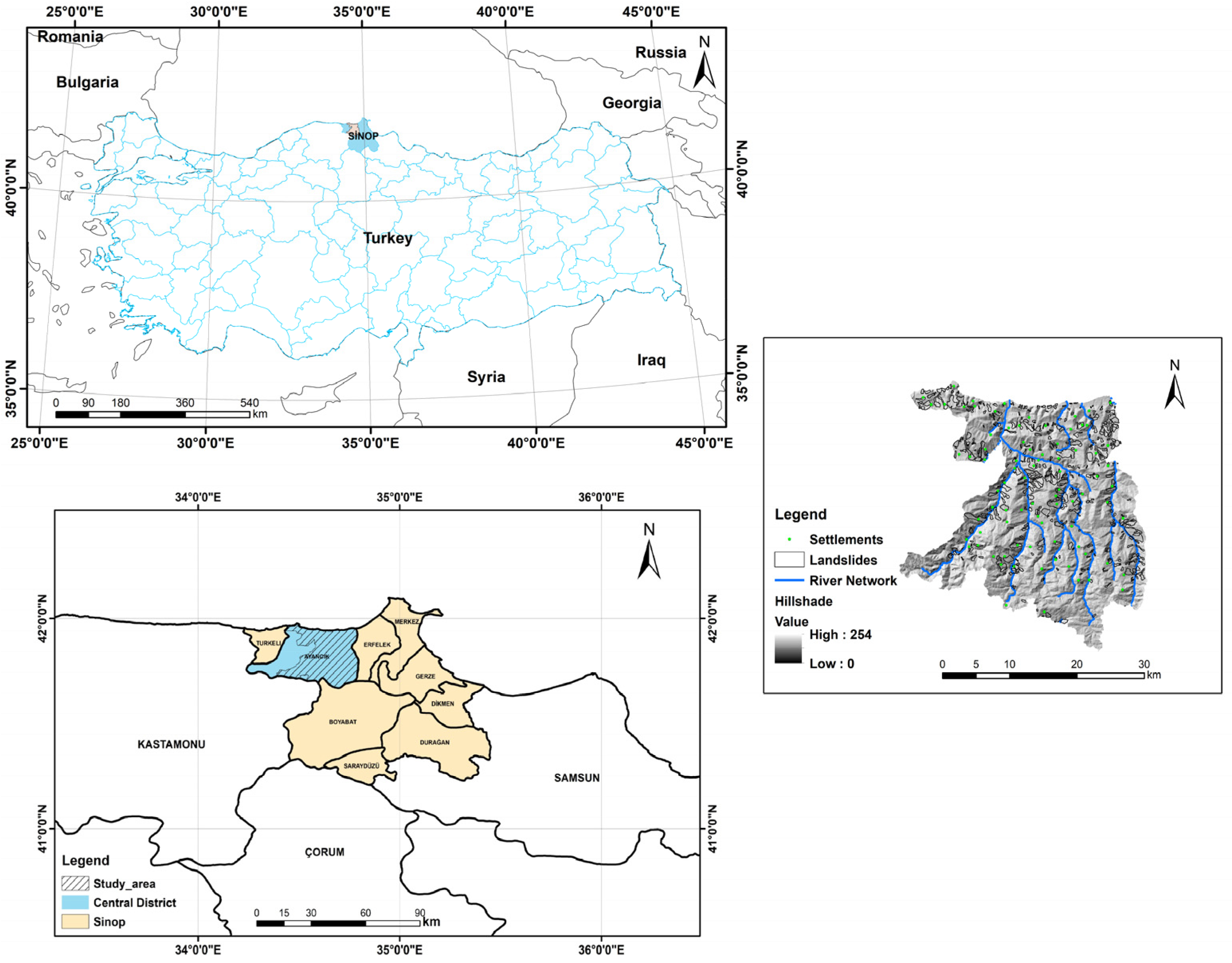
The study was conducted in Sinop, Türkiye, under the jurisdiction of the Sinop Regional Directorate of Forestry, specifically under the Ayancık Forest Management Directorate, which is located between the latitudes 4648241.35–4608997.43 N and the longitudes 615504.93–652508.08 E. The directorate comprises 12 forest management units, including 11 forest sub-districts and 3 forest depot offices. The total area managed by the Ayancık Forest Management Directorate is 80,195 hectares, of which 61,456 hectares (77%) is made up of forested land, while the remaining 18,739 hectares (23%) constitute non-forested (open) areas. Topographically, the region is characterized by rugged and mountainous terrain with steep slopes and elevations ranging approximately from 100 to 1200 m above sea level. Several streams, including the Ayancık River, traverse the landscape, significantly influencing local hydrology and forest ecology.
The area is dominated by a humid Black Sea climate, characterized by high annual precipitation (exceeding 1000 mm on average) and moderate temperatures, which support rich and diverse forest ecosystems. Forests in the region primarily consist of broadleaved species such as
Fagus orientalis (Oriental beech), along with conifers like
Pinus sylvestris (Scots pine) and
Abies nordmanniana (Nordmann fir), forming mixed stands in many parts of the territory.
Figure 1 illustrates the geographical location of the study area.
2.2. Method
A three-stage approach was employed to generate the final suitability map for the selection of forest depot sites. In the first stage, landslide and flood susceptibility maps—two of the most critical factors for determining appropriate locations—were generated. This phase involved separate calculations for each geoenvironmental factor, as illustrated in
Table 1. For LSM, LR, a machine learning method, was applied exclusively. LR model was employed within a spatial multicriteria decision-making framework to determine the relative influence of environmental variables and to produce a meaningful susceptibility index for decision support. The results revealed that Corine is the most important factor for the selection of forest depot sites.
Table 1 lists the input datasets used for these analyses. Based on these data, both landslide and flood susceptibility maps were generated. The second stage involved generating maps for other influential factors in the selection of forest depot sites, such as stand structure, distance to power transmission lines, and distance to roads. These factors, which also significantly affect the suitability of the site, are provided in
Table 1. In the third and final stage, the AHP model was used to identify the most suitable locations for the forest depot. This model enabled the integration and weighting of all the considered criteria, resulting in the development of the final suitability map.
2.3. Data Preparation
A total of 451 landslide inventory records for the study area were obtained from the General Directorate of Mineral Research and Exploration (GDMRE). The landslides in the study area typically fall into the shallow landslide group. Landslides were manually delineated as polygons at a scale of 1:25,000. Total landslide area is 93.10932 km
2. The landslides cover 11% of the study area. The smallest and largest landslides on the inventory map have areas of 0.005 and 2.89 km
2, respectively. The average area of the landslide polygons is 0.2 km
2. A comprehensive and accurate landslide inventory is essential for both the training and validation of landslide susceptibility models, as it provides fundamental information for assessing landslide hazards on a regional scale. Landslide inventory maps are particularly valuable for analyzing the spatial relationship between landslide occurrences and the factors influencing them. In landslide susceptibility modeling, the dependent variable is defined as the presence or absence of landslides, derived from an up-to-date and reliable landslide inventory [
21]. In this study, the dependent variable was obtained from 1:25,000 scale landslide inventory maps produced by GDMRE, in which landslides were identified through field surveys and the interpretation of aerial photographs [
26]. The independent variables consist of conditioning factors that influence the occurrence of landslides. In the study area, the independent variables include geological features, topographic parameters (e.g., slope, aspect, altitude, plan and profile curvature), hydrological parameters (e.g., distance to drainage, drainage density) and variables related to land cover. These variables were used to explain the spatial distribution of the dependent variable and to construct the landslide susceptibility model. In this study, Distance to River and Distance to Drainage represent two hydrologically distinct variables. Distance to River refers exclusively to the distance from major rivers (i.e., high-order streams that maintain perennial flow and form the primary fluvial corridors of the basin). These channels correspond to Strahler stream orders 4 and above, and their proximity mainly influences large-scale flood hazards and bank erosion processes. In contrast, Distance to Drainage represents the distance to the entire drainage network, including all stream orders (1st–7th), such as minor tributaries, ephemeral channels, and small gullies. These low-order streams play a critical role in local soil saturation, near-surface water accumulation, and runoff concentration, which are known to trigger shallow landslides in forested and mountainous areas.
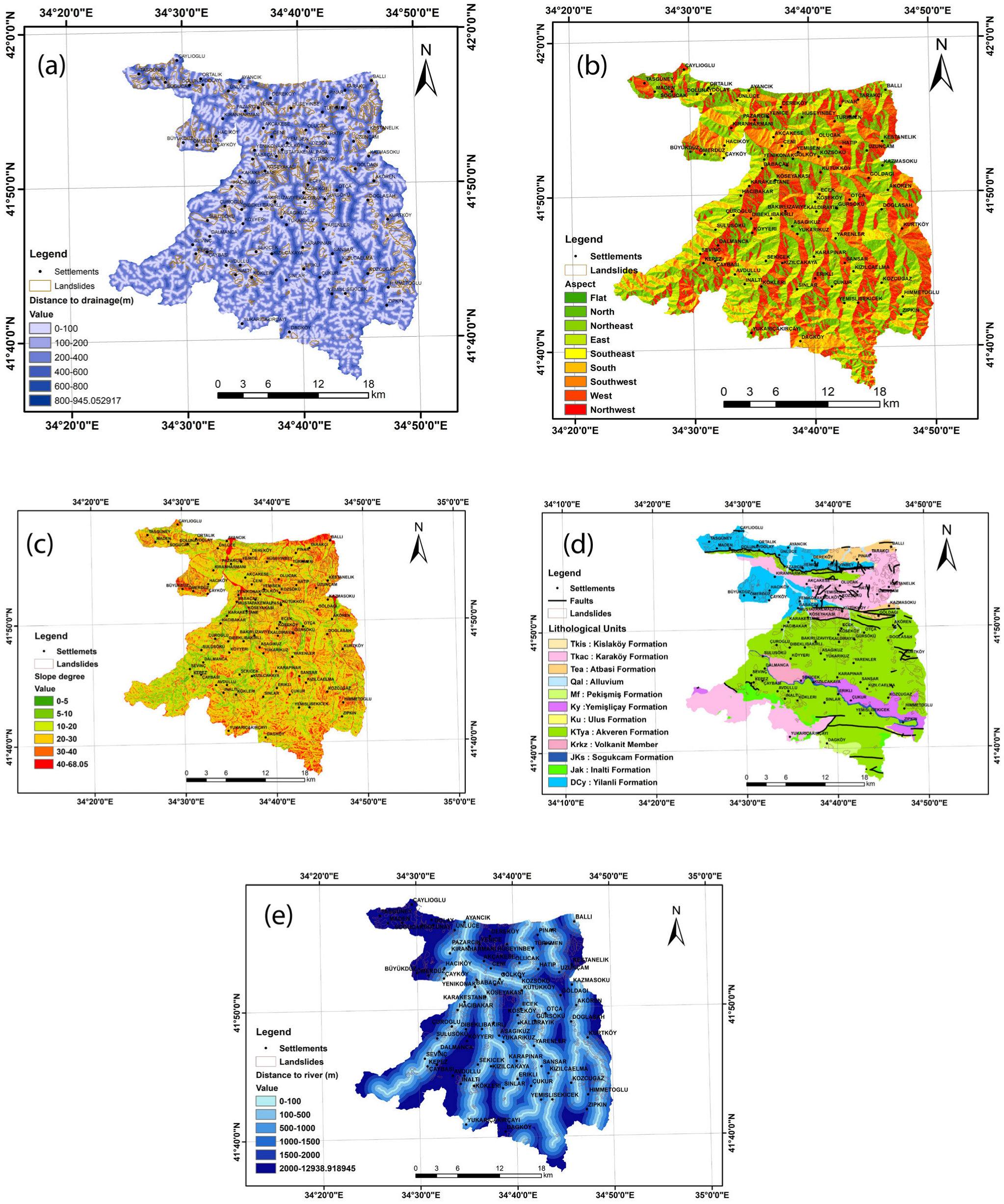
In this study, the following 11 factors were used for landslide susceptibility analysis based on the literature and the geoenvironmental characteristics of the study area: altitude, slope, aspect, lithology, plan curvature, profile curvature, TWI, distance to drainages, distance to roads, Corine land cover, and distance to faults (
Figure 2 and
Figure 3). The data for landslide susceptibility analysis are presented in
Table 1, where the classification of the data is done. 11 different lithological units surfaced based on a geological map obtained from the GDMRE. Herein, the classification technique used is similar to that frequently used in previous studies [
27,
28]. It should be noted that the availability of landslide inventory maps is a fundamental component of medium-scale landslide susceptibility analysis [
29,
30]. The study herein involved the generation of susceptibility maps, which were developed by incorporating nine categorical variables known to influence the occurrence of landslides. These were subsequently classified into five categories—very low (1), low (2), moderate (3), high (4), and very high (5)—using the natural breaks method. Natural breaks (Jenks) classification was chosen for its effectiveness in reflecting data distribution patterns. Although its sensitivity to input values is a known limitation, it was preferred over methods like equal interval and quantile for producing clearer class distinctions in this study.
Digital topographic maps were obtained from the General Mapping Directorate. The DEM was used to generate slope, aspect, plan curvature, profile curvature, TWI, and the drainage network. The distance to the drainage map was calculated using the “Hand (Height Above Nearest Drainage)” function in ArcGIS 10.5 software. In addition, a Height Above the Nearest Drainage (HAND) layer was derived from the DEM to explicitly represent the relative elevation of each pixel above the closest drainage channel. The HAND index allowed us to distinguish low-lying valley bottoms and floodplains from more elevated terraces and hillslopes that are less prone to inundation. HAND values were grouped into five classes and converted into suitability scores (0–10) according to defined thresholds; pixels very close to the drainage (0–4 m) received a score of 0, whereas cells located more than 20 m above the nearest drainage were assigned the maximum score (10). The resulting HAND map was used as an independent flood-related criterion in the AHP-based suitability analysis. A geological map of the study area was obtained from the GDMRE (
Table 1). Furthermore, lithology and fault data were obtained from the geological map. The distance to faults map for the study area was generated using the “Euclidean Distance” function in ArcGIS 10.5 software.
2.4. Logistic Regression (LR)
The LR (based on machine learning) method enables the establishment of a multivariate regression relationship between a dependent variable and more than one independent variable. The LR model can be used to evaluate the spatial relationship between the occurrence of landslides and the conditioning factors that influence landslides [
31]. The purpose of LR in LS mapping is to determine the most appropriate model for describing the relationship between the presence or absence of a landslide and a number of independent factors, such as lithology, slope, and the distance to fault [
32,
33]. The logistic regression model derivation follows the standard approach as described in [
34,
35]. The LR model can be calculated using Equation (1).
where
p is the probability of landslide occurrence. The value of
p varies between 0 and 1, and z varies between −∞ and +∞. z is defined by the following Equation (2).
where b
0 is the intercept of the model,
n is the number of independent variables,
xi (i = 1, 2, 3,…,
n) are independent variables and bi (i = 1, 2, 3,…,
n) are coefficients measuring the contribution of independent variables [
19]. In this study, the “glm” method of the “caret” package [
36]. RStudio Desktop (Version: 2023.12.1) was used to perform LR.
2.5. Analytical Hierarchy Process (AHP)
AHP was developed as a multicriteria decision-making method by Thomas L. Saaty during the 1970s. This approach facilitates the systematic analysis and resolution of complex decision-making problems [
37] by enabling decision-makers to select the optimal alternative by integrating objective data with intuitive assessments.
AHP is a multicriteria decision-making (MCDM) method that is extensively employed to address issues pertaining to location selection in various domains. A plethora of studies in the extant literature have employed the AHP method in various domains. For instance, in a survey conducted in a previous study [
38], the AHP and Geographic Information Systems (GIS) were used to determine the optimal location for establishing a solar power plant in the Karapınar region of Konya. Another study [
39] employed the AHP method to evaluate the economic and environmental criteria, thereby identifying suitable locations for the storage of solid waste in Beijing. Furthermore, the AHP method has also been proven to be an important decision support tool in the health sector. For instance, in an earlier study [
40], the AHP method was employed to ascertain the optimal location for constructing a new hospital in Muğla province. These researchers meticulously evaluated various factors, including demand, accessibility, competing hospitals, and government policies. In yet another interesting study [
41], the AHP method was used for dam site selection in Iran. Notably, AHP is also regarded as a pivotal instrument in disaster management. It [
42] was used to select the locations for constructing fire stations in Kathmandu, Nepal, and to determine suitable areas by considering population density, road access, and land use data. In the context of renewable energy projects, researchers [
43] employed an integrated approach that combined AHP and GIS methodologies to facilitate the selection of optimal locations for wind turbines in Jordan. This study comprehensively analyzed the critical factors that affect the selection, including wind speed, land slope, and existing usage patterns. In a study published in 2010 [
44], AHP and Data Envelopment Analysis (DEA) methodologies were employed to ascertain the optimal location for constructing a railway station in Mashhad, Iran. Furthermore, a study [
45] evaluated the engineering applications of AHP by combining this approach with an ideal point model for selecting underground oil storage areas. Among various MCDM techniques, AHP was preferred in this study due to its ability to incorporate expert judgments in a structured hierarchical framework and to handle both qualitative and quantitative criteria effectively, which is especially advantageous for spatial decision-making contexts [
37,
46].
Compared to methods like TOPSIS or PROMETHEE, AHP allows greater transparency and ease in evaluating trade-offs when decision criteria are not equally weighted or precisely measurable.
The following section delineates the steps of the AHP method.
Step 1: The decision problem is defined and modeled in a hierarchical structure. The hierarchical structure is as follows: the overarching goal is at the uppermost level, the criteria and sub-criteria are at the intermediate level, and the alternatives are at the lowermost level.
Step 2: Pairwise comparison matrices are used to ascertain the relative importance of the elements located at each hierarchy level. A previous study [
37] proposed using the scale delineated in
Table 2 to ascertain the relative importance of the criteria.
Step 3: Priority vectors are calculated from the pairwise comparison matrices. The eigenvalue method used for this calculation [
30] was proposed in an earlier report.
Step 3.1: The column elements of the pairwise comparison matrix are summed.
Step 3.2: The elements of the pairwise comparison matrix are normalized using the sums of the columns.
Step 3.3: The priority vector is obtained by calculating the average of each row of the normalized matrix.
Step 4: The consistency of the pairwise comparison matrices is checked by calculating the Consistency Ratio (CR).
Step 4.1: The column elements of the pairwise comparison matrix are multiplied by their weight. At the end of this step, the weighted vector sum is obtained.
Step 4.2: The elements of the weighted vector sum are divided by the weight values of their counterparts.
Step 4.3: The average of the values obtained in Step 4.2 is calculated. These average values represent the λmax value.
Step 4.4: The Consistency Index (CI) is calculated using Equation (3), as follows:
Step 4.5: The consistency rate (CR) is calculated using Equation (4). The RI (Random Index) in the formula is presented in
Table 3.
A CR value of 0.1 indicates that the comparison matrix has acceptable consistency. When CR > 0.1, the decision-maker must reconsider their judgments.
Step 5: The priorities at each hierarchy level are combined to obtain the global priorities of the alternatives. The global priority of an element at a lower level is equal to the product of its local priority and the global priority of the component at the upper level.
Step 6: The alternative that exhibits the highest value of global priority is the best solution for the decision problem.
3. Results
3.1. Landslide Susceptibility Map Based on the LR Model
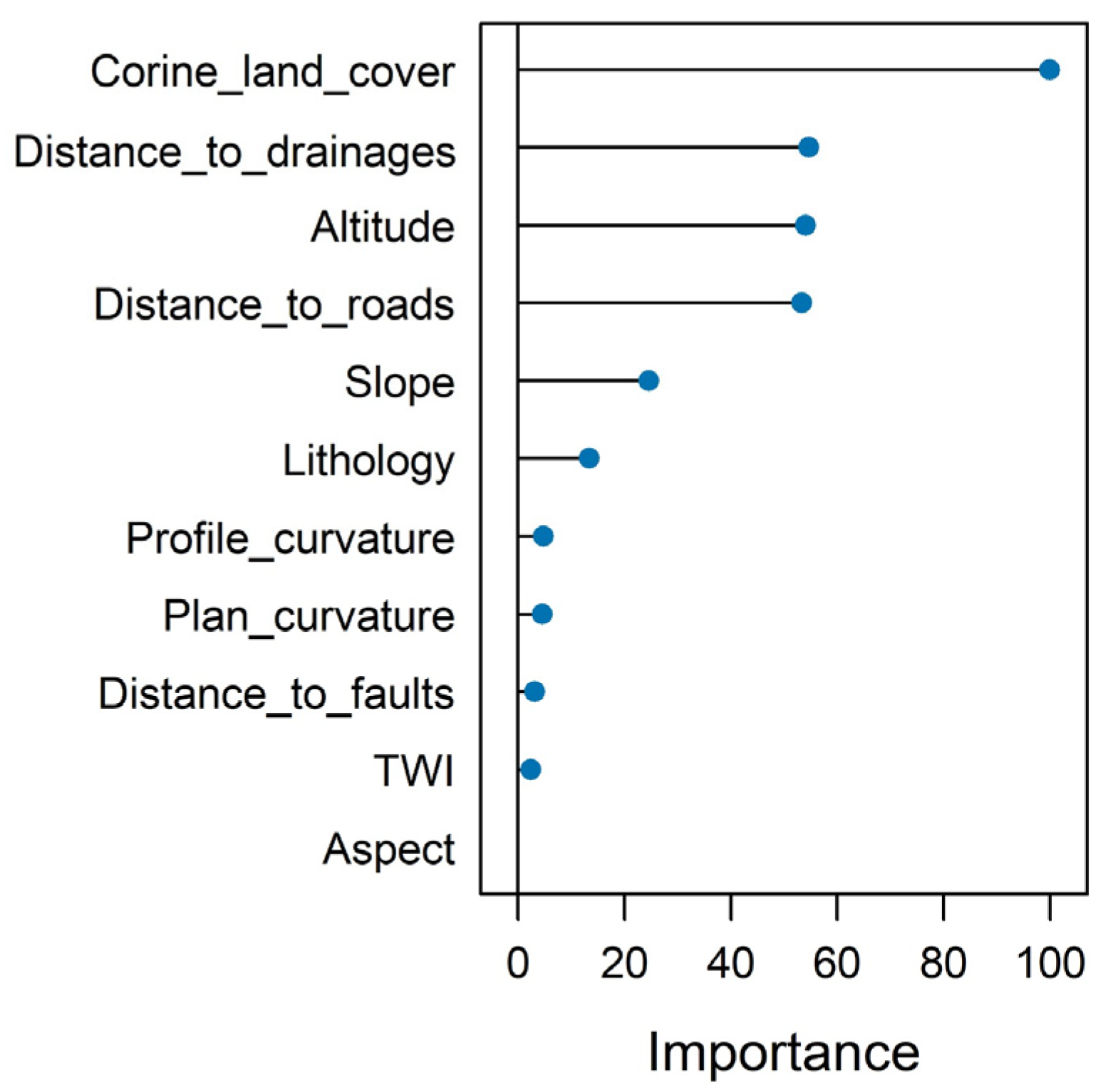
The importance levels of the 11 factors used in susceptibility analyses (
Figure 4). From the results, it is revealed that in the model, the factors of Corine and distance to drainages emerged as the most influential factors in the occurrence of landslides in the study area. This suggests that anthropogenic and hydrological conditions play a critical role in landslide susceptibility in the study area. In particular, certain land cover classes such as artificial surfaces, bare land, or steeply sloped forested areas may exhibit higher landslide potential due to limited infiltration and reduced slope stability. Similarly, areas located closer to drainage channels are more prone to saturation, erosion, and toe-cutting processes, which increase the likelihood of slope failure. These findings are consistent with previous studies highlighting the role of surface hydrology and land cover dynamics in triggering landslides in mountainous regions.
The frequency ratios of the subclasses of the two factors identified to be the most influential in the occurrence of landslides in the study area are given in
Table 4. When the existing landslides were evaluated in terms of proximity to drainage networks, 76.33% of the landslides occurred within 200 m of drainage networks. This also indicates that proximity to drainage networks is an effective factor in landslide occurrences in the study area. According to the frequency ratio (FR) analysis, CORINE land cover classes show varying degrees of influence on landslide susceptibility. Among all classes, mineral extraction sites (131) exhibited the highest FR value (5.63), indicating a strong positive correlation with landslide occurrences. Similarly, fruit plantations (222) and pastures (231) showed high FR values of 4.84 and 3.95, respectively. These findings suggest that areas used for agricultural or extractive purposes—where vegetation cover is sparse or disturbed—are significantly more prone to landslides. Pasture lands generally exhibit sparse and shallow-rooted vegetation, which provides limited mechanical reinforcement to the soil, thereby reducing slope stability. Similarly, fruit plantations are subject to frequent anthropogenic disturbances such as plowing, irrigation, and maintenance activities, all of which may alter soil structure and increase surface water infiltration. These conditions can elevate pore water pressure and weaken soil cohesion, making such areas more prone to landslides. In the case of mining zones, large-scale excavation activities significantly disturb the natural terrain and often lead to over-steepened slopes, removal of vegetation cover, and exposure of loose, unconsolidated materials. These factors collectively contribute to the heightened landslide susceptibility observed in these land use types.
3.2. Model Validation
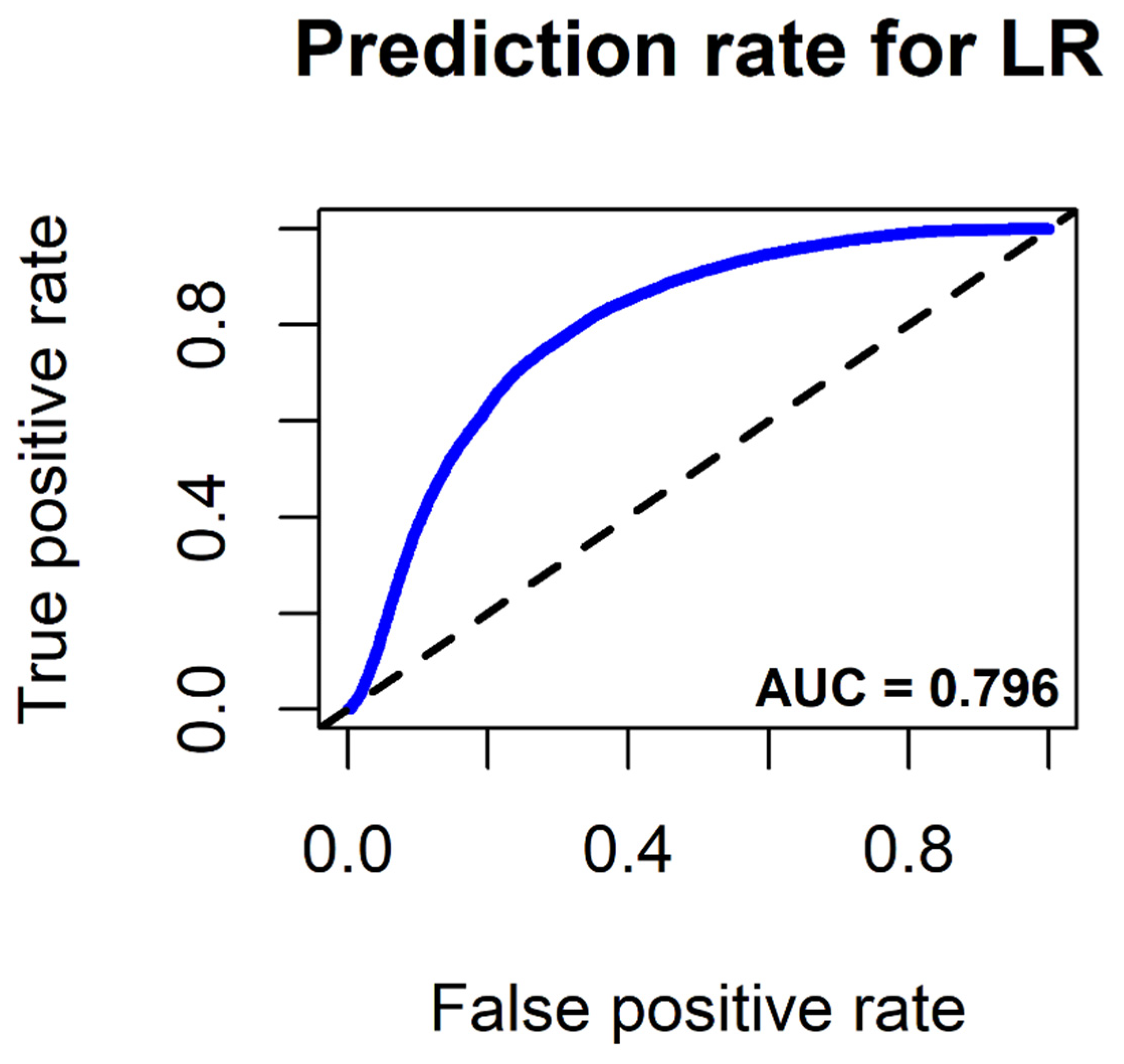
To assess the reliability of the produced models and suitability maps, a two-step validation approach was applied. For LR landslide susceptibility model, the dataset of landslide and non-landslide pixels was randomly divided into two subsets: 70% for model training and 30% for validation. The validation subset, which was not used in the model calibration, served as an independent dataset for performance assessment. In the study area, where landslides occur quite frequently, a total of 451 landslide polygons—293 of which are active—have been mapped by the General Directorate of Mineral Research and Exploration. These polygons are represented in raster format with a spatial resolution of 25 m, corresponding to a total of 146,231 pixels. An equal number of non-landslide pixels was randomly selected in R 4.2.2 software. In the overall dataset, which consists of 292,462 pixels, a value of 1 was assigned to landslide pixels and a value of 0 to non-landslide pixels. Seventy percent of the dataset (204,723 pixels) was used for training the LR-based landslide susceptibility model, while the remaining 30% (87,739 pixels) was used for model validation. The performance of the LR model was evaluated using the area under the receiver operating characteristic curve (AUC) metric. The AUC value of the LR model was calculated as 0.796 (
Figure 5). An AUC value between 0.5 and 0.6 indicates poor model performance, 0.6–0.7 indicates moderate performance, 0.7–0.8 indicates good performance, 0.8–0.9 indicates very good performance, and 0.9–1.0 indicates excellent performance [
26,
47]. According to this classification, the landslide susceptibility model used in this study demonstrated good performance. The dashed diagonal line represents the performance of a non-informative (random) classifier (TPR = FPR), corresponding to an AUC of 0.5, and serves as a reference for model discrimination
3.3. AHP
In this study, the AHP, a multicriteria decision-making method, was employed to evaluate various criteria such as flood susceptibility, landslide susceptibility, the HAND index, distance to road, stand structure, proximity to faults, slope, and distance to power transmission line. The HAND criterion was introduced to explicitly penalize low-lying areas close to river channels and to prioritize depot sites located on topographically higher, well-drained surfaces. A suitability analysis was performed based on these evaluations. Based on the AHP calculations and the assessments of the maps generated using ArcGIS, we identified areas that are located at a safe distance from electric lines, faults, suitable slope areas, exhibit low landslide and flood risk, are situated near existing roads, and possess a suitable stand structure (primarily open forested and low-low closure areas). According to the defined criteria, these areas were proposed as appropriate locations for forest depots. In this study, all main AHP criteria and their sub-criteria were defined and scored based on expert judgment, and sub-criteria were developed for each factor used in the analysis.
A pairwise comparison matrix was generated to determine the parameters’ weights based on the AHP method. The judgments in the pairwise comparison matrix (i.e., the relative importance levels of the parameters) were determined by consulting an expert team consisting of faculty members in the forestry engineering departments and forest engineers working in the field. From our calculations, the consistency rate of the pairwise comparison judgments was found to be 0.06. The parameters also demonstrated scores in the range of 0–10, according to the opinions of the experts (
Table 5). Herein, the parameters that were considered substantially important for the selection of an appropriate forest depot location were given high scores. On the other hand, low scores were given to the parameters considered less important for the depot selection.
Herein, the number of criteria was determined to be n = 8, and the maximum eigenvalue (λmax) was calculated to be 8.59. Based on these calculations, the consistency index (CI) was found to be 0.08 by applying the formula CI = (λmax − n)/(n − 1). Given that the random index (RI) for n = 8 is 1.41, the consistency ratio (CR) was computed to be CR = CI/RI = 0.06, indicating that the pairwise comparison matrix demonstrated an acceptable level of consistency.
Based on the findings of the study, the parameters and their corresponding weights used in the selection of suitable forest depot sites have been identified (
Table 5). Among these, flood susceptibility emerged as the most influential factor, with a weight of 30%. This was followed by landslide susceptibility (22%) and HAND (16%), ranking second and third, respectively. Distance to main and village roads combined ranked fourth, with a weight of 13%. The fifth through seventh most significant parameters were forest stand structure (8%), slope (5%), and proximity to faults (4%). The least influential parameter was distance to power transmission line, with a weight of 2%.
In the LR model, “Corine” and “distance to drainage” were identified as the most contributing variables, whereas in the AHP, “flood susceptibility” and “landslide susceptibility” received the highest weights. The divergence between LR and AHP variable rankings is attributable to the distinct purposes of the two methods. LR statistically models landslide susceptibility, whereas AHP incorporates expert-based judgments for depot site selection. Accordingly, overlap between LR’s most influential variables and AHP’s highest-weighted criteria is neither expected nor required. The methods were designed to inform different components of the study, with LR providing data-driven hazard insights and AHP capturing decision-making priorities.
3.4. Flood, Landslide and HAND Susceptibility Maps
Information on the river system in the study area was obtained from the Copernicus Land Monitoring Service (
https://land.copernicus.eu/imagery-in-situ/eu-hydro (accessed before 5 November 2025)). This map was classified into five groups: 0–500 m (very high), 500–1000 m (high), 1000–1500 m (moderate), 1500–2000 m (low), and 2000–13,000 m (very low). After obtaining these results, the flood susceptibility map of the study area was generated. The study area on the map was divided into five classes: very low (1), low (2), medium (3), high (4), and very high (5).
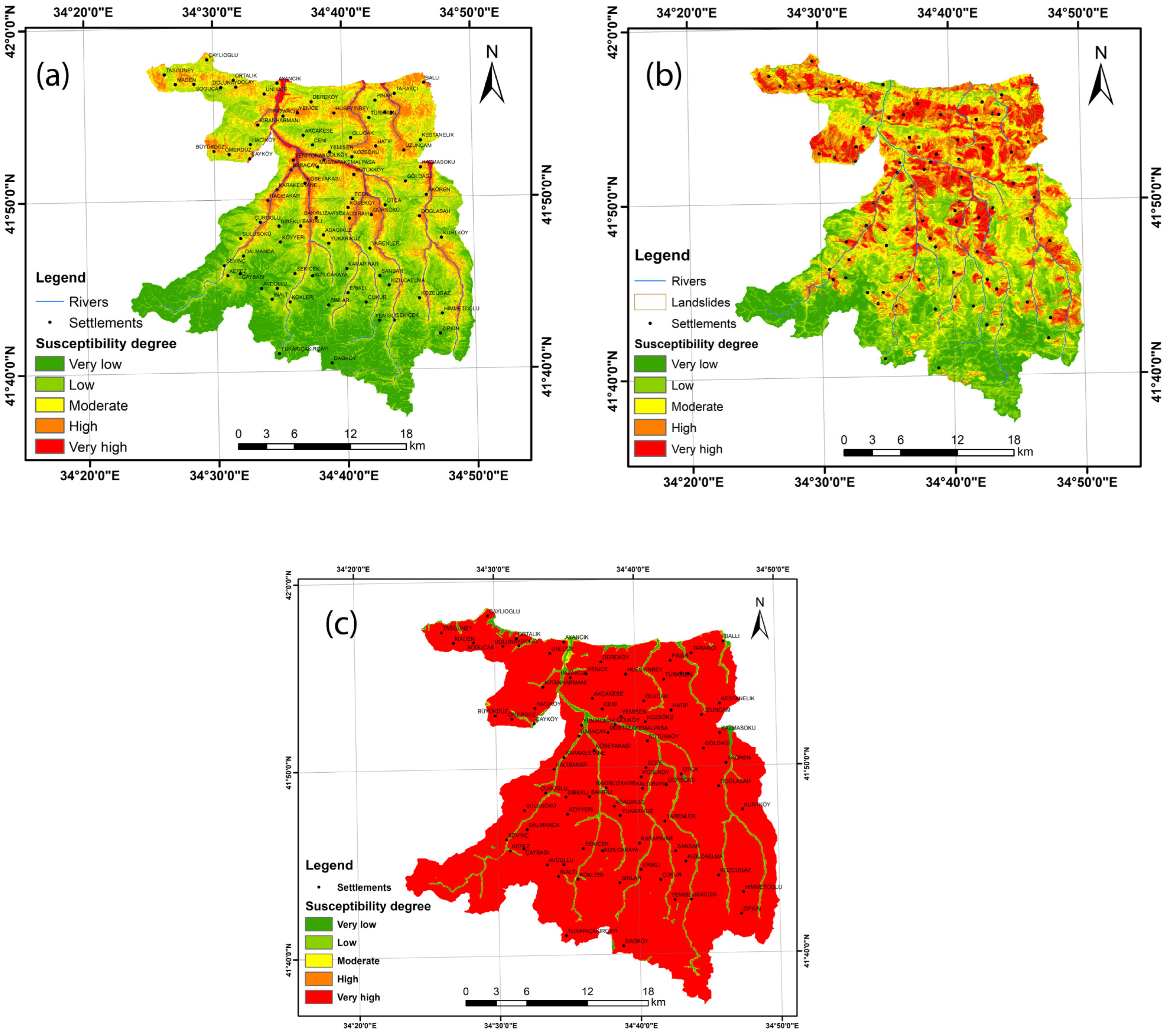
Figure 6a depicts the flood risk classification map generated in this study. Based on the calculations derived from this map, it is revealed that approximately 1.80% of the total study area can be classified as very high risk, 15.71% as high risk, 26.57% as moderate risk, 33.80% as low risk, and 22.09% as very low risk. The areas classified as fourth- and fifth-level risk groups, which indicate a very high or high flood susceptibility, comprise approximately 17.52% of the total study area. The first- and second-level areas represent regions with a low flood risk, whereas the third-level areas exhibit a moderate level of risk. Hence, these areas are deemed suitable for the construction and establishment of facilities.
Before generating the landslide susceptibility map with LR, the model was evaluated to determine whether there was a high correlation among the factors used. For this purpose, a multicollinearity analysis was performed. In the multicollinearity analysis, there are two indicators used to determine whether there is a high correlation or relationship between the factors. These are the Variance Inflation Factor (VIF) and Tolerance (TOL), which are commonly used in susceptibility mapping studies [
26,
28]. A common rule of thumb for detecting multicollinearity is a VIF greater than 10 or a TOL level less than 0.1 [
26].
Table 6 presents the results of the multicollinearity analysis for this study. Since the VIF values of the 11 factors used in landslide susceptibility mapping were less than 10, it was determined that there was no multicollinearity among the factors, and all 11 factors were used in the LR model. The values of landslide susceptibility index (LSI) calculated by using LR-based ML model for each pixel were classified into five subclasses—very low, low, moderate, high, and very high—using the natural breaks classification method, and the resultant susceptibility maps of the study area were obtained (
Figure 6b).
According to the calculations based on the landslide risk classification map generated in this study, approximately 12.80% of the total study area can be categorized as very high risk, 19.59% as high risk, 26.45% as moderate risk, 26.03% as low risk, and 15.11% as very low risk. The first- and second-class areas represent zones with low landslide risk, whereas the third-class areas indicate moderate risk. These areas are considered suitable for the construction and establishment of facilities.
Figure 6b reveals that the first- and second-class risk groups, which exhibit low levels of landslide risk, constitute approximately 41.15% of the total study area.
According to the calculations based on the HAND-derived flood hazard classification map, approximately 93.45% of the total study area can be categorized as very high flood hazard, 1.54% as high hazard, 0.88% as moderate hazard, 1.11% as low hazard, and 3.01% as very low hazard. In this classification scheme, the first- and second-class areas correspond to very low and low flood hazard, whereas the third-class areas indicate moderate hazard. Together, these relatively safe zones occupy only about 5.00% of the total study area, with the first and second classes alone accounting for approximately 4.12%, and may therefore be regarded as the most suitable sectors for settlement and infrastructure development, provided that detailed site-specific hydraulic and engineering studies confirm an acceptable level of risk. By contrast, the fourth- and fifth-class hazard groups, representing high and very high flood susceptibility, cover nearly 95.00% of the region, indicating that the landscape is largely characterized by low-lying or hydraulically connected areas prone to inundation. This strong dominance of the upper hazard classes highlights the need for strict land-use control, conservative design criteria, and the implementation of effective flood-mitigation measures in most parts of the basin.
3.5. Forest Stand Type, Distance to Road, and Power Transmission Line Maps
In the selection of suitable areas for forest depot sites, priority is given to lands owned by the General Directorate of Forestry and to forest interior openings and clearings. In the case of unavailability of such areas, depot sites are selected, in order of preference, from forests with canopy closures of 0 and 1, agricultural lands, and finally, from forests with canopy closures of 2.
Since the timber products extracted from forest areas need to be transported to the nearest forest depot, these depots are typically located within or in close proximity to forested areas. As illustrated in
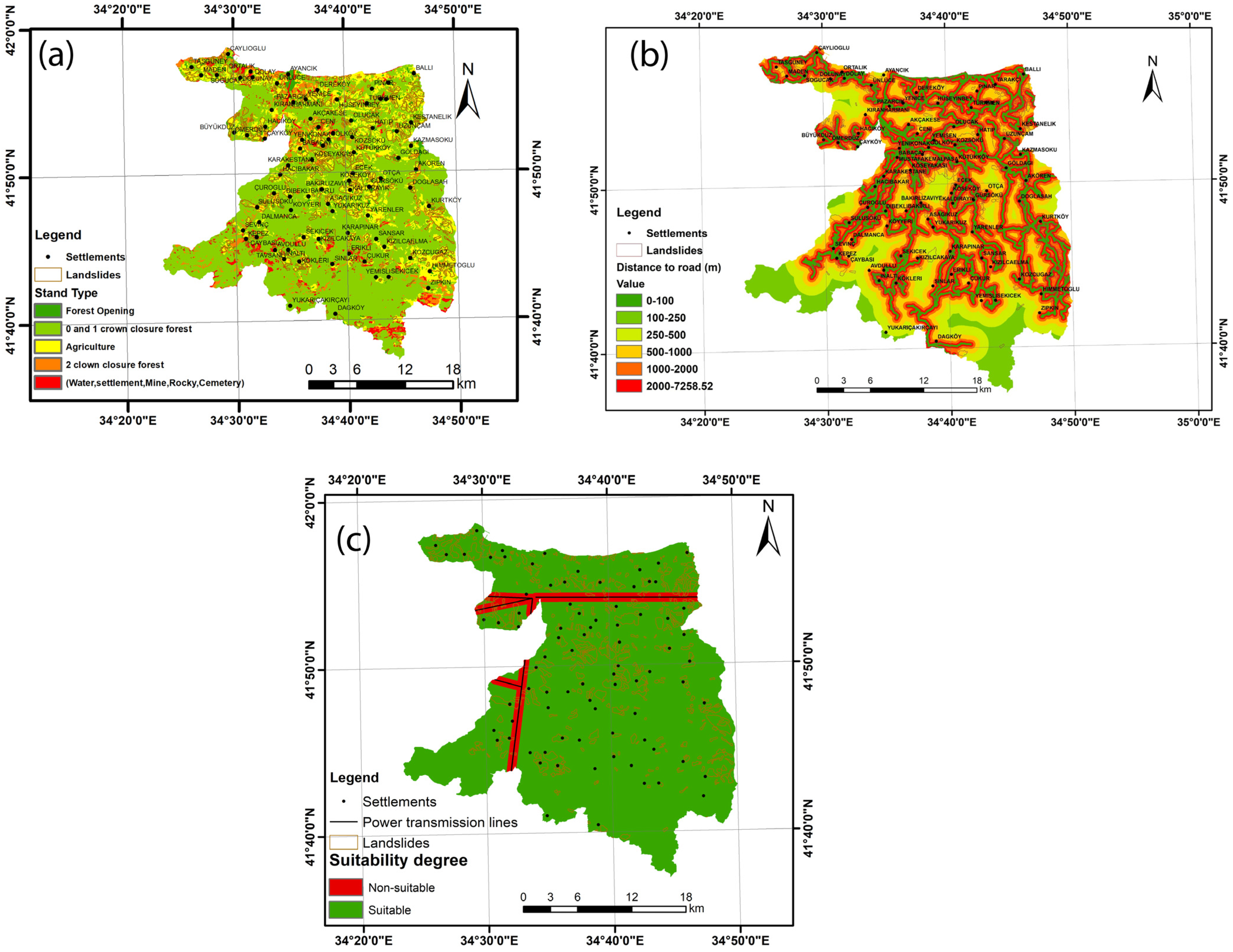
Figure 7a, within the jurisdiction of the relevant forest man-agement directorate in this study, approximately 3.84% of the forested areas consist of for-est interior clearings, 6.74% are forests with canopy closures of 0 and 1, 20.04% are agri-cultural lands, 66.89% are forests with canopy closures of 2, and the remaining 2.46% comprise other land cover types (such as water bodies, settlements, mines, rocky areas, and cemeteries).
It is known that forest roads, village roads, and highways play a significant role in the selection of forest depot sites. In this regard, it is worth noting that forest roads constitute one of the most critical components in the timber transportation chain, from the production location to the depot, and ultimately, to the end user. Therefore, the condition, accessibility, and cost implications of forest roads must be carefully considered when determining the location of a forest depot. It is evident that selecting depot sites in close proximity to existing roads facilitates logistical planning by reducing transportation time and associated costs.
In the analysis herein, the criterion for proximity to existing roads was classified into six categories. The areas with high proximity to roads were evaluated as suitable, whereas those at greater distances from roads were classified as less suitable.
The road proximity map, which was generated based on the distance to roads in the area, is presented in
Figure 7b. Based on the analysis, the areas located within 0–100 m of the roads constitute 19.51% of the total study area, those within 100–250 m account for 19.74%, the areas within 250–500 m comprise 20.35%, those within 500–1000 m constitute 19.15%, the areas within 1000–2000 m comprise 12.97%, and the areas located at distances greater than 2000 m from the roads constitute 8.25% of the total area.
As is known, areas containing high-voltage electricity transmission lines are deemed unsuitable for the establishment of settlements. As reported before, settlement permits are not issued for regions located beneath or in proximity to these lines due to associated safety risks. Within the scope of this study, the transmission lines in the study area were identified and digitized by creating 50 m buffer zones and were considered accordingly.
Figure 7c reveals that high-voltage transmission lines—posing significant construction risks—cover approximately 1.29% of the total study area.
3.6. Site Suitability Assessment of Forest Depots
In this study, the regions within the Forest Management Directorate were classified as either suitable or unsuitable for establishing forest depots. It was observed that the interior areas of the Ayancık Forest Management Directorate are more favorable for selecting depot sites compared to other areas. After evaluating the risk factors in the study area, suitable locations for forest depots were identified. These areas were chosen because they demonstrated a low risk of landslides or floods, were located far from power lines, and were in close proximity to existing roads, well-drained areas, and forest areas with a low canopy cover.
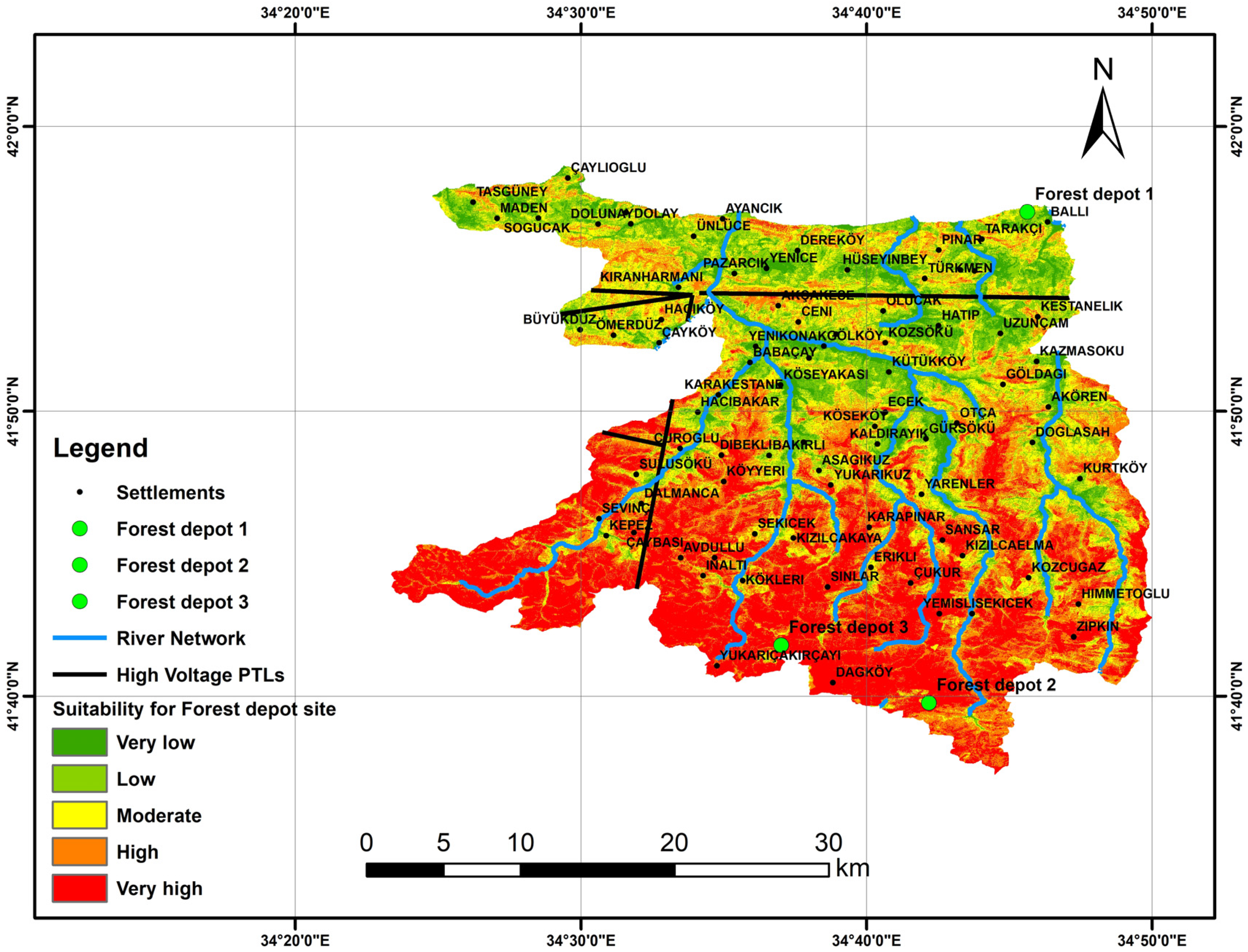
Accordingly, based on all the above-mentioned criteria, the most suitable areas for establishing new forest depots were identified and are presented in
Figure 8. These suitable areas are predominantly concentrated in the southern part of the Forest Management Directorate’s jurisdiction. In this study, a five-class land suitability map was used for forest depot site selection. In this classification, class 1 represents very high suitability, class 2 high suitability, class 3 moderate suitability, class 4 low suitability, and class 5 very low suitability. Increasing class numbers, therefore, indicate decreasing suitability. Based on the calculations, the suitability values are distributed across the five classes as follows: 10.69% of the area is classified as class 1 (very high suitability), 16.59% as class 2 (high suitability), 20.71% as class 3 (moderate suitability), 23.34% as class 4 (low suitability), and 28.67% as class 5 (very low suitability). Thus, only about 27.28% of the study area falls within the very high and high suitability classes (classes 1–2), whereas more than half of the area (52.01%) is characterized by low or very low suitability (classes 4–5). This distribution weighted average class value of approximately 3.43 indicates that, overall, the study area can be described as having predominantly medium-to-low suitability with respect to the criteria used in the analysis.
Additionally, a five-class land suitability map was used to determine the spatial suitability levels of the three forest depot sites (
Table 7). The forest depot 3 site is almost entirely located within the moderate suitability class, with only a small share of low-suitability cells and no overlap with the highest suitability categories, indicating an overall acceptable but non-optimal location. The forest depot 2 is again dominated by moderate suitability, yet it contains a substantially larger proportion of low and very low suitability classes and only a negligible share of highly suitable cells, making it less favorable than forest depot 3. In contrast, the Forest Depot 1 site is largely composed of very high and high suitability classes, with only a minor fraction of low-suitability areas and no very low-suitability cells. Overall, when the three forest depot sites are evaluated together, the forest depot 1 area can be identified as the most suitable location, while the forest depot 3 exhibits medium suitability and the forest depot 2 falls into the medium-to-low suitability range. These findings suggest that, in decisions related to future capacity expansion, new investments or possible relocation, priority should be given to the forest depot 1 site.
4. Discussion
This study integrated LR-based landslide susceptibility modeling and AHP-based multi-criteria evaluation within a GIS framework to identify disaster-resilient forest depot locations in the Ayancık Forest Management Directorate. The results clearly show that a substantial portion of the existing management area is unsuitable for depot construction when flood and landslide hazards are jointly considered, and that the former depot site is located in a very low suitability zone. This outcome underscores the need to systematically integrate hydro-geomorphological risks into forestry infrastructure planning rather than relying solely on accessibility or administrative convenience.
In previous GIS-based flood and infrastructure planning studies, the Height Above the Nearest Drainage (HAND) index has often been employed as a simple morphometric measure to represent relative elevation above drainage and to delineate flood-prone zones. The hydromorphological approach defined by [
21] demonstrates that the vertical distance to the drainage network is a primary determinant of flood hazard, and the present study is built on the same mathematical rationale. Applications by [
48,
49] show that DEM-based hydro-topographic models yield effective results, particularly in basins without gauging stations. Similarly, the HAND classes proposed by [
50] (0–2 m, 2–5 m, 5–10 m) exhibit a direct parallel with the HAND zoning produced in this study. In addition, [
51] combined the HAND terrain model with flood conditioning factors within an AHP-based weighted overlay to produce basin-scale flood hazard classes and then overlaid these with demographic data to map population vulnerability. Therefore, the HAND-based flood model developed in this study demonstrates methodological robustness consistent with both hydromorphological approaches and with multivariate analysis frameworks. This, in turn, supports the scientific validity of the method and its potential transferability to different geographical contexts.
Several studies have examined the relationship between forestry activities and landslide occurrence, emphasizing that forest management operations can significantly modify slope stability. Early work on forest management and landslide risk showed that disturbances such as road construction, timber harvesting, and soil compaction tend to increase landslide susceptibility, particularly on steep and deeply weathered slopes [
52]. Similarly, ref. [
53] reported that forests, depending on their structural characteristics and management regime, may either mitigate or exacerbate landslide occurrence, highlighting the need to account for terrain instability in forest planning. These findings conceptually support the present study’s emphasis on combining forest-related operational needs with explicit landslide and flood risk assessments.
More recently, a growing body of research has focused specifically on forest roads and their interaction with landslides. Ref. [
54] evaluated forest road conditions in terms of landslide susceptibility in the Yığılca Forest Directorate and showed that road segments on steep and hydrologically active slopes exhibit significantly higher landslide frequency. Ref. [
55] used landslide susceptibility maps to analyze the risk levels of existing forest roads and to design an optimum road route in the Maçka region of Türkiye, demonstrating that integrating LSM into road planning can markedly reduce exposure to slope failures. More recent studies by [
56] extended this perspective by applying GIS-based landslide susceptibility mapping and AHP specifically to forest road planning units, again confirming that road alignment decisions are highly sensitive to landslide hazard patterns.
These forest-road-oriented studies share a common premise with the present work: landslide susceptibility maps are used as decision-support tools for spatial planning in forestry. However, their primary objective is to optimize road routing and upgrading, whereas the present study focuses on the site selection of forest depots—a different but equally critical element of forestry infrastructure. While forest road studies largely evaluate alternative alignments along a linear corridor, depot siting requires the identification and ranking of discrete candidate areas where both storage safety and logistical connectivity must be satisfied. Thus, the current study extends the operational scope of landslide-based planning tools from line infrastructure (roads) to nodal infrastructure (depots).
In addition to forest roads, several studies have explored landslide susceptibility in forest-covered areas with explicit reference to forest management and stand characteristics. Ref. [
57] showed that landslide susceptibility varies significantly among different forest types and that understanding these differences is valuable for planning forest management interventions that minimize slope failure risk. Ref. [
58] demonstrated that appropriate forest management strategies can reduce shallow landslide susceptibility by modifying root reinforcement, canopy interception, and soil moisture dynamics. Also, [
59] reported that landslide susceptibility mapping in forested basins can directly support forest planners in identifying high-risk stands and prioritizing mitigation measures. In line with these findings, the present study identified CORINE land cover and proximity to drainage networks as the most influential variables in the LR model, indicating that both vegetation structure and hydrological conditions strongly control landslide occurrence in the Ayancık region.
From a methodological perspective, recent forestry-related studies increasingly combine machine learning or statistical models with multi-criteria decision-making in a GIS environment [
60,
61]. For instance, ref. [
62] applied machine learning algorithms such as Random Forest and Logistic Regression to assess alternative forest road routes under different landslide susceptibility scenarios, while [
63] used AHP to evaluate landslide susceptibility of forest roads by weighting topographic and geological factors. These approaches parallel the hybrid framework used in the present study, where LR is employed to generate a data-driven landslide susceptibility index and AHP is used to incorporate expert evaluations of flood risk, accessibility, stand structure, and other operational criteria. However, unlike most road-oriented studies, the current work explicitly integrates flood susceptibility as a primary decision criterion, reflecting the compound nature of the 2021 disaster and the dual sensitivity of depots to both fluvial and gravitational processes. Similarly, recent studies conducted in various disciplines highlight the importance of GIS, multi-criteria decision-making, and risk-oriented planning approaches [
64,
65,
66]. The common conclusion of these works is that decision-support mechanisms should be associated not only with technical accuracy but also with sustainability, resilience, and practical effectiveness; an approach that aligns well with the LR–AHP-based framework of the present study.
Taken together, the comparison with existing forestry-related landslide studies highlights several distinctive contributions of this research. First, while previous work has predominantly focused on forest road routing and risk assessment, this study is among the first to apply a hybrid LR–AHP approach to forest depot site selection, explicitly targeting storage infrastructure under combined flood and landslide risk. Second, by identifying that only 15.48% of the management area is suitable for depot construction and that the previous depot was located in a very low suitability zone, the study demonstrates the practical implications of neglecting hazard information in past infrastructure decisions. Third, the emphasis on integrating hazard, accessibility, and stand structure within a single decision-support framework responds directly to international calls for risk-sensitive and climate-resilient forest infrastructure planning.
Overall, the findings suggest that methodologies originally developed for forest roads and other linear infrastructure can be successfully adapted and extended to the planning of forest depots. By doing so, this study contributes to bridging the gap between hazard-oriented landslide research and operational forestry infrastructure planning and provides a transferable model that can be applied in other forest management units exposed to similar hydro-geomorphological risks.
6. Recommendations
In addition to the Ayancık Forest Management Directorate, other forest management regions with comparable geographic and climatic characteristics can be used as models. Disaster risk assessments must be considered when choosing locations for vital infrastructure, such as forest depots, particularly considering the increased frequency and severity of abrupt downpour events caused by climate change. The model should be contrasted with various decision-making techniques in subsequent research, and more thorough land analyses should be conducted to determine possible appropriate locations.
The choice of location for a forest depot exhibits administrative, social, and economic ramifications in addition to technical ones. Thus, the inclusion of the viewpoints of stakeholders, including those from villages, forest cooperatives, Disaster and Emergency Management Authority, State Hydraulic Works, and local governments, can improve the study’s comprehensiveness. Additionally, in light of the projections provided by the climate change models on future rainfall and flood risk scenarios for the next 10–20 years, the recently identified depot locations should be reexamined. Since this study focuses on current and regional conditions, RCP (Representative Concentration Pathways) scenarios were not incorporated. However, Future studies may include RCP 4.5 and RCP 8.5 climate scenarios to better understand how changing climate conditions could affect site suitability for forest depots or strengthen long-term planning and risk assessment. This would contribute to the development of a sustainable decision-making process that considers both present and potential future threats.
This study evaluates and provides scores to the geographic attributes of the existing forest depot—specifically its slope, proximity to the stream bed, soil composition, and accessibility to roads—utilizing the AHP (Analytic Hierarchy Process) method. These scores can then be compared with those of the newly proposed suitable areas. In this way, the appropriateness or risk level of the current depot site can be objectively assessed. If the existing site receives a low score, the necessity for relocation can be scientifically justified.