Abstract
This study presents the design and development, fabrication, and experimental testing of a four-circular-coil system capable of generating controlled, very low-frequency magnetic fields for biomedical applications. The system is tailored for use with a bioreactor cultivating mesenchymal stem cells, ensuring highly uniform magnetic fields within the area of interest (AOI). An asymptotic approach—the Multiple-Turn Thin-Wire Approximation (MTTWA)—was employed for fast calculations and modeling of multi-turn coil systems with massive windings. The MTTWA-calculated magnetic field distribution of the four-multi-turn coil system was verified with Ansys Maxwell simulations, showing good agreement. The coils and coil system were designed and fabricated, along with a prototype of the exposure system to validate both numerical modeling and simulation results, achieving magnetic field uniformity of at least 97% within the AOI. In the fabricated four-coil exposure setup, symmetric coils are connected in parallel with two separate amplifier-controlled outputs, enabling precise adjustment of field strength, uniformity, and intentional inhomogeneity for specialized experiments. An automated measurement system has been designed and fabricated to measure the magnetic field within the AOI volume with a spatial resolution of 1 mm.
1. Introduction
Magnetic fields (MFs) are widely used in many applications. Different frequencies and magnitudes, including sinusoidal and pulsed, as well as non-heating and intensive-heating homogeneous and nonhomogeneous MFs, are used. External MFs are utilized in physics and technology, including the guidance and targeting of magnetic nanoparticles, studies on the field effect on spintronic nanomaterials (ferromagnetic semiconductors), ferromagnetic crystals in metamaterials, and similar applications.
Magnetic nanoparticles are a promising tool for the future, especially in nanomedicine, where they are utilized for diagnostic imaging, drug delivery, and cancer therapy. In these applications, external MFs are also indispensable [1].
Non-heating low-frequency MF applications in medicine and biotechnologies are also not far behind [2,3].
In recent years, the study of non-heating MF generation systems has become topical in a wide range of technological applications, such as magnetic navigation systems [4], magnetic search coil technique [5], creation of materials with a designed anisotropy [6], investigations on ferromagnetic crystals in metamaterials [7], and application in nuclear magnetic resonance [8].
The development of MFs and their effects began and continues to evolve actively with the advent of magnetic hyperthermia, a medical procedure that involves injecting magnetic nanoparticles, which has been studied and utilized [9]. Modern magnetic hyperthermia utilizes various types of engineered magnetic nanoparticles to enable localized thermal energy conversion via an alternating MF, converting magnetic energy into heat [10].
In magnetic fluid hyperthermia, solutions to complex problems that combine electromagnetic and thermal modeling, as well as eddy current and cooling problems associated with inductors, are crucial. Such problems are difficult to formulate and can only be realistically solved with numerical methods [11,12]. In some applications, magnetic fluid hyperthermia is used not only alone but also in combination with chemotherapy or radiotherapy [13].
In the studies mentioned here, various coil designs are used to generate MFs; the use of solenoids is popular, but the requirements for field homogeneity in the experimental areas are not strictly emphasized.
Over the past few decades, extremely low frequency MFs have been extensively investigated and applied in a range of experimental medical studies and biotechnological applications [2]. A significant area of research today is the study of non-heating low-frequency electromagnetic fields in molecular biology, where stem cells and tissue engineering are of great interest [14,15].
One of the main challenges faced by the scientific community today is developing these systems to be suitable for use in bioreactors and other confined experimental environments, given the stringent constraints on system dimensions, materials, thermal effects, magnitude of an MF, and the homogeneity of MF, among other factors [16]. Particular attention has been devoted to experiments and applications employing extremely low-frequency MFs with a satisfactory practical homogeneity to explore the effects on metamorphosis and metabolism rates [17].
Particular attention has been devoted to experiments and applications employing extremely low-frequency MFs with a satisfactory practical homogeneity. Nevertheless, a comprehensive overview linking the reported biological effects to well-defined MF characteristics is still lacking. This gap largely arises from the fact that most studies do not report how the MF is spatially distributed in area of interest (AOI), and very few provide data that allow for estimating the homogeneity of MF [18] in AOI.
Low-frequency MFs used in biotechnology and experimental biology are usually generated by inductive coil systems (CSs). Research on such systems is closely tied to the analysis of MFs generated by current loops of various geometries and configurations. Among coil configurations, axially aligned circular loops with parallel planes are of particular interest due to their ability to generate highly uniform MF. Early investigations, originating from Ampere’s circular current loop [19], led to numerous studies aimed at enhancing homogeneity of the MF. The classical Helmholtz coil—two identical, parallel coils separated by a distance equal to their radius—remains in a foundational design [20]. Subsequent refinements by Gaugain, Maxwell, Braunbeck, and others were produced by CSs with improved uniformity, such as three-coil and four-coil arrangements described by Barker [21].
Comprehensive research undertaken by Garret is a substantial contribution to the study of axially symmetric CSs [22]. Here, the central uniformity of symmetrical fields and gradients is analyzed by zonal harmonic expansion. Legendre functions are used in field calculations and analysis. Garrett pointed out [23,24] that, in the case of axially symmetric MF systems, the zonal harmonic expansion method has several practical advantages over the elliptic integral method [25]. Boridy summarized and extended Garret’s results to gradient field and higher-order axially symmetric coil systems [26]. Gluck presented systematic theoretical approaches, including multipole and zonal harmonic expansions, and further advanced the analysis and optimization of axially symmetric CS [27]. The zonal harmonic expansion method is often employed in many model calculations due to its speed and accuracy, making it ideal for high-precision and long-term trajectory computations. Nevertheless, it cannot be said that this method is widely known in the literature. The disadvantages of the zonal harmonic method include the use of highly sophisticated mathematics and the fact that its series does not converge in all regions. Therefore, the method of elliptic integrals [28,29] remains widely used in calculations of axially symmetric MFs.
While almost all of the previously mentioned studies were based on the assumption that the coils have a very small (or infinitely small) cross-section, research on CS involving real-sized coils with a defined cross-section has also been carried out. A common feature of these studies is that in all practical cases, CS coils and support systems have physical sizes that must be taken into account in calculations and modeling.
Nowadays, the CSs constructed from practical wires (real-size, manufactured wires) forming windings of various cross-sectional shapes or composed of thick conductors with different cross-sections are mainly analyzed using the following approaches or their variations:
- (a)
- Approximate analytical methods, which typically involve summing the fields of ideal or thin wires in various configurations [30,31];
- (b)
- Optimization and parametric design methods [32,33,34,35,36];
- (c)
- Computer simulations [4,37,38,39,40];
- (d)
- Combined approaches, integrating two or more of the above methods [40,41].
In practice, the first two approaches are often used in combination, with the results verified by computer simulations. Experimental validation, however, is less frequently performed.
There is no universal method for accurately modeling multi-turn massive windings (thick) coils CSs; the approach depends largely on the specific problem being addressed. For example, in optimization problems, computational methods must be both fast and precise, making them suitable for high-accuracy and long-duration calculations. In contrast, when analyzing electromagnetic fields generated by multi-turn coils, computer simulations typically require such extensive computation time that obtaining optimal solutions becomes practically infeasible. As demonstrated in [39], a standard density-based topology optimization method was implemented and solved using commercial software, highlighting this challenge.
Several studies employ more sophisticated hybrid approaches that combine field summation, analytical calculations, and various physical considerations—such as the effects of winding cross-section, cross-sectional shape, conductor spacing, installation misalignment, and field inhomogeneity deviations due to misalignment. These works often include computer simulations [40,41] and, in some cases, experimental verification [42].
Studies on thick coils—massive coils with real-size cross-sections (or multi-turn practical wire windings)—have shown that analytical solutions derived from approximate models remain valid if the system geometry is properly optimized. Moreover, in some cases, manufactured CSs exhibit reduced sensitivity to construction tolerances and current imbalance [30].
Most of the above publications indicate that modeling of practical CS revealed that analysis based on the thin, discreet wire CS models can still be useful, as the results of such analysis may provide completely satisfactory results for practical design, thereby making the design of practical coil systems less challenging and time-consuming. The theoretical developments presented in these papers are crucial for designing practical coil systems that are tailored to specific applications.
This paper describes the design and fabrication process of a four-CS, which consists of four identical multi-turn practical wire coils with rectangular (or square) winding cross sections intended to produce a time-harmonic MF in the AOI to expose mesenchymal stem cells contained within a FiberCell Systems C2011 cartridge or a container with a similarly sized volume. The cartridge is placed inside CS so that its axis coincides with the axis of the coil system symmetrically with respect to the midpoint of CS.
The primary objective of this study is to design, develop, and validate an exposure system for investigating the biocompatibility of cells under extremely low-frequency MF. A central focus of this work is the calculation and modeling of the most compact coil configuration required to generate a practically homogeneous MF in the area of interest AOI volume, as well as the analysis of such systems constructed using thick multi-wire coils.
An asymptotic approach called Multiple-Turn Thin-Wire Approximation (MTTWA) was validated, which provided very fast calculations and sufficiently accurate design CS with thick coils. This method significantly simplifies the analysis of MF generated by thick coils with a rectangular cross-sectional shape and varying numbers of turns. The cross-sections of the windings can also be square.
A prototype of the four-CS was fabricated to experimentally validate the design. This prototype was constructed to verify the theoretical predictions, numerical calculations, and simulation outcomes. The comparison between the numerical model and the experimental measurements shows good agreement. In test experiments, the generated MF exhibits a uniformity of at least 97% in (AOI), which is similar to cartridge volume, while maintaining a relatively high magnitude of a MF of up to 2.5 (root-mean-square (RMS)). The exposure coils are driven by a sinusoidal electric current within the 10–50 frequency range. Laboratory measurements confirm a good correspondence between the measured and designed MF characteristics.
A custom-fabricated, PC-controlled MF measurement system was developed and programmed to move the MF probe longitudinally and transversely within the CS volume. The system can perform up to five measurements at each position within the AOI and the surrounding area with a spatial resolution of 1 .
Unlike many other exposure systems, in which the coils are connected in series, our setup features a symmetric pair of coils connected in parallel to reduce the input impedance of the CS. This arrangement also decreases the system’s power consumption and significantly reduces the heating of the inner coils compared to other popular systems, where the coils are connected in series. Additionally, the power block features individual outputs for each coil pair. The used power supply setup provides for a precise adjustment of the current ratio between coil pairs. This enables control of the operating mode and convenient tuning of the magnitude of the MF, ensuring field homogeneity. Additionally, the setup enables experiments to be performed even in intentionally non-uniform MFs, if required by the user.
A temperature measurement system has been designed, which includes a built-in module that measures the temperature on each coil surface using attached thermocouples. The temperature of each coil surface is displayed and recorded throughout the experiments.
In addition, a simple, inexpensive, yet sufficiently accurate MF measuring probe was designed and fabricated, which can be sterilized and placed in a fixed position within the incubator experimental environment, ensuring that the set field magnitude is consistently generated during the experiments.
The developed and fabricated exposure system has already been used in biological experiments at the Latvian Biomedical Research and Study Center.
2. System Design Methods
2.1. Design of the Exposure System
The design and fabrication of an exposure system to produce a very low frequency time-harmonic homogeneous MF in AOI is a general task in this investigation. The primary focus of the investigation is the design and construction of the CS. The designed CS provides the generation of a practically homogeneous MF in AOI. The remaining devices of the system provide CS power supply, automatic setting and control of operating modes, coil temperature measurements, and fission in the memory block. Additionally, it includes CS-generated MF measurements in the test laboratory and during bio-experiments.
The exposure system must ensure practically homogeneous MF in AOI for use in bio-experiments; for example, to expose mesenchymal stem cells contained within a FiberCell Systems C2011 or a similar-sized cartridge. The system can ensure that the CS heating is small, even at the maximum MF intensity, thereby not affecting the outcome of the biological experiments. Since the prototype is designed for practical application in specific biological experiments, it is necessary to consider the system’s limitations. Based on various practical considerations and the physical constraints of the intended deployment environment for biological studies, the following main specifications for the exposure-producing system were defined as follows:
- (1)
- The MF in a hollow fiber cartridge C2011 or a cartridge of similar size (AOI) must be practically homogeneous. The homogeneity of MF in AOI will be 97% or better. The cartridge or other AOI is cylindrical in shape to be positioned along the CS axes and symmetrically with respect to the CS origin. The AOI is defined as a cylindrical volume with a diameter of 30 and a length of 120 ;
- (2)
- The magnitude of an MF, which throughout this article refers to the magnetic flux density in the SI system of units, on the CS axis, must be tunable in the range of 0–2.5 (RMS);
- (3)
- Operating frequency must be adjustable in the range from 10 to 50 ;
- (4)
- The amount of power dissipated by the CS should not exceed 5 ;
- (5)
- The maximum size of the CS (including the protective cover) in the longitudinal (axial) direction must not exceed the cartridge longitudinal dimension by 1.7 times, while the maximum transverse dimension of the system cannot be larger than 8 times the cartridge diameter;
- (6)
- The system design must guarantee sufficiently good accessibility to the CS interior (the cartridge must not fit tightly into the CS interior and should not touch coil supporting surfaces).
It should be noted that the construction of the CS meeting the above conditions may pose a significant challenge for the designers, as some of them may be mutually inconsistent:
- (1)
- While, in general, the larger the dimensions of the CS relative to the size of the region where a specific field uniformity level must be guaranteed, the better from the MF uniformity viewpoint, but unfortunately the CS dimensions are constrained by the size for practical applications in incubator;
- (2)
- Physically larger CS demonstrates significantly weaker MF on the CS axis for the same currents and winding parameters (the number of turns in each coil);
- (3)
- A higher magnitude of an MF in the AOI could be achieved by increasing coil currents;
- (4)
- The coil inductance leads to higher coil impedance of the coils;
- (5)
- Consequently, the load on the power supply increases with the operating frequency—the system must supply an increasing amount of power to maintain the same magnitude of the MF as at lower frequencies;
- (6)
- Higher coil winding resistance results in increased coil heating.
In addition, it is noteworthy that when it comes to the practical fabrication of the CS, another problem arises, namely, ensuring the durability of the CS, as the estimated weight of wire for the fabrication of one coil is approximately 0.9 . Other critical practical issues encountered at the CS fabrication stage include the precise separation between the constituent coils for accurate coil placement according to the design data, as well as other less severe issues. The selection of quasi-optimal CS parameters is not a trivial task, since the maximum CS dimensions are subject to size constraints determined by the maximum allowable system dimensions. It must be acknowledged that the application of multi-parameter optimization methods in this design is limited, and the focus should be on practical implementation, which, of course, relies on correct design and modeling.
The construction of the designed exposure system was carried out in several stages, the main of which included the following:
- (1)
- Design of the coil and CS—design and calculation of the dimensions of the coil windings and bodies, including windings cross-section shapes, the number of wire turns in windings, and the diameter of wires;
- (2)
- Design and calculation of the dimensions of the coil and cartridge support system;
- (3)
- Development of a personal computer (PC)-controlled two-axis MF measurement system for positioning the magnetic probe in CS space;
- (4)
- Choose suitable temperature sensors and their placement in CS, implementation of a temperature monitoring system (recording coil temperature during experiments and displaying temperature in real-time);
- (5)
- Selection and design of power supply system and control devices.
Preliminary calculations indicate that a coaxial, circular four-CS may be a suitable choice for the MF generator. The CS design, modeling, and fabrication are the first tasks that need to be completed to realize the set task. The structural dimensions of coils and CS were determined when this part of the design was completed. The CS is fabricated when an experimental test with the CS prototype has taken place, and the results are satisfactory. The coil and CS design and fabrication are described in Section 3. The structure and construction of the prototype of the exposure system, which includes control devices, a powering system, a custom-made PC-controlled MF measurement setup, and a coil temperature measurement system, have been designed and fabricated and are described in Section 4.
2.2. Methods and Approximate Models for the Coils and Coil System Design
The choice of the even quasi-optimal CS parameters is the first task, as the CS geometrical dimensions are subject to the size constraints defined by the maximal allowable system dimensions. To accomplish this task, several computer routines have been developed and validated in this paper. The procedures employ field calculation methods that are valid only for particular geometries, such as those involving parallel circular coils with a common axis. The specific approximated methods are considerably faster than flexible general-purpose numerical methods (e.g., the Finite Element Method (FEM)) or software employing them and therefore facilitate and expedite the CS optimization process. The simplified models leverage the advantages of thin wire loops (theoretically current loops with an infinitely small cross-section) and approximation models [28,29]. Specifically, in this investigation, two similar approximations have been employed to analyze CS. The simplified methods used in this article are based on the following two assumptions, which turned out to be very effective:
- (1)
- The analysis of the very low-frequency MFs produced by CSs can be considerably simplified by assuming that each coil carries an equivalent current in a thin current turn (thin wire);
- (2)
- In many situations, numerical calculations may be simplified when coils with practical wires and real winding dimensions can be modeled as a set of single-turn coils with infinitely small wire radii.
An analysis of the 3D four-CSs was accomplished using the Ansys Maxwell 2021 R1 software. The obtained results are compared with those obtained by performing numerical calculations using the above-mentioned approximation methods.
2.2.1. Heterogeneity of the Magnetic Field
Since one of the most important aspects of this investigation is to design a CS that ensures the set homogeneity of an MF in the AOI, it is necessary to determine how the field homogeneity (or inhomogeneity) will be calculated in order to compare it with the fields generated by other systems and optimize the CS under study. In many publications MF homogeneity is usually characterized by MF heterogeneity. The MF heterogeneity is generally defined as the non-uniformity of the magnitude of an MF and its direction across a given space. The heterogeneity of an MF is usually defined as comparing it to some fixed field magnitude and direction. There are many practical cases when one is interested only in the magnitude of an MF and its distribution in space. If the direction is not taken into account, but only the magnitude of an MF at a point, then the heterogeneity is calculated using Formula (1) as follows:
The latter estimate is of interest to researchers when only the field magnitude is of interest, and its direction is not important. In cases where the MF axial component is as dominant as it is for coaxial symmetrical CSs, the field inhomogeneity is determined with respect to the axial component (here the axial axis is the z-axis) of the field by choosing the magnitude of a MF on the axis of the symmetrical CS center as the reference field, and the heterogeneity is calculated using Formula (2) as follows:
The heterogeneity functions provide a means for estimating the degree of field variation. It allows for identifying the region’s boundary where the field is very close to a uniform one. In many reported studies, the axial component of an MF (z-component) is of primary importance for biomedical applications. The heterogeneity serves as an indicator to determine whether a given coil system is suitable for a particular application. For bio-applications, the primary objective is to ensure a practical uniform MF within the AOI. The major challenge is the set volume in the incubator, where the coil system will be located during the biological experiments, which imposes serious difficulties in realizing an exposure system with very low heterogeneity in AOI.
2.2.2. Models for Thin Coils
The electromagnetic coils used in most MF generation systems are primarily divided into two types: those designed from cylindrical coils and those designed from rectangular coils. Rectangular-coil systems have a simpler MF model establishment and require lower precision in material processing. However, the magnitude of an MF generated by rectangular electromagnetic coils is lower than that generated by circular coils. To generate homogeneous MF, solenoids or coaxial, axially symmetrical parallel circular two-coil systems are most often used in biological experiments. In this investigation the models for thin coils are used, and we assume that a thin wire refers to a wire whose circular loop (turn) produces an MF that is practically identical to that of a loop made of a wire with an infinitesimally small cross-sectional area (an ideal wire), provided the magnitudes of currents in both loops are equal. The radius of the thin wire’s cross-section is not directly included in the field calculations. Therefore, the MF of a thin wire loop is approximated by the MF of an ideal thin wire loop. The Laplace equation is used to find the magnetostatic vector potential of an MF for an ideal thin wire current loop:
This equation is widely used even when very low-frequency sinusoidal currents are applied, because the effect of displacement currents is negligible. The resulting error is entirely negligible if the wavelength is large compared with the dimensions of the system being analyzed, which is indeed the case at very low frequencies.
An approach that is extensively used to calculate fields produced by circular coils employs the elliptic integrals of the first and second kinds. The mathematical expressions for a single infinitely thin-wire circular current loop (see Figure 1) can be found in [29].
Figure 1.
A single thin-wire circular current coil (loop) and the associated coordinate system.
Figure 1 illustrates a scenario where an equivalent current exists in the current loop, characterized by ampere-turns. Such a model is the single thin wire (STW) model [28,29]. The equivalent current is related to the actual one by , where represents the actual current in the l-th coil, and is the number of turns in the real multi-turn coil with finite dimensions (width and thickness), which in approximate calculations can be modeled by an infinitely thin circular wire loop carrying the equivalent current. In cases where the coil current is not a direct current but a low-frequency sine wave given by , where represents the RMS value of the current in the l-th coil.
Although Garrett [22,24] demonstrated the feasibility of constructing four-, six-, and eight-CSs, as well as systems containing a larger number of coils, lower-order coil arrangements are more commonly utilized in practical applications, such as extremely low-frequency electromagnetic fields in biological experiments. Systems with many coils theoretically exhibit excellent results for the homogeneity of an MF; however, in practice, their use is limited by the fact that the coils have finite dimensions, and their placement in the theoretically calculated system is often unrealistic in many cases.
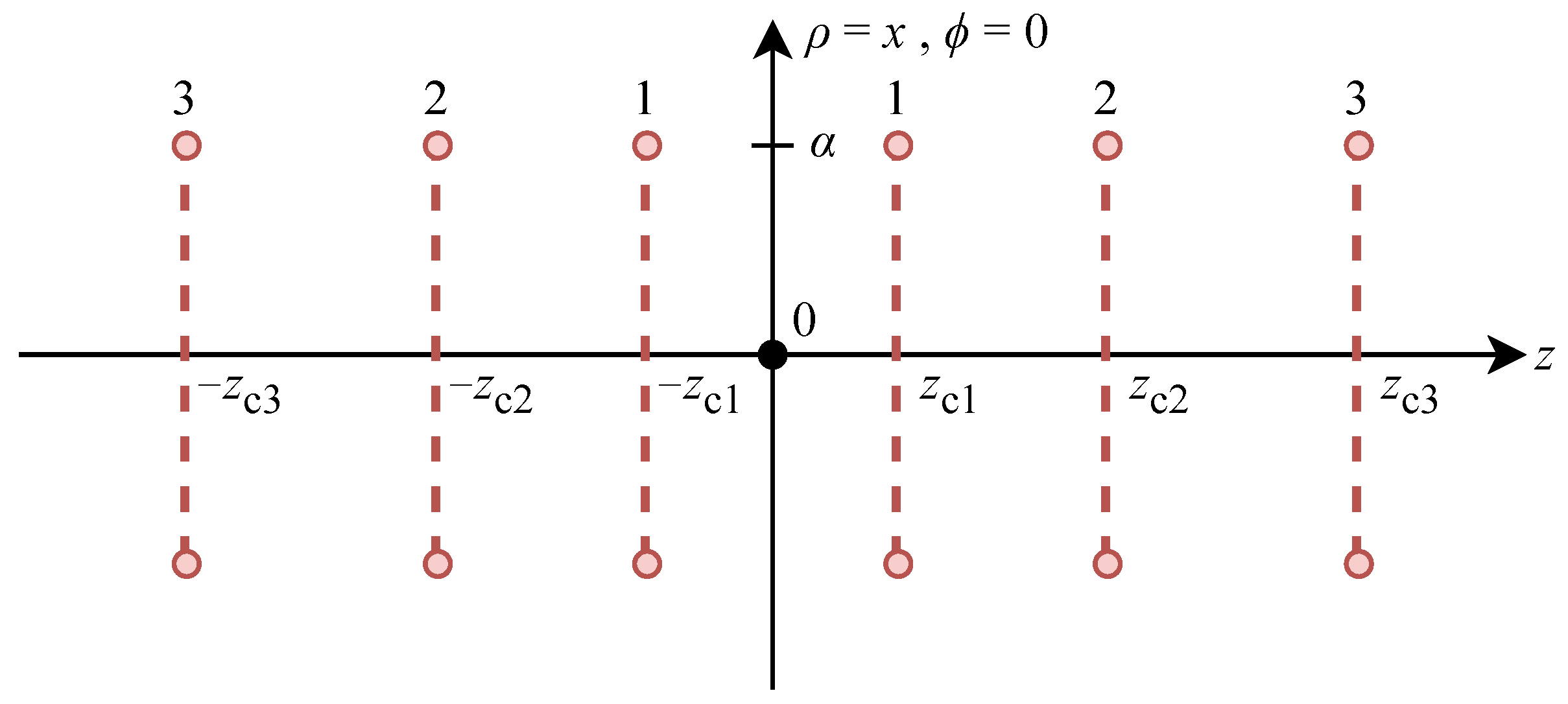
In this article, we use formulas for symmetrical four- and six-coaxial circular CSs. Preliminary calculations on the possibilities of creating six-CSs were made to evaluate the possibilities for future research, but in this work, specific calculations are made to ensure the design and production of only four-CSs. It is accepted here that in the four-CSs, all coils are the same, because it is most convenient to realize the specified constructive constraints. The MF of a multi-coil system of current loops is a superposition of the fields generated by a single current loop. The potential symmetrical arrangements of six-CSs or four-CSs are illustrated in Figure 2. If a four-CS is being studied, then the current in coil 3 is set to zero, and coil three is removed from the analysis. Due to the axial symmetry of the circular CS volume, the geometry model can be reduced, and the whole calculation can be carried out by solving a planar problem in a plane. This characteristic of the system allowed the circular current loop to be modeled with its cross-sectional geometry in one plane; for example, in the plane or the plane, which is a vertical direction plane, as can be seen from Figure 1. The CS model is geometrically identical on both sides of the plane , and reducing the original geometry significantly reduces the computational complexity of the model.
Figure 2.
A schematic representation of a symmetrical six-coil arrangement in the plane ( plane) of cylindrical coordinate system.
In Figure 2, the symmetry center of CS is the origin, and the z-axis is the axis of coaxial parallel coils. The current loops (coils) are indexed with numbers 1, 2, and 3 and are located at symmetrical z distances from the origin. In loops 1, 2, and 3, there are unidirectional (see Figure 1) currents, which are, respectively, denoted by , , and .
For the equal radii six-CS depicted in Figure 2, the MF components can be found numerically using the thin-wire circular current loop field expressions from [29] and combining these expressions according to the arrangement of the coils in Figure 2, which leads to Formulas (4) and (5):
where and are complete elliptic integrals of the first and second kinds and ; ; ; ; and .
If we consider a four-CS, then , , and , but for a six-CS, , , and . The constants and and the distances of the coil centers from the origin are CS parameters and will be calculated using the special theoretical conditions that are determined as described below. In real-size CSs, these constants may differ from ideal coil theory results and are determined by numerical calculations; for example, by identifying the largest region in which the stated field homogeneity meets the requirements.
The theoretical analysis of the fields produced by CSs, in which the coils are arranged on the same axis, parallel and symmetrical to the center, similar to what is seen in Figure 2, the field behavior along the system axis is a reliable predictor of the size of the space region where the field uniformity is acceptably high (high field uniformity regions).
In [43], it is demonstrated that by properly choosing system parameters, a few first axial derivatives of the MF at the origin can be made identically zero, resulting in improved field homogeneity.
The radial component of the MF along the CS axis vanishes . Since is an even function of z, all of its odd-order partial derivatives with respect to z are odd functions of z, and therefore are equal to zero at . Hence, the Taylor series expansion of the axial MF component is
The CS classification was originally introduced in [43,44]. A coil system is said to ensure a field uniformity of the N-th order when the first N terms of the Taylor series expansion of the MF at the center of symmetry, besides the first one, can be made zero by properly choosing the coil system parameter values. In a symmetrical four-CS (see Figure 1) whose coil axes coincide (the z-axis), the planes of the coils are perpendicular to this axis, and the currents denoted by and have the same flow direction, this arrangement can ensure a field uniformity of the sixth order [44] if
Solving the system of equations yields a suitable combination of the coil radii, coil positions, and the ratio of coil equivalent currents [45,46]. A symmetrical six CS (see Figure 2) with the currents having the same flow direction. This arrangement can ensure a field uniformity of the eight order [44]. To find the unknown parameters, it is necessary to set up and solve a system of three nonlinear equations of the following form:
In the system of Equation (7) for four-coil CS, the number of unknowns is one more than the number of equations; there exist multiple solutions to the system of Equation (7). When an additional equation in (7) is used, resulting in a system of three equations with three unknowns, it has been found that such a system is not solvable. The conclusion is that an eighth-order-coil system cannot be realized using three- and four-CSs, despite the three degrees of freedom (three variable parameters).
Thus, to find one four-CS configuration, one of the three parameters must be set to a particular value, while the other two are treated as variables to be determined by solving the system (7). This fact provides excellent freedom when choosing a CS that is the most suitable for a specific application. One of the possible solutions to (7) was proposed by Barker [21], who reduced the number of unknowns by using four-CS of identical radii. The following set of system parameters corresponds to Barker’s four-CS, the parameters of which are as follows:
These results have been extensively utilized in numerous reported studies [44,45,46] to design and construct thick coils CSs for generating a MF distribution close to that of Barker’s four-CS. Recently, our group compared the advantages and drawbacks of commonly used sixth-order systems, including Maxwell’s system, Barker’s three-coil system, and the near-optimal system developed by the authors [47].
If the STW model is used in the calculations of CS, it is assumed that each coil is replaced with an equivalent circular current loop with a thin wire carrying the equivalent current having the same ampere-turn ratio. That is the effect of the finite dimensions, coil windings, cross-section shapes, and wire arrangement in different wire layers is not taken into account [48], which, in turn, may lead to over- or under-estimation of high field uniformity region size. However, in cases where the number of turns is large and the wire radii are much smaller than the smallest cross-sectional area of the winding and coil average radii, this method gives good results when the winding cross-section is rectangular and the ratio of the sides of the rectangle is not greater than 3:1.
2.2.3. Multi-Turn Coil Approximation Method
Evaluation of the suitability of CSs for a particular application can be accomplished through analytical and/or numerical calculations, computer modeling, or by fabricating practical CSs with varying parameters to construct an adjustable system. From a practical point of view, numerical studies are often preferable due to their lower cost; however, in many cases, computer simulations can be time-consuming. Therefore, simple, sufficiently accurate, and fast numerical studies are often more preferable compared to computer modeling or fabrication without preliminary calculations. Fast, simplified, and sufficiently correct numerical solutions are particularly effective; therefore, the idea of creating a simple yet effective approximation that yields approximate results for practical applications is noteworthy.
To ensure a set magnitude of the MF in the AOI, several options can be implemented in the construction of real coils in practice as follows:
- (1)
- Thick conductor coil with a very high current, in which case the radius of the wire will be large, and this fact must be taken into account in the calculations, as in this case it is unacceptable to disregard the wire dimensions;
- (2)
- Several thick wires forming a coil, but even in this case, the currents will have to be large, and the gaps between the wires cannot be ignored in the calculations;
- (3)
- A multi-turn practical coil, which is called a thick coil—a coil with a large number of wire turns when practical wires form a coil. In this investigation, we assume that a practical wire refers to a wire if the wire radii are much smaller than the smallest cross-sectional area of the winding and coil average radii. This type of coil is used in this study.
There may be various transitional states between these situations. Studies addressing the situations described above have been thoroughly described in publications [31,49,50]. For example, paper [49] looks at cases when the coil is not exactly round but deforms and becomes a bit elliptical, or the coils are not parallel. [31] investigates effects of the assembly misalignment and the manufacturing mismatches, including insulation effects, in a very time consuming and fundamental study. [30] investigates cases when the windings’ cross-section shapes are deformed or exhibit dimensional deviations, which influence the creation of free spaces between the conductors modeled as thin, discretely spaced wires. In the publications mentioned here, as well as in others, the main attention is paid to the impact on the field homogeneity of assembly misalignment and the manufacturing mismatches, including insulation effects and other similar effects.
In calculations and design of the practical CSs, these and similar deformation and mismatch effects cannot actually be taken into account; for example, taking into account the possibility of a gap between the windings or wire deformation during the manufacture of the coil can only be given with some probability distribution, statistically, but not by studying it specifically when the coil has already been manufactured. Therefore, it is thought about how the calculations could be simplified so that they are simple but sufficiently correct so that the calculated and constructed CS fields differ minimally from real, experimentally measured ones.
The above and other publications, along with some of our calculations, crystallize the main conclusions regarding thick coils CSs calculations using approximate methods. If the following conditions are met: radial dimensions of coils are 4–5 times or larger than the maximal radial dimension of the AOI, and CS longitudinal dimensions are at least 1.5 times larger than the longitudinal dimension of the AOI, the cross section of the coil windings (for coils with the rectangular cross-section) must contain at least 15–20 windings in winding width and height, and the maximal dimension of the rectangular winding is about 3 times smaller than CS coils winding smaller radius, and the ratio of the length of the rectangular cross-section sides is less than 3:1, then:
- (1)
- In the thick coils, small shape changes of the winding cross-section, small displacement of wires in the windings, and wire isolation do not cause notable uniformity changes and can be fully ignored if the wire radius is chosen small compared to the windings’ cross-section dimensions [30];
- (2)
- In the thick coils, current uniformity in wires is ignorable if the wire radius is chosen small compared to the windings’ cross-section dimensions [30].
In this study, multi-turn coils were used because they significantly reduce the current magnitudes in the wires, which is important in biological experiments where heating is an undesirable factor. The above conditions are met in the coils constructed in this study, which allows a simple asymptotic method to be used to calculate the MF of a thick coil. This allows us to choose from many possible CS configurations, the most suitable one for the given application, shape, and size of the region.
A simple custom-made approximation method—the MTTWA—is implemented for thick coils CSs design.
This asymptotic method is valid for multiple N-turn practical coil approximations using the STW model for N thin wires, enabling fast calculations and optimal coil design.
The software is implemented to calculate the MF of thick coils if the cross-section of the coil windings is rectangular. The number of turns is , where is the number of turns in the width of the coil and is the number of turns in the height of the coil. If a circular wire with cross-section diameter is used, then theoretically the width of the coil is , and the height of the coil is . It is understood that for practical coils, these dimensions will differ slightly.
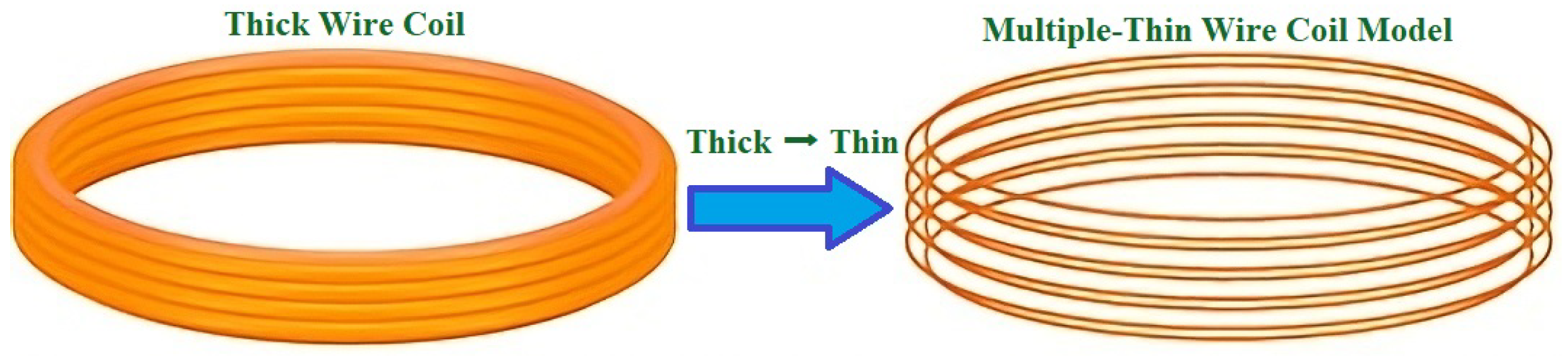
Figure 3 illustrates the basic idea of the MTTWA method. The 3D model of a practical coil shown in the left part of Figure 3 is composed of two practical wire layers. In this example, the inner layer consists of five turns, while the outer layer has four turns.
Figure 3.
Coil formed from a wire with a finite radius (on the (left)) and the equivalent MTTWA-based model (on the (right)).
MTTWA provides fairly accurate results if there are at least 15–20 turns in each layer. The simplified thick coil model is obtained by replacing each turn of practical wires with a finite radius in a thick coil with a thin wire arrangement, maintaining the constant position of the central axes of the practical wires and cross-sectional dimensions of the winding.
Although this simplifying assumption results in an approximation error, under this type of approximation, one can calculate the MF field produced by the entire winding carrying a given current by treating each turn separately as if the winding were just a set of thin single-wire current loops described above and then utilizing the superposition principle to add fields due to individual turns. Alternatively, the main advantage of the proposed MTTWA for thick winding coils is that one calculates the fields due to each turn using the well-established method based on the use of the elliptic integrals of the first and the second kind. The limitation of this method is that the turns must be close to the circular current loop, which is not always the case due to various imperfections of the winding process and relevant equipment.
The efficiency of the approximate methods MTTWA and STW was tested on coils and simple CS models, and the calculation results obtained with these methods were compared with those given by Ansys Maxwell simulations, where the coil is modeled as a 3D solid conductor, not as a set of isolated wires. A 3D model was built and analyzed using the magnetostatic solver Ansys Maxwell. In all three cases, when the coil winding cross-section was rectangular, the results of all three methods practically coincided, which made it possible to make a decision that further calculations can be performed with MTTWA. The coincidence of STW versus MTTWA and Ansys Maxwell models differs if the winding cross-section is a rectangle with a large side length ratio (such a case is rarely interesting for practical implementation), but this is quite natural since the STW model is not an ideal method for all cases of practical multi-turn coils.
3. Coil and Coil System Design and Fabrication
The dimensions of the coil system under study were chosen to meet the size constraint imposed by the dimensions of the incubator employed in the biological study and the size of the AOI. The AOI here was defined as a cylindrical volume with a radius of 15 and a length of 120 . It was determined that the maximum longitudinal dimensions of the CS are 20 and the maximum transverse dimensions are 24 , which are essential for the design of the coil and the CS.
3.1. Coil Design and Fabrication
To start the CS design and calculations of the homogeneity of the MF generated by the CS, preliminary calculations were made. The real physical parameters of the coils were selected—the wire diameter; the shape of the winding cross-sectional area, which will be rectangular or square, with a calculated number of horizontal and vertical wire turns in windings, which determines the dimensions of the coil winding cross-section; and the average radius of the windings. Such a choice was made to ensure the specified magnitude of the MF on the AOI axis, taking into account the maximum dimensions of the CS. Additionally, it is necessary to ensure minimal heating of the coils at the maximum field magnitude. Such calculations were carried out before making the decision on the coil design and its geometric dimensions. It was decided that all coils will be made the same. Considerations and approximate calculations, which used the STW and MTTWA models, Barker’s CS parameters (8) took into account the constructive constraints and conditions that were set for the maximal magnitude of MF on CS axes, frequency range, and CS coils heating. As a result of the preliminary modeling, it was determined that a multi-turn wire coil with a rectangular winding cross-section should be used. The windings must be a wire with a diameter , the number of horizontal windings , and the number of vertical windings . The average radius of the windings would be .
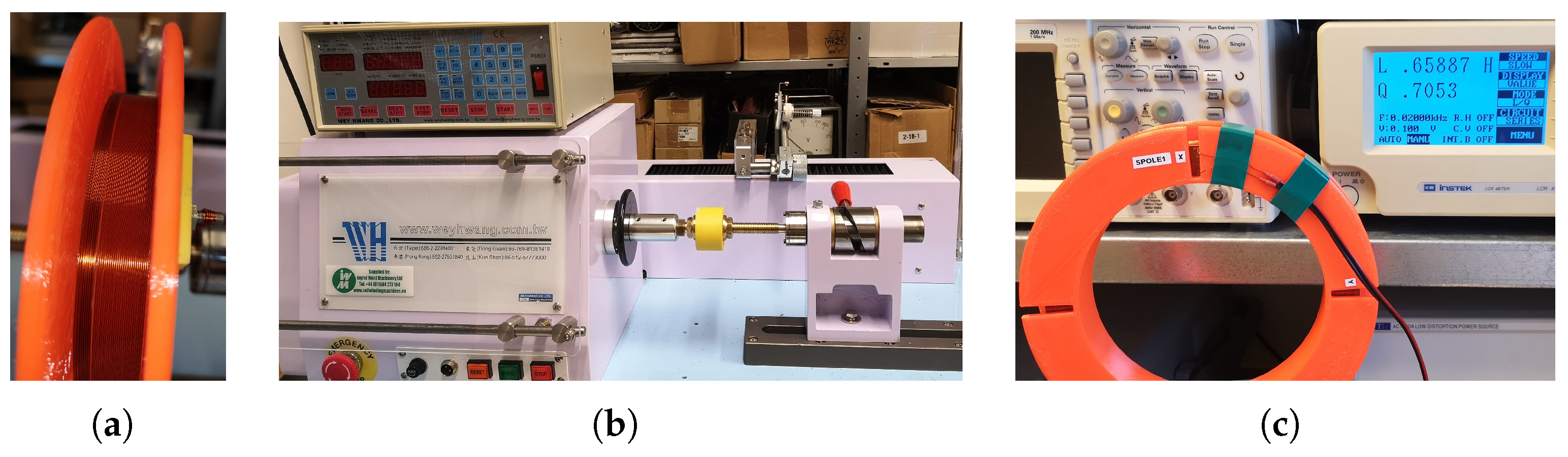
The coil support structure and other accessories were 3D printed from polyethylene terephthalate glycol (PETG) plastic, and the coil windings were wound using the programmable wire winding device WH751 (see Figure 4a,b). Coil parameters were measured and adjusted for all coils (see Figure 4).
Figure 4.
Captured photographs of the wire winding winding process (a), the wire winding device WH751 (b), and the coil parameter measurements (c).
3.2. Coil System Design and Fabrication
It is understood that for practical coils, the dimensions of windings will differ from those in calculations; therefore, the calculations of distances between CS coil centers and current ratio of currents in pairs of symmetrical coils must be repeated when the real dimensions of fabricated coils are measured.
Here, circular and symmetrical four-CS (see Figure 2) were calculated and designed. All coils have practically the same dimensions, with the same number of turns and practically identical winding dimensions. The calculations and modeling use the winding dimensions and winding average radii of already manufactured coils. The average values of these dimensions are given in Table 1. At this stage, distances between pairs of symmetrical coils and the ratio of currents in symmetrical coils are sought with the aim of obtaining an MF as homogeneous as possible in the AOI. When starting the calculations, the Barkers’ coil parameters (9) are used as initial values. In this situation, in search of a better option, the graphical optimization method described in [51] was employed. It was considered that the heterogeneity on the system axis could be improved; however, the result turned out to be slightly better than the classical solution for a single-winding Barker’s coil system. The calculation results are given in Table 1. After these calculations, in which the more proper distances between the coils and currents in coil pairs were determined, the coils were placed on a cylindrical fixture at the calculated distances . A more precise assessment is not feasible because errors in CS fabrication will still result in deviations from the actual situation. Moreover, in many biological experiments, very high field homogeneity in AOI is not required, as is the case, for example, when CS is fabricated for use in micro-electron paramagnetic resonance imaging devices [52]. Calculations showed that for a four-CS system, heterogeneity is small in a relatively wide volume, and in this particular case, only at the ends of the AOI (which is a 12 long cylinder whose axis coincides with the CS axis and coincides with the z-axis (see Figure 2)), the heterogeneity is about 3%, but in the largest part of AOI volume, it is less than 0.5%.
Table 1.
The measured coil and CS parameters and currents in coils.
The CS and the coils used in practical CS have differences from the values used in calculations, but in practice, such differences are often not essential. This can be explained by the fact that for coils with a large number of turns in the coil windings (the coils used here each have 1634 turns), manufacturing deviations do not noticeably affect the CS characteristics, and the measurement results differ from the calculated ones within the measurement error limits and have minimal impact on the CS magnitude of an MF in AOI and MF homogeneity, which was also observed in other studies [30,49,50,52,53].
To evaluate the calculation accuracy of the CS-generated MF, which was provided by the simplified STW and MTTWA models, the results were compared with the results of Ansys Maxwell simulations. The magnitude of an MF on the coil system axis (the z-axis) was calculated using these three methods.
To ascertain the effect of the real coil windings’ dimensions on the size of the uniform regions, the MF produced by a four-CS with the same distances between coil winding central lines, but with single-turn coils instead of thick ones, is examined with the STW method. For this purpose, each thick coil in the original arrangement is replaced by a single infinitely thin circular wire loop carrying an equivalent current. The equivalent current for each coil is set equal to the actual coil current times the number of turns.
In the MTTWA method, the windings of the practical wires are replaced with loops of ideal wires, which are located at the locations where the cross-sectional centers of the practical wires were located. The MF field produced by the entire winding carrying a given current is calculated as if the winding were just a set of thin single-wire current loops, and then utilizing the superposition principle to add fields due to individual turns.
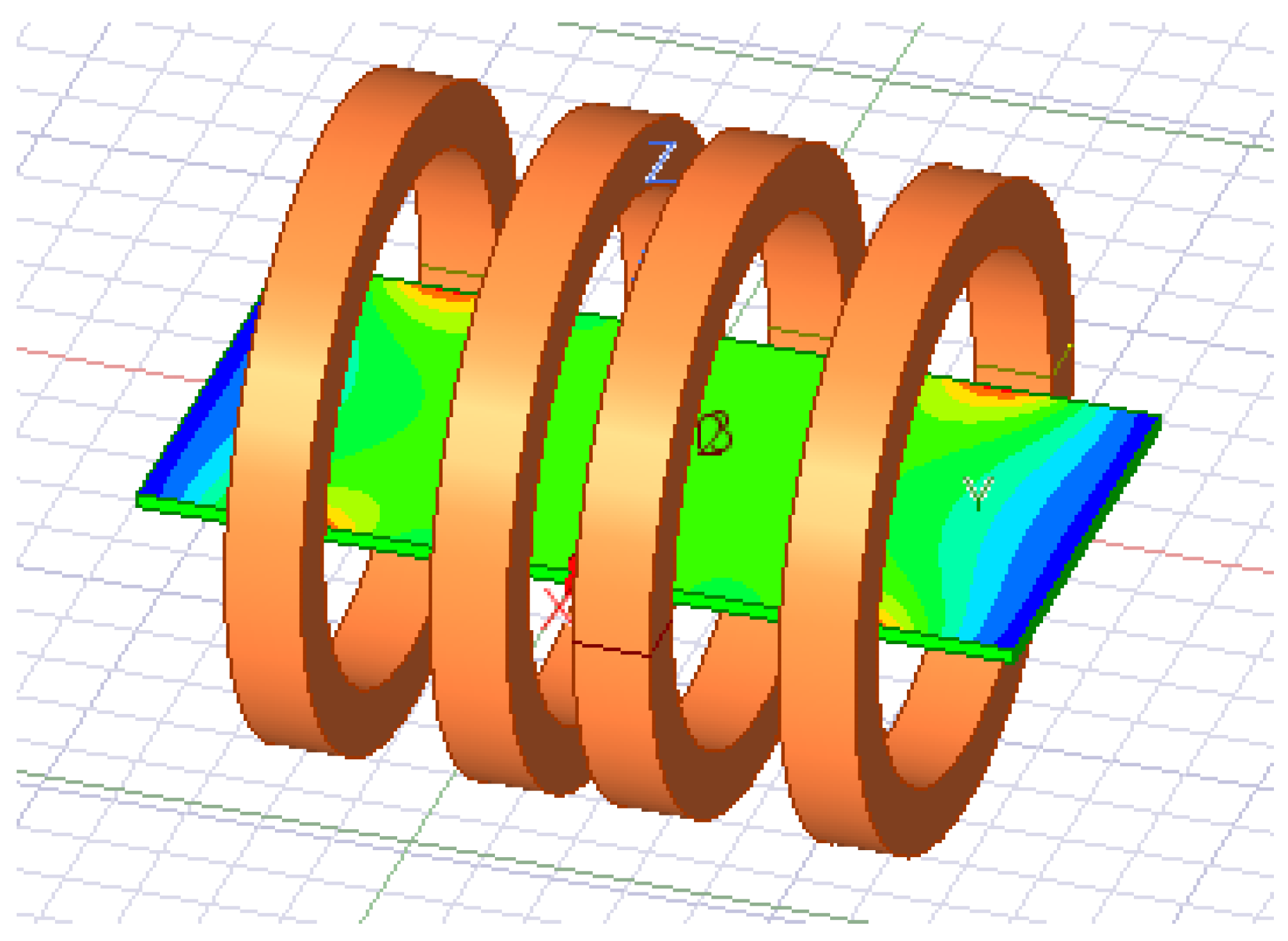
In the Ansys Maxwell simulations, each coil is modeled as a 3D solid conductor (not as a set of isolated wires) with a width equal to the coil winding width and a height equal to the coil winding height. The average values of these dimensions are given in Table 1. The Ansys model, composed of four coils with identical radii, was built and analyzed using the magnetostatic field solver (see Figure 5).
Figure 5.
The Ansys Maxwell 3D model of the four-coil system.
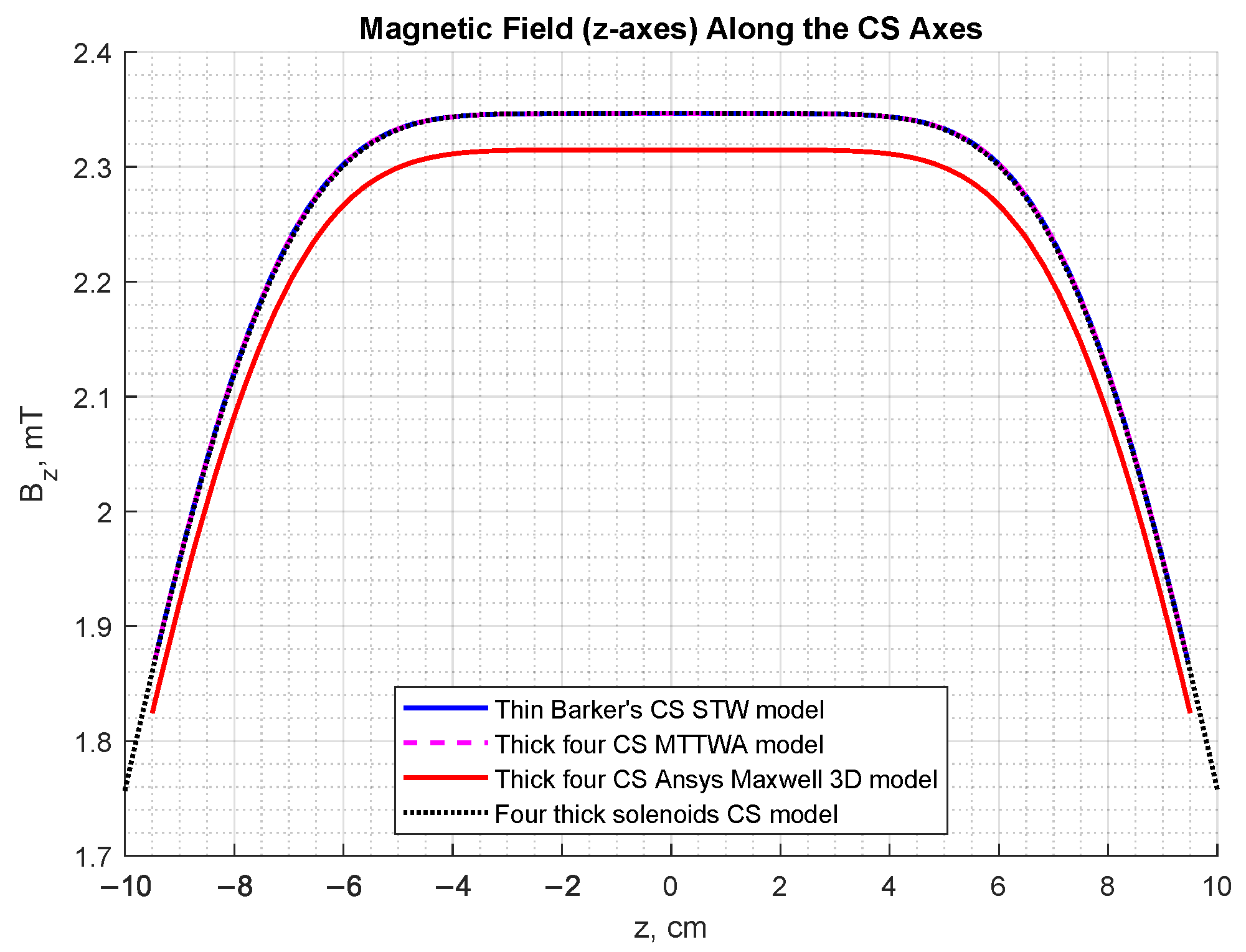
In the Ansys model, the Neumann boundary conditions were imposed on the fictitious airbox surface to truncate the otherwise infinite modeling domain. The airbox size was chosen to be significantly larger than the CS to minimize errors due to the finiteness of the modeling domain. To further improve the field calculation accuracy, the maximum size of the mesh elements inside each coil model was set to 5 ; nevertheless, it was found by integrating the current density over an arbitrary cross-section of one of the coils that the current differs slightly from that set for the current port object. All calculations used parameter values from Table 1. The graphical results for all three models, specifically the MF (z-axis component) along the CS axes, are shown in Figure 6.
Figure 6.
Magnitude of an MF z-component on the CS axes of the ideal thin coils Barker’s coil model (dashed magenta), thick coil Barker’s four-coil configuration calculated using the MTTWA model (solid blue), the Ansys Maxwell modeling results using solid object winding approximation (solid red), and four thick solenoid coil model (dotted black).
Calculations show that differences in results (see Figure 6) are very negligible, which indicates that the MTTWA model results are sufficiently accurate and can be used for the calculation of fields of multi-turn coils and significantly accelerate CS design and reduce costs. Additionally, this approach considers the dimensions of the windings, specifically the parameters of real coils. If the cross-section of the windings is close to square and the radius of the turns is large enough compared to the AOI dimensions, then the STW method also yields usable results.
Additionally, to verify the results of the STW method calculations, an analytical expression for the MF z-component calculation on the CS axes was used. This formula is derived from the field expression Formula (9) and is as follows:
To compare the results of the multi-turn coil calculation with the MTTWA approximation, formulas for calculating the field on the CS axis were derived. In creating these formulas, expressions for calculating a thick solenoid along its axis were used [11,54]. The expressions for calculating the magnetic field on the axis of a system of four thick solenoids are as follows:
where ; ; ; and .
For numerical calculation with Formula (11), data for the values of current , current ratio , distances , and coil winding average radius were taken from Table 1. The distances and were fixed according to the center lines of the windings. The width W and height of the rectangular-shaped windings of coils were calculated by multiplying the wire diameter by the numbers of windings, and , respectively.
The numerically calculated curve is shown in Figure 6 (dotted black). Such a calculation also confirms that the used MTTWA approximation can be successfully applied to the calculation of multi-turn coils with real-size wires, provided the number of windings is sufficiently large.
Additionally, to evaluate the accuracy and, therefore, the applicability of the simplified analysis methods, such as the STW method and the MTTWA method discussed above, the field heterogeneity in a region inside CS in the plane (horizontal plane passing through the origin) is calculated using the undermentioned three methods and compared. Field uniformity is estimated using Formula (2). In the area where the MF heterogeneity is graphically represented (see heterogeneity graphs in Figure 7, Figure 8 and Figure 9), the radial component of the MF is very small, and the calculation of the heterogeneity with Formula (1), which takes into account both MF components, is similar, and graphically no differences are visible.
Figure 7.
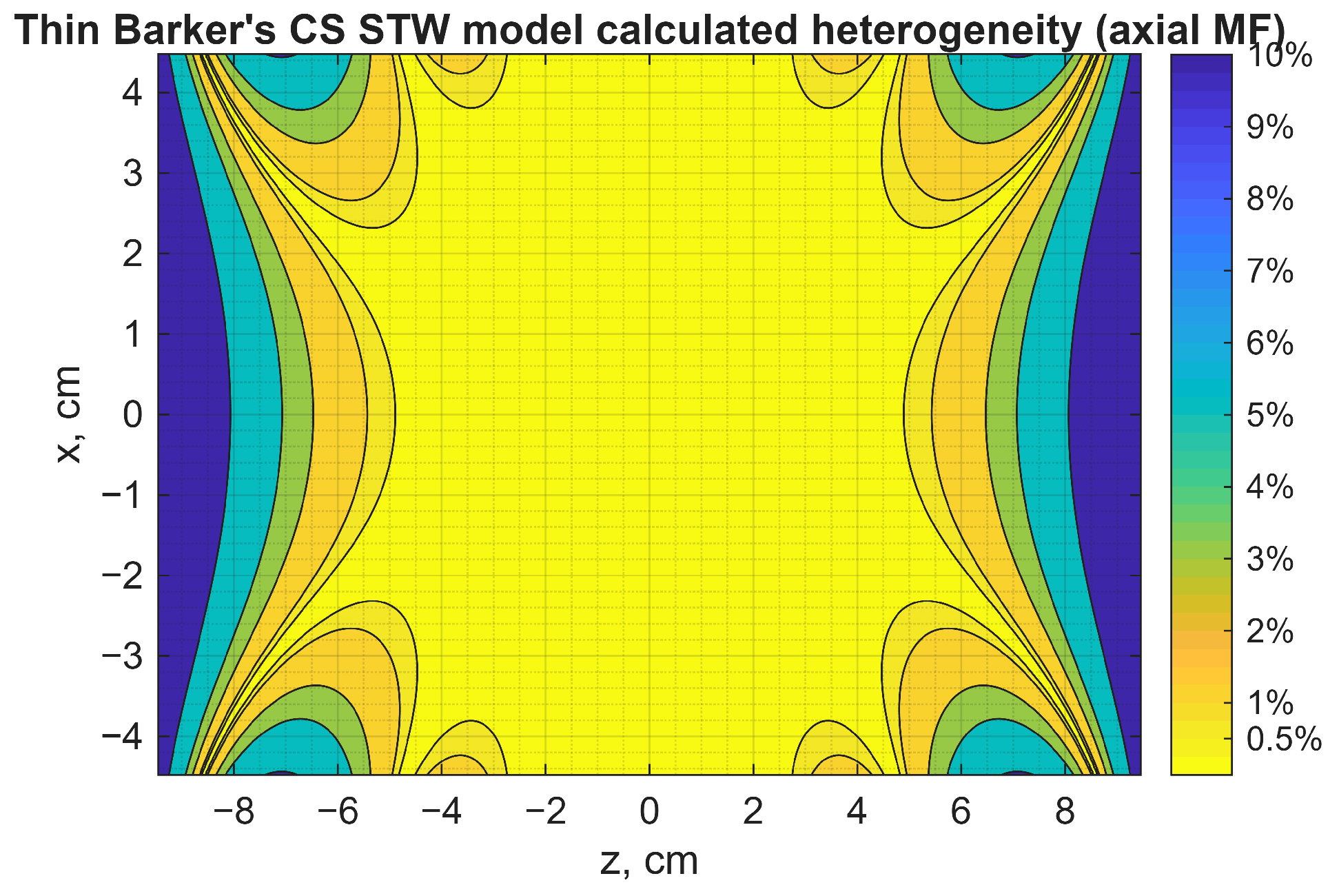
The MF axial component uniformity regions inside the CS (indicated by distinct colors) of different heterogeneity levels (0.5%, 1.0%, 3.0%, 5.0%, 10%, and >10%) found using the STW model.
Figure 8.
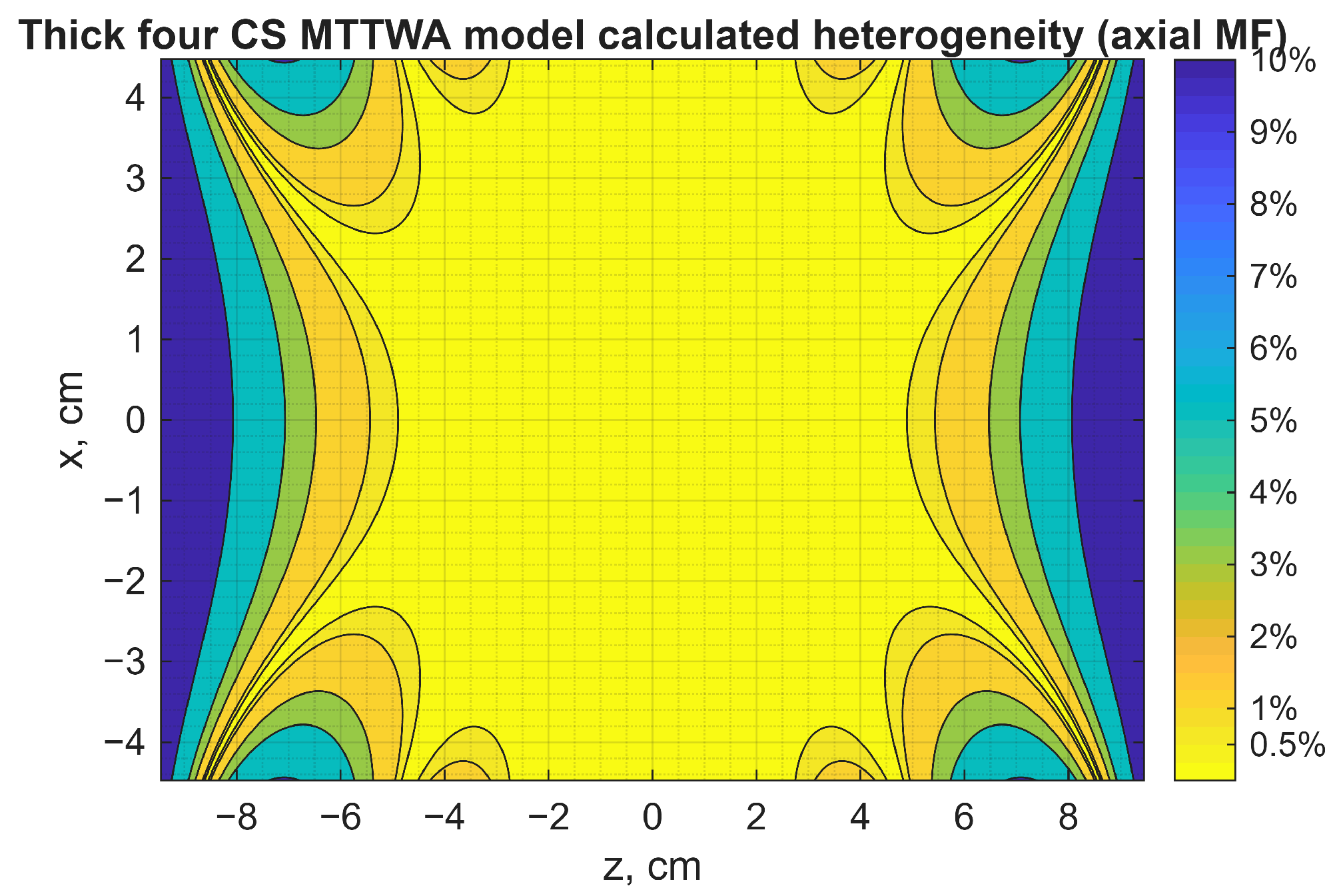
The MF axial component uniformity regions inside the CS (indicated by distinct colors) of different heterogeneity levels (0.5%, 1.0%, 3.0%, 5.0%, 10%, and >10%) found using the MTTWA model.
Figure 9.
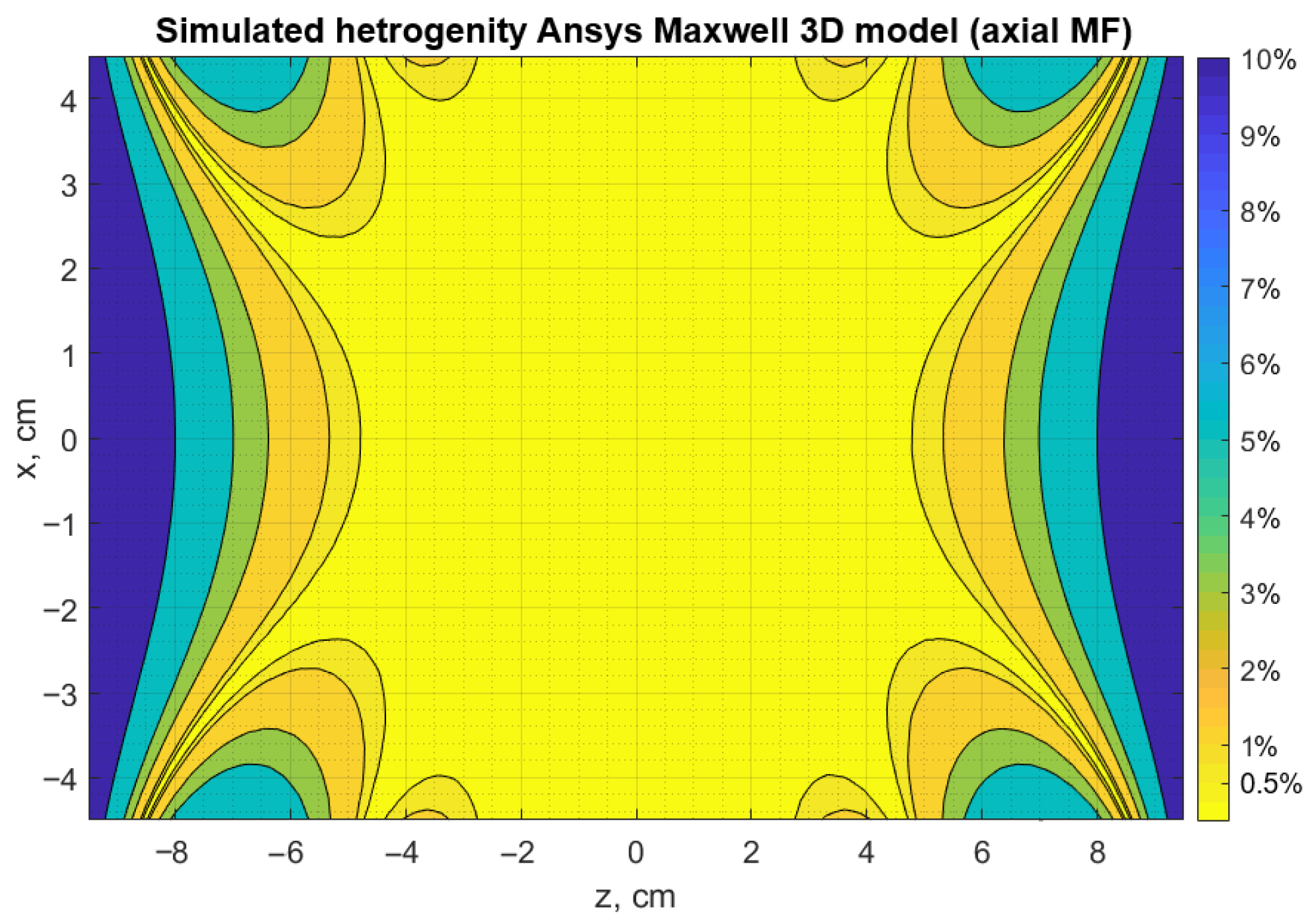
The MF axial component uniformity regions inside the CS (indicated by distinct colors) of different heterogeneity levels (0.5%, 1.0%, 3.0%, 5.0%, 10%, and >10%) were found using the Ansys Maxwell 3D magnetostatic field solver.
In the heterogeneity graphs, six regions are shown, representing volumes inside the coil where the field heterogeneity is less than 0.5% (yellow), 1.0% (sand color), 3.0% (orange), 5.0% (green), and 10% (cyan). The region highlighted in blue represents the part of space where the heterogeneity is greater than 10%.
The MF z-component (axial MF component) heterogeneity estimated using the STW model is shown in Figure 7.
Figure 8 shows the heterogeneity of an MF calculated for the same space region using the MTTWA approximation model, which takes into account the dimensions of the windings and numbers of horizontal and vertical wire turns, i.e., the size parameters of real coil windings.
In contrast to the STW, the thick coil-based one exhibits slightly wider field uniformity regions corresponding to different heterogeneity levels. However, as evidenced by comparing the results seen in Figure 7 and Figure 8, the difference between the size of uniform field regions of different heterogeneity levels and the shape of their boundaries is almost indistinguishable within the graphical accuracy.
The results of the thin wire approximation-based STW model and the MTTWA model closely agree with those of Ansys Maxwell 3D simulations. The relevant results of heterogeneity of an MF are presented in Figure 9.
The heterogeneity graphs in Figure 7, Figure 8 and Figure 9 show that all three models yield very similar results. The graphs show that in most of the AOI calculated heterogeneity of a MF does not exceed 0.5%, which is a significantly better result than was planned when the CS design was initiated.
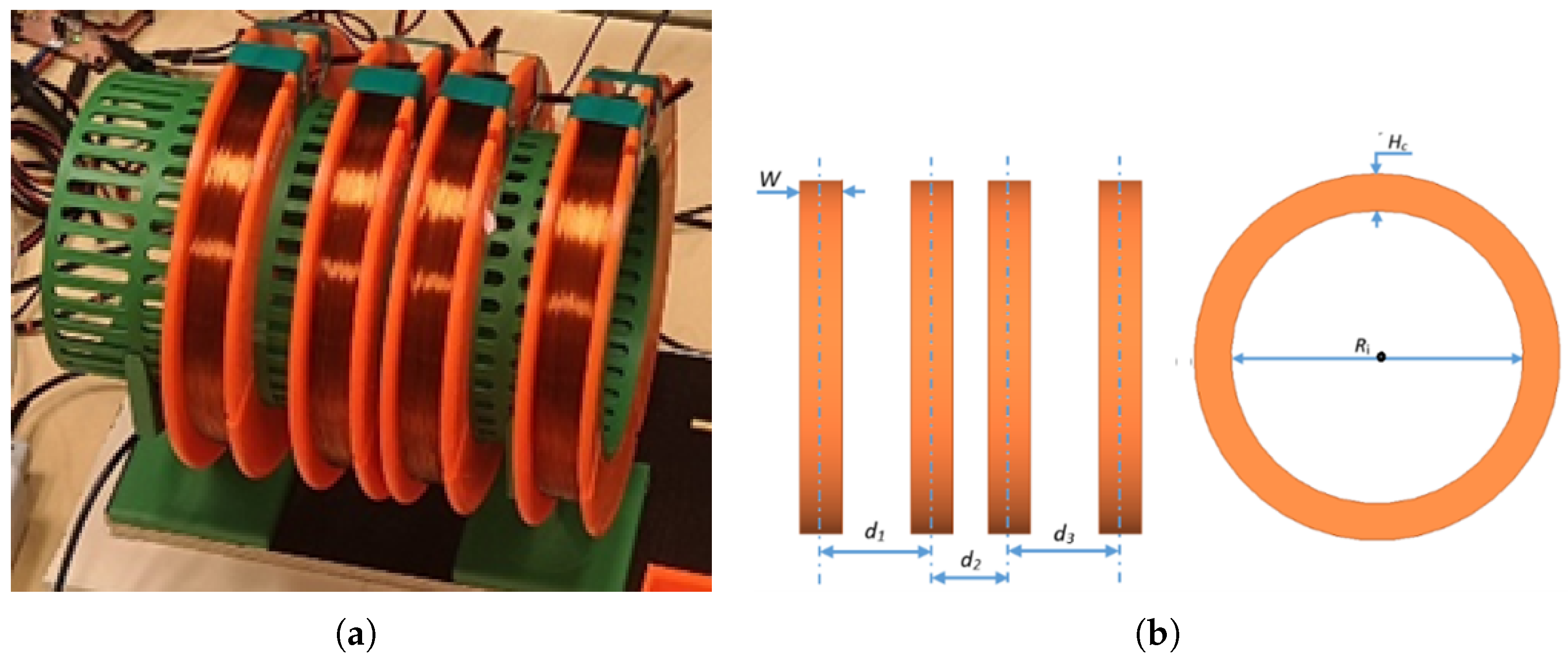
The results obtained with the three methods described above confirmed that the distances between the coils (see Table 1) determined in the design procedure are adequate for generating a homogeneous MF in the AOI volume. The coils were placed on the cylindrical fixture at the calculated distances (see Figure 10b), and the prototype CS was ready for measurements.
Figure 10.
Fabricated four-CS (a), and coil winding width W and calculated distances between coils’ midlines (b).
The measured inner radius of the real CS, calculated and implemented distances between the centerlines of the coils (see Figure 10b), measured coil winding cross-section width, height, and average radius, current values in coils (used calculations and measurements), number of horizontal and vertical turns in coil windings, and frequency used in the experiment are shown in Table 1.
4. Exposure System
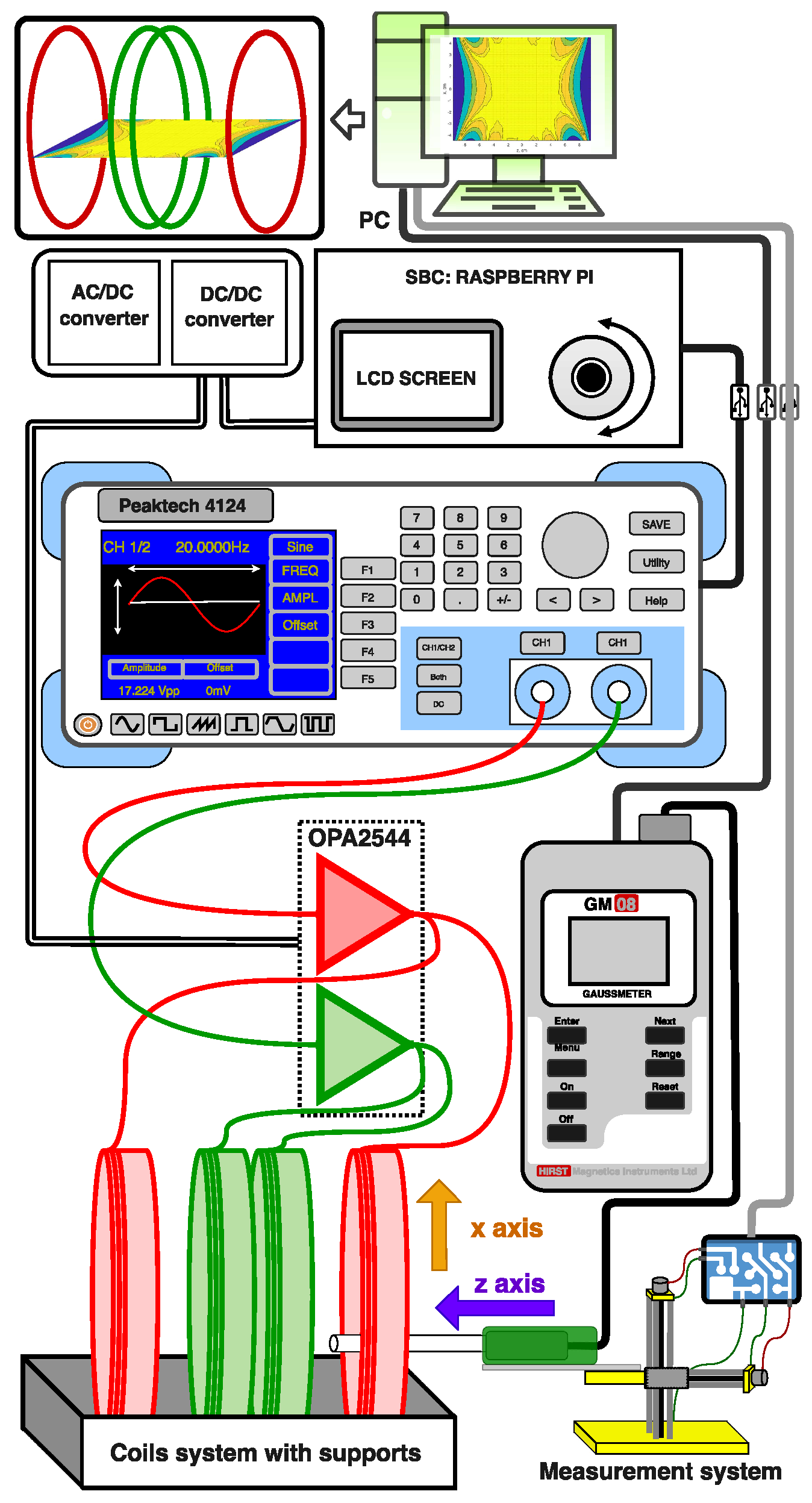
The exposure system consists of a CS, a power supply and control device (PCD) controlled by a single board computer (SBC), and the Peaktech 4124 2-channel arbitrary function generator (AFG) with remote control and waveform editing software. If MF measurements are performed inside the CS, an automated measurement platform, described in Section 5, is added. The exposure system block diagram and MF measurement platform are shown in Figure 11.
Figure 11.
Exposure system conceptual diagram.
When the exposure system is used in biological experiments, the CS with thermocouples, attached to the coils of the cartridge embedded within it, is placed in an incubator, while the power supply and the generator are left outside.
It is possible to insert a stationary MF probe into the CS to monitor for unexpected changes in the MF during the experiments. In biological experiments, everything placed in an incubator is sterilized, and the ambient temperature is approximately 37 °C. The relative humidity can reach 100%, while the pH level can vary. Most MF probes are not intended for sterilization and placement in such an environment. Therefore, a simple yet sufficiently accurate probe based on the Melexis (Belgium) MLX9039 magnetometer was manufactured, which can operate in environments where biological experiments are conducted, allowing for the measurement of the magnitude of an MF at a single fixed point during the experiments. The probe has a Japan Solderless Terminal (Doshomachi, Chuo-ku Osaka, Japan) PH-2.0 8-pin connector followed by a 3.3 voltage regulator. The probe was programmed using the PlatformIO programming environment. The probe performance was compared with that of the Hirst Magnetic Instruments GM08 probe, and the test measurements showed a sufficiently good match between the measurements obtained with both probes.
The PCD was designed as a standalone unit, which includes the following:
- (1)
- Dual channel operational amplifier Texas Instruments (Dallas, TX, USA) OPA2544;
- (2)
- AC-DC and DC-DC converters (Bel Power Solutions, West Orange, NJ, USA);
- (3)
- A liquid crystal display (LCD);
- (4)
- A device which measures the surface temperature of each coil and displays the temperature readings;
- (5)
- A device which reads and saves the MF probe measurements during the experiments;
- (6)
- An SBC;
- (7)
- Peripherals such as buttons and a rotary encoder for controlling the SBC settings.
In the CS, the inner and outer pairs of coils are connected in parallel and then connected to different AFG channels. The channel currents are pre-amplified using their respective power amplifiers. This means that each of the two currents is equally split between the coils, constituting the corresponding coil pair. The two-channel configuration was chosen to enable independent adjustment of currents in the outer and inner coil pairs, which offers greater flexibility and, to some extent, allows for compensation of design imperfections by adjusting the current ratio. The impedance of the coils matches that of the voltage generator. The parallel connection of symmetrical coils is a crucial element of this exposure system, as it reduces the load impedance and facilitates easy adjustment of the current ratio in the coil pairs.
The AFG can be set up remotely from the SBC, which stores a number of preset current configurations (current ratio in the coil pairs). Thus, one can also obtain strongly inhomogeneous MFs if the need arises for such experiments. Thermocouples are attached to the coils, which measure the surface temperature of each coil during the experiments. The measured coil temperature is displayed on the screen and saved.
5. Experimental Setup
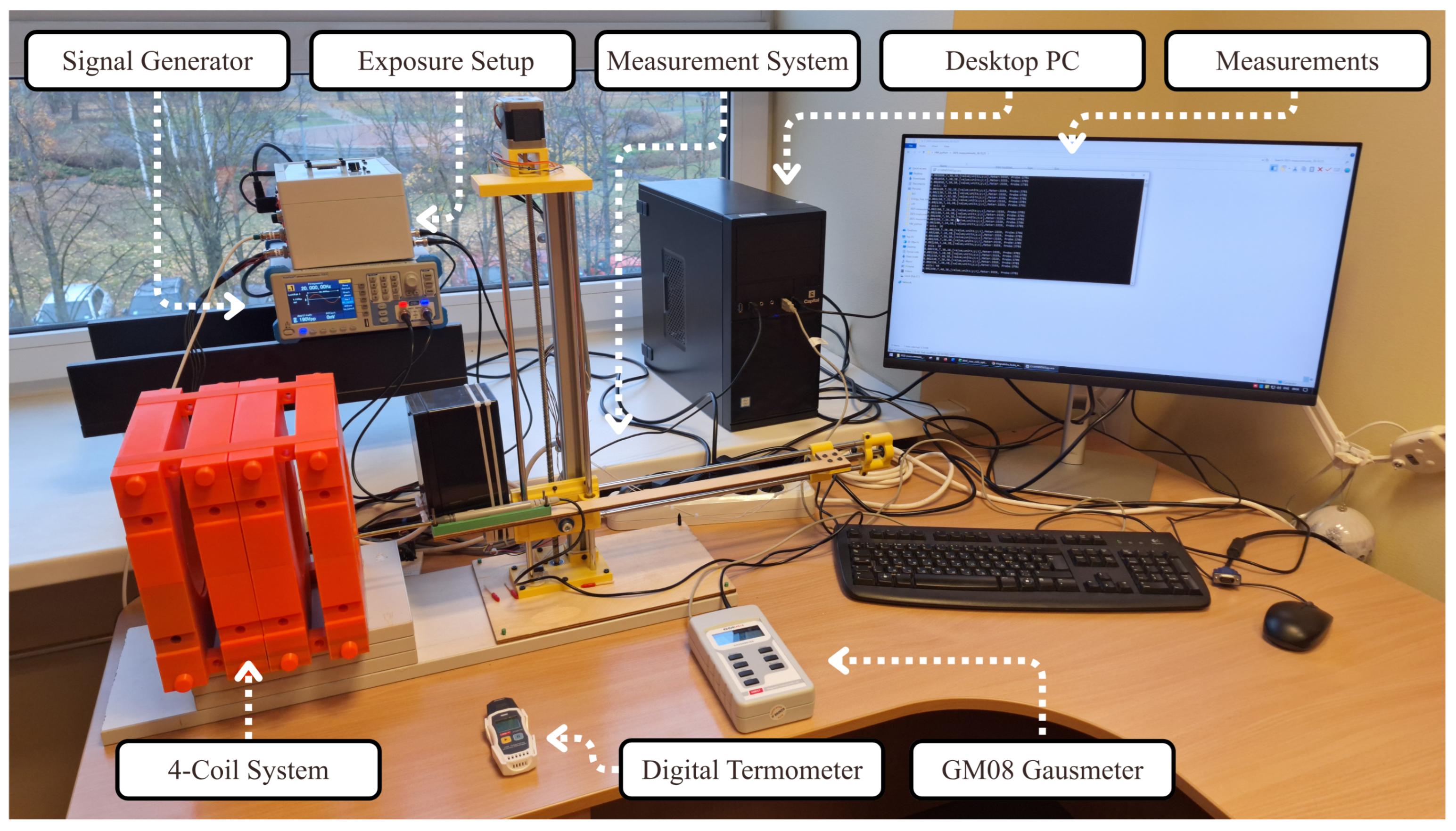
The MF measurement laboratory setup is shown in Figure 12. The setup includes a PC, Hirst Magnetic Instruments GM08 gauss meter with axial and traversal probes, a custom-designed MF measurement probe, an automated two-axis MF measurement system with a probe holder, and the exposure system described in Section 4.
Figure 12.
Captured photograph of the MF measurement system setup in the laboratory.
The MF measurement system design utilizes two trapezoidal threaded rods and four rails, along with two servomotors. The vertical-axis motor was positioned at the top of the device, allowing the probe to be moved as close to the base as possible. In the horizontal axis, the servomotor was placed as close as possible to the vertical axis to ensure a balanced overall design. The practically manufactured MF measurement system is 934 high and 590 wide. The maximum probe displacement along the longitudinal axis is 402 , and along the transverse axis is 347 . A push rod with an 8 step per revolution was placed on both axes; the minimum motor step was 0.225 degrees, or 1600 steps per revolution. This means that 200 motor steps are required for 1 of displacement. The MF measurement system is computerized, providing automatic and precise movement of the probe within the volume of the coil system, recording measurement data at set points, and recording and displaying measurement data. The measurement probe was connected to the PC using a USB adapter, and communication occurred via the command-line interface.
The measuring instrument was connected to the computer via a USB adapter, and communication occurred through the command line and Python 3.10environment. The GM08 magnetometer was used in the measurements, and the MF measurement system operated in slave mode, where it waited for commands, processed them, and performed probe movements upon request. Data from the GM08 magnetometer was collected via the device’s USB port.
The aim of the experiment was to measure the MF generated by the four-coil system and estimate and visualize the field homogeneity in the test volume. The MF was measured inside the CS in plane , the dimensions of which from the origin in the axial direction are from to , and in the transverse direction from to .
To perform the experiment, measurement steps must be set. The minimum step is , and the number of field measurements at a single point can be set from 1 to 5. In the experiment, relatively large measurement steps are used, in the longitudinal direction (z axis) and in the transverse direction (x axis), and the measurements of the magnitude of an MF were only in the plane. The axial probe made 5 measurements of the magnitude of an MF at each point (there were a total of 3031 points). The entire measurement process lasted about 59 h. Different measurement limits and probe movement steps can be set in the measuring procedure.
The coil temperature readings were taken after 50 h of measurement time at a room ambient temperature of 22.7 °C. The temperature of the outer coils was 28.25 °C and 28.0 °C, while the current in each outer coil was 116 . The inner coils showed temperature readings of 25.19 °C and 25.64 °C, while the current in each inner coil was 51.5 .
Like in [55], temperature monitoring was performed when the system was placed inside the incubator MCO-18AIC. At the beginning of the experiment, the CS was placed in the incubator with the set temperature of 37 °C, and only after some tens of minutes the MF generation turned on, and no temperature changes in the incubator were observed, as the heating of coils in the presented CS is not an essential problem, due to the heat capacity of the CS being much lower than, for example, in [55], where a different system is employed—a large solenoid to achieve the author’s stated goals.
For the experiment, the magnitude of an MF at the center of the system, on the axis, must be set. In the experiment, the magnitude of an MF was set to . In responding to such a task, the SBC ensured that the summary current in both outer coils was 232 (RMS); consequently, in each coil, the current was 116 because the coils are the same and connected in parallel. The currents in both inner coils were 103 . In each coil, the current was 51.5 , providing the required current ratio (see Table 1). Operating frequency was set to 20 .
6. Results and Discussion
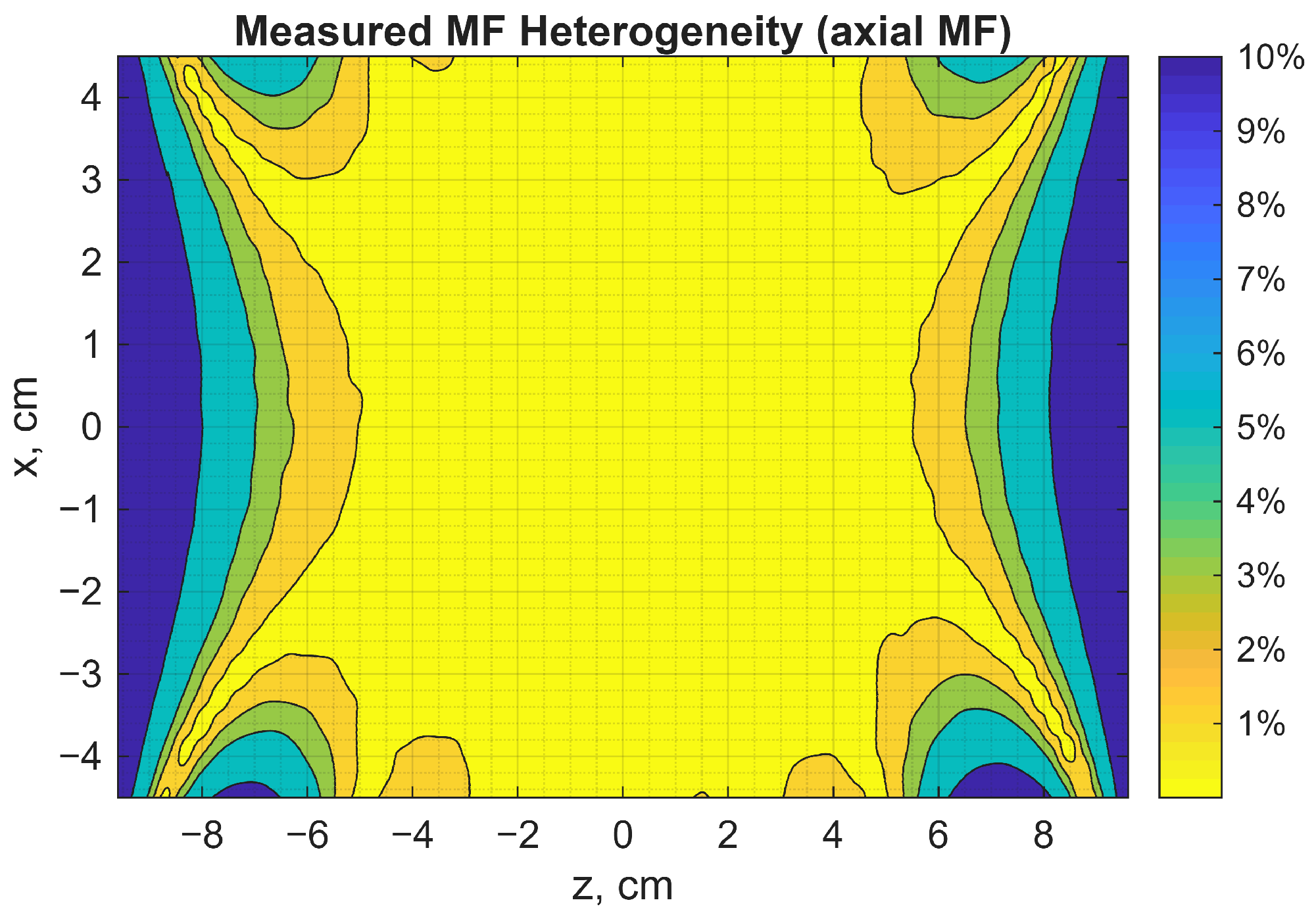
To verify the performance of the exposure system, MF homogeneity measurements were performed using the automated MF measurement platform. The numerical values of measured MF were stored in a computer memory, in which the coordinate of the measurement point and the magnitude of a MF were recorded. The measurement results were used to create a heterogeneity graph, which is shown in Figure 13. The uniformity of the z component of the MF was estimated using Formula (2).
Figure 13.
Homogeneous field’s measured magnetic field heterogeneity at levels 1.0%, 3.0%, 5.0%, and 10%.
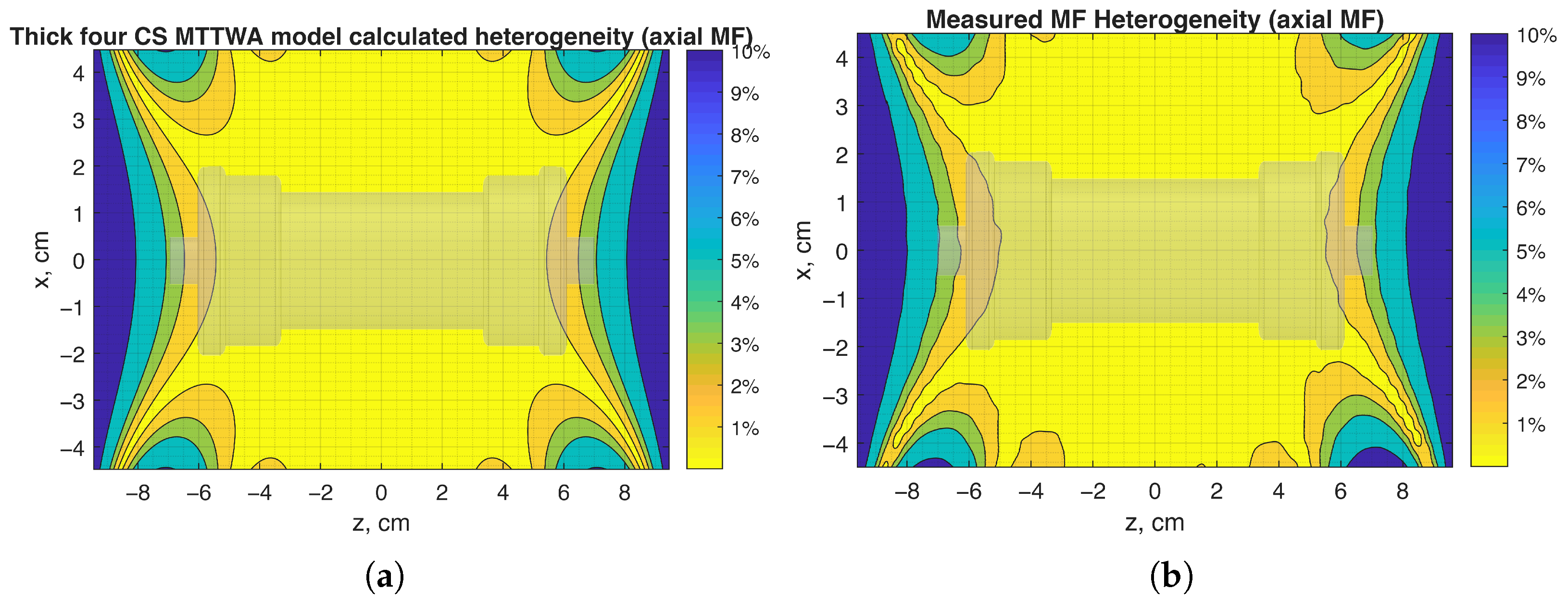
To verify the results of the calculations and modeling and to validate the operation of the exposure system and measurement setup, two MF heterogeneity graphs were created, utilizing the MTTWA method and measurement data. The silhouette of the cartridge (AOI) was inserted into both heterogeneity graphs, and the results are shown in Figure 14. These graphs also enable us to assess whether the goals for field homogeneity in the AOI volume have been met.
Figure 14.
The magnetic field uniformity regions (indicated by different colors) of different heterogeneity levels 1.0%, 3.0%, 5.0%, and 10% with superimposed C2011 cartridge silhouette. (a) found using MTTWA, and (b) by measuring the magnetic field produced by the prototype.
As can be seen from Figure 13 and Figure 14, in most of the AOI, the field heterogeneity is less than 1%, reaching approximately 3% at the ends of the cartridge. It should be noted that the ends of the cartridge have walls of the cartridge body, and cells do not settle there during biological experiments.
Comparisons of different CSs can be found in many publications, for example [24,26,37,44,48,56]. From the possible implementation options for a homogeneous MF generating CS, of which optimal solutions are Garrett, Braunbec, and Barker [44] CS, it was chosen to implement a Barker CS, as it best meets the construction requirements and MF homogeneity in the given AOI. Helmholtz and Maxwell CSs cannot fulfill the set requirements, and they produce lower-order homogeneous fields [22,45]. Six or more CSs [24] were evaluated as potential options; however, they were not chosen due to the construction requirements, as such CSs would be more expensive and more difficult to fabricate.
In practical CS implementations, multi-turn coils are used; therefore, it is possible to consider only more or less suited solutions for the specific requirements and aims when construction, weight, power consumption, heating, field magnitude, and homogeneity in the AOI, etc., are set as target parameters. Practically, only quasi-optimal solutions are possible if we consider that CS fabrication with the theoretically calculated precision is either not possible or too expensive. Quasi-optimal solutions for multi-turn coils can be found by considering the winding cross-sectional shape and dimensions, wire diameters, coil arrangement, and ampere-turn ratios in coils; however, these solutions will not be superior to theoretical ones with ideal windings. Additionally, there will be fabrication defects in multi-turn coils.
If we consider publications where very low frequency MF is used in biological experiments, then there are significant issues with the comparison of results, as these works give insufficient information about the exposure system and field homogeneity. Not one of the works mentioned in reviews [3,18] gives information about the spatial distribution of the MF in the AOI, only information about the magnitude of the MF at a specific point and operating frequency, and there are no technical parameters, which does not allow for repetition of the presented experiments [18].
Comparing different coil systems, which are used for homogeneous MF generation, is not trivial, because for a system to be optimal for a given number of coils and magnitude of an MF, its radial and longitudinal dimensions differ. In practice, it is essential to consider not only a single system’s parameter, such as field homogeneity, but also multiple parameters and their limitations together.
For example, if a comparison were made between CSs that were created to generate a homogeneous magnetic field and have two, three, four, or six coils, and the systems have equal length, then the radial dimensions of the systems would be different, and vice versa. Also, the dimensions of windings in the coils are different in many systems, so they consume different amounts of power to generate fields of set magnitudes; for example, at the center of symmetry of the system. Typically, multi-turn CSs are built for specific practical purposes, which means that an AOI is defined in which the minimal MF inhomogeneity is set.
Considering the published theoretical calculations, which demonstrate very high MF homogeneity, the same result can be achieved with classical systems in a relatively small AOI. It must be taken into account that these calculations are based on the existing theoretical basis, and extremely precise coil fabrication and arrangement are necessary for the practical implementation of such a system; it is an open question if it is possible to fabricate systems described in [53,56]. It would not be prudent to compare the results presented in this paper with those of theoretically calculated systems, as the fabrication of these systems is not described.
Only some works have reported measurements of the MF in CS volume; however, these measurements were made with a small number of points, which still provide some insight into the MF distribution. Examples include MF measurements in a solenoid [54,55], measurements of Helmholtz coils [33], and measurements of axial gradient coils [32].
Since the most important problem for the specific AOI, which in this study was the cartridge FiberCell Systems C2011, was the field homogeneity in the axial direction, in the search for a practical optimum, the distance on the z-axis at which the field heterogeneity is less than the specified value was chosen as the objective function, and this distance is denoted by . Ratio is used for the comparison of different CSs, where is the length of the z-axis segment where heterogeneity is % and is the coil winding average diameter. A comparison of different CSs, including the proposed CSs in this paper and other existing CSs, is presented in Table 2.
Table 2.
Comparison of different CSs at heterogeneity levels <0.3%, <0.5%, and <1.0%.
Here, is the list of notes for Table 2:
- Note 1
- Barker and Lee-Whitening one thin turn CSs are with the same parameters.
- Note 2
- Experimental measurement of the field in the CS volume at multiple points in space has been conducted.
- Note 3
- Thick Barker coil with parameters from Table 1 (distances between coil cross-section middle points and Barker’s ratio of currents in the outer and inner coils).
- Note 4
- No winding parameters set in [37].
- Note 5
- Two pairs of coils of different radii, symmetrical with respect to the center of a sphere, in which they are inscribed. The number of ampere-turns differs in the two pairs of coils. The average radius of coils is used for comparison. In [48], the optimal case is the radius of the sphere in which the system is inscribed.
The designed exposure system enables convenient and rapid biological experiments with various inhomogeneous fields, allowing for comparison of the results with those obtained in a homogeneous field situation. A simpler power supply unit has also been developed, which allows you to manually select current values for the outer and inner pairs of coils (this can also be achieved through calculations). This power supply device can be used in test measurements, allowing us to determine the effectiveness of system tuning when the current ratio differs slightly from the calculated value or to specifically create inhomogeneous MF for certain experiments.
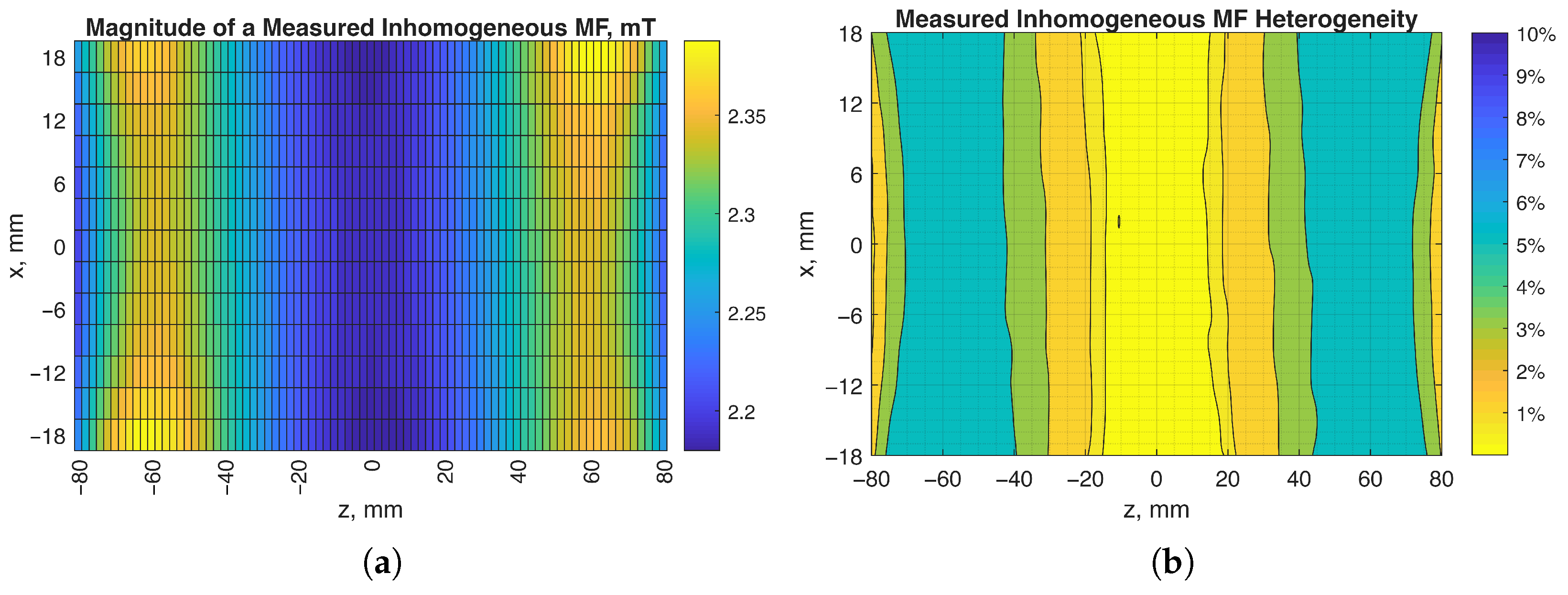
The result of the experiment for generating inhomogeneous MF is shown in Figure 15. This example illustrates the current values and ratios, which were chosen to minimize large differences in the magnitude of an MF compared to previous experiments. The currents in each coil of the pair of coils were chosen to be in the outside coils and in the inner coils, and the ratio of the current ratios was then 3.25. This choice was made to ensure the convenient possibility of quickly obtaining inhomogeneous fields with the existing exposure system. During the measurements, the measuring probe moved along the z axis with a step of 2 , along the x axis with a step of 3 , and at each point, the probe made only one measurement.
Figure 15.
Inhomogeneous field’s measured magnetic field (a) induction and (b) heterogeneity at levels 1.0%, 3.0%, 5.0%, and 10%.
When calculating and modeling the four-CS, it was not possible to noticeably improve the result, as the specified maximum dimensions of the CS had to be taken into account. Therefore, it was decided to implement a six-CS in future work. The calculated distances between the coils and current ratios in the coil pairs for the ideal single-wire six-CS model must ensure the fulfillment of the system of Equation (8). Such a CS is an eighth-order CS according to the classification in [43], and the calculation with the approximation methods STW or MTTWA method shows that six-CS can provide higher MF homogeneity than the four-CS in similar volumes, but that would be if we could overcome the design limitations and place the coils at calculated distances, which will be attempted in future studies for practical coils.
7. Conclusions
This research focuses on developing a compact MF exposure system that generates a high homogeneity MF in a test cylindrical volume with a radius of 15 and a height of 120 . Measurements show that in all tests, volume heterogeneity of MF is , but at least 80% of volume has MF with heterogeneity <0.5%. The device can generate MF with magnitudes ranging from 0 to 2.5 at frequencies of 10–50 . The design assumes the use of an incubator that maintains a constant temperature during biological experiments. The custom-made CS field measurement system provides CS magnitude measurements in the test volume and its surroundings, with a step size of even 1 , which allows us to accurately determine which MF affected the cells during biological experiments, a finding rarely reported in other publications.
Unlike many similar four-CSs, which use symmetrical coil pairs with different windings to ensure the theoretically required ratio of the number of ampere turns in the inner and outer coil pairs, in this study, the coils are made identical, which reduces costs, and the average current in the inner coil pair is reduced, which is important for the thermal regime of the system. It is highly advantageous to create an axially symmetric CSs from identical coils if coils in inner and outer pairs of coils are connected in parallel and then connected to different generator channels. The two-channel configuration enables one to independently adjust currents in the outer and inner coil pairs, which offers flexibility and, to some extent, allows one to compensate for some design imperfections by changing the current ratio, or one can also obtain strongly inhomogeneous MFs if the need arises for biological experiments. The parallel connection of symmetrical coils is a crucial element of this exposure system, as it reduces the load impedance.
In this investigation, a custom-made fast approximation method, MTTWA, is implemented for the design of multi-turn coils CSs. This asymptotic method is valid for the N-turn practical coil approximation with N current loops (thin wire approximation), enabling fast calculations and CS design. This allows one to choose from many possible CS winding configurations, the most suitable one for the given application. The shape and size of the region where the field is nearly uniform must be estimated and compared in a computationally efficient manner using the MTTWA method. The Exposure System CS prototype was manufactured based on these calculations, and its MF measurements confirmed the effectiveness of this method, with accuracy sufficient for practical implementation.
If the cross-sectional areas of the coil windings are nearly square, the optimal parameters found differ very little from (9), but they apply to the location of the centerline of the real-sized coils and real currents in the coil windings.
Our future work involves implementing a six-CS to achieve even higher MF homogeneity in a larger volume AOI.
Author Contributions
Conceptualization, J.S., A.K. and S.M.; methodology, J.S.; software, A.K. and N.T.; validation, J.S., A.K., S.M., N.T. and M.T.; formal analysis, J.S. and M.T.; investigation, J.S., A.K., S.M. and N.T.; resources, J.S.; data curation, N.T.; writing—original draft preparation, J.S. and S.M.; writing—review and editing, J.S., S.M. and N.T.; visualization, N.T.; supervision, J.S.; project administration, J.S.; funding acquisition, J.S. All authors have read and agreed to the published version of the manuscript.
Funding
This research was funded by the Latvian Council of Science, grant No. lzp-2022/1-0373 “Extremely low frequency electromagnetic field as temporary enhancer for production of extracellular vesicles from mesenchymal stem cells in bioreactor”.
Institutional Review Board Statement
Not applicable.
Informed Consent Statement
Not applicable.
Data Availability Statement
The original contributions presented in this study are included in the article. Further inquiries can be directed to the corresponding author.
Conflicts of Interest
The authors declare no conflicts of interest.
Abbreviations
The following abbreviations are used in this manuscript:
| AFG | arbitrary function generator |
| AOI | area of interest |
| CS | coil system |
| FEM | finite element method |
| LCD | liquid crystal display |
| MF | magnetic field |
| MTTWA | multiple-turn thin-wire approximation |
| PC | personal computer |
| PCD | power supply and control device |
| PETG | polyethylene terephthalate glycol |
| RMS | root mean square |
| SBC | single board computer |
| STW | single thin wire |
References
- Pusta, A.; Tertis, M.; Crăciunescu, I.; Turcu, R.; Mirel, S.; Cristea, C. Recent Advances in the Development of Drug Delivery Applications of Magnetic Nanomaterials. Pharmaceutics 2023, 15, 1872. [Google Scholar] [CrossRef] [PubMed]
- García, R.M.; Novas, N.; Alcayde, A.; El Khaled, D.; Fernández-Ros, M.; Gazquez, J.A. Progress in the Knowledge, Application and Influence of Extremely Low Frequency Signals. Appl. Sci. 2020, 10, 3494. [Google Scholar] [CrossRef]
- Safavi, A.S.; Sendera, A.; Haghighipour, N.; Banas-Zabczyk, A. The Role of Low-Frequency Electromagnetic Fields on Mesenchymal Stem Cells Differentiation: A Systematic Review. Tissue Eng. Regen. Med. 2022, 19, 1147–1160. [Google Scholar] [CrossRef] [PubMed]
- Cao, Q.; Han, X.; Zhang, B.; Li, L. Analysis and Optimal Design of Magnetic Navigation System Using Helmholtz and Maxwell Coils. IEEE Trans. Appl. Supercond. 2012, 22, 4401504. [Google Scholar] [CrossRef]
- Ditterich, J.; Eggert, T. Improving the homogeneity of the magnetic field in the magnetic search coil technique. IEEE Trans. Biomed. Eng. 2001, 48, 1178–1185. [Google Scholar] [CrossRef]
- Bukharaev, A.A.; Zvezdin, A.K.; Pyatakov, A.P.; Fetisov, Y.K. Straintronics: A new trend in micro- and nanoelectronics and material science. Phys. Usp. 2018, 61, 1175–1212. [Google Scholar] [CrossRef]
- Zivieri, R. Chapter Three—Metamaterial Properties of One-Dimensional and Two-Dimensional Magnonic Crystals. In Solid State Physics; Academic Press: Cambridge, MA, USA, 2012; Volume 63, pp. 151–216. [Google Scholar] [CrossRef]
- Turner, R. Gradient coil design: A review of methods. Magn. Reson. Imaging 1993, 11, 903–920. [Google Scholar] [CrossRef]
- Miaskowski, A.; Gas, P. Estimation of SLP/ILP parameters inside a female breast tumor during hyperthermia with mobilized and immobilized magnetic nanoparticles. Acta Bioeng. Biomech. 2025, 27, 159–169. [Google Scholar] [CrossRef]
- Bravo, M.; Fortuni, B.; Mulvaney, P.; Hofkens, J.; Uji-i, H.; Rocha, S.; Hutchison, J. Nanoparticle-mediated thermal Cancer therapies: Strategies to improve clinical translatability. J. Control. Release 2024, 372, 751–777. [Google Scholar] [CrossRef]
- Gas, P.; Kurgan, E. Cooling effects inside water-cooled inductors for magnetic fluid hyperthermia. In Proceedings of the 2017 Progress in Applied Electrical Engineering (PAEE), Koscielisko, Poland, 25–30 June 2017; pp. 1–4. [Google Scholar] [CrossRef]
- Gas, P. Behavior of helical coil with water cooling channel and temperature dependent conductivity of copper winding used for MFH purpose. Iop Conf. Ser. Earth Environ. Sci. 2019, 214, 012124. [Google Scholar] [CrossRef]
- Borkowska, A.M.; Chmiel, P.; Rutkowski, P.; Telejko, M.; Spałek, M.J. Radiotherapy combined with locoregional hyperthermia for oligoprogression in metastatic melanoma local control. Ther. Adv. Med. Oncol. 2025, 17, 17588359251316189. [Google Scholar] [CrossRef] [PubMed]
- López de Mingo, I.; Rivera González, M.X.; Ramos Gómez, M.; Maestú Unturbe, C. The Frequency of a Magnetic Field Reduces the Viability and Proliferation of Numerous Tumor Cell Lines. Biomolecules 2025, 15, 503. [Google Scholar] [CrossRef] [PubMed]
- Ullah, I.; Subbarao, R.B.; Rho, G.J. Human mesenchymal stem cells—Current trends and future prospective. Biosci. Rep. 2015, 35, e00191. [Google Scholar] [CrossRef] [PubMed]
- Wang, Y.; Worrell, G.A.; Wang, H.L. It is the Frequency that Matters — Effects of Electromagnetic Fields on the Release and Content of Extracellular Vesicles. Cold Spring Harb. Lab. 2023. [Google Scholar] [CrossRef]
- Wyszkowska, J.; Maliszewska, J.; Gas, P. Metabolic and Developmental Changes in Insects as Stress-Related Response to Electromagnetic Field Exposure. Appl. Sci. 2023, 13, 9893. [Google Scholar] [CrossRef]
- Flatscher, J.; Pavez Loriè, E.; Mittermayr, R.; Meznik, P.; Slezak, P.; Redl, H.; Slezak, C. Pulsed Electromagnetic Fields (PEMF)—Physiological Response and Its Potential in Trauma Treatment. Int. J. Mol. Sci. 2023, 24, 11239. [Google Scholar] [CrossRef]
- Collectif. Collection de Mémoires Relatifs à la Physique: Tome II. Mémoires sur L’électrodynamique, Première Partie; Gauthier-Villars: Paris, France, 1885; pp. 7–53. [Google Scholar]
- McKeehan, L.W. Gaugain-Helmholtz (?) Coils for Uniform Magnetic Fields. Nature 1934, 133, 832–833. [Google Scholar] [CrossRef]
- Barker, J.R. New Coil Systems for the Production of Uniform Magnetic Fields. J. Sci. Instrum. 1949, 26, 273. [Google Scholar] [CrossRef]
- Garrett, M.W. Axially Symmetric Systems for Generating and Measuring Magnetic Fields. Part I. J. Appl. Phys. 1951, 22, 1091–1107. [Google Scholar] [CrossRef]
- Garrett, M.W. The Method of Zonal Harmonics. In High Magnetic Fields; John Wiley & Sons: New York, NY, USA, 1962. [Google Scholar]
- Garrett, M.W. Thick Cylindrical Coil Systems for Strong Magnetic Fields with Field or Gradient Homogeneities of the 6th to 20th Order. J. Appl. Phys. 1967, 38, 2563–2586. [Google Scholar] [CrossRef]
- Garrett, M.W. Calculation of Fields, Forces, and Mutual Inductances of Current Systems by Elliptic Integrals. J. Appl. Phys. 1963, 34, 2567–2573. [Google Scholar] [CrossRef]
- Boridy, E. Magnetic fields generated by axially symmetric systems. J. Appl. Phys. 1989, 66, 5691–5701. [Google Scholar] [CrossRef]
- Gluck, F. Axisymmetric Magnetic Field Calculation with Zonal Harmonic Expansion. Prog. Electromagn. Res. B 2011, 32, 351–388. [Google Scholar] [CrossRef]
- Jackson, J.D. Classical Electrodynamics; John Wiley & Sons: New York, NY, USA, 1999. [Google Scholar]
- Smythe, W.R. Static and Dynamic Electricity; McGraw-Hill Book Company: New York, NY, USA, 1968. [Google Scholar]
- Beiranvand, R. Effects of the Winding Cross-Section Shape on the Magnetic Field Uniformity of the High Field Circular Helmholtz Coil Systems. IEEE Trans. Ind. Electron. 2017, 64, 7120–7131. [Google Scholar] [CrossRef]
- Crosser, M.S.; Scott, S.; Clark, A.; Wilt, P.M. On the magnetic field near the center of Helmholtz coils. Rev. Sci. Instruments 2010, 81, 084701. [Google Scholar] [CrossRef]
- Wu, W.; Zhou, B.; Liu, Z.; Wang, J.; Pang, H.; Chen, L.; Quan, W.; Liu, G. Design of Highly Uniform Magnetic Field Coils Based on a Particle Swarm Optimization Algorithm. IEEE Access 2019, 7, 125310–125322. [Google Scholar] [CrossRef]
- Lapuh, R.; Aslan, C.; Stibernik, K.; Hudlicka, M. Uniform magnetic field coils construction optimization. In Proceedings of the 2024 International Symposium on Electromagnetic Compatibility—EMC Europe, Brugge, Belgium, 2–5 September 2024; pp. 214–219. [Google Scholar] [CrossRef]
- Ji, L.; Zhang, C.; Ge, F.; Qian, B.; Sun, H. A Parameter Design Method for a Wireless Power Transmission System with a Uniform Magnetic Field. Energies 2022, 15, 8829. [Google Scholar] [CrossRef]
- Wang, J.; She, S.; Zhang, S. An improved Helmholtz coil and analysis of its magnetic field homogeneity. Rev. Sci. Instruments 2002, 73, 2175–2179. [Google Scholar] [CrossRef]
- Abbott, J.J. Parametric design of tri-axial nested Helmholtz coils. Rev. Sci. Instruments 2015, 86, 054701. [Google Scholar] [CrossRef]
- Zatonov, I.; Baranov, P.; Kolomeycev, A. Magnetic field computation and simulation of the coil systems using Comsol software. MATEC Web Conf. 2018, 158, 01032. [Google Scholar] [CrossRef]
- Baranova, V.E.; Baranov, P.F.; Muravyov, S.V.; Uchaikin, S.V. The Production of a Uniform Magnetic Field Using a System of Axial Coils for Calibrating Magnetometers. Meas. Tech. 2015, 58, 550–555. [Google Scholar] [CrossRef]
- Thabuis, A.; Ren, X.; Duong, T.; Perriard, Y. Exploring Beyond the Helmholtz Coils for Uniform Magnetic Field Generation With Topology Optimization. IEEE Trans. Magn. 2022, 58, 7001404. [Google Scholar] [CrossRef]
- Huang, Y.; Jiang, L.; Fu, P.; Huang, Z.; Xu, X. Optimal Design Method to Improve the Magnetic Field Distribution of Multiple Square Coil Systems. IEEE Access 2020, 8, 171184–171194. [Google Scholar] [CrossRef]
- Yang, Y.; Song, Z.; Jiang, L.; Rao, B.; Zhang, M. An Improved Two-Coil Configuration for Low-Frequency Magnetic Field Immunity Tests and Its Field Inhomogeneity Analysis. IEEE Trans. Ind. Electron. 2018, 65, 8204–8214. [Google Scholar] [CrossRef]
- Lu, Y.; Yang, Y.; Zhang, M.; Wang, R.; Jiang, L.; Qin, B. Improved Square-Coil Configurations for Homogeneous Magnetic Field Generation. IEEE Trans. Ind. Electron. 2022, 69, 6350–6360. [Google Scholar] [CrossRef]
- Bloom, A.L.; Innes, D.J.; Rempel, R.C.; Ruddock, K.A. Octagonal Coil Systems for Canceling the Earth’s Magnetic Field. J. Appl. Phys. 1965, 36, 2560–2565. [Google Scholar] [CrossRef]
- Caprari, R.S. Optimal current loop systems for producing uniform magnetic fields. Meas. Sci. Technol. 1995, 6, 593. [Google Scholar] [CrossRef]
- Lee-Whiting, G. Uniform Magnetic Fields; Atomic Energy of Canada Limited: Chalk River, ON, Canada, 1957. [Google Scholar]
- Pittman, M.E.; Waidelich, D.L. Three and Four Coil Systems for Homogeneous Magnetic Fields. IEEE Trans. Aerosp. 1964, 2, 36–45. [Google Scholar] [CrossRef]
- Semenako, J.; Kusnins, R.; Litvinenko, A.; Deksnis, R. Axial Cylindrical Three-Coil Systems for Producing a Uniform Magnetic Field. In Proceedings of the 2023 Workshop on Microwave Theory and Technology in Wireless Communications (MTTW), Riga, Latvia, 4–6 October 2023; pp. 50–55. [Google Scholar] [CrossRef]
- Gottardi, G.; Mesirca, P.; Agostini, C.; Remondini, D.; Bersani, F. A four coil exposure system (tetracoil) producing a highly uniform magnetic field. Bioelectromagnetics 2003, 24, 125–133. [Google Scholar] [CrossRef]
- Beiranvand, R. Analyzing the uniformity of the generated magnetic field by a practical one-dimensional Helmholtz coils system. Rev. Sci. Instruments 2013, 84, 075109. [Google Scholar] [CrossRef]
- Beiranvand, R. Magnetic field uniformity of the practical tri-axial Helmholtz coils systems. Rev. Sci. Instruments 2014, 85, 055115. [Google Scholar] [CrossRef]
- Nieves, F.J.; Bayón, A.; Gascón, F. Optimization of the magnetic field homogeneity of circular and conical coil pairs. Rev. Sci. Instruments 2019, 90, 045120. [Google Scholar] [CrossRef]
- Kędzia, P.; Czechowski, T.; Baranowski, M.; Jurga, J.; Szcześniak, E. Analysis of Uniformity of Magnetic Field Generated by the Two-Pair Coil System. Appl. Magn. Reson. 2013, 44, 605–618. [Google Scholar] [CrossRef]
- Deksnis, R.; Eidaks, J.; Kuznecova, A.; Kusnins, R.; Semenako, J. A Compact Symmetric Four-Coil Uniform Magnetic Field Generating System for Biological Studies. In Proceedings of the 2024 IEEE 11th Workshop on Advances in Information, Electronic and Electrical Engineering (AIEEE), Valmiera, Latvia, 31 May–1 June 2024; pp. 1–8. [Google Scholar] [CrossRef]
- Ristic-Djurovic, J.L.; Gajic, S.S.; Ilic, A.Z.; Romcevic, N.; Djordjevich, D.M.; De Luka, S.R.; Trbovich, A.M.; Jokic, V.S.; Cirkovic, S. Design and Optimization of Electromagnets for Biomedical Experiments With Static Magnetic and ELF Electromagnetic Fields. IEEE Trans. Ind. Electron. 2018, 65, 4991–5000. [Google Scholar] [CrossRef]
- Judakova, Z.; Janousek, L.; Radil, R.; Carnecka, L. Low-Frequency Magnetic Field Exposure System for Cells Electromagnetic Biocompatibility Studies. Appl. Sci. 2022, 12, 6846. [Google Scholar] [CrossRef]
- Robinson, P.R. Improvements to the system of four equiradial coils for producing a uniform magnetic field. J. Phys. Sci. Instruments 1983, 16, 39. [Google Scholar] [CrossRef]
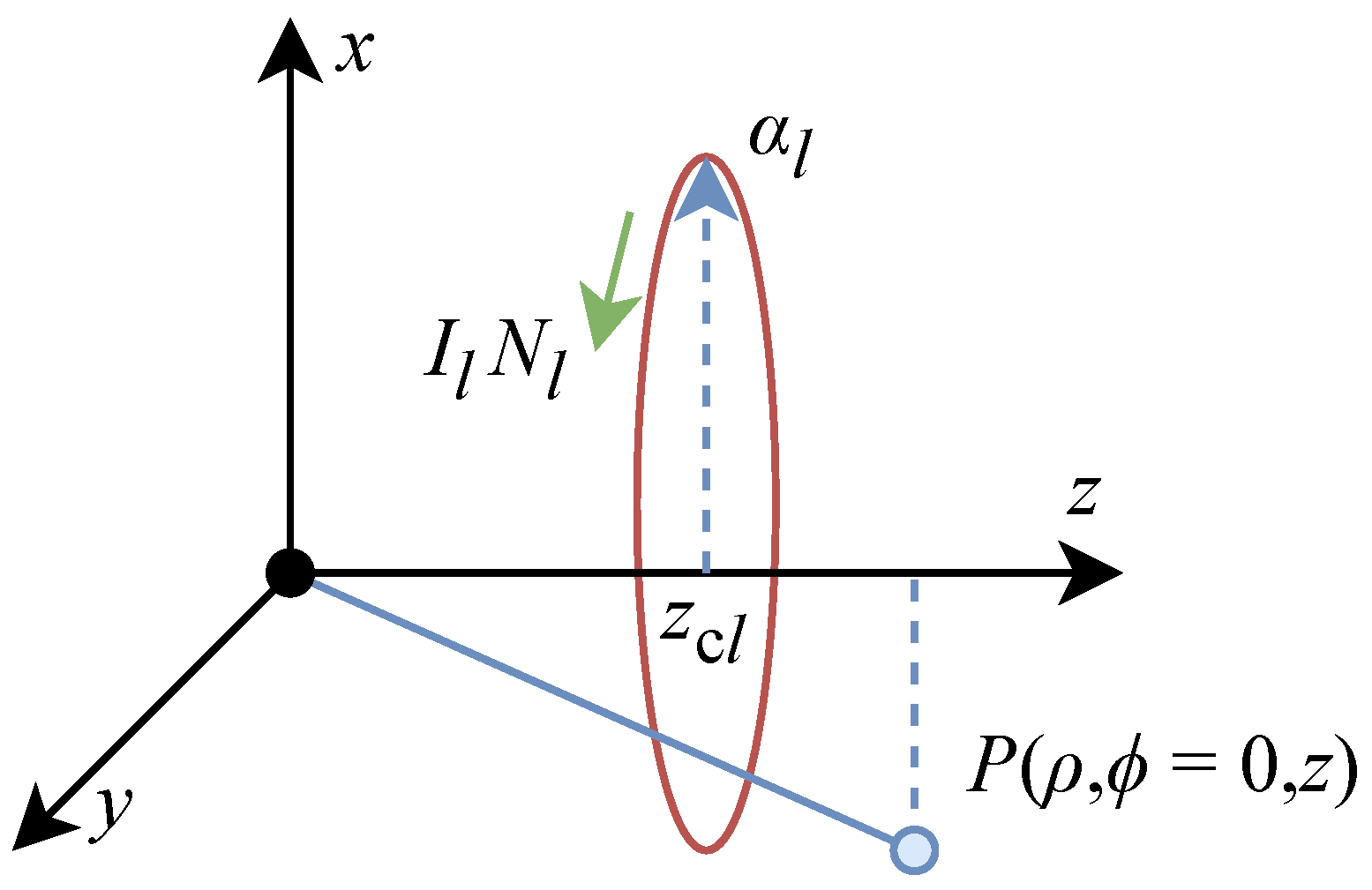
Disclaimer/Publisher’s Note: The statements, opinions and data contained in all publications are solely those of the individual author(s) and contributor(s) and not of MDPI and/or the editor(s). MDPI and/or the editor(s) disclaim responsibility for any injury to people or property resulting from any ideas, methods, instructions or products referred to in the content. |
© 2025 by the authors. Licensee MDPI, Basel, Switzerland. This article is an open access article distributed under the terms and conditions of the Creative Commons Attribution (CC BY) license.