Control of Discrete Fracture Networks on Gas Accumulation and Reservoir Performance: An Integrated Characterization and Modeling Study in the Shahezi Formation


Abstract
1. Introduction
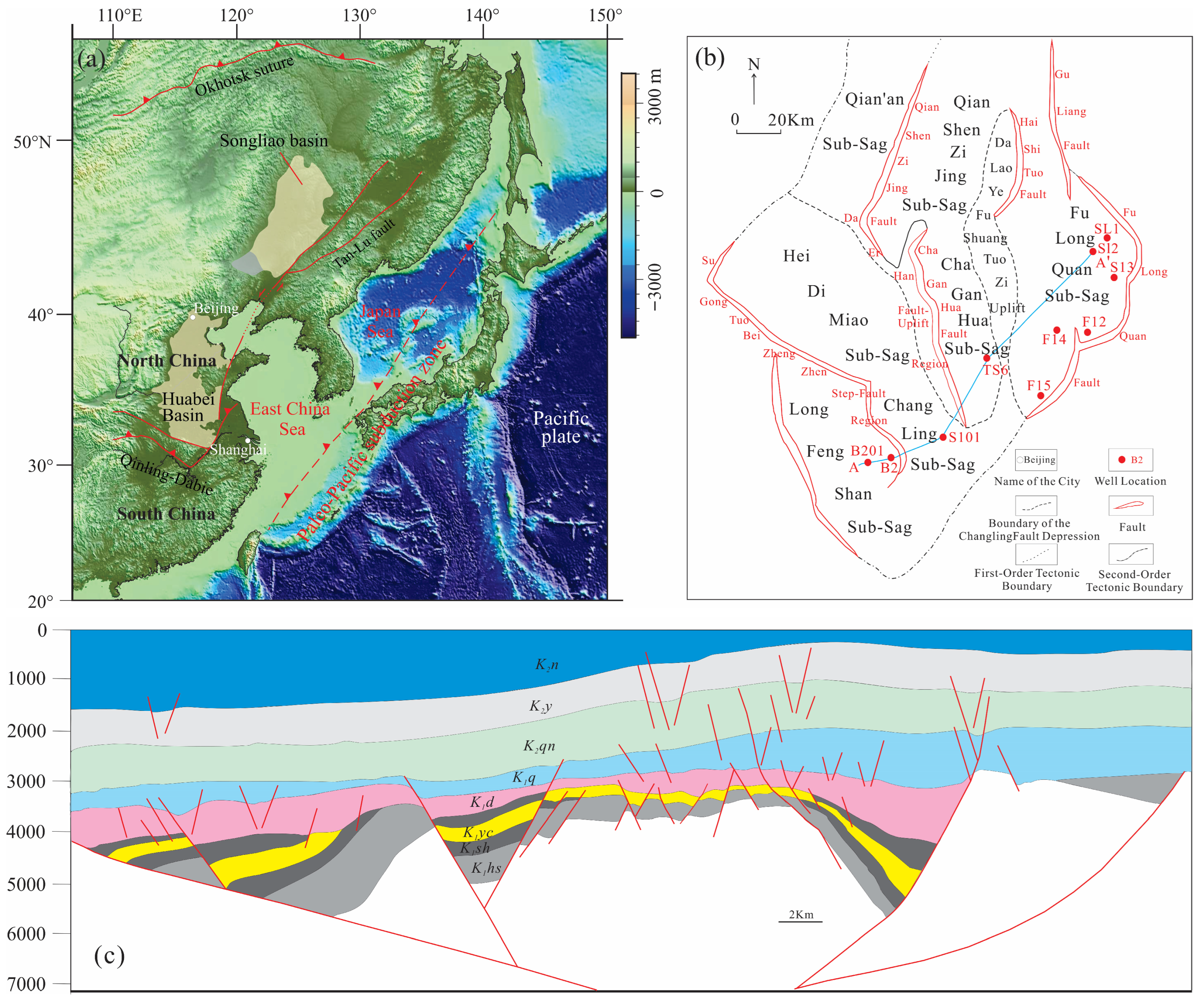
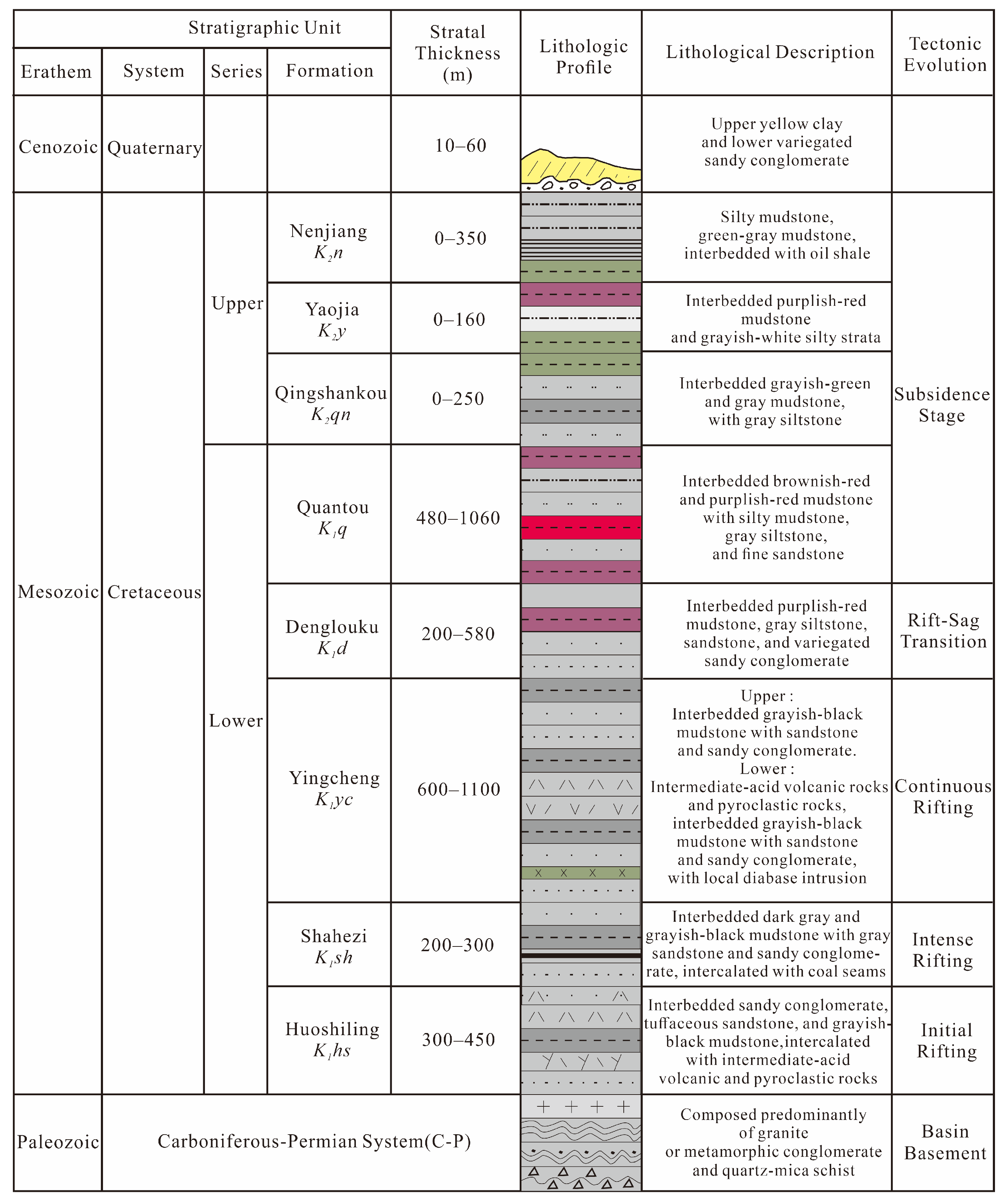
2. Geological Setting
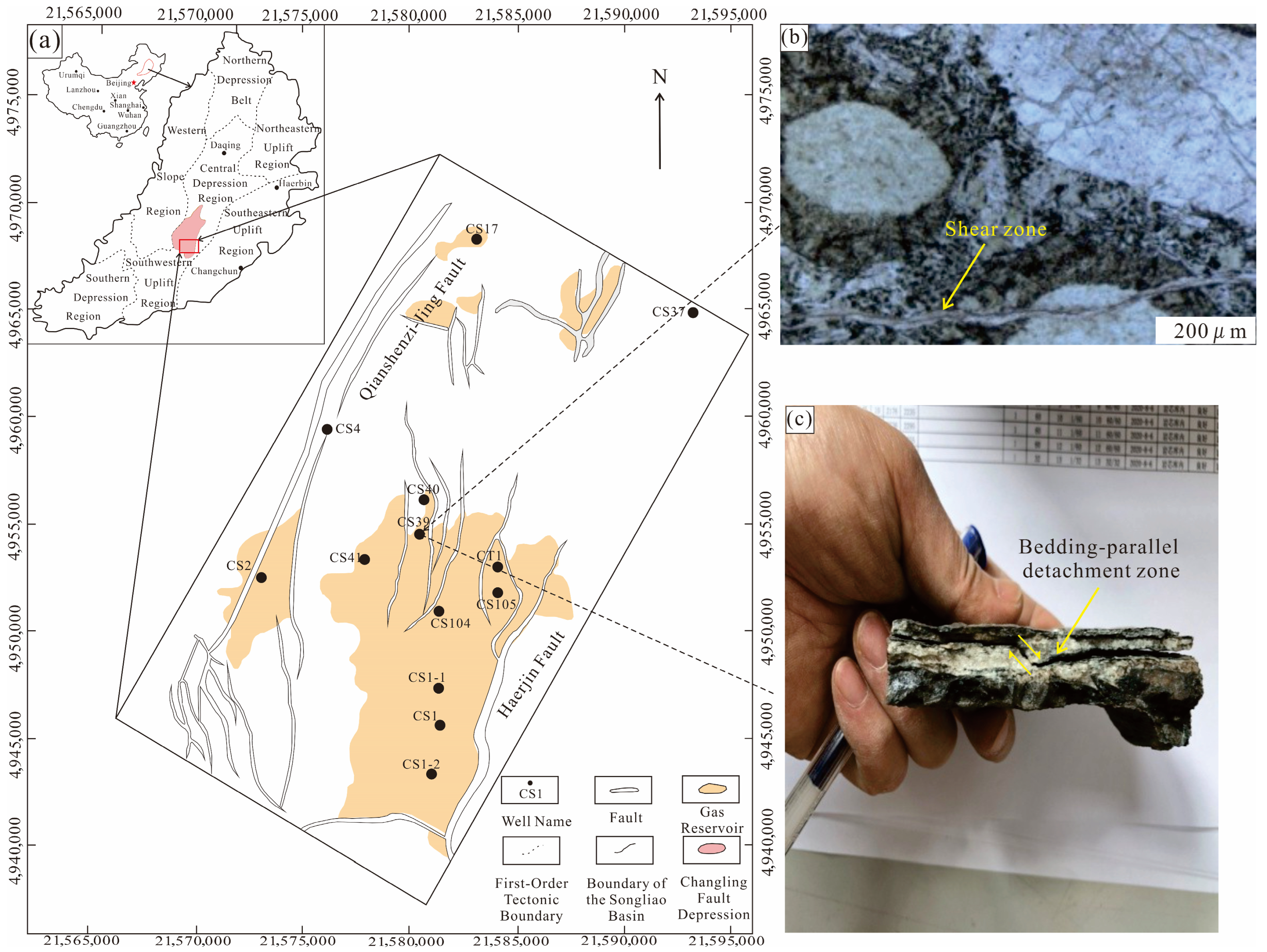
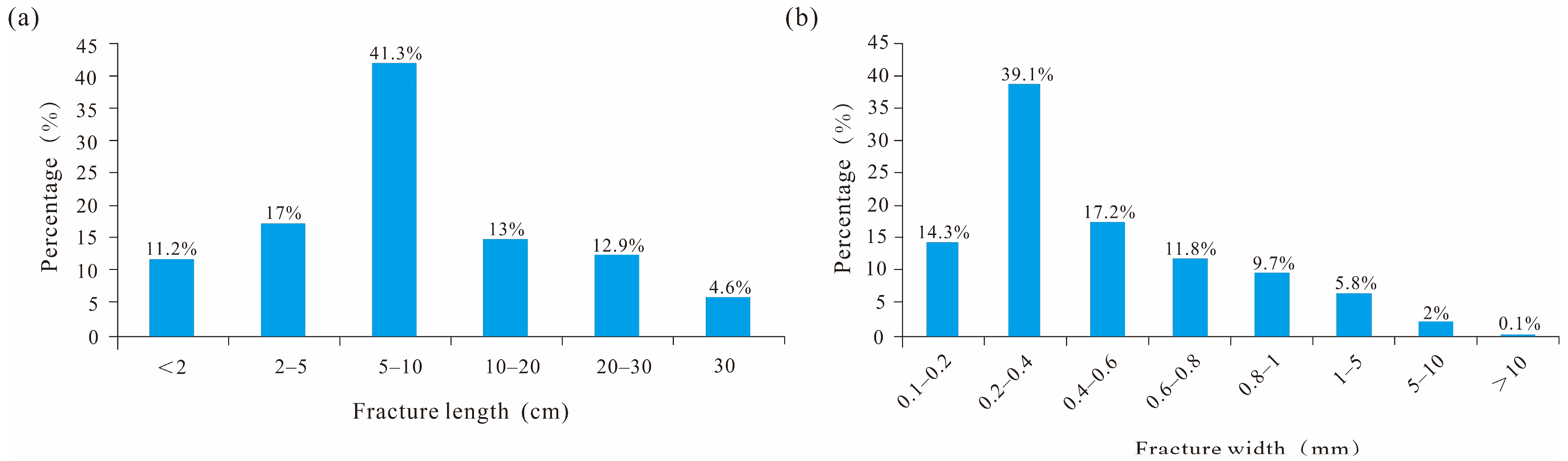
3. Analysis of Fracture Development in the Shahezi Formation
3.1. Parameters for Fracture Characterization
3.2. Fracture Heterogeneity
3.2.1. Spatial Variation
3.2.2. Vertical Variation
3.3. Principal Controlling Factors of Fracture Development
4. Discrete Fracture Network Modeling Within Tectonic Stress Field Constraints
4.1. Numerical Simulation of Tectonic Stress Field
4.1.1. Mathematical Model Construction
- (1)
- Static Equilibrium Equations
- (2)
- Geometric Equations
- (3)
- Constitutive Equations
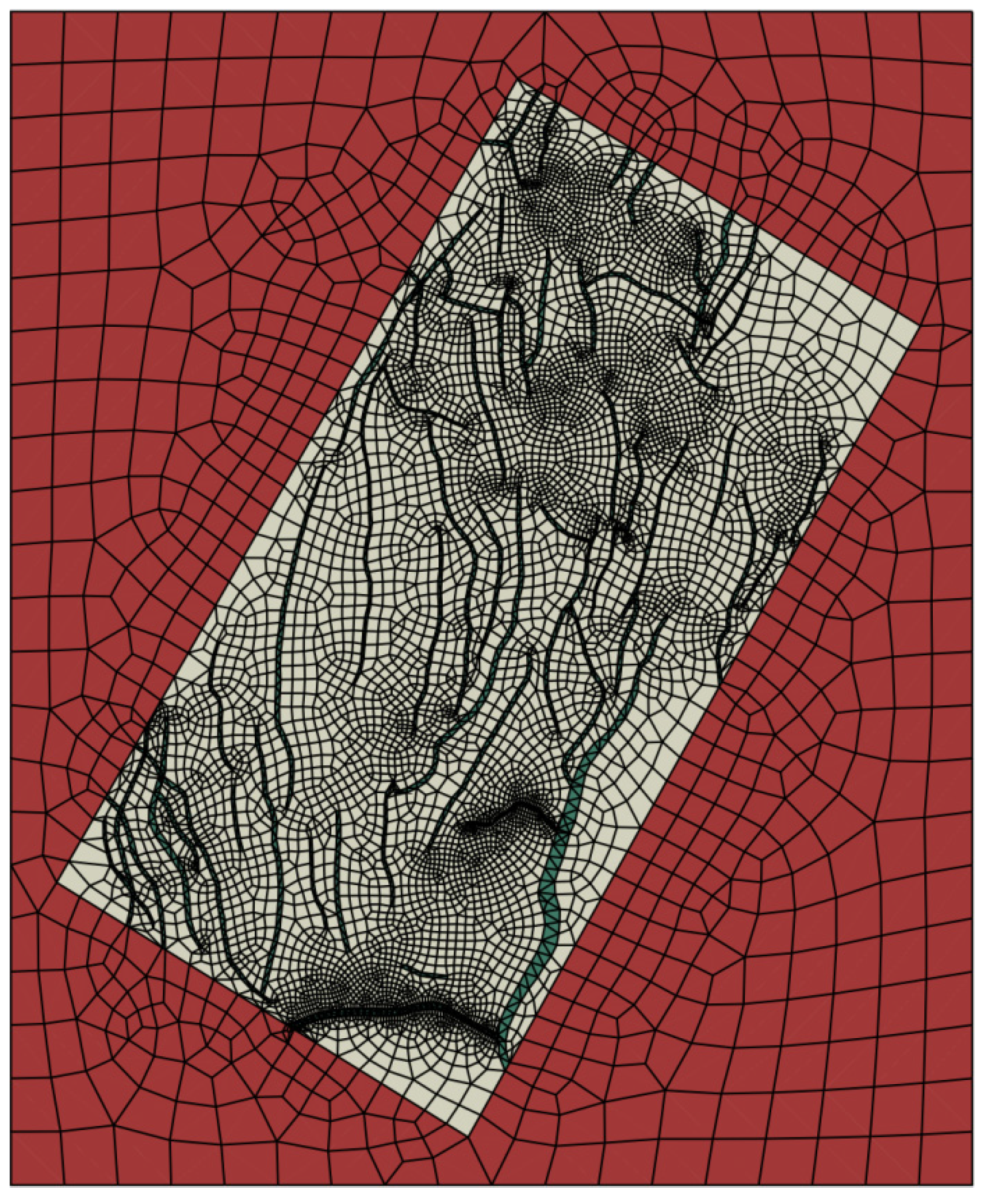
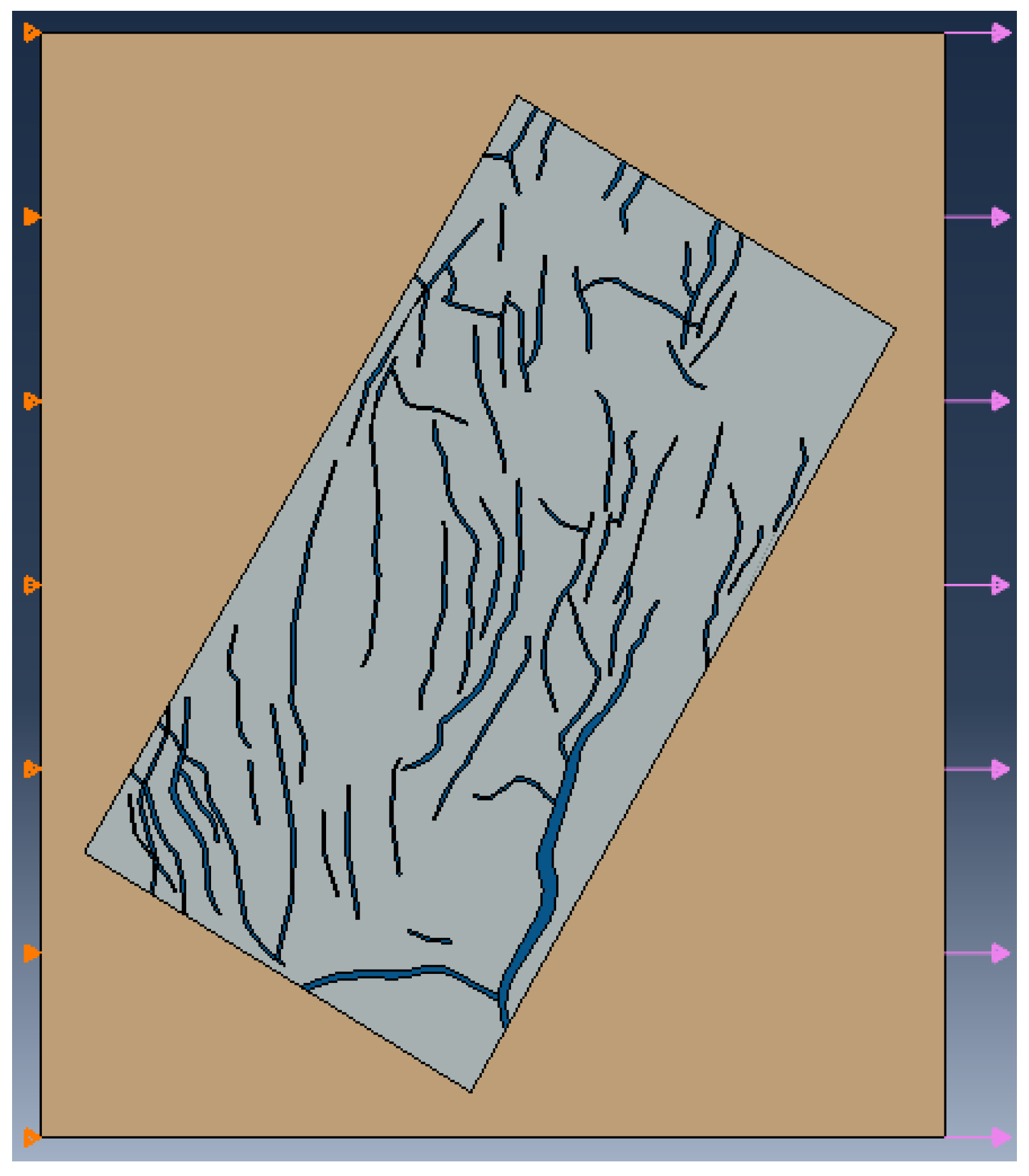
4.1.2. Geological Model Construction
4.1.3. Mechanical Model Construction
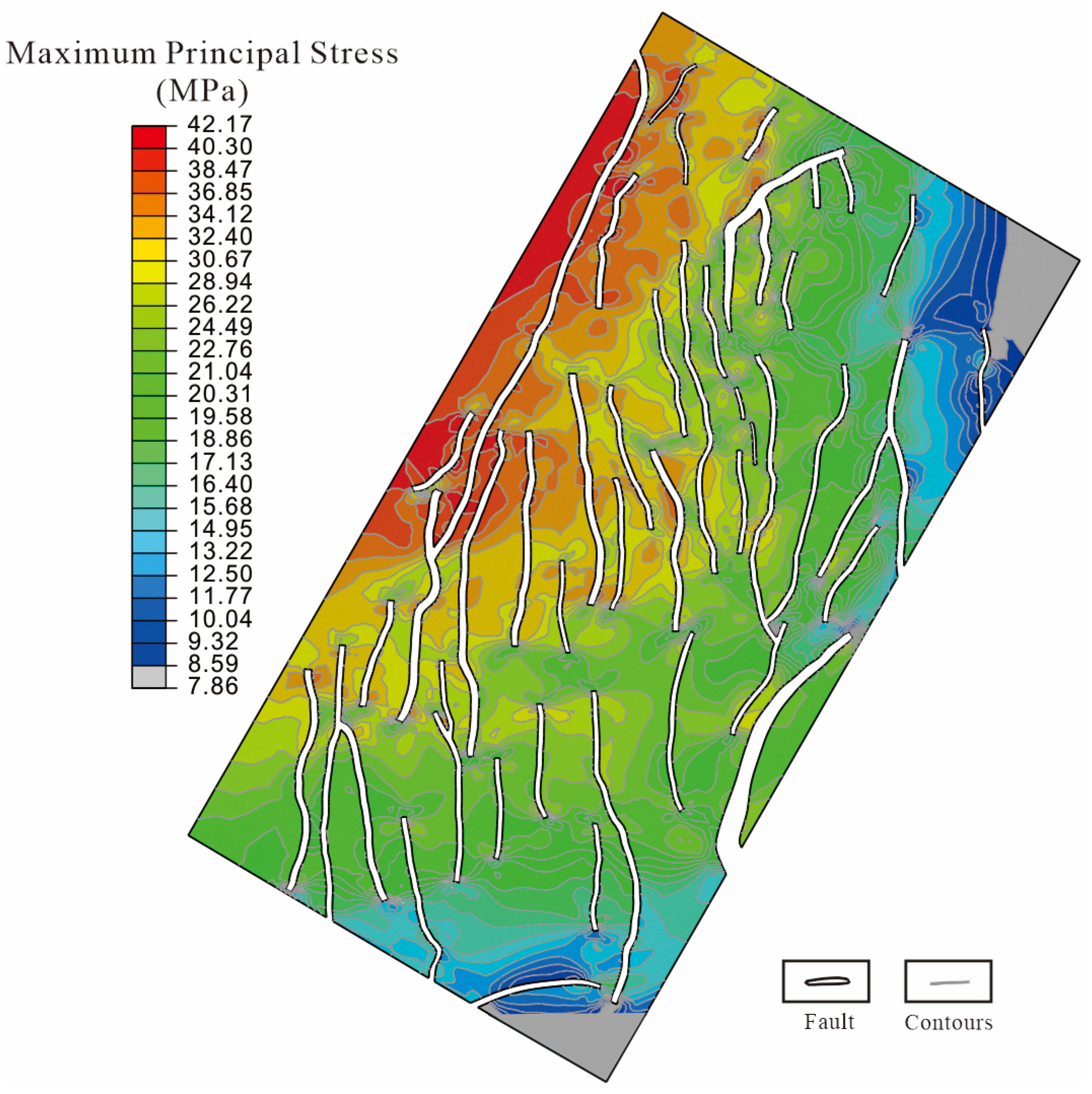
4.2. Analysis of Finite Element Simulation Results
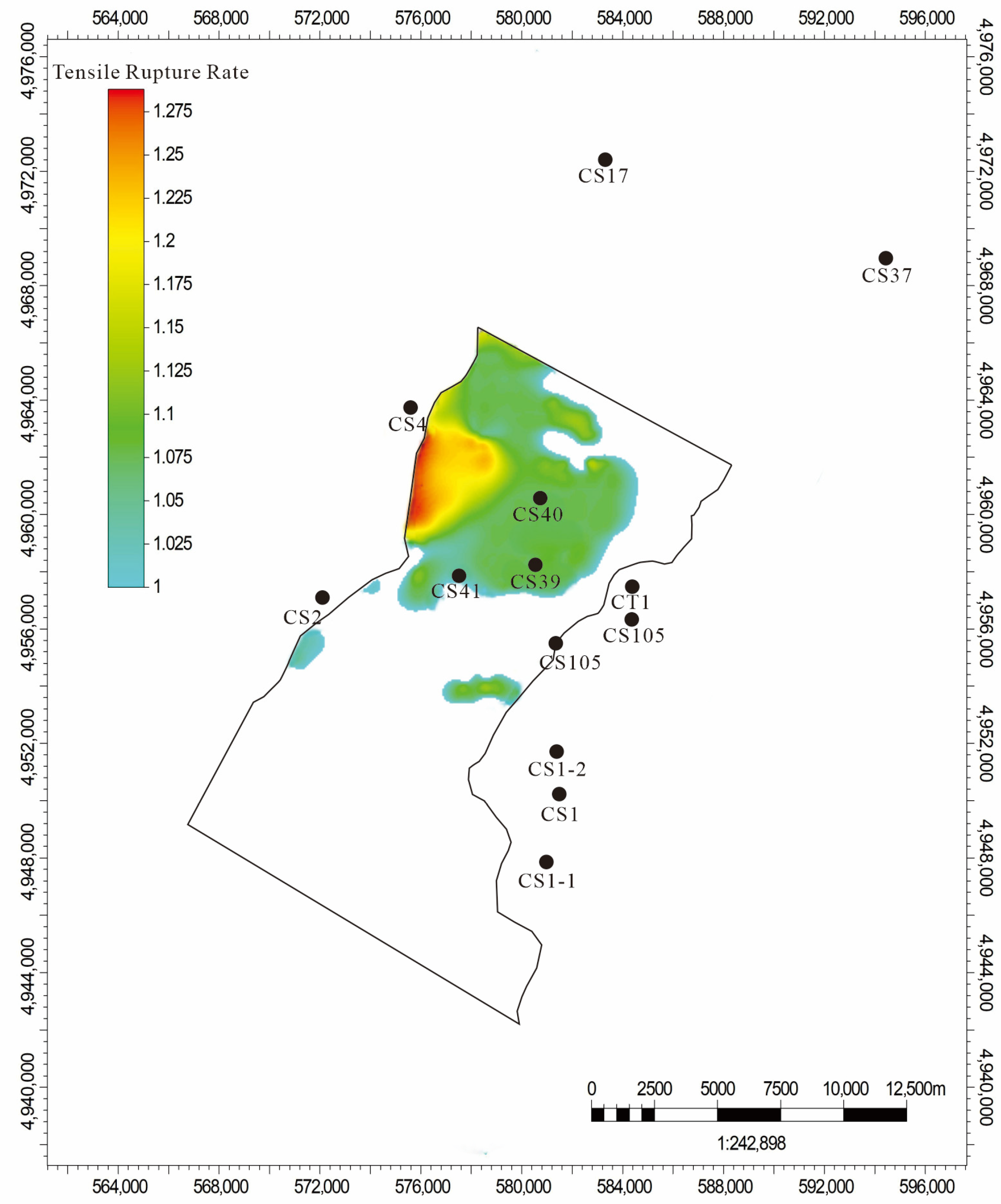
4.3. Delineating Fracture Development Zones Based on Tectonic Stress Field Analysis
- (1)
- Determination of Rock Failure Threshold
- (2)
- Determination of Fracture Development Extent
4.4. Development of a Discrete Fracture Network Model Within Stress Field-Delineated Fracture Zones
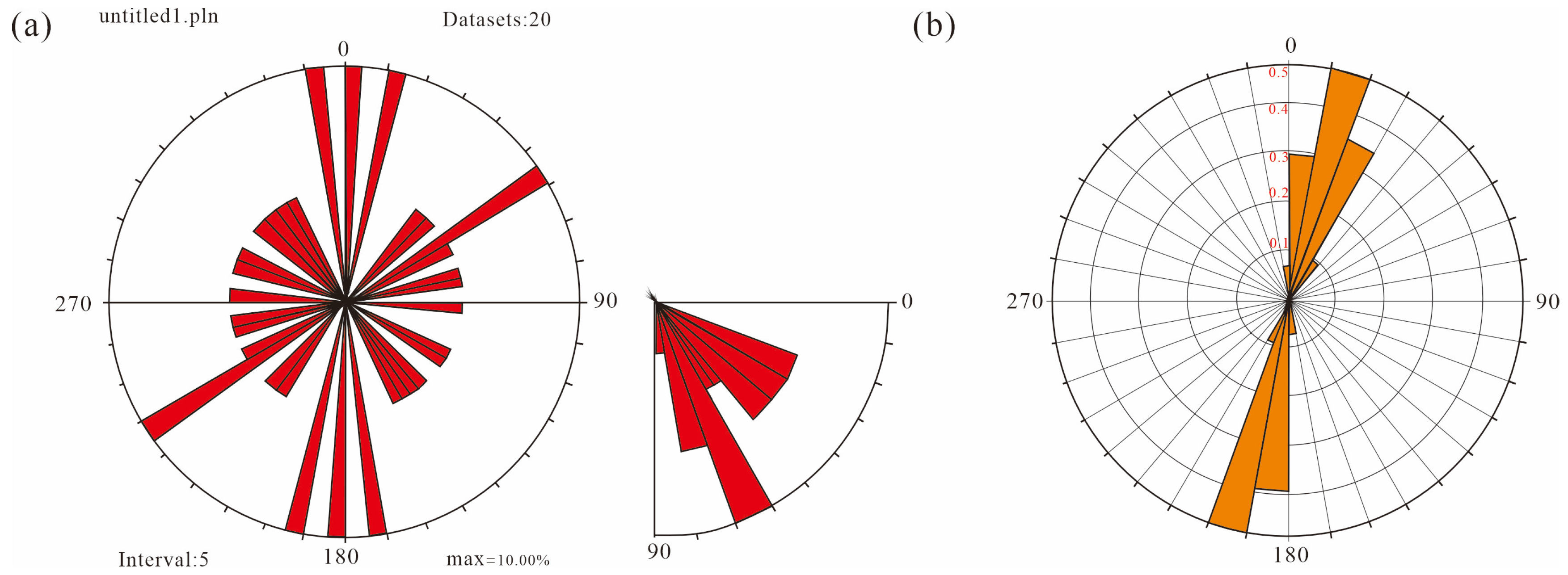
4.4.1. Fracture Attribute Analysis
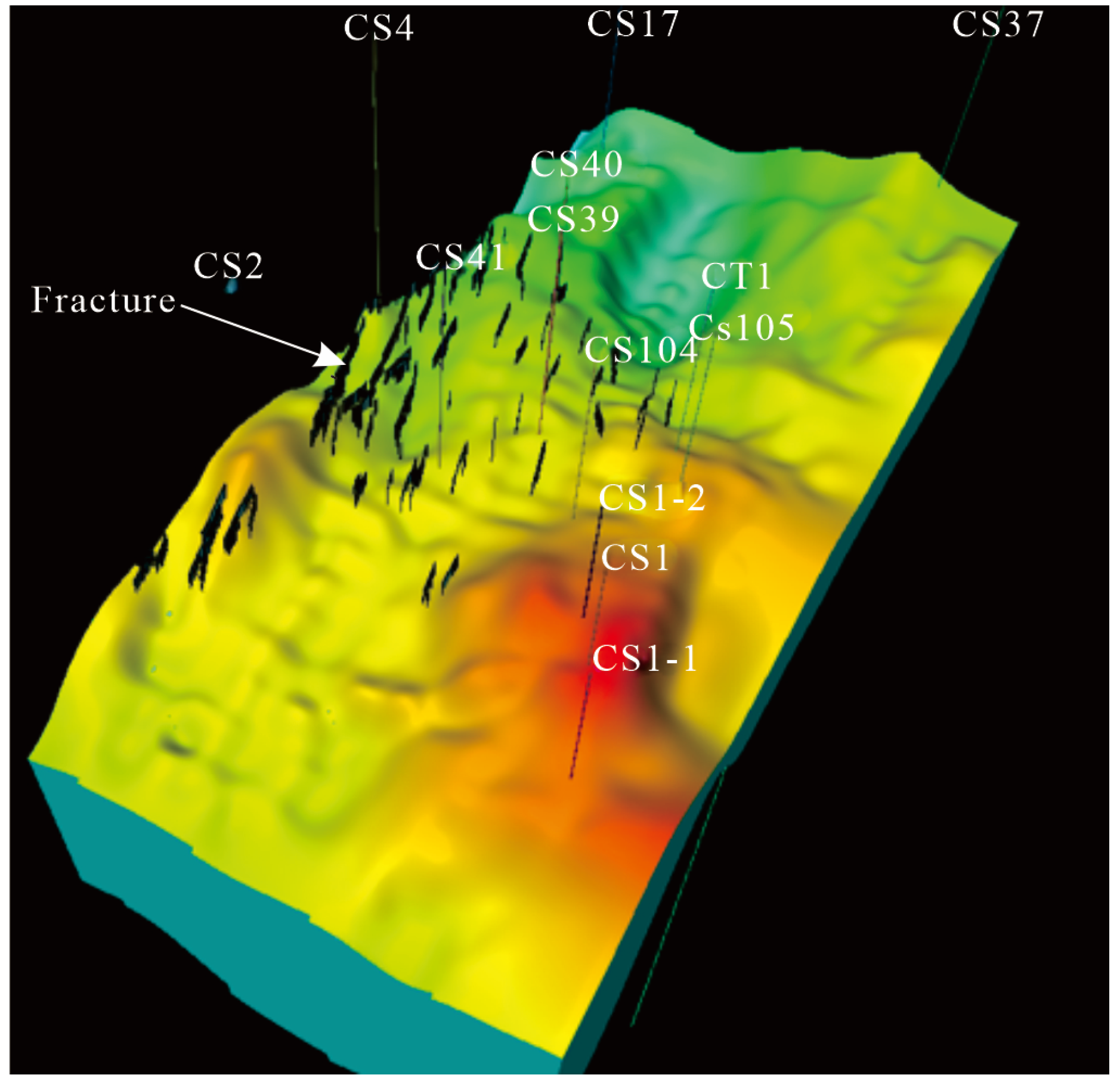
4.4.2. Stochastic Modeling of 3D Fracture Spatial Distribution
5. Contribution of Fractures to Formation Permeability
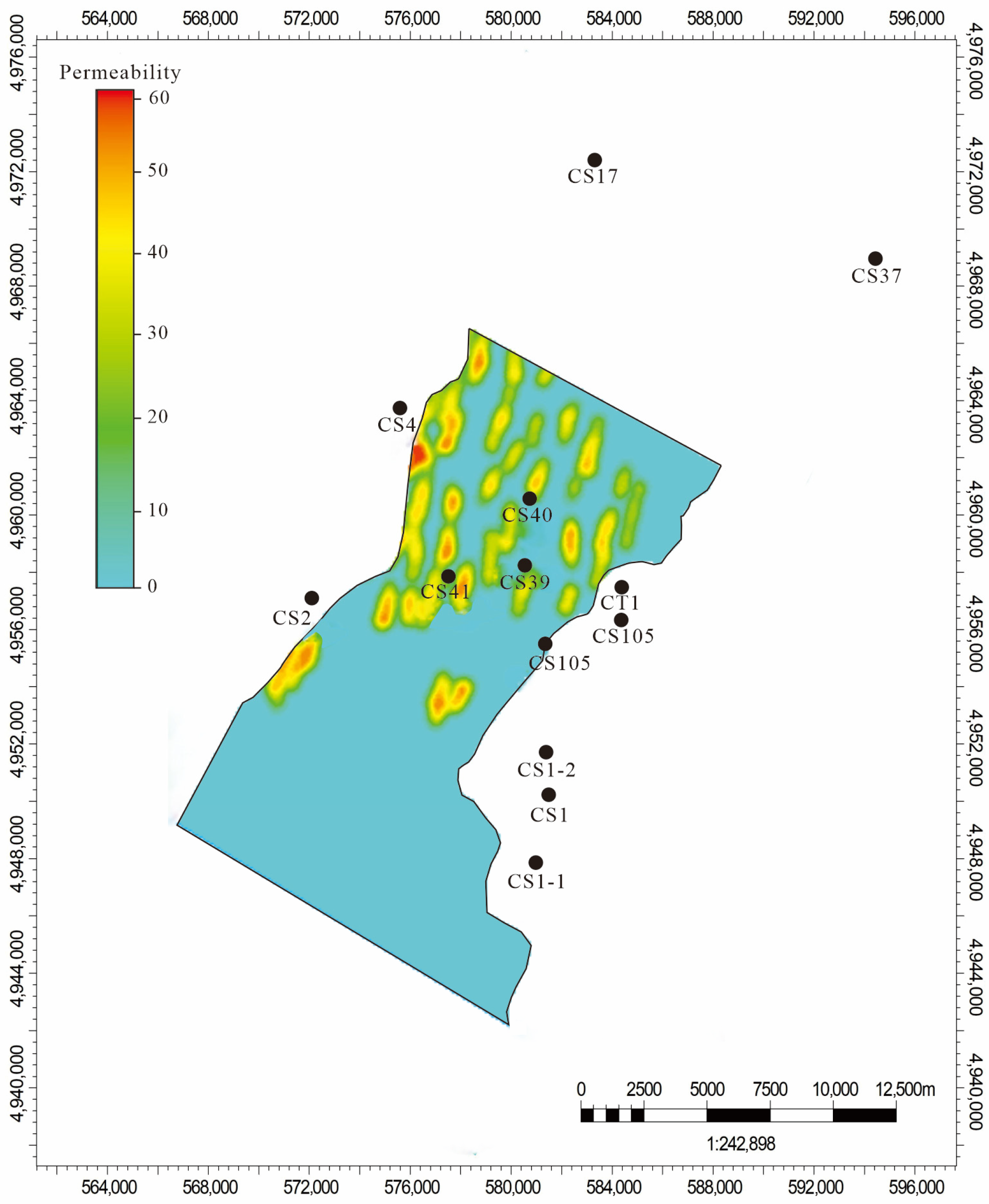
5.1. Analysis of Fracture Permeability Calculation Results
5.2. Criteria for Favorable Target Evaluation
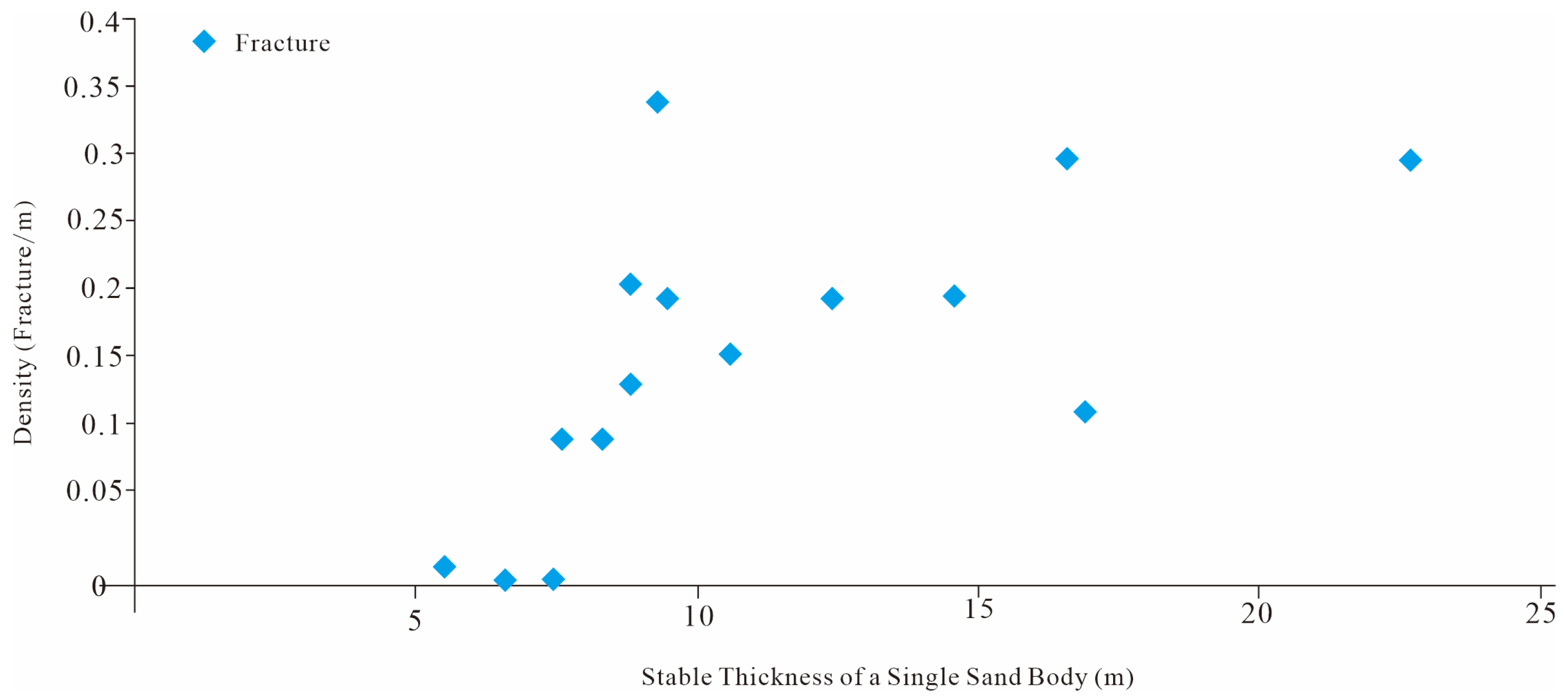
5.2.1. Fracture Density Exceeding 0.1 Fractures per Meter
5.2.2. Sand-Body Thickness Exceeding 5.5 m
5.3. Delineation of Favorable Target Areas
5.4. Discussion and Application
- (1)
- Limitations and uncertainties of integrated reservoir modeling. Core observations and image logs provide complementary constraints on fracture orientation and depth-specific occurrence. Reliable estimates of fracture size, however, remain difficult to obtain. Data incompleteness severely restricts robust statistical characterization of fracture dimensions. Interwell scale fracture attributes, including density, orientation, length, and intersection relationships, exert a primary control on permeability anisotropy. These attributes also govern the development of preferential flow pathways. Paleo-tectonic stress field modeling imposes strong mechanical constraints on dominant fracture orientations and overall development intensity. However, the precise locations and lengths of individual fractures remain inherently stochastic [60,61,62]. As a result, the model produces multiple plausible high-permeability pathways rather than a single unique solution. Therefore, the high-permeability zones identified in this study should be interpreted as probabilistic envelopes. These envelopes delineate the spatial extent of favorable domains rather than representing deterministic predictions that eliminate uncertainty.
- (2)
- The implications of this study for practical reservoir development. This stratigraphic framework clarifies the reservoir-scale impact of fractures within the Shahezi Formation. Favorable fracture-modified zones in the second member are concentrated in the central area, forming an NS-trending belt. Alternatively, they define a broadly favorable corridor spanning the Changshen-39 to Changshen-1 area. From a field-development perspective, the fracture-controlled sweet spots provide a robust geological basis for optimizing well-pattern design. The predicted distribution of high-permeability pathways provides a robust basis for forecasting long-term production behavior. They also help in evaluating the risks and returns of alternative development scenarios. However, further integration is required to translate these insights into refined drilling strategies and optimized hydraulic-fracturing designs.
6. Conclusions
- (1)
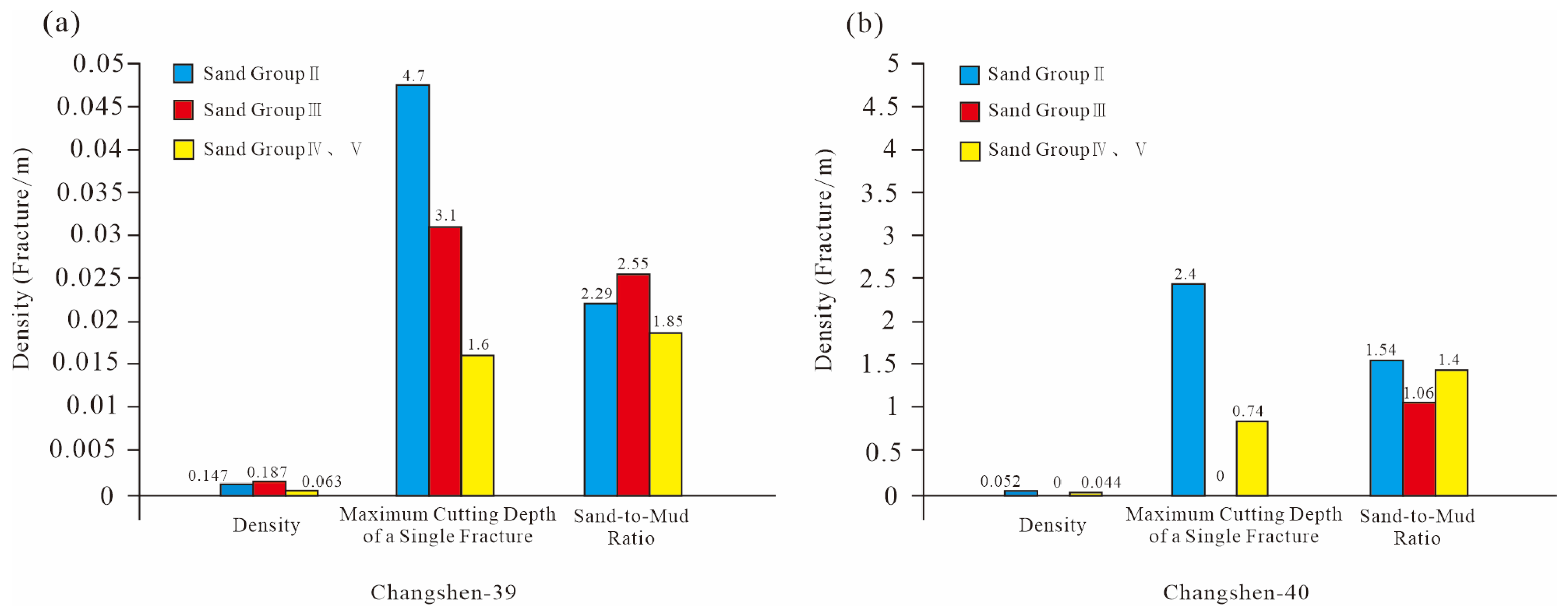
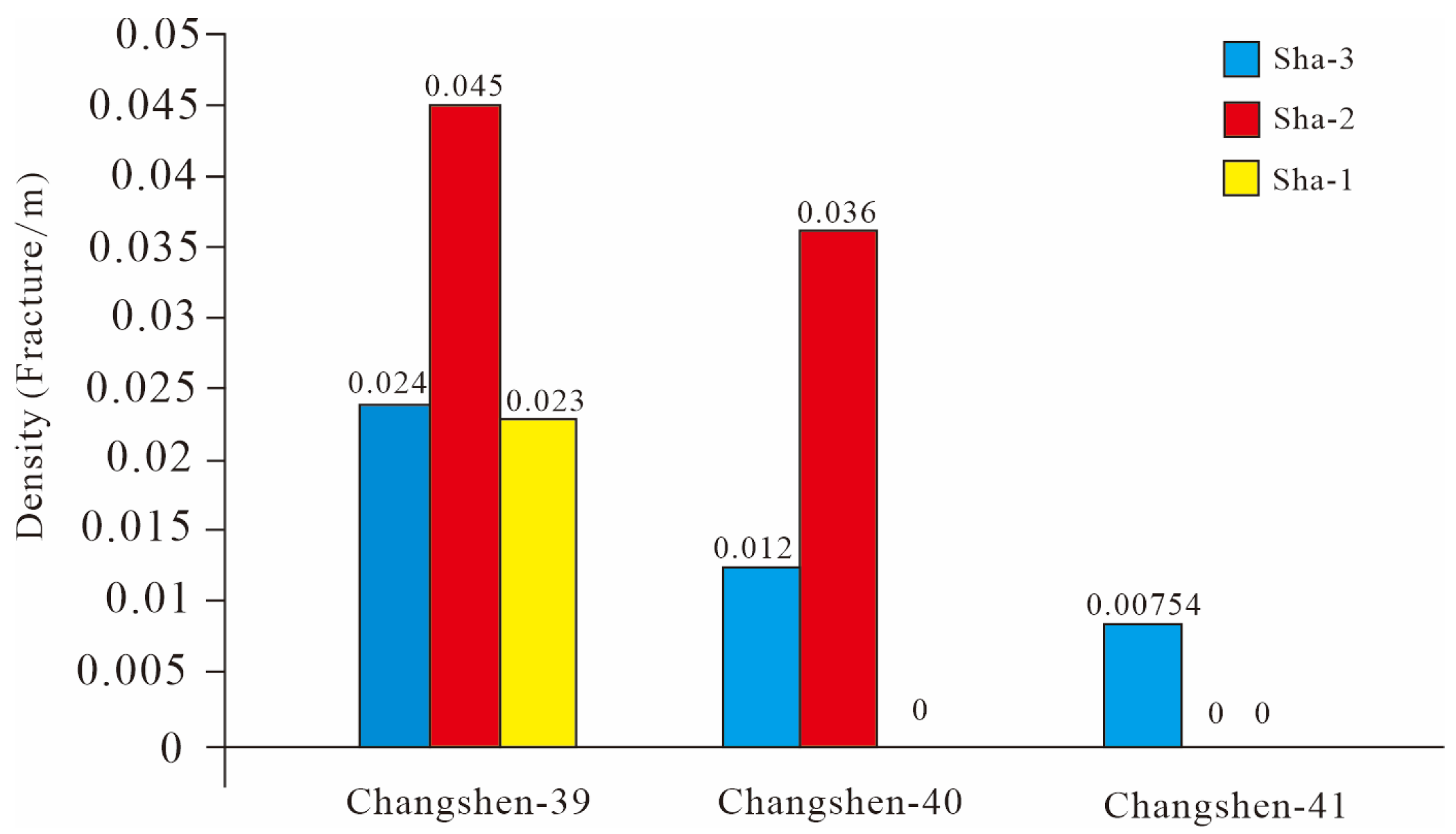
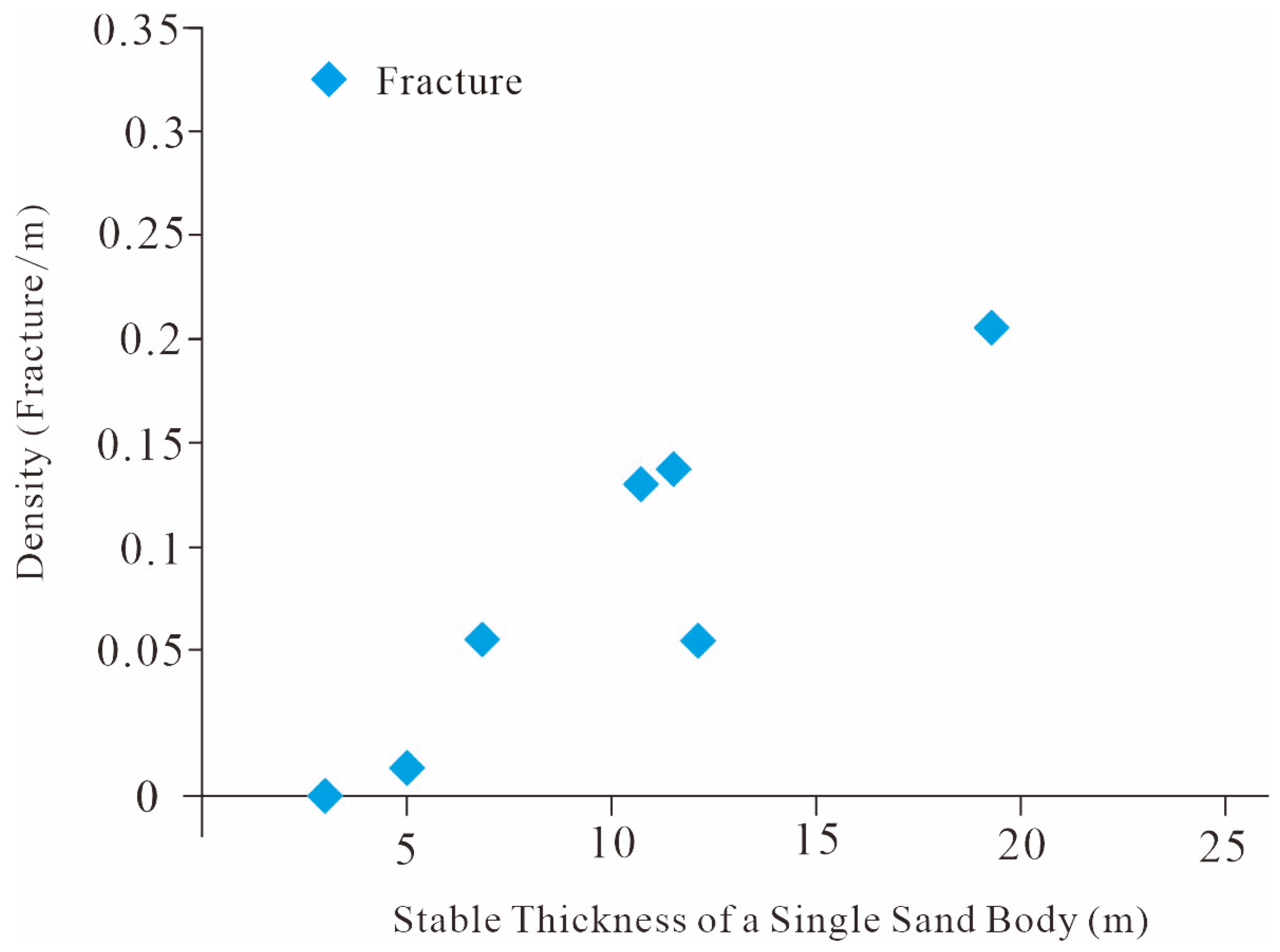
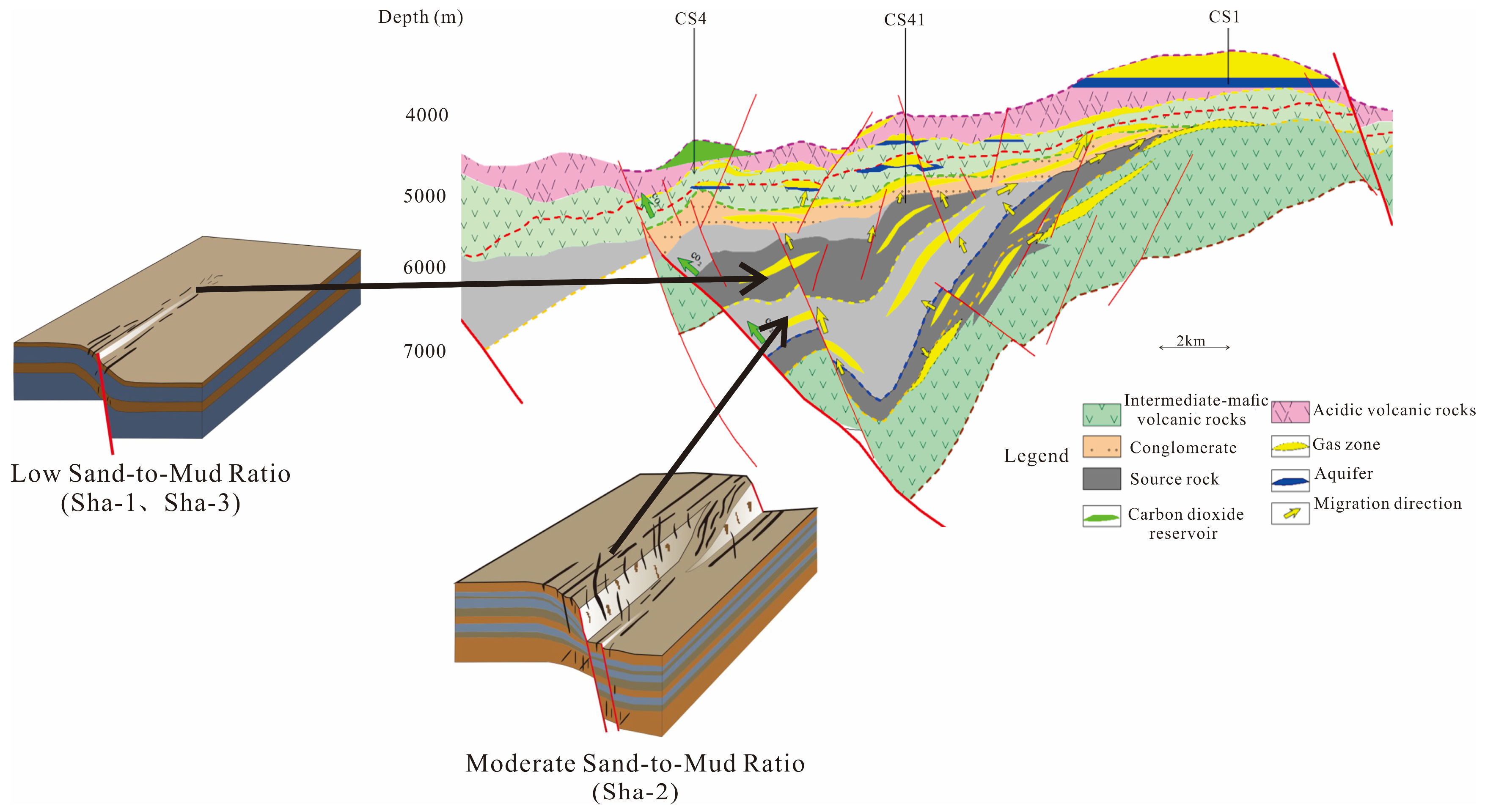
- Building upon conventional core observations and well-log interpretations. This study introduces an innovative centroid dimension method for quantitative fracture characterization, using fracture line density as the key parameter. Our analysis identifies the Sha-2 Member as the dominant fracture interval, hosting both tectonic and bedding-slip fractures shaped by structural stress and lithological contrasts. The fracture system exhibits strong heterogeneity, controlled jointly by fault proximity, sand-mud ratio, and sandstone thickness.
- (2)
- Stress-field simulations bfased on tensile failure rate quantitatively map the distribution of extensional fractures in the Sha-2 Member. The model predicts intense fracturing in the western sector near well Changshen-40, structurally influenced by the Qianshenzijing Fault. Core and log data reveal a more nuanced picture: although tectonic stress is uniformly high, only the tuffaceous sandstone-rich sand group IV develops effective fractures. The more argillaceous sand groups II, III, and V remain poorly fractured. This contrast underscores lithology as the primary control on fracture effectiveness. By integrating one-dimensional well data with two-dimensional simulation outputs, we link different observational scales. The differences in lithology determine how stress responds in specific strata and control whether fractures can form effective flow pathways. They ultimately govern the precise locations of fracture development and the microscopic heterogeneity.
- (3)
- Using an improved Baecher model, we constructed a discrete fracture network (DFN) coupled with finite element flow simulation to derive permeability fields and evaluate reservoir fluid conductivity. Results show that high-permeability zones are confined to the central Qianshenzijing Fault belt, fading southward and disappearing eastward. The DFN model clarifies a critical discrepancy: although fault activity induces widespread fracturing, the high mudstone content of the Sha-2 Member restricts fracture aperture and connectivity. Consequently, high fracture density does not translate into high permeability. This emphasizes lithology as the decisive factor in fracture-based reservoir performance. In summary, fault systems create the structural potential for fracture development, but lithology ultimately determines reservoir effectiveness. This integrated methodology transcends the limitations of single-scale observations, delivering a system-level understanding of fracture network architecture. It thereby establishes a rigorous, quantitative framework. This framework is used to identify productive fracture corridors in fault-depression basins and to optimize the development of tight gas reservoirs in the Changling Fault Depression.
Author Contributions
Funding
Institutional Review Board Statement
Informed Consent Statement
Data Availability Statement
Conflicts of Interest
References
- Shen, H.; Hu, J.; Yang, G.; Yang, L.; Shao, M.L.; Yang, K.S.; Wang, Y.H. Accumulation characteristics and exploration potential of tight oil and gas in southern Songliao Basin. Acta Pet. Sin. 2025, 46, 61–76. [Google Scholar] [CrossRef]
- Ding, W.L.; Wang, X.H.; Hu, Q.J.; Yin, S.; Cao, X.Y.; Liu, J.J. Progress in tight sandstone reservoir fractures research. Adv. Earth Sci. 2015, 30, 737–750. [Google Scholar] [CrossRef]
- Yu, S.Q.; Li, L.; Shi, G.Y.; Cao, Z.; He, X.Y. Fracture development and evolution characteristics of low permeability sandstone reservoirs. Chin. J. Geol. 2021, 56, 109–120. [Google Scholar]
- Nelson, R.A. Geologic Analysis of Naturally Fractured Reservoirs; Gulf Professional Publishing: Houston, TX, USA, 1985. [Google Scholar]
- Laubach, S.E.; Olson, J.E.; Gross, M.R. Mechanical and fracture stratigraphy. AAPG Bull. 2009, 93, 1413–1426. [Google Scholar] [CrossRef]
- Ellis, M.A.; Laubach, S.E.; Eichhubl, P.; Olson, J.E.; Hargrove, P.; Fall, A. Fracture development and diagenesis of Torridon Group Applecross Formation, near An Teallach, NW Scotland: Millennia of brittle deformation resilience? J. Geol. Soc. 2012, 169, 297–310. [Google Scholar] [CrossRef]
- Geng, B.; Zhou, D.Z.; Wang, M.; Wang, Y.G.; Wang, S.J.; Meng, L.; Zhang, Y.Y. Development and prospects of logging evaluation technologies for reservoirs in Shengli Oilfield. Pet. Geol. Recovery Effic. 2024, 31, 184–195. [Google Scholar] [CrossRef]
- Yin, S.; Zhang, Z.Y.; Wang, R.Y.; Liu, H.L.; Xu, Z.Q.; Wang, M.J.; Liu, Y.; Liu, J.S.; Xu, K.; Ju, W.; et al. Advances, challenges and prospects of reservoir geomechanics for deep/ultra-deep oil and gas exploration in China. Nat. Gas Ind. 2025, 45, 33–47. Available online: http://kns.cnki.net/kcms/detail/51.1179.TE.20250320.1657.002.html (accessed on 31 March 2025).
- Dai, J.; Wang, B. Integrated methods for identification and prediction of reservoir fractures. Pet. Geol. Recovery Effic. 2003, 10, 1–2+8–5. [Google Scholar]
- Zhou, X.G.; Deng, H.W.; Cao, C.J.; Yuan, J.Y.; Mao, X.C.; Xiao, Y.R. Quantitative prediction and evaluation methods of reservoir structural fractures. Acta Geosci. Sin. 2003, 24, 175–180. [Google Scholar]
- Pu, J.; Qin, Q. A summary of fracture prediction methods for oil and gas reservoirs. Spec. Oil Gas Reserv. 2008, 15, 9–13+106. [Google Scholar]
- Yang, H.J.; Li, Y.; Tang, Y.G.; Lei, G.L.; Zhou, P.; Zhou, L.; Xu, A.M.; Huan, Z.P.; Zhu, W.H.; Chen, W.L.; et al. Accumulation conditions and key exploration and development technologies for Keshen gas field in Tarim Basin. Acta Pet. Sin. 2021, 42, 399–414. [Google Scholar] [CrossRef]
- Li, X.; Qin, R. Method of fracture characterization and productivity prediction of 19-6 buried-hill fractured reservoirs, Bohai Bay Basin. Earth Sci. 2023, 48, 475–487. [Google Scholar]
- Dong, H.; Yang, J.G.; Wu, G.Q.; Ma, K.; Li, X. Digital core technology-based microstructure characteristics and main controlling factors of continental shale oil: A case study of shale in Cretaceous Qingshankou Formation in Songliao Basin. Geol. Resour. 2021, 30, 377–384. [Google Scholar] [CrossRef]
- Sun, Z.L.; Li, Z.M.; Shen, B.J.; Zhu, Q.M.; Li, C.X. NMR technology in reservoir evaluation for shale oil and gas. Pet. Geol. Exp. 2022, 44, 930–940. [Google Scholar] [CrossRef]
- Shao, G.Y.; Xiong, W.; Shen, R.; Yang, Y.; Shang, Z.H.; Wang, G.D.; Yu, H. Application progress of CT scanning technology in characterization of shale oil and gas reservoir microstructure. Appl. Chem. Ind. 2023, 52, 1785–1789+1799. [Google Scholar] [CrossRef]
- Huang, J.X.; Peng, S.M.; Wang, X.J.; Xiao, K. Application of imaging logging data in the study of fractures and in-situ stress. Acta Pet. Sin. 2006, 27, 65–69. [Google Scholar]
- Qian, S.; Yang, Z.; Xu, C. Logging evaluation methods of low-organic matter fault-block shale oil in the Subei Basin and their application. Pet. Reserv. Eval. Dev. 2025, 15, 19–27+39. [Google Scholar] [CrossRef]
- Fiallos, M.; Morales, A.; Yu, W.; Miao, J.J. Characterization of complex hydraulic fractures in Eagle Ford shale oil development through embedded discrete fracture modeling. Pet. Explor. Dev. 2021, 48, 613–619. [Google Scholar] [CrossRef]
- Deng, P.; Wei, G.; Yang, Y. Establishment and application of geological mathematical models in quantitative prediction of reservoir tectonic fractures. Nat. Gas Geosci. 2006, 17, 480–484. [Google Scholar]
- Wei, Y.S.; Wang, J.L.; Yu, W.; Qi, Y.D.; Miao, J.J.; Yuan, H.; Liu, C.X. A smart productivity evaluation method for shale gas wells based on 3D fractal fracture network model. Pet. Explor. Dev. 2021, 48, 787–796. [Google Scholar] [CrossRef]
- Tang, Y.; Xiao, A.; Tang, W.; Ke, W.; Zeng, F. Stochastic fracture simulation based on three-dimensional laser scan technology: A case study of Kuqa River outcrop in Kuqa Depression. Earth Sci. 2023, 48, 640–656. [Google Scholar]
- Zhang, Z.; Meng, P.; Yang, W.; Zhang, X.L.; Huang, Q.; Wang, H.R. Characterization of braided river reservoir architecture based on seismic attribute stacking ensemble learning: A case study of the C-2 Oilfield in the Bohai Bay Basin. Pet. Reserv. Eval. Dev. 2025, 15, 64–72. [Google Scholar] [CrossRef]
- Sun, X. Post-stack fracture prediction technology for shale gas reservoirs based on well-seismic integration in Nanchuan area. Pet. Reserv. Eval. Dev. 2022, 12, 462–467. [Google Scholar]
- Wu, L.; Zhu, M.; Feng, X.Q.; Ji, D.S.; Zhou, L.; Liu, S.X.; Zhang, L.Y.; Tan, Y.L.; Qian, Z.L.; Yang, Z. Interpretation of tectonic stress field and structural deformation in Sikeshu Sag, Junggar Basin. Acta Pet. Sin. 2022, 43, 494–506. [Google Scholar] [CrossRef]
- Zeng, L.B.; Lyu, P.; Qu, X.F. Multi-scale fractures in tight sandstone reservoirs with low permeability and geological conditions of their development. Oil Gas Geol. 2020, 41, 449–454. [Google Scholar]
- Liu, P.B.; Pu, R.H.; Liu, J.X. Study on sedimentary microfacies and reservoir identification from the Huoshiling Formation to the Yingcheng Formation in Shiwu Fault Depression. Oil Geophys. Prospect. 2009, 44, 347–353. [Google Scholar]
- Yan, Y.M.; Liu, S.F.; Pan, F.; Wu, J.; Qi, P.W. Study on basement faults in Shiwu Fault Depression, southern Songliao Basin based on high-precision gravity and magnetic data. Geoscience 2011, 25, 122–128. [Google Scholar]
- Dong, S.Q.; Zeng, L.B.; Cao, H.; Xu, C.S.; Wang, S.J. A discrete fracture network modeling method constrained by fracture density and its application. Geol. Rev. 2018, 64, 1302–1314. [Google Scholar]
- Wang, K.; Zhang, R.; Li, B.; Wang, J.; Song, B.; Zeng, Q.; Zhang, Z.; Huang, Q. Characteristics and geological modeling of structural fractures in tight sandstone reservoir: Taking Dabei-12 gas reservoir in Kuqa Depression, Tarim Basin as an example. Mar. Orig. Pet. Geol. 2023, 28, 72–82. [Google Scholar]
- Shu, L.; Mu, Y.; Wang, B. Petroleum-bearing strata and structural characteristics of the Songliao Basin. J. Stratigr. 2003, 27, 340–347. [Google Scholar]
- Gao, R.; Cai, X. Formation Conditions and Distribution Patterns of Oil and Gas Fields in the Songliao Basin; Petroleum Industry Press: Beijing, China, 1997. [Google Scholar]
- Zhang, W.; Li, H.; Li, M. Deep structural characteristics and natural gas accumulation in the Changling Fault Depression of southern Songliao Basin. Geoscience 2008, 22, 592–598. [Google Scholar]
- Qiu, L.; Yan, D.P.; Xu, H.; Shi, H.; Dong, W.; Sun, S. Late Cretaceous mud volcanism in the southwestern Songliao basin records slab rollback of the subducted paleo-Pacific Plate underneath NE China. J. Asian Earth Sci. X 2020, 3, 100028. [Google Scholar] [CrossRef]
- Fang, L.M.; Li, Y.X.; Yin, J.Y.; Chen, J.L. Characteristics and formation mechanism of inversion structures at the end of rift stage in Songliao Basin. Oil Geophys. Prospect. 2003, 38, 190–193. [Google Scholar]
- Yu, W.; Dong, Q.; Zhou, L.; Zhang, Y.; Li, G.; Zhui, J. Action of reversal fault structure on sandstone-type uranium mineralization in the south of Songliao Basin. Uranium Geol. 2008, 24, 195–200. [Google Scholar]
- Cai, Q.S.; Hu, M.Y.; Ngia, N.R.; Hu, Z.G. Sequence stratigraphy, sedimentary systems and implications for hydrocarbon exploration in the northern Xujiaweizi Fault Depression, Songliao Basin, NE China. J. Pet. Sci. Eng. 2017, 152, 471–494. [Google Scholar] [CrossRef]
- Lai, J.; Xiao, L.; Zhao, X.; Zhao, F.; Li, Y.H.; Zhu, S.F.; Wang, G.W.; Liu, H.K. Genesis and logging evaluation methods of deep-ultradeep high-quality clastic reservoirs: A case study of Cretaceous Bashijiqike Formation in Kuqa Depression. Acta Pet. Sin. 2023, 44, 612–625. [Google Scholar]
- Chen, J.; Zhang, Q.L.; Wang, L.S.; Xie, G.A.; Xu, S.Y.; Bi, S.P.; Ge, R.F. Tectonic Transformation of Changling Fault Depression in the Southern Songliao Basin and Its Significance of Hydrocarbon Accumulation. Acta Geol. Sin. 2008, 82, 1027–1035. [Google Scholar]
- Xu, H.D.; Wang, S.F.; Chen, K.Y. Fundamentals of Seismic Stratigraphy Interpretation; China University of Geosciences Press: Wuhan, China, 1990. [Google Scholar]
- Yu, K.; Hou, H.B.; Guo, N.F.; He, X.H. Petroleum and Natural Gas Geology in the Faulted Sequence of the Southern Songliao Basin; Petroleum Industry Press: Beijing, China, 2002. [Google Scholar]
- Florez-Nino, J.M.; Aydin, A.; Mavko, G.; Antonellini, M.; Ayaviri, A. Fault and fracture systems in a fold and thrust belt: An example from Bolivia. AAPG Bull. 2005, 89, 471–493. [Google Scholar] [CrossRef]
- Dershowitz, W.S.; Einstein, H.H. Characterizing rock joint geometry with joint system models. Rock Mech. Rock Eng. 1988, 21, 21–51. [Google Scholar] [CrossRef]
- Gudmundsson, A. Rock Fractures in Geological Processes; Cambridge University Press: Cambridge, UK, 2011. [Google Scholar]
- Xi, X.; Feng, Z.M.; Yang, S.T.; Ning, Z.G.; Pan, J.L.; Zhang, L.M.; Yin, Z.Q.; Cai, M.F. Nanoindentation-based random field model for fracture of heterogeneous rock. Rock Mech. Rock Eng. 2025, 58, 5185–5205. [Google Scholar] [CrossRef]
- Santos, R.; Miranda, T.; Barbosa, J.; Gomes, I.; Matos, G.; Gale, J.; Neumann, V.; Guimarães, L. Characterization of natural fracture systems: Analysis of uncertainty effects in linear scanline results. AAPG Bull. 2015, 99, 2203–2219. [Google Scholar] [CrossRef]
- Wu, M.; Yang, F.L. Application of tectonic stress field forward and inverse modeling in volcanic fracture reservoir prediction. In Proceedings of the 26th Annual Meeting of the Chinese Geophysical Society and 13th Academic Conference of the Seismological Society of China, Ningbo, China, 16–19 October 2010; Tongji University Press: Shanghai, China, 2010; p. 634. [Google Scholar]
- Ladanyi, B.; Archambault, G. Simulation of shear behavior of a jointed rock mass. In Proceedings of the 11th U.S. Symposium on Rock Mechanics (USRMS), Berkeley, CA, USA, 16–19 June 1969. [Google Scholar]
- Zhang, Y. Numerical simulation study of discrete fracture network models for fractured reservoirs. J. Pet. Sci. Eng. 2008, 61, 123–134. [Google Scholar]
- Fernández-Ibáñez, F.; DeGraff, J.M.; Ibrayev, F. Integrating borehole image logs with core: A method to enhance subsurface fracture characterization. AAPG Bull. 2018, 102, 1067–1090. [Google Scholar] [CrossRef]
- Jiang, X.Y.; Song, T.; Gan, L.D.; Du, W.H.; Li, X.B.; Xu, L. Multi-scale modeling and application of fractured granite buried-hill reservoirs. Oil Geophys. Prospect. 2023, 58, 403–411. [Google Scholar] [CrossRef]
- Clark, R.M.; Cox, S.J.D.; Laslett, G.M. Generalizations of power-law distributions applicable to sampled fault-trace lengths: Model choice, parameter estimation and caveats. Geophys. J. Int. 1999, 136, 357–372. [Google Scholar] [CrossRef]
- Baecher, G.B.; Lanney, N.A.; Einstein, H.H. Statistical description of rock properties and sampling. In Proceedings of the 18th U.S. Symposium on Rock Mechanics, Golden, CO, USA, 22–24 June 1977; Colorado School of Mines: Golden, CO, USA, 1977; pp. 1–8. [Google Scholar]
- Lang, X.; Guo, Z. A modeling method for fractured reservoirs based on Discrete Fracture Network (DFN) model. Acta Sci. Nat. Univ. Pekin. 2013, 49, 964–972. [Google Scholar]
- Liu, J.J.; Dai, L.Q.; Li, S.T. Numerical simulation of microcosmic flow in porous media. J. Liaoning Tech. Univ. Nat. Sci. 2005, 24, 680–682. [Google Scholar]
- Ye, L.Y.; Liu, J.J.; Xue, Q.; He, X.; Pei, G.H. Numerical simulation of microcosmic flow in fracture-cavity carbonate reservoir based on Navier-Stokes equations. J. China Univ. Geosci. 2007, 18, 510–512. [Google Scholar]
- Zeng, Q.Q.; Zhang, L.; Liu, P.; Wang, Z.; Wang, L.; Zhao, L.Y.; Li, Z.P. Study on dynamic fractures in water injection wells of tight oil reservoirs based on inter-well connectivity. Fault-Block Oil Gas Field 2022, 29, 383–389. [Google Scholar]
- Yong, L.; Cheng, B.J.; Xu, T.J. Research and application of high-resolution reservoir fracture prediction and connectivity evaluation method. Geophys. Prospect. Pet. 2024, 63, 846–857. [Google Scholar]
- Aydin, A. Failure modes of shales and their implications for natural and man-made fracture assemblages. AAPG Bull. 2014, 98, 2391–2409. [Google Scholar] [CrossRef]
- Guerriero, V.; Iannace, A.; Mazzoli, S.; Parente, M.; Vitale, S.; Giorgioni, M. Quantifying uncertainties in multi-scale studies of fractured reservoir analogues: Implemented statistical analysis of scan line data from carbonate rocks. J. Struct. Geol. 2010, 32, 1271–1278. [Google Scholar] [CrossRef]
- Pradhan, A.; Mukerji, T. Seismic Bayesian evidential learning: Estimation and uncertainty quantification of sub-resolution reservoir properties. Comput. Geosci. 2019, 24, 1121–1140. [Google Scholar] [CrossRef]
- Sun, W.; Durlofsky, L.J. A new data-space inversion procedure for efficient uncertainty quantification in subsurface flow problems. Math. Geosci. 2017, 49, 679–715. [Google Scholar] [CrossRef]





| Stratigraphic Interval | Changshen-1 | Changshen-1-1 | Changshen-1-2 | Changshen-104 | Changshen-105 | Changshen-39 | Changshen-40 | Changshen-41 | Changshen-17 |
|---|---|---|---|---|---|---|---|---|---|
| Sha-3 | - | - | - | - | - | 0.024 | 0.012 | 0.016 | 0.032 |
| Sha-2 | - | - | - | - | - | 0.045 | 0.036 | - | - |
| Sha-1 | - | - | - | - | - | 0.019 | - | - | - |
| Stratigraphic Interval | Changshen-39 | Changshen-40 | Changshen-41 |
|---|---|---|---|
| Sha-3 | 3.070 | 4 | 3.467 |
| Sha-2 | 1.336 | 1.990 | - |
| Sha-1 | 4.134 | - | - |
| Object | Poisson’s Ratio | Young’s Modulus |
|---|---|---|
| Sandstone | 0.214 | 45.18 |
| Mudstone | 0.326 | 25.224 |
| Tuffaceous sandstone | 0.237 | 44.28 |
| Tuffaceous conglomeratic sandstone | 0.213 | 30.12 |
| Andesite | 0.12 | 56.4 |
| Tuff | 0.27 | 29 |
| Tuff breccia | 0.19 | 50.8 |
| Fault | 0.39 | 60% of the wall rock |
| Period | Model | Plane Perpendicular to the X-Axis | Plane Perpendicular to the Y-Axis | Plane Perpendicular to the Z-Axis | |||
|---|---|---|---|---|---|---|---|
| Positive X-Direction | Negative X-Direction | Positive Y-Direction | Negative Y-Direction | Positive Z-Direction | Negative Z-Direction | ||
| Early Extensional | I | Apply an EW-trending uniform compressive stress | Constrained one degree of freedom | Free | Free | Free | Free |
| II | Apply a uniform tensile stress in the NW-SE direction | Fully constrained | Free | Free | Free | Free | |
| III | Apply a uniform compressive stress in the NW-SE direction | Constrained one degree of freedom | Apply a gradient stress that varies along the x-direction | Free | Free | Free | |
| IV | Apply an NW-trending gradient tensile stress that increases along the z-direction | Fully constrained | Free | Free | Free | Free | |
| V | Apply an EW-trending gradient tensile stress that increases along the z-direction | Constrained one degree of freedom | Constrained two degrees of freedom | Constrained two degrees of freedom | Free | Free | |
| Remark | Rotational degrees of freedom about the X, Y, and Z axes | ||||||
| Well | Depth | Stratigraphic Horizon | Shear Strength (MPa) | Tensile Strength (MPa) | ||
|---|---|---|---|---|---|---|
| Mechanical Twinning | Lattice Dislocation | Triaxial Mechanics | Cohesion | |||
| Changshen-39 | 5030.52 | Shahezi | - | - | 102.3 | 32.4 |
| 5038.53 | Shahezi | 180.75 | 158.86 | - | - | |
| 5407.7 | Shahezi | - | - | 113.4 | 34.12 | |
| Perforated Interval | Depth (m) | Width (mm) | Density (1/m) | Porosity (%) | Strike of Conductive Fractures |
|---|---|---|---|---|---|
| Sha-2 | 5121 | 0.037 | 0.512 | 0.038 | NW-SE |
| Sha-2 | 5186.7 | 0.021 | 0.55 | 0.008 | near EW-trending |
| Sha-2 | 5298 | 0.032 | 0.181 | 0.013 | near EW-trending |
| Sha-2 | 5388 | 0.011 | 0.264 | 0.007 | NNE |
Disclaimer/Publisher’s Note: The statements, opinions and data contained in all publications are solely those of the individual author(s) and contributor(s) and not of MDPI and/or the editor(s). MDPI and/or the editor(s) disclaim responsibility for any injury to people or property resulting from any ideas, methods, instructions or products referred to in the content. |
© 2025 by the authors. Licensee MDPI, Basel, Switzerland. This article is an open access article distributed under the terms and conditions of the Creative Commons Attribution (CC BY) license.
Share and Cite
Zhang, Y.; Tang, Y.; Song, H.; Qiu, L. Control of Discrete Fracture Networks on Gas Accumulation and Reservoir Performance: An Integrated Characterization and Modeling Study in the Shahezi Formation. Appl. Sci. 2026, 16, 164. https://doi.org/10.3390/app16010164
Zhang Y, Tang Y, Song H, Qiu L. Control of Discrete Fracture Networks on Gas Accumulation and Reservoir Performance: An Integrated Characterization and Modeling Study in the Shahezi Formation. Applied Sciences. 2026; 16(1):164. https://doi.org/10.3390/app16010164
Chicago/Turabian StyleZhang, Yuan, Yong Tang, Huanxin Song, and Liang Qiu. 2026. "Control of Discrete Fracture Networks on Gas Accumulation and Reservoir Performance: An Integrated Characterization and Modeling Study in the Shahezi Formation" Applied Sciences 16, no. 1: 164. https://doi.org/10.3390/app16010164
APA StyleZhang, Y., Tang, Y., Song, H., & Qiu, L. (2026). Control of Discrete Fracture Networks on Gas Accumulation and Reservoir Performance: An Integrated Characterization and Modeling Study in the Shahezi Formation. Applied Sciences, 16(1), 164. https://doi.org/10.3390/app16010164