Article

An Enhanced Hybrid TLBO–ANN Framework for Accurate Photovoltaic Power Prediction Under Varying Environmental Conditions


Department of Electrical and Electronics Engineering, Faculty of Engineering and Architecture, Kırşehir Ahi Evran University, Kırşehir 40100, Türkiye
*
Author to whom correspondence should be addressed.
Appl. Sci. 2026, 16(1), 157; https://doi.org/10.3390/app16010157
Submission received: 28 October 2025 / Revised: 9 December 2025 / Accepted: 22 December 2025 / Published: 23 December 2025
(This article belongs to the Topic Solar and Wind Power and Energy Forecasting, 2nd Edition)

Abstract

This study presents an enhanced hybrid TLBO–ANN model for daily photovoltaic (PV) power generation prediction. By combining the strong nonlinear modeling capacity of Artificial Neural Networks (ANN) with the robust optimization capability of the Teaching–Learning-Based Optimization (TLBO) algorithm, the proposed framework effectively improves prediction accuracy and generalization performance. The model was trained using real meteorological and power generation data and validated on a grid-connected PV power plant in Türkiye. Results indicate that the hybrid TLBO–ANN approach outperforms the conventional ANN by achieving 39.97% and 37.46% improvements on the test subset and overall dataset, respectively. The improved convergence behavior and avoidance of local minima by TLBO contribute to this enhanced accuracy. Overall, the proposed hybrid model provides a powerful and practical tool for reliable PV power forecasting, which can facilitate better grid integration, operational planning, and energy management in renewable energy systems.

1. Introduction

Today, meeting energy demand with sustainable sources has become a major priority due to environmental concerns and the limited availability of fossil fuels. The share of renewable energy sources in global energy production is increasing in line with environmental sustainability goals [1]. In parallel, many countries are adopting policies to promote the use of renewable energy [2]. Among renewable energy sources, solar energy stands out as an environmentally friendly and unlimited energy source [3]. If the conversion rate of only 0.1% of solar energy into electricity were 10% efficient, energy production of approximately 3000 GW would be realized, which is almost four times the total annual amount of energy consumed in the world [4]. While solar electricity generation in Turkey was 5.7% of total electricity generation in 2023, this value was realized as 16.2% by the end of August 2024 [5]. Photovoltaic power generation is increasing rapidly in Turkey and the World.
Photovoltaic systems are the most widely used technology for converting solar energy into electrical energy. Accurate estimation of power generation plays a critical role in the efficient operation of these systems [6]. However, the inherently variable and unpredictable nature of solar energy makes it difficult to manage the power generation capacity of photovoltaic systems [7]. Accurate forecasting of photovoltaic power generation is of great importance for energy grid management, planning, and supply-demand balance [8]. Unpredictable photovoltaic power generation adversely affects the stability, reliability, and planning of the power system [9,10]. However, since photovoltaic power generation is affected by many environmental factors such as solar radiation, temperature, and wind speed, it has to work with nonlinear and variable data [11].
Photovoltaic power generation forecasts are usually made at different time intervals: very short, short, medium, and long term. Very short-term forecasts are those between 0–15 min, short forecasts are those between 15–60 min, medium forecasts are those between 1–24 h, and long-term forecasts are those longer than 24 h [12,13,14]. Very short and short-term forecasts are particularly important for grid stability and optimizing energy supply. Medium and long-term forecasts play a critical role in optimizing energy pricing, grid planning, and maintenance schedules. Moreover, the integration of meteorological data into forecasting models is an important factor in improving the accuracy of forecasts. In particular, meteorological parameters such as solar radiation, temperature, wind speed, and cloudiness are important variables in photovoltaic power generation [15,16,17].
Photovoltaic power generation forecasting can be defined under three headings: physical, statistical, and artificial intelligence (AI) model-based forecasting methods [18]. Photovoltaic power generation estimation can be realized by all three methods. However, the power generation forecasting structures of all three methods are different from each other. The physical method calculates a photovoltaic power forecast based on the parameters of the photovoltaic panel by creating a mathematical model based on meteorological and geological data [19]. With statistical forecasting methods, it can predict the photovoltaic power generation of the next stage based on past statistical data of photovoltaic power generation [20,21]. The AI model is a data-driven model. Photovoltaic power generation prediction is trained by an AI model and used to predict photovoltaic power generation. Moreover, AI models such as artificial neural networks (ANN), support vector machines (SVM), and extreme learning machines (ELM) are also widely used in photovoltaic power generation prediction [22,23,24].
Photovoltaic power generation forecasts play a critical role in grid operation, energy management, and cost optimization. Reliable and accurate photovoltaic power forecasting improves the performance of energy management systems and optimizes energy storage strategies. While accurate forecasting is fundamental, contemporary research emphasizes that the reliability of energy systems depends not only on prediction precision but also on decision resilience under multiple uncertainties. Recent studies have highlighted the importance of integrating forecasting with broader energy system resilience, particularly in the context of transportation electrification and grid stability [25]. Furthermore, decision-making strategies in extreme or isolated environments require robust forecasting data to optimize energy dispatch and ensure system survivability, as demonstrated in recent applications for isolated energy systems [26]. Therefore, the enhanced accuracy provided by the proposed TLBO-ANN model serves as a critical input for these advanced resilience and optimization frameworks.
In recent years, artificial intelligence and machine learning techniques have become widely used and successful methods for photovoltaic power generation forecasting. Artificial Neural Networks (ANN) offer an effective solution in photovoltaic forecasting processes with their ability to model nonlinear relationships [27]. ANN can learn complex dependencies in large datasets and provide a powerful tool for predicting future energy production. However, ANN models can give successful results if the correct hyperparameter settings and network weights are optimized. Improperly optimized models can lead to reduced prediction accuracy. Accordingly, meta-heuristic optimization algorithms are among the effective methods used to improve the performance of ANN.
Among meta-heuristic algorithms, the TLBO algorithm stands out as an effective method for simulating group-based learning processes and solving complex optimization problems. TLBO has an approach that increases the knowledge level of the population by basing the learning stages on the teacher–student relationship [28]. This feature of TLBO makes it a highly suitable method for optimizing complex weight structures and hyperparameters of ANNs. For problems with variable data, such as photovoltaic power forecasting, using TLBO in hybrid with ANN as the TLBO-ANN algorithm significantly improves the prediction accuracy. Compared to other meta-heuristic algorithms, TLBO-ANN provides fast convergence with fewer parameter requirements and produces effective results in applications such as photovoltaic power prediction.
In the literature, many studies have been conducted on photovoltaic power forecasting. In [29], short-term forecasts of photovoltaic power generation are presented using time series analysis, machine learning (ML), and various forecasting methods. In [30], a genetic algorithm (GA) assisted support vector machines (GASVM) technique is used for short-term photovoltaic power generation forecasting, which takes into account the impact of external environmental factors such as weather. In [31], it is discussed how model chains can be optimized to provide reliable forecasts by generating probability distributions for photovoltaic power generation using weather forecasts and solar radiation data. In [32], hyperparameter optimization is performed with the white shark optimization (WSO) model, taking into account weather conditions, photovoltaic inverter quality, and cleanliness of photovoltaic modules in photovoltaic power forecasting. In [33], hyperparameter settings of recurrent deep learning models for solar power generation forecasting are optimized with the Reptile Search Algorithm (RSA) meta-heuristic algorithm. In [34], a solar energy forecasting model is developed using a hybrid artificial neural network and a Shark scent optimization algorithm. In [35], a hybrid JAYA and Artificial Neural Network (ANN) model was used to predict power with PM10 and other meteorological data, and the results were compared with ANN and continuum models. In [36], a hybrid meta-heuristic algorithm model called DEPSO, which combines differential evolution (DE) and particle swarm optimization (PSO) techniques, is developed for short-term power generation prediction of building-integrated photovoltaic systems by estimating meteorological parameters such as solar radiation, temperature, and solar irradiance. In [37], the benefits of the hybridization of physical and machine learning (ML) models on photovoltaic power generation prediction are investigated. In [38], the particle swarm optimization (PSO) algorithm is used to estimate photovoltaic power, and the effects of factors such as solar irregularity and weather are reported. In [39], the difficulties in forecasting photovoltaic power generation due to its variability due to weather conditions are discussed and the ELM model is optimized with an improved CSO algorithm to improve the forecasting accuracy. In [40], data preprocessing techniques and an improved version of the ant colony optimization algorithm are used to optimize support vector machine parameters to improve the accuracy of ultra-short-term photovoltaic power prediction. In [41], a new deep neural network model based on particle swarm optimization algorithm with randomly distributed delay is developed. In [42], the focus is on the integration of long short-term memory (LSTM) and particle swarm optimization (PSO) algorithms for multi-site solar power generation forecasting. In [43], the performance of bootstrap and quantile regression (QR) methods for quantitatively assessing uncertainty in photovoltaic power generation forecasts is studied. In [44], a forecasting strategy using the Hybrid Wavelet Transform–Particle Swarm Optimization–Support Vector Machines (WT-PSO-SVM) model is developed to forecast short-term solar photovoltaic power generation. In [45], a model based on the online sequential extreme learning machine with a forgetting mechanism (FOS-ELM) algorithm is developed for short-term photovoltaic power forecasting. In [46], photovoltaic power generation forecasting was performed using similar day analysis (SDA), genetic algorithm (GA), and extreme learning machine (ELM).
To provide a clear overview of the current state of the art and to contextualize the contributions of this study, a comparative summary of existing PV power prediction methodologies is presented in Table 1. This table highlights the key characteristics, advantages, and limitations of physical, statistical, conventional AI, and hybrid meta-heuristic approaches, contrasting them with the proposed TLBO-ANN framework.
This study aims to provide higher accuracy in photovoltaic power estimation by combining ANN and TLBO algorithms in a hybrid TLBO-ANN model. TLBO aims to reduce the error rates obtained in the prediction process by optimizing the parameters of the ANN. The hybrid TLBO-ANN model aims to provide a more efficient solution compared to traditional methods, enabling energy grid management and photovoltaic systems to operate more efficiently. Although several previous studies have proposed hybrid TLBO-ANN models in different domains (e.g., solar energy, wind energy), this study presents a unique application focused specifically on medium-term forecasting using a 92-day dataset collected from a PV plant located in the Central Anatolian region of Türkiye. This regional and temporal specificity makes it a novel contribution to the literature, particularly in contexts with similar climatic profiles.
This study makes several key contributions to the field of renewable energy forecasting. Primarily, it proposes an enhanced hybrid TLBO-ANN algorithm that effectively combines the non-linear modeling capacity of ANNs with the robust optimization features of the TLBO algorithm. A distinct advantage of the proposed TLBO approach, unlike other popular meta-heuristic algorithms such as Genetic Algorithms (GA) or Particle Swarm Optimization (PSO), is its “parameter-less” nature. TLBO does not require the tuning of algorithm-specific parameters (e.g., mutation rate, crossover probability, or inertia weight), which significantly reduces the risk of operator error and computational complexity. Consequently, this study not only applies this robust framework to real-world regional data from a Mediterranean climate zone but also provides a rigorous benchmarking against GA-ANN and PSO-ANN models to demonstrate its superior convergence stability and prediction accuracy.
The rest of the article is structured as follows: Section 2 introduces the steps of the artificial neural networks and the Teach-Learn Based Optimization algorithm and the structure of the proposed TLBO-ANN hybrid model. Section 3 details the prediction results for photovoltaic power with TLBO-ANN and ANN. The conclusions of the study are presented in Section 4.

2. Materials and Methods

In this study, a hybrid TLBO-ANN model was developed using Artificial Neural Networks (ANN) and Teaching-learning-based optimization (TLBO). The simulation results of this model were analyzed using Matlab R2017b program on an Intel Core™ i7-2620 2.7 GHz and 8.00 (64-bit) GB RAM PC.

2.1. Artificial Neural Networks

Artificial neural networks (ANN) are known as a common and powerful technique that mimics the activity and performance of the human brain and nervous system [47]. This technique has many important capabilities, such as generalization and learning from data. ANN is fed with input data using hidden layers to produce the desired output and consists of layers called neurons [48]. While the input layer processes the input data, the output layer predicts the outcome [49].
Hidden layers in ANNs are the structures where most of the computations in the network are performed. The channels connecting the neurons in these layers are initially assigned certain weights. The input data is multiplied by these weights and transmitted to the hidden layer neurons. Each neuron adds a bias value to the total input signal it receives. This total signal is then subjected to an activation function, which determines whether the neuron will be active or not. Neurons that are active transmit the acquired data to the next layer. This process continues until the data reaches the output layer in the last layer. The network is trained by comparing the predicted output with the actual result, and the weights are updated by backpropagation according to the prediction errors. This process is repeated until the network accurately produces the desired output [50].
In summary, ANN has the ability to train and organize the network using historical data and has key features such as high fault tolerance, collective computation, self-learning, and self-organization [51]. In this study, a standard multilayer perceptron (MLP) architecture is utilized to model the complex nonlinear relationships between the input meteorological parameters and the output power generation [35].

2.2. Teaching–Learning-Based Optimization

Teaching–learning-based optimization (TLBO) is an intelligence evolutionary algorithm that simulates the teaching behavior of a natural classroom [52]. In other words, TLBO, proposed by Rao et al. [28], is motivated by the behavior of teachers and students in the classroom. The TLBO algorithm consists of two parts: teachers’ teaching behavior and students’ learning behavior. The former focuses on increasing the average value of the population through teachers’ teaching behavior. The latter is used to achieve the complementary advantages of students through learning behavior, bringing the lower individuals closer to the optimal individual, and then improving the overall level of the population. In terms of the optimization algorithm, the TLBO process can be interpreted through a classroom analogy [53]. In this framework, each student represents a potential solution, where the outcome of each subject studied constitutes a specific component of that solution. Collectively, all solutions form the population. This population evolves and seeks to identify better solutions through multiple iterations, which are divided into two distinct phases: the teacher phase and the student phase.

2.2.1. Teacher Phase

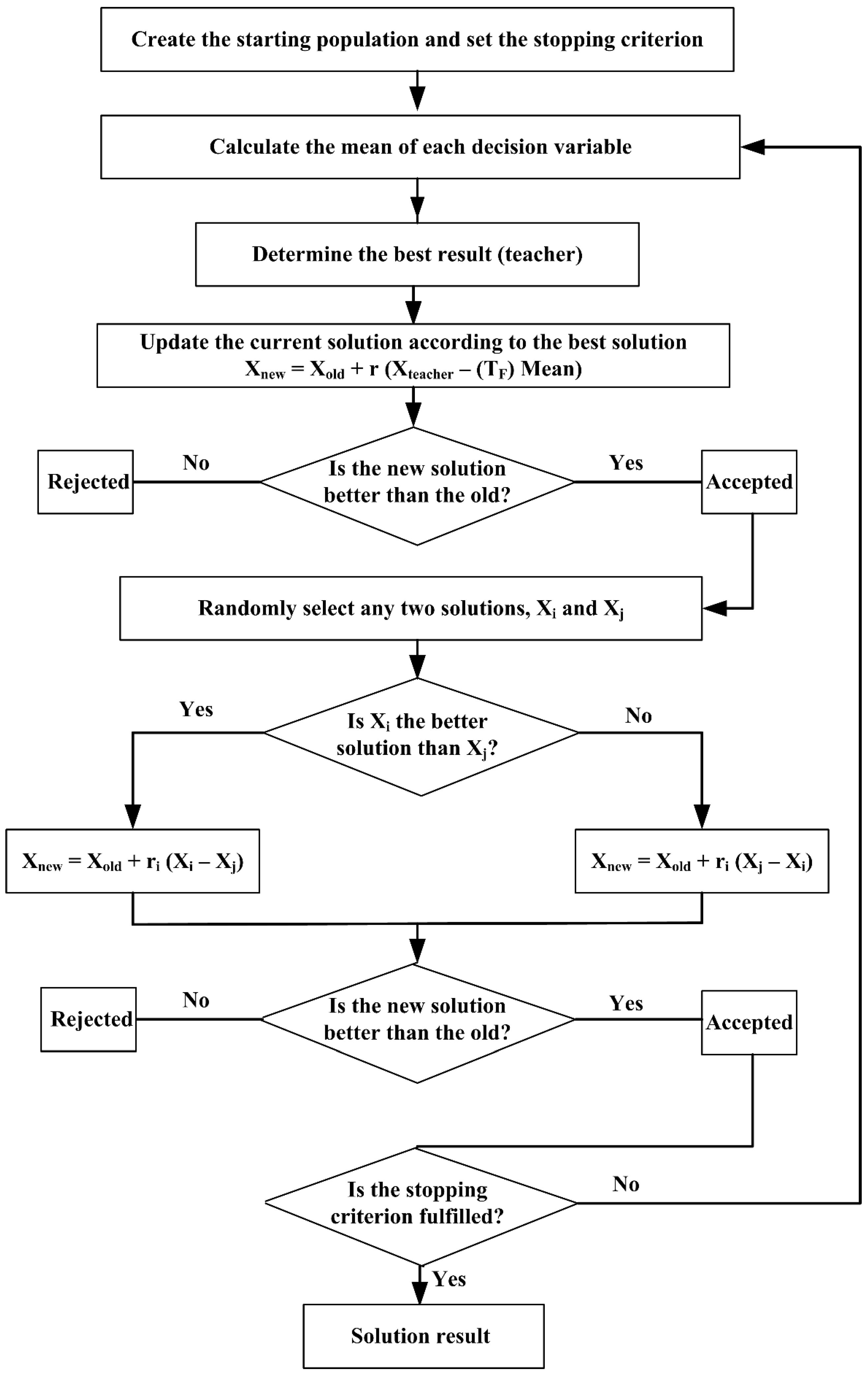
This is the first stage of the algorithm, and the stage where learners learn directly from the teacher. In this process, the teacher tries to increase the grade point average of the class based on his/her ability in a subject considered by him/her. Therefore, the solution with the best objective function value in the population is considered to be the teacher. In the teacher stage, there is an average difference between the teacher’s level and the student’s learning level, which can be defined as in Equation (1) [54].
D i f f e r e n c e _ M e a n j , k , i = r j , i X j , k b e s t , i T F M j , i
X j , k b e s t , i is the result of the best learner (new teacher) on subject j , T F (Teaching Factor) is the teaching factor (teacher’s ability) that decides the change in the mean value, and r j , i is a random number in the interval [0,1]. The value of T F can be 1 or 2 and is decided randomly by the following probability equation. The expression of T F is defined in Equation (2) [54].
T F = r o u n d 1 + r a n d 0,1
Taking the value of D i f f e r e n c e _ M e a n j , k , i as a reference, the value of the current solution at this stage is updated according to Equation (3) [54].
X j , k , i = X j , k , i + D i f f e r e n c e _ M e a n j , k , i
If X j , k , i gives a better function value than X j , k , i by   w (positive number value for maximization problem, negative number value for minimization), it is accepted. At the end of the tutoring phase, the accepted function values are retained, and these values form the inputs to the learning phase.

2.2.2. Student Phase

In the student phase, students try to increase their knowledge by influencing each other. The learner stage is a stochastic process in which learners are influenced by another learner to increase their knowledge. If a learner has more knowledge than another learner, he/she learns new knowledge from him/her. Considering the population size n , the learning process of this stage is expressed in Equations (4) and (5) [54]. At any iteration i , each student is compared with a randomly selected other student. In this comparison, X P , i X Q , i for two randomly selected students P and Q ( X P , i and X Q , i are updated values at the end of the teaching phase):
X j , P , i = X j , P , i + r j , i X j , P , i X j , Q , i             i f   f X P , i < f X Q , i
X j , P , i = X j , P , i + r j , i X j , Q , i X j , P , i             i f   f X Q , i < f X P , i
If X j , P , i is a better function value, it is accepted, and the flow diagram of the TLBO method is given in Figure 1.

2.3. Proposed TLBO-ANN Hybrid Model

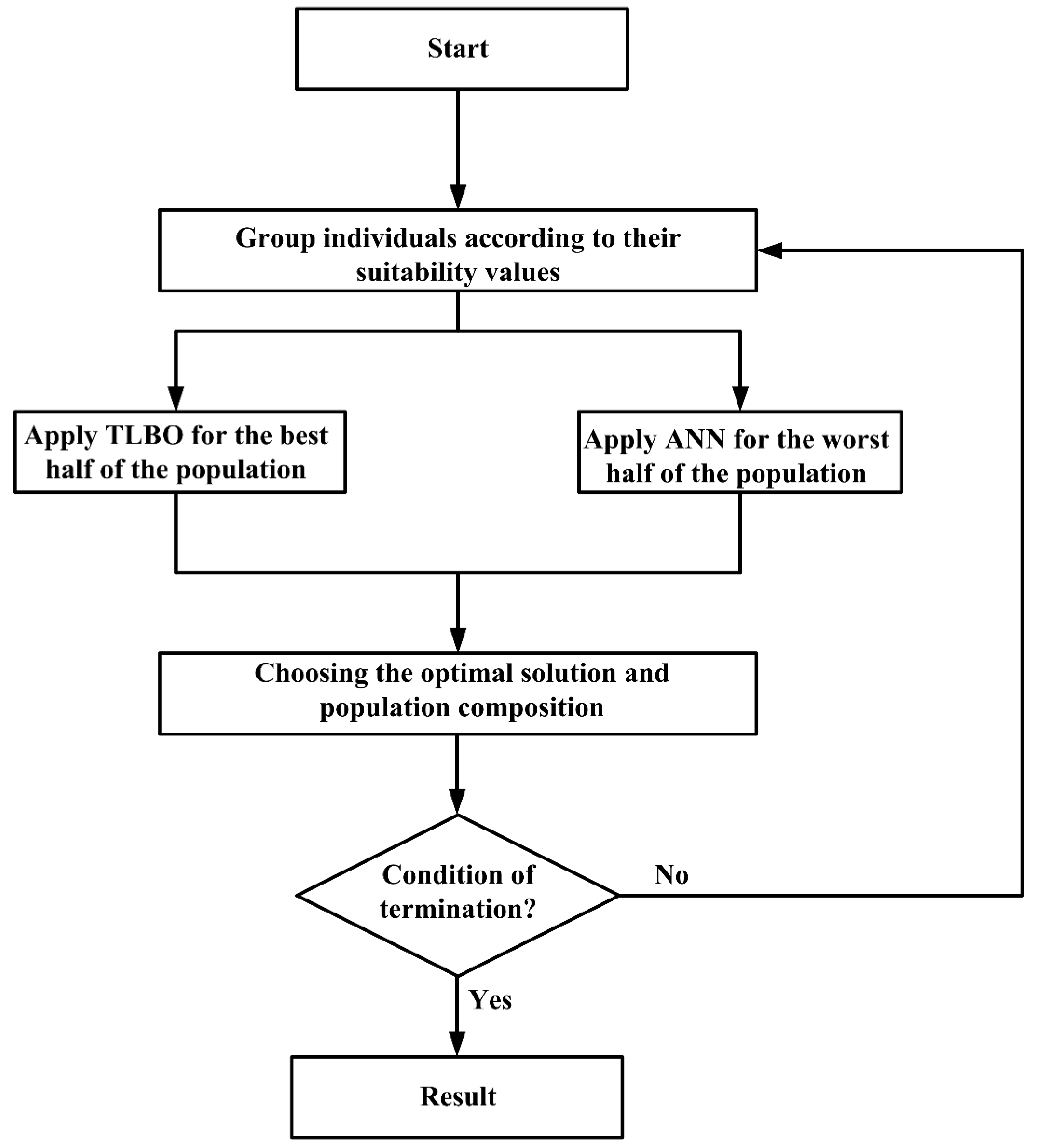
In the proposed TLBO-ANN hybrid model, the ability of ANN to search for the global optimum is combined with the fast convergence capability of the TLBO algorithm. This approach aims to utilize the strengths of TLBO and ANN most effectively. In this context, the population is divided into two groups according to the fitness values of the individuals; the best half of the population is optimized by TLBO, while the worst half is treated with ANN. This equal population split was deliberately selected to preserve the ‘parameter-less’ advantage of the proposed framework, ensuring a neutral balance between global exploration and local exploitation without introducing an additional user-defined hyperparameter. In this way, the advantages of both methods are combined to achieve a more efficient optimization process.
In the TLBO-ANN hybrid model, the population is split into two groups after each iteration to prevent solutions from being trapped in local minima and to preserve diversity in the search space [55]. This method increases the ability of the TLBO-ANN hybrid model to escape from the local optimum. In the model, TLBO is used to optimize the best half of the population, while ANN is used to process the weakest half of the population. Figure 2 shows the flow diagram of the TLBO-ANN model.
In this study, PV forecasting parameters such as solar irradiance, ambient temperature, and wind speed are used as inputs for training the ANN model. TLBO then optimizes the weight and bias parameters of the ANN by evaluating the fitness function based on forecasting error (e.g., MAPE). These environmental parameters indirectly influence the TLBO process by shaping the ANN’s input–output behavior, which TLBO seeks to improve. This integration ensures that meteorological variability is effectively accounted for within the optimization loop.

2.4. Model Configuration and Hyperparameters

To ensure the reproducibility of the study and to provide a clear understanding of the proposed framework’s complexity, the detailed architectural parameters and hyperparameter settings are presented in Table 2. The input layer consists of three neurons corresponding to the meteorological variables (solar irradiance, ambient temperature, and wind speed), while the output layer has a single neuron representing the predicted PV power. The optimal number of neurons in the hidden layer was determined through a trial-and-error procedure to balance generalization capability and convergence speed. For the TLBO process, the population size and maximum iteration limits were selected to ensure sufficient search space exploration without incurring high computational costs.

3. Prediction Results for Photovoltaic Power with TLBO-ANN and ANN

In this study, utilizes data obtained from a 7 MW solar power plant located in the northwestern part of Turkey’s Central Anatolia Region (Latitude: [40.20]° N, Longitude: [29.21]° E). The dataset consists of PV power, solar radiation, temperature, and wind speed, covering a 92-day period from 1 March 2023 to 31 May 2023. In the forecasting study, 92 days of historical photovoltaic power, ambient temperature, solar radiation, and wind speed parameters are used to predict the photovoltaic power to be generated. Although the dataset is limited to a quarterly period, this specific timeframe represents a high-variability transition season within the Central Anatolian climate. This period is characterized by rapid fluctuations in cloud cover and temperature, as opposed to the stable clear-sky conditions typical of summer months. Consequently, this dataset was deliberately selected to serve as a ‘stress test’ for the forecasting algorithms, challenging the TLBO-ANN model to converge under highly non-linear and volatile environmental conditions where traditional models often fail. The results of the ANN and TLBO-ANN hybrid prediction models are compared. The comparisons were made separately for the whole dataset, training, and test subsets, and mean absolute percentage error ( M A P E ), root mean square error ( R M S E ), mean absolute error ( M A E ), and determination coefficient ( R 2 ) functions were used to evaluate the model accuracy. M A P E , R M S E , M A E , and R 2 error functions are calculated using Equations (6)–(9).
M A P E = 1 n i = 1 n t i p i t i × 100
R M S E = 1 n i = 1 n t i p i 2
M A E = 1 n i = 1 n t i p i
R 2 = 1 i = 1 n ( t i p i ) 2 i = 1 n ( t i t ) 2
In Equations (6)–(9), t i is the actual measured value, p i is the predicted value, t is the mean of the actual measured value, and n is the total number of data points. In addition, the prediction model was trained with the training data set (80%) and tested with the test data set (20%).
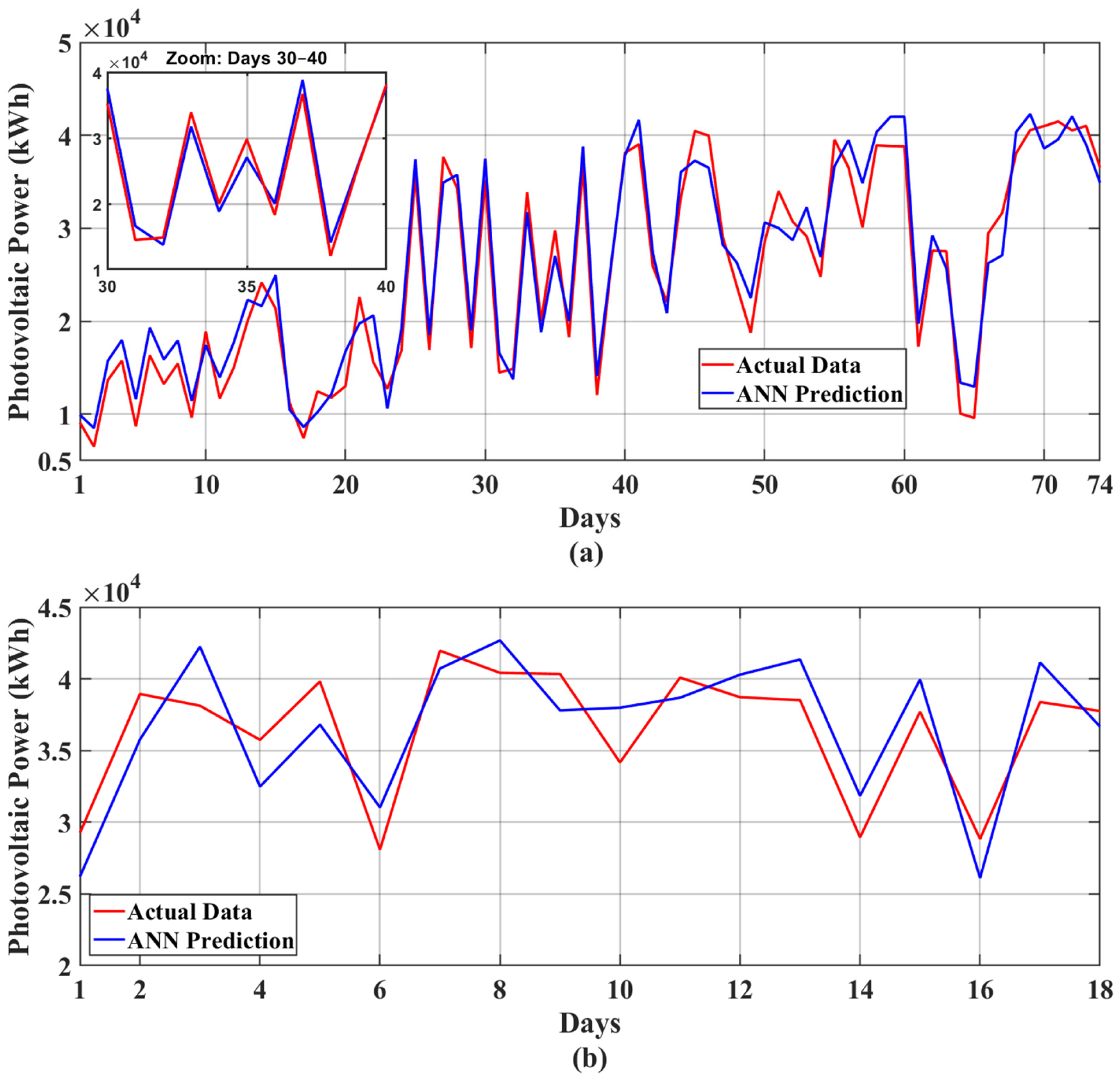
Using the available dataset, the M A P E , R M S E , M A E , and R 2 values for the training and test subsets were 11.55%, 2494.3 kWh, 2299.7 kWh, 0.94, and 7.38%, 2732.1 kWh, 2606.5 kWh, 0.96, respectively. The ANN predicted, and actual power generation for the training and test subsets are shown in Figure 3.
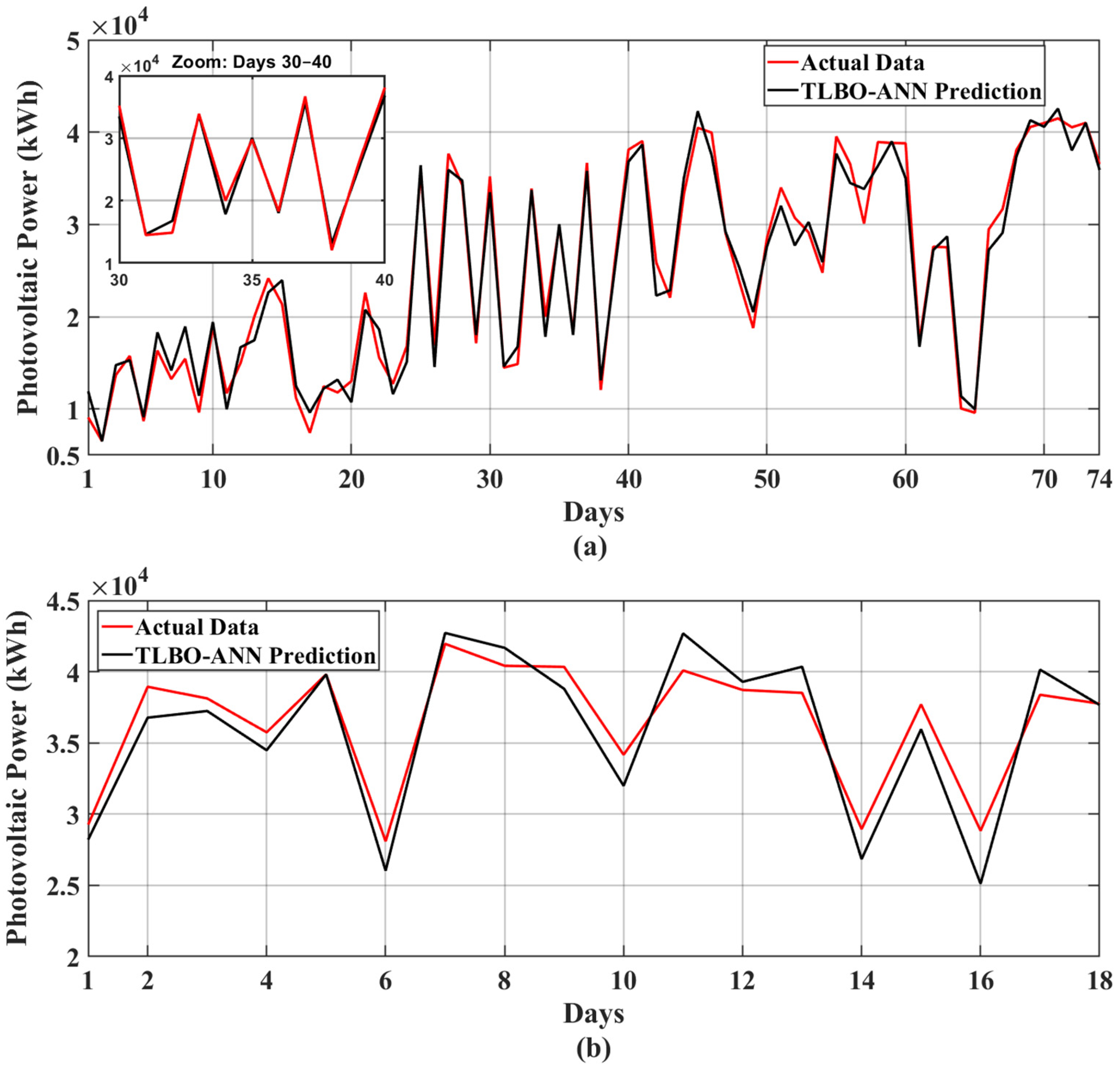
The M A P E , R M S E , M A E , and R 2 values for the training and test subsets were 7.26%, 1733.8 kWh, 1440.5 kWh, 0.97, and 4.43%, 1773 kWh, 1533 kWh, 0.98, respectively. The TLBO-ANN prediction and actual power generation for the training and test subsets are shown in Figure 4.
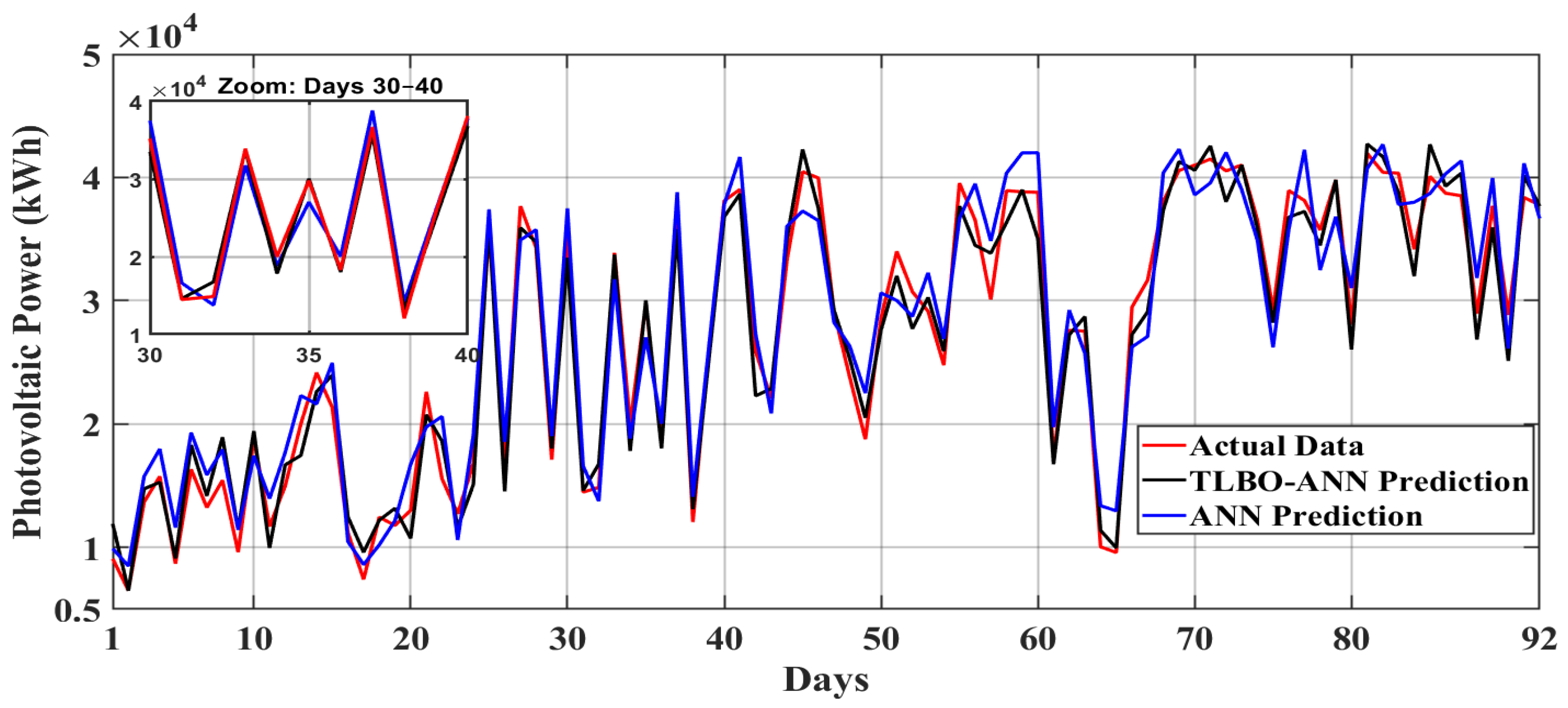
The M A P E , R M S E , M A E , and R 2 values for the TLBO-ANN hybrid model are 6.71%, 1741.5 kWh, 1458.6 kWh, and 0.97, respectively, while for the ANN model these values are 10.73%, 2542.6 kWh, 2359.8 kWh, and 0.95, respectively. Figure 5 shows the prediction results of real power generation, ANN, and TLBO-ANN models for the whole data set.
When the prediction results are compared, it is seen that the proposed TLBO-ANN hybrid model is much more successful than the ANN model. Although the prediction trajectories of both models appear visually similar in the full-scale plots, a closer examination reveals significant differences in performance. The superiority of the TLBO-ANN model is most pronounced during periods of high environmental variability (e.g., rapid fluctuations in cloud cover, as highlighted in the zoomed-in sections of Figure 3, Figure 4 and Figure 5). In these volatile instances, the conventional ANN model tends to exhibit larger deviations and delays in tracking sudden power drops, contributing to higher cumulative errors. In contrast, the TLBO-ANN model adapts more quickly to these non-linear transitions, minimizing peak errors and resulting in the reported statistical improvement. M A P E , R M S E , M A E , and R 2 values obtained as a result of prediction are given in Table 3.
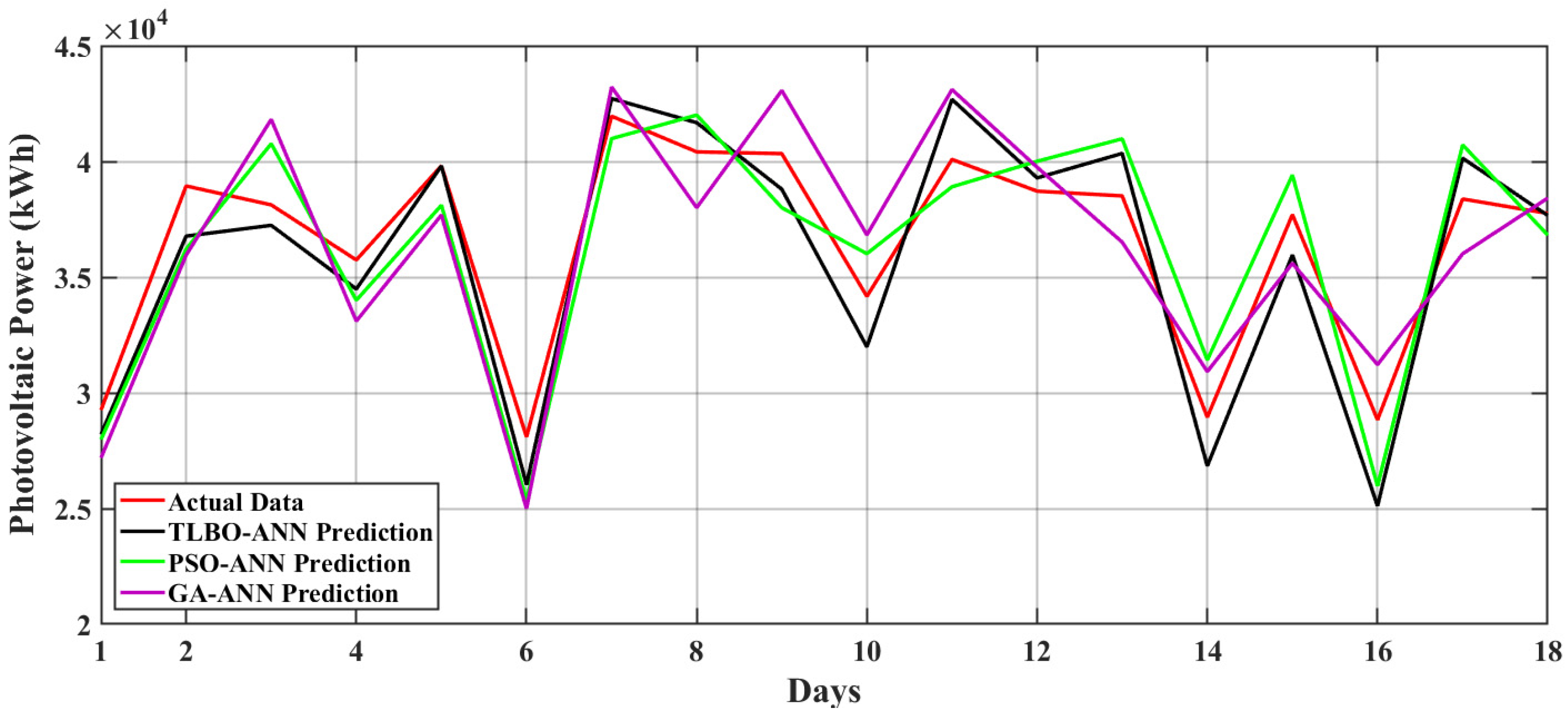
In addition, the success of the proposed TLBO-ANN hybrid model is also compared with the GA-ANN and PSO-ANN hybrid models that are widely used in the literature. For the test dataset, the M A P E , R M S E , M A E , and R 2 values of the TLBO-ANN model are 4.43%, 1773 kWh, 1533 kWh, and 0.98, respectively. These values are 6.42%, 2404.3 kWh, 2289.6 kWh, 0.97, and 5.49%, 2035.3 kWh, 1935 kWh, 0.97 for GA-ANN, and PSO-ANN hybrid models, respectively. According to the results obtained, the proposed TLBO-ANN model outperformed the GA-ANN and PSO-ANN models. The TLBO-ANN, GA-ANN, and PSO-ANN prediction and actual power generation for the test subsets are shown in Figure 6. Moreover, M A P E , R M S E , M A E , and R 2 values obtained as a result of prediction are given in Table 4.
The superior performance of the TLBO-ANN hybrid model over both the standalone ANN and the benchmarked GA-ANN and PSO-ANN models can be attributed to its unique algorithmic structure. While GA and PSO rely heavily on the precise tuning of hyperparameters (such as selection pressure in GA or acceleration coefficients in PSO) to avoid premature convergence, TLBO operates without such algorithm-specific control parameters. This characteristic allows the algorithm to explore the solution space more effectively and escape local minima more reliably. As evidenced by the results in Table 4, this robustness translates into lower error metrics ( M A P E , R M S E ) compared to the competing hybrid models, validating TLBO as a more stable optimizer for the highly non-linear problem of PV forecasting.

4. Conclusions

In this study, a hybrid TLBO-ANN model is proposed to estimate daily photovoltaic power production. The model combines the learning ability of Artificial Neural Networks with the optimization power of the Teaching–Learning Based Optimization (TLBO) algorithm. TLBO-ANN model showed significantly higher accuracy compared to ANN model alone, providing 39.97% M A P E improvement on test data and 37.46% on the entire dataset. R M S E and M A E analysis also support the robustness of the model. These results demonstrate the effectiveness of metaheuristic-based hybrid models in processing nonlinear energy data depending on weather conditions. The use of real data obtained from a PV power plant located in the Mediterranean region also added practical value to the study. The system was also tested with PSO and GA, and the superiority of the proposed algorithm model was proven. Despite the promising results demonstrated in this study, certain limitations should be acknowledged. The current analysis relies on a 92-day dataset, which, while effective for testing model robustness under volatile transition conditions, does not encompass a full annual cycle. Therefore, the model’s performance across long-term seasonal variations (e.g., specific winter shading or peak summer thermal degradation) remains to be fully characterized. Future research will focus on expanding this framework using multi-year datasets to capture comprehensive seasonal patterns. Additionally, further studies may investigate the integration of the proposed model into real-time grid management systems to test its operational resilience in extreme weather scenarios.

Author Contributions

Conceptualization, S.E. and O.T.; methodology, O.T.; software, S.E.; validation, O.T.; formal analysis, S.E.; investigation, S.E. and O.T.; resources, O.T.; data curation, S.E.; writing—original draft preparation, O.T.; writing—review and editing, S.E. and O.T.; visualisation, O.T.; supervision, S.E.; project administration, S.E. and O.T. All authors have read and agreed to the published version of the manuscript.

Funding

This research received no specific funding from public, commercial, or non-profit agencies.

Data Availability Statement

The datasets generated and analyzed during the current study are available from the corresponding author on reasonable request.

Conflicts of Interest

The authors declare no conflicts of interest.

References

  1. Mansouri, N.Y.; Crookes, R.J.; Korakianitis, T. A projection of energy consumption and carbon dioxide emissions in the electricity sector for Saudi Arabia: The case for carbon capture and storage and solar photovoltaics. Energy Policy 2013, 63, 681–695. [Google Scholar] [CrossRef]
  2. Sayigh, A. Renewable energy—The way forward. Appl. Energy 1999, 64, 15–30. [Google Scholar] [CrossRef]
  3. Liu, L.; Wang, Q.; Lin, H.; Li, H.; Sun, Q. Power generation efficiency and prospects of floating photovoltaic systems. Energy Procedia 2017, 105, 1136–1142. [Google Scholar] [CrossRef]
  4. Alamdari, P.; Nematollahi, O.; Alemrajabi, A.A. Solar energy potentials in Iran: A review. Renew. Sustain. Energy Rev. 2013, 21, 778–788. [Google Scholar] [CrossRef]
  5. T.C. Enerji ve Tabii Kaynaklar Bakanlığı. 2023. Available online: https://enerji.gov.tr/bilgi-merkezi-enerji-elektrik (accessed on 20 August 2024).
  6. Eltawil, M.A.; Zhao, Z. Grid-connected photovoltaic power systems: Technical and potential problems—A review. Renew. Sustain. Energy Rev. 2010, 14, 112–129. [Google Scholar] [CrossRef]
  7. Shi, J.; Lee, W.-J.; Liu, Y.; Yang, Y.; Wang, P. Forecasting power output of photovoltaic systems based on weather classification and support vector machines. IEEE Trans. Ind. Appl. 2012, 48, 1064–1069. [Google Scholar] [CrossRef]
  8. Tascikaraoglu, A.; Sanandaji, B.M.; Chicco, G.; Cocina, V.; Spertino, F.; Erdinc, O.; Paterakis, N.G.; Catalao, J.P. Compressive spatio-temporal forecasting of meteorological quantities and photovoltaic power. IEEE Trans. Sustain. Energy 2016, 7, 1295–1305. [Google Scholar] [CrossRef]
  9. Strzalka, A.; Alam, N.; Duminil, E.; Coors, V.; Eicker, U. Large scale integration of photovoltaics in cities. Appl. Energy 2012, 93, 413–421. [Google Scholar] [CrossRef]
  10. Woyte, A.; Thong, V.; Belmans, R.; Nijs, J. Voltage fluctuations on distribution level introduced by photovoltaic systems. IEEE Trans. Energy Convers. 2006, 21, 202–209. [Google Scholar] [CrossRef]
  11. van der Meer, D.; Shepero, M.; Svensson, A.; Widén, J.; Munkhammar, J. Probabilistic forecasting of electricity consumption, photovoltaic power generation and net demand of an individual building using Gaussian Processes. Appl. Energy 2018, 213, 195–207. [Google Scholar] [CrossRef]
  12. Yesilbudak, M.; Colak, M.; Bayindir, R. What are the current status and future prospects in solar irradiance and solar power forecasting? Int. J. Renew. Energy Res. 2018, 8, 635–648. [Google Scholar] [CrossRef]
  13. Elsinga, B.; van Sark, W.G. Short-term peer-to-peer solar forecasting in a network of photovoltaic systems. Appl. Energy 2017, 206, 1464–1483. [Google Scholar] [CrossRef]
  14. Kleissl, J. Solar Energy Forecasting and Resource Assessment; Academic Press: Cambridge, MA, USA, 2013. [Google Scholar]
  15. Han, S.; Qiao, Y.-H.; Yan, J.; Liu, Y.-Q.; Li, L.; Wang, Z. Mid-to-long term wind and photovoltaic power generation prediction based on copula function and long short term memory network. Appl. Energy 2019, 239, 181–191. [Google Scholar] [CrossRef]
  16. Lin, P.; Peng, Z.; Lai, Y.; Cheng, S.; Chen, Z.; Wu, L. Short-term power prediction for photovoltaic power plants using a hybrid improved Kmeans-GRA-Elman model based on multivariate meteorological factors and historical power datasets. Energy Convers. Manag. 2018, 177, 704–717. [Google Scholar] [CrossRef]
  17. Izgi, E.; Öztopal, A.; Yerli, B.; Kaymak, M.K.; Şahin, A.D. Short–mid-term solar power prediction by using artificial neural networks. Sol. Energy 2012, 86, 725–733. [Google Scholar] [CrossRef]
  18. Ni, L.; Wang, D.; Singh, V.P.; Wu, J.; Wang, Y.; Tao, Y.; Liu, J.; Zou, Y.; He, R. A hybrid model-based framework for estimating ecological risk. J. Clean. Prod. 2019, 225, 1230–1240. [Google Scholar] [CrossRef]
  19. Huang, Y.; Lu, J.; Liu, C.; Xu, X.; Wang, W.; Zhou, X. Comparative study of power forecasting methods for PV stations. In Proceedings of the 2010 International Conference on Power System Technology, Hangzhou, China, 24–28 October 2010; IEEE: Piscataway, NJ, USA, 2010. [Google Scholar]
  20. Xie, T.; Zhang, G.; Liu, H.; Liu, F.; Du, P. A hybrid forecasting method for solar output power based on variational mode decomposition, deep belief networks and auto-regressive moving average. Appl. Sci. 2018, 8, 1901. [Google Scholar] [CrossRef]
  21. Wang, H.; Sun, J.; Wang, W. Photovoltaic power forecasting based on EEMD and a variable-weight combination forecasting model. Sustainability 2018, 10, 2627. [Google Scholar] [CrossRef]
  22. Lin, K.-P.; Pai, P.-F. Solar power output forecasting using evolutionary seasonal decomposition least-square support vector regression. J. Clean. Prod. 2016, 134, 456–462. [Google Scholar] [CrossRef]
  23. Nespoli, A.; Ogliari, E.; Leva, S.; Pavan, A.M.; Mellit, A.; Lughi, V.; Dolara, A. Day-ahead photovoltaic forecasting: A comparison of the most effective techniques. Energies 2019, 12, 1621. [Google Scholar] [CrossRef]
  24. Zhu, H.; Lian, W.; Lu, L.; Dai, S.; Hu, Y. An improved forecasting method for photovoltaic power based on adaptive BP neural network with a scrolling time window. Energies 2017, 10, 1542. [Google Scholar] [CrossRef]
  25. Li, Z.; Sun, H.; Xue, Y.; Li, Z.; Jin, X.; Wang, P. Resilience-oriented asynchronous decentralized restoration considering building and E-bus co-response in electricity-transportation networks. IEEE Trans. Transp. Electrif. 2025, 11, 11701–11713. [Google Scholar] [CrossRef]
  26. Chang, L.; Li, Z.; Tian, X.; Su, J.; Chang, X.; Xue, Y.; Li, Z.; Jin, X.; Wang, P.; Sun, H. A two-stage distributionally robust low-carbon operation method for antarctic unmanned observation station integrating virtual energy storage and hydrogen waste heat recovery. Appl. Energy 2025, 400, 126578. [Google Scholar] [CrossRef]
  27. Raza, M.Q.; Nadarajah, M.; Ekanayake, C. On recent advances in PV output power forecast. Sol. Energy 2016, 136, 125–144. [Google Scholar] [CrossRef]
  28. Rao, R.V.; Savsani, V.J.; Vakharia, D.P. Teaching–learning-based optimization: A novel method for constrained mechanical design optimization problems. Comput.-Aided Des. 2011, 43, 303–315. [Google Scholar] [CrossRef]
  29. Thaker, J.; Höller, R. Hybrid model for intra-day probabilistic PV power forecast. Renew. Energy 2024, 232, 121057. [Google Scholar] [CrossRef]
  30. VanDeventer, W.; Jamei, E.; Thirunavukkarasu, G.S.; Seyedmahmoudian, M.; Soon, T.K.; Horan, B.; Mekhilef, S.; Stojcevski, A. Short-term PV power forecasting using hybrid GASVM technique. Renew. Energy 2019, 140, 367–379. [Google Scholar] [CrossRef]
  31. Mayer, M.J.; Yang, D. Probabilistic photovoltaic power forecasting using a calibrated ensemble of model chains. Renew. Sustain. Energy Rev. 2022, 168, 112821. [Google Scholar] [CrossRef]
  32. Zhang, Y.; Li, B.; Han, Z. A new method for short-term photovoltaic power generation forecast based on ensemble model. AIP Adv. 2024, 14, 095008. [Google Scholar] [CrossRef]
  33. Stoean, C.; Zivkovic, M.; Bozovic, A.; Bacanin, N.; Strulak-Wójcikiewicz, R.; Antonijevic, M.; Stoean, R. Metaheuristic-based hyperparameter tuning for recurrent deep learning: Application to the prediction of solar energy generation. Axioms 2023, 12, 266. [Google Scholar] [CrossRef]
  34. Abedinia, O.; Amjady, N.; Ghadimi, N. Solar energy forecasting based on hybrid neural network and improved metaheuristic algorithm. Comput. Intell. 2018, 34, 241–260. [Google Scholar] [CrossRef]
  35. Irmak, E.; Yeşilbudak, M.; Taşdemir, O. Enhanced PV power prediction considering PM10 parameter by hybrid JAYA-ANN Model. Electr. Power Compon. Syst. 2024, 52, 1998–2007. [Google Scholar] [CrossRef]
  36. Seyedmahmoudian, M.; Jamei, E.; Thirunavukkarasu, G.S.; Soon, T.K.; Mortimer, M.; Horan, B.; Stojcevski, A.; Mekhilef, S. Short-term forecasting of the output power of a building-integrated photovoltaic system using a metaheuristic approach. Energies 2018, 11, 1260. [Google Scholar] [CrossRef]
  37. Mayer, M.J. Benefits of physical and machine learning hybridization for photovoltaic power forecasting. Renew. Sustain. Energy Rev. 2022, 168, 112772. [Google Scholar] [CrossRef]
  38. Behera, M.K.; Majumder, I.; Nayak, N. Solar photovoltaic power forecasting using optimized modified extreme learning machine technique. Eng. Sci. Technol. Int. J. 2018, 21, 428–438. [Google Scholar] [CrossRef]
  39. Liu, Z.-F.; Li, L.-L.; Tseng, M.-L.; Lim, M.K. Prediction short-term photovoltaic power using improved chicken swarm optimizer-extreme learning machine model. J. Clean. Prod. 2020, 248, 119272. [Google Scholar] [CrossRef]
  40. Pan, M.; Li, C.; Gao, R.; Huang, Y.; You, H.; Gu, T.; Qin, F. Photovoltaic power forecasting based on a support vector machine with improved ant colony optimization. J. Clean. Prod. 2020, 277, 123948. [Google Scholar] [CrossRef]
  41. Jallal, M.A.; Chabaa, S.; Zeroual, A. A novel deep neural network based on randomly occurring distributed delayed PSO algorithm for monitoring the energy produced by four dual-axis solar trackers. Renew. Energy 2020, 149, 1182–1196. [Google Scholar] [CrossRef]
  42. Zheng, J.; Zhang, H.; Dai, Y.; Wang, B.; Zheng, T.; Liao, Q.; Liang, Y.; Zhang, F.; Song, X. Time series prediction for output of multi-region solar power plants. Appl. Energy 2020, 257, 114001. [Google Scholar] [CrossRef]
  43. Wen, Y.; AlHakeem, D.; Mandal, P.; Chakraborty, S.; Wu, Y.-K.; Senjyu, T.; Paudyal, S.; Tseng, T.-L. Performance evaluation of probabilistic methods based on bootstrap and quantile regression to quantify PV power point forecast uncertainty. IEEE Trans. Neural Netw. Learn. Syst. 2019, 31, 1134–1144. [Google Scholar] [CrossRef]
  44. Eseye, A.T.; Zhang, J.; Zheng, D. Short-term photovoltaic solar power forecasting using a hybrid Wavelet-PSO-SVM model based on SCADA and Meteorological information. Renew. Energy 2018, 118, 357–367. [Google Scholar] [CrossRef]
  45. Wang, J.; Ran, R.; Zhou, Y. A short-term photovoltaic power prediction model based on an FOS-ELM algorithm. Appl. Sci. 2017, 7, 423. [Google Scholar] [CrossRef]
  46. Zhou, Y.; Zhou, N.; Gong, L.; Jiang, M. Prediction of photovoltaic power output based on similar day analysis, genetic algorithm and extreme learning machine. Energy 2020, 204, 117894. [Google Scholar] [CrossRef]
  47. Asteris, P.G.; Armaghani, D.J.; Hatzigeorgiou, G.D.; Karayannis, C.G.; Pilakoutas, K. Predicting the shear strength of reinforced concrete beams using Artificial Neural Networks. Comput. Concr. Int. J. 2019, 24, 469–488. [Google Scholar]
  48. Zou, J.; Han, Y.; So, S.S. Overview of artificial neural networks. In Artificial Neural Networks: Methods and Applications; Springer: Berlin/Heidelberg, Germany, 2008; pp. 14–22. [Google Scholar]
  49. Fahmy, M.; Moselhi, O. Automated detection and location of leaks in water mains using infrared photography. J. Perform. Constr. Facil. 2010, 24, 242–248. [Google Scholar] [CrossRef]
  50. Sbarufatti, C.; Corbetta, M.; Manes, A.; Giglio, M. Sequential Monte-Carlo sampling based on a committee of artificial neural networks for posterior state estimation and residual lifetime prediction. Int. J. Fatigue 2016, 83, 10–23. [Google Scholar] [CrossRef]
  51. Rumelhart, D.E.; McClelland, J.L.; PDP Research Group. Parallel Distributed Processing, Volume 1: Explorations in the Microstructure of Cognition: Foundations; The MIT press: Cambridge, MA, USA, 1986. [Google Scholar]
  52. Kankal, M.; Uzlu, E. Neural network approach with teaching–learning-based optimization for modeling and forecasting long-term electric energy demand in Turkey. Neural Comput. Appl. 2017, 28, 737–747. [Google Scholar] [CrossRef]
  53. Zhang, Y.; Jin, Z.; Chen, Y. Hybrid teaching–learning-based optimization and neural network algorithm for engineering design optimization problems. Knowl.-Based Syst. 2020, 187, 104836. [Google Scholar] [CrossRef]
  54. Rao, R.V.; Savsani, V.J.; Balic, J. Teaching–learning-based optimization algorithm for unconstrained and constrained real-parameter optimization problems. Eng. Optim. 2012, 44, 1447–1462. [Google Scholar] [CrossRef]
  55. Rakhshani, H.; Rahati, A. Snap-drift cuckoo search: A novel cuckoo search optimization algorithm. Appl. Soft Comput. 2017, 52, 771–794. [Google Scholar] [CrossRef]
Figure 1. TLBO flow diagram.
Applsci 16 00157 g001
Figure 2. TLBO-ANN flow diagram.
Applsci 16 00157 g002
Figure 3. ANN prediction and actual power generation (a) Training subset, (b) Test subset.
Applsci 16 00157 g003
Figure 4. TLBO-ANN prediction and actual power generation (a) Training subset, (b) Test subset.
Applsci 16 00157 g004
Figure 5. ANN, TLBO-ANN prediction, and actual power generation.
Applsci 16 00157 g005
Figure 6. TLBO-ANN, GA-ANN, PSO-ANN prediction and actual power generation for test subset.
Applsci 16 00157 g006
Table 1. Comparative summary of existing photovoltaic power prediction methods.
MethodKey CharacteristicsAdvantagesLimitationsRef.
Physical MethodsBased on mathematical modeling of PV panels and meteorological data.No training data required; good for stable conditions.Sensitive to rapid weather changes; requires precise system parameters.[19]
Statistical MethodsUses historical time series data to predict future values.Simple computation; effective for linear patterns.Struggles with non-linear and chaotic weather data.[20,21]
Conventional ANNData driven AI model mimicking neural networks.Strong non-linear mapping capability.Prone to getting stuck in local minima; slow convergence.[27]
Hybrid metaheuristic algorithmOptimization algorithms coupled with ANN.Improved accuracy over a standalone ANN.Requires tuning of complex parameters (mutation, inertia); computationally expensive.[30,31,32,33,34,35,36,37,38]
Proposed TLBO-ANNParameterless optimization coupled with ANN.Fast convergence; robust against local minima; no parameter tuning.Dependent on the quality of training data.[This Study]
Table 2. Detailed architecture and hyperparameters of the proposed TLBO-ANN model.
ParameterValue/Description
ANN Architecture
Input Layer Neurons4 (PV Power, Solar Radiation, Temperature, Wind Speed)
Hidden Layers1
Hidden Layer Neurons5
Output Layer Neurons1 (PV Power Output)
Activation Function (Hidden)Sigmoid
Activation Function (Output)Linear (Purelin)
TLBO Settings
Population Size50
Maximum Iterations100
Stopping CriterionMaximum iterations reached or Min. Error
Table 3. Performance metrics of ANN and TLBO-ANN models.
Models M A P E (%) R M S E (kWh) M A E (kWh) R 2
ANN (test)7.382732.12606.50.96
TLBO-ANN (test)4.43177315330.98
ANN (training)11.552494.32299.70.94
TLBO-ANN (training)7.261733.81440.50.97
ANN (all)10.732542.62359.80.95
TLBO-ANN (all)6.711741.51458.60.97
Table 4. Comparison with GA-ANN and PSO-ANN models.
Models M A P E (%) R M S E (kWh) M A E (kWh) R 2
TLBO-ANN (test)4.43177315330.98
PSO-ANN (test)5.492035.319350.97
GA-ANN (test)6.422404.32289.60.97
Disclaimer/Publisher’s Note: The statements, opinions and data contained in all publications are solely those of the individual author(s) and contributor(s) and not of MDPI and/or the editor(s). MDPI and/or the editor(s) disclaim responsibility for any injury to people or property resulting from any ideas, methods, instructions or products referred to in the content.