Data-Driven Road Traffic Safety Modeling: A Comprehensive Literature Review




Abstract
1. Introduction
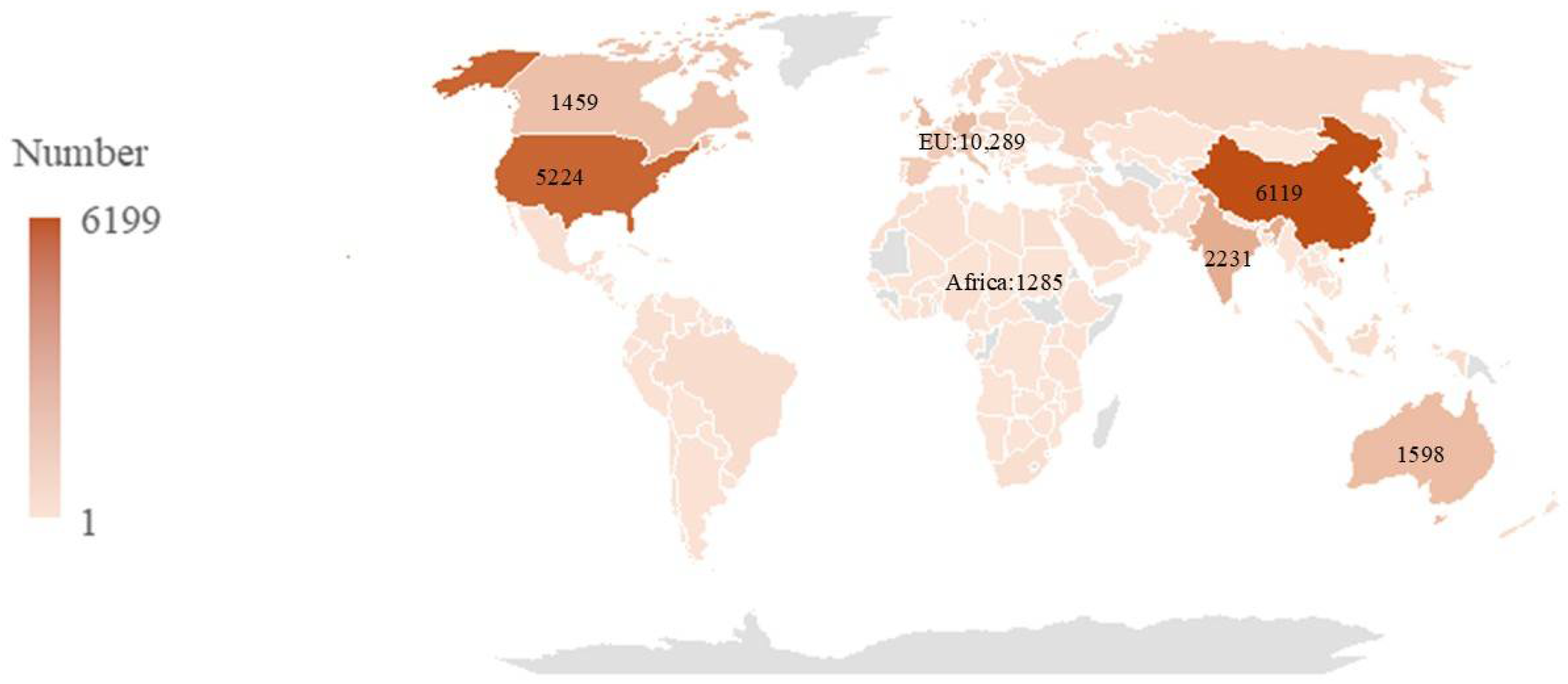
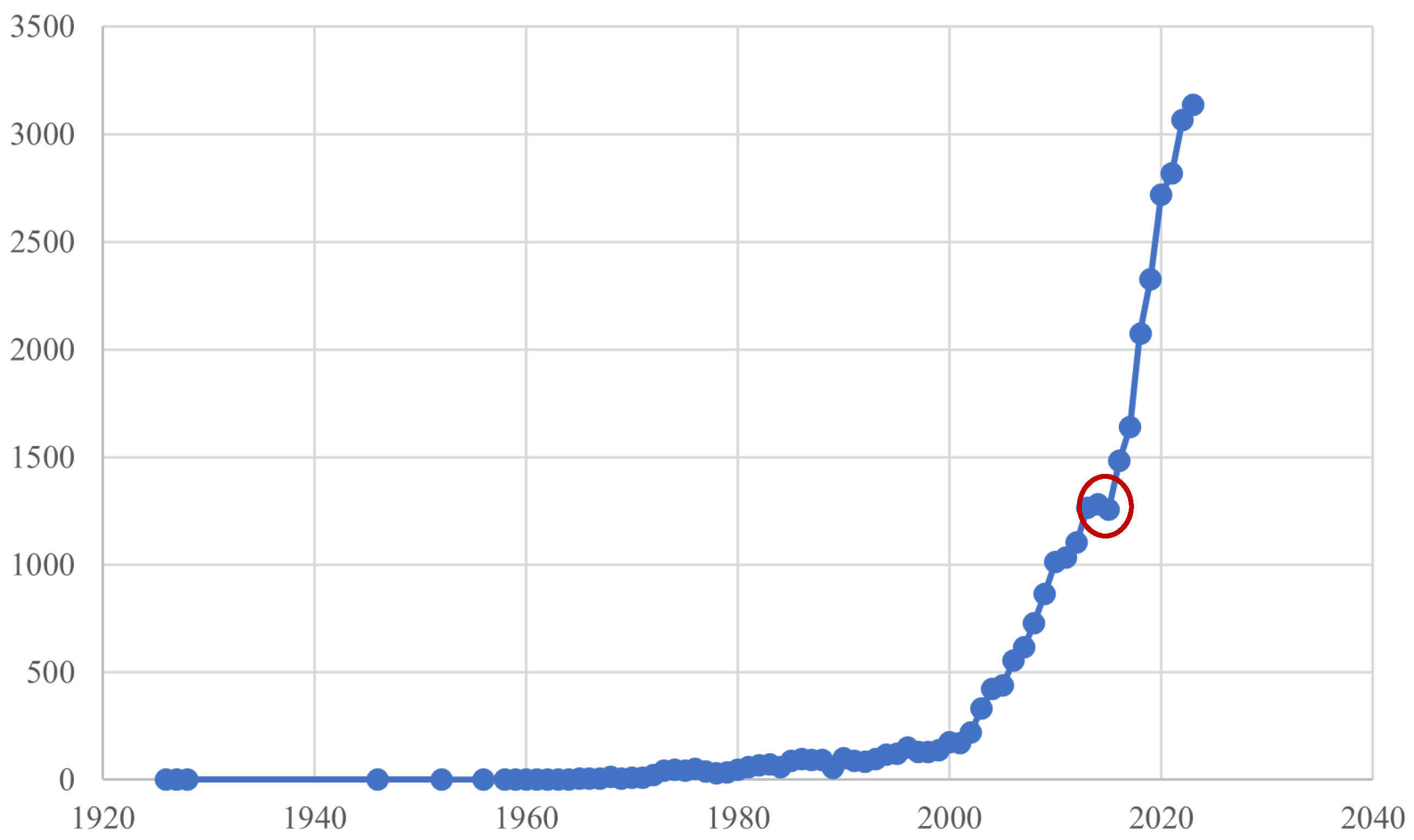
- A structured and comprehensive synthesis of road traffic safety modeling, including data acquisition, analysis of influencing factors, and both reactive and proactive modeling approaches.
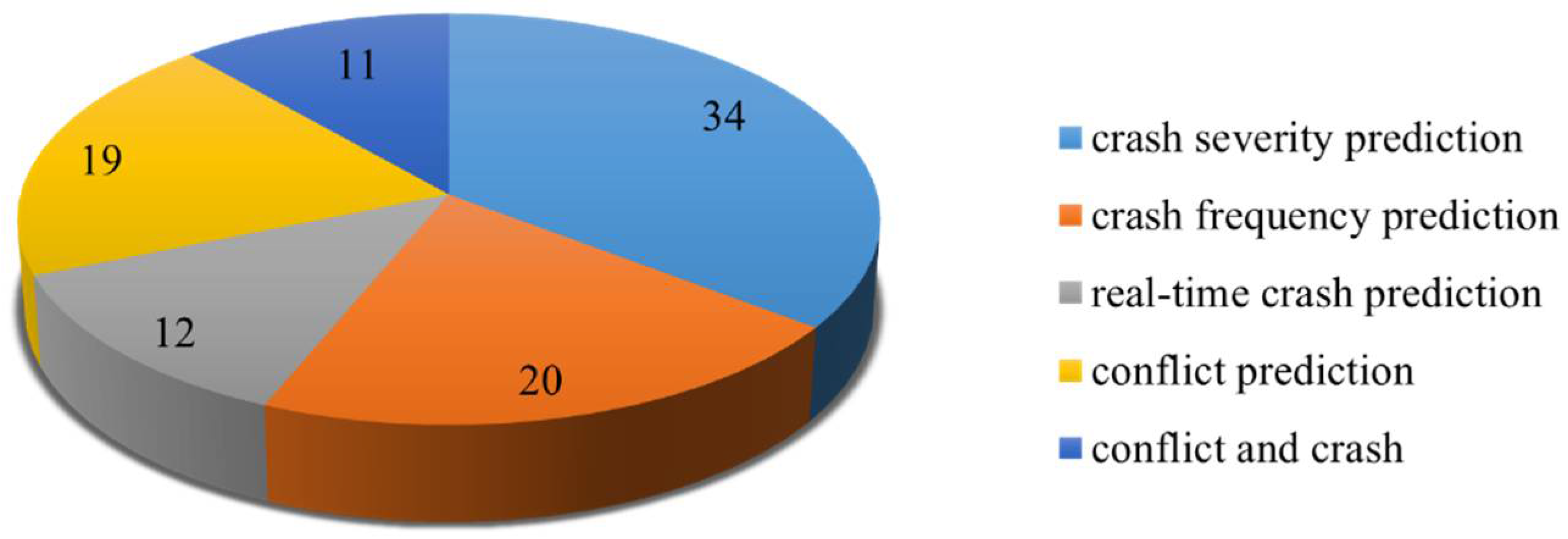
- A classification and vote-counting strategy to evaluate key research topics and methodological trends in road traffic safety.
- A critical analysis of recent studies to identify methodological limitations and research gaps, along with potential directions for future research.
2. Methodology
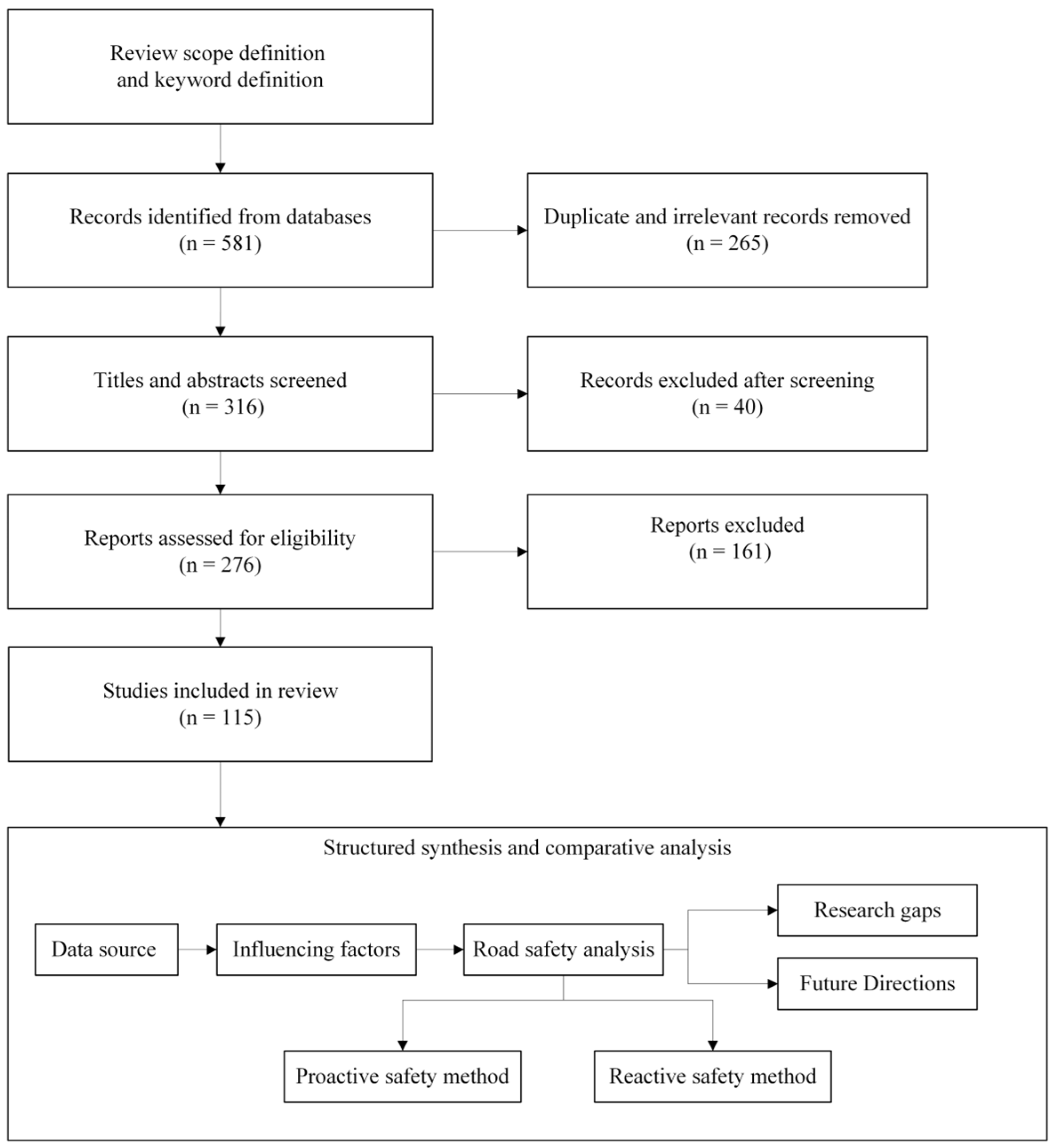
- Journal impact factors exceeding 2.0.
- Journals ranked in Q1 or Q2 according to Scimago Journal & Country Rank.
- Studies were published after 2015.
3. Data Source
3.1. Data Acquisition Technologies
3.2. Data Quality Challenges and Preprocessing Techniques
3.3. Influencing Factors
3.3.1. Traffic-Related and Functional Features
3.3.2. Road Geometry
4. Road Safety Analysis
4.1. Reactive Road Traffic Safety Analysis
4.1.1. Traffic Crash Severity Prediction
4.1.2. Traffic Crash Frequency Prediction
4.1.3. Real-Time Traffic Crash Prediction
- Imbalanced classification algorithms: some studies [71,96,97,98] proposed to balance data through imbalanced classification algorithms. These methods effectively improve the prediction ability of model for minority events by increasing the weight of minority class samples or oversampling majority class samples.
- Weighted loss function: Wang et al. [95] proposed a weighted loss function for crash data, which aims to solve the zero-inflation problem within the data. This method significantly improves the prediction accuracy of the model by adjusting the weight of the loss function to pay more attention to crash events.
- Prior Knowledge-based Data Augmentation (PKDE): Zhou et al. [37] proposed an innovative strategy for training DLAs by transforming zeros to discriminative negative values. This method enhances the expressiveness of minority samples while preserving the authenticity of the data.
4.2. Proactive Road Traffic Safety Analysis
4.2.1. Traffic Conflict Prediction
4.2.2. Traffic Conflict Prediction Based on Trajectory
4.3. Relationship Between Conflicts and Crashes
5. Discussion
- Data quality and integration: multi-source data remain difficult to combine consistently, and standardized processing pipelines are still missing.
- Spatio-temporal modeling: current approaches do not fully capture the contextual factors that shape risk across locations and time.
- Interpretability: many advanced models lack transparency, which limits their practical use.
- Transferability: most models are designed for specific environments and cannot be easily applied elsewhere.
6. Conclusions
Author Contributions
Funding
Data Availability Statement
Acknowledgments
Conflicts of Interest
Abbreviations
| AADT | Annual Average Daily Traffic |
| ADT | Average Daily Traffic |
| AI | Artificial Intelligence |
| Bi-LSTM | Bidirectional Long Short-Term Memory |
| CART | Classification and Regression Tree |
| CCTV | Closed-Circuit Television |
| CFP | Crash Frequency Prediction |
| CPI | Crash Potential Index |
| CNN | Convolutional Neural Network |
| CSP | Crash Severity Prediction |
| CV | Computer Vision |
| DLAs | Deep Learning Algorithms |
| DNN | Deep Neural Network |
| DTGN | Dynamic Temporal Graph Network |
| EML/EMLs | Ensemble Machine Learning (Methods) |
| EVT | Extreme Value Theory |
| GAN/GANs | Generative Adversarial Network(s) |
| GCN/GCNs | Graph Convolutional Network(s) |
| GLR | Generalized Linear Regression |
| GSNet | Geographical and Semantic Temporal Network |
| HMM | Hidden Markov Model |
| ITS | Intelligent Transportation System |
| KNN | K-Nearest Neighbor |
| LDA | Latent Dirichlet Allocation |
| LIME | Local Interpretable Model-Agnostic Explanations |
| LR | Linear Regression |
| LSTM | Long Short-Term Memory |
| MLA/MLAs | Machine Learning Algorithm(s) |
| NB | Negative Binomial |
| OLDA | Ontology-based Latent Dirichlet Allocation |
| PKDE | Prior Knowledge-based Data Enhancement |
| RF | Random Forest |
| RTCP | Real-Time Crash Prediction |
| R-CNN | Region-Based Convolutional Neural Network |
| SHAP | SHapley Additive exPlanations |
| SMOTE | Synthetic Minority Oversampling Technique |
| SORT | Simple Online and Realtime Tracking |
| SSMs | Safety Surrogate Measures |
| SVR | Support Vector Regression |
| SVM | Support Vector Machine |
| UAV | Unmanned Aerial Vehicle |
| WHO | World Health Organization |
| YOLO | You Only Look Once |
| XGBoost | Extreme Gradient Boosting |
References
- World Health Organization Global Status Report on Road Safety. 2023. Available online: https://www.who.int/teams/social-determinants-of-health/safety-and-mobility/global-status-report-on-road-safety-2023 (accessed on 25 November 2025).
- European Transport Safety Council 17th Annual Road Safety Performance Index (PIN Report). Available online: https://etsc.eu/17th-annual-road-safety-performance-index-pin-report/ (accessed on 25 November 2025).
- European Commission. Europe on the Move: Sustainable Mobility for Europe; Safe, Connected and Clean; European Commission: Brussels, Belgium, 2018. [Google Scholar]
- Basso, F.; Basso, L.J.; Bravo, F.; Pezoa, R. Real-Time Crash Prediction in an Urban Expressway Using Disaggregated Data. Transp. Res. Part C Emerg. Technol. 2018, 86, 202–219. [Google Scholar] [CrossRef]
- Fiorentini, N.; Losa, M. Handling Imbalanced Data in Road Crash Severity Prediction by Machine Learning Algorithms. Infrastructures 2020, 5, 61. [Google Scholar] [CrossRef]
- Fu, C.; Sayed, T.; Zheng, L. Multi-Type Bayesian Hierarchical Modeling of Traffic Conflict Extremes for Crash Estimation. Accid. Anal. Prev. 2021, 160, 106309. [Google Scholar] [CrossRef]
- Hussain, F.; Li, Y.; Arun, A.; Haque, M.M. A Hybrid Modelling Framework of Machine Learning and Extreme Value Theory for Crash Risk Estimation Using Traffic Conflicts. Anal. Methods Accid. Res. 2022, 36, 100248. [Google Scholar] [CrossRef]
- Ziakopoulos, A.; Yannis, G. A Review of Spatial Approaches in Road Safety. Accid. Anal. Prev. 2020, 135, 105323. [Google Scholar] [CrossRef]
- Silva, P.B.; Andrade, M.; Ferreira, S. Machine Learning Applied to Road Safety Modeling: A Systematic Literature Review. J. Traffic Transp. Eng. 2020, 7, 775–790. [Google Scholar] [CrossRef]
- Sheykhfard, A.; Haghighi, F.; Papadimitriou, E.; Van Gelder, P. Review and Assessment of Different Perspectives of Vehicle-Pedestrian Conflicts and Crashes: Passive and Active Analysis Approaches. J. Traffic Transp. Eng. 2021, 8, 681–702. [Google Scholar] [CrossRef]
- Shaik, M.E.; Islam, M.M.; Hossain, Q.S. A Review on Neural Network Techniques for the Prediction of Road Traffic Accident Severity. Asian Transp. Stud. 2021, 7, 100040. [Google Scholar] [CrossRef]
- Santos, K.; Dias, J.P.; Amado, C. A Literature Review of Machine Learning Algorithms for Crash Injury Severity Prediction. J. Saf. Res. 2022, 80, 254–269. [Google Scholar] [CrossRef]
- Zheng, L.; Sayed, T.; Mannering, F. Modeling Traffic Conflicts for Use in Road Safety Analysis: A Review of Analytic Methods and Future Directions. Anal. Methods Accid. Res. 2021, 29, 100142. [Google Scholar] [CrossRef]
- Zhu, S.Y.; Jiang, R.X.; Wang, H.; Zou, H.; Wang, P.; Qiu, J. Review of Research on Traffic Conflict Techniques. China J. Highw. Transp. 2020, 33, 15. [Google Scholar] [CrossRef]
- Hu, L.; Ou, J.; Huang, J.; Chen, Y.; Cao, D. A Review of Research on Traffic Conflicts Based on Intelligent Vehicles. IEEE Access 2020, 8, 24471–24483. [Google Scholar] [CrossRef]
- Sohail, A.; Cheema, M.A.; Ali, M.E.; Toosi, A.N.; Rakha, H.A. Data-Driven Approaches for Road Safety: A Comprehensive Systematic Literature Review. Saf. Sci. 2023, 158, 105949. [Google Scholar] [CrossRef]
- Ahmed, M.M.; Khan, M.N.; Das, A.; Dadvar, S.E. Global Lessons Learned from Naturalistic Driving Studies to Advance Traffic Safety and Operation Research: A Systematic Review. Accid. Anal. Prev. 2022, 167, 106568. [Google Scholar] [CrossRef]
- Zeng, Q.; Wang, Q.; Zhang, K.; Wong, S.C.; Xu, P. Analysis of the Injury Severity of Motor Vehicle–Pedestrian Crashes at Urban Intersections Using Spatiotemporal Logistic Regression Models. Accid. Anal. Prev. 2023, 189, 107119. [Google Scholar] [CrossRef]
- Liu, Z.; He, J.; Zhang, C.; Yan, X.; Wang, C.; Qiao, B. Vehicle Trajectory Extraction at the Exit Areas of Urban Freeways Based on a Novel Composite Algorithms Framework. J. Intell. Transp. Syst. 2023, 27, 295–313. [Google Scholar] [CrossRef]
- Arun, A.; Haque, M.M.; Washington, S.; Sayed, T.; Mannering, F. How Many Are Enough?: Investigating the Effectiveness of Multiple Conflict Indicators for Crash Frequency-by-Severity Estimation by Automated Traffic Conflict Analysis. Transp. Res. Part C Emerg. Technol. 2022, 138, 103653. [Google Scholar] [CrossRef]
- Abdel-Aty, M.; Wang, Z.; Zheng, O.; Abdelraouf, A. Advances and Applications of Computer Vision Techniques in Vehicle Trajectory Generation and Surrogate Traffic Safety Indicators. Accid. Anal. Prev. 2023, 191, 107191. [Google Scholar] [CrossRef] [PubMed]
- Krajewski, R.; Bock, J.; Kloeker, L.; Eckstein, L. The highD Dataset: A Drone Dataset of Naturalistic Vehicle Trajectories on German Highways for Validation of Highly Automated Driving Systems. In Proceedings of the 21st International Conference on Intelligent Transportation Systems (ITSC), Maui, HI, USA, 4–7 November 2018; pp. 2118–2125. [Google Scholar] [CrossRef]
- Krajewski, R.; Moers, T.; Bock, J.; Vater, L.; Eckstein, L. The rounD Dataset: A Drone Dataset of Road User Trajectories at Roundabouts in Germany. In Proceedings of the 23rd International Conference on Intelligent Transportation Systems (ITSC), Rhodes, Greece, 20–23 September 2020. [Google Scholar] [CrossRef]
- Moers, T.; Vater, L.; Krajewski, R.; Bock, J.; Zlocki, A.; Eckstein, L. The exiD Dataset: A Real-World Trajectory Dataset of Highly Interactive Highway Scenarios in Germany. In Proceedings of the IEEE Intelligent Vehicles Symposium (IV), Aachen, Germany, 4–9 June 2022; pp. 958–964. [Google Scholar] [CrossRef]
- Li, L.; Zhang, J.; Wang, Y.; Ran, B. Missing Value Imputation for Traffic-Related Time Series Data Based on a Multi-View Learning Method. IEEE Trans. Intell. Transp. Syst. 2019, 20, 2933–2943. [Google Scholar] [CrossRef]
- Zhao, D.; Zhang, Y.; Wang, W.; Hua, X.; Yang, M. Car-Following Trajectory Data Imputation with Adversarial Convolutional Neural Network. IET Intell. Transp. Syst. 2023, 17, 960–972. [Google Scholar] [CrossRef]
- Chang, H.; Li, L.; Huang, J.; Zhang, Q.; Chin, K.S. Tracking Traffic Congestion and Accidents Using Social Media Data: A Case Study of Shanghai. Accid. Anal. Prev. 2022, 169, 106618. [Google Scholar] [CrossRef] [PubMed]
- Chen, Y.; Lv, Y.; Wang, X.; Li, L.; Wang, F.Y. Detecting Traffic Information from Social Media Texts with Deep Learning Approaches. IEEE Trans. Intell. Transp. Syst. 2019, 20, 3049–3058. [Google Scholar] [CrossRef]
- Ali, F.; Ali, A.; Imran, M.; Naqvi, R.A.; Siddiqi, M.H.; Kwak, K.-S. Traffic Accident Detection and Condition Analysis Based on Social Networking Data. Accid. Anal. Prev. 2021, 151, 105973. [Google Scholar] [CrossRef]
- Zhang, Y.; Chen, Y.; Gu, X.; Sze, N.N.; Huang, J. A Proactive Crash Risk Prediction Framework for Lane-Changing Behavior Incorporating Individual Driving Styles. Accid. Anal. Prev. 2023, 188, 107072. [Google Scholar] [CrossRef]
- Katrakazas, C.; Quddus, M.; Chen, W.H. A New Integrated Collision Risk Assessment Methodology for Autonomous Vehicles. Accid. Anal. Prev. 2019, 127, 61–79. [Google Scholar] [CrossRef]
- Liu, J.; Khattak, A.J.; Wali, B. Do Safety Performance Functions Used for Predicting Crash Frequency Vary across Space? Applying Geographically Weighted Regressions to Account for Spatial Heterogeneity. Accid. Anal. Prev. 2017, 109, 132–142. [Google Scholar] [CrossRef]
- Zhang, P.; Wang, C.; Chen, F.; Cui, S.; Cheng, J.; Bo, W. A Random-Parameter Negative Binomial Model for Assessing Freeway Crash Frequency by Injury Severity: Daytime versus Nighttime. Sustainability 2022, 14, 9061. [Google Scholar] [CrossRef]
- Fiorentini, N.; Leandri, P.; Losa, M. Defining Machine Learning Algorithms as Accident Prediction Models for Italian Two-Lane Rural, Suburban, and Urban Roads. Int. J. Inj. Control Saf. Promot. 2022, 29, 450–462. [Google Scholar] [CrossRef]
- Ryder, B.; Dahlinger, A.; Gahr, B.; Zundritsch, P.; Wortmann, F.; Fleisch, E. Spatial Prediction of Traffic Accidents with Critical Driving Events—Insights from a Nationwide Field Study. Transp. Res. Part Policy Pract. 2019, 124, 611–626. [Google Scholar] [CrossRef]
- Li, J.; Wang, X. Hotspot Identification on Urban Arterials at the Meso Level. Accid. Anal. Prev. 2022, 169, 106632. [Google Scholar] [CrossRef] [PubMed]
- Zhou, Z.; Wang, Y.; Xie, X.; Chen, L.; Liu, H. RiskOracle: A Minute-Level Citywide Traffic Accident Forecasting Framework. Proc. AAAI Conf. Artif. Intell. 2020, 34, 1258–1265. [Google Scholar] [CrossRef]
- Li, J.; Wang, X.; Yang, X.; Zhang, Q.; Pan, H. Analyzing Freeway Safety Influencing Factors Using the CatBoost Model and Interpretable Machine-Learning Framework, SHAP. Transp. Res. Rec. 2023, 2678, 563–574. [Google Scholar] [CrossRef]
- Rahman, F.; Zhang, X.; Chen, M. Evaluating Effect of Operating Speed on Crashes of Rural Two-Lane Highways. J. Adv. Transp. 2023, 2023, 2882951. [Google Scholar] [CrossRef]
- Saha, D.; Alluri, P.; Gan, A.; Wu, W. Spatial Analysis of Macro-Level Bicycle Crashes Using the Class of Conditional Autoregressive Models. Accid. Anal. Prev. 2018, 118, 166–177. [Google Scholar] [CrossRef]
- Gu, Y.; Liu, D.; Arvin, R.; Khattak, A.J.; Han, L.D. Predicting Intersection Crash Frequency Using Connected Vehicle Data: A Framework for Geographical Random Forest. Accid. Anal. Prev. 2023, 179, 106880. [Google Scholar] [CrossRef]
- Islam, Z.; Abdel-Aty, M.; Anwari, N.; Islam, M.R. Understanding the Impact of Vehicle Dynamics, Geometric and Non-Geometric Roadway Attributes on Surrogate Safety Measure Using Connected Vehicle Data. Accid. Anal. Prev. 2023, 189, 107125. [Google Scholar] [CrossRef]
- Lu, J.; Grembek, O.; Hansen, M. Learning the Representation of Surrogate Safety Measures to Identify Traffic Conflict. Accid. Anal. Prev. 2022, 174, 106755. [Google Scholar] [CrossRef]
- Gore, N.; Chauhan, R.; Easa, S.; Arkatkar, S. Traffic Conflict Assessment Using Macroscopic Traffic Flow Variables: A Novel Framework for Real-Time Applications. Accid. Anal. Prev. 2023, 185, 107020. [Google Scholar] [CrossRef]
- Katrakazas, C.; Theofilatos, A.; Islam, M.A.; Papadimitriou, E.; Dimitriou, L.; Antoniou, C. Prediction of Rear-End Conflict Frequency Using Multiple-Location Traffic Parameters. Accid. Anal. Prev. 2021, 152, 106007. [Google Scholar] [CrossRef]
- Hosseinpour, M.; Yahaya, A.S.; Sadullah, A.F.; Ismail, N.; Ghadiri, S.M.R. Evaluating the Effects of Road Geometry, Environment, and Traffic Volume on Rollover Crashes. Transport 2016, 31, 221–232. [Google Scholar] [CrossRef]
- Mishra, A.; Rao, A.M.; Othayoth, D. A Review of Safety and Operational Impacts of Various Speed Limits. In International Conference on Transportation Planning and Implementation Methodologies for Developing Countries; Springer Nature: Singapore, 2024; Volume 434, pp. 487–497. [Google Scholar] [CrossRef]
- Loo, B.P.Y.; Fan, Z.; Lian, T.; Zhang, F. Using Computer Vision and Machine Learning to Identify Bus Safety Risk Factors. Accid. Anal. Prev. 2023, 185, 107017. [Google Scholar] [CrossRef]
- Wang, X.; Li, S.; Li, X.; Wang, Y.; Zeng, Q. Effects of Geometric Attributes of Horizontal and Sag Vertical Curve Combinations on Freeway Crash Frequency. Accid. Anal. Prev. 2023, 186, 107056. [Google Scholar] [CrossRef] [PubMed]
- Gooch, J.P.; Gayah, V.V.; Donnell, E.T. Quantifying the Safety Effects of Horizontal Curves on Two-Way, Two-Lane Rural Roads. Accid. Anal. Prev. 2016, 92, 71–81. [Google Scholar] [CrossRef] [PubMed]
- Hou, Q.; Huo, X.; Leng, J. A Correlated Random Parameters Tobit Model to Analyze the Safety Effects and Temporal Instability of Factors Affecting Crash Rates. Accid. Anal. Prev. 2020, 134, 105326. [Google Scholar] [CrossRef]
- Zhao, G.; Jiang, Y.; Li, S.; Tighe, S. Exploring Implicit Relationships between Pavement Surface Friction and Vehicle Crash Severity Using Interpretable Extreme Gradient Boosting Method. Can. J. Civ. Eng. 2022, 49, 1206–1219. [Google Scholar] [CrossRef]
- Malin, F.; Norros, I.; Innamaa, S. Accident Risk of Road and Weather Conditions on Different Road Types. Accid. Anal. Prev. 2019, 122, 181–188. [Google Scholar] [CrossRef]
- Wang, L.; Abdel-Aty, M.; Shi, Q.; Park, J. Real-Time Crash Prediction for Expressway Weaving Segments. Transp. Res. Part C Emerg. Technol. 2015, 61, 1–10. [Google Scholar] [CrossRef]
- Yang, Y.; Wang, K.; Yuan, Z.; Liu, D. Predicting Freeway Traffic Crash Severity Using XGBoost-Bayesian Network Model with Consideration of Features Interaction. J. Adv. Transp. 2022, 2022, 4257865. [Google Scholar] [CrossRef]
- Zong, F.; Chen, X.; Tang, J.; Yu, P.; Wu, T. Analyzing Traffic Crash Severity with Combination of Information Entropy and Bayesian Network. IEEE Access 2019, 7, 63288–63302. [Google Scholar] [CrossRef]
- Alnawmasi, N.; Ali, Y.; Yasmin, S. Exploring Temporal Instability Effects on Bicyclist Injury Severities Determinants for Intersection and Non-Intersection-Related Crashes. Accid. Anal. Prev. 2024, 194, 107339. [Google Scholar] [CrossRef]
- Islam, M.K.; Reza, I.; Gazder, U.; Akter, R.; Arifuzzaman, M.; Rahman, M.M. Predicting Road Crash Severity Using Classifier Models and Crash Hotspots. Appl. Sci. 2022, 12, 11354. [Google Scholar] [CrossRef]
- Jamal, A.; Zahid, M.; Rahman, M.T.; Al-Ahmadi, H.M.; Almoshaogeh, M.; Farooq, D.; Ahmad, M. Injury Severity Prediction of Traffic Crashes with Ensemble Machine Learning Techniques: A Comparative Study. Int. J. Inj. Contr. Saf. Promot. 2021, 28, 408–427. [Google Scholar] [CrossRef] [PubMed]
- Ren, Q.; Xu, M. Exploring Variations and Temporal Instability of Factors Affecting Driver Injury Severities between Different Vehicle Impact Locations under Adverse Road Surface Conditions. Anal. Methods Accid. Res. 2023, 40, 100305. [Google Scholar] [CrossRef]
- Elyassami, S.; Hamid, Y.; Habuza, T. Road Crashes Analysis and Prediction Using Gradient Boosted and Random Forest Trees. In Proceedings of the 6th IEEE Congress on Information Science and Technology (CiSt), Agadir-Essaouira, Morocco, 5–12 June 2021; pp. 520–525. [Google Scholar] [CrossRef]
- Rahim, M.A.; Hassan, H.M. A Deep Learning Based Traffic Crash Severity Prediction Framework. Accid. Anal. Prev. 2021, 154, 106090. [Google Scholar] [CrossRef] [PubMed]
- Wahab, L.; Jiang, H. Severity Prediction of Motorcycle Crashes with Machine Learning Methods. Int. J. Crashworthiness 2019, 25, 485–492. [Google Scholar] [CrossRef]
- Islam, M.; Patel, D.; Hasan, A.S.; Jalayer, M. An Exploratory Analysis of Two-Vehicle Crashes for Distracted Driving with a Mixed Approach: Machine Learning Algorithm with Unobserved Heterogeneity. J. Transp. Saf. Secur. 2024, 16, 709–745. [Google Scholar] [CrossRef]
- Kidando, E.; Kitali, A.E.; Kutela, B.; Ghorbanzadeh, M.; Karaer, A.; Koloushani, M.; Moses, R.; Ozguven, E.E.; Sando, T. Prediction of Vehicle Occupants Injury at Signalized Intersections Using Real-Time Traffic and Signal Data. Accid. Anal. Prev. 2021, 149, 105869. [Google Scholar] [CrossRef]
- Li, Y.; Yang, Z.; Xing, L.; Yuan, C.; Liu, F.; Wu, D.; Yang, H. Crash Injury Severity Prediction Considering Data Imbalance: A Wasserstein Generative Adversarial Network with Gradient Penalty Approach. Accid. Anal. Prev. 2023, 192, 107271. [Google Scholar] [CrossRef] [PubMed]
- Janstrup, K.H.; Kostic, B.; Møller, M.; Rodrigues, F.; Borysov, S.; Pereira, F.C. Predicting Injury-Severity for Cyclist Crashes Using Natural Language Processing and Neural Network Modelling. Saf. Sci. 2023, 164, 106153. [Google Scholar] [CrossRef]
- Kasasbeh, A.; Shabbar, R.; Santos, D. Crash Severity Prediction Using a Series of Artificial Neural Networks. In Proceedings of the IISE Annual Conference and Expo, Orlando, FL, USA, 19–22 May 2018; pp. 443–448. [Google Scholar]
- Khan, M.N.; Das, S.; Liu, J. Predicting Pedestrian-Involved Crash Severity Using Inception-v3 Deep Learning Model. Accid. Anal. Prev. 2024, 197, 107457. [Google Scholar] [CrossRef]
- Niyogisubizo, J.; Liao, L.; Sun, Q.; Nziyumva, E.; Wang, Y.; Luo, L.; Lai, S.; Murwanashyaka, E. Predicting Crash Injury Severity in Smart Cities: A Novel Computational Approach with Wide and Deep Learning Model. Int. J. Intell. Transp. Syst. Res. 2023, 21, 240–258. [Google Scholar] [CrossRef]
- Basso, F.; Pezoa, R.; Varas, M.; Villalobos, M. A Deep Learning Approach for Real-Time Crash Prediction Using Vehicle-by-Vehicle Data. Accid. Anal. Prev. 2021, 162, 106409. [Google Scholar] [CrossRef]
- Hall, T.; Tarko, A.P. Adequacy of Negative Binomial Models for Managing Safety on Rural Local Roads. Accid. Anal. Prev. 2019, 128, 148–158. [Google Scholar] [CrossRef]
- Ma, Z.; Zhang, H.; Chien, S.I.J.; Wang, J.; Dong, C. Predicting Expressway Crash Frequency Using a Random Effect Negative Binomial Model: A Case Study in China. Accid. Anal. Prev. 2017, 98, 214–222. [Google Scholar] [CrossRef] [PubMed]
- Mahmud, A.; Gayah, V.V.; Paleti, R. Estimation of Crash Type Frequency Accounting for Misclassification in Crash Data. Accid. Anal. Prev. 2023, 184, 106998. [Google Scholar] [CrossRef]
- Sze, N.N.; Su, J.; Bai, L. Exposure to Pedestrian Crash Based on Household Survey Data: Effect of Trip Purpose. Accid. Anal. Prev. 2019, 128, 17–24. [Google Scholar] [CrossRef]
- Tang, H.; Gayah, V.V.; Donnell, E.T. Evaluating the Predictive Power of an SPF for Two-Lane Rural Roads with Random Parameters on out-of-Sample Observations. Accid. Anal. Prev. 2019, 132, 105275. [Google Scholar] [CrossRef] [PubMed]
- Wang, X.; Tang, D.; Pei, S.; Li, P.; Yu, R.; Xie, K. Transferability of Urban Arterial Safety Performance Functions between Shanghai and Guangzhou, China. J. Transp. Eng. Part Syst. 2022, 148, 04021110. [Google Scholar] [CrossRef]
- Wang, X.; Pu, H.Q.; Li, X.; Yan, Y.; Yao, J. A New GNB Model of Crash Frequency for Freeway Sharp Horizontal Curve Based on Interactive Influence of Explanatory Variables. J. Adv. Transp. 2018, 2018, 8973581. [Google Scholar] [CrossRef]
- Yuan, J.; Abdel-Aty, M.; Fu, J.; Wu, Y.; Yue, L.; Eluru, N. Developing Safety Performance Functions for Freeways at Different Aggregation Levels Using Multi-State Microscopic Traffic Detector Data. Accid. Anal. Prev. 2021, 151, 105984. [Google Scholar] [CrossRef]
- Zhang, H.; Li, S.; Wu, C.; Zhang, Q.; Wang, Y. Predicting Crash Frequency for Urban Expressway Considering Collision Types Using Real-Time Traffic Data. J. Adv. Transp. 2020, 2020, 8523818. [Google Scholar] [CrossRef]
- Mahmoud, N.; Abdel-Aty, M.; Abdelraouf, A. The Impact of Target Speed on Pedestrian, Bike, and Speeding Crash Frequencies. Accid. Anal. Prev. 2023, 192, 107263. [Google Scholar] [CrossRef]
- Rolison, J.J.; Regev, S.; Moutari, S.; Feeney, A. What Are the Factors That Contribute to Road Accidents? An Assessment of Law Enforcement Views, Ordinary Drivers’ Opinions, and Road Accident Records. Accid. Anal. Prev. 2018, 115, 11–24. [Google Scholar] [CrossRef]
- Zeng, Q.; Sun, J.; Wen, H. Bayesian Hierarchical Modeling Monthly Crash Counts on Freeway Segments with Temporal Correlation. J. Adv. Transp. 2017, 2017, 5391054. [Google Scholar] [CrossRef]
- Zhu, T.; Qin, D.; Jia, W. Examining the Associations between Urban Bus Drivers’ Rule Violations and Crash Frequency Using Observational Data. Accid. Anal. Prev. 2023, 187, 107074. [Google Scholar] [CrossRef]
- Wu, Y.W.; Hsu, T.P. Mid-Term Prediction of at-Fault Crash Driver Frequency Using Fusion Deep Learning with City-Level Traffic Violation Data. Accid. Anal. Prev. 2021, 150, 105910. [Google Scholar] [CrossRef] [PubMed]
- Yehia, A.; Wang, X.; Feng, M.; Yang, X.; Gong, J.; Zhu, Z. Applicability of Boosting Techniques in Calibrating Safety Performance Functions for Freeways. Accid. Anal. Prev. 2021, 159, 106193. [Google Scholar] [CrossRef] [PubMed]
- Zhang, X.; Waller, S.T.; Jiang, P. An Ensemble Machine Learning-Based Modeling Framework for Analysis of Traffic Crash Frequency. Comput.-Aided Civ. Infrastruct. Eng. 2020, 35, 258–276. [Google Scholar] [CrossRef]
- Lin, L.; Wang, Q.; Sadek, A.W. A Novel Variable Selection Method Based on Frequent Pattern Tree for Real-Time Traffic Accident Risk Prediction. Transp. Res. Part C Emerg. Technol. 2015, 55, 444–459. [Google Scholar] [CrossRef]
- Theofilatos, A. Incorporating Real-Time Traffic and Weather Data to Explore Road Accident Likelihood and Severity in Urban Arterials. J. Saf. Res. 2017, 61, 9–21. [Google Scholar] [CrossRef]
- Elassad, Z.E.A.; Mousannif, H.; Moatassime, H.A. A Real-Time Crash Prediction Fusion Framework: An Imbalance-Aware Strategy for Collision Avoidance Systems. Transp. Res. Part C Emerg. Technol. 2020, 118, 102708. [Google Scholar] [CrossRef]
- Cui, H.; Xie, K. An Accelerated Hierarchical Bayesian Crash Frequency Model with Accommodation of Spatiotemporal Interactions. Accid. Anal. Prev. 2021, 153, 106018. [Google Scholar] [CrossRef]
- Ding, H.; Lu, Y.; Sze, N.N.; Antoniou, C.; Guo, Y. A Crash Feature-Based Allocation Method for Boundary Crash Problem in Spatial Analysis of Bicycle Crashes. Anal. Methods Accid. Res. 2023, 37, 100251. [Google Scholar] [CrossRef]
- Ren, H.; Song, Y.; Wang, J.; Hu, Y.; Lei, J. A Deep Learning Approach to the Citywide Traffic Accident Risk Prediction. In Proceedings of the 21st International Conference on Intelligent Transportation Systems (ITSC), Maui, HI, USA, 4–7 November 2018; pp. 3346–3351. [Google Scholar] [CrossRef]
- Guo, S.; Lin, Y.; Feng, N.; Song, C.; Wan, H. Attention Based Spatial-Temporal Graph Convolutional Net-works for Traffic Flow Forecasting. Proc. AAAI Conf. Artif. Intell. 2019, 33, 922–929. [Google Scholar] [CrossRef]
- Wang, B.; Lin, Y.; Guo, S.; Wan, H. GSNet: Learning Spatial-Temporal Correlations from Geographical and Semantic Aspects for Traffic Accident Risk Forecasting. Proc. AAAI Conf. Artif. Intell. 2021, 35, 4402–4409. [Google Scholar] [CrossRef]
- Cai, L.; Janowicz, K.; Mai, G.; Yan, B.; Zhu, R. Traffic Transformer: Capturing the Continuity and Periodicity of Time Series for Traffic Forecasting. Trans. GIS 2020, 24, 736–755. [Google Scholar] [CrossRef]
- Man, C.K.; Quddus, M.; Theofilatos, A. Transfer Learning for Spatio-Temporal Transferability of Real-Time Crash Prediction Models. Accid. Anal. Prev. 2022, 165, 106511. [Google Scholar] [CrossRef] [PubMed]
- Peng, Y.; Li, C.; Wang, K.; Gao, Z.; Yu, R. Examining Imbalanced Classification Algorithms in Predicting Real-Time Traffic Crash Risk. Accid. Anal. Prev. 2020, 144, 105610. [Google Scholar] [CrossRef] [PubMed]
- Essa, M.; Sayed, T. Traffic Conflict Models to Evaluate the Safety of Signalized Intersections at the Cycle Level. Transp. Res. Part C Emerg. Technol. 2018, 89, 289–302. [Google Scholar] [CrossRef]
- Xie, K.; Yang, D.; Ozbay, K.; Yang, H. Use of Real-World Connected Vehicle Data in Identifying High-Risk Locations Based on a New Surrogate Safety Measure. Accid. Anal. Prev. 2019, 125, 311–319. [Google Scholar] [CrossRef]
- Stylianou, K.; Dimitriou, L. Analysis of Rear-End Conflicts in Urban Networks Using Bayesian Networks. Transp. Res. Rec. 2018, 2672, 302–312. [Google Scholar] [CrossRef]
- Orsini, F.; Gecchele, G.; Rossi, R.; Gastaldi, M. A Conflict-Based Approach for Real-Time Road Safety Analysis: Comparative Evaluation with Crash-Based Models. Accid. Anal. Prev. 2021, 161, 106382. [Google Scholar] [CrossRef]
- Katrakazas, C.; Quddus, M.; Chen, W.H. A Simulation Study of Predicting Real-Time Conflict-Prone Traffic Conditions. IEEE Trans. Intell. Transp. Syst. 2018, 19, 3196–3207. [Google Scholar] [CrossRef]
- Hu, Y.; Li, Y.; Huang, H.; Lee, J.; Yuan, C.; Zou, G. A High-Resolution Trajectory Data Driven Method for Real-Time Evaluation of Traffic Safety. Accid. Anal. Prev. 2022, 165, 106503. [Google Scholar] [CrossRef]
- Islam, Z.; Abdel-Aty, M. Traffic Conflict Prediction Using Connected Vehicle Data. Anal. Methods Accid. Res. 2023, 39, 100275. [Google Scholar] [CrossRef]
- Formosa, N.; Quddus, M.; Ison, S.; Abdel-Aty, M.; Yuan, J. Predicting Real-Time Traffic Conflicts Using Deep Learning. Accid. Anal. Prev. 2020, 136, 105429. [Google Scholar] [CrossRef]
- Jia, C.; Ma, J. Conditional Temporal GAN for Intent-Aware Vessel Trajectory Prediction in the Precautionary Area. Eng. Appl. Artif. Intell. 2023, 126, 106776. [Google Scholar] [CrossRef]
- Cao, Q.; Zhao, Z.; Zeng, Q.; Wang, Z.; Long, K. Real-Time Vehicle Trajectory Prediction for Traffic Conflict Detection at Unsignalized Intersections. J. Adv. Transp. 2021, 2021, 8453726. [Google Scholar] [CrossRef]
- Sun, Z.; Chen, Y.; Wang, P.; Fang, S.; Tang, B. Vision-Based Traffic Conflict Detection Using Trajectory Learning and Prediction. IEEE Access 2021, 9, 34558–34569. [Google Scholar] [CrossRef]
- Davis, G.A.; Hourdos, J.; Xiong, H.; Chatterjee, I. Outline for a Causal Model of Traffic Conflicts and Crashes. Accid. Anal. Prev. 2011, 43, 1907–1919. [Google Scholar] [CrossRef] [PubMed]
- Zhao, P.; Lee, C. Assessing Rear-End Collision Risk of Cars and Heavy Vehicles on Freeways Using a Surrogate Safety Measure. Accid. Anal. Prev. 2018, 113, 149–158. [Google Scholar] [CrossRef]
- Ali, Y.; Washington, S.; Haque, M.M. Estimating Real-Time Crash Risk at Signalized Intersections: A Bayesian Generalized Extreme Value Approach. Saf. Sci. 2023, 164, 106181. [Google Scholar] [CrossRef]
- Nazir, F.; Ali, Y.; Sharma, A.; Zheng, Z.; Haque, M.M. Car-Following Crash Risk Analysis in a Connected Environment: A Bayesian Non-Stationary Generalised Extreme Value Model. Anal. Methods Accid. Res. 2023, 39, 100278. [Google Scholar] [CrossRef]
- Ali, Y.; Haque, M.M.; Mannering, F. Assessing Traffic Conflict/Crash Relationships with Extreme Value Theory: Recent Developments and Future Directions for Connected and Autonomous Vehicle and Highway Safety Research. Anal. Methods Accid. Res. 2023, 39, 100276. [Google Scholar] [CrossRef]
- Tarko, A.P. Maximum Likelihood Method of Estimating the Conflict-Crash Relationship. Accid. Anal. Prev. 2023, 179, 106875. [Google Scholar] [CrossRef]
- Fiorentini, N.; Losa, M. Developing Safety Performance Functions to Inform Transport Policies on Urban Two-Lane Roads. Res. Transp. Bus. Manag. 2025, 60, 101357. [Google Scholar] [CrossRef]
- Cai, Q.; Abdel-Aty, M.; Zheng, O.; Wu, Y. Applying Machine Learning and Google Street View to Explore Effects of Drivers’ Visual Environment on Traffic Safety. Transp. Res. Part C Emerg. Technol. 2022, 135, 103541. [Google Scholar] [CrossRef]
- Lee, J.Y.; Kwak, J.I.; Oh, Y.K.; Kim, S. Quantifying Incident Impacts and Identifying Influential Features in Urban Traffic Networks. Transp. B 2023, 11, 279–300. [Google Scholar] [CrossRef]



| Variables | Articles | Tests | #N | %N | #P | %P | #S | %S |
|---|---|---|---|---|---|---|---|---|
| Volume | 68 | 75 | 0 | 0% | 75 | 100% | 0 | 0% |
| Speed | 43 | 55 | 22 | 40% | 33 | 60% | 0 | 0% |
| Traffic Composition | 16 | 16 | 16 | 100% | 0 | 0% | 0 | 0% |
| Acceleration/deceleration | 11 | 14 | 1 | 7% | 13 | 93% | 0 | 0% |
| Time | 8 | 14 | 0 | 0% | 10 | 71% | 4 | 29% |
| Occupancy | 8 | 10 | 0 | 0% | 10 | 100% | 0 | 0% |
| Headway | 3 | 3 | 3 | 100% | 0 | 0% | 0 | 0% |
| Traffic Condition | 2 | 5 | 0 | 0% | 5 | 100% | 0 | 0% |
| Variables | Articles | Tests | #N | %N | #P | %P | #S | %S |
|---|---|---|---|---|---|---|---|---|
| Lane length | 24 | 27 | 21 | 78% | 6 | 22% | 0 | 0% |
| Speed limit | 21 | 21 | 5 | 24% | 16 | 76% | 0 | 0% |
| Road facilities | 18 | 18 | 12 | 67% | 6 | 33% | 0 | 0% |
| Lane number | 16 | 16 | 14 | 87.5% | 0 | 0% | 2 | 12.5% |
| Lane width | 16 | 17 | 14 | 82% | 2 | 12% | 1 | 6% |
| Curvature | 13 | 16 | 0 | 0% | 16 | 100% | 0 | 0% |
| Gradient | 8 | 8 | 4 | 50% | 4 | 50% | 0 | 0% |
| Surface friction | 5 | 5 | 5 | 100% | 0 | 0% | 0 | 0% |
| Surface Condition | 3 | 3 | 3 | 100% | 0 | 0% | 0 | 0% |
| Type | Tests | References | #Support | %Support | #Counter | %Counter |
|---|---|---|---|---|---|---|
| Bayesian | 3 | [54,55,56] | 3 | 100% | 0 | 0% |
| Logit | 6 | [5,42,57,58,59,60] | 2 | 33% | 4 | 67% |
| Tree-based | 7 | [5,58,59,61,62,63] | 3 | 43% | 4 | 57% |
| Boosting-based | 6 | [52,58,59,61,64,65,66] | 5 | 83% | 1 | 17% |
| DNN-based | 6 | [55,62,67,68,69,70] | 6 | 100% | 0 | 0% |
| Type | Tests | References | #Support | %Support | #Counter | %Counter |
|---|---|---|---|---|---|---|
| Negative Binomial models | 20 | [32,33,35,39,72,73,74,75,76,77,78,79,80] | 16 | 80% | 4 | 20% |
| Poisson models | 6 | [49,74,81,82,83,84] | 3 | 50% | 3 | 50% |
| Boosting | 6 | [34,38,80,85,86,87] | 3 | 50% | 3 | 50% |
| Tree-based | 6 | [34,41,85,87,88,89] | 3 | 50% | 3 | 50% |
| SVM | 3 | [4,34,90] | 3 | 100% | 0 | 0% |
| Bayesian | 3 | [40,83,91] | 3 | 100% | 0 | 0% |
| DNN | 3 | [85,92,93] | 3 | 100% | 0 | 0% |
| Advantages | Disadvantages | |
|---|---|---|
| Statistical method | Well suited for small-scale, structured data; effective for non-negative and discrete outcomes. | Limited model flexibility; difficulty in capturing nonlinear and complex variable interactions. |
| Machine learning approaches | Capable of modeling nonlinear relationships and high-dimensional data; robust for classification and regression tasks. | Performance is unstable; limited ability to capture the dynamic correlations. |
| Deep learning approaches | Effective in learning complex features and dynamic patterns; often achieves higher prediction accuracy. | High computational cost; lacks interpretability. |
Disclaimer/Publisher’s Note: The statements, opinions and data contained in all publications are solely those of the individual author(s) and contributor(s) and not of MDPI and/or the editor(s). MDPI and/or the editor(s) disclaim responsibility for any injury to people or property resulting from any ideas, methods, instructions or products referred to in the content. |
© 2025 by the authors. Licensee MDPI, Basel, Switzerland. This article is an open access article distributed under the terms and conditions of the Creative Commons Attribution (CC BY) license.
Share and Cite
Wang, C.; Fiorentini, N.; Riccardi, C.; Losa, M. Data-Driven Road Traffic Safety Modeling: A Comprehensive Literature Review. Appl. Sci. 2026, 16, 149. https://doi.org/10.3390/app16010149
Wang C, Fiorentini N, Riccardi C, Losa M. Data-Driven Road Traffic Safety Modeling: A Comprehensive Literature Review. Applied Sciences. 2026; 16(1):149. https://doi.org/10.3390/app16010149
Chicago/Turabian StyleWang, Chenxi, Nicholas Fiorentini, Chiara Riccardi, and Massimo Losa. 2026. "Data-Driven Road Traffic Safety Modeling: A Comprehensive Literature Review" Applied Sciences 16, no. 1: 149. https://doi.org/10.3390/app16010149
APA StyleWang, C., Fiorentini, N., Riccardi, C., & Losa, M. (2026). Data-Driven Road Traffic Safety Modeling: A Comprehensive Literature Review. Applied Sciences, 16(1), 149. https://doi.org/10.3390/app16010149