Article

Analysis of Passive Shielding Performance Stability in Hybrid Magnetic Shielding Devices

by
Shicheng Yu
1,2,
Jinji Sun
1,2,
Haifeng Zhang
1,2,
Bangcheng Han
1,2 and
Zhouqiang Yang
1,2,*
1
School of Instrumentation and Optoelectronics Engineering, Beihang University, Beijing 100191, China
2
Zhejiang Provincial Key Laboratory of Ultra-Weak Magnetic-Field Space and Applied Technology, Hangzhou Innovation Institute, Beihang University, Hangzhou 310051, China
*
Author to whom correspondence should be addressed.
Appl. Sci. 2025, 15(24), 13173; https://doi.org/10.3390/app152413173
Submission received: 13 November 2025 / Revised: 3 December 2025 / Accepted: 15 December 2025 / Published: 16 December 2025

Abstract

In hybrid active–passive magnetic shielding systems, active compensation coils are used to suppress residual magnetic fields inside the shield. However, due to the intrinsic hysteresis of high-permeability materials, the compensation fields inevitably magnetize the passive layers. This process introduces new and unpredictable remanent magnetization, paradoxically worsening the remanence stability during active compensation. This study systematically investigates and quantifies how the number of passive shielding layers affects remanence instability. A combined approach of theoretical analysis, finite-element simulations, and experimental validation is employed. The results reveal a key counter-intuitive finding: although adding more shielding layers enhances the static attenuation of external fields, it markedly amplifies the remanence instability induced by active compensation. Specifically, multi-layer shields exhibit larger remanence changes under identical compensation-field excitations. This finding reveals a previously overlooked performance trade-off and provides new design insights for ultra-high-precision shielding systems. These findings provide essential guidance for optimizing the design and operation of next-generation ultra-high-precision magnetic shielding devices and their applications in frontier areas such as fundamental physics and biomedicine.

1. Introduction

Many cutting-edge scientific and technological fields require highly controlled experimental conditions [1]. These include fundamental physics exploration, biomedical imaging, and precision metrology [2]. A prerequisite for success in these areas is the creation of a space with an ultra-low and stable magnetic field. This environment must also be highly isolated from external electromagnetic interference [3]. Such conditions are essential for acquiring high signal-to-noise ratio data and ensuring the proper operation of sensitive instruments. This places extremely stringent demands on magnetic shielding technology [4,5].
In recent years, the rapid development of new-generation high-sensitivity magnetic sensors, represented by optically pumped magnetometers (OPMs) [6], has further propelled the evolution of magnetic shielding technology. These sensors, such as the QuSpin Zero-Field Magnetometer (QZFM), offer advantages like small size and cryogen-free operation, which greatly expands their range of applications in areas like magnetoencephalography (MEG). However, they also have strict requirements for their operating environment, typically demanding a near-zero field condition for optimal performance [7]. A symbiotic relationship has thus formed between sensor and shielding technologies. Higher-performance magnetic shielding devices (MSDs) enable the development of more sensitive sensors. In turn, the application of these new sensors imposes unprecedented challenges on the MSDs themselves. These challenges relate to residual field strength, uniformity, and—most critically stability [8].
To meet these demanding requirements, modern high-performance magnetic shielding systems widely adopt a hybrid active-passive shielding strategy [9,10]. This approach combines the advantages of two techniques. The first is passive shielding, which utilizes enclosed shells of multiple layers of high-permeability soft magnetic materials (such as Permalloy, a nickel-iron alloy) to effectively divert and attenuate external magnetic fields [11]. Increasing the number of shielding layers is a classic and effective method to improve the shielding factor (SF) and achieve broadband attenuation of static magnetic fields, including high-frequency noise and the Earth’s magnetic field [12]. The second is active shielding, which involves deploying a precisely controlled coil system (e.g., Helmholtz coils) outside or inside the shielded room [13]. This system generates a compensation magnetic field equal in magnitude and opposite in direction to the internal residual magnetic field, thereby actively canceling the remaining low-frequency and DC components to achieve a near-zero magnetic environment [14,15]. In theory, such a hybrid system can achieve shielding performance far beyond what any single technique can accomplish.
However, this hybrid design reveals a profound internal contradiction in practice. The active compensation system, which is intended to enhance performance, paradoxically becomes a major source of disturbance affecting the magnetic state stability of the passive shielding layers [16]. The magnetic field produced by the active compensation coils must penetrate the soft magnetic shielding layers to act on the internal space. In this process, the compensation field inevitably magnetizes the high-permeability shielding material [17]. Due to the inherent magnetic hysteresis of soft magnetic materials, their magnetization state is not a single-valued function of the magnetic field strength but depends on their magnetization history [18]. When the active compensation current is switched on, varied, or turned off, the material’s state evolves along a minor hysteresis loop. This means that even after the compensation field is removed, the material does not return to its initial state but instead acquires a new remanent magnetization [19].
Against this backdrop, a critical and hitherto under-researched question emerges. Conventional wisdom holds that increasing the number of passive shielding layers is the most direct way to improve shielding performance, as it significantly increases the shielding factor [20]. However, the core hypothesis of this study contradicts this conventional intuition. We propose that in a hybrid active–passive system, a paradoxical effect occurs, while increasing the number of shielding layers enhances the static attenuation of external magnetic fields, it may also exacerbate remanence instability during the active compensation process. In other words, a MSD with more layers might be more susceptible to the excitation from the compensation field, producing a larger change in remanence, for the same compensation effect. This hypothesis reveals a potential and not fully recognized design trade-off in hybrid magnetic shielding systems involving the conflict between static shielding effectiveness and dynamic magnetic state stability. The existing literature focuses predominantly on how to maximize the shielding factor [21,22], while the quantitative relationship between this dynamic stability and structural parameters (like the number of layers) remains largely unexplored. This gap forms the entry point and innovative value of our research.
To address this issue, this paper aims to systematically investigate and quantify the relationship between the number of passive shielding layers and their remanence stability in a hybrid MSD, using a comprehensive approach that combines theoretical analysis, numerical simulation, and experimental validation. First, based on the classic Preisach hysteresis model [23], we will theoretically elucidate the physical mechanism by which the active compensation field induces remanence in the passive shielding layers. And the dynamic magnetization characteristics of magnetic shielding materials under abrupt magnetic fields is analyzed. Second, we will use the finite element analysis software COMSOL Multiphysics to perform parameterized sweep simulations on multi-layer magnetic shielding box models to predict the variation in internal remanence change with compensation field strength for different layer configurations. Finally, we will build an experimental platform to test real magnetic shielding boxes to verify the accuracy of the theoretical analysis and simulation results. The main contribution of this research is to quantitatively reveal, for the first time, the positive correlation between the number of shielding layers and remanence instability, and to provide an empirical model describing this relationship. These findings offer crucial theoretical basis and practical guidance for the design, optimization, and operational strategies of next-generation ultra-high-precision MSD.

2. Magnetization Process Analysis

2.1. Static Magnetization Analysis

The demagnetization process involves passing an alternating current with a gradually decaying amplitude through demagnetization coils located outside the MSD. This procedure randomizes the orientation of the magnetic domains, bringing the material into an anhysteretic magnetization state where it exhibits no macroscopic magnetism, as illustrated in Figure 1.
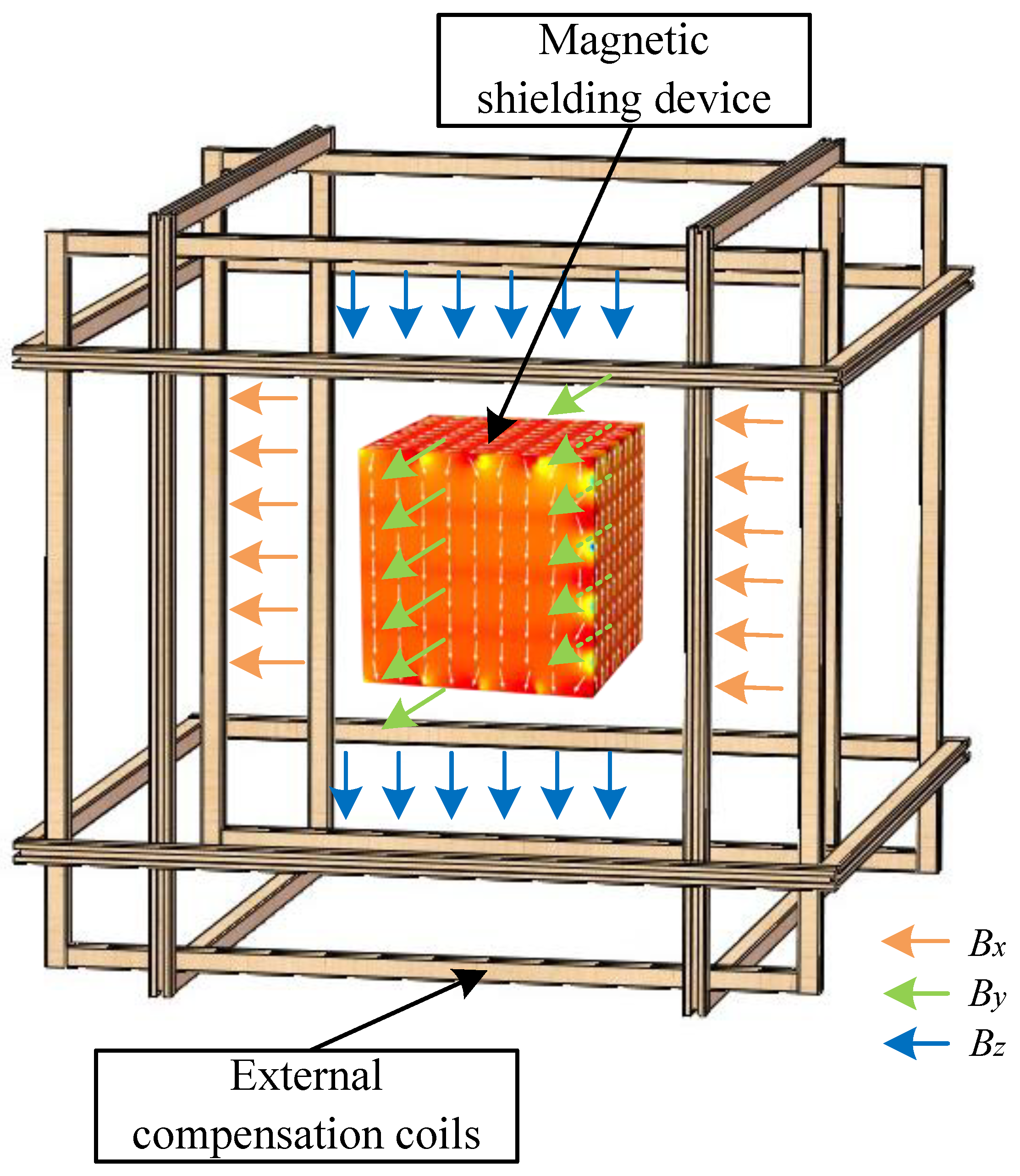
The external compensation coils for active magnetic compensation are arranged as shown in Figure 2. The coils are mounted on a frame surrounding the MSD. When current flows through the coils, they can generate magnetic fields of corresponding magnitudes in three orthogonal directions to cancel the remanent magnetization within the MSD. The magnetic field produced by the coils must pass through the soft magnetic material to reach the interior of the shield. This process progressively magnetizes the soft magnetic material, causing the passive shielding performance of the MSD to deteriorate and the distribution of the internal remanent magnetic field to change.
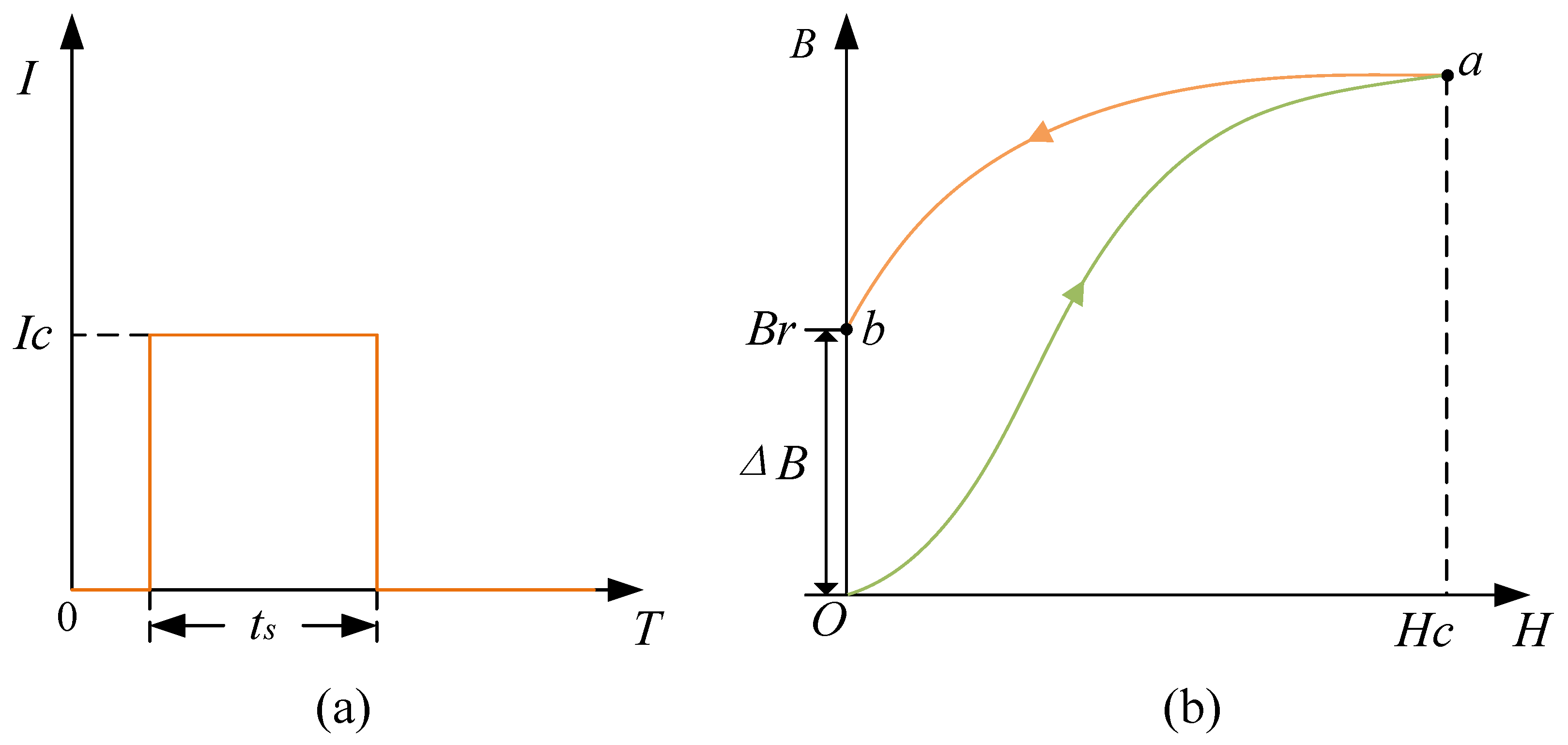
Assume that a certain soft magnetic material has been completely demagnetized. An external compensation coil is supplied with a current I c , generating a magnetic field strength of H c . After a duration of t s , the current is switched off. The waveform of the current in the coil is shown in Figure 3a. During this process, the material’s B-H curve starts from point O, first follows the initial magnetization curve to point a, corresponding to a magnetic field strength of H c . After time t s , the compensation magnetic field is removed, and the material’s state moves along a minor loop of the B-H curve to point b, at which point the magnetization is the remanence B r . This process is depicted in Figure 3b.
The classic expression for the Preisach model is as follows:
B ( t ) = T μ ( α , β ) γ α β [ H ( t ) ] d α d β
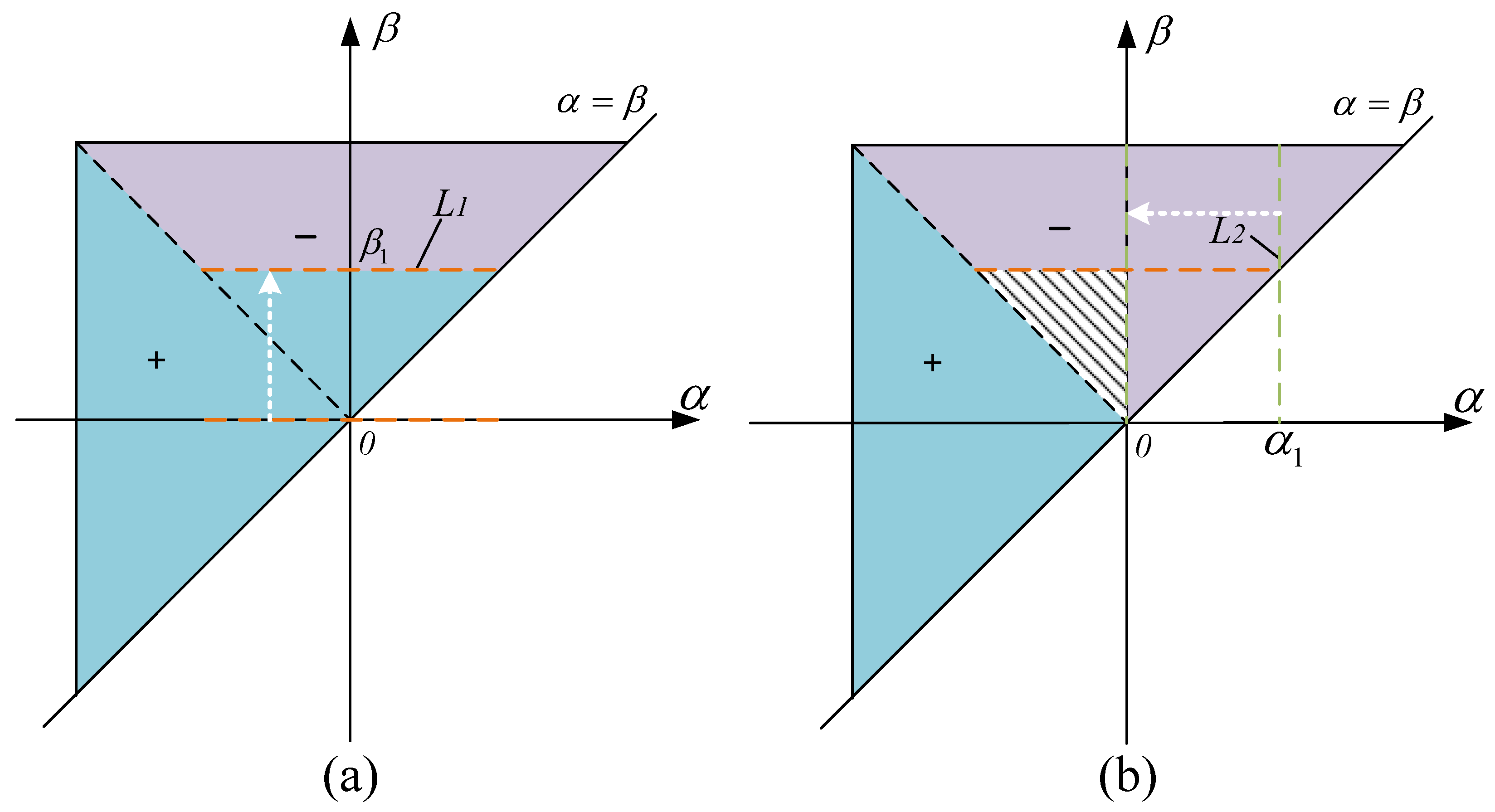
where T represents the Preisach triangle region shown in Figure 4, H ( t ) is the magnetic field strength input, B ( t ) is the magnetic flux density output, and γ α β is the hysteron operator, defined as:
γ α β [ H ( t ) ] = + 1 , if H ( t ) > α 1 , if H ( t ) < β γ α β [ H ( t Δ t ) ] , if β H ( t ) α .
Here, α and β are the two thresholds that determine the switching of the hysteron operator between +1 and −1, and t Δ t denotes the previous time step. μ ( α , β ) is the weight function of the Preisach model, defined over the region α β . Outside this triangle, μ ( α , β ) = 0 .
Assuming the Preisach function distribution of a soft magnetic material satisfies a factorized Lorentz function, which is a commonly used distribution function in constructing the Preisach model. It should be noted that the factorized Lorentz distribution selected for the Preisach weight function μ ( α , β ) is a phenomenological but standard choice in hysteresis modeling. This functional form is not derived from first-principle magnetostatics; instead, it originates from the classical statistical interpretation of the Preisach model, where α and β represent, respectively, the effective coercive field and interaction field of elementary hysterons. The Lorentz profile has been extensively used in the Extended Preisach Model (EPM) and in Della Torre’s formulations because it provides a realistic heavy-tailed distribution for these switching fields, capturing the experimentally observed spread and asymmetry of domain interaction energies in soft magnetic alloys such as Permalloy [24,25]. Compared with Gaussian or uniform distributions, the Lorentz form offers better agreement with measured minor-loop behavior and preserves analytical tractability in the Preisach integration, while different empirical distributions may influence the precise numerical values of the simulated hysteresis loops, they do not modify the qualitative mechanism responsible for remanence formation in multilayer structures. Thus, the choice of the Lorentz distribution affects quantitative fitting accuracy but does not alter the central trends demonstrated in this work.
μ ( α , β ) = k 1 1 + α β H c 0 w c 2 · k 2 1 + α + β w i 2 ,
where H c 0 , w c , w i , k 1 , and k 2 are the parameters of the factorized Lorentz function.
After demagnetization, the distribution of positive and negative hysterons within the Preisach triangle is as shown in Figure 4. The process of applying an external compensation field can be calculated by moving the line L 1 from β 1 = 0 up to a certain value, as shown in Figure 4a. At this point, the magnetic flux density B will change from the initial flux density B 0 to:
B = B 0 + 2 Triangle μ ( α , β ) d α d β .
The process of removing the external compensation field can be calculated by moving the line L 2 from α = α 1 to α = 0 , as shown in Figure 4b. The corresponding B-H curve is depicted in Figure 3b. It is evident that removing the external compensation magnetic field will cause additional magnetization in the shielding material. More generally, the change in remanence Δ B r is twice the integral over the shaded triangular area in Figure 4b:
Δ B r 2 0 α 1 α 0 μ ( α , β ) d β d α .
Therefore, the stronger the external compensation field strength, the larger Δ B r will be, and the greater the impact on the remanent magnetization within the MSD.

2.2. Transient Effects of Shielding Material

In practical applications, the compensation field is often applied abruptly rather than infinitely slowly. Understanding the transient response of the material to such sudden fields is crucial for predicting its real-world behavior and explaining dynamic phenomena observed in experiments.
To analytically estimate the time scale of eddy current decay, we employ a simplified linear diffusion model assuming a constant effective permeability μ . We acknowledge that Permalloy exhibits highly non-linear hysteresis; however, this linear approximation is intended strictly for calculating the transient stabilization time constant, not for determining the final magnetization state.
When the shielding material is in a three-dimensional space, assuming the transient magnetic field is parallel to the X-axis and uniform in the X-Y plane, its conduction equation can be expressed as:
2 H x z 2 = μ σ H x t .
The initial condition is H x ( z , 0 ) = 0 , and the boundary conditions are H x ( 0 , t ) = H x ( d , t ) = H 0 for t > 0 . By applying the Laplace transform to H x ( z , t ) with respect to t, we obtain its image function H ¯ x ( z , s ) . The transformed PDE becomes:
d 2 H ¯ x ( z , s ) d z 2 = s μ σ H ¯ x ( z , s ) .
The transformed boundary conditions are:
H ¯ x ( 0 , s ) = H ¯ x ( d , s ) = H 0 s .
When s is treated as a constant, (7) is a second-order ordinary differential equation in z. For a semi-infinite plate, the solution satisfying the boundary conditions is:
H ¯ x ( z , s ) = H 0 s e z μ σ s .
By consulting a table of Laplace transforms, the inverse transform of e k s / s is related to the complementary error function, erfc. Let k = z μ σ . The solution in the time domain is:
H x ( z , t ) = H 0 · erfc z 2 t / ( μ σ ) = H 0 · erfc k s 2 s · t .
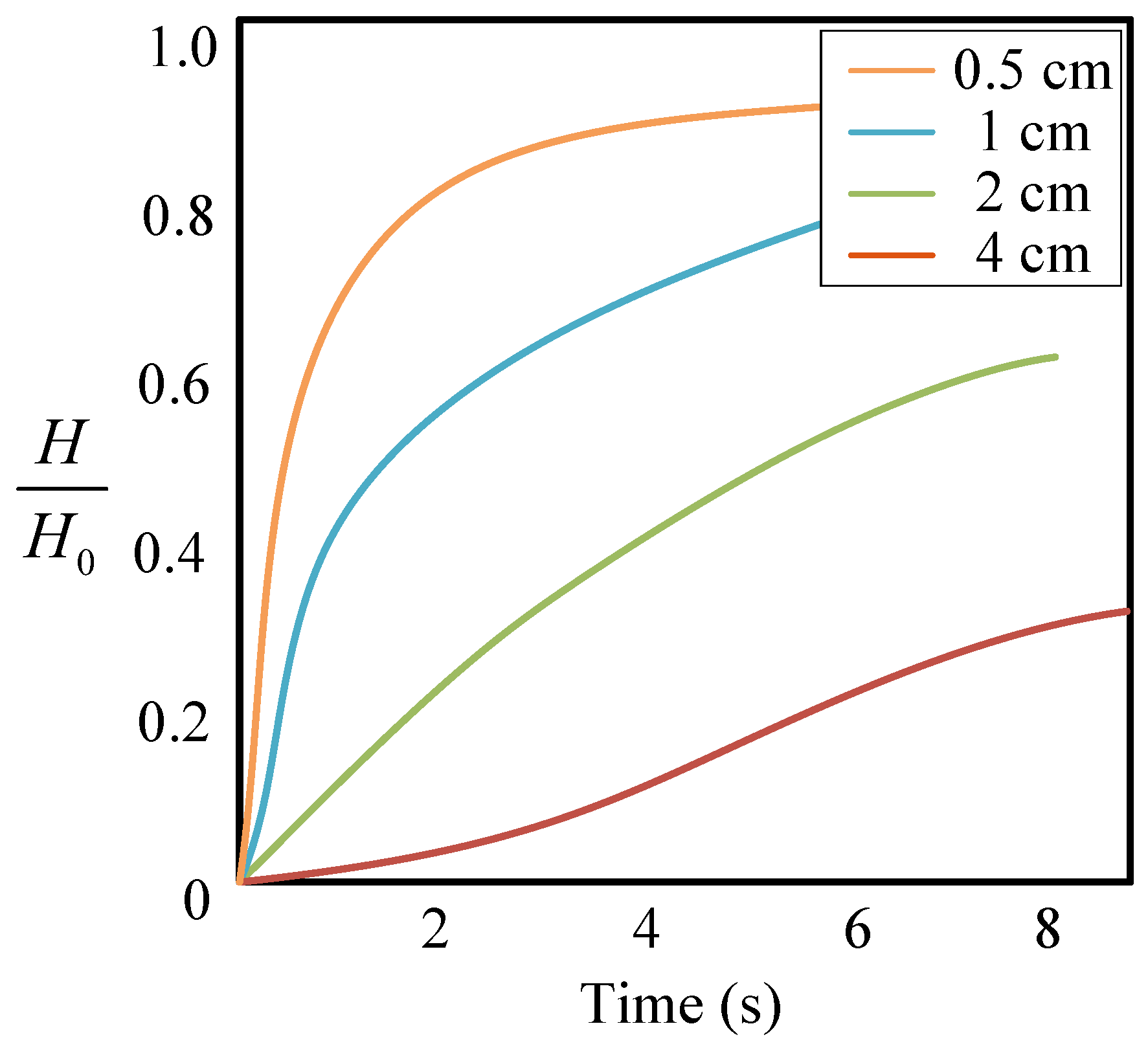
The complementary error function erfc ( u ) is a decreasing function of u. Thus, we can obtain a family of curves for H / H 0 versus time t for different material thicknesses, as shown in Figure 5.
From (10), it can be seen that for a smaller material thickness, the time required for the magnetization field to reach a stable state is shorter, and the degree of magnetization is lower. Therefore, in practical applications, the stabilization time of magnetization can be calculated based on the actual thickness of the material.
Consequently, the calculated stabilization time serves as a conservative lower bound. In our experiments, we set the measurement delay to be significantly longer than this estimated time to ensure that the non-linear eddy current effects have fully decayed.

3. Finite Element Modeling and Simulation Analysis

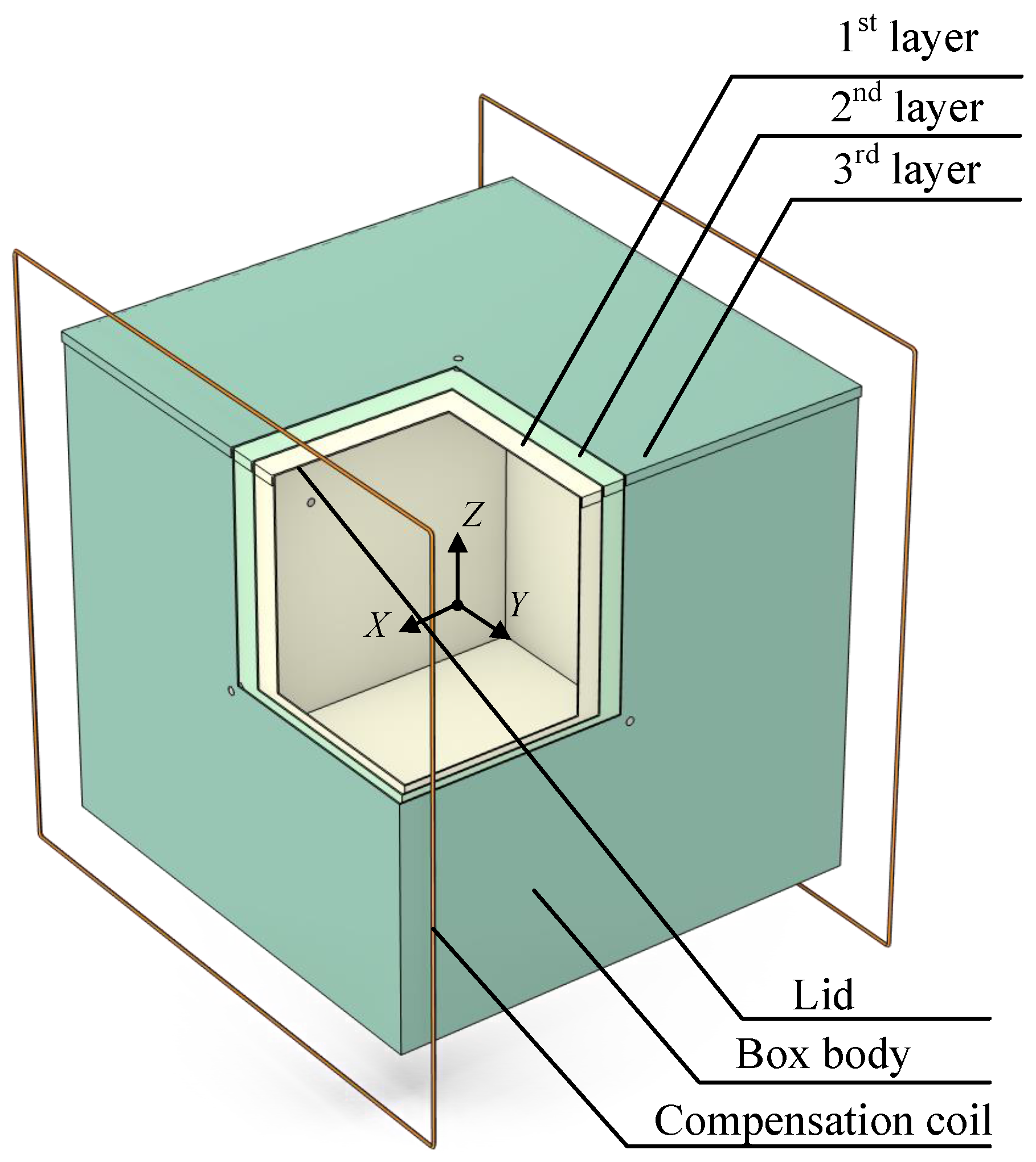
This paper uses the finite element simulation software COMSOL Multiphysics 6.2 to model and simulate a scaled-down version of a magnetic shielding room, referred to as a magnetic shielding box (MSB). Simulations were conducted for single-layer, two-layer, and three-layer MSBs. The specific dimensions of the MSB are listed in Table 1. The simulation model is shown in Figure 6. The compensation coil is used to generate the excitation magnetic field. A fine mesh is used for the coil and the magnetic shielding layer, while a regular mesh was used for the air domain. The total number of solving elements is 240,342.
The simulation utilized the Magnetic Fields (mf) interface in COMSOL. To reproduce the hysteretic behavior described by the theory, we adopted the Jiles-Atherton material model (available in the Non-linear Magnetic Material library), which is numerically more stable for FEM convergence than a direct Preisach implementation. The model parameters were explicitly calibrated to match the Permalloy material used in our experiments. The specific parameters are as follows: Saturation magnetization M s = 1.31 × 10 6 A/m, Domain wall density a J A = 233.78 A/m, Pinning loss k J A = 374.975 A/m, Magnetization reversibility c J A = 0.736 , and Inter-domain coupling α J A = 5.62 × 10 4 . The simulation employed a Time-Dependent solver with a generalized alpha method to capture the dynamic magnetization history efficiently.
The purpose of the finite element simulation is to investigate the change in remanent magnetization in the internal space of MSDs with different numbers of layers after magnetic compensation. In the simulation environment, the MSB is placed in an ambient magnetic field of 30 uT in the X-direction, which is close to the north–south component of the Earth’s magnetic field in China. The simulation protocol is as follows:
  • For single-, double-, and triple-layer MSBs, with the number of turns on one side of the coil fixed at 50, a parametric sweep is performed by passing different compensation currents I c .
  • The center point is selected as the reference point to measure the magnetic field. For a given compensation field B c at the center, the corresponding current I c is determined, and then the change in the central magnetic field relative to the initial residual magnetic field, Δ B r , is calculated after the current is removed.
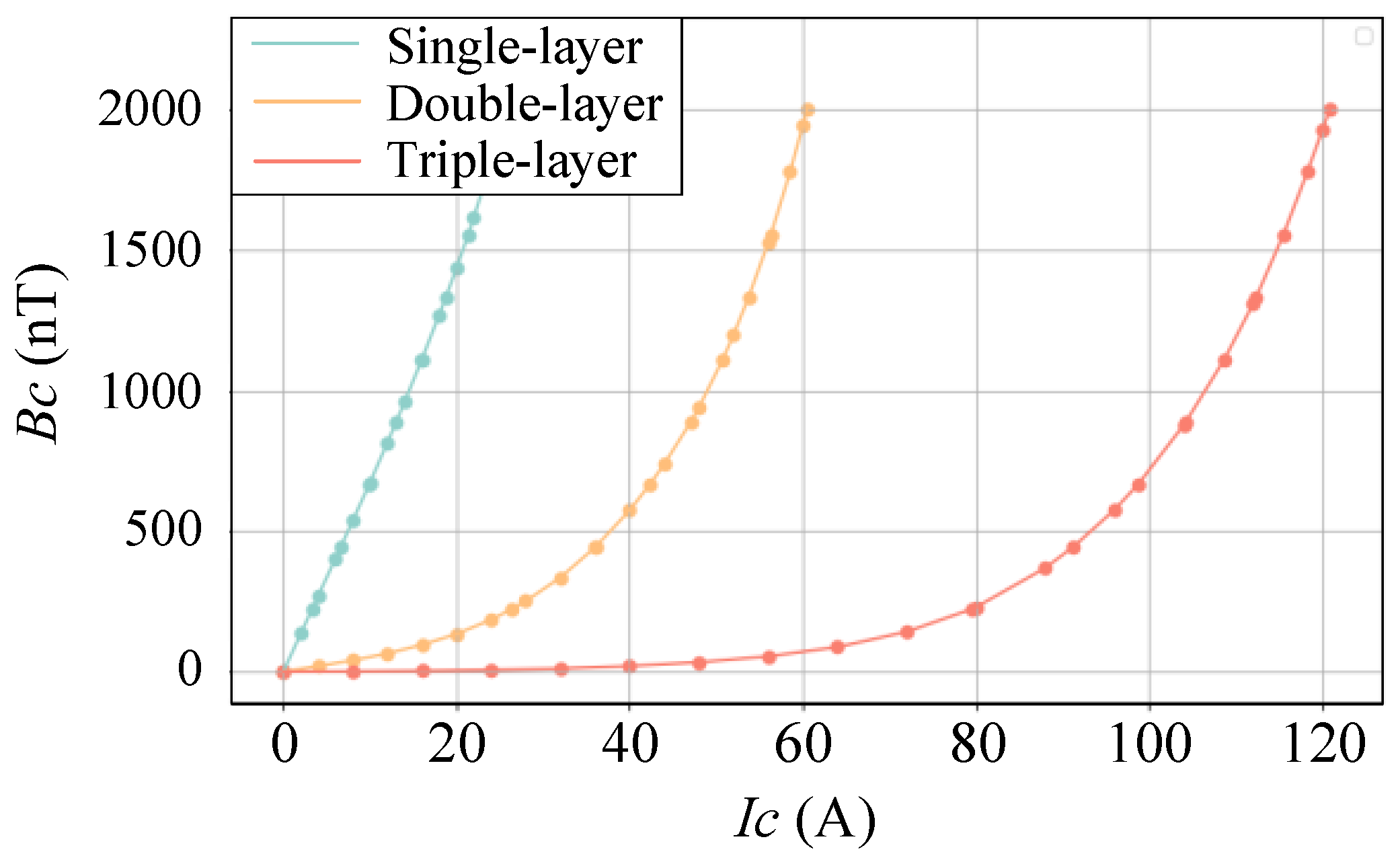
Figure 7 shows the variation in the internal center point magnetic field B c with the current I c . It can be seen that the fewer the shielding layers, the lower the shielding factor of the MSB, and the relationship between the center point compensation magnetic field B c and the current is more linear.
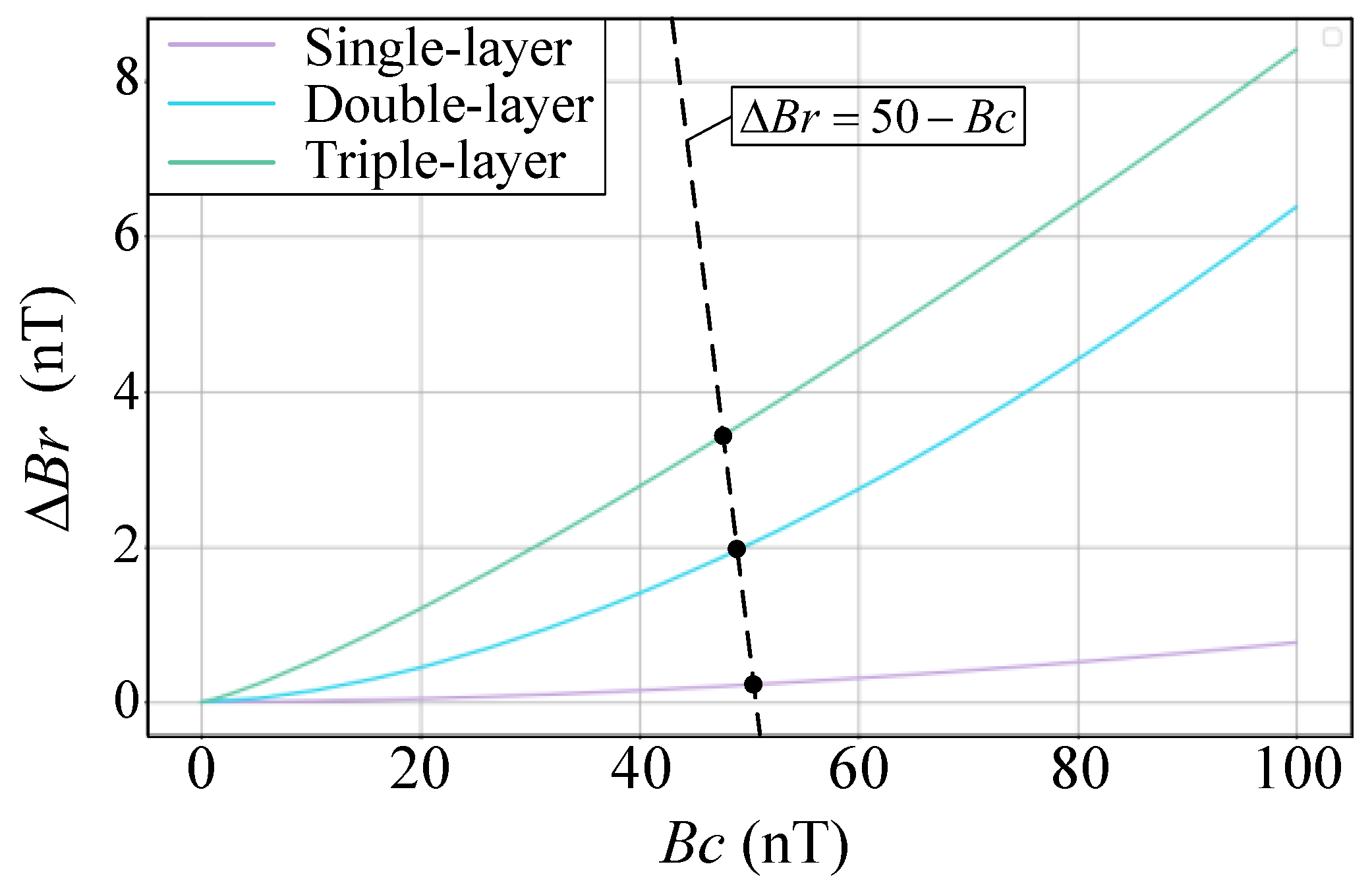
Figure 8 shows the variation in the remanent magnetization change Δ B r at the center point of the MSB with different numbers of layers as a function of the compensation magnetic field B c . It is evident that as the number of layers increases, the internal remanent magnetization change Δ B r caused by the same compensation magnetic field strength B c becomes larger. The straight line defined by Δ B r = 50 B c in Figure 8 represents a theoretical boundary for stability performance. Assuming that 50 nT is the maximum acceptable limit for the internal residual magnetic field, this line serves as a reference threshold. If the combination of the compensation field ( B c ) and the resulting remanence change ( Δ B r ) falls to the right of this line, it indicates that the static remanence after the compensation cycle will exceed the 50 nT limit.
The B c - Δ B r curves for different numbers of layers were fitted with an exponential function, Δ B r = a · B c b . The fitted parameters for MSBs with different numbers of layers are shown in Table 2.
The analysis of Table 2 reveals a key quantitative relationship. The parameter a can be interpreted as the susceptibility coefficient of the remanent response. From single-layer to double-layer, and then to triple-layer, the value of a increases by an order of magnitude, from approximately 2 × 10 4 to 3 × 10 3 , and then to 3 × 10 2 . This provides decisive quantitative evidence of a direct positive correlation between the number of layers and the strength of the remanence instability. The values of parameter b are all greater than 1, indicating that the change in remanence grows non-linearly and accelerates with the strength of the compensation field, which is also consistent with the theoretical predictions of the Preisach model.

4. Experimental Validation

To verify the accuracy of the theoretical analysis and finite element simulation results, and to investigate the dynamic response characteristics of the MSD under actual working conditions, an experimental platform was established to systematically study the stability of the passive shielding performance of MSBs with different layer configurations. The experiment not only aims to confirm the core relationship between remanence instability and the number of layers but also to reveal the accompanying transient physical phenomena.
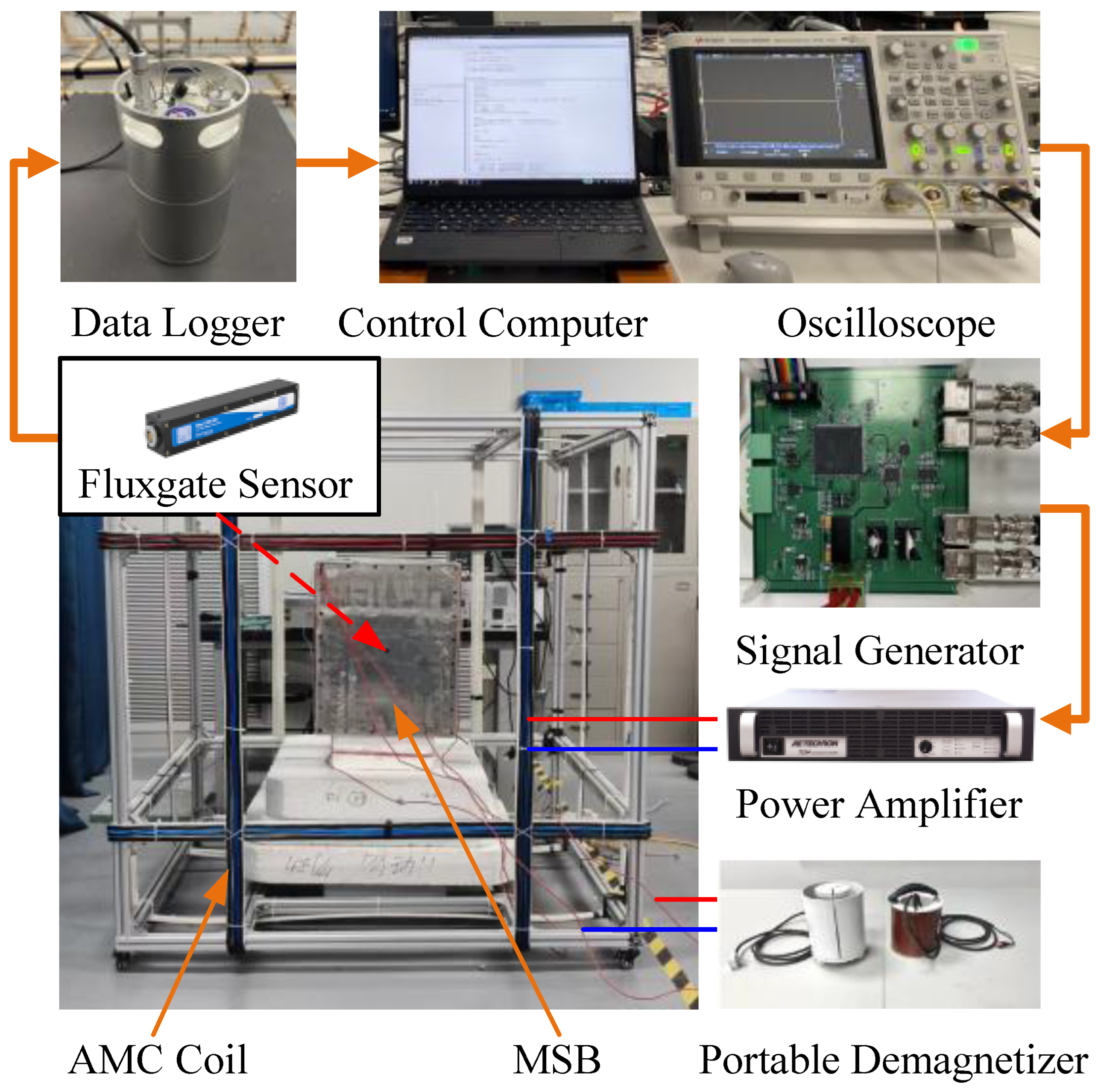
The experimental validation platform is shown in Figure 9. It mainly consists of the single-, double-, and triple-layer Permalloy MSBs to be tested; a triaxial active magnetic compensation coil for generating external excitation fields; and corresponding driving and measurement equipment. The experimental procedure is strictly followed.
  • Initial State Setting: Before testing each layer configuration, the MSB is thoroughly demagnetized using a portable demagnetizer to eliminate remanence interference and ensure consistent initial conditions.
  • Sensor Deployment: A high-precision triaxial fluxgate sensor is accurately placed at the geometric center of the MSB to monitor the magnetic field changes at that point in real-time.
  • Excitation Field Application: A signal generator, controlled by a computer, produces a square wave current signal with linearly increasing amplitude. This signal, after being amplified by a power amplifier, drives the AMC coil to generate a dynamically changing magnetic field outside the MSB.
  • Data Acquisition: While applying the excitation field, a data logger and an oscilloscope simultaneously record the current waveform in the compensation coil and the magnetic field strength data from the fluxgate sensor at the internal center point.
  • Repetitive Testing: The above experimental procedure is repeated for single-, double-, and triple-layer MSBs to obtain performance data for different configurations for subsequent comparative analysis.
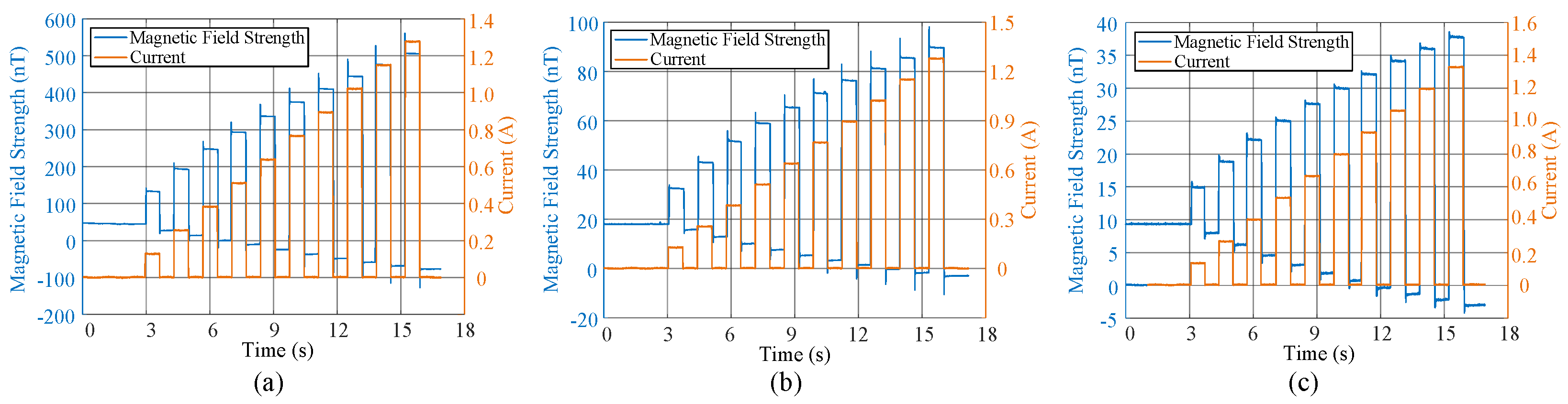
Figure 10 shows the variation in the magnetic field at the center of the 1-, 2-, and 3-layer MSBs with the external coil current. In the figure, the orange curve represents the input square wave current, and the blue curve represents the change in magnetic flux density (Y-component) at the center of the MSB. It can be seen that whenever the orange square wave current undergoes a step change (rising or falling edge), a brief spike appears on the blue magnetic field curve. This phenomenon is the result of the combined action of electromagnetic induction (especially eddy current effects) and the dynamic magnetization characteristics of the magnetic shielding material (including hysteresis and response delay).
To distinguish eddy-current transients from true hysteretic remanence, we relied on a time-scale separation inherent to multilayer magnetic shields. According to (10), for a material thickness of 1.5 mm, the magnetization reaches a stable state in about 0.21 s. These transients exhibit an exponential-like decay and vanish within a few multiples of the diffusion time. In contrast, hysteretic remanence corresponds to a quasi-static shift in the magnetic operating point and evolves only from cycle to cycle; it does not relax within the time scale of the diffusion process.
In the experimental processing, the magnetic field was sampled 1.0 s after each current reversal—more than four diffusion time constants—ensuring that the transient eddy-current contribution had decayed by over 98%. Therefore, the extracted values of Δ B r and the instability metric K r represent purely the static remanence change associated with hysteresis. This confirms that the measured instability originates from magnetization history rather than from dynamic eddy-current artifacts.
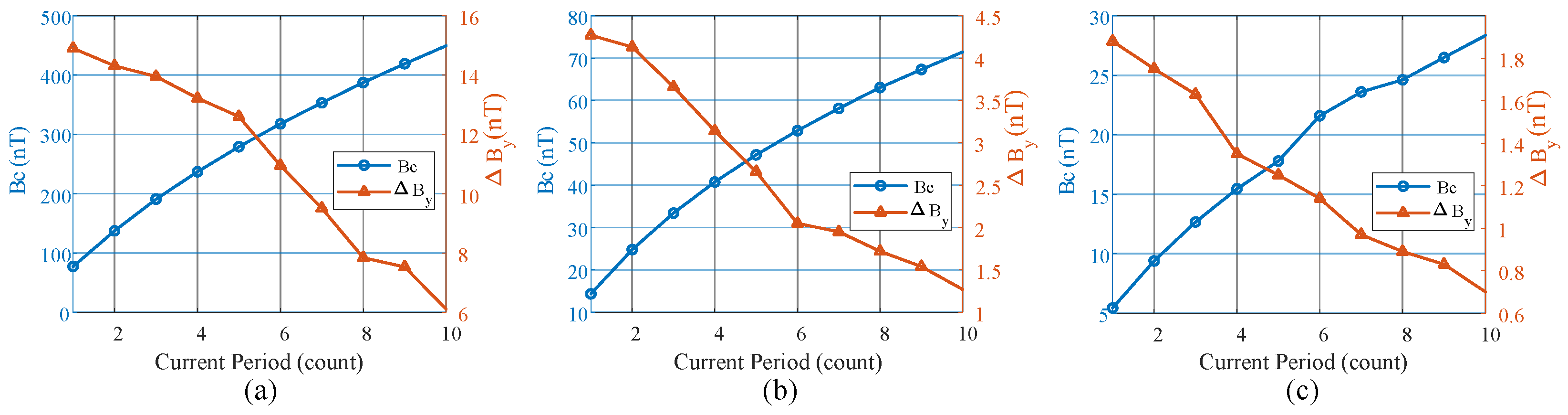
To validate the core argument of this paper, we processed the experimental data to quantify the relationship between the compensation magnetic field B c and the remanent magnetization change Δ B y after compensation, as shown in Figure 11. It is evident that in all layer configurations, as the compensation current period increases (i.e., the compensation field B c increases), the remanence produced after compensation also increases. To further observe the relationship between the remanent field change and the number of layers more intuitively and quantitatively, this paper uses the rate of change in remanence, K r = Δ B y / B c , to characterize the stability of the MSB with different numbers of layers.
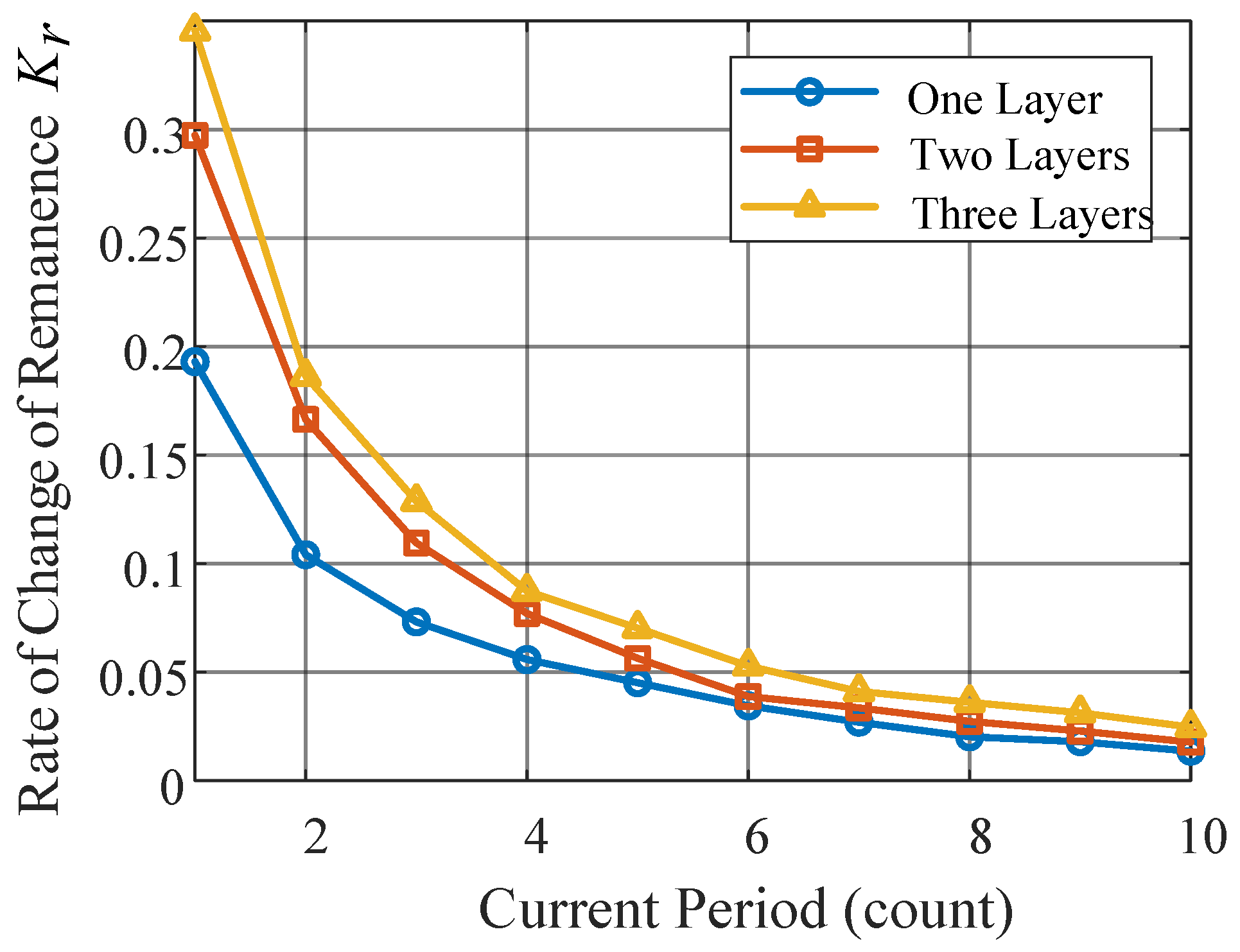
Figure 12 compares the rate of change in remanence for different numbers of layers. It shows a clear positive correlation between the number of layers of the MSB and the rate of change in remanence. This indicates that when the same strength of compensation magnetic field B c is applied, a MSD with more shielding layers produces a larger change in remanent magnetization Δ B y . This experimental result is completely consistent with the trend of the simulation results shown in Figure 8, strongly supporting the core conclusion of this paper: although increasing the number of shielding layers can improve the overall shielding effectiveness, it also leads to a decrease in remanence stability during the active compensation process, making it more susceptible to compensation operations.

5. Discussion

The results presented above clearly establish a positive correlation between the number of passive shielding layers and the degree of remanence instability in hybrid active–passive magnetic shielding systems. Nevertheless, several aspects warrant further discussion and clarification.
First, the theoretical framework is based on the classical Preisach hysteresis model with a factorized Lorentz distribution of the weight function. This model effectively captures the qualitative behavior of magnetic hysteresis but neglects inter-layer magnetic coupling and spatial non-uniformity of the field inside multi-layer structures. In reality, eddy current interactions and boundary effects between adjacent layers can lead to additional nonlinearities that may further amplify or suppress the observed instability. A more refined model, such as a vector Preisach [26] or Jiles–Atherton formulation [27] incorporating inter-layer coupling terms, could provide deeper insight into these effects. Moreover, although a vector hysteresis model or an explicit inter-layer coupling formulation would modify the quantitative prediction, it is unlikely to overturn the qualitative trend reported in this work. The amplification of remanence instability with increasing layer number primarily originates from geometric flux-shunting and boundary-condition stacking: as additional layers are added, the outer shells reshape the magnetic flux distribution and locally concentrate the compensation field inside the inner layers. This geometric effect persists regardless of whether the hysteresis operator is scalar or vector. Therefore, a vector Preisach or Jiles–Atherton model would refine the magnitude of the predicted instability but not reverse the monotonic increase in remanence sensitivity with layer count. At low frequencies relevant to active compensation, inductive damping remains weak, making amplification the dominant mechanism, whereas suppression due to eddy-current coupling becomes significant only at much higher frequencies.
Second, the finite-element simulations assumed constant permeability and conductivity values, independent of frequency and magnetic history. However, the effective permeability of high-permeability alloys can vary significantly under low-field conditions due to stress and magnetic annealing states. Introducing frequency-dependent complex permeability and conducting a convergence study on the meshing strategy would enhance the quantitative reliability of the numerical predictions. In addition, the present work focuses on the quasi-static regime, where the compensation field changes slowly enough that magnetic hysteresis dominates the material response. This corresponds to the worst-case condition for remanence generation, as the compensation field fully penetrates the shield layers. At higher frequencies, however, the situation changes: eddy currents induced in the conductive high-permeability layers increasingly oppose field penetration, effectively reducing the magnetic flux reaching the inner regions. This frequency-dependent attenuation acts as a dynamic low-pass filter and may partially suppress the depth of magnetization and the resulting remanence change. A full characterization of this frequency response—including the identification of the transition frequency at which eddy-current shielding begins to outweigh hysteretic amplification—remains an important direction for future work, especially for systems relying on high-bandwidth dynamic compensation.
Third, the experimental verification was limited to the central point of the magnetic shielding box. Although this configuration suffices to confirm the main trend, spatial mapping of the internal field distribution and analysis of gradient variations would provide a more comprehensive understanding of the field stability. Although our experimental measurements were taken only at the geometric center, it is important to acknowledge that the internal magnetic field of a multilayer shield is generally non-uniform. Prior studies and typical FEM results of similar multilayer structures indicate that residual fields tend to increase near the walls and corners due to flux-funneling and edge effects, whereas the center typically exhibits the lowest field magnitude. Therefore, the remanence instability quantified at the center likely represents a lower bound rather than the maximum possible value within the shield. A full spatial mapping—either experimentally or through dedicated FEM analysis—was beyond the scope of the present study but will be pursued in future work to characterize gradient stability and local amplification effects throughout the entire shield volume. Furthermore, potential experimental uncertainties—such as misalignment of the compensation coils, residual field drift, and environmental noise—should be statistically evaluated in future work.
Furthermore, regarding the excitation signal type, this study primarily utilized a square wave current sequence. This waveform was chosen because it simulates a ’step response’ scenario, representing the most abrupt change in the magnetic field. In terms of hysteresis dynamics, the step change induces the most severe transient magnetization response compared to gradual changes, while other waveforms (such as sinusoidal or triangular waves) would drive the material along different minor loops on the B-H curve, the fundamental mechanism identified in this study—that multi-layer structures trap more significant remanent magnetization due to the penetration depth of active fields—remains applicable. Future work could further quantify the ’Rate of Change of Remanence’ under continuous AC compensation signals to provide a broader data reference.
Finally, it should be emphasized that the present study used a scaled-down magnetic shielding box model. In large-scale magnetic shielding rooms, where the layer dimensions and inter-layer gaps differ significantly, the remanence dynamics may exhibit size-dependent scaling effects. Extending the current methodology to room-sized systems and investigating demagnetization protocols optimized for active-compensation scenarios will be an important direction for future research.
Overall, while the simplified modeling assumptions do not alter the qualitative conclusion, acknowledging these limitations clarifies the scope of validity of the present results and points to the next steps required for the quantitative design optimization of hybrid magnetic shielding systems.

Author Contributions

Conceptualization, S.Y. and Z.Y.; methodology, S.Y. and J.S.; software, S.Y.; validation, H.Z. and B.H.; formal analysis, S.Y. and J.S.; investigation, S.Y. and H.Z.; data curation, S.Y.; writing—original draft preparation, S.Y.; writing—review and editing, Z.Y. and J.S.; visualization, S.Y. All authors have read and agreed to the published version of the manuscript.

Funding

This work was supported by the National Natural Science Foundation of China (Grant No. 52525501), the National Key R&D Program of China (Grant No. 2022YFB3902900), and the Innovation Program for Quantum Science and Technology (Grant No. 2021ZD0300500). Additional support was provided by the Beijing Engineering Research Center of HighSpeed Magnetically Suspended Motor Technology and Application, Beijing 100191, China.

Data Availability Statement

The raw data supporting the conclusions of this article will be made available by the authors on request.

Conflicts of Interest

The authors declare no conflicts of interest.

References

  1. Yu, S.; Sun, J.; Zhang, H.; Tian, P. Composite suppression method for gradient and uniform field disturbance in magnetic shielding cylinders using DL-LESO-PDR. Measurement 2026, 258, 115906. [Google Scholar] [CrossRef]
  2. Baillet, S. Magnetoencephalography for brain electrophysiology and imaging. Nat. Neurosci. 2017, 20, 327–339. [Google Scholar] [CrossRef] [PubMed]
  3. Gröbner, J.; Rüdhamer, M.; Fierlinger, P. A Method to Measure and Compensate Temperature-Dependent Magnetic Field Fluctuations in a Magnetically Shielded Room. IEEE Trans. Instrum. Meas. 2021, 70, 1–8. [Google Scholar]
  4. Alarcon, I.; Bales, M.; Beck, D.H.; Chupp, T.; Fierlinger, K.; Fierlinger, P.; Kuchler, F.; Lins, T.; Marino, M.G.; Naessen, B.; et al. A large-scale magnetic shield with 105 damping at millihertz frequencies. J. Appl. Phys. 2015, 117, 183903. [Google Scholar] [CrossRef]
  5. Sun, Z.; Fierlinger, P.; Han, J.; Li, L.; Liu, T.; Schnabel, A. Limits of Low Magnetic Field Environments in Magnetic Shields. IEEE Trans. Ind. Electron. 2021, 68, 5385–5395. [Google Scholar] [CrossRef]
  6. Long, T.; Song, X.; Duan, Z.; Suo, Y.; Wu, Z.; Jia, L. Suppression of Amplitude and Phase Errors in Optically Pumped Magnetometers Using Dual-PI Closed-Loop Control. IEEE Trans. Instrum. Meas. 2023, 73, 4001412. [Google Scholar] [CrossRef]
  7. Sun, Z.; Schnabel, A.; Burghoff, M.; Li, L. Calculation of an optimized design of magnetic shields with integrated demagnetization coils. AIP Adv. 2016, 6, 075114. [Google Scholar] [CrossRef]
  8. Pan, D.; Li, J.; Jin, C.; Liu, T.; Lin, S.; Li, L. A new calibration method for triaxial fluxgate magnetometer based on magnetic shielding room. IEEE Trans. Ind. Electron. 2020, 67, 4183–4192. [Google Scholar] [CrossRef]
  9. Kelhä, V.O.; Pukki, J.M.; Peltonen, R.S.; Penttinen, A.J.; Ilmoniemi, R.J.; Heino, J.J. The effect of shaking on magnetic shields. IEEE Trans. Magn. 1980, 16, 575–578. [Google Scholar] [CrossRef]
  10. Altarev, I.; Babcock, E.; Beck, D.; Burgdorf, M.; Chesnevskaya, S.; Chupp, T.; Degenkolb, S.; Fan, I.; Fierlinger, P.; Freifrei, A.; et al. A magnetically shielded room with ultra low residual field and gradient. Rev. Sci. Instrum. 2014, 85, 075106. [Google Scholar] [CrossRef]
  11. Sasada, I.; Shiokawa, M. Noise characteristics of Co-based amorphous tapes to be applied as magnetic shielding shell for magnetic shaking. IEEE Trans. Magn. 2003, 39, 3435–3437. [Google Scholar] [CrossRef]
  12. Pan, D.; Lin, S.; Li, L.; Li, J.; Jin, Y.; Sun, Z. Research on the Design Method of Uniform Magnetic Field Coil Based on the MSR. IEEE Trans. Ind. Electron. 2020, 67, 1348–1356. [Google Scholar] [CrossRef]
  13. Dou, S.; Liu, X.; Shangguan, S.; Wen, T.; Zheng, S.; Han, B. Design of biplane coils based on funnel algorithm for generating a near-zero magnetic environment in MSR. IEEE Trans. Instrum. Meas. 2023, 72, 6004211. [Google Scholar] [CrossRef]
  14. Chen, Y.; Wen, T.; Fang, Y.; Han, B.; Liu, X. Highly homogeneous and low-noise magnetic field compensation based on the high-uniform magnetic field coils with small coil constant. IEEE Trans. Instrum. Meas. 2024, 73, 6004309. [Google Scholar] [CrossRef]
  15. Zhang, H.; Shi, Z.; Zhao, F.; Li, H. Disturbance suppression based high-precision magnetic field compensation method for magnetic shielding cylinder. IEEE Trans. Ind. Electron. 2024, 72, 857–866. [Google Scholar] [CrossRef]
  16. Chen, Y.; Lin, S.; Jin, C.; Dai, X.; Pan, D.; Jin, Y.; Li, Y.; Li, L. Optimization Method for Weak Magnetic Measurement Environments Using Active–Passive Coupled Magnetic Shielding Analysis. IEEE Trans. Instrum. Meas. 2025, 74, 1–11. [Google Scholar] [CrossRef]
  17. Sun, Z.; Reisner, M.; Fierlinger, P.; Schnabel, A.; Stuiber, S.; Li, L. Dynamic modeling of the behavior of permalloy for magnetic shielding. J. Appl. Phys. 2016, 119, 193901. [Google Scholar] [CrossRef]
  18. Thiel, F.; Schnabel, A.; Knappe-Grueneberg, S.; Stollfuß, D.; Burgdorf, M. Demagnetization of magnetically shielded rooms. Rev. Sci. Instrum. 2007, 78, 035106. [Google Scholar] [CrossRef]
  19. Chupp, T.E.; Fierlinger, P.; Ramsey-Musolf, M.J.; Singh, J.T. Electric dipole moments of atoms, molecules, nuclei, and particles. Rev. Modern Phys. 2019, 91, 015001. [Google Scholar] [CrossRef]
  20. Tang, S.; Lu, J.; Sun, B.; Wang, S.; Wang, K.; Zhang, X. Optimal Design of Self-Shielded Biplanar Coil Assembly with Miniaturized Structure. IEEE Trans. Instrum. Meas. 2023, 72, 9005209. [Google Scholar] [CrossRef]
  21. Han, B.; Zhou, W.; Xu, X.; Sun, J.; Zhao, F.; Jiang, Q. Asymmetric Cylindrical Coils Design for Uniform Magnetic Field. IEEE Trans. Instrum. Meas. 2023, 72, 6009710. [Google Scholar] [CrossRef]
  22. Tierney, T.M.; Holmes, N.; Mellor, S.; López, J.D.; Roberts, G.; Hill, R.M.; Boto, E.; Leggett, J.; Shah, V.; Brooks, M.J.; et al. Optically pumped magnetometers: From quantum origins to multi-channel magnetoencephalography. NeuroImage 2019, 199, 598–608. [Google Scholar] [CrossRef]
  23. Mayergoyz, I.D. The classical Preisach model of hysteresis. In Mathematical Models of Hysteresis; Springer: New York, NY, USA, 1991; pp. 1–63. [Google Scholar] [CrossRef]
  24. Zhang, B.; Gupta, B.; Ducharne, B.; Sebald, G.; Uchimoto, T. Preisach’s Model Extended with Dynamic Fractional Derivation Contribution. IEEE Trans. Magn. 2018, 54, 6100204. [Google Scholar] [CrossRef]
  25. Della Torre, E. A Preisach model for accommodation. IEEE Trans. Magn. 1994, 30, 2701–2707. [Google Scholar] [CrossRef]
  26. Charap, S.H.; Ktena, A. Vector Preisach modeling (invited). J. Appl. Phys. 1993, 73, 5818–5823. [Google Scholar] [CrossRef]
  27. Chen, J.; Shang, H.; Xia, D.; Wang, S.; Peng, T.; Zang, C. A Modified Vector Jiles-Atherton Hysteresis Model for the Design of Hysteresis Devices. IEEE Trans. Energy Convers. 2023, 38, 1827–1835. [Google Scholar] [CrossRef]
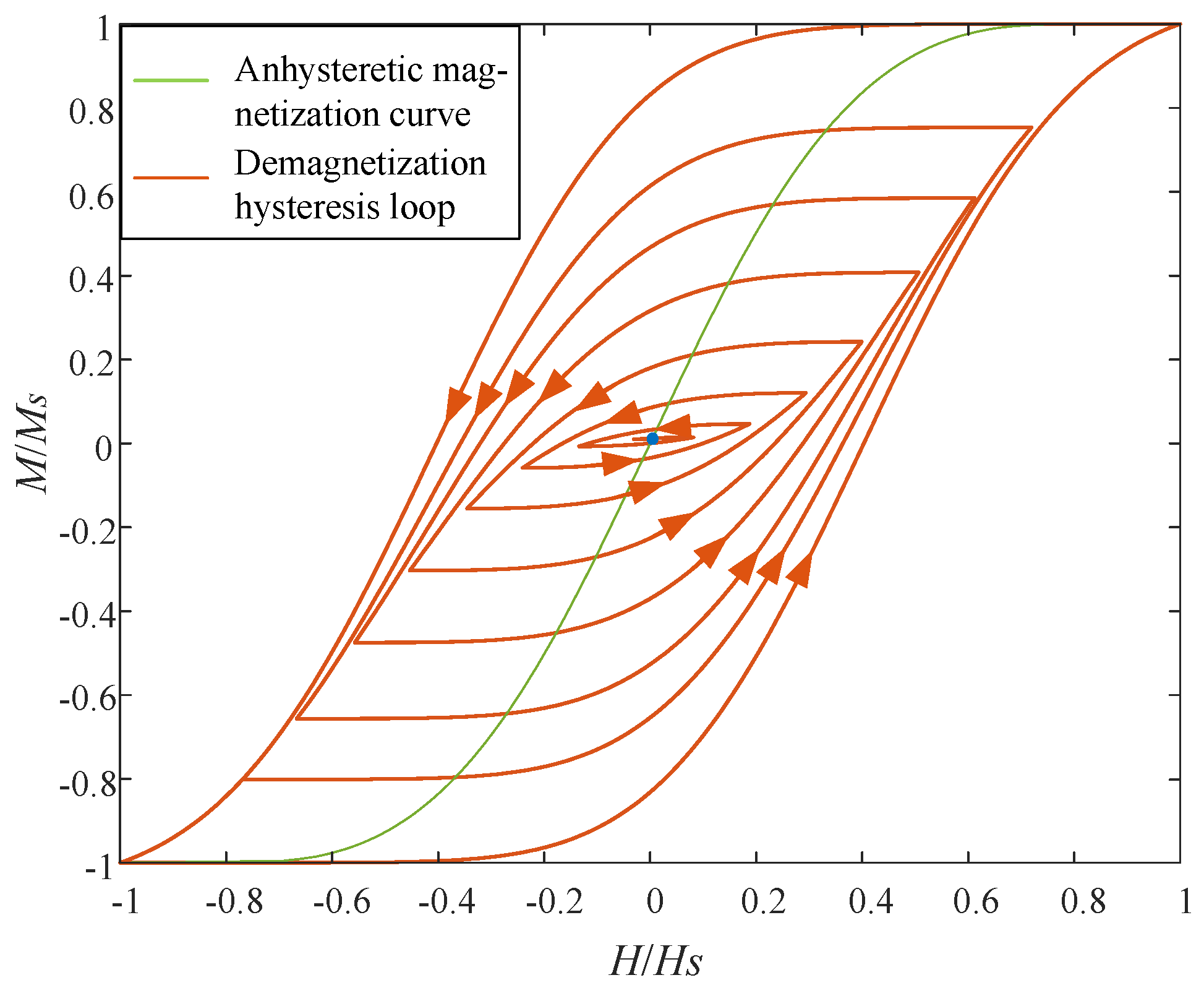
Figure 1. M-H curve of the demagnetization process.
Applsci 15 13173 g001
Figure 2. Schematic diagram of the triaxial hybrid MSD.
Applsci 15 13173 g002
Figure 3. (a) The waveform of the current in the coil and (b) the corresponding B-H curve during the compensation process.
Applsci 15 13173 g003
Figure 4. Illustration of the calculation principle of the Preisach triangle. (a) Applying the compensation field. (b) Removing the compensation field and formation of remanence (shaded area).
Applsci 15 13173 g004
Figure 5. Family of curves for normalized magnetic field strength H H 0 (dimensionless) versus time t (s) at different material depths. The different colored lines represent different material thicknesses (0.5 cm to 4 cm) to illustrate the variation in magnetization stabilization time.
Applsci 15 13173 g005
Figure 6. The finite element simulation model of the multi-layer MSB.
Applsci 15 13173 g006
Figure 7. Variation of compensation field B c with current I c for MSBs with different numbers of layers.
Applsci 15 13173 g007
Figure 8. Variation of remanence change Δ B r with compensation field B c for MSBs with different numbers of layers.
Applsci 15 13173 g008
Figure 9. The experimental validation platform.
Applsci 15 13173 g009
Figure 10. Waveforms of the magnetic field strength in the Y-direction at the center point and the compensation current. (a) Single-layer MSB. (b) Double-layer MSB. (c) Triple-layer MSB.
Applsci 15 13173 g010
Figure 11. Compensation field and remanence change at the center point under a square wave current sequence. (a) Single-layer, (b) Double-layer, (c) Triple-layer.
Applsci 15 13173 g011
Figure 12. Rate of change in remanence ( K r , dimensionless) at the center point under a square wave current sequence for different numbers of layers. The X-axis represents the number of current periods (count).
Applsci 15 13173 g012
Table 1. Parameters of the MSB Model.
ParameterValue
1st layer box dimensions46 cm × 46 cm × 46 cm
2nd layer box dimensions48 cm × 48 cm × 48 cm
3rd layer box dimensions50 cm × 50 cm × 50 cm
Hole diameter1 cm
Lid height1 cm
Material thickness1.5 mm
Gap between lid and body5 × 10 3 mm
Coil dimensions60 cm × 60 cm
Coil distance from box10 cm
Table 2. Fitted Parameters for the Δ B r B c Expression.
Number of LayersParameter aParameter b
Single-layer2.065 × 10 4 1.785
Double-layer3.131 × 10 3 1.654
Triple-layer3.221 × 10 2 1.208
Disclaimer/Publisher’s Note: The statements, opinions and data contained in all publications are solely those of the individual author(s) and contributor(s) and not of MDPI and/or the editor(s). MDPI and/or the editor(s) disclaim responsibility for any injury to people or property resulting from any ideas, methods, instructions or products referred to in the content.