


Phase Angle Is More Strongly Associated with Peak Oxygen Uptake than Skeletal Muscle Mass Percentage in Healthy Young Adults: A Cross-Sectional Study


Featured Application
Abstract
1. Introduction
2. Materials and Methods
2.1. Study Participants
2.2. Body Composition Measurement
2.3. Cardiopulmonary Exercise Testing
2.4. Statistical Analysis
3. Results
3.1. Baseline Characteristics of Participants
3.2. Correlation and Regression Analyses
4. Discussion
4.1. PhA and VO2peak
4.2. PhA and VO2AT
4.3. PhA and Relative VO2peak
4.4. Clinical Implications and Future Directions
4.5. Limitations
5. Conclusions
Author Contributions
Funding
Institutional Review Board Statement
Informed Consent Statement
Data Availability Statement
Acknowledgments
Conflicts of Interest
Abbreviations
| BIA | Bioelectrical impedance analysis |
| BMI | Body mass index |
| CI | Confidence interval |
| CPX | Cardiopulmonary exercise testing |
| PhA | Phase angle |
| SMM% | Skeletal muscle mass percentage |
| VIF | Variance inflation factor |
| VO2 | Oxygen uptake |
| VO2AT | Oxygen uptake at anaerobic threshold |
| VO2peak | Peak oxygen uptake |
References
- Balady, G.J.; Arena, R.; Sietsema, K.; Myers, J.; Coke, L.; Fletcher, G.F.; Forman, D.; Franklin, B.; Guazzi, M.; Gulati, M.; et al. Clinician’s guide to cardiopulmonary exercise testing in adults: A scientific statement from the American Heart Association. Circulation 2010, 122, 191–225. [Google Scholar] [CrossRef] [PubMed]
- Wasserman, K.; Whipp, B.J.; Koyl, S.N.; Beaver, W.L. Anaerobic threshold and respiratory gas exchange during exercise. J. Appl. Physiol. 1973, 35, 236–243. [Google Scholar] [CrossRef] [PubMed]
- Bassett, D.R.; Howley, E.T. Limiting factors for maximum oxygen uptake and determinants of endurance performance. Med. Sci. Sports Exerc. 2000, 32, 70–84. [Google Scholar] [CrossRef] [PubMed]
- Calbet, J.A.; Jensen-Urstad, M.; van Hall, G.; Holmberg, H.C.; Rosdahl, H.; Saltin, B. Maximal muscular vascular conductances during whole body upright exercise in humans. J. Physiol. 2004, 558, 319–331. [Google Scholar] [CrossRef] [PubMed]
- Poole, D.C.; Hirai, D.M.; Copp, S.W.; Musch, T.I. Muscle oxygen transport and utilization in heart failure: Implications for exercise (in)tolerance. Am. J. Physiol. Heart Circ. Physiol. 2012, 302, H1050–H1063. [Google Scholar] [CrossRef] [PubMed]
- Goodpaster, B.H.; He, J.; Watkins, S.; Kelley, D.E. Skeletal muscle lipid content and insulin resistance: Evidence for a paradox in endurance-trained athletes. J. Clin. Endocrinol. Metab. 2001, 86, 5755–5761. [Google Scholar] [CrossRef] [PubMed]
- Toth, M.J.; Gardner, A.W.; Ades, P.A.; Poehlman, E.T. Contribution of body composition and physical activity to age-related decline in peak VO2 in men and women. J. Appl. Physiol. (1985) 1994, 77, 647–652. [Google Scholar] [CrossRef] [PubMed]
- Janssen, I.; Heymsfield, S.B.; Wang, Z.M.; Ross, R. Skeletal muscle mass and distribution in 468 men and women aged 18–88 yr. J. Appl. Physiol. (1985) 2000, 89, 81–88. [Google Scholar] [CrossRef] [PubMed]
- Barbosa-Silva, M.C.; Barros, A.J. Bioelectrical impedance analysis in clinical practice: A new perspective on its use beyond body composition equations. Curr. Opin. Clin. Nutr. Metab. Care 2005, 8, 311–317. [Google Scholar] [CrossRef] [PubMed]
- Norman, K.; Herpich, C.; Müller-Werdan, U. Role of phase angle in older adults with focus on the geriatric syndromes sarcopenia and frailty. Rev. Endocr. Metab. Disord. 2023, 24, 429–437. [Google Scholar] [CrossRef] [PubMed]
- Norman, K.; Stobäus, N.; Zocher, D.; Bosy-Westphal, A.; Szramek, A.; Scheufele, R.; Smoliner, C.; Pirlich, M. Cutoff percentiles of bioelectrical phase angle predict functionality, quality of life, and mortality in patients with cancer. Am. J. Clin. Nutr. 2010, 92, 612–619. [Google Scholar] [CrossRef] [PubMed]
- Streb, A.R.; Hansen, F.; Gabiatti, M.P.; Tozetto, W.R.; Del Duca, G.F. Phase angle associated with different indicators of health-related physical fitness in adults with obesity. Physiol. Behav. 2020, 225, 113104. [Google Scholar] [CrossRef] [PubMed]
- Matias, C.N.; Campa, F.; Cerullo, G.; D’antona, G.; Giro, R.; Faleiro, J.; Reis, J.F.; Monteiro, C.P.; Valamatos, M.J.; Teixeira, F.J. Bioelectrical impedance vector analysis discriminates aerobic power in futsal players: The role of body composition. Biology 2022, 11, 505. [Google Scholar] [CrossRef] [PubMed]
- Yamada, Y.; Itoi, A.; Yoshida, T.; Nakagata, T.; Yokoyama, K.; Fujita, H.; Kimura, M.; Miyachi, M. Association of bioelectrical phase angle with aerobic capacity, complex gait ability and total fitness score in older adults. Exp. Gerontol. 2021, 150, 111350. [Google Scholar] [CrossRef] [PubMed]
- Silva Junior, M.C.P.D.; Silva, D.A.S.; Martins, P.C.; Bueno, N.B.; Moura, F.A.; Lima, L.R.A. Aerobic fitness, phase angle, and bioelectrical impedance vector analysis in adolescents living with HIV: A cross-sectional study. Rev. Paul. Pediatr. 2025, 43, e2024277. [Google Scholar] [CrossRef] [PubMed]
- Onishi, H.; Ogawa, M.; Honda, T.; Kobayashi, M.; Soma, R.; Yoshikawa, R.; Sakai, Y. Phase angle measured by bioelectrical impedance analysis as a predictor of exercise capacity in patients undergoing late-recovery phase cardiac rehabilitation. Eur. J. Prev. Cardiol. 2025, zwaf398. [Google Scholar] [CrossRef] [PubMed]
- Beaver, W.L.; Wasserman, K.; Whipp, B.J. A new method for detecting anaerobic threshold by gas exchange. J. Appl. Physiol. (1985) 1986, 60, 2020–2027. [Google Scholar] [CrossRef] [PubMed]
- Sanada, K.; Kearns, C.F.; Kojima, K.; Abe, T. Peak oxygen uptake during running and arm cranking normalized to total and regional skeletal muscle mass measured by magnetic resonance imaging. Eur. J. Appl. Physiol. 2005, 93, 687–693. [Google Scholar] [CrossRef] [PubMed]
- Cicoira, M.; Zanolla, L.; Franceschini, L.; Rossi, A.; Golia, G.; Zamboni, M.; Tosoni, P.; Zardini, P. Skeletal muscle mass independently predicts peak oxygen consumption and ventilatory response during exercise in noncachectic patients with chronic heart failure. J. Am. Coll. Cardiol. 2001, 37, 2080–2085. [Google Scholar] [CrossRef] [PubMed]
- Freitas, S.P.; Júdice, P.B.; Hetherington-Rauth, M.; Magalhães, J.P.; Correia, I.R.; Lopes, J.M.; Strong, C.; Matos, D.; Sardinha, L.B. The impact of 2 weeks of detraining on phase angle, BIVA patterns, and muscle strength in trained older adults. Exp. Gerontol. 2021, 144, 111175. [Google Scholar] [CrossRef] [PubMed]
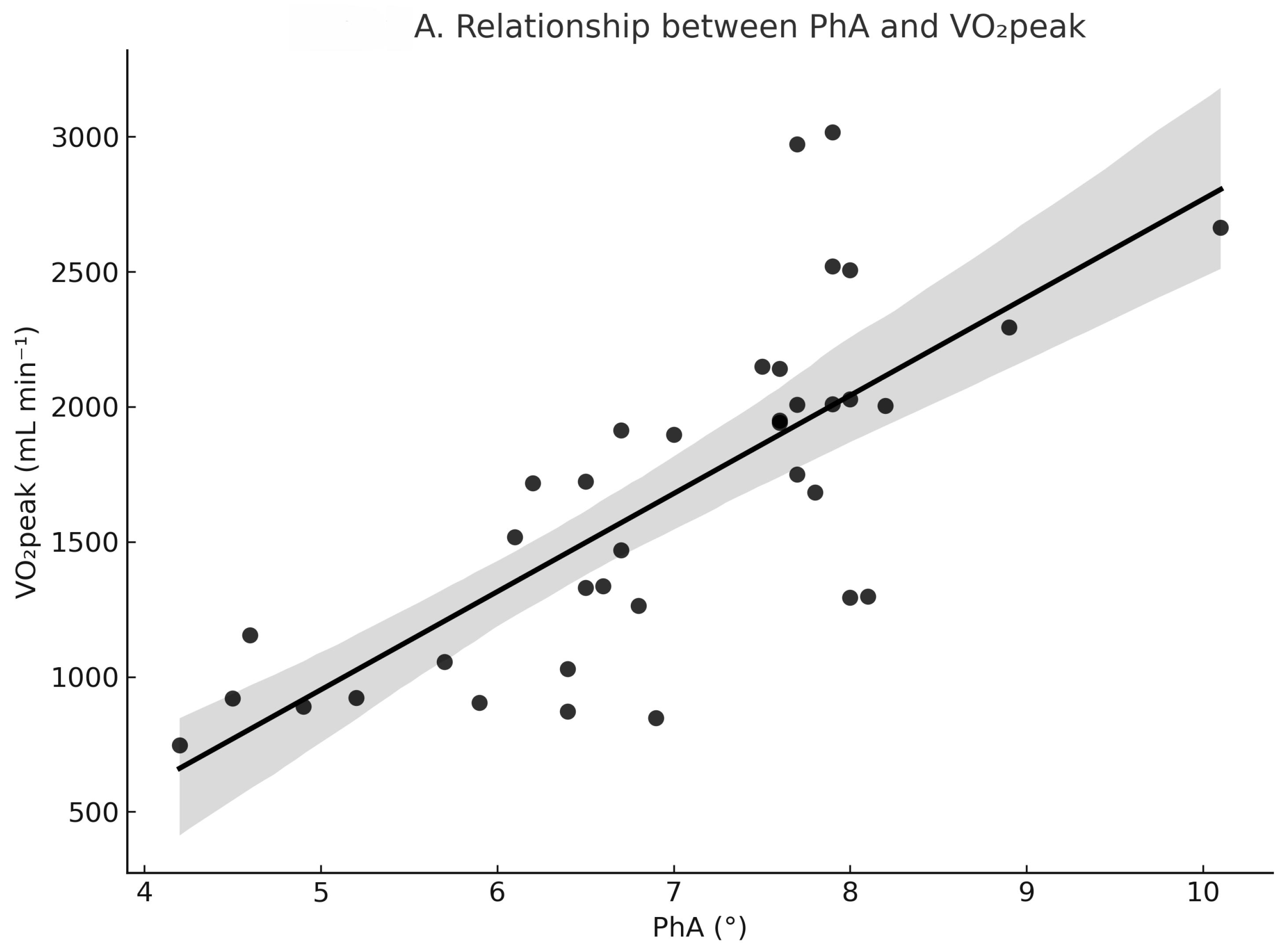
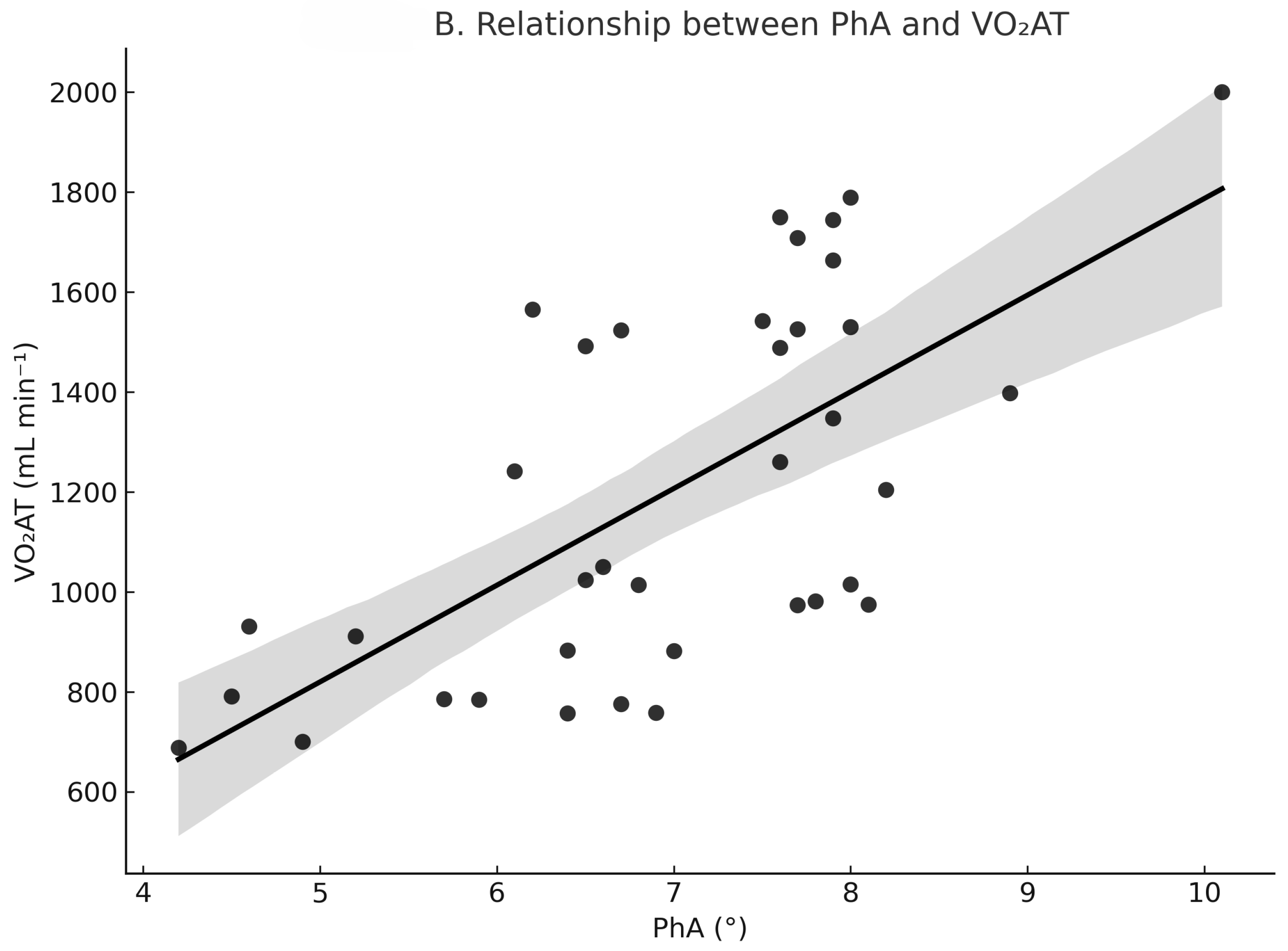

| Variable | Overall (n = 41) | Men (n = 27) | Women (n = 14) | p-Value |
|---|---|---|---|---|
| Age (years) | 23.3 ± 1.7 | 23.5 ± 1.8 | 23.0 ± 1.6 | 0.395 |
| BMI (kg/m2) | 20.8 ± 2.5 | 21.3 ± 2.5 | 19.8 ± 2.2 | 0.059 |
| PhA (°) | 6.9 ± 1.3 | 7.6 ± 0.9 | 5.6 ± 0.9 | <0.001 |
| SMM% (%) | 33.5 ± 3.9 | 35.4 ± 2.8 | 29.9 ± 3.0 | <0.001 |
| VO2peak * (mL min−1) | 1669 ± 619 | 1967 ± 481 | 964 ± 149 | <0.001 |
| VO2AT (mL min−1) | 1195 ± 368 | 1372 ± 324 | 855 ± 129 | <0.001 |
| Variable | r | 95% CI | p-Value |
|---|---|---|---|
| VO2peak vs. PhA | 0.75 | 0.55–0.87 | <0.001 |
| VO2peak vs. SMM% | 0.41 | 0.10–0.65 | 0.012 |
| VO2AT vs. PhA | 0.66 | 0.44–0.80 | <0.001 |
| VO2AT vs. SMM% | 0.49 | 0.21–0.69 | 0.001 |
| PhA vs. SMM% | 0.42 | 0.13–0.64 | 0.006 |
| Predictor | B (mL min−1) | 95% CI | Standardized β | p-Value | VIF |
|---|---|---|---|---|---|
| PhA (°) | 201.6 | 54.9–348.3 | 0.41 | 0.009 | 2.11 |
| SMM% (%) | −13.5 | −59.8–32.7 | −0.08 | 0.555 | 1.79 |
| Sex (men = 1) | 676.8 | 185.9–1167.6 | 0.51 | 0.008 | 3.14 |
| Predictor | B (mL min−1) | 95% CI | Standardized β | p-Value | VIF |
|---|---|---|---|---|---|
| PhA (°) | 11.2 | 1.0–21.4 | 0.38 | 0.032 | 2.27 |
| SMM% (%) | 10.5 | −19.5–40.5 | 0.11 | 0.483 | 1.89 |
| Sex (men = 1) | 242.2 | −85.7–570.2 | 0.32 | 0.143 | 3.44 |
Disclaimer/Publisher’s Note: The statements, opinions and data contained in all publications are solely those of the individual author(s) and contributor(s) and not of MDPI and/or the editor(s). MDPI and/or the editor(s) disclaim responsibility for any injury to people or property resulting from any ideas, methods, instructions or products referred to in the content. |
© 2025 by the authors. Licensee MDPI, Basel, Switzerland. This article is an open access article distributed under the terms and conditions of the Creative Commons Attribution (CC BY) license (https://creativecommons.org/licenses/by/4.0/).
Share and Cite
Takashina, Y.; Sakai, T.; Hirao, M.; Yoshii, T. Phase Angle Is More Strongly Associated with Peak Oxygen Uptake than Skeletal Muscle Mass Percentage in Healthy Young Adults: A Cross-Sectional Study. Appl. Sci. 2025, 15, 13170. https://doi.org/10.3390/app152413170
Takashina Y, Sakai T, Hirao M, Yoshii T. Phase Angle Is More Strongly Associated with Peak Oxygen Uptake than Skeletal Muscle Mass Percentage in Healthy Young Adults: A Cross-Sectional Study. Applied Sciences. 2025; 15(24):13170. https://doi.org/10.3390/app152413170
Chicago/Turabian StyleTakashina, Yusuke, Tomoko Sakai, Masanobu Hirao, and Toshitaka Yoshii. 2025. "Phase Angle Is More Strongly Associated with Peak Oxygen Uptake than Skeletal Muscle Mass Percentage in Healthy Young Adults: A Cross-Sectional Study" Applied Sciences 15, no. 24: 13170. https://doi.org/10.3390/app152413170
APA StyleTakashina, Y., Sakai, T., Hirao, M., & Yoshii, T. (2025). Phase Angle Is More Strongly Associated with Peak Oxygen Uptake than Skeletal Muscle Mass Percentage in Healthy Young Adults: A Cross-Sectional Study. Applied Sciences, 15(24), 13170. https://doi.org/10.3390/app152413170

