Article

Enhanced Drilling Accuracy in Mandibular Reconstruction with Fibula Free Flap Using a Novel Drill-Fitting Hole Guide: A 3D Simulation-Based In Vitro Comparison with Conventional Guide Systems


1
Department of Oral and Maxillofacial Surgery, Korea University Anam Hospital, Seoul 02841, Republic of Korea
2
Department of Oral and Maxillofacial Surgery, School of Dentistry, Kyung Hee University, Seoul 02447, Republic of Korea
*
Author to whom correspondence should be addressed.
Appl. Sci. 2025, 15(24), 13144; https://doi.org/10.3390/app152413144
Submission received: 6 October 2025 / Revised: 9 December 2025 / Accepted: 11 December 2025 / Published: 14 December 2025
(This article belongs to the Special Issue Recent Development and Emerging Trends in Dental Implants)

Abstract

Virtual planning and patient-specific surgical guides have become standard practice to achieve accurate mandibular reconstruction with fibula free flaps. Although these technologies have greatly improved surgical precision, slight deviations may still occur. To further minimize these inaccuracies, we focused on the drilling process and developed a novel drill-fitting hole guide (DFG) system. This in vitro study compared the DFG with two conventional guide designs—a drill-wide hole guide (DWG) and a trocar-fitting hole guide (TFG)—using 3D-printed resin models. Twenty oral and maxillofacial surgeons performed guided drilling with all three guide types, and drilling accuracy and subsequent plate positioning were evaluated using a fully digitized workflow in 3-matic software. Deviations in drill entry points and trajectories were quantified, along with plate overlap ratios (Dice coefficients) and plate angular discrepancies. The DFG achieved the highest accuracy, showing the smallest drilling point deviation (0.17 ± 0.08 mm) and angular deviation (2.41 ± 1.24°), the greatest plate overlap (0.90 ± 0.04), and the lowest plate angular misalignment (0.87 ± 0.59°). Although all guide types yielded clinically acceptable results, the DFG demonstrated significantly higher accuracy. These findings suggest that the drill-guide interface is a key factor in surgical precision that has received limited attention.

1. Introduction

Mandibular reconstruction with a fibula free flap is a well-established surgical technique for managing extensive bony defects caused by tumor resection, osteonecrosis, or trauma [1,2]. Since its introduction by Hidalgo in 1989, this method has become the gold standard for restoring both function and aesthetics [3]. However, accurate osteotomy, segment alignment, and fixation remain technically demanding and directly influence surgical outcomes such as occlusion, facial contour, and postoperative recovery [4].
With the advent of computer-aided design and manufacturing (CAD/CAM) and virtual surgical planning (VSP), and dynamic navigation (DN) systems, computer-assisted surgery (CAS) has revolutionized the field of mandibular reconstruction [5,6,7,8,9]. These technologies enable the fabrication of patient-specific surgical guides such as cutting guides and positioning guides, which improve surgical precision and reduce operating time [8,9,10,11,12,13]. As a result, surgical guides are now routinely employed in mandibular and fibular reconstruction procedures. All of these guides incorporate drilling holes, which serve both to secure the guide during osteotomy and to position the reconstruction plate or fibula segments via shared hole locations [5,6,13,14]. Whether produced in-house or by commercial vendors, these holes are typically designed in one of two ways: a hole-only design, which provides a simple position for the drill bit (drill-wide hole guide, DWG), or a trocar-compatible design, which accommodates a metal trocar sleeve to guide the drill bit trajectory (trocar-fitting hole guide, TFG). Both methods are widely used in surgical guide design. However, a common limitation is the gap between the drill bit and the guide hole, which can allow unintended movement during drilling. This may compromise the precision of the osteotomy and the plate positioning. Although digital workflows have become increasingly sophisticated, this key step remains a weak point that has received little focused attention. Unlike DWG systems, which provide only positional guidance, or TFG systems, which offer angular control through a detachable metal sleeve, the DFG allows for both positional and angular guidance simultaneously. Moreover, this is achieved without additional components, minimizing visual obstruction and improving intraoperative handling. To our knowledge, no prior study has compared the drilling accuracy of DWG and TFG—both of which are commonly used in mandibular reconstruction—under identical experimental or clinical conditions. This study is the first to provide such a quantitative comparison, while also introducing the DFG as a potentially more precise alternative.
To address these shortcomings, we developed the ACE system (Advanced Craniomaxillofacial Surgery Made Easy), which incorporates a novel drill-fitting hole guide (DFG) as its core component. The ACE drill bit, a custom-designed modification of conventional drill bits, features an added cylindrical shank that fits tightly within the guide hole, ensuring precise control over the drilling pathway.
In this study, we aimed to compare the drilling accuracy of three types of surgical guides: (1) our in-house designed drill-fitting hole guide (DFG), (2) drill-wide hole guide (DWG), and (3) trocar-fitting hole guide (TFG) (Figure 1). Through a controlled in vitro experimental setup and a comprehensive 3D simulation-based analysis, we objectively evaluated the drilling accuracy and the resulting positional changes in the plate across three guide types. This experimental validation also serves as the accuracy basis for an ongoing clinical study on DFG-guided mandibular reconstruction.

2. Materials and Methods

2.1. Study Design

To investigate how differences in drilling guidance approach affect surgical accuracy, we conducted a controlled in vitro experiment using 3D-printed resin models of the fibula and surgical guides. For the purpose of isolating the drilling step, the fibula was simplified into a rectangular block model rather than its anatomical shape. Each guide was designed to cover the superior surface of the block and to seat securely in a fixed position, thereby eliminating confounding factors such as anatomical curvature, variable adaptation, or slippage. All guides included pre-aligned drilling holes that were configured to enable fixation of a conventional 4-hole mini-plate at the center of the block’s upper surface.
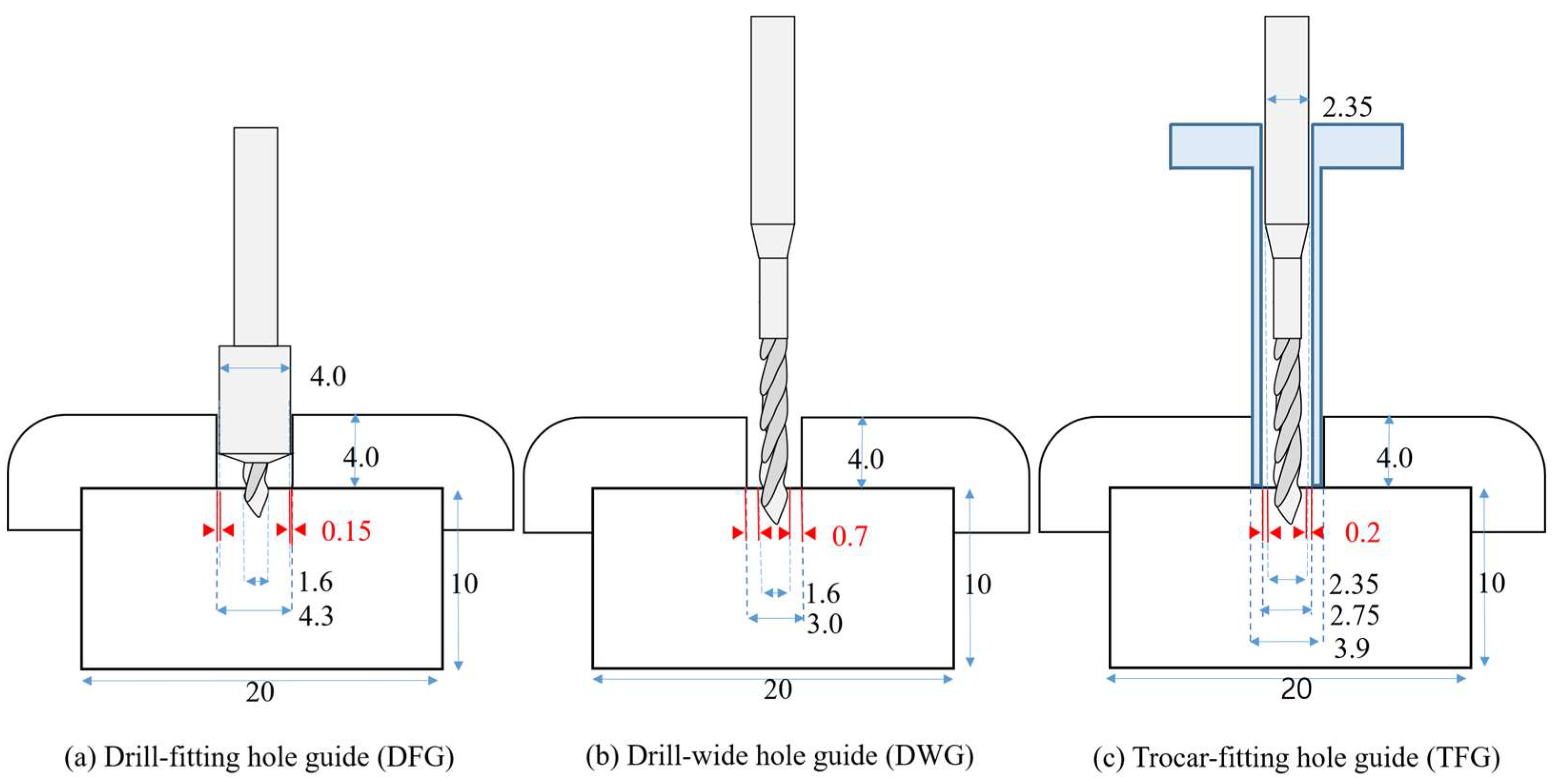
The participants comprised 20 oral and maxillofacial surgeons with prior experience in guided drilling procedures, ensuring minimal variability related to operator experience. Each surgeon performed three separate drilling procedures on individual block models, using a different type of surgical guide for each procedure (Figure 2). The order in which the three guide types (DFG, DWG, and TFG) were used was randomized to minimize potential bias related to procedural sequence. For the drill-fitting hole guide (DFG), drilling was performed with our ACE drill bit, which fit tightly into the guide holes. For the drill-wide hole guide (DWG), a conventional drill bit was used directly within the guide holes. For the trocar-fitting hole guide (TFG), the metal trocar sleeve was first inserted into the guide hole, followed by drilling with a conventional drill bit. After drilling, a conventional 4-hole mini-plate was fixed to each block with screws.
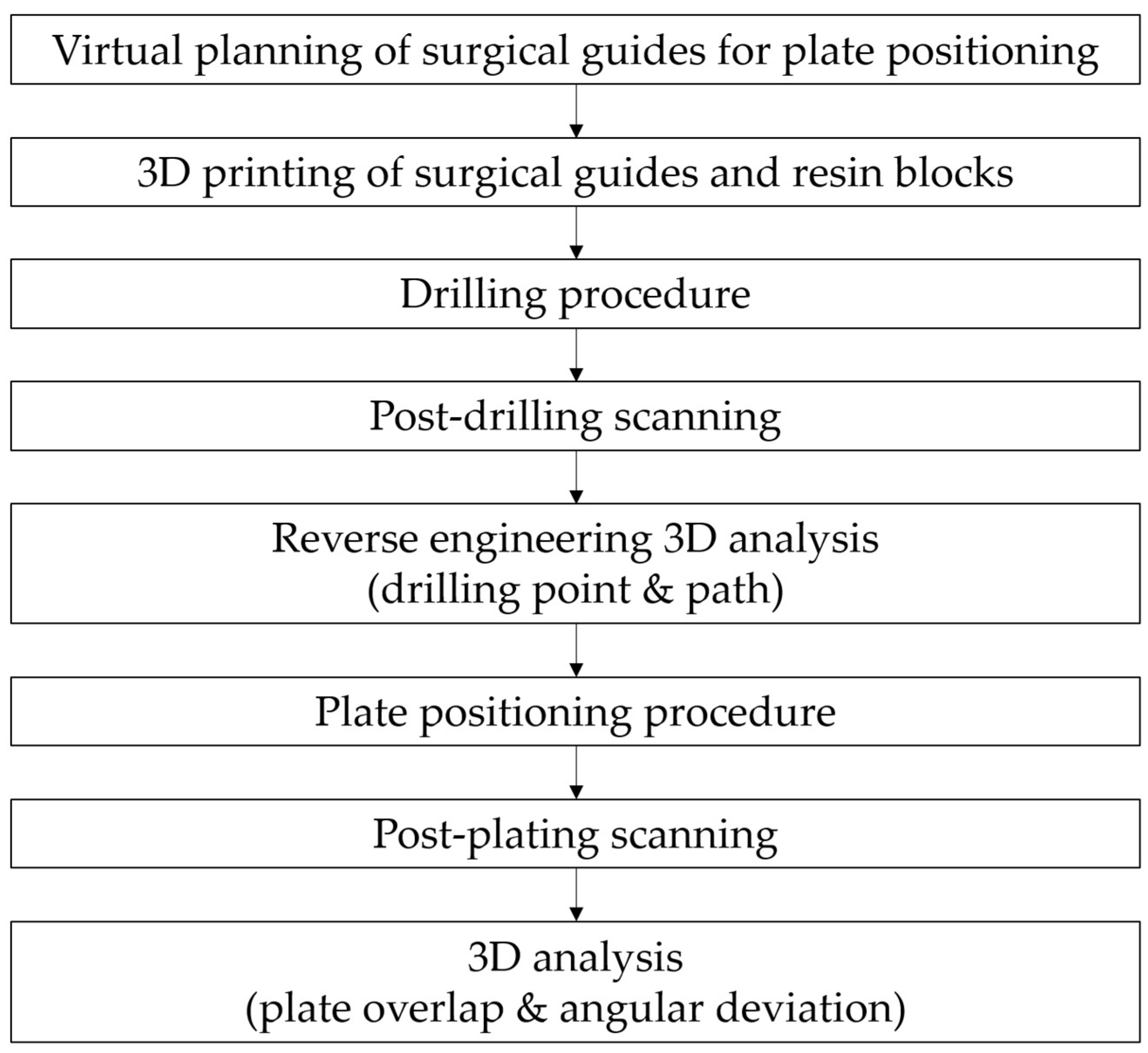
All outcomes—including drill entry points, drilling directions, and final plate positions—were analyzed through 3D simulation software to maintain objectivity and reproducibility. Specifically, plate position deviations were quantified using two analytic approaches: the Dice coefficient to calculate the overlap ratio, and angular deviations measured as the angle between the planes containing the planned and actual plates (Figure 3).

2.2. Virtual Planning and Surgical Guide Fabrication

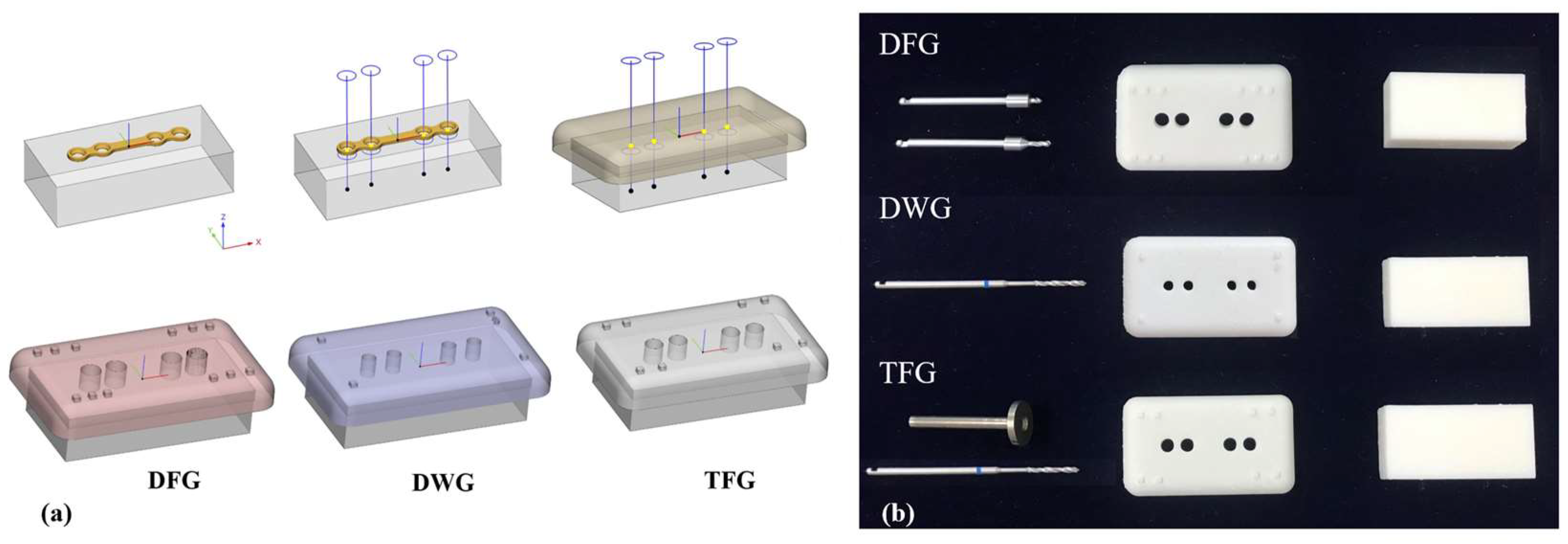
Virtual modeling was performed in 3-matic (version 13.0, Materialise NV, Leuven, Belgium), a specialized 3D medical CAD software. The stereolithography (STL) file of a conventional 4-hole, 1.0 mm thick mini-plate (ø2.0 mm holes, LeForte system, Jeil Medical Corporation, Seoul, Republic of Korea) was imported as the positional reference. A rectangular block (40 mm × 20 mm × 10 mm) was created with its superior face on the XY-plane and its center defined as the origin; the mini-plate was aligned to the center of this surface (Figure 4a).
For each plate hole, a vertical reference axis generated using the “Create Analytical Cylinder” function, passing through the hole center and normal to the block surface. The intersection point of these axes with the superior surface were marked using the “Create Point” tool, serving as reference drilling insertion points (Figure 4a).
A 4 mm thick guide shell was then modeled to fit snugly over the superior surface of the block. Drill holes were created by applying the “Boolean Subtraction” function to modified reference cylinders, customized according to three guiding concepts: for the DFG, 4.3 mm hole tightly accommodated the custom ACE drill bit; for the DWG, 3.0 mm holes allowed free passage of a conventional ø1.6 mm drill bit (LeForte system); and for the TFG, the 3.9 mm holes were tailored to receive a metal trocar sleeve (Osteomed Co., Addison, TX, USA), which guided the same ø1.6 mm drill bit. Small fiducial dimples were added to the surface of each guide for visual identification and alignment verification (Figure 4a).
The surgical guides and block models were fabricated using a Form 3 3D printer (Formlabs Inc., Somerville, MA, USA) with a 0.1 mm layer thickness and standard white resin V4 (Formlabs Inc., Somerville, MA, USA), followed by post-processing according to the manufacturer’s protocol (Figure 4b). The in vitro study proceeded in two phases: a drilling accuracy test and a plate positioning accuracy test.

2.3. Drilling Accuracy Test

Twenty oral and maxillofacial surgeons each performed drilling with all three guide types (DFG, DWG, TFG) on matched block models, with the guides fully seated before drilling. For the DFG, drilling proceeded in two sequential steps using the custom ACE drill bit (3 mm thread drill followed by a 6 mm thread drill). For the DWG and TFG, a conventional ø1.6 mm drill bit was used; in the TFG condition, a metal trocar sleeve was inserted prior to drilling. Drilling procedures were performed using a motorized handpiece system (OZ100 No-Carbon, Saeshin Precision Co., Ltd., Daegu, Republic of Korea) operated via foot control at variable speeds up to a maximum of 35,000 rpm with an approximate torque of 3.1 N·cm, without irrigation.
Following drilling, each guide-block assembly was fixed with custom ACE cylinder-head screws designed to encode the drilling vector for subsequent analysis. The assemblies were coated with 3D scan spray (Micro, DOF, Seoul, Republic of Korea) to minimize reflections form metallic components during scanning. They were then scanned on a high-resolution 3D model scanner (FREEDOM UHD, DOF, Seoul, Republic of Korea). The scan data were exported as STL files and imported into 3-matic, where they were superimposed to their corresponding reference models using the “Global Registration” function (Figure 5a).
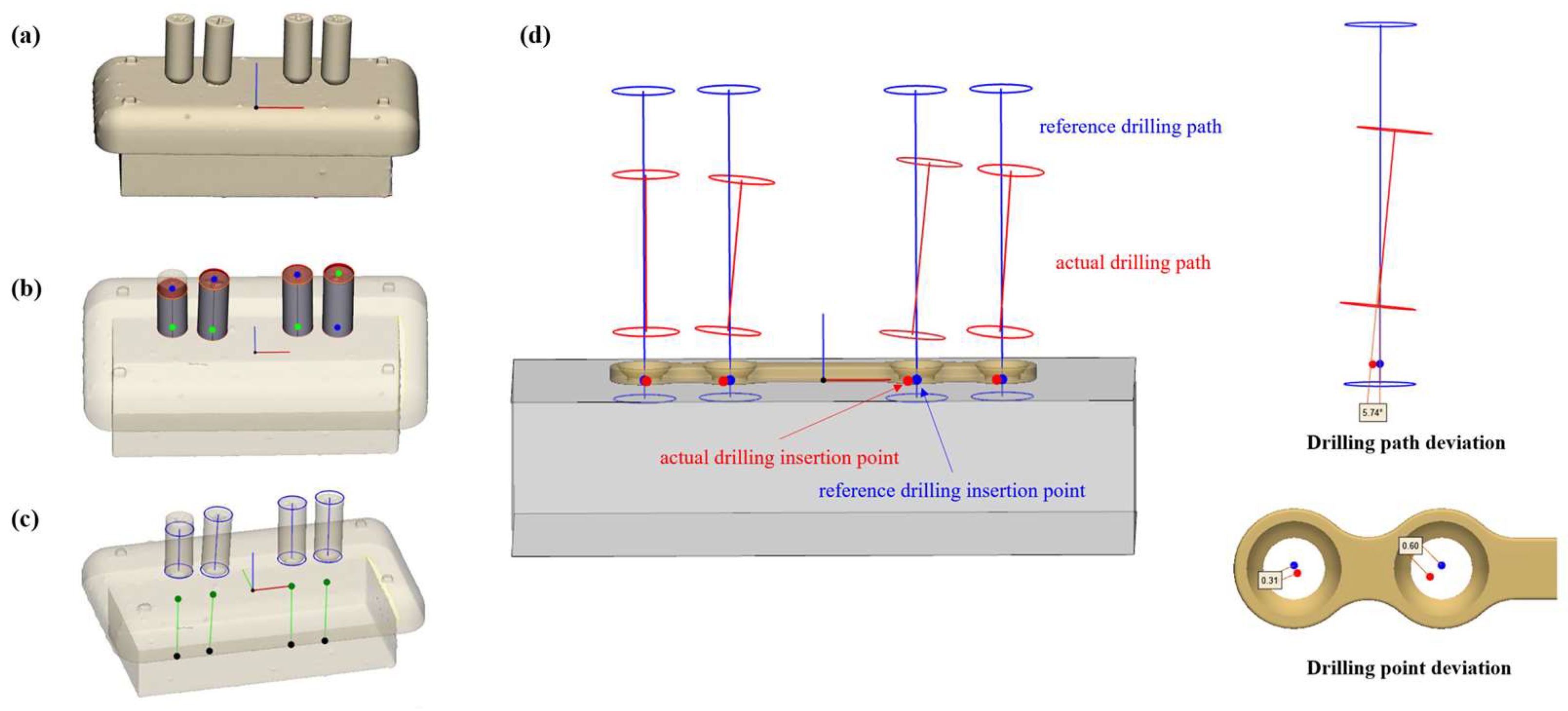
The aligned scans were re-exported and brought into reverse-engineering software (Geomagic Design X, 3D Systems Inc., Rock Hill, SC, USA), where the geometry of the cylinder-head screws was reconstructed into surface meshes. These meshes were saved and re-imported into 3-matic (Figure 5b), where analytical cylinders were fitted to the reverse-engineered screw surfaces using the “Create Analytical Cylinder” tool to recover the actual drilling paths (Figure 5c). The intersection point between the actual drilling path and the upper side of the block was marked using the “Create Point” tool, determining the actual drilling insertion point (Figure 5c).
Drilling point deviation (mm) was calculated using the “Measure Distance” function to measure the distance between the reference and actual drilling insertion points. Drilling path deviation (°) was computed with the “Measure Angle” function to assess the angular difference between the reference and actual drilling paths (Figure 5d).

2.4. Plate Positioning Accuracy Test

Following the drilling accuracy test, a conventional 4-hole mini-plate was secured to each block with four ø2.0 mm screws (length 4 mm, LeForte system, Jeil Medical Corporation, Seoul, Republic of Korea). Each plate-block assembly was scanned using the 3D scanner, and the resultant STL files were imported into 3-matic. The scans were registered to the reference block model using the “Global Registration” function, enabling direct visualization of any plate displacement.
To quantify plate displacement, we used the Dice coefficient, which measures spatial overlap between two segmentations and range from 0 (no overlap) to 1 (perfect overlap). It is defined as:
Dice   Coefficient   =   2   ×   A     B A   +   B
In this study, A and B denote the volumes of the reference and actual plate. Because both plates have identical volumes in this in vitro setup, the formula simplifies to:
Dice   Coefficient   =   I n t e r s e c t i o n   V o l u m e     o f   t h e   P l a t e s V o l u m e   o f   a   p l a t e
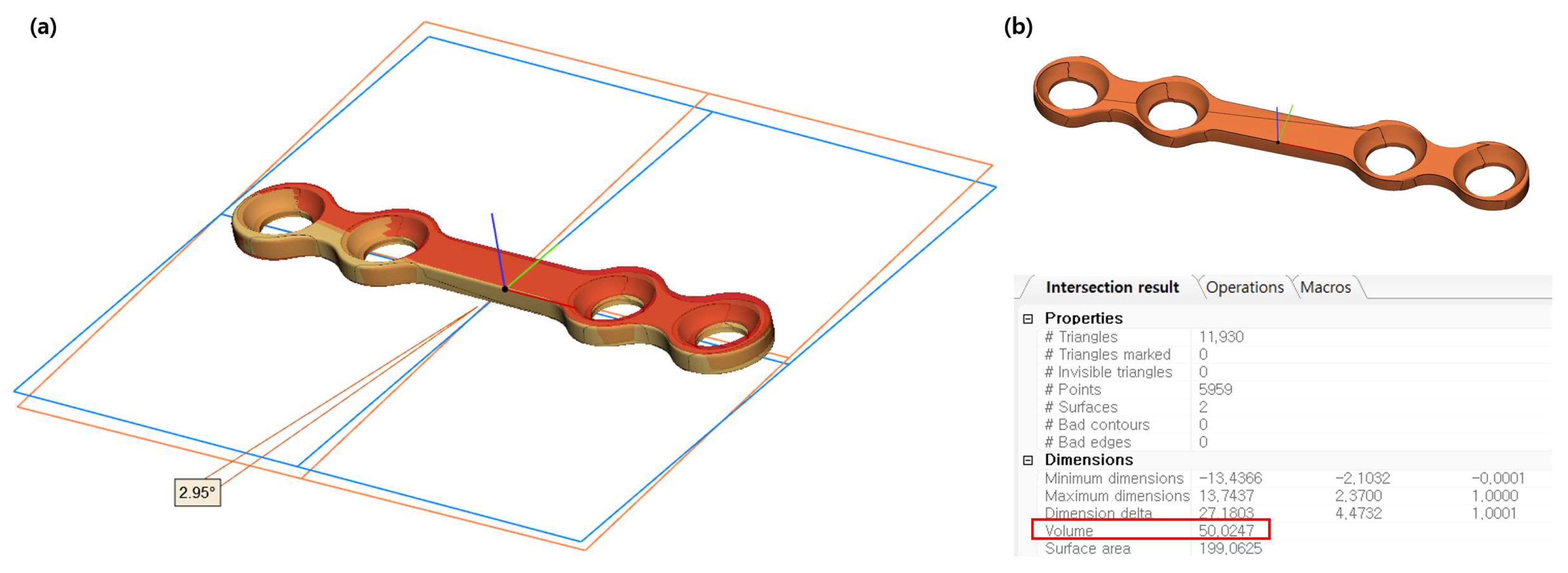
The intersection volume of the plates was obtained via “Boolean Intersection” function in 3-matic, and the volume values were read form the properties tab (Figure 6b).
To provide an additional measure of positioning accuracy, angular deviation was also evaluated. Planes were generated on the undersides of both the reference and actual plates, and the angle between these planes was measured using the “Measure Angle” tool The output of this tool includes angular components for the XY, YZ planes as well as the integrated XYZ value, and the XYZ value was used as the representative metric for analysis. This metric complemented the overlap-based analysis by capturing discrepancies in angular alignment (Figure 6a).

2.5. Statistical Analysis

Statistical analysis was conducted in R (version 4.4.1) to compare performance across the three surgical guide types. For drilling accuracy, each guide type provided 80 drill holes (20 surgeons × 4 holes), yielding N = 80 per group. For plate positioning accuracy, each guide type provided 20 plates (one plate per surgeon), yielding N = 20 per group. Normality of all variables was confirmed using the Kolmogorov–Smirnov test. For variables with a normal distribution, one-way analysis of variance (ANOVA) was applied, followed by the Holm method for post hoc comparisons. A p value < 0.05 was considered statistically significant.

3. Results

3.1. Drilling Point Deviation

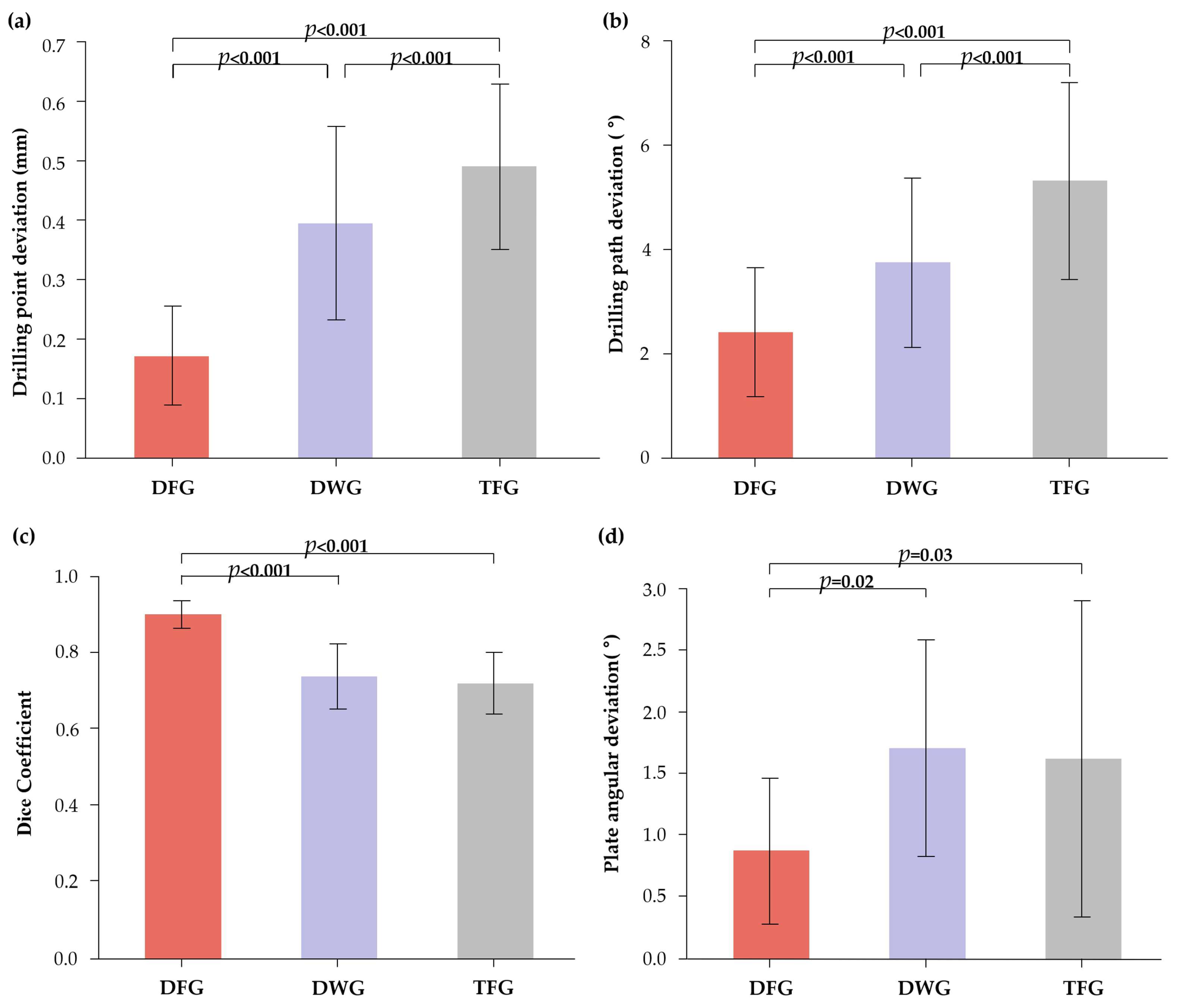
Drilling point deviation was evaluated to compare the positional accuracy of the three surgical guide types. As shown in Table 1, the DFG exhibited the smallest mean deviation (0.17 ± 0.08 mm), followed by the DWG (0.39 ± 0.16 mm) and the TFG (0.49 ± 0.14 mm). One-way ANOVA revealed a statistically significant difference among the three guide types (F (2, 237) = 121.91, p < 0.001). Post hoc analysis using the Holm method confirmed that the DFG had significantly lower deviation than both DWG and TFG (both p < 0.001), and that DWG also outperformed TFG (p < 0.001). These results, visualized in Figure 7a, indicate that while all guides types exhibited mean deviation under 0.6 mm, the DFG demonstrated the highest positional precision.

3.2. Drilling Path Deviation

Angular deviation between the reference and actual drilling paths was assessed to compare directional accuracy among the three guide types. Table 2 presents the results of one-way ANOVA. The DFG showed the smallest mean angular deviation (2.41 ± 1.24°), followed by the DWG (3.75 ± 1.64°) and TFG (5.31 ± 1.89°). One-way ANOVA confirmed a statistically significant difference among the three guide types (F (2, 237) = 65.34, p < 0.001). Post hoc testing with the Holm method indicated that the DFG had significantly lower deviation than both DWG and TFG (both p < 0.001), and DWG also outperformed TFG (p < 0.001). These findings are illustrated in Figure 7b and suggest that the DFG achieved highest angular accuracy.

3.3. Plate Overlap Ratio (Dice Coefficient)

The Dice coefficient was calculated to evaluate the spatial correspondence between the planned and actual plate position. As presented in Table 3, the DFG yielded the highest mean Dice coefficient (0.90 ± 0.04), reflecting the greatest overlap between the planned and actual plate volumes. The DWG and TFG followed with values of 0.74 ± 0.09 and 0.72 ± 0.08, respectively. One-way ANOVA revealed statistically significant differences among the three guide types (F (2, 57) = 38.88, p < 0.001). Post hoc analysis using the Holm method showed that DFG had significantly greater overlap than both DWG and TFG (both p < 0.001). However, the difference DWG and TFG was not statistically significant (p = 0.39). Taken together, these results demonstrated that plate positioning using surgical guides achieved approximately 90%, 74%, and 72% three-dimensional concordance for DFG, DWG, and TFG, respectively, with DFG exhibiting the highest accuracy (Figure 7c).

3.4. Plate Angular Deviation

To assess angular alignment of the plate after fixation, deviations between the planes of the reference and actual plates were compared. According to the results summarized in Table 4, the DFG achieved the smallest mean angular deviation (0.87 ± 0.59°), followed by TFG (1.62 ± 1.28°) and DWG (1.70 ± 0.88°). Statistical analysis via one-way ANOVA showed a significant difference among the three guides (F (2, 57) = 4.60, p = 0.014). Holm-adjusted post hoc comparisons revealed that the DFG had significantly smaller deviation than both DWG (p = 0.02) and TFG (p = 0.03), whereas no significant difference was observed between DWG and TFG (p = 0.79). These findings, as illustrated in Figure 7d, indicate that all guides exhibited minimal angular deviation within 3°, with the DFG demonstrating the most consistent alignment.

4. Discussion

This study evaluated the drilling accuracy of three different types of surgical guides applied in mandibular reconstruction with fibula free flaps: the conventional drill-wide hole guide (DWG), the trocar-fitting hole guide (TFG), and a novel drill-fitting hole guide (DFG) specifically designed within our ACE system. By employing an in vitro model and a fully digitized evaluation framework, we were able to objectively assess the spatial and angular accuracy of drilling and the final plate positioning. Our results revealed that although all three guide types provided acceptable accuracy within clinically tolerable margins, the DFG consistently outperformed the other two in terms of both positional and angular precision.
Previous research has validated the clinical benefits of using computer-aided surgical guides in fibula-based mandibular reconstruction [7,13]. These guides have been shown to significantly enhance the osteotomy accuracy, improve graft alignment, and facilitate predictable flap inset and fixation, ultimately contributing to better occlusion, facial contour, and functional recovery [7,13]. There is now widespread agreement that guide-assisted reconstruction offers superior outcomes compared to conventional freehand techniques [13,15,16,17,18]. As a result, the use of patient-specific surgical guides has become a standard component of mandibular reconstruction workflows. Consequently, recent studies increasingly focused on presenting in-house fabrication workflows or proposing strategies to optimize the practical use of surgical guides. In particular, several groups have explored how variations in guide configuration—such as the number and placement of anatomical reference points, modification of cutting guide edge contours, addition of positioning guides, or incorporation of teeth-supported extensions—can influence surgical accuracy and ease of use [19,20,21,22,23]. For example, Goodrum et al. proposed a novel fibula segment guide that achieves stabilization through direct insertion into a matching slot, eliminating the need for external bridging and thereby improving intraoperative handling and alignment accuracy [24]. Coopen et al. similarly developed a guide with integrated titanium inserts designed to enhance osteotomy precision by stabilizing saw blade movement and ensuring tight guide-to-bone conformity [25].
Despite these improvements, however, the literature to date has largely neglected one fundamental technical factor: the drilling method itself. Drilling is a critical component of surgical guide application, serving not only to secure the guide during osteotomy but also to define the final placement of the plate. Regardless of whether guides are fabricated commercially or produced in-house, all systems adopt one of two basic approaches to guide-hole design: either a free-fit method, in which the drill bit passes through an oversized hole with minimal resistance (DWG), or a sleeve-fit method, in which a metal trocar is inserted to stabilize the drilling trajectory (TFG). However, no prior studies have systematically compared the relative accuracy of these approaches under controlled experimental conditions. It was from this persistent concern about drilling-related deviations that we developed a novel guide system incorporating a drill-fitting method (DFG). The tree systems differ fundamentally in their drill-guide interface. In DWG systems, the drill hole provides only positional information for the drill bit, but not angular guidance. This is because the resin guide cannot withstand direct contact with the rotating blade of the drill bit, and therefore the hole diameter cannot be made too small. TFG systems improve upon this by using a trocar metal sleeve that protects the resin guide and allows for both positional and angular guidance. However, to prevent frictional heat or sleeve damage, a small gap must still be maintained between the drill bit and the trocar. In addition, the trocar can partially obstruct the surgeon’s view during drilling. In contrast, our system addresses these limitations by using a custom drill bit with an integrated cylindrical collar that fits tightly into the guide hole. This design enables both precise positional and angular guidance without damaging the resin guide. Because the drill bit is self-aligning, it eliminates the need for a separate sleeve, minimizing mechanical clearance and avoiding obstruction of the surgeon’s view.
Our experimental results confirmed that our DFG achieved the highest accuracy among the three guide types, not only in drilling performance but also in the final plate placement. These findings support the hypothesis that improving the mechanical interface during drilling can lead to measurable gains in overall reconstructive accuracy. Between the conventional drilling guides, the DWG showed slightly better drilling precision than the TFG. However, this advantage did not translate into improved accuracy in plate positioning. Interestingly, the TFG demonstrated marginally better outcomes in final plate alignment. This may be due to the metal trocar partially obstructing the visual field or interfering with hand movement, particularly for operators less familiar with this technique. The lack of significant differences in plate positioning between the DWG and TFG suggests that the measured drilling deviations, all within 0.7 mm and 7°, were too minor to affect final plate location. This may also reflect the fact that plate positioning is influenced not only by the magnitude of deviation in distance and angle, but by the spatial direction of the drill path. While both conventional guides were less accurate than our DFG, these results indicate that they still provide acceptable levels of clinical precision. It should also be note that drilling represents only one step in the overall reconstruction surgery, and errors arising at this stage may accumulate with deviations introduced during subsequent osteotomy, segment alignment, and flap fixation. Therefore, minimizing drilling errors remains clinically important despite the small numerical differences observed in this in vitro study [23]. Although recent advances in CAD/CAM technology, 3D printing, and virtual surgical planning have significantly improved surgical accuracy in mandibular reconstruction, there is still no consensus on the clinical threshold for what constitutes a meaningful level of accuracy. Most studies report deviations within the range of 1–3 mm and suggest that such errors are clinically acceptable in terms of both functional and esthetic outcomes. Thus, further research is needed to objectively determine which levels of deviation are directly associated with functional outcomes in mandibular reconstruction.
This study has a limitation in that it employed 3D-printed resin block models rather than actual bone, which differs in both mechanical properties and structural complexity. However, because our study aimed to isolate and precisely analyze the influence of the drilling step on surgical accuracy, it was necessary to eliminate variables that could affect drilling outcomes, such as bone curvature, shape, slope, and density variation. For this reason, real bone was not used due to regional variability in structure, limited reusability after drilling, and difficulties in standardization across trials [26]. The resin material was not selected to replicate cortical bone, but rather because it is the standard material used in the 3D printing process for fabricating surgical guides. This choice enabled reproducible fabrication, tight guide-to-block coupling, and consistent evaluation across different guide designs. While resin does differ from bone in mechanical properties, the simplified model allowed for standardized comparisons under controlled conditions. Although this controlled setting enabled consistent comparisons across guide types, it does not fully replicate the anatomical complexity, visual restrictions, and limited access typical of real surgical environments. The relatively small deviations observed in this study may partly reflect the favorable test conditions, including direct visualization and perpendicular drilling angles and the absence of clinical irrigation. In contrast, the ACE system, characterized by a tightly fitted drill-hole interface, is expected to perform more effectively under clinical conditions, where drilling often occurs in confined spaces and at oblique angles. Under such circumstances, the system’s enhanced stability and directional control may lead to greater accuracy. In support of this hypothesis, clinical cases using the DFG have already been accumulated, and a separate manuscript based on these patient outcomes is currently in preparation.
Another potential limitation of our study is the use of a specialized commercial software rather than open-source platforms. Recent studies have highlighted the use of open-source planning software for fibula reconstruction, emphasizing its cost-effectiveness and the advantage of allowing surgeons to directly manage the planning process [2,10,27,28,29]. However, such platforms typically do not support angled or multi-vector osteotomies, which are essential for preserving anatomical contours and achieving more precise reconstructions [30]. Moreover, the evaluation process in this study was fully digitized and free from manual intervention, including reference point selection, surface alignment, or superimposition. In contrast to most previous studies, which measure accuracy by manually placing landmark points within the software, our method extracted surfaces from the scanned data, generated axes passing through these surfaces, and calculated distances and angles based on their intersection points and vectors [5,31]. This approach avoided user-dependent variation in landmark selection and enabled a more stable and objective assessment of angular and spatial deviation.
Recent studies have demonstrated promising results in the use of navigation-assisted surgery for mandibular reconstruction [9]. Considering the increasing demand for precision in complex cases, future studies could explore the integration of navigation systems with the ACE system. This combination may further enhance surgical accuracy and warrants clinical investigation.

5. Conclusions

While all three drilling guide types demonstrated clinically acceptable accuracy, the drill-fitting hole guide (DFG), developed as part of our ACE system, achieved the highest precision in both drilling and final plate positioning. Unlike DWG and TFG, the DFG features a custom-designed drill bit that fits tightly into the guide hole, enabling both positional and angular guidance. These findings suggest that the drill-guide interface is a critical determinant of surgical precision that has remained underexplored in prior studies. Our fully digitized, manual-free evaluation process also provides an objective and reproducible approach for future comparative research

Author Contributions

Conceptualization, B.-Y.H. and J.-W.L.; methodology, B.-Y.H. and J.-W.L.; software, B.-Y.H. and C.J.; validation, C.J. and J.K.; formal analysis, B.-Y.H.; investigation, B.-Y.H. and C.J.; resources, B.-Y.H. and J.-W.L.; data curation, C.J. and J.K.; writing—original draft preparation, B.-Y.H.; writing—review and editing, B.-Y.H. and C.J.; visualization, B.-Y.H.; supervision, J.-W.L.; project administration, B.-Y.H. and J.-W.L.; funding acquisition, B.-Y.H. and J.-W.L. All authors have read and agreed to the published version of the manuscript.

Funding

This research was supported by a grant of the Korea Health Technology R&D Project through the Korea Health Industry Development Institute (KHIDI), funded by the Ministry of Health & Welfare, Republic of Korea (grant number: HI23C0162), and by Basic Science Research Program through the National Research Foundation of Korea (NRF) funded by the Ministry of Education (grant number: RS-2025-02653917).

Data Availability Statement

The original contributions presented in this study are included in the article. Further inquiries can be directed to the corresponding author.

Conflicts of Interest

The authors declare no conflicts of interest. The funders had no role in the design of the study; in the collection, analyses, or interpretation of data; in the writing of the manuscript; or in the decision to publish the results.

References

  1. Hirsch, D.L.; Garfein, E.S.; Christensen, A.M.; Weimer, K.A.; Saddeh, P.B.; Levine, J.P. Use of computer-aided design and computer-aided manufacturing to produce orthognathically ideal surgical outcomes: A paradigm shift in head and neck reconstruction. J. Oral Maxillofac. Surg. 2009, 67, 2115–2122. [Google Scholar] [CrossRef] [PubMed]
  2. Awad, M.E.; Altman, A.; Elrefai, R.; Shipman, P.; Looney, S.; Elsalanty, M. The use of vascularized fibula flap in mandibular reconstruction; A comprehensive systematic review and meta-analysis of the observational studies. J. Cranio Maxillofac. Surg. 2019, 47, 629–641. [Google Scholar] [CrossRef]
  3. Hidalgo, D.A. Fibula free flap: A new method of mandible reconstruction. Plast. Reconstr. Surg. 1989, 84, 71–79. [Google Scholar] [CrossRef] [PubMed]
  4. Brown, J.S.; Barry, C.; Ho, M.; Shaw, R. A new classification for mandibular defects after oncological resection. Lancet Oncol. 2016, 17, e23–e30. [Google Scholar] [CrossRef]
  5. Tarsitano, A.; Battaglia, S.; Ricotta, F.; Bortolani, B.; Cercenelli, L.; Marcelli, E.; Cipriani, R.; Marchetti, C. Accuracy of CAD/CAM mandibular reconstruction: A three-dimensional, fully virtual outcome evaluation method. J. Cranio Maxillofac. Surg. 2018, 46, 1121–1125. [Google Scholar] [CrossRef]
  6. Mascha, F.; Winter, K.; Pietzka, S.; Heufelder, M.; Schramm, A.; Wilde, F. Accuracy of computer-assisted mandibular reconstructions using patient-specific implants in combination with CAD/CAM fabricated transfer keys. J. Cranio Maxillofac. Surg. 2017, 45, 1884–1897. [Google Scholar] [CrossRef]
  7. May, M.M.; Howe, B.M.; O’Byrne, T.J.; Alexander, A.E.; Morris, J.M.; Moore, E.J.; Kasperbauer, J.L.; Janus, J.R.; Van Abel, K.M.; Dickens, H.J.; et al. Short and long-term outcomes of three-dimensional printed surgical guides and virtual surgical planning versus conventional methods for fibula free flap reconstruction of the mandible: Decreased nonunion and complication rates. Head Neck 2021, 43, 2342–2352. [Google Scholar] [CrossRef]
  8. Powcharoen, W.; Yang, W.F.; Yan Li, K.; Zhu, W.; Su, Y.X. Computer-Assisted versus Conventional Freehand Mandibular Reconstruction with Fibula Free Flap: A Systematic Review and Meta-Analysis. Plast. Reconstr. Surg. 2019, 144, 1417–1428. [Google Scholar] [CrossRef]
  9. Wang, F.; Cai, X.; Sun, W.; Chen, C.; Meng, L. Application of dynamic navigation technology in oral and maxillofacial surgery. Clin. Oral Investig. 2024, 29, 13. [Google Scholar] [CrossRef] [PubMed]
  10. Ritschl, L.M.; Kilbertus, P.; Grill, F.D.; Schwarz, M.; Weitz, J.; Nieberler, M.; Wolff, K.-D.; Fichter, A.M. In-house, open-source 3D-software-based, CAD/CAM-planned mandibular reconstructions in 20 consecutive free fibula flap cases: An explorative cross-sectional study with three-dimensional performance analysis. Front. Oncol. 2021, 11, 731336. [Google Scholar] [CrossRef]
  11. van Baar, G.J.C.; Forouzanfar, T.; Liberton, N.; Winters, H.A.H.; Leusink, F.K.J. Accuracy of computer-assisted surgery in mandibular reconstruction: A systematic review. Oral Oncol. 2018, 84, 52–60. [Google Scholar] [CrossRef]
  12. Wilde, F.; Hanken, H.; Probst, F.; Schramm, A.; Heiland, M.; Cornelius, C.P. Multicenter study on the use of patient-specific CAD/CAM reconstruction plates for mandibular reconstruction. Int. J. Comput. Assist. Radiol. Surg. 2015, 10, 2035–2051. [Google Scholar] [CrossRef]
  13. Ciocca, L.; Marchetti, C.; Mazzoni, S.; Baldissara, P.; Gatto, M.R.A.; Cipriani, R.; Scotti, R.; Tarsitano, A. Accuracy of fibular sectioning and insertion into a rapid-prototyped bone plate, for mandibular reconstruction using CAD-CAM technology. J. Cranio Maxillofac. Surg. 2015, 43, 28–33. [Google Scholar] [CrossRef] [PubMed]
  14. Bao, T.; He, J.; Yu, C.; Zhao, W.; Lin, Y.; Wang, H.; Liu, J.; Zhu, H. Utilization of a pre-bent plate-positioning surgical guide system in precise mandibular reconstruction with a free fibula flap. Oral Oncol. 2017, 75, 133–139. [Google Scholar] [CrossRef] [PubMed]
  15. Ballard, D.H.; Mills, P.; Duszak, R., Jr.; Weisman, J.A.; Rybicki, F.J.; Woodard, P.K. Medical 3D printing cost-savings in orthopedic and maxillofacial surgery: Cost analysis of operating room time saved with 3D printed anatomic models and surgical guides. Acad. Radiol. 2020, 27, 1103–1113. [Google Scholar] [CrossRef]
  16. Rodby, K.A.; Turin, S.; Jacobs, R.J.; Cruz, J.F.; Hassid, V.J.; Kolokythas, A.; Antony, A.K. Advances in oncologic head and neck reconstruction: Systematic review and future considerations of virtual surgical planning and computer aided design/computer aided modeling. J. Plast. Reconstr. Aesthetic Surg. 2014, 67, 1171–1185. [Google Scholar] [CrossRef] [PubMed]
  17. Schepers, R.H.; Raghoebar, G.M.; Vissink, A.; Stenekes, M.W.; Kraeima, J.; Roodenburg, J.L.; Reintsema, H.; Witjes, M.J. Accuracy of fibula reconstruction using patient-specific CAD/CAM reconstruction plates and dental implants: A new modality for functional reconstruction of mandibular defects. J. Cranio Maxillofac. Surg. 2015, 43, 649–657. [Google Scholar] [CrossRef]
  18. Mazzoni, S.; Marchetti, C.; Sgarzani, R.; Cipriani, R.; Scotti, R.; Ciocca, L. Prosthetically guided maxillofacial surgery: Evaluation of the accuracy of a surgical guide and custom-made bone plate in oncology patients after mandibular reconstruction. Plast. Reconstr. Surg. 2013, 131, 1376–1385. [Google Scholar] [CrossRef]
  19. Yodrabum, N.; Tianrungroj, J.; Sinmaroeng, C.; Rudeejaroonrung, K.; Pavavongsak, K.; Puncreobutr, C. How is a cutting guide with additional anatomical references better in fibular-free flap mandibular reconstruction? a technical strategy. J. Craniofacial Surg. 2024, 35, 63–66. [Google Scholar] [CrossRef]
  20. Sharma, S.; Gaba, S.; Nair, S. A Novel Trapezoid Concept of Fibula Cutting Guide for Mandible Angle Reconstruction. J. Craniofacial Surg. 2021, 32, e513–e515. [Google Scholar] [CrossRef]
  21. Lim, S.-H.; Kim, M.-K.; Kang, S.-H. Precision of fibula positioning guide in mandibular reconstruction with a fibula graft. Head Face Med. 2016, 12, 1–10. [Google Scholar] [CrossRef]
  22. Choi, J.W.; Kim, Y.C.; Han, S.J.; Jeong, W.S. Dual Application of Patient-Specific Occlusion-Based Positioning Guide and Fibular Cutting Guide for Accurate Reconstruction of Segmental Mandibular Defect. J. Craniofacial Surg. 2023, 34, 1381–1386. [Google Scholar] [CrossRef] [PubMed]
  23. Dong, Z.; Li, B.; Xie, R.; Wu, Q.; Zhang, L.; Bai, S. Comparative study of three kinds of fibula cutting guides in reshaping fibula for the reconstruction of mandible: An accuracy simulation study in vitro. J. Cranio Maxillofac. Surg. 2017, 45, 1227–1235. [Google Scholar] [CrossRef] [PubMed]
  24. Goodrum, H.; Breik, O.; Koria, H.; Idle, M.; Praveen, P.; Martin, T.; Parmar, S. Novel in-house design for fibula cutting guide with detachable connecting arm for head and neck reconstruction. J. Oral Maxillofac. Surg. 2021, 79, 1769–1778. [Google Scholar] [CrossRef]
  25. Coppen, C.; Verhoeven, T.; Snoeijink, T.; Weijs, W.; Verhulst, A.; van Rijssel, J.; Maal, T.; Dik, E. Fibula free flap reconstruction: Improving the accuracy of virtual surgical planning using titanium inserts. Int. J. Oral Maxillofac. Surg. 2025, 54, 1037–1042. [Google Scholar] [CrossRef] [PubMed]
  26. Liang, Y.; Yuan, S.; Huan, J.; Zhang, Y.; Fang, C.; Li, J. In Vitro Experimental Study of the Effect of Adjusting the Guide Sleeve Height and Using a Visual Direction-Indicating Guide on Implantation Accuracy. J. Oral Maxillofac. Surg. 2019, 77, 2259–2268. [Google Scholar] [CrossRef]
  27. Numajiri, T.; Nakamura, H.; Sowa, Y.; Nishino, K. Low-cost design and manufacturing of surgical guides for mandibular reconstruction using a fibula. Plast. Reconstr. Surg. Glob. Open 2016, 4, e805. [Google Scholar] [CrossRef]
  28. Bosc, R.; Hersant, B.; Carloni, R.; Niddam, J.; Bouhassira, J.; De Kermadec, H.; Bequignon, E.; Wojcik, T.; Julieron, M.; Meningaud, J.-P. Mandibular reconstruction after cancer: An in-house approach to manufacturing cutting guides. Int. J. Oral Maxillofac. Surg. 2017, 46, 24–31. [Google Scholar] [CrossRef]
  29. Mottini, M.; Jafari, S.S.; Shafighi, M.; Schaller, B. New approach for virtual surgical planning and mandibular reconstruction using a fibula free flap. Oral Oncol. 2016, 59, e6–e9. [Google Scholar] [CrossRef]
  30. Hwang, B.-Y.; Lee, J.-Y.; Jung, J.; Ohe, J.-Y.; Eun, Y.-G.; Lee, Y.; Lee, J.-W. Computer-assisted preoperative simulations and 3D printed surgical guides enable safe and less-invasive mandibular segmental resection: Tailor-made mandibular resection. Appl. Sci. 2020, 10, 1325. [Google Scholar] [CrossRef]
  31. van Baar, G.J.; Liberton, N.P.; Forouzanfar, T.; Winters, H.A.; Leusink, F.K. Accuracy of computer-assisted surgery in mandibular reconstruction: A postoperative evaluation guideline. Oral Oncol. 2019, 88, 1–8. [Google Scholar] [CrossRef] [PubMed]
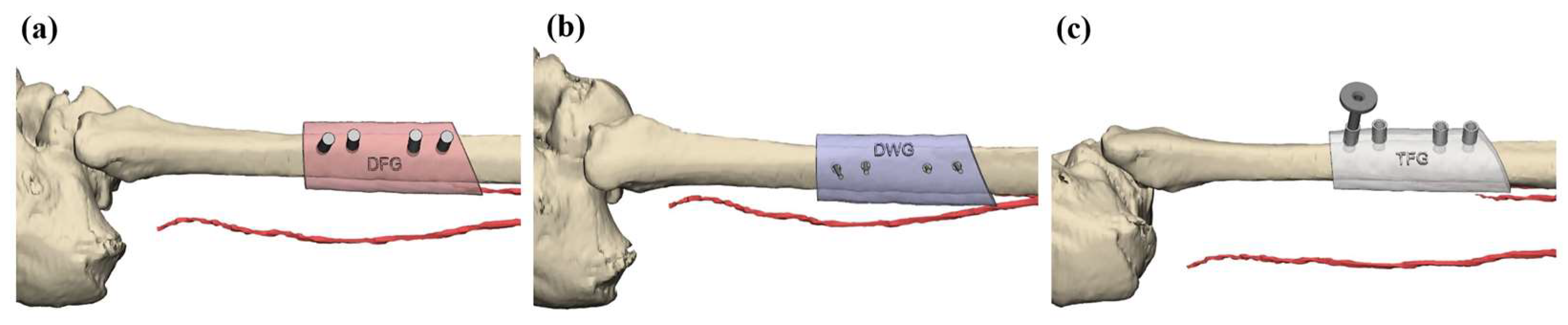
Figure 1. 3D simulation-based models depicting three types of surgical guides and their corresponding drill-hole interfaces for fibula cutting: (a) drill-fitting hole guide (DFG); (b) drill-wide hole guide (DWG); (c) trocar-fitting hole guide (TFG). (Illustrative purposes only).
Applsci 15 13144 g001
Figure 2. Schematic illustration of the drill-guide interface for each surgical guide type with relevant dimensional specifications (unit: mm). The red numbers indicate the quantified range of movement of the drill bit within the guide hole. Both the ACE drill bit and the conventional drill bit had an active tip size of 1.6 mm, compatible with 2.0 mm screws.
Applsci 15 13144 g002
Figure 3. Schematic workflow of the experimental protocol.
Applsci 15 13144 g003
Figure 4. Simulation modeling and corresponding 3D-printed outputs with experimental tools: (a) virtual simulation workflow in 3-matic; (b) fabricated block models, surgical guides (DFG, DWG, TFG), and associated drill components.
Applsci 15 13144 g004
Figure 5. Drilling analysis in 3-matic using scanned data. (a) 3D scanned model of the drilled guide-block assembly with cylinder-head screws; (b) reverse-engineered screw surfaces generated in Geomagic Design X and reimported into 3-matic (transparent contours represent the scanned model; dark gray cylinders denote the reverse-engineered screw surface meshes); (c) extraction of actual drilling paths by fitting analytical cylinders to the reverse-engineered screw surfaces and creating actual drilling insertion points at their intersection with the block model; (d) comparison of actual (red) and reference (blue) drilling paths, showing deviations in angle and insertion point.
Applsci 15 13144 g005
Figure 6. 3D simulation positional analysis of planned and actual plate alignment (planned plate: yellow; actual plate: red). (a) Angular deviation measured between planes created on the underside of the planned and actual plates, visualized in blue and orange, respectively; (b) Intersection volume between the two plate models, shown in orange, used to calculate the Dice coefficient as the overlap ratio.
Applsci 15 13144 g006
Figure 7. Bar graphs comparing drilling accuracy and plate positioning accuracy across guide types: (a) drilling point deviation (mm); (b) drilling path deviation (°); (c) plate overlap ratio (Dice coefficient); (d) plate angular deviation (°). Bars represent mean values, and error bars indicate standard deviation. Exact p-values (Holm-adjusted) are shown above each comparison.
Applsci 15 13144 g007
Table 1. Distance deviation of drilling insertion points across the three guide designs (N = 80 drill holes per guide type).
GuideNMean (mm)SDF (df1, df2)p ValuePost Hoc ††
vs. DWGvs. TFG
DFG800.170.08121.91 (2, 237)<0.001 <0.001<0.001
DWG800.390.16 <0.001
TFG800.490.14
One-way ANOVA was performed and for the post hoc test †† the Holm method was used.
Table 2. Comparison of the drilling path angular deviation among the three guides (N = 80 drill holes per guide type).
GuideNMean
(°)
SDF (df1, df2)p ValuePost Hoc ††
vs. DWGvs. TFG
DFG802.411.2465.34 (2, 237)<0.001 <0.001<0.001
DWG803.751.64 <0.001
TFG805.311.89
One-way ANOVA was performed and for the post hoc test †† the Holm method was used.
Table 3. Comparison of Dice coefficient among the three guides (N = 20 plates per guide type).
GuideNMeanSDF (df1, df2)p ValuePost Hoc ††
vs. DWGvs. TFG
DFG200.900.0438.88 (2, 57)<0.001 <0.001<0.001
DWG200.740.09 0.39
TFG200.720.08
One-way ANOVA was performed and for the post hoc test †† the Holm method was used.
Table 4. Comparison of the plate angular deviation among the three guides (N = 20 plates per guide type).
GuideNMean
(°)
SDF (df1, df2)p ValuePost Hoc ††
vs. DWGvs. TFG
DFG200.870.594.60 (2, 57)<0.014 0.020.03
DWG201.700.88 0.79
TFG201.621.28
One-way ANOVA was performed and for the post hoc test †† the Holm method was used.
Disclaimer/Publisher’s Note: The statements, opinions and data contained in all publications are solely those of the individual author(s) and contributor(s) and not of MDPI and/or the editor(s). MDPI and/or the editor(s) disclaim responsibility for any injury to people or property resulting from any ideas, methods, instructions or products referred to in the content.