1. Introduction
Accurate radiation detection is essential in high-energy tumor-directed radiotherapy to ensure prescription consistency and patient safety. Independent dose verification using radiation detectors underpins equipment quality assurance (QA), prevents treatment errors, and enables precise delivery of therapeutic doses to the target [
1,
2,
3,
4,
5,
6,
7]. Various detector architectures have been proposed and adopted to meet the stringent QA requirements of therapeutic beams, including ionization chambers, radiographic films, thermoluminescent dosimeters (TLDs), radiophotoluminescent dosimeters (RPLDs), single semiconductor/metal structures, metal–oxide–semiconductor field-effect transistors (MOSFETs), and silicon diode dosimeters [
8,
9,
10,
11,
12,
13,
14,
15,
16,
17,
18,
19]. However, films, TLDs, and RPLDs are passive devices that lack real-time readout capability and require time-consuming post-processing, additional hardware, and trained personnel. Although single semiconductor/metal detectors, MOSFETs, and silicon diodes can provide real-time information, they typically require external instrumentation and biasing. Furthermore, MOSFETs suffer from limited operational lifetimes (often <50 Gy of accumulated dose), and amorphous silicon (a-Si) devices exhibit intrinsically low detection efficiency owing to their low atomic number (Z) and electron density [
13].
Radiation detectors based on photovoltaic (PV) devices have been proposed as attractive alternatives [
20,
21]. Operating in the photovoltaic (zero-bias) mode, these detectors utilize the built-in electric field of a p–n junction; they are amenable to miniaturization and offer true real-time readout without the need for external bias circuitry. Among PV-derived detectors, cadmium telluride (CdTe) is particularly promising. Compared to Si or CIGS, CdTe combines a higher effective Z and density—yielding superior stopping power—and a wide bandgap that ensures low leakage current and stable room-temperature operation, all of which are advantageous for therapeutic dosimetry [
22,
23,
24,
25].
CdTe thin-film solar cells have been extensively studied as commercial PV materials because their bandgap (~1.45 eV) and extremely high absorption coefficient (10
4–10
5 cm
−1) enable efficient visible-light harvesting with absorber layers only a few micrometers thick. CdTe has long been recognized as a high-performance radiation detector material. Its high-Z constituents (Cd: 48, Te: 52) and the resulting high stopping power provide superior attenuation and detection efficiency for X-/γ rays in the tens-to-hundreds of keV range, while its wide bandgap ensures low-noise, room-temperature operation [
26,
27,
28]. Consequently, CdTe/CZT materials are widely used in medical imaging, security, and non-destructive testing. Despite these advantages, studies on CdTe-based detectors that are specifically tailored to the therapeutic high-energy photon regime remain scarce. For instance, Shvydka et al. examined the radiation durability of CdTe solar cells under 6-MV photon beams as a function of cumulative dose but did not evaluate dose linearity—an essential parameter for clinical dosimetry [
29].
In this study, we investigated polycrystalline CdTe solar cells under 6 MV photon irradiation to cumulative doses up to 20 kGy and, based on these results, implemented a real-time dosimetry tool operating in the photovoltaic mode. The CdTe absorber employs a Freon-treated structure, previously shown to improve the radiation hardness relative to conventional processing. Unlike previous studies that have primarily focused on diagnostic energy ranges or passive detection modes, this study demonstrates the feasibility of using Freon-treated polycrystalline CdTe solar cells as bias-free, real-time dosimeters for therapeutic high-energy (6 MV) photon beams. Furthermore, in addition to single-cell operation, we investigated parallel-connected configurations of multiple cells to explore the potential for enhancing both the output signal and the measurement reproducibility. We systematically characterized the key dosimetric properties, including dose linearity, dose-rate dependence for single-cell and parallel-connected configurations, field-size dependence, depth dependence, and reproducibility, and assessed the feasibility of CdTe solar cell structures as therapeutic dosimeters.
2. Materials and Methods
2.1. CdTe Cell Fabrication
Superstrate-type CdTe devices were fabricated using Corning 7059 glass substrates (Corning Incorporated, Corning, NY, USA). An indium tin oxide (ITO) layer (90–100 nm thick) was deposited by RF magnetron sputtering. A CdS buffer layer (80–100 nm) was then deposited by physical vapor deposition (PVD) from high-purity CdS powder (99.995%, Sigma-Aldrich, St. Louis, MO, USA) at a substrate temperature of 200 °C and a deposition rate of 3 Å s−1. Subsequently, a CdTe absorber layer (5–10 µm thick) was deposited by PVD at 350 °C.
Activation was performed via Freon treatment using a mixed atmosphere of CHF
2Cl and Ar. The partial pressure of CHF
2Cl was maintained at 40 mbar, and the combined pressure of CHF
2Cl and Ar was 400 mbar. Under these conditions, the CdTe cells were annealed at 400–450 °C for less than 30 min. Freon dissociates and releases chlorine, which reacts with CdTe to form CdCl
2, at temperatures above ~400 °C, promoting recrystallization and grain-boundary passivation. Prior to back-contact formation, the CdTe surface was etched with an NP solution to remove CdCl
2 residues and produce a heavily doped p
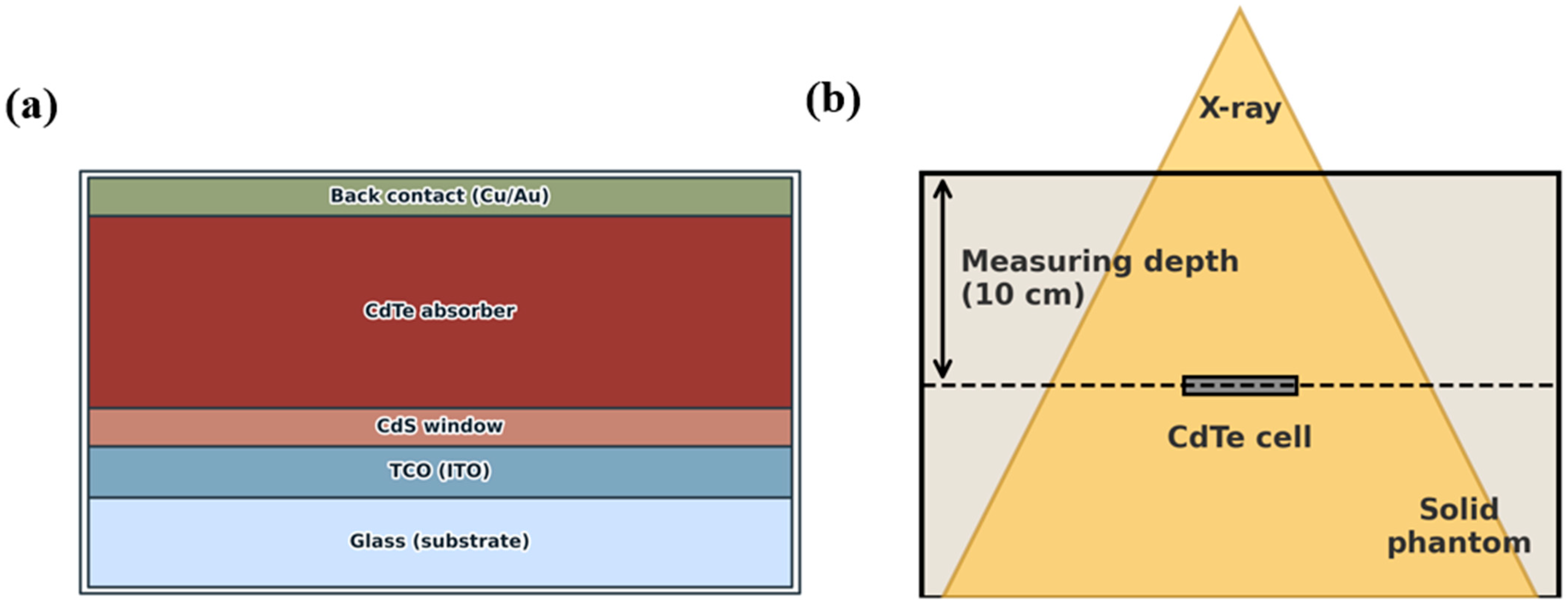
+ surface layer. Back contacts of Cu (4 nm) and Au (100 nm) were deposited by magnetron sputtering, followed by a post-metallization anneal at 190 °C for less than 20 min to activate the back-contact region. A schematic of the device stack is shown in
Figure 1a.
2.2. Measurement Configuration
Device performance under illumination was evaluated using current–voltage (J–V) characteristics measured under AM 1.5 simulated sunlight at an intensity of 100 mW cm−2. External quantum efficiency (EQE) spectra were acquired using a monochromator-based system equipped with a Xe lamp. For each processing condition, the reported solar cell parameters represent the means of five devices, and the standard deviation is provided as the error metric.
For the irradiation tests, samples were exposed to a 6-MV photon beam using a clinical linear accelerator (LINAC; Trilogy Clinac iX, Varian, Palo Alto, CA, USA) at Chonnam National University Medical School. Cumulative doses of 3, 9, 15, and 21 kGy were administered. The dosimetric setup used to extract the reference dose data is shown in
Figure 1b; samples were placed in a solid-water phantom at a source-to-surface distance (SSD) of 100 cm and a depth of 10 cm.
2.3. Dose Linearity
Dose linearity was assessed using a 6-MV X-ray beam at a dose rate of 400 MU min−1. Doses of 50, 100, 200, 300, 400, 500, 600, and 1000 cGy were delivered at a gantry angle of 0°, SSD of 100 cm, and field size of 10 × 10 cm.
2.4. Dose-Rate Dependence
To evaluate dose-rate dependence, the delivered dose was maintained at 200 cGy, while the dose rate was varied from 100 to 600 MU min−1 by using a 6-MV beam.
2.5. Field-Size Dependence and Reproducibility
Field-size dependence was measured by varying the field from 5 × 5 cm2 to 25 × 25 cm2 while delivering 200 cGy at a dose rate of 400 MU min−1 and an SSD of 100 cm. Identical measurements were performed using an ionization chamber. Reproducibility was verified by weekly measurements of 200 cGy over a one-month period, and the results were compared across sessions.
2.6. Percentage Depth Dose
The percentage depth dose (PDD) was measured by varying the detector depth from 0 to 25 cm under 6-MV irradiation while delivering 500 cGy. The PDD results obtained using the CdTe solar-cell detector were compared with those obtained using an ionization chamber.
3. Results
3.1. CdTe Solar Cell Performance
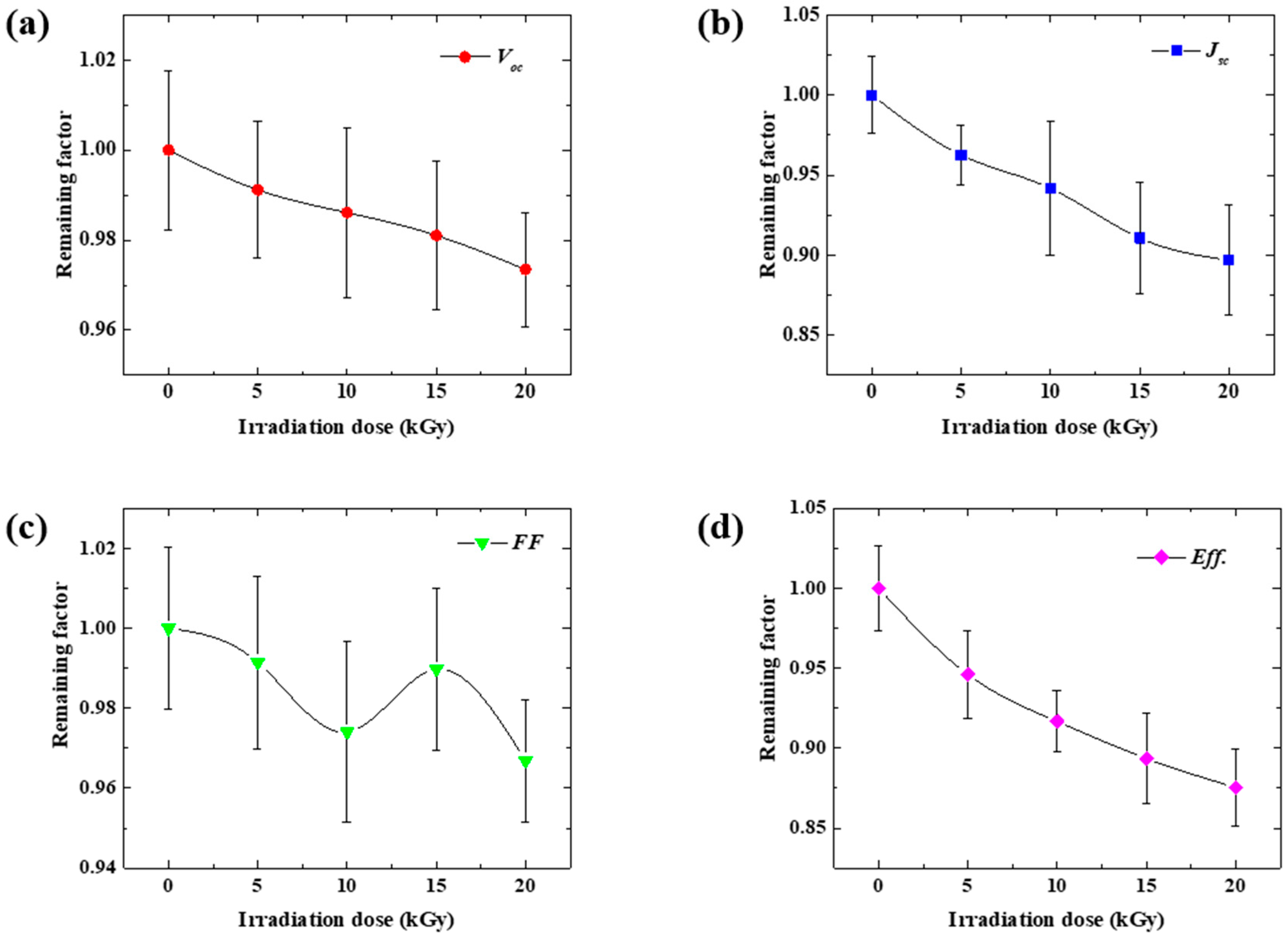
Figure 2 summarizes the photovoltaic performance of the fabricated devices; for comparison, all parameters were normalized to their respective maximum values. As the cumulative photon dose increased from 5 to 20 kGy, both the open-circuit voltage (Voc) and short-circuit current density (Jsc) progressively decreased (
Figure 2a,b). Despite this overall trend, Voc decreased by only 2% relative to its initial value, whereas Jsc exhibited a larger reduction of approximately 10%. The fill factor (FF) exhibited minor fluctuations with dose but decreased by only 2–3% on average (
Figure 2c). Consequently, the observed reduction in power conversion efficiency (PCE) was primarily attributed to the decrease in Jsc (
Figure 2d). As summarized in
Table 1, the devices retained approximately 87% of their initial efficiency after exposure to 20 kGy.
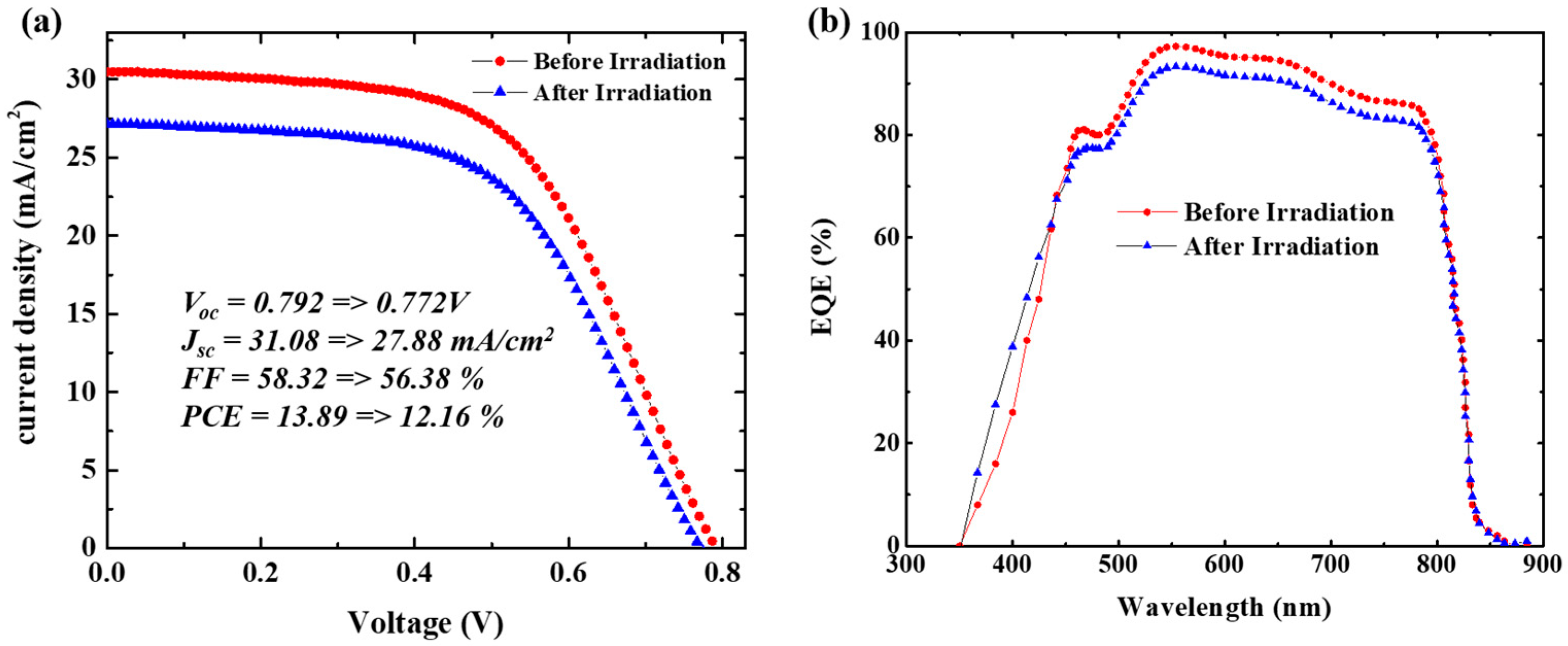
Representative J–V characteristics recorded before and after 20 kGy irradiation showed that the series and shunt resistances remained nearly unchanged, as indicated by the slopes near the current and voltage intercepts. We measured the EQE spectra before and after irradiation to investigate the origin of the Jsc reduction (
Figure 3b). Across the principal absorption band of CdTe (approximately 450–800 nm), the EQE decreased by approximately 5% in a spectrally uniform manner, which is consistent with the observed modest photocurrent. In the EQE spectra (
Figure 3b), a slight increase in response was observed in the short-wavelength region (<500 nm) after irradiation. This behavior likely arises from radiation-induced modifications near the CdS window layer and the interface, effectively enhancing the transmission of blue light to the absorber. Conversely, in the principal absorption band of CdTe (approximately 450–800 nm), the EQE decreased uniformly by approximately 5%. This global reduction reflects the degradation of bulk transport and collection properties due to the accumulation of radiation-induced defects within the CdTe absorber. It is worth noting that the measured Jsc values are slightly higher than those calculated from the EQE spectra. This discrepancy is attributed to an edge-collection effect induced by the aperture mask configuration during J–V measurements, which results in an overestimation of Jsc and a concurrent underestimation of FF, without affecting the relative degradation trends observed in the dosimetric evaluation.
3.2. Dose Linearity
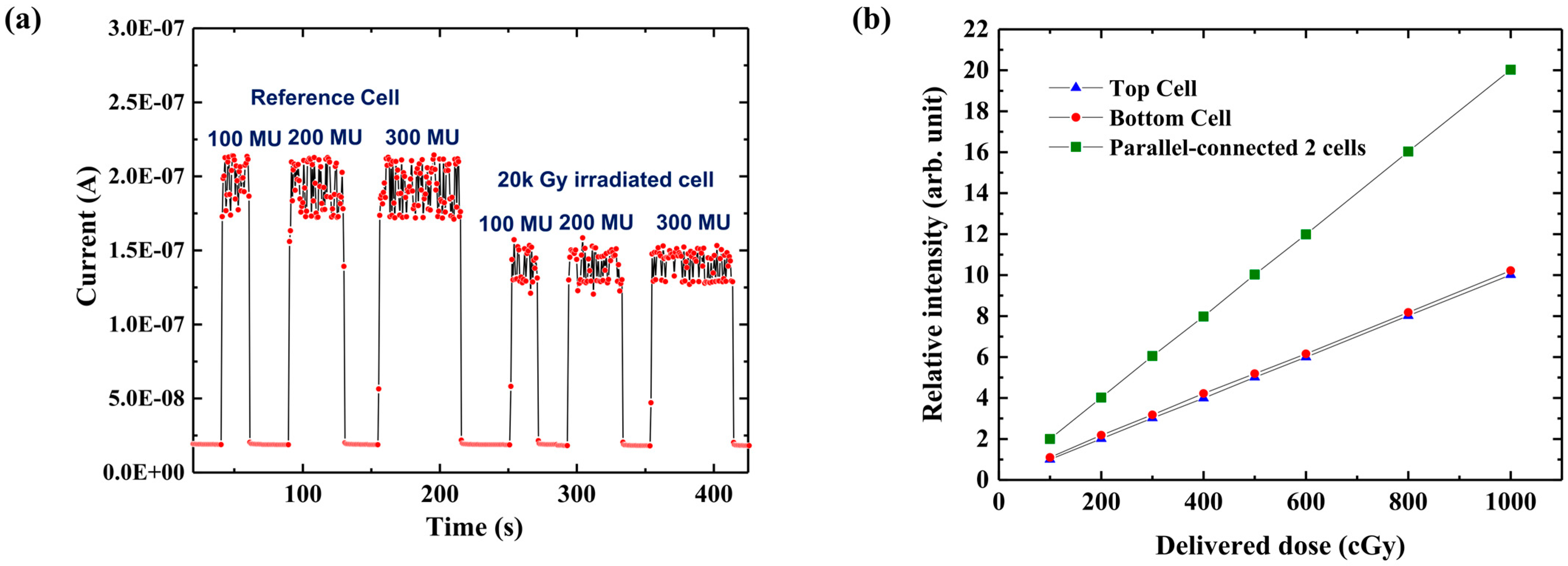
To evaluate the suitability of the dosimeter, we assessed the dose linearity by using a reference device and a device irradiated at 20 kGy (
Figure 4a). The irradiated device produced a total signal of approximately 75% of that of the pristine device; nonetheless, the linear relationship between the signal and delivered dose remained intact for both. As the absolute signal from a single CdTe cell at 6 MV was relatively small, we examined a stacked configuration in which two CdTe solar cells were connected in parallel. The measured signal was equal to the sum of the individual cell outputs, indicating that the response scaled nearly proportionally with the number of stacked cells (
Figure 4b). Minimal variation was observed between the top and bottom cells, suggesting that vertical stacking can enhance signal amplitude without compromising linearity. In this study, the term “signal” refers to the current generated in the CdTe solar cell under unbiased conditions (0 V) during irradiation with 6 MV photon beams. Specifically, it represents the steady-state current measured while the linear accelerator output is stable. The “relative signal” presented in the figures is obtained by normalizing this absolute current to the current measured at a specific reference dose (200 cGy or 400 MU). This normalization allows for a direct comparison of dose dependence across different devices and experimental setups, independent of minor variations in absolute sensitivity.
3.3. Dose-Rate Dependence and Reproducibility
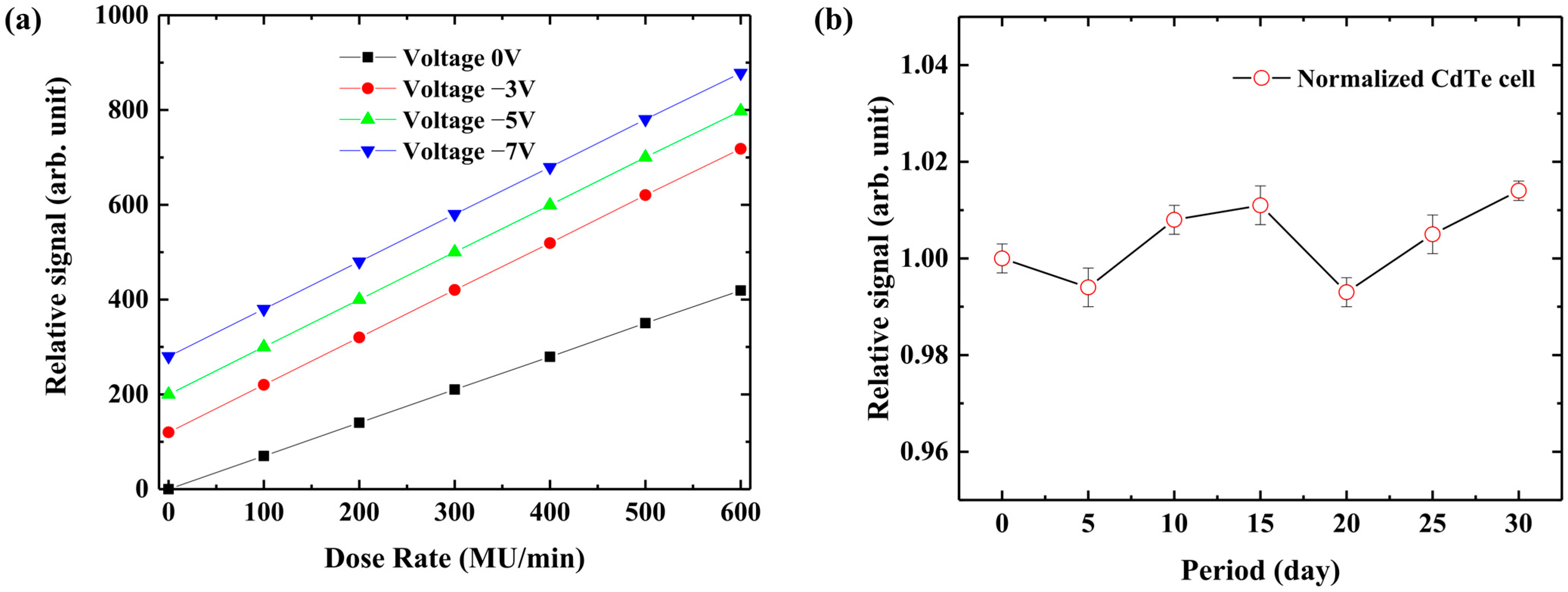
Figure 5a illustrates the dependence of the CdTe cell signal on the dose rate under different reverse-bias conditions. Increasing the reverse bias to 3 V produced a steeper signal-versus-dose-rate slope and extending the bias to 7 V did not introduce significant nonlinearity or instability. Reproducibility was verified through weekly measurements over one month: for a delivered dose of 200 cGy, the recorded signal remained stable within 1%, with no detectable temporal drift (
Figure 5b). All dose-rate tests were performed using 6-MV beams. This variation is well within the generally accepted clinical tolerance of ±2% for relative dosimetry, confirming the detector’s reliability against minor fluctuations in LINAC output. The absolute signal magnitude was found to vary slightly among different CdTe devices due to minor variations in the fabrication process, such as absorber thickness and contact resistance. The absolute sensitivity differed by at most a few percent across the tested devices. However, when the response curves were normalized to a reference dose, the dose linearity and dose-rate dependence characteristics were highly consistent. This indicates that device-to-device variations in absolute sensitivity can be effectively compensated by a simple calibration factor without affecting the detector’s linearity or reliability.
3.4. Field-Size Dependence and Percentage Depth Dose
Field-size dependence was measured by varying the field from 5 × 5 cm
2 to 25 × 25 cm
2 while delivering 200 cGy at 400 MU min
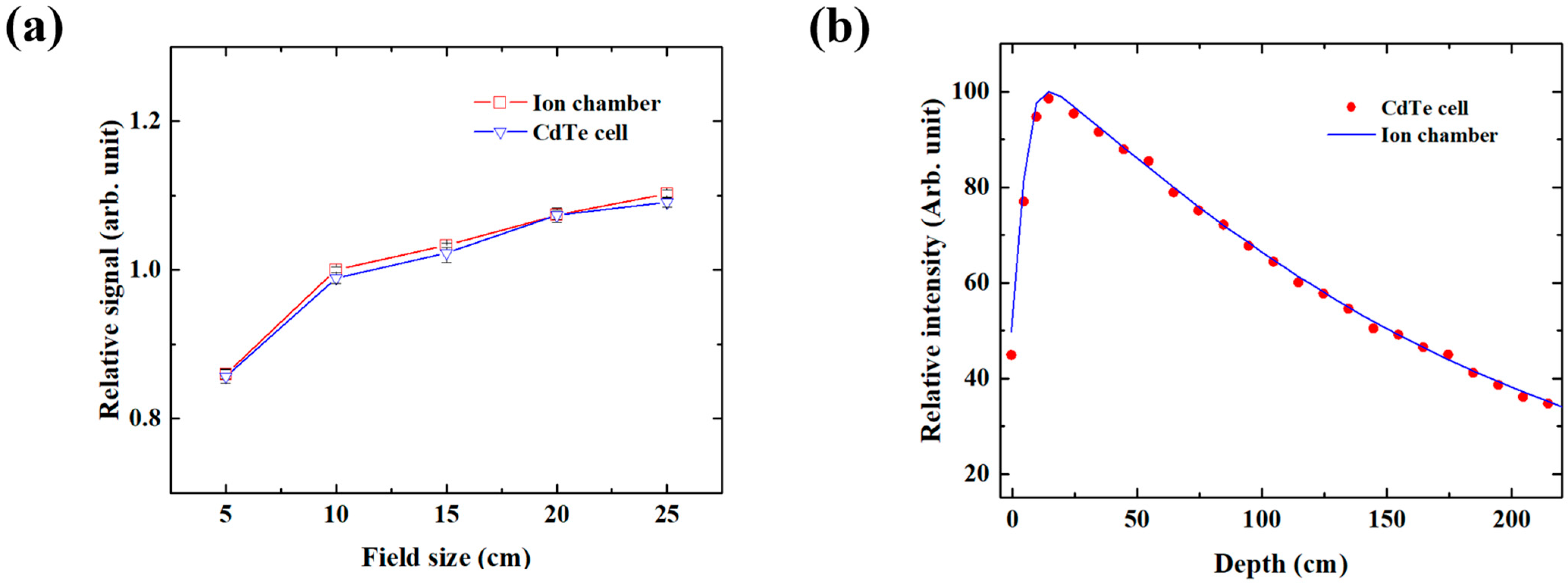
−1 and an SSD of 100 cm. The CdTe response closely matches that of the ionization chamber (
Figure 6a). After normalization to 10 × 10 cm
2, the CdTe and ionization-chamber results agreed within 1% across the investigated field sizes.
PDD measurements further validated the detector fidelity (
Figure 6b). Under 6-MV irradiation, the signal recorded by the CdTe device from the surface to a depth of 25 cm closely followed the ionization chamber curve, with similar agreement observed at 10 MV. These results indicate that the CdTe solar cell detector accurately reproduces both field-size and depth-dose characteristics required for clinical dosimetry.
4. Discussion
This study demonstrated that untreated polycrystalline CdTe solar cell structures exhibit sufficient performance and stability to function as dosimetric detectors under therapeutic megavoltage photon beams. As the cumulative dose increased from 5 to 20 kGy, Jsc decreased by approximately 10%, the FF decreased slightly by 2–3%, and Voc decreased by only ~2%. Consequently, the devices retained approximately 87% of their initial efficiency after irradiation at 20 kGy.
The near invariance of the series and shunt resistances, inferred from the J–V intercept slopes, together with an approximately uniform ~5% reduction in EQE across the principal CdTe absorption band (≈450–800 nm), implies that the performance loss is not primarily due to contact degradation. While the moderate reduction in Voc is consistent with increased non-radiative recombination, the more pronounced degradation in Jsc indicates that the dominant degradation pathway is the deterioration of bulk charge transport properties rather than simple interfacial recombination. High-energy irradiation is known to induce crystallographic defects and traps within the CdTe absorber, acting as scattering centers that significantly reduce carrier mobility and minority carrier diffusion length. When the diffusion length becomes shorter than the absorption depth, carriers generated in the bulk fail to reach the depletion region, leading to a substantial loss in Jsc. This suggests that bulk transport limitations, driven by radiation-induced defects, are the primary factor limiting the device performance after high-dose exposure.
With respect to clinical dosimetry requirements, the CdTe detector maintained a linear dose–signal relationship over a wide range. Even when absolute sensitivity decreased after irradiation, the response could be readily renormalized using a single calibration factor. Dose-rate dependence at 6 MV was minimal. Applying a modest reverse bias (e.g., 3 V) increased the signal slope smoothly, and extending the bias to 7 V did not introduce measurable nonlinearity, indicating that the detector can operate in a simple zero-bias photovoltaic mode while retaining the option for low-bias tuning to optimize dynamic range and signal-to-noise ratio. Field-size dependence and percentage depth dose closely matched ionization chamber results, remaining within ~1% after normalization at 10 × 10 cm2, and weekly measurements over one month showed ≤1% variation, satisfying temporal-stability requirements for routine QA.
We evaluated parallel stacking to address the inherently small absolute signal of a single CdTe cell at MV energies. The response increased proportionally with the number of stacked cells, with negligible variation between the top and bottom devices. This suggests practical pathways for increasing signal amplitude and spatial resolution via through-thickness multilayer stacking or in-plane tiled arrays. The combination of bias-free real-time readout enabled by the built-in field, high stopping power from the high-Z/high-density absorber, and low room-temperature noise from the wide bandgap positions makes the CdTe solar cell detector a compelling alternative to passive dosimeters (film, TLD, and RPLD), which require post-processing, and active junction devices (MOSFETs and Si diodes), which typically require external biasing and may suffer from limited lifetime or efficiency.
Several limitations of this study highlight avenues for future research. The present evaluation focused primarily on 6 MV; verification across a broader clinical energy range, including 10 and 15 MV, is warranted. Systematic assessments of angular dependence, including oblique incidence and rotational delivery, as well as temperature sensitivity, should be performed. The performance under higher cumulative doses beyond 20 kGy and under high-dose-rate pulsed beams, such as flattening-filter-free (FFF) delivery, also merits further study. Complementary defect- and lifetime-sensitive probes (e.g., time-resolved photoluminescence, impedance spectroscopy, and deep-level transient spectroscopy) should be employed to reconcile the uniform EQE attenuation with a larger Jsc reduction. Optimizations of the back electrode and buffer layer to mitigate Schottky barriers and surface recombination can further enhance the signal-to-noise ratio. For clinical deployment, a standardized calibration protocol incorporating dose rate, field size, and depth corrections, together with clear quality control procedures, is necessary. Finally, extending the design to pixelated arrays can enhance the spatial resolution for small-field measurements and broaden applicability to patient-specific QA.
In summary, the Freon-treated CdTe solar cell detector satisfies the key criteria for therapeutic dosimetry: dose linearity, close agreement with a reference ionization chamber, temporal stability, and structural scalability, while offering the practical advantage of zero-bias real-time readout. With further quantitative validation across energy, angle, and long-term doses, as well as developments at the array level, CdTe solar cell structures are well positioned to evolve into a competitive platform for clinical dosimetry.
While the results are promising, several practical limitations must be addressed for clinical implementation. Future studies will focus on systematic assessments of angular dependence, temperature sensitivity corrections, and long-term stability over extended periods of clinical operation to fully qualify the device for routine quality assurance.
5. Conclusions
This study quantitatively demonstrated that freon-treated polycrystalline CdTe solar cell structures can function as practical dosimetric detectors under therapeutic MV photon beams. As the cumulative dose increased, Jsc decreased modestly and FF declined slightly, whereas Voc remained nearly unchanged. Consequently, approximately 87% of the initial efficiency was retained after 20 kGy. The minimal changes in series and shunt resistances inferred from J–V analysis, along with the gentle, broadband reduction in EQE across the main CdTe absorption band, indicate that the performance loss was primarily due to increased nonradiative recombination in the bulk and at interfaces rather than contact degradation. This is consistent with the chlorine-based passivation and grain-boundary recrystallization from the Freon treatment, effectively maintaining the junction stability.
From a dosimetric perspective, the CdTe detector-maintained dose–signal linearity over a wide range, and the post-irradiation sensitivity loss could be readily corrected using a single calibration. The dose-rate dependence was minimal, and when needed, a low reverse bias enabled fine tuning of the dynamic range and signal-to-noise ratio. The field-size dependence and depth-dose distributions closely matched the ionization chamber results, remaining within 1% across the full range when normalized at 10 × 10 cm2, with repeated measurements over one month were stable within 1%. The limitation of a small absolute signal from a single cell was addressed through parallel stacking, which scaled the response nearly linearly and highlighted practical strategies for enhancing signal and spatial resolution via through-thickness stacking or lateral arrays.
In summary, the CdTe solar cell–based detector offers a compelling alternative to passive detectors (film, TLD, and RPLD) and active junction devices (MOSFETs and Si diodes) by offering zero-bias real-time readout, high stopping power from its high-Z/high-density absorber, low room-temperature noise, and process/structural scalability. Future work will extend the validation to 10 and 15 MV, assess angular and temperature dependence, verify performance at higher cumulative doses and under FFF beams, optimize the back electrodes and buffer layers, establish standardized calibration protocols, and develop pixelated arrays. With these advancements, CdTe solar cell structures are expected to become competitive platforms for clinical QA and patient-specific verification.
Author Contributions
Conceptualization, S.C. and S.H.Y.; methodology, S.K.; software, S.K.; validation, S.C., S.H.Y. and J.H.L.; formal analysis, J.H.L.; investigation, J.H.L.; resources, J.H.L.; data curation, J.H.L.; writing—original draft preparation, S.H.Y.; writing—review and editing, J.H.L.; visualization, S.K.; supervision, S.C.; project administration, S.C.; funding acquisition, S.C. All authors have read and agreed to the published version of the manuscript.
Funding
This research was supported by a National Research Foundation of Korea (NRF) grant funded by the Korean Government (MSIT) (No. RS-2025-00561749). This work was supported by the Chonnam National University, Hwasun Hospital Institute for Biomedical Science [HCRI24-010].
Institutional Review Board Statement
Not applicable.
Informed Consent Statement
Not applicable.
Data Availability Statement
Data underlying the results presented in this paper are not publicly available but may be obtained from the authors upon reasonable request.
Conflicts of Interest
The authors declare no conflicts of interest. The funders had no role in the study design; collection, analyses, or interpretation of data; writing of the manuscript; or decision to publish the results.
References
- Bissonnette, J.P.; Medlam, G. Trend analysis of radiation therapy incidents over seven years. Radiother. Oncol. 2010, 96, 139–144. [Google Scholar] [CrossRef]
- Kann, B.H.; Park, H.S.; Johnson, S.B.; Chiang, V.L.; Yu, J.B. Radiosurgery for brain metastases: Changing practice patterns and disparities in the United States. J. Natl. Compr. Cancer Netw. 2017, 15, 1494–1502. [Google Scholar] [CrossRef]
- Hendric Kamalrudin, M.; Razali, M. Radiotherapy errors and its verification approach. Int. J. Rec. Technol. Eng. 2019, 8, 191. [Google Scholar]
- Hoffman, D.; Dragojević, I.; Hoisak, J.; Hoopes, D.; Manger, R. Lung stereotactic body radiation therapy (SBRT) dose gradient and PTV volume: A retrospective multicenter analysis. Radiol. Oncol. 2019, 14, 162. [Google Scholar] [CrossRef] [PubMed]
- van der Merwe, D.; Van Dyk, J.; Healy, B.; Zubizarreta, E.; Izewska, J.; Mijnheer, B.; Meghzifene, A. Accuracy requirements and uncertainties in radiotherapy: A report of the International Atomic Energy Agency. Acta Oncol. 2017, 56, 1–6. [Google Scholar] [CrossRef] [PubMed]
- Shaw, M.; Lye, J.; Alves, A.; Keehan, S.; Lehmann, J.; Hanlon, M.; Kenny, J.; Baines, J.; Porumb, C.; Geso, M.; et al. Characterisation of a synthetic diamond detector for end-to-end dosimetry in stereotactic body radiotherapy and radiosurgery. Phys. Imaging Radiat. Oncol. 2021, 20, 40–45. [Google Scholar] [CrossRef] [PubMed]
- Li, G.; Zhang, Y.; Jiang, X.; Bai, S.; Peng, G.; Wu, K.; Jiang, Q. Evaluation of the ArcCHECK QA system for IMRT and VMAT verification. Phys. Medica 2013, 29, 295–303. [Google Scholar] [CrossRef]
- Foote, M.; Bailey, M.; Smith, L.; Siva, S.; Hegi-Johnson, F.; Seeley, A.; Barry, T.; Booth, J.; Ball, D.; Thwaites, D. Guidelines for safe practice of stereotactic body (ablative) radiation therapy. J. Med. Imaging Radiat. Oncol. 2015, 59, 646–653. [Google Scholar] [CrossRef]
- Sahgal, A.; Roberge, D.; Schellenberg, D.; Purdie, T.G.; Swaminath, A.; Pantarotto, J.; Filion, E.; Gabos, Z.; Butler, J.; Letourneau, D.; et al. The Canadian association of radiation oncology scope of practice guidelines for lung, liver and spine stereotactic body radiotherapy. Clin. Oncol. (R Coll. Radiol.) 2012, 24, 629–639. [Google Scholar] [CrossRef]
- Matuszak, M.M.; Hadley, S.W.; Feng, M.; Hayman, J.A.; Brock, K.K.; Burger, P.; Owen, D.; Suresh, K.; Schipper, M.; Lawrence, T.S.; et al. Enhancing safety and quality through preplanning peer review for patients undergoing stereotactic body radiation therapy. Pract. Radiat. Oncol. 2016, 6, e39–e46. [Google Scholar] [CrossRef]
- Van Elmpt, W.; McDermott, L.; Nijsten, S.; Wendling, M.; Lambin, P.; Mijnheer, B. A literature review of electronic portal imaging for radiotherapy dosimetry. Radiother. Oncol. 2008, 88, 289–309. [Google Scholar] [CrossRef]
- Scalchi, P.; Francescon, P.; Rajaguru, P. Characterization of a new MOSFET detector configuration for in vivo skin dosimetry. Med. Phys. 2005, 32, 1571–1578. [Google Scholar] [CrossRef]
- Jornet, N.; Carrasco, P.; Jurado, D.; Ruiz, A.; Eudaldo, T.; Ribas, M. Comparison study of MOSFET detectors and diodes for entrance in vivo dosimetry in 18 MV X-ray beams. Med. Phys. 2004, 31, 2534–2542. [Google Scholar] [CrossRef]
- Kron, T. Thermoluminescence dosimetry and its applications in medicine—Part 2: History and applications. Australas. Phys. Eng. Sci. Med. 1995, 18, 1–25. [Google Scholar]
- Kron, T. Thermoluminescence dosimetry and its applications in medicine—Part 1: Physics, materials and equipment. Australas. Phys. Eng. Sci. Med. 1994, 17, 175–199. [Google Scholar]
- Mrčela, I.; Bokulić, T.; Izewska, J.; Budanec, M.; Fröbe, A.; Kusić, Z. Optically stimulated luminescence in vivo dosimetry for radiotherapy: Physical characterization and clinical measurements in (60)Co beams. Phys. Med. Biol. 2011, 56, 6065–6082. [Google Scholar] [CrossRef] [PubMed]
- Butson, M.; Haque, M.; Smith, L.; Butson, E.; Odgers, D.; Pope, D.; Gorjiana, T.; Whitaker, M.; Morales, J.; Hong, A.; et al. Practical time considerations for optically stimulated luminescent dosimetry (OSLD) in total body irradiation. Australas. Phys. Eng. Sci. Med. 2017, 40, 167–171. [Google Scholar] [CrossRef] [PubMed]
- Yu, S.J.; Lim, S.; Ma, S.Y.; Seo, S.Y.; Kim, Y.J.; Kang, Y.N.; Keum, K.C.; Cho, S. In vivo dosimetry for mammography with and without lead apron using the glass dosimeters. Prog. Med. Phys. 2015, 26, 93–98. [Google Scholar] [CrossRef]
- Rah, J.-E.; Hwang, U.-J.; Jeong, H.; Lee, S.-Y.; Lee, D.-H.; Shin, D.H.; Yoon, M.; Lee, S.B.; Lee, R.; Park, S.Y. Clinical application of glass dosimeter for in vivo dose measurements of total body irradiation treatment technique. Radiat. Meas. 2011, 46, 40–45. [Google Scholar] [CrossRef]
- Jeong, S.; Cheon, W.; Shin, D.; Lim, Y.K.; Jeong, J.; Kim, H.; Yoon, M.; Lee, S.B. Development of a dosimetry system for therapeutic X-rays using a flexible amorphous silicon thin-film solar cell with a scintillator screen. Med. Phys. 2022, 49, 4768–4779. [Google Scholar] [CrossRef]
- Shin, D.-S.; Kim, T.-H.; Rah, J.-E.; Lee, S.B.; Lim, Y.K.; Jeong, J.; Kim, H.; Shin, D.; Son, J. Flexible real-time skin dosimeter based on a thin-film copper indium gallium selenide solar cell for electron radiation therapy. Med. Phys. 2023, 50, 2402–2416. [Google Scholar] [CrossRef]
- Audet, N.; Levicharsky, B.; Zappettini, A.; Zha, M. Composition study of CdTe charges synthesized by the travelling heater method. IEEE Trans. Nucl. Sci. 2007, 54, 782–785. [Google Scholar] [CrossRef]
- Carramate, L.F.N.D.; Oliveira, C.A.B.; Silva, A.L.M.; Silva, A.M.; Santos, J.M.F.; Veloso, J.F.C.A. Energy weighting technique in Quantum Computed Tomography using a MPGD. J. Instrum. 2011, 6, C02002. [Google Scholar] [CrossRef]
- Barber, W.C.; Wessel, J.C.; Nygard, E.; Iwanczyk, J.S. Energy dispersive CdTe and CdZnTe detectors for spectral clinical CT and NDT applications. Nucl. Instrum. Methods Phys. Res. A 2015, 784, 531–537. [Google Scholar] [CrossRef] [PubMed]
- Taguchi, K.; Iwanczyk, J.S. Vision 20/20: Single photon counting X-ray detectors in medical imaging. Med. Phys. 2013, 40, 100901. [Google Scholar] [CrossRef] [PubMed]
- Neo, Y.; Ikeda, Y.; Sakata, T.; Morii, H.; Shiozawa, K.; Aoki, T.; Mimura, H. CdTe x-ray sensing driven by electron beam from field emitters. J. Vac. Sci. Technol. B 2007, 25, 643–645. [Google Scholar] [CrossRef]
- Okamoto, T.; Takahashi, K.; Akiba, S.; Yasuda, N.; Tokuda, S.; Kishihara, H.; Ichioka, A.; Doki, T.; Sato, T. Deposition of Cl-doped CdTe polycrystalline films by close-spaced sublimation. Phys. Status Solidi C 2015, 12, 532–535. [Google Scholar] [CrossRef]
- Okamoto, T.; Igari, T.; Gotoh, Y.; Sato, N.; Akiyoshi, M.; Takagi, I. Gamma-ray tolerance of CdS/CdTe photodiodes for radiation tolerant compact image sensor with field emitter array. Phys. Status Solidi C 2016, 13, 635–638. [Google Scholar] [CrossRef]
- Shvydka, D.; Parsai, E.I.; Kang, J. Radiation hardness studies of CdTe thin films for clinical high-energy photon beam detectors. Nucl. Instrum. Methods Phys. Res. Sect. A 2008, 586, 169–173. [Google Scholar] [CrossRef]
| Disclaimer/Publisher’s Note: The statements, opinions and data contained in all publications are solely those of the individual author(s) and contributor(s) and not of MDPI and/or the editor(s). MDPI and/or the editor(s) disclaim responsibility for any injury to people or property resulting from any ideas, methods, instructions or products referred to in the content. |
© 2025 by the authors. Licensee MDPI, Basel, Switzerland. This article is an open access article distributed under the terms and conditions of the Creative Commons Attribution (CC BY) license (https://creativecommons.org/licenses/by/4.0/).