


Exploring the Effect of Blood Flow Restriction Training on Lower-Limb Muscle Activation in CrossFit Athletes: A Pilot Crossover Trial

 ,
,  , , and
Abstract
1. Introduction
2. Materials and Methods
2.1. Study Design
2.2. Ethical Considerations
2.3. Participants
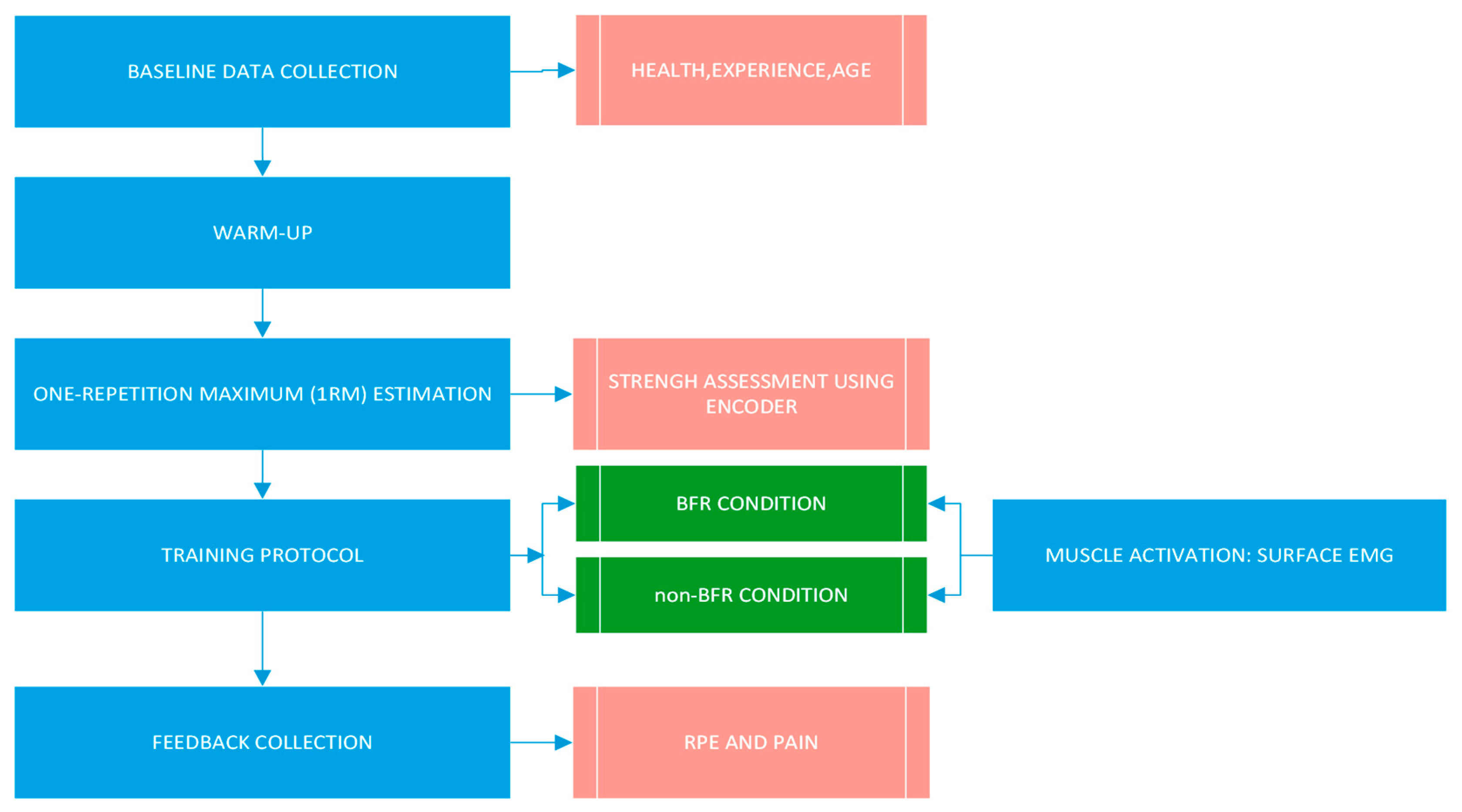
2.4. Procedures
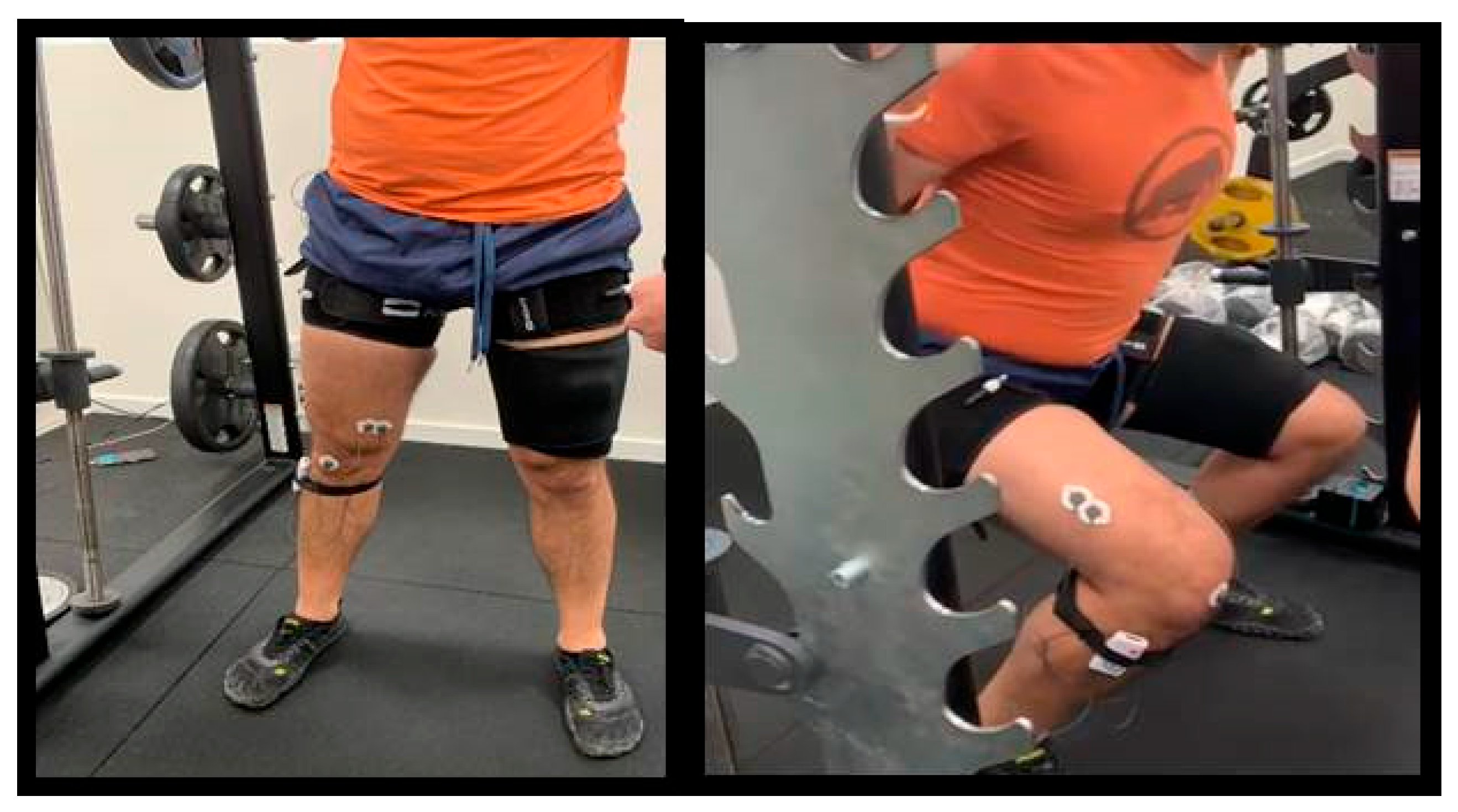
2.4.1. BFR Device
2.4.2. Determination of BFR Pressure
2.4.3. One-Repetition Maximum (1RM) Estimation
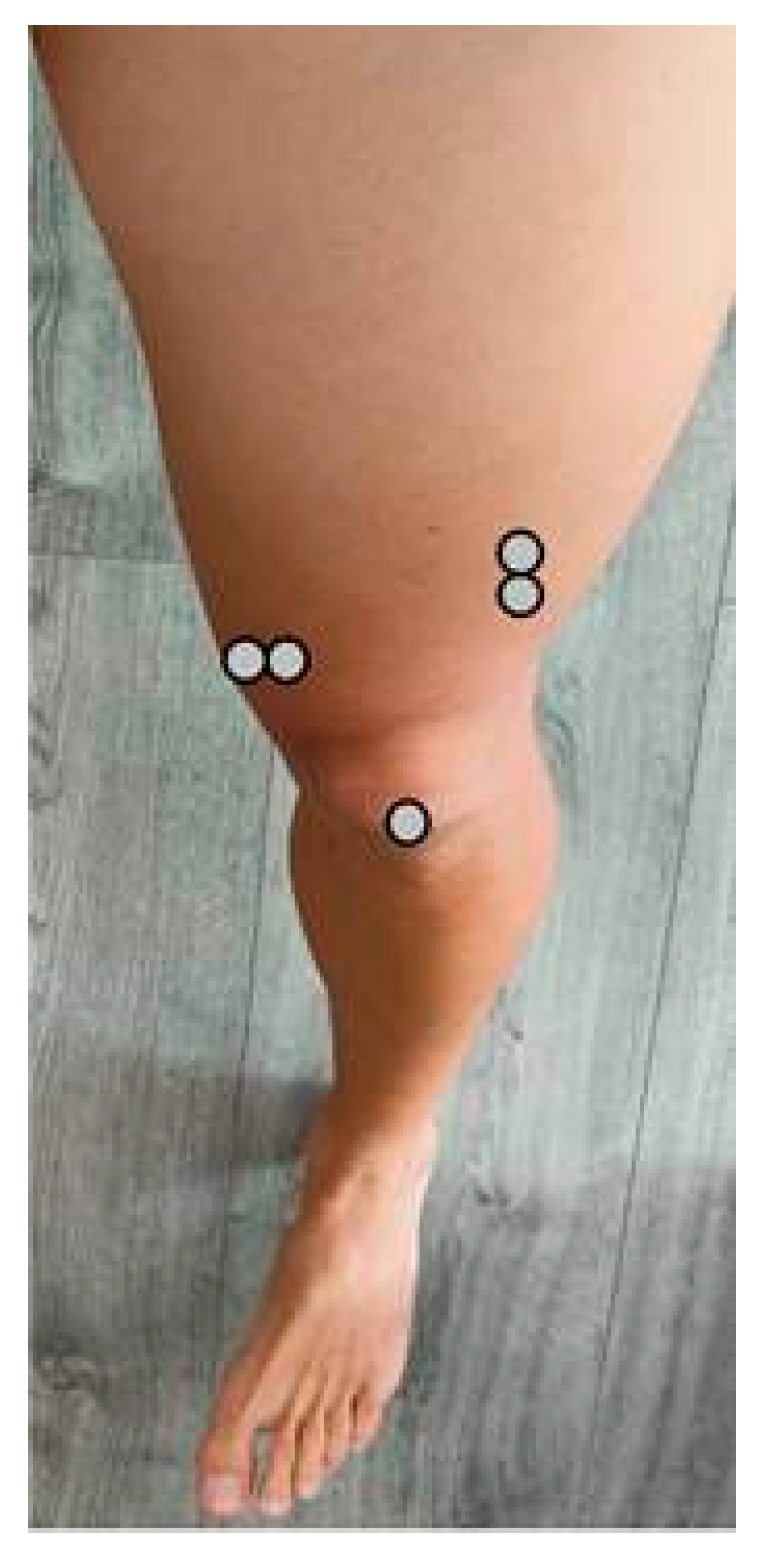
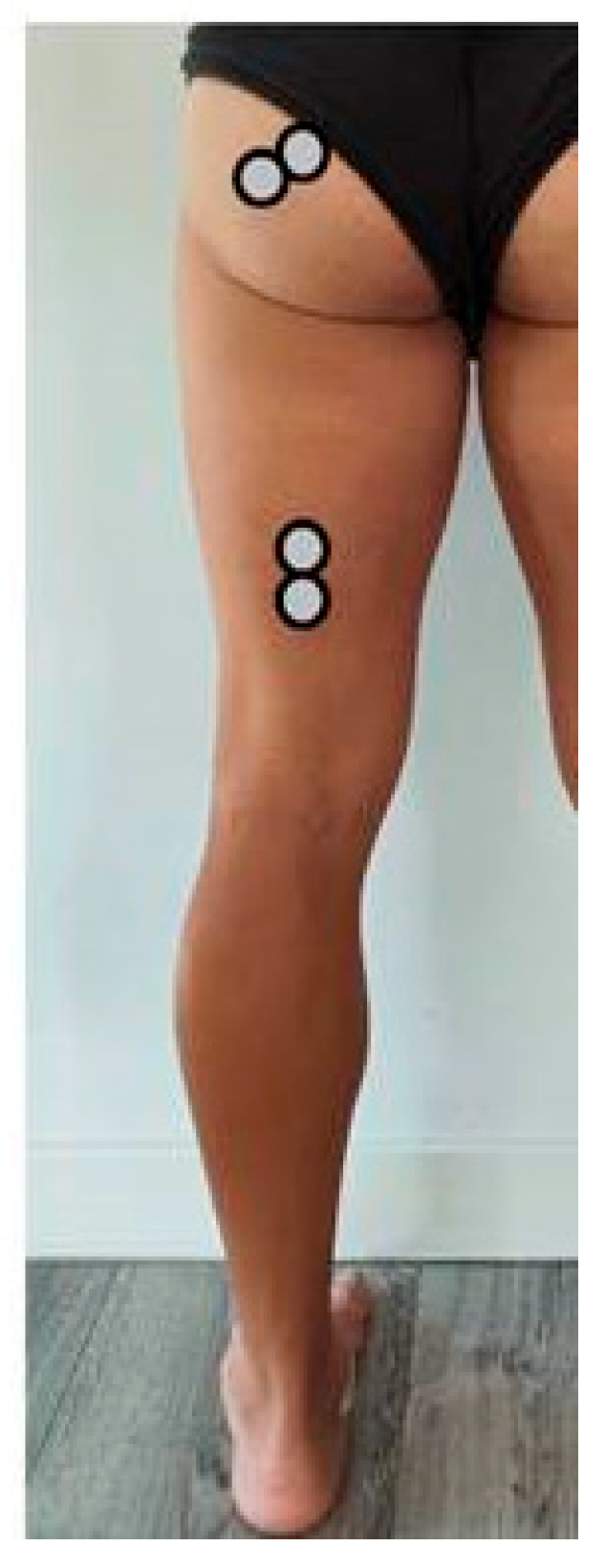
2.4.4. Surface Electromyography (sEMG)
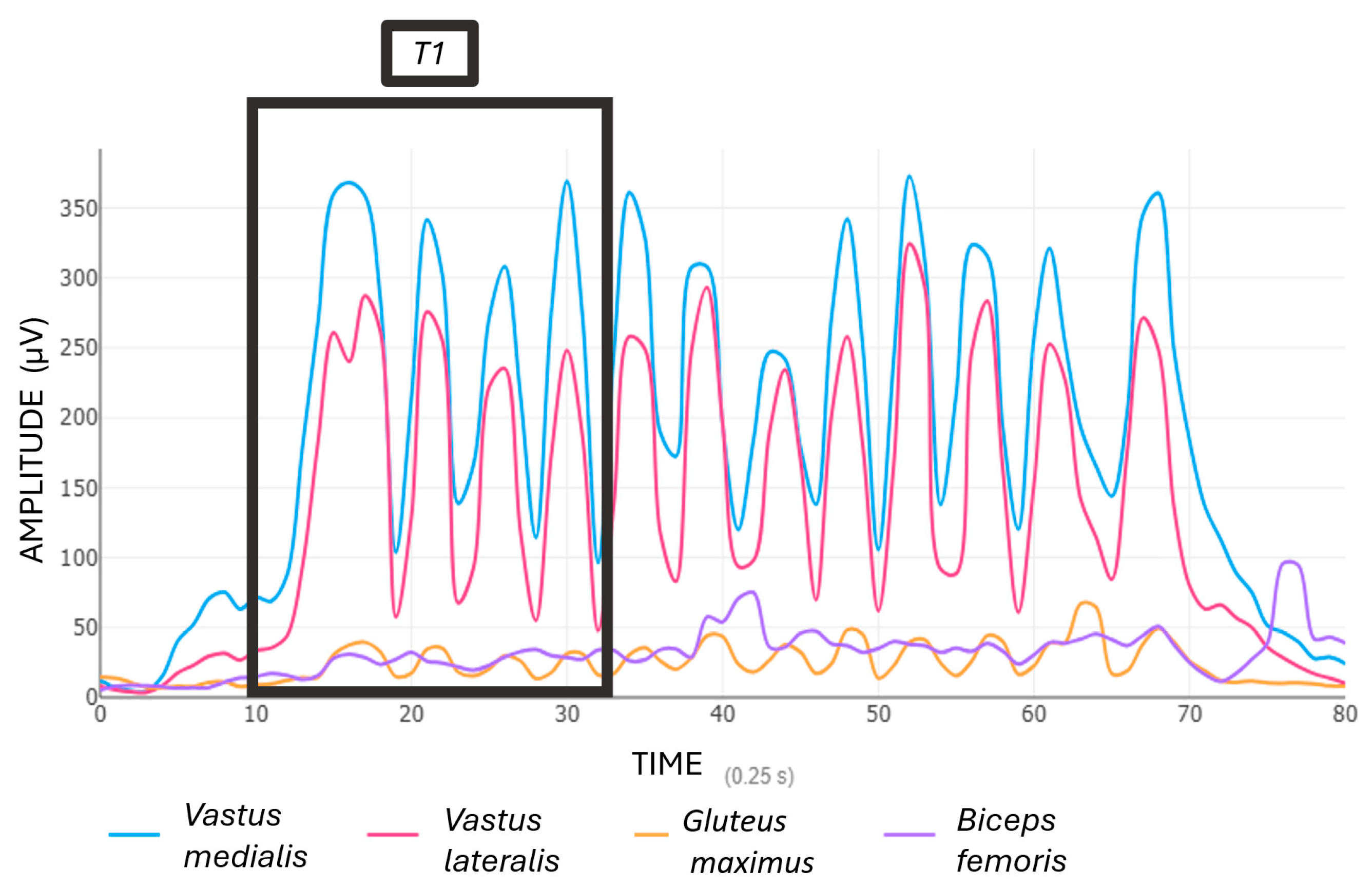
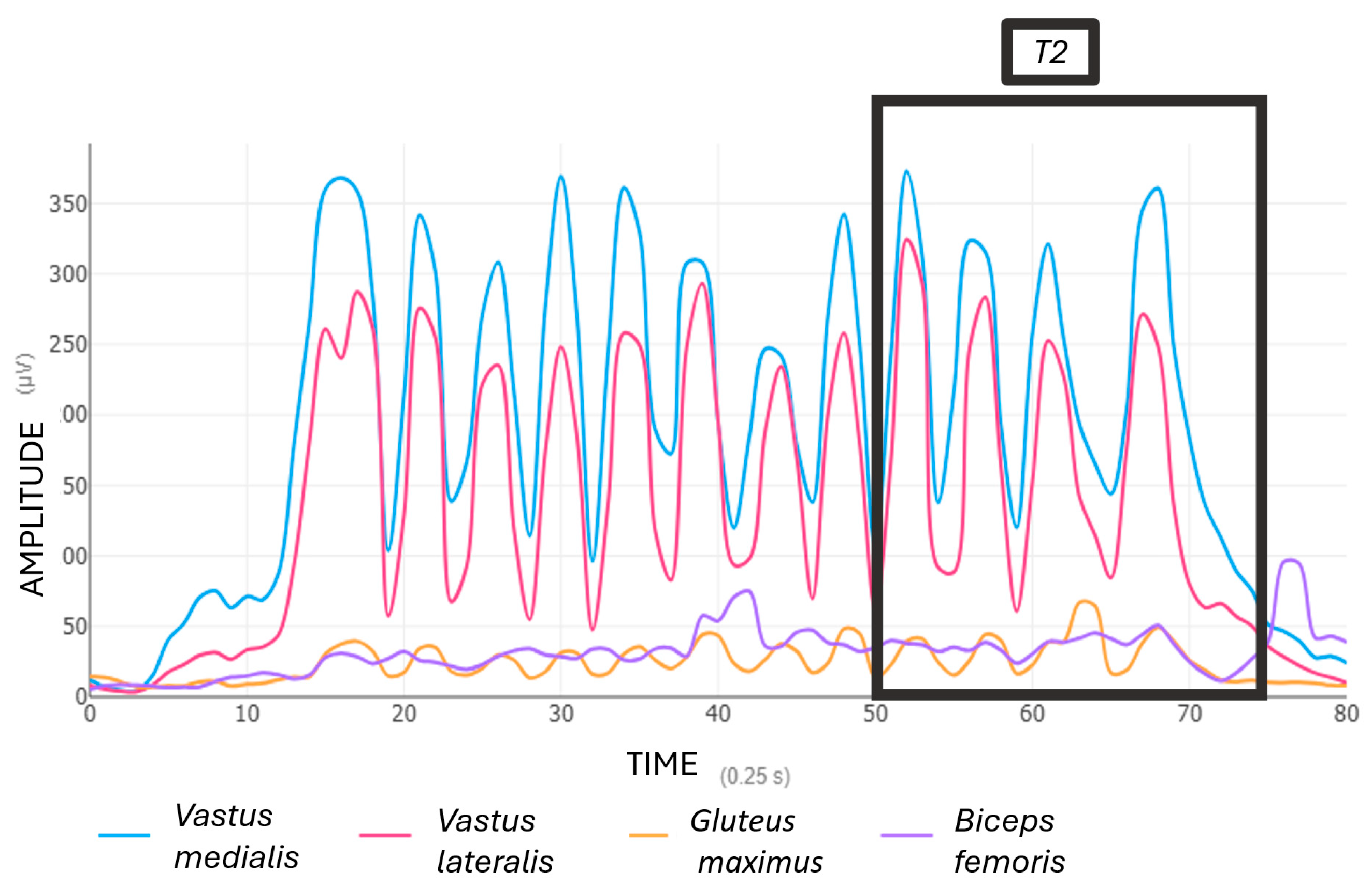
2.4.5. Data Processing and Normalization
2.4.6. Training Protocols
2.4.7. Statistical Analysis
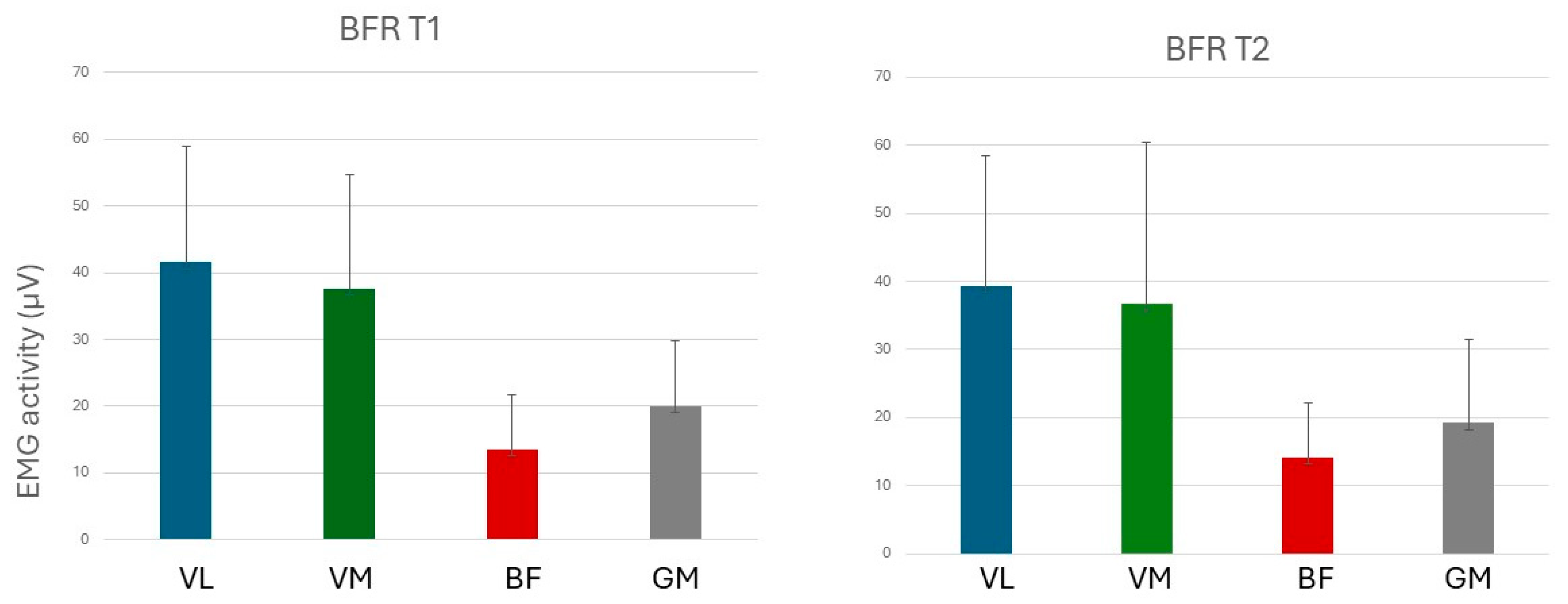
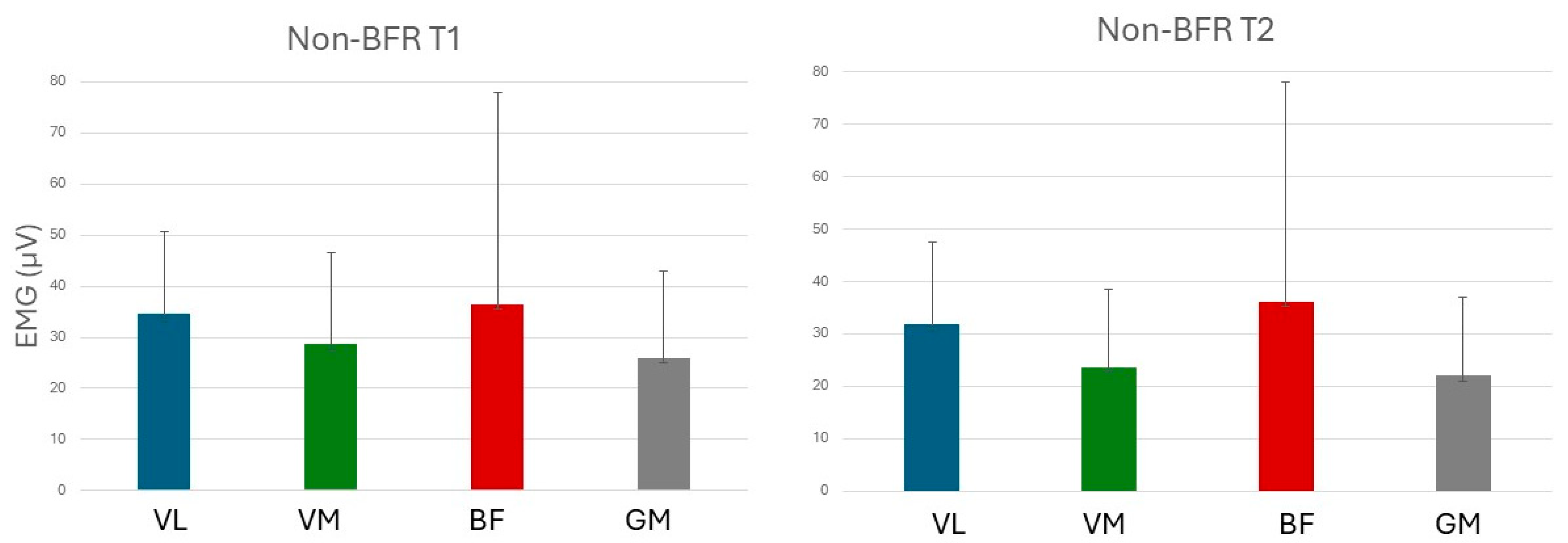
3. Results
4. Discussion
4.1. Limitations
4.2. Clinical Relevance
4.3. Future Lines of Research
5. Conclusions
Author Contributions
Funding
Institutional Review Board Statement
Informed Consent Statement
Data Availability Statement
Conflicts of Interest
References
- Nicolay, R.W.; Moore, L.K.; DeSena, T.D.; Dines, J.S. Upper Extremity Injuries in CrossFit Athletes—A Review of the Current Literature. Curr. Rev. Musculoskelet. Med. 2022, 15, 402–410. [Google Scholar] [CrossRef]
- Lastra-Rodríguez, L.; Llamas-Ramos, I.; Rodríguez-Pérez, V.; Llamas-Ramos, R.; López-Rodríguez, A.F. Musculoskeletal Injuries and Risk Factors in Spanish CrossFit® Practitioners. Healthcare 2023, 11, 1346. [Google Scholar] [CrossRef]
- Shim, S.S.; Confino, J.E.; Vance, D.D. Common Orthopaedic Injuries in CrossFit Athletes. J. Am. Acad. Orthop. Surg. 2023, 31, 557–564. [Google Scholar] [CrossRef] [PubMed]
- Loenneke, J.P.; Wilson, G.J.; Wilson, J.M. A Mechanistic Approach to Blood Flow Occlusion. Int. J. Sports Med. 2010, 31, 1–4. [Google Scholar] [CrossRef]
- Loenneke, J.P.; Fahs, C.A.; Rossow, L.M.; Abe, T.; Bemben, M.G. The anabolic benefits of venous blood flow restriction training may be induced by muscle cell swelling. Med. Hypotheses 2012, 78, 151–154. [Google Scholar] [CrossRef] [PubMed]
- Sieljacks, P.; Matzon, A.; Wernbom, M.; Ringgaard, S.; Vissing, K.; Overgaard, K. Muscle damage and repeated bout effect following blood flow restricted exercise. Eur. J. Appl. Physiol. 2016, 116, 513–525. [Google Scholar] [CrossRef]
- Burgomaster, K.A.; Moore, D.R.; Schofield, L.M.; Phillips, S.M.; Sale, D.G.; Gibala, M.J. Resistance Training with Vascular Occlusion: Metabolic Adaptations in Human Muscle. Med. Sci. Sports Exerc. 2003, 35, 1203–1208. [Google Scholar] [CrossRef]
- Patterson, S.D.; Hughes, L.; Warmington, S.; Burr, J.; Scott, B.; Owens, J.; Abe, T.; Nielsen, J.; Libardi, C.A.; Laurentino, G.; et al. Blood Flow Restriction Exercise: Considerations of Methodology, Application, and Safety. Front. Physiol. 2019, 10, 533. [Google Scholar]
- Abe, T.; Kearns, C.F.; Sato, Y. Muscle size and strength are increased following walk training with restricted venous blood flow from the leg muscle, Kaatsu-walk training. J. Appl. Physiol. 2006, 100, 1460–1466. [Google Scholar] [CrossRef] [PubMed]
- Cook, S.B.; Clark, B.C.; Ploutz-Snyder, L.L. Effects of Exercise Load and Blood-Flow Restriction on Skeletal Muscle Function. Med. Sci. Sports Exerc. 2007, 39, 1708–1713. [Google Scholar] [CrossRef] [PubMed]
- Zhang, M.; Song, Y.; Zhu, J.; Ding, P.; Chen, N. Effectiveness of low-load resistance training with blood flow restriction vs. conventional high-intensity resistance training in older people diagnosed with sarcopenia: A randomized controlled trial. Sci. Rep. 2024, 14, 28427. [Google Scholar] [CrossRef]
- Centner, C.; Wiegel, P.; Gollhofer, A.; König, D. Effects of Blood Flow Restriction Training on Muscular Strength and Hypertrophy in Older Individuals: A Systematic Review and Meta-Analysis. Sports Med. 2019, 49, 95–108, Correction in Sports Med. 2019, 49, 109–111.. [Google Scholar] [CrossRef]
- Hughes, L.; Rosenblatt, B.; Haddad, F.; Gissane, C.; McCarthy, D.; Clarke, T.; Ferris, G.; Dawes, J.; Paton, B.; Patterson, S.D. Comparing the Effectiveness of Blood Flow Restriction and Traditional Heavy Load Resistance Training in the Post-Surgery Rehabilitation of Anterior Cruciate Ligament Reconstruction Patients: A UK National Health Service Randomised Controlled Trial. Sports Med. 2019, 49, 1787–1805. [Google Scholar] [CrossRef] [PubMed]
- Lipker, L.A.; Persinger, C.R.; Michalko, B.S.; Durall, C.J. Blood Flow Restriction Therapy Versus Standard Care for Reducing Quadriceps Atrophy After Anterior Cruciate Ligament Reconstruction. J. Sport Rehabil. 2019, 28, 897–901. [Google Scholar] [CrossRef] [PubMed]
- Loenneke, J.P.; Wilson, J.M.; Marín, P.J.; Zourdos, M.C.; Bemben, M.G. Low intensity blood flow restriction training: A meta-analysis. Eur. J. Appl. Physiol. 2012, 112, 1849–1859. [Google Scholar] [CrossRef] [PubMed]
- Jagim, A.R.; Schuler, J.; Szymanski, E.; Khurelbaatar, C.; Carpenter, M.; Fields, J.B.; Jones, M.T. Acute Responses of Low-Load Resistance Exercise with Blood Flow Restriction. J. Funct. Morphol. Kinesiol. 2024, 9, 254. [Google Scholar] [CrossRef]
- May, A.K.; Russell, A.P.; Della Gatta, P.A.; Warmington, S.A. Muscle Adaptations to Heavy-Load and Blood Flow Restriction Resistance Training Methods. Front. Physiol. 2022, 13, 837697. [Google Scholar] [CrossRef]
- Kamiş, O.; Gürses, V.V.; Şendur, H.N.; Altunsoy, M.; Pekel, H.A.; Yıldırım, E.; Aydos, L. Low-Load Resistance Exercise With Blood Flow Restriction Versus High-Load Resistance Exercise on Hamstring Muscle Adaptations in Recreationally Trained Men. J. Strength Cond. Res. 2024, 38, e541–e552. [Google Scholar] [CrossRef]
- Ishizaka, H.; Uematsu, A.; Mizushima, Y.; Nozawa, N.; Katayanagi, S.; Matsumoto, K.; Nishikawa, K.; Takahashi, R.; Arakawa, T.; Sawaguchi, T.; et al. Blood Flow Restriction Increases the Neural Activation of the Knee Extensors During Very Low-Intensity Leg Extension Exercise in Cardiovascular Patients: A Pilot Study. J. Clin. Med. 2019, 8, 1252. [Google Scholar] [CrossRef]
- Merletti, R.; Rainoldi, A.; Farina, D. Surface Electromyography for Noninvasive Characterization of Muscle. Exerc. Sport Sci. Rev. 2001, 29, 20–25. [Google Scholar] [CrossRef]
- Farina, D. Interpretation of the Surface Electromyogram in Dynamic Contractions. Exerc. Sport Sci. Rev. 2006, 34, 121–127. [Google Scholar] [CrossRef]
- Wortman, R.J.; Brown, S.M.; Savage-Elliott, I.; Finley, Z.J.; Mulcahey, M.K. Blood Flow Restriction Training for Athletes: A Systematic Review. Am. J. Sports Med. 2021, 49, 1938–1944. [Google Scholar] [CrossRef]
- Eldridge, S.M.; Chan, C.L.; Campbell, M.J.; Bond, C.M.; Hopewell, S.; Thabane, L.; Lancaster, G.A.; PAFS Consensus Group. CONSORT 2010 statement: Extension to randomised pilot and feasibility trials. BMJ 2016, 355, i5239. [Google Scholar] [CrossRef]
- Holt, G.R. Declaration of Helsinki—The World’s Document of Conscience and Responsibility. South. Med. J. 2014, 107, 407. [Google Scholar] [CrossRef] [PubMed]
- Zhu, H.; Tan, Z.; Zhang, N.; Li, Y.; Qi, H. Acute effects of blood flow restriction training at various arterial occlusion pressures on muscle activation, blood lactate responses, and RPE in healthy adult males. Front. Physiol. 2025, 16, 1620294. [Google Scholar] [CrossRef]
- Walden, T.P.; Jonson, A.M.; Dempsey, A.R.; Fairchild, T.J.; Girard, O. Prescribing Blood Flow Restricted Exercise: Limb Composition Influences the Pressure Required to Create Arterial Occlusion. J. Sport Rehabil. 2024, 33, 695–699. [Google Scholar] [CrossRef] [PubMed]
- García-Arrabé, M.; González-de-la-Flor, Á.; Salniccia, F.; López-Ruiz, J.; García-Pérez-de-Sevilla, G. Development of a predictive formula for arterial complete occlusion pressure in upper and lower limbs during blood flow restriction. J. Tissue Viability 2025, 34, 100946. [Google Scholar] [CrossRef] [PubMed]
- Justo-Álvarez, A.; García-López, J.; Sabido, R.; García-Valverde, A. Validity of a New Portable Sensor to Measure Velocity-Based Resistance Training. Methods Protoc. 2025, 8, 9. [Google Scholar] [CrossRef]
- Molina-Molina, A.; Ruiz-Malagón, E.J.; Carrillo-Pérez, F.; Roche-Seruendo, L.E.; Damas, M.; Banos, O.; García-Pinillos, F. Validation of mDurance, A Wearable Surface Electromyography System for Muscle Activity Assessment. Front. Physiol. 2020, 11, 606287. [Google Scholar] [CrossRef]
- Hermens, H.J.; Freriks, B.; Disselhorst-Klug, C.; Rau, G. Development of recommendations for SEMG sensors and sensor placement procedures. J. Electromyogr. Kinesiol. 2000, 10, 361–374. [Google Scholar] [CrossRef]
- García-Arrabé, M.; De La Plaza San Frutos, M.; Bermejo-Franco, A.; Del Prado-Álvarez, R.; López-Ruiz, J.; del-Blanco-Muñiz, J.A.; Giménez, M.-J. Effects of Minimalist vs. Traditional Running Shoes on Abdominal Lumbopelvic Muscle Activity in Women Running at Different Speeds: A Randomized Cross-Over Clinical Trial. Sensors 2024, 24, 310. [Google Scholar] [CrossRef]
- Rainoldi, A.; Melchiorri, G.; Caruso, I. A method for positioning electrodes during surface EMG recordings in lower limb muscles. J. Neurosci. Methods 2004, 134, 37–43. [Google Scholar] [CrossRef]
- Bishop, B.N.; Greenstein, J.; Etnoyer-Slaski, J.L.; Sterling, H.; Topp, R. Electromyographic Analysis of Gluteus Maximus, Gluteus Medius, and Tensor Fascia Latae During Therapeutic Exercises with and Without Elastic Resistance. Int. J. Sports Phys. Ther. 2018, 13, 668–675. [Google Scholar] [CrossRef]
- Abe, T.; Loenneke, J.P.; Fahs, C.A.; Rossow, L.M.; Thiebaud, R.S.; Bemben, M.G. Exercise intensity and muscle hypertrophy in blood flow–restricted limbs and non-restricted muscles: A brief review. Clin. Physiol. Funct. Imaging 2012, 32, 247–252. [Google Scholar] [CrossRef] [PubMed]
- Borg, G.A.V. Borg’s Perceived Exertion and Pain Scales; Human Kinetics: Champaign, IL, USA, 1998; 104p. [Google Scholar]
- Slysz, J.; Stultz, J.; Burr, J.F. The efficacy of blood flow restricted exercise: A systematic review & meta-analysis. J. Sci. Med. Sport 2016, 19, 669–675. [Google Scholar] [CrossRef] [PubMed]
- Lorenz, D.S.; Bailey, L.; Wilk, K.E.; Mangine, R.E.; Head, P.; Grindstaff, T.L.; Morrison, S. Blood Flow Restriction Training. J. Athl. Train. 2021, 56, 937–944. [Google Scholar] [CrossRef] [PubMed]
- Wilson, J.M.; Lowery, R.P.; Joy, J.M.; Loenneke, J.P.; Naimo, M.A. Practical Blood Flow Restriction Training Increases Acute Determinants of Hypertrophy Without Increasing Indices of Muscle Damage. J. Strength Cond. Res. 2013, 27, 3068–3075. [Google Scholar] [CrossRef]
- Loenneke, J.; Abe, T.; Wilson, J.; Thiebaud, R.; Fahs, C.; Rossow, L.; Bemben, M. Blood flow restriction: An evidence based progressive model (Review). Acta Physiol. Hung. 2012, 99, 235–250. [Google Scholar] [CrossRef]
- Xu, D.; Zhou, H.; Quan, W.; Gusztav, F.; Baker, J.S.; Gu, Y. Adaptive neuro-fuzzy inference system model driven by the non-negative matrix factorization-extracted muscle synergy patterns to estimate lower limb joint movements. Comput. Methods Programs Biomed. 2023, 242, 107848. [Google Scholar] [CrossRef]

| Variable | Median (P25, P75) |
|---|---|
| Age (years) | 27.5 (24.3, 29.0) |
| Weight (Kg) | 82.5 (75.8, 89.0) |
| Height (cm) | 181.0 (177.0, 184.0) |
| BMI (Kg/m2) | 24.7 (23.6, 26.3) |
| Weekly moderate exercise (min) | 220.0 (165.0, 255.0) |
| Weekly intensive exercise (min) | 50.0 (45.0, 62.5) |
| T1 vs. T2 | ||||||||
|---|---|---|---|---|---|---|---|---|
| Variable | Non-BFR | BFR | Non-BFR vs. BFR | Non-BFR | BFR | |||
| p | r | p | r | p | r | |||
| Mean VL | ||||||||
| T1 | 30.96 (27.63, 38.45) | 42.98 (28.70, 53.12) | 0.547 | −0.278 | 0.023 | 0.889 | 0.461 | 0.333 |
| T2 | 27.79 (26.45, 37.53) | 38.60 (31.32, 46.95) | 0.461 | −0.333 | ||||
| Peak VL | ||||||||
| T1 | 69.49 (66.29, 85.72) | 88.61 (70.20, 113.41) | 0.383 | −0.389 | 0.078 | 0.722 | 0.313 | 0.444 |
| T2 | 69.80 (58.46, 79.82) | 81.12 (72.01, 107.19) | 0.250 | −0.500 | ||||
| Mean VM | ||||||||
| T1 | 24.45 (19.47, 35.29) | 33.34 (22.66, 51.68) | 0.641 | −0.222 | 0.008 | 1.00 | 0.742 | 0.167 |
| T2 | 21.86 (15.05, 28.31) | 29.19 (18.91, 48.58) | 0.313 | −0.444 | ||||
| Peak VM | ||||||||
| T1 | 52.28 (41.05, 76.45) | 58.90 (46.59, 110.90) | 0.742 | −0.167 | 0.008 | 1.00 | 0.844 | 0.111 |
| T2 | 42.50 (33.14, 56.10) | 59.41 (38.31, 110.03) | 0.313 | −0.444 | ||||
| Mean BF | ||||||||
| T1 | 20.81 (10.81, 27.94) | 11.75 (6.36, 20.89) | 0.055 | 0.778 | 0.742 | 0.167 | 0.547 | −0.278 |
| T2 | 26.95 (13.14, 33.87) | 12.61 (7.35, 19.57) | 0.078 | 0.722 | ||||
| Peak BF | ||||||||
| T1 | 46.26 (39.91, 76.30) | 24.77 (12.25, 49.64) | 0.016 | 0.944 | 0.250 | 0.500 | 0.641 | −0.222 |
| T2 | 56.80 (26.88, 73.96) | 23.16 (14.78, 42.36) | 0.078 | 0.722 | ||||
| Mean GM | ||||||||
| T1 | 25.13 (14.87, 35.01) | 23.24 (10.35, 28.06) | 0.250 | 0.500 | 0.008 | 1.00 | 0.250 | 0.500 |
| T2 | 21.36 (9.99, 30.69) | 18.89 (9.81, 25.61) | 0.547 | 0.278 | ||||
| Peak GM | ||||||||
| T1 | 61.06 (44.07, 77.01) | 55.75 (33.90, 65.23) | 0.483 | 0.306 | 0.016 | 0.944 | 0.250 | 0.500 |
| T2 | 50.51 (31.39, 62.15) | 46.39 (25.17, 58.31) | 0.742 | 0.167 | ||||
Disclaimer/Publisher’s Note: The statements, opinions and data contained in all publications are solely those of the individual author(s) and contributor(s) and not of MDPI and/or the editor(s). MDPI and/or the editor(s) disclaim responsibility for any injury to people or property resulting from any ideas, methods, instructions or products referred to in the content. |
© 2025 by the authors. Licensee MDPI, Basel, Switzerland. This article is an open access article distributed under the terms and conditions of the Creative Commons Attribution (CC BY) license (https://creativecommons.org/licenses/by/4.0/).
Share and Cite
López-Tostado, G.; Plata, D.; García-Arrabé, M.; García-Pérez-de-Sevilla, G.; Salniccia, F.; Giménez, M.-J.; Del-Blanco-Múñiz, J.-Á. Exploring the Effect of Blood Flow Restriction Training on Lower-Limb Muscle Activation in CrossFit Athletes: A Pilot Crossover Trial. Appl. Sci. 2025, 15, 13003. https://doi.org/10.3390/app152413003
López-Tostado G, Plata D, García-Arrabé M, García-Pérez-de-Sevilla G, Salniccia F, Giménez M-J, Del-Blanco-Múñiz J-Á. Exploring the Effect of Blood Flow Restriction Training on Lower-Limb Muscle Activation in CrossFit Athletes: A Pilot Crossover Trial. Applied Sciences. 2025; 15(24):13003. https://doi.org/10.3390/app152413003
Chicago/Turabian StyleLópez-Tostado, Gustavo, Diana Plata, María García-Arrabé, Guillermo García-Pérez-de-Sevilla, Federico Salniccia, María-José Giménez, and José-Ángel Del-Blanco-Múñiz. 2025. "Exploring the Effect of Blood Flow Restriction Training on Lower-Limb Muscle Activation in CrossFit Athletes: A Pilot Crossover Trial" Applied Sciences 15, no. 24: 13003. https://doi.org/10.3390/app152413003
APA StyleLópez-Tostado, G., Plata, D., García-Arrabé, M., García-Pérez-de-Sevilla, G., Salniccia, F., Giménez, M.-J., & Del-Blanco-Múñiz, J.-Á. (2025). Exploring the Effect of Blood Flow Restriction Training on Lower-Limb Muscle Activation in CrossFit Athletes: A Pilot Crossover Trial. Applied Sciences, 15(24), 13003. https://doi.org/10.3390/app152413003

