1. Introduction
Knee osteoarthritis (OA) is a leading cause of disability and chronic pain worldwide, particularly among aging populations. Characterized by progressive degradation of articular cartilage, subchondral bone changes, and synovial inflammation, OA severely impairs functional mobility and quality of life [
1]. Globally, over 300 million individuals are affected, with the prevalence expected to rise as life expectancy increases [
2,
3]. In addition to physical impairments, OA is associated with comorbid depression, reduced productivity, and a substantial economic burden on health systems [
1,
4].
First-line OA management typically includes conservative, non-pharmacological strategies such as physiotherapy and structured exercise programs [
5,
6]. Exercise therapy—particularly muscle strengthening and neuromuscular training—has been consistently shown to reduce pain and improve physical function [
7,
8]. However, widespread implementation of these interventions remains limited due to barriers such as clinic availability, transportation, cost, and inconsistent adherence to home-based programs [
9,
10].
To overcome these limitations, telerehabilitation has emerged as a promising alternative that enables remote delivery of therapeutic interventions. This approach leverages digital platforms to provide supervised or semi-supervised exercise programs with clinician oversight, offering solutions for geographic and logistical constraints. Systematic reviews confirm the effectiveness of telerehabilitation in OA, reporting improvements in both pain and physical function that are comparable to traditional face-to-face physiotherapy [
11,
12,
13]. Furthermore, remote interventions may enhance patient autonomy and reduce healthcare costs, supporting long-term sustainability.
Despite promising outcomes, many existing telerehabilitation systems rely on generic video instruction or basic self-report tools. These lack real-time feedback mechanisms, making it difficult to ensure correct execution or track objective progress. The recent integration of wearable sensor technologies—such as surface electromyography (sEMG) and inertial measurement units (IMUs)—has enabled a new era of sensor-guided rehabilitation. These tools allow for continuous monitoring of muscle activation, joint angles, and movement velocity, facilitating more precise and personalized feedback [
14,
15].
In this context, KneE-PAD (Knee Exercise-Postural Assessment Dataset) was developed as the first large-scale dataset capturing real patient movement during unsupervised rehabilitation tasks. Unlike prior datasets based on healthy volunteers mimicking dysfunction, KneE-PAD comprises over 2000 annotated sensor recordings from patients with knee OA performing exercises like squats, walking, and leg extensions, collected over six months with 8 synchronized sEMG and IMU sensors [
16,
17]. This rich, multimodal dataset supports the development of machine learning models capable of detecting postural errors, identifying motor compensations, and tailoring feedback to optimize outcomes. It is worth noting that while KneE-PAD refers to a dataset, the monitoring and assessment framework used in this study shares the same name.
The current pilot study evaluates a novel telerehabilitation protocol utilizing the KneE-PAD monitoring system to deliver individualized, sensor-driven rehabilitation with real-time biomechanical feedback. The study compares this approach to conventional physiotherapy, examining feasibility, adherence, patient satisfaction, and short-term clinical outcomes across multiple dimensions including pain, strength, neuromuscular activation, and psychological status. Of particular interest is the platform’s ability to enhance engagement through visual cues and data-driven personalization while maintaining the safety and effectiveness of in-person care.
The innovation of this pilot trial lies in its integration of wearable technology, AI-assisted movement analytics, and patient-centered design principles to enable truly remote, autonomous rehabilitation. The potential to scale such solutions to larger populations and incorporate them into mainstream musculoskeletal care offers substantial implications for clinical practice. Furthermore, this study serves as a methodological foundation for future large-scale randomized trials, contributing to evidence-based digital rehabilitation frameworks in OA care.
In summary, as the burden of OA continues to grow, the development of scalable, intelligent, and home-based rehabilitation systems is critical. This pilot trial explores the feasibility and preliminary effectiveness of a next-generation telerehabilitation platform that combines objective sensor data, real-time feedback, and remote monitoring to deliver individualized care for people with knee osteoarthritis.
2. Materials and Methods
2.1. Study Design
This was a two-arm, parallel-group, single-blind pilot randomized controlled trial (RCT) aimed at evaluating the feasibility, safety, and preliminary effectiveness of a novel telerehabilitation protocol compared to conventional physiotherapy for patients with knee osteoarthritis (OA). The study adhered to the ethical standards of the Declaration of Helsinki (World Medical Association, 2013) and received approval from the University of West Attica’s Research Ethics Committee (Approval Protocol: 61121/27-06-2023) [
18]. It was prospectively registered on
ClinicalTrials.gov (NCT06416332) (date of registration: 27 June 2023).
2.2. Participants
Twenty participants aged between 40 and 70 years with radiographically confirmed Kellgren–Lawrence grade 1 to 3 knee OA were enrolled. Inclusion criteria required participants to be capable of providing informed consent, ambulate independently, and follow instructions. Exclusion criteria included prior knee surgery within three years, neurological or cognitive impairments, inflammatory arthritis, recent physiotherapy or lower limb training, or contraindications to physical activity. All participants provided informed consent prior to participation.
Participant Demographics
Demographic characteristics were assessed to confirm baseline comparability between the intervention (tele-rehabilitation) and control (in-person therapy) groups. Categorical variables included gender, occupational status, side of affected limb, and treatment assignment (
Table 1). The sample was composed of 45% males and 55% females (
Figure 1). Most participants were employed in the private sector (45%), followed by retirees (20%) and state employees (15%) (
Figure 2). Laterality was equally distributed between right and left side (50% each), minimizing asymmetry bias.
Continuous demographic variables are summarized in
Table 2. The average age was 56.0 years (SD = 7.3), with a median of 59 (
Figure 3). Mean height was 168.5 cm (SD = 10.4; IQR = 16.25 cm), and weight was 88.95 kg (SD = 14.98; median = 86.5 kg; IQR = 18.5 kg) (
Figure 4). No statistically significant baseline differences were detected between the groups in demographic or clinical parameters, confirming balanced initial conditions for subsequent comparisons.
2.3. Randomization and Blinding
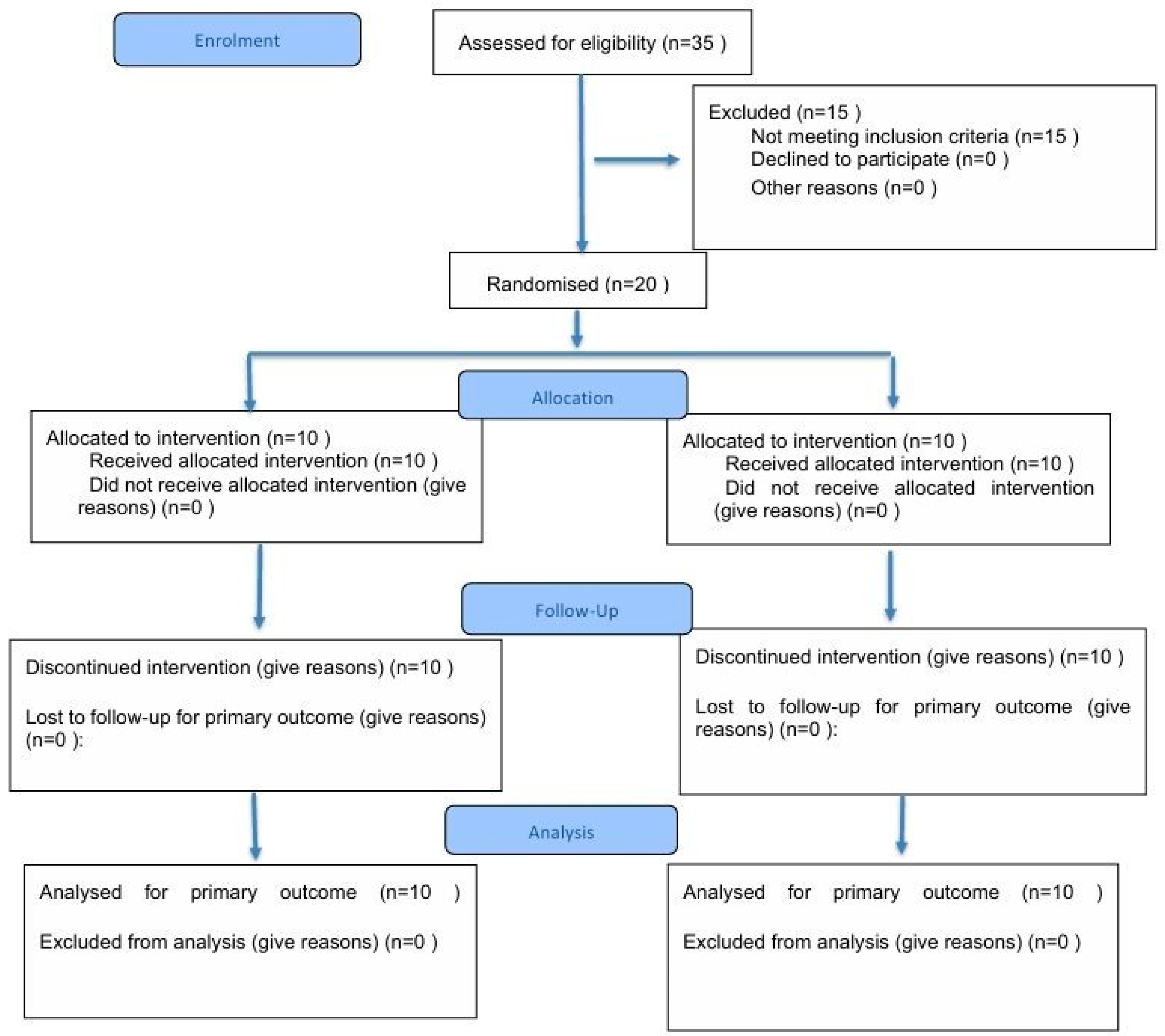
Participants were randomized in a 1:1 ratio into two groups (n = 10 per group) using computer-generated random numbers and allocation concealment with sealed opaque envelopes. An independent researcher who was not involved in recruitment or assessment procedures managed randomization. Blinding was maintained for outcome assessors, who were unaware of group assignments, to minimize bias in outcome measurements. Given the behavioral nature of the interventions, participant blinding was not feasible; however, assessor blinding was strictly maintained to minimize measurement bias. Outcome assessors were unaware of group allocation, and participants were instructed not to disclose their treatment modality during evaluations. Potential expectancy effects were mitigated through standardized pre-assessment instructions.
2.4. Interventions
Both groups followed an 8-week structured physiotherapy program, based on international clinical guidelines for OA management [
6]. Each participant received two supervised sessions weekly (45 min) and was instructed to complete three additional home-based sessions. Group A attended in-person physiotherapy at affiliated outpatient clinics. Sessions included isometric exercises for quadriceps and gluteal muscles, balance training using wobble boards, and proprioceptive tasks with elastic bands.
Group B followed the identical protocol remotely through a telerehabilitation platform supported by wearable technology and the KneE-PAD data capturing approach. Participants were equipped with Trigno Avanti wearable sensors (sEMG and IMU; [
19]), enabling real-time biofeedback during exercise sessions. In addition to this, they wore 17 XSENS awinda IMU sensors (60 Hz sampling rate), providing real-time feedback via a visual avatar based on the processed sensor signals. During the evaluation, the developed AI-based module for automatic classification of exercise correctness (i.e., correct vs. faulty execution) was not utilized [
20]. Feedback was visual-only, without automated labeling of performance quality. The AI-based postural correction module was intentionally disabled to ensure unbiased feasibility evaluation of real-time sensor feedback; its future activation is expected to further enhance corrective guidance and motor learning. Physiotherapists monitored movements live.
As described in the introduction, the KneE-PAD dataset was developed during a previous phase involving 31 patients with knee OA, yielding 2086 annotated files used for training machine learning algorithms for posture estimation [
16]. Sensor placements in this study, similarly to the initial one, adhered to SENIAM guidelines to ensure accurate capture of lower limb muscle activity. A detailed description of all exercises, including sets, repetitions, and intensity parameters, is provided in the
Appendix A,
Appendix B,
Appendix C and
Appendix D, where
Figures S1–S30 illustrate the initial and final positions of each movement performed during the KneE-PAD intervention protocol. The same exercise sequence and parameters were applied in both the in-person and telerehabilitation groups.
2.5. Outcome Measures
Outcomes were assessed at baseline and after the 8-week intervention, covering patient-reported, functional, physiological, and psychological dimensions through validated instruments and objective devices. Clinical symptoms were assessed with the Western Ontario and McMaster Universities Osteoarthritis Index (WOMAC), muscle strength with handheld dynamometry, neuromuscular activity with surface electromyography (sEMG) sensors equipped with inertial measurement units (IMUs), and functional mobility with the Timed Up and Go (TUG) test. Psychological dimensions were captured with the Arthritis Self-Efficacy Scale (ASES), the Tampa Scale of Kinesiophobia (TSK), and the Hospital Anxiety and Depression Scale (HADS), all validated in Greek clinical populations.
Primary outcomes included pain, stiffness, and neuromuscular performance. The WOMAC is a 24-item self-administered questionnaire with three subscales (pain: 5 items; stiffness: 2 items; physical function: 17 items), each scored on a 5-point Likert scale (0–4), with higher scores indicating greater symptom severity. The Greek version has demonstrated strong psychometric properties in osteoarthritis cohorts [
21]. Quadriceps isometric strength was assessed with the ActivForce 2 handheld dynamometer (ActivBody, Inc., San Diego, CA, USA.), a portable tool with excellent reproducibility (ICC = 0.75–0.95) for isometric strength testing [
22,
23]. Neuromuscular activation was recorded via sEMG using Delsys Trigno Avanti sensors [
19], with electrodes placed according to SENIAM guidelines to ensure accurate and reproducible biosignal acquisition.
Secondary outcomes included mobility, self-efficacy, kinesiophobia, and psychological well-being. Mobility was assessed with the TUG test, which measures the time required to rise from a chair, walk 3 m, return, and sit, a validated indicator of balance and functional mobility [
24]. Self-efficacy was measured with the ASES, a 20-item scale comprising three domains (pain, function, symptom management) rated on a 10-point scale, with the Greek version showing adequate reliability [
25,
26]. Kinesiophobia was evaluated with the 17-item TSK (score range: 17–68), where higher scores denote greater fear of movement; the Greek version has been validated in musculoskeletal populations [
27,
28]. Anxiety and depression were assessed using the HADS, a 14-item instrument with two subscales (7 items each; score range: 0–21), with higher scores reflecting more severe symptoms. Its Greek version has demonstrated robust validity in both clinical and general populations [
29,
30].
Adherence was monitored via participant-maintained exercise diaries and therapist logs, and calculated as the percentage of completed sessions relative to the total prescribed. All assessments were performed by trained, blinded assessors in a standardized sequence to minimize measurement bias.
2.6. Feasibility Indicators
Feasibility of the intervention was assessed using key indicators such as recruitment rate, session attendance, and participant retention throughout the study period. Treatment engagement was monitored through digital exercise diaries and therapist-maintained records, allowing for evaluation of session completion rates relative to the prescribed program. Retention was defined as the proportion of participants who completed both baseline and post-intervention assessments. All participant activity was documented, and no dropouts or adverse events were recorded during the intervention.
These findings offered valuable insight into implementation logistics, participant acceptance of the digital tools, and overall procedural efficiency, informing the future development and refinement of large-scale clinical trials exploring digitally assisted physiotherapy in individuals with knee osteoarthritis.
2.7. Statistical Analysis
All statistical analyses were conducted using R (version 4.3.1, R Foundation for Statistical Computing, Vienna, Austria). The primary objective was to evaluate both within-group changes over time and between-group differences in outcomes following intervention, comparing a tele-rehabilitation protocol with conventional in-person therapy.
Descriptive statistics (mean, median, standard deviation, and range) were computed for all outcome variables to summarize participant characteristics and clinical measures. Data visualization included histograms, boxplots, and Q-Q plots to inspect distributional properties and identify outliers.
Prior to inferential testing, the assumption of normality was assessed using the Shapiro–Wilk and Kolmogorov–Smirnov tests. For visual confirmation, Q-Q plots were reviewed. Homogeneity of variances between groups was evaluated via Levene’s test.
To examine pre-to-post intervention changes within each group, paired samples t-tests were employed for normally distributed data. In cases where the normality assumption was violated, the Wilcoxon signed-rank test was used as a robust non-parametric alternative. All tests were two-tailed, with statistical significance set at p < 0.05.
Between-group comparisons were based on change scores (post–pre) for each outcome metric. When the assumption of equal variances was met, independent samples t-tests (pooled) were used. Otherwise, Welch’s t-test, which does not assume equal variances, was applied. For non-normally distributed variables or unequal variances, the Mann–Whitney U test was implemented.
To account for potential violations of distributional assumptions and to reinforce the robustness of findings, permutation tests were also conducted. These resampling-based tests offer reliable inference under minimal assumptions and are especially suitable in smaller sample contexts or skewed distributions.
All analyses were performed at a 95% confidence level, and where appropriate, effect sizes (e.g., Cohen’s d, rank-biserial correlation) were calculated to complement p-values and provide insight into clinical relevance.
As this was an exploratory pilot study, no formal correction for multiple comparisons (e.g., Bonferroni) was applied. Nevertheless, the potential inflation of Type I error was acknowledged and mitigated through effect size reporting and permutation-based validation. The analytical focus was primarily on identifying feasibility patterns and estimating effect sizes to inform the design of future adequately powered trials.
Sample Size Estimation for Future Trial
To inform the design of a future randomized controlled trial (RCT), an a priori power analysis was conducted using G*Power 3.1 software [
31]. Based on the primary outcomes assessed in this pilot study, effect sizes were derived from relevant meta-analyses and prior trials. Specifically, Cottrell et al. [
32] reported a standardized mean difference (SMD) of 0.66 for pain-related outcomes, while [
33] an SMD of 0.42 in quadriceps strength following rehabilitation interventions involving isokinetic dynamometry was observed. Assuming an α level of 0.05, statistical power of 80%, and a two-tailed test, the minimum sample size required was estimated at 34 participants. Accounting for a 10% attrition rate, the projected recruitment targeted for the full-scale trial is 42 participants.
3. Results
3.1. Primary Outcome Measures
3.1.1. WOMAC Index
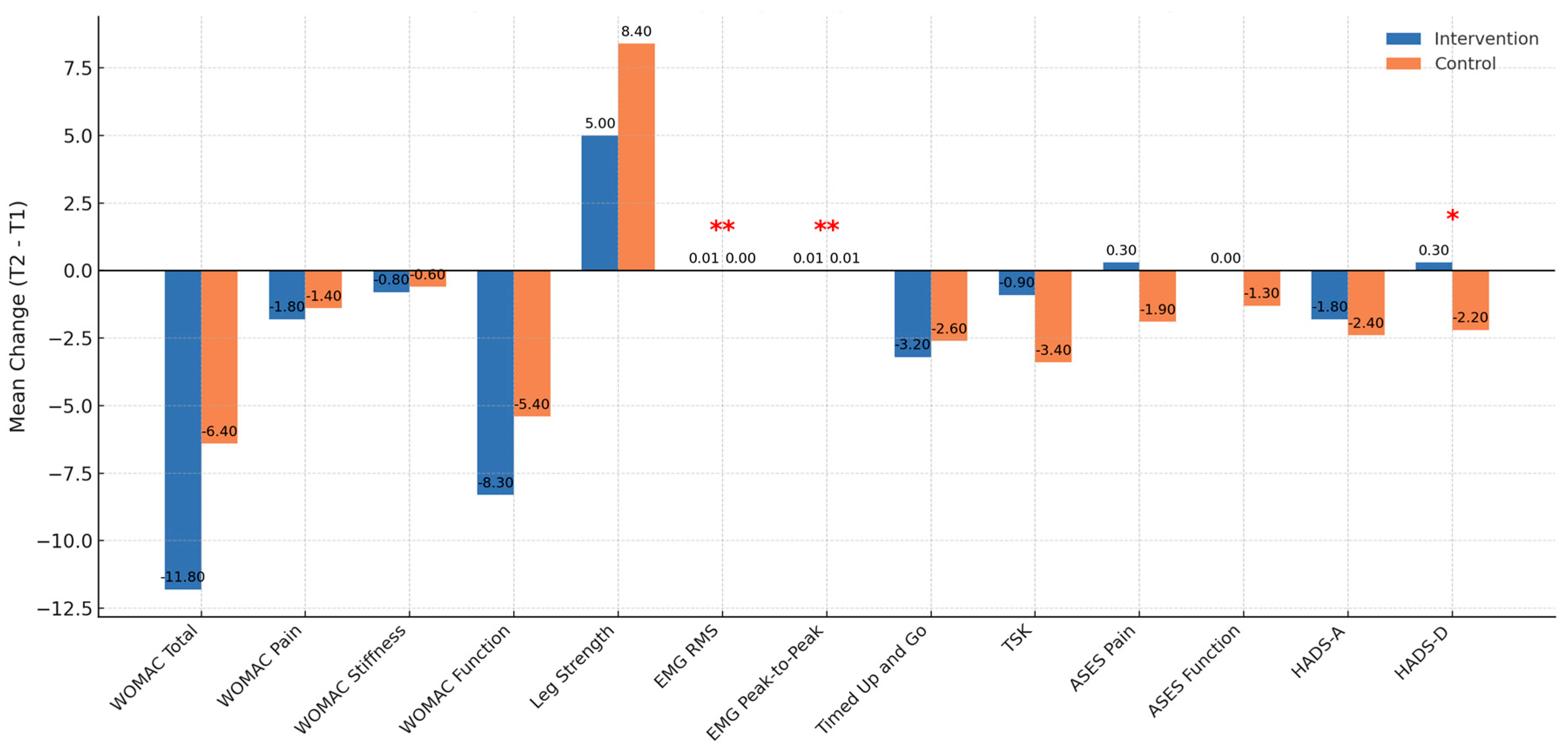
Significant improvements were observed in the WOMAC total score and its subscales (pain, stiffness, and function) in both the intervention and control groups.
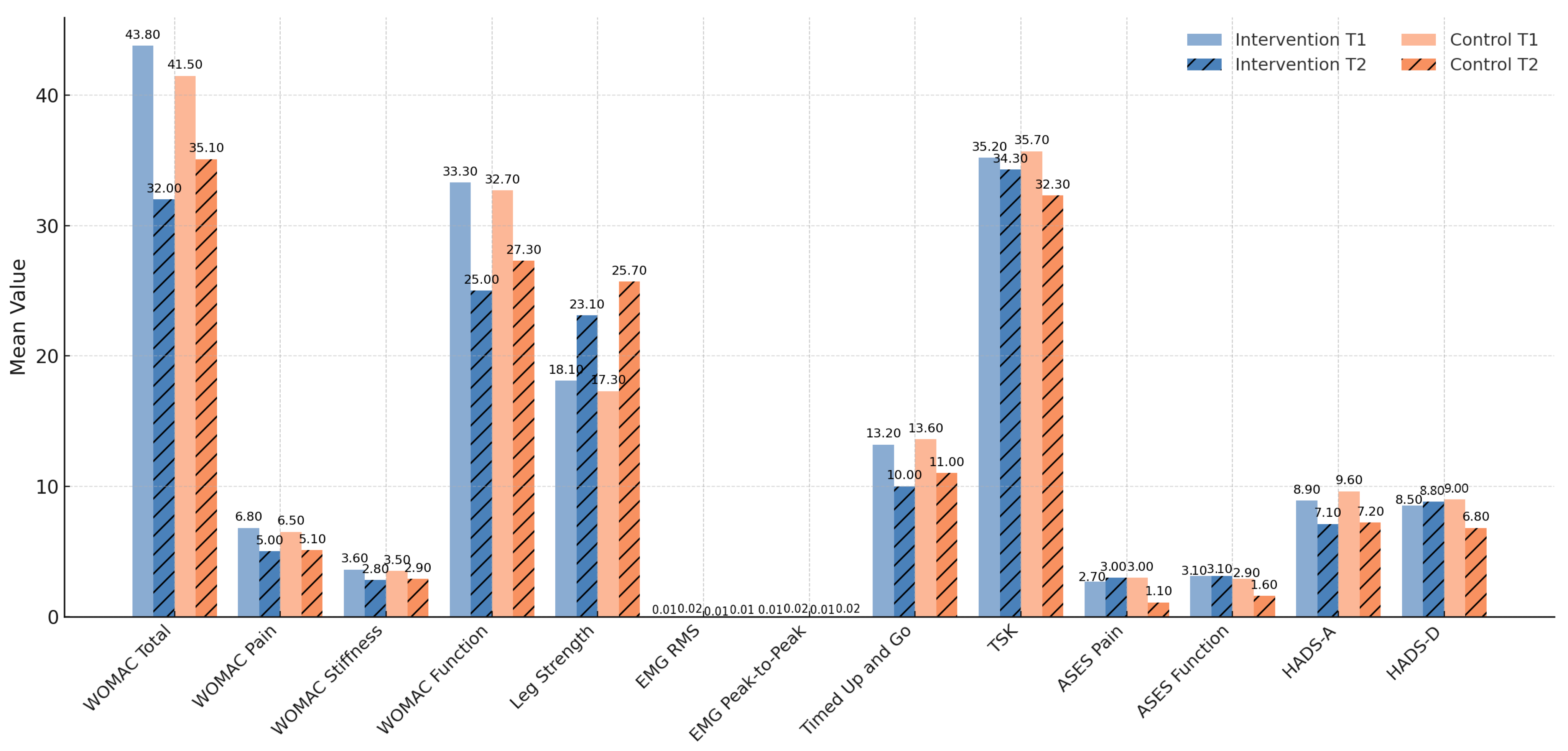
In the intervention group, the WOMAC total score decreased from 43.8 ± 18.5 to 32.0 ± 16.9 (t = 2.38, p = 0.027, Cohen’s d = 0.60). Pain scores improved from 6.8 ± 3.0 to 5.0 ± 2.3 (t = 2.32, p = 0.030), stiffness from 3.6 ± 1.2 to 2.8 ± 1.0 (t = 2.39, p = 0.025), and function from 33.3 ± 13.1 to 25.0 ± 11.5 (t = 2.29, p = 0.034).
In the control group, the WOMAC total score decreased from 41.5 ± 17.9 to 35.1 ± 16.0 (t = 2.45, p = 0.021), with pain improving from 6.5 ± 2.8 to 5.1 ± 2.4 (t = 2.23, p = 0.040), stiffness from 3.5 ± 1.1 to 2.9 ± 1.0 (t = 2.82, p = 0.010), and function from 32.7 ± 12.8 to 27.3 ± 11.3 (t = 2.31, p = 0.030).
No significant interaction effect between groups was detected (t = 1.91, p = 0.067), suggesting that both groups improved comparably over time.
Importantly, the mean reductions in WOMAC scores exceeded the established minimal clinically important difference (MCID) of 9–12 units for patients with knee OA, Refs. [
34,
35] indicating that the observed improvements are not only statistically significant but also clinically meaningful in both groups.
3.1.2. Quadriceps Strength (Dynamometry)
Quadriceps strength increased significantly in both groups. The intervention group improved from 18.1 ± 5.9 kg to 23.1 ± 6.0 kg (t = 3.90,
p = 0.0012, Cohen’s d = 0.90), while the control group improved from 17.3 ± 6.1 kg to 25.7 ± 5.6 kg (t = 4.44,
p = 0.0004, d = 1.26). Although both improvements were large, the between-group difference was not significant (t = 1.13,
p = 0.270). From a clinical standpoint, both groups surpassed the MCID threshold of ≥5 kg for quadriceps strength gains in knee OA populations [
23,
36], confirming the practical relevance of the observed improvements beyond statistical testing.
3.1.3. Surface Electromyography (sEMG)
Surface EMG variables revealed stronger neuromuscular gains in the intervention group. RMS amplitude increased from 0.011 ± 0.002 mV to 0.016 ± 0.002 mV (t = 6.83, p < 0.001, Cohen’s d = 1.18), while the control group improved from 0.011 ± 0.002 mV to 0.014 ± 0.002 mV (t = 5.31, p < 0.001, d = 1.00). The group × time interaction for RMS was statistically significant (t = 2.89, p = 0.008), suggesting greater neuromuscular activation in the intervention group.
Peak-to-peak amplitude rose from 0.015 ± 0.002 mV to 0.022 ± 0.003 mV in the intervention group (t = 7.92, p < 0.001, d = 1.53), compared to 0.015 ± 0.002 mV to 0.020 ± 0.003 mV in the control group (t = 6.39, p < 0.001, d = 1.30). Again, a significant group × time interaction was observed (t = 3.26, p = 0.0023), further supporting enhanced neuromuscular adaptation with the sensor-based intervention.
Although no standardized MCID exists for sEMG outcomes, prior work has emphasized that test–retest reliability is robust in knee OA patients [
36], and the large effect sizes (d > 1.0) observed here indicate clinically relevant neuromuscular adaptations, likely facilitated by real-time biofeedback during telerehabilitation.
3.2. Secondary Outcome Measures
3.2.1. Timed up and Go (TUG)
Mobility, assessed by the TUG test, improved significantly in both groups. The intervention group improved from 13.2 ± 2.7 s to 10.0 ± 2.4 s (t = 6.24,
p < 0.0001, Cohen’s d = 1.19), while the control group improved from 13.6 ± 2.9 s to 11.0 ± 2.5 s (t = 5.40,
p = 0.0002, d = 1.07). The group × time interaction was not significant (t = 0.91,
p = 0.37), indicating comparable improvements. Importantly, the observed reductions exceeded the minimal clinically important difference (MCID) of ~1.5–2.0 s for older adults with mobility limitations [
37], confirming that the gains were both statistically and clinically meaningful.
3.2.2. Arthritis Self-Efficacy Scale (ASES)
The control group improved in ASES Pain from 3.0 ± 1.5 to 1.1 ± 1.2 (t = 2.44,
p = 0.025, d = 0.66) and ASES Function from 2.9 ± 1.4 to 1.6 ± 1.2 (t = 2.14,
p = 0.045, d = 0.52), while no significant changes were observed in the intervention group. Group × time interactions were not significant (Pain: t = 0.85,
p = 0.41; Function: t = 1.09,
p = 0.29). Although only the control group showed significant within-group changes, the magnitude of change (Δ > 1 point) corresponds to the MCID for self-efficacy [
25,
38] measures in arthritis populations, supporting a clinically relevant improvement in self-management confidence.
3.2.3. Tampa Scale for Kinesiophobia (TSK)
No significant changes were observed in TSK scores. The intervention group changed from 35.2 ± 6.9 to 34.3 ± 7.5 (t = 0.31,
p = 0.756), while the control group moved from 35.7 ± 6.7 to 32.3 ± 7.1 (t = 1.10,
p = 0.294). The group × time interaction was not significant (t = 0.74,
p = 0.47). Given that the MCID for TSK is estimated at ~4 points [
39], neither group reached a clinically meaningful change, suggesting that kinesiophobia remained largely unaffected by either intervention.
3.2.4. Hospital Anxiety and Depression Scale (HADS)
Anxiety scores (HADS-A) decreased in both groups, but significantly only in the control group (from 9.6 ± 3.4 to 7.2 ± 3.3, t = 2.51, p = 0.022). Depression scores (HADS-D) improved significantly only in the control group (from 9.0 ± 3.1 to 6.8 ± 2.9, t = 2.50, p = 0.024, d = 0.68), while the intervention group remained stable (from 8.5 ± 2.9 to 8.8 ± 3.0, t = −0.15, p = 0.882). Between-group interaction for depression was significant (t = 2.29, p = 0.03).
These changes exceeded the MCID for HADS, estimated at 1.5–1.8 points in chronic disease populations [
40,
41] indicating that reductions in depression symptoms among the control group were both statistically significant and clinically meaningful, while anxiety reductions remained modest
Summary of psychological outcomes (TSK, HADS, ASES): Comprehensive data for the psychological and self-efficacy measures are presented in
Table 2 and
Table 3. TSK scores decreased by 3.4 points in the Control group (
p = 0.294) and 0.9 points in the Intervention group (
p = 0.756), showing no statistically significant or clinically meaningful change (MCID ≈ 4 points). For HADS, the Control group demonstrated significant reductions in both Anxiety (−2.4 points,
p = 0.022) and Depression (−2.2 points,
p = 0.024), whereas the Intervention group showed non-significant changes (HADS-A = −1.8,
p = 0.141; HADS-D = +0.3,
p = 0.882). Regarding ASES, the Control group exhibited significant improvements in Pain (+1.92 points,
p = 0.025) and Function (+1.24 points,
p = 0.045), exceeding the MCID (~1 point) for arthritis self-efficacy, while the Intervention group showed no significant change. Full pre- and post-intervention means, 95% confidence intervals,
p-values, and Cohen’s d effect sizes are detailed in
Table 3 and
Table 4.
3.3. Between-Group Comparison of Outcomes
Although both intervention and control groups showed significant within-group improvements in primary and secondary outcomes, several between-group differences emerged, shedding light on the distinct contributions of each therapeutic approach (
Table 5).
For WOMAC scores, both groups improved significantly in total, pain, stiffness, and function subscales. No statistically significant group × time interaction was found (
p = 0.067). However, the intervention group demonstrated a numerically larger reduction in the function subscale (−8.3 vs. −5.4 points). Both groups exceeded the minimal clinically important improvement (MCII) [
35] threshold for WOMAC (≈9–12 units), as defined by OMERACT–OARSI. Refs. [
34,
35] confirming that functional improvements were not only statistically but also clinically meaningful in both settings.
Although both groups demonstrated improvements in quadriceps strength, the between-group difference did not reach statistical significance (interaction p = 0.270). Specifically, the control group improved by +8.42 kg and the intervention group by +5.04 kg, with large within-group effect sizes (Cohen’s d = 1.26 and 0.90, respectively). These findings indicate that there was no statistically significant difference in strength gains between the groups.
Neuromuscular activation, as assessed by surface EMG, revealed significant between-group effects favoring the intervention group. The group × time interaction was statistically significant for both RMS amplitude (t = 2.94, p = 0.0077) and peak-to-peak amplitude (t = 3.43, p = 0.0023), with larger gains in the intervention group (ΔRMS = +0.005 mV; ΔPP = +0.007 mV). Given that EMG amplitude changes reflect enhanced motor unit recruitment and neuromuscular efficiency, these findings suggest superior neural adaptation facilitated by biofeedback and consistent motor retraining in the tele-rehabilitation system.
In mobility, both groups improved in TUG performance. The intervention group exhibited a slightly larger reduction (−3.17 s vs. −2.57 s), although between-group interaction was not significant (t = 0.91,
p = 0.37). Notably, both groups exceeded the MCID for TUG [
37], (~1.5–2.0 s), confirming that functional mobility gains were clinically meaningful. Furthermore, the post-intervention TUG score was lower in the intervention group (10.0 s vs. 11.0 s), suggesting more rapid gait efficiency recovery.
Regarding self-efficacy, only the control group showed significant improvements in ASES pain and function subscales. While the intervention group remained unchanged, the observed improvements in the control group (Δ > 1 unit) exceeded the MCID for arthritis self-efficacy [
38] (~1 point), indicating clinically relevant gains in perceived self-management ability.
For psychological outcomes, particularly depression (HADS-D), a significant group × time interaction was detected (t = 2.26,
p = 0.03). The control group improved from 9.0 ± 3.1 to 6.8 ± 2.9 (
p = 0.024), a mean reduction exceeding the MCID [
40] for HADS-D (1.5–1.8 points), while the intervention group remained stable. In contrast, anxiety symptoms (HADS-A) decreased slightly in both groups but without significant between-group differences.
Kinesiophobia (TSK) scores declined marginally in the control group (−3.4 points) and remained stable in the intervention group (−0.9 points). Neither group reached the MCID [
39] threshold for TSK (~4 points), indicating that reductions in fear of movement were not clinically relevant.
In summary, sEMG outcomes and HADS-D presented statistically and clinically significant between-group differences, favoring neuromuscular adaptation in the intervention group and psychological relief in the control group. All other outcomes showed improvements beyond MCID [
36,
37,
38,
39,
40] thresholds in both groups, with comparable effectiveness between modalities.
3.4. Visualization of Key Findings
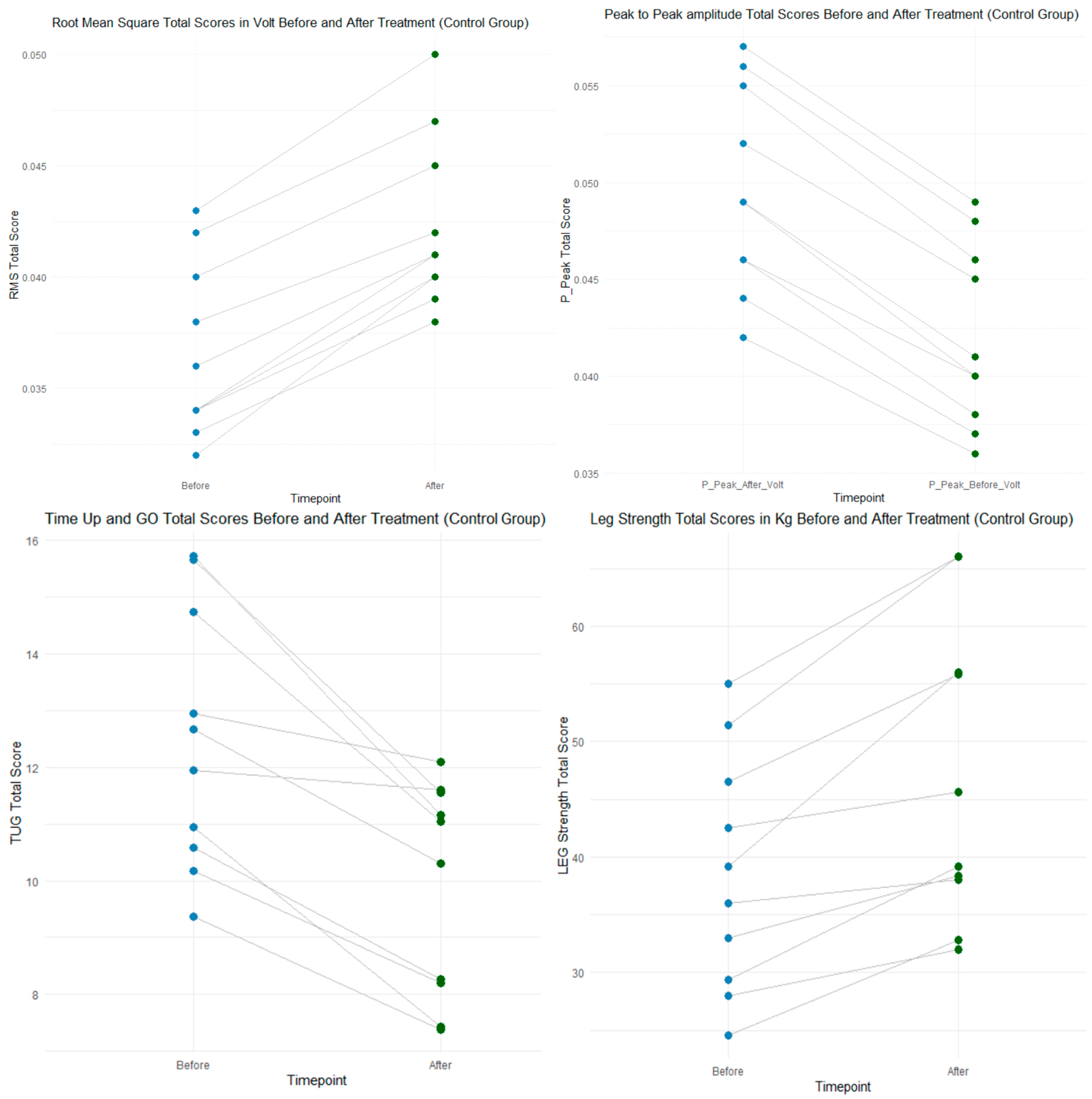
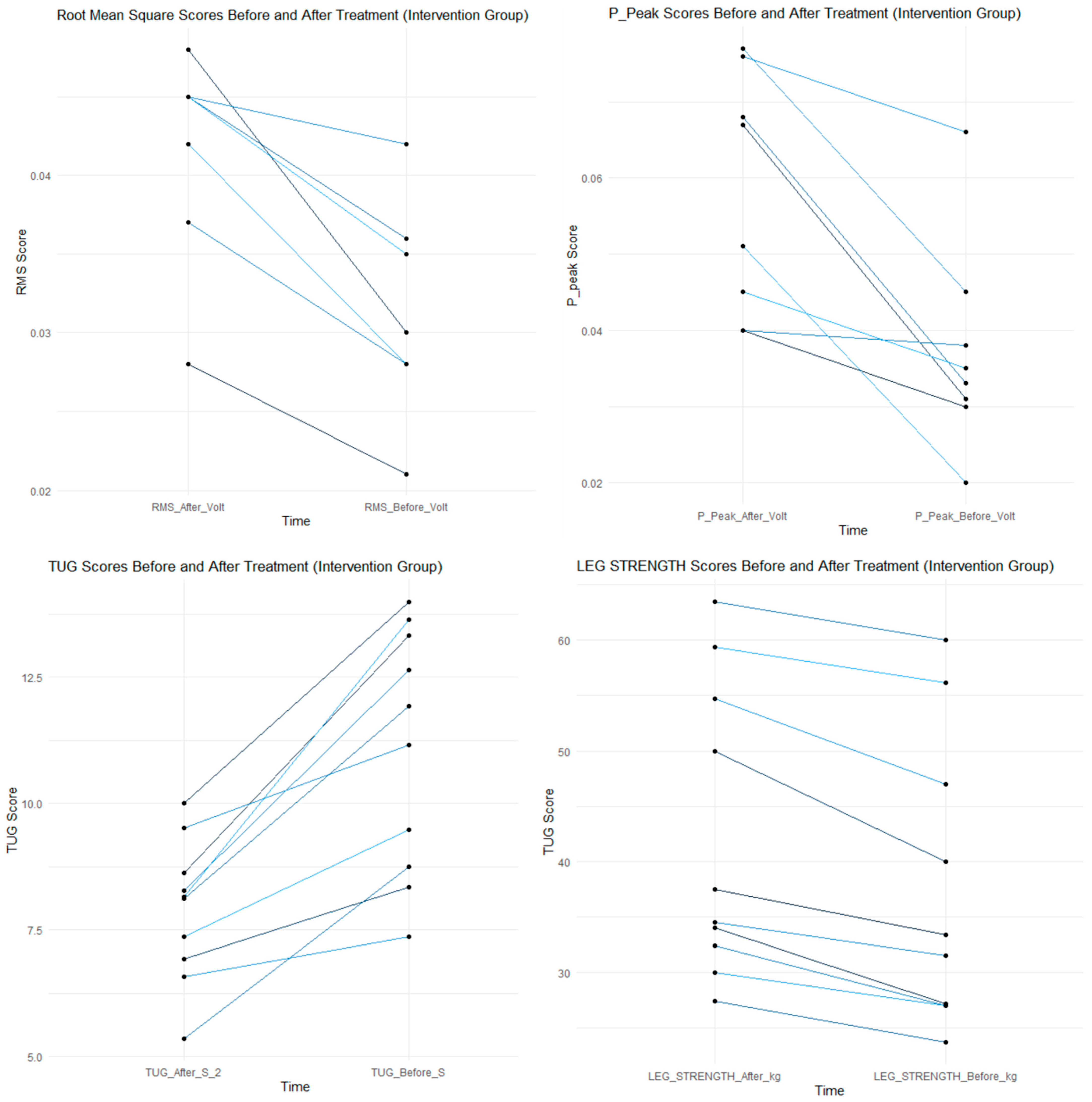
To enhance interpretability, representative visualizations of the main functional and neuromuscular outcomes were included (
Figure 3 and
Figure 4).
These plots illustrate the pre–post changes in Timed Up-and-Go performance, quadriceps strength, and EMG-derived RMS and peak-to-peak activation for the Control and Intervention groups.
The figures clearly demonstrate significant within-group improvements, with greater neuromuscular activation gains observed in the Intervention group, consistent with the statistical findings reported in
Table 2 and
Table 3. This visualization complements the quantitative data and facilitates an intuitive understanding of the intervention effects.
4. Discussion
4.1. PROMs vs. Objective Metrics
Both groups demonstrated clinically meaningful improvements in subjective measures, as assessed by the WOMAC Index. The WOMAC is a Patient-Reported Outcome Measure (PROM) that evaluates patient-perceived pain, stiffness, and physical function [
21]. PROMs have been recognized as essential tools in chronic musculoskeletal rehabilitation, aligning with the principles of value-based and patient-centered care [
25,
26]. However, the lack of statistically significant between-group differences in PROMs (WOMAC, HADS, TSK) aligns with previous literature, indicating their limited sensitivity in short-term interventions or technologically novel settings [
10,
15], where expectations may elicit placebo or masking effects [
11,
12].
4.2. Neuromuscular Gains and Functional Performance
The KneE-PAD intervention resulted in statistically and clinically significant increases in RMS and peak-to-peak sEMG amplitudes, reflecting improved motor unit activation and recruitment. However, these findings should be interpreted with caution, as sEMG amplitude may also be influenced by electrode placement accuracy, skin impedance, and signal normalization procedures, and therefore may not directly quantify neural adaptation. These outcomes, supported by large effect sizes (Cohen’s d > 1.0), are consistent with the hypothesis that real-time biofeedback promotes motor relearning through enhanced sensorimotor integration [
14,
42]. Compared to conventional telerehabilitation protocols that rely mainly on video guidance [
43], the KneE-PAD system offers active posture correction and interactive feedback [
16,
17]. Functional improvements were further confirmed by the Timed Up and Go (TUG) test, with the intervention group surpassing the minimal clinically important difference (MCID) [
24].
Psychological Outcomes Interpretation: The limited improvements observed in psychological measures (HADS-D, TSK, and ASES) may be attributed to the absence of structured psychological support, such as cognitive-behavioral guidance, and the relatively short duration of the intervention. While both programs effectively improved physical outcomes, addressing emotional and cognitive aspects of pain management likely requires dedicated behavioral interventions. Future iterations of the KneE-PAD system could integrate digital cognitive–behavioral therapy (CBT) modules or e-coaching components to enhance affective and self-efficacy outcomes, fostering a more holistic biopsychosocial rehabilitation approach.
4.3. Muscle Strength and Psychological Outcomes
Quadriceps strength improved significantly in both groups, with slightly higher gains in the control group—possibly due to in-person therapist-supervised progressive resistance training. However, the intervention group still exceeded the MCID without supervision, affirming the potential of remote sensor-based training [
44]. Regarding psychological outcomes, depressive symptoms declined more notably in the control group, likely due to direct therapeutic rapport. However, the digital group also showed modest improvement, suggesting beneficial effects from perceived autonomy and engagement [
1,
28,
30]. Although both groups followed identical exercise content, the higher degree of therapist interaction in the control group may have contributed to better self-efficacy and affective outcomes. Future studies should consider equalizing supervision intensity or including motivational e-coaching elements to control for this effect.
These findings underscore the need to integrate digital CBT or e-coaching tools into future iterations [
43,
45]. While both modalities produced clinically meaningful gains, between-group differences were largely non-statistically significant; hence, the results should be interpreted as supporting comparable rather than superior effectiveness. This finding reinforces the feasibility of digital physiotherapy approaches as a viable alternative rather than a replacement to conventional in-person care.
4.4. Feasibility, Usability, and Safety
This study aimed to evaluate the feasibility, usability, and safety of the KneE-PAD platform. The results confirm full feasibility, with adherence rates exceeding 94% and no adverse events reported. The accurate and uninterrupted collection of biosignals in real-time also supports its technical reliability [
46,
47]. Usability was confirmed through qualitative and compliance data: participants reported ease of use, comprehension of instructions, and a positive overall experience. Although standardized tools like SUS were not applied, user feedback and compliance data indicate high acceptance and long-term use potential [
3,
48]. This serves as a fundamental issue in applying this specific type of research in larger samples of patients.
4.5. Clinical Integration and Scalability
KneE-PAD demonstrates promise for remote high-quality care delivery to patients facing geographical, mobility, or socioeconomic limitations. The real-time processing of biosignals enables the development of predictive machine-learning models that could be embedded in hybrid care models (e.g., asynchronous supervision with periodic check-ins) [
16,
20]. Additionally, integrating psychological support modules (e.g., cognitive-behavioral therapy, coaching) may enable the platform to address the psychosocial dimension of recovery, supporting holistic and patient-centered rehabilitation [
6,
49]. From a health policy perspective, the implementation of such platforms could reduce per-session costs, alleviate clinical workload, and enhance access for underserved populations, in alignment with modern principles of technology-enabled, patient-centered care [
6,
44].
5. Strengths and Limitations
This study’s primary strength lies in its integration of wearable sensing with home-based rehabilitation, enabling high-resolution monitoring without compromising ecological validity. The inclusion of multiple physical measures (sEMG, TUG) alongside psychological and functional assessments provided a multidimensional view of therapeutic impact. Zero attrition and absence of technical failures further reinforce intervention feasibility.
On the other hand, although the sample size was small, which is inherent in pilot designs, this was counterbalanced by robust within-group improvements that exceeded MCID thresholds. Use of non-parametric and permutation-based methods enhanced statistical reliability despite limited power.
Furthermore, the 8-week duration may appear restrictive; however, it mirrors durations in existing digital rehabilitation literature and sets the stage for more prolonged studies. On the psychosocial perspective, while the lack of structured psychological support may have blunted effects on affective domains, even modest improvements suggest underlying behavioral activation potential [
25]. This is enforced by the fact that although formal usability assessments were omitted, high adherence and satisfaction indicated strong user acceptance, which can be further validated in future work. Future studies should include standardized usability and user experience tools, such as the System Usability Scale (SUS), the mHealth App Usability Questionnaire (MAUQ), or the UTAUT2 model, to objectively quantify system acceptability and enhance comparability across digital rehabilitation studies.
Lastly and also importantly, the use of sensor-derived metrics addressed the often-reported ceiling effects of PROMs in digitally fluent cohorts. The study thus underscores the value of combining subjective and objective outcomes when assessing technology-enhanced interventions. Given the pilot nature of this study, the limited sample size may have constrained statistical power, increasing the risk of type II error. Therefore, findings should be interpreted as preliminary indicators guiding future adequately powered trials.
6. Future Directions
Future trials should scale the sample size and extend follow-up periods to assess long-term adherence, functional maintenance, and relapse risk. Cost-effectiveness analyses will be essential for evaluating the economic viability of the KneE-PAD methodology relative to in-person care.
Enhancing the psychological dimension of the intervention through cognitive-behavioral therapy (CBT) modules or digital coaching may also yield more pronounced affective benefits. Moreover, adaptive personalization via machine learning algorithms can improve targeting of feedback and progression based on user-specific responses.
User-centered evaluations using validated instruments like the System Usability Scale (SUS), mHealth App Usability Questionnaire (MAUQ), and UTAUT2 are recommended to assess interaction dynamics. Additionally, coupling sensor-based personalization with asynchronous clinician oversight may provide a robust hybrid care model.
Deploying hybrid trial designs in primary care or community settings can facilitate broader scalability and increase ecological validity, particularly for underserved populations.
7. Conclusions
This pilot randomized controlled trial demonstrates the feasibility, safety, and promising clinical utility of the KneE-PAD platform as a telerehabilitation solution for individuals with knee osteoarthritis. The integration of sensor-based biofeedback led to significant neuromuscular improvements, surpassing conventional physiotherapy in key objective measures such as sEMG amplitude and functional mobility, while maintaining high adherence and safety. Although subjective outcomes improved comparably across groups, the lack of significant between-group differences reflects the known limitations of PROMs in early-phase trials, underscoring the necessity for objective biomechanical indices in evaluating digital interventions.
Importantly, the study addressed critical feasibility questions: the system was usable without technical complications, well-tolerated by participants, and maintained engagement despite the absence of in-person supervision. These findings validate the platform’s readiness for broader deployment and potential scalability in diverse care settings. Furthermore, the capacity for real-time signal processing and remote monitoring highlights KneE-PAD’s alignment with contemporary trends in decentralized, personalized rehabilitation—particularly for populations facing geographic, mobility, or socioeconomic barriers. While limitations such as small sample size, short intervention duration, and deactivated AI-driven posture correction warrant cautious interpretation, the results contribute meaningfully to the growing literature on digital physiotherapy. Future trials should incorporate long-term follow-up, advanced algorithmic modules, formal usability assessments, and integration with psychological support frameworks to maximize both motor and affective rehabilitation outcomes.
Taken together, these findings support the KneE-PAD platform as a viable, scalable, and clinically relevant tool within evolving models of technology-enabled, patient-centered musculoskeletal care.





 ,
,