State-of-the-Art Zirconia and Glass–Ceramic Materials in Restorative Dentistry: Properties, Clinical Applications, Challenges, and Future Perspectives



Abstract
1. Introduction
2. Methodology
3. Zirconia-Based Ceramics
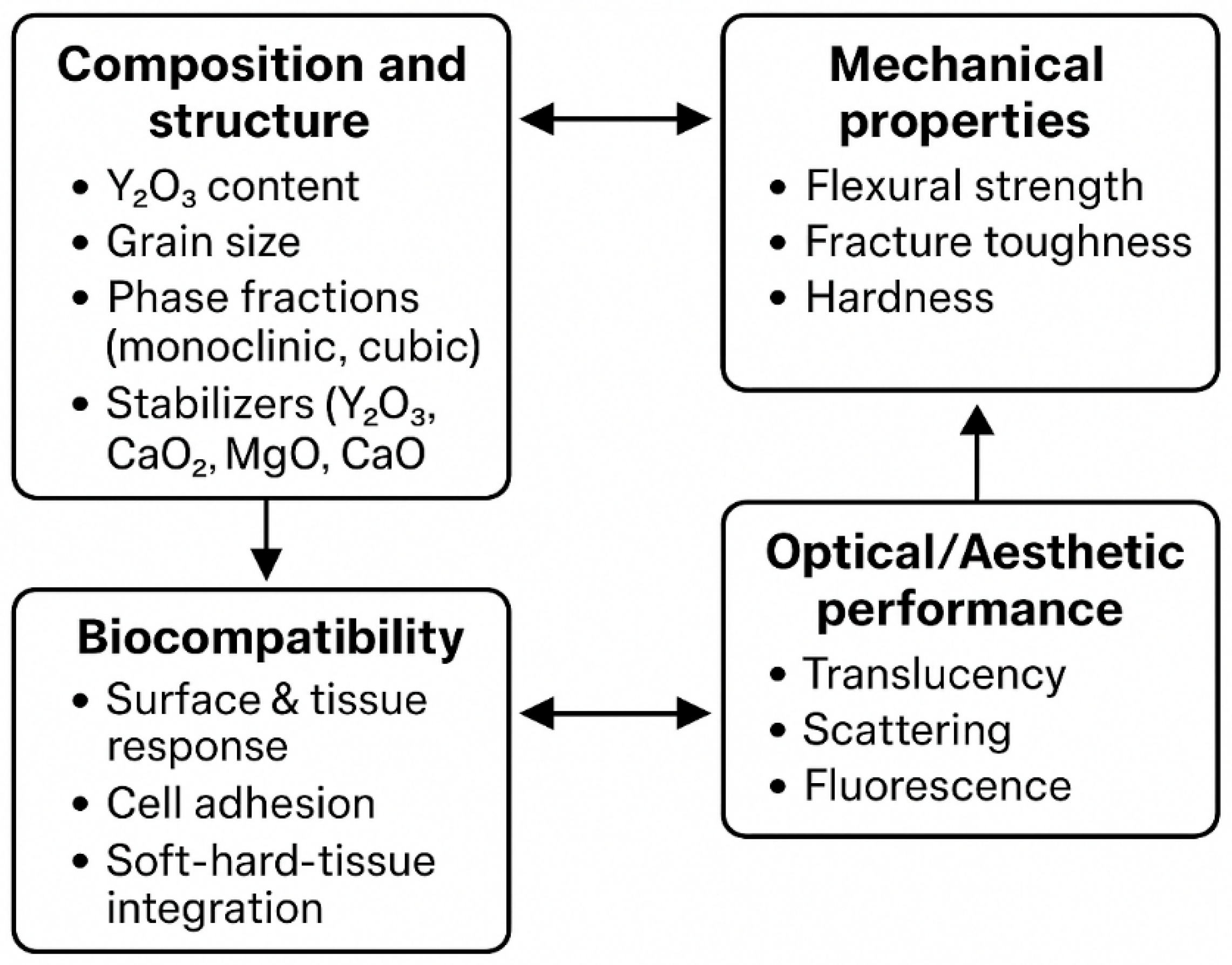
3.1. Composition and Structure
3.2. Mechanical Properties
3.3. Optical Properties and Esthetic Performance
3.4. Biocompatibility
3.5. Clinical Applications of Zirconia-Based Ceramics
3.5.1. Veneers
3.5.2. Crowns and Bridges
3.5.3. Orthodontic Applications
3.5.4. Implants
3.5.5. Abutments

| Type of Restoration | Material | Study Type | EV | No. of Samples Tested | Follow-Up Duration | Tested Location | Survival Rate | Complication Rate (Annual/Cumulative) | Study Limitations | Type of Complications | Ref |
|---|---|---|---|---|---|---|---|---|---|---|---|
| Veneers | Monolithic cubic ultra-translucent zirconia | Case Report | V | 6 | 1 year | Anterior | NR (all restorations intact) | 0% (cumulative) | Single case-level; short follow-up; protocol not standardized | - | [36] |
| Laminate Veneers | Ultrathin translucent zirconia (conventional sintered vs. speed sintered zirconia) | RCT | II | 32 | 1 year | Anterior, Posterior | NR (all intact) | 18.75% (conventional sintering), 25% (speed sintering) (cumulative) | Short follow-up; color endpoint only; bonding not uniform | Marginal discoloration | [105] |
| Veneers | Multi-shaded translucent zirconia | Split-mouth RCT | II | 15 | 5 years | Anterior | 93.3% | 6.67% (cumulative) | Small sample; veneer thickness/adhesion details NR | - | [187] |
| Minimally invasive veneers | Monolithic ultratranslucent zirconia | Case series | IV | 28 | 4.33 years | - | 100% | 3.57% (cumulative) | No control; bonding protocol may vary | Superficial marginal discoloration in the maxillary left lateral incisor | [188] |
| Veneers (3D gel deposition) | Self-glazed zirconia (3Y-ZTP) | Retrospective | III | 45 | 37 months | Anterior, Posterior | 100% | 4.4% (cumulative) | No control; finishing unique (self-glazed), generalizability limited | Yellowish color change after cementation | [189] |
| Single-unit ceramic laminate veneers | Translucent zirconia veneers etched with hydrofluoric–nitric acid mixture and bonded with MDP-containing polymeric adhesive | Double-blind RCT | II | 26 | 1 year | Anterior, Posterior | 100% | 3.8% (cumulative) | Short follow-up; aggressive surface Protocol (not routine) | Debonding | [102] |
| Tooth-supported crowns | Zirconia-based | SR | I | - | Up to 5 years | - | 95.9% | - | Pooled designs; zirconia generations mixed; outcomes heterogeneous | Veneering material fractures, bleeding on probing, loss of retention, and endodontic treatments | [107] |
| Implant-supported crowns | Zirconia-based | SR | I | - | Up to 5 years | - | 97.1% | - | Pooled implant systems; veneer/monolithic mixed | Veneering material fractures, bleeding on probing | [107] |
| Crowns | Monolithic Zirconia | Prospective | III | 40 | 5 years | Posterior | 95% | 15% (cumulative) | Student operators; finishing varies; parafunction NR | Color mismatch (5%), surface roughness (5%), marginal integrity issues, such as gap or exposure with secondary caries (5%), anatomical shape change (2.5%), and crown fracture (2.5%). | [103] |
| Single crowns | Zirconia cores veneered with feldspathic porcelain. | Prospective observational | III | 192 | 15 years | Anterior, Posterior | 77.6% | ~4.8% (cumulative) | Long follow-up; veneering liability prominent | Veneer fracture (5.01%), loss of retention (14.85%), crown loss due to extraction (1.73%) | [89] |
| Fixed Partial Denture (FPD)—Bridges | Zirconia cores veneered with feldspathic porcelain. | Prospective observational | III | 370 crowns (in bridges: 2–3, 4–6, >6 units) | 15 years | Anterior, Posterior | 62.96% | ~4.8% (cumulative) | Long spans; connector/veneer risks accumulate | Veneer fracture (5.01%), loss of retention (14.85%), crown loss due to extraction (1.73%) | [112] |
| Crowns | Monolithic zirconia | Clinical observational | III | 209 | 3 years | Anterior, Posterior | 91.5% | 21.5% (cumulative) | Endpoints broad; risk factors NR | Sensitivity/pain (8.7%), occlusal adjustment (4.1%), periodontitis (5.6%), recurrent caries (2.1%), crown recementation (2.6%), infections (2.1%), irreversible pulpitis (2.1%), open margins (1.0%), loose crown/tooth (3.1%), endodontic issues (2.0%), and porcelain repair (0.5%). | [115] |
| Crowns | Monolithic 3Y-TZP zirconia | Prospective | III | 50 | 5 years | Posterior | 98% | 6% (cumulative) | Small cohort; parafunction control NR | Debonding (4%), root fracture (2%) | [116] |
| Crowns | Monolithic zirconia | SR/MA of RCTs | I | 86 | 1 year | Posterior | 97.5% | 3.33% (annual) | RCTs pooled; short horizon; bruxism often excluded | Chipping due to bruxism (1.1%), screw-loosening (2.82%), implant failure (1.6%) | [117] |
| Zirconia single crowns (SCs) | Zirconia-ceramic (veneered) | SR/MA | I | 952 | 3.8 years | Anterior, Posterior | 96.3% | 4.5% (annual) | Veneer chipping, screw loosening prominent | Ceramic chipping (1.84%), ceramic fractures (0.98%), core fractures (0.17%), catastrophic veneer fractures (0.71%), abutment fractures (0.23%), screw loosening (0.53%), loss of retention (0.20%), soft tissue complications (2.73%), and bone loss >2 mm (0.31%). | [131] |
| Zirconia SCs | Monolithic zirconia | SR/MA | I | 394 | 1.6 years | Anterior, Posterior | 96.1% | 3.6% (annual) | Short mean follow-up; low veneer-related events | Ceramic chipping (0.39%), ceramic fractures (0.58%), catastrophic veneer fractures (0.19%), abutment fractures (0.39%), screw loosening (2.27%), loss of retention (4.55%), soft tissue complications (3.9%), and bone loss >2 mm (1%). | [131] |
| SCs | Veneered zirconia | Clinical observational | III | 28 | 10 years | - | 92.9% | 54% technical, 12% biological (cumulative) | Veneer/fit liabilities explicit; small sample | Chipping (50%), marginal gap issues (50%), mild periodontal issues | [132] |
| FPDs | Veneered zirconia framework | Clinical observational | III | 57 | 5 years | Posterior (3- and 5-unit bridges) | 73.9% | 26.1% (cumulative) | Connector/veneer sensitivity; trauma event reported | 21.7% secondary caries, 15.2% ceramic chipping, 1 framework fracture due to trauma | [144] |
| FPDs | Veneered zirconia frameworks | SR | I | 423 | Up to 10 years | Posterior | 84.35% | ~35–40% (cumulative) | Veneer chipping up to 32%; marginal & retention issues | Chipping of the veneering ceramic (up to 32%), loss of retention (~5%), framework fractures (~4.5%), marginal discrepancies (~16.7–90.7%), secondary caries (~7.9%), endodontic issues (~10.9%), and abutment tooth fractures (~2.2%) | [137] |
| Cantilever RBFDP (anterior bridge) | Zirconia ceramic | Clinical observational | III | 108 | 10 years | Anterior | 98.2% | 6.5% (cumulative) | Strong performance in the conservative anterior span | Debonding (5.6%), chipping (0.9%) | [190] |
| Cantilever RBFDP (anterior bridge) | Zirconia-based | Clinical observational | III | 24 | up to 61 months | Anterior | 100% at 36 months | ~17.6% (cumulative) | Small series; debonding & chipping modest | Debonding (4.2%), incisal chippings (8.3%), orthodontic relapse (4.2%) | [191] |
| Inlay-Retained Fixed Dental Prosthesis (IRFDP) | Zirconia (Vita In-Ceram YZ), veneered with feldspathic porcelain | Clinical observational | III | 30 | 5 years | Posterior | 95.8% | 16.7% (cumulative) | Bonding-dependent; chipping/debonding present | Debonding (6.9%), chipping (10.5%), secondary caries (8.1%) | [192] |
| 3-/4-Unit Posterior FDPs (conventional) | Zirconia (Cercon Smart Ceramics, Charlotte, NC, USA), veneered (first-gen CAD/CAM) | Prospective | III | 99 | 10 years | Posterior | 75% | 60% (cumulative) | First-gen CAD/CAM; veneer liability high | Absolute technical failures (13.1%), such as framework fractures and chipping, and relative failures requiring clinical intervention (50.5%), of which 35.4% were due to technical issues. | [193] |
| Dental Implant-supported prostheses, including SCs (85%), FDPs (9.6%), overdentures (5.4%) | Y-TZP, ATZ | SR/MA | I | 4017 | 10 years | Anterior, Posterior | 95.1% | 4.3% (cumulative) | Older/discontinued systems included; narrow-diameter risk flagged | Fractures (0.65%, especially in narrow-diameter implants—3.25 mm—with 69% of fractures from Z-Look3), early failures before osseointegration (~41% of analyzed failures), mechanical weakness from drill-preparation (7.5% failure rate vs. 3.5% for non-prepared), material aging of Y-TZP, and higher failure rates in discontinued or prototype systems (11.3% vs. 2.5% for commercially available implants). | [160] |
| Dental Implant-supported prostheses, including SCs | One-piece zirconia dental implants (CeraRoot, Santa Monica, CA, USA) featuring three distinct roughened surface treatments: coated, uncoated, and acid-etched. | Comparative observational | III | 831 | 5 years | - | 95% (92.77% for uncoated implants, 93.57% for coated implants, and 97.60% for acid-etched implants) | - | Surface variants pooled; center effects | - | [166] |
| Dental implant-supported prostheses, including SCs (two-piece implant) | Zirconia implants (ZERAMEX® T, ZrO2-ATZ-Bio-HIP, Spreitenbach, Switzerland) | Prospective | III | 76 | Up to 3 years | Posterior | 87.3% (2-year) 85% (3-year cumulative) | 4% (cumulative) | Early gen; aseptic loosening notable | Aseptic loosening (13%), abutment fracture (2.6%) | [127] |
| Implant-supported fixed complete dentures (Zir-IFCDs) | Zirconia | Retrospective cohort | III | 67 | 5 years | Anterior, Posterior | 70.9% | 13.4% (cumulative) | Framework fractures in a limited restorative space | Framework fracture (4.4%), all associated with limited vertical restorative space, veneering porcelain fracture (1.5%), implant loss (3.0%), esthetic concerns (3.0%), and one failure of unknown cause (1.5%) | [194] |
| Implant-supported prostheses, including SCs and 3-unit FDPs | ATZ implants | ProspectCohort | III | 53 | 5 years | Anterior, Posterior | 94.3% | 8.3% (cumulative) | MBL > 2 mm endpoint | Marginal bone loss > 2 | [195] |
| Dental implant-supported prostheses, including single-tooth replacements | Zirconia | Prospective | III | 30 | 5 years | Anterior, Posterior | 93.3% | 40% (cumulative) | Small cohort; maintenance factors | peri-implant mucositis (26.7%), peri-implantitis, and implant failure (6.7%) | [196] |
| Dental implant-supported prostheses, including SCs and 3-unit FDPs—one-piece zirconia implants | Zirconia | Prospective Cohort | III | 71 | 5 years | Anterior, Posterior | 98.4% | 1.6% (cumulative) | Good survival; details of hygiene protocols NR | Implant failure (0.7 mm), but stable thereafter | [197] |
| Dental implant-supported prostheses, including SCs— one-piece implant | Y-TZP (zirconia) with a ZiUnite® surface (Nobel Biocare, Zürich, Switzerland). | Prospective Cohort | III | 66 | 5 years | Anterior, Posterior | 78.2% | 27% (cumulative) | Higher peri-implantitis/MBL; system-specific | Implant failure (21.2%), peri-implantitis (21.2%), marginal bone loss >2 mm (27%), and implant fracture (1.5%). | [198] |
| Abutments— Implant-supported SCs with zirconia abutments. Implant Type: Standard Platform (SP) vs. Platform Switching (PS) | Zirconia abutments | Retrospective | III | 158 | Up to 12 years | Anterior | SP (93.8.%) up to 12 years, PS (90%) up to 5 years | 10.1% (cumulative) | Platform/MBL differences; soft-tissue endpoints | Abutment fractures (1.9%) loss of retention (frequency not specified) and marginal bone loss, which was more pronounced in standard platform designs compared to platform-switching designs | [199] |
| Abutments (two-piece) | Zirconia | Retrospective | III | 32 | 6 years | Anterior, Posterior | 100% | 21.9% (cumulative) | Screw loosening/chips; small cohort | Abutment screw loosening (3.1%), veneering ceramic chipping (6.2%), crown loosening or decementation (9.3%), and occlusal roughness (3.1%) | [200] |
| Single-tooth implants supporting veneered porcelain crowns, using zirconia abutments | Zirconia abutments with porcelain veneer | Retrospective | III | 29 | 10 years | Anterior, Posterior | 97.9% | ~41.4% (cumulative) | Mucositis prevalent; veneer chip & screw issues | Peri-implant mucositis (34.5%), veneering porcelain chipping (6.9%), and abutment screw loosening (6.9%) | [178,201] |
| Implant-supported single crowns with zirconia abutments | Zirconia abutments | MA | I | 429 | Up to 5 years | Anterior, Posterior | 39.4% | - | Heterogeneous definitions; esthetic outcomes favorable vs. Ti/Au | Low marginal bone loss, least soft tissue discoloration (vs Ti & Au) | [202] |
3.6. Challenges and Future Perspective
4. Glass-Based Ceramics
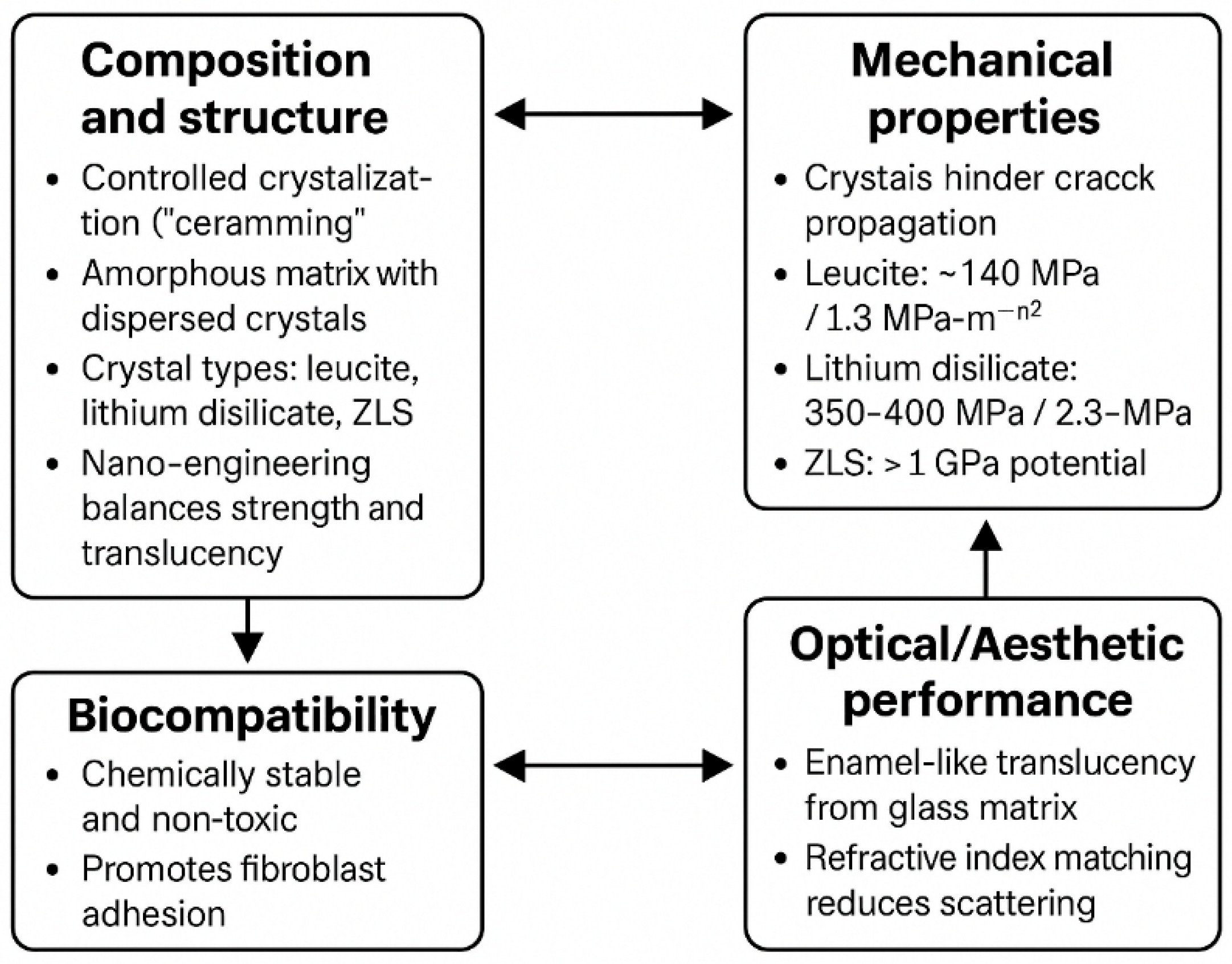
4.1. Composition and Structure
4.2. Mechanical Properties
4.3. Optical Properties and Esthetic Performance
4.4. Biocompatibility
4.5. Clinical Applications of Glass-Based Ceramics
4.5.1. Veneers
4.5.2. Inlays, Onlays
4.5.3. Crowns and Short-Span Bridges
| Type of Restoration | Material | Study Type | EV | No. of Samples Tested | Follow-Up Duration | Tested Location | Survival Rate | Complication Rate (Annual/Cumulative) | Study Limitations | Type of Complications | Ref |
|---|---|---|---|---|---|---|---|---|---|---|---|
| Veneers | Leucite-reinforced (LR) | SR/MA | I | 125 | 10.4 years | Anterior, Posterior | 93.70% | Technical (29.87%), esthetic (17.89%), and biological (4.4%) (cumulative) | Pooled across studies with variable protocols and outcome criteria, several reports include minor esthetic/technical events as “complications”. | Chipping (0.99%), bulk fractures (7.92%), marginal gaps (41.67%), debonding (8.91%), marginal discoloration (17.89%), secondary caries (1.98%), endodontic complications (1.98%), and tooth loss (0.99%) | [286] |
| Veneers | Lithium Disilicate (LD) | SR/MA | I | 1135 | 10.4 years | Anterior, Posterior | 96.81% | Technical (6.1%), esthetic (1.9%), and biological (0.45%) (cumulative) | Pooled cohorts with differences in adhesive workflows and follow-up schedules; endpoint definitions heterogeneous across studies. | Chipping (0.84%), bulk fractures (0.55%), marginal gaps (12.83%), debonding (2.23%), marginal discoloration (1.9%), secondary caries (0.45%), and endodontic complications (0.84%) | [286] |
| Veneers | Feldspathic ceramic | SR/MA | I | 428 | 10.4 years | Anterior, Posterior | 96.13% | Technical (41.48%), esthetic (19.64%), and biological (6.51%) (cumulative) | Methodological heterogeneity across included studies; minor events variably classified as failures limiting comparability. | Cracks (6.31%), chipping (7.21%), bulk fractures (8.33%), marginal gaps (32%), debonding (5.95%), marginal discoloration (19.64%), tooth fracture (1.19%), secondary caries (2.83%), and endodontic complications (1.80%) | [286] |
| Veneers | LD | Controlled Clinical Trial | II | 36 | 3 years | Anterior | 100% | Technical (37.5%), and biological (43.75%) (cumulative) | Controlled trial; randomization not specified; small sample and short follow-up limit generalizability. | Surface staining (37.5%) and initial hypersensitivity (43.75%), which were mild and reversible | [288] |
| Veneers | Heat-pressed LR Glass ceramic (Cergo) | Retrospective | III | 101 | 10 years | Anterior | 91.8% | 23.8% (cumulative) | Single-center retrospective design; operator and bonding/finishing protocols may vary; selection/recall bias possible. | Ceramic fractures (7.9%), recementation (8.9%), minor ceramic chipping managed with polishing (1%), endodontic treatment (2%), and secondary caries requiring composite repair (2%). | [315] |
| Veneers | Feldspathic porcelain (IPS InLine) | Retrospective | III | 78 | ~3.6 years | Anterior | 97.4% | 9% (cumulative) | Short-to-mid-term data from practice setting; substrate and cement protocol not standardized. | Catastrophic fractures (2.6%), minor ceramic fractures or cracks (3.8%), marginal discoloration (2.6%), marginal integrity issues (6.4%), and marginal excess material (2.6%) | [316] |
| Porcelain laminate veneers | Lithium disilicate-reinforced glass–ceramic (IPS e.max Press) | Retrospective | III | 358 | 10 years | Anterior, Posterior | ≥99.7% | ~2.5% (cumulative) | Retrospective design; possible selection and recall bias; | Small cracks (0.03%), large cracks (0.08%), extensive fractures (0.03%), veneer loss (0.08%), rebonding (0.13%), and secondary caries (0.08%) | [317] |
| Laminate veneers | Pressable lithium disilicate glass–ceramic (LDLVs) | Retrospective | III | 364 | 10 years | - | 97.4% | 1.64% (cumulative) | Bonding uniformity not reported in detail. | Fractures (0.55%) and debonding (1.09%) | [318] |
| Veneers | Feldspathic ceramic | Retrospective | III | 170 | 7 years | Anterior | 91.77% | 8.23% (cumulative) | Retrospective single-material study; substrate reporting limited; failures often retreated with LD (affecting long-term estimate). | Core fractures (8.23%), all replaced with LD, and surface chipping (5.88%) | [319] |
| Onlays | Pressed LD glass–ceramic (IPS e.max) | Clinical Study | III | 305 | >9.8 years | Anterior, Posterior | 98.3% | 0.29% (cumulative) | Single-material cohort with standardized finishing; good external validity but inter-operator details are limited. | Bulk fracture or large chips, exclusively in molar teeth | [297] |
| Onlays | Ceramic reinforced with lithium disilicate, conventional feldspathic ceramic, or reinforced with leucite | SR/MA | I | 14–231 | 24–180 months | Posterior | ~94.2% | ~10% (cumulative) | Mixed materials and protocols pooled; follow-up and endpoint criteria heterogeneous. | Fractures (4%), marginal integrity loss (2.32%), anatomical degradation (2.17%), secondary caries (1.22%), discoloration or color instability (~1%), surface texture degradation (~1–2%), and critical failures requiring replacement (~0.79%) | [320] |
| Inalys, Onlays | LR | Retrospective | III | 132 (107 Inlays; 25 onlays) | 11.2 years | Posterior | 80.3% | Technical (16.7%), biological (4.5%) (cumulative) | Posterior load retrospective design; material limitations may affect long-term margins; parafunction control not reported. | Ceramic fractures (10.6%) and chipping (2.3%) were the most frequent complications | [321] |
| Inlays, Onlays | Feldspathic porcelain and other glass-based ceramics | SR/MA | I | 3266 restorations (Glass ceramics: 2218 + Feldspathic: 1048) - 10-year follow-up: 2904 restorations (Glass ceramics: 1075 + Feldspathic: 1829) | Up to 10 years | Posterior | - 5-year follow-up: (Glass ceramics: 92% Feldspathic: 90%)- 10-year follow-up: (Glass ceramics: 89% + Feldspathic: 91%) | ~3–9% (cumulative) | Pooled protocols and outcomes; survival evaluated at 5 and 10 years with variable criteria. | Fractures (6.2%), endodontic problems (3%), secondary caries (1.7%), and debonding (0.9%) | [322] |
| Inlays, Onlays | Feldspathic porcelain, LR, LD | Prospective | III | 5791 (4475—feldspathic porcelain, 1076—LR glass–ceramic, and 240—LD) | Up to 15 years (Mean: 3 years) | Posterior | ~84% | ~3.8% (cumulative) | Multimaterial practice-based dataset; operator and indication variability limit comparability. | Ceramic or tooth fractures (44.5%), endodontic complications (16.4%), secondary caries (8.2%), postoperative sensitivity (3.2%), and periodontal complications (2.7%) | [323] |
| Inlays, Onlays, Overlays | LR and LD | SR/MA | I | 605 | 10 years | Posterior | 93% | 9% (cumulative) | Mixed ceramics; adhesion and finishing details variably reported; mostly minor repairs. | Fractures/chipping (4%), followed by endodontic complications (3%), secondary caries (1%), and debonding (1%) | [324] |
| Inlays, Onlays, Crowns | Pressed LD (IPS e.max Press) | Clinical Study | III | 2392 (1782— Crowns; 610—Inlays, Onlays) | 16.9 years | Posterior | 96.49% | 0.92% (cumulative) | Practice-based network study; high external validity but protocol adherence varied across centers. | Bulk fracture or large chip | [298] |
| Inlays | Pressed LD glass–ceramic (IPS e.max) | Clinical Study | III | 246 | > 9.9 years | Posterior | 93.9% | 1.22% (cumulative) | Posterior molar-only cohort; occlusal schemes and parafunction not detailed. | Bulk fracture or large chips, all in posterior molars | [297] |
| Inlays | LD | Retrospective | III | 29 | 8.3 years | Posterior | 100% | 0% | Small retrospective series; selection bias possible; cement protocol not fully specified. | - | [295] |
| Inlay, Partial Crown, Crown | LD (IPS e.max Press) | Retrospective | III | 250 (inlay— 66; partial crown—174; crown—5) | 8.5 years | Posterior | 94% | 83.8% (cumulative) | Undergraduate clinic data; technique variability across operators. | Fracture (2%), Debonding (0.4%), Endodontic (0.8%), Caries (0.8%) | [325] |
| Partial crowns | LD | Retrospective | III | 114 | 8.3 years | Posterior | 95% | Technical (2.7%), esthetic (1.8%), and biological (5.3%) (cumulative) | Mixed substrates and preparation designs; maintenance protocols not reported. | Debonding (0.9%), marginal staining (1.8%), secondary caries (2.6%), irreversible pulpitis (1.8%), and tooth loss (0.9%) | [295] |
| Crowns | IPS Empress 2 | Prospective | III | 27 | 5 years | Posterior | 100% | 0% | Small prospective cohort; posterior-only; limited statistical power. | None observed | [326] |
| Crowns | LD (IPS e.max Press, IPS e.max CAD, IPS Empress 2) | SR | I | 696 | Up to 10 years | Posterior, Anterior | 100% at 2 years, 97.8% at 5 years, and 96.7% at 10 years | ~1.3% (cumulative) | Pooled crown cohorts; monolithic/veneered distinction inconsistently reported; endpoint criteria variable | Core ceramic fractures (~0.7%) and veneering chipping (~0.6%), mostly occurring in the posterior region, while endodontic issues, secondary caries, and debonding | [103] |
| Crowns | LD (IPS e.max) | Clinical Study | III | 22 (conventional veneered crowns), 22 (reduced-thickness monolithic crowns) | 1 year | Posterior | 100% veneered crowns, 95.5% monolithic crowns | 0% veneered crowns, 4.5% monolithic crowns (cumulative) | Short-term comparison; small sample; limited inference for long-term posterior use. | Catastrophic fracture (occlusal surface, required replacement) | [271] |
| Monolithic and Bilayered Crowns | LD (IPS e.max) | Clinical Study | III | 1960 | Up to 10.4 years | Anterior, Posterior | Monolithic: 96.5% at 10.4 years Bilayered: 100% at 7.9 years | Monolithic: 0.21% Bilayered: 0% (annually) | Mixed clinical settings; tooth-type and load stratification partial; good external validity | Fracture (bulk or large chip requiring replacement), Minor chips noted but did not require replacement unless significant | [304] |
| Crowns | LR | Clinical Study | III | 93 | Up to 15 years | Anterior, Posterior | 79.6% | 20.4% (cumulative) | Older-generation material; very long follow-up; higher event rate reflects material and indication era. | Fractures/chipping (5.4%), periodontitis (4.3%), occlusal wear | [305] |
| Crowns | LD | SR | I | ~1500+ | Up to 15 years | Anterior, Posterior | 87.1–100% | <1%–16.6% (cumulative) | Pooled across indications and designs; heterogeneous reporting of success vs. survival. | Fractures of the crown or core (~1–3%), veneer chipping in bilayered restorations (2–5%), loss of retention (1–4%), need for endodontic treatment (2–3%), gingival inflammation (~2–5%), marginal caries (<1–2%), and debonding or dislodgement (~1–3%). | [313] |
| Bridges (3-unit) | IPS Empress 2 | Prospective | III | 31 | 5 years | Anterior, Posterior | 70% | 19.4% (cumulative) | Early-generation framework; connector stress and span length limit longevity. | Framework fractures (9.7%), biological failures (6.5%), and an irreparable partial veneer fracture (3.2%). | [326] |
| Bridges | LD (Mainly IPS e.max Press, IPS Empress 2) | SR | I | 145 | Up to 10 years | Posterior | 83.3% at 2 years, 78.1% at 5 years, and 70.9% at 10 years | 17.2% (cumulative) | Posterior spans pooled; connector and load variability across studies. | Core/framework fractures, veneering ceramic chipping, debonding, endodontic issues, and secondary caries | [103] |
| Bridges (3-unit) | LD (IPS e.max Press) | Clinical Study | III | 33 | Up to 8 years | Anterior, Posterior | 93% | 6% (cumulative) | Small single-material cohort; connector dimensions and indication limit generalizability. | Fractures requiring replacement (6%), chipping of the veneering ceramic (6%), loss of retention requiring recementation (6%), and endodontic complications in abutment teeth (3%) | [311] |
| Bridges (3-unit) | Monolithic CAD/CAM LD | Multicenter | III | 32 | 10 years | Anterior, Posterior | 84.4% | 15.6% (cumulative) | Multicenter design; endpoint heterogeneity and maintenance protocols vary across sites. | Connector fracture (3.1%), repeated debonding (3.1%), persistent pain (6.2%), abutment loss (3.1%) | [312] |
| Bridges (3-unit) | LD | SR | I | ~270+ | Up to 15 years | Anterior, Posterior | 48.6–100% | 2.7–46% (cumulative) | Wide indication mix; high heterogeneity | Fractures at the connector or pontic area (3–10%), loss of retention or debonding (4–6%), persistent or post-operative pain (2–5%), endodontic complications in abutment teeth (2–3%), chipping of veneering ceramic (2–6%), and biological complications such as periodontal issues or marginal inflammation (~2–4%) | [313] |
| Bridges | LD (IPS e.max, Empress) | Integrative Review | I | 35 | Up to 6 years | Anterior | 100% | 0% | Small sample | None observed | [314] |
4.6. Challenges and Future Directions
5. Discussion
6. Conclusions
Funding
Data Availability Statement
Conflicts of Interest
References
- Shenoy, A.; Shenoy, N. Dental Ceramics: An Update. J. Conserv. Dent. 2010, 13, 195–203. [Google Scholar] [CrossRef]
- de Matos, J.D.M.; Lopes, G.R.S.; Queiroz, D.A.; Nakano, L.J.N.; Ribeiro, N.C.R.; Barbosa, A.B.; Anami, L.C.; Bottino, M.A. Dental Ceramics: Fabrication Methods and Aesthetic Characterization. Coatings 2022, 12, 1228. [Google Scholar] [CrossRef]
- Makhija, S.K.; Lawson, N.C.; Gilbert, G.H.; Litaker, M.S.; McClelland, J.A.; Louis, D.R.; Gordan, V.V.; Pihlstrom, D.J.; Meyerowitz, C.; Mungia, R.; et al. Dentist Material Selection for Single-Unit Crowns: Findings from the National Dental Practice-Based Research Network. J. Dent. 2016, 55, 40–47. [Google Scholar] [CrossRef] [PubMed]
- Madfa, A.A.; Al-Sanabani, F.A.; Al-Qudami, N.H.; Al-Sanabani, J.S.; Amran, A.G. Use of Zirconia in Dentistry: An Overview. Open Biomater. J. 2014, 5, 1–7. [Google Scholar] [CrossRef]
- Pereira, G.K.R.; Guilardi, L.F.; Dapieve, K.S.; Kleverlaan, C.J.; Rippe, M.P.; Valandro, L.F. Mechanical Reliability, Fatigue Strength and Survival Analysis of New Polycrystalline Translucent Zirconia Ceramics for Monolithic Restorations. J. Mech. Behav. Biomed. Mater. 2018, 85, 57–65. [Google Scholar] [CrossRef]
- Lin, H.; Yin, C.; Mo, A. Zirconia Based Dental Biomaterials: Structure, Mechanical Properties, Biocompatibility, Surface Modification, and Applications as Implant. Front. Dent. Med. 2021, 2, 689198. [Google Scholar] [CrossRef]
- Xi, D.; Wong, L. Titanium and Implantology: A Review in Dentistry. J. Biol. Regul. Homeost. Agents 2021, 35, 63–72. [Google Scholar]
- Montazerian, M.; Zanotto, E.D. Bioactive and Inert Dental Glass-Ceramics. J. Biomed. Mater. Res. A 2017, 105, 619–639. [Google Scholar] [CrossRef]
- Ritzberger, C.; Apel, E.; Höland, W.; Peschke, A.; Rheinberger, V.M. Properties and Clinical Application of Three Types of Dental Glass-Ceramics and Ceramics for CAD-CAM Technologies. Materials 2010, 3, 3700–3713. [Google Scholar] [CrossRef]
- Zhang, Y.; Kelly, J.R. Dental Ceramics for Restoration and Metal Veneering. Dent. Clin. N. Am. 2017, 61, 797–819. [Google Scholar] [CrossRef]
- El-Meliegy, E.; van Noort, R. Glasses and Glass Ceramics for Medical Applications; Springer: New York, NY, USA, 2012; pp. 1–244. [Google Scholar] [CrossRef]
- Fu, L.; Engqvist, H.; Xia, W. Glass–Ceramics in Dentistry: A Review. Materials 2020, 13, 1049. [Google Scholar] [CrossRef]
- Hallmann, L.; Ulmer, P.; Kern, M. Effect of Microstructure on the Mechanical Properties of Lithium Disilicate Glass-Ceramics. J. Mech. Behav. Biomed. Mater. 2018, 82, 355–370. [Google Scholar] [CrossRef] [PubMed]
- Shi, H.Y.; Pang, R.; Yang, J.; Fan, D.; Cai, H.X.; Jiang, H.B.; Han, J.; Lee, E.S.; Sun, Y. Overview of Several Typical Ceramic Materials for Restorative Dentistry. Biomed. Res. Int. 2022, 2022, 8451445. [Google Scholar] [CrossRef] [PubMed]
- Hanawa, T. Zirconia versus Titanium in Dentistry: A Review. Dent. Mater. J. 2020, 39, 24–36. [Google Scholar] [CrossRef]
- Huang, B.; Chen, M.; Wang, J.; Zhang, X. Advances in Zirconia-Based Dental Materials: Properties, Classification, Applications, and Future Prospects. J. Dent. 2024, 147, 105111. [Google Scholar] [CrossRef]
- Su, G.; Zhang, Y.; Jin, C.; Zhang, Q.; Lu, J.; Liu, Z.; Wang, Q.; Zhang, X.; Ma, J. 3D Printed Zirconia Used as Dental Materials: A Critical Review. J. Biol. Eng. 2023, 17, 78. [Google Scholar] [CrossRef]
- Zhai, Z.; Sun, J. Research on the Low-Temperature Degradation of Dental Zirconia Ceramics Fabricated by Stereolithography. J. Prosthet. Dent. 2023, 130, 629–638. [Google Scholar] [CrossRef]
- Della Bona, A.; Pecho, O.E.; Alessandretti, R. Zirconia as a Dental Biomaterial. Materials 2015, 8, 4978–4991. [Google Scholar] [CrossRef] [PubMed]
- Cesar, P.F.; Miranda, R.B.d.P.; Santos, K.F.; Scherrer, S.S.; Zhang, Y. Recent Advances in Dental Zirconia: 15 Years of Material and Processing Evolution. Dent. Mater. 2024, 40, 824–836. [Google Scholar] [CrossRef] [PubMed]
- Shahmiri, R.; Standard, O.C.; Hart, J.N.; Bahmanrokh, G.; Yin, Y.; Samiee, A.; Gharagozlu, N.; Sorrell, C.C. Critical Effects of Thermal Processing Conditions on Grain Size and Microstructure of Dental Y-TZP during Layering and Glazing. J. Mater. Sci. 2023, 58, 3854–3878. [Google Scholar] [CrossRef]
- Han, M.K. Advances and Challenges in Zirconia-Based Materials for Dental Applications. J. Korean Ceram. Soc. 2024, 61, 783–799. [Google Scholar] [CrossRef]
- Alqutaibi, A.Y.; Ghulam, O.; Krsoum, M.; Binmahmoud, S.; Taher, H.; Elmalky, W.; Zafar, M.S. Revolution of Current Dental Zirconia: A Comprehensive Review. Molecules 2022, 27, 1699. [Google Scholar] [CrossRef]
- Cho, J.-H.; Han, J.-S.; Yoon, H.-I.; Yeo, I.-S.L. Effect of Phase Fraction and Grain Size on Translucency of 3 mol% Yttria-Stabilized Tetragonal Zirconia Polycrystal. J. Mater. Res. Technol. 2023, 25, 1222–1230. [Google Scholar] [CrossRef]
- Yousry, M.; Hammad, I.; El Halawani, M.; Aboushelib, M. Translucency of Recent Zirconia Materials and Material-Related Variables Affecting Their Translucency: A Systematic Review and Meta-Analysis. BMC Oral Health 2024, 24, 309. [Google Scholar] [CrossRef]
- Li, Q.-L.; Jiang, Y.-Y.; Wei, Y.-R.; Swain, M.V.; Yao, M.-F.; Li, D.-S.; Wei, T.; Jian, Y.-T.; Zhao, K.; Wang, X.-D. The Influence of Yttria Content on the Microstructure, Phase Stability and Mechanical Properties of Dental Zirconia. Ceram. Int. 2022, 48, 5361–5368. [Google Scholar] [CrossRef]
- Nakamura, K.; Shishido, S.; Inagaki, R.; Kanno, T.; Barkarmo, S.; Svanborg, P.; Örtengren, U. Critical Evaluations on the Crystallographic Properties of Translucent Dental Zirconia Ceramics Stabilized with 3–6 mol% Yttria. Dent. Mater. 2024, 40, 1425–1451. [Google Scholar] [CrossRef] [PubMed]
- Inokoshi, M.; Liu, H.; Yoshihara, K.; Yamamoto, M.; Tonprasong, W.; Benino, Y.; Minakuchi, S.; Vleugels, J.; Van Meerbeek, B.; Zhang, F. Layer Characteristics in Strength-Gradient Multilayered Yttria-Stabilized Zirconia. Dent. Mater. 2023, 39, 430–441. [Google Scholar] [CrossRef]
- Maharishi, A.; McLaren, E.A.; White, S.N. Color- and Strength-Graded Zirconia: Strength, Light Transmission, and Composition. J. Prosthet. Dent. 2024, 131, 1236.e1–1236.e9. [Google Scholar] [CrossRef] [PubMed]
- Vult von Steyern, P.; Bruzell, E.M.; Vos, L.; Andersen, F.S.; Ruud, A. Sintering Temperature Accuracy and Its Effect on Translucent Yttria-Stabilized Zirconia: Flexural Strength, Crystal Structure, Tetragonality and Light Transmission. Dent. Mater. 2022, 38, 7. [Google Scholar] [CrossRef]
- Zhang, Y.; Lawn, B.R. Novel Zirconia Materials in Dentistry. J. Dent. Res. 2018, 97, 140–147. [Google Scholar] [CrossRef]
- Elzoughary, A.A.; Hamza, T.A.R.; Metwally, M.F. Effect of Hydrothermal Aging on Color Stability and Translucency of Two Zirconia Generations Compared to Lithium Disilicate Ceramics. J. Dent. Res. Dent. Clin. Dent. Prospects 2024, 18, 172–181. [Google Scholar] [CrossRef]
- Willems, E.; Turon-Vinas, M.; Camargo dos Santos, B.; Van Hooreweder, B.; Zhang, F.; Van Meerbeek, B.; Vleugels, J. Additive Manufacturing of Zirconia Ceramics by Material Jetting. J. Eur. Ceram. Soc. 2021, 41, 5292–5306. [Google Scholar] [CrossRef]
- Alves, M.F.R.P.; de Campos, L.Q.B.; Simba, B.G.; da Silva, C.R.M.; Strecker, K.; dos Santos, C. Microstructural Characteristics of 3Y-TZP Ceramics and Their Effects on the Flexural Strength. Ceramics 2022, 5, 798–813. [Google Scholar] [CrossRef]
- Nowicka, A.; El-Maghraby, H.F.; Švančárková, A.; Galusková, D.; Reveron, H.; Gremillard, L.; Chevalier, J.; Galusek, D. Corrosion and Low Temperature Degradation of 3Y-TZP Dental Ceramics under Acidic Conditions. J. Eur. Ceram. Soc. 2020, 40, 6114–6122. [Google Scholar] [CrossRef]
- Souza, R.; Barbosa, F.; Araújo, G.; Miyashita, E.; Bottino, M.A.; Melo, R.; Zhang, Y. Ultra-Thin Monolithic Zirconia Veneers: Reality or Future? Report of a Clinical Case and One-Year Follow-Up. Oper. Dent. 2018, 43, 3. [Google Scholar] [CrossRef] [PubMed]
- Ban, S. Classification and Properties of Dental Zirconia as Implant Fixtures and Superstructures. Materials 2021, 14, 4879. [Google Scholar] [CrossRef] [PubMed]
- Mao, L.; Kaizer, M.R.; Zhao, M.; Guo, B.; Song, Y.F.; Zhang, Y. Graded Ultra-Translucent Zirconia (5Y-PSZ) for Strength and Functionalities. J. Dent. Res. 2018, 97, 1222. [Google Scholar] [CrossRef] [PubMed]
- Fiorin, L.; Oliveira, P.E.B.S.; Silva, A.O.; Faria, A.C.L.; Macedo, A.P.; Ribeiro, R.F.; Rodrigues, R.C.S. Wear Behavior of Monolithic Zirconia after Staining, Glazing, and Polishing Opposing Dental Restorative Materials: An In Vitro Study. Coatings 2023, 13, 466. [Google Scholar] [CrossRef]
- Velastegui, M.L.; Montiel-Company, J.M.; Agustín-Panadero, R.; Fons-Badal, C.; Solá-Ruíz, M.F. Enamel Wear of Antagonist Tooth Caused by Dental Ceramics: Systematic Review and Meta-Analysis. J. Clin. Med. 2022, 11, 6547. [Google Scholar] [CrossRef]
- Janyavula, S.; Lawson, N.; Cakir, D.; Beck, P.; Ramp, L.C.; Burgess, J.O. The Wear of Polished and Glazed Zirconia against Enamel. J. Prosthet. Dent. 2013, 109, 22–29. [Google Scholar] [CrossRef]
- Esquivel-Upshaw, J.F.; Kim, M.J.; Hsu, S.M.; Abdulhameed, N.; Jenkins, R.; Neal, D.; Ren, F.; Clark, A.E. Randomized Clinical Study of Wear of Enamel Antagonists against Polished Monolithic Zirconia Crowns. J. Dent. 2018, 68, 19–27. [Google Scholar] [CrossRef]
- Arellano Moncayo, A.M.; Peñate, L.; Arregui, M.; Giner-Tarrida, L.; Cedeño, R. State of the Art of Different Zirconia Materials and Their Indications According to Evidence-Based Clinical Performance: A Narrative Review. Dent. J. 2023, 11, 18. [Google Scholar] [CrossRef]
- Kyung, K.Y.; Park, J.M.; Heo, S.J.; Koak, J.Y.; Kim, S.K.; Ahn, J.S.; Yi, Y. Comparative Analysis of Flexural Strength of 3D Printed and Milled 4Y-TZP and 3Y-TZP Zirconia. J. Prosthet. Dent. 2024, 131, 529.e1–529.e9. [Google Scholar] [CrossRef]
- Dewan, H. Clinical Effectiveness of 3D-Milled and 3D-Printed Zirconia Prosthesis—A Systematic Review and Meta-Analysis. Biomimetics 2023, 8, 394. [Google Scholar] [CrossRef] [PubMed]
- 3D Printed Crowns vs. Milled Crowns: Full Comparison. Available online: https://glidewelldental.com/company/blog/dental-3d-printing-vs-chairside-milling (accessed on 16 June 2025).
- de Araújo-Júnior, E.N.S.; Bergamo, E.T.P.; Bastos, T.M.C.; Benalcázar Jalkh, E.B.; Lopes, A.C.O.; Monteiro, K.N.; Cesar, P.F.; Tognolo, F.C.; Migliati, R.; Tanaka, R.; et al. Ultra-Translucent Zirconia Processing and Aging Effect on Microstructural, Optical, and Mechanical Properties. Dent. Mater. 2022, 38, 587–600. [Google Scholar] [CrossRef] [PubMed]
- Hetzler, S.; Hinzen, C.; Rues, S.; Schmitt, C.; Rammelsberg, P.; Zenthöfer, A. Biaxial Flexural Strength and Vickers Hardness of 3D-Printed and Milled 5Y Partially Stabilized Zirconia. J. Funct. Biomater. 2025, 16, 36. [Google Scholar] [CrossRef]
- Branco, A.C.; Silva, R.; Jorge, H.; Santos, T.; Lorenz, K.; Polido, M.; Colaço, R.; Serro, A.P.; Figueiredo-Pina, C.G. Tribological Performance of the Pair Human Teeth vs 3D Printed Zirconia: An in Vitro Chewing Simulation Study. J. Mech. Behav. Biomed. Mater. 2020, 110, 103900. [Google Scholar] [CrossRef] [PubMed]
- Abbas, M.K.G.; Ramesh, S.; Tasfy, S.F.H.; Lee, K.Y.S.; Gul, M.; Aljaoni, B. Effect of Sintering Additives on the Properties of Alumina Toughened Zirconia (ATZ). MRS Commun. 2023, 13, 618–626. [Google Scholar] [CrossRef]
- Abbas, S.; Maleksaeedi, S.; Kolos, E.; Ruys, A.J. Processing and Properties of Zirconia-Toughened Alumina Prepared by Gelcasting. Materials 2015, 8, 4344. [Google Scholar] [CrossRef]
- Alumina Toughened Zirconia—CeramAlloy ATZTM. Available online: https://precision-ceramics.com/materials/alumina-toughened-zirconia/ (accessed on 16 June 2025).
- Kurtz, S.M.; Kocagöz, S.; Arnholt, C.; Huet, R.; Ueno, M.; Walter, W.L. Advances in Zirconia Toughened Alumina Biomaterials for Total Joint Replacement. J. Mech. Behav. Biomed. Mater. 2013, 31, 107. [Google Scholar] [CrossRef]
- Gafur, M.A.; Al-Amin, M.; Sarker, M.S.; Alam, M.Z. Structural and Mechanical Properties of Alumina-Zirconia (ZTA) Composites with Unstabilized Zirconia Modulation. Mater. Sci. Appl. 2021, 12, 542–560. [Google Scholar] [CrossRef]
- Özcan, M.; Volpato, C.A.M.; Hian, L.; Karahan, B.D.; Cesar, P.F. Graphene for Zirconia and Titanium Composites in Dental Implants: Significance and Predictions. Curr. Oral. Health Rep. 2022, 9, 66–74. [Google Scholar] [CrossRef]
- Holman, C.D.; Lien, W.; Gallardo, F.F.; Vandewalle, K.S. Assessing Flexural Strength Degradation of New Cubic Containing Zirconia Materials. J. Contemp. Dent. Pract. 2020, 21, 114–118. [Google Scholar] [CrossRef]
- Hu, C.; Sun, J.; Long, C.; Wu, L.; Zhou, C.; Zhang, X. Synthesis of Nano Zirconium Oxide and Its Application in Dentistry. Nanotechnol. Rev. 2019, 8, 396–404. [Google Scholar] [CrossRef]
- Arena, A.; Prete, F.; Rambaldi, E.; Bignozzi, M.C.; Monaco, C.; Di Fiore, A.; Chevalier, J. Nanostructured Zirconia-Based Ceramics and Composites in Dentistry: A State-of-the-Art Review. Nanomaterials 2019, 9, 1393. [Google Scholar] [CrossRef]
- Lamnini, S.; Pugliese, D.; Baino, F. Zirconia-Based Ceramics Reinforced by Carbon Nanotubes: A Review with Emphasis on Mechanical Properties. Ceramics 2023, 6, 1705–1734. [Google Scholar] [CrossRef]
- Sorrell, C. A Review of the Characteristics and Optimization of Optical Properties of Zirconia Ceramics for Aesthetic Dental Restorations. World Acad. Sci. Eng. Technol. Int. J. Med. Health Biomed. Bioeng. Pharm. Eng. 2017, 11, 499–507. [Google Scholar]
- Shahmiri, R.; Standard, O.C.; Hart, J.N.; Sorrell, C.C. Optical Properties of Zirconia Ceramics for Esthetic Dental Restorations: A Systematic Review. J. Prosthet. Dent. 2018, 119, 36–46. [Google Scholar] [CrossRef]
- Kim, H.K. Optical and Mechanical Properties of Highly Translucent Dental Zirconia. Materials 2020, 13, 3395. [Google Scholar] [CrossRef]
- Alrabeah, G.; Al-Sowygh, A.H.; Almarshedy, S. Use of Ultra-Translucent Monolithic Zirconia as Esthetic Dental Restorative Material: A Narrative Review. Ceramics 2024, 7, 264–275. [Google Scholar] [CrossRef]
- Diéguez-Pereira, M.; Chávarri-Prado, D.; Estrada-Martínez, A.; Pérez-Pevida, E.; Brizuela-Velasco, A. Monolithic and Minimally Veneered Zirconia Complications as Implant-Supported Restorative Material: A Retrospective Clinical Study up to 5 Years. Biomed. Res. Int. 2020, 2020, 8821068. [Google Scholar] [CrossRef] [PubMed]
- Elbadry, M.; Mohsen, C.; Hashem, R. Effect of Different Shading Techniques on the Color of Zirconia Ceramic Restoration (An In Vivo Study). Open Access Maced. J. Med. Sci. 2022, 10, 372–379. [Google Scholar] [CrossRef]
- Lin, S.C.; Lin, W.C.; Lin, Y.L.; Yan, M.; Tang, C.M. In Vitro Evaluation of the Shading Effect of Various Zirconia Surface Stains on Porcelain Crowns. Coatings 2022, 12, 734. [Google Scholar] [CrossRef]
- Abduo, J.; Ho, G.; Centorame, A.; Chohan, S.; Park, C.; Abdouni, R.; Le, P.; Ngo, C. Marginal Accuracy of Monolithic and Veneered Zirconia Crowns Fabricated by Conventional and Digital Workflows. J. Prosthodont. 2023, 32, 706–713. [Google Scholar] [CrossRef]
- Dyakonenko, E.E.; Verdiyan, S.A.; Sakhabieva, D.A.; Lebedenko, I.Y. Fluorestsentsiya Stomatologicheskikh Keramicheskikh Materialov Na Osnove Dioksida Tsirkoniya. Stomatologiia 2021, 100, 109–114. [Google Scholar] [CrossRef]
- Alshali, R.Z.; Alqahtani, M.A.; Alturki, B.N.; Algizani, L.I.; Batarfi, A.O.; Alshamrani, Z.K.; Faden, R.M.; Bukhary, D.M.; Altassan, M.M. Effect of Air-Particle Abrasion and Methacryloyloxydecyl Phosphate Primer on Fracture Load of Thin Zirconia Crowns: An in Vitro Study. Front. Dent. Med. 2024, 5, 1501909. [Google Scholar] [CrossRef]
- Harada, A.; Shishido, S.; Barkarmo, S.; Inagaki, R.; Kanno, T.; Örtengren, U.; Egusa, H.; Nakamura, K. Mechanical and Microstructural Properties of Ultra-Translucent Dental Zirconia Ceramic Stabilized with 5 Mol% Yttria. J. Mech. Behav. Biomed. Mater. 2020, 111, 103974. [Google Scholar] [CrossRef]
- Lim, C.H.; Vardhaman, S.; Reddy, N.; Zhang, Y. Composition, Processing, and Properties of Biphasic Zirconia Bioceramics: Relationship to Competing Strength and Optical Properties. Ceram. Int. 2022, 48, 17095–17103. [Google Scholar] [CrossRef]
- Sulaiman, T.A.; Suliman, A.A.; Abdulmajeed, A.A.; Zhang, Y. Zirconia Restoration Types, Properties, Tooth Preparation Design, and Bonding. A Narrative Review. J. Esthet. Restor. Dent. 2023, 36, 78. [Google Scholar] [CrossRef] [PubMed]
- Nakamura, T.; Okamura, S.; Nishida, H.; Kawano, A.; Tamiya, S.; Wakabayashi, K.; Sekino, T. Fluorescence and Physical Properties of Thulium- and Erbium-Co-Doped Dental Zirconia. Dent. Mater. J. 2021, 40, 1080–1085. [Google Scholar] [CrossRef] [PubMed]
- Pizzolatto, G.; Borba, M. Optical Properties of New Zirconia-Based Dental Ceramics: Literature Review. Cerâmica 2021, 67, 338–343. [Google Scholar] [CrossRef]
- Zarone, F.; Ruggiero, G.; Leone, R.; Breschi, L.; Leuci, S.; Sorrentino, R. Zirconia-Reinforced Lithium Silicate (ZLS) Mechanical and Biological Properties: A Literature Review. J. Dent. 2021, 109, 103661. [Google Scholar] [CrossRef]
- Abd El-Ghany, O.S.; Sherief, A.H. Zirconia Based Ceramics, Some Clinical and Biological Aspects: Review. Future Dent. J. 2016, 2, 55–64. [Google Scholar] [CrossRef]
- Piconi, C.; Condo, S.G.; Kosmač, T. Alumina- and Zirconia-Based Ceramics for Load-Bearing Applications. In Advanced Ceramics for Dentistry; Elsevier: Amsterdam, The Netherlands, 2014; pp. 219–253. [Google Scholar] [CrossRef]
- Hu, J.; Atsuta, I.; Luo, Y.; Wang, X.; Jiang, Q. Promotional Effect and Molecular Mechanism of Synthesized Zinc Oxide Nanocrystal on Zirconia Abutment Surface for Soft Tissue Sealing. J. Dent. Res. 2023, 102, 505–513. [Google Scholar] [CrossRef]
- Caglar, I.; Ates, S.M.; Duymus, Z.Y. The Effect of Various Polishing Systems on Surface Roughness and Phase Transformation of Monolithic Zirconia. J. Adv. Prosthodont. 2018, 10, 132–137. [Google Scholar] [CrossRef]
- Mas-Moruno, C.; Su, B.; Dalby, M.J. Multifunctional Coatings and Nanotopographies: Toward Cell Instructive and Antibacterial Implants. Adv. Healthc. Mater. 2019, 8, 1801103. [Google Scholar] [CrossRef] [PubMed]
- Lee, D.W.; Kim, J.G.; Kim, M.K.; Ansari, S.; Moshaverinia, A.; Choi, S.H.; Ryu, J.J. Effect of Laser-Dimpled Titanium Surfaces on Attachment of Epithelial-like Cells and Fibroblasts. J. Adv. Prosthodont. 2015, 7, 138–145. [Google Scholar] [CrossRef]
- Geurs, N.C.; Vassilopoulos, P.J.; Reddy, M.S. Soft Tissue Considerations in Implant Site Development. Oral. Maxillofac. Surg. Clin. N. Am. 2010, 22, 387–405. [Google Scholar] [CrossRef]
- Yamano, S.; Ma, A.K.Y.; Shanti, R.M.; Kim, S.W.; Wada, K.; Sukotjo, C. The Influence of Different Implant Materials on Human Gingival Fibroblast Morphology, Proliferation, and Gene Expression. Int. J. Oral. Maxillofac. Implant. 2011, 26, 1247–1255. [Google Scholar]
- Takamori, E.R.; Cruz, R.; Gonçalvez, F.; Zanetti, R.V.; Zanetti, A.; Granjeiro, J.M. Effect of Roughness of Zirconia and Titanium on Fibroblast Adhesion. Artif. Organs 2008, 32, 305–309. [Google Scholar] [CrossRef]
- Scarano, A.; Piattelli, M.; Caputi, S.; Favero, G.A.; Piattelli, A. Bacterial Adhesion on Commercially Pure Titanium and Zirconium Oxide Disks: An In Vivo Human Study. J. Periodontol. 2004, 75, 292–296. [Google Scholar] [CrossRef]
- Ray, R.R. Dental Biofilm: Risks, Diagnostics and Management. Biocatal. Agric. Biotechnol. 2022, 43, 102381. [Google Scholar] [CrossRef]
- Tsai, M.T.; Chang, Y.Y.; Huang, H.L.; Wu, Y.H.; Shieh, T.M. Micro-Arc Oxidation Treatment Enhanced the Biological Performance of Human Osteosarcoma Cell Line and Human Skin Fibroblasts Cultured on Titanium–Zirconium Films. Surf. Coat. Technol. 2016, 303, 268–276. [Google Scholar] [CrossRef]
- Al Qahtani, W.M.S.; Schille, C.; Spintzyk, S.; Al Qahtani, M.S.A.; Engel, E.; Geis-Gerstorfer, J.; Rupp, F.; Scheideler, L. Effect of Surface Modification of Zirconia on Cell Adhesion, Metabolic Activity and Proliferation of Human Osteoblasts. Biomed. Tech. 2017, 62, 75–87. [Google Scholar] [CrossRef] [PubMed]
- Nothdurft, F.P.; Fontana, D.; Ruppenthal, S.; May, A.; Aktas, C.; Mehraein, Y.; Lipp, P.; Kaestner, L. Differential Behavior of Fibroblasts and Epithelial Cells on Structured Implant Abutment Materials: A Comparison of Materials and Surface Topographies. Clin. Implant. Dent. Relat. Res. 2015, 17, 1237–1249. [Google Scholar] [CrossRef] [PubMed]
- Hong, G.; Tsoi, J.K.-H.; Han, J.-M. Editorial: Biofunctional Applications of Zirconia in Dental Devices. Front. Dent. Med. 2022, 3, 841120. [Google Scholar] [CrossRef]
- Abouel Maaty, F.A.N.; Ragab, M.A.; El-Ghazawy, Y.M.; Elfaiedi, F.I.; Abbass, M.M.S.; Radwan, I.A.; Rady, D.; El Moshy, S.; Korany, N.S.; Ahmed, G.M.; et al. Peri-Implant Soft Tissue in Contact with Zirconium/Titanium Abutments from Histological and Biological Perspectives: A Concise Review. Cells 2025, 14, 129. [Google Scholar] [CrossRef]
- Shalaby, L.; Saifeldin, H.; Abdel Samad, F.; Mohamed, T.; El Demery, Y. Exploring the Effect of Femtosecond Laser Surface Treatment on the Bond Strength of Zirconia to Metal Brackets: An In Vitro Study. BMC Oral. Health 2025, 25, 1636. [Google Scholar] [CrossRef]
- Sevilla, P.; Gseibat, M.; Peláez, J.; Suárez, M.J.; López-Suárez, C. Effect of Surface Treatments with Low-Pressure Plasma on the Adhesion of Zirconia. Materials 2023, 16, 6055. [Google Scholar] [CrossRef]
- Zheng, M.; Ma, X.; Tan, J.; Zhao, H.; Yang, Y.; Ye, X.; Liu, M.; Li, H. Enhancement of Biocompatibility of High-Transparency Zirconia Abutments with Human Gingival Fibroblasts via Cold Atmospheric Plasma Treatment: An In Vitro Study. J. Funct. Biomater. 2024, 15, 200. [Google Scholar] [CrossRef]
- Ye, X.-Y.; Liu, M.-Y.; Li, J.; Liu, X.-Q.; Liao, Y.; Zhan, L.-L.; Zhu, X.-M.; Li, H.-P.; Tan, J. Effects of Cold Atmospheric Plasma Treatment on Resin Bonding to High-Translucency Zirconia Ceramics. Dent. Mater. J. 2022, 41, 896–904. [Google Scholar] [CrossRef]
- Tang, K.; Luo, M.-L.; Zhou, W.; Niu, L.-N.; Chen, J.-H.; Wang, F. The Integration of Peri-Implant Soft Tissues Around Zirconia Abutments: Challenges and Strategies. Bioact. Mater. 2023, 27, 348–361. [Google Scholar] [CrossRef]
- Ramenzoni, L.L.; Flückiger, L.B.; Attin, T.; Schmidlin, P.R. Effect of Titanium and Zirconium Oxide Microparticles on Pro-Inflammatory Response in Human Macrophages under Induced Sterile Inflammation: An In Vitro Study. Materials 2021, 14, 4166. [Google Scholar] [CrossRef]
- Tian, Y.; Song, Y.; Lan, S.; Geng, R.; Wang, M.; Li, S.; Han, J.; Bai, H.; Hong, G.; Li, Y. Ceria-Stabilized Zirconia/Alumina Nanocomposite (NANO-Zr) Surface Enhances Osteogenesis Through Regulation of Macrophage Polarization. Coatings 2024, 14, 1460. [Google Scholar] [CrossRef]
- de Almeida Camargo, B.; da Silva Feltran, G.; Fernandes, C.J.d.C.; Carra, M.G.; Saeki, M.J.; Zambuzzi, W.F. Impact of Zirconia-Based Oxide on Endothelial Cell Dynamics and Extracellular Matrix Remodeling. J. Trace Elem. Med. Biol. 2024, 86, 127537. [Google Scholar] [CrossRef]
- Fernandes, C.J.D.C.; da Silva, R.A.; Fretes Wood, P.; Teixeira, S.A.; Bezerra, F.; Zambuzzi, W.F. The Molecular Pathway Triggered by Zirconia in Endothelial Cells Involves Epigenetic Control. Tissue Cell 2021, 73, 101627. [Google Scholar] [CrossRef] [PubMed]
- Kongkiatkamon, S.; Rokaya, D.; Kengtanyakich, S.; Peampring, C. Current Classification of Zirconia in Dentistry: An Updated Review. PeerJ 2023, 11, e15669. [Google Scholar] [CrossRef] [PubMed]
- Nguyen, V.A.; Vo, T.N.N.; Tong, M.S.; Nguyen, T.N.T.; Nguyen, T.T. Clinical Performance of Zirconia Veneers Bonded with MDP-Containing Polymeric Adhesives: A One-Year Randomized Controlled Trial. Polymers 2025, 17, 1213. [Google Scholar] [CrossRef] [PubMed]
- Pieger, S.; Salman, A.; Bidra, A.S. Clinical Outcomes of Lithium Disilicate Single Crowns and Partial Fixed Dental Prostheses: A Systematic Review. J. Prosthet. Dent. 2014, 112, 22–30. [Google Scholar] [CrossRef]
- Emax vs. Zirconia Veneers: Selecting for Best Patient Outcomes—STOMADENT. Available online: https://stomadentlab.com/emax-vs-zirconia-veneers/ (accessed on 4 June 2025).
- Yousry, M.; Hammad, I.; El Halawani, M.; Aboushelib, M. Randomized Clinical Trial of Zirconia Laminate Veneers Sintered by Using Conventional versus Speed Process: 1-Year Follow-Up. J. Prosthet. Dent. 2025, 133, 1474.e1–1474.e9. [Google Scholar] [CrossRef]
- Harianawala, H.; Kheur, M.; Kheur, S.; Sethi, T.; Bal, A.; Burhanpurwala, M.; Sayed, F. Biocompatibility of Zirconia. J. Adv. Med. Dent. Scie Res. 2016, 4, 35–39. [Google Scholar]
- Larsson, C.; Wennerberg, A. The Clinical Success of Zirconia-Based Crowns: A Systematic Review. Int. J. Prosthodont. 2014, 27, 33–43. [Google Scholar] [CrossRef]
- Barile, G.; Capodiferro, S.; Muci, G.; Carnevale, A.; Albanese, G.; Rapone, B.; Corsalini, M. Clinical Outcomes of Monolithic Zirconia Crowns on Posterior Natural Abutments Performed by Final Year Dental Medicine Students: A Prospective Study with a 5-Year Follow-Up. Int. J. Environ. Res. Public Health 2023, 20, 2943. [Google Scholar] [CrossRef]
- Quinn, J.B.; Quinn, G.D.; Sundar, V. Fracture Toughness of Veneering Ceramics for Fused to Metal (PFM) and Zirconia Dental Restorative Materials. J. Res. Natl. Inst. Stand. Technol. 2010, 115, 343. [Google Scholar] [CrossRef]
- Stawarczyk, B.; Liebermann, A.; Rosentritt, M.; Povel, H.; Eichberger, M.; Lümkemann, N. Flexural Strength and Fracture Toughness of Two Different Lithium Disilicate Ceramics. Dent. Mater. J. 2020, 39, 302–308. [Google Scholar] [CrossRef] [PubMed]
- Datewas, P.; Nair, S.; Tariq, H. Zirconia VS PFM in Long Span Bridges; Poster/Presentation, Excellence Day 2024; Arthur A. Dugoni School of Dentistry: San Francisco, CA, USA, 8 May 2024. [Google Scholar]
- Khijmatgar, S.; Tumedei, M.; Tartaglia, G.; Crescentini, M.; Isola, G.; Sidoti, E.; Sforza, C.; Del Fabbro, M.; Tartaglia, G.M. Fifteen-Year Recall Period on Zirconia-Based Single Crowns and Fixed Dental Prostheses. A Prospective Observational Study. BDJ Open 2024, 10, 54. [Google Scholar] [CrossRef] [PubMed]
- Gargari, M.; Gloria, F.; Cappello, A.; Ottria, L. Strength of Zirconia Fixed Partial Dentures: Review of the Literature. Oral Implantol. 2011, 3, 15. [Google Scholar]
- Afrashtehfar, K.I. Monolithic Zirconia Outperforms Metal-Ceramic in Mechanical Reliability for Single Implant Crowns but Lacks Long-Term Validation: Dental Implants. Evid. Based Dent. 2025, 26, 76–77. [Google Scholar] [CrossRef] [PubMed]
- D’Souza, N.L.; Jutlah, E.M.; Deshpande, R.A.; Somogyi-Ganss, E. Comparison of Clinical Outcomes between Single Metal-Ceramic and Zirconia Crowns. J. Prosthet. Dent. 2025, 133, 464–471. [Google Scholar] [CrossRef]
- Solá-Ruiz, M.F.; Baixauli-López, M.; Roig-Vanaclocha, A.; Amengual-Lorenzo, J.; Agustín-Panadero, R. Prospective Study of Monolithic Zirconia Crowns: Clinical Behavior and Survival Rate at a 5-Year Follow-Up. J. Prosthodont. Res. 2021, 65, 284–290. [Google Scholar] [CrossRef]
- Tajti, P.; Solyom, E.; Czumbel, L.M.; Szabó, B.; Fazekas, R.; Németh, O.; Hermann, P.; Gerber, G.; Hegyi, P.; Mikulás, K. Monolithic Zirconia as a Valid Alternative to Metal-Ceramic for Implant-Supported Single Crowns in the Posterior Region: A Systematic Review and Meta-Analysis of Randomized Controlled Trials. J. Prosthet. Dent. 2024, 132, 881–889. [Google Scholar] [CrossRef]
- Rinke, S.; Fischer, C. Range of Indications for Translucent Zirconia Modifications: Clinical and Technical Aspects. Quintessence Int. 2013, 44, 557. [Google Scholar] [CrossRef]
- Harada, K.; Raigrodski, A.J.; Chung, K.H.; Flinn, B.D.; Dogan, S.; Mancl, L.A. A Comparative Evaluation of the Translucency of Zirconias and Lithium Disilicate for Monolithic Restorations. J. Prosthet. Dent. 2016, 116, 257–263. [Google Scholar] [CrossRef]
- Church, T.D.; Jessup, J.P.; Guillory, V.L.; Vandewalle, K.S. Translucency and Strength of High-Translucency Monolithic Zirconium Oxide Materials. Gen. Dent. 2017, 65, 48–52. [Google Scholar]
- Kwon, S.J.; Lawson, N.C.; McLaren, E.E.; Nejat, A.H.; Burgess, J.O. Comparison of the Mechanical Properties of Translucent Zirconia and Lithium Disilicate. J. Prosthet. Dent. 2018, 120, 132–137. [Google Scholar] [CrossRef] [PubMed]
- Hamepaiboon, P.; Chukiatmun, K.; Posritong, S. The Mechanical Properties of Translucency Monolithic Zirconia vs Lithium Disilicate: A Systematic Review and Meta-Analysis. J. Dept. Med. Serv. 2024, 49, 29–38. [Google Scholar]
- Pipatphatsakorn, M.; Norchai, P.; Sornsuwan, T. Clinical Outcomes of Translucent Monolithic Zirconia vs. Lithium Base Glass Ceramic Fixed Dental Prosthesis: A Systematic Review and Meta-Analysis. Preprint 2025. [Google Scholar] [CrossRef]
- Deville, S.; Chevalier, J.; Gremillard, L. Influence of Surface Finish and Residual Stresses on the Ageing Sensitivity of Biomedical Grade Zirconia. Biomaterials 2006, 27, 2186–2192. [Google Scholar] [CrossRef]
- Stober, T.; Bermejo, J.L.; Rammelsberg, P.; Schmitter, M. Enamel Wear Caused by Monolithic Zirconia Crowns after 6 Months of Clinical Use. J. Oral. Rehabil. 2014, 41, 314–322. [Google Scholar] [CrossRef]
- Preis, V.; Behr, M.; Handel, G.; Schneider-Feyrer, S.; Hahnel, S.; Rosentritt, M. Wear Performance of Dental Ceramics after Grinding and Polishing Treatments. J. Mech. Behav. Biomed. Mater. 2012, 10, 13–22. [Google Scholar] [CrossRef]
- Cionca, N.; Müller, N.; Mombelli, A. Two-Piece Zirconia Implants Supporting All-Ceramic Crowns: A Prospective Clinical Study. Clin. Oral. Implant. Res. 2015, 26, 413–418. [Google Scholar] [CrossRef]
- Vohra, F.; Al-Kheraif, A.A.; Ab Ghani, S.M.; Abu Hassan, M.I.; Alnassar, T.; Javed, F. Crestal Bone Loss and Periimplant Inflammatory Parameters around Zirconia Implants: A Systematic Review. J. Prosthet. Dent. 2015, 114, 351–357. [Google Scholar] [CrossRef] [PubMed]
- Roehling, S.; Astasov-Frauenhoffer, M.; Hauser-Gerspach, I.; Braissant, O.; Woelfler, H.; Waltimo, T.; Kniha, H.; Gahlert, M. In Vitro Biofilm Formation on Titanium and Zirconia Implant Surfaces. J. Periodontol. 2017, 88, 298–307. [Google Scholar] [CrossRef]
- Lugade, A.; Srilakshmi, J.; Vaidya, K.K.; Gaonkar, P. A Comparison of Gingival and Periodontal Health in Anterior Teeth Restored With Porcelain-Fused-to-Metal and Zirconia Crowns. Cureus 2025, 17, e85469. [Google Scholar] [CrossRef] [PubMed]
- Pjetursson, B.E.; Sailer, I.; Latyshev, A.; Rabel, K.; Kohal, R.J.; Karasan, D. A Systematic Review and Meta-Analysis Evaluating the Survival, the Failure, and the Complication Rates of Veneered and Monolithic All-Ceramic Implant-Supported Single Crowns. Clin. Oral. Implants Res. 2021, 32, 254–288. [Google Scholar] [CrossRef]
- Prause, E.; Hey, J.; Sterzenbach, G.; Beuer, F.; Adali, U. Survival and Success of Veneered Zirconia Crowns: A 10-Year Follow up Study. Int. J. Comput. Dent. 2023, 26, 247–255. [Google Scholar] [CrossRef] [PubMed]
- Rathmann, F.; Bömicke, W.; Rammelsberg, P.; Ohlmann, B. Veneered Zirconia Inlay-Retained Fixed Dental Prostheses: 10-Year Results from a Prospective Clinical Study. J. Dent. 2017, 64, 68–72. [Google Scholar] [CrossRef]
- Donker, V.J.J.; Raghoebar, G.M.; Jensen-Louwerse, C.; Vissink, A.; Meijer, H.J.A. Monolithic Zirconia Single Tooth Implant-Supported Restorations with CAD/CAM Titanium Abutments in the Posterior Region: A 1-Year Prospective Case Series Study. Clin. Implant. Dent. Relat. Res. 2022, 24, 125–132. [Google Scholar] [CrossRef]
- Sailer, I.; Fehér, A.; Filser, F.; Gauckler, L.J.; Lüthy, H.; Hämmerle, C.H.F. Five-Year Clinical Results of Zirconia Frameworks for Posterior Fixed Partial Dentures. Int. J. Prosthodont. 2007, 20, 383–388. [Google Scholar]
- Fonseca, L.C.d.M.; Faé, D.S.; Fernandes, B.N.; da Costa, I.; Miranda, J.S.; Lemos, C.A.A. Are Implant-Supported Monolithic Zirconia Single Crowns a Viable Alternative to Metal-Ceramics? A Systematic Review and Meta-Analysis. Ceramics 2025, 8, 63. [Google Scholar] [CrossRef]
- Kalghoum, I.; Azzouzi, I.; Hadyaou, D.; Harzallah, H.; Cherif, M. A Systematic Review of Survival and Complications of Posterior Zirconia Based Fixed Dental Prostheses with a Minimum Follow-Up Time of 3 Years. Dent. Adv. Res. 2017, 3, 122. [Google Scholar] [CrossRef]
- Cacciafesta, V.; Sfondrini, M.F.; Scribante, A.; Klersy, C.; Auricchio, F. Evaluation of Friction of Conventional and Metal-Insert Ceramic Brackets in Various Bracket-Archwire Combinations. Am. J. Orthod. Dentofac. Orthop. 2003, 124, 403–409. [Google Scholar] [CrossRef] [PubMed]
- Johnson, G.; Walker, M.P.; Kula, K. Fracture Strength of Ceramic Bracket Tie Wings Subjected to Tension. Angle Orthod. 2005, 75, 95–100. [Google Scholar] [PubMed]
- Park, C.; Van Giap, H.; Kwon, J.S.; Kim, K.H.; Choi, S.H.; Lee, J.S.; Lee, K.J. Dimensional Accuracy, Mechanical Property, and Optical Stability of Zirconia Orthodontic Bracket According to Yttria Proportions. Sci. Rep. 2023, 13, 20418. [Google Scholar] [CrossRef]
- Srinidhi, R.; Dilip, S.; Gopinath, A.; Kannan, R.; Chakravathi, S.; Davis, D. Orthodontic Bracket Materials—An Up-to-Date Review. Int. J. Chem. Biochem. Sci. 2023, 24, 45–54. [Google Scholar]
- Ardlin, B.I. Transformation-Toughened Zirconia for Dental Inlays, Crowns and Bridges: Chemical Stability and Effect of Low-Temperature Aging on Flexural Strength and Surface Structure. Dent. Mater. 2002, 18, 590–595. [Google Scholar] [CrossRef]
- Keith, O.; Kusy, R.P.; Whitley, J.Q. Zirconia Brackets: An Evaluation of Morphology and Coefficients of Friction. Am. J. Orthod. Dentofac. Orthop. 1994, 106, 605–614. [Google Scholar] [CrossRef]
- Hemmati, Y.B.; Asli, H.N.; Nahavandi, A.M.; Safari, N.; Falahchai, M. Effect of Orthodontic Bonding with Different Surface Treatments on Color Stability and Translucency of Full Cubic Stabilized Zirconia after Coffee Thermocycling. Korean J. Orthod. 2023, 53, 139–149. [Google Scholar] [CrossRef]
- Malkondu, Ö.; Tinastepe, N.; Akan, E.; Kazazoğlu, E. An Overview of Monolithic Zirconia in Dentistry. Biotechnol. Biotechnol. Equip. 2016, 30, 644–652. [Google Scholar] [CrossRef]
- Chakravarthi, S.; Padmanabhan, S.; Chitharanjan, A. Allergy and Orthodontics. J. Orthod. Sci. 2012, 1, 83. [Google Scholar] [CrossRef]
- Noble, J.; Ahing, S.I.; Karaiskos, N.E.; Wiltshire, W.A. Nickel Allergy and Orthodontics, a Review and Report of Two Cases. Br. Dent. J. 2008, 204, 297–300. [Google Scholar] [CrossRef]
- Prashant, P.S.; Nandan, H.; Gopalakrishnan, M. Friction in Orthodontics. J. Pharm. Bioallied Sci. 2015, 7, S334. [Google Scholar] [CrossRef]
- Abdou, A.; Hussein, N.; Kusumasari, C.; Abo-Alazm, E.A.; Rizk, A. Alumina and Glass-Bead Blasting Effect on Bond Strength of Zirconia Using 10-Methacryloyloxydecyl Dihydrogen Phosphate (MDP) Containing Self-Adhesive Resin Cement and Primers. Sci. Rep. 2023, 13, 19127. [Google Scholar] [CrossRef] [PubMed]
- Babaee Hemmati, Y.; Neshandar Asli, H.; Falahchai, M.; Safary, S. Effect of Different Surface Treatments and Orthodontic Bracket Type on Shear Bond Strength of High-Translucent Zirconia: An In Vitro Study. Int. J. Dent. 2022, 2022, 9884006. [Google Scholar] [CrossRef] [PubMed]
- Ju, G.Y.; Oh, S.; Lim, B.S.; Lee, H.S.; Chung, S.H. Effect of Simplified Bonding on Shear Bond Strength between Ceramic Brackets and Dental Zirconia. Materials 2019, 12, 1640. [Google Scholar] [CrossRef] [PubMed]
- Ju, G.Y.; Lim, B.S.; Moon, W.; Park, S.Y.; Oh, S.; Chung, S.H. Primer-Treated Ceramic Bracket Increases Shear Bond Strength on Dental Zirconia Surface. Materials 2020, 13, 4106. [Google Scholar] [CrossRef]
- Lee, J.-Y.; Ahn, J.; An, S.I.; Park, J. Comparison of Bond Strengths of Ceramic Brackets Bonded to Zirconia Surfaces Using Different Zirconia Primers and a Universal Adhesive. Restor. Dent. Endod. 2018, 43, e7. [Google Scholar] [CrossRef]
- Zirconia Metal Free Implants—Dental Implants. Available online: https://dentalimplants.com.au/zirconia-metal-free-implants/ (accessed on 21 June 2025).
- Discover the Benefits of Straumann® PURE Ceramic Implants. Available online: https://portlandperioimplantcenter.com/straumann-pure-ceramic-implants-2/ (accessed on 21 June 2025).
- Padhye, N.M.; Calciolari, E.; Zuercher, A.N.; Tagliaferri, S.; Donos, N. Survival and Success of Zirconia Compared with Titanium Implants: A Systematic Review and Meta-Analysis. Clin. Oral. Investig. 2023, 27, 6279–6290. [Google Scholar] [CrossRef]
- Jin, H.W.; Noumbissi, S.; Wiedemann, T.G. Comparison of Zirconia Implant Surface Modifications for Optimal Osseointegration. J. Funct. Biomater. 2024, 15, 91. [Google Scholar] [CrossRef]
- Sun, L.; Hong, G. Surface Modifications for Zirconia Dental Implants: A Review. Front. Dent. Med. 2021, 2, 733242. [Google Scholar] [CrossRef]
- Schünemann, F.H.; Galárraga-Vinueza, M.E.; Magini, R.; Fredel, M.; Silva, F.; Souza, J.C.M.; Zhang, Y.; Henriques, B. Zirconia Surface Modifications for Implant Dentistry. Mater. Sci. Eng. C Mater. Biol. Appl. 2019, 98, 1294. [Google Scholar] [CrossRef]
- Mohseni, P.; Soufi, A.; Chrcanovic, B.R. Clinical Outcomes of Zirconia Implants: A Systematic Review and Meta-Analysis. Clin. Oral Investig. 2024, 28, 15. [Google Scholar] [CrossRef]
- Thoma, D.; Ioannidis, A.; Cathomen, E.; Hämmerle, C.; Hüsler, J.; Jung, R. Discoloration of the Peri-Implant Mucosa Caused by Zirconia and Titanium Implants. Int. J. Periodontics Restor. Dent. 2016, 36, 39–45. [Google Scholar] [CrossRef]
- Shahramian, K.; Gasik, M.; Kangasniemi, I.; Walboomers, X.F.; Willberg, J.; Abdulmajeed, A.; Närhi, T. Zirconia Implants with Improved Attachment to the Gingival Tissue. J. Periodontol. 2020, 91, 1213–1224. [Google Scholar] [CrossRef]
- Sadowsky, S.J. Zirconia Implants: A Mapping Review. Oral 2023, 4, 9–22. [Google Scholar] [CrossRef]
- Abu Al-Faraj, T.M.; Alsubhi, B.M.; Almarhoon, A.N.; Almarshoud, A.A.; Alqattan, M.S.; Alqahtani, S.H.; Al Osaimi, A.A.; Saad Alshammari, L.; Almakrami, A.I.; Alwadai, Y.S. Comparison of Peri-Implant Soft Tissue Around Zirconia and Titanium Abutments in the Aesthetic Zone: A Narrative Review. Cureus 2024, 16, e65782. [Google Scholar] [CrossRef] [PubMed]
- Aldhuwayhi, S. Zirconia in Dental Implantology: A Review of the Literature with Recent Updates. Bioengineering 2025, 12, 543. [Google Scholar] [CrossRef] [PubMed]
- Oliva, J.; Oliva, X.; Oliva, J.D. Five-Year Success Rate of 831 Consecutively Placed Zirconia Dental Implants in Humans: A Comparison of Three Different Rough Surfaces. Int. J. Oral. Maxillofac. Implant. 2010, 25, 336–344. [Google Scholar]
- Gul, A.; Papia, E.; Naimi-Akbar, A.; Ruud, A.; Vult von Steyern, P. Zirconia Dental Implants; the Relationship between Design and Clinical Outcome: A Systematic Review. J. Dent. 2024, 143, 104903. [Google Scholar] [CrossRef]
- Calazans Neto, J.V.; Celles, C.A.S.; de Andrade, C.S.A.F.; Afonso, C.R.M.; Nagay, B.E.; Barão, V.A.R. Recent Advances and Prospects in β-Type Titanium Alloys for Dental Implants Applications. ACS Biomater. Sci. Eng. 2024, 10, 6029–6060. [Google Scholar] [CrossRef]
- Al-Asaadi, S.; Austin, N.; Watson, P.J.; Wood, D.J.; Altaie, A.; Rodrigues, F.P. Titanium-Zirconia Abutment-Implant Assemblies: Are They Alternatives for Single Material Implants? Dent. Mater. 2025, 41, 914–925. [Google Scholar] [CrossRef]
- Kohal, R.J.; Schikofski, T.; Adolfsson, E.; Vach, K.; Patzelt, S.B.M.; Nold, J.; Wemken, G. Fracture Resistance of a Two-Piece Zirconia Implant System after Artificial Loading and/or Hydrothermal Aging—An In Vitro Investigation. J. Funct. Biomater. 2023, 14, 567. [Google Scholar] [CrossRef]
- Choi, S.; Kang, Y.S.; Yeo, I.S.L. Influence of Implant–Abutment Connection Biomechanics on Biological Response: A Literature Review on Interfaces between Implants and Abutments of Titanium and Zirconia. Prosthesis 2023, 5, 527–538. [Google Scholar] [CrossRef]
- Shemtov-Yona, K.; Rittel, D.; Machtei, E.E.; Levin, L. Effect of Dental Implant Diameter on Fatigue Performance. Part II: Failure Analysis. Clin. Implant. Dent. Relat. Res. 2014, 16, 178–184. [Google Scholar] [CrossRef]
- Mostafavi, A.S.; Mojtahedi, H.; Javanmard, A. Hybrid Implant Abutments: A Literature Review. Eur. J. Gen. Dent. 2021, 10, 106–115. [Google Scholar] [CrossRef]
- Naveau, A.; Rignon-Bret, C.; Wulfman, C. Zirconia Abutments in the Anterior Region: A Systematic Review of Mechanical and Esthetic Outcomes. J. Prosthet. Dent. 2019, 121, 775–781.e1. [Google Scholar] [CrossRef] [PubMed]
- Burkhardt, F.; Sailer, I.; Fehmer, V.; Mojon, P.; Pitta, J. Retention and Marginal Integrity of CAD/CAM Fabricated Crowns Adhesively Cemented to Titanium Base Abutments—Influence of Bonding System and Restorative Material. Int. J. Prosthodont. 2023, 36, 651. [Google Scholar] [CrossRef] [PubMed]
- Bienz, S.P.; Hilbe, M.; Hüsler, J.; Thoma, D.S.; Hämmerle, C.H.F.; Jung, R.E. Clinical and Histological Comparison of the Soft Tissue Morphology between Zirconia and Titanium Dental Implants under Healthy and Experimental Mucositis Conditions—A Randomized Controlled Clinical Trial. J. Clin. Periodontol. 2021, 48, 721–733. [Google Scholar] [CrossRef]
- Watanabe, S.; Nakano, T.; Ono, S.; Yamanishi, Y.; Matsuoka, T.; Ishigaki, S. Fracture Resistance of Zirconia Abutments with or without a Titanium Base: An In Vitro Study for Tapered Conical Connection Implants. Materials 2022, 15, 364. [Google Scholar] [CrossRef]
- Foong, J.K.W.; Judge, R.B.; Palamara, J.E.; Swain, M.V. Fracture Resistance of Titanium and Zirconia Abutments: An in Vitro Study. J. Prosthet. Dent. 2013, 109, 304–312. [Google Scholar] [CrossRef]
- Chmielewski, M.; Dąbrowski, W.; Ordyniec-Kwaśnica, I. The Fracture Resistance Comparison between Titanium and Zirconia Implant Abutments with and without Ageing: Systematic Review and Meta-Analysis. Dent. J. 2024, 12, 274. [Google Scholar] [CrossRef]
- Boujoual, I.; Benazouz, I.; Mbarki, B.; Andoh, A. The Biomechanical Contribution of Customized Hybrid Implant Abutment Zirconia-Titanium. J. Emerg. Technol. Innov. Res. 2020, 7, 626. [Google Scholar]
- Mohamed, M.H.; Al-Zordk, W.A.; El-Gohary, N.; Ghazy, M.H. Screw Retained Implant Supported Zirconia Anterior Fixed Dental Prosthesis with Different Abutment Angulations: Evaluation of Fracture Resistance and Failure Modes. Mansoura J. Dent. 2023, 10, 135–139. [Google Scholar] [CrossRef]
- Schmitter, M.; Mussotter, K.; Rammelsberg, P.; Gabbert, O.; Ohlmann, B. Clinical Performance of Long-Span Zirconia Frameworks for Fixed Dental Prostheses: 5-Year Results. J. Oral. Rehabil. 2012, 39, 552–557. [Google Scholar] [CrossRef] [PubMed]
- Rasaie, V.; Abduo, J.; Falahchai, M. Clinical and Laboratory Outcomes of Angled Screw Channel Implant Prostheses: A Systematic Review. Eur. J. Dent. 2022, 16, 488–499. [Google Scholar] [CrossRef] [PubMed]
- Roh, H.Y.; Doh, R.-M. Zirconia Abutment Fracture in the Anterior Region: Case Series. J. Implantol. Appl. Sci. 2023, 27, 196–204. [Google Scholar] [CrossRef]
- Thakare, V.; Chaware, S.; Kakatkar, V.; Darekar, A. An Insight Performance of Zirconia Implant Abutment: A Systematic Review and Meta-Analysis of Randomized Controlled Clinical Trial. Indian J. Dent. Res. 2023, 34, 80–86. [Google Scholar] [CrossRef]
- Kraus, R.D.; Espuelas, C.; Hämmerle, C.H.F.; Jung, R.E.; Sailer, I.; Thoma, D.S. Five-year Randomized Controlled Clinical Study Comparing Cemented and Screw-retained Zirconia-based Implant-supported Single Crowns. Clin. Oral. Implant. Res. 2022, 33, 537. [Google Scholar] [CrossRef]
- Al-Harbi, F.; Alqahtani, A. A Comparison Between the Durability of Glass-Ceramic and Translucent Zirconia Veneers: A Randomized, Split-Mouth, Controlled Trial with 5 Years Follow-up. Gen. Med. 2025, 27. Available online: https://www.general-medicine.com/article/a-comparison-between-the-durability-of-glass-ceramic-and-translucent-zirconia-veneers-a-randomized-split-mouth-controlled-trial-with-5-years-follow-up (accessed on 4 October 2025).
- Silva, N.R.; de Araújo, G.M.; Moura, D.M.D.; de Araújo, L.N.M.; de Vasconcelos Gurgel, B.C.; Melo, R.M.; Bottino, M.A.; Özcan, M.; Zhang, Y.; Souza, R.O.A. Clinical Performance of Minimally Invasive Monolithic Ultratranslucent Zirconia Veneers: A Case Series up to Five Years of Follow-up. Oper. Dent. 2023, 48, 606–617. [Google Scholar] [CrossRef]
- Yu, F.; Xiang, F.; Zhao, J.; Lin, N.; Sun, Z.; Zheng, Y. Clinical Outcomes of Self-Glazed Zirconia Veneers Produced by 3D Gel Deposition: A Retrospective Study. BMC Oral Health 2024, 24, 457. [Google Scholar] [CrossRef] [PubMed]
- Kern, M.; Passia, N.; Sasse, M.; Yazigi, C. Ten-Year Outcome of Zirconia Ceramic Cantilever Resin-Bonded Fixed Dental Prostheses and the Influence of the Reasons for Missing Incisors. J. Dent. 2017, 65, 51–55. [Google Scholar] [CrossRef]
- Klink, A.; Hüttig, F. Zirconia-Based Anterior Resin-Bonded Single-Retainer Cantilever Fixed Dental Prostheses: A 15- to 61-Month Follow-Up. Int. J. Prosthodont. 2016, 29, 284–286. [Google Scholar] [CrossRef]
- Sasse, M.; Kern, M. Five-Year Clinical Outcome of Posterior Zirconia Ceramic Inlay-Retained FDPs with a Modified Design. J. Dent. 2015, 43, 1411–1415. [Google Scholar] [CrossRef]
- Rinke, S.; Wehle, J.; Schulz, X.; Bürgers, R.; Rödiger, M. Prospective Evaluation of Posterior Fixed Zirconia Dental Prostheses: 10-Year Clinical Results. Int. J. Prosthodont. 2018, 31, 35–42. [Google Scholar] [CrossRef]
- Thompson, J.; Schoenbaum, T.R.; Pannu, D.; Knoernschild, K. Survival Analysis of Zirconia Implant-Supported, Fixed Complete Dentures: A 5-Year Retrospective Cohort Study. J. Prosthet. Dent. 2025, 133, 790–795. [Google Scholar] [CrossRef]
- Kohal, R.-J.; Spies, B.C.; Vach, K.; Balmer, M.; Pieralli, S. A Prospective Clinical Cohort Investigation on Zirconia Implants: 5-Year Results. J. Clin. Med. 2020, 9, 2585. [Google Scholar] [CrossRef]
- Shukla, A.K.; Priyadarshi, M.; Kumari, N.; Singh, S.; Goswami, P.; Srivastava, S.B.; Makkad, R.S. Investigating the Long-Term Success and Complication Rates of Zirconia Dental Implants: A Prospective Clinical Study. J. Pharm. Bioallied Sci. 2024, 16 (Suppl. S1), S477–S479. [Google Scholar] [CrossRef] [PubMed]
- Balmer, M.; Spies, B.C.; Kohal, R.-J.; Hämmerle, C.H.-F.; Vach, K.; Jung, R.E. Zirconia Implants Restored with Single Crowns or Fixed Dental Prostheses: 5-Year Results of a Prospective Cohort Investigation. Clin. Oral Implant. Res. 2020, 31, 452–462. [Google Scholar] [CrossRef] [PubMed]
- Kohal, R.-J.; Burkhardt, F.; Chevalier, J.; Patzelt, S.B.M.; Butz, F. One-Piece Zirconia Oral Implants for Single Tooth Replacement: Five-Year Results from a Prospective Cohort Study. J. Funct. Biomater. 2023, 14, 116. [Google Scholar] [CrossRef] [PubMed]
- Wittneben, J.G.; Abou-Ayash, S.; Gashi, A.; Buser, D.; Belser, U.; Brägger, U.; Sailer, I.; Gavric, J. Implant-Supported Single All-Ceramic Crowns Made from Prefabricated (Stock) or Individualized CAD/CAM Zirconia Abutments: A 5-Year Randomized Clinical Trial. J. Esthet. Restor. Dent. 2024, 36, 164–173. [Google Scholar] [CrossRef]
- Chen, J.-Y.; Pan, Y.-H. All-Ceramic Crowns in Anterior and Premolar Regions: A Six-Year Retrospective Study. Biomed. J. 2019, 42, 358–364. [Google Scholar] [CrossRef]
- Olander, J.; Stenport, V.F. Ten-Year Survival of Single Implants with Veneered Porcelain on Zirconia or Titanium Abutments: A Retrospective Analysis. Clin. Implant. Dent. Relat. Res. 2025, 27, e70026. [Google Scholar] [CrossRef]
- Hu, M.; Chen, J.; Pei, X.; Han, J.; Wang, J. Network meta-analysis of survival rate and complications in implant-supported single crowns with different abutment materials. J. Dent. 2019, 88, 103115. [Google Scholar] [CrossRef] [PubMed]
- OCEBM Levels of Evidence Working Group. The Oxford 2011 Levels of Evidence. Oxford Centre for Evidence-Based Medicine. Available online: https://www.cebm.net/index.aspx?o=5653 (accessed on 10 November 2025).
- Qian, W.; Zhang, Z.; Wang, S.; Guo, Z.; Chen, Y.; Islam, M.A.; Zhao, Q.; Li, H.; Liu, Y.; Zhan, H. Enhancing the Toughness of Nano-Composite Coating for Light Alloys by the Plastic Phase Transformation of Zirconia. Int. J. Plast. 2023, 163, 103555. [Google Scholar] [CrossRef]
- Koenig, V.; Douillard, T.; Chevalier, J.; Amiard, F.; Lamy de la Chapelle, M.; Le Goff, S.; Vanheusden, A.; Dardenne, N.; Wulfman, C.; Mainjot, A. Intraoral Low-Temperature Degradation of Monolithic Zirconia Dental Prostheses: 5-Year Results of a Prospective Clinical Study with Ex Vivo Monitoring. Dent. Mater. 2024, 40, 198–209. [Google Scholar] [CrossRef]
- Du, W.; Ai, Y.; He, W.; Chen, W.; Liang, B.L.; Lv, C. Formation and Control of “Intragranular” ZrO2 Strengthened and Toughened Al2O3 Ceramics. Ceram. Int. 2020, 46, 8452–8461. [Google Scholar] [CrossRef]
- Kohorst, P.; Borchers, L.; Strempel, J.; Stiesch, M.; Hassel, T.; Bach, F.W.; Hübsch, C. Low-Temperature Degradation of Different Zirconia Ceramics for Dental Applications. Acta Biomater. 2012, 8, 1213–1220. [Google Scholar] [CrossRef]
- Shen, D.; Wang, H.; Shi, Y.; Su, Z.; Hannig, M.; Fu, B. The Effect of Surface Treatments on Zirconia Bond Strength and Durability. J. Funct. Biomater. 2023, 14, 89. [Google Scholar] [CrossRef] [PubMed]
- Denry, I.; Dawson, D.V.; Holloway, J.A. Crystalline Phase Evolution and Thermal Behavior of Zirconia-Lanthanum Aluminate Ceramics Produced by Surface Modification. J. Biomed. Mater. Res. B Appl. Biomater. 2020, 109, 328–337. [Google Scholar] [CrossRef] [PubMed]
- Ling, Y.; Hao, X.; Zhang, S.; Chen, J.; Gao, L.; Omran, M.; Chen, G. Crystal Structure and Morphology of CeO2-Doped Stabilized Zirconia Ceramics under High-Frequency Microwave Field Sintering. Ceram. Int. 2022, 48, 10547–10554. [Google Scholar] [CrossRef]
- Zhong, H.; Liu, Y.; Zhou, Z.; Fan, Z.; Shu, Z.; Wu, L. Preparation and Properties of Ternary Rare Earth Co-Stabilized Zirconia Ceramics for Dental Restorations. Ceram. Int. 2024, 50, 799–809. [Google Scholar] [CrossRef]
- Al-Amari, A.S.; Saleh, M.S.; Albadah, A.A.; Almousa, A.A.; Mahjoub, W.K.; Al-Otaibi, R.M.; Alanazi, E.M.; Alshammari, A.K.; Malki, A.T.; Alghelaiqah, K.F.; et al. A Comprehensive Review of Techniques for Enhancing Zirconia Bond Strength: Current Approaches and Emerging Innovations. Cureus 2024, 16, e70893. [Google Scholar] [CrossRef]
- Miura, S.; Shinya, A.; Ishida, Y.; Fujita, T.; Vallittu, P.; Lassila, L.; Fujisawa, M. The Effect of Low-Temperature Degradation and Building Directions on the Mechanical Properties of Additive-Manufactured Zirconia. Dent. Mater. J. 2023, 42, 800–805. [Google Scholar] [CrossRef]
- Ren, K.; Liu, J.; Wang, Y. Flash Sintering of Yttria-Stabilized Zirconia: Fundamental Understanding and Applications. Scr. Mater. 2020, 187, 371–378. [Google Scholar] [CrossRef]
- Roitero, E.; Reveron, H.; Gremillard, L.; Garnier, V.; Ritzberger, C.; Chevalier, J. Ultra-Fine Yttria-Stabilized Zirconia for Dental Applications: A Step Forward in the Quest towards Strong, Translucent and Aging Resistant Dental Restorations. J. Eur. Ceram. Soc. 2023, 43, 2852–2863. [Google Scholar] [CrossRef]
- Zhao, Y.; Deng, J.; Li, W.; Liu, J.; Yuan, W. Grain Growth Behavior of Alumina in Zirconia-Toughened Alumina (ZTA) Ceramics During Pressureless Sintering. Crystals 2025, 15, 89. [Google Scholar] [CrossRef]
- Manziuc, M.M.; Gasparik, C.; Negucioiu, M.; Constantiniuc, M.; Burde, A.; Vlas, I.; Dudea, D. Optical Properties of Translucent Zirconia: A Review of the Literature. Eurobiotech. J. 2019, 3, 45–51. [Google Scholar] [CrossRef]
- Branco, A.C.; Colaço, R.; Figueiredo-Pina, C.G.; Serro, A.P. Recent Advances on 3D-Printed Zirconia-Based Dental Materials: A Review. Materials 2023, 16, 1860. [Google Scholar] [CrossRef]
- Zenthöfer, A.; Ilani, A.; Schmitt, C.; Rammelsberg, P.; Hetzler, S.; Rues, S. Biaxial Flexural Strength of 3D-Printed 3Y-TZP Zirconia Using a Novel Ceramic Printer. Clin. Oral. Investig. 2024, 28, 145. [Google Scholar] [CrossRef]
- Abualsaud, R.; Abussaud, M.; Assudmi, Y.; Aljoaib, G.; Khaled, A.; Alalawi, H.; Akhtar, S.; Matin, A.; Gad, M.M. Physiomechanical and Surface Characteristics of 3D-Printed Zirconia: An In Vitro Study. Materials 2022, 15, 6988. [Google Scholar] [CrossRef]
- Pinelli, L.A.P.; Ferreira, I.; Dos Reis, A.C. Analysis of Flexural Strength and Weibull Modulus of Printed and Milled Zirconia: A Systematic Review. J. Prosthet. Dent. 2025, 134, 628.e1–628.e8. [Google Scholar] [CrossRef] [PubMed]
- Cho, S.-M.; Park, J.-M.; Ioannidis, A.; Kim, R.J.Y.; Chung, H.-M. Comparative Analysis of Fit, Mechanical Properties, and Surface Characteristics in Subtractive- and Additive-Manufactured Zirconia Crowns. BMC Oral Health 2025, 25, 1291. [Google Scholar] [CrossRef]
- Kelly, J.R.; Denry, I. Stabilized Zirconia as a Structural Ceramic: An Overview. Dent. Mater. 2008, 24, 289–298. [Google Scholar] [CrossRef]
- Alghauli, M.A.; Almuzaini, S.; Aljohani, R.; Alqutaibi, A.Y. Influence of 3D Printing Orientations on Physico-Mechanical Properties and Accuracy of Additively Manufactured Dental Ceramics. J. Prosthodont. Res. 2025, 69, 181–202. [Google Scholar] [CrossRef] [PubMed]
- Denry, I.; Kelly, J.R. State of the Art of Zirconia for Dental Applications. Dent. Mater. 2008, 24, 299–307. [Google Scholar] [CrossRef]
- Mummareddy, B.; Negro, D.; Bharambe, V.T.; Oh, Y.; Burden, E.; Ahlfors, M.; Choi, J.-W.; Du Plessis, A.; Adams, J.; MacDonald, E.; et al. Mechanical Properties of Material-Jetted Zirconia Complex Geometries with Hot Isostatic Pressing. Adv. Ind. Manuf. Eng. 2021, 2021, 100052. [Google Scholar] [CrossRef]
- Chaim, R.; Hefetz, M. Fabrication of Dense Nanocrystalline ZrO2–3 wt% Y2O3 by Hot-Isostatic Pressing. J. Mater. Res. 1998, 13, 1875–1880. [Google Scholar] [CrossRef]
- Khanlar, L.N.; Rios, A.S.; Tahmaseb, A.; Zandinejad, A. Additive Manufacturing of Zirconia Ceramic and Its Application in Clinical Dentistry: A Review. Dent. J. 2021, 9, 104. [Google Scholar] [CrossRef]
- Kurihara, A.; Nakamura, K.; Shishido, S.; Inagaki, R.; Harada, A.; Kanno, T.; Egusa, H. Mechanism Underlying Ultraviolet-Irradiation-Induced Discoloration of Dental Zirconia Ceramics Stabilized with 3 and 5 Mol% Yttria. Ceram. Int. 2024, 50, 12136–12145. [Google Scholar] [CrossRef]
- Xiaoqing, Z.; Yu, J.; Cao, D.; Yang, R.; Wu, T.; Ye, W.; Zhou, W.; Xu, M.; Yang, M.; Xu, X.; et al. Reversible Discoloration Mechanism of Irradiated Blue Cubic Zirconia Single Crystals. Opt. Mater. 2024, 149, 114958. [Google Scholar] [CrossRef]
- Dokuzlu, S.N.; Subaşı, M.G. Effect of Sintering Programs and Surface Treatments on Monolithic Zirconia. J. Adv. Prosthodont. 2024, 16, 25–37. [Google Scholar] [CrossRef]
- Romario, Y.S.; Bhat, C.; Ramezani, M.; Pasang, T.; Chen, Z.; Jiang, C.P. Fabrication of Translucent Graded Dental Crown Using Zirconia-Yttrium Multi-Slurry Tape Casting 3D Printer. J. Mech. Behav. Biomed. Mater. 2024, 152, 106406. [Google Scholar] [CrossRef]
- Marchesi, G.; Piloni, A.C.; Nicolin, V.; Turco, G.; Di Lenarda, R. Chairside Cad/Cam Materials: Current Trends of Clinical Uses. Biology 2021, 10, 1170. [Google Scholar] [CrossRef]
- Altan, B.; Cinar, S.; Tuncelli, B. Evaluation of Shear Bond Strength of Zirconia-Based Monolithic CAD-CAM Materials to Resin Cement after Different Surface Treatments. Niger. J. Clin. Pract. 2019, 22, 1475–1482. [Google Scholar] [CrossRef]
- Deng, J.; Zhou, J.; Wu, T.; Liu, Z.; Wu, Z. Review and Assessment of Fatigue Delamination Damage of Laminated Composite Structures. Materials 2023, 16, 7677. [Google Scholar] [CrossRef]
- Sathish, M.; Radhika, N.; Saleh, B. A Critical Review on Functionally Graded Coatings: Methods, Properties, and Challenges. Compos. B Eng. 2021, 223, 109278. [Google Scholar] [CrossRef]
- Ielo, I.; Giacobello, F.; Sfameni, S.; Rando, G.; Galletta, M.; Trovato, V.; Rosace, G.; Plutino, M.R. Nanostructured Surface Finishing and Coatings: Functional Properties and Applications. Materials 2021, 14, 2733. [Google Scholar] [CrossRef] [PubMed]
- Zauner, L.; Hahn, R.; Aschauer, E.; Wojcik, T.; Davydok, A.; Hunold, O.; Polcik, P.; Riedl, H. Assessing the Fracture and Fatigue Resistance of Nanostructured Thin Films. Acta Mater. 2022, 239, 118260. [Google Scholar] [CrossRef]
- Chopra, D.; Jayasree, A.; Guo, T.; Gulati, K.; Ivanovski, S. Advancing Dental Implants: Bioactive and Therapeutic Modifications of Zirconia. Bioact. Mater. 2022, 13, 161–178. [Google Scholar] [CrossRef] [PubMed]
- Cunha, W.; Carvalho, O.; Henriques, B.; Silva, F.S.; Özcan, M.; Souza, J.C.M. Surface Modification of Zirconia Dental Implants by Laser Texturing. Lasers Med. Sci. 2022, 37, 77–93. [Google Scholar] [CrossRef] [PubMed]
- Łosiewicz, B.; Osak, P.; Nowińska, D.; Maszybrocka, J. Developments in Dental Implant Surface Modification. Coatings 2025, 15, 109. [Google Scholar] [CrossRef]
- Zarone, F.; Russo, S.; Sorrentino, R. From Porcelain-Fused-to-Metal to Zirconia: Clinical and Experimental Considerations. Dent. Mater. 2011, 27, 83–96. [Google Scholar] [CrossRef]
- Mosaddad, S.A.; Peláez, J.; Panadero, R.A.; Ghodsi, S.; Akhlaghian, M.; Suárez, M.J. Do 3D Printed and Milled Tooth-Supported Complete Monolithic Zirconia Crowns Differ in Accuracy and Fit? A Systematic Review and Meta-Analysis of in Vitro Studies. J. Prosthet. Dent. 2025, 133, 383–393. [Google Scholar] [CrossRef]
- Travitzky, N.; Bonet, A.; Dermeik, B.; Fey, T.; Filbert-Demut, I.; Schlier, L.; Schlordt, T.; Greil, P. Additive Manufacturing of Ceramic-Based Materials. Adv. Eng. Mater. 2014, 16, 729–754. [Google Scholar] [CrossRef]
- Zhang, X.; Wu, X.; Shi, J. Additive Manufacturing of Zirconia Ceramics: A State-of-the-Art Review. J. Mater. Res. Technol. 2020, 9, 9029–9048. [Google Scholar] [CrossRef]
- Alghauli, M.A.; Alqutaibi, A.Y.; Wille, S.; Kern, M. The Physical-Mechanical Properties of 3D-Printed versus Conventional Milled Zirconia for Dental Clinical Applications: A Systematic Review with Meta-Analysis. J. Mech. Behav. Biomed. Mater. 2024, 156, 106601. [Google Scholar] [CrossRef]
- Galante, R.; Figueiredo-Pina, C.G.; Serro, A.P. Additive Manufacturing of Ceramics for Dental Applications: A Review. Dent. Mater. 2019, 35, 825–846. [Google Scholar] [CrossRef]
- Zocca, A.; Colombo, P.; Gomes, C.M.; Günster, J. Additive Manufacturing of Ceramics: Issues, Potentialities, and Opportunities. J. Am. Ceram. Soc. 2015, 98, 1983–2001. [Google Scholar] [CrossRef]
- Theunissen, G.S.A.M.; Winnubst, A.J.A.; Burggraaf, A.J. Effect of Dopants on the Sintering Behaviour and Stability of Tetragonal Zirconia Ceramics. J. Eur. Ceram. Soc. 1992, 9, 251–263. [Google Scholar] [CrossRef]
- Seno, C.; Reichholf, N.; Salutari, F.; Spadaro, M.C.; Ivanov, Y.P.; Divitini, G.; Gogos, A.; Herrmann, I.K.; Arbiol, J.; Smet, P.F.; et al. Epitaxial Core/Shell Nanocrystals of (Europium-Doped) Zirconia and Hafnia. J. Am. Chem. Soc. 2024, 146, 20550–20555. [Google Scholar] [CrossRef] [PubMed]
- Bocam, K.; Anunmana, C.; Eiampongpaiboon, T. Grain Size, Crystalline Phase and Fracture Toughness of the Monolithic Zirconia. J. Adv. Prosthodont. 2022, 14, 285. [Google Scholar] [CrossRef]
- Hosseini Hooshiar, M.; Mozaffari, A.; Hamed Ahmed, M.; Abdul Kareem, R.; Jaber Zrzo, A.; Salah Mansoor, A.; Athab, Z.H.; Parhizgar, Z.; Amini, P. Potential Role of Metal Nanoparticles in Treatment of Peri-Implant Mucositis and Peri-Implantitis. Biomed. Eng. 2024, 23, 101. [Google Scholar] [CrossRef] [PubMed]
- Yamada, R.; Nozaki, K.; Horiuchi, N.; Yamashita, K.; Nemoto, R.; Miura, H.; Nagai, A. Ag Nanoparticle–Coated Zirconia for Antibacterial Prosthesis. Mater. Sci. Eng. 2017, 78, 1054–1060. [Google Scholar] [CrossRef]
- Yang, Y.; Liu, M.; Yang, Z.; Lin, W.S.; Chen, L.; Tan, J. Enhanced Antibacterial Effect on Zirconia Implant Abutment by Silver Linear-Beam Ion Implantation. J. Funct. Biomater. 2023, 14, 46. [Google Scholar] [CrossRef]
- McLaren, E.A.; Tran Cao, P. Ceramics in Dentistry—Part I: Classes of Materials. Inside Dent. 2009, 5, 94–103. [Google Scholar]
- Hurbag, M.; Dilek Nalbant, A.; Tokar, E. Flexural Strength and Fracture Resistance of Leucite-Reinforced Glass Ceramic for Dental CAD/CAM. J. Dent. 2018, 6, 26–32. [Google Scholar] [CrossRef]
- Al-Johani, H.; Haider, J.; Satterthwaite, J.; Silikas, N. Lithium Silicate-Based Glass Ceramics in Dentistry: A Narrative Review. Prosthesis 2024, 6, 478–505. [Google Scholar] [CrossRef]
- Chen, X.; Chadwick, T.C.; Wilson, R.M.; Hill, R.G.; Cattell, M.J. Crystallization and Flexural Strength Optimization of Fine-Grained Leucite Glass-Ceramics for Dentistry. Dent. Mater. 2011, 27, 1153–1161. [Google Scholar] [CrossRef]
- Rekow, E.D.; Silva, N.R.F.A.; Coelho, P.G.; Zhang, Y.; Guess, P.; Thompson, V.P. Performance of Dental Ceramics: Challenges for Improvements. J. Dent. Res. 2011, 90, 937. [Google Scholar] [CrossRef]
- Denry, I.; Holloway, J.A. Ceramics for Dental Applications: A Review. Materials 2010, 3, 351–368. [Google Scholar] [CrossRef]
- Manziuc, M.; Kui, A.; Chisnoiu, A.; Labuneț, A.; Negucioiu, M.; Ispas, A.; Buduru, S. Zirconia-Reinforced Lithium Silicate Ceramic in Digital Dentistry: A Comprehensive Literature Review of Our Current Understanding. Medicina 2023, 59, 2135. [Google Scholar] [CrossRef]
- Guaita-Sáez, R.; Montiel-Company, J.M.; Agustín-Panadero, R.; Fons-Badal, C.; Serra-Pastor, B.; Solá-Ruiz, M.F. Analysis of Different Lithium Disilicate Ceramics According to Their Composition and Processing Technique—A Systematic Review and Meta-Analysis. Materials 2025, 18, 2709. [Google Scholar] [CrossRef]
- Patterson Dental. How Do CEREC Tessera Blocks Optimize Single-Visit Dentistry? Off the Cusp (Patterson Dental) 2022, 9 February. Available online: https://www.offthecusp.com/how-do-cerec-tessera-blocks-optimize-single-visit-dentistry/?utm_source=chatgpt.com (accessed on 13 November 2025).
- Bai, R.; Sun, Q.; He, Y.; Peng, L.; Zhang, Y.; Zhang, L.; Lu, W.; Deng, J.; Zhuang, Z.; Yu, T.; et al. Ceramic Toughening Strategies for Biomedical Applications. Front. Bioeng. Biotechnol. 2022, 10, 840372. [Google Scholar] [CrossRef]
- Elsaka, S.E.; Elnaghy, A.M. Mechanical Properties of Zirconia Reinforced Lithium Silicate Glass-Ceramic. Dent. Mater. 2016, 32, 908–914. [Google Scholar] [CrossRef]
- Willard, A.; Gabriel Chu, T.M. The Science and Application of IPS e.Max Dental Ceramic. Kaohsiung J. Med. Sci. 2018, 34, 238–242. [Google Scholar] [CrossRef] [PubMed]
- IPS Empress CAD® Scientific Documentation. Available online: https://ivodent.hu/__docs/775_d9ea1b27d845c2dd50ef19b4a86c1fdc.pdf (accessed on 20 June 2025).
- IPS e.Max® CAD Scientific Documentation. Available online: https://www.ivoclar.com/en_li/products/digital-processes/ips-e.max-cad?utm_source=chatgpt.com (accessed on 20 June 2025).
- Taniguchi, M.M.; da Silva, E.; da Silva, M.A.T.; Herculano, L.S.; Muniz, R.F.; Sandrini, M.; Belançon, M.P. The Role of Ce3+/Ce4+ in the Spectroscopic Properties of Cerium Oxide Doped Zinc-Tellurite Glasses Prepared under Air. J. Non-Cryst. Solids 2020, 547, 120307. [Google Scholar] [CrossRef]
- Špehar, D.; Jakovac, M. Clinical Survival of Reduced-Thickness Monolithic Lithium-Disilicate Crowns: A 3-Year Randomized Controlled Trial. Acta Stomatol. Croat. 2024, 58, 123. [Google Scholar] [CrossRef] [PubMed]
- Špehar, D.; Jakovac, M. Clinical Evaluation of Reduced-Thickness Monolithic Lithium-Disilicate Crowns: One-Year Follow-Up Results. Processes 2021, 9, 2119. [Google Scholar] [CrossRef]
- Thilagar, P.; Sampathkumar, J.; Krishnan, C.; Ramakrishnan, H.; Ramasubramanian, H.; Azhagarasan, N. Comparative Evaluation of the Masking Ability of Lithium Disilicate Ceramic with Different Core Thickness on the Shade Match of Indirect Restorations over Metallic Substrate: An In Vitro Study. Contemp. Clin. Dent. 2019, 10, 56. [Google Scholar] [CrossRef]
- Ho, G.W.; Matinlinna, J.P. Insights on Ceramics as Dental Materials. Part I: Ceramic Material Types in Dentistry. Silicon 2011, 3, 109–115. [Google Scholar] [CrossRef]
- Nejat, A.H. Overview of Current Dental Ceramics. Dent. Clin. N. Am. 2025, 69, 155–171. [Google Scholar] [CrossRef]
- Mallineni, S.K.; Nuvvula, S.; Matinlinna, J.P.; Yiu, C.K.; King, N.M. Biocompatibility of Various Dental Materials in Contemporary Dentistry: A Narrative Insight. J. Investig. Clin. Dent. 2013, 4, 9–19. [Google Scholar] [CrossRef]
- Bergmann, C.P.; Stumpf, A. Dental Ceramics: Microstructure, Properties and Degradation; Springer: Berlin/Heidelberg, Germany, 2013; pp. 1–84. [Google Scholar] [CrossRef]
- Zarone, F.; Di Mauro, M.I.; Ausiello, P.; Ruggiero, G.; Sorrentino, R. Current Status on Lithium Disilicate and Zirconia: A Narrative Review. BMC Oral Health 2019, 19, 134. [Google Scholar] [CrossRef]
- Ritter, R.G.; Rego, N.A. Material Considerations for Using Lithium Disilicate as a Thin Veneer Option. J. Cosmet. Dent. 2009, 25, 111–117. [Google Scholar]
- Jung, S.; Moser, M.M.; Kleinheinz, J.; Happe, A. Biocompatibility of Lithium Disilicate and Zirconium Oxide Ceramics with Different Surface Topographies for Dental Implant Abutments. Int. J. Mol. Sci. 2021, 22, 7700. [Google Scholar] [CrossRef]
- Brunot-Gohin, C.; Duval, J.L.; Azogui, E.E.; Jannetta, R.; Pezron, I.; Laurent-Maquin, D.; Gangloff, S.C.; Egles, C. Soft Tissue Adhesion of Polished versus Glazed Lithium Disilicate Ceramic for Dental Applications. Dent. Mater. 2013, 29, e205–e212. [Google Scholar] [CrossRef]
- Arbildo-Vega, H.I.; Cruzado-Oliva, F.H.; Coronel-Zubiate, F.T.; Luján-Valencia, S.A.; Meza-Málaga, J.M.; Aguirre-Ipenza, R.; Echevarria-Goche, A.; Luján-Urviola, E.; Castillo-Cornock, T.B.; Serquen-Olano, K.; et al. Clinical Effectiveness of Ion-Releasing Restorations versus Composite Restorations in Dental Restorations: Systematic Review and Meta-Analysis. Dent. J. 2024, 12, 158. [Google Scholar] [CrossRef] [PubMed]
- El-Sayed Ellakwa, D.; Abu-Khadra, A.S.; Ellakwa, T.E. Insight into Bioactive Glass and Bio-Ceramics Uses: Unveiling Recent Advances for Biomedical Application. Discov. Mater. 2025, 5, 78. [Google Scholar] [CrossRef]
- Abozaid, D.; Azab, A.; Bahnsawy, M.A.; Eldebawy, M.; Ayad, A.; Soomro, R.; Elwakeel, E.; Mohamed, M.A. Bioactive Restorative Materials in Dentistry: A Comprehensive Review of Mechanisms, Clinical Applications, and Future Directions. Odontology 2025, 113, 78. [Google Scholar] [CrossRef] [PubMed]
- Sulaiman, T.A.; Delgado, A.J.; Donovan, T.E. Survival Rate of Lithium Disilicate Restorations at 4 Years: A Retrospective Study. J. Prosthet. Dent. 2015, 114, 364–366. [Google Scholar] [CrossRef]
- Bonfante, E.A.; Calamita, M.; Bergamo, E.T.P. Indirect Restorative Systems—A Narrative Review. J. Esthet. Restor. Dent. 2023, 35, 84–104. [Google Scholar] [CrossRef]
- Klein, P.; Spitznagel, F.A.; Zembic, A.; Prott, L.S.; Pieralli, S.; Bongaerts, B.; Metzendorf, M.I.; Langner, R.; Gierthmuehlen, P.C. Survival and Complication Rates of Feldspathic, Leucite-Reinforced, Lithium Disilicate and Zirconia Ceramic Laminate Veneers: A Systematic Review and Meta-Analysis. J. Esthet. Restor. Dent. 2024, 37, 601–619. [Google Scholar] [CrossRef]
- Leevailoj, C.; Sethakamnerd, P. Masking Ability of Lithium Disilicate and High-Translucent Zirconia with Liner on Colored Substrates. IP Ann. Prosthodont. Restor. Dent. 2017, 3, 94–100. [Google Scholar]
- Fawakhiri, H.A.; Abboud, S.; Kanout, S. A 3-Year Controlled Clinical Trial Comparing High-Translucency Zirconia (Cubic Zirconia) with Lithium Disilicate Glass Ceramic (e.Max). Clin. Exp. Dent. Res. 2023, 9, 1078–1088. [Google Scholar] [CrossRef] [PubMed]
- Rueda, S.R.; Hammamy, M.; Notarantonio, A.; Seay, A.; Lawson, N. A Technique to Predict the Shade of Lithium Disilicate Veneers. Oral Health. Available online: https://www.oralhealthgroup.com/features/a-technique-to-predict-the-shade-of-lithium-disilicate-veneers (accessed on 24 June 2025).
- Czechowski, Ł.; Dejak, B.; Konieczny, B.; Krasowski, M. Evaluation of Fracture Resistance of Occlusal Veneers Made of Different Types of Materials Depending on Their Thickness. Materials 2023, 16, 6006. [Google Scholar] [CrossRef]
- Taha, A.I.; Hafez, M.E. Effect of Preparation Design on Fracture Resistance of Molars Restored with Occlusal Veneers of Different CAD-CAM Materials: An in Vitro Study. BMC Oral Health 2024, 24, 1168. [Google Scholar] [CrossRef]
- Lawson, N.C.; Janyavula, S.; Syklawer, S.; McLaren, E.A.; Burgess, J.O. Wear of Enamel Opposing Zirconia and Lithium Disilicate after Adjustment, Polishing and Glazing. J. Dent. 2014, 42, 1586–1591. [Google Scholar] [CrossRef] [PubMed]
- Kamnoy, M.; Pengpat, K.; Intatha, U.; Eitssayeam, S. Effects of Heat Treatment Temperature on Microstructure and Mechanical Properties of Lithium Disilicate-Based Glass-Ceramics. Ceram. Int. 2018, 44, S121–S124. [Google Scholar] [CrossRef]
- Imburgia, M.; Lerner, H.; Mangano, F. A Retrospective Clinical Study on 1075 Lithium Disilicate CAD/CAM Veneers with Feather-Edge Margins Cemented on 105 Patients. Eur. J. Prosthodont. Restor. Dent. 2021, 29, 54–63. [Google Scholar] [CrossRef]
- Lindner, S.; Frasheri, I.; Hickel, R.; Crispin, A.; Kessler, A. Retrospective Clinical Study on the Performance and Aesthetic Outcome of Pressed Lithium Disilicate Restorations in Posterior Teeth up to 8.3 Years. Clin. Oral. Investig. 2023, 27, 7383–7393. [Google Scholar] [CrossRef]
- Margvelashvili-Malament, M.; Thompson, V.; Polyakov, V.; Malament, K.A. Over 14-Year Survival of Pressed e.Max Lithium Disilicate Glass-Ceramic Complete and Partial Coverage Restorations in Patients with Severe Wear: A Prospective Clinical Study. J. Prosthet. Dent. 2024, 133, 737–746. [Google Scholar] [CrossRef]
- Malament, K.A.; Margvelashvili-Malament, M.; Natto, Z.S.; Thompson, V.; Rekow, D.; Att, W. 10.9-Year Survival of Pressed Acid Etched Monolithic e.Max Lithium Disilicate Glass-Ceramic Partial Coverage Restorations: Performance and Outcomes as a Function of Tooth Position, Age, Sex, and the Type of Partial Coverage Restoration (Inlay or Onlay). J. Prosthet. Dent. 2021, 126, 523–532. [Google Scholar] [CrossRef]
- Malament, K.A.; Margvelashvili-Malament, M.; Natto, Z.S.; Thompson, V.; Rekow, D.; Att, W. Comparison of 16.9-Year Survival of Pressed Acid Etched e.Max Lithium Disilicate Glass-Ceramic Complete and Partial Coverage Restorations in Posterior Teeth: Performance and Outcomes as a Function of Tooth Position, Age, Sex, and Thickness of Ceramic Material. J. Prosthet. Dent. 2021, 126, 533–545. [Google Scholar] [CrossRef] [PubMed]
- von Maltzahn, N.; El Meniawy, O.; Breitenbuecher, N.; Kohorst, P.; Stiesch, M.; Eisenburger, M. Fracture Strength of Ceramic Posterior Occlusal Veneers for Functional Rehabilitation of an Abrasive Dentition. Int. J. Prosthodont. 2018, 31, 451–452. [Google Scholar] [CrossRef] [PubMed]
- Vianna, A.L.S.d.V.; Do Prado, C.J.; Bicalho, A.A.; Pereira, R.A.d.S.; Das Neves, F.D.; Soares, C.J. Effect of Cavity Preparation Design and Ceramic Type on the Stress Distribution, Strain and Fracture Resistance of CAD/CAM Onlays in Molars. J. Appl. Oral. Sci. 2018, 26, e20180004. [Google Scholar] [CrossRef] [PubMed]
- Sasse, M.; Krummel, A.; Klosa, K.; Kern, M. Influence of Restoration Thickness and Dental Bonding Surface on the Fracture Resistance of Full-Coverage Occlusal Veneers Made from Lithium Disilicate Ceramic. Dent. Mater. 2015, 31, 907–915. [Google Scholar] [CrossRef]
- Seydler, B.; Rues, S.; Müller, D.; Schmitter, M. In Vitro Fracture Load of Monolithic Lithium Disilicate Ceramic Molar Crowns with Different Wall Thicknesses. Clin. Oral. Investig. 2014, 18, 1165–1171. [Google Scholar] [CrossRef]
- Dhima, M.; Carr, A.B.; Salinas, T.J.; Lohse, C.; Berglund, L.; Nan, K.A. Evaluation of Fracture Resistance in Aqueous Environment under Dynamic Loading of Lithium Disilicate Restorative Systems for Posterior Applications. Part 2. J. Prosthodont. 2014, 23, 353–357. [Google Scholar] [CrossRef]
- Malament, K.A.; Natto, Z.S.; Thompson, V.; Rekow, D.; Eckert, S.; Weber, H.P. Ten-Year Survival of Pressed, Acid-Etched e.Max Lithium Disilicate Monolithic and Bilayered Complete-Coverage Restorations: Performance and Outcomes as a Function of Tooth Position and Age. J. Prosthet. Dent. 2019, 121, 782–790. [Google Scholar] [CrossRef]
- Zürcher, A.N.; Hjerppe, J.; Studer, S.; Lehner, C.; Sailer, I.; Jung, R.E. Clinical Outcomes of Tooth-Supported Leucite-Reinforced Glass-Ceramic Crowns after a Follow-up Time of 13–15 Years. J. Dent. 2021, 111, 103721. [Google Scholar] [CrossRef]
- Liu, X.; Cameron, A.B.; Haugli, K.H.; Mougios, A.A.; Heng, N.C.K.; Choi, J.J.E. Accuracy of Lithium Disilicate and Polymer-Infiltrated Ceramic-Network (PICN) Ceramic Restorations Fabricated from Subtractive Manufacturing: A Systematic Review of in Vitro Studies. J. Dent. 2025, 161, 105872. [Google Scholar] [CrossRef]
- Helvey, G. Monolithic Versus Bilayered Restorations: A Closer Look. Chairside Mag 2011. Available online: https://glidewelldental.com/education/chairside-magazine/volume-6-issue-1/clinical-techniques-monolithic-versus-bilayered-restorations-a-closer-look (accessed on 27 June 2025).
- Radaelli, M.T.B.; Federizzi, L.; Jardim Barbon, F.; Spazzin, A.O.; Boscato, N. Masking Ability of Different Ceramic Systems over a Darkened Substrate. Stomatos 2016, 22, 23–31. [Google Scholar]
- Christensen, G.J. Zirconia vs. Lithium Disilicate | Dental Economics. Available online: https://www.dentaleconomics.com/science-tech/article/16390419/zirconia-vs-lithium-disilicate? (accessed on 27 June 2025).
- IPS e.Max Press Instructions for Use. Available online: https://media.dentalcompare.com/m/25/Downloads/IPS%20e.max%20Press%20Instructions%20for%20Use.pdf (accessed on 27 June 2025).
- Wolfart, S.; Eschbach, S.; Scherrer, S.; Kern, M. Clinical Outcome of Three-Unit Lithium-Disilicate Glass–Ceramic Fixed Dental Prostheses: Up to 8 Years Results. Dent. Mater. 2009, 25, e63–e71. [Google Scholar] [CrossRef]
- Homa, M.; Schneider, O.; Neumann, P.; Endres, L.; Rafai, N.; Reich, S.; Wolfart, S.; Tuna, T. Three-Unit CAD/CAM-Manufactured Lithium Disilicate FDPs after an Average Observation Period of 120 Months. J. Dent. 2025, 155, 105625. [Google Scholar] [CrossRef]
- AlMashaan, A.; Aldakheel, A. Survival of Complete Coverage Tooth-Retained Fixed Lithium Disilicate Prostheses: A Systematic Review. Medicina 2023, 59, 95. [Google Scholar] [CrossRef] [PubMed]
- Mendes, J.M.; Bentata, A.L.G.; De Sá, J.; Silva, A.S. Survival Rates of Anterior-Region Resin-Bonded Fixed Dental Prostheses: An Integrative Review. Eur. J. Dent. 2021, 15, 788. [Google Scholar] [CrossRef] [PubMed]
- Rinke, S.; Bettenhäuser-Hartung, L.; Leha, A.; Rödiger, M.; Schmalz, G.; Ziebolz, D. Retrospective Evaluation of Extended Glass-Ceramic Laminate Veneers after a Mean Observational Period of 10 Years. J. Esthet. Restor. Dent. 2020, 32, 487–495. [Google Scholar] [CrossRef] [PubMed]
- De Angelis, F.; D’Arcangelo, C.; Angelozzi, R.; Vadini, M. Retrospective Clinical Evaluation of a No-Prep Porcelain Veneer Protocol. J. Prosthet. Dent. 2023, 129, 40–48. [Google Scholar] [CrossRef]
- Demirekin, Z.B.; Turkaslan, S. Laminate Veneer Ceramics in Aesthetic Rehabilitation of Teeth with Fluorosis: A 10-Year Follow-Up Study. BMC Oral Health 2022, 22, 42. [Google Scholar] [CrossRef]
- Aslan, Y.U.; Uludamar, A.; Özkan, Y. Retrospective Analysis of Lithium Disilicate Laminate Veneers Applied by Experienced Dentists: 10-Year Results. Int. J. Prosthodont. 2019, 32, 471–474. [Google Scholar] [CrossRef]
- Mihali, S.G.; Lolos, D.; Popa, G.; Tudor, A.; Bratu, D.C. Retrospective Long-Term Clinical Outcome of Feldspathic Ceramic Veneers. Materials 2022, 15, 2150. [Google Scholar] [CrossRef]
- Bustamante-Hernández, N.; Montiel-Company, J.M.; Bellot-Arcís, C.; Mañes-Ferrer, J.F.; Solá-Ruíz, M.F.; Agustín-Panadero, R.; Fernández-Estevan, L. Clinical Behavior of Ceramic, Hybrid and Composite Onlays: A Systematic Review and Meta-Analysis. Int. J. Environ. Res. Public Health 2020, 17, 7582. [Google Scholar] [CrossRef] [PubMed]
- Strasding, M.; Sebestyén-Hüvös, E.; Studer, S.; Lehner, C.; Jung, R.E.; Sailer, I. Long-Term Outcomes of All-Ceramic Inlays and Onlays after a Mean Observation Time of 11 Years. Quintessence Int. 2020, 51, 566–576. [Google Scholar] [CrossRef] [PubMed]
- Naik, V.B.; Jain, A.K.; Rao, R.D.; Naik, B.D. Comparative Evaluation of Clinical Performance of Ceramic and Resin Inlays, Onlays, and Overlays: A Systematic Review and Meta-Analysis. J. Conserv. Dent. 2022, 25, 347–355. [Google Scholar] [CrossRef] [PubMed]
- Collares, K.; Corrêa, M.B.; Laske, M.; Kramer, E.; Reiss, B.; Moraes, R.R.; Huysmans, M.C.D.N.J.M.; Opdam, N.J.M. A Practice-Based Research Network on the Survival of Ceramic Inlay/Onlay Restorations. Dent. Mater. 2016, 32, 687–694. [Google Scholar] [CrossRef]
- Morimoto, S.; Rebello de Sampaio, F.B.W.; Braga, M.M.; Sesma, N.; Özcan, M. Survival Rate of Resin and Ceramic Inlays, Onlays, and Overlays: A Systematic Review and Meta-Analysis. J. Dent. Res. 2016, 95, 985–994. [Google Scholar] [CrossRef] [PubMed]
- Fotiadou, C.; Manhart, J.; Diegritz, C.; Folwaczny, M.; Hickel, R.; Frasheri, I. Longevity of Lithium Disilicate Indirect Restorations in Posterior Teeth Prepared by Undergraduate Students: A Retrospective Study up to 8.5 Years. J. Dent. 2021, 105, 103569. [Google Scholar] [CrossRef]
- Marquardt, P.; Strub, J.R. Survival Rates of IPS Empress 2 All-Ceramic Crowns and Fixed Partial Dentures: Results of a 5-Year Prospective Clinical Study. Quintessence Int. 2006, 37, 253–259. [Google Scholar]
- Swain, M.V. Impact of Oral Fluids on Dental Ceramics: What Is the Clinical Relevance? Dent. Mater. 2014, 30, 33–42. [Google Scholar] [CrossRef] [PubMed]
- Salazar Marocho, S.M.; Studart, A.R.; Bottino, M.A.; Della Bona, A. Mechanical Strength and Subcritical Crack Growth under Wet Cyclic Loading of Glass-Infiltrated Dental Ceramics. Dent. Mater. 2010, 26, 483–490. [Google Scholar] [CrossRef]
- ISO 6872:2015; 4th ed. Dentistry—Ceramic Materials. International Organization for Standardization (ISO): Geneva, Switzerland, 2015. Available online: https://www.iso.org/standard/59936.html (accessed on 27 June 2025).
- Miragaya, L.M.; Guimarães, R.B.; Souza, R.O.A.E.; Santos Botelho, G.D.; Antunes Guimarães, J.G.; da Silva, E.M. Effect of Intra-Oral Aging on T→m Phase Transformation, Microstructure, and Mechanical Properties of Y-TZP Dental Ceramics. J. Mech. Behav. Biomed. Mater. 2017, 72, 14–21. [Google Scholar] [CrossRef] [PubMed]
- Esquivel-Upshaw, J.F.; Dieng, F.Y.; Clark, A.E.; Neal, D.; Anusavice, K.J. Surface Degradation of Dental Ceramics as a Function of Environmental PH. J. Dent. Res. 2013, 92, 467–471. [Google Scholar] [CrossRef]
- Labban, N.; Al Amri, M.D.; Alnafaiy, S.M.; Alhijji, S.M.; Alenizy, M.A.; Iskandar, M.; Feitosa, S. Influence of Toothbrush Abrasion and Surface Treatments on Roughness and Gloss of Polymer-Infiltrated Ceramics. Polymers 2021, 13, 3694. [Google Scholar] [CrossRef]
- Hjerppe, J.; Shahramian, K.; Rosqvist, E.; Lassila, L.V.J.; Peltonen, J.; Närhi, T.O. Gastric Acid Challenge of Lithium Disilicate–Reinforced Glass–Ceramics and Zirconia-Reinforced Lithium Silicate Glass–Ceramic after Polishing and Glazing—Impact on Surface Properties. Clin. Oral. Investig. 2023, 27, 6865–6877. [Google Scholar] [CrossRef]
- Wille, S.; Lehmann, F.; Kern, M. Durability of Resin Bonding to Lithium Disilicate and Zirconia Ceramic Using a Self-Etching Primer. J. Adhes. Dent. 2017, 19, 491–496. [Google Scholar] [CrossRef]
- Meng, X.F.; Yoshida, K.; Gu, N. Chemical Adhesion Rather than Mechanical Retention Enhances Resin Bond Durability of a Dental Glass-Ceramic with Leucite Crystallites. Biomed. Mater. 2010, 5, 044101. [Google Scholar] [CrossRef] [PubMed]
- Hooshmand, T.; Van Noort, R.; Keshvad, A. Bond Durability of the Resin-Bonded and Silane Treated Ceramic Surface. Dent. Mater. 2002, 18, 179–188. [Google Scholar] [CrossRef]
- Kim, J.-Y.; Kim, Y.-K.; Oh, W.-S.; Bae, T.-S.; Lee, J.-J.; Lee, M.-H.; Jang, Y.; Kim, J.-Y.; Kim, Y.-K.; Oh, W.-S.; et al. Effect of Thermal Mismatch on Fracture Characteristics of Porcelain Veneered Lithia-Based Disilicate Posterior Ceramic Crown. Appl. Sci. 2024, 14, 9682. [Google Scholar] [CrossRef]
- Alsulami, U.E.N. Influence of the Coefficient of Thermal Expansion Mismatch on the Bond Strength of Bi-Layered All-Ceramic System. Doctoral Dissertation, Eberhard Karls Universität Tübingen, Tübingen, Germany, 2014. [Google Scholar]
- Murillo-Gómez, F.; Rueggeberg, F.A.; De Goes, M.F. Short- and Long-Term Bond Strength between Resin Cement and Glass-Ceramic Using a Silane-Containing Universal Adhesive. Oper. Dent. 2017, 42, 514–525. [Google Scholar] [CrossRef]
- Juri, A.Z.; Belli, R.; Lohbauer, U.; Ebendorff-Heidepriem, H.; Yin, L. Edge Chipping Damage in Lithium Silicate Glass-Ceramics Induced by Conventional and Ultrasonic Vibration-Assisted Diamond Machining. Dent. Mater. 2023, 39, 557–567. [Google Scholar] [CrossRef] [PubMed]
- Chen, X.P.; Xiang, Z.X.; Song, X.F.; Yin, L. Machinability: Zirconia-Reinforced Lithium Silicate Glass Ceramic versus Lithium Disilicate Glass Ceramic. J. Mech. Behav. Biomed. Mater. 2020, 101, 103435. [Google Scholar] [CrossRef] [PubMed]
- Roperto, R.C.; Lopes, F.C.; Porto, T.S.; Teich, S.; Rizzante, F.A.P.; Gutmacher, Z.; de Sousa-Neto, M.D. CAD/CAM Diamond Tool Wear. Quintessence Int. 2018, 49, 781–786. [Google Scholar] [CrossRef]
- Riquieri, H.; Monteiro, J.B.; Viegas, D.C.; Campos, T.M.B.; de Melo, R.M.; de Siqueira Ferreira Anzaloni Saavedra, G. Impact of Crystallization Firing Process on the Microstructure and Flexural Strength of Zirconia-Reinforced Lithium Silicate Glass-Ceramics. Dent. Mater. 2018, 34, 1483–1491. [Google Scholar] [CrossRef] [PubMed]
- Ottoni, R.; Marocho, S.M.S.; Griggs, J.A.; Borba, M. CAD/CAM versus 3D-Printing/Pressed Lithium Disilicate Monolithic Crowns: Adaptation and Fatigue Behavior. J. Dent. 2022, 123, 104181. [Google Scholar] [CrossRef]
- Fu, L.; Xie, L.; Fu, W.; Hu, S.; Zhang, Z.; Leifer, K.; Engqvist, H.; Xia, W. Ultrastrong Translucent Glass Ceramic with Nanocrystalline, Biomimetic Structure. Nano Lett. 2018, 18, 7146–7154. [Google Scholar] [CrossRef]
- Fu, L.; Engqvist, H.; Xia, W. Highly Translucent and Strong ZrO2-SiO2 Nanocrystalline Glass Ceramic Prepared by Sol-Gel Method and Spark Plasma Sintering with Fine 3D Microstructure for Dental Restoration. J. Eur. Ceram. Soc. 2017, 37, 4067–4081. [Google Scholar] [CrossRef]
- Gailevičius, D.; Padolskytė, V.; Mikoliūnaitė, L.; Šakirzanovas, S.; Juodkazis, S.; Malinauskas, M. Additive-Manufacturing of 3D Glass-Ceramics down to Nanoscale Resolution. Nanoscale Horiz. 2019, 4, 647–651. [Google Scholar] [CrossRef]
- Lu, Y.; van Steenoven, A.; Dal Piva, A.M.O.; Tribst, J.P.M.; Wang, L.; Kleverlaan, C.J.; Feilzer, A.J. Additive-Manufactured Ceramics for Dental Restorations: A Systematic Review on Mechanical Perspective. Front. Dent. Med. 2025, 6, 1512887. [Google Scholar] [CrossRef]
- Sing, S.L.; Yeong, W.Y.; Wiria, F.E.; Tay, B.Y.; Zhao, Z.; Zhao, L.; Tian, Z.; Yang, S. Direct Selective Laser Sintering and Melting of Ceramics: A Review. Rapid Prototyp. J. 2017, 23, 611–623. [Google Scholar] [CrossRef]
- Schönherr, J.A.; Baumgartner, S.; Hartmann, M.; Stampfl, J. Stereolithographic Additive Manufacturing of High Precision Glass Ceramic Parts. Materials 2020, 13, 1492. [Google Scholar] [CrossRef]
- Caligiana, G.; Francia, D.; Liverani, A. CAD-CAM Integration for 3D Hybrid Manufacturing. In Lecture Notes in Mechanical Engineering; Chiabert, P., Bouras, A., Noël, F., Ríos, J., Eds.; Springer: Cham, Switzerland, 2017; pp. 329–337. [Google Scholar] [CrossRef]
- Hoffmann, M.; Schubert, N.H.; Günster, J.; Stawarczyk, B.; Zocca, A. Additive Manufacturing of Glass-Ceramic Dental Restorations by Layerwise Slurry Deposition (LSD-Print). J. Eur. Ceram. Soc. 2025, 45, 117235. [Google Scholar] [CrossRef]
- Bose, S.; Akdogan, E.K.; Balla, V.K.; Ciliveri, S.; Colombo, P.; Franchin, G.; Ku, N.; Kushram, P.; Niu, F.; Pelz, J.; et al. 3D Printing of Ceramics: Advantages, Challenges, Applications, and Perspectives. J. Am. Ceram. Soc. 2024, 107, 7879–7920. [Google Scholar] [CrossRef]
- Zhou, S.; Liu, G.; Wang, C.; Zhang, Y.; Yan, C.; Shi, Y. Thermal Debinding for Stereolithography Additive Manufacturing of Advanced Ceramic Parts: A Comprehensive Review. Mater. Des. 2024, 238, 112632. [Google Scholar] [CrossRef]
- Li, B.; Ai, R.; Chen, X.; Wang, Y.; Pan, C.; Song, S.; Yang, C.; Zhou, Y.; Zhang, Z.; Liu, X.; et al. Multiscale Design of Dental Restorative Materials: Mechanistic Foundations, Technological Innovations, and Clinical Translation. Adv Sci 2025, 12, e11258. [Google Scholar] [CrossRef]
- Gerhardt, L.-C.; Boccaccini, A.R. Bioactive Glass and Glass-Ceramic Scaffolds for Bone Tissue Engineering. Materials 2010, 3, 3867–3910. [Google Scholar] [CrossRef]
- O’Donnell, M.D.; Hill, R.G. Influence of Strontium and the Importance of Glass Chemistry and Structure When Designing Bioactive Glasses for Bone Regeneration. Acta Biomater. 2010, 6, 2382–2385. [Google Scholar] [CrossRef]
- Bellantone, M.; Williams, H.D.; Hench, L.L. Broad-Spectrum Bactericidal Activity of Ag2O-Doped Bioactive Glass. Antimicrob. Agents Chemother. 2002, 46, 1940–1945. [Google Scholar] [CrossRef] [PubMed]
- Fernandes, J.S.; Gentile, P.; Pires, R.A.; Reis, R.L.; Hatton, P.V. Multifunctional Bioactive Glass and Glass-Ceramic Biomaterials with Antibacterial Properties for Repair and Regeneration of Bone Tissue. Acta Biomater. 2017, 59, 2–11. [Google Scholar] [CrossRef] [PubMed]


Disclaimer/Publisher’s Note: The statements, opinions and data contained in all publications are solely those of the individual author(s) and contributor(s) and not of MDPI and/or the editor(s). MDPI and/or the editor(s) disclaim responsibility for any injury to people or property resulting from any ideas, methods, instructions or products referred to in the content. |
© 2025 by the authors. Licensee MDPI, Basel, Switzerland. This article is an open access article distributed under the terms and conditions of the Creative Commons Attribution (CC BY) license (https://creativecommons.org/licenses/by/4.0/).
Share and Cite
Mihali, S.G.; Hiller, A. State-of-the-Art Zirconia and Glass–Ceramic Materials in Restorative Dentistry: Properties, Clinical Applications, Challenges, and Future Perspectives. Appl. Sci. 2025, 15, 12841. https://doi.org/10.3390/app152312841
Mihali SG, Hiller A. State-of-the-Art Zirconia and Glass–Ceramic Materials in Restorative Dentistry: Properties, Clinical Applications, Challenges, and Future Perspectives. Applied Sciences. 2025; 15(23):12841. https://doi.org/10.3390/app152312841
Chicago/Turabian StyleMihali, Sorin Gheorghe, and Adela Hiller. 2025. "State-of-the-Art Zirconia and Glass–Ceramic Materials in Restorative Dentistry: Properties, Clinical Applications, Challenges, and Future Perspectives" Applied Sciences 15, no. 23: 12841. https://doi.org/10.3390/app152312841
APA StyleMihali, S. G., & Hiller, A. (2025). State-of-the-Art Zirconia and Glass–Ceramic Materials in Restorative Dentistry: Properties, Clinical Applications, Challenges, and Future Perspectives. Applied Sciences, 15(23), 12841. https://doi.org/10.3390/app152312841