Article

Assessment of Muscle Activity During Uphill Propulsion in a Wheelchair Equipped with an Anti-Rollback Module


by
Bartosz Wieczorek
* and
Łukasz Warguła
Institute of Machine Design, Faculty of Mechanical Engineering, Poznan University of Technology, Piotrowo 3, 60-965 Poznan, Poland
*
Author to whom correspondence should be addressed.
Appl. Sci. 2025, 15(23), 12834; https://doi.org/10.3390/app152312834
Submission received: 20 October 2025 / Revised: 7 November 2025 / Accepted: 24 November 2025 / Published: 4 December 2025

Abstract

Uphill wheelchair propulsion requires considerable upper-limb effort and often leads to rapid fatigue, limiting user mobility and independence. Therefore, mechanical solutions that enhance propulsion safety and efficiency are essential. This study aimed to evaluate the effect of an anti-rollback module on upper-limb muscle activity and user load during uphill propulsion. Eight male participants propelled a manual wheelchair under three conditions: without the module (NAR), with a flexible roller (EAR), and with a stiff roller (SAR). Electromyographic (EMG) signals were recorded from four upper-limb muscles—anterior deltoid, triceps brachii, biceps brachii, and extensor carpi radialis—along with propulsion kinematics. The analyzed parameters included the number of push cycles, cycle duration, normalized muscle activity (EMGnorm), cumulative muscle load (CML), and its rate over time (CML/s). On average, participants performed 13.4 push cycles in NAR, 14.3 in EAR, and 14.4 in SAR, with corresponding cycle durations of 1.22 s, 1.59 s, and 1.39 s. The EAR configuration reduced fluctuations in EMG amplitude and CML/s compared to NAR, indicating smoother and more stable propulsion. No significant differences in mean EMGnorm or total CML were observed (p > 0.99). The flexible anti-rollback module improved propulsion stability and control without increasing muscle effort, suggesting its potential benefits for safer and more efficient manual wheelchair use on inclines.

1. Introduction

A manual wheelchair is the primary means of mobility for individuals with physical disabilities [1,2]. It enables independent movement, performance of daily activities, and participation in social life. Its propulsion relies on the work of the upper limbs, executed through a repetitive movement cycle [1]. The propulsion cycle consists of two main phases: the push phase and the recovery phase [3,4]. The push phase begins when the hand contacts the pushrim and serves to generate the force required to move the wheelchair. The effectiveness of this phase is crucial for propulsion efficiency. It requires significant muscle engagement and precise movement coordination [5]. The recovery phase occurs when the hand returns to the starting position [3,4]. Although it does not generate propulsive force, it prepares the muscles for the next push and allows for partial recovery. The course of this phase also depends on the system’s inertia and may affect the smoothness and comfort of propulsion [6,7].
Uphill propulsion using a manual wheelchair presents a significant biomechanical challenge. The need to overcome gravitational force requires both higher push forces and an increased frequency of propulsion cycles, leading to rapid fatigue accumulation [8]. The resulting overload of the muscular system, particularly in the shoulder girdle and upper limbs, can over time cause strain injuries associated with overuse [4]. Maintaining smooth propulsion demands continuous effort, and any loss of fluidity may negatively affect propulsion efficiency and the user’s overall independence [9,10,11]. A critical risk arises when the wheelchair stops on an incline, as the loss of momentum can cause the wheelchair to roll backward, creating a danger of tipping and loss of control [10,12]. Such situations call for the use of safety devices, such as anti-rollback mechanisms, which enhance user safety and allow short periods of rest without the risk of rolling down a ramp. Users often attempt to cope independently by applying adaptive strategies, such as ascending in short segments, but this typically comes at the cost of mobility efficiency and maneuver smoothness [4,8].
When ascending slopes, manual wheelchair users often employ a technique based on short, dynamic push sequences. This approach helps maintain momentum and prevents the wheelchair from rolling backward [8,13]. The rhythmic nature of these movements allows for better energy management; however, the inability to stop during ascent eliminates the recovery phase and leads to rapid fatigue accumulation [4,10]. Continuous muscle activity without rest increases the risk of overload and injury, particularly in the shoulders and upper limbs [7,12]. To maintain stability on an incline, users often adopt unnatural body positions, such as leaning forward or shifting their center of gravity, which may cause discomfort and postural strain [6,9]. The need to sustain balance and control further increases the muscular workload [8,10]. Given the limitations of current propulsion techniques, there is a growing need to redefine the propulsion cycle in manual wheelchairs. Extending the recovery phase is crucial, as it can support muscle regeneration and reduce fatigue [8,13]. Slowing down the propulsion rhythm promotes smoother and more controlled movements, improving both stability and safety [3,4] while reducing the risk of overuse injuries [10,12]. Such an approach can enhance comfort and enable longer, more efficient wheelchair use during uphill propulsion [6,7]. Ergonomic and adaptive design solutions further support a more natural and less physically demanding driving technique. However, despite these improvements, there is still a need for mechanical solutions that can further enhance propulsion safety and reduce muscular effort during uphill movement. Understanding the biomechanical consequences of such devices is crucial for optimizing wheelchair performance and preventing upper-limb overuse injuries.
In response to the risk of wheelchair rollback on slopes, anti-rollback systems have gained increasing importance. These solutions, operating either mechanically or semi-actively, prevent the wheelchair from unintentionally rolling backward, allowing the user to stop without losing position and to safely resume motion [14,15]. This functionality is particularly important for individuals with limited upper-limb strength, for whom maintaining balance and continuous propulsion can be especially challenging [14]. The use of anti-rollback modules significantly enhances safety, particularly in situations where the user must stop on an incline [15]. The ability to rest at any point during ascent reduces physical effort and enables users to perform propulsion movements more consciously and ergonomically. Modern prototypes demonstrate high functionality and user satisfaction, especially in terms of ease of operation and compact design [15]. Although some of these solutions still require further development and optimization [16,17], their potential to improve independence and accessibility in public spaces is substantial. However, despite numerous technical studies on anti-rollback mechanisms, there is still little biomechanical evidence on how these modules, equipped with either flexible or stiff rollers, influence propulsion dynamics and upper-limb muscle activity during uphill movement. This shortage of experimental data highlights a distinct research gap in the evaluation of assistive modules designed for manual wheelchairs. Addressing this issue is particularly relevant from both scientific and practical perspectives. A biomechanical evaluation of anti-rollback systems can provide objective evidence of their influence on propulsion dynamics, user effort, and muscle coordination. Such data are essential for verifying the ergonomic validity of these mechanisms and for guiding future design improvements that enhance both safety and energy efficiency in manual wheelchair propulsion.
Considering the difficulties faced by manual wheelchair users when ascending slopes, the present study focuses on the impact of an anti-rollback module on wheelchair propulsion biomechanics. The main research question addresses whether the presence of such a module affects propulsion technique and the level of muscular load during uphill movement. It is essential to determine whether preventing wheelchair rollback allows the user to stop and rest safely without introducing unfavorable changes to the biomechanics of motion. The aim of this study is to comprehensively assess the influence of the anti-rollback module on selected parameters of propulsion technique and upper-limb muscle activity recorded using surface electromyography (EMG). The experimental approach was based on the hypothesis that the use of the anti-rollback module does not adversely affect wheelchair propulsion mechanics, although it may slightly increase muscular effort. However, this increase is assumed to remain within biomechanically neutral limits and not negatively influence user comfort. Through the analysis of biomechanical and electromyographic data, the study aims to verify this hypothesis and provide recommendations for the practical application of assistive modules in real-world wheelchair propulsion conditions.

2. Materials and Methods

2.1. Materials

The study utilized a semi-active manual wheelchair Vermeiren Trigo T (Vermeiren, Trzebnica, Poland) with a total mass of 12 kg. The wheelchair was equipped with 24-inch pneumatic drive wheels, positioned with a camber angle of 0°. The wheelchair (Figure 1) was fitted with a tire pressure control system that maintained a constant pressure of 7 bar, as well as an anti-rollback module.
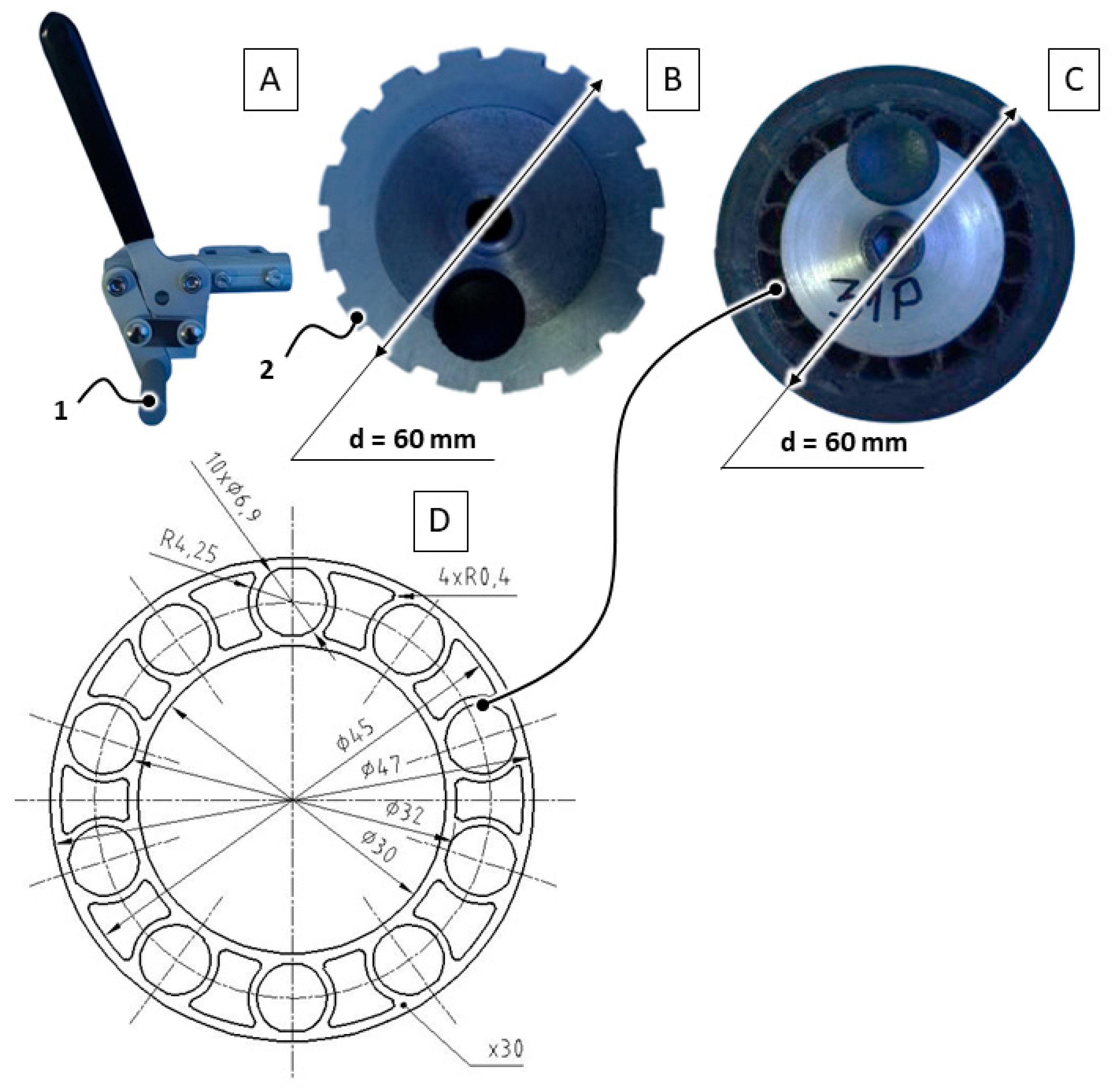
During the tests, three propulsion configurations were introduced (Figure 2): uphill propulsion without the anti-rollback module (NAR), propulsion with a stiff roller in the anti-rollback module (SAR), and propulsion with a flexible roller in the anti-rollback module (EAR). The anti-rollback module was a modified version of the parking brake (Figure 2A), in which the original pin (1) was replaced with one of the two tested rollers. The stiff roller of the anti-rollback module (Figure 2B) had an outer diameter of d = 60 mm, and its external surface was ribbed (2). The flexible roller of the anti-rollback module (Figure 2C) had a composite structure with a flexible core (3) made of TPU material with a hardness of 55 Shore. The external surface of this roller was coated with EPDM rubber. The flexible core had an openwork geometry (Figure 2D), allowing deformation that compensated for the non-circularity of the cooperating wheelchair wheel. The anti-rollback module variants were developed as part of the project “Anti-Rollback Module for a Manual Wheelchair–Functional Prototype, Operational Tests, and Dissemination” (BEA/000005/BF/2023), funded by the State Fund for the Rehabilitation of Disabled Persons (PFRON).
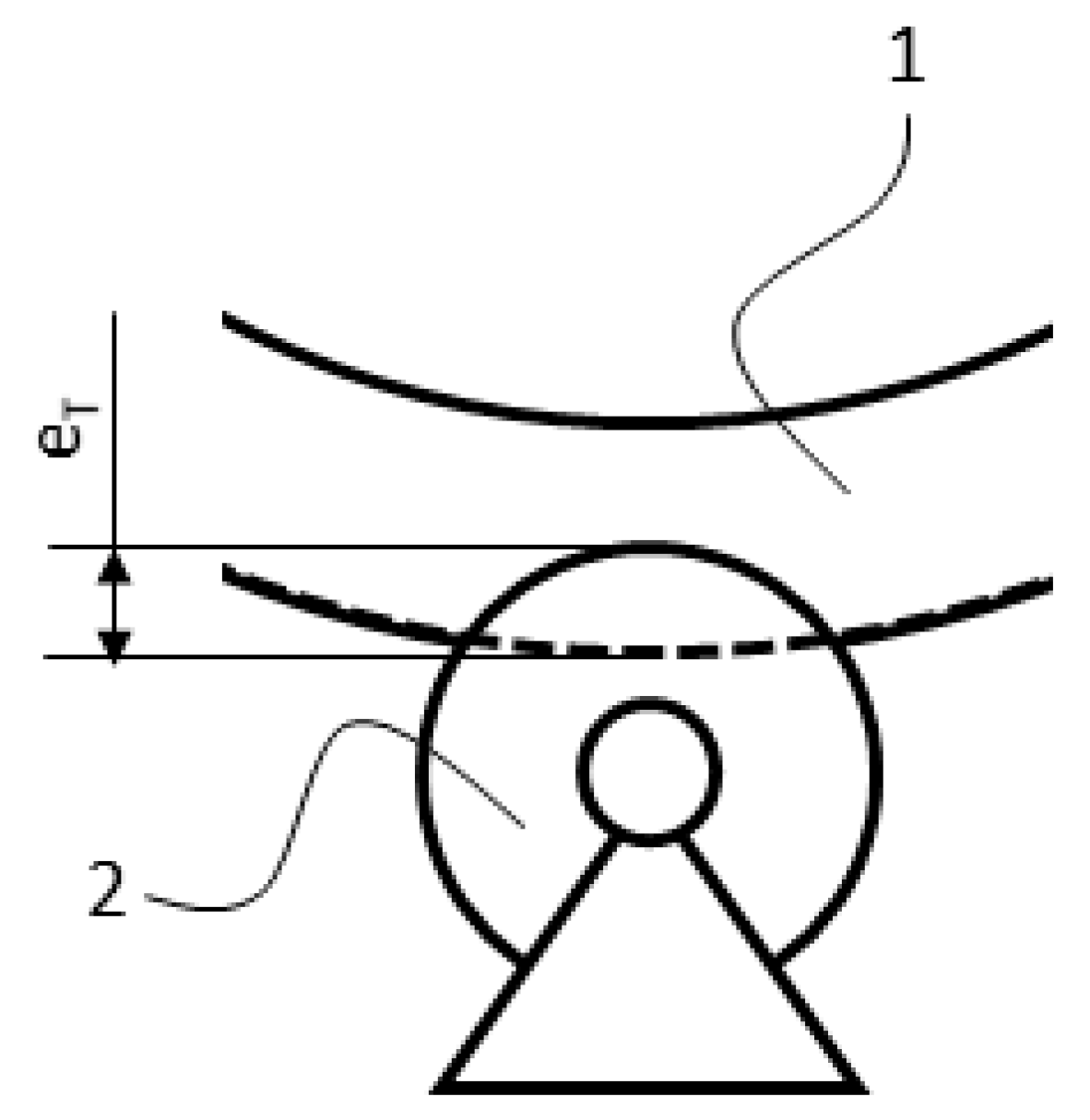
During the use of the anti-rollback module, the roller pressure was adjusted to achieve a tire deformation (eT) of 2–3 mm (Figure 3). This level of pressure eliminated slippage between the wheel and the anti-rollback roller caused by gravitational force on slopes up to 10° and for a user mass of 100 kg.

2.2. Participants Taking Part in the Tests

The study was conducted with the participation of eight male subjects representing the 50th percentile (C50) of anthropometric dimensions. Each participant declared abstaining from physical activity on the day prior to testing. The skin was prepared according to standard procedures, which included cleaning, shaving, and removing dead epidermis [18,19]. Due to the prototype nature of the tested device and its intended use by individuals beginning to use a wheelchair, it was decided that able-bodied participants would be included in the study. This approach primarily ensured participant safety by enabling quick evacuation from the wheelchair during testing if necessary [20,21,22]. Additionally, it prevented individuals recovering from mobility-impairing injuries from experiencing psychological discomfort associated with participation in the experiment. Following the recommendations of other researchers [23,24,25,26], the following muscles were selected for measurement: caput mediale musculi tricipitis brachii (TBM), caput laterale musculi tricipitis brachii (TBL), musculus extensor carpi ulnaris (ECU), and musculus extensor carpi radialis (ERC). The study received ethical approval from the Bioethics Committee of the Poznan University of Medical Sciences (Resolution No. 1100/16 of 10 November 2016), chaired by Prof. P. Chęciński, under the supervision of Dr. B. Wieczorek. Informed consent for the publication of the study results was obtained from each participant. All data were presented in a manner ensuring full anonymity. The male participants were classified based on height, body mass, body mass index (BMI), and maximum voluntary contraction (MVC). An anonymous summary of participant characteristics is presented in Table 1.

2.3. Research Method and Analyzed Parameters

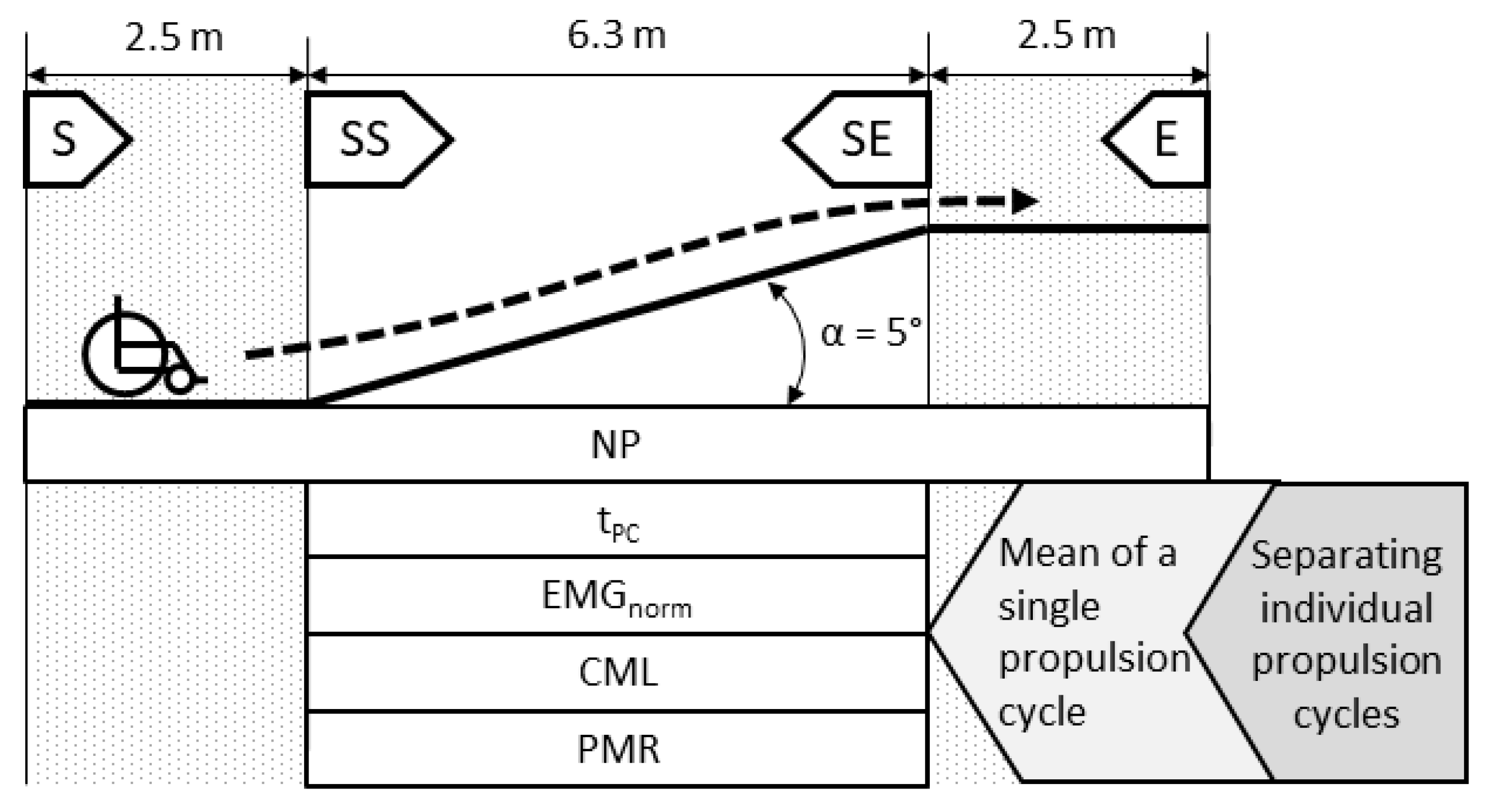
The research method involved uphill propulsion using a manual wheelchair under three conditions: without the anti-rollback module (NAR), with the flexible anti-rollback module (EAR), and with the stiff anti-rollback module (SAR). The test track (Figure 4) was located indoors and consisted of a smooth oak surface with a slip resistance value (SRV) of 31 [27] The track comprised three sections: an acceleration segment (from S to SS) measuring 2.5 m in length, an inclined segment (from SS to SE) measuring 6.3 m in length and inclined at 5° ± 0.5°, and a final flat segment (from SE to E) measuring 2.5 m in length. The ramp angle was set to 5° ± 0.5°, corresponding to the slope range most commonly encountered in urban environments and indoor accessibility standards. This inclination is consistent with the gradient recommended by ISO 7176-1 [28] and ADA accessibility guidelines, which specify slopes between 4° and 6° as representative of typical wheelchair propulsion conditions. During testing, each participant completed three uphill runs for each configuration. The trials were performed alternately in the order NAR, EAR, and SAR, and this sequence was repeated three times. This approach minimized the effects of fatigue, eliminated order-related bias (such as warming-up effects), and reduced participant adaptation to a specific configuration. The adopted procedure followed the methodology of the Balanced Alternating Design and Latin Square Design [29].
Among the analyzed parameters used to evaluate and compare the wheelchair variants were:
  • the number of push cycles required to complete the entire track, NP (section from S to E);
  • the duration of a single propulsion cycle, tPC, measured on the incline (section from SS to SE);
  • the normalized muscle activity signal for a single propulsion cycle, EMGnorm, measured on the incline (section from SS to SE);
  • the normalized cumulative muscle load for a single propulsion cycle, CML, measured on the incline (section from SS to SE);
  • the peak-to-mean ratio, PMR, of the EMG signal for a single propulsion cycle during uphill propulsion (section from SS to SE).
Since the tested participants exhibited different push frequencies, the parameters related to muscle activity were first normalized to a dimensionless time base. This base was expressed as a percentage of propulsion cycle progression [30,31,32], where 0% represented the beginning of the propulsion cycle and 100% indicated the start of the next cycle. It should be noted that the propulsion cycle consists of two phases: the push phase, during which the user generates the driving torque, and the recovery phase, which allows the hand to return to the initial position [5,7].
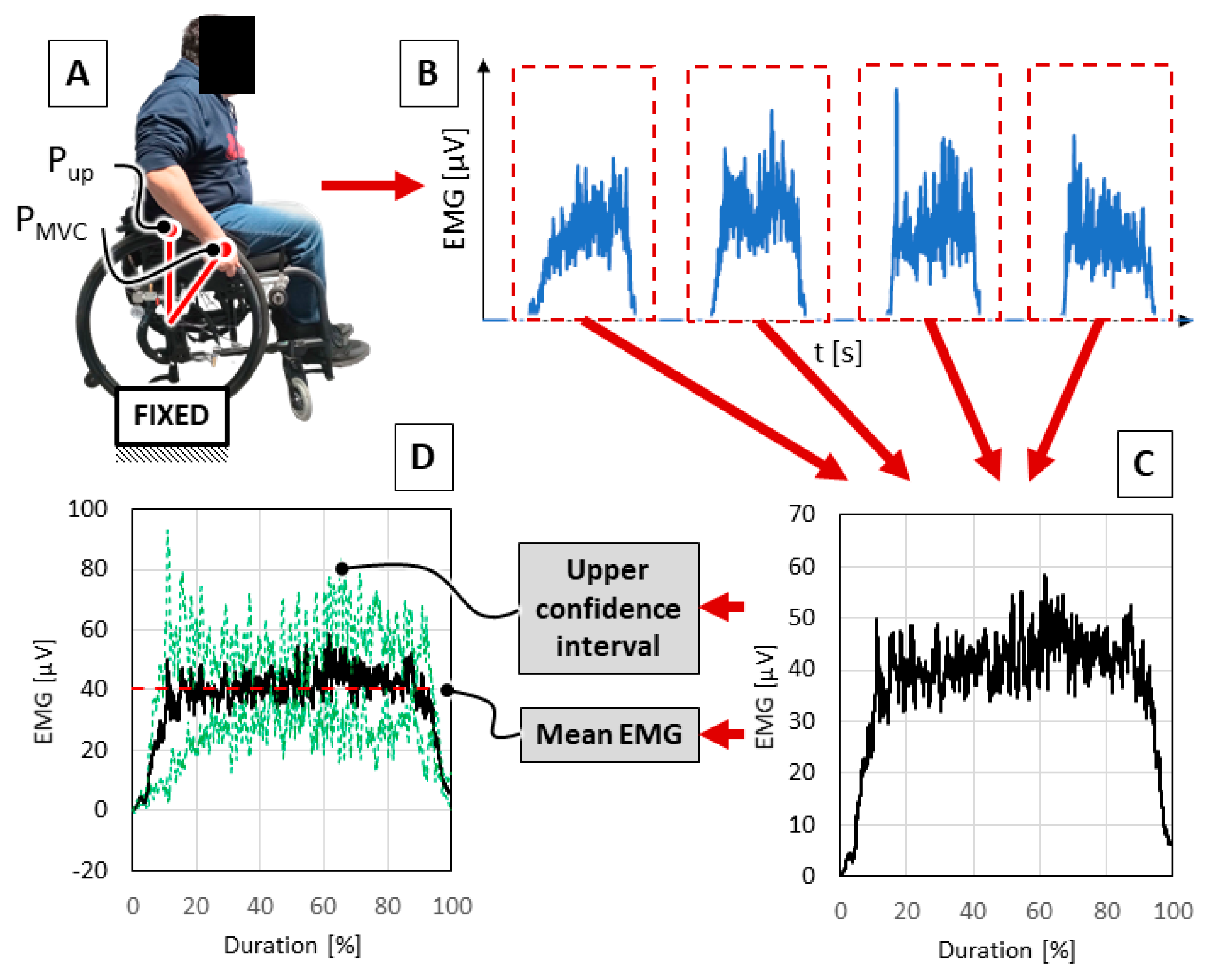
A wireless Noraxon TeleMyo DTS system was used to record the electromyographic (EMG) signal. Muscle activity was measured using Noraxon Ag/AgCl double surface electrodes (Noraxon USA Inc., Scottsdale, AZ, USA) [33], which were placed over the bellies of the analyzed muscles in accordance with the SENIAM (Surface ElectroMyoGraphy for the Non-Invasive Assessment of Muscles) recommendations [33]. Before the measurements, an impedance test was performed for each channel to verify signal quality. All values remained within the acceptable range (<5 kΩ) [34]. Esuring proper electrode–skin contact and high-quality EMG data acquisition. To ensure comparability of EMG signals among participants, normalization was performed using the maximum voluntary contraction (MVC) method. The MVC measurement was conducted on a stationary wheelchair, where the participant, while holding the pushrim at a 30° position (PMVC) from the top point (Pup), attempted to propel the wheelchair, thus generating a maximum voluntary muscle contraction in a posture identical to the actual propulsion activity (Figure 5A) [35,36,37]. The normalization procedure involved performing four repetitions of the maximum voluntary contraction, each sustained for four seconds, with a 5-s rest interval between repetitions. The raw EMG signal was segmented into individual contractions (Figure 5B), time-normalized to an absolute base (Figure 5C), and used to compute the mean MVC60% value along with a confidence band at a significance level of p = 0.05 (Figure 5D). The MVC60% mean was calculated from the range (1), excluding values below the 20th percentile and above the 80th percentile. Only the data within this percentile range (20–80%) were used to calculate the mean MVC value and its confidence interval, while excluded samples were not considered in further analysis.
M V C 60 % = M V C i M V C | M V C 0.2 n M V C i M V C 0.8 n , M V C ¯ 60 % = M V C i M V C 60 % M V C i M V C 60 %
where: MVC60%—maximum voluntary contraction for 60% of its duration, MVCi—the i-th sample of the analyzed set of MVC60% values, MVC[0.2n]—MVC value for the first 20% of the duration, MVC[0.8n]—MVC value for the last 20% of the duration.
The MVC60% value calculated in this manner served as the basis for determining the normalized muscle activity value, EMGnorm. The computation of EMGnorm; required, similar to the MVC procedure, dividing the raw EMG signal into individual propulsion cycles, converting these signals to a normalized time base, and calculating the mean value for all cycles performed during the uphill propulsion, M EMG(t). Based on this, the normalized muscle activity EMGnorm(t) was expressed as a function of the propulsion cycle duration t, represented as a percentage (2). The normalization reference was the MVC60% value increased by the upper confidence limit (UCL) for a confidence level of p = 0.05.
E M G n o r m ( t ) = M   E M G ( t ) M V C ¯ 60 % + U C L
where: t—dimensionless time range expressed as an interval <0%; 100%>; UCL—upper confidence limit of the MVC60% mean.
The use of the MVC60% value increased by the upper confidence limit (UCL) accounts for measurement uncertainty and the natural variability of MVC values. Since the maximum voluntary muscle contraction is susceptible to fluctuations caused by both biological and technical factors, using only the mean MVC60% value could lead to its underestimation and, consequently, to an overestimation of the normalized EMG values. Including the upper confidence limit helps correct potential errors resulting from the limited number of trials and individual differences in contraction strength variability.
The assessment of the maximum EMGnorm value may not provide complete information about the entire propulsion cycle. Therefore, another parameter related to muscle activity that was analyzed was the normalized cumulative muscle load (CML) (3). CML, expressed as a dimensionless coefficient, allows for the evaluation of the normalized muscle load throughout the entire wheelchair propulsion cycle, regardless of its duration [38].
C M L = 0 % 100 % E M G n o r m ( t ) d t
where: t—dimensionless time range expressed as an interval <0%; 100%>.
The final parameter related to muscle activity was the peak-to-mean ratio (PMR) (4), which allows the assessment of how large the instantaneous and maximum EMGnorm values are in relation to the mean value M EMGnorm.
P M R = E M G n o r m m a x M   E M G n o r m , br - to - break   E M G n o r m m a x = m a x E M G n o r m t | t [ 0 % ; 100 % ] . E M G n o r m m a x = m a x E M G norm ( t ) t [ 0 % ; 100 % ] .

2.4. Statistical Analysis

All statistical analyses were performed using Statistica 13.3 (TIBCO Software Inc., Palo Alto, CA, USA). The normality of data distribution was verified using the Shapiro–Wilk test, and the Levene test was applied to assess the homogeneity of variances. A one-way repeated-measures ANOVA was conducted to determine significant differences between the tested conditions (NAR, SAR, and EAR) for all normalized EMG parameters (EMGnorm, CML, and PMR) as well as propulsion-related variables (tPC, NP). When a significant main effect was detected, Tukey’s post hoc test was used for pairwise comparisons. The Pearson correlation coefficient (r) was calculated to evaluate the relationship between the perceived exertion (RPE) and the angle α describing the rate of muscle activation. Statistical significance was set at p < 0.05 for all tests. Data are presented as mean ± standard deviation (SD).

3. Results

In accordance with the described research methodology, the presented mean results were obtained from a group of participants (n = 8), and confidence intervals were determined at a confidence level of p = 0.05 using Student’s t-distribution.
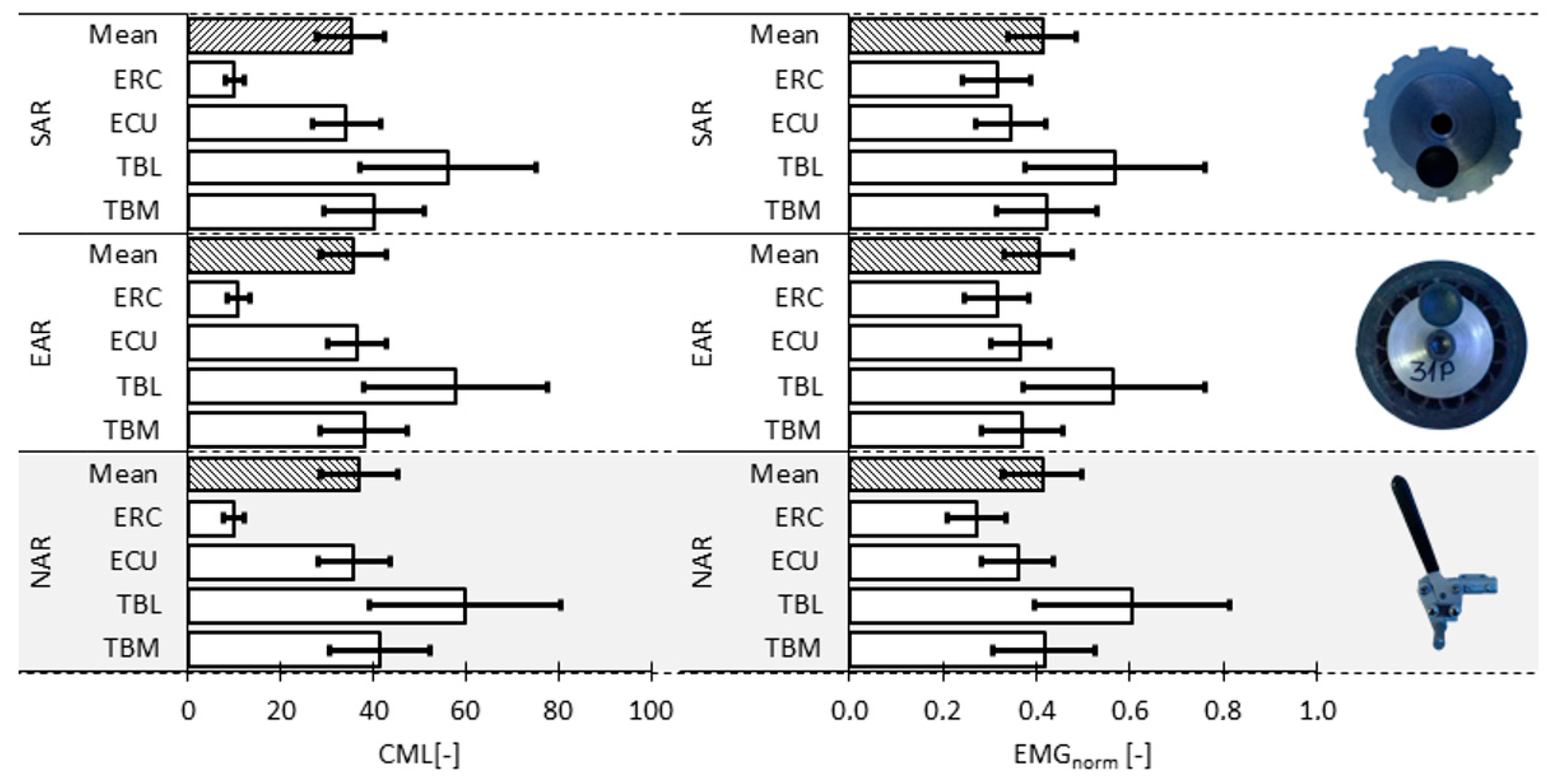
The analysis of the CML and EMGnorm parameters (Figure 6, Appendix A Table A1) showed that the use of the anti-rollback module—regardless of its variant (SAR or EAR)—did not significantly affect muscle recruitment or muscle load during uphill propulsion compared to propulsion without the module (NAR). The statistical significance analysis (ANOVA) revealed no statistically significant differences between the test conditions. For the normalized cumulative muscle load (CML), the p-value was 0.993, and for the normalized muscle activity (EMGnorm), it was 0.9978. These results indicate that the application of the anti-rollback module, both in the SAR and EAR configurations, is biomechanically neutral and does not increase muscular effort for the user. When analyzing CML for the entire limb, values ranged from 35.14 to 36.75, with the highest value observed during propulsion without the anti-rollback module (NAR). This difference compared to propulsion with the module can be considered negligible. Further confirmation of the lack of influence on muscle recruitment when propelling the wheelchair with or without the anti-rollback module is provided by the analysis of CML and EMGnorm for individual muscles. For both parameters, the highest muscle activity in all test conditions was recorded for the triceps brachii lateral head (TBL), followed by the medial head (TBM), the extensor carpi ulnaris (ECU), and the lowest activity was observed in the extensor carpi radialis (ERC).
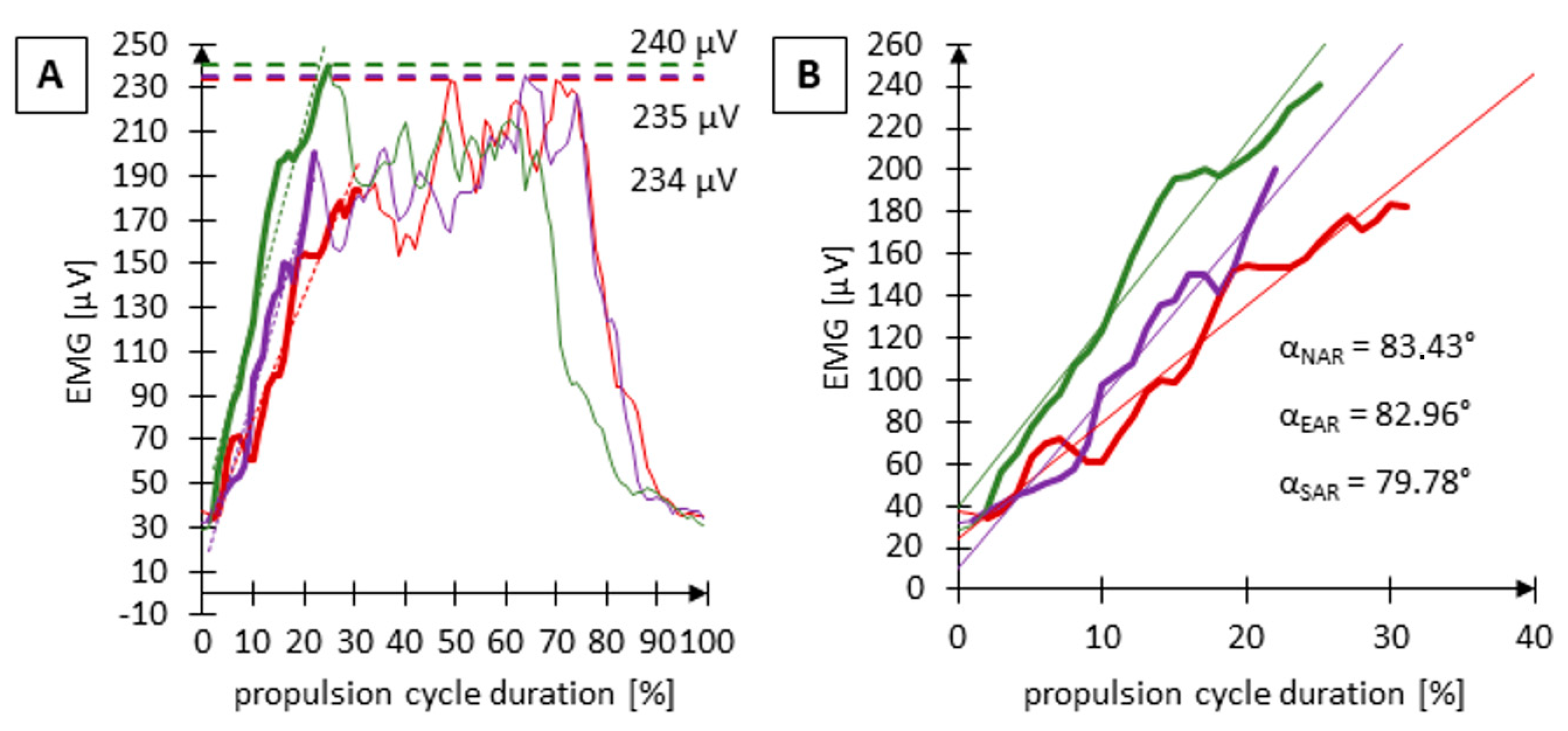
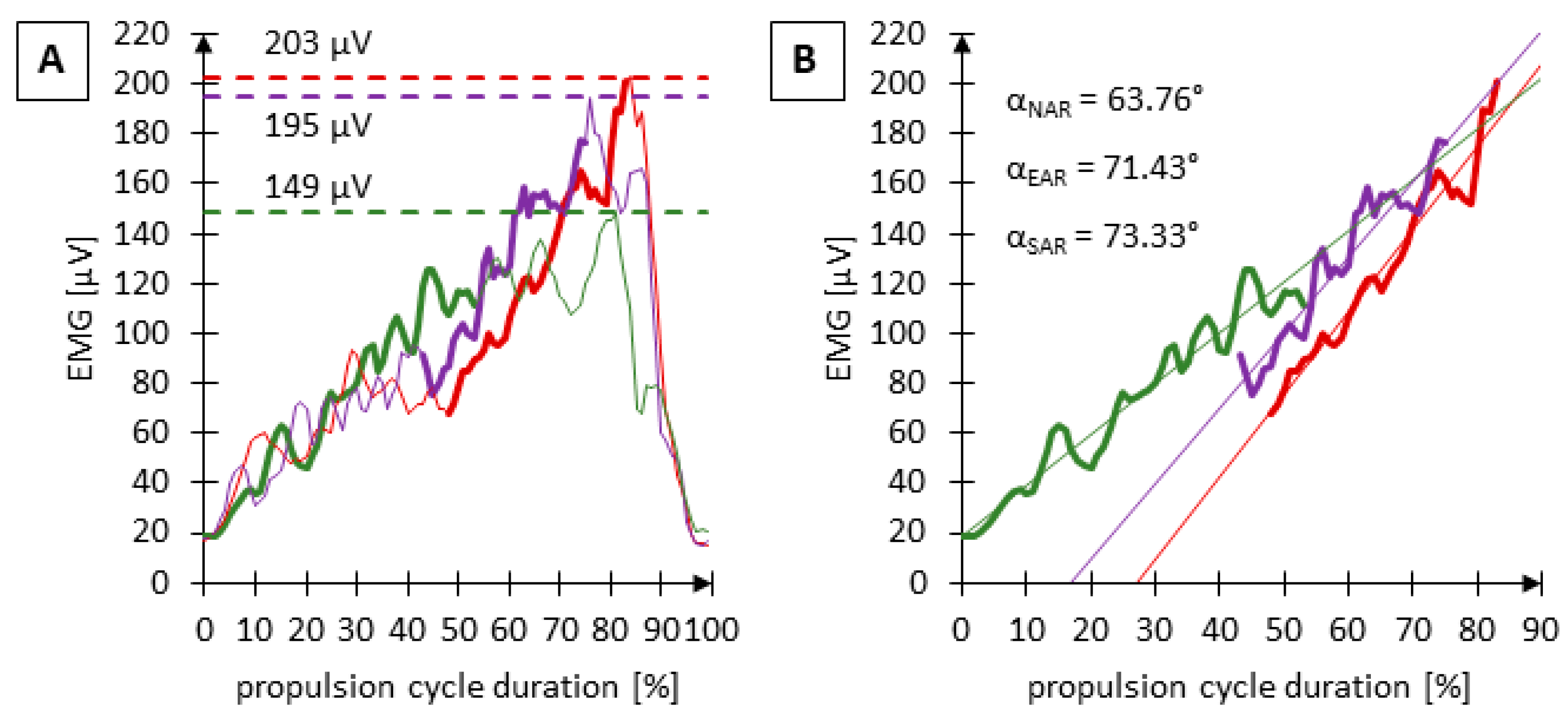
The analysis of EMG signals and the interpretation of muscle activity parameters revealed no measurable effect of the anti-rollback modules on muscular effort. However, during the tests, 6 out of 8 participants reported perceiving a slightly higher physical effort when propelling uphill with the anti-rollback module engaged. Since this observation was reported by 75% of participants—despite no significant differences in EMGnorm or CML values between wheelchair configurations—an additional analysis was conducted to investigate the cause of this subjective perception of increased effort. EMG waveforms from individual propulsion cycles were analyzed to identify possible biomechanical factors influencing this sensation. Considering the participants’ differing body structures [6,39] and propulsion techniques [40], which affect muscle recruitment patterns [30] only EMG signals from muscles generating the highest levels of muscle tension were examined. The analysis showed that the perceived increase in effort was closely related to the rate of rise in the EMG signal before reaching its steady-state or near-maximum value. This rate can be defined as the angle α of the trend line corresponding to the portion of the propulsion cycle where muscle tension increases due to the generation of driving force by the upper limb. An example of the EMG waveform of the ERC muscle for a participant reporting reduced effort when using the anti-rollback module is shown in Figure 7, while the waveform for a participant reporting increased effort is presented in Figure 8.
The results of the analysis of the muscle tension rise rate are presented in Table 2. The summary also includes information on the analyzed muscle, the measured maximum EMG signal values, and the participants’ self-reported perception of physical effort. The perceived effort was assessed using a Likert scale, where 1 indicates significantly higher effort, 3 indicates no difference, and 5 indicates significantly lower effort.
The analysis confirmed the hypothesis explaining the cause of the perceived increase in effort, as two participants who reported lower effort (rating 4 on the Likert scale) showed a decrease in the rate of muscle tension rise when using the anti-rollback module. For participant M03, the difference in the rate of muscle tension rise between NAR and EAR was 1.33%, while for participant M04, the difference between NAR and EAR was 4.58%. Although these relative differences were small, they influenced the participants’ subjective perception of effort. The correlation analysis between the perceived physical effort and the increase in muscle tension parameters showed that participants were more sensitive to changes in the rate of tension rise (angle α) than to the maximum EMG value itself. The Pearson correlation coefficient for the difference in angle α relative to the NAR configuration was −0.893, and the Spearman coefficient was −0.866, indicating a very strong negative relationship. This means that the higher the rate of tension increase, the lower the Likert score, corresponding to a greater perceived effort. For differences in EMGmax, the correlation values were significantly lower (Pearson: −0.409, Spearman: −0.371), confirming that it is not the intensity but the dynamics of muscle activation that play a key role in the perception of physical load during wheelchair propulsion.
The correlation analysis between the difference in the rate of muscle tension rise (Δα) and the change in the maximum EMG value (ΔEMG) showed only a weak positive relationship between these parameters. The Pearson correlation coefficient was 0.265, while the Spearman coefficient was 0.357. This indicates that although the data show a general tendency for a greater increase in angle α (faster muscle tension rise) [41] to correspond with a higher EMGmax, this relationship is neither strong nor consistent. For example, in participant M01, the difference in angle α relative to the NAR configuration was +9.57°, and the maximum EMG value increased by 54 µV, indicating a notable increase in both the dynamics and intensity of muscle activity. In contrast, for participant M04, the rate of tension rise α decreased by 3.65°, and EMGmax decreased slightly by 6 µV, even though the participant reported a reduction in perceived effort.
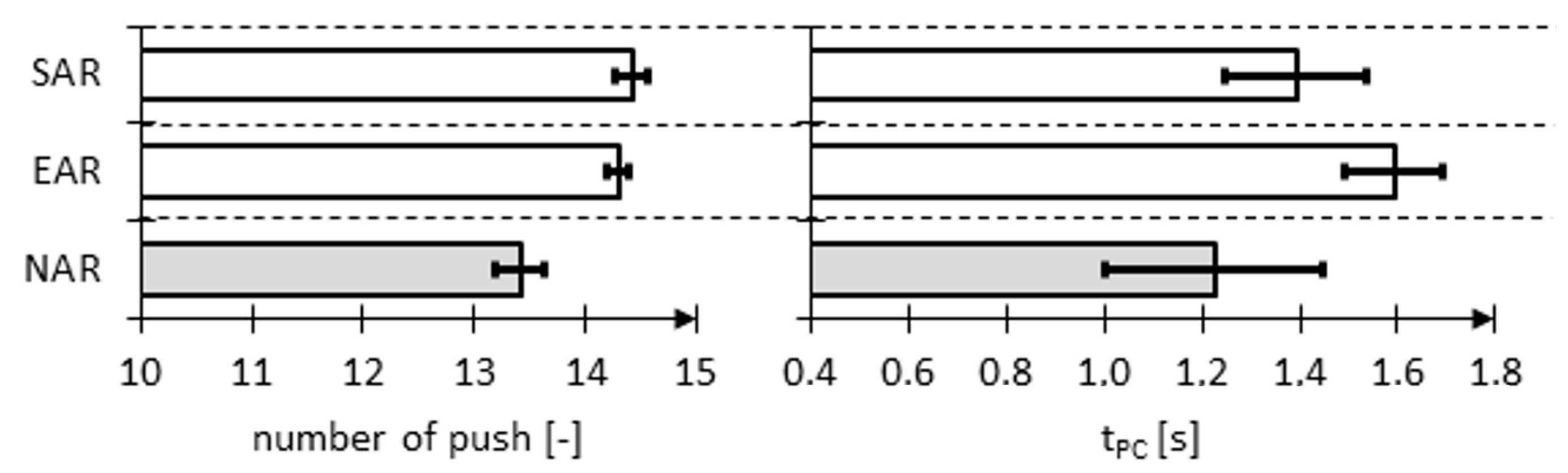
The final analyzed parameters were the number of push cycles (NP) required to complete the tested incline and the propulsion cycle duration (tPC) (Figure 9, Table 3). The analysis included data collected during the acceleration and uphill propulsion phases for three wheelchair configurations: without the anti-rollback module (NAR), with the flexible module (EAR), and with the stiff module (SAR). For the number of push cycles (NP), the recorded values among participants ranged from 9 to 21 in the NAR variant, from 11 to 18 in the EAR variant, and from 11 to 18 in the SAR variant. The mean values were 13.4 ± 0.51 for NAR, 14.3 ± 0.32 for EAR, and 14.4 ± 0.32 for SAR. The propulsion cycle duration (tPC) ranged from 0.77 s to 1.87 s for NAR, from 0.75 s to 2.53 s for EAR, and from 0.77 s to 2.11 s for SAR. The mean cycle durations were 1.22 ± 0.06 s (NAR), 1.59 ± 0.07 s (EAR), and 1.39 ± 0.08 s (SAR), indicating noticeable differences between the tested configurations.
The repeated measures analysis of variance (ANOVA) showed that the wheelchair configuration had a significant effect on both the number of push cycles (NP) (F(2,46) = 4.14, p = 0.0221) and the propulsion cycle duration (tPC) (F(2,46) = 12.23, p = 0.0001). This indicates a clear influence of the anti-rollback module on the duration and frequency of propulsion cycles. Since the ANOVA does not identify specific differences between the NAR, SAR, and EAR configurations, a post-hoc analysis was performed. The post-hoc Tukey HSD test revealed that only the EAR–NAR comparison for the propulsion cycle duration (tPC) was statistically significant (p = 0.0114). Wheelchair users with the flexible anti-rollback module (EAR) demonstrated a significantly longer propulsion cycle duration compared to the configuration without the module (NAR). The remaining configuration pairs showed no significant differences in either propulsion cycle duration (tPC) or the number of push cycles (NP) (all p > 0.3).

4. Discussion

In accordance with the established research objectives, it was demonstrated and confirmed that the use of an anti-rollback module does not adversely affect the wheelchair propulsion technique during uphill movement. The statistical analysis showed no significant differences in the number of push cycles (NP) performed while ascending the test track, either with or without the anti-rollback module. During the ascent without the anti-rollback module (NAR), the mean number of push cycles was 13.4 ± 1.3, while with the stiff-roller anti-rollback module (SAR), it was 14.4 ± 0.8. This represents an increase of 7.5% in NP, corresponding to 1.52 push cycles per meter of distance for NAR and 1.64 push cycles per meter for SAR. According to studies analyzing push frequency under moderate and high intensity, manual wheelchair users perform between 53 and 64 pushes per minute [42,43,44]. Considering the propulsion cycle duration observed in the present study, ranging from 1.22 to 1.59 s, the measured number of push cycles (NP) during testing aligns with findings from other researchers and remains within the normal range.
The analysis of propulsion cycle duration (tPC) showed that during uphill propulsion without the anti-rollback module (NAR variant), the average cycle duration was 1.22 s, while with the stiff-roller module (SAR) it was 1.39 s, and with the flexible-roller module (EAR) it was 1.59 s. The increase in cycle duration in the presence of the anti-rollback module can be interpreted as a result of eliminating the wheelchair’s tendency to roll backward, which enhances motion control and allows the user to extend the recovery phase of the hand returning to the initial position on the pushrims. This phenomenon is consistent with literature findings indicating that at lower propulsion speeds (e.g., 1.11 m/s), the total propulsion cycle duration (push and recovery phases) can reach approximately 0.82 s, whereas at higher speeds (1.67 m/s) it shortens to about 0.45 s [43]. The observed increase in propulsion cycle duration (tPC) in configurations with the anti-rollback module can be interpreted as resulting from both the reduced uphill speed and the resistance introduced by the module. According to previous studies, wheelchair propulsion on slopes requires an extended push phase due to the need to generate greater muscular force and prolonged upper limb muscle activation [24,45,46]. The anti-rollback mechanism, which prevents backward motion, allows the user to extend the hand’s recovery phase without losing progress, thus increasing the overall cycle duration. Additionally, a longer recovery phase may improve comfort by enabling smoother, more controlled movements and allowing short muscle recovery between pushes. This finding is particularly important in the context of literature emphasizing the relationship between propulsion intensity, push frequency, total energy expenditure, and muscle fatigue [47]. The parameters described above—the number of push cycles (NP) and propulsion cycle duration (tPC)—determine the overall wheelchair propulsion technique. The observed changes reflect a movement strategy based on a smoother and more controlled hand return [13].
An important issue identified in the study was the participants’ subjective perception of increased muscular effort during uphill propulsion when using the anti-rollback module. The reason for this perceived increase in effort may be the higher rolling resistance [48] and the additional resistance associated with overcoming inertia when starting from a stationary position rather than from motion, as in the configuration without the module. This condition results in a longer push phase [8,45]. In the NAR configuration (without the anti-rollback module), the participant could utilize the inertial force generated at the end of the previous propulsion cycle, allowing the next cycle to begin with the wheelchair already in motion. This enabled a smoother and less abrupt initiation of movement, resulting in a lower rate of effort increase (α) and often a lower EMGmax. In contrast, in the EAR and SAR configurations (with the anti-rollback module), each propulsion cycle started from a stationary wheelchair, requiring the user to overcome inertia from zero velocity. This situation led to more dynamic muscle engagement, producing a higher rate of effort increase (α) and, in many cases, a higher EMGmax.
Individual propulsion techniques may influence the shape and timing of muscle activation patterns recorded during wheelchair propulsion. In this study, the variability of propulsion style was minimized through a standardized training session prior to testing and the use of a fixed ramp geometry. Nevertheless, slight differences in handrim contact, push angle, and wrist motion could contribute to interindividual variation in EMG profiles. Future work should include a detailed kinematic assessment of propulsion technique to better link individual movement strategies with muscle activation patterns.
Although the EMG and CML data indicated no significant increase in muscular demand, participants reported a higher perceived effort when using the anti-rollback module. This discrepancy suggests that factors other than muscular activation, such as perceived safety, motor control adaptation, altered proprioceptive feedback or anticipatory co-contraction, may influence subjective exertion. Future work should therefore include psychophysiological measures such as RPE scales aligned to cycle phases, heart rate variability and skin conductance, together with sensorimotor assessments, to clarify the mechanisms underlying perceived effort during assisted uphill propulsion.
Based on the above, parameters related to muscle activity such as CML, EMGnorm, and PMR were compared first. The normalized cumulative muscle load (CML) for the entire upper limb was 35.14 ± 7.45 for the SAR module, 35 ± 7.16 for the EAR module, and 36.75 for propulsion without the module. These data indicate that there were no significant differences in CML, as the variation amounted to 4.4% for SAR and 4.8% for EAR. Importantly, contrary to the participants’ subjective perceptions, a decrease in CML values was observed when using the anti-rollback module. Since EMG signal analysis requires the consideration of multiple parameters to exclude irregularities caused by individual participant characteristics, the mean normalized muscle activity value (EMGnorm) was also analyzed. The results showed that regardless of the anti-rollback module configuration, the highest average EMGnorm values for all participants were recorded for the triceps brachii lateral head (TBL), reaching 0.60 for the NAR variant and 0.57 for both the SAR and EAR variants. The high activity of this muscle aligns with the literature, which indicates that the lateral head of the triceps brachii plays a key role during the propulsion phase of manual wheelchair use, and its activation increases with terrain incline and decreasing shoulder elevation angle [49,50,51]. Conversely, the lowest muscle activity, averaged across all participants, was recorded for the extensor carpi radialis (ERC), with EMGnorm values of 0.27 for NAR and 0.32 for both SAR and EAR. These findings are also consistent with literature reports, which emphasize that the extensor carpi radialis exhibits steady but moderate activation throughout the propulsion cycle, serving primarily a stabilizing and supportive role, particularly during ramp ascent and depending on seat height [7,52]. A noteworthy observation is that the mean muscle activity (EMGnorm) for the entire upper limb was nearly identical across all tested configurations (NAR, SAR, EAR), ranging between 0.40 and 0.41. No significant differences between configurations were also observed for the PMR parameter, which was 1.90 for NAR and 1.93 for both SAR and EAR.
Based on the above observations, it was concluded that the participants’ perception of increased effort was not caused by the mean EMGnorm value but rather by the rate of EMG signal rise (α) from the resting level and the achieved peak values (EMGmax). This phenomenon is supported by literature showing that the intensity of muscle activation increases with wheelchair propulsion speed, which correlates with greater perceived exertion by the user [53]. Furthermore, studies indicate that muscle fatigue manifests as an increase in the rate of EMG signal rise and spectral changes, which may lead to muscular imbalance and a heightened sense of effort [31]. Referring these findings to the present study, it was found that users reported a greater sense of effort when using both SAR and EAR anti-rollback modules. Although this was not confirmed by measured CML and EMGnorm parameters, the analysis of the EMG signal rise rate (α) supported the users’ subjective perception. This suggests that participants who reported higher perceived effort exhibited a steeper slope of the EMG signal rise during the initial propulsion phase. In these individuals, the increase in microvolt amplitude over time was more rapid, meaning the linear trend of EMG growth formed a larger α angle. This reflects a faster muscle activation process leading to an earlier attainment of individual maximum activation (EMGmax). Importantly, this relationship does not concern the total normalized EMG amplitude (EMGnorm) but the rate of its rise toward each participant’s own maximum. Consequently, users who experienced higher effort likely activated their motor units more abruptly, which may have intensified the subjective perception of exertion despite comparable mechanical conditions. Due to variations in wheelchair propulsion technique among participants—resulting from factors such as wheelchair configuration (seat height, axle position), physical fitness level, and individual biomechanical characteristics—a wide range of maximum muscle activation values (EMGmax) was recorded for different upper-limb muscles. Therefore, the analysis of muscle tension rise rate (angle α) was based on the EMG signal from the most engaged muscle for each participant. This approach aligns with prior studies demonstrating that muscle activation patterns vary depending on axle position [54], seat height [55], propulsion speed [53,56], muscle fatigue level [53], and long-term adaptations in individuals with spinal cord injuries [57,58]. Regardless of which muscle was most active, a consistent trend was observed: the lowest rate of effort increase (α) was recorded during uphill propulsion without the anti-rollback module (NAR), with an average angle of 70.04° ± 8.73°, while for the anti-rollback module with the elastic roller (EAR) α was 75.24° ± 5.67°, and for the rigid roller (SAR) 75.98° ± 6.29°.
It should be noted that for six participants, the most active muscle during uphill propulsion in the wheelchair was the extensor carpi radialis (ERC), while for two participants, it was the triceps brachii lateral head (TBL), confirming individual differences in propulsion technique and muscle activation [53,59]. Muscle activity increases proportionally with movement intensity and speed, which explains the higher EMGmax values observed during uphill propulsion [53,60]. The mean measured values of maximum muscle tension (EMGmax) were 177.25 ± 75.37 μV for the NAR configuration, 199.63 ± 70.62 μV for EAR, and 196.88 ± 75.15 μV for SAR, reflecting an increased effort demand in the presence of the anti-rollback module. The analysis therefore indicates a higher perceived effort during uphill propulsion when using the anti-rollback module. However, according to the Likert scale assessment, participants gave an average score of 2 ± 1, where 3 indicated no difference and 1 indicated significantly greater effort. It should be emphasized that in terms of energetic and metabolic parameters (CML and EMGnorm), no direct evidence of increased muscular load was found.
In summary, the biomechanical and metabolic cost resulting from the increased muscular load when using the anti-rollback module is minimal compared to the significant improvement in safety during wheelchair movement, especially when ascending inclines. Assistive devices such as anti-rollback mechanisms allow the user to maintain control over trajectory and stability in high-risk situations, similar to power-assist systems that reduce the number of propulsion cycles and decrease the velocity amplitude required to overcome slopes [8]. The ability to stop and continue moving step by step without the risk of rolling backward enables partial rest, which is particularly important for individuals with limited physical capabilities [61,62]. From the perspective of public accessibility, the implementation of such solutions makes slope inclination less of a barrier, while the ability to independently ascend ramps and inclines enhances real access to urban infrastructure [63,64].
The present study was conducted on healthy male participants to ensure control over propulsion conditions and muscle activation patterns. However, long-term studies involving individuals with mobility impairments or those who use wheelchairs in daily life are necessary to evaluate adaptation effects, fatigue development, and user acceptance of the anti-rollback module. Such studies would provide broader insight into the practical and rehabilitation-related implications of this solution.

5. Conclusions

The aim of the study was to determine whether the anti-rollback module affects wheelchair propulsion technique and muscle effort during uphill movement. The research hypothesis assumed that the module does not impair propulsion technique or significantly increase muscle load. The results confirmed this hypothesis. It was found that the propulsion cycle time and the number of pushes were slightly higher when using the module, especially in the configuration with the elastic roller (EAR). No significant differences were observed in the mean values of muscle activity (EMGnorm) or cumulative muscle load (CML). Muscle load did not increase despite changes in propulsion cycle parameters. The most important finding of the study was the relationship between the subjective perception of effort and the rate of muscle activation. This relationship was described using the angle α. The slower the muscle activation increased, the lower the perceived effort. This was confirmed by a statistically significant negative correlation between angle α and perceived effort on the Likert scale (r = −0.893). The value of this indicator may be useful in assessing muscle fatigue and optimizing wheelchair propulsion technique.
This study contributes new insights to the literature on wheelchair propulsion biomechanics. It demonstrates that traditional indicators such as mean EMG or EMGmax do not fully reflect the perceived level of exertion. The research introduces a novel approach to assessing muscle load based on the dynamics of signal rise. One limitation of the study was participant selection. The tests were conducted with healthy individuals rather than regular wheelchair users. This decision was made to ensure safety during trials with the prototype module. However, this group allowed for precise control of biomechanical conditions. Variability in propulsion technique among participants was also observed. To maintain comparability, data from the most active muscle for each participant were used in the analysis.
Future research should involve participants with greater experience in wheelchair use. However, it is essential that such studies be conducted only after full validation of the module’s design and confirmation of its reliability under long-term operating conditions. The currently tested prototype has not yet been sufficiently verified in terms of mechanical durability and operational stability, which justifies caution when working with clinical groups. Despite these limitations, studies involving wheelchair users with mobility impairments are crucial, as only they can provide reliable information about the practical functionality of the module in real-world use. It would also be valuable to include older adults and individuals with varying levels of physical ability in future investigations.
The observed divergence between objective EMG/CML metrics and perceived exertion highlights the potential role of psychophysiological factors and warrants targeted investigation in future studies. In summary, the use of an anti-rollback module enhances safety during uphill propulsion without significantly increasing muscular effort. It can serve as an effective assistive tool supporting independent mobility in public spaces. The study confirms that technical solutions can be safe, functional, and consistent with ergonomic principles.

Author Contributions

Conceptualization, B.W.; methodology, B.W.; software, B.W.; validation, B.W. and Ł.W.; formal analysis, B.W.; investigation, B.W. and Ł.W.; resources, B.W.; data curation, B.W. and Ł.W.; writing—original draft preparation, B.W.; writing—review and editing, B.W. and Ł.W.; visualization, B.W.; supervision, B.W.; project administration, B.W.; funding acquisition, B.W. All authors have read and agreed to the published version of the manuscript.

Funding

This research was funded by PFRON (Poland State Fund for the Rehabilitation of Disabled Persons), grant number “BEA/000068/BF/D” and “Reverse Locking Module for Wheelchairs—Functional Prototype, Operational Testing, Popularization”.

Institutional Review Board Statement

The study was conducted in accordance with the Declaration of Helsinki and approved by the Bioethics Committee of the Poznan University of Medical Sciences (Resolution No. 1100/16, 10 November 2016). All participants were informed about the experimental procedures and objectives, and provided written informed consent to participate in the study and for the publication of the results. The research involved non-invasive measurements only.

Data Availability Statement

The original contributions presented in this study are included in the article. Further inquiries can be directed to the corresponding author(s).

Conflicts of Interest

The authors declare no conflicts of interest.

Abbreviations

The following abbreviations are used in this manuscript:
CMLCumulative Muscle Load
EARElastic Anti-Rollback module
EMGElectromyography
EMGnormNormalized Electromyographic Activity
EMGmaxMaximum Electromyographic Activity
ERCMusculus extensor carpi radialis
ECUMusculus extensor carpi ulnaris
MVCMaximum Voluntary Contraction
NPNumber of Pushes
NARNo Anti-Rollback module
PMRPeak-to-Mean Ratio
SARStiff Anti-Rollback module
TBMCaput mediale musculi tricipitis brachii
TBLCaput laterale musculi tricipitis brachii
tPCPush Cycle Time
UCLUpper Confidence Limit

Appendix A

Table A1. Mean values of the normalized cumulative muscle load (CML) and normalized muscle activity (EMGnorm) of the participants.
MuscleCMLEMGnorm
Mean±Mean±
NARTBM41.3810.780.420.11
TBL59.8420.730.600.21
ECU35.817.720.360.08
ERC9.972.230.270.06
Mean36.758.330.410.09
EARTBM37.969.400.370.09
TBL57.7319.960.570.20
ECU36.486.210.370.06
ERC10.852.520.320.07
Mean35.767.160.400.07
SARTBM40.1510.790.420.11
TBL56.2019.020.570.19
ECU34.207.520.340.07
ERC10.011.970.320.07
Mean35.147.450.410.07

References

  1. Fernandes, T. Choosing a Manual Wheelchair: The Options. Int. J. Ther. Rehabil. 2007, 14, 89–93. [Google Scholar] [CrossRef]
  2. Salunke, A.; Malviya, M.; Pandya, R.; Rao, P. Empowering Mobility: Applying Advancements in Walker Design for Differently Abled Individuals. In Proceedings of the 2024 15th International Conference on Computing Communication and Networking Technologies (ICCCNT), Kamand, India, 24–28 June 2024. [Google Scholar]
  3. Aissaoui, R. Automatic Filtering and Phase Detection of Propulsive and Recovery Phase during Wheelchair Propulsion. Assist. Technol. Res. Ser. 2010, 26, 19–21. [Google Scholar] [CrossRef]
  4. Bailey, S.N.; Foglyano, K.M.; Bean, N.F.; Triolo, R.J. Effect of Context-Dependent Modulation of Trunk Muscle Activity on Manual Wheelchair Propulsion. Am. J. Phys. Med. Rehabil. 2021, 100, 983–989. [Google Scholar] [CrossRef]
  5. Slowik, J.S.; Requejo, P.S.; Mulroy, S.J.; Neptune, R.R. The Influence of Wheelchair Propulsion Hand Pattern on Upper Extremity Muscle Power and Stress. J. Biomech. 2016, 49, 1554–1561. [Google Scholar] [CrossRef]
  6. Amancio, A., Jr.; Leonardi, F.; de Toleto Fleury, A.; Ackermann, M. The Influence of Inertial Forces on Manual Wheelchair Propulsion. In International Symposium on Dynamic Problems of Mechanics; Springer: Berlin/Heidelberg, Germany, 2018; Part F6; pp. 459–469. [Google Scholar] [CrossRef]
  7. Fuss, F.K.; Tan, A.M.; Weizman, Y. The Effect of Arm Movements on the Dynamics of the Wheelchair Frame during Manual Wheelchair Actuation and Propulsion. Actuators 2024, 13, 183. [Google Scholar] [CrossRef]
  8. Bertocci, G.; Smalley, C.; Page, A.; Digiovine, C. Manual Wheelchair Propulsion on Ramp Slopes Encountered When Boarding Public Transit Buses. Disabil. Rehabil. Assist. Technol. 2019, 14, 561–565. [Google Scholar] [CrossRef]
  9. Van Der Woude, L.H.V.; Vegter, R.J.K.; Hettinga, F.J.; Valent, L.J.; Mason, B.S.; Verellen, J.; De Groot, S. Wheeled Mobility: An Ergonomics Perspective. Assist. Technol. Res. Ser. 2011, 29, 728–736. [Google Scholar] [CrossRef]
  10. Skendraoui, N.; Bogard, F.; Murer, S.; Ahram, T.; Taiar, R. Optimization and Ergonomics of Novel Modular Wheelchair Design. Adv. Intell. Syst. Comput. 2018, 588, 479–487. [Google Scholar] [CrossRef]
  11. Khan, D.; Alonazi, M.; Abdelhaq, M.; Al Mudawi, N.; Algarni, A.; Jalal, A.; Liu, H. Robust Human Locomotion and Localization Activity Recognition over Multisensory. Front. Physiol. 2024, 15, 1344887. [Google Scholar] [CrossRef] [PubMed]
  12. Watanabe, T.; Miyazaki, K.; Shiotani, M.; Symonds, A.; Holloway, C.; Suzuki, T. A Basic Study on Temporal Parameter Estimation of Wheelchair Propulsion Based on Measurement of Upper Limb Movements Using Inertial Sensors. In Proceedings of the 2016 IEEE International Conference on Systems, Man, and Cybernetics (SMC), Budapest, Hungary, 9–12 October 2016; pp. 2729–2733. [Google Scholar]
  13. Wieczorek, B.; Warguła, Ł.; Rybarczyk, D. Impact of a Hybrid Assisted Wheelchair Propulsion System on Motion Kinematics during Climbing up a Slope. Appl. Sci. 2020, 10, 1025. [Google Scholar] [CrossRef]
  14. Deems-Dluhy, S.L.; Jayaraman, C.; Green, S.; Albert, M.V.; Jayaraman, A. Evaluating the Functionality and Usability of Two Novel Wheelchair Anti-Rollback Devices for Ramp Ascent in Manual Wheelchair Users with Spinal Cord Injury. PMR 2017, 9, 483–493. [Google Scholar] [CrossRef]
  15. Katz, R. An Affordable Anti Rollback Brake for Wheelchairs. Assist. Technol. Res. Ser. 2013, 33, 887–892. [Google Scholar] [CrossRef]
  16. Wieczorek, B.; Kukla, M.; Rybarczyk, D.; Warguła, Ł. Evaluation of the Biomechanical Parameters of Human-Wheelchair Systems during Ramp Climbing with the Use of a Manual Wheelchair with Anti-Rollback Devices. Appl. Sci. 2020, 10, 8757. [Google Scholar] [CrossRef]
  17. Wieczorek, B.; Kukla, M.; Warguła, Ł.; Giedrowicz, M.; Rybarczyk, D. Evaluation of Anti-Rollback Systems in Manual Wheelchairs: Muscular Activity and Upper Limb Kinematics during Propulsion. Sci. Rep. 2022, 12, 19061. [Google Scholar] [CrossRef]
  18. Merletti, R.; Botter, A.; Cescon, C.; Minetto, M.A.; Vieira, T.M.M. Advances in Surface EMG: Recent Progress in Clinical Research Applications. CRB 2010, 38, 347–379. [Google Scholar] [CrossRef] [PubMed]
  19. Laferriere, P.; Lemaire, E.D.; Chan, A.D.C. Surface Electromyographic Signals Using Dry Electrodes. IEEE Trans. Instrum. Meas. 2011, 60, 3259–3268. [Google Scholar] [CrossRef]
  20. Vieira, S.A.A.; De Araújo, C.A.; Dos Santos, S.S. ERGO1 Physical Evaluation and Training for Wheelchair Users. In Proceedings of the International Congress on Sport Sciences Research and Technology Support, Rome, Italy, 24–26 October 2014; pp. 69–76. [Google Scholar]
  21. Peula, J.M.; Urdiales, C.; Herrero, I.; Fernandez-Carmona, M.; Sandoval, F. Case-Based Reasoning Emulation of Persons for Wheelchair Navigation. Artif. Intell. Med. 2012, 56, 109–121. [Google Scholar] [CrossRef]
  22. Jenkins, A.; Gooch, S.D.; Theallier, D.; Dunn, J. Analysis of a Lever-Driven Wheelchair Prototype and the Correlation between Static Push Force and Wheelchair Performance. IFAC Proc. Vol. 2014, 19, 9895–9900. [Google Scholar] [CrossRef]
  23. Borysiuk, Z.; Błaszczyszyn, M.; Piechota, K.; Nowicki, T. Movement Patterns of Polish National Paralympic Team Wheelchair Fencers with Regard to Muscle Activity and Co-Activation Time. J. Hum. Kinet. 2022, 82, 223–232. [Google Scholar] [CrossRef]
  24. Qi, L.; Wakeling, J.; Grange, S.; Ferguson-Pell, M. Coordination Patterns of Shoulder Muscles during Level-Ground and Incline Wheelchair Propulsion. J. Rehabil. Res. Dev. 2013, 50, 651–662. [Google Scholar] [CrossRef]
  25. Qi, L.; Ferguson-Pell, M.; Lu, Y. The Effect of Manual Wheelchair Propulsion Speed on Users’ Shoulder Muscle Coordination Patterns in Time-Frequency and Principal Component Analysis. IEEE Trans. Neural Syst. Rehabil. Eng. 2019, 27, 60–65. [Google Scholar] [CrossRef]
  26. Wieczorek, B.; Warguła, Ł.; Gierz, Ł.; Zharkevich, O.; Nikonova, T.; Sydor, M. Electromyographic Analysis of Upper Limb Muscles for Automatic Wheelchair Propulsion Control. Prz. Elektrotechniczny 2024, 100, 6–11. [Google Scholar] [CrossRef]
  27. Warguła, Ł.; Wieczorek, B.; Krystofiak, T.; Sydor, M. Impact of Surface Finishing Technology on Slip Resistance of Oak Lacquer Wood Floorboards with Distinct Gloss Levels. Wood Mater. Sci. Eng. 2024, 19, 1163–1172. [Google Scholar] [CrossRef]
  28. ISO 7176-1:2014; Wheelchairs Part 1: Determination of static stability. International Organization for Standardization: Geneva, Switzerland, 2014. Available online: https://www.iso.org/standard/56817.html (accessed on 23 November 2025).
  29. Bradley, J.V. Complete Counterbalancing of Immediate Sequential Effects in a Latin Square Design. J. Am. Stat. Assoc. 1958, 53, 525–528. [Google Scholar] [CrossRef]
  30. Wieczorek, B. The Wheelchair Propulsion Wheel Rotation Angle Function Symmetry in the Propelling Phase: Motion Capture Research and a Mathematical Model. Symmetry 2022, 14, 576. [Google Scholar] [CrossRef]
  31. Qi, L.; Wakeling, J.; Grange, S.; Ferguson-Pell, M. Changes in Surface Electromyography Signals and Kinetics Associated with Progression of Fatigue at Two Speeds during Wheelchair Propulsion. J. Rehabil. Res. Dev. 2012, 49, 23–34. [Google Scholar] [CrossRef]
  32. Wu, G.; Liu, W.; Hitt, J.; Millon, D. Spatial, Temporal and Muscle Action Patterns of Tai Chi Gait. J. Electromyogr. Kinesiol. 2004, 14, 343–354. [Google Scholar] [CrossRef]
  33. Subashini, J.M.; Judin, L.G.; Amirdha, S.; Vislavath, S.C.; Palanisamy, R.; Sathiyamoorthy, S.; Veluswamy, P. Durability Design and Construction Enhancement of Textile Electrode Shape on Analysis of Its Surface Electromyography Signal. IEEE Sens. Lett. 2024, 8, 3458906. [Google Scholar] [CrossRef]
  34. Sae-lim, W.; Phukpattaranont, P.; Thongpull, K. Effect of Electrode Skin Impedance on Electromyography Signal Quality. In Proceedings of the 2018 15th International Conference on Electrical Engineering/Electronics, Computer, Telecommunications and Information Technology (ECTI-CON), Chiang Rai, Thailand, 18–21 July 2018; pp. 748–751. [Google Scholar]
  35. Warnock, B.; Gyemi, D.L.; Brydges, E.; Stefanczyk, J.M.; Kahelin, C.; Burkhart, T.A.; Andrews, D.M. Comparison of Upper Extremity Muscle Activation Levels between Isometric and Dynamic Maximum Voluntary Contraction Protocols. Int. J. Kinesiol. Sports Sci. 2019, 7, 21–29. [Google Scholar] [CrossRef]
  36. Wang, X.; Beltran Martinez, K.; Golabchi, A.; Tavakoli, M.; Rouhani, H. A Dynamic Procedure to Detect Maximum Voluntary Contractions in Low Back. Sensors 2023, 23, 4999. [Google Scholar] [CrossRef]
  37. Ghazwan, A.; Forrest, S.M.; Holt, C.A.; Whatling, G.M. Can Activities of Daily Living Contribute to EMG Normalization for Gait Analysis? PLoS ONE 2017, 12, e0174670. [Google Scholar] [CrossRef] [PubMed]
  38. Koch, M.; Forsman, M.; Enquist, H.; Olsen, H.B.; Søgaard, K.; Sjøgaard, G.; Østensvik, T.; Nilsen, P.; Andersen, L.L.; Jacobsen, M.D.; et al. Frequency of Breaks, Amount of Muscular Rest, and Sustained Muscle Activity Related to Neck Pain in a Pooled Dataset. PLoS ONE 2024, 19, e0297859. [Google Scholar] [CrossRef]
  39. Larraga-García, B.; Lozano-Berrio, V.; Gutiérrez, A.; Gil-Agudo, A.; Del-Ama, A.J. A Systematic Methodology to Analyze the Impact of Hand-Rim Wheelchair Propulsion on the Upper Limb. Sensors 2019, 19, 4643. [Google Scholar] [CrossRef] [PubMed]
  40. Bertolaccini, G.D.S.; Carvalho Filho, I.F.P.D.; Christofoletti, G.; Paschoarelli, L.C.; Medola, F.O. The Influence of Axle Position and the Use of Accessories on the Activity of Upper Limb Muscles during Manual Wheelchair Propulsion. Int. J. Occup. Saf. Ergon. 2018, 24, 311–315. [Google Scholar] [CrossRef] [PubMed]
  41. Brown, S.H.M.; McGill, S.M. Co-Activation Alters the Linear versus Non-Linear Impression of the EMG-Torque Relationship of Trunk Muscles. J. Biomech. 2008, 41, 491–497. [Google Scholar] [CrossRef]
  42. Rice, I.M.; Jeng, B.; Silveira, S.L.; Motl, R.W. Push-Rate Threshold for Physical Activity Intensity in Persons Who Use Manual Wheelchairs. Am. J. Phys. Med. Rehabil. 2021, 100, 292–296. [Google Scholar] [CrossRef]
  43. Moss, A.D.; Fowler, N.E.; Goosey-Tolfrey, V.L. The Intra-Push Velocity Profile of the over-Ground Racing Wheelchair Sprint Start. J. Biomech. 2005, 38, 15–22. [Google Scholar] [CrossRef]
  44. Briley, S.J.; Vegter, R.J.K.; Tolfrey, V.L.; Mason, B.S. Propulsion Biomechanics Do Not Differ between Athletic and Nonathletic Manual Wheelchair Users in Their Daily Wheelchairs. J. Biomech. 2020, 104, 109725. [Google Scholar] [CrossRef]
  45. Gagnon, D.H.; Babineau, A.-C.; Champagne, A.; Desroches, G.; Aissaoui, R. Pushrim Biomechanical Changes with Progressive Increases in Slope during Motorized Treadmill Manual Wheelchair Propulsion in Individuals with Spinal Cord Injury. J. Rehabil. Res. Dev. 2014, 51, 789–802. [Google Scholar] [CrossRef]
  46. Gagnon, D.; Babineau, A.-C.; Champagne, A.; Desroches, G.; Aissaoui, R. Trunk and Shoulder Kinematic and Kinetic and Electromyographic Adaptations to Slope Increase during Motorized Treadmill Propulsion among Manual Wheelchair Users with a Spinal Cord Injury. BioMed Res. Int. 2015, 2015, 636319. [Google Scholar] [CrossRef]
  47. Bernasconi, S.M.; Tordi, N.; Ruiz, J.; Parratte, B. Changes in Oxygen Uptake, Shoulder Muscles Activity, and Propulsion Cycle Timing during Strenuous Wheelchair Exercise. Spinal Cord. 2007, 45, 468–474. [Google Scholar] [CrossRef]
  48. Pavlidou, E.; Kloosterman, M.G.M.; Buurke, J.H.; Rietman, J.S.; Janssen, T.W.J. Rolling Resistance and Propulsion Efficiency of Manual and Power-Assisted Wheelchairs. Med. Eng. Phys. 2015, 37, 1105–1110. [Google Scholar] [CrossRef]
  49. Akima, H.; Maeda, H.; Koike, T.; Ishida, K. Effect of Elbow Joint Angles on Electromyographic Activity versus Force Relationships of Synergistic Muscles of the Triceps Brachii. PLoS ONE 2021, 16, e0252644. [Google Scholar] [CrossRef]
  50. Chow, J.W.; Millikan, T.A.; Carlton, L.G.; Chae, W.; Lim, Y.; Morse, M.I. Kinematic and Electromyographic Analysis of Wheelchair Propulsion on Ramps of Different Slopes for Young Men with Paraplegia. Arch. Phys. Med. Rehabil. 2009, 90, 271–278. [Google Scholar] [CrossRef] [PubMed]
  51. Kholinne, E.; Zulkarnain, R.F.; Sun, Y.C.; Lim, S.; Chun, J.-M.; Jeon, I.-H. The Different Role of Each Head of the Triceps Brachii Muscle in Elbow Extension. Acta Orthop. Et Traumatol. Turc. 2018, 52, 201–205. [Google Scholar] [CrossRef]
  52. Lee, S.-Y.; Kim, S.-C.; Lee, M.-H. Effect of Wheelchair Seat Height on Shoulder and Forearm Muscle Activities during Wheelchair Propulsion on a Ramp. J. Phys. Ther. Sci. 2012, 24, 495–497. [Google Scholar] [CrossRef]
  53. Qi, L.P.; Wakeling, J.; Grange, S.; Ferguson-Pell, M. Effect of Velocity on Shoulder Muscle Recruitment Patterns during Wheelchair Propulsion in Nondisabled Individuals: Pilot Study. J. Rehabil. Res. Dev. 2012, 49, 1527–1536. [Google Scholar] [CrossRef]
  54. Lafta, H.A.; Guppy, R.; Whatling, G.; Holt, C. Impact of Rear Wheel Axle Position on Upper Limb Kinematics and Electromyography during Manual Wheelchair Use. Int. Biomech. 2018, 5, 17–29. [Google Scholar] [CrossRef]
  55. Louis, N.; Gorce, P. Surface Electromyography Activity of Upper Limb Muscle during Wheelchair Propulsion: Influence of Wheelchair Configuration. Clin. Biomech. 2010, 25, 879–885. [Google Scholar] [CrossRef]
  56. Hwang, S.; Kim, S.; Son, J.; Lee, J.; Kim, Y. Upper Limb Joint Motion of Two Different User Groups during Manual Wheelchair Propulsion. J. Korean Phys. Soc. 2013, 62, 648–656. [Google Scholar] [CrossRef]
  57. Kim, S.J.; Park, S.H.; Lee, C.-R. Comparison of Neck and Upper-Limb Muscle Activities between Able-Bodied and Paraplegic Individuals during Wheelchair Propulsion on the Ground. J. Phys. Ther. Sci. 2015, 27, 1473–1475. [Google Scholar] [CrossRef]
  58. Hong, S.; Kim, H.; Ahn, J.; Park, W. Impacts of Disability Duration and Physical Activity Level on Wheelchair Propulsion Strategies in People with T12/L1 Spinal Cord Injury. In Proceedings of the Human Factors and Ergonomics Society Annual Meeting, Lübeck, Germany, 9–13 September 2025; Volume 68, pp. 613–614. [Google Scholar]
  59. Niemeyer, L.O.; Aronow, H.U.; Kasman, G.S. A Pilot Study to Investigate Shoulder Muscle Fatigue during a Sustained Isometric Wheelchair-Propulsion Effort Using Surface EMG. Am. J. Occup. Ther. 2004, 58, 587–593. [Google Scholar] [CrossRef]
  60. Diong, J.; Kishimoto, K.C.; Butler, J.E.; Héroux, M.E. Muscle Electromyographic Activity Normalized to Maximal Muscle Activity, Not to Mmax, Better Represents Voluntary Activation. PLoS ONE 2022, 17, e0277947. [Google Scholar] [CrossRef]
  61. Heinrichs, N.D.; Kirby, R.L.; Smith, C.; Russell, K.F.J.; Theriault, C.J.; Doucette, S.P. Effect of Seat Height on Manual Wheelchair Foot Propulsion, a Repeated-Measures Crossover Study: Part 2–Wheeling Backward on a Soft Surface. Disabil. Rehabil. Assist. Technol. 2022, 17, 325–330. [Google Scholar] [CrossRef]
  62. Yang, S.; Li, S.; Lu, Y. Dynamics of Vehicle-Pavement Coupled System Based on a Revised Flexible Roller Contact Tire Model. Sci. China Ser. E-Technol. Sci. 2009, 52, 721–730. [Google Scholar] [CrossRef]
  63. Assila, N.; Rushton, P.W.; Duprey, S.; Begon, M. Trunk and Glenohumeral Joint Adaptations to Manual Wheelchair Propulsion over a Cross-Slope: An Exploratory Study. Clin. Biomech. 2024, 111, 106167. [Google Scholar] [CrossRef]
  64. Cooper, R.A.; Teodorski, E.E.; Sporner, M.L.; Collins, D.M. Manual Wheelchair Propulsion Over Cross-Sloped Surfaces: A Literature Review. Assist. Technol. 2011, 23, 42–51. [Google Scholar] [CrossRef]
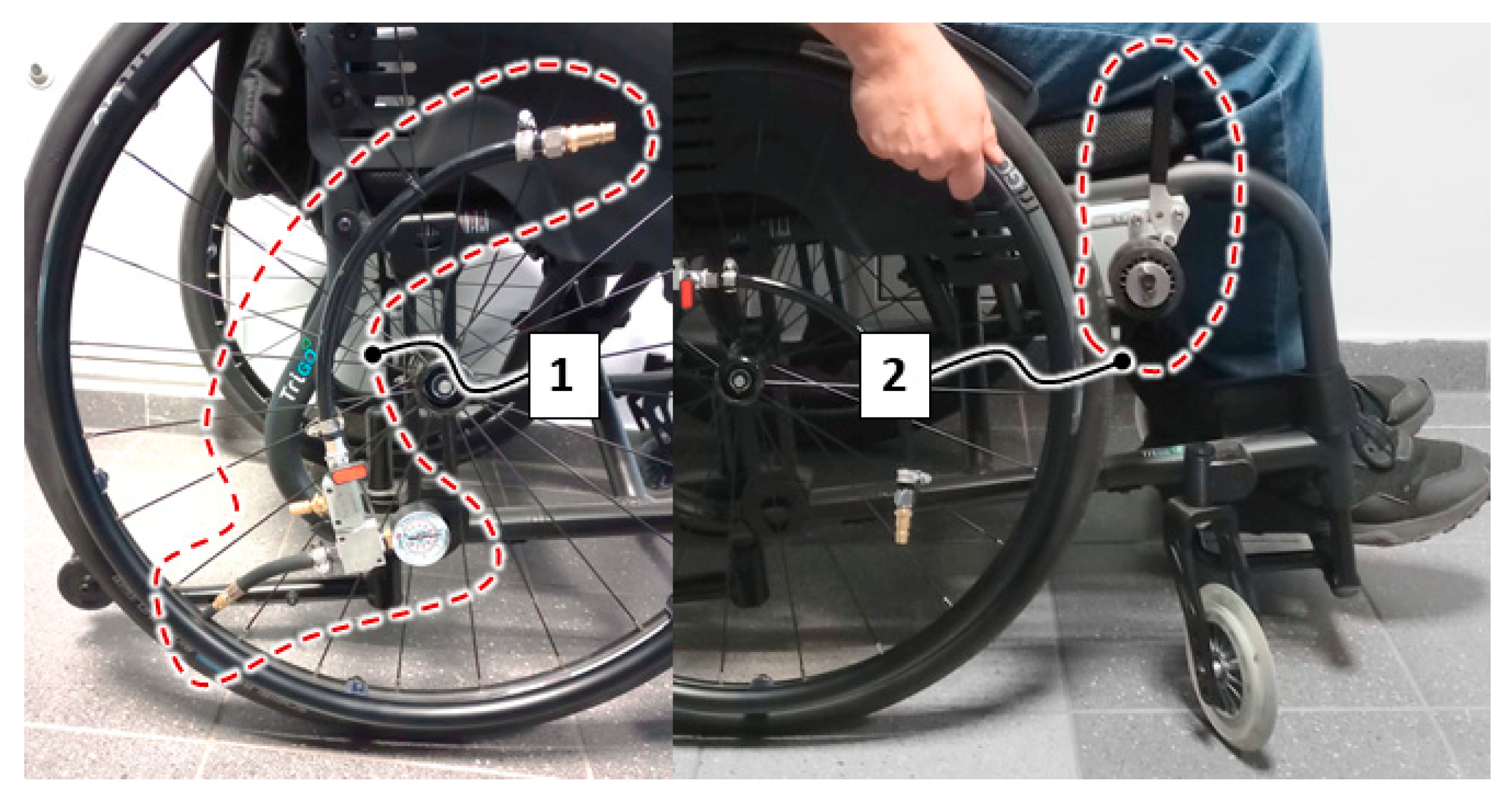
Figure 1. The tested wheelchair with the marked tire pressure control system (1) and the anti-rollback module (2).
Applsci 15 12834 g001
Figure 2. The tested variants of the anti-rollback module, where: (A)—parking brake subjected to modification, (B)—stiff roller (SAR) of the anti-rollback module, (C)—flexible roller (EAR) of the anti-rollback module, (D)—dimensional scheme of the flexible core of the EAR roller.
Applsci 15 12834 g002
Figure 3. Diagram of tire deformation (eT) caused by the pressure of the anti-rollback module roller, where: 1—tire, 2—roller of the anti-rollback module.
Applsci 15 12834 g003
Figure 4. Diagram of the test track with highlighted measurement parameters and the sections where they were recorded. NP—number of push cycles; tPC—duration of a single propulsion cycle; EMGnorm—normalized muscle activity value; CML—normalized cumulative muscle load; PMR—peak-to-mean ratio of the EMGnorm signal, S—start point, SS—slope start point, SE—slope end point, E—end point.
Applsci 15 12834 g004
Figure 5. Schematic representation of the process for obtaining the MVC60% value used for normalization. Pup—peak point on the sequences, PMVC—MVC measurement point, (A)—diagram of hand placement during normalization, (B)—example EMG signal traces for the MVC procedure, (C)—average MVC signal trace for the extracted MVC trials, (D)—mean MVC trace with calculation of the average value and confidence intervals.
Applsci 15 12834 g005
Figure 6. Charts of maximum CML and EMGnorm values for individual muscles (TBM, TBL, ECU, ERC) and the mean value for the entire upper limb (Mean), depending on the type of assistance used during uphill propulsion (NAR, SAR, EAR). Values determined for a sample size of n = 8 and a confidence level of p = 0.05.
Applsci 15 12834 g006
Figure 7. EMG signal waveforms of the ERC muscle as a function of propulsion cycle duration for participant M04, who reported a reduction in physical effort when using the anti-rollback module. (A)—plot of the entire propulsion cycle; (B)—segment of the propulsion cycle showing the increase in muscle tension; α—angle representing the rate of muscle tension rise; NAR—green; EAR—purple; SAR—red.
Applsci 15 12834 g007
Figure 8. EMG signal waveforms of the ERC muscle as a function of propulsion cycle duration for participant M01, who reported an increase in physical effort when using the anti-rollback module. (A)cplot of the entire propulsion cycle; (B)—segment of the propulsion cycle showing the increase in muscle tension; α—angle representing the rate of muscle tension rise; NAR—green; EAR—purple; SAR—red.
Applsci 15 12834 g008
Figure 9. Charts showing the effect of using different anti-rollback module variants (SAR, EAR) and the absence of the module (NAR) on the number of propulsion cycles (NP) required to ascend the test incline and on the duration of a single propulsion cycle (tPC).
Applsci 15 12834 g009
Table 1. Summary of the tested participants, where: BMI—body mass index; MVC—muscle activity value for maximum voluntary contraction; TBM—caput mediale musculi tricipitis brachii; TBL—caput laterale musculi tricipitis brachii; ECU—musculus extensor carpi ulnaris; ERC—musculus extensor carpi radialis.
Patient CodeAge [lata]Height [m]Weight [kg]BMI [kg/m2]MVC [μV]
TBMTBLECUERC
M01281.707526.018.13 ± 7.7658.23 ± 24.18138.17 ± 57.71373.9 ± 134.88
M02361.7310033.440.67 ± 14.64110.88 ± 43.91134.81 ± 39.59212.14 ± 56.50
M03371.769530.749.45 ± 23.2282.75 ± 47.05116.30 ± 110.83437.59 ± 171.73
M04201.735518.4104.44 ± 48.05236.17 ± 109.52130.54 ± 45.81274.60 ± 91.82
M05351.7811034.791.21 ± 59.0082.19 ± 40.97170.27 ± 46.06108.11 ± 32.07
M06331.8011535.552.53 ± 53.5741.36 ± 28.06238.83 ± 140.16299.07 ± 124.65
M07391.867321.125.82 ± 17.3950.14 ± 28.67128.83 ± 55.51223.95 ± 86.12
M08401.807322.549.71 ± 38.2592.86 ± 64.39157.58 ± 93.95202.74 ± 100.84
Mean33.5 ± 5.031.77 ± 0.0587.0 ± 17.6127.79 ± 5.5753.99 ± 24.9494.32 ± 51.67151.92 ± 32.63266.51 ± 87.03
Table 2. Summary of the EMG signal analysis for the tested participants, showing the maximum EMG value (EMGmax) and the rate of increase (α) depending on the wheelchair configuration, where: NAR—without the anti-rollback module; EAR—with the flexible anti-rollback module; SAR—with the stiff anti-rollback module.
Patient CodeMuscleNAREARSARPerceived Effort During the Use of the Anti-Rollback Module
αEMGmaxαEMGmaxαEMGmax
[°][μV][°][μV][°][μV]
M01ERC63.7614971.4319573.332032
M02ERC60.3611777.0512765.011152
M03ERC82.6336481.5537782.613844
M04ERC83.4324082.9623579.782344
M05ERC54.597164.559566.311022
M06ERC66.5412967.0617573.871443
M07TBL73.9717678.4718382.701682
M08TBL75.0617278.8521084.212252
Table 3. Summary of the analysis of the number of push cycles (NP) and the propulsion cycle duration (tPC) depending on the wheelchair configuration, where: NAR—without the anti-rollback module; EAR—with the flexible anti-rollback module; SAR—with the stiff anti-rollback module.
ParameterVariantMeanp = 0.05
Number of push NP [-]NAR13.4[12.89; 13.91]
EAR14.3[13.98; 14.62]
SAR14.4[14.08; 14.72]
Propulsion cycle time tPC [s]NAR1.22[1.16; 1.28]
EAR1.59[1.51; 1.67]
SAR1.39[1.31; 1.47]
Disclaimer/Publisher’s Note: The statements, opinions and data contained in all publications are solely those of the individual author(s) and contributor(s) and not of MDPI and/or the editor(s). MDPI and/or the editor(s) disclaim responsibility for any injury to people or property resulting from any ideas, methods, instructions or products referred to in the content.