
Function-Centered Modeling of Complex Non-Physical Systems: An Exploratory GTST-MLD Application to an Unstructured System for Transformative Change




Featured Application
Abstract
1. Introduction
2. Related Work
2.1. Function-Centered Modeling of Complex Systems
2.2. Integrating GTST-MLD with Transformative Change
2.3. Applications of the GTST-MLD Framework
2.4. Rationale for Selecting GTST-MLD over Existing Pedagogical Modeling Frameworks
3. Materials and Methods
3.1. Research Approach
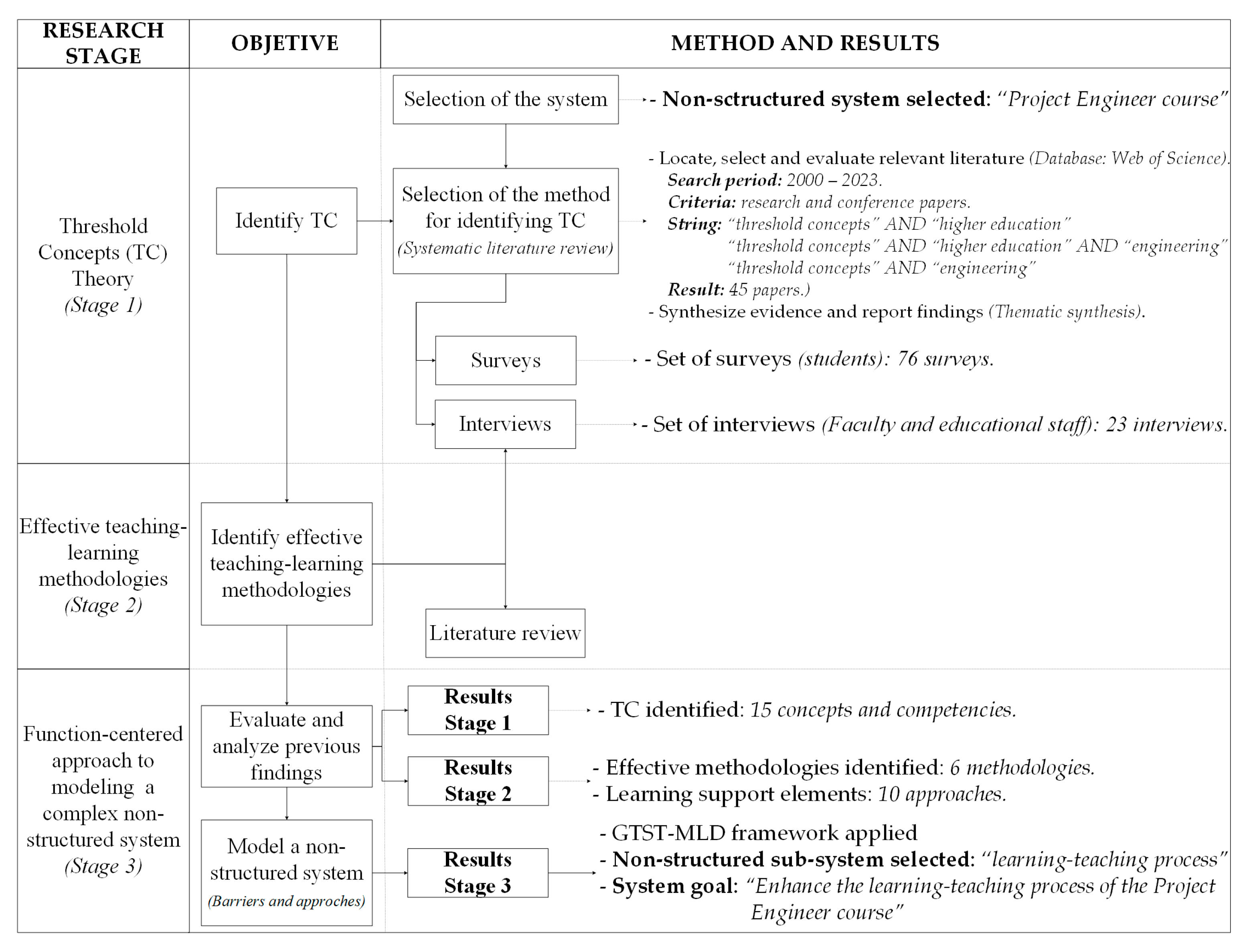
3.1.1. Stage 1. Threshold Concepts Identification
- String 1: TS = (“threshold concept*” AND engineering*)
- String 2: TS = (“threshold concept*” AND “higher education” AND “engineering”)
- String 3: TS = (“threshold concept*” AND “engineering”))
- Section 1: Profile information;
- Section 2: Identification of significant course concepts and justification, concluding with an introduction to TC theory [44];
- Section 4: Reflection on troublesome learning experiences and potential course improvements;
- Section 5: Implementation of TCs in teaching, focusing on tools and mechanisms for their acquisition.
- Section 1: General respondent information;
- Section 2: Open-ended question about important and challenging concepts;
- Section 3: Evaluation of faculty-identified TCs using a seven-point Likert scale, including classification as problematic, transformative, irreversible, or integrative, following [49]. Importantly, the quantitative section included four items directly aligned with the core TCs attributes defined by [45,50] allowing students to evaluate each candidate concept on its characteristic threshold dimensions rather than on perceived difficulty alone.
- Section 4: Course satisfaction and perceptions of the teaching–learning process.
3.1.2. Stage 2. Identification of Effective Teaching–Learning Methodologies
3.1.3. Stage 3. Function-Centered Approach to Modeling an Unstructured System
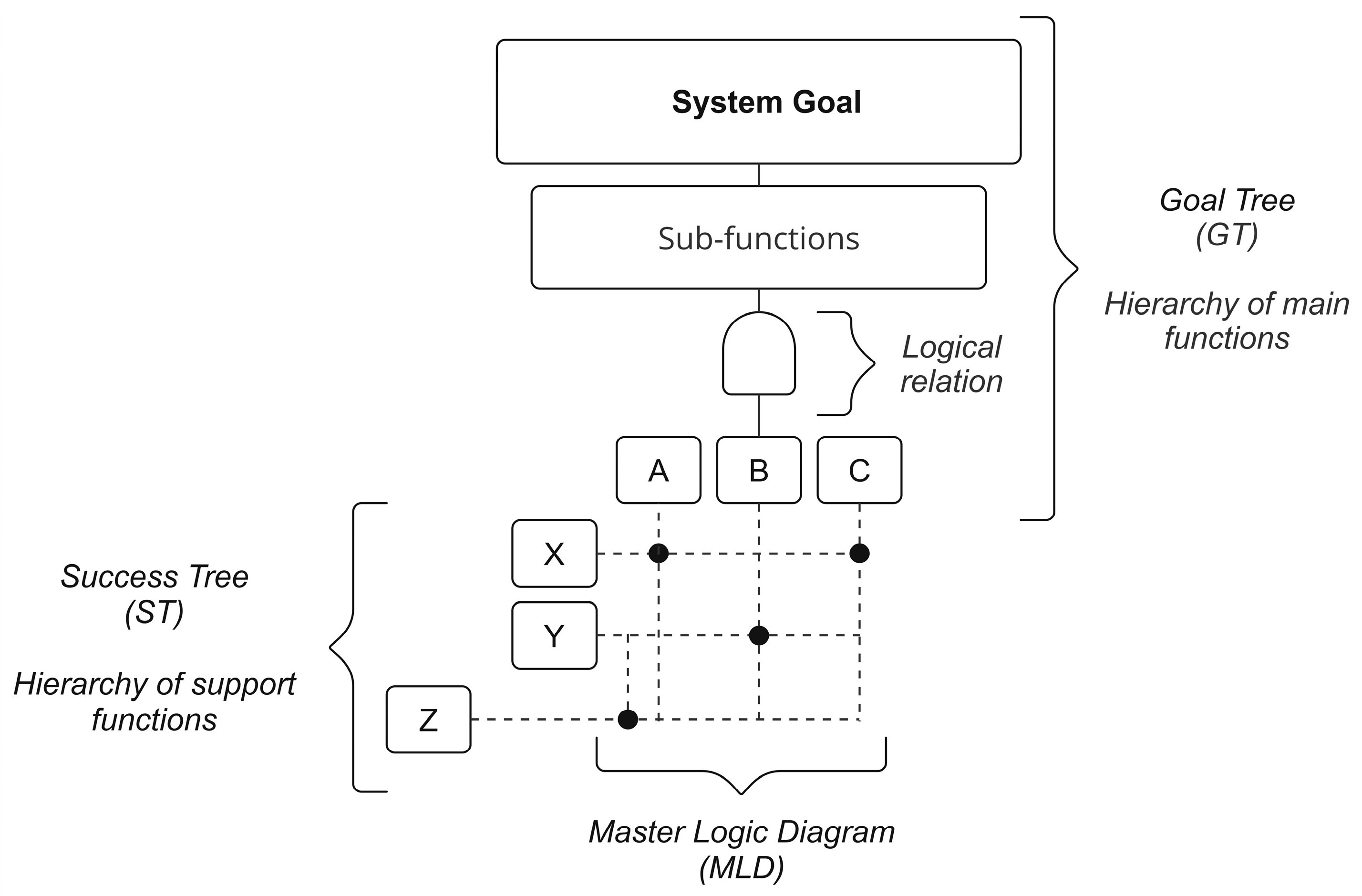
- The GT, which decomposes high-level objectives into sub-functions;
- The ST, which defines the conditions required to achieve these goals.
- System characterization: defining the operational environment of the teaching–learning process.
- System decomposition: identifying the main system goal and key contributing functions [2,4,36]. Decomposition proceeded until further breakdown required material specification, marking the transition to the ST, which detailed basic GT functions. Logical binary input–output relationships represented intra- and inter-tree dependencies [16]. Dependencies between main and support functions were depicted through lattices, with filled dots indicating required elements (e.g., element Y supports function B, while X supports A and C). Mutual dependencies were represented by bidirectional arrows.
- Model synthesis: constructing a conceptual schematic summarizing all components and relationships.
3.2. Data Analysis
4. Results
4.1. Stage 1 Findings: Threshold Concepts Identification
4.2. Stage 2 Findings: Effective Teaching–Learning Approaches
- Relevance: direct contribution to TC assimilation and competency acquisition;
- Replicability: potential to be consistently applied across courses and contexts;
- Adaptability: capacity to scale to different class sizes, formats, and institutional environments.
4.3. Stage 3 Findings: A Function-Centered Approach to Modeling the Teaching–Learning Process
4.3.1. System Description: Environment and Essential Aspects
4.3.2. Goal Tree: Functional Decomposition
- Project-based learning with an approach to professional reality;
- Project Engineering management, developing time planning and budgeting;
- Regulatory management in Project Engineering;
- Understanding professional activity, implications, and responsibilities;
- Drafting and developing engineering projects.
4.3.3. Success Tree: Structural Decomposition
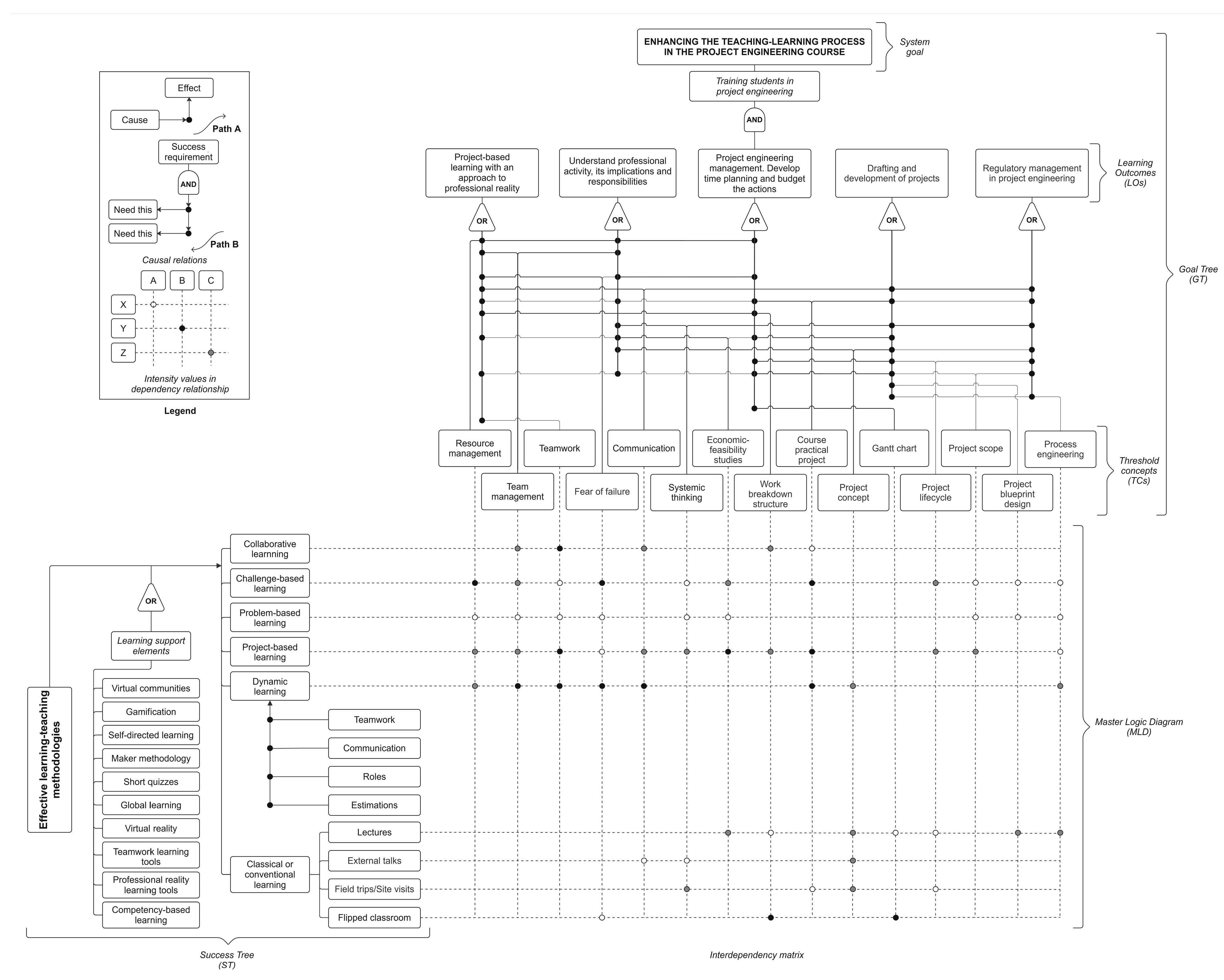
4.3.4. Master Logic Diagram
- Upward (bottom-to-top): tracing how specific teaching methodologies contribute to higher-level learning goals;
- Downward (top-to-bottom): identifying the methods and support mechanisms most effective in facilitating TC assimilation.
4.3.5. The Combined GTST-MLD Framework
- Top-down interpretation: starting from the system’s main goal, enhancing the teaching–learning process, the model decomposes objectives into LOs, TCs, and competencies. Each LO depends on the assimilation of specific TCs and competencies. For instance, in LO(3), Regulatory management in Project Engineering, the essential TCs are process engineering, project scope, project lifecycle, project concept, and course practical project, supported by competencies such as communication and systems thinking. These are connected through OR relationships: while mastering all of them is not mandatory, each additional element contributes incrementally to performance.The top-down analysis therefore clarifies how LOs are achieved by decomposing abstract course goals into tangible, teachable components, facilitating strategic curriculum design and assessment alignment.
- Bottom-up interpretation: conversely, the bottom-up reading begins with a specific methodology, such as CBL, and explores its impact on the system by tracing upward connections. This process reveals why a given method is pedagogically justified and how it contributes to concept mastery. For example, CBL directly supports the assimilation of project concept, systemic thinking, and economic feasibility studies TCs, indirectly influencing the overall LO of drafting and developing projects.This bottom-up view allows instructors to select and combine methodologies according to their relevance, effectiveness, and alignment with intended outcomes. It also promotes evidence-based instructional design by linking micro-level teaching strategies with macro-level system objectives.
5. Discussion
5.1. Theoretical Implications
5.2. Practical Implications
5.3. Implications for Social Complexity and Transformative Change
5.4. Limitations and Further Research
6. Conclusions
Author Contributions
Funding
Institutional Review Board Statement
Informed Consent Statement
Data Availability Statement
Acknowledgments
Conflicts of Interest
Abbreviations
| AI | Artificial Intelligence |
| ABM | Agent-Based Modeling |
| CBL | Case-Based Learning |
| CAS | Complex Adaptive Systems |
| CoL | Collaborative Learning |
| DFD | Dynamic Flow Diagrams |
| FTA | Fault Tree Analysis |
| ETA | Event Tree Analysis |
| EBL | Experiential/Practice-Based Learning |
| FC | Flipped Classroom |
| GT | Goal Tree |
| GTST–MLD | Goal Tree–Success Tree and Master Logic Diagram |
| HE | Higher Education |
| LMS | Learning Management System |
| LO/LOs | Learning Outcome(s) |
| MLD | Master Logic Diagram |
| MFM | Multilevel Flow Modeling |
| PBL | Problem-Based Learning |
| SLR | Systematic Literature Review |
| SSM | Soft Systems Methodology |
| ST | Success Tree |
| TC/TCs | Threshold Concept(s) |
| ToC | Theory of Change |
| UPM | Universidad Politécnica de Madrid |
Appendix A
Appendix A.1

| Node ID | Type | Description |
|---|---|---|
| LO1 | Goal | Drafting and developing engineering projects |
| LO2 | Goal | Time planning and budgeting |
| LO3 | Goal | Regulatory management |
| TC1 | TC | Project scope |
| TC2 | TC | Project lifecycle |
| TC3 | TC | Process engineering |
| TC4 | TC | Economic feasibility |
| TC5 | TC | Course practical project |
| TC6 | TC | Communication |
| TC7 | TC | Teamwork |
| TC8 | TC | Systemic thinking |
| M1 | Methodology | Problem-Based Learning |
| M2 | Methodology | Case-Based Learning |
| M3 | Methodology | Flipped Classroom |
| M4 | Methodology | Experiential/Practice-Based Learning |
| M5 | Methodology | Collaborative Learning |
| S1–S10 | Support Elements | Quizzes, guest lectures, teamwork platforms, etc. |
Appendix A.2
| Edge List (Source-Target) |
|---|
| LO1-TC1 LO1-TC5 LO1-TC8 LO2-TC2 LO2-TC3 LO2-TC7 LO3-TC1 LO3-TC2 LO3-TC3 TC1-M1 TC1-M2 TC2-M1 TC2-M5 TC3-M3 TC3-M1 TC4-M2 TC5-M1 TC5-M5 TC8-M4 |
References
- Ferrario, E.; Zio, E. Goal Tree Success Tree–Dynamic Master Logic Diagram and Monte Carlo simulation for the safety and resilience assessment of a multistate system of systems. Eng. Struct. 2014, 59, 411–433. [Google Scholar] [CrossRef]
- Modarres, M.; Cheon, S.W. Function-centered modeling of engineering systems using the goal tree–success tree technique and functional primitives. Reliab. Eng. Syst. Saf. 1999, 64, 181–200. [Google Scholar] [CrossRef]
- Shallcross, N.J.; Parnell, G.S.; Pohl, E.A.; Specking, E.A. Informing program management decisions using quantitative set-based design. IEEE Trans. Eng. Manag. 2021, 70, 3213–3228. [Google Scholar] [CrossRef]
- Li, Y.-F.; Valla, S.; Zio, E. Reliability assessment of generic geared wind turbines by GTST-MLD model and Monte Carlo simulation. Renew. Energy 2015, 83, 222–233. [Google Scholar] [CrossRef]
- Kezar, A. How Colleges Change: Understanding, Leading, and Enacting Change, 2nd ed.; Routledge: New York, NY, USA, 2018. [Google Scholar] [CrossRef]
- Middlebrooks, A.J.; Connell, T.G.; Vetter, R.T. The Operational Environment Exchange Network: Modeling a complex environment for resilient system design. IEEE Trans. Eng. Manag. 2021, 69, 3952–3967. [Google Scholar] [CrossRef]
- Zwikael, O.; Salmona, M.; Meredith, J.; Zarghami, S.A. Enhancing project stakeholder communication under insufficient knowledge of project management concepts. Eng. Constr. Archit. Manag. 2023, 30, 5007–5029. [Google Scholar] [CrossRef]
- Checkland, P. Systems Thinking. In Rethinking Management Information Systems: An Interdisciplinary Perspective; Currie, W., Galliers, R., Eds.; Oxford University Press: Oxford, UK, 1999; pp. 45–56. [Google Scholar]
- Sayama, H. Introduction to the Modeling and Analysis of Complex Systems; Open SUNY Textbooks: Albany, NY, USA, 2015. [Google Scholar]
- Simon, H.A. The Sciences of the Artificial, 3rd ed.; MIT Press: Cambridge, MA, USA, 2019. [Google Scholar]
- Leveson, N.G. Engineering a Safer World: Systems Thinking Applied to Safety; MIT Press: Cambridge, MA, USA, 2016. [Google Scholar]
- Forrester, J.W. System dynamics, systems thinking, and soft OR. Syst. Dyn. Rev. 1994, 10, 245–256. [Google Scholar] [CrossRef]
- Forrester, J.W. System dynamics—The next fifty years. Syst. Dyn. Rev. 2007, 23, 359–370. [Google Scholar] [CrossRef]
- Lind, M. Functional Modeling of Complex Systems. In Risk Management of Life-Critical Systems; Lind, M., Ed.; Springer: Berlin/Heidelberg, Germany, 2015; pp. 95–113. [Google Scholar] [CrossRef]
- Guo, C.; Gong, S.; Tan, L.; Guo, B. Extended GTST-MLD for aerospace system safety analysis. Risk Anal. 2012, 32, 1060–1071. [Google Scholar] [CrossRef]
- Brissaud, F.; Barros, A.; Bérenguer, C.; Charpentier, D. Reliability analysis for new technology-based transmitters. Reliab. Eng. Syst. Saf. 2011, 96, 299–313. [Google Scholar] [CrossRef]
- Lind, M. An introduction to multilevel flow modeling. Nucl. Saf. Simul. 2011, 2, 22–32. [Google Scholar]
- Chen, L.W.; Modarres, M. Hierarchical decision process for fault administration. Comput. Chem. Eng. 1992, 16, 425–448. [Google Scholar] [CrossRef]
- Courtois, P.-J. On time and space decomposition of complex structures. Commun. ACM 1985, 28, 590–603. [Google Scholar] [CrossRef]
- Di Maio, F.; Mascherona, R.; Wang, W.; Zio, E. Simulation-based Goal Tree Success Tree for the risk analysis of cyber-physical systems. In Proceedings of the 29th European Safety and Reliability Conference (ESREL), Hannover, Germany, 22–26 September 2019; Research Publishing Services: Singapore, 2019; pp. 4122–4129. Available online: https://hdl.handle.net/11311/1159313 (accessed on 1 February 2024).
- Hao, Z.; Di Maio, F.; Zio, E. Dynamic reliability assessment of cyber-physical energy systems by GTST-MLD. In Proceedings of the 5th International Conference on System Reliability and Safety (ICSRS), Palermo, Italy, 24–26 November 2021; IEEE: Palermo, Italy, 2021; pp. 98–102. [Google Scholar] [CrossRef]
- Annaswamy, A.M. Adaptive control and intersections with reinforcement learning. Annu. Rev. Control Robot. Auton. Syst. 2023, 6, 65–93. [Google Scholar] [CrossRef]
- Stork, M.; Pinker, J.; Weissar, P. Adaptive control system for autonomous vehicle path following. In Proceedings of the International Conference on Applied Electronics (AE), Pilsen, Czech Republic, 10–11 September 2019; IEEE: Pilsen, Czech Republic, 2019; pp. 1–4. [Google Scholar] [CrossRef]
- Gil, Y.; Garijo, D.; Khider, D.; Knoblock, C.A.; Ratnakar, V.; Osorio, M.; Shu, L. Artificial intelligence for modeling complex systems: Taming the complexity of expert models to improve decision making. ACM Trans. Interact. Intell. Syst. 2021, 11, 1–49. [Google Scholar] [CrossRef]
- Lakemond, N.; Holmberg, G.; Pettersson, A. Digital transformation in complex systems. IEEE Trans. Eng. Manag. 2021, 71, 192–204. [Google Scholar] [CrossRef]
- Uhl-Bien, M.; Arena, M. Leadership for organizational adaptability: A theoretical synthesis and integrative framework. Leadersh. Q. 2018, 29, 89–104. [Google Scholar] [CrossRef]
- Priyadarshini, P.; Abhilash, P.C. Rethinking of higher education institutions as complex adaptive systems for enabling sustainability governance. J. Clean. Prod. 2022, 359, 132083. [Google Scholar] [CrossRef]
- Koh, G.A.; Askell-Williams, H. Sustainable school-improvement in complex adaptive systems: A scoping review. Rev. Educ. 2021, 9, 281–314. [Google Scholar] [CrossRef]
- Zhou, W.J.; Shen, H.R. Function-oriented risk model for engineering system. Adv. Mater. Res. 2012, 433, 2899–2903. [Google Scholar] [CrossRef]
- Rasmussen, J. The role of hierarchical knowledge representation in decision making and system management. IEEE Trans. Syst. Man Cybern. 1985, 15, 234–243. [Google Scholar] [CrossRef]
- Hu, Y.-S.; Modarres, M. Evaluating system behavior through dynamic master logic diagram (DMLD) modeling. Reliab. Eng. Syst. Saf. 1999, 64, 241–269. [Google Scholar] [CrossRef]
- Ericson, C.A. Hazard Analysis Techniques for System Safety, 2nd ed.; John Wiley & Sons: Hoboken, NJ, USA, 2015. [Google Scholar]
- Modarres, M.; Roush, M.; Hunt, R. Application of goal trees for nuclear power plant hardware protection. In Proceedings of the IEEE International Conference on Reliability and Safety, Brussels, Belgium, 19–23 August 1985; IEEE: Washington, DC, USA, 1985. [Google Scholar]
- Modarres, M. Functional modeling of complex systems with applications. In Proceedings of the Annual Reliability and Maintainability Symposium (RAMS), Washington, DC, USA, 18–21 January 1999; IEEE: Washington, DC, USA, 1999; pp. 418–425. [Google Scholar] [CrossRef]
- Pan, X.; Chen, H.; Shen, A.; Zhao, D.; Su, X. A reliability assessment method for complex systems based on non-homogeneous Markov processes. Sensors 2024, 24, 3446. [Google Scholar] [CrossRef]
- Sabaliauskaite, G.; Adepu, S.; Mathur, A. A six-step model for safety and security analysis of cyber-physical systems. In Proceedings of the 11th International Conference on Critical Information Infrastructures Security (CRITIS 2016), Paris, France, 10–12 October 2016; Springer: Cham, Switzerland, 2017; pp. 189–200. [Google Scholar] [CrossRef]
- Connell, J.P.; Kubisch, A.C. Applying a Theory of Change Approach to the Evaluation of Comprehensive Community Initiatives. In New Approaches to Evaluating Community Initiatives; Fulbright-Anderson, K., Ed.; Aspen Institute: Washington, DC, USA, 1998; pp. 15–46. [Google Scholar]
- Vogel, I. Review of the Use of Theory of Change in International Development; UK Department for International Development: London, UK, 2012.
- Gašević, D.; Dawson, S.; Siemens, G. Let’s not forget: Learning analytics are about learning. TechTrends 2015, 59, 64–71. [Google Scholar] [CrossRef]
- Goldie, J.G.S. Connectivism: A knowledge learning theory for the digital age? Med. Teach. 2016, 38, 1064–1069. [Google Scholar] [CrossRef] [PubMed]
- Ifenthaler, D.; Mah, D.K.; Yau, J.Y.K. Utilizing Learning Analytics for Study Success: Reflections on Current Empirical Findings. In Utilizing Learning Analytics to Support Study Success; Springer International Publishing: Cham, Switzerland, 2019; pp. 27–36. [Google Scholar] [CrossRef]
- McLaughlin, J.A.; Jordan, G.B. Using Logic Models. In Handbook of Practical Program Evaluation; Wholey, J.S., Hatry, H.P., Newcomer, K.E., Eds.; Wiley: Hoboken, NJ, USA, 2015; pp. 62–87. [Google Scholar] [CrossRef]
- Snowden, D.J.; Boone, M.E. A leader’s framework for decision making. Harv. Bus. Rev. 2007, 85, 68–76. [Google Scholar]
- Hendrawati, R.; Mulyani, S.; Wiji, W. A review for threshold concept identification methods in science. J. Phys. Conf. Ser. 2021, 1806, 012192. [Google Scholar] [CrossRef]
- Meyer, J.; Land, R. Threshold Concepts and Troublesome knowledge: Linkages to Ways of Thinking and Practicing. In Improving Student Learning: Theory and Practice Ten Years on; Oxford Centre for Staff and Learning Development: Oxford, UK, 2003. [Google Scholar]
- Nicola-Richmond, K.M.; Pépin, G.; Larkin, H. Transformation from student to occupational therapist: Using the Delphi technique to identify the threshold concepts of occupational therapy. Aust. Occup. Ther. J. 2016, 63, 95–104. [Google Scholar] [CrossRef]
- Page, M.J.; McKenzie, J.E.; Bossuyt, P.M.; Boutron, I.; Hoffmann, T.C.; Mulrow, C.D.; Alonso-Fernández, S. Declaración PRISMA 2020: Una guía actualizada para la publicación de revisiones sistemáticas. Rev. Esp. Cardiol. 2021, 74, 790–799. [Google Scholar] [CrossRef] [PubMed]
- Nicola-Richmond, K.; Pépin, G.; Larkin, H.; Taylor, C. Threshold concepts in higher education: A synthesis of the literature relating to measurement of threshold crossing. High. Educ. Res. Dev. 2018, 37, 101–114. [Google Scholar] [CrossRef]
- Beitelmal, W.H.; Littlejohn, R.; Okonkwo, P.C.; Hassan, I.U.; Barhoumi, E.M.; Khozaei, F.; Hassan, A.M.; Alkaaf, K.A. Threshold Concepts Theory in Higher Education—Introductory Statistics Courses as an Example. Educ. Sci. 2022, 12, 748. [Google Scholar] [CrossRef]
- Meyer, J.H.F.; Land, R. Threshold concepts and troublesome knowledge (2): Epistemological considerations and a conceptual framework for teaching and learning. High. Educ. 2005, 49, 373–388. [Google Scholar] [CrossRef]
- Booth, A.; James, M.-S.; Clowes, M.; Sutton, A. Systematic Approaches to a Successful Literature Review, 3rd ed.; SAGE Publications: London, UK, 2021. [Google Scholar]
- Male, S.; Baillie, C. Threshold capabilities: An emerging methodology to locate curricula thresholds. In Proceedings of the Research in Engineering Education Symposium 2011, Madrid, Spain, 4–7 October 2011; pp. 907–957. [Google Scholar]
- Salinas-Navarro, D.E.; Garay-Rondero, C.L. Requirements of challenge-based learning for experiential learning spaces: An industrial engineering application case. In Proceedings of the 2020 IEEE International Conference on Teaching, Assessment, and Learning for Engineering (TALE), Takamatsu, Japan, 8–11 December 2020; IEEE: Piscataway, NJ, USA, 2020; pp. 1–8. [Google Scholar] [CrossRef]
- Quinlan, K.M.; Male, S.; Baillie, C.; Stamboulis, A.; Fill, J.; Jaffer, Z. Methodological challenges in researching threshold concepts: A comparative analysis of three projects. High. Educ. 2013, 66, 585–601. [Google Scholar] [CrossRef]
- Ghani, A.S.A.; Rahim, A.F.A.; Yusoff, M.S.B.; Hadie, S.N.H. Effective learning behavior in problem-based learning: A scoping review. Med. Sci. Educ. 2021, 31, 1199–1211. [Google Scholar] [CrossRef]
- Hartikainen, S.; Rintala, H.; Pylväs, L.; Nokelainen, P. The concept of active learning and the measurement of learning outcomes: A review of research in engineering higher education. Educ. Sci. 2019, 9, 276. [Google Scholar] [CrossRef]
- Aji, C.A.; Khan, M.J. The impact of active learning on students’ academic performance. Open J. Soc. Sci. 2019, 7, 204–211. [Google Scholar] [CrossRef]
- Passarelli, A.M.; Kolb, D.A. Using Experiential Learning Theory to Promote Student Learning and Development in Programs of Education Abroad. In Student Learning Abroad; Routledge: New York, NY, USA, 2023; pp. 137–161. [Google Scholar]
- Savery, J.R. Comparative Pedagogical Models of Problem-Based Learning. In The Wiley Handbook of Problem-Based Learning; Moallem, M., Hung, W., Dabbagh, N., Eds.; Wiley: Hoboken, NJ, USA, 2019; pp. 81–104. [Google Scholar] [CrossRef]
- Aljawarneh, S.A. Reviewing and exploring innovative ubiquitous learning tools in higher education. J. Comput. High. Educ. 2020, 32, 57–73. [Google Scholar] [CrossRef]
- Lavado-Anguera, S.; Velasco-Quintana, P.-J.; Terrón-López, M.-J. Project-Based Learning (PBL) as an Experiential Pedagogical Methodology in Engineering Education: A Review of the Literature. Educ. Sci. 2024, 14, 617. [Google Scholar] [CrossRef]
- Ghannam, R.; Chan, C. Teaching undergraduate students to think like real-world systems engineers: A technology-based hybrid learning approach. Syst. Eng. 2023, 26, 728–741. [Google Scholar] [CrossRef]
- Wut, T.; Wong, H.S.-M.; Sum, C.K.-M.; Chan, E.A.-H. Does institution support matter? Blended learning approach in the higher education sector. Educ. Inf. Technol. 2024, 29, 15133–15145. [Google Scholar] [CrossRef]
- Garcia, R.; Treude, C.; Valentine, A. Application of collaborative learning paradigms within software engineering education: A systematic mapping study. In Proceedings of the 55th ACM Technical Symposium on Computer Science Education (SIGCSE 2024), Portland, OR, USA, 20–23 March 2024; ACM: New York, NY, USA, 2024; pp. 366–372. [Google Scholar] [CrossRef]
- Zhan, Z.; Tong, Y.; Lan, X.; Zhong, B. A systematic literature review of game-based learning in artificial intelligence education. Interact. Learn. Environ. 2024, 32, 1137–1158. [Google Scholar] [CrossRef]
- Mehrotra, A.; Giang, C.; El-Hamamsy, L.; Guinchard, A.; Dame, A.; Zahnd, G.; Mondada, F. Accessible maker-based approaches to educational robotics in online learning. IEEE Access 2021, 9, 96877–96889. [Google Scholar] [CrossRef]
- Magana, A.J.; de Jong, T. Modeling and simulation practices in engineering education. Comput. Appl. Eng. Educ. 2018, 26, 731–738. [Google Scholar] [CrossRef]
- Morris, T.H. Self-directed learning: A fundamental competence in a rapidly changing world. Int. Rev. Educ. 2019, 65, 633–653. [Google Scholar] [CrossRef]
- O’Flaherty, J.; Phillips, C. The use of flipped classrooms in higher education: A scoping review. Internet High. Educ. 2015, 25, 85–95. [Google Scholar] [CrossRef]
- Castedo, R.; López, L.M.; Chiquito, M.; Navarro, J.; Cabrera, J.D.; Ortega, M.F. Flipped classroom—Comparative case study in engineering higher education. Comput. Appl. Eng. Educ. 2019, 27, 206–216. [Google Scholar] [CrossRef]
- Zhang, L.; Ma, Y. A study of the impact of project-based learning on student learning effects: A meta-analysis study. Front. Psychol. 2023, 14, 1202728. [Google Scholar] [CrossRef]
- Theobald, E.J.; Hill, M.J.; Tran, E.; Agrawal, S.; Arroyo, E.N.; Behling, S.; Freeman, S. Active learning narrows achievement gaps for underrepresented students in undergraduate STEM. Proc. Natl. Acad. Sci. USA 2020, 117, 6476–6483. [Google Scholar] [CrossRef]
- Hernández-de-Menéndez, M.; Vallejo Guevara, A.; Tudón Martínez, J.C.; Hernández Alcántara, D.; Morales-Menendez, R. Active learning in engineering education: A review of fundamentals, best practices and experiences. Int. J. Interact. Des. Manuf. 2019, 13, 909–922. [Google Scholar] [CrossRef]
- Ouyang, F.; Wu, M.; Zheng, L.; Zhang, L.; Jiao, P. Integration of AI performance prediction and learning analytics to improve student learning in online engineering course. Int. J. Educ. Technol. High. Educ. 2023, 20, 4. [Google Scholar] [CrossRef] [PubMed]
- Matcha, W.; Uzir, N.A.A.; Gašević, D.; Pardo, A. A systematic review of empirical studies on learning analytics dashboards: A self-regulated learning perspective. IEEE Trans. Learn. Technol. 2019, 13, 226–245. [Google Scholar] [CrossRef]
- Boisot, M.; McKelvey, B. Integrating modernist and postmodernist perspectives on organizations: A complexity science bridge. Acad. Manag. Rev. 2010, 35, 415–433. [Google Scholar] [CrossRef]
- Schulze, J.H.; Pinkow, F. Leadership for organisational adaptability: How enabling leaders create adaptive space. Adm. Sci. 2020, 10, 37. [Google Scholar] [CrossRef]
- Yu, Y.; Lakemond, N.; Holmberg, G. AI in the context of complex intelligent systems: Engineering management consequences. IEEE Trans. Eng. Manag. 2023, 71, 6512–6525. [Google Scholar] [CrossRef]


| TC | Name | Operational Definition | Transformative | Integrative | Troublesome | Irreversible |
|---|---|---|---|---|---|---|
| TC1 | Project Scope | Understanding boundaries, stakeholders, deliverables | Yes | Yes | Yes | Yes |
| TC2 | Project Lifecycle | Phases, gates, transitions | Yes | Yes | Yes | No |
| TC3 | Process Engineering | Flows, transformations, interdependencies | Yes | Yes | Yes | Yes |
| TC4 | Economic Feasibility | Cash flow, VAN/TIR, CAPEX/OPEX | Yes | Yes | Yes | Yes |
| TC5 | Project Plan | WBS, Gantt, precedence | Yes | Yes | Yes | No |
| TC6 | Risk Management | Probability, impact, mitigation | Yes | Yes | Yes | Yes |
| TC7 | Regulatory Constraints | Normative compliance | Yes | No | Yes | Yes |
| TC8 | Systemic Thinking | Holistic interactions | Yes | Yes | Yes | Yes |
| TC9 | Requirements Engineering | Functional vs. non-functional requirements | Yes | Yes | Yes | No |
| TC10 | Sustainability Integration | Environmental, social, economic constraints | Yes | Yes | Yes | Yes |
| TC11 | Teamwork | Coordination dynamics | Yes | No | Yes | Yes |
| TC12 | Communication | Technical and managerial communication | Yes | No | Yes | Yes |
| TC13 | Safety and Risk Regulations | Safety factors, compliance | Yes | Yes | Yes | Yes |
| TC14 | Iterative Design | Iteration, prototyping | Yes | Yes | Yes | Yes |
| TC15 | Practical Engineering | Constraints Real-world material/technical limits | Yes | Yes | Yes | Yes |
Disclaimer/Publisher’s Note: The statements, opinions and data contained in all publications are solely those of the individual author(s) and contributor(s) and not of MDPI and/or the editor(s). MDPI and/or the editor(s) disclaim responsibility for any injury to people or property resulting from any ideas, methods, instructions or products referred to in the content. |
© 2025 by the authors. Licensee MDPI, Basel, Switzerland. This article is an open access article distributed under the terms and conditions of the Creative Commons Attribution (CC BY) license (https://creativecommons.org/licenses/by/4.0/).
Share and Cite
Uribe, D.F.; García-Galán, R.; Ortiz-Marcos, I.; Rodríguez-Rivero, R. Function-Centered Modeling of Complex Non-Physical Systems: An Exploratory GTST-MLD Application to an Unstructured System for Transformative Change. Appl. Sci. 2025, 15, 12830. https://doi.org/10.3390/app152312830
Uribe DF, García-Galán R, Ortiz-Marcos I, Rodríguez-Rivero R. Function-Centered Modeling of Complex Non-Physical Systems: An Exploratory GTST-MLD Application to an Unstructured System for Transformative Change. Applied Sciences. 2025; 15(23):12830. https://doi.org/10.3390/app152312830
Chicago/Turabian StyleUribe, Diego F., Ramiro García-Galán, Isabel Ortiz-Marcos, and Rocío Rodríguez-Rivero. 2025. "Function-Centered Modeling of Complex Non-Physical Systems: An Exploratory GTST-MLD Application to an Unstructured System for Transformative Change" Applied Sciences 15, no. 23: 12830. https://doi.org/10.3390/app152312830
APA StyleUribe, D. F., García-Galán, R., Ortiz-Marcos, I., & Rodríguez-Rivero, R. (2025). Function-Centered Modeling of Complex Non-Physical Systems: An Exploratory GTST-MLD Application to an Unstructured System for Transformative Change. Applied Sciences, 15(23), 12830. https://doi.org/10.3390/app152312830