

Article

Condition Assessment of Road Markings in Denmark, Norway and Sweden—A Comparison Between Retroreflectivity, Visibility and Preview Time

The Swedish National Road and Transport Research Institute (VTI), SE-581 95 Linköping, Sweden
*
Author to whom correspondence should be addressed.
Appl. Sci. 2025, 15(23), 12788; https://doi.org/10.3390/app152312788
Submission received: 23 October 2025 / Revised: 24 November 2025 / Accepted: 26 November 2025 / Published: 3 December 2025
(This article belongs to the Special Issue Road Markings: Technologies, Materials, and Traffic Safety)

Abstract

Longitudinal road markings provide visual guidance for drivers and are essential for safe driving, particularly at night. The aim of this study is to investigate possible differences in road marking performance, with regard to retroreflectivity, visibility and preview time between Denmark, Norway and Sweden. The results are compared to current recommendations and regulations regarding road marking performance in the three countries. This study is based on condition assessments of 30,000 km of edge road markings from 2017 to 2021. The results showed that the performance requirement fulfillment for retroreflectivity of white road markings (150 mcd/m2/lx) is 38% in Denmark, 65% in Norway and 66% in Sweden. No large differences in dry road marking performance were found between the three countries. The performance regarding all variables was rather stable during the five years investigated. The mean preview time was 4.7 s in Sweden, 4.9 s in Norway and 5.6 s in Denmark. The observed preview times are higher than the recommended minimum preview times (ranging from 1.8 to 3.65 s) found in the literature. The results do not raise any need for revision of the current regulations regarding road marking retroreflectivity and geometry in Denmark, Norway and Sweden.

1. Introduction

Longitudinal road markings provide visual guidance for drivers and are essential for safe driving, particularly at night. In daylight, road markings are visible from their white (or sometimes yellow) color, while at night, the visibility is determined by the retroreflective properties of the road marking material and by the geometry of the marking [1,2]. Adequate requirements on minimum performance levels and regular condition surveys are important to maintain sufficient function of the road markings.
Road markings also play an important role in enhancing traffic safety. They help guide drivers, improve lane discipline and increase overall awareness on the road, especially in challenging conditions such as darkness or bad weather. Several international studies have shown positive traffic safety effects from road markings. Most of these are before-and-after studies, where roads previously lacking markings were equipped with them. A meta-analysis reported a reduction in injury crashes when previously unmarked roads were provided with both edge and center lines [3]. A positive effect on single-vehicle crashes from profiled edge markings was also found. An updated meta-analysis [4] concluded that edge lines on two-lane rural roads reduce the risk of accidents by an average of 6%, and that the effect is further enhanced when the lines are wider or have good retroreflectivity. A literature review found that although previous studies on the impact of road marking retroreflectivity on crash occurrence have yielded inconclusive results, the consensus is that higher retroreflectivity positively contributes to road safety [5]. This is also supported by [4], where a meta-analysis showed that increased retroreflectivity in longitudinal road markings is associated with a 10% reduction in total accidents. As road markings are exposed to persistent wear from tires and from weather, function declines over time. On high-traffic roads and in areas where studded tires and winter maintenance are present, the decline can be rapid, which requires frequent maintenance. Consequently, the costs for road marking maintenance can be high. For road authorities, it is important to have knowledge and understanding of the relationships between the measurable properties of the road markings and how they are perceived by the drivers in terms of visibility. This understanding is essential for making cost-efficient and balanced decisions regarding performance requirements, especially considering how visibility relates to factors such as driver behavior and traffic safety.
The visibility distance of road markings is influenced by several external factors, such as the vehicle lighting, the visual ability of the driver, the presence of glare (e.g., from oncoming vehicles), the curvature of the road, and the weather conditions [1]. The preview time, i.e., the time it takes to drive the distance that corresponds to the visibility distance, depends on the driving speed. To determine the visibility distance and the preview time from measurable physical properties and in various conditions, a computational model is needed. One such model is the COST 331 model, which was developed in a European project in the 1990s [1]. Other models for this purpose are the CARVE model [6] and its successor, the TarVIP model [7].
Although there is research on road marking visibility in relation to, for example, line width [8,9], line configuration (continuous vs. broken line) [1] and retroreflectivity [10,11], which are often assessed in controlled experiments on test tracks, less is known about the condition of road markings on real roads and on how the condition compares to national regulations and requirements. A Croatian case study, where the properties of newly applied road markings were assessed over two decades, pinpoints the importance of supervision (performance measurements) and the lack of research in this area [12].
In 2015, a Nordic certification system for road marking materials was introduced, which implies that public purchasers can set requirements on product quality in their procurements and contracts [13]. Requirements on certified road marking materials have been successively introduced by the national road authorities in the Nordic countries since 2017. Parallel to the introduction of the certification system, a five-year Nordic project called ROMA was carried out to assess the condition of the road markings and to investigate possible differences between Denmark, Norway and Sweden [14]. The project focused mainly on the retroreflectivity of the road markings, while visibility was presented in a simplified way as the visibility model COST 331, which is applied in the Nordic countries, was under revision.
In this paper, the revised COST 331 model is used, which has been updated with a new model for vehicle lighting to better reflect the lighting of today’s cars [15], to further investigate the visual properties of road markings in Denmark, Norway and Sweden, using the large dataset collected in the ROMA project. In particular, differences in road marking visibility and preview time that are due to differences in policies and regulations on road marking geometry and speed limits in the three countries are demonstrated.

Aim

The aim of this study is to investigate possible differences in road marking performance between Denmark, Norway and Sweden. Road marking performance is studied on right-edge road markings through retroreflectivity, visibility and preview time. The road marking visibility is of special interest, as Sweden uses broken edge lines to a larger extent than Denmark and Norway. Possible differences between road marking performance, dependent on country, type of road and AADT (Annual Average Daily Traffic), are investigated based on data from the years 2017 to 2021. A comparison between the TEN-T and the non-TEN-T road network is also made. The results are compared to current recommendations and regulations regarding road marking performance in the three countries.

2. Materials and Methods

This study is based on physical mobile road marking condition assessments carried out in 2017, 2018, 2019, 2020 and 2021 in Denmark, Norway and Sweden by Ramboll. A more detailed description of materials and methods can be found in [14].

2.1. Measured Objects

A road object is defined as a 10 km road section that is homogeneous with respect to road number, type of road (two-lane or multi-lane road), and traffic flow (AADT). In every two-lane road object, the two edge lines and the center line (if any) are measured. On multi-lane roads, the right-edge line is measured in one direction, the left-edge line in the opposite direction, and one lane line in any direction. In total, one road object includes two or three measured road markings with a total length of about 30 km; see Figure 1. In this study, only right-edge lines are studied, which means that on two-lane roads, both edge lines are included, while on multi-lane roads, only the edge line in one (random) direction is included.
The roads studied are classified into four different road classes defined according to Table 1. In every country, region and road class, measurements are carried out on at least five road objects per year.
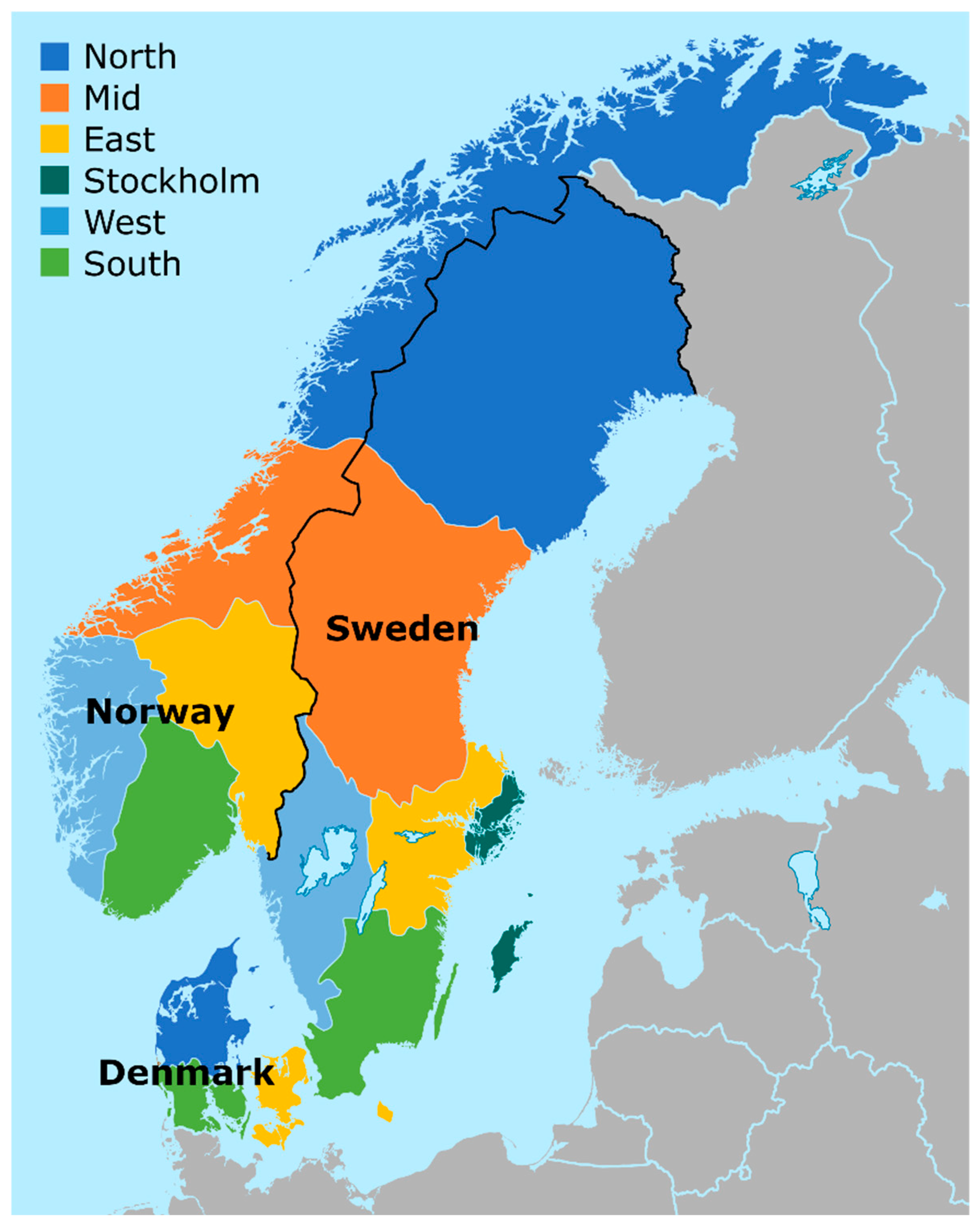
To avoid selection biases, the selection of road objects to measure in each country was randomly performed from all available roads in each road class and region (see Figure 2). The distribution over regions ensures that the data will cover all parts of the countries. This study considers permanent road markings only. If it was not possible to measure the randomly selected road object, the site was moved to the nearest possible site on the same road within the same road class.
Denmark is divided into three regions (South, East and North), Norway into five regions (South, West, East, Mid and North), and Sweden into six (South, East, West, Stockholm, Mid and North); see Figure 2. In Denmark and Sweden all permanent road markings are white, while in Norway the permanent edge lines on two-lane roads are white and the centerline is yellow. On multi-lane roads, the permanent right-edge lines and lane lines are white, while the permanent left-edge lines are yellow. To avoid differences due to the color of road markings, this study focuses only on right-edge road markings, i.e., only white road markings. In total (2017–2021), 448 right-edge road markings were studied in Denmark, 761 in Norway, and 1875 in Sweden; see Table 2. In total, approximately 30,000 km of road markings were investigated.
The roads measured differ regarding road marking area and speed limits. The area of the road marking (m2) refers to a 60 m long section of the road and is calculated based on the measured width and effective length of the road marking. The effective length refers to the actual road marking length within the 60 m section (for continuous lines the effective length is 60 m, while broken lines have an effective length of less than 60 m) and is based on country standards [14]. Speed limits for the road objects investigated were obtained from the national road authorities in the respective countries.
Most road markings in Denmark, Norway and Sweden consist of extruded thermoplastics. Paint is sometimes used on minor roads in Norway and Sweden. The wear is relatively high due to winter maintenance and use of studded tires, particularly in the northern parts of Norway and Sweden. The maintenance interval ranges from one to more than ten years, depending on, e.g., traffic volume.

2.2. Measurements and Data

The measurements were performed at speed with Ramboll’s mobile measurement system for physical inspection of road markings, RMT, and according to the Swedish-issued method statement described in TDOK 2013:0461_v2, which includes an annual third-party validation of accuracy and precision [16]. The measurement equipment used was identical in the three countries and throughout the five years.
For registration of the retroreflectivity of dry road markings (RL), a reflectometer of type LTL-M (Delta, Denmark) was used. The reflectometer sends out visible light, which will resemble vehicle lighting, and measures how much light is reflected back to the instrument. The equipment has a stated reproducibility of ±5%, and it was calibrated according to the operator’s internal routines.
The measurements were carried out on dry road markings during the following time periods each year within the project:
  • Denmark: 15 April–1 October.
  • Sweden: 15 May (starting in the south)–1 October.
  • Norway: 15 June (starting in the south)–1 October.
Sections with newly installed pavement or dirty road markings were excluded. In case the road marking was worn and no retroreflectivity data could be collected, a standard minimum value of 40 mcd/m2/lx was inserted.

2.3. Variables

The dependent variables analyzed in this study are retroreflectivity, visibility and preview time (pvt) of dry road markings. A brief description of the variables follows below:

2.3.1. Retroreflectivity

The coefficient of retroreflected luminance, RL, represents the brightness of a road marking in darkness as seen by drivers of vehicles under the illumination of the driver’s own headlamps. It is measured in the direction of traffic and is expressed in mcd/m2/lx; see European Standard EN 1436:2018 [17]. The performance requirement in Denmark, Norway and Sweden for retroreflectivity of white road markings is 150 mcd/m2/lx.

2.3.2. Visibility

Visibility is the longest distance at which a road marking in darkness is visible to a driver when illuminated by the headlamps of the vehicle (m). Visibility is calculated by the revised COST 331 model and is dependent on the properties of the road marking (the retroreflectivity and the area), the vehicle type, the headlamp type, the age of the driver, and some environmental factors (e.g., curvature, ambient light) [1,15]. Visibility was determined for each road object from the measured average retroreflectivity and the observed area of the object, and with fixed values for all other parameters, according to the following factors:
  • Driver age: 60 years;
  • Vehicle type: passenger car;
  • Vehicle light distribution: low-beam, 75th percentile of the revised light distribution;
  • Retroreflectivity of the road surface: 15 mcd/m2/lx;
  • Position of road marking: 1.75 m to the right of the vehicle’s center line;
  • No veiling luminance or other light sources;
  • Visibility level (VL): 6.5.
The selected values are based on a previous study that was carried out to validate the revised COST 331 model [18]. In that study, 60-year-old drivers assessed the visibility distance of nine edge lines with different retroreflectivities while sitting in a car (a new mid-size non-premium passenger car) with a low-beam illumination that corresponded to the 75th percentile of the revised low-beam light distribution. A visibility Level (VL), which is a threshold for what is regarded as visible, of approximately 6.5 gave the best fit to the experimental data.

2.3.3. Preview Time

Preview time (pvt) is defined as the time it takes to drive the distance that corresponds to the visibility distance (see Section 2.3.2) at a speed that corresponds to the speed limit.
The speed limit used in this study is defined as the main speed limit over the distance of the road object. For instance, if 7 km of the road object has a speed limit of 90 km/h and 3 km has 70 km/h, the speed limit for calculation of pvt is set to 90 km/h. An alternative speed limit to use in the analyses would be the mean speed limit over the measured road section. Overall, the mean difference between the mean speed limit and the mean speed limit is rather small, about 2 km/h higher for the mean speed limit.

2.4. Statistical Analyses

For all variables (retroreflectivity, visibility and preview time), the results are analyzed and compared between the three countries (Denmark, Norway and Sweden), four road classes (2L low, 2L high, MW low, MW high) and five years (2017–2021).
The analyses are made using analysis of variance, ANOVA [19]. The dependent variables (Y) are retroreflectivity, visibility and preview time (pvt) of dry road markings. The factors considered in the model are country, year and road class, and the model is specified in (1):
Yijk = μ + αi + βj + θk + αβij + αθik + βθjk + εijk,
where µ is the mean effect and ɛ is an error term and
  • αi = country (Denmark, Norway, Sweden);
  • βj = year (2017, 2018, 2019, 2020, 2021);
  • θk = road class (2 L low, 2 L high, MW low, MW high).
The interaction effects in the model reflect that there might be a different development of the dependent variable between countries, year and road classes. Only 2-way interactions are considered. The mean levels estimated are estimated marginal means and are therefore adjusted for imbalance in the design.
If a factor of interest is shown to be significant in the ANOVA analysis, pairwise comparisons between different levels of the factor are made. The comparisons are based on the estimated marginal means, which compensate for an unbalanced design if that is the case. The Bonferroni adjustment for multiple comparisons is used. All significant tests are carried out at a 5% risk level.

3. Results

The results of the performance of road markings in Denmark, Norway and Sweden during 2017–2021 are presented below. Additionally, a comparison between the TEN-T and the non-TEN-T is made. All results refer to right-edge road markings only.
The performance requirement in Denmark, Norway and Sweden for retroreflectivity of white road markings is 150 mcd/m2/lx. In Table 3, the percentage of road markings within various levels of retroreflectivity is shown. The figures are based on all right-edge road markings and on total measured road marking length. In Denmark, Norway and Sweden, the share of measured road markings that meet the requirement is 38%, 65% and 66%, respectively. The corresponding shares with a level of retroreflectivity below 80 mcd/m2/lx are 2%, 5% and 1%.

3.1. Mean Performance per Country, Year and Road Class

The mean performance of retroreflectivity, visibility and preview time is studied by an analysis of variance (ANOVA). Results from the ANOVA are shown in Table 4. For retroreflectivity and visibility, there is a significant difference between country, year and road class, as well as for some interaction effects. For preview time, there is a significant difference between country and road class, but not for year.
In Table 5, the mean level and standard error per country from the ANOVA are shown for retroreflectivity, visibility and preview time of all right-edge road markings. The mean levels are estimated marginal means and adjusted for imbalance in the design. The mean levels are compared between countries, and a Bonferroni adjustment for multiple comparisons is made in Table 6. Regarding retroreflectivity, Norway has the highest value, closely followed by Sweden, while Denmark has the lowest value. The differences between Denmark and the other two countries are significant. Looking at visibility gives a different picture where Norway and Denmark have significantly longer visibility than Sweden. Finally, preview time shows that Norway has a longer preview time than both Sweden and Denmark and also that Denmark has a longer preview time than Sweden (significant at the 0.05 level).
In Table 7, mean level and standard error per year from the ANOVA are shown for retroreflectivity, visibility and preview time. Considering retroreflectivity, the values are rather stable over the years; it is only 2020 that significantly differs from the other years. For visibility, the pattern is the same; 2020 has significantly higher values than 2017, 2018 and 2019, but the difference between 2020 and 2021 is not significant. For preview time, there are no significant differences between the years. It can be noted that 2020 was in the middle of the pandemic, and therefore the traffic pattern might be different for this year. This is, however, difficult to quantify.
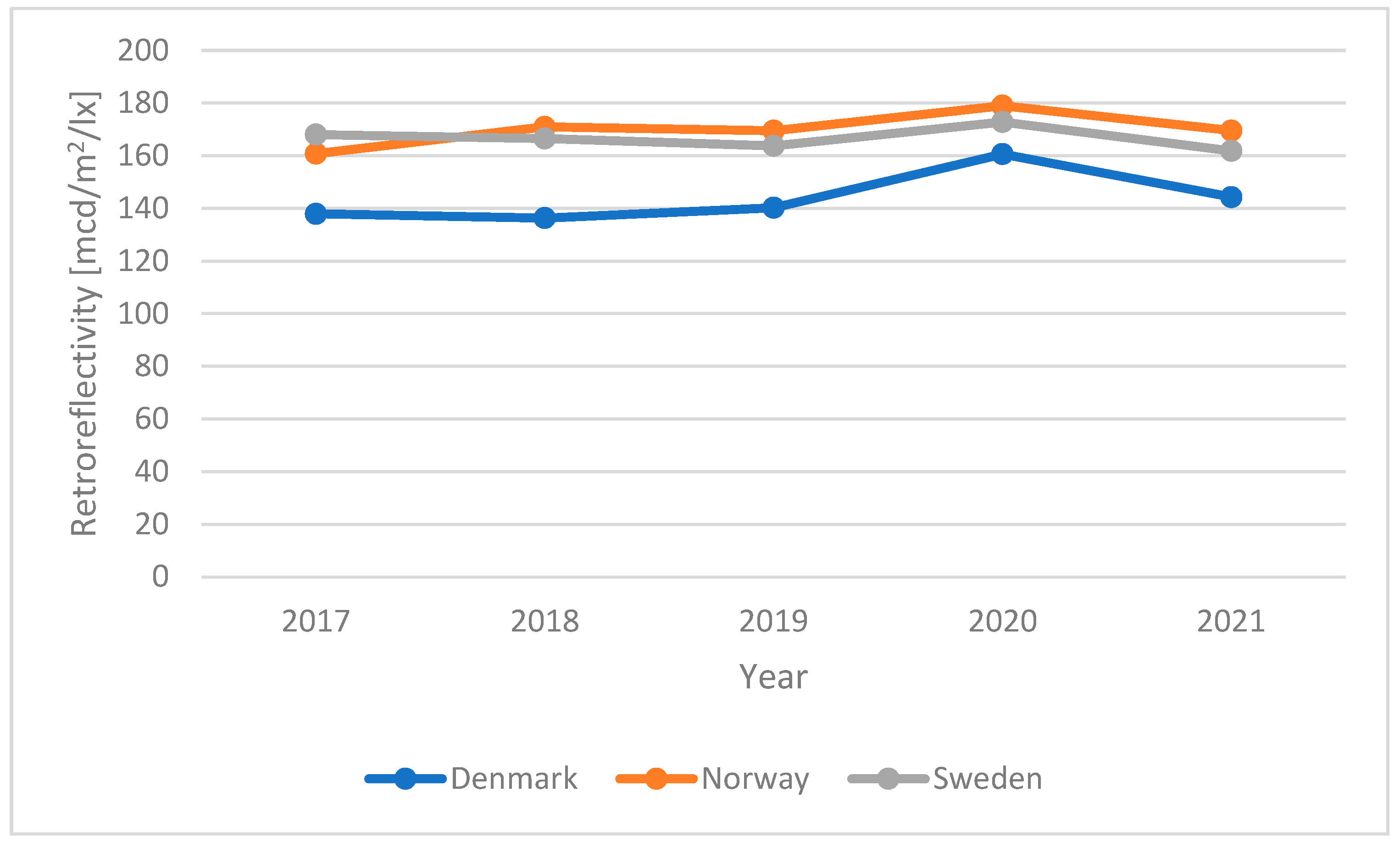
In Figure 3, a comparison of retroreflectivity between 2017 and 2021 for Denmark, Norway and Sweden is shown. The pattern is rather similar between countries, with a significantly higher value in 2020.

3.2. Mean Performance per Country and Road Class

In Table 8, mean levels and standard errors of retroreflectivity, visibility and preview time for Denmark, Norway and Sweden and road class are shown. Mean differences between road classes for each variable and country are shown in Appendix A.
In Denmark, retroreflectivity on two-lane roads with low traffic volumes is significantly higher than on motorways (both high and low traffic volumes), while in Norway, there are no significant differences regarding retroreflectivity between road classes. In Sweden, all differences between road classes are significant except between motorways with high traffic volumes and two-lane roads with high traffic volumes.
Looking at visibility, the pattern is somewhat different. For all three countries, the visibility on motorways is significantly higher than on rural two-lane roads. Regarding preview time, it is significantly lower on motorways than on two-lane roads in Denmark, while in Norway, rural two-lane roads with high traffic volumes have significantly higher preview times than the other road types. In Sweden, there are no major differences in preview time, though rural two-lane roads with low traffic volumes have significantly lower preview times than the other road types.
Visibility is dependent on the properties of the road marking, the retroreflectivity and the area. Prereview time (pvt) is defined as the time it takes to drive the distance that corresponds to the visibility distance (see Section 2.3.2) at a speed that corresponds to the speed limit and is therefore dependent on the speed limit. The observed mean area on a road marking length of 60 m and mean speed limit per country and road class is shown in Table 9. The observed mean area on a road marking length of 60 m is 11.1 m2 in Denmark, 7.7 m2 in Norway, and 6.9 m2 in Sweden. The most notable difference appears on two-lane roads with low traffic volumes (2L low), where the area is almost three times higher in Denmark (10.0 m2) than in Sweden (3.5 m2) and almost double compared to the area in Norway (6.0 m2). The larger area in Denmark is explained by the fact that a line width of 0.3 m is required where the road shoulder is wide enough to accommodate bicyclists and pedestrians, and otherwise 0.1 m [20], while the line width in Norway and Sweden is 0.1 or 0.15 m. The mean speed limits are the highest in Denmark (92.1 km/h), followed by Sweden (88.8 km/h) and Norway (77.8 km/h). The main differences regarding mean speed limits are for motorways with high traffic volumes, where Denmark has the highest mean speed limit (121.5 km/h) compared to Sweden (107.5 km/h) and Norway (95.8 km/h).

3.3. Mean Performance on the TEN-T Network

The trans-European transport network (TEN-T) is a network that comprises roads, railway lines, inland waterways, inland and maritime ports, airports and railroad terminals in the European Union and in some neighboring countries, including Norway.
In total, about 44% of the measured objects during 2017–2021 belong to the TEN-T network. The distribution is different between the three countries, which is shown in Table 10. The share of the measured roads is 53% in Denmark, 46% in Norway, and 41% in Sweden.
The mean performance of retroreflectivity, visibility and preview time for each country and if it is a TEN-T road (Yes/No) is studied by an ANOVA (Table 11). For retroreflectivity, there is a significant difference between countries, but not between the non-TEN-T and TEN-T road networks. However, the interaction effect between country and TEN-T is significant. For visibility and preview time, there are significant differences between country and TEN-T as well as a significant interaction effect.
The mean levels and standard error of retroreflectivity, visibility and preview time per country and TEN-T (Yes/No) are shown in Table 12. There are only minor differences in retroreflectivity between the TEN-T and other roads within each country. It is only in Sweden that there is a significant difference between the TEN-T and non-TEN-T, where the retroreflectivity is lower on the TEN-T road network. Looking at visibility, the visibility in all countries is significantly higher on the TEN-T road network. Preview times are significantly lower on the TEN-T road network in Denmark and Norway and significantly higher in Sweden.
Since the visibility depends on the area of the road marking and the preview time depends on the speed limit, the observed mean area on a road marking length of 60 m and mean speed limit per country and road class is shown in Table 8. In Table 13, the observed mean area on a road marking length of 60 m and the mean speed limit per country and TEN-T (Yes/No) are shown. For all countries, the mean area for road markings on the TEN-T road network is larger than for the non-TEN-T road network. The mean speed limits are also higher on the TEN-T road network than on the non-TEN-T road network. The difference in speed limit is largest in Denmark (113 km/h on TEN-T compared to 81 km/h on the non-TEN-T), followed by Sweden (105 km/h on TEN-T compared to 84 km/h on the non-TEN-T), and the difference is smallest in Norway (89 km/h on TEN-T compared to 74 km/h on the non-TEN-T).

4. Discussion

This study sought to investigate possible differences in road marking performance between Denmark, Norway and Sweden. Road marking performance was studied on right-edge road markings through retroreflectivity, visibility and preview time. The road marking visibility is of special interest as Sweden uses broken edge lines (which have a smaller area than continuous lines) to a larger extent than Denmark and Norway. Four different road classes were studied: motorways with high and low traffic volumes and two-lane roads with high and low traffic volumes.
Regarding the three parameters investigated, it is only retroreflectivity that is found in the regulations for all three countries. The performance requirement in Denmark, Norway and Sweden for retroreflectivity of white road markings is 150 mcd/m2/lx [21], which is based on the European Standard EN 1436:2018 [17]. This level is fulfilled by about 38% of the markings measured in Denmark, 65% in Norway, and 66% in Sweden. Results also indicate that right-edge road markings in Sweden and Norway have somewhat higher retroreflectivity than road markings in Denmark. The differences between Denmark and the other two countries are significant. Regarding visibility, Norway and Denmark have significantly longer visibility than Sweden. Preview time shows that Norway has a longer preview time than both Sweden and Denmark and also that Denmark has a longer preview time than Sweden (significant at the 0.05 level).
The reason why visibility and preview time give a different picture when comparing between countries is that they are based on retroreflectivity but also depend on the area of the road marking and the speed (here approximated by speed limit). The observed mean area for all road classes combined on a road marking length of 60 m is 11.1 m2 in Denmark, 7.7 m2 in Denmark, and 6.9 m2 in Sweden. The most notable difference appears on two-lane roads with low traffic volumes (2L low), where the area is almost three times higher in Denmark than in Sweden and almost double compared to the area in Norway. The mean speed limits are also the highest in Denmark followed by Sweden and Norway. The main differences regarding mean speed are for motorways with high traffic volumes, where Denmark has the highest mean speed limit (121.5 km/h) compared to Sweden (107.5 km/h) and Norway (95.8 km/h).
Some retroreflectivity values are low, e.g., edge lines on motorways with high traffic volumes in Denmark. However, this is compensated for by a large area, which nevertheless results in good visibility. The opposite is true for low-traffic-volume two-lane roads in Sweden. That is, they have high retroreflectivity, implying good visibility. However, the road marking area is smaller compared to Norway and Denmark, thus reducing the relative visibility to shorter distances than for both Danish and Norwegian edge lines.
A comparison is also made between the trans-European transport network (TEN-T) and other roads. The TEN-T is a network comprising roads, railway lines, inland waterways, inland and maritime ports, airports and railroad terminals throughout the 28 member states. In total, about 44% of the measured objects in this study belong to the TEN-T network. Comparing retroreflectivity for right-edge road markings on the TEN-T road network and the non-TEN-T road network during 2017–2021, it is shown that there are only minor differences in retroreflectivity between the TEN-T and other roads within each country. It is only in Sweden that there is a significant difference between the TEN-T and non-TEN-T, where the retroreflectivity is lower on the TEN-T road network. Looking at visibility, the visibility in all countries is significantly higher on the TEN-T road network, probably reflecting the higher standard and larger road marking area on the TEN-T network. Preview times are significantly lower on the TEN-T road network in Denmark and Norway and significantly higher in Sweden. However, this is probably due to higher speed limits on the TEN-T road network. For Sweden, the preview time is 0.1 s longer on the TEN-T roads, while for Denmark the relative preview time is about 0.8 s shorter on the TEN-T roads. This is most likely explained by the fact that in Denmark, the speed limits are much higher on the TEN-T roads than on other roads (around 30 km/h higher in Denmark, compared to 20 km/h higher in Sweden).
One advantage with the present study is its large scope. Retroreflectivity has been measured in the three different countries during five years (2017–2021). In total, approximately 30,000 km of road markings were investigated. Comparing the results over the years, the values regarding retroreflectivity are rather stable; it is only 2020 that significantly differs from the other years. For visibility, the pattern is the same; 2020 has significantly higher values than 2017, 2018 and 2019, but the difference between 2020 and 2021 is not significant. For preview time, there are no significant differences between the years. It can be noted that 2020 was in the middle of the pandemic, and therefore the traffic pattern might be different, but this is difficult to quantify.
Visibility was determined using the revised COST 331 model. In a pre-study carried out in 2015, the original COST 331 model was found to significantly underestimate nighttime visibility [18], and a recent study has shown that it overestimates daytime visibility [22]. Based on the results from 2015, a revision of the model with respect to nighttime visibility was initiated. Three factors were addressed: (1) the vehicle lighting, which was assumed to have improved since the 1990s; (2) the method to collect data for the model, which was believed to underestimate visibility distances; and (3) the visibility level, which was believed to be too high to reflect an ordinary driving situation [18]. The revised model has been validated with experimental data and is expected to provide visibility distances that agree well with those perceived by drivers of modern passenger vehicles. However, as with all models, the COST 331 model is a simplified representation of how road markings are perceived, and road marking visibility for only one specific case is presented (see also Section 2.3.2). The visibility distances presented in this study could thus be different in other conditions than those considered here, regarding, for example, the presence of glare (e.g., from oncoming vehicles), the curvature of the road, and the weather conditions. What scenario (i.e., input parameters to the model) to use might be different for different applications. In the present study, a scenario that was neither an ideal case nor a worst-case scenario was chosen. The scenario studied was assumed to be a realistic representation of the driving conditions in the Nordic countries and also similar to the scenario used in the previous validation study. It had nevertheless been relevant to assess road marking visibility in the presence of glare, on curvy and hilly roads, and in wet conditions, as these factors are both frequently present and expected to impair the visibility distances. But as the COST 331 model has not yet been validated for these parameters, they were not included in this study. Regarding the retroreflectivity of wet road markings, some results have, however, been presented in the ROMA reports [14].
The visibility level (VL) was set to 6.5, based on the results in the validation study [18]. The visibility distances based on this VL value can be assumed to correspond to the actual visibility distances of the road markings. In the COST 331 study, a higher value of VL (VL = 10) was suggested, with the motivation that in traffic situations targets may have to be searched for, resulting in shorter (and in some sense underestimated) visibility distances. The selected VL value of 6.5 corresponds to the best fit to experimental data, but it was observed that VL tended to vary with RL [18]. This has an impact especially on road markings with low RL values (approximately RL < 75 mcd/m2/lx), for which the COST 331 model might underestimate the visibility distances. As the percentage of road markings with such low RL values is low (<5%, see Table 3), this can be assumed to have a limited effect on the results.
Preview time is defined as the time it takes to drive the distance that corresponds to the visibility distance at a speed that corresponds to the speed limit and is probably the most relevant variable from a driver perspective. The mean preview time was 4.7 s in Sweden, 4.9 s in Norway, and 5.6 s in Denmark. COST 331 [1] states that the absolute minimum driver preview time for safe driving is 1.8 s and that a short time period should be added to this value to account for other visual tasks (e.g., looking in the mirrors). Based on the COST 331 results, the Federal Highway Administration in the US has used a preview time of 2.2 s when developing minimum levels for road marking retroreflectivity [7], while [23] recommends that the preview time should be at least 3.65 s, based on previous research. Although the recommendations in the literature differ, it can be concluded that the preview times observed in the present study are higher than all recommended minimum values found in the literature.
This study has several useful implications for the road administrations in Denmark, Norway and Sweden. Firstly, the results demonstrate how different policies and regulations regarding road marking geometry and speed limits cause differences in visibility and preview time, even though the requirement on retroreflectivity is the same in the three countries. Secondly, with the current regulations, although slightly different in the three countries, and the actual average retroreflectivity of the road markings, the preview time in dry conditions is adequate. Thus, this study does not raise any need for revision of the current regulations. Thirdly, while the results show that the average road marking meets the requirement on retroreflectivity, a non-negligible proportion of the road markings has insufficient retroreflectivity—in Denmark and Norway around 10% of the road markings have retroreflectivity < 100 mcd/m2/lx, while the corresponding figure for Sweden is around 4%. For road markings with relatively large areas on roads with moderate speed limits, preview time might still be sufficient. But when the retroreflectivity is 80 mcd/m2/lx and the area is small (narrow broken lines) or the speed limit is high (≥120 km/h), preview time will be less than the recommended 3.65 s. Thus, the effect of insufficient retroreflectivity is different on different roads, which might be considered when setting or revising maintenance strategies. Finally, the results of this study provide a solid baseline for future studies to evaluate the effect of, for example, the use of certified materials or of revised maintenance strategies.
This study has not specifically studied implications for traffic safety. However, earlier studies show that road markings also play an important role in enhancing traffic safety [4,5]. In [4], it was concluded that edge lines on two-lane rural roads reduce the risk of accidents by an average of 6%, and that the effect is further enhanced when the lines are wider or have good retroreflectivity. While Sweden and Norway generally show higher retroreflectivity levels than Denmark, Denmark compensates with a larger road marking area, which may support good visibility and preview time across all three countries—factors that could potentially influence traffic safety outcomes.
This study considers edge lines only. The results cannot be directly generalized to center lines and lane lines, for several reasons. Norway has yellow center lines, which typically have lower retroreflectivity than white lines (center lines were thus not included in this study; see Section 2.1). Center lines often have a varying geometry—broken lines, hazard lines, solid lines, double lines and combinations of those—which makes the calculations of visibility and preview time complicated. In addition, as a dipped beam is asymmetrical, less light will reach the lane/center line than the edge line, resulting in shorter visibility distances and preview times.
The road administrations in Denmark, Norway and Sweden have requirements on minimum road marking retroreflectivity, while drivers’ need for visibility and preview time is provided for by the regulations regarding the geometrical properties of the road markings. For example, road markings on motorways have a larger area than those on two-lane roads to account for the higher speed limits on motorways. Both the speed and geometry regulations differ somewhat between the three countries, which is reflected by the results regarding visibility and preview time, but in general the differences between the countries are rather small and the drivers’ needs of preview times are fulfilled. In worse conditions, such as bad weather or heavy traffic, the visibility and preview times can be expected to be shorter. One could argue that the regulations on retroreflectivity and geometry are not enough to fulfill drivers’ needs in such situations. From the present study, no conclusions can be drawn about that, but it should be mentioned that better visibility does not necessarily mean better traffic safety, as there is a risk that drivers compensate for better visibility in terms of increased speed [24,25]. Furthermore, increasing the retroreflectivity and/or the area of the road markings would inevitably mean higher costs. Increased consumption of road marking materials also has negative environmental effects in terms of emissions of microplastics [26]. Thus, to motivate improved visibility, more research and knowledge would be needed to enable well-grounded cost–benefit analyses. The comprehensive work carried out in the European project EGRIS provides a basis for such analyses, but it also recognizes limitations in available data and knowledge [27].
The present study considers road marking properties that are of relevance for human drivers, while much research in recent years is related to machine-readability of road markings; see, for example, [28,29,30,31]. The accessibility of machine-vision-based systems and other new technology such as LiDAR provides for the development of new efficient evaluation methods that will supplement the conventional methods [32,33]. But as the correlation between machine-readability and the conventional performance parameters (which are based on human drivers’ needs) has been found to be relatively weak [28,34], future research and methods must not leave the human driver out but instead address the co-existence of human and automated drivers.

5. Conclusions

In conclusion, this study found that there are no large differences in dry road marking performance in the three countries. One clear strength of the present study is its large scope. Retroreflectivity was measured over a five-year period in three different countries, covering approximately 30,000 km of road markings. This extensive dataset provides a solid foundation for identifying patterns and trends over time. The performance regarding all variables is rather stable during the five years investigated. It is only 2020 that differs somewhat, but that year was in the middle of the pandemic, and therefore the traffic pattern for this year might be different, which is difficult to quantify. The mean preview time, defined as the time it takes to drive the distance corresponding to the visibility distance at a speed that corresponds to the speed limit, was 4.7 s in Sweden, 4.9 s in Norway, and 5.6 s in Denmark. The observed preview times are higher than the recommended minimum preview times (ranging from 1.8 to 3.65 s) found in the literature. The results of the present study have several useful implications for the road administrations: (1) they do not raise any need for revision of the current regulations regarding road marking retroreflectivity and geometry in Denmark, Norway and Sweden; (2) they provide updated insights into the relationship between retroreflectivity, speed limit and preview time, which can be of relevance for maintenance strategies; and (3) they provide a solid baseline for future evaluations of, e.g., new or revised requirements. The present study has investigated retroreflectivity, visibility and preview time in nighttime conditions of dry white edge lines in a visibility scenario that is assumed to be a realistic representation of the driving conditions in the Nordic countries. Further research on road marking visibility in challenging conditions is needed.

Author Contributions

Conceptualization, A.V. and C.F.; methodology, A.V. and C.F.; validation, A.V. and C.F.; formal analysis, A.V. and C.F.; investigation, A.V. and C.F.; resources, A.V. and C.F.; data curation, A.V. and C.F.; writing—original draft preparation, A.V. and C.F.; writing—review and editing, A.V. and C.F.; visualization, A.V. and C.F.; supervision, A.V.; project administration, A.V.; funding acquisition, A.V. All authors have read and agreed to the published version of the manuscript.

Funding

This research was funded by NordFoU, through the Swedish Transport Administration: TRV 2016/90416.

Institutional Review Board Statement

Not applicable.

Informed Consent Statement

Not applicable.

Data Availability Statement

The data supporting the conclusions of this article are included within the article. The authors do not have permission to share raw data.

Acknowledgments

The authors acknowledge the support of the Swedish Transport Administration, the Norwegian Public Roads Administration, the Danish Road Directorate and Ramboll.

Conflicts of Interest

The authors declare no conflicts of interest.

Appendix A

Table A1. Mean difference between road classes of retroreflectivity, visibility and preview time for Denmark, Norway and Sweden. All years (2017–2021). Lower and higher bound for 95% confidence intervals, CI (95%) and * indicates significance at the 5 % level.
CountryComparisonRetroreflectivity (mcd/m2/lx)Visibility (m)Preview Time (s)
Mean DifferenceCI (95%)Mean DifferenceCI (95%)Mean DifferenceCI (95%)
DenmarkMV high—MV low−17.8(−39.3, 3.8)1.8(−5.0, 8.6)−0.3(−0.6, 0.01)
MV high—2L high−9.8(−28.4, 8.8)19.8 *(13.9, 25.6)−1.2 *(−1.5, −0.9)
MV high—2L low−30.6 *(−49.3, −12.0)8.9 *(3.1, 14.8)−1.6 *(−1.9, −1.4)
MV low—2L high8.0(−10.7, 26.7)18.0 *(12.1, 23.9)−0.9 *(−1.1, −0.6)
MV low—2L low−12.9(−31.6, 5.8)7.2 *(1.3, 13.0)−1.3 *(−1.6, −1.0)
2L high—2L low−20.9 *(−36.1, −5.7)−10.8 *(−15.6, −6.0)−0.4 *(−0.6, −0.2)
NorwayMV high—MV low1.2(−21.5, 23.9)2.0(−5.1, 9.1)0.3(−0.04, 0.6)
MV high—2L high−1.3(−18.2, 15.6)24.2 *(18.9, 29.5)−0.7 *(−0.9, −0.5)
MV high—2L low−2.6(−19.3, 14.1)26.0 *(20.8, 31.3)−0.04(−0.3, 0.2)
MV low—2L high−2.5(−21.2, 16.2)22.2 *(16.3, 28.1)−1.0 *(−1.3, −0.7)
MV low—2L low−3.8(−22.3, 14.7)24.0 *(18.2, 29.9)−0.4 *(−0.6, −0.1)
2L high—2L low−1.3(−11.9, 9.4)1.9(−1.5, 5.2)0.7 *(0.5, 0.8)
SwedenMV high—MV low−16.8 *(−29.3, −4.4)4.2 *(0.3, 8.1)−0.04(−0.2, 0.1)
MV high—2L high−6.7(−19.4, 5.9)37.5 *(33.6, 41.5)0.1(−0.1, 0.3)
MV high—2L low−33.7 *(−44.9, −22.4)39.2 *(35.7, 42.7)0.3 *(0.1, 0.4)
MV low—2L high10.1 *(0.3, 20.0)33.3 *(30.2, 36.4)0.2 *(0.01, 0.3)
MV low—2L low16.8 *(24.8, −8.8)35.0 *(32.5, 37.5)0.3 *(0.2, 0.4)
2L low—2L high27.0 *(18.7, 35.2)−1.7(−4.3, 0.9)−0.2 *(−0.3, −0.04)

References

  1. COST 331. Requirements for Horizontal Road Marking. Final Report of the Action; Office for Official Publications of the European Communities: Luxembourg, 1999.
  2. Babić, D.; Babić, D.; Fiolic, M.; Ferko, M. Road Markings and Signs in Road Safety. Encyclopedia 2022, 2, 1738–1752. [Google Scholar] [CrossRef]
  3. Elvik, R.; Vaa, T. The Handbook of Road Safety Measures; Institute of Transport Economics: Oslo, Norway, 2004. [Google Scholar]
  4. Høye, A. (Ed.) Chapter 3.13: Road marking [Vegoppmerking]. In Trafikksikkerhetshåndboken; Transportøkonomisk Institutt: Oslo, Norway, 2024; Available online: https://www.tshandbok.no/del-2/3-trafikkregulering/doc662/ (accessed on 22 November 2025).
  5. Babić, D.; Fiolić, M.; Babić, D.; Gates, T. Road Markings and Their Impact on Driver Behaviour and Road Safety: A Systematic Review of Current Findings. J. Adv. Transp. 2020, 2020, 7843743. [Google Scholar] [CrossRef]
  6. Zwahlen, H.T.; Schnell, T. Minimum In-Service Retroreflectivity of Pavement Markings. Transp. Res. Rec. 2000, 1715, 60–70. [Google Scholar] [CrossRef]
  7. Deballion, C.; Carlson, P.J.; He, Y.; Schnell, T.; Aktan, F. Updates to Research on Recommended Minimum Levels for Pavement Marking Retroreflectivity to Mee Driver Night Visibility Needs; Final Report FHWA-HRT-07-059; FHWA, U.S. Department of Transportation: McLean, VA, USA, 2007. [Google Scholar]
  8. Zwahlen, H.T.; Schnell, T. Visibility of New Centerline and Edge Line Pavement Markings. Transp. Res. Rec. 1997, 1605, 49–61. [Google Scholar] [CrossRef]
  9. Ohme, P.J.; Schnell, T. Is Wider Better?: Enhancing Pavement Marking Visibility for Older Drivers. Proc. Hum. Factors Ergon. Soc. 2001, 45, 1617–1621. [Google Scholar] [CrossRef]
  10. Burns, D.M.; Hodson, N.; Haunschild, D.; May, D. Pavement Marking Photometric Performance and Visibility under Dry, Wet, and Rainy Conditions: Pilot Field Study. Transp. Res. Rec. 2006, 1973, 113–119. [Google Scholar] [CrossRef]
  11. Gibbons, R.B.; Andersen, C.; Hankey, J. Wet Night Visibility of Pavement Markings a Static Experiment. Transp. Res. Rec. 2005, 1911, 113–122. [Google Scholar] [CrossRef]
  12. Babić, D.; Fiolić, M.; Babić, D.; Burghardt, T.E. Systematic Testing of Road Markings’ Retroreflectivity to Increase Their Sustainability through Improvement of Properties: Croatia Case Study. Sustainability 2024, 16, 6653. [Google Scholar] [CrossRef]
  13. VTI PM 2024:9A; Nordic Certification System for Road Marking Materials. Version 10:2024. The Swedish National Road and Transport Research Institute: Linköping, Sweden, 2024.
  14. Vadeby, A.; Fors, C. ROMA. State Assessment of Road Markings in Denmark, Norway and Sweden—Results from 2021; Nord Fou Report 2022-02; NordFoU: Copenhagen, Denmark, 2022. [Google Scholar]
  15. Sørensen, K. A Successor for the “Visibility” Program for the Visibility Distance to Longitudinal Road Markings. Available online: https://nmfv.dk/wp-content/uploads/2018/05/A-successor-for-the-Visibility-program-for-the-calculation-of-visibility-distances-to-longitudinal-road-markings.pdf (accessed on 20 November 2024).
  16. TDOK 2013:0461; Trafikverket. Mobil Kontroll av Vägmarkering (Mobile Inspection of Road Markings). Version 2.0. Trafikverket: Borlänge, Sweden, 2017. (In Swedish)
  17. SS-EN 1436:2018; Road Marking Materials. Road Marking Performance for Road Users and Test Methods. Swedish Standards Institute: Stockholm, Sweden, 2018.
  18. Fors, C. Synavstånd för Längsgående Vägmarkering. Validering av den Reviderade COST 331-Modellen (Visibility Distances of Longitudinal Road Markings. Validation of the Updated COST 331 Model); VTI Rapport 1048; The Swedish National Road and Transport Research Institute: Linköping, Sweden, 2020; (In Swedish, summary in English). [Google Scholar]
  19. Montgomery, D.C. Design and Analysis of Experiments; John Wiley and Sons: Hoboken, NJ, USA, 1991. [Google Scholar]
  20. Vejdirektoratet. Vejledning til Vejafmærkningsbekendtgørelserne. Afmærkning på Kørebanen. Længdeafmærkning. Færdselregulering, March 2025; Vejdirektoratet: Copenhagen, Denmark, 2025. [Google Scholar]
  21. Fager, H.; Johansen, T.C. Quality Control of Road Markings in the Nordic Countries. Prerequisites for a Common Regulatory Framework; VTI Rapport; The Swedish National Road and Transport Research Institute: Linköping, Sweden, 2023; Available online: https://urn.kb.se/resolve?urn=urn:nbn:se:vti:diva-20063 (accessed on 10 November 2025)(In Swedish, summary in English).
  22. Girard, J.; Lebouc, L.; Muzet, V. Is the COST 331 software still relevant for characterising the visibility of road markings? In Proceedings of the CIE Midterm Meeting, Vienna, Austria, 4–11 July 2025. [Google Scholar]
  23. Schnell, T.; Zwahlen, H.T. Driver Preview Distances at Night Based on Driver Eye Scanning Recordings as a Function of Pavement Marking Retroreflectivities. Transp. Res. Rec. 1999, 1692, 129–141. [Google Scholar] [CrossRef]
  24. Sharfi, T.; Shinar, D. Enhancement of road delineation can reduce safety. J. Saf. Res. 2014, 49, 61.e1–68. [Google Scholar] [CrossRef]
  25. Kučina, I.; Kosovec, B.; Jezidžić, F.; Ferko, M.; Babić, D. The influence of road marking visibility on lateral vehicle position and driving speed. Acta Polytech. CTU Proc. 2025, 52, 69–76. [Google Scholar] [CrossRef]
  26. Järlskog, I.; Nyberg, E.; Fager, H.; Gustafsson, M.; Blomqvist, G. Microplastic Emissions from Wear of Road Markings: Overview and Assessment for Swedish Conditions; VTI Rapport; Statens väg- och Transportforskningsinstitut: Linköping, Sweden, 2024; Available online: https://urn.kb.se/resolve?urn=urn:nbn:se:vti:diva-20676 (accessed on 21 November 2025).
  27. Babic, D.; Babic, D.; Scukanec, A.; Fiolic, M.; Brijs, T.; Polders, E.; Pirdavani, A.; Eichberger, A.; Milhalj, T.; Jeudy, M.; et al. RMSF—Road Markings and Road Signs for the Future. Final Report on the Study on Common Specifications for Road Markings and Road Signs. 2023. European Commission. Available online: https://documentserver.uhasselt.be/bitstream/1942/42574/1/Study%20on%20common%20specifications%20for%20road%20markings%20and%20road%20signs_FINAL%20REPORT.pdf (accessed on 20 November 2025).
  28. Nygårdhs, S.; Fors, C.; Nielsen, B.; Felsgård-Hansen, M.; Laugesen, J. Machine-Readability of Road Markings in the Nordic Countries; NordFoU: Copenhagen, Denmark, 2023; Available online: https://urn.kb.se/resolve?urn=urn:nbn:se:vti:diva-19906 (accessed on 2 October 2025).
  29. Marr, J.; Benjamin, S.; Zhang, A. Implications of Pavement Markings for Machine Vision. Austroads Publication No. AP-R633-20; Sydney, Australia, 2020. Available online: https://www.google.com.hk/url?sa=t&source=web&rct=j&opi=89978449&url=https://rosap.ntl.bts.gov/view/dot/77435/dot_77435_DS1.pdf&ved=2ahUKEwikr4O3jKGRAxUbETQIHT8gKUQQFnoECEAQAQ&usg=AOvVaw19u-h1IE7BdH8OD96T2cIf (accessed on 25 November 2025).
  30. Babić, D.; Babić, D.; Fiolić, M.; Eichberger, A.; Magosi, Z.F. Impact of road marking retroreflectivity on machine vision in dry conditions: On-road test. Sensors 2022, 22, 1303. [Google Scholar] [CrossRef] [PubMed]
  31. Pike, A.M.; Barrette, T.P.; Carlson, P. Evaluation of the Effects of Pavement Marking Characteristics on Detectability by ADAS Machine Vision (Final Report). 2018. Available online: https://onlinepubs.trb.org/onlinepubs/nchrp/docs/NCHRP20-102-06finalreport.pdf (accessed on 19 November 2025).
  32. Fors, C.; Kälvesten, J.; Karim, H. Tillståndsbedömning av Vägmarkering med Fordonsgenererade Data: Etapp 1—Teknisk Utvärdering; VTI Rapport; Statens väg- och Transportforskningsinstitut: Linköping, Sweden, 2025; Available online: https://urn.kb.se/resolve?urn=urn:nbn:se:vti:diva-21887 (accessed on 10 November 2025).
  33. Manasreh, D.; Nazzal, M.D.; Abbas, A.R. Feature-Centric Approach for Learning-Based Prediction of Pavement Marking Retroreflectivity from Mobile LiDAR Data. Buildings 2024, 14, 62. [Google Scholar] [CrossRef]
  34. El Krine, A.; Redondin, M.; Girard, J.; Heinkele, C.; Stresser, A.; Muzet, V. Does the Condition of the Road Markings Have a Direct Impact on the Performance of Machine Vision during the Day on Dry Roads? Vehicles 2023, 5, 286–305. [Google Scholar] [CrossRef]
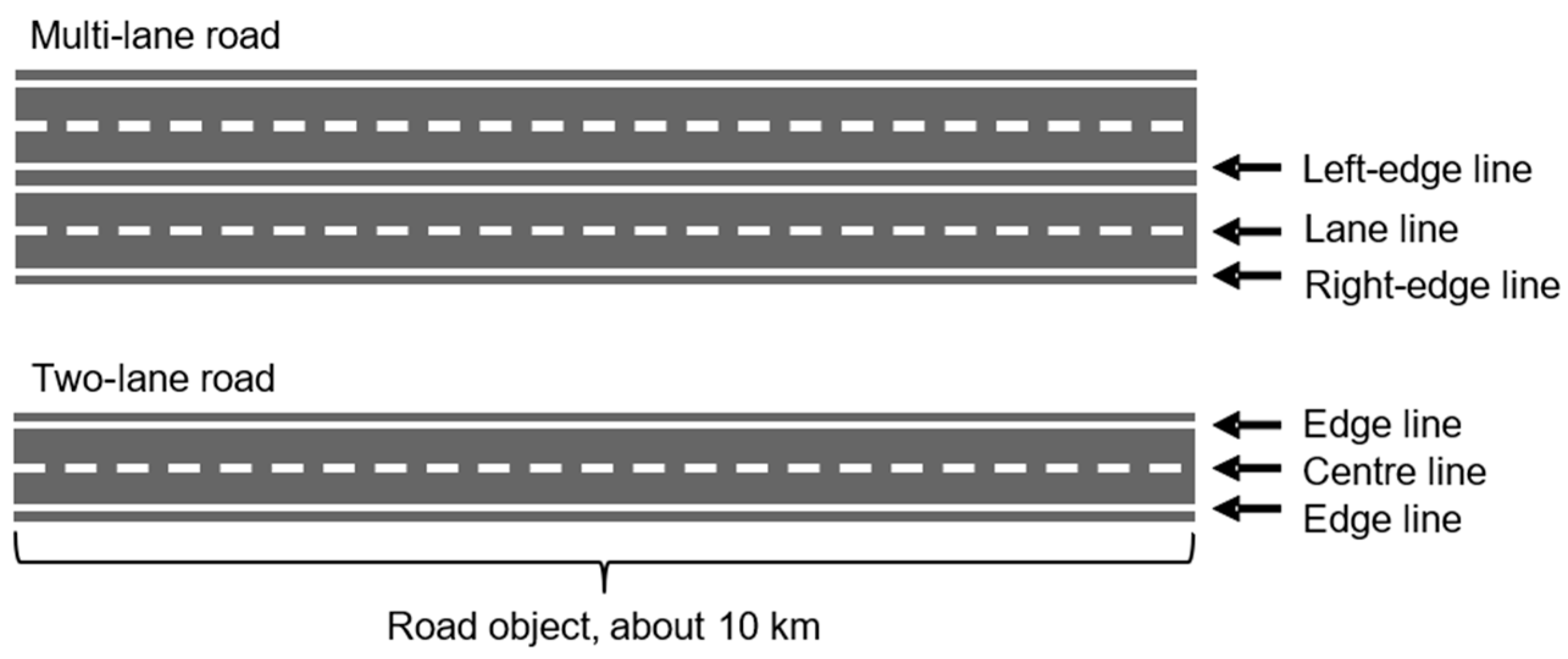
Figure 1. Illustration of road object and measured road markings.
Applsci 15 12788 g001
Figure 2. Regions studied in Denmark, Norway and Sweden.
Applsci 15 12788 g002
Figure 3. Retroreflectivity of right-edge line between 2017 and 2021 for Denmark, Norway and Sweden.
Applsci 15 12788 g003
Table 1. Classification of roads.
Road ClassDescription
MW highMotorway or multi-lane roads, 20,000 < AADT ≤ 50,000
MW lowMotorway or multi-lane roads, AADT ≤ 20,000
2L highTwo-lane roads, AADT > 5000
2L lowTwo-lane roads, 2000 < AADT ≤ 5000
Table 2. Number of measured road markings (right-edge only) for each road class and year in Denmark, Norway and Sweden.
CountryYearMW HighMW Low2L High2L LowTotal
Denmark20171514303089
20181515302989
20191515303090
20201515303090
20211515303090
Total7574150149448
Norway201715115049125
201817125870157
201916136072161
202015116172159
202114136072159
Total7760289335761
Sweden2017357554186350
2018247179197371
2019328086209407
2020367658198368
2021367372198379
Total1633753499881875
Table 3. Percentage of road marking length within different levels of retroreflectivity for Denmark, Norway and Sweden in 2021.
Retroreflectivity, RL
(mcd/m2/lx)
DenmarkNorwaySweden
RL ≤ 801.8%4.7%1.4%
80 ≤ RL ≤ 1008.3%5.9%2.7%
100 ≤ RL ≤ 13028.6%11.0%14.3%
130 ≤ RL ≤ 15023.2%13.0%15.6%
RL ≥ 15038.2%65.3%66.0%
Table 4. Results from ANOVA, retroreflectivity, visibility and preview time, * indicates interaction effects between factors.
Independent
Variable
Degrees of FreedomDependent Variable
Retroreflectivity
p-Value
Visibility
p-Value
Preview Time
p-Value
Country2<0.001<0.001<0.001
Year4<0.0010.0030.296
Road class3<0.001<0.001<0.001
Country*year80.203<0.0010.002
Country*road class6<0.001<0.001<0.001
Year*road class120.8760.0130.292
Table 5. Mean levels and standard error of retroreflectivity, visibility and preview time for Denmark, Norway and Sweden. All years and road classes.
CountryRetroreflectivityVisibilityPreview Time
Mean
(mcd/m2/lx)
Standard Error (mcd/m2/lx)Mean
(m)
Standard Error
(m)
Mean
(s)
Standard Error
(s)
Denmark143.92.5128.60.84.860.04
Norway170.02.4129.40.75.570.04
Sweden166.61.4122.00.44.700.02
Table 6. Comparison of mean levels of retroreflectivity, visibility and preview time between countries. * The mean difference is significant at the 0.05 level.
ComparisonRetroreflectivity
Difference
(mcd/m2/lx)
Visibility
Difference
(m)
Preview Time
Difference
(s)
Denmark–Norway−26.1 *−0.8−0.71 *
Denmark–Sweden22.7 *6.6 *0.16 *
Norway–Sweden3.47.4 *0.07 *
Table 7. Mean levels and standard error of retroreflectivity, visibility and preview time for 2027–2021. All countries and road classes.
YearRetroreflectivityVisibilityPreview Time
Mean
(mcd/m2/lx)
Standard Error (mcd/m2/lx)Mean
(m)
Standard Error
(m)
Mean
(s)
Standard Error
(s)
20171562.71250.95.00.04
20181582.71260.85.00.04
20191582.61260.85.00.04
20201712.61290.85.10.04
20211592.61270.85.00.04
Table 8. Mean levels and standard error of retroreflectivity, visibility and preview time for Denmark, Norway and Sweden and per road class. All years (2017–2021).
CountryRoad ClassRetroreflectivityVisibilityPreview Time
Mean
(mcd/m2/lx)
Standard Error
(mcd/m2/lx)
Mean
(m)
Standard Error
(m)
Mean
(s)
Standard Error
(s)
DenmarkMW high1295.81361.84.10.08
MW low1475.81341.84.40.09
2L high1394.11161.35.30.06
2L low1604.11271.35.70.06
NorwayMW high1705.71431.85.50.08
MW low1686.41402.05.10.10
2L high1712.91180.96.20.04
2L low1712.71160.95.50.04
SwedenMW high1533.91421.24.80.06
MW low1692.61380.84.80.04
2L high1592.71050.84.70.04
2L low1861.61030.54.50.02
Table 9. Observed mean area on a road marking length of 60 m and mean speed limit per country and road class, 2017–2021.
Road ClassDenmarkNorwaySweden
Area
(m2)
Mean Speed Limit
(km/h)
Area
(m2)
Mean Speed Limit
(km/h)
Area
(m2)
Mean Speed Limit
(km/h)
MW high17.0121.514.695.816.7107.5
MW low14.2110.814.497.013.4103.3
2L high7.879.66.570.25.081.7
2L low10.080.76.076.73.582.8
All road classes11.192.17.777.86.988.8
Table 10. Share of measured TEN-T roads in Denmark, Norway and Sweden. Data from 2017 to 2021.
CountryShare of TEN-T Roads (%)
Denmark53.2%
Norway45.7%
Sweden40.7%
All43.8%
Table 11. Results from ANOVA with independent variables country and TEN-T, retroreflectivity, visibility and preview time, * indicates interaction effects between factors.
Independent
Variable
Degrees of FreedomDependent Variable
Retroreflectivity
p-Value
Visibility
p-Value
Preview Time
p-Value
Country2<0.001<0.001<0.001
TEN-T10.484<0.001<0.001
Country*TEN-T20.015<0.001<0.001
Table 12. Mean levels and standard error of retroreflectivity, visibility and preview time for 2017–2021. Per country and if TEN-T or not.
CountryTEN-T
(Yes/No)
RetroreflectivityVisibilityPreview Time
Mean
(mcd/m2/lx)
Standard Error
(mcd/m2/lx)
Mean
(m)
Standard Error
(m)
Mean
(s)
Standard Error
(s)
DenmarkYes146.23.7135.01.34.60.06
No145.33.2119.91.15.40.05
NorwayYes173.23.0130.61.05.60.05
No169.92.3116.30.85.80.04
SwedenYes168.32.1133.30.74.70.03
No177.21.4104.90.54.60.02
Table 13. Observed mean area on a road marking length of 60 m and mean speed limit per country and TEN-T.
TEN-TDenmarkNorwaySweden
Area
(m2)
Mean Speed Limit
(km/h)
Area
(m2)
Mean Speed Limit
(km/h)
Area
(m2)
Mean Speed Limit
(km/h)
Yes14.611310.48912.8105
No8.6816.1744.384
Disclaimer/Publisher’s Note: The statements, opinions and data contained in all publications are solely those of the individual author(s) and contributor(s) and not of MDPI and/or the editor(s). MDPI and/or the editor(s) disclaim responsibility for any injury to people or property resulting from any ideas, methods, instructions or products referred to in the content.