Article

Design and Experimentation of a Roller-Type Precision Seed Metering Device for Rapeseed with Bezier Curve-Based Profiled Holes

1
Research and Design Institute of Agricultural Machinery Engineering, Hubei University of Technology, Wuhan 430068, China
2
Hubei Provincial Agricultural Machinery Identification Station, Wuhan 430068, China
3
School of Mechanical Engineering, Hubei University of Technology, Wuhan 430068, China
*
Author to whom correspondence should be addressed.
Appl. Sci. 2025, 15(23), 12786; https://doi.org/10.3390/app152312786
Submission received: 13 October 2025 / Revised: 18 November 2025 / Accepted: 21 November 2025 / Published: 3 December 2025
(This article belongs to the Section Agricultural Science and Technology)

Abstract

To address the industry pain points of high seed breakage rate and uncontrollable miss-filling rate, multiple-filling rate in traditional rapeseed roller-type precision centralized seed metering devices—while breaking the adaptation limitation of existing empirical hole designs for different small-particle-size crops—this study innovatively proposes a hole optimization scheme based on the Bezier curve and develops a roller-type precision centralized seed metering device suitable for rapeseed and small-particle-size crops. First, combined with the physical properties of rapeseed seeds (particle size 1.5~2.5 mm, high sphericity, strong fluidity) and agronomic requirements for precision seeding, a multi-mechanical coupling model for seed filling and dropping (synergistic effect of gravity–centrifugal force–air blowing force) was established. The regulatory mechanism of hole geometric parameters (wrap angle, width, height) on seeding performance was clarified, and the enhancement mechanism of the Bezier curve’s curvature continuity on seed movement stability was revealed from the theoretical level. On this basis, a three-factor quadratic orthogonal combination experiment of hole wrap angle, width, and height was conducted using EDEM discrete element software. The optimal hole parameter combination was obtained through multi-objective optimization (minimizing miss-filling rate, multiple-filling rate and maximizing seed-filling qualification rate): wrap angle 2.271° (error ± 0.2°), width 3.407 mm (error ± 0.1 mm), and height 2.254 mm (error ± 0.02 mm). Simulation results showed that under this parameter combination, the seed-filling qualification rate reached 99.122%, with the miss-filling rate and multiple-filling rate as low as 0.448% and 0.416%, respectively. Further bench test verification indicated that when the roller speed was in the range of 10~30 r/min, the seed breakage rate was consistently below 0.5%, and the seed-filling qualification rate remained above 94%. Among them, the comprehensive seeding performance was optimal at a speed of 15 r/min, with a miss-seeding rate of 0.65%, a multiple-seeding rate of 2.06%, and a breakage rate of 0.12%, fully meeting the agronomic requirements for rapeseed precision seeding, providing a theoretical basis and engineering reference for the digital and universal design of key components of precision seeders for small-particle-size crops.

1. Introduction

Rapeseed is a vital oilseed crop in China, playing a significant role in ensuring food and oil security and promoting sustainable agricultural development. In recent years, with the continuous expansion of planting scale and the ongoing improvement in mechanization levels, precision seeding has placed increasingly stringent demands on uniformity of row and plant spacing as well as seed protection performance [1,2,3]. However, due to the small particle size of rapeseed (approximately 1.5–2.5 mm), high sphericity, and strong fluidity, in the regular geometric holes (such as circular holes and square holes) of roller-type seed metering devices, the seeds are prone to falling off in advance under the action of centrifugal force or being crushed by extrusion. At the same time, sharp angles or sudden curvature changes at the inlet and outlet of the holes often cause seed damage or even hole blockage, leading to a simultaneous increase in the miss-filling rate, multiple-filling rate, and breakage rate. Domestic and foreign studies have shown that the geometric structure of the holes directly determines the seed entry posture and residence time, while the continuity of the hole wall curvature affects the uniformity of the force on the seeds during the seed-dropping process. Therefore, optimized hole geometry has been widely recognized as a key approach to enhancing seed discharge performance while reducing the risk of damage and clogging [4,5].
In terms of hole optimization, scholars have carried out various explorations. Wang Baoshan et al. [6] proposed an inclined parabolic hole structure, which increased the qualified seed-filling rate to 92% and significantly reduced the breakage rate. Yuan Wensheng et al. [7] designed special-shaped pockmarked holes, which effectively improved the seeding uniformity and reduced missing and re-seeding. Zhong Jiyu [8] verified the advantages of inverted fin-shaped streamlined holes in seed-filling adaptability and stability through EDEM simulation and bench tests. Luo Xiwen et al. [9] developed a ladle-shaped hole wheel in the research of rice seed metering devices, realizing precision hill direct seeding of rice. It is worth noting that the involute and conical cylindrical holes proposed by Lei Xiaolong et al. [10] both show strong advantages in seed-filling performance. The above research results indicate that special-shaped and gradient holes have more advantages in seed protection and adaptability compared with traditional regular holes. Meanwhile, Liao Qingxi’s team [11] introduced the Bezier curve into the design of the guide vanes of the rotating disc-type centralized seed metering device, established the parameter equation, and verified it through simulation and experiments. The results showed that the breakage rate of rapeseed was controlled within 0.5%, and the coefficient of variation of row consistency was controlled to within 3.9%, which fully demonstrates the important potential of the Bezier curve in eliminating sudden curvature changes and reducing the breakage rate. In addition, scholars at home and abroad have also conducted relevant research from the perspective of the coupling between the hole type and the seed metering device system. Ahmadi E. et al. [12] designed grooved rapeseed holes and clarified the influence of the inlet angle and outlet angle on the seed-filling rate and seeding delay time. Lei X. et al. [13] conducted in-depth research on the air-blowing cluster metering device for rapeseed, and optimized the hole structure by adjusting the distribution of airflow velocity and pressure. Aliyev E.B. et al. [14] conducted numerical modeling of the seed reduction gearbox for pneumatic precision seed drills. This research provides a mature numerical simulation methodology and explicit quantitative basis for the parameter design and performance quantification analysis of reduction gearboxes in air-suction seed drills. Gang Zheng et al. [15] found in the research of spinach spoon wheel seed metering devices that spoon-shaped holes can improve the seed-filling rate while playing a stirring role. Nikolay et al. [16] proposed an anti-missing seeding system combining a special hole profile and speed adjustment, which effectively reduced the risk of missing seeding. Peng Guo et al. [17] used the DEM–CFD coupling method to reveal the significant influence of the seed-filling chamber structure on the seed-filling effect. Datsyuk D.A. et al. [18] designed a roller-spiral seeding device, which offers a novel approach to precision seed placement for small-seeded crops and underscores the pivotal role of optimized aperture structures in upgrading seeding equipment. It can be seen that the hole geometry plays a core role in optimizing the seeding performance.
To sum up, although existing studies have made positive progress in special-shaped holes and gradient holes, most of them are still based on straight-line-arc splicing or empirical chamfering transitions. It is difficult to maintain continuous curvature in the three stages of inlet introduction, transition slow release, and outlet falling off, and local jamming and stress concentration may still occur. In addition, traditional roller-type rapeseed seeders suffer from inadequate parameterized hole design, which hinders their rapid adaptation to rapeseed particle size and physical property distribution. This results in defects such as damage rates of 1.2% to 3.5%, skipped sowing rates of 5% to 8%, and double sowing rates of 4% to 6%. To address the above problems, this study proposes applying the Bezier curve to the parametric design of roller holes, and using its continuous curvature and controllability to construct a flexible profile of “gentle entry–gradient change–gentle release.” On this basis, a mechanical model of seed filling and dropping is established, and combined with EDEM orthogonal experiments and bench verification, the influence laws of hole geometry on the missing seeding rate, re-seeding rate, qualified rate of seeds per hill, and breakage rate are revealed. The research results can provide theoretical support and engineering reference for the optimal design of the hole structure of seed metering devices for rapeseed and other small-particle-size crops.

2. Materials and Methods

2.1. Structure and Working Principle

2.1.1. Overall Structure

The rapeseed roller-type precision centralized seed metering device based on the Bezier curve designed in this study is installed on the dual-axis rotary tillage precision seeder shown in Figure 1. Its main structures include a rotary tillage device, a seeding device, a fertilization device, a compaction device, and a power transmission device.

2.1.2. Structure of the Seed Metering Device

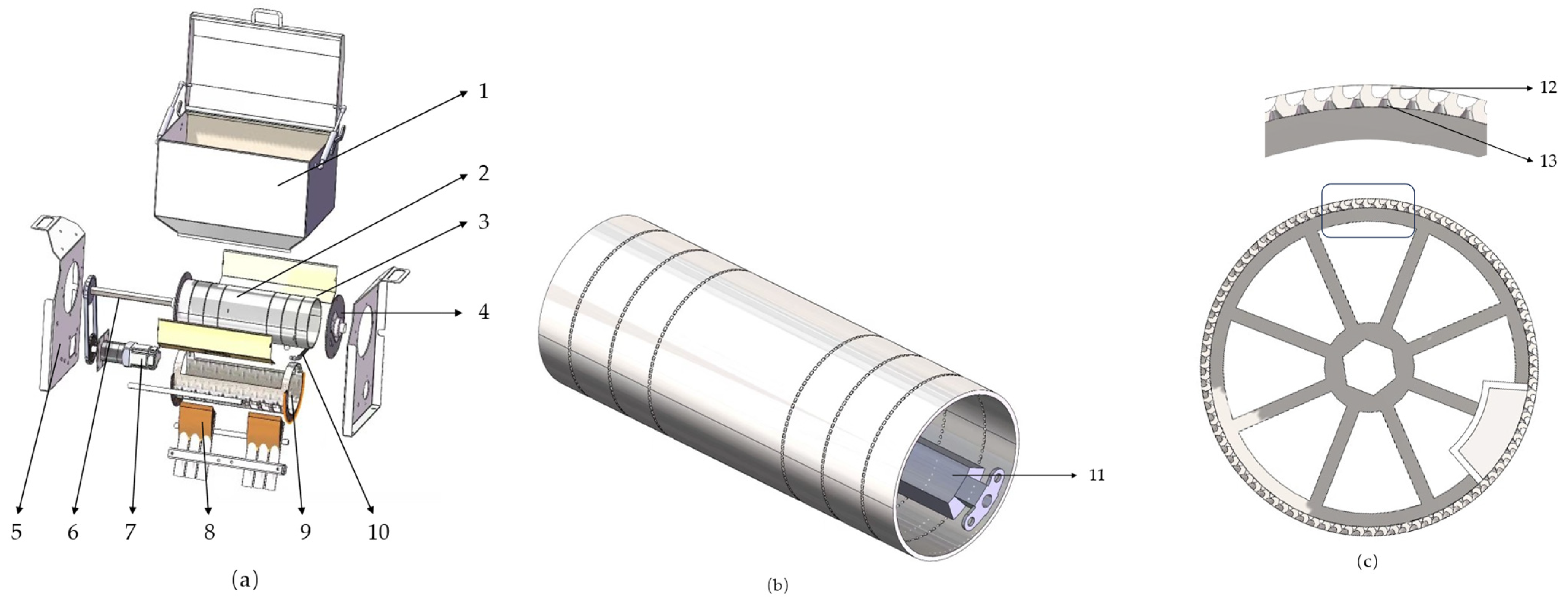
The structure of the seed metering device is shown in Figure 2. As presented in Figure 2a, it mainly consists of a seed box, a seed metering roller, an air-blowing plate, a rotating shaft, a roller cover, a seed-dropping pipe, and other components. The seed metering roller is provided with several circles of seed-filling holes, which include Bezier curve holes and conical air inlets. The profile of the Bezier curve holes is constructed based on cubic Bezier curves, and the cross-sectional curvature is dynamically adjusted via the coordinates of control points. The conical air inlets at the bottom of the holes (shown in Figure 2b,c) are connected to the air-blowing plate. As shown in Figure 2b, the positive-pressure airflow inside the air-blowing plate acts on the bottom of the holes through the air inlets, and seed dropping is completed with the combination of the seeds’ own weight.

2.1.3. Working Principle of the Seed Metering Device

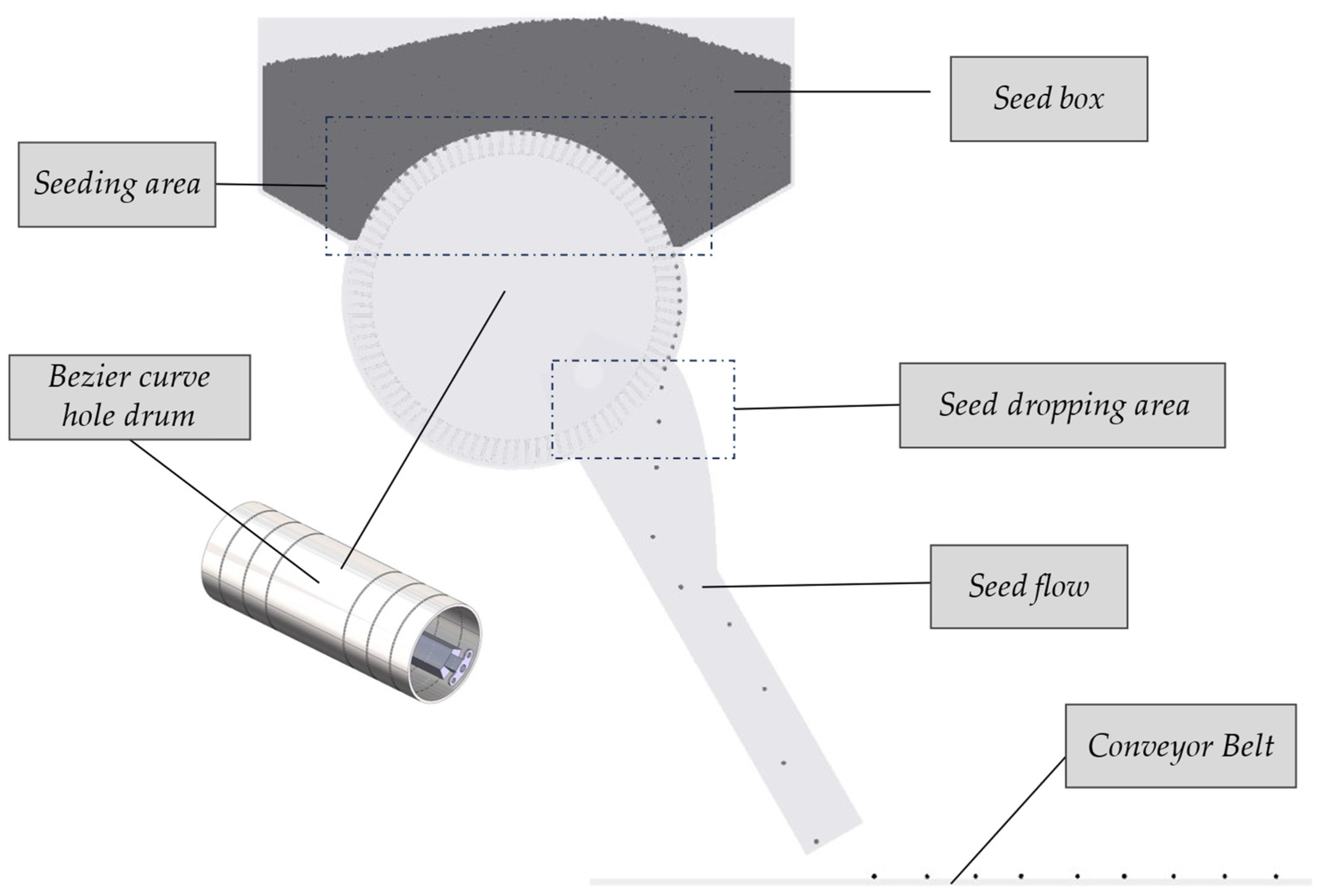
The working process of the seed metering device for rapeseed seeding is shown in Figure 3. First, rapeseeds are added to the seed box, and the fan system is started. Airflow is delivered to the air-blowing plate through the air pipe, forming a positive-pressure environment inside it. Then, the drive motor is started, which drives the hexagonal shaft to rotate through the gear transmission mechanism. The hexagonal shaft is nested inside the seed metering roller, thereby making the seed metering roller rotate. During the rotation of the roller, the seeds in the seed box fill the holes under the combined action of the mechanical disturbance of the holes and their own gravity. As the roller continues to rotate, the holes filled with seeds rotate to the lower seed-dropping area. In this area, the seeds are discharged from the holes under the synergistic effect of centrifugal force, airflow blowing, and self-weight. The discharged seeds fall into the seed-dropping pipe through the opening of the arc-shaped plate, and finally enter the pre-opened soil furrows to complete precision seeding.

2.2. Design of Key Structures of the Seed Metering Device

2.2.1. Design of the Seed Metering Roller

As the main carrier of the holes, the seed metering roller is manufactured by 3D printing using ABS engineering plastic. It is mainly composed of a hollow cylinder and holes on its outer surface. The diameter of the seed metering roller determines the overall size of the centralized seed metering device and affects the seed-filling performance of the device, thereby influencing the seeding performance of the centralized seed metering device. To investigate the relationship between the diameter of the seed metering roller and the seed-filling time, Equation (1) is derived as follows:
t c = l a v a l a = θ a d a 2 v a = π d a n p 60
where t c represents the seed-filling time of the hole (s), θ a represents the radian of the seed-filling area (rad), l a represents the arc length of the seed-filling area (m), d a represents the diameter of the seed metering roller (m),   n p represents the rotational speed of the seed metering roller (r/min), and v a represents the linear speed of the seed metering roller (m/s).
From the above equation, the following can be derived:
t c = 30 θ a π n p
It can be seen from Equation (2) that the seed-filling time t c is related to the radian θ a   of the seed-filling area and the rotational speed n p of the seed metering roller. In combination with the design requirement that the diameter of existing hole wheels be generally 80–200 mm (Agricultural Machinery Design Manual, 2007) [19], and considering the principle of keeping the overall structure of the centralized seed metering device compact as well as factors such as manufacturing costs, the diameter of the seed metering roller in this study is set to 150 mm, with a wall thickness of 3 mm. The seed metering roller is designed to have a total length of 350 mm, with 6 rows of holes evenly distributed axially and a spacing of 35 mm between holes in a single row.

2.2.2. Design of the Number of Radial Holes

According to the agronomic requirements for rapeseed precision seeding, the agronomic parameters of rapeseed [20,21] are shown in Table 1.
Considering the actual field operation conditions of the seeder, the designed operating speed of the unit ν n 5   k m / h . The field operation of the centralized seed metering device is powered by the ground wheel, and thus Equation (3) is obtained as follows:
v n S 1 = v a S k Z S k = π d a S k 2 d a Z L π d a v a = π d a n p 60
where v a represents the linear speed of the seed metering roller (m/s), S 1 represents the seeding hill spacing (m), S k represents the spacing between adjacent holes (m), Z represents the number of holes, and L represents the length of the hole (m).
The forward speed of the machine is 2–5 km/h, the rotational speed of the hole wheel is 10–30 r/min, and the diameter of the hole wheel is 150 mm. The width of the direct seeder is 1.8 m, and 6 rows of rapeseed can be sown with an equal row spacing of 300 mm. The emergence rate of the rapeseed is set to 43% [21,22]. Taking the average value of the planting density range in Table 1, the average plant spacing is calculated to be 84.94 mm. After calculation and rounding, the number of holes Z on the rapeseed seed metering roller is determined to be 90.

2.2.3. Design of Hole Contour

Cubic Bezier Curve
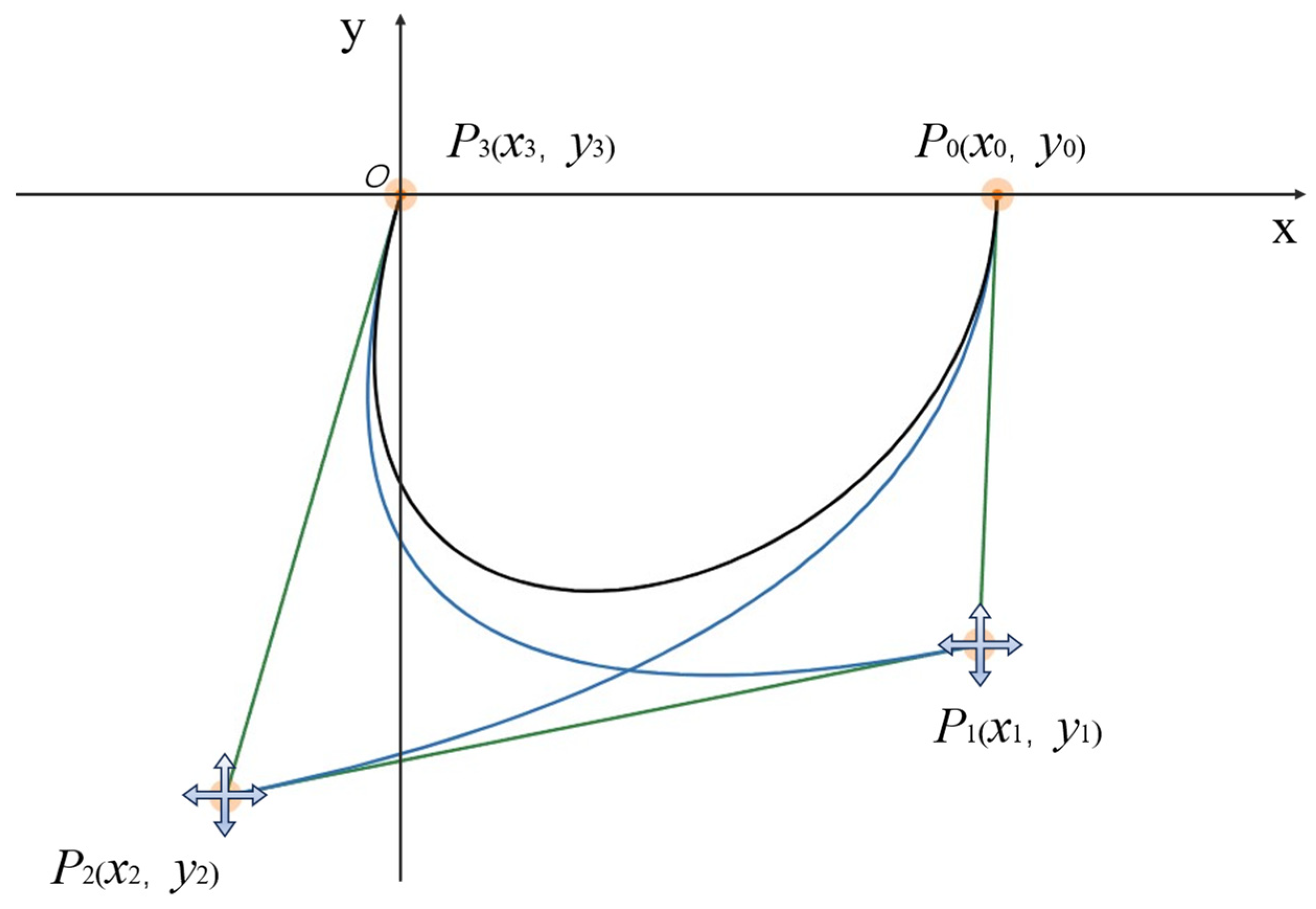
A Bezier curve is a uniquely shaped curve obtained by defining the positions of vertices of a set of polygonal lines. It has tangent vector properties, with continuous slope changes at all points on the curve. Additionally, the positional relationship between the curve’s control vertices and the curve itself is clear. The shape of the curve can be altered by modifying parameters according to actual requirements, making it relatively convenient to use in 2D curve modeling [11]. Among them, the geometric shape of the cubic Bezier curve is shown in Figure 4, where P 0 , P 1 , P 2 , and P 3 are the vertices of its characteristic polygon. Let a point on this curve be P t ; then, it can be known that:
P ( t ) = P 0 B 30 ( t ) + P 1 B 31 ( t ) + P 2 B 32 ( t ) + P 3 B 33 ( t ) = [ t 3 t 2 t 1 ] 1 3 3 1 3 6 3 0 3 3 0 0 1 0 0 0 P 0 P 1 P 2 P 3 = ( 1 t ) 3 P 0 + 3 t ( 1 t ) 2 P 1 + 3 t 2 ( 1 t ) P 2 + t 3 P 3
where P 0 ,   P 1 ,   P 2 ,   a n d   P 3 represent the vertex coordinates of the Bezier control polygon; B i , 3 t (where i =   0 ,   1 ,   2 ,   3 ) represents the cubic Bezier basis functions; and t represents the abscissa value of the point on the curve, with 0 t 1 .
It can be seen from Figure 4 that at the starting point of the curve, i.e., when t =   0 , P 0 = P 0 , and the curve is tangent to the initial edge P 0 P 1 of the characteristic polygon; at the end point of the curve, i.e., when t =   1 , P 1 = P 3 , and the curve is tangent to the final edge P2P3 of the characteristic polygon. The curvature direction of the curve can be adjusted by changing the coordinate values of the two control points P 1 x 1 ,   y 1 and P 2 x 2 ,   y 2 . According to the relevant properties of the curve, expanding Equation (4) gives:
P x ( t ) = x 0 ( 1 t ) 3 + 3 x 1 ( 1 t ) 2 +       3 x 2 t 2 ( 1 t ) + x 3 t 3 P y ( t ) = y 0 ( 1 t ) 3 + 3 y 1 t ( 1 t ) 2 +       3 y 2 t 2 ( 1 t ) + y 3 t 3 P z ( t ) = 0
Radial Cross-Section Structure of the Hole
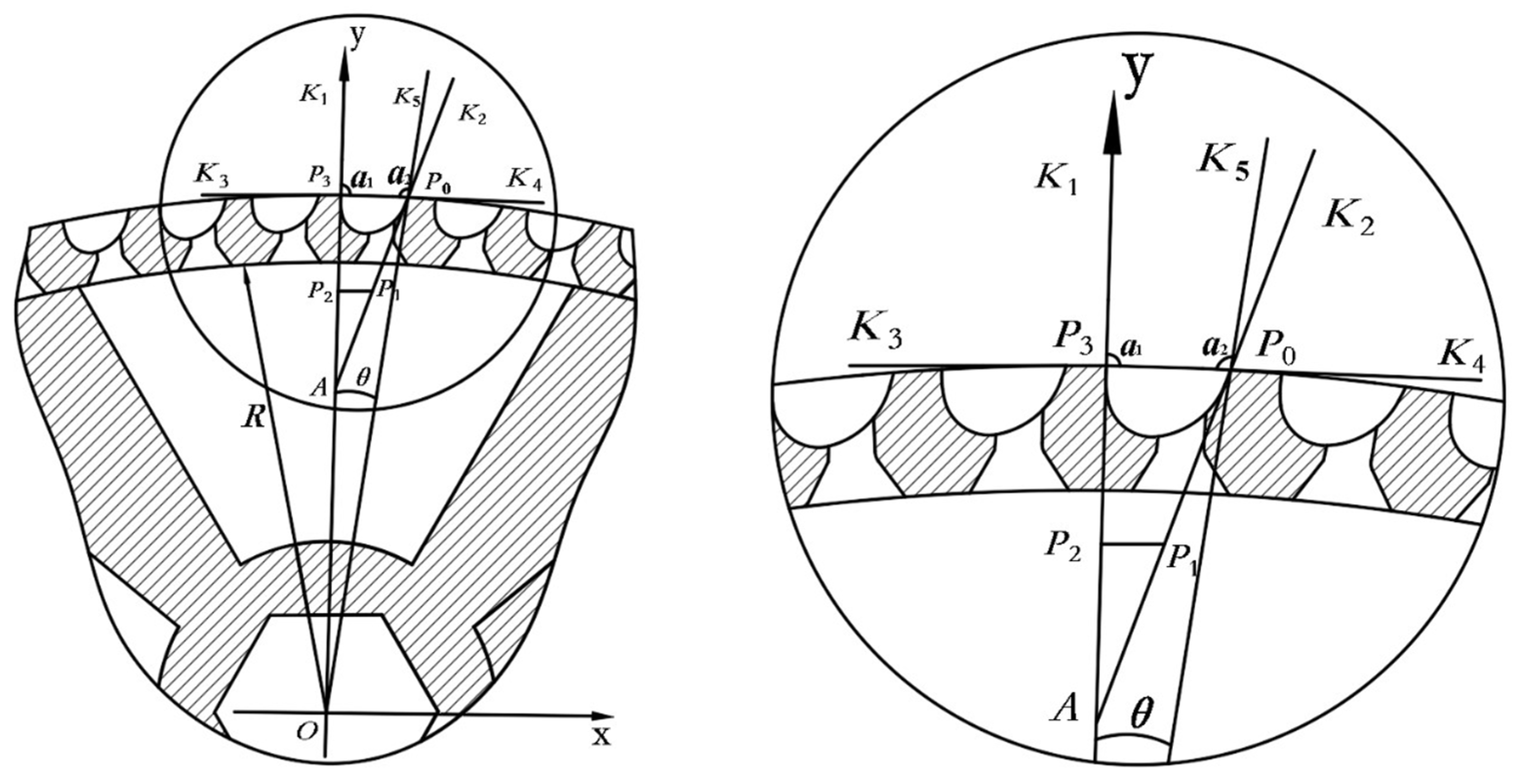
The seed metering roller adopted in the centralized seed metering device is a key component, and its hole structure plays a crucial role in seed-filling and seed-dropping performance. The slope of each point on the Bezier curve changes continuously and uniformly, with a slope of zero at the lowest point—this is conducive to ensuring the stable movement of seeds during the seed-filling and seed-dropping processes and keeping seeds stably at the bottom of the hole. Setting chamfers and using slope-shaped holes can shorten seed-filling time and improve seed-filling effect. Therefore, a hole with a radial cross-section of Bezier curve structure is designed. Based on the properties of the endpoints of the Bezier curve, a cubic Bezier curve is used to construct the contour line of the hole’s radial cross-section. The parameter definitions are shown in Figure 5. With the axis of the roller as the origin and the line passing through the origin and point   P 3 as the y-axis, a planar Cartesian coordinate system is established. The contour curve of the hole’s radial cross-section is P 0 P 3 . Draw the tangent line K 1 of the arc at point P 3 ; the angle between K 1 and the horizontal line K 3   is the inlet angle α 1 . Draw the tangent line K2 of the arc at point P 0 ; the angle between K 2 and the tangent line K 4 of the circle at point P 0 is the outlet angle α 2 . Draw the straight line K 5 passing through both the origin and point   P 0 ; the angle θ between K 5   and the y-axis (where the starting point P 3 of the hole’s radial cross-section contour curve is located) is the hole wrap angle. Take points P 1   and P 2 as the midpoints of P 0 A and P 3 A , respectively; the polygon P 0 P 1 P 2 P 3 is the control polygon of the hole curve.
It can be known from the shape of the hole curve that coordinates   X 1 and X 2 mainly control the position of the maximum deflection, while coordinate Y 1 mainly controls the positive and negative curvature of the contour line, and its absolute value represents the maximum deflection. The coordinate values of the 4 control vertices are calculated based on the geometric relationships in the contour curve schematic diagram. Substituting these values into Equation (5), the equation of the hole’s radial cross-section contour curve is obtained as follows:
P x ( t ) = R t [ 3 ( 1 t ) 2 2 cos α 1 +       t ( 3 ( 1 t ) 2 cos ( θ + α 2 ) + ( 3 2 t ) sin θ ) ] P y ( t ) = R [ 1 3 t 2 + 2 t 3 +       3 t ( 1 t ) 2 2 sin α 1 + t 2 ( 3 2 t ) cos θ       3 t 2 ( 1 t ) 2 sin ( θ + α 2 ) ] P z ( t ) = 0
The material properties of seeds serve as the basis for hole design. A total of 100 seeds of the Deyouza 988 variety are randomly selected. The maximum and minimum values of the three-axis dimensions of the seeds can be approximately expressed using the mean value and three times the standard deviation in accordance with the “ 3 σ ” principle [23].
To ensure that the hole depth can effectively constrain seeds and the hole length can accommodate at least one seed with the maximum particle size while preventing more than three seeds from being filled in, the hole depth and length shall meet the following requirements:
α ¯ + 3 σ α 2 h α ¯ + 3 σ α   α ¯ + 3 σ α l P 0 P 3   3 b ¯
where h represents the hole depth when the hole inclination angle is θ (mm), α ¯ represents the mean value of seed length (mm), σ a represents the standard deviation of seed length (mm), and b ¯ represents the mean value of seed width (mm).
It can be seen from Equations (6) and (7) that R , α 1 , α 2 , and θ are the main geometric parameters of the contour curve of the hole’s radial cross-section, and the value of R   is already known from the aforementioned structural parameter design. When the position of P 3 is fixed, the hole length l P 0 P 3 is determined by the hole wrap angle   θ and increases as θ increases. When P 0 and P 3 are fixed, α 1 decreases as the hole depth h increases, while α2 increases as the hole depth h increases. When R =   75   mm , the hole length l P 0 P 3 and hole wrap angle θ are calculated based on Equations (6) and (7) and the three-axis dimensions of seeds in Table 2. Additionally, the hole depth h and the value range of the hole wrap angle θ are determined with the help of the Bezier curve design and analysis function in the Desmos graphing calculator.
Axial Cross-Sectional Structure of the Holes
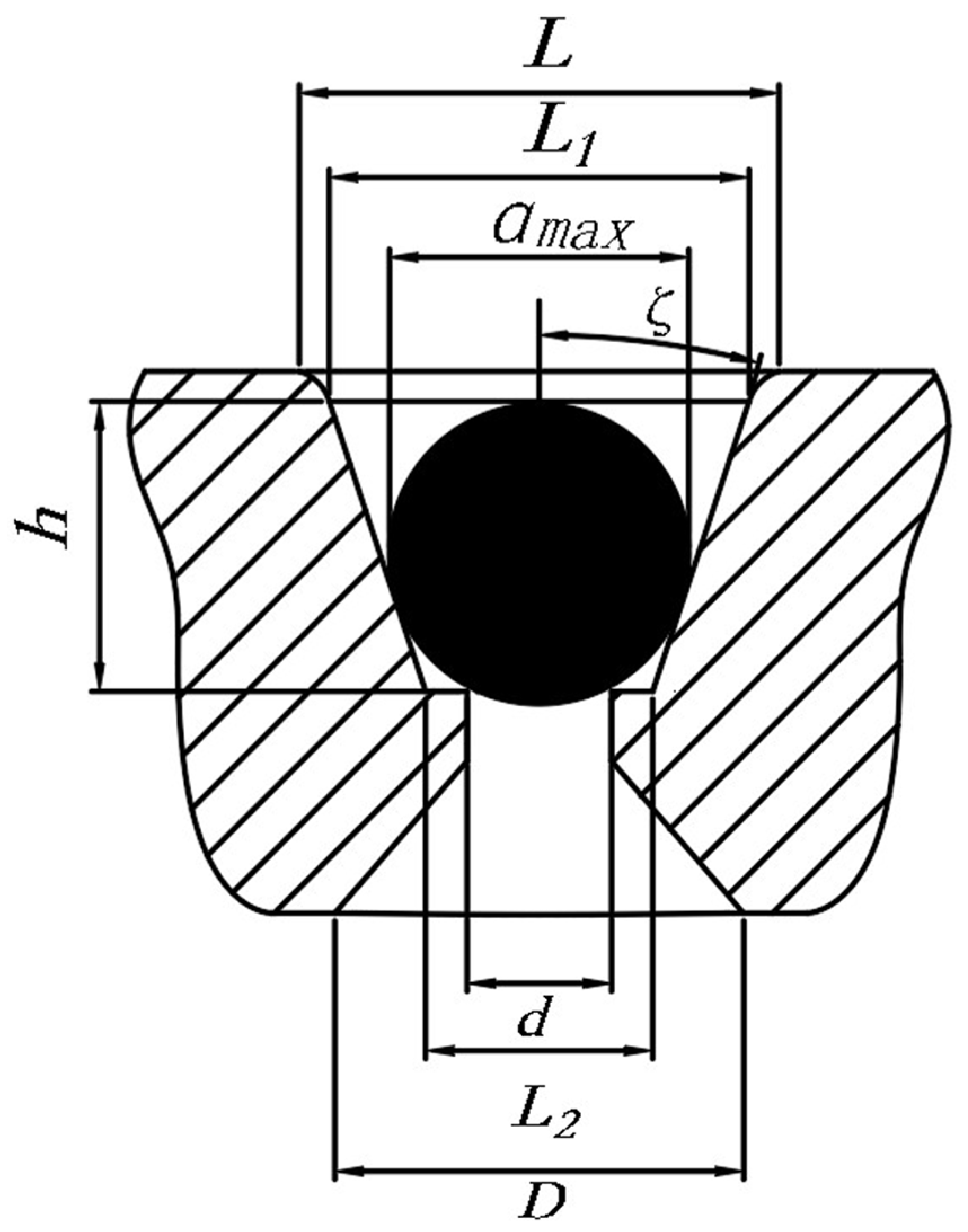
The hole width and side inclination angle are the main factors affecting seed jamming. When the hole width is smaller than the maximum seed length, the hole is prone to single-seed jamming and missed seed-filling; therefore, the hole width should be slightly larger than the maximum seed length to facilitate seed-filling and control the number of filled seeds. The axial cross-section of the hole mainly realizes single-seed filling, and its structure is shown in Figure 6. Increasing the hole side inclination angle is conducive to smooth seed unloading [24,25]. The static friction angle between rapeseed and the ABS hole wheel is 16.7°, and the initial value of the side inclination angle coefficient K ζ is set to 1.0. When the initial value of the width coefficient K w is 1.5, the top width L 1 of the hole is 3.375 mm, and the geometric relationship of the structural parameters of the hole’s axial cross-section is as follows:
α max   = α ¯ + 3 σ a L 1   = K w α max L 2   = L 1 - 2 h tan ζ ζ = K ζ φ L = 1.1 L 1 d 0.8 α max D r Z
where α max represents the maximum seed length (mm), L 2 represents the hole bottom width (mm), ζ represents the hole side inclination angle (°), φ represents the static friction angle between the seed and the hole wheel (°), d represents the diameter of the air outlet hole (mm), D represents the diameter of the air inlet hole (mm), and r represents the hole inner diameter (mm).
According to the aforementioned three-axis dimensions of rapeseed, designing L 2 as 1.1 mm can meet the requirements. Combined with the rapeseed material parameters in Table 2, when the width coefficient K w takes the optimal simulation values of 1.4, 1.5, and 1.6, and the side inclination angle coefficient K ζ takes 1.57 [25], the value range of the hole’s top width L 1 can be determined based on Equation (8). The calculation results are as follows:   L 1 ( 3.15   mm , 3.6   mm ) , h ( 2.18 mm , 2.53 mm ) (where h refers to the hole depth).

2.3. Mechanical Analysis of the Seed-Filling and Seed-Dropping Process

2.3.1. Seed-Filling Process

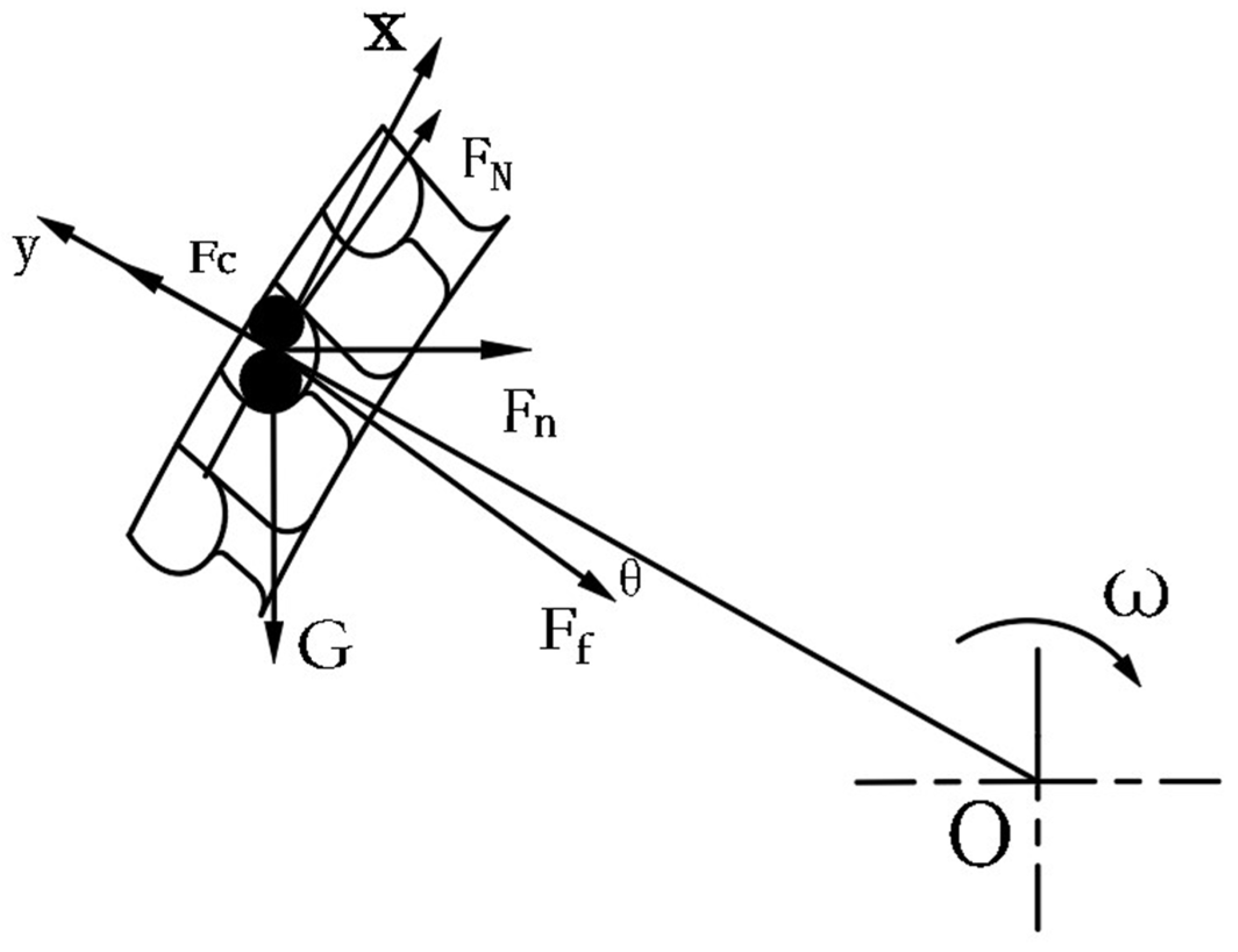
Seed-filling is the primary link in the seed-dropping process. In the seed-filling area, each hole captures 1–3 seeds at a time. To simplify the model, the captured seeds are regarded as a single integral unit, and the analysis is conducted by taking the distribution of 2 seeds along the hole length direction and 1 seed along the hole width direction as an example. The schematic diagram of the forces acting on the seeds during the seed-filling process is shown in Figure 7, and the force balance of Equation (9) is established as follows:
F N cos θ + F n sin β = F f sin θ + G cos β F n cos β + F N sin θ + F f cos θ + G sin β F c F f = μ F N F c = m ω 2 R G = m g ω = π n p 30
where G represents the gravity of the seed (N), m represents the mass of the seed (kg), F f represents the friction force of the hole wall on the seed (N), F n represents the lateral pressure of the seed population in the seed-filling chamber on the seed (N), F N represents the supporting force of the hole wall on the seed (N), R represents the radius of the seed metering roller (with R = 75   mm ), ω represents the angular velocity of the seed metering roller (rad/s), F c represents the inertial centrifugal force of the rapeseed (N), μ represents the friction coefficient between the seed metering roller and the seed (the value is 0.3 for rapeseed), β represents the initial filling angle (°), and g represents the gravitational acceleration (m/s2).
According to Equation (9), the following is obtained:
β arctan ω 2 R + μ g g μ ω 2 R
It can be seen from Equation (10) that the initial filling angle β is related to the seed material property μ (friction coefficient), the cone angle of the hole wheel, the angular velocity ω   of the seed metering roller, the diameter of the hole wheel, and other factors. When other conditions are the same, the initial filling angle β 0 decreases as the angular velocity ω increases. The friction coefficient   μ between the roller and rapeseed is set to 0.3 (the same below). According to the actual operation conditions, the spindle speed of the cluster metering device is set to a relatively wide range of 10 ~ 30   r / min , which corresponds to an angular velocity range of 1 ~ 4.19   rad / s . Under this range, the minimum initial filling angle is 1.6°, and the maximum is 34.8°. The minimum seed-filling height is thus h min = 1.1   mm , meaning the seed-filling height should be 1.1 mm higher than the horizontal axis of the seed metering roller. By substituting the parameters μ = 0.3 , ω = 2.09   rad / s , and R = 75   mm into Equations (8)–(10), the calculation result is obtained as follows: θ ( 2.02 ° , 2.64 ° ) .

2.3.2. Seed-Dropping Process

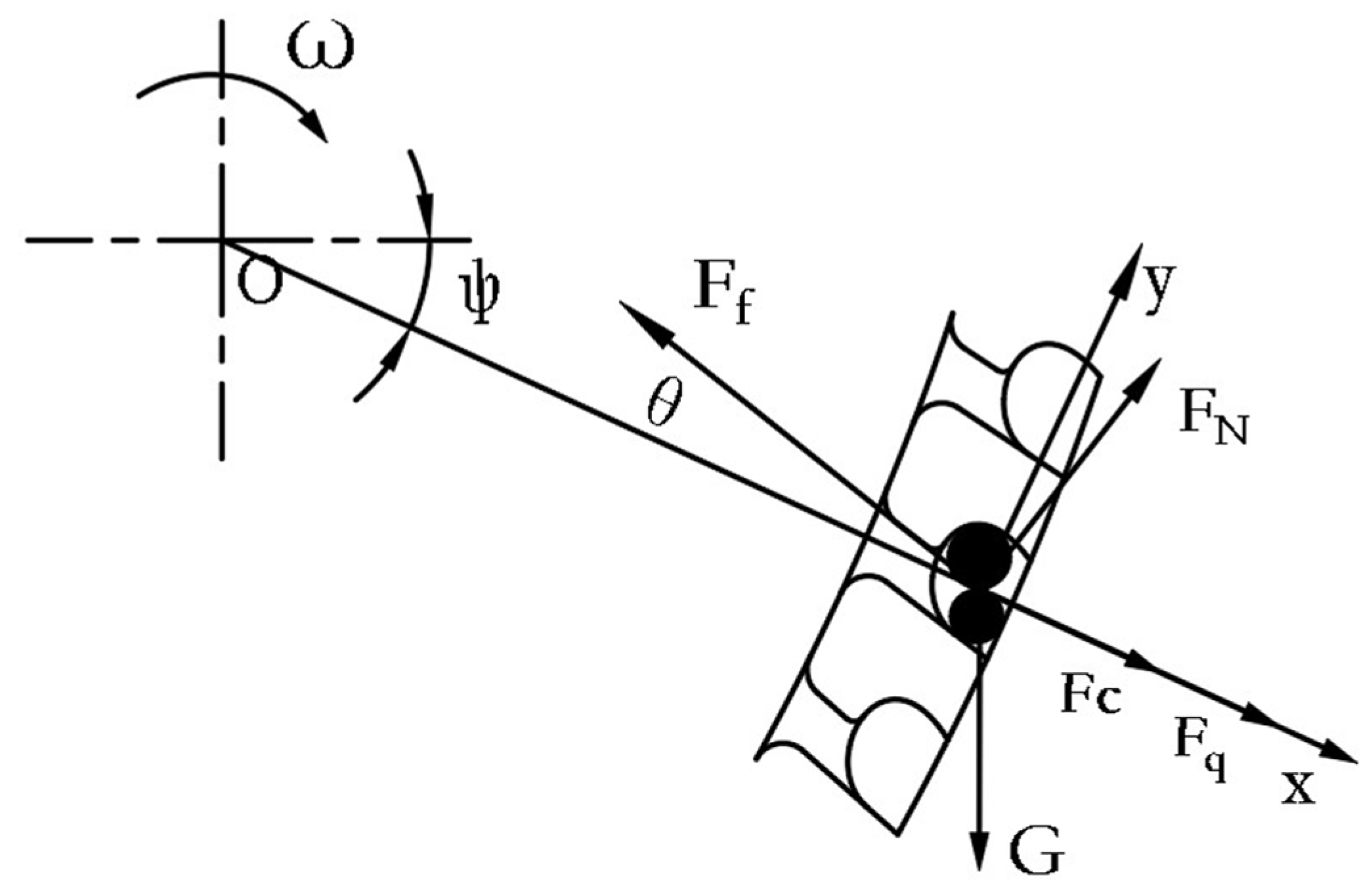
As the seed metering roller rotates, the seeds in the hole pass through the seed-protecting area and reach the end of the seed-protecting device—specifically, the position where ψ =   25 ° . At this moment, the seeds in the hole are mainly affected by the air-blowing force and their own gravity, slide along the hole wall, move to the outside of the hole, and complete the seed-dropping process. To better conduct the mechanical analysis of the seed-dropping process, the following assumptions are made: The seed is regarded as a uniform rigid body without considering its own deformation; the vibration of the seed metering roller itself is not considered. Take the seed at the moment of seed-dropping as the research object, a simplified mechanical model is established, as shown in Figure 8. The force balance Equation (11) for the seed at the hole outlet is established as follows:
F N cos θ + F f sin θ = G cos ψ F N sin θ + F c + F q + G sin ψ = F f cos θ F c = m ω 2 R F q = p S G = m g F f = μ F N
where F N represents the supporting force of the hole wall on the seed (N), F f represents the friction force between the seed and the hole wall (N), ψ represents the seed-dropping position angle (°), F q represents the air-blowing force (N), p represents the air-blowing pressure (Pa), and S represents the cross-sectional area of the air hole (m2).
From Equation (11), it can be concluded that when seed-dropping is imminent, the seed is mainly subjected to gravity G , inertial centrifugal force F c , supporting force F N from the hole wall, friction force   F f from the chute wall, and other forces. At the moment of seed-dropping, the seed breaks contact with the curved wall of the hole, so F N = 0 . The seed is then acted upon by the supporting force and friction force from the chute, inertial centrifugal force, and gravity, and thus has a tendency to move in the tangential direction. Therefore, adding an arc-shaped plate is beneficial for controlling the seed-dropping direction, which plays an important role in achieving the orderly dropping of rapeseed.

2.4. Simulation Experiments

2.4.1. Model Establishment

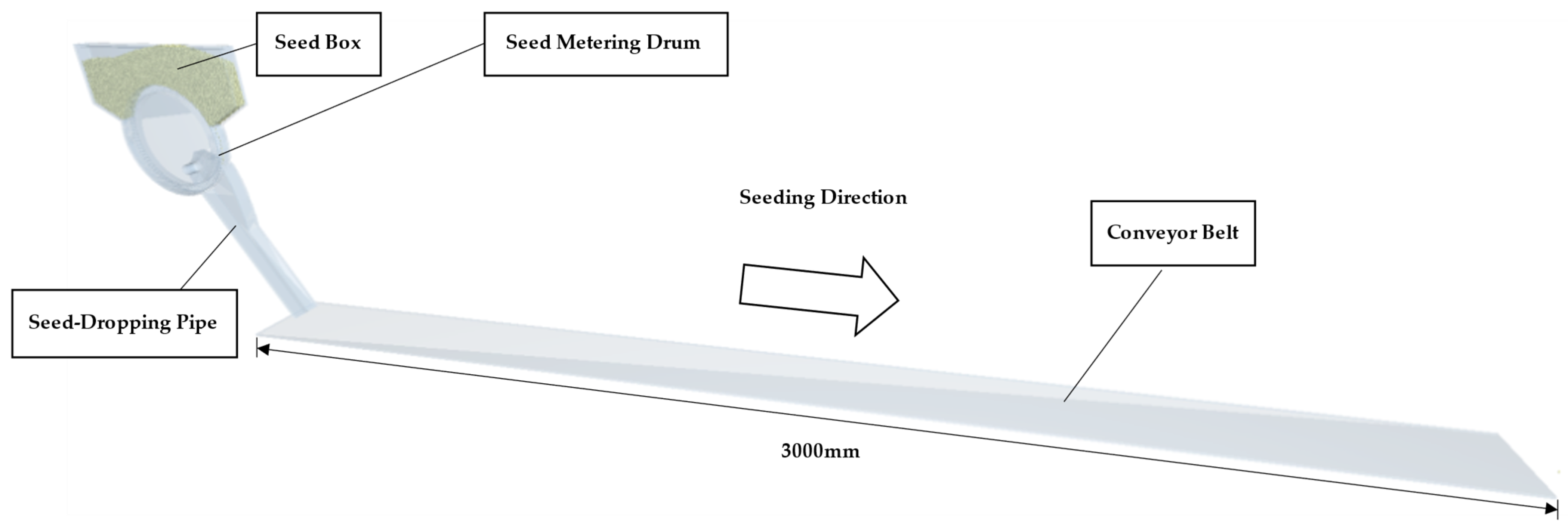
SolidWorks 2024 software is used to model the seed metering device. To improve simulation efficiency, the simulation model is simplified, retaining only key components such as the outer shell, single-row seed metering roller slice, seed-dropping pipe, and conveyor belt, as shown in Figure 9. The simplified model file is imported into the preprocessing module of EDEM 2022, and a particle factory is established above the seed hopper to allow the rapeseed to fall freely into the seed metering device.
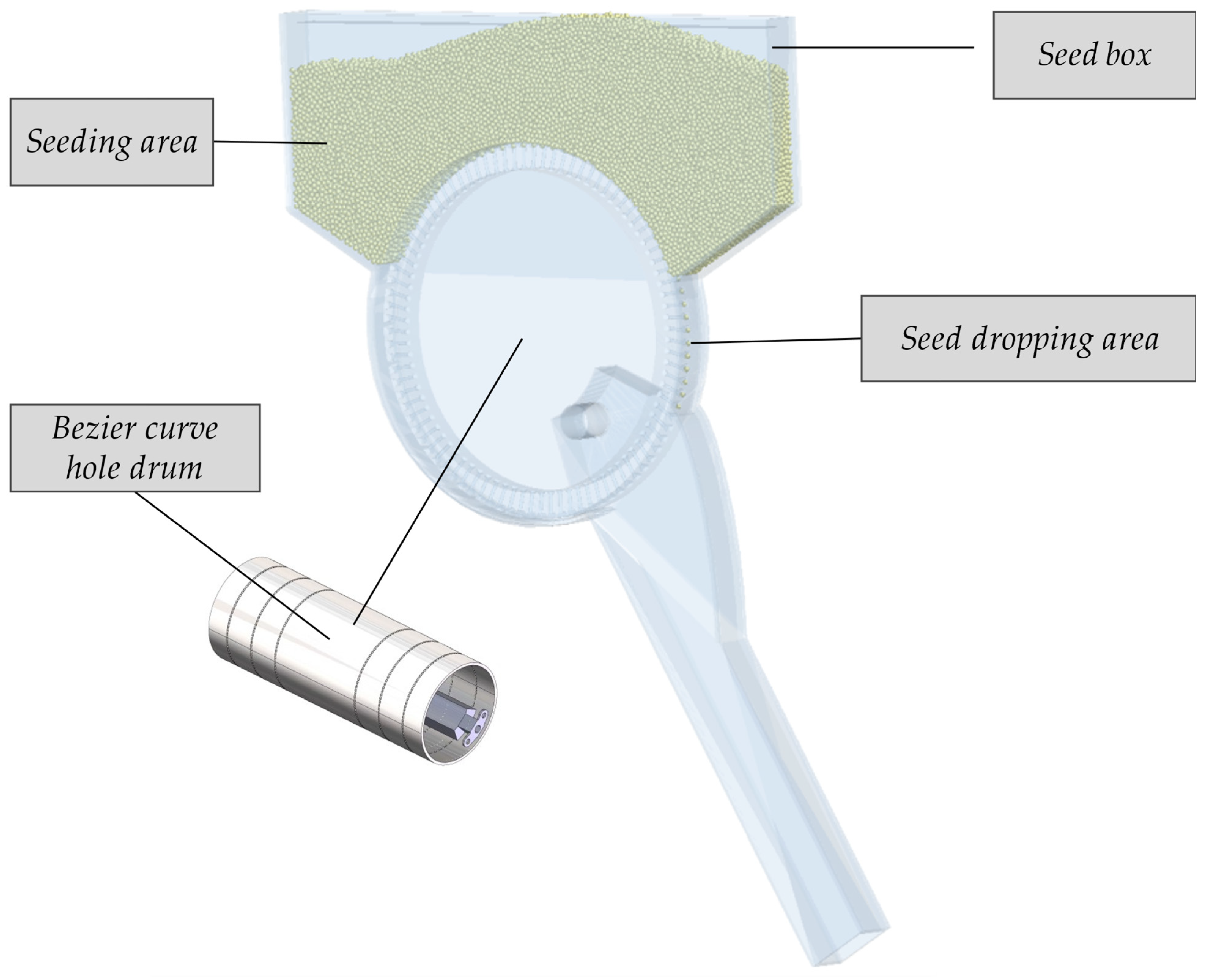
In the simulation, the seed particles are simplified to a spherical model with a diameter of 2 mm. The size of the seed model follows a normal distribution, with a standard deviation of 0.05 mm [26]. The Hertz–Mindlin non-slip contact model is adopted for the contact between seeds, and between seeds and the seed metering device model. The material of the seed metering device model is ABS engineering plastic, and the dimensions of the conveyor belt are 3000 mm × 100 mm × 3 mm [27]. The finally established discrete element model of the seeding test bench is shown in Figure 10. The simulation parameters are listed in Table 3 [28].

2.4.2. Test Method

The hole structure includes radial and axial cross-sections of the hole. EDEM simulations were conducted to determine the influence and optimal values of the structural dimensions of the radial and axial cross-sections of the hole on seed-filling performance and seed jamming. To verify the improvement effect of the hole seeding performance proposed by theoretical analysis, the simulation experiment selected the seed-filling qualification rate, miss-filling rate, and multiple-filling rate as the evaluation indicators. One to three seeds per hole were considered qualified, more than 3 seeds as multiple-filling, and 0 seeds as miss-filling, which more intuitively reflects the requirements of precision seeding [29]. From the mechanical analysis of the seed-filling and seed-dropping processes, it can be known that the radial and axial cross-sectional dimensions of the hole determine whether the hole can stably fill seeds and smoothly drop seeds. Simulation experiments were conducted to explore the influence of the main structural parameters of the hole (hole wrap angle, hole width, and hole height) on the seed-filling qualification rate, miss-filling rate, and multiple-filling rate. The response surface methodology was used to carry out a three-factor, three-level quadratic regression orthogonal combination experiment to analyze the influence law of hole parameter changes on the seed-filling performance of Bessel holes and determine the optimal parameter combination of hole wrap angle, hole width, and hole height. The coding of simulation experiment factors is shown in Table 4.
The total simulation time was set to 10   s , with a time step of 6.72 × 1 0 6 s . The seed generation stage lasted from 0 to 1 s, during which 3.5 × 1 0 4 rapeseeds were generated above the seed hopper and allowed to fall freely into the seed metering device. After 1 s, the roller started to rotate. Based on the previous analysis of the seed-filling process and pre-experiments, it is known that the seed supply device exhibits favorable seed-filling performance parameters when the rotation speed is 20   r / m i n ; thus, the roller rotation speed was set to 20   r / m i n . After the simulation was completed, the EDEM post-processing module was used to extract and analyze the simulation data. Each group of experiments was repeated 5 times, and the average value was taken.

2.5. Seed Metering Performance Bench Test

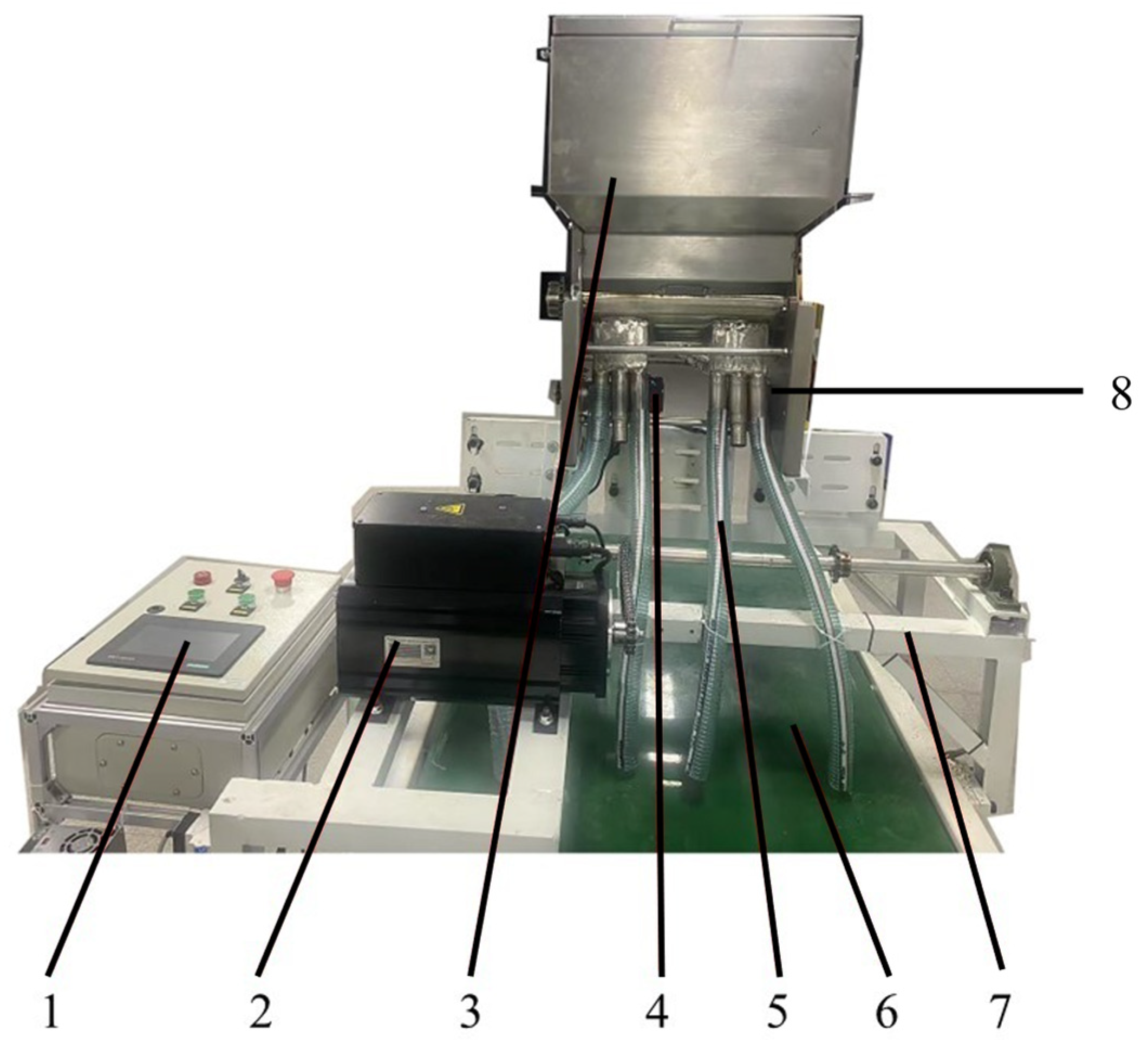
To verify the accuracy of the simulation and the actual seeding effect under bench test conditions, a bench test on the seeding performance of a 6-row seed metering device was conducted on the seed metering device test bench in the laboratory of Hubei Provincial Agricultural Machinery Appraisal Station. The main test devices included a prototype of the rapeseed roller-type precision cluster metering device with Bezier curve-based cell holes, a servo motor, a centrifugal fan (connected to the high-pressure chamber of the seed metering device via an air pipe), an electronic balance, and a test platform for seed metering device performance detection. For the test, Deyouza 988 rapeseed seeds—widely cultivated in the middle and lower reaches of the Yangtze River—were selected. The seed metering device test setup is shown in Figure 11.
To verify the rationality of the simulation results and explore how roller rotation speed affects the seeding performance of the cluster metering device, a bench test was conducted using four evaluation indicators—average breakage rate, miss-seeding rate, multiple-seeding rate, and hole seed count qualification rate—all following the requirements of GB/T 6973-2005 [30] Test Methods for Single-Seed (Precision) Planters [31]. Based on rapeseed planting agronomic requirements and previous theoretical analysis of the seed-filling and seed-dropping processes, the roller rotation speed range was set to 10 ~ 30   r / m i n , with a gradient of 5   r / m i n per level. The test adopted optimized hole structure parameters: Each rotation speed level was repeated 5 times, and the four indicators of rapeseed seeds were recorded over 5 min per test. For breakage rate determination, damaged seeds were manually sorted out before the test. Seeding was performed at 5 rotation speed levels (5 min per level); for each test, a sample of no less than 50 g was taken, broken seeds were manually sorted and weighed, and the average value was calculated from 5 repetitions. For hole seed count qualification rate statistics, 120 holes were tested per trial (5 repetitions total, with the average value used). A hole was deemed qualified if it contained 1–3 seeds.

3. Results

3.1. Analysis of Simulation Results and Parameter Optimization

The results of the simulation test are shown in Table 5. Based on the test results, the corresponding parameters were analyzed, and a mathematical model was established.

3.1.1. Analysis of Miss-Filling Rate

Multiple regression fitting was performed on the test data using the data processing software Design-Expert 13. Analysis of variance (ANOVA) was conducted on the regression model for the test results in Table 5, and a regression equation between the under-filling rate and the cell hole wrap angle, cell hole width, and cell hole height was established; the results are shown in Table 6. After eliminating the non-significant terms, the regression equation of the under-filling rate with the coded test factors was obtained as follows:
Y 1 = 575.489 33.3492 X 1 72.5266 X 2 362.226 X 3 + 2.31183 X 1 X 2 5.83333 X 2 X 3 + 6.69615 X 1 2 + 11.8167 X 2 2 + 84.35 X 3 2
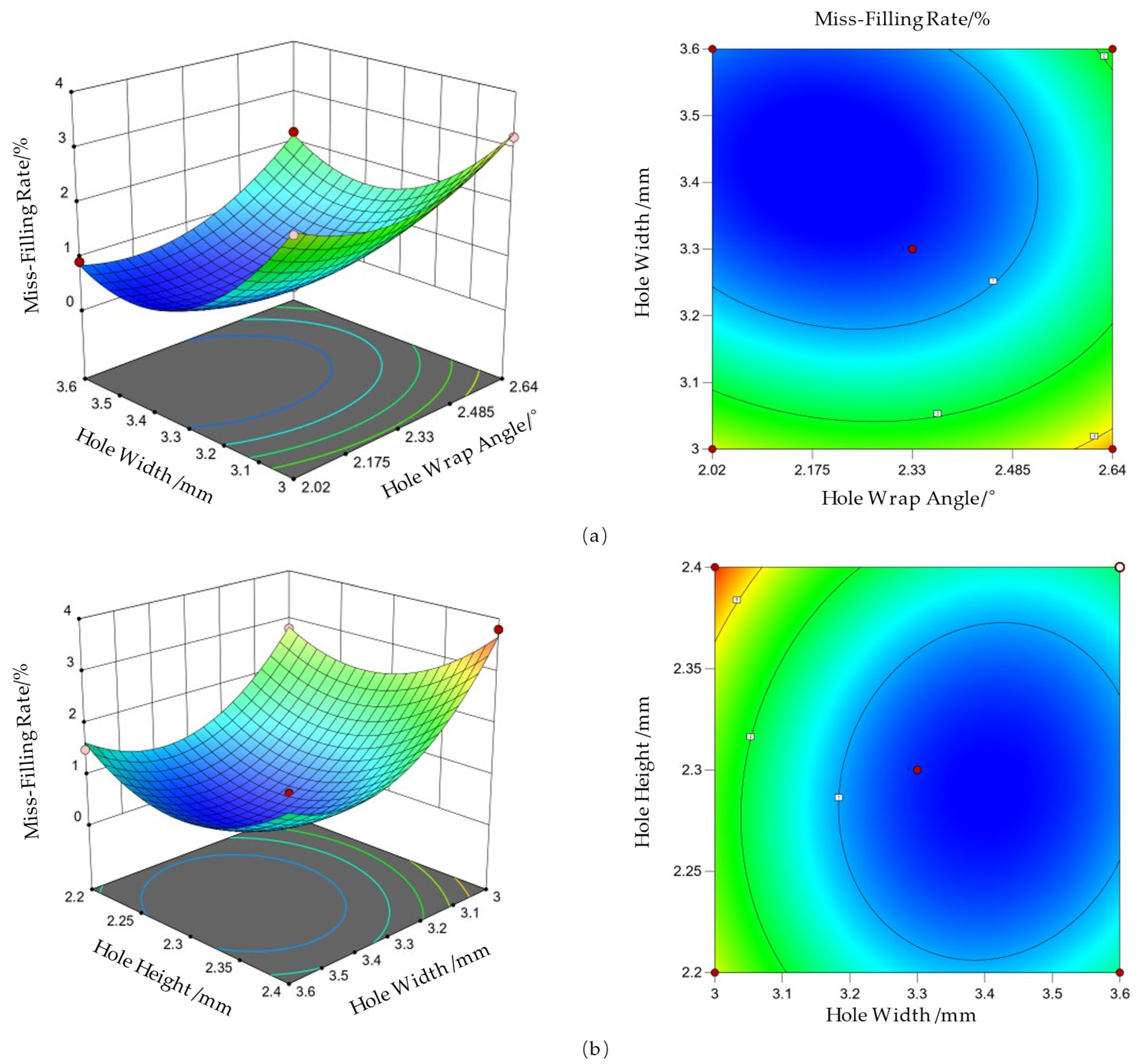
As can be seen from Table 6, the regression model for the under-filling rate had p < 0.01, indicating that the influence of independent variables on the response variable was extremely significant; meanwhile, the lack-of-fit term had p > 0.05, meaning the lack-of-fit term was not significant. Therefore, this model can be used to express the relationship between cell hole parameters and the under-filling rate. From the magnitude of the F-value, the order of significance of the factors affecting the under-filling rate (from highest to lowest) was cell hole width, cell hole wrap angle, and cell hole height, and these factors had interactive effects; the corresponding response surface is shown in Figure 12. When the cell hole wrap angle was fixed, the under-filling rate first decreased and then increased with the increase in cell hole width. The reason for this phenomenon is that the cell hole width directly determines the smoothness of seed filling. When the width was smaller than the maximum seed particle size, seeds were prone to getting stuck at the entrance of the cell hole, leading to under-filling; when the width was too large, the cell hole provided insufficient constraint on the seeds, and the seeds were prone to falling off in advance under the action of centrifugal force. Both situations significantly increased the under-filling rate. The wrap angle determines the retention arc of the seeds in the cell hole. When the wrap angle was too small, seeds were easily thrown out of the cell hole prematurely under centrifugal force; when the wrap angle was too large, the resistance to seed discharge increased, which might have led to under-filling due to delayed seeding. However, since the direct effect of the wrap angle on filling was weaker than that of the width, its influence degree was secondary.

3.1.2. Analysis of Multiple-Filling Rate

Multiple regression fitting was performed on the test data using the data-processing software Design-Expert 13. Analysis of variance (ANOVA) was conducted on the regression model for the test results in Table 5, and a regression equation between the over-filling rate and the cell hole wrap angle, cell hole width, and cell hole height was established; the results are shown in Table 7. After eliminating the non-significant terms, the regression equation of the over-filling rate with the coded test factors was obtained as follows:
Y 2 = 1013.06 74.2103 X 1 83.6261 X 2 704.935 X 3 + 1.88172 X 1 X 2 + 27.0161 X 1 X 3 + 1.67794 X 1 2 + 11.375 X 2 2 + 141.125 X 3 2
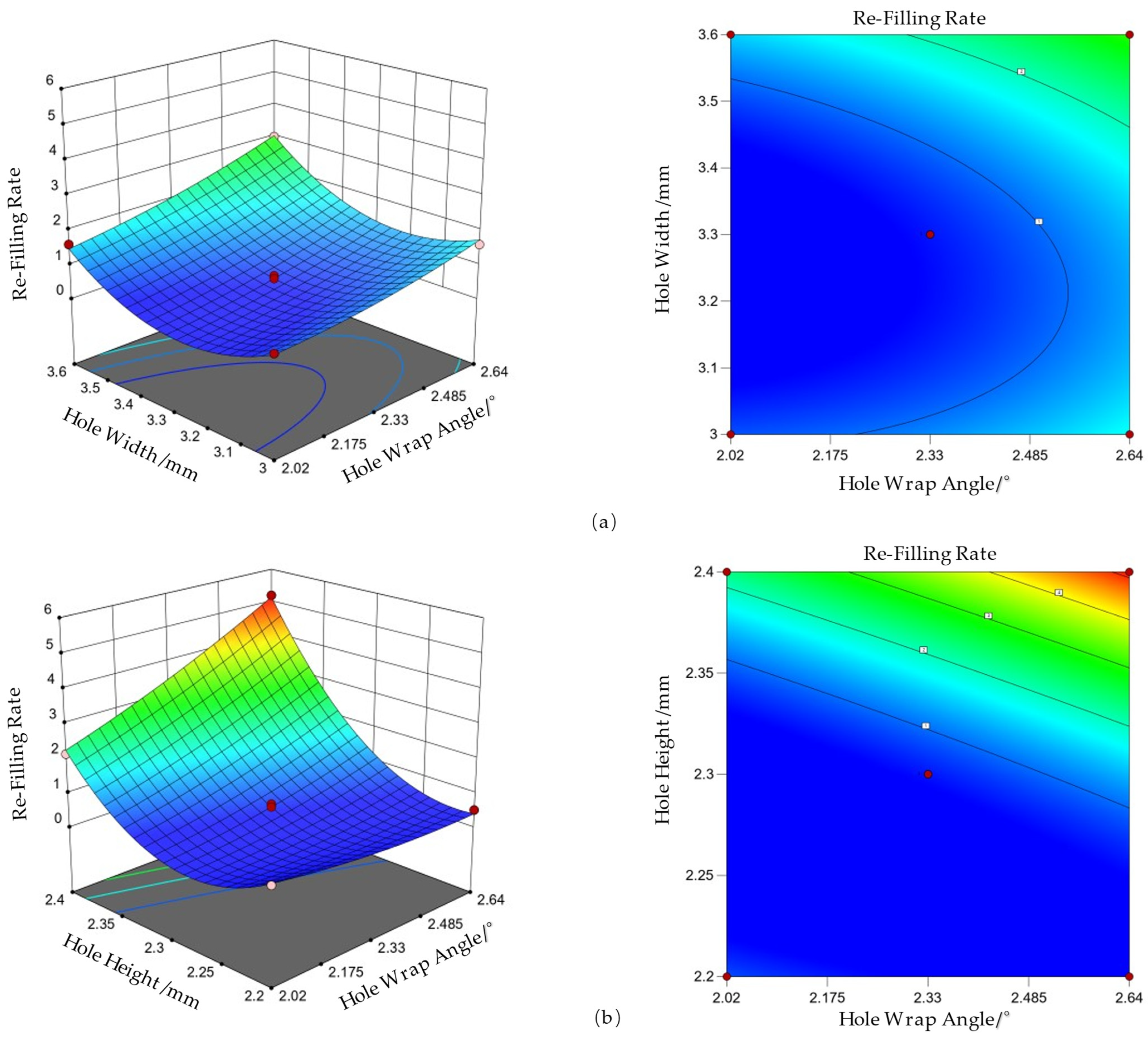
As can be seen from Table 7, the regression model for the over-filling rate had p < 0.01, indicating that the influence of independent variables on the response variable was significant; meanwhile, the lack-of-fit term had p > 0.05, meaning the lack-of-fit term was not significant. Therefore, this model can be used to express the relationship between cell hole parameters and the over-filling rate. From the magnitude of the F-value, the order of significance of the factors affecting the over-filling rate (from highest to lowest) was cell hole height, cell hole wrap angle, and cell hole width, and these factors had interactive effects; the corresponding response surface is shown in Figure 13. When the cell hole wrap angle was fixed, the over-filling rate first decreased and then increased with the increase in cell hole height. The reason for this phenomenon is that the cell hole height determines the longitudinal accommodation space of the cell hole. When the height was >2.4 mm, the cell hole could accommodate more than two seeds at the same time, making “stacked discharge” prone to occur during seeding; when the matching degree between the height and seed thickness was low, the gap of seeds in the cell hole was excessive, which easily led to secondary filling and a surge in the over-filling rate. The wrap angle affects the seeding rhythm through retention time: An excessively large wrap angle would extend the retention time of seeds in the cell hole, causing subsequent seeds to accumulate at the seeding outlet; an excessively small wrap angle would result in excessively fast seeding speed, and the cell hole would enter the next round of seed filling before being fully emptied, leading to repeated seed carrying. When the width was too large, the lateral space of the cell hole was sufficient, which might have allowed two seeds to be filled at the same time; however, due to the small particle size of rapeseed seeds, the magnitude of the width’s influence on over-filling was weaker than that of height and wrap angle.

3.1.3. Analysis of and Seed-Filling Qualification Rate

Multiple regression fitting was performed on the test data using the data processing software Design-Expert 13. Analysis of variance (ANOVA) was conducted on the regression model for the test results in Table 5, and a regression equation between the seed-filling qualification rate and the cell hole wrap angle, cell hole width, and cell hole height was established; the results are shown in Table 8. After eliminating the non-significant terms, the regression equation of the seed-filling qualification rate with the coded test factors was obtained as follows:
Y 3 = 1085.14 + 78.1985 X 1 + 95.292 X 2 + 830.152 X 3 6.39785 X 1 X 2 + 22.5 X 2 X 3 6.94849 X 1 2 19.725 X 2 2 193.775 X 3 2
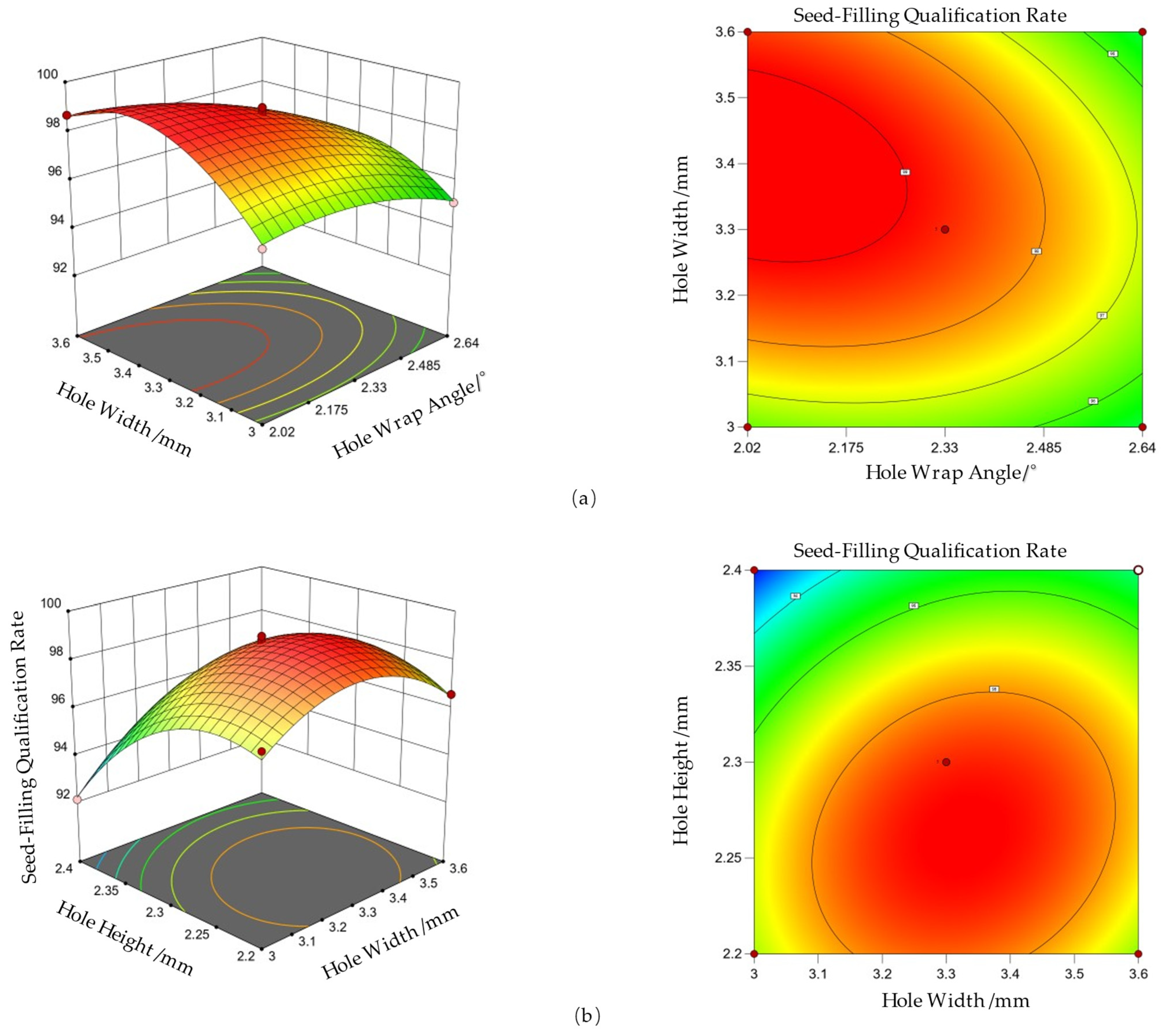
As can be seen from Table 8, the regression model for the seed-filling qualification rate had p < 0.01, indicating that the influence of independent variables on the response variable was significant; meanwhile, the lack-of-fit term had p > 0.05, meaning the lack-of-fit term was not significant. Therefore, this model can be used to express the relationship between cell hole parameters and the seed-filling qualification rate. From the magnitude of the F-value, the order of significance of the factors affecting the seed-filling qualification rate (from highest to lowest) was cell hole height, cell hole wrap angle, and cell hole width, and these factors had interactive effects; the corresponding response surface is shown in Figure 14. When the cell hole width was fixed, the seed-filling qualification rate first increased significantly and then decreased with the increase in cell hole height. The reason for this phenomenon is that the seed-filling qualification rate is calculated as “100%–under-filling rate–over-filling rate,” and the height has the most significant influence on the over-filling rate. Deviations in the height parameter directly led to an increase in the over-filling rate, thereby reducing the seed-filling qualification rate. For example, when the height increased from 2.3 mm to 2.4 mm, the over-filling rate increased by an average of 1.2%, and the seed-filling qualification rate decreased by 1.2% simultaneously. The cell hole wrap angle had a significant influence on the under-filling rate; optimizing the wrap angle reduced missed seeding, thereby improving the seed-filling qualification rate. However, since its influence on a single index was less significant than the influence of cell hole height on the over-filling rate, its overall influence was secondary.

3.1.4. Parameter Optimization

According to the selection range of simulation test factors, the key working parameters of the cell hole were theoretically optimized via using Design-Expert 12.0. data analysis software. The optimization objective function and constraint conditions are shown in Equation (15):
min Y 1 ( X 1 ,   X 2 ,   X 3 ) min Y 2 ( X 1 ,   X 2 ,   X 3 ) max Y 3 ( X 1 ,   X 2 ,   X 3 ) 2.02 ° X 1 2.64 ° 3   mm X 2 3.6   mm 2.2   mm X 3 2.4   mm
The optimal working parameters of the Bezier curve-based cell hole obtained from this theoretical optimization are as follows: cell hole wrap angle of 2.271° with an error range of ±0.2°, cell hole width of 3.407 mm with an error range of ±0.1 mm, and cell hole height of 2.254 mm with an error range of ±0.02 mm. Under these theoretical optimized parameters, the calculate under-filling rate is 0.448%, the over-filling rate is 0.416%, and the seed-filling qualification rate is 99.122%.

3.2. Bench Test Results

A test on the influence law of roller speed on the damage rate, under-filling rate, over-filling rate, and seed-filling qualification rate was conducted in accordance with the bench test method in Section 2.5. The test device was the rapeseed roller-type precision cluster metering device with Bezier curve-based cell holes, whose parameters had been optimized via simulation tests. The test results are shown in Figure 15.
The bench test results show that in the range of roller speed from 10 to 30 r/min, as the roller speed increased during seeding, the damage rate and under-filling rate showed a gradual upward trend, while the over-filling rate showed a significant downward trend. The reason for this phenomenon is that the accelerated speed shortens the seed-filling time, leading to an increase in the under-filling rate; at the same time, when the speed is relatively high, seeds will undergo compression and collision with the seed metering device housing, resulting in an increase in the damage rate. Therefore, on the premise of ensuring the seeding rate, controlling the roller speed at the optimal value is the key to reducing the under-filling rate and damage rate. As shown in Table 9, the test results indicate that when the roller speed of the cluster metering device in the bench test was in the range of 10–30 r/min, the seed damage rate was all less than 0.5%, and the seed-filling qualification rate of the cluster metering device was all above 94%, which meets the national standards. From Table 10, it can be concluded that the multiple-filling rate and miss-filling rate are lower than those of the miss-filling rate and multiple-filling rate obtained from the simulation test in Section 3.1, with the differences being 1.9 and 0.87 percentage points, respectively. The miss-filling rate and multiple-filling rate in the bench test were 2.35% and 1.29%, respectively. The errors between simulation and bench test originate from practical factors ignored in the simulation (such as mechanical wear of seeds and equipment vibration), yet the core trends are consistent, which verifies the consistency between theory and experiment.

4. Discussion

To address the issues of high seed damage rate and uncontrollable under-seeding/over-seeding rates in traditional rapeseed roller-type seed metering devices caused by geometric defects of cell holes, this study innovatively introduced Bezier curves into cell hole design and developed an optimized cell hole solution for precision seeding of small-seeded crops through the “theoretical modeling–simulation optimization–bench verification” approach: Breaking the limitations of traditional regular cell holes or special-shaped holes with straight line-arc splicing, it constructed a flexible contour featuring “gentle entry–gradual transition–smooth release” using Bezier curves, fundamentally eliminating the risk of mechanical abrupt changes in the three stages of cell hole operation (seed entry at the inlet, transition and slow release in the middle, and seed detachment at the outlet); bench test results show that within the roller speed range of 10~30 r/min, the seed damage rate remained consistently below 0.5%, and compared with traditional square holes and cylindrical (conical) holes, this scheme features a wider parameter adjustment range [32]—by adjusting the curve control points, it can quickly adapt to the particle size differences (1.5~2.5 mm) of different rapeseed varieties (e.g., Deyouza 988). The traditional square holes [6] had a breakage rate of 1.8%~3.2% and an adaptable particle size range of 1.8~2.2 mm, while the conical holes [10] had a breakage rate of 0.6~1.0% and an adaptable range of 1.7~2.3 mm. In contrast, the bench test results of this scheme showed a breakage rate of ≤0.48% (Table 9) and an adaptable particle size range of 1.5~2.5 mm, with the breakage rate reduced by 20~60% and the adaptable range expanded by 15~20%. Using EDEM discrete element simulation and a three-factor quadratic orthogonal combination test, the study quantified the influence patterns of cell hole wrap angle, width, and height on seeding performance, and clarified the priority order of factors affecting the seed-filling qualification rate as cell hole height (F = 217.35) > wrap angle (F = 114.16) > width (F = 30.13); specifically, each 0.1 mm deviation in height caused an approximately 2% fluctuation in the over-filling rate, and when the width was less than 3.15 mm, the under-filling rate surged by more than 5%, providing a reference analytical basis for the quantitative design of cell hole parameters in small-seeded crop seed metering devices. The study also expanded the application scenario of Bezier curves from guide vanes of rotating disc-type cluster metering devices to cell holes of roller -type seed metering devices, and combined the three-axis dimensions of rapeseed seeds (length: 2.01 ± 0.29 mm, width: 1.98 ± 0.27 mm) to calculate and determine the key parameter ranges of the cell hole as follows: wrap angle 2.02~2.64°, width 3.15~3.6 mm, and height 2.18~2.53 mm; verification tests confirmed that under the conditions of six-row synchronous seeding and an operating speed of 2~5 km/h, the seed-filling qualification rate reached ≥ 94%, providing an engineering reference model for the design of key components of precision seeders for small-seeded crops. The core performance indicators of this study (damage rate < 0.5%, seed-filling qualification rate > 94%) have met the Grade I standards specified in GB/T 6973-2005 Test Methods for Single-Seed (Precision) Seeders, laying a foundation for direct application and transformation; the current work has established reusable technical and theoretical support in aspects such as cell hole design methods and quantification rules of seeding performance. Furthermore, based on the design and verification results of the Bezier curve-based holes in this study, future research can be further expanded in the following directions: firstly, explore the influence of complex field working conditions (such as seeder vibration and soil resistance) on seeding performance and optimize the anti-interference parameter design of the holes; secondly, combine CFD-DEM coupled simulation to conduct a refined analysis of the microscopic interaction mechanism between air-blowing force and inter-seed friction force; and thirdly, extend this design method to small-particle-size crops such as sesame and wheat, develop a universal roller-type seed metering device, and expand the application scenarios so as to more fully adapt to the precision seeding requirements of small-seeded crops under different field environments.

5. Conclusions

(1) Based on the curvature continuity of Bezier curves, this study designed a rapeseed roller with Bezier curve-based cell holes, determined the structural design scheme of the cluster metering device, and established the parametric model of cell holes. It completed the mechanical analysis of the seed filling/discharging process of rapeseed seeds, and calculated the key parameters as follows: roller diameter of 150 mm, 90 cell holes per circle, cell hole wrap angle of 2.02–2.64°, cell hole width of 3.15–3.6 mm, and cell hole height of 2.18–2.53 mm.
(2) Through EDEM simulation and response surface analysis, the main influence patterns of cell hole wrap angle, width, and height on seeding performance were determined. The test results show that the order of influence on the seed-filling qualification rate (from largest to smallest) is cell hole height, cell hole width, and cell hole wrap angle. The height is the most sensitive to the over-filling rate, the width mainly affects the under-filling rate, and the wrap angle influences the retention time of seeds in the cell holes. When the cell hole height is 2.254 mm, cell hole width is 3.407 mm, and cell hole wrap angle is 2.271°, the seed-filling qualification rate obtained from the simulation is 99.122%, with the under-filling rate and over-filling rate being 0.448% and 0.416%, respectively.
(3) Bench tests verified the applicability of the optimized cell holes. The bench test results indicate that within the roller speed range of 10–30 r/min, the damage rate is all below 0.5%, and the seed-filling qualification rate remains above 94%, which meets the requirements of rapeseed precision seeding.

Author Contributions

Conceptualization, H.P. and G.W.; methodology, G.W. and H.P.; software, H.P. and Y.Z.; validation, H.P., G.W., H.J., Y.Z. and X.H.; formal analysis, H.J. and G.W.; investigation, G.W.; resources, G.W. and H.J.; data curation, Y.Z.; writing—original draft preparation, H.P.; writing—review and editing, X.H.; supervision, X.H. and G.W.; project administration, H.J. and X.H.; funding acquisition, X.H. All authors have read and agreed to the published version of the manuscript.

Funding

This research was funded by the Hubei Provincial Department of Agriculture and Rural Affairs; and the Key Technology Application and Research Project for Addressing Shortcomings in Agricultural Machinery and Equipment of Hubei Province (No. HBSNYT202301).

Institutional Review Board Statement

Not applicable.

Informed Consent Statement

Not applicable.

Data Availability Statement

The data presented in this study are available on request from the corresponding author. The data are not publicly available due to ongoing patent applications.

Conflicts of Interest

The authors declare no conflicts of interest.

References

  1. Liao, Y.T.; Shi, B.B.; Wang, C.Q.; Liao, Q.X.; Wu, A.Y.; Ou, Y.H. Current Situation and Development Trend of Mechanized Seeding for Rapeseed and Wheat in Southern Hilly and Mountainous Areas. Trans. Chin. Soc. Agric. Eng. 2025, 41, 12–26. [Google Scholar] [CrossRef]
  2. Xia, X.L. Practice and Exploration of Full-Process Mechanization Technology for Rapeseed Production. Agric. Mach. Technol. Promot. 2021, 29–31. [Google Scholar] [CrossRef]
  3. Zhang, Y.Y. Major Rapeseed-Producing Counties Are Expected to Realize Fully Mechanized Production. Hunan Agric. 2019, 14–15. [Google Scholar] [CrossRef]
  4. Liao, Q.X.; Cao, M.; Wang, B.S.; Wang, L.; Shen, W.H.; Pei, L.M. Design and Experiment of Slotted-tooth Spoon Hole and Air-assisted Precision Centralized Metering Device for Sesame. Trans. Chin. Soc. Agric. Mach. 2023, 54, 65–76. [Google Scholar] [CrossRef]
  5. Tan, Y.; Zhang, Y.; Jin, Y. Design and Test of a Pneumatically Assisted Seed Guiding and Integrated Seed-Meter for Both Oilseed Rape and Wheat. Trans. Chin. Soc. Agric. Mach. 2025, 56, 105–116+187. [Google Scholar] [CrossRef]
  6. Wang, B.S.; Wang, L.; Liao, Y.T.; Wu, C.; Cao, M.; Liao, Q.X. Design and Experiment of Seeding Wheels for Precision Hole-seeding Centralized Metering Device for Small-Particle-Size Seeds. Trans. Chin. Soc. Agric. Mach. 2022, 53, 64–75, 119. [Google Scholar] [CrossRef]
  7. Yuan, W.S.; Wu, C.Y.; Jin, C.Q. Design and Experiment of Special-Shaped Hole Pocket Wheel-Type Rapeseed Seed Metering Device. Trans. Chin. Soc. Agric. Mach. 2009, 40, 72–75. [Google Scholar]
  8. Zhong, J.Y. Design and Experiment of Inverted Fin-Shaped Hole Wheel-Type Variable Seed Metering Device for Dual-Use of Wheat and Rapeseed. Master’s Thesis, Anhui Agricultural University, Hefei, China, 2022. [Google Scholar]
  9. Luo, X.W.; Liu, T.; Jiang, E.C.; Li, Q. Design and Experiment of Seeding Wheel for Rice Precision Hill-Direct Seeding. Trans. Chin. Soc. Agric. Eng. 2007, 23, 108–112. [Google Scholar] [CrossRef]
  10. Lei, X.L.; Yang, W.H.; Yang, L.J.; Liu, L.Y.; Liao, Q.X.; Ren, W.J. Design and Experiment of Centralized Seeding Device for Rapeseed Precision Hill Seeding. Trans. Chin. Soc. Agric. Mach. 2020, 51, 54–64. [Google Scholar] [CrossRef]
  11. Yao, L.; Liao, Q.X.; Shen, W.H.; Wang, L.; Li, M.L.; Hu, Q.L. Design and Experiment of Rapeseed Rotary Disc-Type Precision Cluster Metering Device Based on Bezier Curve. Trans. Chin. Soc. Agric. Mach. 2022, 53, 56–66+83. [Google Scholar] [CrossRef]
  12. Ahmadi, E.; Ghassemzadeh, H.R.; Moghaddam, M.; Kim, K.U. Development of a Precision Seed Drill for Oilseed Rape. Turk. J. Agric. For. 2008, 32, 451–458. [Google Scholar]
  13. Lei, X.; Hu, H.; Yang, W.; Liu, L.; Liao, Q.; Ren, W. Seeding Performance of Air-Assisted Centralized Seed-Metering Device for Rapeseed. Int. J. Agric. Biol. Eng. 2021, 14, 79–87. [Google Scholar] [CrossRef]
  14. Aliyev, E.B.; Bezverkhniy, P.E. Numerical modelling of the seed retarder of a precision pneumatic seeder. National interdepartmental scientific and technical collection. Des. Manuf. Oper. Agric. Mach. 2022, 52, 86–98. [Google Scholar] [CrossRef]
  15. Zheng, G.; Qi, B.; Zhang, W.; Shao, W.; Zhang, L.; Wang, Y.; Ding, Y. Engineering Discrete Element Method-Based Design and Optimization of the Key Components of a Spoon-Wheel Spinach Seed-Metering Device. Agronomy 2024, 14, 2096. [Google Scholar] [CrossRef]
  16. Nikolay, Z.; Nikolay, K.; Gao, X.; Wei Li, Q.; Peng Mi, G.; Xiang Huang, Y. Design and Testing of Novel Seed Miss Prevention System for Single Seed Precision Metering Devices. Comput. Electron. Agric. 2022, 198, 107048. [Google Scholar] [CrossRef]
  17. Guo, P.; Sun, B.; Shang, S.; Hou, J.; Wang, D.; Zhao, Z.; Elshafie, A.; Zheng, X.; Eltoum, F. Effect of Auxiliary Air-Suction Seed-Filling Structure on Seed Discharge Performance of Peanut High-Speed Seed-Metering Machine. Agriculture 2025, 15, 1678. [Google Scholar] [CrossRef]
  18. Vladimir, N.; Nikolai, K.; Alexandr, K.; Yulia, N. Design and study of seeding devices for small selection seeding machines. E3S Web Conf. 2019, 126, 00008. [Google Scholar] [CrossRef]
  19. Chinese Academy of Agricultural Mechanization Sciences. Agricultural Machinery Design Manual; China Agricultural Science and Technology Press: Beijing, China, 2007. [Google Scholar]
  20. Lin, P. Experiment and Analysis of Rapeseed and Sesame Dual-Purpose Precision Seeding Device. Master’s Thesis, Huazhong Agricultural University, Wuhan, China, 2021. [Google Scholar]
  21. Kuai, J.; Wang, J.J.; Zuo, Q.S.; Chen, H.L.; Gao, J.Q.; Wang, B.; Zhou, G.S.; Fu, T.D. Effects and Mechanism of Higher Plant Density on Directly-Sown Rapeseed in the Yangtze River Basin of China. Sci. Agric. Sin. 2018, 51, 4625–4632. [Google Scholar] [CrossRef]
  22. Kuai, J.; Sun, Y.Y.; Zuo, Q.S.; Liao, Q.X.; Leng, S.H.; Cheng, Y.G.; Cao, S.; Wu, J.S.; Zhou, G.S. Optimization of Planting Density and Row Spacing for Direct-Seeded Winter Rapeseed under Mechanical Harvesting Mode. Acta Agron. Sin. 2016, 42, 898–908. [Google Scholar] [CrossRef]
  23. Cao, X.L.; Ma, X.; Li, H.W.; Wen, Z.C.; Li, Z.H.; Wang, X.C. Design and Experiment of Precision Seed Metering Device for Air-Suction roller -Type Rapeseed Plug Seedling. Trans. Chin. Soc. Agric. Eng. 2021, 37, 51–60. [Google Scholar] [CrossRef]
  24. Ding, L.; Yang, L.; Zhang, D.X.; Cui, T. Parametric Design and Experiment of Seed Cleaning Mechanism for Air-Suction Corn Seed Metering Device. Trans. Chin. Soc. Agric. Mach. 2019, 50, 47–56. [Google Scholar] [CrossRef]
  25. Shen, H.; Zhang, J.; Chen, X.; Dong, J.; Huang, Y.; Shi, J. Development of a Guiding-Groove Precision Metering Device for High-Speed Planting of Soybean. Am. Soc. Agric. Biol. Eng. 2021, 64, 1113–1122. [Google Scholar] [CrossRef]
  26. Gao, L.P.; Shi, B.B.; Liao, Q.X.; Zhang, B.X.; Zheng, J.; Liao, Y.T. Seeding Performance of Conical Hole Disc in Rapeseed Precision Seed Metering Device with Combined Positive and Negative Air Pressure. Trans. Chin. Soc. Agric. Eng. 2022, 38, 22–33. [Google Scholar] [CrossRef]
  27. Zhang, C.L.; Liu, T.; Zheng, Z.H.; Fang, J.; Xie, X.D.; Chen, L.Q. Design and Test of Precision Seeding Dispenser with Staggered Convex Teeth for Wheat Wide—Seedling—Belt Sowing. Trans. Chin. Soc. Agric. Eng. 2024, 40, 47–59. [Google Scholar] [CrossRef]
  28. Wu, W.; Chang, C.; Li, T.; Hu, H.; Zhou, Z.; Yang, W.; Guo, J.; Zhu, P.; Li, J.; Hu, J.; et al. Seed-Filling Characteristics of a Centralized Seed-Metering Device for Rapeseed Caused by Vibration. Agriculture 2022, 12, 965. [Google Scholar] [CrossRef]
  29. Li, T.; Zhang, Y.; Liao, Q.X.; Chen, H.; He, K.W.; Liao, Y.T. Design and Experiment of Pneumatic Roller—Type Single—Grain Precision Seed—Metering Device for Multi—Crop Compatibility. Trans. Chin. Soc. Agric. Eng. 2025, 14, 1–10. [Google Scholar] [CrossRef]
  30. GB/T 6973-2005; Testing Methods of Single Seed Drills (Precision Drills). China Standards Press: Beijing, China, 2005.
  31. Yan, B.; Gao, N.; Meng, Z. Design and Test of a Gravity-Assisted Vacuum Seed-Meter for Maize. In Proceedings of the 2020 4th International Workshop on Advances in Energy Science and Environment Engineering (AESEE 2020), Hangzhou, China, 10–12 April 2020; Yan, B., Gao, N., Meng, Z., Eds.; Beijing Research Center of Intelligent Equipment for Agriculture: Beijing, China; Beijing Research Center for Information Technology in Agriculture: Beijing, China, 2020; Volume 2, pp. 29–35. [Google Scholar] [CrossRef]
  32. Wei, G.L.; Ji, H.; Pan, H.L. Design and Test of a Simplified Intelligent Control Integrated Seed-Meter for Oilseed Rape. Digital Agriculture and Intelligent Agricultural Machinery. Digit. Agric. Intell. Agric. Mach. 2025, 1–5. [Google Scholar] [CrossRef]
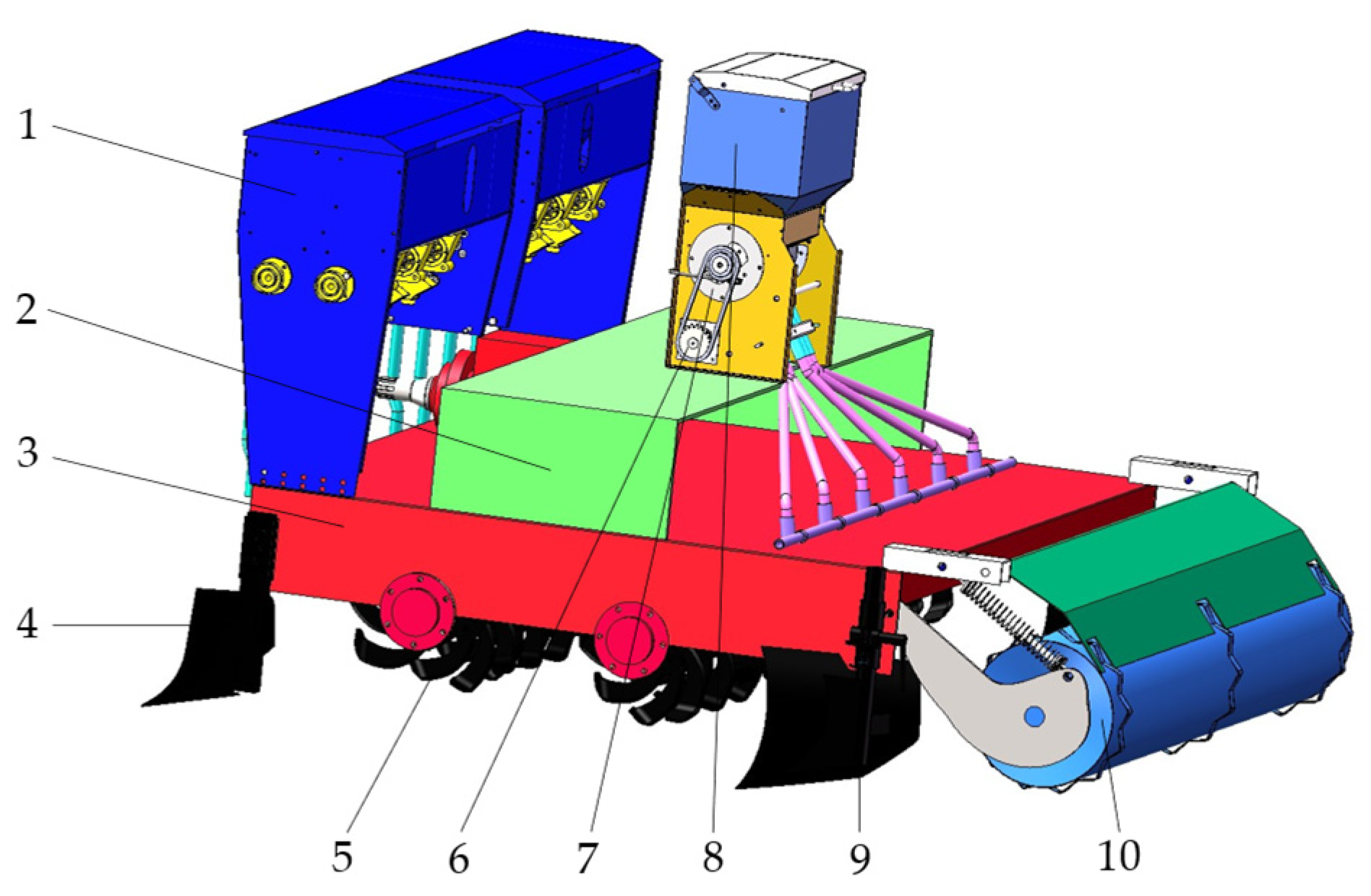
Figure 1. Schematic diagram of the dual-axis rotary tillage precision seeder. 1. Fertilizer box. 2. Auxiliary frame. 3. Main frame. 4. Front plow for furrow opening. 5. Rotary tillage device. 6. Drive motor. 7. Mechanical hole roller-type centralized seed metering device. 8. Seed box. 9. Rear plow for furrow opening. 10. Compaction device.
Applsci 15 12786 g001
Figure 2. Structural schematic diagram of the rapeseed roller-type precision centralized seed metering device with Bezier curve holes. (a) Exploded view of the centralized seed metering device; (b) Schematic diagram of the installation position of the seed metering roller and air-blowing plate; (c) Schematic diagram of the radial cross-section of the hole. 1. Seed box. 2. Seed metering roller. 3. Arc-shaped plate. 4. Roller end cover. 5. Cover side plate. 6. Hexagonal shaft. 7. Drive motor. 8. Seed-dropping pipe. 9. Roller cover. 10. Air pipe. 11. Air-blowing plate. 12. Bezier curve hole. 13. Hole air inlet.
Applsci 15 12786 g002
Figure 3. Schematic diagram of the working principle of the centralized seed metering device.
Applsci 15 12786 g003
Figure 4. Schematic diagram of the cubic Bezier curve.
Applsci 15 12786 g004
Figure 5. Schematic diagram of the hole’s radial cross-section.
Applsci 15 12786 g005
Figure 6. Schematic diagram of the hole’s axial cross-section. The black sections represent rapeseed.
Applsci 15 12786 g006
Figure 7. Force analysis of the seed-filling process.
Applsci 15 12786 g007
Figure 8. Force analysis of the seed-dropping process.
Applsci 15 12786 g008
Figure 9. Simulation model of the seed metering device.
Applsci 15 12786 g009
Figure 10. Schematic diagram of the cluster metering device operation model.
Applsci 15 12786 g010
Figure 11. Seed metering performance test setup. 1. Controller. 2. Speed-regulating motor. 3. Seed metering device. 4. Servo motor. 5. Steel wire hose. 6. Conveyor belt platform. 7. Seed metering device test bench. 8. Centrifugal fan.
Applsci 15 12786 g011
Figure 12. Interaction effects of test factors on the under-filling rate: (a) interaction effect of cell hole width and cell hole wrap angle on the under-filling rate; (b) interaction effect of cell hole width and cell hole height on the under-filling rate.
Applsci 15 12786 g012
Figure 13. Interaction effects of test factors on the over-filling rate: (a) interaction effect of cell hole width and cell hole wrap angle on the over-filling rate; (b) interaction effect of cell hole wrap angle and cell hole height on the over-filling rate.
Applsci 15 12786 g013
Figure 14. Interaction effects of test factors on the seed-filling qualification rate: (a) interaction effect of cell hole width and cell hole wrap angle on the seed-filling qualification rate; (b) interaction effect of cell hole width and cell hole height on the seed-filling qualification rate.
Applsci 15 12786 g014
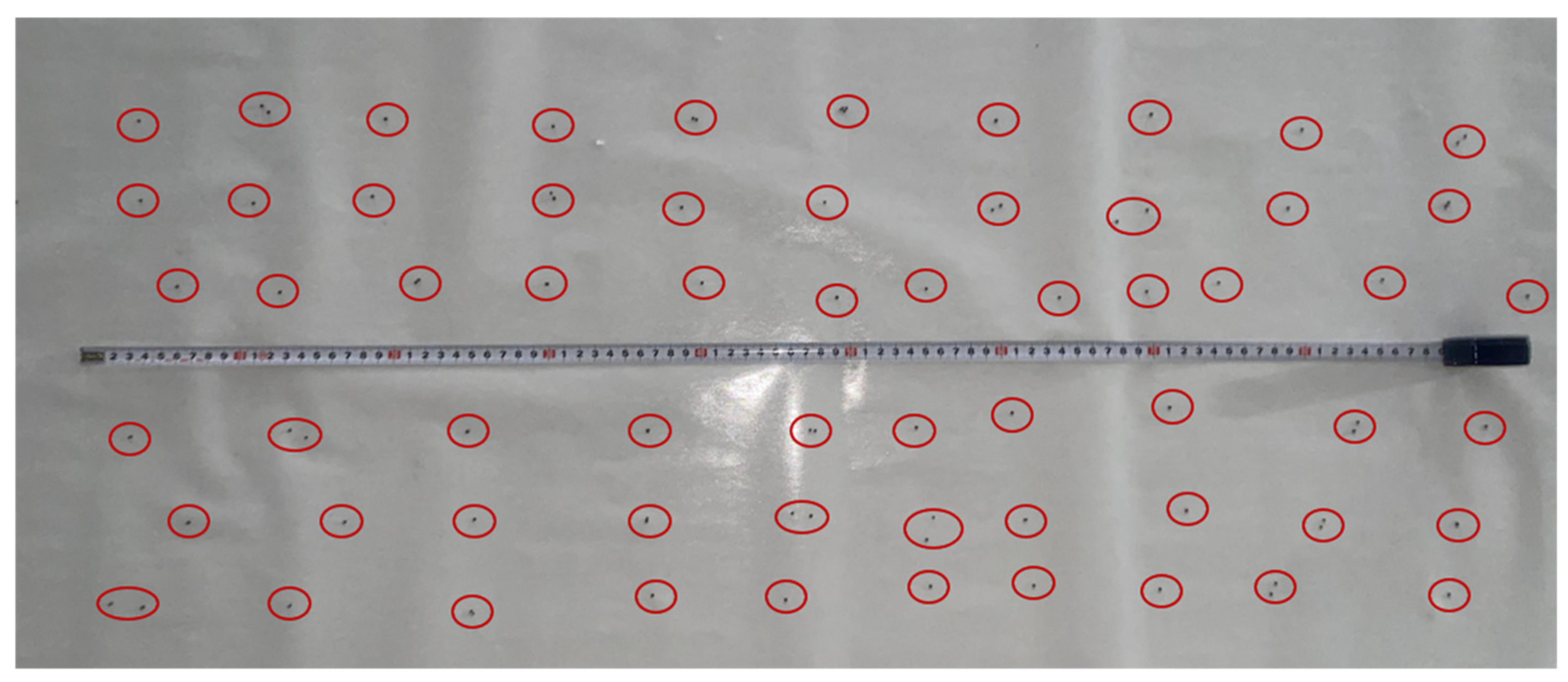
Figure 15. Seed distribution in bench test.
Applsci 15 12786 g015
Table 1. Agronomic parameters for rapeseed planting.
VarietyPlanting Density/(Plants·hm−2)Hill Spacing/mmRow Spacing/mmNumber of Rows
Deyouza 9883 × 105–6 × 10560–150150–3006–8
Table 2. Rapeseed material parameters and varieties.
VarietyLength/mmWidth/mmHeight/mm
Deyouza 9882.01 ± 0.291.98 ± 0.271.88 ± 0.22
Table 3. Simulation and Contact Parameters.
ItemParameterValue
Rapeseed seedPoisson’s ratio0.25
Shear modulus/Pa1.1 × 107
Density/(kg·m−3)1060
ABS engineering plasticPoisson’s ratio0.394
Shear modulus/Pa8.9 × 108
Density/(kg·m−3)1060
Seed–seedRestitution coefficient0.6
Static friction coefficient0.5
Dynamic friction coefficient0.01
Seed–ABS engineering plasticRestitution coefficient0.75
Static friction coefficient0.3
Dynamic friction coefficient0.01
Table 4. Factor coding of simulation experiments.
CodeFactorValue of Each Level
−101
X1Hole wrap angle (°)2.022.332.64
X2Hole width (mm)2.52.72.9
X3Hole height (mm)2.22.32.4
Table 5. Simulation test results.
Serial NumberLevelMiss-Filling Rate Y1 (%)Multiple-Filling Rate Y2 (%)Seed-Filling Qualification Rate Y3 (%)
X1X2X3
1−1−102.780.996.1
21−103.21.695.1
3−1100.921.698.68
41102.2395.3
5−10−11.40.898.3
610−12.40.596.7
7−1011.822.1596.33
81012.65.293.2
90−1−12.81.197
1001−11.51.896.6
110−113.84.192.1
120111.85.194.4
130000.580.5498.4
140000.550.6498.85
150000.450.5998.99
160000.640.598.7
170000.620.6898.75
Table 6. Analysis of variance (ANOVA) for miss-seeding rate.
Source of VarianceSum of SquaresDegrees of FreedomMean SquareFp
Model17.5991.95130.23<0.0001 **
X11.5111.51100.84<0.0001 **
X24.7414.74315.97<0.0001 **
X30.460810.460830.700.0009 **
X1X20.184910.184912.320.0099 **
X1X30.012110.01210.80610.3991
X2X30.122510.12258.160.0245 *
X121.7411.74116.15<0.0001 *
X224.7614.76317.24<0.0001 **
X323.0013.00199.57<0.0001 **
Residual0.105170.0150
Lack of fit0.082830.02764.960.0781
Error0.022340.0056
Total17.7016
Note: ** indicates extremely significant difference (p < 0.01); * indicates significant difference (0.01 ≤ p ≤ 0.05); the same below.
Table 7. Analysis of variance (ANOVA) for multiple-filling rate.
Source of VarianceSum of SquaresDegrees of FreedomMean SquareFp
Model40.6194.51310.19<0.0001 **
X12.9412.94202.13<0.0001 **
X21.8011.80124.090.0009 **
X319.07119.071310.65<0.0001 **
X1X20.122510.12258.420.0229 *
X1X32.8112.81192.87<0.0001 **
X2X30.022510.02251.550.2536
X120.109510.10957.530.0288 *
X224.4114.41303.37<0.0001 **
X328.3918.39576.48<0.0001 **
Residual0.101870.0145
Lack of fit0.080630.02695.070.0754
Error0.021240.0053
Total40.7116
Note: ** indicates extremely significant difference (p < 0.01); * indicates significant difference (0.01 ≤ p ≤ 0.05).
Table 8. Analysis of variance (ANOVA) for seed-filling qualification rate.
Source of VarianceSum of SquaresDegrees of FreedomMean SquareFp
Model70.6197.8586.34<0.0001 **
X110.37110.37114.16<0.0001 **
X22.7412.7430.130.0009 **
X319.75119.75217.35<0.0001 **
X1X21.4211.4215.580.0055 **
X1X30.585210.58526.440.0388 *
X2X31.8111.8220.060.0029 **
X121.8811.8820.660.0027 **
X2213.27113.27146.02<0.0001 **
X3215.81115.81173.98<0.0001 **
Residual0.636170.0909
Lack of fit0.444230.14813.090.1523
Error0.191940.0480
Total71.2516
Note: ** indicates extremely significant difference (p < 0.01); * indicates significant difference (0.01 ≤ p ≤ 0.05).
Table 9. Bench test results.
Rotational Speed/(r·min−1)Average Breakage Rate/%Miss-Seeding Rate/%Multiple-Seeding Rate/%Hole Seed Count Qualification Rate/%
100.0504.6395.37
150.120.652.0697.29
200.182.351.2996.36
250.353.610.2296.17
300.484.840.2794.89
Table 10. Comparison table of simulation optimization values and bench test values.
Evaluation Indicator (s)Simulation Optimization ValueBench Test Value (20 r/min)Error
Seed-filling qualification rate%99.12296.362.762
Miss-filling rate%0.4482.351.902
Multiple-filling rate%0.4161.290.874
Breakage rate%-0.18-
Simulation: No mechanical loss considered.
Disclaimer/Publisher’s Note: The statements, opinions and data contained in all publications are solely those of the individual author(s) and contributor(s) and not of MDPI and/or the editor(s). MDPI and/or the editor(s) disclaim responsibility for any injury to people or property resulting from any ideas, methods, instructions or products referred to in the content.