Article

Turbulence and Windshear Study for Typhoon Wipha in 2025

1
Hong Kong Observatory, Hong Kong, China
2
Department of Architecture and Civil Engineering, City University of Hong Kong, Hong Kong, China
3
Department of Civil and Environmental Engineering, The Hong Kong Polytechnic University, Hong Kong, China
*
Author to whom correspondence should be addressed.
Appl. Sci. 2025, 15(23), 12772; https://doi.org/10.3390/app152312772
Submission received: 13 September 2025 / Revised: 26 November 2025 / Accepted: 29 November 2025 / Published: 2 December 2025
(This article belongs to the Special Issue Transportation and Infrastructures Under Extreme Weather Conditions)

Abstract

This paper reports on the study of turbulence at various locations in Hong Kong during Typhoon Wipha in July 2025, including turbulence intensity based on Doppler Light Detection and Ranging (LIDAR) systems and radiosondes, observations by microclimate stations, and low-level windshear and turbulence at the Hong Kong International Airport (HKIA) by LIDAR, flight data, and pilot reports. Although the observation period was primarily limited to 20 July 2025, passage of a typhoon over a densely instrumented urban area is uncommon; these observations on turbulent flow associated with typhoons therefore can serve as valuable benchmarks for similar studies on turbulent flow associated with typhoons in other coastal areas, particularly for operational alerts in aviation. To assess the predictability of turbulence, the eddy dissipation rate (EDR) was derived from a high-resolution numerical weather prediction (NWP) model using diagnostic and reconstruction approaches. Compared with radiosonde data, both approaches performed similarly in the shear-dominated low-level atmosphere, while the diagnostic approach outperformed when buoyancy became important. This result highlights the importance of incorporating buoyancy effects in the reconstruction approach if the EDR diagnostic is not available. The high-resolution NWP was also used to provide time-varying boundary conditions for computational fluid dynamics simulations in urban areas, and its limitations were discussed. This study also demonstrated the difficulty of capturing low-level windshear encountered by departing aircraft in an operational environment and demonstrated that a trajectory-aware method for deriving headwind could align more closely with onboard measurements than the standard fixed-path product.

1. Introduction

Low-level windshear and turbulence have long been recognized as hazards to aviation safety and as critical factors influencing urban resilience. In tropical cyclone (TC) conditions, strong winds, gusts, and rapid changes in wind directions in the boundary layer can lead to severe turbulence. To quantify atmospheric turbulence, the eddy dissipation rate (EDR)—defined as the cube root of the turbulent kinetic energy dissipation rate ( ε )—has become a standardized metric for describing turbulence intensity [1]. However, observational studies of ε or EDR in tropical cyclone boundary layers remain rather limited. The tower-based observations have mostly been limited to heights under 200 m [2,3,4]. Fang et al. extended the study of the vertical structure of turbulent dissipation using sonic-anemometer measurements on a 356-m-tall meteorological tower [5]. Nevertheless, such towers are costly to construct and maintain, and their deployment is often constrained by regulatory or logistical limitations.
As a complementary approach, ground-based Doppler Light Detection and Ranging (LIDAR) systems have emerged as a powerful and practical alternative for probing turbulence [6,7,8]. LIDARs can be deployed on land or offshore platforms to measure wind profiles over broad spatial ranges and to higher altitudes with high temporal resolution. Their portability and flexibility enable operation at remote or exposed sites [9]. Previous studies have confirmed that LIDAR-derived wind and turbulence statistics are comparable with sonic-anemometer measurements [10,11].
On 20 July 2025, Hong Kong was affected by Typhoon Wipha, which necessitated the issuance of Hurricane Signal No. 10, the highest warning signal for TCs in Hong Kong. Wipha brought very strong winds to various parts of Hong Kong. This provides a unique opportunity to study turbulence over the territory. A network of Doppler LIDAR systems was deployed in various parts of the territory, which were used to continuously monitor the wind field and to derive vertical profiles of EDR following [12,13]. The direct impact of Wipha on Hong Kong provides a unique opportunity to study the spatial and temporal variations of turbulence intensity within the territory and assess the performance of high-resolution numerical weather prediction (NWP) models in reproducing these structures. Complementary to the LIDAR measurements, radiosonde observations could provide additional thermodynamic information of the tropical cyclone boundary layers, which cannot be directly measured by LIDAR. In addition, the high-frequency vertical sampling of radiosonde observations offers fine-scale resolution of the turbulent structure in the boundary layer.
Apart from examining the vertical structure of turbulence, it is also important to understand the spatial variability of near-surface winds during the passage of tropical cyclones. The complex urban morphology of Hong Kong can strongly modify local wind fields, producing localized accelerations, flow separation, and enhanced turbulence around built-up areas [14]. A comparison between computational fluid dynamics (CFD) simulation over the urban area of Hong Kong and measurements from microclimate stations during the passage of a tropical cyclone was reported in [15]; however, only two stations were available at that time, limiting the comprehensiveness of the evaluation. By 2025, more microclimate stations will have been established in Hong Kong. The dense networks of microclimate stations provide an opportunity to quantify the spatial distribution and temporal evolution of urban airflow under extreme winds. These measurements are essential not only for validating high-resolution mesoscale and CFD simulations, but also for improving the understanding of wind hazard and turbulence exposure in densely populated coastal cities affected by tropical cyclones.
While understanding building effects is essential for characterizing urban airflow, they are also highly relevant to aviation safety. Previous studies have shown that building-induced airflow disturbances and windshear can significantly affect aircraft operations [16,17,18]. Rapid changes in wind speed or direction within a few hundred meters of the ground can cause sudden loss of lift or control, making early detection and timely alerting vital for flight operations. Continuous monitoring using Doppler LIDAR, wind profilers, and surface anemometers has been implemented to detect wind-shear signatures and evaluate their relationship with aircraft-encountered events [19]. Nevertheless, operational challenges in wind-shear alerting remain, especially during the passage of tropical cyclones when wind variability is extreme. During Typhoon Wipha, a departing aircraft reported an unusually strong headwind loss of about 20 kt at rotation—an event seldom observed at HKIA. Direct comparison with LIDAR-derived data showed that the magnitude of headwind loss inferred was significantly smaller than that experienced by the aircraft. This discrepancy highlights the potential limitations of current detection methods and underscores the need for detailed investigation.
This study investigates turbulence and windshear in Hong Kong during Typhoon Wipha through a series of coordinated observational and numerical analyses. The paper is structured as follows. Section 2 provides a brief overview of the observation datasets and discusses the specific research questions. Section 3.1 presents the estimation of the EDR from a network of Doppler LiDAR observations and compares the results with the EDR derived from a high-resolution NWP model using two different diagnostic methods. Section 3.2 examines the vertical profiles of turbulence obtained from high-resolution radiosonde data and analyzes the performance of model-based EDR calculation methods under different flow regimes, providing insight into how stability and stratification affect turbulence representation. Section 3.3 explores urban-scale airflow over an urban area in Hong Kong using a mesoscale–CFD coupled modeling approach, validating the simulated winds against measurements from microclimate stations and evaluating the relative strengths and limitations of the CFD simulation compared with the parent mesoscale model. Section 3.4 investigates building-induced turbulence near a new terminal building at the Hong Kong International Airport (HKIA), where the CFD simulation successfully reproduced the enhanced turbulent flow observed by LIDAR. Section 3.5 focuses on a rare case of low-level windshear encountered by a departing aircraft during Typhoon Wipha, analyzing both LIDAR and flight data to illustrate operational challenges in wind-shear detection and alerting. These results are novel for turbulence studies of tropical cyclones in Hong Kong and could be a useful reference for similar turbulent flows in coastal cities in other parts of the world.

2. Materials and Methods

This section provides an overview of the observational datasets used in this study and lays out the specific research questions. The detailed analyses and results are presented in Section 3 by topic.
A network of six vertically scanned LIDARs was established in Hong Kong. Using laser beams with a central wavelength of approximately 1.5 µm to perform Doppler swinging measurements, the LIDARs retrieved vertical profiles of the three components of the wind up to approximately 1 km. Individual three-component wind estimates were available every 15 s. For each 10-min averaging window, we retained the height-specific time series and estimated EDR using a spectral method. High-frequency radiosondes were launched from King’s Park, measuring pressure, temperature, dew point temperature, and wind every 2 s. Radiosonde-based EDR was derived using the Thorpe method. The LIDAR and radiosonde dataset form the basis for assessing the predictability of turbulence from a high-resolution NWP model. Near-surface wind observations were obtained from a dense network of urban microclimate stations in Tsim Sha Tsui. Each installation comprised two identical meteorological devices (Gill MaxiMet GMX500; Gill Instruments Limited, Lymington, UK, United Kingdom Accreditation Service-traceable calibration) mounted at two distinct heights above ground. Wind speed and direction were measured by ultrasonic sensors. For this study, we used 10-min mean wind speeds and directions reported every minute to examine the spatial variability of urban winds under extreme forcing and to validate CFD simulations at neighborhood scales. At HKIA, LIDARs were used to characterize low-level windshear and building-induced turbulence from PPI and RHI scans.
The research questions in this study are motivated by operational needs in tropical cyclone environments over complex coastal cities. First, the predictability of turbulence, expressed here via EDR, remains uncertain across the rapidly evolving regimes that occur in a landfalling typhoon. While modern NWP systems can provide native turbulence diagnostics in principle, such outputs are often unavailable in third-party products, and practitioners must instead reconstruct EDR from resolved fields using simplified closures. Without a systematic evaluation against independent observations, it is unclear when diagnostic outputs are indispensable and when reconstruction is sufficient. By confronting both pathways with LiDAR- and radiosonde-derived EDR, the study addresses a practical question at the heart of forecasting and aviation decision support: what minimum model information is required to obtain reliable turbulence guidance during extreme events. This will be studied in Section 3.1 and Section 3.2.
The second question concerns the fidelity of building-resolving CFD under typhoon forcing. Urban morphology profoundly reshapes near-surface flow, producing localized accelerations, channeling, separation, and enhanced turbulence that can amplify wind hazards and affect critical infrastructure. Mesoscale models, even at kilometer resolution, cannot explicitly represent these microscale processes. CFD promises to bridge this gap, but its performance under the strongly sheared, gusty, and precipitation-affected conditions of a tropical cyclone is not well quantified, especially when constrained by realistic inflow and limited spin-up time. Evaluating CFD against a dense microclimate network and airport remote sensing provides evidence for when building-resolving simulations offer material improvements over mesoscale guidance, thereby informing urban risk assessment, design standards, and operational planning for extreme winds. This will be studied in Section 3.3 and Section 3.4.
Finally, the operational question on low-level windshear at HKIA stems from a case in which a departing aircraft experienced a larger headwind loss than standard remote-sensing products indicated. Fixed-path headwind estimates from RHI scans assume a static sampling geometry and may not represent the winds encountered along the aircraft’s actual trajectory in a rapidly changing wind field. A new, trajectory-aware method in headwind reconstruction was proposed to mitigate the discrepancy between LIDAR measurements and pilot reports. This will be studied in Section 3.5.

3. Results

3.1. LIDAR-Based EDR and Comparison with Modeling Results

This section concerns the LIDAR-based estimation of EDR and compares two model-derived EDR methods: (i) EDR from the model’s prognostic turbulent kinetic energy (TKE) equation, and (ii) EDR estimated using a subfilter-scale reconstruction (SFSR) approach [20]. The comparison spans six sites across Hong Kong, providing a general assessment of which model-derived EDR is more suitable under tropical cyclone conditions.
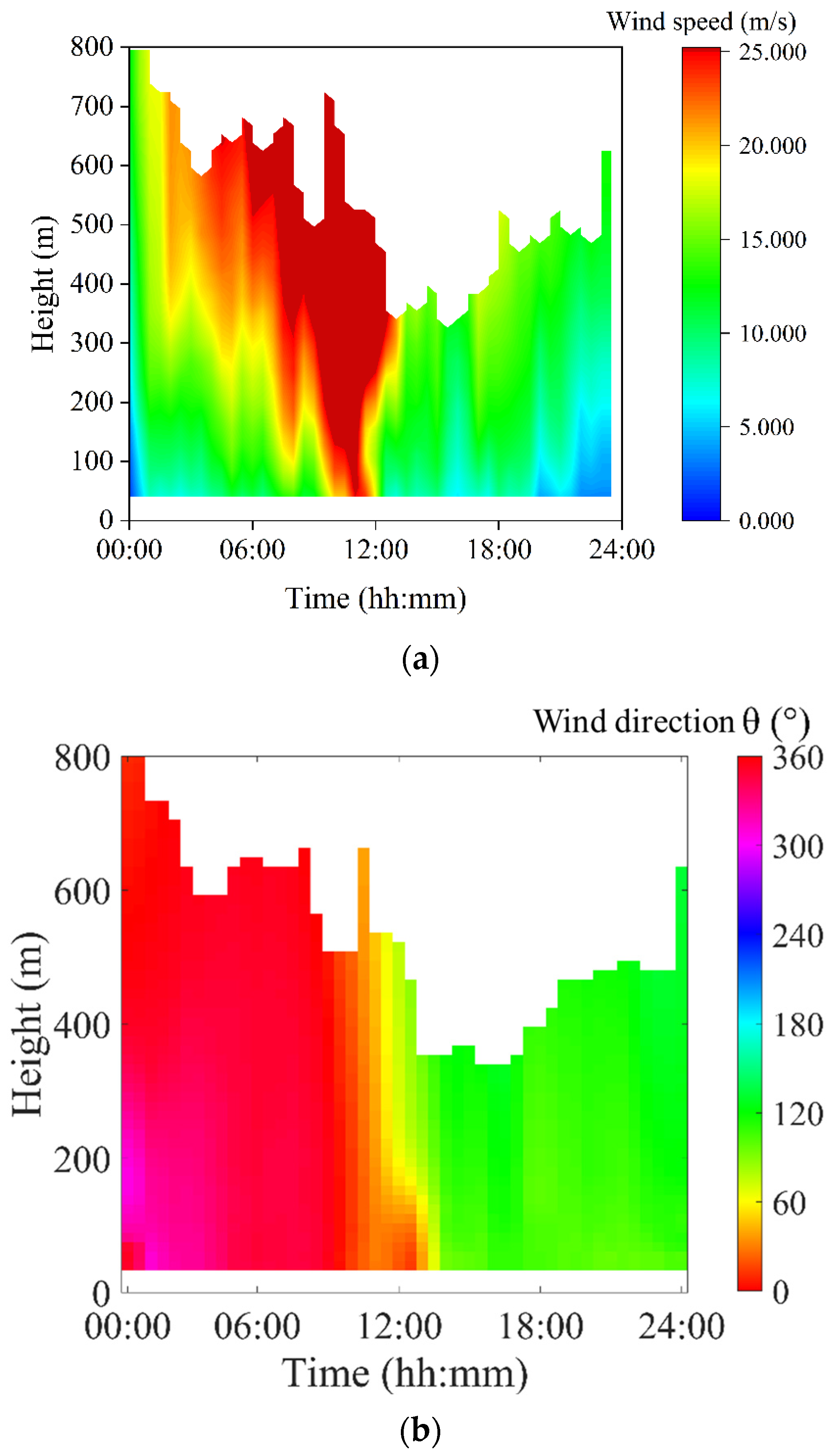
An example of vertical wind profiles measured by LIDAR at Bui O (BO) in the southern part of Lantau Island is shown in Figure 1. Figure 1a gives the time-height plot of horizontal wind speed. There was a descending jet with wind speed exceeding 25 m s−1 following the approach of Wipha, with the strongest winds from approximately 10:00 to 12:00 Hong Kong Time (HKT) on 20 July 2025 (HKT = UTC + 8 h). Following the departure of Wipha, wind speed decreased rapidly at all heights. The time-height plot of horizontal wind direction is shown in Figure 1b, displaying the rapid change in wind direction from north to south following the passage of Wipha’s eye across BO.
To compute the EDR from LIDAR measurements, 10-min mean wind profiles were used. For each 10-min averaging period, individual measurements of the three wind components were available every 15 s. As such, the 15-s updating wind data could be used to construct a time series to calculate EDR using the spectral method, following [12]. Because wind direction can vary rapidly near a tropical cyclone, nonstationary periods were screened following [21]. A candidate segment was rejected if either (i) the difference between the scalar and vector mean wind speeds exceeded 0.51 m s−1, or (ii) the standard deviation of wind direction exceeded 10°. Only segments passing these criteria were used in the spectral fit. After quality control, EDR was estimated directly from Doppler velocity spectra. A Fourier transform was applied to the 15-s time series to obtain the velocity power spectrum, S ( f ) , which was fitted to a generalized power-law model:
S ( f ) = α ε 2 / 3 f n
where f is the frequency, α is the Kolmogorov constant, and n is a fitted spectral slope. EDR can then be obtained by taking the cube root of ε .
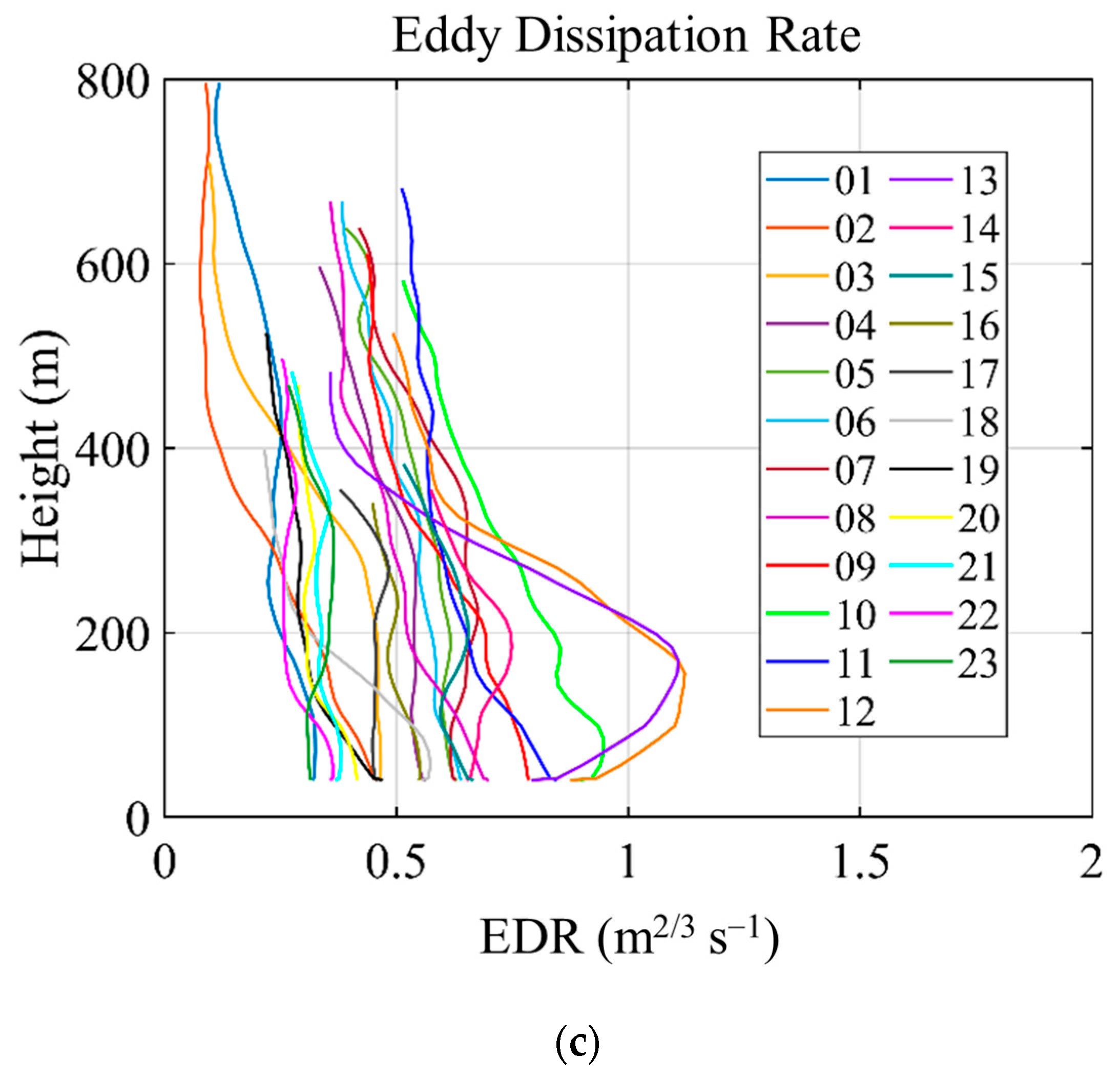
The hourly vertical profile of EDR derived from LIDAR in BO is shown in Figure 1c. When Wipha was closest to BO, EDR below a height of approximately 300 m was highest, reaching approximately 1.1 m2/3s−1 at 12:00–13:00 HKT. This high turbulence could be associated with local terrain because there are mountains as high as 1000 m above mean sea level north of BO on Lantau Island. This is also attributable to the high turbulence within the surface layer of the typhoon, especially following the change in wind direction to southerly winds without much upstream terrain blockage.
A high-resolution NWP with a horizontal resolution of approximately 1 km was performed using the Regional Atmospheric Modeling System (RAMS) version 6.3, nested with the reanalysis of the European Centre of Medium Range Weather Forecast (ECMWF) following the method described in [22]. At a horizontal resolution of 1 km, the Deardorff turbulence parameterization scheme [23] was adopted, in which the EDR is directly computed from the prognostic TKE equation. In the inertial subrange, the dissipation rate   ε is a function of TKE and the integral scale of turbulence L, based on Kolmogorov’s theory:
ε = E 3 / 2 / L ,
where E is the TKE. In the Deardorff scheme, L is related to the subgrid-scale (SGS) mixing length l via L = l / C D , with C D = 0.19 + 0.51 l / ( x y z ) 1 / 3 , and x , y , and z denote the grid spacings in the x-, y-, and z-directions, respectively. EDR can then be obtained by taking the cube root of ε . In this study, RAMS was configured to output the instantaneous EDR field and other variables every minute.
Alternatively, the SFSR technique [20] was applied to the RAMS output data to calculate the time-height contour of EDR at BO. This method estimates EDR by applying an explicit top-hat filter [24] to the model-resolved three-dimensional velocity field and reconstructing the resolvable sub-filter-scale (RSFS) motions through a truncated deconvolution. The reconstructed RSFS TKE and the SGS TKE, which are calculated from the strain-rate and rotation-rate tensors of the resolved model velocity fields using a nonlinear backscatter and anisotropy model [25], are combined to obtain the total TKE. The total TKE is then converted to EDR via Equation (1). In SFSR, the integral scale of turbulence is taken as ( λ x y z ) 1 / 3 , where λ is a flow-dependent quantity. A constant value of 8 was set for λ in this work following [20].
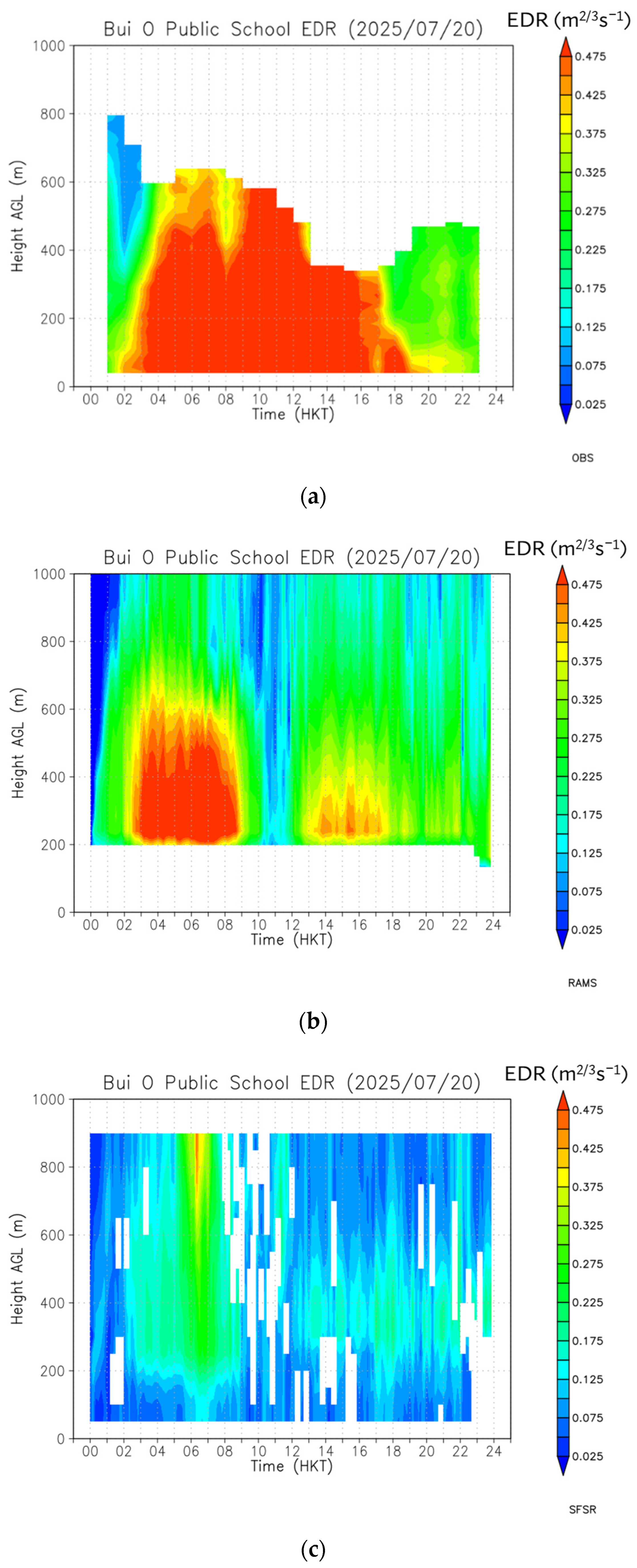
The time-height plot of EDR from LIDAR measurement at BO is shown in Figure 2a.
For comparison, the EDR derived from RAMS’s prognostic TKE equation and SFSR are shown in Figure 2b and Figure 2c, respectively. It can be seen that both have some deficiencies in comparison with observations in Figure 2a; namely, the direct RAMS output failed to give higher turbulence between 10 a.m. and noon on 20 July 2025, whereas the SFSR technique generally underestimated EDR.
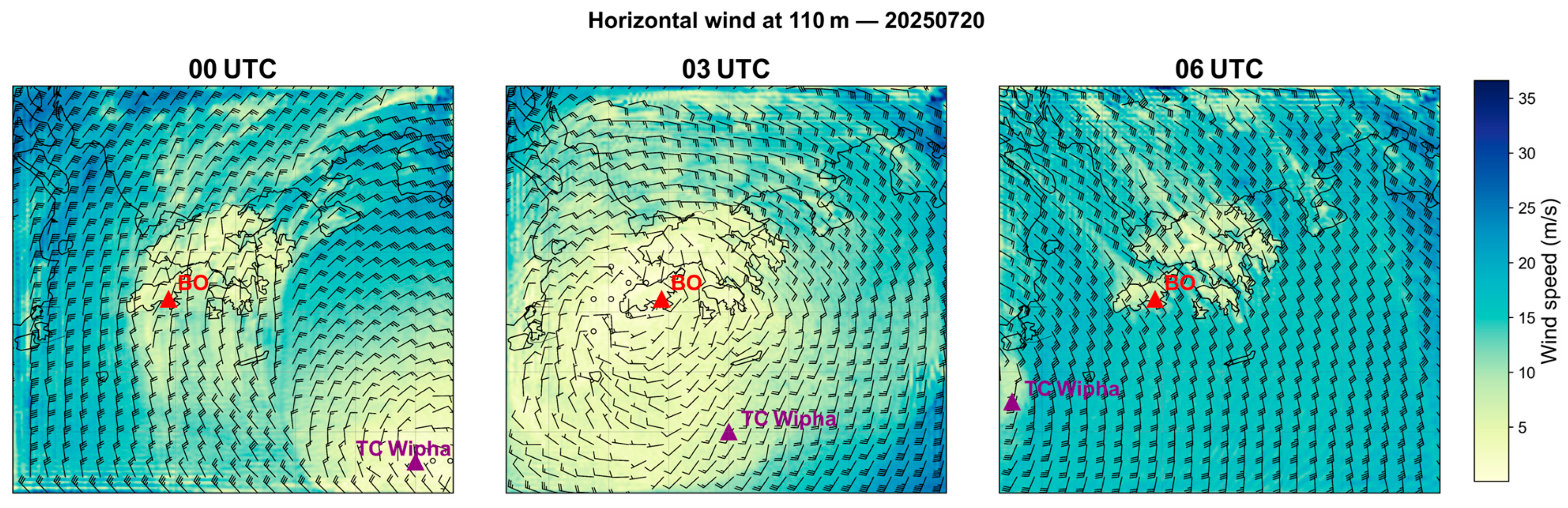
The underestimation of turbulence by the direct RAMS output between 10:00 and 12:00 HKT (02–04 UTC) on 20 July 2025 is mainly attributed to position errors in the simulated TC. Figure 3 compares the horizontal wind fields at 110 m simulated by RAMS with the Hong Kong Observatory’s operational analysis position of tropical cyclone Wipha. At 00 UTC, the model reproduced the observed northerly winds at BO reasonably well, although the simulated TC center was slightly displaced from the analyzed location. By 03 UTC, however, the simulated TC had migrated northward toward Lantau Island, placing BO near the TC’s center where weaker winds prevailed in the model. In reality, Wipha remained about 60 km south of Hong Kong, and BO lay within the eyewall region, experiencing stronger winds and higher turbulence as indicated by the LIDAR-derived EDR in Figure 2a. Consequently, the simulated EDR showed a spurious decrease during this period (Figure 2b). As Wipha moved away from Hong Kong, the positional discrepancy lessened by 06 UTC, the simulated wind direction shifted correctly to southeasterly, and the model-derived EDR aligned more closely with both the observations. This demonstrates model-derived EDR is highly sensitive to TC position errors, especially when the circulation center is close to the observing site; track bias can even invert the temporal trend of EDR, underscoring the need for careful interpretation of the model results.
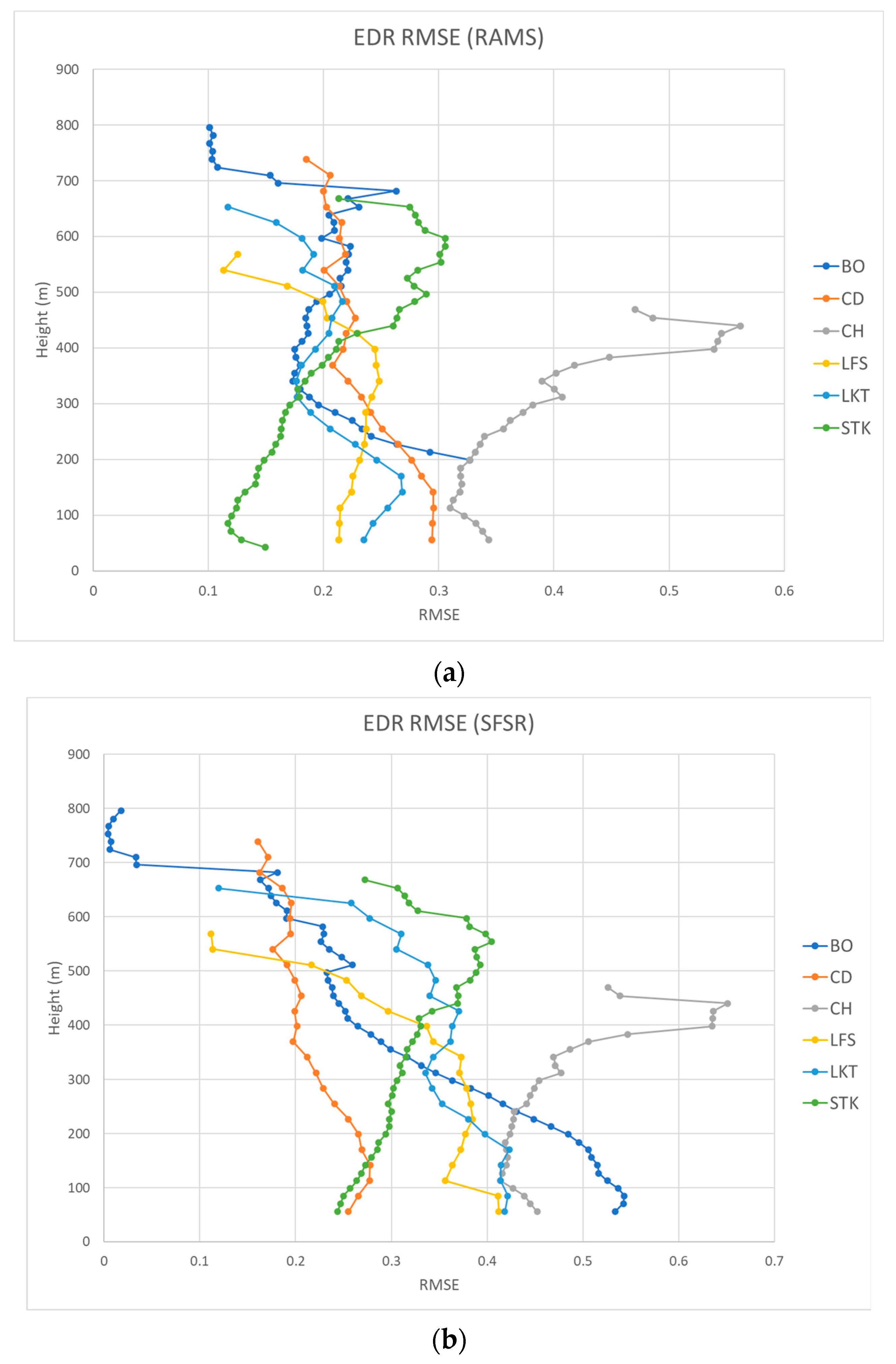
To quantitatively compare EDRs from RAMS direct output and SFSR methods, we calculated the root-mean-square errors (RMSEs) of EDRs against LIDAR observations at six locations in Hong Kong for the whole day of 20 July 2025, when Typhoon Wipha impacted the territory. The results are shown in Figure 4a and Figure 4b, respectively. In general, the former had smaller errors, with RMSEs mostly in the region of 0.1 to 0.3 m2/3 s−1. In contrast, the latter had slightly larger RMSEs in the region of around 0.2 to 0.5 m2/3 s−1. A distinct peak in the EDR error at approximately 400 m was found for both methods at the CH site, which was likely caused by the limited number of LIDAR retrievals around those altitudes instead of local terrain effect or systematic model bias. The differences between the RAMS and SFSR EDR estimates are examined in greater detail in the next section using higher-frequency radiosonde data.

3.2. Radiosonde-Based EDR and Comparison with Modeling Results

Similar to Section 2, which compared LIDAR-derived and model-derived EDR, this section analyzes turbulence characteristics obtained from high-resolution radiosonde measurements to provide an independent observational reference for model evaluation. Compared with LIDAR, radiosonde measurements offer much finer vertical resolution, enabling a more detailed examination of the vertical structure of EDR and providing valuable insight into small-scale turbulence features within the atmospheric boundary layer [26,27,28]. Radiosonde observations with a two-second sampling interval from King’s Park in Hong Kong were used to calculate the vertical profile of the EDR following the Thorpe method [29], which has been applied to radiosonde data over the United States and shown to be comparable to the flight-derived EDR [30].
In the Thorpe method, temperature inversions in the potential temperature θ profile are first reordered to a monotonically increasing profile. The resulting vertical displacements of θ are the Thorpe displacements, and the root-mean-square value of the Thorpe displacement is the Thorpe scale L T , which represents the local overturning scale. Assuming a linear relationship between L T and the Ozmidov scale L O = ( ε / N 3 ) 1 / 2 [31], the turbulent energy dissipation rate ε can be determined as ε = C K L T 2 N 3 , where C K is an empirical constant and set to 1.0, N is the Brunt-Väisälä frequency.
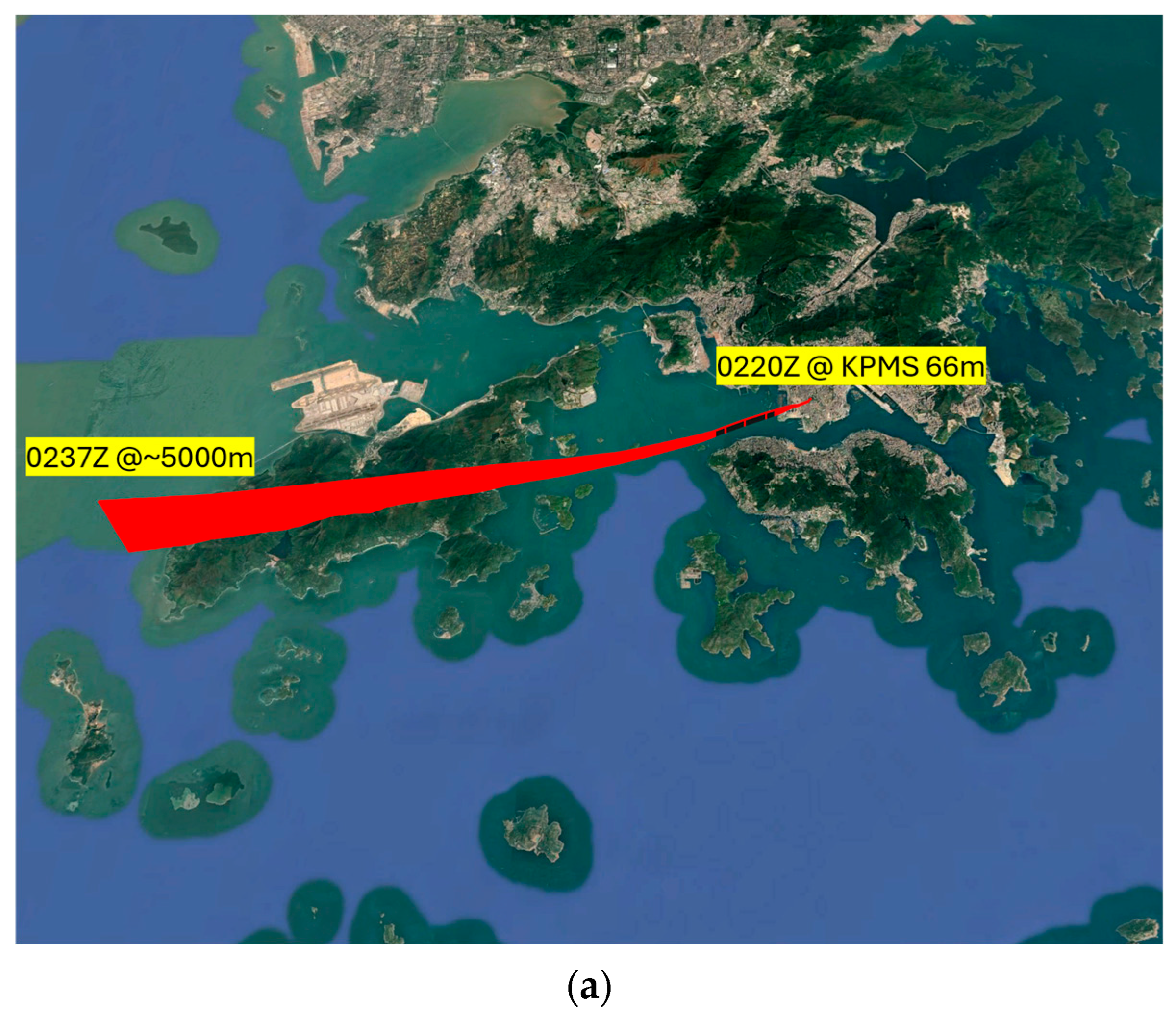
An example of the radiosonde track launched during Typhoon Wipha is shown in Figure 5a. To facilitate model comparison, the one-minute RAMS outputs were temporally and spatially interpolated along the ascending track of the radiosonde. Following Section 2, two sets of model-derived EDR profiles were analyzed: (i) the prognostic EDR directly available from the TKE equation in RAMS and (ii) the EDR reconstructed using the SFSR technique.
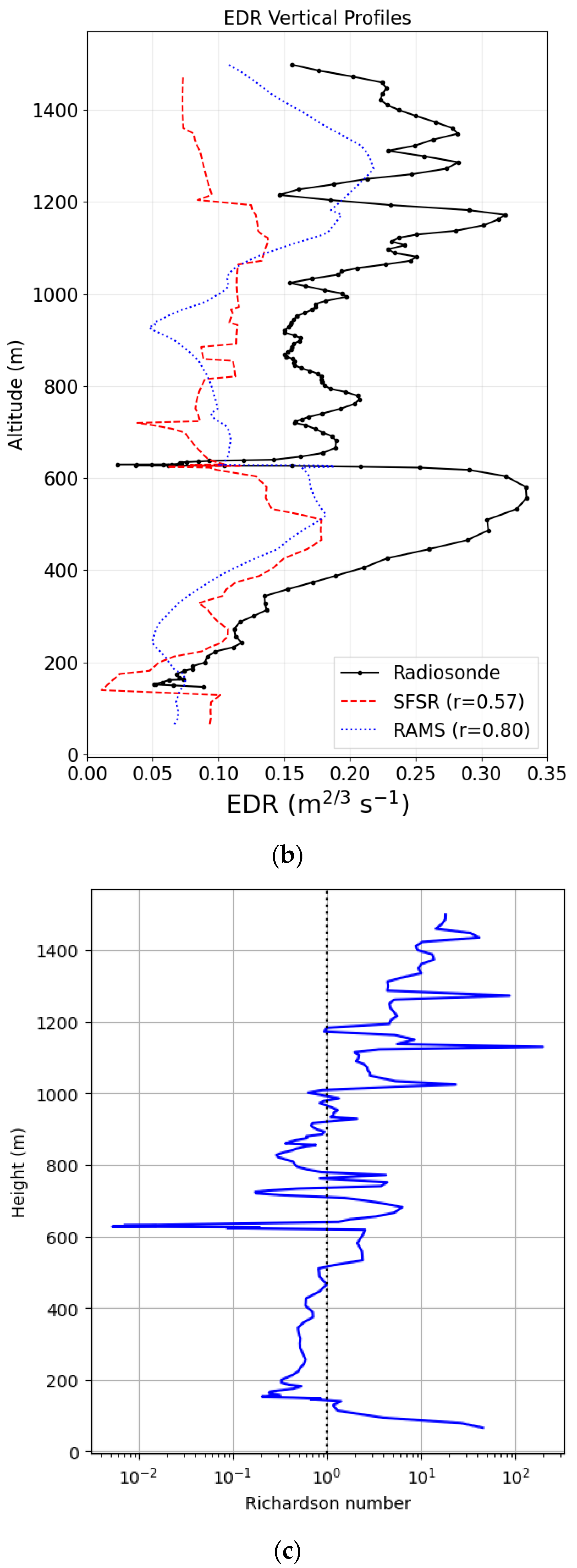
Figure 5b shows the vertical profile of EDR from radiosonde measurements (black solid line); the RAMS direct output (blue dotted line), and the SFSR EDR (red dashed line). In the observation, EDR was the highest within the atmospheric boundary layer, reaching approximately 0.35 m2/3 s−1, while the peak value from RAMS direct output was only about 0.22 m2/3 s−1 and even smaller from the SFSR estimation.
Apart from underestimating the peak intensity, both model-derived EDR profiles display smoother vertical variations. These characteristics mainly reflect the coarser temporal (1-min) and spatial resolution of the model output relative to the 2-s, meter-scale radiosonde measurements. The limited resolution effectively filters out short-lived or small-scale turbulent overturns, resulting in weaker and less fluctuating EDR amplitudes. Despite these differences at small scales, the modeled vertical structures agree reasonably well with the radiosonde, with correlations of 0.57 for the SFSR-derived EDR and 0.80 for the direct RAMS EDR, indicating that the dominant boundary-layer turbulence structure is broadly captured.
The two modeling approaches agree closely up to approximately 1000 m, beyond which their behaviors diverge. Above this altitude, the RAMS/Deardorff EDR reproduces a secondary maximum evident in the radiosonde profile (aside from small-scale fluctuations), whereas the SFSR-derived EDR exhibits only a weak increase, leading to a lower correlation with the observations. These results indicate that, for the direct RAMS output, a simple bias correction to address representativeness errors could mitigate the underestimation of EDR, at least in cases similar to the current one. Although one might expect that adjusting the SGS constants in the Deardorff TKE scheme would shift the EDR profile toward the observations, sensitivity experiments showed a nontrivial dependence (Figure S1 in Supplementary Material), and the simulation with original parameter values provided the best overall match.
For SFSR, the diagnosed EDR scales inversely with the cube root of the flow-dependent parameter λ. Achieving parity with the RAMS direct output would therefore require a very large reduction in λ, suggesting that the discrepancy reflects a systematic underestimation rather than a tunable bias alone. Additional context is provided by the vertical profile of the gradient Richardson number from RAMS (Figure 5c), which generally exceeded unity above 1000 m, indicating buoyancy-dominated flow. In the current SFSR implementation, the SGS TKE is diagnosed with strain-rate and rotation-rate tensor from the model-resolved velocity field without explicit buoyancy terms [32]. This might explain why SFSR performs comparably to RAMS below 1000 m but underestimates EDR aloft, where buoyancy effects become important.

3.3. City-Scale Simulation

Section 3 demonstrated that RAMS generally reproduces the vertical structure of turbulence with good correlation to radiosonde measurements, apart from reduced small-scale variability. However, its resolution is insufficient to represent the intricate wind field in dense urban environments. Therefore, this section investigates the ability of a mesoscale-driven CFD simulation to reproduce urban flow patterns. Using output from RAMS as time-varying boundary forcing, the large-eddy simulation (LES) model, PALM, was employed to resolve the fine-scale features of the wind field in Tsim Sha Tsui.
The RAMS configuration utilized five nested grids with horizontal resolutions of 25 km, 5 km, 1 km, 200 m, and 40 m. For turbulence parameterization, the Smagorinsky scheme [33] was applied to the two coarsest grids, while the Deardorff scheme [23] was used for the remaining three finer grids. The LEAF-3 land-surface model was implemented to represent surface energy and momentum exchanges. The offline coupling between the innermost RAMS domain and PALM was achieved through a dynamic input file that provided time-varying boundary conditions for the CFD simulation. This file was generated by interpolating meteorological variables, including the three-dimensional wind components, potential temperature, and water-vapor mixing ratio, from the RAMS output onto the PALM grids.
PALM is a parallel large-eddy simulation (LES) model that solves the nonhydrostatic, filtered, and incompressible Navier–Stokes equations under the Boussinesq approximation. In the LES, energy-containing eddies are explicitly resolved, whereas SGS turbulence is represented by parameterization. A 1.5-order TKE closure, following Deardorff for the SGS fluxes and dissipation, was used in the PALM simulation [23]. For momentum advection and time integration, a fifth-order upwind scheme [34] and a third-order Runge–Kutta method [35] were used, respectively. For more details on PALM, see [36,37,38]. In the current study, the horizontal grid spacing was 2 m. The vertical grid spacing was 2 m near the surface, with a vertical stretching ratio of 1.08 applied above 50 m, capped at a maximum value of 12 m. Synthetic turbulence generation was also applied at the inflow [39,40].
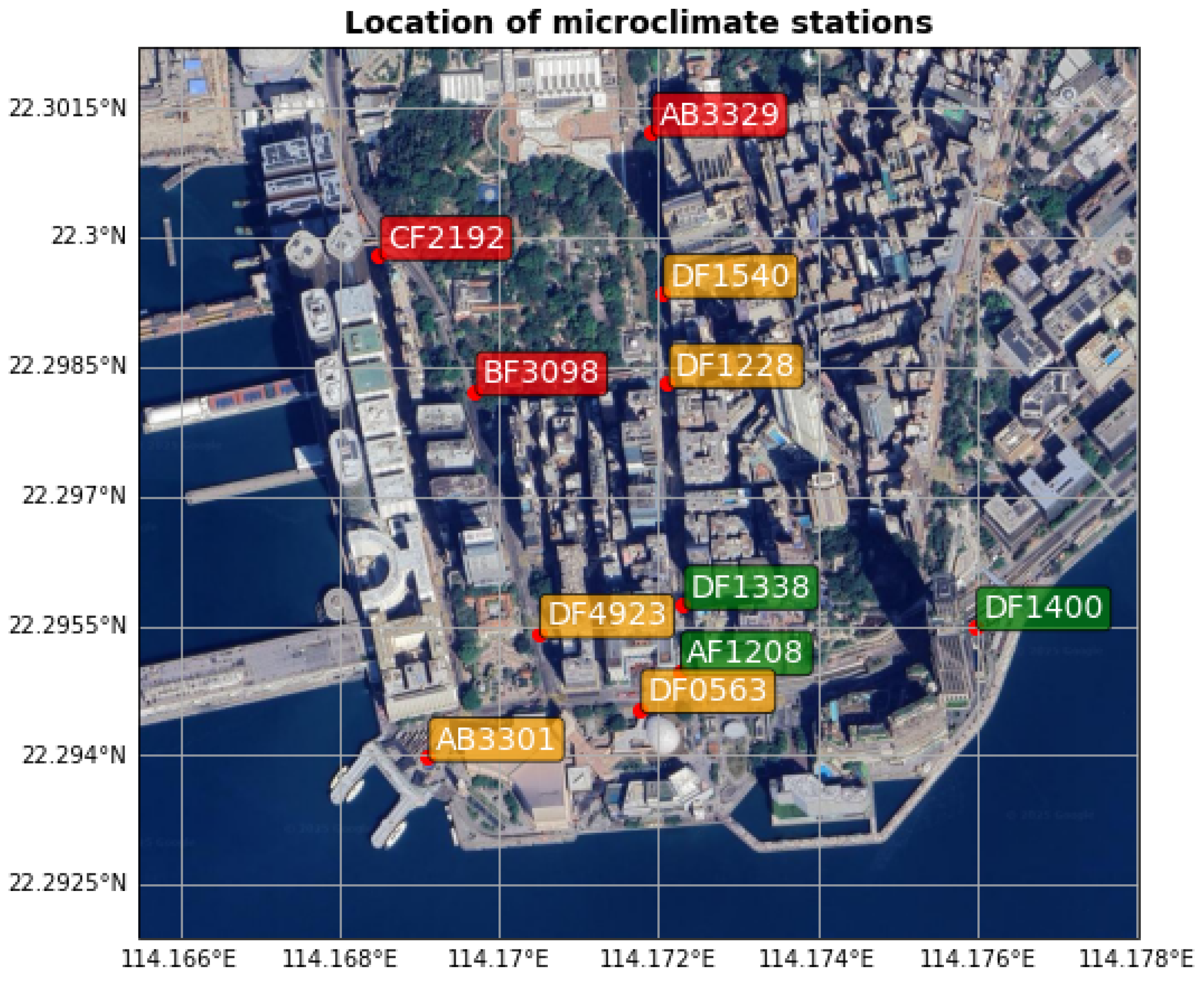
To evaluate the mesoscale–CFD coupling and its ability to reproduce local wind characteristics, we compared model output with measurements from an expanded network of microclimate stations in urban Kowloon. Whereas Lo et al. evaluated a similar approach for urban winds in Tsim Sha Tsui during Typhoon Saola using only two stations [15], the present study utilizes eleven stations, each with two sensors at different heights. The distribution of these microclimate stations is shown in Figure 6. We analyzed the period from 00:00 to 18:00 HKT on 20 July 2025, spanning the increase in wind speed during the approach of Typhoon Wipha and the subsequent weakening after its passage.
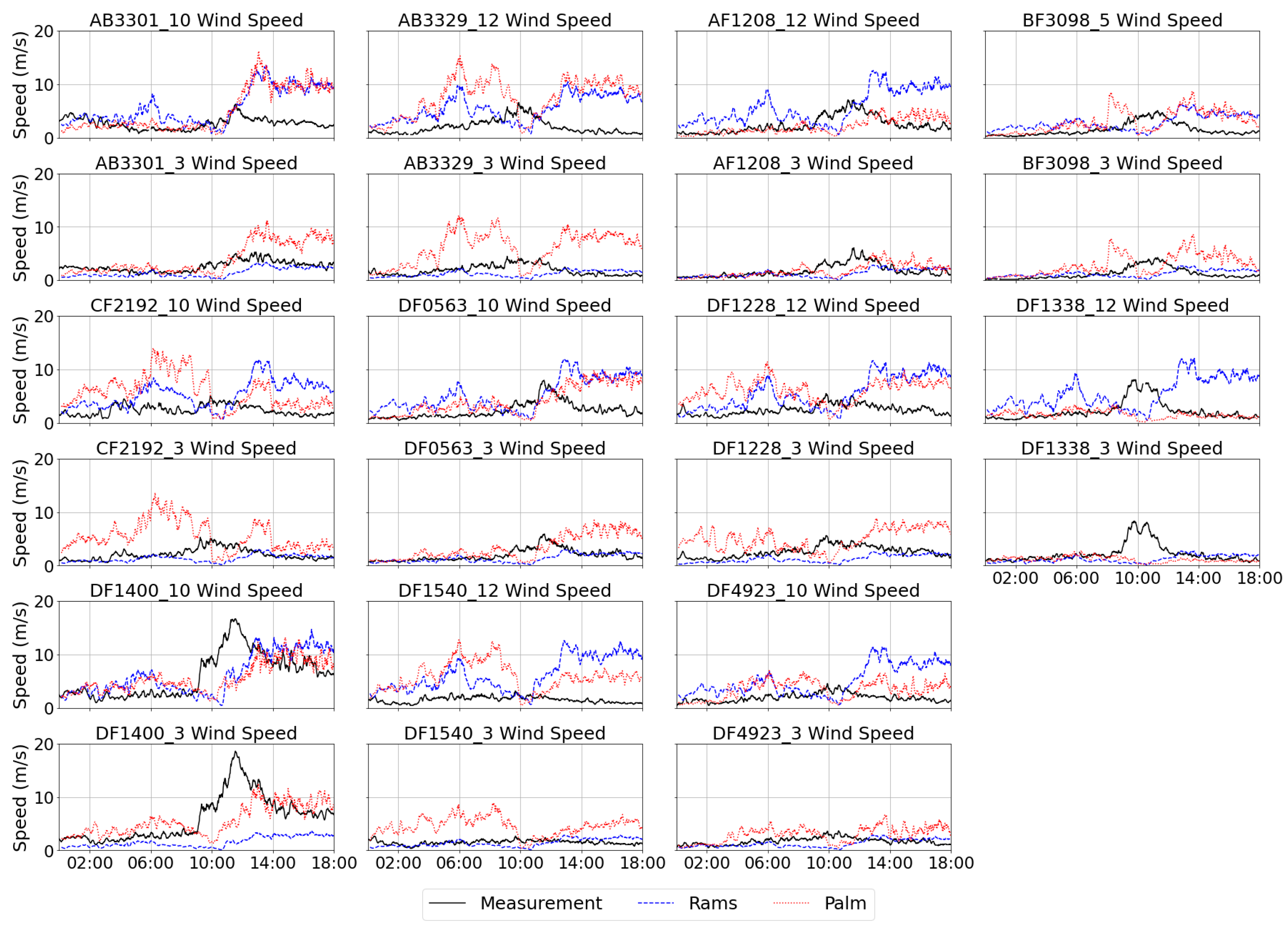
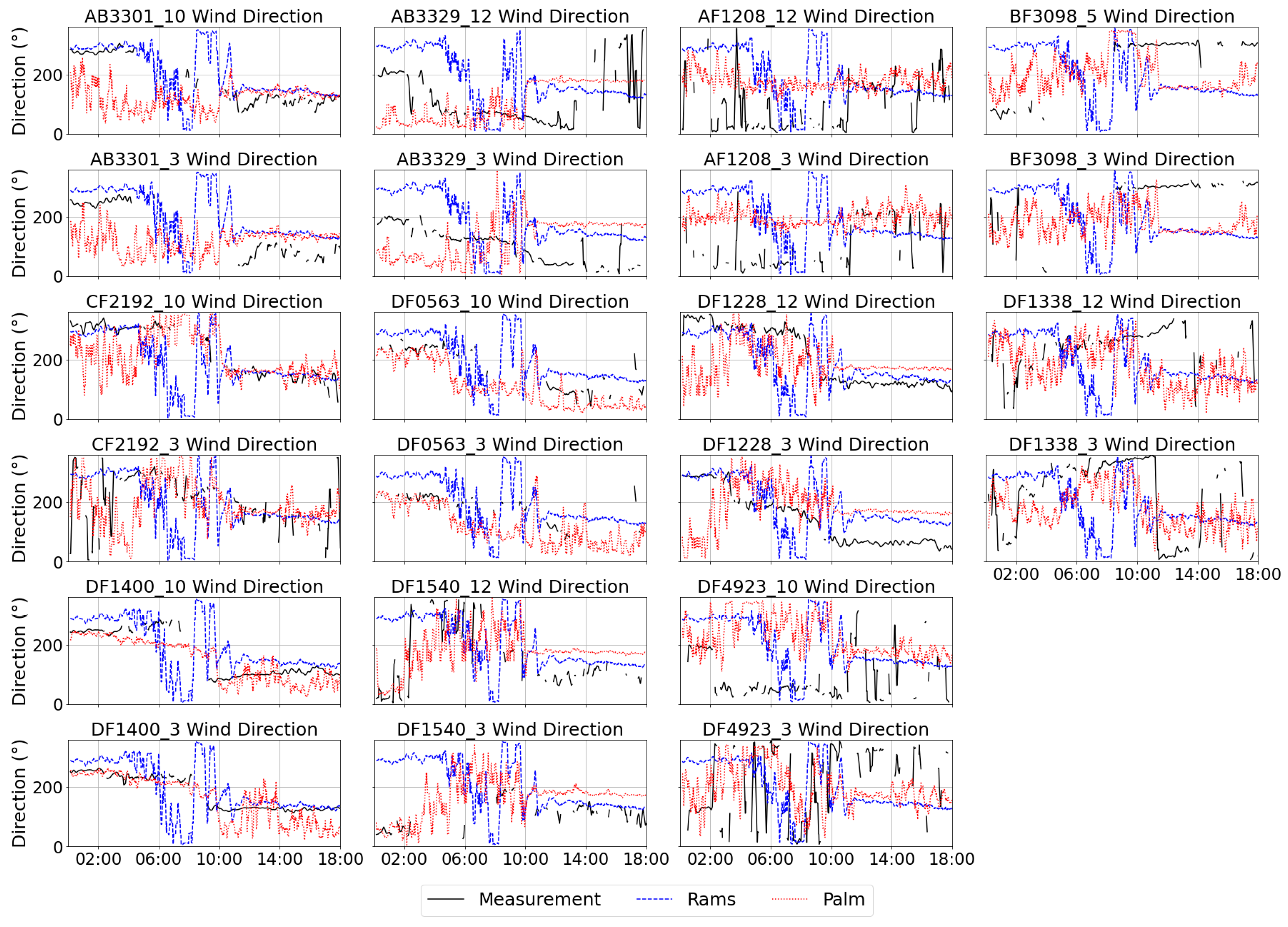
Figure 7 and Figure 8 present time series of 10-min mean wind speed and direction measured at multiple microclimate stations, compared with the simulation from RAMS and PALM. Performance was mixed across sites. At some stations, PALM reduced wind-speed errors relative to RAMS; at others, PALM exhibited substantial positive biases (e.g., AB3329 and CF2192). Root-mean-square errors (RMSEs) over the entire analysis period are summarized in Table 1 for both RAMS alone and RAMS-driven PALM (additional metrics are provided in Table S1 in Supplementary Materials). The RMSEs for wind speeds ranged between 1 and 5 ms−1. The wind direction discrepancies were much larger (in the order of 60° to 140°), showing the complexity of the airflow in a highly urbanized area, especially the variability of wind direction in higher wind conditions. To assess the statistical significance of differences between PALM and RAMS, we applied a non-parametric bootstrap with 1000 resamples to obtain 95% confidence intervals and two-sided p-values for the difference in RMSE at each measurement (Table S2 in Supplementary Materials). Results again indicated mixed performance: nine measurements showed statistically lower RMSE for PALM, eleven for RAMS, and two showed no significant difference. To visualize these outcomes, the station labels in Figure 6 were color-coded—green for sites where PALM outperformed RAMS at both measurement heights, red where RAMS performed better at both heights, and orange for mixed results.
Interestingly, the colored labels formed discernible clusters: the green (PALM-better) stations were mainly located in the lower-right part of the study area, closer to the waterfront and more open spaces. In contrast, the red (RAMS-better) stations were concentrated around Kowloon Park, where a large vegetation area exists. Since the PALM configuration in the current simulation did not include drag effects from plants, the absence of such resistance may have led to an overestimation of wind speeds in PALM, thereby reducing its performance in that region. The orange-labeled stations, showing mixed results, were primarily located within the most densely built-up sectors, characterized by narrow street canyons and complex building arrangements. In these areas, strong flow separations and wake interactions likely cause greater model-observation discrepancies, possibly due to boundary-forcing limitations from the coarser RAMS input or uncertainties in the building representations. Careful refinement of building representations and inclusion of vegetation canopy in future CFD simulations are expected to improve model performance in such complex urban settings. Sensitivity tests on surface roughness length indicate that the present results are relatively insensitive to plausible variations in the surface roughness length (Figures S2 and S3 in Supplementary Materials).
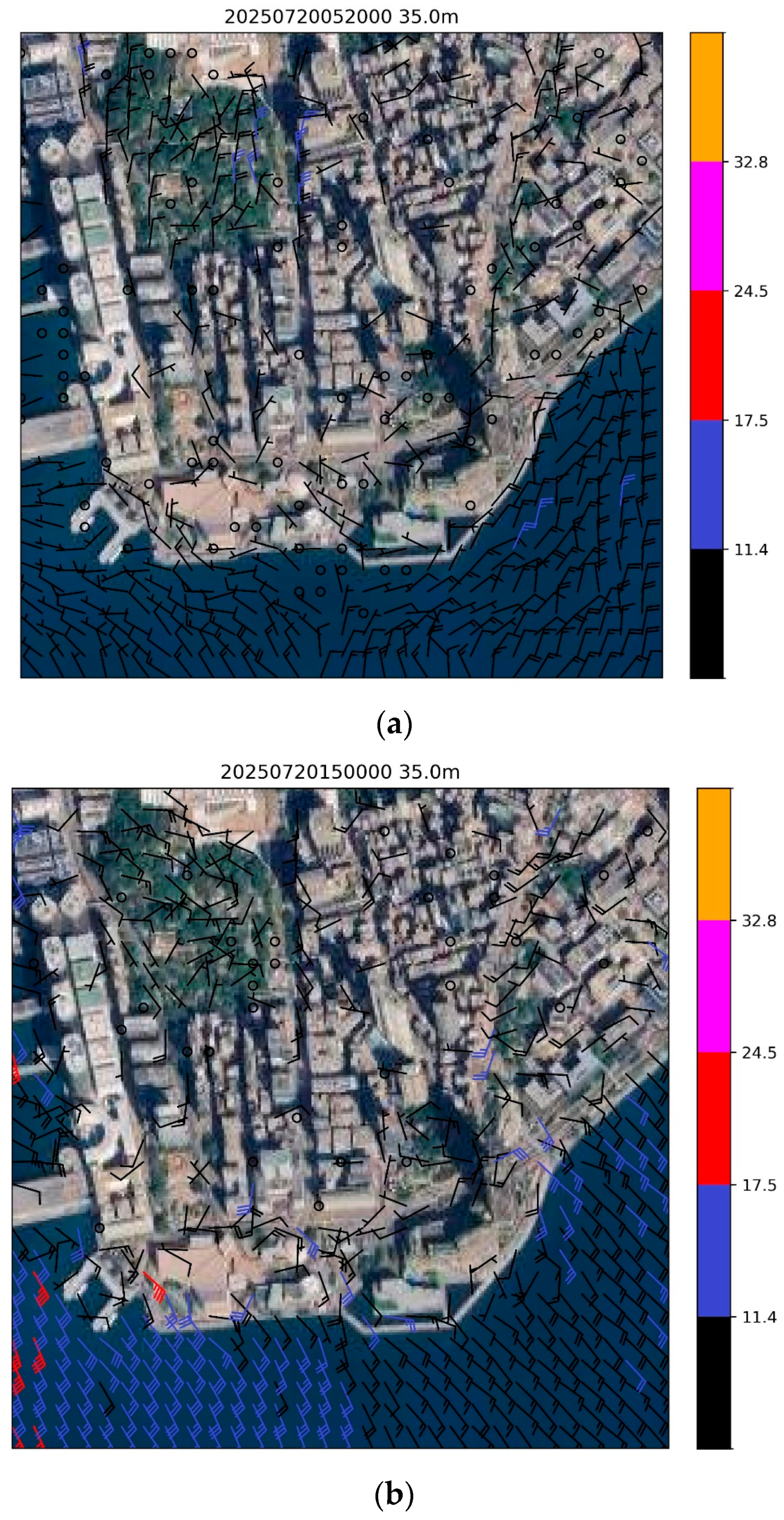
Two snapshots of simulated winds are shown in Figure 9, representing two contrasting stages of Typhoon Wipha’s influence on Hong Kong. Figure 9a shows the simulation at 05:20 HKT on 20 July 2025, when Wipha was centered about 150 km east-southeast of Hong Kong. At this stage, winds were generally light to moderate northerly, prior to the rapid strengthening associated with the approach of Wipha. In contrast, Figure 9b shows the situation later the same day when Wipha skirted about 50 km south of the Hong Kong Observatory and started to depart westward. The prevailing winds had shifted to strong southeasterly winds. A height of 35 m above mean sea level was chosen. In the morning, wind speeds were generally light, with a slight northerly jet in the northern part of the modeling domain due to channeling along Nathan Road (the main north-south oriented road in the center of the domain). During the afternoon, as Wipha moved over the south of Hong Kong, the prevailing wind shifted to southeasterly, producing stronger breezes along the waterfront, particularly at Tsim Sha Tsui East (eastern part of the domain in Figure 9b) and near the Star Ferry pier (southwestern part of the domain). The distribution of stronger winds appears to be reasonable and consistent with the conceptual anticipation of locations for the occurrence of jets under different prevailing wind directions.

3.4. Turbulence Associated with Terminal Building at the Airport

Many buildings have been constructed on the reclaimed island of the HKIA, and some of them have been found to produce turbulent flow in certain prevailing wind directions, as observed by plan position indicator (PPI) scans of the long-range LIDAR at HKIA (with a measurement range of 10–15 km) and high-resolution modeling results using RAMS coupled with PALM [16]. However, no previous study has been conducted on building-induced turbulent flow at HKIA under southeasterly wind conditions. Typhoon Wipha provided a unique opportunity for this study.
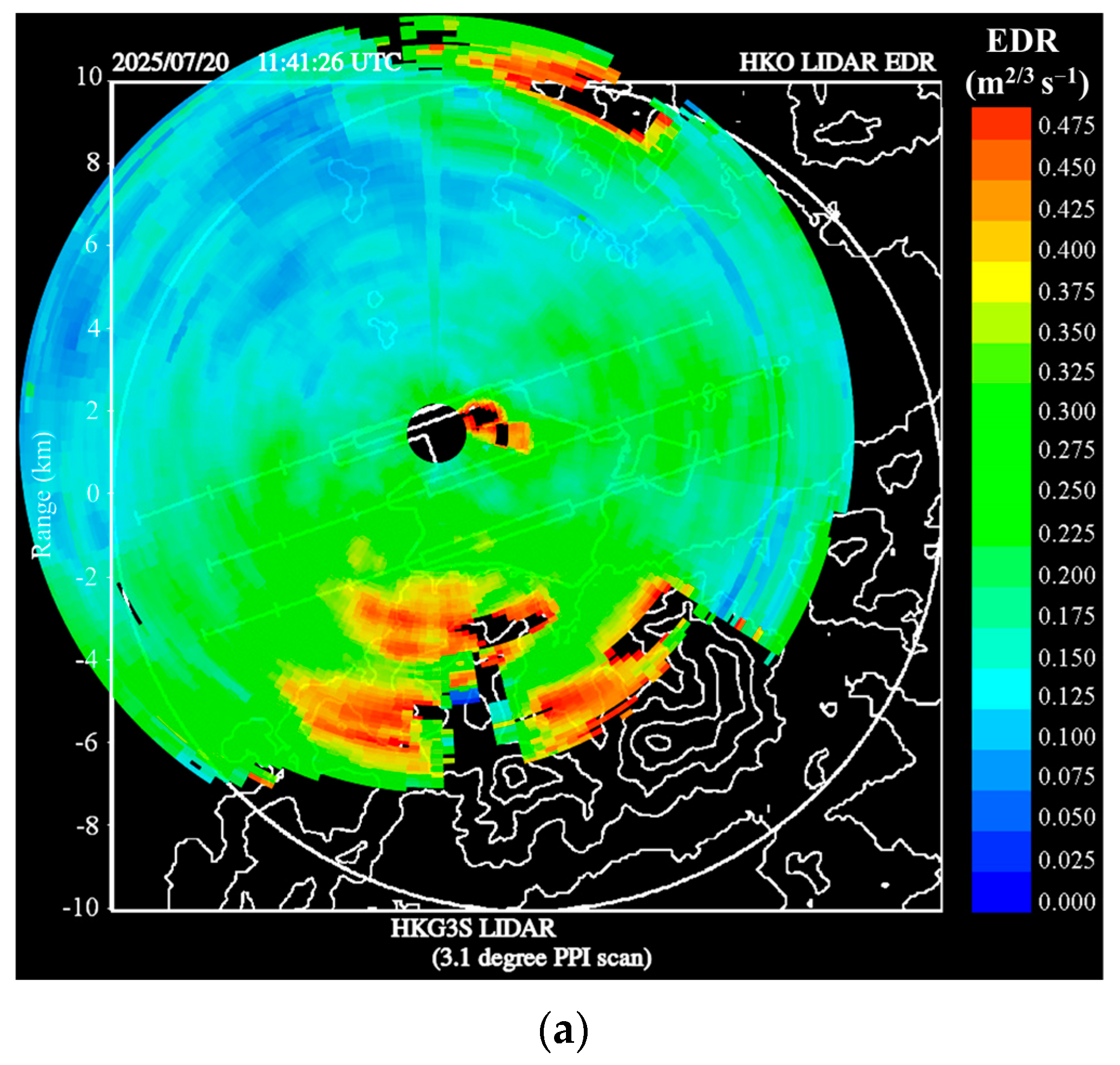
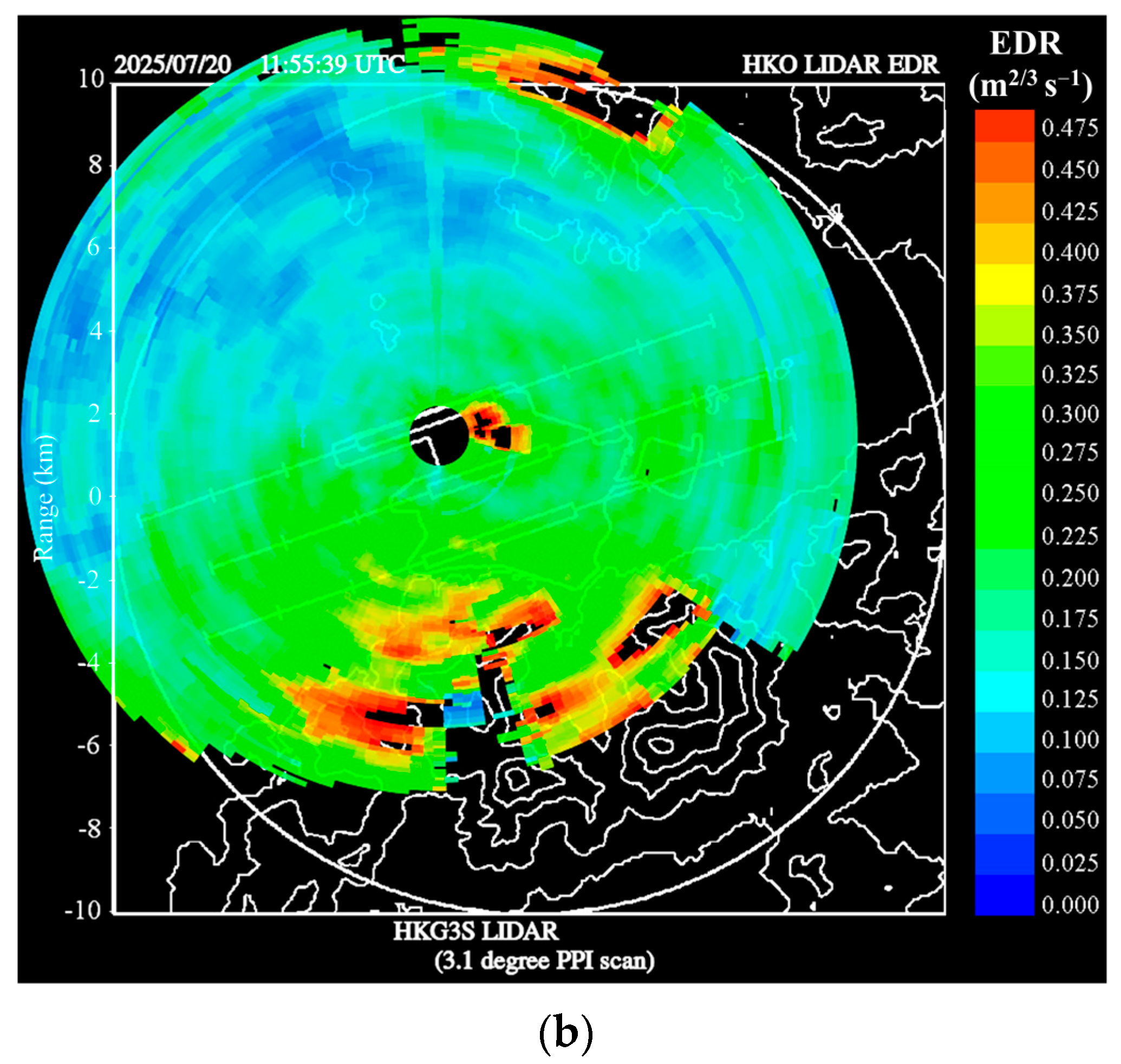
Two samples of LIDAR-based EDR maps (following the method in [41]) are shown in Figure 10a,b between 11 and 12 UTC (i.e., 19:00 and 20:00 HKT) on 20 July 2025. Near the location of the new terminal building (at a height of around 40 m above ground) to the southeast of the LIDAR, there was an enhanced and quasi-stationary area of higher turbulence (colored red and black, with EDR of 0.4 m2/3 s−1 or above), and this area of highly turbulent flow appeared to spread into the central part of the north runway of HKIA. Under southeasterly wind conditions, aircraft mostly arrive at the north runway from the west. At the location of the turbulent flow, the aircraft typically touches down and taxies; therefore, the turbulent flow area is not expected to have a significant impact. However, if the aircraft conducts a missed approach, it may hit the turbulent flow area.
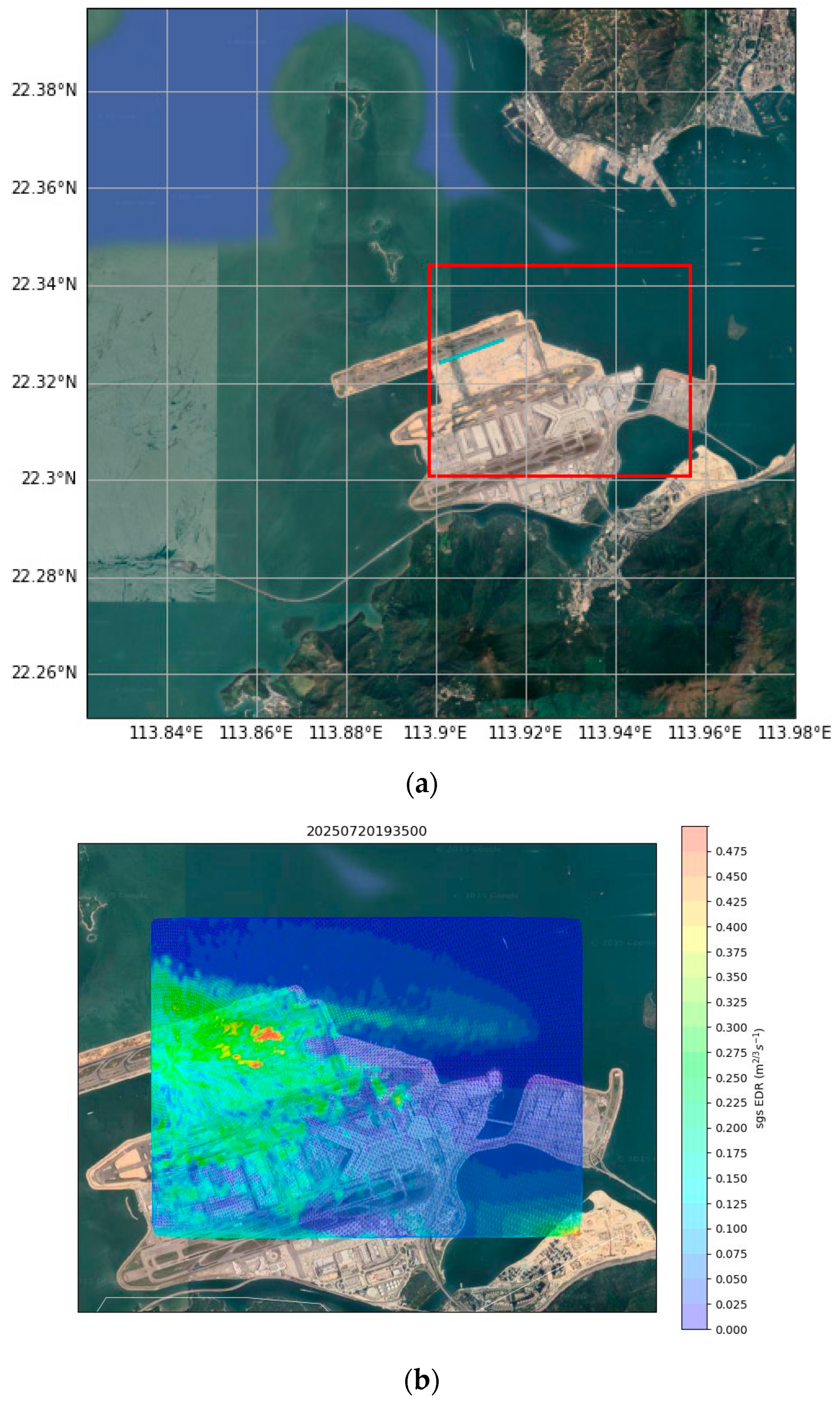
A high-resolution RAMS–PALM coupled simulation was conducted for Wipha following the configuration in [16]. The simulation domains of RAMS and PALM are shown in Figure 11a. Figure 11b shows a snapshot of the simulated EDR, with EDR plotted in the same conical scan area as the PPI scan of the long-range LIDAR on the northern runway in Figure 10. It can be seen that turbulent flow was simulated successfully downstream of the new terminal building, and this turbulent flow area spread toward the central part of the north runway.
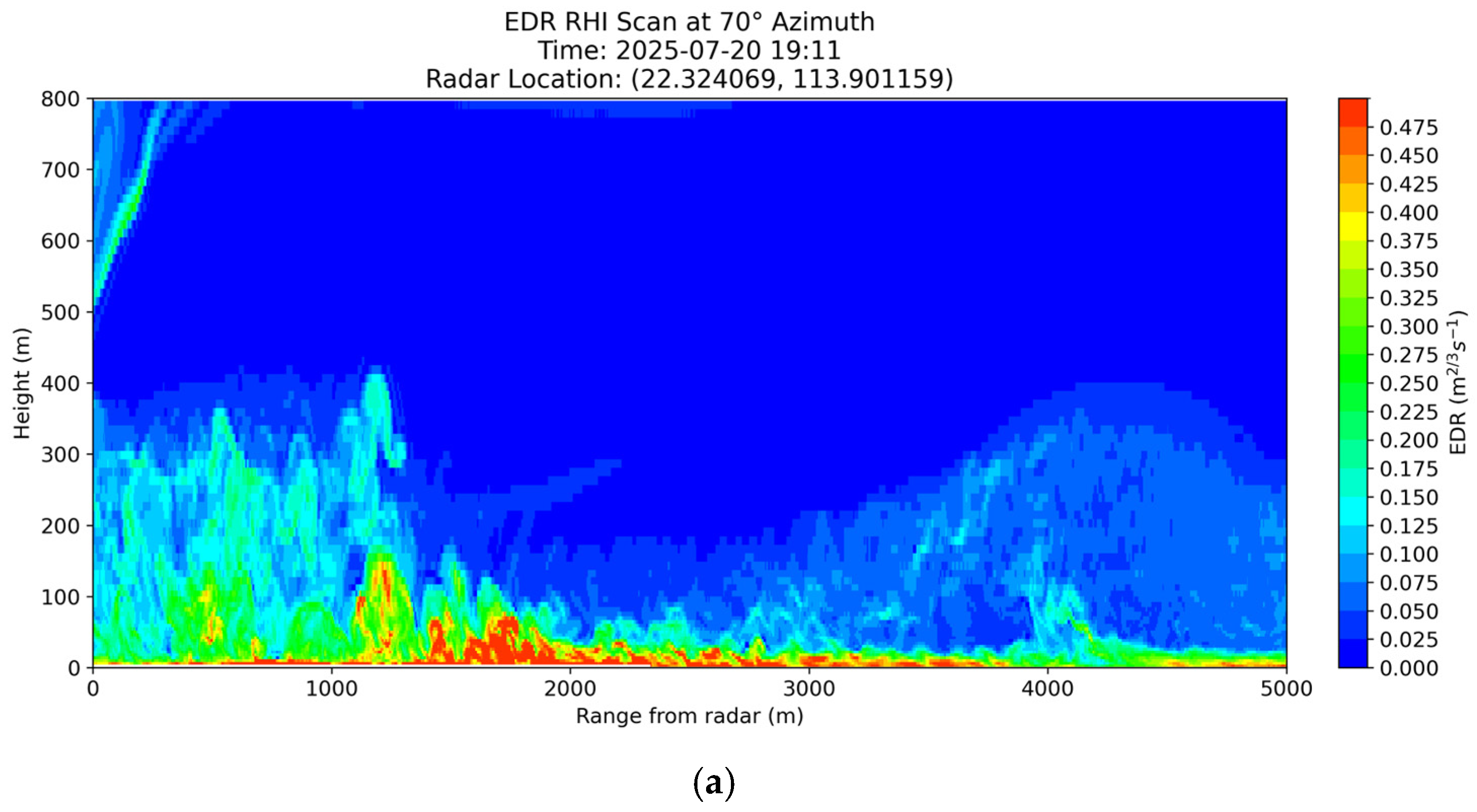
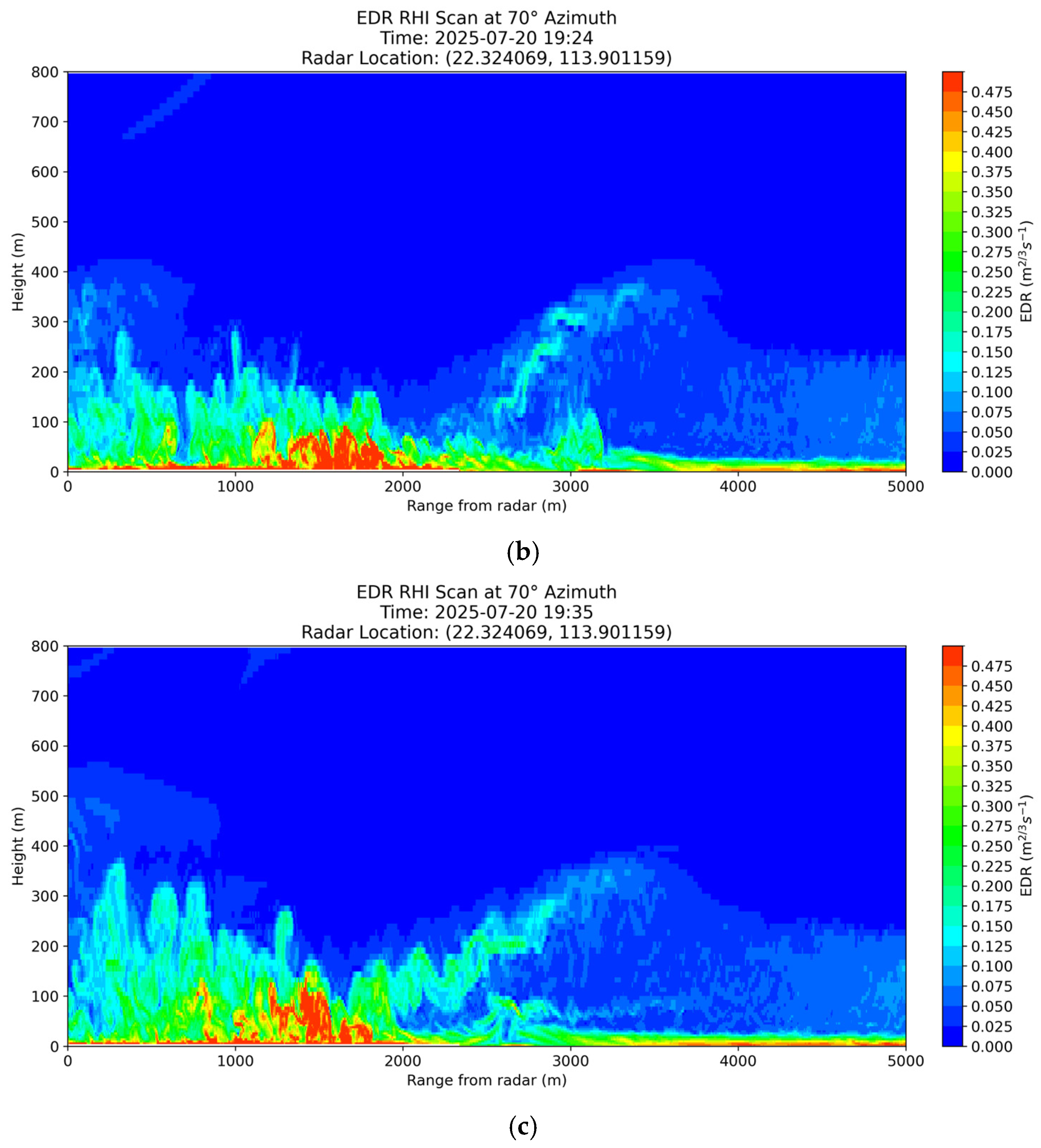
A vertical cross-section was created across the location of the turbulent flow (the location of the vertical cross-section is indicated by the cyan line in Figure 11a), and the height-range plots of simulated EDR at three times are shown in Figure 12a–c. Turbulence was simulated to be generated when southeasterly winds hit the building (colored red with an EDR exceeding 0.5 m2/3 s−1). The higher turbulence area then extended upward and drifted downwind (to the left-hand side of the figures), with the vertical extent increasing from approximately 100 m to approximately 150 m above ground. While simulation results appear to be reasonable and consistent with the anticipation of turbulent flow with southeasterly winds hitting the terminal building, there were no LIDAR observations nor other data sources available to verify the cross-section of the simulated EDRs, unfortunately.

3.5. Windshear of a Departing Aircraft

Building upon the preceding analyses of wind and turbulence structures during Typhoon Wipha, this section presents an observational case study that demonstrates their operational significance. Low-level windshear is a form of turbulent flow experienced by aircraft. At the HKIA, this is mainly related to terrain disruption of airflow. With the passage of Wipha, the southeasterly flow generally affected Hong Kong, and the terrain on Lantau Island is expected to generate near-ground turbulence. Such low-level windshear reports mostly originate from aircraft arriving at HKIA. However, in the case of Wipha, a departing aircraft reported a headwind loss of 20 knots at rotation during an eastbound departure from the south runway of HKIA at approximately 12:30 UTC on 20 July 2025. Low-level windshear reports for departing aircraft in rotation are rather rare at HKIA, especially during typhoon conditions; thus, this case was studied in detail.
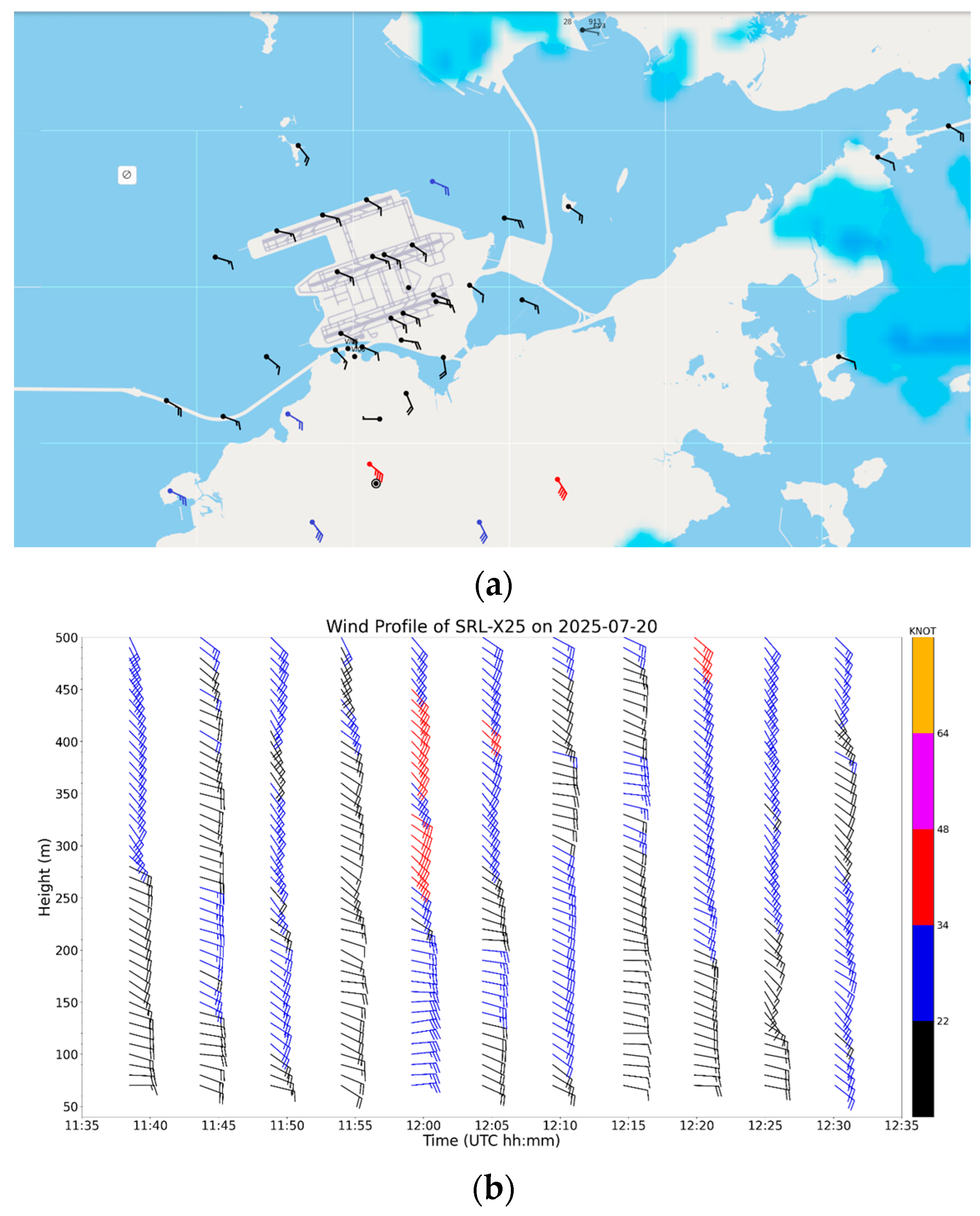
Surface wind observations at that time are shown in Figure 13a. Runway winds are generally moderate southeasterlies, with winds reaching strong forces (wind barbs colored blue) and gale forces (wind barbs colored red) on the mountains of Lantau Island (south of HKIA). The vertical wind profiles from a vertically pointing LIDAR near the center of the southern runway around that time are shown in Figure 13b. It can be observed that low-level winds fluctuated between easterly and southeasterly winds. Wind speeds also varied with time, with winds occasionally reaching a strong force, especially at the time of the event (12:30 UTC; southeasterly winds of up to 25 knots near the surface).
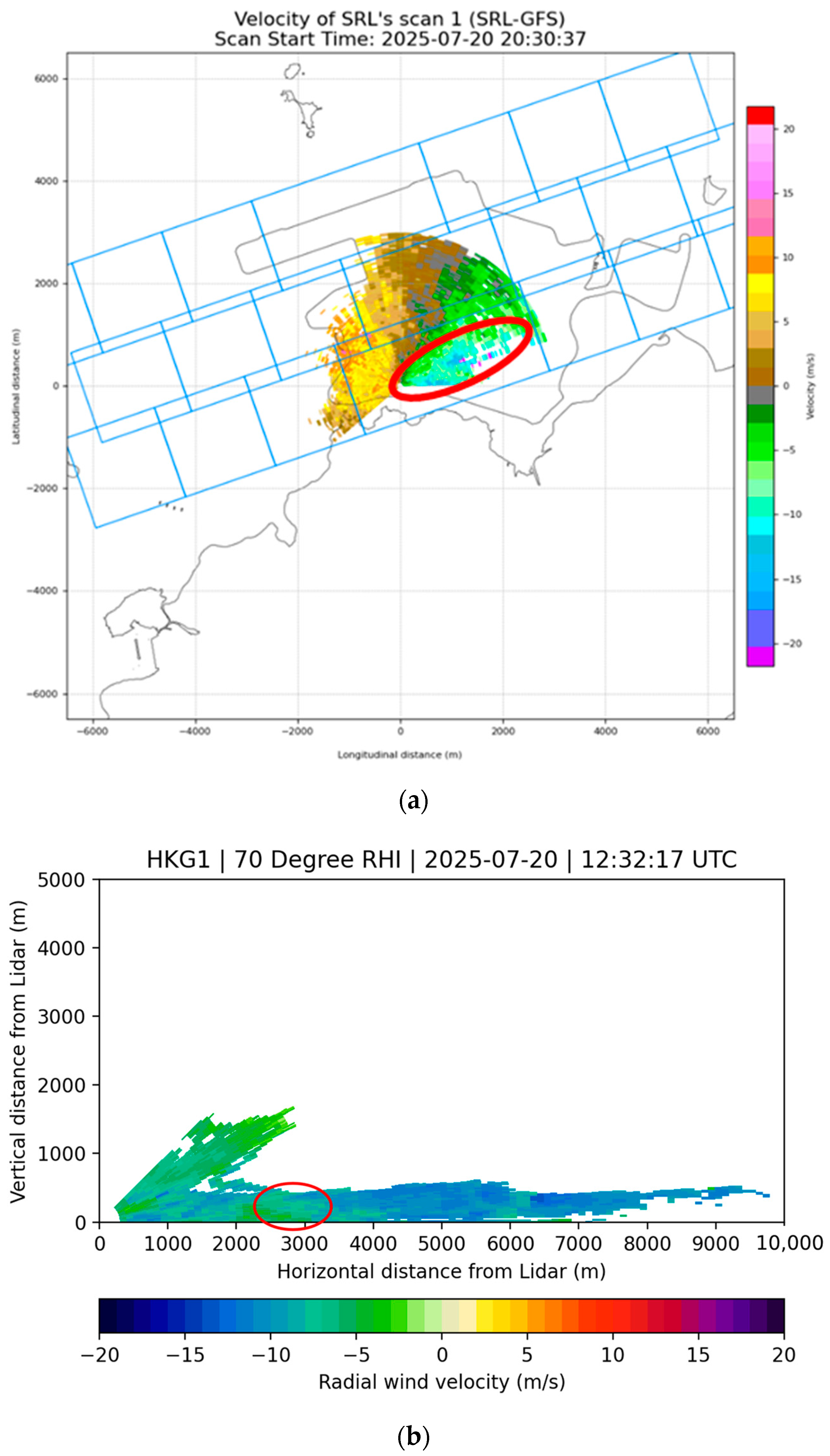
From the PPI scan of a LIDAR (Figure 14a), turbulent flow was observed in the Doppler velocity field with a highly fluctuating Doppler wind (area highlighted in the red ellipse). From the range-height indicator (RHI) scan of a LIDAR around that time (Figure 14b), there is an area of weaker winds (in the red ellipse) in the generally inbound flow. It appears that there was a drop in the headwind near the center of the runway, which may result in low-level windshear or headwind loss.
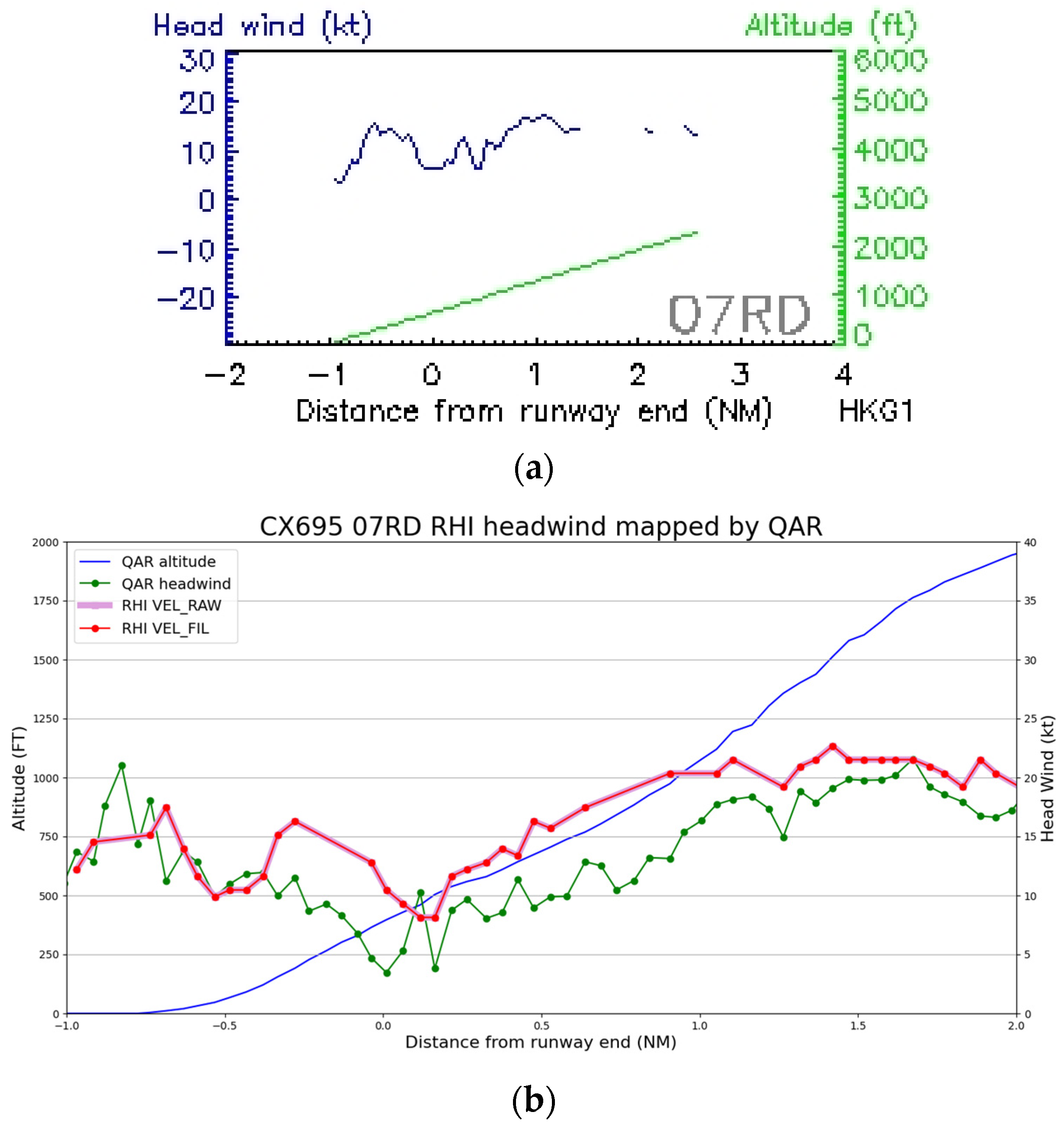
From the LIDAR-based headwind profile used operationally (Figure 15a, assuming a 6-degree glide path originating from the center of the runway for departing flights), there was indeed a headwind loss of approximately 10 knots between the center of the runway (location −1 nautical mile from the runway end) and the runway end itself (0 nautical mile). However, the magnitude of the headwind loss was smaller than that reported by the pilot (headwind loss of 20 knots). The case was investigated further by using the actual location of the aircraft from the flight data and then extracting the LIDAR-based headwind from the RHI scan of the long-range LIDAR (Figure 14b) so that the LIDAR-based headwind at the location of the aircraft could be used to construct the headwind profile. The results are presented in Figure 14b. The time of the windshear encounter of the flight was at 12:30:14–32 UTC, and the RHI scan time was about 2 min after the event. The horizontal of the RHI scan plane is set to be parallel to the runway orientation, such that the magnitude of radial velocity generally corresponds to the headwind at low scan angles, and the sign would be adjusted to align with the traveling direction of the flight. Each data point from aircraft data was mapped to the closest point on the RHI plane with available data, with the condition that the angle formed by the line joining the two aforementioned points and the line joining the point on the RHI plane and the LIDAR should be within 12° of the perpendicular. This headwind profile (bold red curve) is more consistent with the measured headwind profile on the aircraft (green curve). The altitude of the aircraft is shown as a blue curve in Figure 15b). Between −0.5 nautical miles from the runway end, to the runway end itself (0 nautical miles), the LIDAR-based headwind based on RHI scan and actual measurement from the aircraft has a magnitude (headwind loss) of around 12 knots, but such a loss appears to be “double losses”, i.e., “two bumps” of headwind changes. In contrast, the headwind profile based on flight data exhibited a “single loss” of around 16 to 17 knots (from −0.8 nautical mile to 0.0 nautical mile), close to the reported headwind loss of 20 knots. This example shows that, in actual turbulent flow, the headwind structure can be rather complex (“double losses” versus “single loss”), which is challenging for windshear alerting in an operational environment.

4. Discussion and Conclusions

Typhoon Wipha offered a unique opportunity to study turbulence in Hong Kong. This paper reports a number of turbulence studies during Typhoon Wipha in July 2025, namely, LIDAR-based EDR profiles, radiosonde-based EDR profiles, turbulence in urban areas, and low-level windshear and turbulence at the HKIA, based on various observational and numerical simulation data.
First, regarding the predictability of turbulence, we compared two model-based EDR estimation techniques—a native diagnostic approach and a reconstruction approach—with observations. Against the LIDAR network, the diagnostic method showed generally better skill in capturing the magnitude of EDR. A more detailed evaluation with radiosonde profiles confirmed this advantage, with the diagnostic approach achieving correlations near 0.8, suggesting that a simple bias correction could further improve performance. The reconstruction method captures the trend of EDR reasonably well below ~1 km but deviated aloft as buoyancy effects became more important, underscoring the need for regime-aware methods that account for stability and stratification when reconstructing EDR from resolved fields. Nevertheless, the predictability of EDR is also strongly limited by storm-track accuracy regardless of the EDR estimation methods chosen.
Second, on the performance of urban, building-resolving CFD, the mesoscale-driven CFD coupling (RAMS–PALM) can resolve fine-scale flow features and reproduce spatial wind variability captured by the dense network of microclimate stations, revealing how urban morphology modulates wind speed and direction during extreme conditions. However, gains over the mesoscale model were mixed. PALM’s improvements clustered near the waterfront and in more open urban sectors, where building geometry is simpler, and inflow is less perturbed. In contrast, stations near Kowloon Park favored RAMS, consistent with PALM’s omission of vegetation canopy drag, which likely led to wind-speed overestimation. Mixed results predominated in the densest street-canyon districts, where strong separations and wake interactions amplify sensitivity to geometric detail. Thus, in settings with well-characterized, relatively open geometry—such as HKIA—the approach is particularly effective. When applied to the terminal area, the CFD simulation successfully replicated the LIDAR-observed turbulence generated downstream of a new terminal building under southeasterly flow, confirming the model’s potential for diagnosing and mitigating building-induced wind hazards.
Third, for operational low-level wind-shear detection at HKIA, analysis of a rare rotation-phase wind-shear event showed that standard fixed-path headwind products underestimated the headwind loss reported by the departing aircraft. A trajectory-aware reconstruction that samples RHI volumes along the aircraft’s path improved alignment with onboard measurements, reducing both magnitude and timing errors. This approach could enhance alert relevance during rapidly changing conditions; quantifying when and by how much it helps will directly inform wind-shear detection practices and future operational product design.
Overall, this study provides several important benefits and applications. It establishes a comprehensive multi-sensor turbulence framework, integrating LIDAR, radiosonde, microclimate, and numerical modeling data, which can be applied to future investigations of tropical cyclone boundary-layer processes in coastal regions. The integrated analyses enhance our understanding of the capabilities and limitations of turbulence-diagnostic methods used in high-resolution NWP and CFD models, thereby improving model design and interpretation under extreme wind conditions. In addition, the findings demonstrate the operational value of LIDAR and CFD systems for aviation safety, as these tools can help refine wind-shear alerting, identify turbulence-prone zones, and assess wind hazards near airports such as the Hong Kong International Airport. Beyond aviation, the modeling results also provide valuable insights for urban wind-resilience planning, contributing to the development of safer built environments in densely populated cities affected by strong typhoons. Together, these advancements strengthen both the scientific basis and the practical application of turbulence research in complex coastal and urban settings.
For future research, systematic analyses of more tropical cyclone cases over multiple seasons are planned to establish statistical benchmarks for model bias and EDR variability. Further work will focus on refining terrain and building representation in CFD models. The impacts of terrain, buildings, and other man-made structures on the low-level airflow experienced by aircraft will be further studied. Such efforts will help enhance both scientific understanding and operational capability in monitoring and forecasting turbulence and windshear in complex coastal settings.

Supplementary Materials

The following supporting information can be downloaded at: https://www.mdpi.com/article/10.3390/app152312772/s1.

Author Contributions

Conceptualization, P.W.C.; Methodology, K.W.L.; Software, M.C.L. and K.K.L.; Validation, K.W.L. and K.K.L.; Formal analysis, M.L.C. and Y.C.X.; Investigation, M.L.C., P.W.C. and Y.C.X.; Data curation, M.C.L. and E.D.; Writing—original draft, P.W.C. All authors have read and agreed to the published version of the manuscript.

Funding

E Deng is funded by the Research Grants Council of the Hong Kong Special Administrative Region Government (Project No. T22-501/23-R).

Institutional Review Board Statement

Not applicable.

Informed Consent Statement

Not applicable.

Data Availability Statement

The data presented in this study are available on request from the corresponding author. The reason for restriction, e.g., the data are not publicly available due to privacy restrictions.

Conflicts of Interest

The authors declare no conflict of interest.

References

  1. MacCready, P.B. Standardization of Gustiness Values from Aircraft. J. Appl. Meteorol. 1964, 3, 439–449. [Google Scholar] [CrossRef]
  2. Zhang, J.A.; Zhu, P.; Masters, F.J.; Rogers, R.F.; Marks, F.D. On Momentum Transport and Dissipative Heating during Hurricane Landfalls. J. Atmos. Sci. 2011, 68, 1397–1404. [Google Scholar] [CrossRef]
  3. Ming, J.; Zhang, J.A. Direct Measurements of Momentum Flux and Dissipative Heating in the Surface Layer of Tropical Cyclones During Landfalls. J. Geophys. Res. Atmos. 2018, 123, 4926–4938. [Google Scholar] [CrossRef]
  4. Zhou, K.; Li, Q.; Tang, J. Estimation of Dissipative Heating Properties Above the Internal Boundary Layer in Landfalling Typhoons Using Multi-Layer Tower Observations. Front. Earth Sci. 2022, 10, 833994. [Google Scholar] [CrossRef]
  5. Fang, Q.; Chu, K.; Zhou, B.; Chen, X.; Peng, Z.; Zhang, C.; Luo, M.; Zhao, C. Observed Turbulent Dissipation Rate in a Landfalling Tropical Cyclone Boundary Layer. J. Atmos. Sci. 2023, 80, 1739–1754. [Google Scholar] [CrossRef]
  6. Sathe, A.; Mann, J. A Review of Turbulence Measurements Using Ground-Based Wind Lidars. Atmos. Meas. Tech. 2013, 6, 3147–3167. [Google Scholar] [CrossRef]
  7. Smalikho, I.N.; Banakh, V.A. Accuracy of Estimation of the Turbulent Energy Dissipation Rate from Wind Measurements with a Conically Scanning Pulsed Coherent Doppler Lidar. Part I. Algorithm of Data Processing. Atmos. Ocean. Opt. 2013, 26, 404–410. [Google Scholar] [CrossRef]
  8. Banakh, V.A.; Smalikho, I.N.; Falits, A.V. Estimation of the Turbulence Energy Dissipation Rate in the Atmospheric Boundary Layer from Measurements of the Radial Wind Velocity by Micropulse Coherent Doppler Lidar. Opt. Express 2017, 25, 22679. [Google Scholar] [CrossRef]
  9. Bodini, N.; Lundquist, J.K.; Kirincich, A.U.S. East Coast Lidar Measurements Show Offshore Wind Turbines Will Encounter Very Low Atmospheric Turbulence. Geophys. Res. Lett. 2019, 46, 5582–5591. [Google Scholar] [CrossRef]
  10. Goit, J.P.; Shimada, S.; Kogaki, T. Can LiDARs Replace Meteorological Masts in Wind Energy? Energies 2019, 12, 3680. [Google Scholar] [CrossRef]
  11. O’Connor, E.J.; Illingworth, A.J.; Brooks, I.M.; Westbrook, C.D.; Hogan, R.J.; Davies, F.; Brooks, B.J. A Method for Estimating the Turbulent Kinetic Energy Dissipation Rate from a Vertically Pointing Doppler Lidar, and Independent Evaluation from Balloon-Borne In Situ Measurements. J. Atmos. Ocean. Technol. 2010, 27, 1652–1664. [Google Scholar] [CrossRef]
  12. Xian, J.; Lu, C.; Lin, X.; Yang, H.; Zhang, N.; Zhang, L. Directly Measuring the Power-Law Exponent and Kinetic Energy of Atmospheric Turbulence Using Coherent Doppler Wind Lidar. Atmos. Meas. Tech. 2024, 17, 1837–1850. [Google Scholar] [CrossRef]
  13. Xian, J.; Qiu, Z.; Rao, H.; Cheng, Z.; Lin, X.; Lu, C.; Yang, H.; Zhang, N. Characteristics of Boundary Layer Turbulence Energy Budget in Shenzhen Area Based on Coherent Wind Lidar Observations. Atmos. Chem. Phys. 2025, 25, 8427–8441. [Google Scholar] [CrossRef]
  14. Huang, M.; Liao, S.; Lou, W.; Lin, W.; Kareem, A. Multi-Scale Simulation of Typhoon Wind Field at Building Scale Utilizing Mesoscale Model with Nested Large Eddy Simulation. J. Wind Eng. Ind. Aerodyn. 2024, 249, 105733. [Google Scholar] [CrossRef]
  15. Lo, K.W.; Chan, P.W.; Lai, K.K.; Lau, S.P.W.; Zhao, Z.H. Case Studies of the Winds in the Urban Area of Hong Kong–Microclimate Station Observations and High Resolution Numerical Simulations. Heliyon 2024, 10, e37865. [Google Scholar] [CrossRef]
  16. Lo, K.W.; Hon, K.K.; Chan, P.W.; Li, L.; Li, Q.S. Simulation of Building-Induced Airflow Disturbances in Complex Terrain Using Meteorological-CFD Coupled Model. Meteorol. Z. 2022, 31, 317–330. [Google Scholar] [CrossRef]
  17. Neofytou, P.; Venetsanos, A.G.; Vlachogiannis, D.; Bartzis, J.G.; Scaperdas, A. CFD Simulations of the Wind Environment around an Airport Terminal Building. Environ. Model. Softw. 2006, 21, 520–524. [Google Scholar] [CrossRef]
  18. Liu, X.; Zhang, H.; Wu, S.; Wang, Q.; He, Z.; Zhang, J.; Li, R.; Liu, S.; Zhang, X. Effects of Buildings on Wind Shear at the Airport: Field Measurement by Coherent Doppler Lidar. J. Wind Eng. Ind. Aerodyn. 2022, 230, 105194. [Google Scholar] [CrossRef]
  19. Shun, C.M.; Chan, P.W. Applications of an Infrared Doppler Lidar in Detection of Wind Shear. J. Atmos. Ocean. Technol. 2008, 25, 637–655. [Google Scholar] [CrossRef]
  20. Chen, H.; Leung, C.Y.; Cheung, P.; Liu, H.; Chan, S.T.; Shi, X. Predicting Convectively Induced Turbulence with Regionally Convection-Permitting Simulations. Asia Pac. J. Atmos. Sci. 2025, 61, 16. [Google Scholar] [CrossRef]
  21. Masters, F.J.; Tieleman, H.W.; Balderrama, J.A. Surface Wind Measurements in Three Gulf Coast Hurricanes of 2005. J. Wind Eng. Ind. Aerodyn. 2010, 98, 533–547. [Google Scholar] [CrossRef]
  22. Chan, P.W.; Lai, K.K.; Li, Q.S. High-resolution (40 m) Simulation of a Severe Case of Low-level Windshear at the Hong Kong International Airport—Comparison with Observations and Skills in Windshear Alerting. Meteorol. Appl. 2021, 28, e2020. [Google Scholar] [CrossRef]
  23. Deardorff, J.W. Stratocumulus-Capped Mixed Layers Derived from a Three-Dimensional Model. Bound. Layer. Meteorol. 1980, 18, 495–527. [Google Scholar] [CrossRef]
  24. Chow, F.K.; Street, R.L.; Xue, M.; Ferziger, J.H. Explicit Filtering and Reconstruction Turbulence Modeling for Large-Eddy Simulation of Neutral Boundary Layer Flow. J. Atmos. Sci. 2005, 62, 2058–2077. [Google Scholar] [CrossRef]
  25. Shi, X.; Wang, Y. Impacts of Cumulus Convection and Turbulence Parameterizations on the Convection-Permitting Simulation of Typhoon Precipitation. Mon. Weather Rev. 2022, 150, 2977–2997. [Google Scholar] [CrossRef]
  26. Wilson, R.; Dalaudier, F.; Luce, H. Can One Detect Small-Scale Turbulence from Standard Meteorological Radiosondes? Atmos. Meas. Tech. 2011, 4, 795–804. [Google Scholar] [CrossRef]
  27. Solanki, R.; Guo, J.; Lv, Y.; Zhang, J.; Wu, J.; Tong, B.; Li, J. Elucidating the Atmospheric Boundary Layer Turbulence by Combining UHF Radar Wind Profiler and Radiosonde Measurements over Urban Area of Beijing. Urban Clim. 2022, 43, 101151. [Google Scholar] [CrossRef]
  28. He, Y.; Sheng, Z.; Zhou, L.; He, M.; Zhou, S. Statistical Analysis of Turbulence Characteristics over the Tropical Western Pacific Based on Radiosonde Data. Atmosphere 2020, 11, 386. [Google Scholar] [CrossRef]
  29. Thorpe, S.A. Turbulence and Mixing in a Scottish Loch. Philos. Trans. R. Soc. Lond. Ser. A Math. Phys. Sci. 1977, 286, 125–181. [Google Scholar] [CrossRef]
  30. Ko, H.-C.; Chun, H.-Y.; Wilson, R.; Geller, M.A. Characteristics of Atmospheric Turbulence Retrieved from High Vertical-Resolution Radiosonde Data in the United States. J. Geophys. Res. Atmos. 2019, 124, 7553–7579. [Google Scholar] [CrossRef]
  31. Ozmidov, R.V. On the Turbulent Exchange in a Stably Stratified Ocean. Izv. Acad. Ser. USSR Atmos. Ocean. Phys. Engl. Transl. 1965, 1, 861. [Google Scholar]
  32. Mirocha, J.D.; Lundquist, J.K.; Kosović, B. Implementation of a Nonlinear Subfilter Turbulence Stress Model for Large-Eddy Simulation in the Advanced Research WRF Model. Mon. Weather Rev. 2010, 138, 4212–4228. [Google Scholar] [CrossRef]
  33. Smagorinsky, J. General Circulation Experiments with the Primitive. Mon. Weather Rev. 1963, 91, 99–164. [Google Scholar] [CrossRef]
  34. Wicker, L.J.; Skamarock, W.C. Time-Splitting Methods for Elastic Models Using Forward Time Schemes. Mon. Weather Rev. 2002, 130, 2088–2097. [Google Scholar] [CrossRef]
  35. Williamson, J.H. Low-Storage Runge-Kutta Schemes. J. Comput. Phys. 1980, 35, 48–56. [Google Scholar] [CrossRef]
  36. Raasch, S.; Schröter, M. PALM—A Large-Eddy Simulation Model Performing on Massively Parallel Computers. Meteorol. Z. 2001, 10, 363–372. [Google Scholar] [CrossRef]
  37. Maronga, B.; Gryschka, M.; Heinze, R.; Hoffmann, F.; Kanani-Sühring, F.; Keck, M.; Ketelsen, K.; Letzel, M.O.; Sühring, M.; Raasch, S. The Parallelized Large-Eddy Simulation Model (PALM) Version 4.0 for Atmospheric and Oceanic Flows: Model Formulation, Recent Developments, and Future Perspectives. Geosci. Model Dev. 2015, 8, 2515–2551. [Google Scholar] [CrossRef]
  38. Maronga, B.; Banzhaf, S.; Burmeister, C.; Esch, T.; Forkel, R.; Fröhlich, D.; Fuka, V.; Gehrke, K.F.; Geletič, J.; Giersch, S.; et al. Overview of the PALM Model System 6.0. Geosci. Model Dev. 2020, 13, 133–1372. [Google Scholar] [CrossRef]
  39. Xie, Z.-T.; Castro, I.P. Efficient Generation of Inflow Conditions for Large Eddy Simulation of Street-Scale Flows. Flow Turbul. Combust. 2008, 81, 449–470. [Google Scholar] [CrossRef]
  40. Kim, Y.; Castro, I.P.; Xie, Z.-T. Divergence-Free Turbulence Inflow Conditions for Large-Eddy Simulations with Incompressible Flow Solvers. Comput. Fluids 2013, 84, 56–68. [Google Scholar] [CrossRef]
  41. Chan, P.W. Generation of an Eddy Dissipation Rate Map at the Hong Kong International Airport Based on Doppler Lidar Data. J. Atmos. Ocean. Technol. 2011, 28, 37–49. [Google Scholar] [CrossRef]
Figure 1. Vertical profile measurements by LIDAR at Bui O on 20 July 2025. (a) Time-height plot of horizontal wind speed; (b) time-height plot of horizontal wind direction; (c) vertical profile of EDR. All times are in Hong Kong Time (UTC + 8 h).
Applsci 15 12772 g001aApplsci 15 12772 g001b
Figure 2. (a) Time-height plot of EDR at BO; (b) EDR in the turbulent kinetic energy equation of RAMS; (c) EDR derived from subfilter-scale reconstruction using RAMS output. All times are in Hong Kong Time (UTC + 8 h).
Applsci 15 12772 g002
Figure 3. Simulated horizontal wind field at 110 m by RAMS at 00 UTC (left), 03 UTC (middle), and 06 UTC (right) on 20 July 2025. The red triangle marks the location of BO, and the purple circle denotes the location of tropical cyclone Wipha from HKO’s operational analysis.
Applsci 15 12772 g003
Figure 4. (a) Root-mean-square errors between EDR measured by LIDAR and EDR obtained from the turbulent kinetic energy equation of RAMS; (b) root-mean-square errors between EDR measured by LIDAR and EDR calculated using subfilter-scale reconstruction from RAMS output.
Applsci 15 12772 g004
Figure 5. (a) Track of radiosonde launched during Typhoon Wipha; (b) vertical profile of EDR based on radiosonde data and estimations from the model. (c) vertical profile of Richardson number from RAMS.
Applsci 15 12772 g005aApplsci 15 12772 g005b
Figure 6. Location of microclimate stations in Tsim Sha Tsui.
Applsci 15 12772 g006
Figure 7. Time series of 10-min-mean wind speeds observed at the microclimate stations in Tsim Sha Tsui (black lines) compared with simulations from RAMS (blue lines) and PALM (red lines) on 20 July 2025 (HKT, UTC + 8 h).
Applsci 15 12772 g007
Figure 8. Comparison between measured (black line) and simulated wind directions (blue line: RAMS, red line: PALM) at different microclimate stations in Tsim Sha Tsui on 20 July 2025 (HKT, UTC + 8 h).
Applsci 15 12772 g008
Figure 9. PALM simulated horizontal winds at 35 m above mean sea level over Tsim Sha Tsui at (a) 05:20 a.m. and (b) 03:00 p.m. on 20 July (HKT, UTC + 8 h).
Applsci 15 12772 g009
Figure 10. LIDAR-based EDR maps at (a) 11:41:26 UTC; and (b) 11:55:39 UTC on 20 July 2025.
Applsci 15 12772 g010aApplsci 15 12772 g010b
Figure 11. (a) Simulation domain of RAMS (innermost domain) and PALM (red box); (b) simulated EDR from PALM at 19:35 on 20 July 2025 (HKT, UTC + 8 h).
Applsci 15 12772 g011
Figure 12. Vertical cross-section of simulated EDR from PALM at (a) 19:11; (b) 19:24; and (c) 19:35, on 20 July 2025 (HKT, UTC + 8 h).
Applsci 15 12772 g012aApplsci 15 12772 g012b
Figure 13. (a) Winds observation at 12:30 UTC on 20 July 2025; (b) vertical wind profile from LIDAR near the center of the south runway of HKIA from 11:35 to 12:35 UTC on 20 July 2025.
Applsci 15 12772 g013
Figure 14. (a) PPI scan of Doppler velocity from LIDAR; (b) RHI scan of radial wind from LIDAR.
Applsci 15 12772 g014
Figure 15. (a) LIDAR-based headwind profile; (b) headwind profile at the location of the aircraft constructed from LIDAR.
Applsci 15 12772 g015
Table 1. RMSE of wind speed (m s−1) and direction (°) for RAMS and RAMS-driven PALM simulations at each microclimate station and height level over 00:00–18:00 HKT, 20 July 2025. Each record is identified by the microclimate station ID and measurement height. For example, AB3301_10 denotes the observation taken at 10 m above ground level at station AB3301.
Microclimate
Stations
(ID_Height)
RMSE of RAMS
Wind Speeds
(m s−1)
RMSE of PALM
Wind Speeds
(m s−1)
RMSE of RAMS
Wind Directions
(°)
RMSE of PALM
Wind Directions
(°)
AB3301_105.035.0468.3568.92
AB3301_31.473.1178.9484.37
AB3329_125.127.45123.85116.53
AB3329_31.525.92111.29119.38
AF1208_125.072.10107.33126.72
AF1208_31.541.52108.00121.48
BF3098_31.432.98142.40127.51
BF3098_52.553.02138.33118.02
CF2192_104.524.7768.4160.71
CF2192_31.714.6290.3683.20
DF0563_104.613.6670.6085.75
DF0563_31.532.9185.6885.17
DF1228_124.874.3970.1668.03
DF1228_31.993.3193.7897.71
DF1338_125.592.41119.8199.91
DF1338_32.642.58116.23108.82
DF1400_104.664.4669.5358.11
DF1400_36.684.2871.3248.43
DF1540_126.335.3579.7597.83
DF1540_30.893.5878.4481.63
DF4923_104.872.58124.43138.60
DF4923_31.252.15124.53120.82
Disclaimer/Publisher’s Note: The statements, opinions and data contained in all publications are solely those of the individual author(s) and contributor(s) and not of MDPI and/or the editor(s). MDPI and/or the editor(s) disclaim responsibility for any injury to people or property resulting from any ideas, methods, instructions or products referred to in the content.