1. Introduction
This article is an extended version of the paper titled “Problems of running train traffic in real time”, originally presented at the XIII International Scientific and Technical Conference Logistics Systems—Theory and Practice, held in Warsaw, Poland, on 1–3 September 2024.
Railway traffic management is evolving under two major trends: the integration of traffic control centers with traffic management centers, which accelerates the shift from strategic decision-making to operational execution, and the introduction of new communication channels between dispatchers and train drivers, enabling continuous and direct train control [
1,
2].
The implementation of these modern solutions is currently under analysis as part of the project planning for the construction of Poland’s Central Communication Port (CPK) [
3].
The scale and operational objectives of the CPK [
4] project include the construction of a new terminal and two runways, with the option to expand to four, ultimately designed to serve between 65 and 100 million passengers annually. The project also encompasses the development of high-speed railway lines, featuring a rail hub directly integrated with the airport and approximately 1600 to 2000 km of new high-speed tracks. Railway traffic management will be based on the RCA-CPK architecture, with the Traffic Management System (TMS) playing a central role in train operations [
3].
The TMS provides capabilities for train movement forecasting, traffic conflict detection, and their automated resolution [
5,
6]. By applying simulation models—such as those predicting train delays—together with heuristic computational algorithms, real-time optimization of train speed profiles can be achieved, enabling higher train speeds and reduced headways [
7,
8].
Implementing the TMS required a comprehensive analysis of technical and operational factors, including the achievable minimum train headway, the time reserves necessary to maintain smooth operations during traffic conflicts or failures of control and signaling systems, and the optimal timing for initiating subsequent train movements after route clearance in accordance with the timetable. These considerations were evaluated in terms of the time required for traffic simulation and conflict resolution, as well as the application of train speed profile optimization based on minimizing traction energy consumption by reducing unnecessary braking and minimizing train delays.
In designing the TMS, factors contributing to train delays were analyzed, with particular emphasis on those that can be mitigated through real-time traffic management.
Table 1 presents a sample summary of factors influencing train delays between 2020 and 2023, based on available data [
9,
10,
11].
In the event of Control Command and Signaling (CCS) system failures, the average train delay caused by such incidents can also be reported. Data for selected EU Member States is provided in
Table 2.
The example of unforeseen yet controlled signaling system (CCS) failures illustrates the considerable potential for reducing train delays. On railway lines with high traffic density, variable operating speeds, and constraints such as traffic conflicts, the train speed profile largely depends on the efficiency of the traffic management and control system. Implementing appropriate methods and computational algorithms is the preferred approach to enable automatic, real-time resolution of traffic conflicts, particularly in the event of signaling system failures [
7].
A comprehensive and up-to-date overview of simulation algorithm implementation for real-time traffic management can be found in scientific publications related to the X2Rail project (2017–2019) [
5,
7,
8]. Depending on the algorithm or method applied, execution times for train traffic simulations vary. Examples of methods and models are provided in
Table 3 [
8].
In the case of maximum simulation execution time, it is essential that the process be completed before the scheduled start time of the train movement. Situations that limit traffic fluidity or degrade line capacity due to waiting for an optimal solution are excluded. Therefore, the computation process must be significantly shorter than the defined train headway time.
In the case of minimum simulation execution time, it is crucial that train operations are conducted based on precisely and promptly transmitted data regarding traffic event registration, the volume of which is proportional to the number of trains being managed at a given moment. The simulation execution time itself increases nonlinearly with the growth of computational data, such as a higher number of trains, tracks, and stations [
7,
8].
In the referenced literature, based on simulation studies and tests conducted on Dutch and Swiss railways, time constraints in the range of 12 to 60 s were identified [
2] and 15 s [
17].
The iterative process of conflict detection, simulation, optimization, selection, and implementation of control measures must be faster than the system dynamics, which leads to a maximum execution time on the order of several tens of seconds. According to infrastructure managers, the expected time should not exceed 30 s [
8] for the creation of an entirely new timetable.
The real-time optimization procedure first computes a feasible timetable and then iteratively searches for improved solutions aimed at minimizing delays. If no feasible timetable is identified within the predefined computation time, the dispatcher must intervene to prevent gridlock by making decisions that are restricted for the automated system, such as shortening train routes or fully canceling services.
When addressing traffic conflict resolution, it is essential to consider both the size and timing of the time reserve applied for modifying planned train routes. Late route assignments may require speed reductions or even train stoppages, while early route assignments can restrict the Traffic Management System’s ability to generate alternative routing solutions. Both scenarios must be taken into account.
The route assignment process within the TMS is based on the scheduled timetable and utilizes dedicated traffic management and execution modules. TMS converts scheduled train routes into Operational Plan, which serves as detailed instructions for execution modules to modify the state of track infrastructure elements and assign train routes.
The execution of the Scheduled Timetable is represented by the Operational Timetable, which incorporates deviations in train timing and routing. This Operational Timetable forms the basis for creating and, if necessary, modifying Operational Plan (
Figure 1) [
6].
When designing processes within the Traffic Management System (TMS), it is crucial to define appropriate time reserves to be applied both before and after the implementation of the Operational Plan.
The body of literature on train speed profile optimization and real-time traffic management is extensive. Therefore, this study focuses on selected publications most closely aligned with its objectives.
The challenge of minimizing train headways and optimizing speed profiles based on traction energy consumption criteria has been addressed in the literature since the 1960s. Numerous studies have focused on route design strategies aimed at reducing traction energy usage, including notable contributions by Scheepmaker and Goverde [
18], Fernández-Rodríguez et al. [
19], Heineken, Richter, Birth-Reichert [
20], and Quaglietta and Goverde [
21], among others.
The implementation of an automated system for detecting and resolving traffic conflicts, including through train speed regulation, was presented by Mazzarello and Ottaviani [
22]. This topic was also explored within the European projects COMBINE and COMBINE 2, which included pilot implementations in the Netherlands.
The deployment of real-time train traffic management solutions was initiated by Swiss Federal Railways (SBB) through the implementation of the Rail Control System (RCS) [
1]. The SBB Infrastructure Division began developing the RCS in 2005, and the system was commissioned in 2009.
A comprehensive overview of the development of real-time train traffic management systems is provided in the scientific works of D’Ariano [
23] and Corman [
17].
In their study, Bettinelli, Santini, and Vigo [
24] analyze real-time traffic conflict resolution in railway traffic management applications. For a given nominal timetable, when modifications occur due to delays or resource unavailability (e.g., tracks, platforms), a set of actions must be implemented to ensure safety—such as preventing potential conflicts like train collisions or breaches of safety spacing—while also minimizing delays.
Recent publications further highlight the potential of applying artificial intelligence techniques to traffic management.
Wang, Zhu, Li, Yang, and De Schutter [
25] propose integrating artificial intelligence within a hierarchical Model Predictive Control (MPC) architecture, where the upper layer minimizes global delays and generates speed recommendations, while the lower layer adjusts train speeds accordingly to minimize energy consumption.
Ying, Zeng, Song, Shen, and Yuan [
26] examine an alternative to classical AI algorithms—an analytical-numerical approach based on an extended first-order Pontryagin’s Maximum Principle (PMP) condition—which avoids global minima and reduces computation time compared to previously proposed heuristic methods.
One of the most important AI-based solutions in railway traffic management is the Capacity and Traffic Management System (CTMS), developed under the Digitale Schiene Deutschland initiative. This system employs Multi-Agent Deep Reinforcement Learning to generate real-time schedules and control train speeds and movement targets [
27]. Other notable implementations include commercial and corporate solutions by Deutsche Bahn and InstaDeep, which combine Deep RL with optimization methods for real-time routing and task assignment [
28], as well as hybrid AI systems introduced by Hitachi for timetable recovery after disruptions, using learning-based traffic restoration techniques [
29].
The reviewed literature reveals a lack of integration between train headway time (including movement synchronization) and train speed profile optimization under the operational constraints of traffic control systems. Based on this observation, the authors conducted simulation studies examining the interaction between two trains and the dependency of the following train’s speed profile on the distance between them. The analysis was performed for headway scenarios on railway lines equipped with fixed block spacing [
30] and on lines using moving block spacing [
31].
In the field of real-time traffic management, the literature shows a lack of differentiation between factors influencing the origin of traffic conflicts and the varying response dynamics of TMS upon conflict detection. In [
32], the author analyzes how, for three selected traffic conflict scenarios—each with a different origin—the defined time frames for conflict resolution simulations may affect the train speed profile.
This article continues the authors’ previous research on determining train headway times and optimizing train speed profiles using the TMS. The present analysis extends earlier work by introducing the aspect of defining and allocating time reserves within the process of automatic route assignment.
2. Materials and Methods
According to data sources [
33,
34,
35], the most common types of traffic conflicts include:
Conflicts at stations or railway junctions (e.g., route crossings, changes in train order), accounting for approximately 18 ÷ 22% of all operational conflicts;
Conflicts when entering a station on an occupied track, representing about 12 ÷ 15% of all operational conflicts;
Speed-related conflicts caused by Temporary Speed Restrictions (TSRs), which account for roughly 8 ÷ 10% of all operational conflicts.
To analyze the impact of road-conflict resolution time—particularly the simulation time parameter (τ)—three predefined traffic scenarios were selected as sources of potential conflicts. Each scenario is characterized by a distinct dynamic of conflict identification and resolution within the TMS, while still being managed by train traffic control systems.
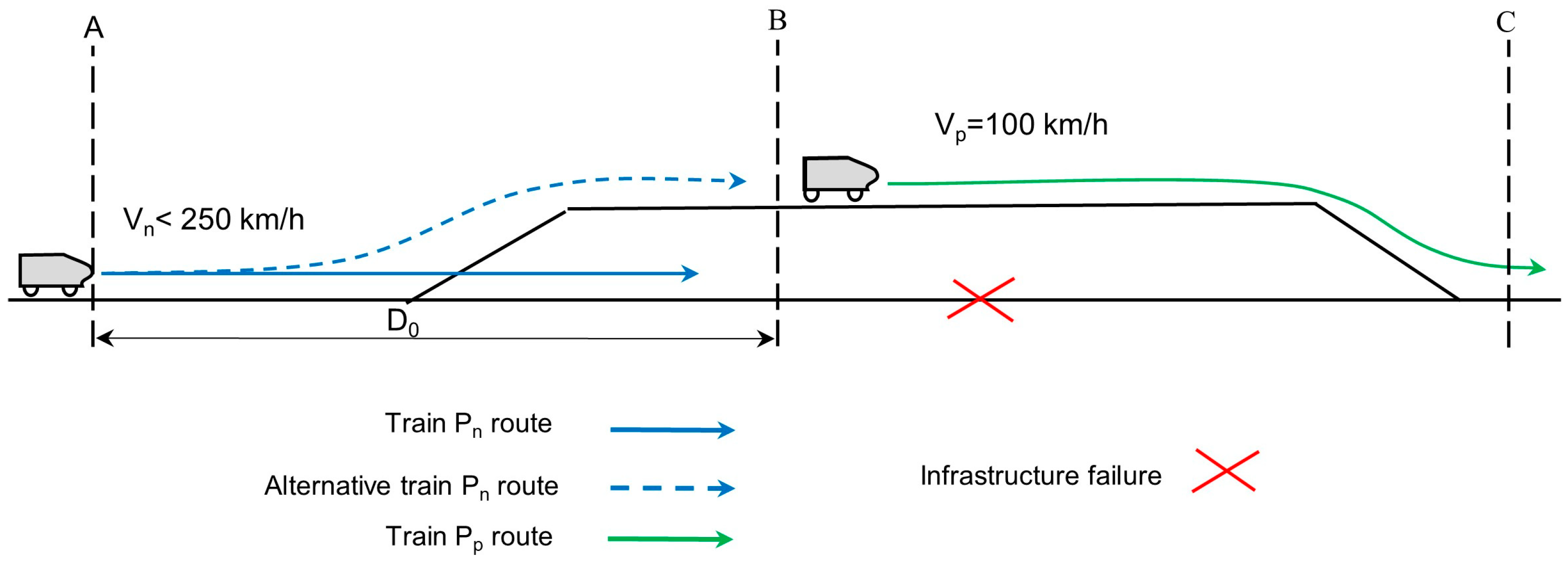
Scenario 1 (
Figure 2) represents a failure on the station’s main track, causing train movements to be rerouted to an auxiliary track exceeding 1000 m in length.
The speed of travel on the auxiliary main track is limited to 100 km/h due to the train operating in the diverging direction over an Rz-1200-18.5 type turnout.
The inability of train Pp to travel on the primary main track constitutes a primary disruption, resulting in a speed restriction and an extended travel time for train Pp. Consequently, a traffic conflict arises with the following train Pn, which is scheduled to run at a defined headway behind train Pp. As train Pn approaches train Pp, it initiates braking, potentially leading to a complete stop.
In the analyzed traffic scenario, the TMS resolves the conflict by running a simulation of the situation and issuing an adjusted speed profile to train Pn to ensure the minimum safe separation between trains.
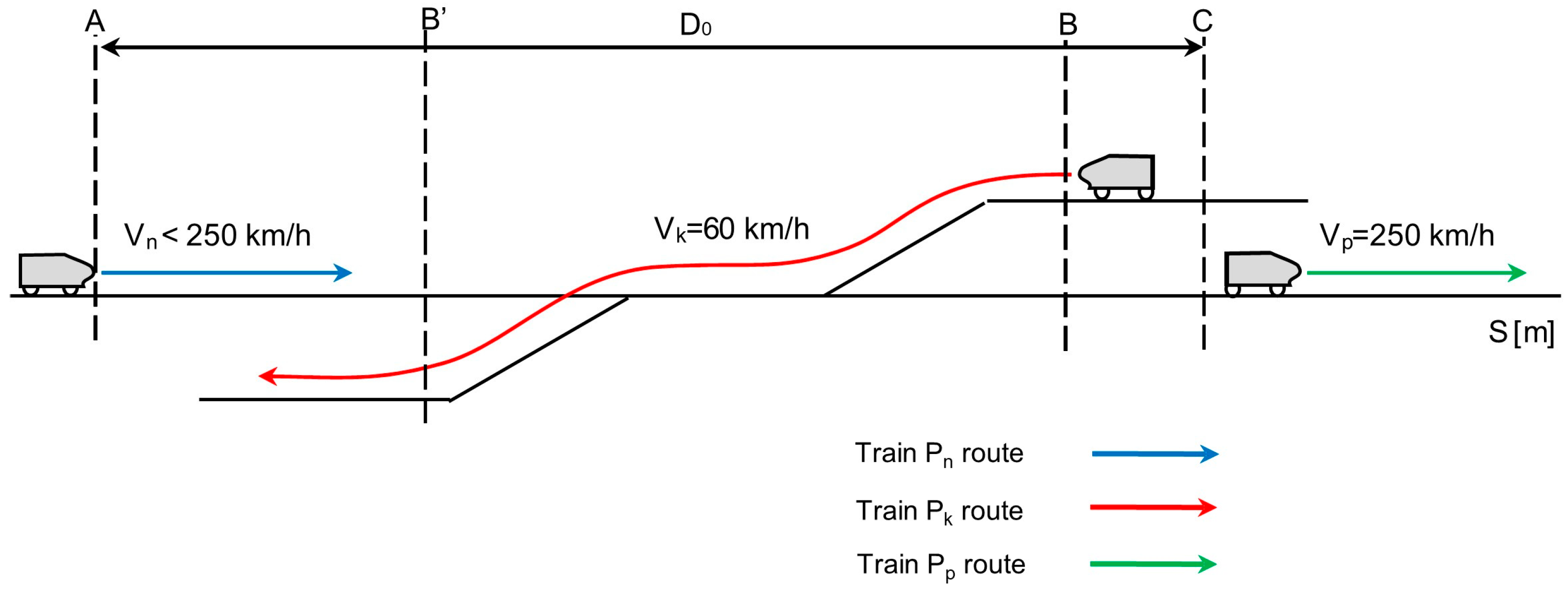
Scenario 2 (
Figure 3) considers the case of a delay of train
Pk, which is traveling in the opposite direction to the analyzed traffic flow. According to the timetable, train
Pk has a crossing movement at the station with trains traveling in the analyzed direction.
During the occupancy of the route (a shared section of 1200 m for trains Pn and Pk), the time required for train Pk to start and travel along the station’s main tracks is calculated—from a standstill (0 km/h) to a speed of 60 km/h—including movement over Rz-500-12 type turnouts.
Once the release of the route by train Pk is confirmed, the TMS performs a simulation and determines a new speed profile for train Pn, allowing it to maintain smooth movement at a reduced speed.
The resolution of the traffic conflict involves adjusting the speed profile of train Pn in order to prevent it from stopping before the station.
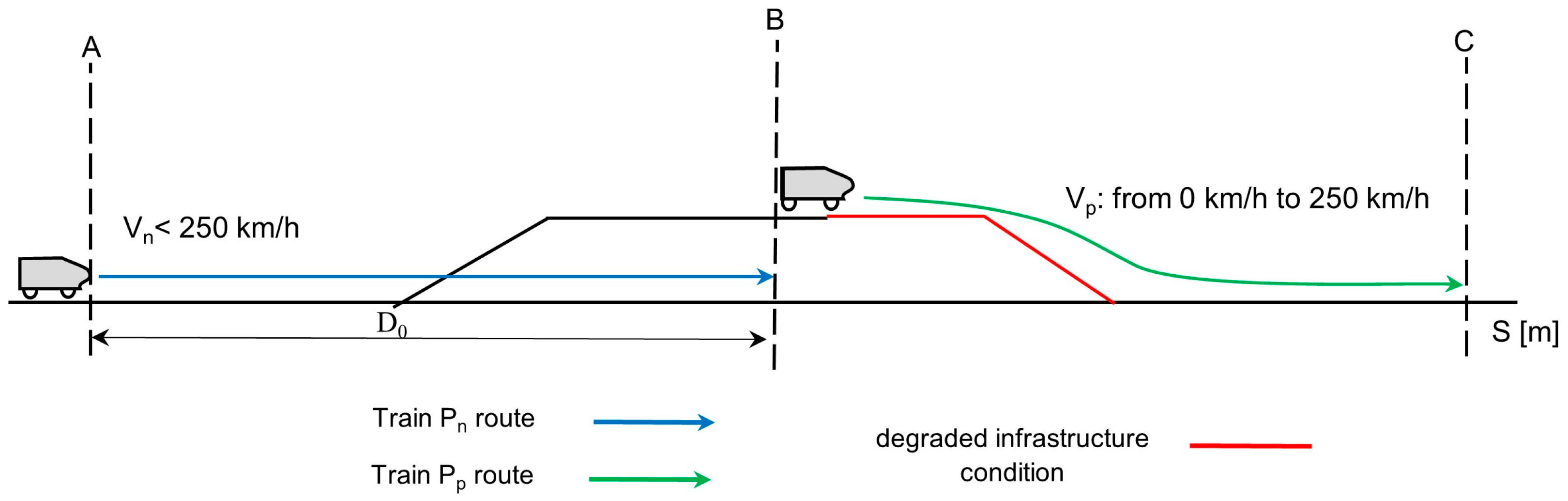
Scenario 3 (
Figure 4) considers the case of train
Pp starting on a track where traction power is reduced (from 100% to 75%) due to deteriorated wheel-rail adhesion (e.g., rail frost) or a drop in electrical voltage in the traction power supply system.
This disruption leads to a traffic conflict in maintaining the scheduled headway between trains and necessitates braking, potentially resulting in a complete stop of the following train. To resolve the traffic conflict, upon detection (or reporting) of traction-related issues affecting train Pp, the TMS performs a simulation and determines a new speed profile for train Pn, enabling it to maintain smooth movement at a reduced speed.
Based on the scenarios, the dependency between planning and implementing the optimal speed profile for train Pn is analyzed in relation to various timeframes available for resolving the traffic conflict.
Additionally, for each simulation time and resulting train speed profile, the amount of mechanical energy loss is assessed, caused by the need to restore maximum speed. The calculation of mechanical energy loss is based on the difference in expended kinetic energy and the forces required to overcome running resistance between the train’s run at maximum speed and the run with the adjusted speed profile.
The above scenarios are carried out on station tracks with fixed track geometry and gradient. Speed limitations primarily result from the need to traverse turnouts in the turnout route.
2.1. Simulation Model
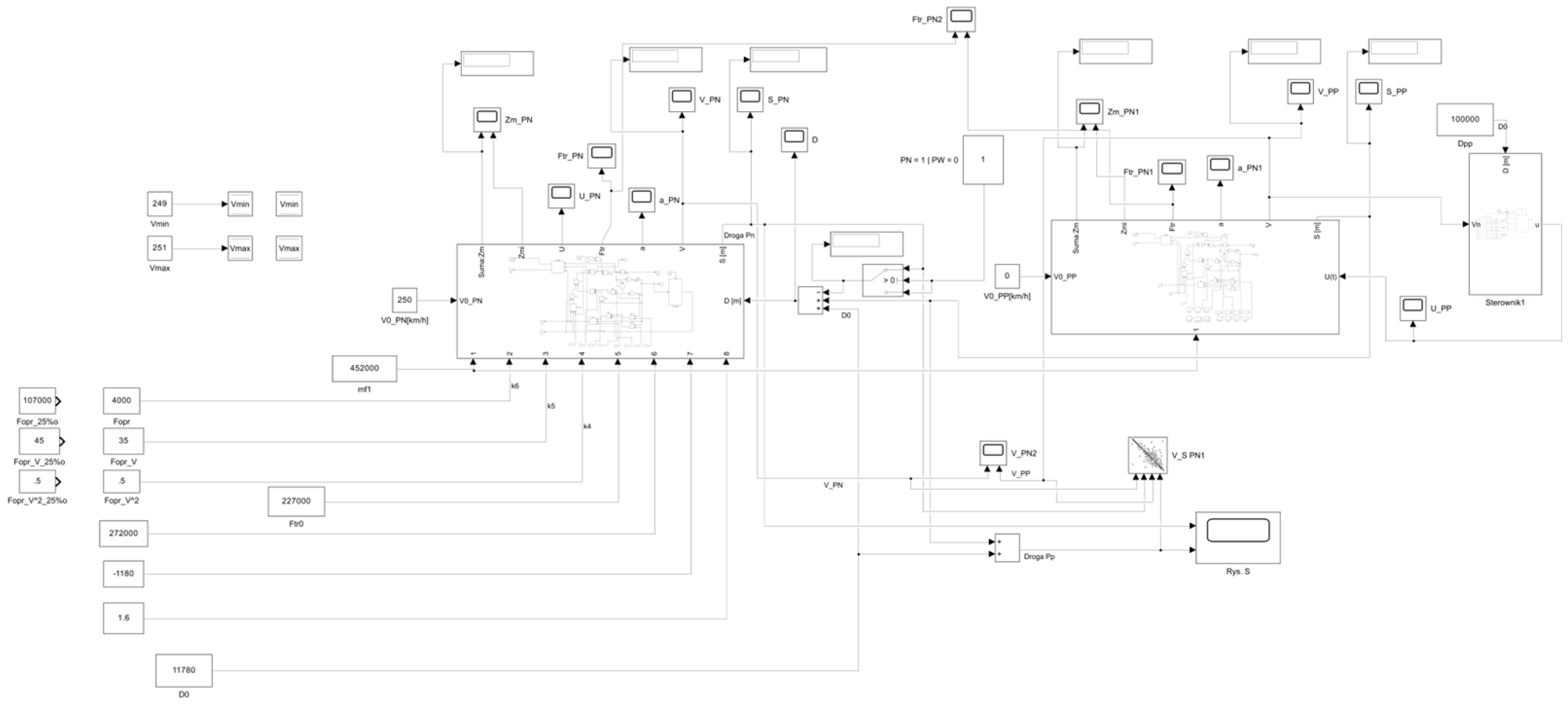
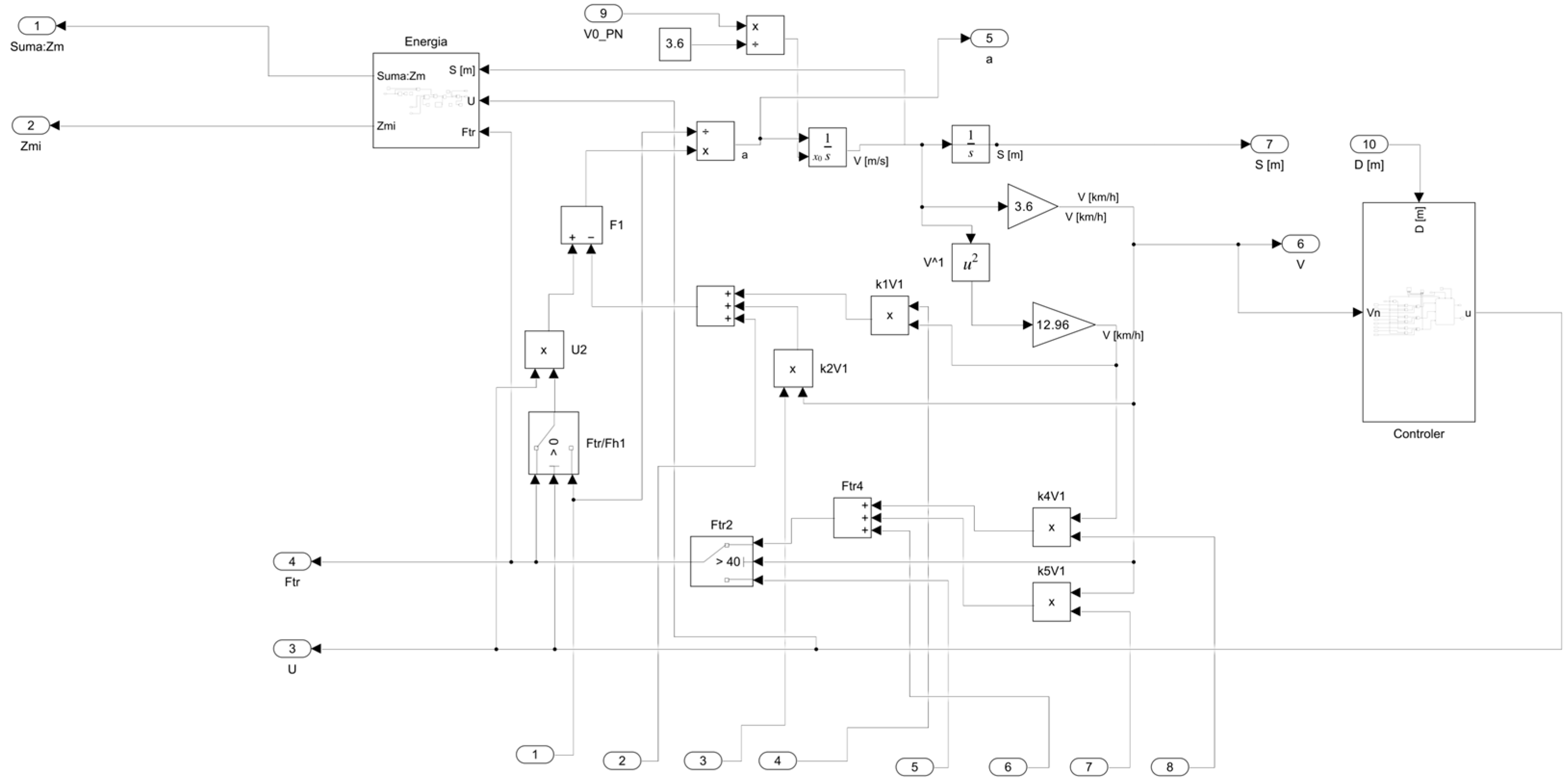
To determine the nonlinear values of mechanical energy consumption by the train, a kinematic motion model of the train was implemented in MATLAB/Simulink (Version number: R2024a Update 3). The general block diagram of the model is presented in the figures below (
Figure 5 and
Figure 6).
The presented model consists of two segments in which, as a function of time, the following parameters are calculated: train speed, distance traveled, and mechanical energy consumption (right segment: preceding train Pp; left segment: following train Pn).
The segments are connected via a block that calculates the distance between the trains, which serves as an input to the control block for train Pn. This control block determines the speed profile of train Pn based on maintaining an appropriate braking distance.
The input data for the program include parameters dependent on train speed, such as tractive force derived from traction characteristics, braking curves, and running resistance forces. The initial train speed and mass are also specified, including the energy contribution from rotating components, as well as fixed constraints imposed by infrastructure elements (e.g., turnouts).
The output values comprise curves representing changes in train speed, distance traveled, mechanical energy consumption, and the distance between two trains as a function of time. Energy variation is calculated based on changes in kinetic energy and the energy required to overcome running resistance.
The boundary conditions define the train’s maximum speed and the duration of the simulation, which is limited to the point at which the analyzed train regains its maximum speed. Variable environmental conditions were not considered in this study.
The model applies the following equations of motion to compute the train’s traveled distance and velocity:
The train model used in the simulation represents a passenger train based on the ETR610 series ED250 traction unit, with a length of 187.4 m and a mass of 427 t [
36]. The train operates at a maximum speed of 250 km/h.
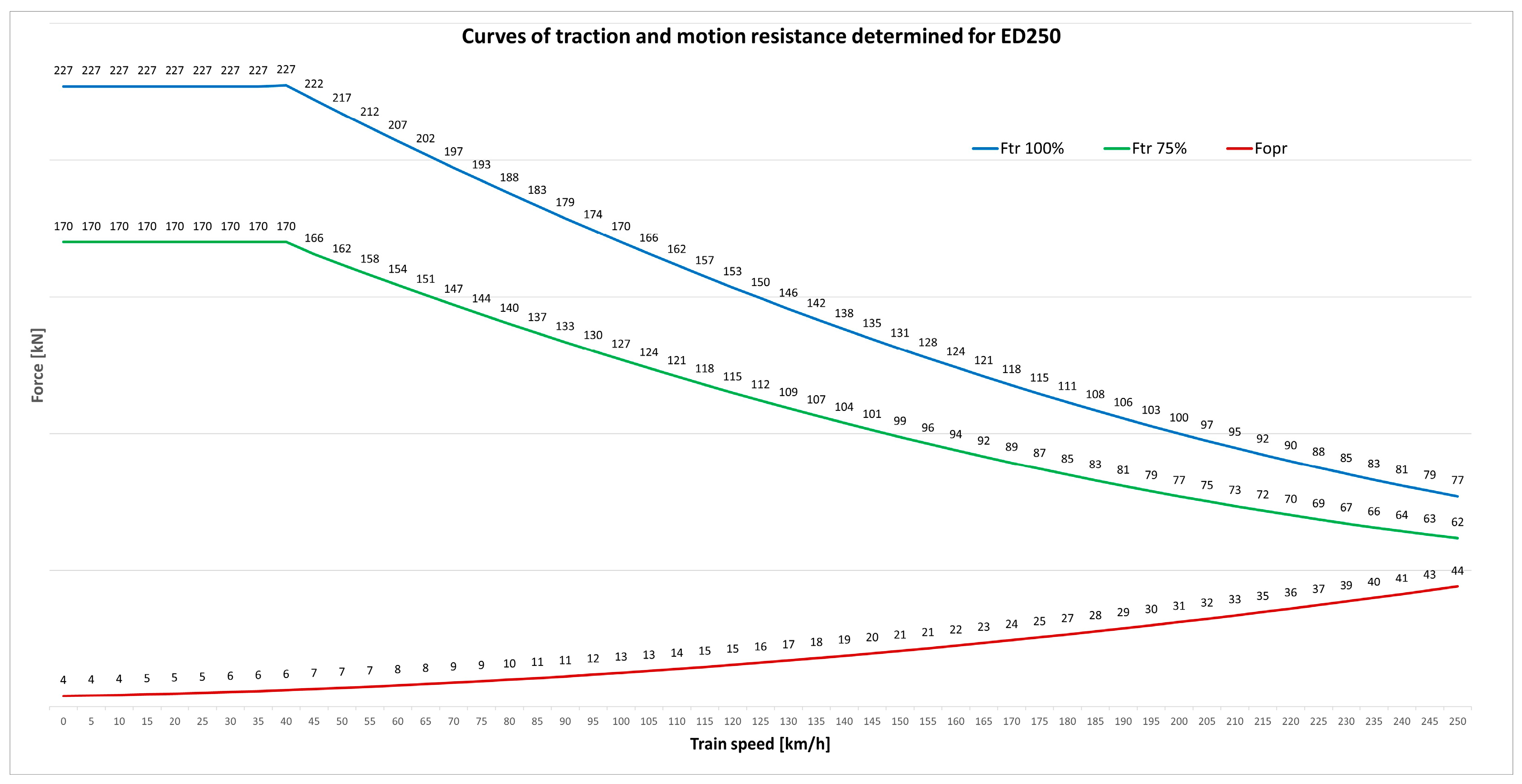
The traction force and running resistance characteristics primarily depend on train speed. In simplified form, they can be expressed using a quadratic function, as detailed in [
37,
38]. The traction force as a function of speed is given by:
The corresponding characteristics are presented in the figure below (
Figure 7).
Differences in calculated travel time, distance, and mechanical energy consumption between the limiting performance curves and the reference curve allow estimation of potential under- or overestimation relative to values derived from traction system characteristics. The analysis indicates that, compared to characteristic-based values, results may be underestimated by up to 7 s in travel time, 212 m in distance, and 0.065 kWh in mechanical energy consumption, or overestimated by up to 16 s, 598 m, and 0.365 kWh, respectively [
40].
The analysis of traction characteristics and validation results illustrates the simulated operation of the ETR610 train under conditions of maximum allowable acceleration and various braking strategies, from maximum speed to a complete stop [
31]. The acceleration and braking performance curves were compared with operational data from an ED250 series ETR610 train running on Line 9 (Warszawa-Gdańsk) and Line 4 (Warszawa-Kraków), confirming the accuracy of the simulation.
Traffic resistance was determined based on parameters specified for the trainsets in [
41] and calculated using the Davis equation:
F = 8
V2 + 130
V + 4000 N, where
V is the train speed in m/s.
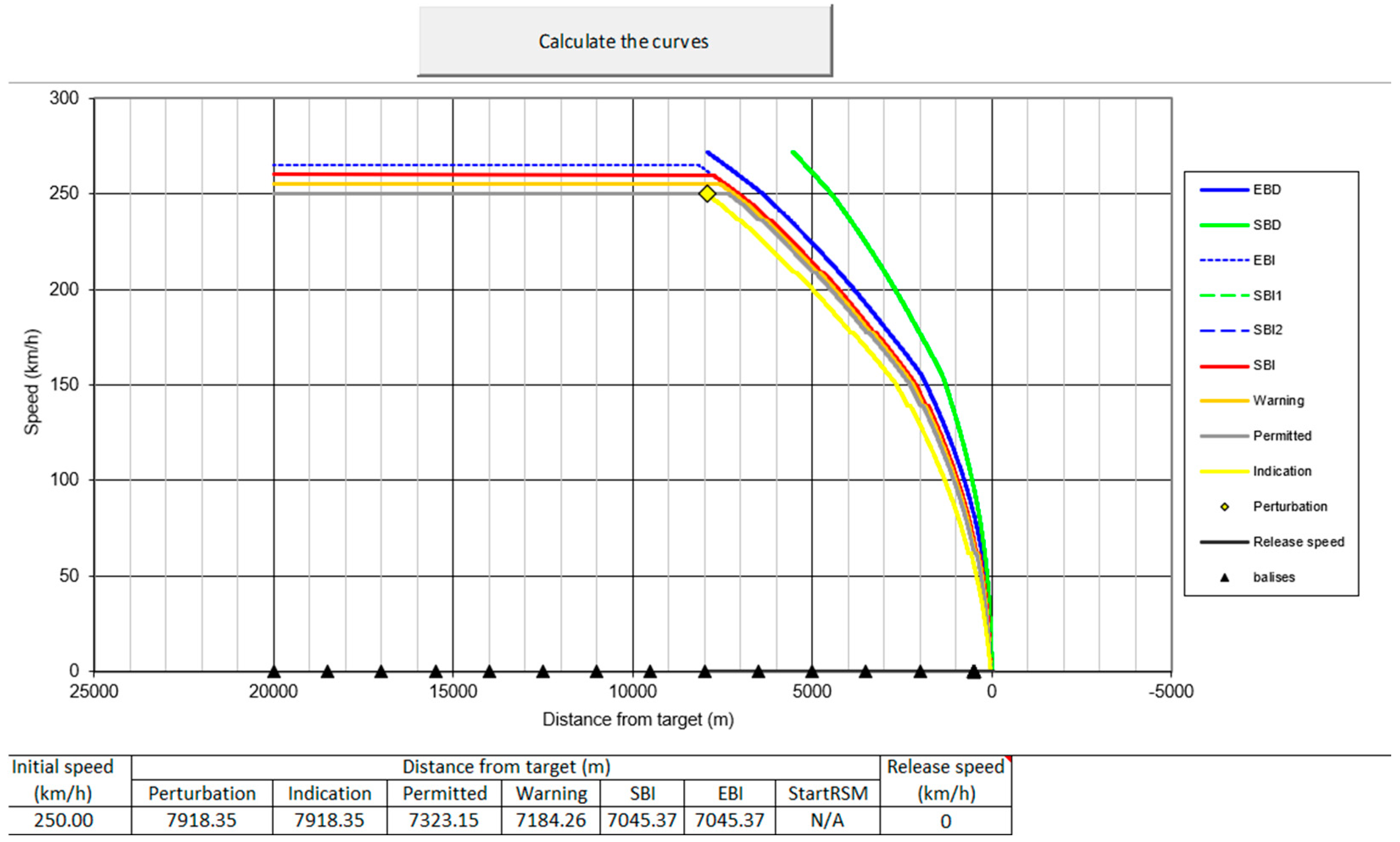
The braking force is determined based on the computational algorithm provided by the European Union Agency for Railways (Braking curves simulation tool v5.1) [
42] according to the SBI (Service Brake Intervention) profile (
Figure 8). This profile defines the train’s speed curve, exceeding which triggers the onboard ETCS to gradually apply braking force, resulting in train deceleration as follows: 0.5 m/s
2; 0.8 m/s
2; 1.0 m/s
2.
Mechanical energy loss is calculated as the partial sum of energy required to overcome running resistance. In cases where the train increases its speed, the loss additionally includes the difference in kinetic energy within the range of the speed change.
For the energy required to overcome running resistance, the resistance force is determined based on the average speed within a one-second time interval and the distance traveled during that interval:
where
i—the index represents consecutive one-second time intervals, such that, i: {i = 1,…, Tm}, where Tm is the total duration of the analyzed train movement.
Fopr—the running resistance force determined for the train’s speed over the distance segment .
In the case of accelerated motion, mechanical energy consumption depends on the change in train speed from
V1 to
V2 and the train’s mass (including the contribution of rotating components). This relationship can be expressed as follows:
The total mechanical energy consumption during accelerated motion is calculated as:
The reported mechanical energy consumption values are expressed as the equivalent of 1 kWh (1000 W over one hour).
When calculating actual electrical energy consumption, efficiency values must be applied. These values depend on the locomotive type, the traction power supply system (e.g., spacing between substations), and environmental conditions (e.g., the contact force between the pantograph and the contact wire).
Electrical energy consumption exceeds mechanical energy due to several factors: traction motors operate with an efficiency of approximately η = 90 ÷ 95%; converters, inverters, and other power electronics achieve η = 95 ÷ 98%; and additional losses occur in the drivetrain (e.g., gearboxes, η ≈ 95%). Furthermore, part of the energy may be recovered during braking through regenerative systems.
After applying the defined simplifications and constraints, together with the specified efficiency values, electrical energy consumption can be calculated using the following equation:
According to the authors, converting results into traction energy terms is, however, limited by the large number of variables, which may hinder the comparison of scenarios for specific traffic conflict resolution strategies.
2.2. Determination of the Operational Plan Implementation Moment
Determining the time reserve for performing the simulation and implementing changes to the Operational Plans is a complex issue, involving not only the quantification of time but also the moment of Operational Plan implementation.
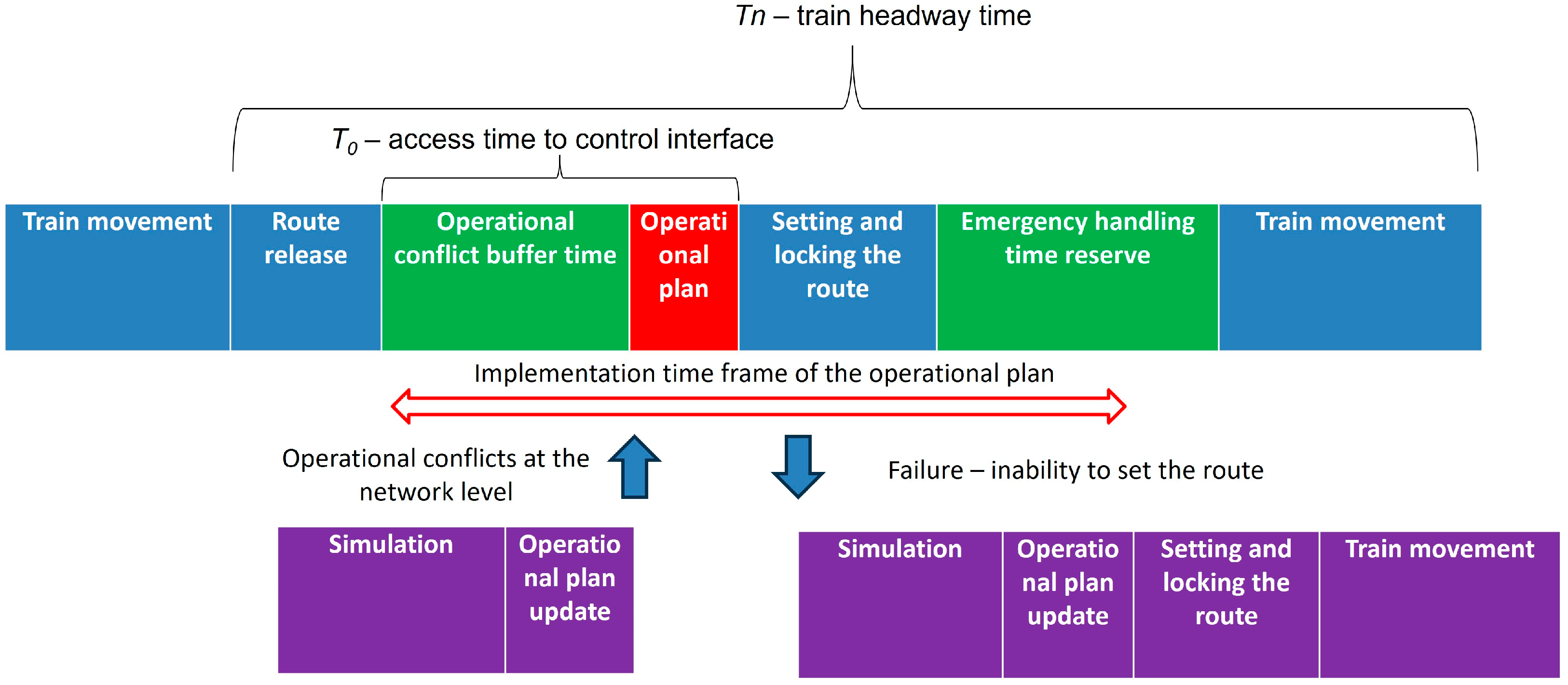
The components of train headway time (
Tn) can be distinguished as follows (
Figure 9):
Tzw—route release time;
TPlOp—Operational Plan implementation time, which comprises the components of the dispatch interval: data acquisition, data transmission, algorithmic processing, safety validation, and the preparation and transmission of control commands;
Tup—route-setting and locking time;
Tpj—train travel time over a locked route.
The braking time (
Th) represents the duration required for a train to decelerate from its maximum operating speed to a full stop before reaching the defined End of Authority (EoA) [
42]. This time component is critical for ensuring safe train separation and must be considered when calculating headway and determining the timing for Operational Plan implementation.
Considering the above assumptions, the formula for the total time reserve (for resolving traffic conflicts and emergency situations) is as follows:
The moment of Operational Plan implementation can be considered as follows:
where
t1 is the earliest possible moment for Operational Plan implementation, and
t2 is the latest permissible moment for implementation, provided that:
where
Tn—train headway time.
t1 represents the earliest moment for Operational Plan implementation, in a situation where no time reserve is allocated for potential simulation or modification of the planned train route to resolve a traffic conflict.
t2 represents the latest moment for Operational Plan implementation, in a situation where no time reserve is allocated for simulation or modification due to infrastructure or equipment failure.
Such a situation may require adjusting the train’s speed profile (i.e., reducing speed) to maintain smooth movement and avoid train stoppage.
To compare the effectiveness of different time reserve values used for resolving traffic conflicts, a parameter T0 is introduced.
T0 represents the availability of a given object (e.g., route section or control element) for implementing a change—in this case, a route modification for a specific train.
Based on this value, the following formula is proposed for calculating the average number of controllable objects within a given time horizon
T =
Tn:
where
represents a stochastic process due to the random nature of the time moments
t, and reflects the average number of controlled objects under the assumption of a constant access time
T0 throughout the entire analysis period
Tn;
n—the total number of objects in the system;
= n—the maximum possible value, assuming all objects are simultaneously available;
t—the object access start time (random variable) t ∈ [0, Tn].
In cases where the number of events n is sufficiently large (
n > 30), assuming that the sum of independent random variables with finite variance converges to a normal distribution (Central Limit Theorem) [
43], a simplified formula can be applied:
In order to assess the effectiveness of different values of time reserve allocation for resolving emergency situations, the impact of train route setup delay on the train’s speed profile (including speed reduction) was analyzed.
The amount of mechanical energy loss required to restore the train’s maximum speed, as well as the energy expenditure needed to reduce the train’s delay, was also determined.
The relationship for the train journey time extension, consisting of a braking phase, travel at constant speed (
V =
Vogr), and acceleration to maximum speed (
V =
Vmax), is as follows (covered in more depth in the publications [
30,
31]):
where
TEoA—travel time over the distance to the EoA;
m—gross train mass including the rotational energy of rotating masses;
Fopr—train motion resistance force dependent on train speed;
Sh—braking distance;
Ss—coasting distance segment (V = Vogr = const);
SV—distance during speed change (V: Vogr –> Vmax).
The relationship describing the difference in mechanical energy used during train coasting (
V =
Vogr =
const) and during acceleration to regain maximum speed (
V: Vogr –>
Vmax), in reference to the mechanical energy consumed to overcome running resistance when the train travels at a constant maximum speed (
V =
Vmax =
const), over the entire considered route distance up to the End of Authority (EoA), is as follows [
30,
31]:
where
Fopr(Vogr)—running resistance force under constant constraint speed (V = Vogr = const);
Fopr(Vmax)—running resistance force under constant maximum speed (V = Vmax = const).
The relationship describing the difference in mechanical energy used to “eliminate” train delay—e.g., through a theoretical increase in speed beyond the maximum speed (
V >
Vmax)—compared to the mechanical energy consumed due to running resistance when the train travels at a constant maximum speed (
V =
Vmax =
const) over the entire route distance, is as follows [
30,
31]:
where
F—net tractive force, i.e., tractive effort after deducting running resistance;
Vϰ—theoretical speed exceeding Vmax, aimed at reducing train travel time;
Sϰ—distance required to eliminate delay by increasing speed to Vϰ.
2.3. Assumptions Adopted for Calculations
For the exemplary solution, the following train headway time and its components were adopted (based on information provided in [
2,
23,
37]):
Tn = 180 s—the minimum permissible train headway time was determined for high-speed lines with homogeneous passenger traffic,
Tzw = 7 s—route release time,
TPlOp = 9 s—Operational Plan implementation time,
Tup = 15 s—setting and locking the route time,
Tpj = 18 s—train travel time over a locked route of 1000 m, with a constant speed of 200 km/h.
The train headway time need also to consider the time required for braking to a safe stop in the event that movement authority is not extended: Th = 77 s—braking time according to the SBI braking curve (4300 m), determined for the assumed train model and a maximum speed of 200 km/h.
To estimate the impact of an increase in the number of controlled train movements within a defined time frame, resulting from the application of an additional time reserve, a uniform statistical distribution of
n = 100 train movements (
n > 30) was assumed within the train headway time horizon (
Tn):
The computation time value was assumed as:
τ = 30 s expected value as defined by infrastructure managers [
8].
Three variants were evaluated:
Variant 1: The implementation of the Operational Plan takes place once the route is cleared by the preceding train:
Variant 2: The Operational Plan is implemented when a train approaches the End of Authority (EoA), taking into account the safe stopping distance, when movement authority cannot be extended:
and the latest possible moment for implementing the Operational Plan considers train headway times and the travel time of the train along the relevant route section:
Variant 3: Implementation of the operational plan as in Variant 2, including a time reserve to address emergency situations (assuming that a failure is detected halfway through the route setup time), based on the defined relationships:
subject to the condition that:
The presented constraints and dependencies indicate that the objective function depends on two variables:
Since improving one variable leads to the deterioration of the other, the problem involves Pareto-optimal solutions.
4. Discussion
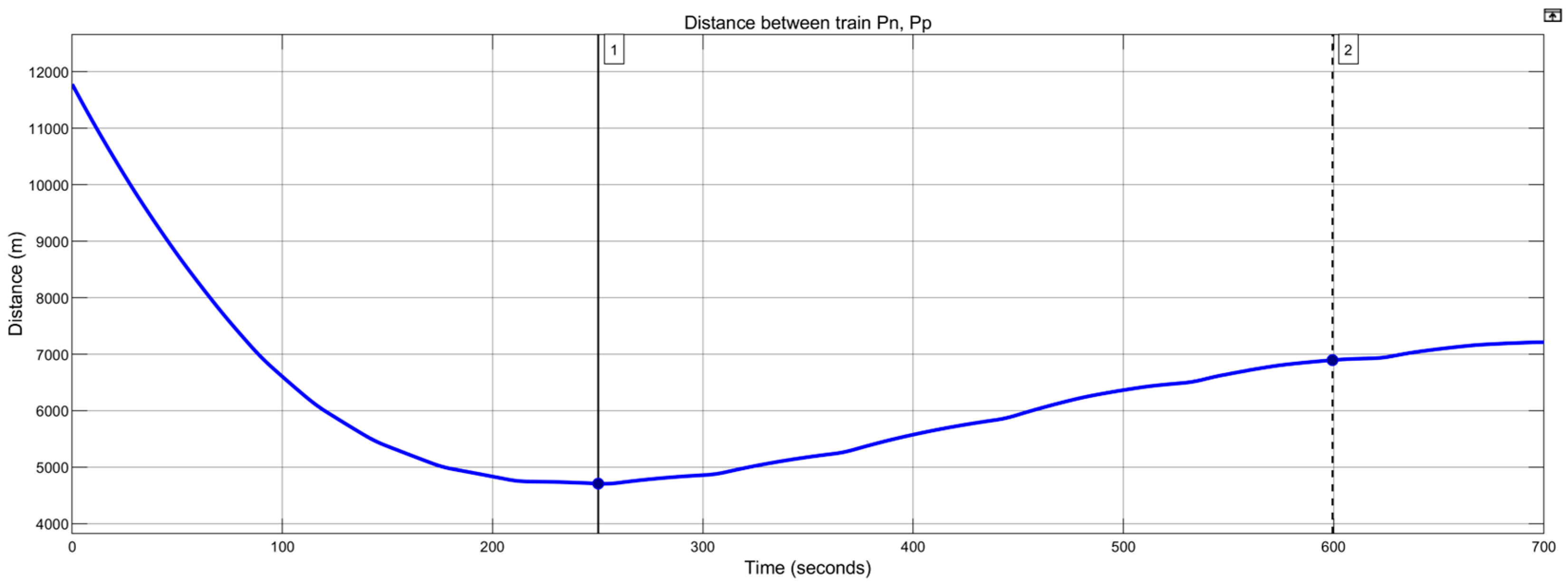
During the traffic analysis for Scenario 1, a time reserve was calculated to enable traffic simulation for resolving operational conflicts. By limiting the train speed to V = 100 km/h and applying a train headway of Tn = 192 s, the resulting value was τ = 137 s. This time reserve allows identification of an initial solution; however, it is insufficient for optimizing the solutions.
The mechanical energy consumption in the case of applying a modified train speed profile to avoid a complete stop amounts to 375.7 kWh. In comparison, the energy consumption of a train running at maximum speed (without any traffic conflict) is 212.6 kWh. The difference in values, ΔE = 375.7 − 212.6 = 163.1 kWh, represents the mechanical energy loss incurred to prevent stopping train Pn. Stopping the train could result in secondary delays impacting subsequent operations. Furthermore, restarting the train to reach a speed of 250 km/h over a comparable distance to uninterrupted travel would require an additional 448 kWh of mechanical energy.
The analyses conducted for Scenario 2 enabled the identification of the speed to which train Pn must be reduced, depending on the value of time τ.
As shown in
Table 2, depending on the assumed time reserve τ, maintaining smooth train operation requires a speed reduction to 209 km/h (for
τ = 12 s), which results in a mechanical energy loss of 72 kWh, and to 157 km/h (for
τ = 60 s), which causes a mechanical energy loss of 152 kWh—twice as much as in the previous case.
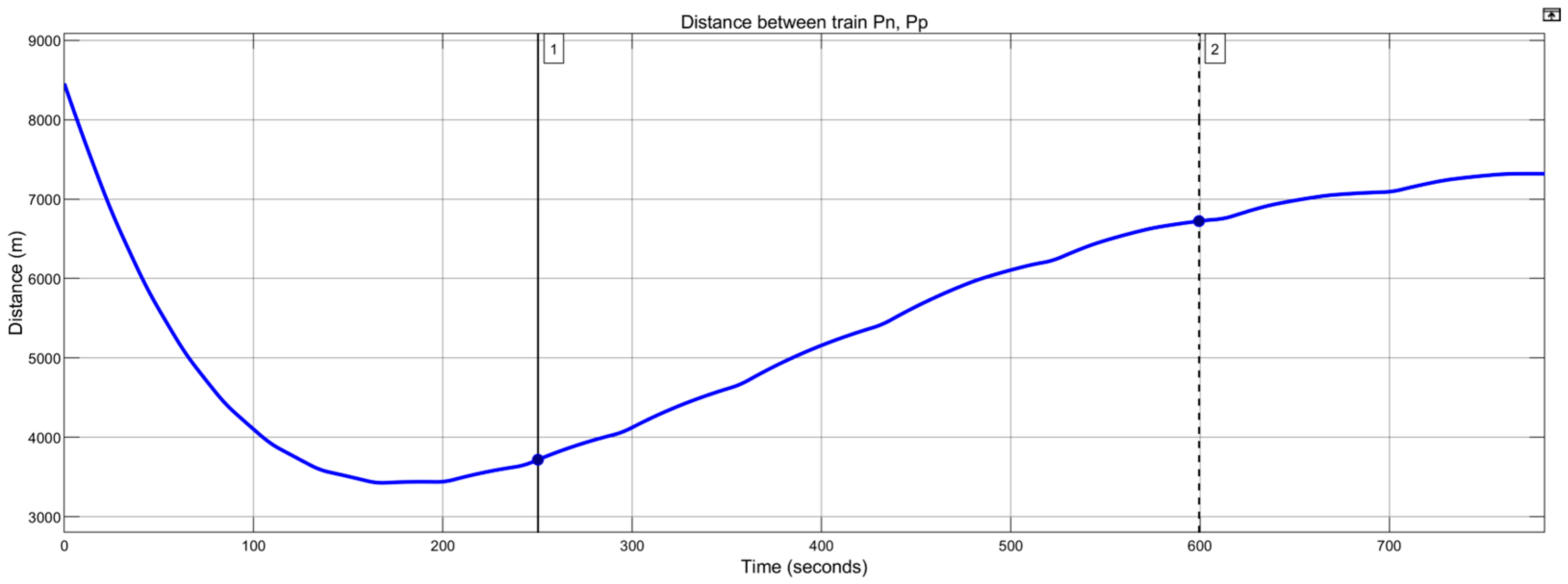
The analyses for Scenario 3 indicated a significant (more than twofold) increase in mechanical energy loss compared to Scenarios 1 and 2. This is due to the shortened distance to train
Pp (as illustrated in
Figure 8 and
Figure 9), which, due to reduced traction force, has limited ability to accelerate to maximum speed. As a result, train
Pn switches its traction mode to coasting or even braking, which further increases the loss of kinetic energy. Similar to 2, the speed reduction in train
Pn depends on the simulation time allocated for resolving the traffic conflict. A shortened simulation time (
τ = 12 s) allowed a speed reduction to 184 km/h, resulting in a mechanical energy loss of 318 kWh. In contrast, with a simulation time of
τ = 60 s, train
Pn had to slow down to 156 km/h, which implies a mechanical energy loss of 403 kWh.
The analysis concerning the selection of the appropriate moment for Operational Plan implementation, as well as the division and allocation of the time reserve, was carried out for a train speed of Vmax = 200 km/h with a train headway of Tn = 180 s. Based on the adopted parameters, the possibilities for optimizing the train speed profile (avoiding speed reduction) in emergency situations were evaluated.
The solution based on variant 1 or 3 is more advantageous for application on railway line sections with lower complexity (e.g., through stations with several additional main tracks), as it enables more effective optimization of train speed profiles in emergency situations by avoiding additional speed restrictions.
The solution based on variant 2 may be suitable for complex track infrastructure (e.g., large junction stations), where numerous independent train and shunting movements are carried out simultaneously and where high efficiency in resolving traffic conflicts (such as changes in train routing) is expected.
The selection of the most advantageous variant can also be related to the assumed component times of train headway as well as the time required to perform simulations, including the computational algorithms used.
For complex infrastructure configurations, the time required for train movement simulation—including analysis, optimization, and control method selection—may prove insufficient. In this example, a time frame of 30 s was assumed, which is extremely short given the computational algorithms employed. In such situations, it may be necessary to revise assumptions concerning train headway times, including the available time reserve for resolving traffic conflicts, as well as the approach to selecting the hierarchy of decision-making processes within the computational algorithms.
According to [
37], the minimum time headways between different train classes are reported as follows: 3.2 min for a high-speed train following another high-speed train, 3.3 min for a freight train following another freight train, and 3.4 min for a local passenger train following another local passenger train. Therefore, the shortest headway in this example is 3.2 min, which exceeds the value assumed in the calculations,
Tn = 180 s.
Selecting an appropriate time frame for simulations and operational adjustments should consider the time required to diagnose traffic disruptions, such as equipment failures (e.g., track or platform unavailability and turnout switching failures), as well as cases of degraded operating conditions reported by the train driver, which may result in reduced traction power.
5. Conclusions
This paper addresses key aspects of designing and implementing a Traffic Management System (TMS), with emphasis on automating the detection and resolution of train movement conflicts. The optimization of train speed profiles within complex railway networks must account for constraints imposed by railway signaling and traffic control systems. Case studies of operational conflicts illustrate their diverse impact on train speed profiles, highlighting the necessity of tailored resolution strategies.
The authors emphasize that specifying simulation duration alone is insufficient; it is essential to include time reserves both prior to and following the implementation of the Operational Plan. Such reserves are crucial for ensuring uninterrupted train operations, especially during emergency scenarios that require route adjustments. Furthermore, traction energy losses associated with conflict resolution should be treated as a key design parameter.
The effective development of a Train Management System (TMS) requires selecting appropriate computational algorithms and incorporating infrastructure parameters, traffic intensity, and correction factors influencing simulation time. The timing of Operational Plan implementation is critical for managing time reserves and responding to disruptions. Therefore, traffic scenarios should be extended to account for traction vehicle and control system failures, including estimated resolution times and the strategic allocation of time reserves.
Currently, the configuration is limited to analyzing conflicts between two trains. To better reflect operational complexity, it is necessary to develop models that capture interactions among three or more trains while incorporating dynamic spatio-temporal dependencies and traffic control system constraints.
Considering the rapid advancement of artificial intelligence techniques in railway traffic management [
25,
26,
27,
28,
29], the potential integration of TMS with predictive and adaptive machine learning systems should be explored for real-time conflict prediction and train trajectory optimization.
Incorporating energy losses as a design parameter creates opportunities for research on energy-efficient conflict resolution strategies. Optimization algorithms (e.g., evolutionary algorithms, dynamic programming) should be considered to minimize energy consumption while maintaining traffic fluidity.
Expanding simulation scenarios to include traction vehicle failures and traffic control system malfunctions will facilitate the assessment of TMS resilience under crisis conditions. In this context, it is essential to develop strategies for managing time reserves and mechanisms for rapid response.
Further analysis should examine how different infrastructure configurations (e.g., number of tracks, signal placement, section lengths between stations) and varying traffic intensity affect TMS operational efficiency and conflict resolution effectiveness. Future work should include comparing simulation results with operational data from real railway systems to enable model calibration and evaluate practical applicability.