1. Introduction
Poor sitting posture has become a widespread health concern among various sedentary populations, including office workers, bus drivers, and students. Maintaining improper postures (i.e., slouching, asymmetrical shoulder alignment, or lumbar collapse) can lead to muscular strain and chronic conditions such as low back pain and upper cross syndrome [
1,
2]. As a result, sitting posture recognition has gained increasing attention in ergonomics and healthcare due to its significant implications for musculoskeletal health in predominantly sedentary populations.
A variety of sensing technologies have been employed for posture monitoring, including vision-based systems [
3,
4], inertial measurement units [
5,
6], and pressure distribution sensors [
7,
8]. Among these, pressure-sensing mats offer a practical and unobtrusive solution for continuous posture assessment while preserving user privacy [
9]. These cushions serve as an effective tool for data acquisition, maintaining direct and continuous contact with seated individuals. They can be seamlessly integrated into everyday environments without requiring wearable devices, thereby enhancing user comfort and compliance. Embedded sensor matrices enable real-time collection of pressure distribution data across the buttocks and thighs, which reflect postural variations intuitively. For example, posterior shifts in the center of pressure (COP) during forward slouching or left-right asymmetries resulting from uneven shoulder positioning. Through analysis of these pressure metrics, it becomes feasible to accurately evaluate sitting posture and provide reliable data for identifying poor postural habits [
10,
11].
Multiple machine learning algorithms have been successfully applied to sitting posture recognition, such as Support Vector Machines, Random Forests, k-Nearest Neighbors, Decision Trees, and Naïve Bayes classifiers [
12]. These approaches typically reported high classification accuracy based on pressure distribution data, though the number of recognized postures varies considerably across studies. Several investigations have focused on limited posture sets, such as four postures (e.g., upright, forward, backward, and lateral leans) classified using Support Vector Machines [
13,
14], or five postures (upright, forward, backward, left, and right leans) implemented with deep learning frameworks [
15]. Other studies have expanded posture variety while maintaining moderate model complexity, developing six-posture systems that include categories such as “no user”, “normal posture”, “lateral leans”, and “leg extensions” [
16], or distinguish between sitting with and without backrest support in various orientations [
17]. A common limitation across these studies is the recognition of a limited number of postures (typically fewer than six), with particular omission of contralaterally rotated or asymmetrical trunk postures that are clinically relevant due to their association with increased musculoskeletal loading and potential injury risk.
Some researchers have achieved more extensive posture classification through enhanced sensing capabilities rather than optimized algorithmic approaches. Katayama et al. [
18] classified nine postures using LiDAR-generated point cloud data, achieving 87% accuracy. Zhang et al. [
9] recognized ten postures using combined infrared and pressure array sensors, with accuracy ranging from 73.4% to 90.6% across different models. Ishac and Suzuki [
19] expanded further to eleven postures using fabric sensors integrated into the chair backrest, reporting 98.1% accuracy. Muppavram et al. [
20] proposed a twelve-posture detection system using sensors installed in the seat base, backrest, and arm supports. The most extensive system to date, developed by Bourahmoune et al. [
21], recognized fifteen sitting postures with 98.82% accuracy using novel pressure-sensing technology embedded in the chair backrest. However, these high-posture-count systems invariably depend on multi-sensor configurations (i.e., combining seat and backrest pressure data or incorporating additional sensing modalities) rather than using only seat pressure distribution, thereby increasing system cost and complexity.
More critically, current studies have not adequately addressed model performance across different seat conditions. Varying seat surface materials significantly alter pressure distribution characteristics under identical postures [
22], yet it remains unknown whether classification models maintain consistent performance when applied across different seat conditions, particularly between hard and soft surfaces that represent common seat environments. This challenge is particularly evident in the context of soft seating substrates (i.e., sofas or cushioned office chairs), where material characteristics, including foam density, elasticity, and structural configurations, induce significant deformation under human load. This deformation substantially influences captured pressure distribution data. Compared to hard surfaces, soft seats tend to disperse pressure over broader areas, attenuate peak pressure values, and enlarge the overall pressure distribution footprint [
23]. Consequently, posture recognition models trained exclusively on hard surface data may exhibit diminished performance when applied to soft seating contexts, highlighting the critical need for comprehensive investigation into cross-domain generalization capabilities and the development of robust classification systems that can adapt to varying seating conditions.
This study aimed to systematically investigate the performance and transferability of different neural network architectures for sitting posture recognition across varying seating environments. Specifically, we addressed three critical research objectives: (1) to develop and optimize deep learning architectures for accurate recognition of nine sitting postures using only pressure distribution data from a single sensing mat; (2) to evaluate and compare classification performance across two distinct seat conditions (hard and soft surfaces) for assessing model robustness; and (3) to investigate model generalization capabilities through cross-domain prediction analysis, examining performance when models trained on one seat surface type are applied to the other. This study would advance the development of practical, unobtrusive sitting posture monitoring systems capable of operating effectively across diverse real-world seating environments.
2. Materials and Methods
2.1. Participants
Eleven healthy male volunteers were recruited for this study. Their mean (±standard deviation, SD) age, height, body mass, and body mass index were 26.64 ± 8.03 years, 1.77 ± 0.03 m, 69.73 ± 4.73 kg, and 22.27 ± 1.65 kg/m2, respectively. None of the participants reported any known musculoskeletal disorders (i.e., low back pain) or other medical conditions (i.e., neurological disorders or cardiovascular diseases). Written informed consent was obtained from each participant prior to data collection. The study protocol was reviewed and approved by the Medical Ethical Review Committee (Reference number: NIOHP202326).
2.2. Data Collection
Each participant was instructed to maintain nine seated postures under two surface conditions: a hard seat and a soft seat. The postures included: natural upright posture (NUP), lean forward (LF), lean backward (LB), lean left (LL), lean right (LR), lean left anterior (LLA), lean right anterior (LRA), lean contralateral left anterior (CLA), and lean contralateral right anterior (CRA). These postures were selected to represent a progression from simple to complex biomechanical configurations, with particular clinical relevance for musculoskeletal health. The contralaterally rotated postures (CLR, CRA) are especially important as they represent high-risk positions associated with asymmetric spinal loading and increased decompression forces. These postures are prevalent in daily activities and are tightly related to low back pain [
2,
6,
22,
24]. Also, these postures are representative sitting postures being widely investigated in previous studies [
12,
14,
15,
17]. Detailed definitions of each posture are presented in
Table 1.
For each surface condition, the postures were assigned to each participant in a randomized order to counterbalance potential order effects. Each posture was maintained for 180 s of continuous data collection, followed by a 3 min rest interval to minimize fatigue accumulation.
The two seating conditions were chosen to represent distinct ends of the stiffness spectrum encountered in real-world scenarios. Hard Seat: A laboratory-standard wooden chair was used, featuring a 5 cm thick solid wood seat with a surface flatness error ≤ 0.5 mm. The seat surface has no padding or covering, which is a very representative seating condition in daily life. The seat dimensions were 45 cm × 45 cm (length × width) with the backrest fixed at a 90° angle relative to the seat surface. The rigid construction ensured minimal elastic deformation, allowing direct and undispersed pressure transmission. Soft Seat: A custom-made steel-framed chair was utilized, with a leather-upholstered cushion on the seat surface. The cushion is high-density foam padding (density: 35 kg/m3; elastic modulus: 2.5 N/mm) with a thickness of 10 cm, covered with a leather exterior. The seat dimensions matched those of the hard seat (45 cm × 45 cm), and the backrest-to-seat angle was 90°. From a biomechanical perspective, the two-seat conditions represent fundamentally different support mechanisms. The hard seat approximates rigid contact conditions where pressure distribution is primarily determined by bony prominences, while the soft seat introduces complex tissue–cushion interactions that redistribute pressure through deformation. This setup simulated realistic deformation behavior under load, representative of typical soft seating environments. While we acknowledge that seat softness exists on a continuum, our experimental design intentionally selected two representative points on this spectrum to capture the most significant pressure distribution variations. The hard seat represents rigid support surfaces typical of wooden furniture, while the soft seat represents compliant automotive seating. Future work could benefit from incorporating quantitative softness metrics such as durometer measurements or compression testing parameters to establish a more continuous softness scale.
A self-developed pressure-sensing mat system was employed to record pressure distribution data [
25]. The system comprised a sensor matrix and an operating software V01. The sensor matrix consisted of a 16 × 16 array, totaling 256 sensing units (piezoresistive sensor) independently distributed across an active area of 340 mm × 337.5 mm. Each individual sensor had an active area of 10 mm × 10 mm. The system operated at a sampling frequency of 1 Hz, which was suitable for capturing static sitting postures while avoiding data redundancy. The pressure detection range was 0–50 kPa with an accuracy of ±3 kPa, and the raw signal output resolution was 0.01 V. Sensors were connected via a serial protocol to a host computer, which enables real-time data transmission for subsequent processing and feature extraction. The spatial resolution of our sensor array (28.4 mm inter-sensor spacing) was sufficient to capture the major pressure distribution patterns associated with different postures, particularly the characteristic dual-peak pattern associated with ischial tuberosity loading in upright sitting. This configuration allowed the system to accurately capture both the relative pressure magnitude and spatial distribution patterns corresponding to different seated postures.
The whole experiment procedure consists of preparation and data collection. During the preparation phase, the pressure-sensing mat was placed flat and securely fastened onto the seat surface. Participants were informed of the purpose and procedures of the experiment, as well as standardized requirements for performing each of the nine seated postures. Subsequently, they were instructed to sit on the mat and were given 15 min to familiarize themselves with the seating conditions and practice all postures. Demonstrations and video materials were adopted to illustrate the required angles and movement specifications. The entire procedure was conducted with the assistance of a research assistant. This practice session would reduce potential data errors resulting from incorrect execution.
Prior to data collection, the pressure-sensing mat was connected to the operating software. The pressure-sensing mat system was then calibrated by recording deviations between sensor outputs and reference pressure values. A linear correction algorithm was applied to adjust sensitivity and ensure measurement accuracy.
During data collection, participants initially adjusted their torso position to meet the requirements of the assigned posture and then maintained it statically until a stabilized pressure distribution was acquired. Subsequently, data were recorded continuously for 180 s before the trial was terminated. Throughout the process, participants were required to maintain the assigned posture without movement. The research assistant monitored torso angles in real time using a goniometer and provided immediate corrective feedback when deviations exceeded specified ranges.
For each seating condition, the testing order was predetermined according to a random number table. The two seating conditions were performed in a randomized order. Participants were provided with a 10 min rest period between conditions, and they were encouraged to stand and move freely to alleviate muscle fatigue.
All acquired data were immediately labeled with subject ID, seat type, posture label, and timestamp, and stored in a dedicated database for analysis.
2.3. Data Processing and Analysis
For each participant under each seating condition, the raw pressure distribution data were preprocessed through the following sequential steps to remove invalid records and enhance data validity and reliability. First, the initial and final 10 frames of the recording segment for each posture were discarded to exclude transitional movements during sitting down or standing up. Second, frames with an effective sensing area covering less than half of the total sensor area were removed to eliminate incomplete posture records. Finally, data segments exhibiting total pressure deviations exceeding ±25% from the posture-specific average were excluded to minimize the impact of transient disturbances or measurement artifacts. These preprocessing steps effectively addressed common noise sources, including sensor initialization artifacts, momentary posture adjustments, and measurement outliers. Thereafter, the dataset was further confirmed using the motion trajectory of the COP, such as calculating a 95% confidence ellipse enclosing the COP. Common noise sources, such as sensor instability and motion artifacts, could be effectively removed based on the aforementioned process. These processes yielded an average of 2497.4 ± 43.0 valid data frames for the hard seat condition and 2241.3 ± 23.5 frames under the soft seat condition. Finally, we obtained a total of 42,649 valid data frames, comprising 22,477 frames from the hard seat condition and 20,172 frames from the soft seat condition. Details for each posture were presented in
Table 2. The retained data were then converted into pressure distribution matrices for subsequent feature extraction and model training.
The valid data frames were further filtered to remove rows or columns with all zeros. Thereafter, peak pressure, mean pressure, and pressure variance were extracted for each frame [
26,
27,
28]. The selection of these specific features was theoretically grounded in biomechanical principles. Peak pressure was defined as the maximum value among all sensor units, reflecting the maximum load at the primary support region of the corresponding seated posture and relating to tissue compression risk through Laplace’s law governing capillary occlusion. Mean pressure was calculated as the average value across all sensor units, representing the overall load borne by the buttocks and thighs. Pressure variance was computed as the variance of all sensor values, indicating the uniformity of pressure distribution: higher variance suggests concentration in specific areas such as the ischial tuberosities, resulting in a less uniform profile, whereas lower variance reflects more even pressure dispersion. The peak pressure, mean pressure, and pressure variance of all valid frames were averaged to represent the pressure distribution of each seated posture. For each participant, the averaged values were used to characterize the overall pressure distribution under each seat condition.
2.4. Automatic Posture Classification
Given the strong performance of neural network models in predicting sitting postures, three classifiers, which are Feedforward Neural Network (FNN), Convolutional Neural Network (CNN), and Residual Neural Network (ResNet), were adopted to predict the nine sitting postures under two seat conditions. Our architectural selection was theoretically motivated: FNN provides a baseline for global feature processing, CNN leverages spatial correlations inherent in the pressure distribution map through its inductive bias for local connectivity and translation invariance, while ResNet addresses gradient propagation challenges in deeper networks through residual learning. In comparison to FNN, CNN, and ResNet are more complex models that allow for the learn of further complex hierarchical features through increasing network depth.
2.4.1. FNN-Based Classifier
FNN employs adopts a standard fully connected architecture specifically designed for processing flattened feature vectors. The network consists of four sequential linear layers, with nonlinear activation functions and regularization modules integrated between successive layers [
29]. In this study, the input data (16 × 16 two-dimensional matrix) is flattened into a one-dimensional vector of 256 input nodes before being fed into the network. The first hidden layer projects the features into a 256-dimensional space, followed by a rectified linear unit (ReLU) activation function to introduce nonlinearity and a Dropout layer with a rate of 0.3 to mitigate overfitting. The second hidden layer reduces the feature dimension to 128, followed by ReLU and Dropout. The third hidden layer further reduces the feature dimension to 64, and the final output layer maps the high-level representations to a nine-dimensional category space, corresponding to the nine posture categories. This model serves as a baseline for performance comparison. The overall network structure is illustrated in
Table 3.
2.4.2. CNN-Based Classifier
A deep CNN was designed to leverage the spatial structure of the input data. The architecture is specialized for extracting local spatial features from the 2D pressure matrix, capturing hierarchical patterns through successive convolution operations [
15]. The input preserves the original 16 × 16 grid structure with an added channel dimension. Feature extraction is performed by three sequentially connected convolutional modules, each containing a convolutional layer, batch normalization, a nonlinear activation, and down-sampling operations. The first module uses 32 filters of size 3 × 3 convolution kernels with the same padding to maintain spatial dimensions, followed by 2 × 2 max pooling that reduces the feature map to 8 × 8. The second module increases the filter count to 64 for capturing more abstract features, and the third further expands to 128 channels. Adaptive average pooling then reduces the output to a fixed 2 × 2 spatial size. The resulting 512-dimensional feature vector (128 × 2 × 2) passes through a dropout layer and is finally projected via two fully connected layers into the nine-class output space. The overall network structure is presented in
Table 4.
2.4.3. ResNet-Based Classifier
A lightweight ResNet architecture was further developed to mitigate the gradient vanishing problem in deep network training. Inspired by the core design of ResNet, this model incorporates shortcut connections to enable identity mappings [
30]. The input single-channel data first passes through a standard Convolutional layer with batch normalization, which projects the features into a 32-channel space. The core part of the network consists of two consecutive residual blocks. Each block contains two 3 × 3 Convolutional layers with batch normalization, and uses a skip connection to add the input of the block directly to its output, realizing residual learning. This structure allows the network to focus on learning the residual component between the target function and the identity mapping, significantly easing the optimization process. Following the residual feature extraction, adaptive average pooling is applied to reduce the feature maps to a fixed 4 × 4 resolution. The final classification is produced by a fully connected layer. The overall network structure is displayed in
Table 5.
2.4.4. Model Training and Testing
The three classifiers were trained and evaluated based on three distinct datasets: hard seat, soft seat, and mixed (combined) seating conditions. Each dataset was partitioned into five equal parts, with each fold maintaining the same proportional distribution of the nine posture categories. In each split, 20% of the data was allocated for testing, and the remaining 80% was used for training.
During training, all models were configured with identical hyperparameters to ensure fair comparison, though we acknowledge that individualized hyperparameter optimization might yield slightly better performance for specific architectures. The selected parameters (50 training epochs (10 per fold in cross-validation), a batch size of 32, the Adam optimizer with a learning rate of 0.001, and cross-entropy loss) represented a compromise that provided stable convergence across all architectures in preliminary experiments. We conducted preliminary experiments with learning rates of 0.01, 0.001, and 0.0001, finding that 0.001 provided the best balance of convergence speed and stability across all architectures. Training loss and validation accuracy were monitored in real-time for each epoch. A performance-based model selection strategy was employed, where only the model parameters achieving the highest validation accuracy were retained.
The overall experimental framework formed a 3 × 3 comparison matrix, comprising three seating conditions and three model architectures, resulting in nine independent training and evaluation runs. All training processes were executed automatically, and key performance metrics were systematically recorded to support reliable model selection under different application scenarios.
2.4.5. Cross-Domain Prediction
To evaluate the generalization capability of the classifiers across different seating conditions, the best-performing model from each training dataset (hard seat, soft seat, and mixed) was selected for cross-domain validation.
Each complete dataset was systematically used as a test set to evaluate models trained under different seating conditions. Specifically, the model trained on the hard seat dataset was used to predict the soft seat dataset, and vice versa. The mixed training model was evaluated on both hard and soft seat datasets. Classification accuracy was calculated by comparing the model predictions with ground-true posture labels, and detailed confusion matrices were generated to analyze error patterns.
This evaluation scheme not only quantifies the performance degradation in cross-domain scenarios but, more importantly, reveals differences in generalization characteristics between network architectures (CNN/ResNet leverage local spatial features, while FNN relies on global statistical features) when facing variations in seat surface materials. The results provide empirical support for model selection in practical applications where seating conditions may vary.
2.5. Statistical Analysis
For the characteristics of pressure distribution (peak pressure, mean pressure, and pressure variance), a paired-sample t-test was performed to examine whether there was any significant difference between hard and soft seat conditions. All statistical analyses were carried out with SPSS software (V26.0, SPSS Inc., Chicago, IL, USA), with the significance level set at p < 0.05.
3. Results
3.1. Comparison of Pressure Distribution Between Hard and Soft Seat Conditions
Pressure distribution was significantly different between hard and soft seat conditions (
Table 3). Specifically, peak pressure and pressure variance were significantly greater in the hard seat condition compared to the soft seat condition (
p < 0.001 and 0.03; Cohen’s
d = 0.55 and 0.22), whereas mean pressure was significantly lower (
p < 0.001; Cohen’s
d = 2.94). Detailed characteristics of pressure distribution for each posture under both hard and soft seat conditions are shown in
Table 6.
3.2. Classification Results
The classification accuracy of the three neural networks (FNN, CNN, and ResNet) evaluated under three seating conditions is summarized in
Table 7. All models achieved a mean accuracy above 97% across all datasets in the 5-fold cross-validation.
On the soft seat dataset, the FNN classifier attained a mean accuracy of 97.73%, while CNN and ResNet achieved 98.30% and 98.35%, respectively. For the hard seat condition, the FNN classifier reached 96.97%, compared to 97.48% for CNN and 97.41% for ResNet. When trained and tested on the combined dataset, the FNN classifier achieved a mean accuracy of 97.27%, whereas CNN and ResNet obtained 97.70% and 97.75%, respectively.
Across all seating conditions, both CNN and ResNet consistently outperformed the FNN classifier by a small margin. Between the two Convolutional architectures, ResNet showed slightly higher accuracy than CNN on the soft and combined datasets, while CNN performed marginally better on the hard seat dataset.
3.3. Cross-Domain Prediction Results
The cross-domain prediction accuracy of the classifier is summarized in
Table 8. When models trained exclusively on hard surface datasets were tested on soft surface data, the FNN classifier achieved 39.35% accuracy, while CNN and ResNet attained 38.33% and 29.26%, respectively. In the reverse scenario, models trained on a soft surface dataset and tested on a hard surface dataset resulted in 39.37% accuracy for FNN, 31.60% for CNN, and 35.00% for ResNet. In contrast, models trained on the mixed dataset demonstrated consistently high accuracy across both surface conditions. The average accuracy was 97.15%, 97.97% and 97.73% for FNN, CNN, and ResNet, respectively. The cross-domain performance of all models was notably lower than their within-domain accuracy, with no consistent advantage observed for Convolutional architectures over FNN in cross-surface generalization.
3.4. Misclassification Analysis
Detailed analysis of confusion matrices revealed systematic misclassification patterns that provide insight into the challenges of pressure-based posture recognition. The most frequent confusion occurred between postures with similar trunk orientation but different rotation components, specifically between LLA and CLA (28% misclassification rate) and between LRA and CRA (31% misclassification rate), suggesting that the rotational component presents the greatest classification challenge, likely due to its subtle manifestation in seat pressure patterns.
Additionally, LF postures were occasionally misclassified as their anterior-leaning counterparts (LLA, LRA), indicating sensitivity to subtle differences in lean direction. This pattern was particularly pronounced in cross-domain scenarios, where the confounding effects of seat surface characteristics exacerbated the discrimination challenges between geometrically similar postures.
Notably, the NUP demonstrated the highest classification consistency across all conditions, suggesting that baseline sitting posture produces the most distinct and reliable pressure signature. The systematic nature of these misclassifications, rather than random errors, indicates that the models are learning coherent but imperfect decision boundaries in the feature space. Detailed results are presented in
Supplementary Materials.
4. Discussion
4.1. Study Overview and Key Findings
This study developed and evaluated three deep learning models (FNN, CNN, and ResNet) for classifying nine sitting postures using only pressure distribution data acquired from both hard and soft seat conditions. The results demonstrated that all three models achieved excellent prediction performance with overall accuracy exceeding 96% when models were trained and tested within the identical seat condition. However, significant performance degradation was observed in cross-domain scenarios, when models trained on one type of seat surface were applied to the other. Notably, models trained on the combined dataset exhibited robust performance on both hard and soft seats, with CNN demonstrating superior cross-domain robustness compared to both FNN and ResNet architectures.
4.2. Comparative Analysis with Existing Research
Our findings aligned with and extended previous research in sitting posture recognition. The overall high accuracy (>96%) achieved by all three models was consistent with reported performance levels in studies utilizing pressure distribution data [
15,
18]. However, unlike previous investigations that typically focused on limited posture sets (4–6 postures) [
13,
14,
15] or relied on multi-sensor configurations [
9,
18,
19,
20,
21], our study successfully classified nine postures using only pressure distribution data, thereby addressing a significant methodological gap in current research. Moreover, the inclusion of contralaterally rotated and asymmetrical trunk postures represents an important advancement, as these clinically relevant postures have been largely overlooked in previous posture recognition research, despite their established association with increased musculoskeletal loading.
The progression from simple lateral learns (LL, LR) to complex contralateral rotations (CLA, CRA) represents increasing biomechanical risk factors, with the latter associated with higher spinal disk compression and muscle strain. This clinical relevance justifies their inclusion despite the classification challenges they present.
4.3. Model Architecture and Performance Analysis
The comparative analysis of the three model architectures revealed distinct advantages and limitations for each model. The FNN served as an effective baseline, demonstrating reasonable classification accuracy despite its architectural simplicity. The CNN architecture, leveraging its inherent inductive bias for local spatial features, achieved superior performance in within-domain classification tasks by effectively capturing discriminative pressure distribution patterns such as gradient edges and pressure centers. This observation aligns with the fundamental advantage of convolutional networks in processing spatially correlated data [
16,
17].
The performance advantage of CNN in homogeneous domains can be attributed to its specialized capacity to detect localized pressure patterns that are highly consistent within the same seat condition. However, this strength becomes a limitation in cross-domain scenarios. The fundamental physical differences between seat surfaces, specifically, the higher compliance of soft seats that leads to more dispersed pressure distribution and significantly reduced pressure variance, directly undermine CNN’s core operational principle. The architectural bias of CNN toward local spatial correlations and salient features such as pressure centers and gradient edges is compromised when these features become less distinct due to surface deformation. In contrast, the FNN’s reliance on global, flattened statistical features provides a more stable foundation for cross-domain generalization, enabling relatively robust performance despite substantial discrepancies between source and target domain data distribution.
Interestingly, the ResNet architecture, while achieving comparable accuracy to CNN, did not provide significant performance improvements despite its greater depth and sophisticated residual connections. This suggests that for the 16 × 16 pressure matrix scale used in the present study, the additional complexity introduced by residual learning mechanisms may not be necessary for achieving optimal performance. From a computational efficiency perspective, both CNN and ResNet demonstrated substantial advantages over the FNN, reducing parameter counts by 62.6% and 76.6%, respectively, while maintaining or improving classification performance. This lightweight design is particularly beneficial for small-scale datasets, effectively mitigating risks while preserving representational capacity.
4.4. Impact of Seat Conditions and Domain Adaptation
The substantial performance degradation observed in cross-domain scenarios (approximately 60% accuracy reduction) underscores the critical influence of seat surface characteristics on pressure distribution patterns. Our detailed pressure distribution analysis revealed fundamental physical differences between hard and soft seats: the hard seat exhibited significantly higher peak pressure and pressure variance, indicating more concentrated pressure distributions, while the soft surface showed higher mean pressure due to increased contact area from surface deformation.
Our binary classification of seat conditions, while practical for initial investigation, represents a simplification of the continuous nature of seat softness. The significant performance degradation in cross-domain testing suggests that pressure distribution characteristics are highly sensitive to relatively small changes in seat mechanical properties. This finding aligns with the existing literature demonstrating that foam properties and support surface characteristics nonlinearly affect pressure distribution patterns [
31,
32]. Future studies should incorporate quantitative softness measurements, such as indentation force deflection tests or durometer readings, to establish continuous relationships between seat mechanical properties and pressure distribution features.
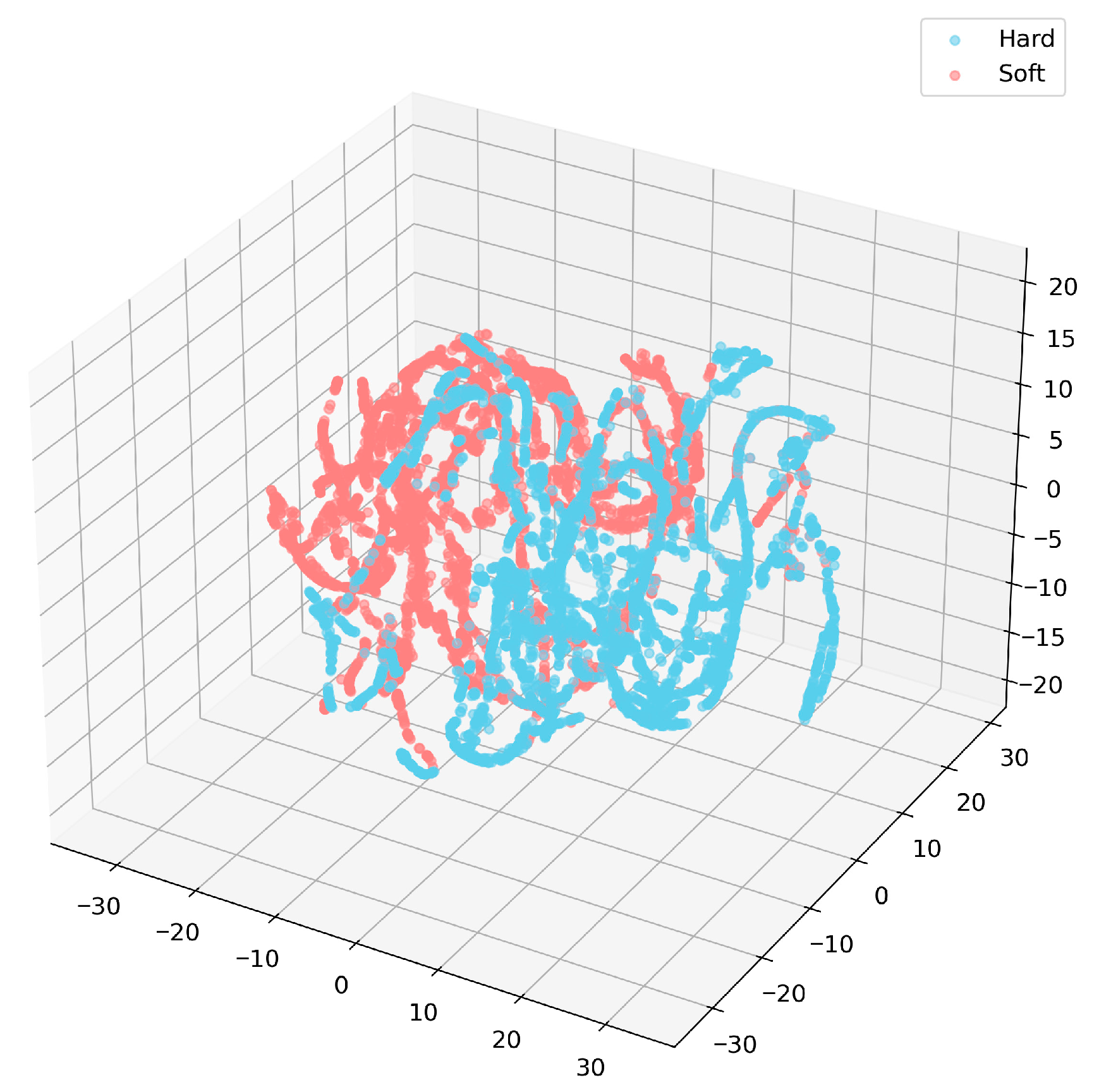
The t-Distributed Stochastic Neighbor Embedding (t-SNE; [
33,
34]) provided compelling evidence of the domain shift phenomenon, with data from the same posture forming distinct clusters based on surface type in the feature space (
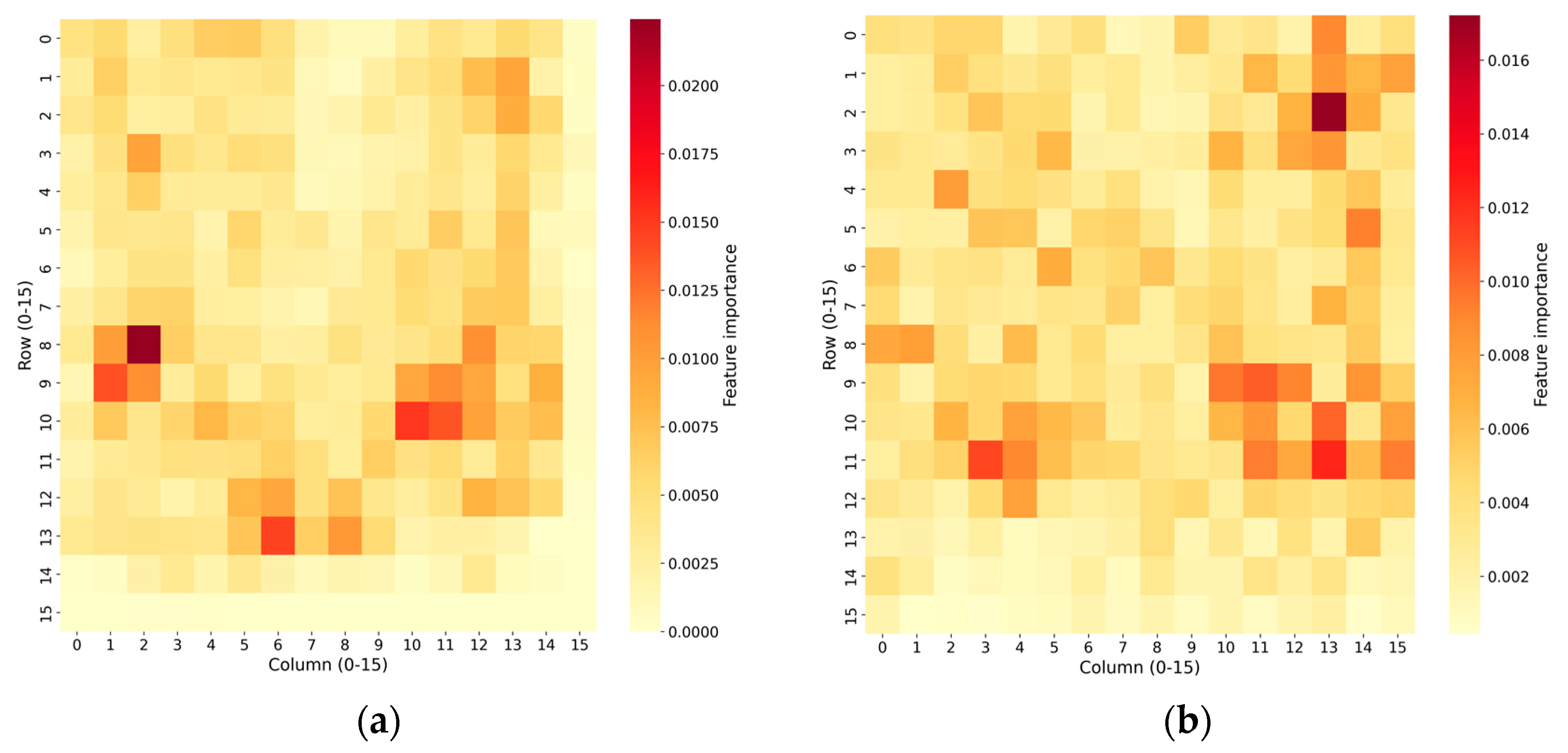
Figure 1). This pronounced separation explains the fundamental challenges in cross-domain generalization, as classifiers trained exclusively on one domain lack effective decision boundaries for effective classification in the other domain. Complementary random forest feature importance analysis [
35,
36] further revealed that classification models primarily relied on high-pressure concentrations in the ischial tuberosity area (
Figure 2), the features that remain well-defined on the hard seat but become dissipated and less discriminative on the soft seat.
The superior cross-domain performance of FNN compared to CNN can be attributed to its reliance on global statistical features rather than localized spatial patterns. While CNN’s spatial inductive bias provides advantages in within-domain classification, it becomes a limitation when key spatial features are not preserved across domains. This explains why FNN maintained slightly better performance (around 40% accuracy) in cross-domain testing compared to CNN (around 35% accuracy).
The mixed training strategy effectively addressed these cross-domain challenges by providing diverse pressure distribution patterns across both seat surfaces. When trained on the combined dataset, CNN’s performance significantly surpassed that of FNN, demonstrating that with sufficient data coverage that encompasses the full spectrum of pressure distribution variation, CNN’s superior feature extraction capability can be fully utilized. The mixed dataset provides rich and diverse local spatial features, ranging from concentrated high-pressure zones characteristic of hard seat to diffuse low-pressure areas typical of soft seat, enabling the CNN architecture to learn more discriminant, spatially hierarchical representations intimately related to the physical properties of different seat surfaces. Although FNN demonstrates slightly better robustness in extreme cross-domain scenarios, its inherent inability to leverage spatial structural information fundamentally limits its maximum achievable classification accuracy when dealing with complex, heterogeneous data environments.
4.5. Misclassification Patterns and Practical Implications
The systematic misclassification between postures sharing similar trunk orientations but differing in rotational components (LLA vs. CLA: 28%; LRA vs. CRA: 31%) highlights a fundamental challenge in pressure-based posture recognition. These errors likely stem from the limited representation of rotational features in seat pressure data alone, suggesting that complementary sensing modalities, e.g., backrest pressure or inertial measurements, may be necessary for robust discrimination of complex postures in practical applications.
The practical application of our measurement system requires careful consideration of the target environment. For well-defined seating conditions with consistent mechanical properties, domain-specific training provides optimal performance. However, for applications involving diverse or unpredictable seating environments, mixed-domain training is essential despite the additional data requirements. The clinical relevance of postures was established through the ergonomic literature, with postures such as contralateral rotations (CLA, CRA) representing particularly high-risk configurations for musculoskeletal disorders due to their association with asymmetric spinal loading.
From a practical implementation perspective, the observed trade-offs between model complexity and generalization capability have important implications for real-world deployment. The CNN architecture emerges as the most balanced choice for applications where training data can encompass the expected variety of seat conditions, offering an optimal combination of parameter efficiency (62.6% reduction compared to FNN), computational performance, and classification accuracy. For resource-constrained environments or applications requiring frequent cross-domain operation, the FNN architecture provides a computationally inexpensive alternative despite its lower peak accuracy. These findings strongly suggest that practical deployment strategies should prioritize comprehensive data diversity over model complexity, ensuring training data adequately represents the target application environments.
4.6. Limitations and Future Directions
This study acknowledges three limitations that should be addressed in future research. First, the homogeneous participant sample restricts the generalizability of our findings. Anthropometric variations, including differences in hip width, mass distribution, and sitting biomechanics across genders and body types, likely influence pressure distribution and posture classification accuracy. Future work should address anthropometric effects on pressure distribution and explore transfer learning approaches to enhance model generalization across diverse populations.
Regarding noise robustness, our current preprocessing pipeline effectively handles common noise types through frame filtering and outlier removal. However, real-world deployment may introduce additional noise sources such as sensor drift, electromagnetic interference, and environmental variations. To address these challenges, we recommend exploring advanced denoising techniques such as the biorthogonal wavelet trees proposed by Mercorelli [
37], which have shown remarkable performance in classifying embedded signal classes under noisy conditions for intelligent sensor applications. These methods could be particularly valuable for long-term monitoring systems where signal quality may degrade over time. Future work will explore integrating wavelet-based denoising frameworks to enhance system robustness without compromising classification accuracy.
Finally, while this study focused on static posture classification, future research will expand to dynamic sitting behavior analysis using time-series pressure data. The biorthogonal wavelet framework [
37] may be particularly suitable for processing such temporal data patterns, enabling more nuanced monitoring of posture transitions and real-world sitting behaviors across diverse seating conditions.