Article

Manganese-Induced Alleviation of Cadmium Stress in Rice Seedlings

1
Department of Agronomy, College of Agriculture and Biotechnology, Zhejiang University, Zijingang Campus, Hangzhou 310029, China
2
Department of Agronomy, Key Laboratory of Crop Resource of Zhejiang Province, Zhejiang University, Hangzhou 310058, China
3
School of Ecology, Hainan University, Haikou 570228, China
*
Author to whom correspondence should be addressed.
Appl. Sci. 2025, 15(23), 12704; https://doi.org/10.3390/app152312704
Submission received: 26 October 2025 / Revised: 27 November 2025 / Accepted: 28 November 2025 / Published: 30 November 2025
(This article belongs to the Section Agricultural Science and Technology)

Abstract

Cadmium (Cd) contamination in agricultural soils poses a significant risk to crop production and food safety. This study explored the role and mechanisms of manganese (Mn) in mitigating Cd toxicity using two rice genotypes: ZS97B (Cd-tolerant) and MY46 (Cd-sensitive). A hydroponic experiment was conducted under two Mn levels (0 and 100 µM) and three Cd levels (0, 5, 10 µM). Exposure to 10 µM Cd significantly inhibited plant growth and induced physiological disorders, with more severe effects observed in MY46 than in ZS97B. The addition of Mn markedly alleviated Cd toxicity, as reflected by increased antioxidant enzyme activities and reduced malondialdehyde (MDA) and hydrogen peroxide (H2O2) contents in both roots and shoots. Gene expression analysis showed that Mn addition up-regulated genes related to antioxidant enzymes and down-regulated key Cd uptake and transport genes, including OsNramp1, OsYSL2, OsMTP9, and OsHMA3. These changes contributed to enhanced antioxidant capacity and reduced Cd accumulation in rice plants under Cd stress. Our findings demonstrate that appropriate Mn application can effectively reduce Cd accumulation and alleviate toxicity in rice grown in Cd-contaminated environments.

1. Introduction

Cadmium (Cd) contamination in arable lands has raised significant global concern due to its detrimental effects on crop production and food safety [1,2,3,4]. Intensive agricultural practices, such as the application of Cd-containing fertilizers, irrigation with contaminated water, and the improper disposal of industrial waste, are major contributors to soil Cd accumulation. Such contamination not only inhibits crop growth and reduces yield but also deteriorates food quality [3,5]. The phytotoxicity of Cd is primarily attributed to its generation of reactive oxygen species (ROS), which can damage essential biomolecules, including proteins, lipids, and DNA, thereby disrupting enzymatic activity and overall plant metabolism [6,7].
On the other hand, manganese (Mn), an essential micro-nutrient for plants, plays a pivotal role in various physiological processes such as photosynthesis, oxidative stress regulation and metal detoxification [8]. A key function of Mn is acting as a cofactor for manganese superoxide dismutase (Mn-SOD), a crucial enzyme responsible for scavenging ROS under stress conditions [9]. Beyond its antioxidative role, Mn mitigates Cd toxicity through antagonistic interactions, inhibiting Cd uptake and accumulation in plant tissues [10]. Studies have shown that supplementation alleviates oxidative damage, promotes growth, and restores nutrient homeostasis in Cd-stressed plants [11,12,13]. This protective effect is also attributed to Mn’s influence on key metabolic pathways, including nutrient uptake, ion homeostasis, and the regulation of metal transporters [14]. Recent studies report that Mn application significantly reduces Cd accumulation in rice roots and shoots, concurrently increasing biomass and chlorophyll content [15]. Similarly, evidence indicates that Mn enhances the activities of major antioxidant enzymes, including catalase (CAT), peroxidase (POD), and superoxide dismutase (SOD), which are vital for ROS scavenging under Cd stress [16].
Although the beneficial role of Mn in mitigating Cd toxicity is well established, the molecular mechanisms by which Mn regulates the expression of Cd-related transporter genes to reduce Cd uptake and accumulation in plants, particularly in rice, remain poorly understood. Recent research has indicated that certain rice cultivars exhibit an enhanced tolerance to heavy metals, which may be attributed to variations in their antioxidant capacity, ion uptake efficiency, and detoxification mechanisms [17,18,19]. Nevertheless, the interaction between Mn and Cd in rice is still not fully elucidated, especially regarding the differential physiological and molecular responses to Mn supplementation under Cd stress.
A number of ion transporter genes involved in Cd and Mn uptake and accumulation in plants have been identified, including heavy metal ATPases (HMAs) and natural resistance-associated macrophage proteins (NRAMPs). For instance, AtHMA2 and AtHMA3 play critical roles in Cd translocation, with double mutants of HMA2 and HMA4 exhibiting an almost complete blockage of Cd transport from roots to shoots. In the hyper-accumulator Thlaspi caerulescens, TcHMA3, localized to the tonoplast, specifically facilitates Cd sequestration into leaf vacuoles, thereby contributing to detoxification. Similarly, in rice, the vacuolar membrane-localized OsHMA3 plays a key role in controlling Cd translocation from roots to shoots [20,21,22]. Yellow Stripe-Like (YSL) proteins, known for transporting metal-chelating compounds, have also been shown to mediate Cd transport in rice when the metal is in a chelated form [23]. These findings underscore the important functions of HMA and YSL transporters in maintaining Cd homeostasis and enhancing tolerance mechanisms across diverse plant species. Moreover, NRAMP transporters have attracted considerable research attention [24]. These highly conserved genes encode membrane proteins that are essential for the uptake and transport of micro-nutrients such as Zn, Fe, and Mn [25]. Notably, NRAMPs are also implicated in Cd uptake and translocation. The knockdown of NRAMP genes has been shown to reduce Cd accumulation in both barley [26] and rice [8]. Despite these advances, little is known about how Mn supplementation under Cd stress regulates the expression dynamics of these transporter genes, their mechanistic link to Cd detoxification, or their differential expression patterns across rice genotypes with varying Cd tolerance.
This study was designed to bridge this knowledge gap by investigating the protective role of manganese (Mn) in mitigating cadmium (Cd) toxicity using two contrasting rice varieties, ZS97B and MY46. We systematically evaluated a suite of physiological and biochemical parameters, including plant growth, chlorophyll content, photosynthetic efficiency, antioxidant enzyme activities, Cd accumulation, and the expression of genes related to antioxidant enzymes and Mn/Cd transporters under different Cd and Mn treatments. Our objectives were to elucidate the physiological functions and molecular mechanisms that underpin the Mn-induced alleviation of Cd phytotoxicity in rice. The findings are expected to provide a theoretical basis for the strategic application of Mn fertilizers in Cd-contaminated paddies.

2. Materials and Methods

2.1. Plant Materials, Cultivation Conditions, and Experimental Treatments

A hydroponic experiment was conducted in a greenhouse at Zijingang Campus, Zhejiang University, China. Two indica rice cultivars (Oryza sativa L.) with contrasting Cd tolerances, ZS97B (Cd-tolerant) and MY46 (Cd-sensitive), were selected based on a previous study [27]. Seeds were surface-sterilized with 2% hydrogen peroxide (H2O2), thoroughly rinsed with deionized water, and subsequently soaked in darkness at 28 °C for three days to promote uniform germination. Thereafter, they were sown in sand-filled plastic boxes and placed in a growth chamber set to a 15 h light/9 h dark photoperiod, with day/night temperatures of 32/24 °C, approximately 80% relative humidity, and a light intensity of 224 ± 25 µmol m−2 s−1. After 15 days, uniform and healthy seedlings were selected and transplanted into 5 L plastic pots containing half-strength nutrient solution. The composition of nutrient solution was as follows: 1.44 mM NH4NO3, 0.3 mM NaH2PO4, 0.5 mM K2SO4, 1.0 mM CaCl2, 1.6 mM MgSO4, 0.17 mM Na2SiO3, 50 µM Fe-EDTA, 0.06 µM (NH4)6Mo7O24, 15 µM H3BO3, 0.12 µM CuSO4, 0.12 µM ZnSO4, 29 µM FeCl3, and 40.5 µM citric acid, (pH 5.5) [28]. Treatments with Mn supplied as MnSO4 and Cd supplied as CdCl2 were initiated 4 days after transplanting and maintained for 14 days. The nutrient solution was renewed every three days to maintain the initial concentrations of Mn and Cd. The experiment was arranged in a randomized block design with multiple factors (genotype, Mn and Cd level). There were three biological replicates for each treatment combination, and three technical replicates were sampled from each biological replicate for measurement and analysis.

2.2. Measurement of Growth Parameters

After 14 days of treatments, seedlings were collected to assess growth parameters. Root and shoot length (RL, SL), root/shoot fresh weight (RFW, SFW), and root and shoot dry weight (RDW, SDW) were measured using standard procedures.

2.3. Determination of Chlorophyll Content and Photosynthetic Efficiency

Chlorophyll content was determined using a chlorophyll meter (Konica Minolta, Tokyo, Japan), presented as the SPAD value. The quantum efficiency of photosystem II (Fv/Fm) was measured using a portable chlorophyll fluorometer (Hansatech Instruments Ltd., King’s Lynn, Norfolk, UK).The intercellular CO2 concentration (Ci), net photosynthetic rate (Pn), transpiration rate (Tr), and stomatal conductance (Gs) were measured using a portable photosynthesis system (LI-6400, LI-COR Biosciences, Lincoln, NE, USA) between 9:00 and 11:00 AM, and measurements were conducted under controlled conditions, relative humidity of 60%, photon flux density of 1000 μmol m−2 s−1, and carbon dioxide (CO2) concentrations of 400 μmol mol−1.

2.4. Elemental Analysis

Roots of the sampled plants were submerged in 20 mM EDTA for 30 min to eliminate metal ions adhered to the surface, then rinsed thoroughly with deionized water. Both roots and shoots were subsequently oven-dried at 70 °C for 72 h to achieve stable weights. For elemental analysis, the dried root and shoot samples were digested with concentrated nitric acid (HNO3) at 140 °C using the protocol from [29], and mineral (e.g., Fe, Zn, Ca, K) and Cd concentrations were quantified using inductively coupled plasma mass spectrometry (ICP-MS, Thermo Scientific, Waltham, MA, USA).

2.5. Chloroplast Ultrastructure Determination

Leaf samples were submerged in 2% paraformaldehyde and 2.5% glutaraldehyde in 0.1 M phosphate buffer (pH 7.2) for 4 h at 4 °C. Post-treatment fixation was carried out in 1% osmium tetroxide for 2 h. Samples were dehydrated through a gradient ethanol concentration and infiltrated with Spurr’s resin. Then ultrathin sections (70 nm) were prepared with an ultramicrotome (Leica, Wetzlar, Germany) and stained with lead citrate and uranyl acetate. The sections were observed using a transmission electron microscope (TEM, Hitachi, Japan)

2.6. Determination of ROS and Malondialdehyde Contents

Hydrogen peroxide (H2O2) content was analyzed following the procedure described by Velikova [30]. About 0.2 g shoot or root samples was intermixed in 0.1% trichloroacetic acid and then centrifuged at 12,000 rpm for 20 min. The obtained 50 μL of supernatant, 100 μL of 1 M KI, and 50 μL of 10 mM potassium phosphate buffer (pH 7) were blended and put in a microplate reader (Synergy H1 Bio-Tec, Agilent Technologies, Santa Clara, CA, USA). H2O2 content was determined at 390 nm wavelength. Malondialdehyde (MDA) content was determined according to Morales and Munné-Bosch [31]. About 100 mg of leaf or root tissue was homogenized with 65 mM potassium phosphate buffer (pH 7.8) and then centrifuged at 12, 000 rpm for 20 min at 4 °C. The reaction solution containing 5% trichloroacetic acid (TCA) and thiobarbituric acid (TBA) was added in the obtained supernatant, incubated at 95 °C for 25 min, then placed on ice to stop the reaction, and centrifuged at 4600 rpm for 12 min. Finally, the absorbance value was read at 600 and 532 nm. Superoxide anion (O2) content was estimated according to the method described by Yasin et al. [32]. Leaf tissue (0.5 g) was homogenized in 65 mM phosphate buffer containing 1% PVP, and then centrifuged for 15 min. The supernatant (1 mL) was mixed with 65 mM phosphate buffer and 10 mM hydroxylamine hydrochloride, followed by incubation at 25 °C for 30 min. Subsequently, 7 mM 1-naphthylamine and 58 mM sulfanilic acid were added, and the mixture was incubated again for 20 min at 25 °C. Absorbance was recorded at 530 nm.

2.7. Analysis of Antioxidant Enzyme Activity

For determining antioxidant enzyme activity, a systematic procedure was employed for extraction of antioxidant enzymes. In detail, fresh root and shoot tissues weighing about 0.2 g were homogenized in 3 mL of ice-cold 1 mol L−1 Tris (pH 7.8) extraction buffer. Then homogenate was centrifuged at 12,000× g for 22 min at 5 °C, and the resulting supernatant was stored at 4 °C for subsequent analyses. Catalase (CAT) activity was determined according to Chance and Maehly (1955) [33]. Superoxide dismutase (SOD) activity was determined using the protocol described by Giannopolitis and Ries (1977) [34]. Peroxidase (POD) activity was determined following the procedure outlined by Polle et al. (1994) [35]. Ascorbate peroxidase (APX) activity was determined according to Nakano and Asada (1981) [36]. All measurements were performed by using commercially available assay kits (Nanjing Jiancheng, Nanjing, China).

2.8. Determination of Expression Levels of Genes Associated with Antioxidative Enzymes and Cd/Mn Transporters

To analyze the expression of the genes related to antioxidative enzymes and Cd/Mn transporters, root samples from various treatments were collected. Total RNA was extracted using a Takara total RNA extraction kit (Dalian, China). cDNA synthesis was carried out via a reverse transcription process, leveraging the advanced Script RT reagent Kit (Dalian, China). Quantitative real-time qRT-PCR was conducted using ChamQ Blue Universal SYBR gPCR Master Mix (Nanjing Vazyme, Nanjing, China) on Light Cycler 480 II (Roche, Basel, Switzerland), with three biological replicates. The relative gene expression of antioxidative enzyme genes (OsSOD, OsPOD, OsAPX, OsCAT) and Cd/Mn transporters was calculated using the 2−ΔΔCT method, with OsActin1 as internal reference genes. The sequences of all primers are shown in Table S1.

2.9. Statistical Analysis

Statistical analysis was performed on a three-factor (genotype, Mn level, Cd level) factorial design with three replicates per treatment. Under controlled conditions, differences among treatments were compared. Experimental error was estimated from the variation among replicates within the same treatment. Data were exposed to analysis of variance (ANOVA) using SPSS software (Version 22.0, IBM, Armonk, NY, USA). Significant differences among treatments were determined using Tukey’s HSD test at p ≤ 0.05.

3. Results

3.1. Plant Height and Dry Weight

Cadmium stress significantly inhibited the growth of both rice genotypes, as evidenced by reductions in root length (RL), shoot length (SL), and biomass, with the Cd-sensitive MY46 exhibiting more severe inhibition than the tolerant ZS97B. For instance, under 5 μM Cd treatment, RL decreased significantly (p ≤ 0.01) by 19% in ZS97B and 40% in MY46 relative to the control (Figure 1A). This inhibitory effect was more pronounced at 10 μM Cd, leading to reductions of 28% and 56%, respectively. The application of 100 μM Mn notably alleviated this Cd-induced growth inhibition. Under the combined treatment of 5 μM Cd and Mn, the reduction in RL was minimized to only 5% in ZS97B and 10% in MY46. Even at 10 μM Cd, the addition of Mn substantially mitigated the effect, limiting the reduction to 34% in ZS97B and 39% in MY46. A similar trend was observed for SL (Figure 1B).
Cadmium exposure significantly (p ≤ 0.01) reduced the fresh and dry weights of roots and shoots (RFW, SFW, RDW, SDW) in a concentration-dependent manner, with a more pronounced effect on the sensitive cultivar MY46. For instance, at 10 µM Cd, RFW decreased by 55% in ZS97B and 67% in MY46 (Figure 1C), while SFW declined by 49% and 59%, respectively (Figure 1D). The addition of 100 µM Mn substantially mitigated this Cd-induced biomass reduction. Under 5 µM Cd stress, the presence of Mn limited the reduction in RFW to only 12% in ZS97B and 29% in MY46, and that in SFW to 6% and 19%, respectively. A similar protective effect of Mn was observed at 10 µM Cd, alleviating biomass loss in both genotypes (Figure 1E,F).

3.2. Chlorophyll Content, Fv/Fm, and Photosynthetic Parameters

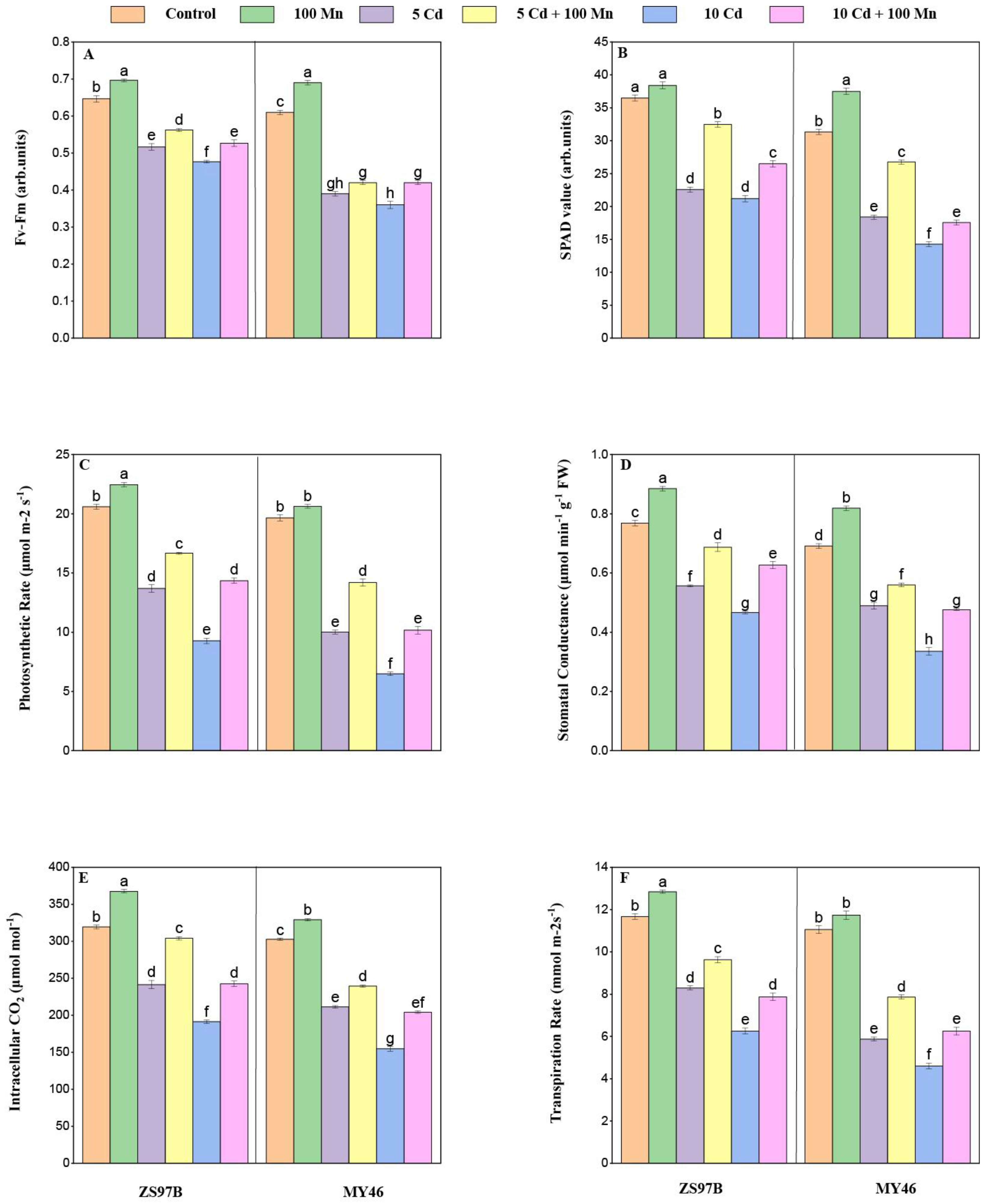
Chlorophyll content, expressed as SPAD values, was significantly (p ≤ 0.01) reduced by Cd stress, with a more pronounced effect observed in MY46. Compared with the control, 10 µM Cd treatment decreased SPAD values by 41% in ZS97B and 54% in MY46. The addition of Mn notably mitigated this decline. Under the 5 µM Cd + Mn treatment, the reduction in SPAD values was limited to only 11% in ZS97B and 14% in MY46 relative to the control (Figure 2A,B).
Similarly, the maximum quantum efficiency of photosystem II (Fv/Fm) was substantially impaired by Cd stress. At 10 µM Cd, Fv/Fm decreased by 26% in ZS97B and 41% in MY46 compared with the control. Mn application alleviated this photo-inhibition, resulting in significantly higher Fv/Fm values. Under Cd stress with Mn supplementation, the reduction in Fv/Fm was lessened to 12% for ZS97B and 31% for MY46, respectively (Figure 2C,D).
Cadmium stress significantly (p ≤ 0.01) inhibited photosynthetic performance in both rice genotypes, as reflected in reductions in the net photosynthetic rate (Pn), transpiration rate (Tr), stomatal conductance (Gs), and intercellular CO2 concentration (Ci). The inhibition was more severe in MY46 than in ZS97B. At 10 µM Cd, Pn decreased by 55% in ZS97B compared with 67% in MY46 (Figure 2C). Concurrently, Tr was reduced by 46% and 58%, Gs by 39% and 51%, and Ci by 40% and 49%, respectively (Figure 2C–F). Notably, the addition of Mn substantially alleviated the Cd-induced suppression across all these photosynthetic parameters (Figure 2).

3.3. Nutrient Element Concentrations

Cadmium stress significantly reduced the tissue concentrations of essential nutrient elements in both rice genotypes, with a more pronounced reduction observed in the Cd-sensitive MY46 than in ZS97B. Under 10 µM Cd treatment, the concentrations of Fe and Zn decreased by 40% and 35%, respectively, in MY46, compared with reductions of 22% and 18% in ZS97B. Similarly, the depletion of Mg and Ca was more severe in MY46, which exhibited declines of 28% and 25%, respectively, versus 15% and 12% in ZS97B. Potassium (K) content was also moderately affected, showing a reduction of 20% in MY46 compared with 10% in ZS97B.
The addition of Mn effectively mitigated the Cd-induced depletion of nutrient elements. In the presence of Cd, Mn supplementation increased Zn and Fe concentrations by 28% and 21%, respectively, in ZS97B, and by 15–18% in MY46. Similarly, the contents of Mg, Ca, and K were also significantly restored by Mn application under Cd stress, with a more pronounced recovery observed in ZS97B than in MY46 (Table 1).

3.4. Cd and Mn Concentrations in Roots and Shoots

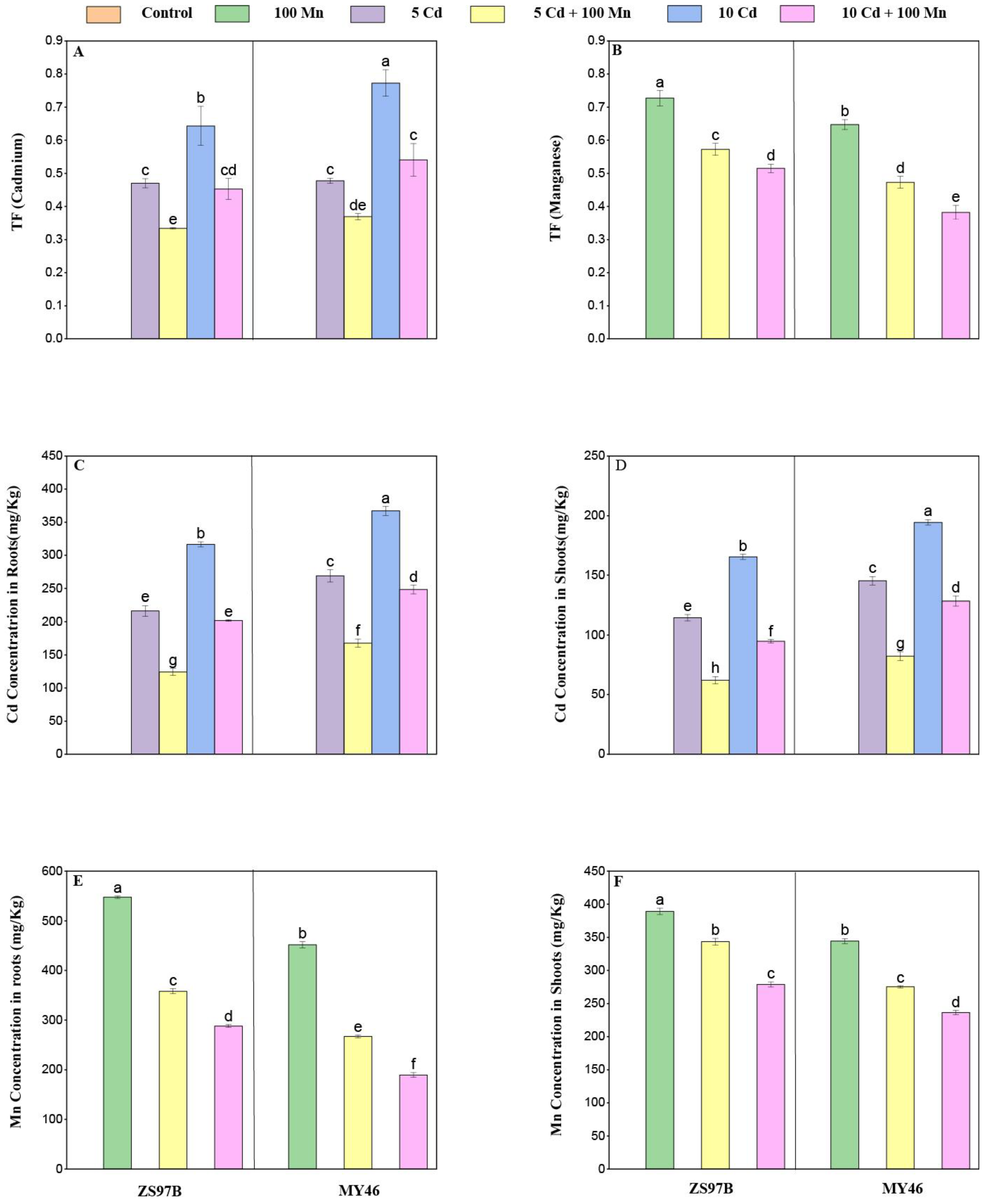
Cadmium treatment significantly increased Cd accumulation in both roots and shoots of the two rice cultivars, with consistently higher concentrations in MY46 than in ZS97B (Figure 3). Under 10 µM Cd, root Cd concentration rose by 4.2-fold in MY46 compared with 3.1-fold in ZS97B, while shoot Cd concentration increased by 3.5-fold and 2.6-fold, respectively (Figure 3A,B). The addition of Mn markedly reduced tissue Cd concentrations, decreasing root and shoot Cd by 52% and 48% in ZS97B, and by 38% and 33% in MY46, respectively (Figure 3C,D).
As expected, Mn supplementation significantly increased root and shoot Mn concentrations. In ZS97B, Mn levels increased by 2.8-fold in roots and 2.2-fold in shoots, while MY46 exhibited increases of 2.4-fold and 1.9-fold, respectively. Notably, Cd treatment had little effect on Mn accumulation in either tissue (Figure 3E,F) (p ≤ 0.01).

3.5. Chloroplast Ultrastructure

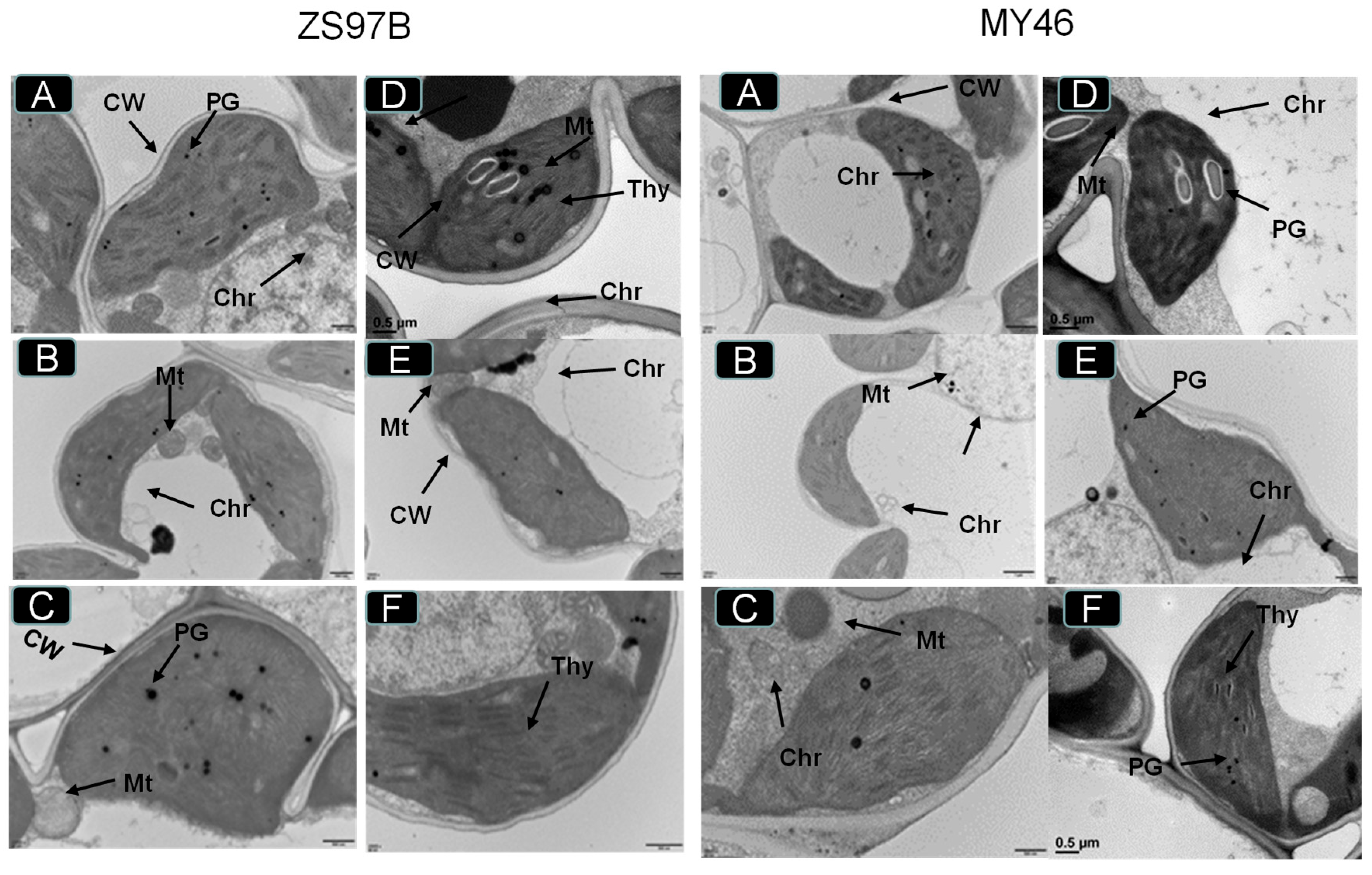
Cadmium stress severely disrupted chloroplast ultrastructure, with more pronounced damage observed in the sensitive cultivar MY46 than in ZS97B (Figure 4A,B). In MY46 under 10 µM Cd, chloroplasts exhibited a loss of integrity, including disorganized thylakoid membranes, the disintegration of grana stacks, the accumulation of plastoglobuli, and an irregular overall morphology. In contrast, ZS97B displayed relatively milder structural alterations, characterized only by moderate chloroplast swelling and limited plastoglobuli formation (Figure 4C,D). The addition of Mn to the Cd-containing solution significantly mitigated these ultrastructural injuries, with the protective effect being more evident in ZS97B (Figure 4E,F).

3.6. MDA and ROS Contents

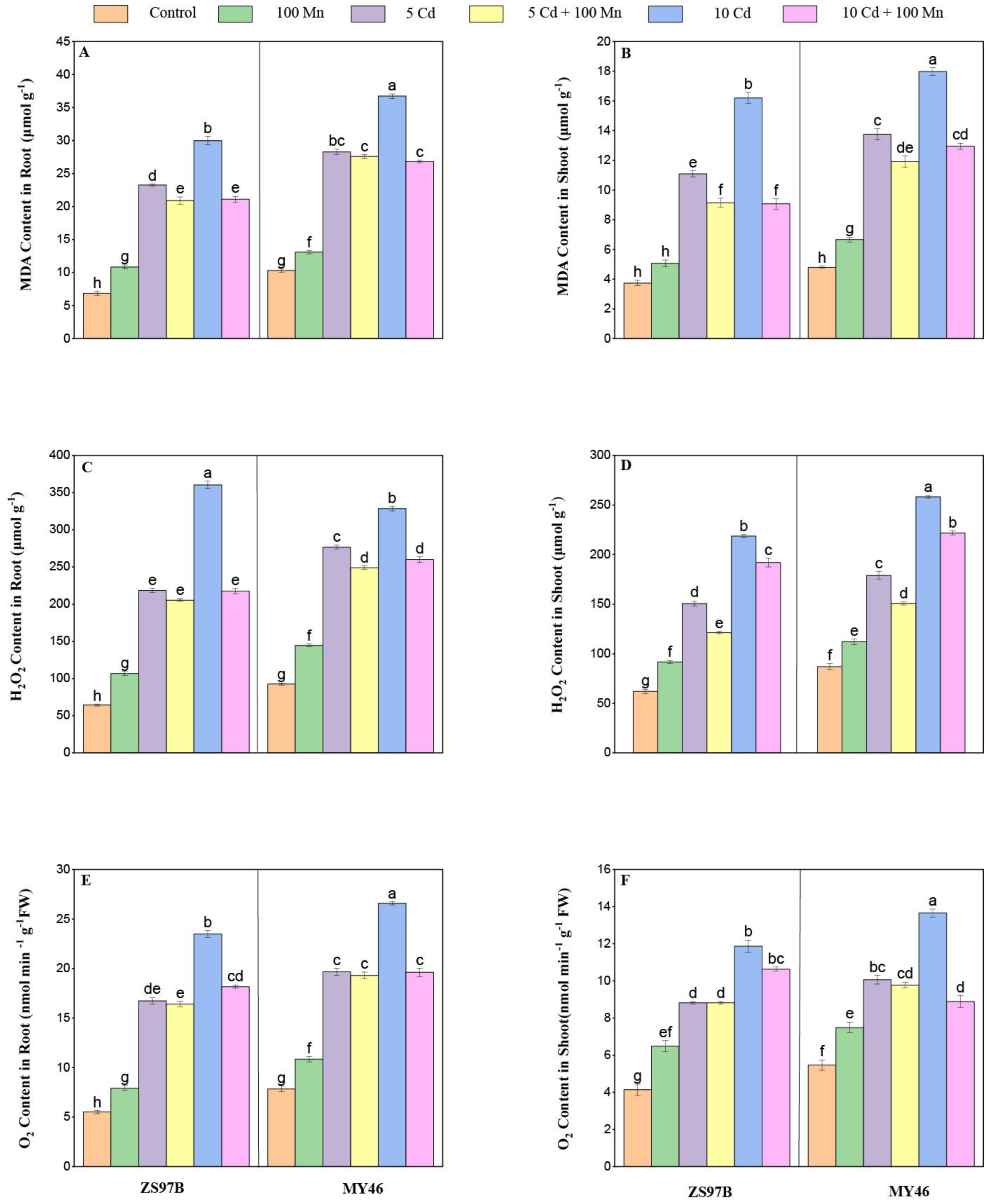
Cadmium stress significantly (p ≤ 0.01) induced oxidative stress in both rice genotypes, as evidenced by increased levels of MDA and ROS (Figure 5). Under 10 µM Cd, root MDA content increased by 338% in ZS97B and 256% in MY46 compared with the control. The addition of Mn effectively mitigated this oxidative damage, reducing the Cd-induced MDA accumulation by 48% in ZS97B and 38% in MY46 (Figure 5A,B). A similar trend was observed for ROS. Cd stress significantly (p ≤ 0.05) elevated root H2O2 content by 460% in ZS97B and 254% in MY46, while Mn addition reduced these levels by 42% and 29%, respectively (Figure 5C). In shoots, the Cd-induced increase in H2O2 (252% in ZS97B and 196% in MY46) was also ameliorated by Mn, which reduced the content by 37% and 21%, respectively (Figure 5D). Furthermore, the superoxide (O2) radical content in roots increased substantially (p ≤ 0.05) under Cd stress by 325% in ZS97B and 238% in MY46. Mn addition significantly reduced O2 accumulation, resulting in decreases of 50% in ZS97B and 37% in MY46 relative to the Cd-stressed plants (Figure 5E,F).

3.7. Antioxidant Enzyme Activity

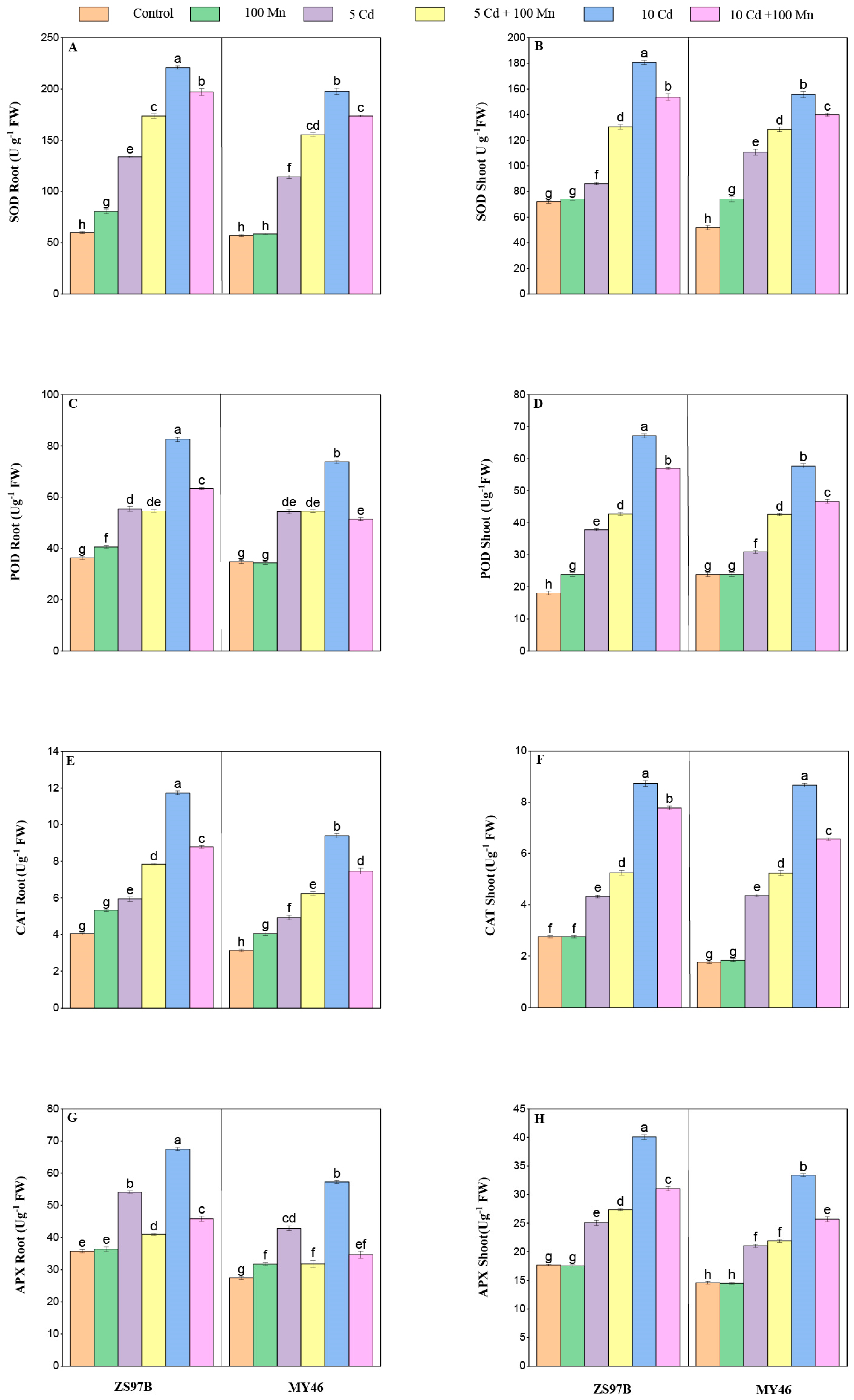
Cadmium exposure significantly (p ≤ 0.01) induced the activities of antioxidant enzymes in both rice genotypes, with generally greater up-regulation in ZS97B than in MY46 (Figure 6). Under Cd stress alone, SOD activity increased by 268% in ZS97B and 246% in MY46 relative to the control. The addition of Mn further enhanced SOD activity, resulting in net increases of 228% and 204% over the levels in Cd-stressed plants, respectively (Figure 6A). A similar pattern was observed for other enzymes. Cd stress increased root POD activity by 216% in ZS97B and 393% in MY46, and Mn addition further elevated it by 182% and 273% above the Cd-only treatment, respectively (Figure 6C). For root CAT activity, Cd stress induced moderate increases of 40% in ZS97B and 28% in MY46, while Mn addition strongly amplified this activity, leading to further rises of 190% and 200%, respectively (Figure 6E). Similarly, APX activity in roots increased by 89% in ZS97B and 108% in MY46 under Cd stress, and was further enhanced by Mn addition, with additional increments of 28% and 26% compared with the Cd-only treatment (Figure 6G). Shoot tissues exhibited response trends to Cd and Mn treatments that were similar to those in roots for all antioxidant enzymes examined (Figure 6B,D,F,H).

3.8. Expression Levels of Genes Related to Cd/Mn Transporters and Antioxidant Enzymes

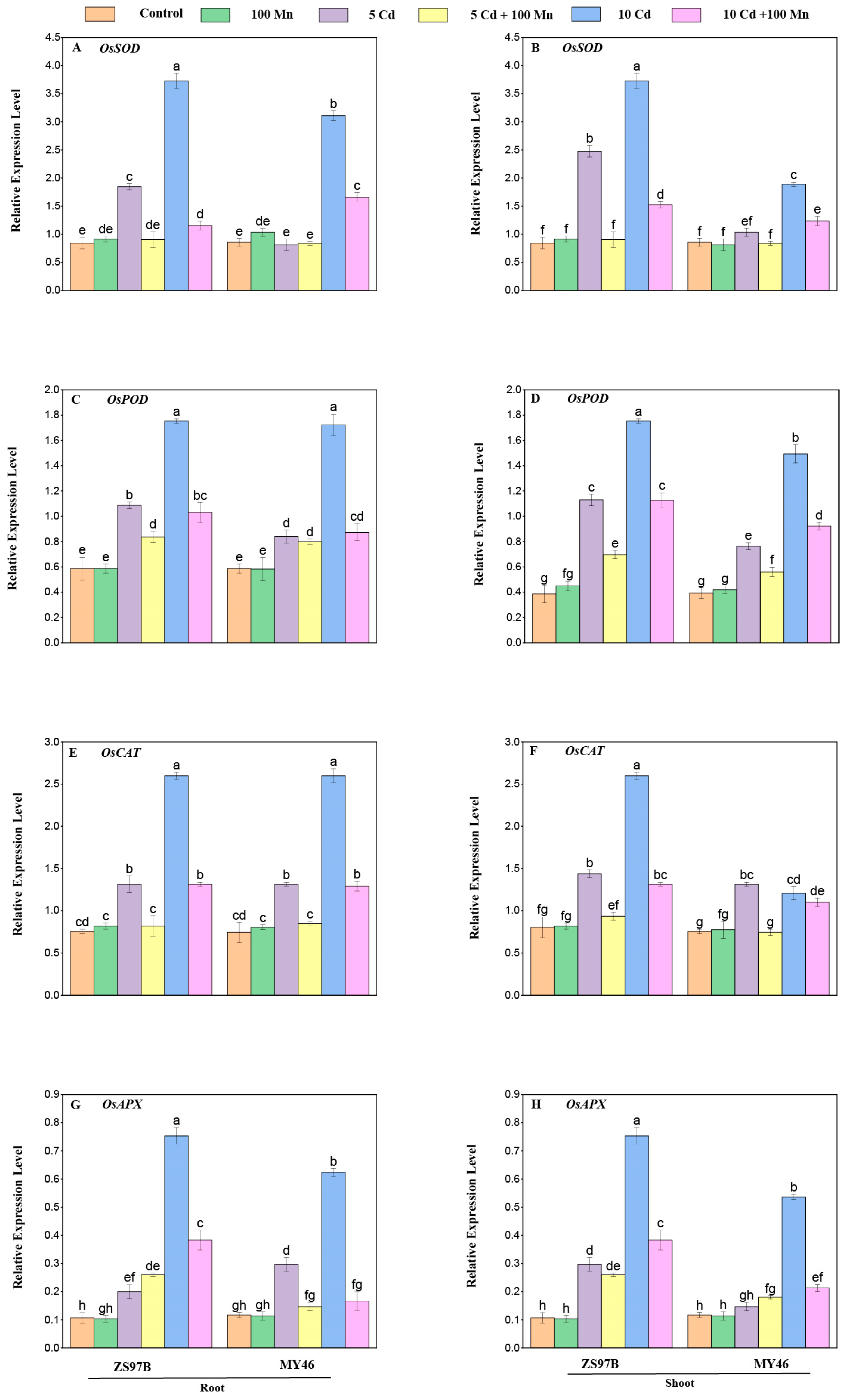
The expression levels of genes associated with antioxidant enzymes and Mn/Cd transporters were significantly altered in both rice genotypes in response to Cd and Mn treatments. In ZS97B, Cd stress markedly up-regulated antioxidant-related genes. Under 10 µM Cd, the expression of OsSOD in roots increased by 3.88-fold relative to the control, while OsPOD and OsCAT were elevated by 1.78-fold and 2.56-fold, respectively. However, the expression of OsAPX showed a different pattern, decreasing to 0.81-fold of the control level (Figure 7).
Mn addition (100 µM) alone induced the moderate up-regulation of some antioxidant enzyme genes. For instance, the expression of OsSOD and OsPOD in roots increased by 0.94-fold and 0.66-fold, respectively, whereas OsCAT and OsAPX remained largely unchanged. Notably, in the combined treatment (10 µM Cd + 100 µM Mn), the expression of these genes was substantially reduced compared with Cd treatment alone. OsSOD was down-regulated by 1.04-fold in roots and 1.54-fold in shoots, while OsPOD expression decreased by 0.96-fold and 1.19-fold in roots and shoots, respectively. Similarly, OsAPX expression declined to 0.33-fold in both tissues (Figure 7A–H).
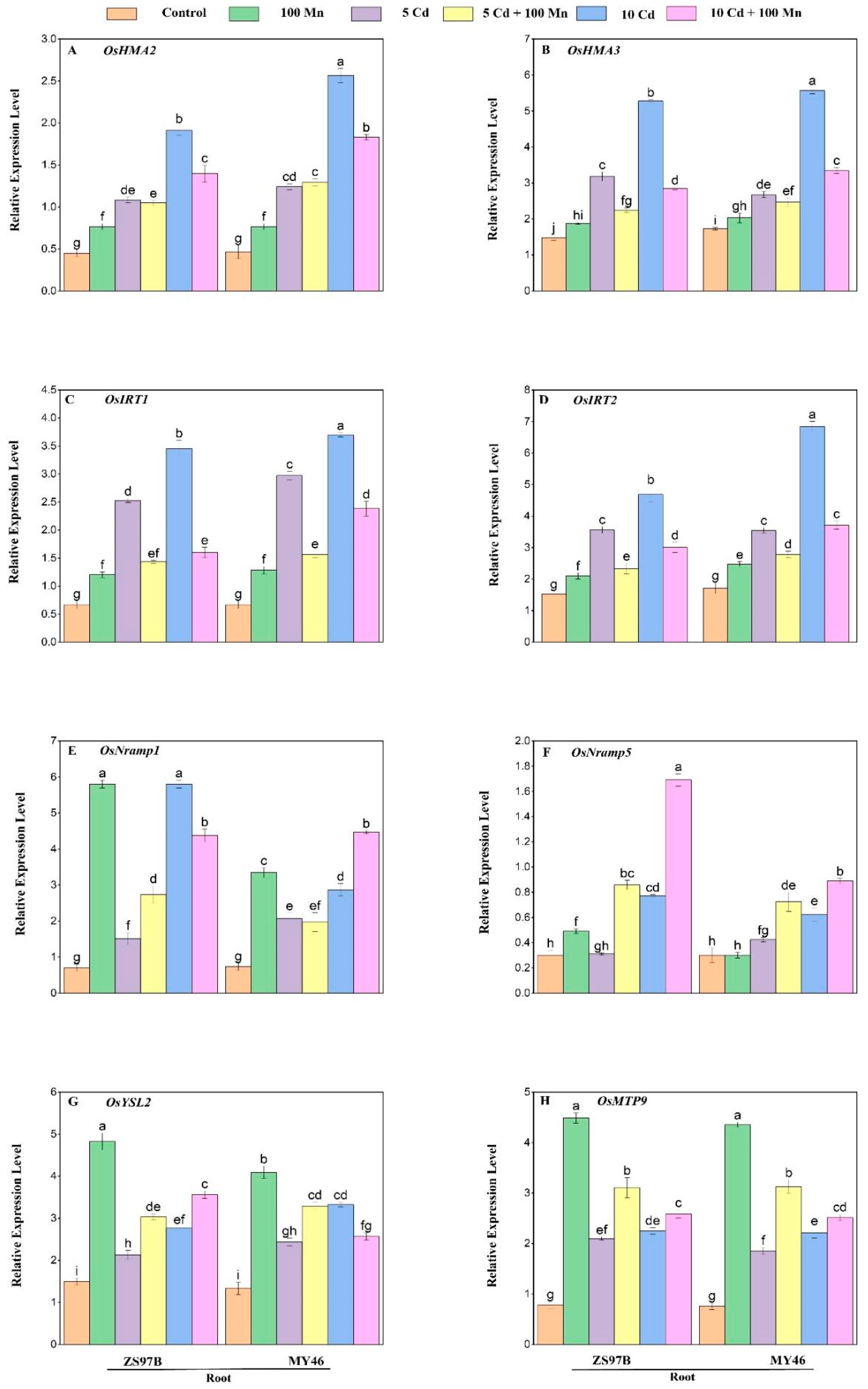
Cadmium stress significantly up-regulated the expression of metal transporter genes in ZS97B. Specifically, transcript levels of OsNramp1 increased from 0.499 (control) to 5.998-fold, OsYSL2 from 1.551 to 2.823-fold, OsMTP9 from 0.628 to 2.364-fold, and OsHMA3 from 0.510 to 3.330-fold relative to the control. However, the addition of Mn to the Cd-containing solution down-regulated the expression of these genes, reducing OsNramp1 to 4.181-fold, OsYSL2 to 3.723-fold, OsMTP9 to 2.743-fold, and OsHMA3 to 1.609-fold of the control level (Figure 8).
A similar expression pattern was observed in MY46. Under 10 µM Cd, the expression of OsSOD in roots increased from 0.75- to 3.26-fold, and OsCAT rose to 2.76-fold. Metal transporter genes were also markedly up-regulated, with OsNramp1, OsYSL2, and OsHMA3 increasing to 3.198-, 3.424-, and 3.590-fold, respectively. Mn addition partially reversed this up-regulation, reducing the expression of OsNramp1 to 4.538-fold, OsYSL2 to 2.724-fold, and OsHMA3 to 2.295-fold relative to the control (Figure 8A–H).

4. Discussion

Cadmium stress significantly inhibited overall plant health, specifically the growth of both rice genotypes, with the sensitive cultivar MY46 exhibiting more severe inhibition than the tolerant ZS97B. This genotypic disparity in growth reduction aligns with their differential Cd tolerance. The observed stunting is consistent with previous reports that Cd disrupts fundamental processes such as cell division and elongation [37,38]. Manganese supplementation effectively ameliorated Cd-induced growth inhibition in rice seedlings, with this protective effect being more pronounced in ZS97B. The mitigation can likely be attributed to the role of Mn in activating key antioxidant enzymes and maintaining cellular ion homeostasis under Cd stress [9,11,39]. The improved seedling growth under combined Mn and Cd exposure further suggests that Mn helps counteract Cd toxicity by sustaining cellular metabolism and structural integrity. Consistent with these findings, Mn supplementation has been shown to reverse the Cd-induced suppression of root and shoot elongation in other plant species [40,41].
Cd stress severely impaired photosynthetic performance, as evidenced by the reduced chlorophyll content, lowered Fv/Fm ratio, and disrupted chloroplast ultrastructure. The more pronounced decline in these parameters in MY46 indicates its heightened susceptibility to Cd-derived photodamage compared with ZS97B. These detrimental effects align with established mechanisms of Cd toxicity, which include the disruption of chlorophyll synthesis, damage to photosystem II, and the structural disorganization of chloroplasts, collectively leading to the severe inhibition of photosynthesis [42,43,44]. Notably, Mn supplementation effectively counteracted these adverse effects, enhancing chlorophyll content, Fv/Fm values, and chloroplast integrity, with a more pronounced improvement observed in ZS97B. These results suggests that Mn plays a vital role in protecting photosynthetic apparatus, potentially by stabilizing chloroplast membranes and optimizing the efficiency of photosynthetic energy transfer. The observed restoration of photosynthetic traits under Cd stress further indicates that Mn supports chlorophyll biosynthesis. This is consistent with previous reports that Mn acts as an essential cofactor for photosystem activity, thereby alleviating the Cd-mediated disruption of chlorophyll structure and stomatal function [24,45,46].
Cd stress significantly suppressed the uptake of essential nutrients, with a more pronounced reduction observed in the sensitive cultivar MY46 compared with ZS97B. This genotype-dependent disparity in the depletion of Fe, Zn, Mg, Ca, and K may be attributed to Cd competition with these cations for shared transporters (as in NRAMP and ZIP families) and its detrimental effect on root membrane integrity. These mechanisms collectively disrupt normal ion uptake and compartmentalization processes [47,48]. Manganese supplementation effectively mitigated this nutrient uptake inhibition, particularly in ZS97B. The alleviation likely stems from Mn’s ability to compete with Cd for absorption sites and to enhance root physiological stability, thereby reducing Cd mobility and improving nutrient acquisition [12,15]. These findings suggest that Mn not only counteracts Cd-induced nutrient depletion but also contributes to genotype-dependent resilience in rice.
Cadmium exposure induced significant oxidative damage, as evidenced by elevated levels of MDA and H2O2, well-established indicators of membrane lipid peroxidation and ROS accumulation. The higher concentrations of these oxidative markers in MY46 indicates that this cultivar is more susceptible to cadmium-triggered oxidative membrane damage than ZS97B. Such excessive ROS accumulation can lead to cellular dysfunction and programmed cell death [49,50,51]. Manganese supplementation effectively reduced both MDA and H2O2 levels, with a more pronounced mitigation observed in ZS97B, highlighting its role in alleviating oxidative stress. This protective effect is likely mediated by enhanced antioxidant capacity, which helps maintain membrane integrity [9,38]. In parallel, Cd exposure up-regulated the activities of key antioxidant enzymes, including APX, CAT, POD, and SOD, in both genotypes. The higher induction of these activities in ZS97B suggests a more robust innate antioxidant capacity. These enzymes are crucial for ROS scavenging and the mitigation of oxidative damage [52,53]. As an essential cofactor for these enzymes, Mn can enhance their catalytic efficiency and help re-establish cellular redox balance [54,55,56]. In this study, Mn application further increased the activities of these enzymes, particularly in ZS97B, indicating a synergistic enhancement of the enzymatic defense system. At the molecular level, Mn supplementation up-regulated the expression of genes encoding key antioxidant enzymes. These results are consistent with previous findings in rice, confirming that Mn improves Cd tolerance, at least in part, through the transcriptional activation of antioxidant defense pathways, thereby facilitating more efficient ROS detoxification [57,58].
Cadmium uptake in plants is primarily mediated by metal transporters, including those of the HMA family [59]. Our findings demonstrate that Mn supplementation effectively reduced Cd accumulation in both roots and shoots of the two rice genotypes. This reduction was associated with the down-regulation of key Cd transporter genes, including OsHMA2, OsHMA3, OsIRT1, and OsIRT2. This observation is consistent with previous reports that Mn can regulate the expression of OsHMA2 and OsHMA3 homologs in rice [60]. Furthermore, we observed that Mn supplementation induced the up-regulation of OsYSL2. Collectively, these gene expression patterns suggest that the relative abundance of Mn and Cd in the rhizosphere plays a critical role in modulating Cd uptake and toxicity, likely through competitive interactions at both the transcriptional and transport levels [61,62,63]. The differential expression of metal transport genes and antioxidant-related genes in Mn-treated plants further indicates that transcriptional re-programming serves as a key mechanism for alleviating Cd stress. These findings align with previous reports demonstrating that Mn influences the expression of genes involved in metal homeostasis and antioxidant defense, ultimately reducing Cd accumulation and oxidative damage [64,65].
Current research indicates that Cd stress in rice can be mitigated by beneficial elements such as selenium (Se), silicon (Si), and Mn. These microelements have been widely reported to alleviate Cd toxicity through multiple mechanisms, including the modulation of antioxidant defense systems, the regulation of metal transporter gene expression, and the enhancement of stress-related protein synthesis [39,40,41,42,43,44,45,46,47,48,49,50,51,52,53,54,55,56,57,58,59,60,61,62,63,64,65,66].
As a major structural component in rice, Si acts as both a physical barrier and a biochemical modulator, limiting Cd uptake and its translocation from roots to shoots. Similarly, Se functions as a key antioxidant by enhancing glutathione metabolism and regulating Cd sequestration processes in root tissues [67,68]. Supplementation with essential nutrients such as Mg, Ca, K, and Zn has also been shown to mitigate Cd toxicity and reduce Cd accumulation. Specifically, Mg and Fe contribute to improved photosynthesis and biomass production, Ca reinforces cell walls and restricts Cd translocation, while K helps maintain osmotic balance and stomatal function [69].
In contrast to these nutrients, manganese appears to confer protection through distinct physiological pathways. Mn ions directly compete with Cd for transport sites, thereby reducing Cd uptake and its translocation to aerial plant parts [63,70]. Moreover, Mn supplementation enhances redox homeostasis and stimulates antioxidant enzyme activities, suggesting a unique mechanism of Cd detoxification. The present study provides evidence for a specific Mn-dependent regulatory network that contributes to Cd tolerance, complementary to, yet distinct from, the protective roles of Si and Se [71].
Manganese application enhanced the up-regulation of OsYSL2, OsIRT1, and OsMTP9, genes involved in Mn uptake, suggesting that Mn inhibits Cd accumulation through competitive interaction at shared transport sites. This antagonistic relationship between Mn and Cd in roots has been documented in several plant species, including rice and wheat [40,72,73]. A key mechanism involves OsNRAMP transporters, which facilitate the uptake of both Mn and Cd due to their similar physiological and chemical properties, allowing Cd to compete with Mn for translocation [74]. Consequently, the relative environmental concentrations of Mn and Cd critically influence Cd uptake and toxicity. In this study, the two genotypes exhibited the differential expression of OsNRAMP genes in response to Mn and Cd treatments, with ZS97B generally showing higher expression than MY46. Notably, the expression patterns among OsNRAMP homologs varied significantly. Under 100 μM Mn exposure, OsNRAMP1 was dramatically up-regulated, whereas OsNRAMP5 exhibited little change. This indicates that OsNRAMP1 may play a more critical role in Mn uptake and transport in rice, potentially contributing to the genotypic differences in Cd tolerance.
The gene expression results further elucidate the observed changes in nutrient uptake in response to cadmium (Cd) and manganese (Mn) treatments. Mn supplementation up-regulated the expression of both OsYSL2 and OsIRT1, transporters directly involved in Mn uptake and homeostasis. Clearly, Mn addition enhanced Mn acquisition while simultaneously restricting Cd uptake, likely due to competitive interactions at shared transport sites, as reported in previous studies [75]. In this study, we found that OsNRAMP expression patterns differed significantly between the two rice genotypes, with ZS97B exhibiting consistently higher expression levels than MY46. This finding aligns with their respective nutrient concentrations under Cd stress. In summary, these results demonstrate that the alleviation of Cd toxicity in rice by Mn addition is mediated through the up-regulation of genes associated with Mn uptake and transport, which in turn leads to the suppression of Cd accumulation.

5. Conclusions

This study provides a comprehensive insight into the role of Mn in mitigating Cd-induced stress in rice. By integrating physiological, biochemical, and transcriptional analyses, we demonstrate that Mn supplementation alleviates Cd-induced oxidative stress and ionic imbalance by modulating the antioxidant defense system and the expression of metal transporter genes. The contrasting responses of the two genotypes, ZS97B and MY46, underscore the genotype-dependent nature of Cd stress tolerance, revealing that variation in Mn acquisition and utilization efficiency plays a pivotal role in shaping differential stress tolerance. Collectively, our findings indicate that Mn not only counteracts Cd toxicity but also fine-tunes the regulation of shared metal transport pathways, thereby improving redox stability and nutrient homeostasis. Beyond its physiological implication, this study highlights the potential of Mn-based nutrient management as a sustainable approach to reduce Cd accumulation in rice grown in contaminated soils.
Future research should focus on elucidating the co-regulatory interplay between Mn and Cd at the proteomic and metabolomic levels, and on identifying key transport proteins that could serve as targets for breeding low-Cd rice varieties with optimized micro-nutrient balance and enhanced food safety. In addition, pot experiments extended to yield formation, as well as field validation trials, are necessary to assess whether the stress tolerance observed at the seedling stage persists throughout the reproductive and grain-filling stages. A particular emphasis should be placed on comparative and combinatorial studies of essential nutrients to clarify their synergistic roles in mitigating Cd toxicity.

Supplementary Materials

The following supporting information can be downloaded at: https://www.mdpi.com/article/10.3390/app152312704/s1. Figure S1: Heatmaps representing the physiological parameters in rice plants under different Mn and Cd treatments; Figure S2: Heatmaps showing gene expression profiles related to antioxidants enzymes in rice plants under various Mn and Cd treatments; Figure S3: Heatmaps displays gene expression profiles of Mn and Cd related transporters in rice plants under individual Mn and Cd treatments; Table S1. The list of primers used in this study.

Author Contributions

Conceptualization, G.Z.; Formal analysis, M.S., Y.Z., Z.C., A.K., Z.W., A.B., T.M.M., and A.A.; Investigation, M.S., Y.Z., Z.C., A.K., Z.W., A.B., T.M.M., and A.A.; Writing—original draft, M.S. and A.B.; Supervision, G.Z.; Funding acquisition, G.Z. All authors have read and agreed to the published version of the manuscript.

Funding

This research project was supported by the Science and Technology Department of Zhejiang Province, under Grant No. 2021C02064-3.

Data Availability Statement

Data will be provided on request.

Conflicts of Interest

The authors declare no conflicts of interest. The funders had no role in the design of the study; in the collection, analyses, or interpretation of data; in the writing of the manuscript, or in the decision to publish the results.

References

  1. Hu:, Y.; Cheng, H.; Tao, S. The Challenges and Solutions for Cadmium-Contaminated Rice in China: A Critical Review. Environ. Int. 2016, 92, 515–532. [Google Scholar] [CrossRef]
  2. Huang, Y.; Mubeen, S.; Yang, Z.; Wang, J. Cadmium Contamination in Agricultural Soils and Crops: Theories and Methods for Minimizing Cadmium Pollution in Crops-Case Studies on Water Spinach; Springer: Berlin/Heidelberg, Germany, 2022; pp. 1–30. [Google Scholar]
  3. Li, Y.; Rahman, S.U.; Qiu, Z.; Shahzad, S.M.; Nawaz, M.F.; Huang, J.; Naveed, S.; Li, L.; Wang, X.; Cheng, H. Toxic Effects of Cadmium on the Physiological and Biochemical Attributes of Plants, and Phytoremediation Strategies: A Review. Environ. Pollut. 2023, 325, 121433. [Google Scholar] [CrossRef]
  4. Hussain, M.; Hafeez, A.; Al-Huqail, A.A.; Alsudays, I.M.; Alghanem, S.M.S.; Ashraf, M.A.; Rasheed, R.; Rizwan, M.; Abeed, A.H. Effect of Hesperidin on Growth, Photosynthesis, Antioxidant Systems and Uptake of Cadmium, Copper, Chromium and Zinc by Celosia argentea Plants. Plant Physiol. Biochem. 2024, 207, 108433. [Google Scholar] [CrossRef]
  5. Kanu, A.S.; Ashraf, U.; Bangura, A.; Yang, D.; Ngaujah, A.S.; Tang, X. Cadmium (Cd) Stress in Rice; Phyto-Availability, Toxic Effects, and Mitigation Measures a Critical Review. IOSR-JESTFT 2017, 11, 7–23. [Google Scholar]
  6. Unsal, V.; Dalkıran, T.; Çiçek, M.; Kölükçü, E. The Role of Natural Antioxidants Against Reactive Oxygen Species Produced by Cadmium Toxicity: A Review. Adv. Pharm. Bull. 2020, 10, 184. [Google Scholar] [CrossRef]
  7. Genchi, G.; Sinicropi, M.S.; Lauria, G.; Carocci, A.; Catalano, A. The Effects of Cadmium Toxicity. Int. J. Environ. Res. Public Health 2020, 17, 3782. [Google Scholar] [CrossRef] [PubMed]
  8. Shahzad, M.; Bibi, A.; Khan, A.; Shahzad, A.; Xu, Z.; Maruza, T.M.; Zhang, G. Utilization of Antagonistic Interactions Between Micronutrients and Cadmium (Cd) to Alleviate Cd Toxicity and Accumulation in Crops. Plants 2025, 14, 707. [Google Scholar] [CrossRef] [PubMed]
  9. Chandra, S.; Roychoudhury, A. Role of Selenium and Manganese in Mitigating Oxidative Damages. In Protective Chemical Agents in the Amelioration of Plant Abiotic Stress: Biochemical and Molecular Perspectives; John Wiley & Sons, Ltd.: Bognor Regis, UK, 2020; pp. 597–621. [Google Scholar]
  10. Huang, Q.N.; An, H.; Yang, Y.J.; Liang, Y.; Shao, G.S. Effects of Mn-Cd Antagonistic Interaction on Cd Accumulation and Major Agronomic Traits in Rice Genotypes by Different Mn Forms. Plant Growth Regul. 2017, 82, 317–331. [Google Scholar] [CrossRef]
  11. Oliveira, B.R.M.; de Almeida, A.A.F.; Pirovani, C.P.; Barroso, J.P.; de C. Neto, C.H.; Santos, N.A.; Mangabeira, P.A.O. Mitigation of Cd Toxicity by Mn in Young Plants of Cacao, Evaluated by the Proteomic Profiles of Leaves and Roots. Ecotoxicology 2020, 29, 340–358. [Google Scholar] [CrossRef] [PubMed]
  12. Shahzad, M.; Peng, D.; Khan, A.; Ayyaz, A.; Askri, S.M.H.; Naz, S.; Huang, B.; Zhang, G. Sufficient Manganese Supply is Necessary for OsNramp5 Knockout Rice Plants to Ensure Normal Growth and Less Cd Uptake. Ecotoxicol. Environ. Saf. 2024, 288, 117386. [Google Scholar] [CrossRef]
  13. Sebastian, A.; Prasad, M. Iron- and Manganese-Assisted Cadmium Tolerance in Oryza sativa L.: Lowering of Rhizotoxicity Next to Functional Photosynthesis. Planta 2015, 241, 1519–1528. [Google Scholar] [CrossRef]
  14. Rai, S.; Singh, P.K.; Mankotia, S.; Swain, J.; Satbhai, S.B. Iron Homeostasis in Plants and its Crosstalk with Copper, Zinc, and Manganese. Plant Stress 2021, 1, 100008. [Google Scholar] [CrossRef]
  15. Hussain, B.; Li, J.; Ma, Y.; Tahir, N.; Ullah, A. Effects of Fe and Mn Cations on Cd Uptake by Rice Plant in Hydroponic Culture Experiment. PLoS ONE 2020, 15, e0243174. [Google Scholar] [CrossRef] [PubMed]
  16. Xiao, Z.; Pan, G.; Li, X.; Kuang, X.; Wang, W.; Liu, W. Effects of Exogenous Manganese on its Plant Growth, Subcellular Distribution, Chemical Forms, Physiological and Biochemical Traits in Cleome viscosa L. Ecotoxicol. Environ. Saf. 2020, 198, 110696. [Google Scholar] [CrossRef]
  17. Barman, F.; Majumdar, S.; Arzoo, S.H.; Kundu, R. Genotypic Variation Among 20 Rice Cultivars/Landraces in Response to Cadmium Stress Grown Locally in West Bengal, India. Plant Physiol. Biochem. 2020, 148, 193–206. [Google Scholar] [CrossRef] [PubMed]
  18. Li, D.; Wang, L.; Wang, Y.; Li, H.; Chen, G. Soil Properties and Cultivars Determine Heavy Metal Accumulation in Rice Grain and Cultivars Respond Differently to Cd Stress. Environ. Sci. Pollut Res. 2019, 26, 14638–14648. [Google Scholar] [CrossRef]
  19. Huang, G.; Ding, C.; Guo, N.; Ding, M.; Zhang, H.; Kamran, M.; Zhou, Z.; Zhang, T.; Wang, X. Polymer-Coated Manganese Fertilizer and its Combination with Lime Reduces Cadmium Accumulation in Brown Rice (Oryza sativa L.). J. Hazard. Mater. 2021, 415, 125597. [Google Scholar] [CrossRef] [PubMed]
  20. Wong, C.K.E.; Cobbett, C.S. HMA P-type ATPases are the Major Mechanism for Root-to-Shoot Cd Translocation in Arabidopsis thaliana. New Phytol. 2009, 181, 71–78. [Google Scholar] [CrossRef]
  21. Miyadate, H.; Adachi, S.; Hiraizumi, A.; Tezuka, K.; Nakazawa, N.; Kawamoto, T.; Katou, K.; Kodama, I.; Sakurai, K.; Takahashi, H. OsHMA3, a P1B-type of ATPase Affects Root-to-Shoot Cadmium Translocation in Rice by Mediating Efflux into Vacuoles. New Phytol. 2011, 189, 190–199. [Google Scholar] [CrossRef]
  22. Ueno, D.; Milner, M.J.; Yamaji, N.; Yokosho, K.; Koyama, E.; Clemencia Zambrano, M.; Kaskie, M.; Ebbs, S.; Kochian, L.V.; Ma, J.F. Elevated Expression of TcHMA3 Plays a Key Role in the Extreme Cd Tolerance in a Cd-Hyperaccumulating Ecotype of Thlaspi caerulescens. Plant J. 2011, 66, 852–862. [Google Scholar] [CrossRef]
  23. Koike, S.; Inoue, H.; Mizuno, D.; Takahashi, M.; Nakanishi, H.; Mori, S.; Nishizawa, N.K. OsYSL2 is a Rice Metal-Nicotianamine Transporter that is Regulated by Iron and Expressed in the Phloem. Plant J. 2004, 39, 415–424. [Google Scholar] [CrossRef]
  24. Kanwal, F.; Riaz, A.; Ali, S.; Zhang, G. NRAMPs and Manganese: Magic Keys to Reduce Cadmium Toxicity and Accumulation in Plants. Sci. Total Environ. 2024, 921, 171005. [Google Scholar] [CrossRef]
  25. Segond, D.; Dellagi, A.; Lanquar, V.; Rigault, M.; Patrit, O.; Thomine, S.; Expert, D. NRAMP Genes Function in Arabidopsis thaliana Resistance to Erwinia chrysanthemi Infection. Plant J. 2009, 58, 195–207. [Google Scholar] [CrossRef]
  26. Wu, D.; Yamaji, N.; Yamane, M.; Kashino-Fujii, M.; Sato, K.; Feng Ma, J. The HvNramp5 Transporter Mediates Uptake of Cadmium and Manganese, but not Iron. Plant Physiol. 2016, 172, 1899–1910. [Google Scholar] [CrossRef] [PubMed]
  27. Huang, F.; Wei, X.; He, J.; Sheng, Z.; Shao, G.; Wang, J.; Tang, S.; Xia, S.; Xiao, Y.; Hu, P. Mapping of Quantitative Trait Loci Associated with Concentrations of Five Trace Metal Elements in Rice (Oryza sativa). Int. J. Agric. Biol. 2018, 20, 554–560. [Google Scholar] [CrossRef]
  28. Yoshida, S.; Forno, D.A.; Cock, J.H. Laboratory Manual for Physiological Studies of Rice, 2nd ed.; The International Rice Research Institute: Manila, Philippines, 1972; pp. 57–63. [Google Scholar]
  29. Lwalaba, J.L.W.; Louis, L.T.; Zvobgo, G.; Fu, L.; Mwamba, T.M.; Mundende, R.P.M.; Zhang, G. Copper Alleviates Cobalt Toxicity in Barley by Antagonistic Interaction of the Two Metals. Environ. Sci. Pollut. Res. 2019, 26, 180–241. [Google Scholar] [CrossRef] [PubMed]
  30. Velikova, V.; Yordanov, I.; Edreva, A. Oxidative Stress and Some Antioxidant Systems in Acid Rain-Treated Bean Plants: Protective Role of Exogenous Polyamines. Plant Sci. 2000, 151, 59–66. [Google Scholar] [CrossRef]
  31. Morales, M.; Munné-Bosch, S. Malondialdehyde: Facts and Artifacts. Plant Physiol. 2019, 180, 1246–1250. [Google Scholar] [CrossRef]
  32. Yasin, M.U.; Hannan, F.; Munir, R.; Muhammad, S.; Iqbal, M.; Yasin, I.; Khan, M.S.S.; Kanwal, F.; Chunyan, Y.; Fan, X. Interactive Mode of Biochar-Based Silicon and Iron Nanoparticles Mitigated Cd-Toxicity in Maize. Sci. Total Environ. 2024, 912, 169288. [Google Scholar] [CrossRef]
  33. Britton, C.; Maehly, A.C. Assay of catalases and peroxidases. Methods Biochem. Anal. 1955, 10, 764–775. [Google Scholar]
  34. Giannopolitis, C.N.; Ries, S.K. Superoxide dismutases: I. Occurrence in higher plants. Plant Physiol. 1977, 59, 309–314. [Google Scholar] [CrossRef]
  35. Polle, A.; Otter, T.; Seifert, F. Apoplastic peroxidases and lignification in needles of Norway spruce (Picea abies L.). Plant Physiol. 1994, 106, 53. [Google Scholar] [CrossRef]
  36. Nakano, Y.; Asada, K. Hydrogen peroxide is scavenged by ascorbate-specific peroxidase in spinach chloroplasts. Plant Cell Physiol. 1981, 22, 867–880. [Google Scholar] [CrossRef]
  37. Ashraf, H.; Ghouri, F.; Ali, S.; Bukhari, S.A.H.; Haider, F.U.; Zhong, M.; Xia, W.; Fu, X.; Shahid, M.Q. The Protective Roles of Oryza glumaepatula and Phytohormone in Enhancing Rice Tolerance to Cadmium Stress by Regulating Gene Expression, Morphological, Physiological, and Antioxidant Defense System. Environ. Pollut. 2025, 364, 125311. [Google Scholar] [CrossRef] [PubMed]
  38. Jiang, Y.; Zhou, P.; Ma, T.; Adeel, M.; Shakoor, N.; Li, Y.; Li, M.; Guo, M.; Rui, Y. Effects of Two Mn-Based Nanomaterials on Soybean Antioxidant System and Mineral Element Homeostasis. Environ. Sci. Pollut. Res. 2023, 30, 18880–18889. [Google Scholar] [CrossRef]
  39. Sun, Y.; Li, X.; Najeeb, U.; Hou, Z.; Buttar, N.A.; Yang, Z.; Ali, B.; Xu, L. Soil Applied Silicon and Manganese Combined with Foliar Application of 5-Aminolevulinic Acid Mediate Photosynthetic Recovery in Cd-Stressed Salvia miltiorrhiza by Regulating Cd-Transporter Genes. Front. Plant Sci. 2022, 13, 1011872. [Google Scholar] [CrossRef]
  40. Huang, G.; Ding, X.; Liu, Y.; Ding, M.; Wang, P.; Zhang, H.; Wang, X. Liming and Tillering Application of Manganese Alleviates Iron Manganese Plaque Reduction and Cadmium Accumulation in Rice (Oryza sativa L.). J. Hazard. Mater. 2022, 427, 127897. [Google Scholar] [CrossRef] [PubMed]
  41. Li, H.; Zheng, X.; Tao, L.; Yang, Y.; Gao, L.; Xiong, J. Aeration Increases Cadmium (Cd) Retention by Enhancing Iron Plaque Formation and Regulating Pectin Synthesis in the Roots of Rice (Oryza sativa) Seedlings. Rice 2019, 12, 28. [Google Scholar] [CrossRef]
  42. Goncharuk, E.A.; Zagoskina, N.V. Heavy Metals, Their Phytotoxicity, and the Role of Phenolic Antioxidants in Plant Stress Responses with Focus on Cadmium. Molecules 2023, 28, 3921. [Google Scholar] [CrossRef]
  43. Giannakoula, A.; Therios, I.; Chatzissavvidis, C. Effect of Lead and Copper on Photosynthetic Apparatus in Citrus (Citrus aurantium L.) Plants. The Role of Antioxidants in Oxidative Damage as a Response to Heavy Metal Stress. Plants 2021, 10, 155. [Google Scholar] [CrossRef]
  44. Faizan, M.; Bhat, J.A.; Hessini, K.; Yu, F.; Ahmad, P. Zinc Oxide Nanoparticles Alleviates the Adverse Effects of Cadmium Stress on Oryza sativa via Modulation of the Photosynthesis and Antioxidant Defense System. Ecotoxicol. Environ. Saf. 2021, 220, 112401. [Google Scholar] [CrossRef]
  45. Pooja Parmar, P.P.; Nilima Kumari, N.K.; Vinay Sharma, V.S. Structural and Functional Alterations in Photosynthetic Apparatus of Plants Under Cadmium Stress. Bot. Stud. 2013, 54, 45. [Google Scholar] [CrossRef] [PubMed]
  46. Barroso, J.P.; de Almeida, A.-A.F.; do Nascimento, J.L.; Oliveira, B.R.M.; Dos Santos, I.C.; Mangabeira, P.A.O.; Ahnert, D.; Baligar, V.C. The Damage Caused by Cd Toxicity to Photosynthesis, Cellular Ultrastructure, Antioxidant Metabolism, and Gene Expression in Young Cacao Plants are Mitigated by High Mn Doses in Soil. Environ. Sci. Pollut. Res. 2023, 30, 115646–115665. [Google Scholar] [CrossRef] [PubMed]
  47. Zhang, Y.; Jiang, S.; Wang, H.; Yu, L.; Li, C.; Ding, L.; Shao, G. Interactions of Fe, Mn, Zn, and Cd in Soil–Rice Systems: Implications for Reducing Cd Accumulation in Rice. Toxics 2025, 13, 633. [Google Scholar] [CrossRef]
  48. Rizwan, M.; Ali, S.; Adrees, M.; Rizvi, H.; Zia-ur-Rehman, M.; Hannan, F.; Ok, Y.S. Cadmium Stress in Rice: Toxic Effects, Tolerance Mechanisms, and Management: A Critical Review. Environ. Sci. Pollut. Res. 2016, 23, 17859–17879. [Google Scholar] [CrossRef]
  49. Petrov, V.; Hille, J.; Mueller-Roeber, B.; Gechev, T.S. ROS-Mediated Abiotic Stress-Induced Programmed Cell Death in Plants. Front. Plant Sci. 2015, 6, 69. [Google Scholar] [CrossRef]
  50. Chen, L.; Xu, B.; Liu, L.; Luo, Y.; Zhou, H.; Chen, W.; Shen, T.; Han, X.; Kontos, C.D.; Huang, S. Cadmium Induction of Reactive Oxygen Species Activates the mTOR Pathway, Leading to Neuronal Cell Death. Free Radic. Biol. Med. 2011, 50, 624–632. [Google Scholar] [CrossRef]
  51. Bi, Y.; Chen, W.; Zhang, W.; Zhou, Q.; Yun, L.; Xing, D. Production of Reactive Oxygen Species, Impairment of Photosynthetic Function and Dynamic Changes in Mitochondria are Early Events in Cadmium-Induced Cell Death in Arabidopsis thaliana. Biol. Cell 2009, 101, 629–643. [Google Scholar] [CrossRef]
  52. Bratovcic, A. Antioxidant Enzymes and their Role in Preventing Cell Damage. Acta Sci. Nutr. Health 2020, 4, 01–07. [Google Scholar] [CrossRef]
  53. Sharma, P.; Jha, A.B.; Dubey, R.S.; Pessarakli, M. Reactive Oxygen Species, Oxidative Damage, and Antioxidative Defense Mechanism in Plants Under Stressful Conditions. J. Bot. 2012, 2012, 217037. [Google Scholar] [CrossRef]
  54. Iranzo, O. Manganese Complexes Displaying Superoxide Dismutase Activity: A Balance Between Different Factors. Bioorg. Chem. 2011, 39, 73–87. [Google Scholar] [CrossRef]
  55. Imlay, J.A. The Mismetallation of Enzymes During Oxidative Stress. J. Biol. Chem. 2014, 289, 28121–28128. [Google Scholar] [CrossRef]
  56. Srivastava, S.; Dubey, R. Manganese-Excess Induces Oxidative Stress, Lowers the Pool of Antioxidants and Elevates Activities of Key Antioxidative Enzymes in Rice Seedlings. Plant Growth Regul. 2011, 64, 1–16. [Google Scholar] [CrossRef]
  57. Rajpoot, R.; Srivastava, R.K.; Rani, A.; Pandey, P.; Dubey, R. Manganese-Induced Oxidative Stress, Ultrastructural Changes, and Proteomics Studies in Rice Plants. Protoplasma 2021, 258, 319–335. [Google Scholar] [CrossRef] [PubMed]
  58. Huang, X.; Duan, S.; Wu, Q.; Yu, M.; Shabala, S. Reducing Cadmium Accumulation in Plants: Structure–Function Relations and Tissue-Specific Operation of Transporters in the Spotlight. Plants 2020, 9, 223. [Google Scholar] [CrossRef]
  59. Wang, M.; Wang, L.; Zhao, S.; Li, S.; Lei, X.; Qin, L.; Sun, X.; Chen, S. Manganese Facilitates Cadmium Stabilization Through Physicochemical Dynamics and Amino Acid Accumulation in Rice Rhizosphere Under Flood-Associated Low pe+pH. J. Hazard. Mater. 2021, 416, 126079. [Google Scholar] [CrossRef] [PubMed]
  60. Chen, H.; Zhang, C.; Guo, H.; Hu, Y.; He, Y.; Jiang, D. Overexpression of a Miscanthus sacchariflorus Yellow Stripe-Like Transporter MsYSL1 Enhances Resistance of Arabidopsis to Cadmium by Mediating Metal Ion Reallocation. Plant Growth Regul. 2018, 85, 101–111. [Google Scholar] [CrossRef]
  61. Dhir, B. Role of Transporters of Copper, Manganese, Zinc, and Nickel in Plants Exposed to Heavy Metal Stress. In Metal and Nutrient Transporters in Abiotic Stress; Elsevier: Amsterdam, The Netherlands, 2021; pp. 145–168. [Google Scholar]
  62. Chen, X.; Yang, S.; Ma, J.; Huang, Y.; Wang, Y.; Zeng, J.; Li, J.; Li, S.; Long, D.; Xiao, X. Manganese and Copper Additions Differently Reduced Cadmium Uptake and Accumulation in Dwarf Polish Wheat (Triticum polonicum L.). J. Hazard. Mater. 2023, 448, 130998. [Google Scholar] [CrossRef]
  63. Hu, R.; Limmer, M.A.; Seyfferth, A.L. How Manganese Affects Rice Cadmium Uptake and Translocation in Vegetative and Mature Plants. Plant Soil 2024, 504, 941–954. [Google Scholar] [CrossRef]
  64. Chang, J.D.; Huang, S.; Konishi, N.; Wang, P.; Chen, J.; Huang, X.Y.; Zhao, F.J. Overexpression of the Manganese/Cadmium Transporter OsNRAMP5 Reduces Cadmium Accumulation in Rice Grain. J. Exp. Bot. 2020, 71, 5705–5715. [Google Scholar] [CrossRef]
  65. Jia, S.; Guan, Q.; Niu, Y.; Wang, Y.; Li, L.; Cheng, H. Progress in Elucidating the Mechanism of Selenium in Mitigating Heavy Metal Stress in Crop Plants. Agriculture 2025, 15, 204. [Google Scholar] [CrossRef]
  66. Haider, Z.; Ahmad, I.; Zia, S.; Gan, Y. Recent Developments in Rice Molecular Breeding for Tolerance to Heavy Metal Toxicity. Agriculture 2023, 13, 944. [Google Scholar] [CrossRef]
  67. Biswas, A.; Pal, S.; Paul, S. Silicon as a Powerful Element for Mitigation of Cadmium Stress in Rice: A Review for Global Food Safety. Plant Stress 2023, 10, 100237. [Google Scholar] [CrossRef]
  68. Yuan, Z.; Cai, S.; Yan, C.; Rao, S.; Cheng, S.; Xu, F.; Liu, X. Research Progress on the Physiological Mechanism by which Selenium Alleviates Heavy Metal Stress in Plants: A Review. Agronomy 2024, 14, 1787. [Google Scholar] [CrossRef]
  69. Khaliq, M.A.; James, B.; Chen, Y.H.; Saqib, H.S.A.; Li, H.H.; Jayasuriya, P.; Guo, W. Uptake, translocation, and accumulation of Cd and its interaction with mineral nutrients (Fe, Zn, Ni, Ca, Mg) in upland rice. Chemosphere 2019, 215, 916–924. [Google Scholar] [CrossRef]
  70. Zhu, Y.X.; Zhuang, Y.; Sun, X.H.; Du, S.T. Interactions Between Cadmium and Nutrients and Their Implications for Safe Crop Production in Cd-Contaminated Soils. Crit. Rev. Environ. Sci. Technol. 2023, 53, 2071–2091. [Google Scholar] [CrossRef]
  71. Rahman, A.; Nahar, K.; Hasanuzzaman, M.; Fujita, M. Manganese-Induced Cadmium Stress Tolerance in Rice Seedlings: Coordinated Action of Antioxidant Defense, Glyoxalase System and Nutrient Homeostasis. Comptes Rendus Biol. 2016, 339, 462–474. [Google Scholar] [CrossRef] [PubMed]
  72. Yu, E.; Yamaji, N.; Mao, C.; Wang, H.; Ma, J.F. Lateral Roots but not Root Hairs Contribute to High Uptake of Manganese and Cadmium in Rice. J. Exp. Bot. 2021, 72, 7219–7228. [Google Scholar] [CrossRef] [PubMed]
  73. Huang, Q.; Wang, Y.; Qin, X.; Zhao, L.; Liang, X.; Sun, Y.; Xu, Y. Soil Application of Manganese Sulfate Effectively Reduces Cd Bioavailability in Cd-Contaminated Soil and Cd Translocation and Accumulation in Wheat. Sci. Total Environ. 2022, 814, 152765. [Google Scholar] [CrossRef]
  74. Alejandro, S.; Höller, S.; Meier, B.; Peiter, E. Manganese in Plants: From Acquisition to Subcellular Allocation. Front. Plant Sci. 2020, 11, 300. [Google Scholar] [CrossRef]
  75. Huang, Q.; An, H.; Chen, J.; Li, X.; Shao, G. Phosphorus Application Interferes Expression of Fe Uptake-Associated Genes to Feedback Regulate Cd Accumulation in Rice (Oryza sativa L.) and Relieves Cd Toxicity via Antioxidant Defense. Plant Growth Regul. 2024, 102, 199–212. [Google Scholar] [CrossRef]
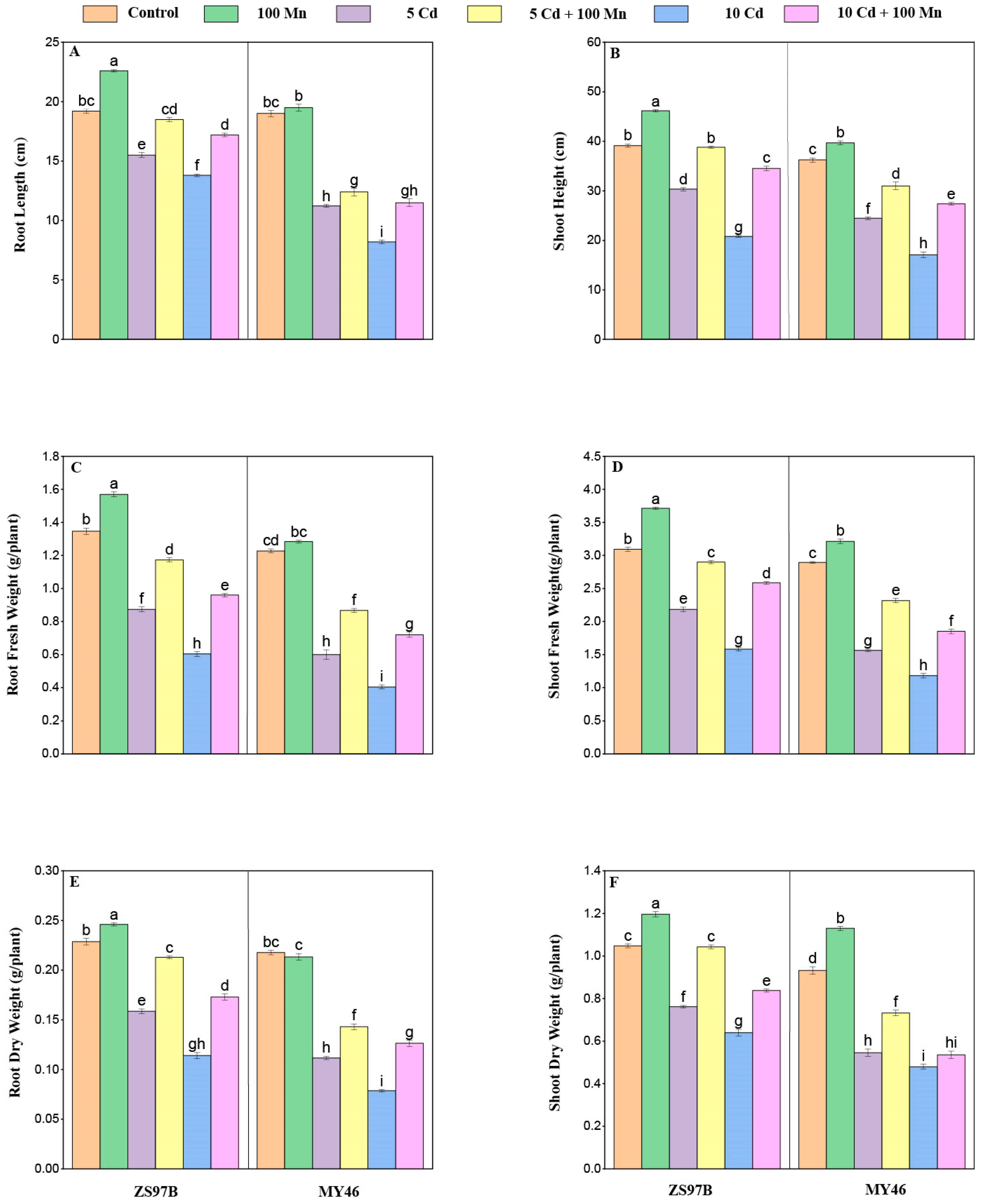
Figure 1. Combined effect of Cd (5 and 10 µM) and Mn (100 µM) treatments on growth attributes of two rice genotypes. (A,B) root length and shoot height, (C,D) Root and shoot fresh weight,(E,F)root and shootdry weight. Error bars represent standard deviation (n = 3); different lowercase letters among columns in each genotype represent significant difference (p ≤ 0.05).
Applsci 15 12704 g001
Figure 2. Combined effect of Cd (5 and 10 µM) and Mn (100 µM) treatments on chlorophyll, Fv/Fm, and photosynthetic parameters of the two rice genotypes. (A) Fv/Fm, (B) SPAD value, (C) photosynthetic rate, (D) stomatal conductance, (E) intracellular CO2, (F) transpiration rate. Error bars represent standard deviation (n = 3); different lowercase letters among columns in each genotype represent significant difference (p ≤ 0.05).
Applsci 15 12704 g002
Figure 3. Combined effects of Cd (5 and 10 µM) and Mn (100 µM) treatments on Cd and Mn concentration in roots and shoots of two rice genotypes. (A,B) Cd and Mn translocation factor in shoots/roots; (C,D) Cd concentration in shoot and roots; (E,F) Mn concentration in shoots and roots. Error bars represent standard deviation (n = 3); different lowercase letters among columns in each genotype represent significant difference (p ≤ 0.05). Translocation factor (TF).
Applsci 15 12704 g003
Figure 4. Combined effect of Cd and Mn treatments on ultrastructure features of chloroplasts in both rice genotypes. (A), Control; (B), Mn 100 μM; (C), Cd 5 μM; (D), Cd 5 + 100 Mn μM; (E), Cd 10 μM; (F), Cd 10 μM + Mn 100 μM. P, plastoglobules; Thy, thylakoids; S, stroma; G, granum. Scale bar, 0.5 μm.
Applsci 15 12704 g004
Figure 5. Combined effect of Cd (5 and 10 µM) and Mn (100 µM) treatments on ROS activity in roots and shoots of the two rice genotypes. (A,B), MDA content; (C,D), H2O2 contents; (E,F), O2 concentration. Error bars represent standard deviation (n = 3); different lowercase letters among columns in each genotype represent significant difference (p ≤ 0.05).
Applsci 15 12704 g005
Figure 6. Combined effect of Cd (5 and 10 µM) and Mn (100 µM) treatments on activities of antioxidant enzymes in two rice genotypes, (A,B) SOD root and shoot, (C,D) POD root and shoot, (E,F) CAT and root and shoot, (G,H) APX root and shoot. Error bars represent standard deviation (n = 3); different lowercase letters among columns in each genotype represent significant difference (p ≤ 0.05).
Applsci 15 12704 g006
Figure 7. Combined effect of Cd (5 and 10 µM) and Mn (100 µM) treatments on relative expression level of (AH) OsSOD, OsPOD, OsCAT, and OsAPX in roots and shoots of two rice genotypes, respectively. Error bars represent standard deviation (n = 3); different lowercase letters among columns in each genotype represent significant difference (p ≤ 0.05).
Applsci 15 12704 g007
Figure 8. Combined effect of Cd (5 and 10 µM) and Mn (100 µM) on relative expression of metal transporters genes in the two rice genotypes (AH). Error bars represent standard deviation (n = 3); different lowercase letters among columns in each genotype represent significant difference (p ≤ 0.05).
Applsci 15 12704 g008
Table 1. Combined effect of Cd (5 and 10 µM) and Mn (100 µM) treatments on nutrient concentrations in roots and shoots of the two rice genotypes.
TreatmentsMg (mg/kg)P (mg/kg)Na (mg/kg)K (mg/kg)Zn (mg/kg)Fe (mg/kg)Cu (mg/kg)
ZS97B Root
Control287.00 b748.47 b342.90 b836.18 b15.08 b257.56 b16.45 b
100 µM Mn332.88 a859.34 a386.96 a976.66 a16.84 a279.89 a19.20 a
5 µM Cd194.73 f549.12 d219.71 f624.43 e10.38 e171.33 e10.18 e
5µMCd + 100 µM Mn260.00 c661.45 c294.57 c809.56 b12.14 d192.08 d14.29 c
10 µM Cd145.23 h424.97 f158.16 g482.94 f7.14 g113.18 g6.31 g
10 µM Cd + 100 µM Mn235.35 d576.12 d264.82 d645.05 de10.11 e171.66 e12.68 d
ZS97B shoot
Control619.74 b455.14 b83.08 b1269.75 b9.58 b119.46 b3.26 b
100 µM Mn723.21 a552.68 a90.09 a1483.82 a10.91 a138.10 a3.89 a
5 µM Cd385.65 f349.12 d45.50 h937.79 e5.71 e84.68 d2.47 e
5µM Cd + 100 µM Mn505.41 d461.45 b65.32 e1113.75 c8.02 c102.39 c2.85 c
10 µM Cd346.58 g248.31 e36.66 i730.10 f3.95 g64.10 f1.90 h
10 µM Cd + 100 µM Mn440.79 e376.12 c48.08 g1017.57 d6.75 d89.56 d2.62 d
MY46 Root
Control261.14 c677.91 c300.14 c722.25 c13.16 c226.03 c14.78 c
100 µM Mn290.37 b747.65 b332.23 b850.24 b14.87 b247.65 b16.52 b
5 µM Cd154.11 h418.29 f154.90 g479.56 f8.51 f128.38 f7.82 f
5µM Cd + 100 µM Mn216.27 e564.97 d237.80 e672.77 d10.43 e165.83 e12.19 d
10 µM Cd90.72 i322.54 g104.73 h363.82 g5.55 h83.04 h4.60 h
10 µM Cd + 100 µM Mn180.58 g463.58 e223.67 f513.33 f7.99 f138.30 f9.83 e
MY46 Shoot
Control537.55 c376.58 c73.98 d1098.32 c8.20 c106.12 c2.79 c
100 µM Mn603.62 b464.32 b78.97 c1260.60 b9.64 b122.97 b3.25 b
5 µM Cd313.38 h248.29 e36.57 i750.99 f4.68 f64.76 f1.90 h
5µM Cd + 100 µM Mn444.64 e371.64 cd54.81 f958.51 de6.01 e86.84 d2.32 f
10 µM Cd265.17 i165.87 f27.02 j558.49 g2.62 h50.07 g1.45 i
10 µM Cd + 100 µM Mn362.66 g268.58 e38.44 i775.72 f4.76 f71.65 e2.11 g
All values represent the means of three biological replications. Different lowercase letters within a column in each genotype represent significant difference (p ≤ 0.05).
Disclaimer/Publisher’s Note: The statements, opinions and data contained in all publications are solely those of the individual author(s) and contributor(s) and not of MDPI and/or the editor(s). MDPI and/or the editor(s) disclaim responsibility for any injury to people or property resulting from any ideas, methods, instructions or products referred to in the content.