Uncoupled Fracture Indicator Dependent on the Third Invariant and the Level of Ductility: Applications in Predominant Shear Loading


Abstract
1. Introduction
2. Theoretical Review
Gao-Based Model
- (i)
- Additive decomposition of total strain:
- (ii)
- Elastic law:
- (iii)
- Yield function:
- (iv)
- Plastic flow rule:
- (v)
- Evolution of the accumulated plastic strain:
- (vi)
- Loading/unloading rule:
3. Proposal Fracture Indicator and Numerical Strategy
3.1. Uncoupled Fracture Indicator
- (a)
- Pure traction: in this case, and the function returns
- (b)
- Pure shear: in this case, and the function returns
- (c)
- Tensile/shear combinations: in this case, and the function returns values in the range of
- (a)
- Pure traction: in this case, and the function returns
- (b)
- Pure shear: in this case, and the function returns
- (c)
- Tensile/shear combinations: in this case, and the function returns values in the range of
3.2. Integration Strategy for Gao-Based Model and Damage Indicator
- (i)
- Given the trial stress state as initial step, , initial parameters: and residual equations:
- (ii)
- (iii)
- Solve the system of equations:
- (iv)
- New guess for :
- (v)
- Update variables:
- (vi)
- Verify the convergence:
- (i)
- Run Box 2 for Gao’s model to determine:
- (ii)
- Calculate , according to Equation (18) to determine :
- (iii)
- To determine the damage in pseudo-time
- (iv)
- End
4. Calibration Strategy and Numerical Results
4.1. Calibration of Material Parameters
4.1.1. Elastoplastic Material Parameters and Damage for Lemaitre Model
4.1.2. Set of Parameters for Fracture Indicator and Gao-Based Model
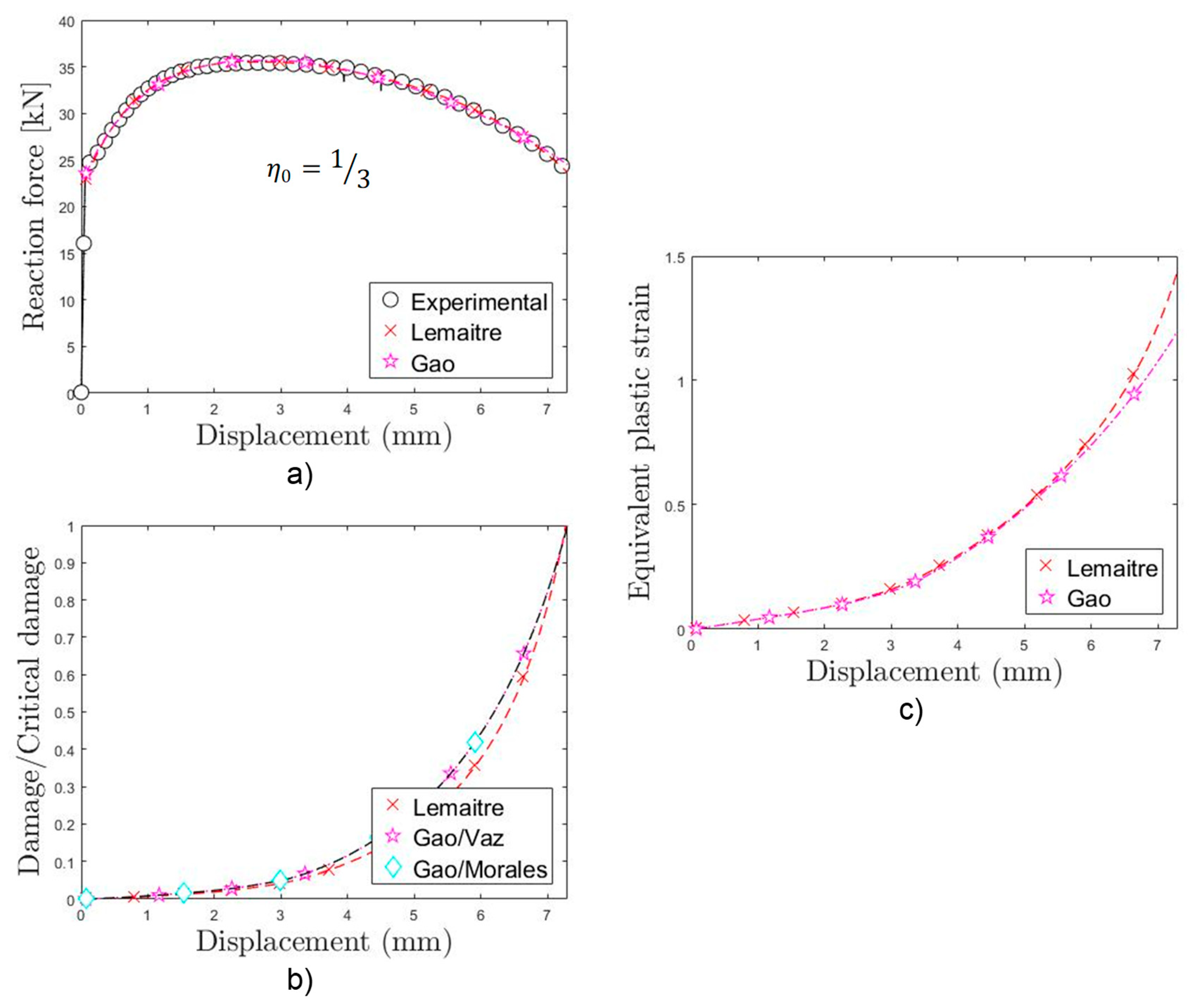
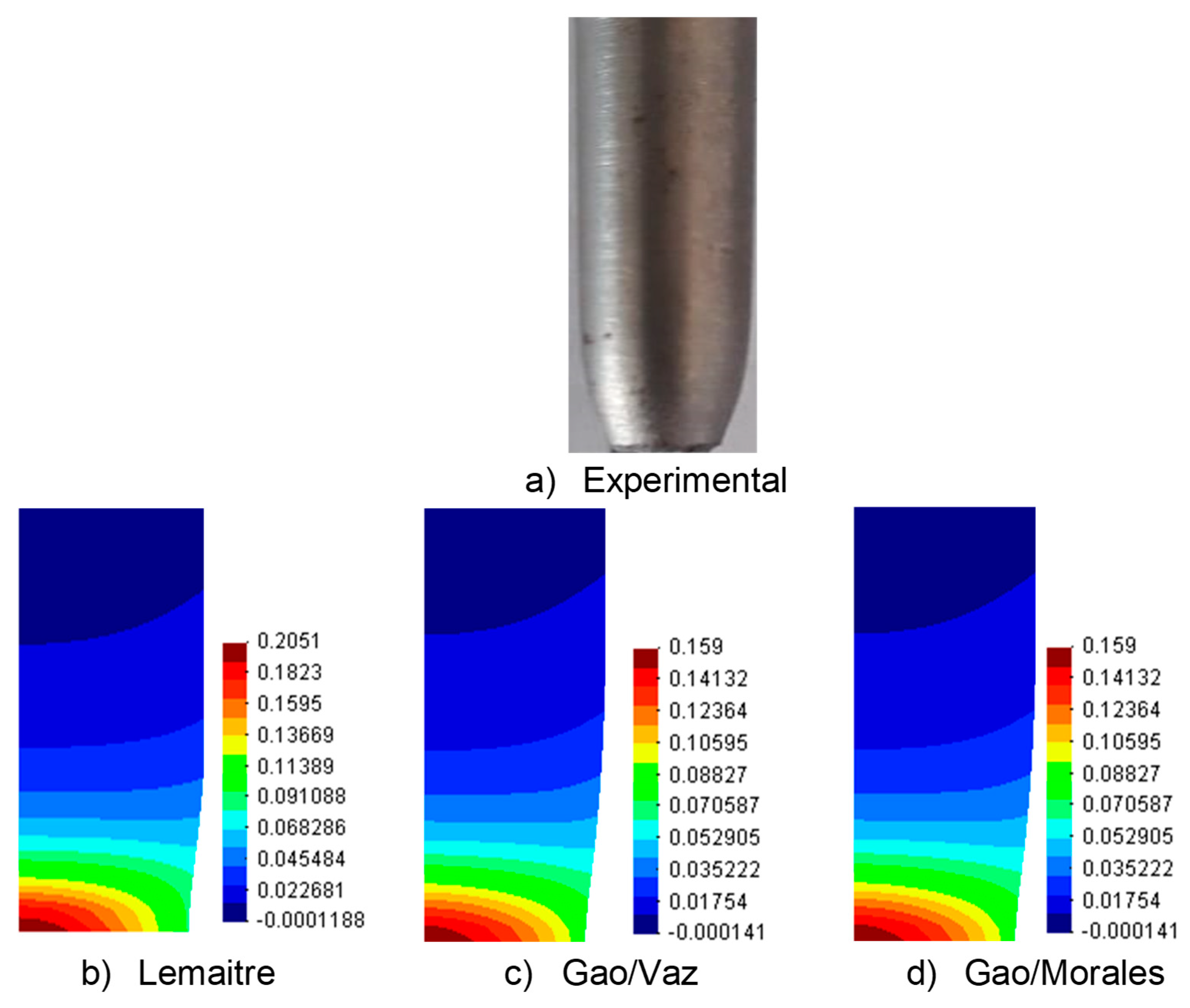
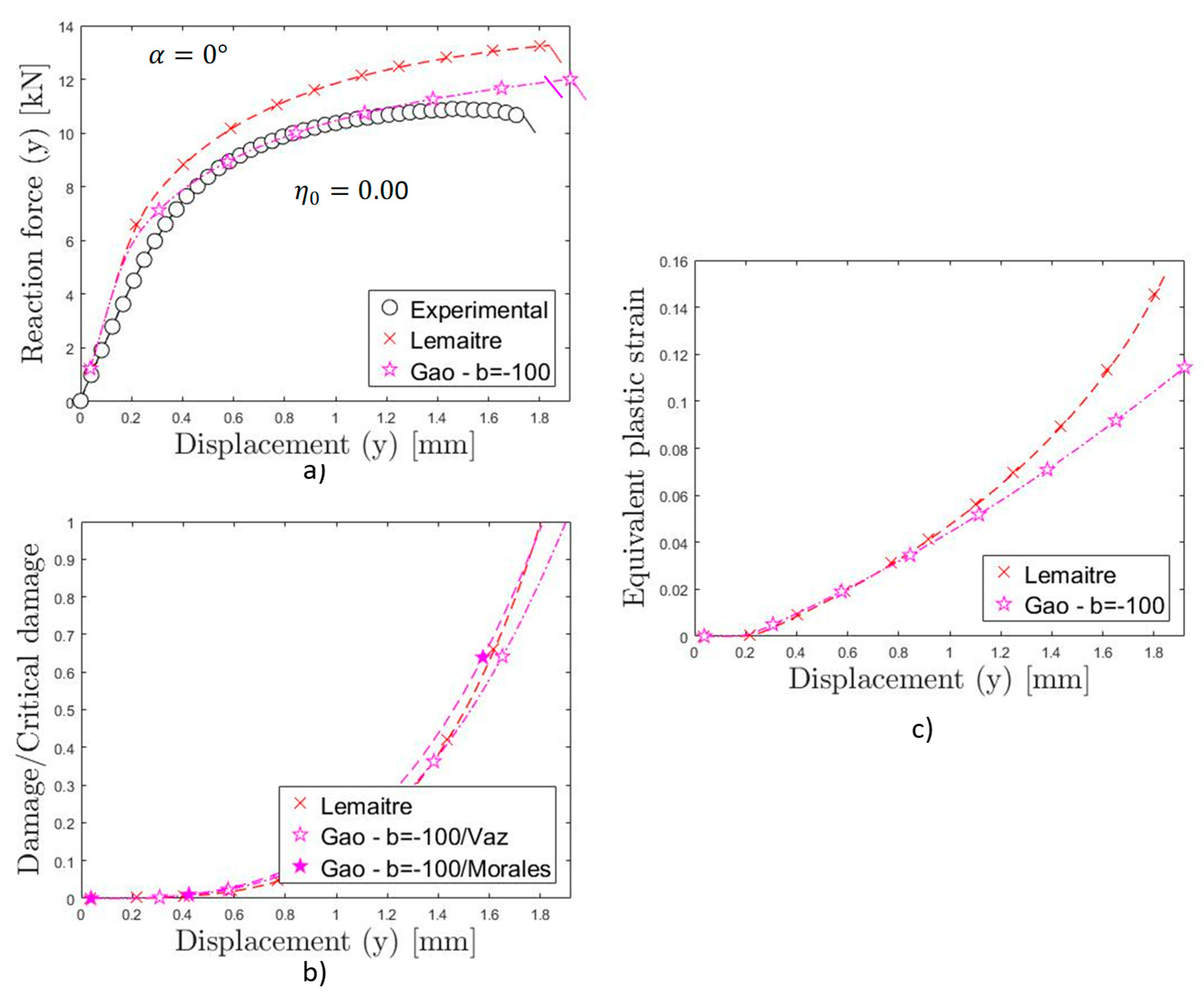
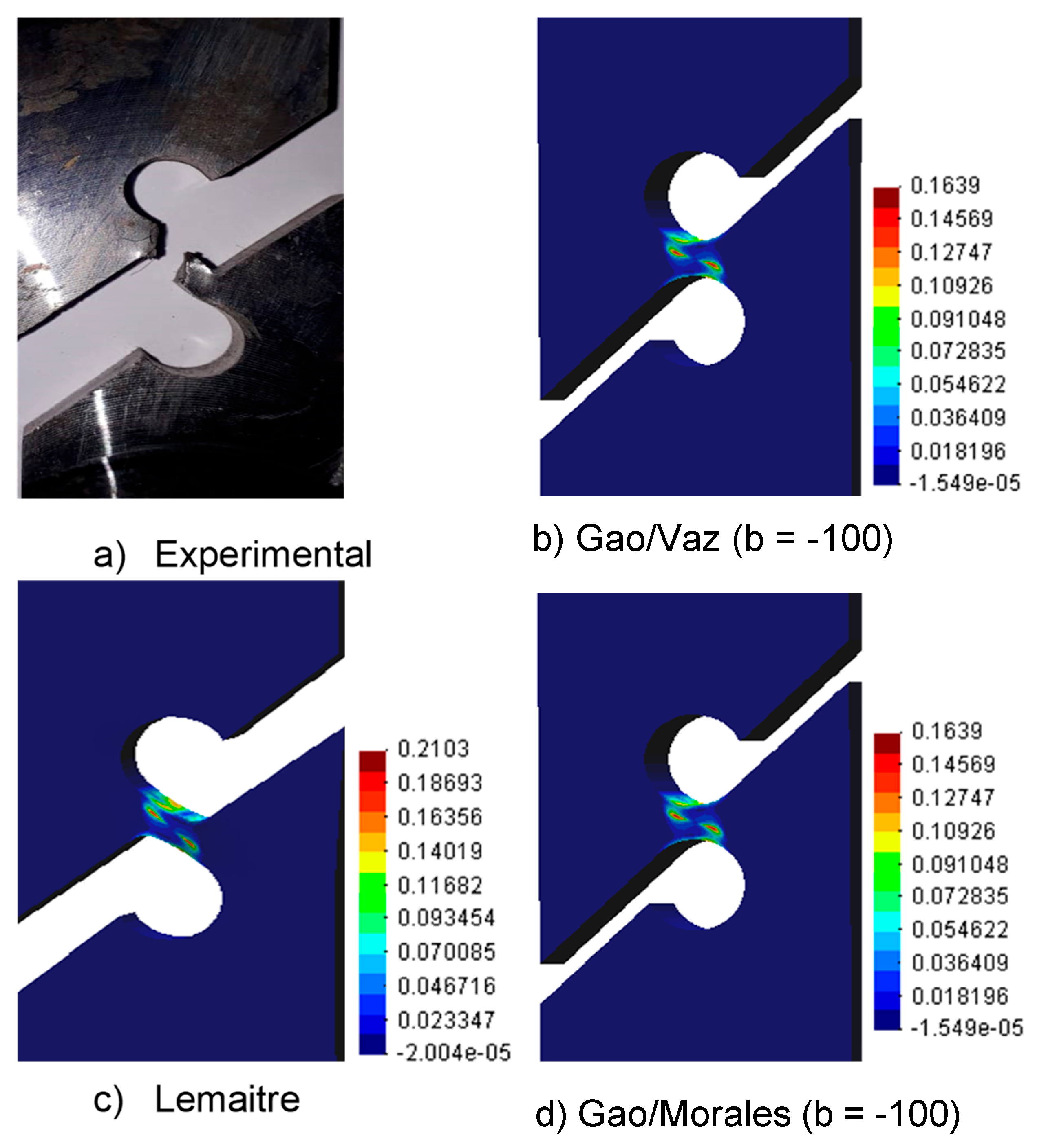
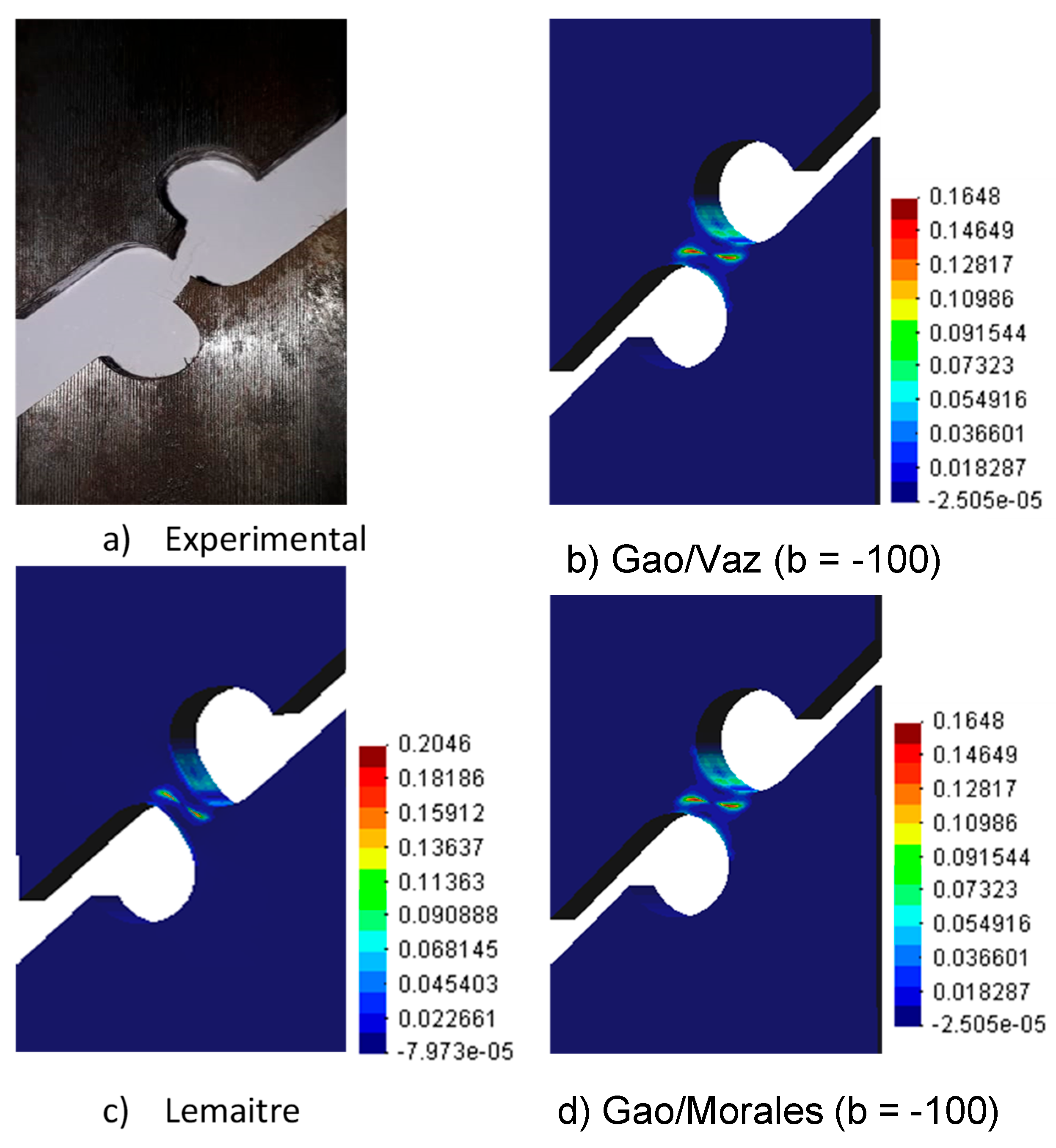
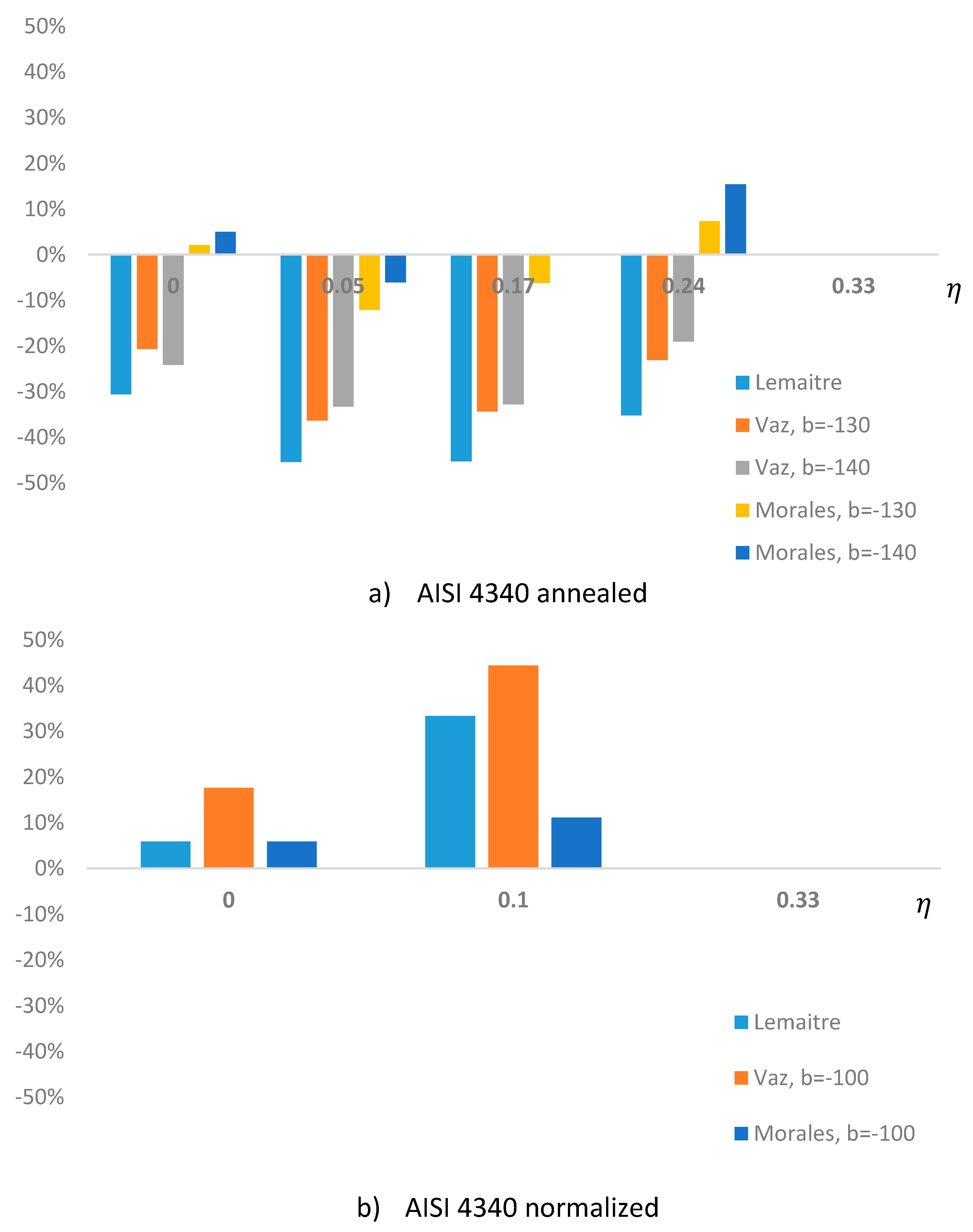
4.2. Results for AISI 4340 Annealed Alloy
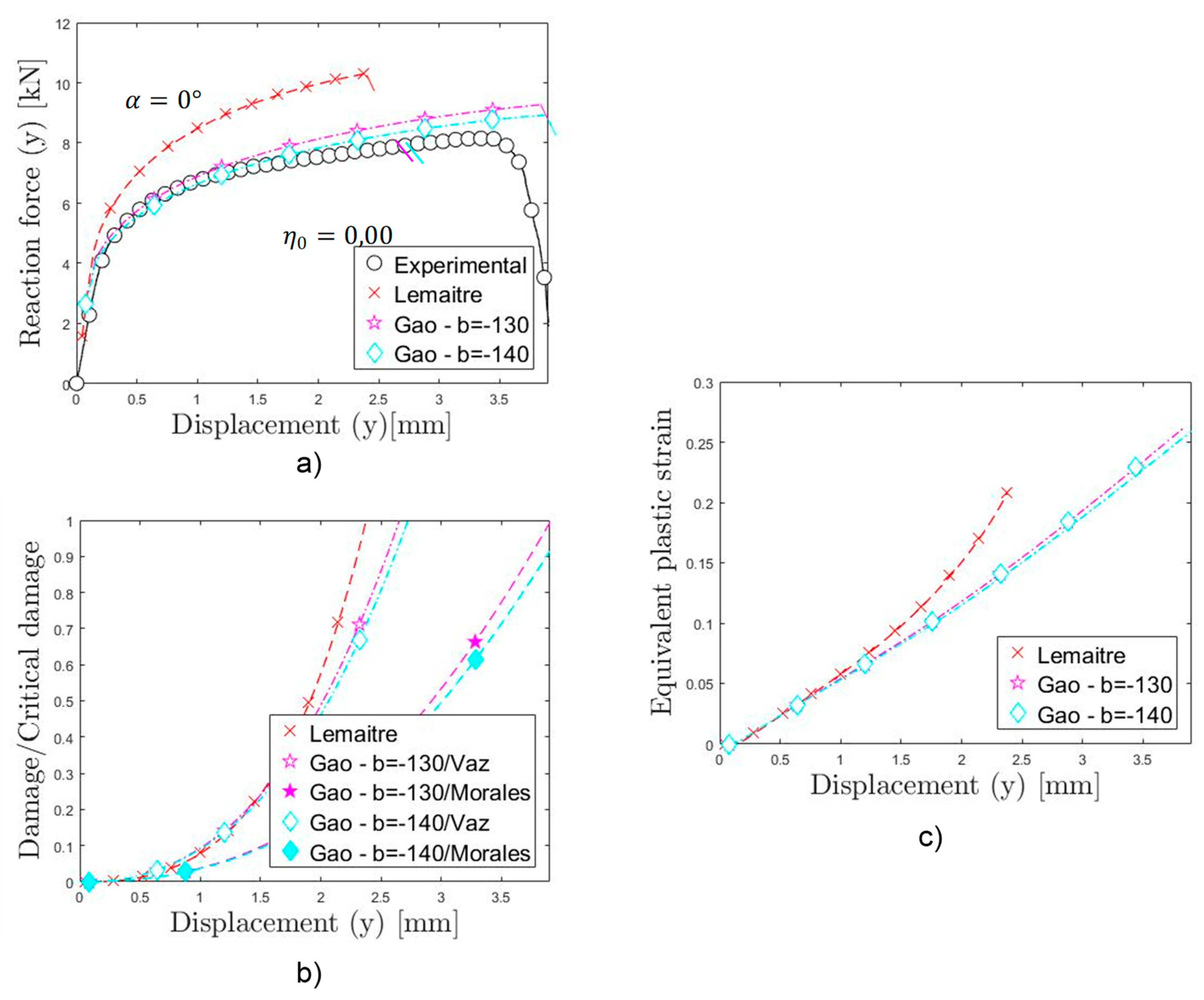
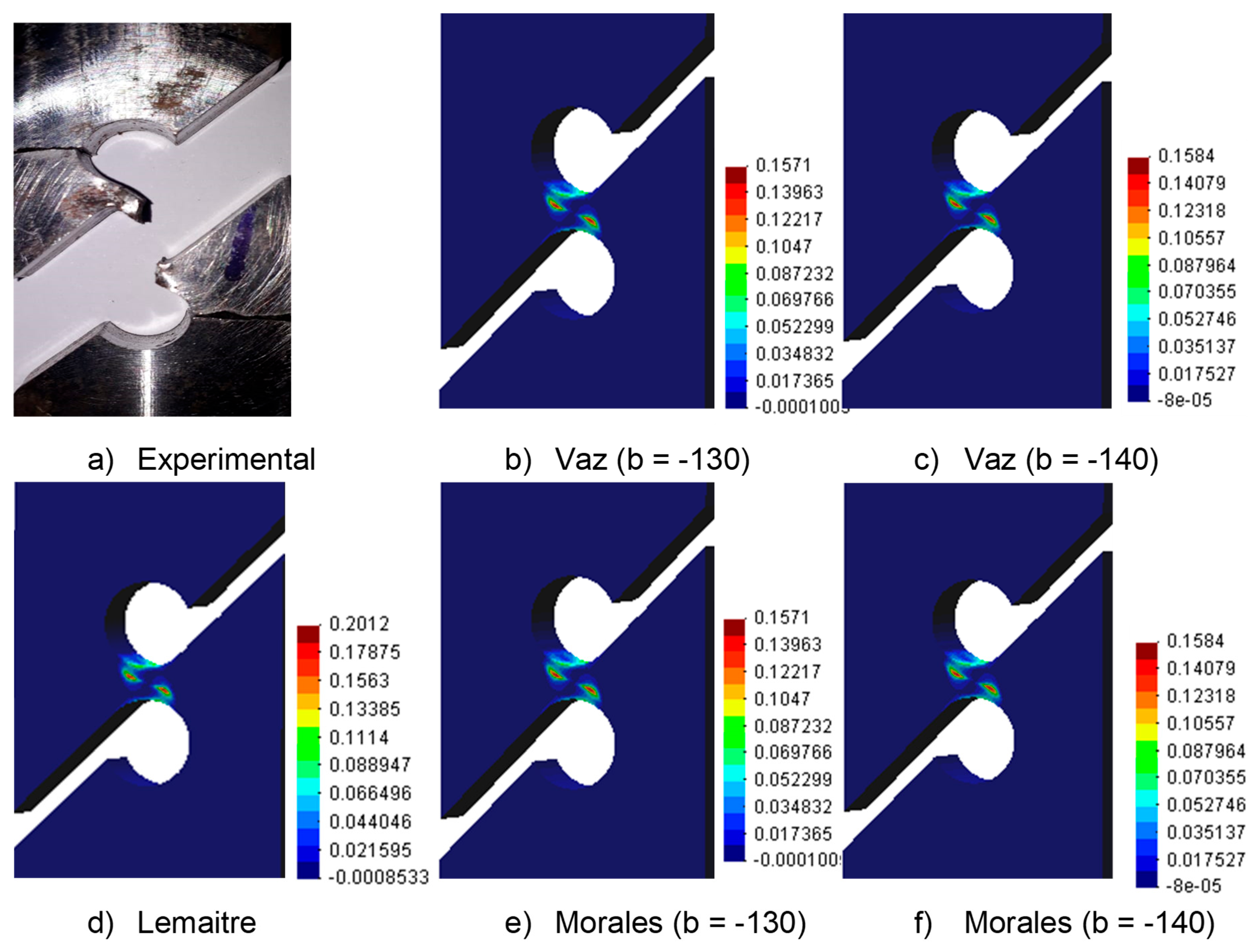
4.3. Results for AISI 4340 Normalized Alloy
5. Conclusions
Author Contributions
Funding
Institutional Review Board Statement
Informed Consent Statement
Data Availability Statement
Acknowledgments
Conflicts of Interest
Nomenclature
| Adjustment parameters of the Gao criterion | |
| Isotropic damage | |
| Fourth order elasticity tensor | |
| Critical damage | |
| Maximum damage | |
| Damage evolution rate | |
| Young’s modulus | |
| Multi-objective strategy | |
| Shear modulus of elasticity | |
| Isotropic hardening modulus | |
| Ductile fracture indicator | |
| Second order identity tensor | |
| Fourth order identity tensor | |
| Fourth order deviatoric projector | |
| First invariant of the Cauchy tensor | |
| Second invariant of the deviator tensor | |
| Third invariant of the deviator tensor | |
| Newton–Raphson iteration counter | |
| Volumetric modulus of elasticity | |
| Flow vector | |
| Hydrostatic stress | |
| Equivalent stress | |
| Residual equation of the variable | |
| Deviatoric stress tensor | |
| Damage exponent | |
| Damage denominator | |
| Damage denominator calibrated through a pure shear test | |
| Damage denominator calibrated through an experimental tensile test | |
| Constant associated with the ductility of the material | |
| Time instant at the beginning of the increment | |
| Time instant at the end of the increment | |
| Experimentally observed displacement | |
| Numerically calculated displacement | |
| Energy released due to damage | |
| Shear modes | |
| Plastic multiplier increment | |
| Unknowns array of the Newton–Raphson method at iteration | |
| Total strain tensor | |
| Accumulated plastic strain | |
| Plastic strain at fracture | |
| Accumulated plastic strain rate | |
| Elastic strain tensor | |
| Plastic strain tensor | |
| Plastic strain tensor rate | |
| Triaxiality ratio | |
| Initial triaxiality ratio | |
| Plastic multiplier rate | |
| Parameter of the Gao criterion | |
| Normalized third invariant | |
| Poisson’s ratio | |
| Yield criterion | |
| Cauchy stress tensor | |
| Kleinermann-Ponthot’s hardening parameters | |
| Yield stress | |
| Initial yield stress | |
| Internal variables at the beginning of the time step | |
| Updated internal variables | |
| Trial State | |
| Internal variables in the initial step, | |
| Internal variables of the Newton–Raphson method at iteration | |
| Internal variables of the Newton–Raphson method at iteration |
References
- Malcher, L.; Morales, L.L.D.; Rodrigues, V.A.M.; Silva, V.R.M.; Araújo, L.M.; Ferreira, G.V. Experimental program and numerical assessment for determination of stress triaxiality and J3 effects on AA6101-T4. Theor. Appl. Fract. Mech. 2020, 106, 102476. [Google Scholar] [CrossRef] [Scilit]
- Brünig, M.; Brenner, D.; Gerke, S. Stress state dependence of ductile damage and fracture behavior: Experiments and numerical simulations. Eng. Fract. Mech. 2015, 1, 152–169. [Google Scholar] [CrossRef] [Scilit]
- Roth, C.; Mohr, D. Ductile fracture experiments with locally proportional loading histories. Int. J. Plast. 2016, 79, 328–354. [Google Scholar] [CrossRef] [Scilit]
- de Souza Neto, E.A.; Peric, D.; Owen, D.R.J. Computational Methods for Plasticity: Theory and Applications; de Souza Neto, E.A., Peric, D., Owen, D.R.J., Eds.; John Wiley & Sons Ltd.: West Sussex, UK, 2008; 816p, ISBN 9780470694527. [Google Scholar] [CrossRef] [Scilit]
- Cao, T.-S.; Gachet, J.-M.; Montmitonnet, P.; Bouchard, P.-O. A Lode-dependent enhanced Lemaitre model for ductile fracture prediction at low-stress triaxiality. Eng. Fract. Mech. 2014, 124–125, 80–96. [Google Scholar] [CrossRef] [Scilit]
- Cortese, L.; Coppola, T.; Campanelli, F.; Broggiato, G.B. A J2–J3 approach in plastic and damage description of ductile materials. Int. J. Damage 2015, 25, 228–250. [Google Scholar] [CrossRef] [Scilit]
- Driemeier, L.; Moura, R.T.; Machado, I.F.; Alves, M. A bifailure specimen for accessing failure criteria performance. Int. J. Plast. 2015, 71, 62–86. [Google Scholar] [CrossRef] [Scilit]
- Brünig, M.; Gerke, S.; Schmidt, M. Biaxial experiments and phenomenological modeling of stress-state-dependent ductile damage and fracture. Int. J. Fract. 2016, 200, 63–76. [Google Scholar] [CrossRef] [Scilit]
- Gerke, S.; Adulyasak, P.; Brünig, M. New biaxially loaded specimens for analysis of damage and fracture in sheet metals. Int. J. Solids Struct. 2017, 110–111, 209–218. [Google Scholar] [CrossRef] [Scilit]
- Haji Aboutalebi, F.; Poursina, M.; Nejatbakhsh, H.; Khataei, M. Numerical simulations and experimental validations of a proposed ductile damage model for DIN1623 St12 steel. Eng. Fract. 2018, 192, 276–289. [Google Scholar] [CrossRef] [Scilit]
- Brünig, M.; Gerke, S.; Schmidt, M. Damage and failure at negative stress triaxialities: Experiments, modeling and numerical simulations. Int. J. Plast. 2018, 102, 70–82. [Google Scholar] [CrossRef] [Scilit]
- Farahani, B.V.; Belinha, J.; Amaral, R.; Tavares, P.J.; Moreira, P. A digital image correlation analysis on a sheet AA6061-T6 bi-failure specimen to predict static failure. Eng. Fail. Anal. 2018, 90, 179–196. [Google Scholar] [CrossRef] [Scilit]
- Brünig, M. Continuum Damage Model for Ductile Materials Based on Stress-State-Dependent Damage Functions. In Encyclopedia of Continuum Mechanics; Altenbach, H., Öchsner, A., Eds.; Springer: Berlin/Heidelberg, Germany, 2019; pp. 1–9. ISBN 978-3-662-53605-6. [Google Scholar] [CrossRef] [Scilit]
- Gerke, S.; Zistl, M.; Bhardwaj, A.; Brünig, M. Experiments with the X0-specimen on the effect of non-proportional loading paths on damage and fracture mechanisms in aluminum alloys. Int. J. Solids Struct. 2019, 163, 157–169. [Google Scholar] [CrossRef] [Scilit]
- Brünig, M.; Zistl, M.; Gerke, S. Biaxial experiments on characterization of stress state dependent damage in ductile metals. Prod. Eng. Dev. 2020, 14, 87–93. [Google Scholar] [CrossRef] [Scilit]
- Sun, S.; Liu, Q.; Brandt, M.; Luzin, V.; Cottam, R.; Janardhana, M.; Clark, G. Effect of laser clad repair on the fatigue behaviour of ultra-high strength AISI 4340 steel. Mater. Sci. Eng. A 2014, 606, 46–57. [Google Scholar] [CrossRef] [Scilit]
- Oliver, X.; Agelet de Saracibar, C. Continuum Mechanics for Engineers: Theory and Problems, 2nd ed.; UPC: Barcelona, Spain, 2017; 550p, Available online: http://hdl.handle.net/2117/102979 (accessed on 1 September 2025).
- Gao, X.; Zhang, T.; Zhou, J.; Graham, S.M.; Hayden, M.; Roe, C. On Stress-state dependent plasticity modeling: Significance of the hydrostatic stress, the third invariant of stress deviator and the non-associated flow rule. Int. J. Plast. 2011, 27, 217–231. [Google Scholar] [CrossRef] [Scilit]
- Lemaitre, J. A Continuous Damage Mechanics Model for Ductile Fracture. J. Eng. Mater. Technol. 1985, 107, 83–89. [Google Scholar] [CrossRef] [Scilit]
- Malcher, L.; Mamiya, E.N. An Improved Damage Evolution Law Based on Continuum Damage Mechanics and Its Dependence on Both Stress Triaxiality and the Third Invariant. Int. J. Plast. 2014, 56, 232–261. [Google Scholar] [CrossRef] [Scilit]
- Cavalheiro, J.V.S.; Malcher, L. Assessment of third invariant elasto-plastic models: Mathematical aspects, numerical strategies and comparative results. Finite Elem. Anal. Des. 2017, 123, 51–69. [Google Scholar] [CrossRef] [Scilit]
- Zichil, V.C. Considerations on stress triaxiality variation for 2P armor steel. IOP Conf. Ser. Mater. Sci. Eng. 2016, 200, 012066. [Google Scholar] [CrossRef] [Scilit]
- Ferreira, G.V.; Campos, E.R.F.S.; Neves, R.S.; Desmorat, R.; Malcher, L. An improved continuous damage model to estimate multiaxial fatigue life under strain control problems. Int. J. Damage Mech. 2022, 31, 815–844. [Google Scholar] [CrossRef] [Scilit]
- Morales, L.L.D. Estudo Experimental e Numérico do Comportamento Mecânico na Fratura da Liga AISI 4340. Ph.D. Thesis, Universidade de Brasília, Brasilia, Brasil, 2020. [Google Scholar] [CrossRef]
- Wang, P.; Qu, S. Analysis of ductile fracture by extended unified strength theory. J. Plast. 2018, 104, 196–213. [Google Scholar] [CrossRef] [Scilit]
- Vaz, M., Jr.; Owen, D.R.J. Aspects of ductile fracture and adaptive mesh refinement in damaged elasto-plastic materials. Int. J. Numer. Methods Eng. 2001, 50, 29–54. [Google Scholar] [CrossRef] [Scilit]
- Kleinermann, J.P.; Ponthot, J.P. Parameter identification and shape/process optimization in metal forming simulation. J. Mater. Process. Technol. 2003, 139, 521–526. [Google Scholar] [CrossRef] [Scilit]
- Machado, L.Q.; Malcher, L. Isotropic hardening curve characterization by the resultant profile of ball indentation tests. Braz. Soc. Mech. Sci. Eng. 2019, 41, 519. [Google Scholar] [CrossRef] [Scilit]
- Gervasyev, A.; Jiao, J.; PortellaGarcia, M.; Barbaro, F.; Huo, C.; Novokshanov, D.; Rapp, S. Direct measurement of the resistance to ductile fracture propagation. Int. J. Press. Vessel. Pip. 2022, 200, 104816. [Google Scholar] [CrossRef] [Scilit]
- Jiao, J.; Gervasyev, A.; Lu, C.; Barbaro, F. A novel measure for the material resistance to ductile fracture propagation under shear-dominated deformation. Theor. Appl. Fract. Mech. 2021, 112, 102845. [Google Scholar] [CrossRef] [Scilit]
- Yin, Y.; Li, M.; Han, Q.; Lu, Y.; Bai, J. A New Micromechanical Criterion for Ductile Fracture of G20Mn5QT Cast Steels Under Shear Stress. Int. J. Steel Struct. 2022, 22, 1306–1321. [Google Scholar] [CrossRef] [Scilit]
- ASTM E8/E8M-09; Standard Test Methods for Tension Testing of Metallic Materials. ASTM International: West Conshohocken, PA, USA, 2022.





| Description | Symbol | Values | |
|---|---|---|---|
| Normalized | Annealed | ||
| Tensile | Tensile | ||
| Young’s modulus | E [MPa] | 199,960 | 206,880 |
| Poisson’s ratio | 0.30 | 0.30 | |
| Initial yield stress | [MPa] | 657.00 | 449.00 |
| First parameter calibration | [MPa] | 819.10 | 568.20 |
| Second parameter calibration | [MPa] | 1022.00 | 747.00 |
| Calibration exponent | 51.90 | 28.90 | |
| Denominator damage | [MPa] | 16.65 | 25.02 |
| Damage exponent | 1 | 1 | |
| Critical damage | 0.21 | 0.21 | |
| Description | Symbol | Vaz Jr. and Owen | Proposed | ||
|---|---|---|---|---|---|
| Normalized | Annealed | Normalized | Annealed | ||
| Gao’s parameter | −100 | −130 and −140 | −100 | −130 and −140 | |
| Denominator damage–tensile | [MPa] | 16.65 | 25.02 | 16.65 | 25.02 |
| Denominator damage–shear | [MPa] | - | - | 14.40 | 62.04 |
| Critical damage | 0.17 | 0.16 | 0.17 | 0.16 | |
| Plastic strain at fracture | - | - | 0.67 | 1.20 | |
Disclaimer/Publisher’s Note: The statements, opinions and data contained in all publications are solely those of the individual author(s) and contributor(s) and not of MDPI and/or the editor(s). MDPI and/or the editor(s) disclaim responsibility for any injury to people or property resulting from any ideas, methods, instructions or products referred to in the content. |
© 2025 by the authors. Licensee MDPI, Basel, Switzerland. This article is an open access article distributed under the terms and conditions of the Creative Commons Attribution (CC BY) license (https://creativecommons.org/licenses/by/4.0/).
Share and Cite
Morales, L.L.D.; Barros, L.O.; Malcher, L. Uncoupled Fracture Indicator Dependent on the Third Invariant and the Level of Ductility: Applications in Predominant Shear Loading. Appl. Sci. 2025, 15, 12689. https://doi.org/10.3390/app152312689
Morales LLD, Barros LO, Malcher L. Uncoupled Fracture Indicator Dependent on the Third Invariant and the Level of Ductility: Applications in Predominant Shear Loading. Applied Sciences. 2025; 15(23):12689. https://doi.org/10.3390/app152312689
Chicago/Turabian StyleMorales, Leonel Leonardo Delgado, Lucas Oliveira Barros, and Lucival Malcher. 2025. "Uncoupled Fracture Indicator Dependent on the Third Invariant and the Level of Ductility: Applications in Predominant Shear Loading" Applied Sciences 15, no. 23: 12689. https://doi.org/10.3390/app152312689
APA StyleMorales, L. L. D., Barros, L. O., & Malcher, L. (2025). Uncoupled Fracture Indicator Dependent on the Third Invariant and the Level of Ductility: Applications in Predominant Shear Loading. Applied Sciences, 15(23), 12689. https://doi.org/10.3390/app152312689