Interpolation-Based Evaluation and Prediction of Vortex Efficiency in Torque-Flow Pumps
 ,
,  ,
,  ,
, 
Abstract
1. Introduction
2. Literature Review
- 1.
- To analyze the existing methodologies for determining the efficiency of torque-flow pumps and to justify the feasibility of applying interpolation methods.
- 2.
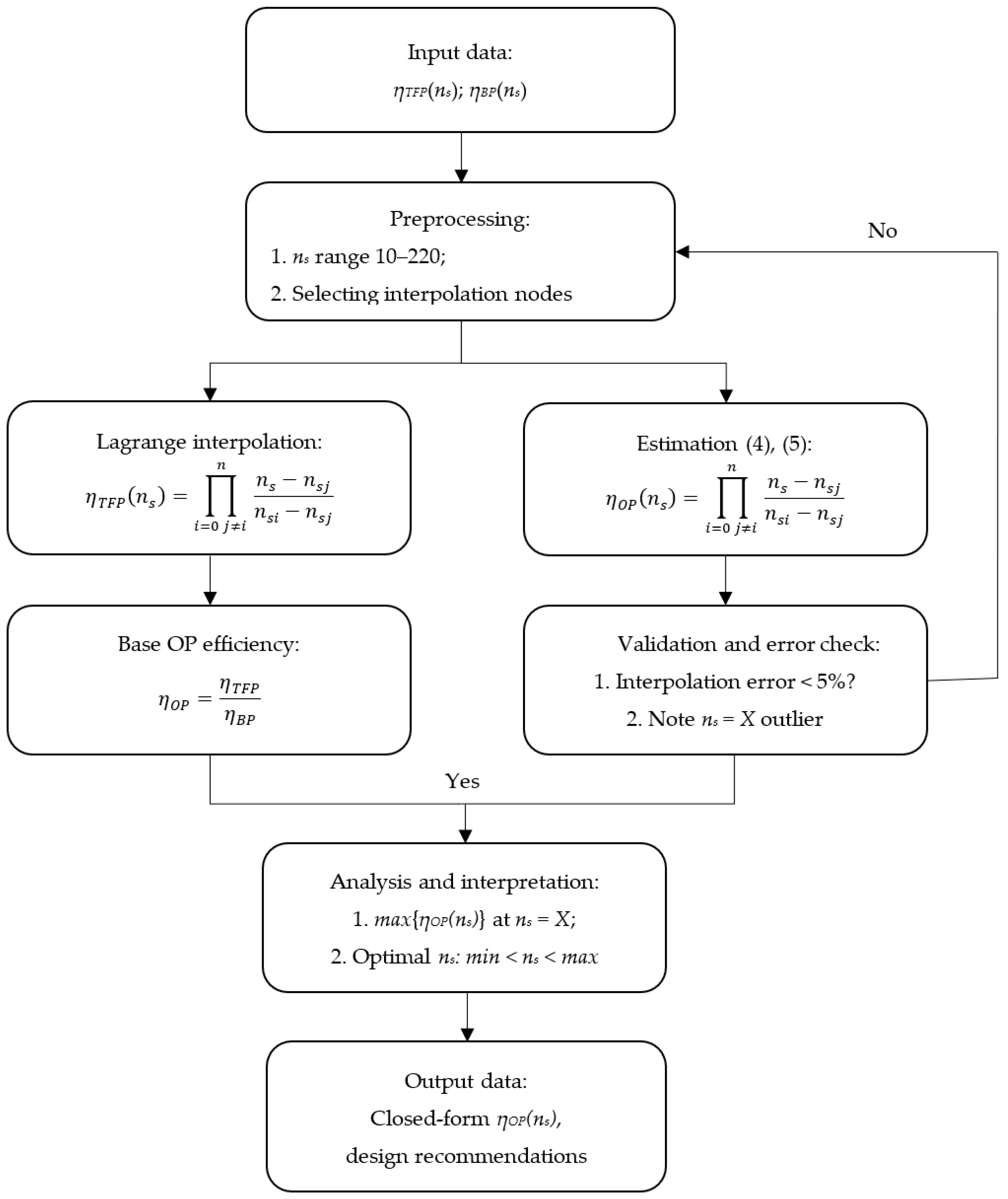
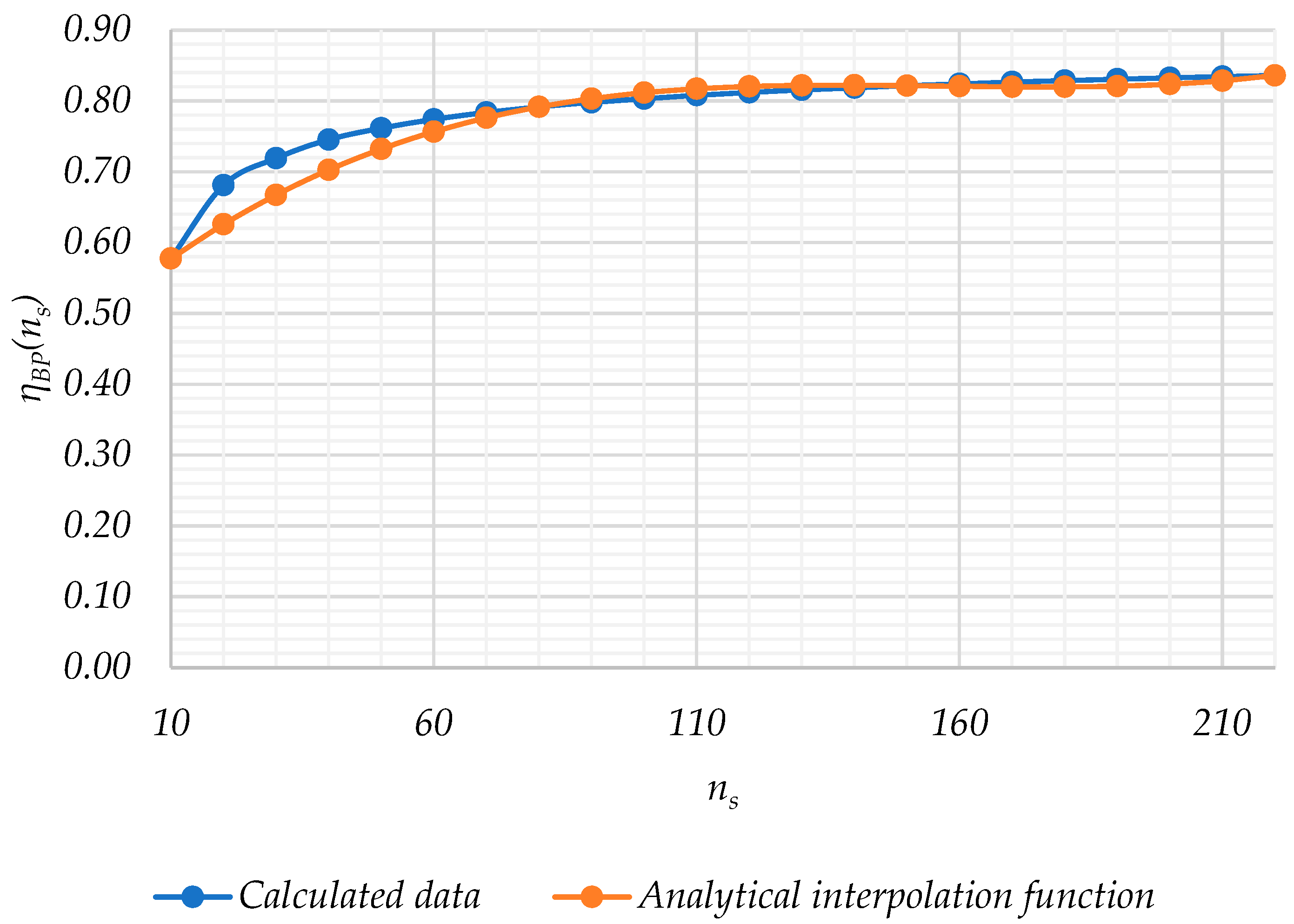
- To construct analytical interpolation dependencies of the efficiency of torque-flow pumps ηTFP(ns) and centrifugal pumps ηBP(ns) based on specific speed ns using initial computational and experimental data.
- 3.
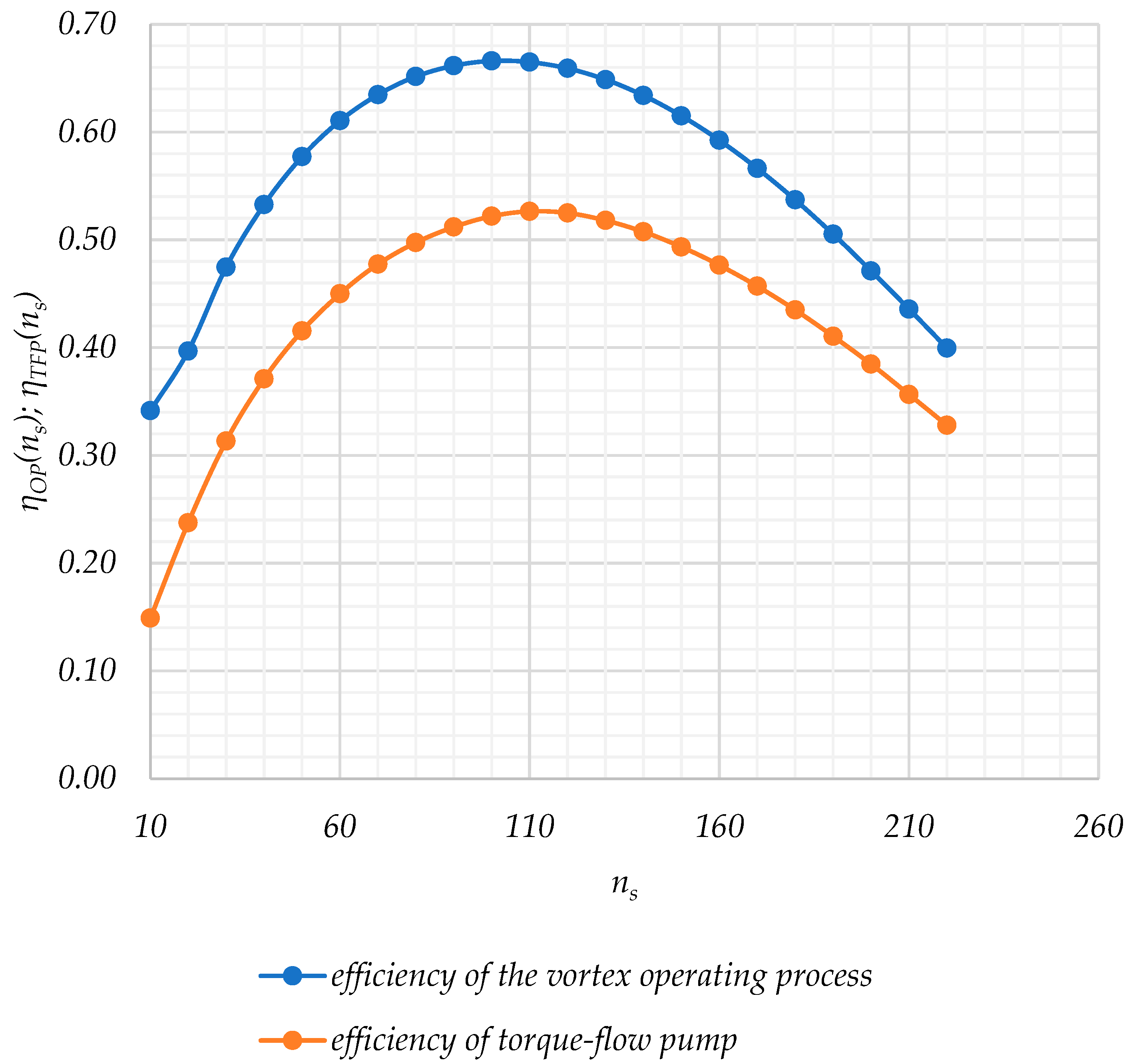
- To develop a methodology for isolating the efficiency of the vortex operating process of torque-flow pumps ηOP(ns) by comparing the efficiency dependencies of torque-flow ηTFP(ns) and centrifugal (blade) pumps ηBP(ns) to specific speed ns.
- 4.
- To determine the complete characteristic of the efficiency of the vortex operating process of torque-flow pumps ηOP(ns) within a wide range of specific speeds ns = 10–220.
- 5.
- To establish the optimal range of specific speed in which the maximum values of vortex process efficiency are achieved.
- 6.
- To evaluate the practical significance of the obtained dependencies for the design, optimization of geometry, and determination of operating modes of torque-flow pumps operating under complex fluid transportation conditions.
3. Materials and Methods
4. Results
4.1. Determination of Analytical Dependence for Torque-Flow Pumps
4.2. Determination of Analytical Dependence for Centrifugal Pumps
4.3. Isolation of the Efficiency of the Vortex Operating Process
5. Discussion
- (1)
- uncertainties in the empirical datasets obtained initially from laboratory measurements;
- (2)
- digitization-related variations inherent to graphical efficiency curves from the literature;
- (3)
- the sensitivity of Lagrange interpolation to points located in regions with steep efficiency gradients;
- (4)
- the assumptions associated with separating centrifugal and vortex contributions using ratio-based definitions.
6. Conclusions
Author Contributions
Funding
Institutional Review Board Statement
Informed Consent Statement
Data Availability Statement
Acknowledgments
Conflicts of Interest
References
- Kumar, J.; Gopi, S.; Amirthagadeswaran, K. Redesigning and numerical simulation of gating system to reduce cold shut defect in submersible pump part castings. Proc. Inst. Mech. Eng. Part E J. Process Mech. Eng. 2023, 237, 971–981. [Google Scholar] [CrossRef] [Scilit]
- Gusak, O.; Krishtop, I.; German, V.; Baga, V. Increase of economy of torque flow pump with high specific speed. IOP Conf. Ser. Mater. Sci. Eng. 2017, 233, 012004. [Google Scholar] [CrossRef] [Scilit]
- Machalski, A.; Skrypacz, J.; Szulc, P.; Blonski, D. Experimental and numerical research on influence of winglets arrangement on vortex pump performance. J. Phys. Conf. Ser. 2021, 1741, 12019. [Google Scholar] [CrossRef] [Scilit]
- Rogovyi, A.; Ren, Q.; Wang, X.; Timchenko, Y. Improvement of dimensions and characteristics of the vortex chamber pump for coal-water medium delivering. Bull. Natl. Tech. Univ. KhPI Ser. Hydraul. Mach. Hydraul. Units 2024, 1, 16–23. [Google Scholar] [CrossRef] [Scilit]
- Panchenko, V.; Ivchenko, A.; Dynnyk, O.; Drach, O. Increasing the technical level of a torque flow pump by changing the geometry of a flowing part. Technol. Audit. Prod. Reserves 2018, 3, 10–21. [Google Scholar] [CrossRef] [Scilit]
- Ramez, A.; Al-Hakimi, W.; Perozo, N.; Jaeger, P. Real-time liquid rate and water cut prediction from the electrical submersible pump sensors data using machine-learning algorithms. ACS Omega 2023, 8, 12671–12692. [Google Scholar] [CrossRef] [Scilit]
- Ivchenko, O.; Andrusiak, V.; Kondus, V.; Pavlenko, I.; Petrenko, S.; Krupińska, A.; Włodarczak, S.; Matuszak, M.; Ochowiak, M. Energy Efficiency Indicator of Pumping Equipment Usage. Energies 2023, 16, 5820. [Google Scholar] [CrossRef] [Scilit]
- Antonenko, S.; Sapozhnikov, S.; Kondus, V.; Chernobrova, A.; Mandryka, A. Creation a universal technique of predicting performance curves for small-sized centrifugal stages of well oil pump units. J. Phys. Conf. Ser. 2021, 1741, 012011. [Google Scholar] [CrossRef] [Scilit]
- Lin, P.; Zheng, Y.; Long, Y.; Qiu, W.; Zhu, R. Study on the Influence of Pump Performance Curve Fitting and Seal Ring Wear on Pump Intelligent Monitoring. Processes 2025, 13, 1529. [Google Scholar] [CrossRef] [Scilit]
- Andrenko, P.; Grechka, I.; Khovanskyy, S.; Rogovyi, A.; Svynarenko, M. Improving the technical level of hydraulic machines, hydraulic units and hydraulic devices using a definitive assessment criterion at the design stage. J. Mech. Eng. 2021, 18, 57–76. [Google Scholar] [CrossRef] [Scilit]
- Shi, Y.; Sheng, B.; Zhu, J.; Chen, G.; Zhang, T.; Luo, R. A Human-Centric Design Method for Industrial Centrifugal Pump Based on Digital Twin. Processes 2024, 12, 42. [Google Scholar] [CrossRef] [Scilit]
- Panchenko, V.; German, V.; Ivchenko, O.; Ryasnaya, O. Combined operating process of torque flow pump. J. Phys. Conf. Ser. 2021, 1741, 012011. [Google Scholar] [CrossRef] [Scilit]
- Krishtop, I. Creating the flowing part of the high energy-efficiency torque flow pump. East. Eur. J. Enterp. Technol. 2015, 2, 31–37. [Google Scholar] [CrossRef] [Scilit]
- Transforming Our World: The 2030 Agenda for Sustainable Development. Available online: https://sdgs.un.org/2030agenda (accessed on 20 August 2025).
- Andrusiak, V.O.; Lugova, S.O.; Medvid, S.A.; Tkach, P.Y.; Rudenko, A.A. Effect of front impelle seal leakages on centrifugal stage characteristics. J. Phys. Conf. Ser. 2021, 1741, 012036. [Google Scholar] [CrossRef] [Scilit]
- Arocena, V.M.; Abuan, B.E.; Reyes, J.G.T.; Rodgers, P.L.; Danao, L.A.M. Numerical investigation of the performance of a submersible pump: Prediction of recirculation, vortex formation, and swirl resulting from off-design operating conditions. Energies 2021, 14, 5082. [Google Scholar] [CrossRef] [Scilit]
- Sun, Z.; Wang, L.; Ge, H.; Yuan, H.; Tang, F. Experiment on pressure pulsation in impeller of large submersible tubular pump. Trans. Chin. Soc. Agric. Mach. 2023, 54, 155–160. [Google Scholar] [CrossRef]
- Gerlach, A.; Thamsen, P.; Wulff, S.; Jacobsen, C. Design Parameters of Vortex Pumps: A Meta-Analysis of Experimental Studies. Energies 2017, 10, 58. [Google Scholar] [CrossRef] [Scilit]
- Rogovyi, A.; Korohodsky, V.; Medviedev, Y. Influence of Bingham fluid viscosity on energy performances of a vortex chamber pump. Energy 2021, 218, 119432. [Google Scholar] [CrossRef] [Scilit]
- Rogovyi, A.; Krasnikov, S.; Lomeiko, O.; Svynarenko, M. Optimal geometrical dimensions of drainless vortex chamber ejector of homogeneous medium. In Advanced Manufacturing Processes VI; Springer: Berlin/Heidelberg, Germany, 2025; pp. 97–106. [Google Scholar] [CrossRef] [Scilit]
- Quan, H.; Chai, Y.; Li, R.; Guo, J. Numerical simulation and experiment for study on internal flow pattern of vortex pump. Eng. Comput. 2019, 36, 1579–1596. [Google Scholar] [CrossRef] [Scilit]
- Rzhebaeva, N.K.; Rzhebaev, E.E. Calculation and Designing of Centrifugal Pumps: Study Guide; Sumy State University: Sumy, Ukraine, 2016; 205p, Available online: https://essuir.sumdu.edu.ua/handle/123456789/44432 (accessed on 20 August 2025).
- Tverdokhleb, I.; Semenov, A.; Ivanyushin, A.; Niemtsev, O.; Rudenko, A. Creating a standard size range as one of the factors reducing production time of modern pumping equipment. Appl. Mech. Mater. 2014, 630, 137–142. [Google Scholar] [CrossRef] [Scilit]
- Kondus, V.; Pavlenko, I.; Kulikov, O.; Liaposhchenko, O. Development of a High-Rotational Submersible Pump for Water Supply. Water 2023, 15, 3609. [Google Scholar] [CrossRef] [Scilit]
- Krishtop, I.; German, V.; Gusak, A.; Lugova, S.; Kochevsky, A. Numerical Approach for Simulation of Fluid Flow in Torque Flow Pumps. In Applied Mechanics and Materials. Trans. Tech. Publ. Ltd. 2014, 630, 43–51. [Google Scholar] [CrossRef] [Scilit]
- Gao, X.; Shi, W.; Zhang, D.; Zhang, Q.; Fang, B. Optimization design and test of vortex pump based on CFD orthogonal test. Nongye Jixie Xuebao/Trans. Chin. Soc. Agric. Mach. 2014, 45, 101–106. [Google Scholar]
- Rogovyi, A.; Korohodskyi, V.; Neskorozhenyi, A.; Hrechka, I.; Khovanskyi, S. Reduction of Granular Material Losses in a Vortex Chamber Supercharger Drainage Channel. In Advances in Design, Simulation and Manufacturing V. DSMIE 2022. Lecture Notes in Mechanical Engineering; Springer: Cham, Switzerland, 2022; pp. 218–226. [Google Scholar] [CrossRef] [Scilit]
- Wu, Y.; Wu, D.; Fei, M.; Xiao, G.; Gu, Y.; Mou, J. The Estimation of Centrifugal Pump Flow Rate Based on the Power–Speed Curve Interpolation Method. Processes 2022, 10, 2163. [Google Scholar] [CrossRef] [Scilit]
- Arocena, V.M.; Abuan, B.E.; Reyes, J.G.T.; Rodgers, P.L.; Danao, L.A.M. Reduction of Entrained Vortices in Submersible Pump Suction Lines Using Numerical Simulations. Energies 2020, 13, 6136. [Google Scholar] [CrossRef] [Scilit]
- Dehnavi, E.; Bakir, F.; Danlos, A.; Kebdani, M. Numerical Analysis of Distance Effect between Inducer and Centrifugal Impeller in Independent Rotational Turbopump in Co-rotating and Counter-rotating Mode. In Proceedings of the European Conference on Turbomachinery Fluid Dynamics and Thermodynamics, ETC, Budapest, Hungary, 24–28 April 2023. [Google Scholar]
- Lavrič, H.; Drobnič, K.; Fišer, R. Model-Based Assessment of Energy Efficiency in Industrial Pump Systems: A Case Study Approach. Appl. Sci. 2024, 14, 10430. [Google Scholar] [CrossRef] [Scilit]
- ISO 9906:2012; Rotodynamic Pumps—Hydraulic Performance Acceptance Tests—Grades 1, 2 and 3. International Organization for Standardization: Geneva, Switzerland, 2012.
- Kondus, V.; Kotenko, A. Investigation of the impact of the geometric dimensions of the impeller on the torque flow pump characteristics. East. Eur. J. Enterp. Technol. 2017, 1, 25–31. [Google Scholar] [CrossRef] [Scilit]
- Zhang, Y.-L.; Li, W.-G. A precisive calculation method of volumetric and hydraulic efficiency of centrifugal pumps. Phys. Fluids 2023, 35, 077104. [Google Scholar] [CrossRef] [Scilit]
- Yan, W.; Zhu, D.; Tao, R.; Wang, Z. Analysis of the Flow Energy Loss and Q-H Stability in Reversible Pump Turbine as Pump with Different Guide Vane Opening Angles. Water 2022, 14, 2526. [Google Scholar] [CrossRef] [Scilit]
- Kovaliov, I.; Ratushnyi, A.; Dzafarov, T.; Mandryka, A.; Ignatiev, A. Predictive vision of development paths of pump technical systems. J. Phys. Conf. Ser. 2021, 1741, 012002. [Google Scholar] [CrossRef] [Scilit]
- Kondus, V.; Ciszak, O.; Zhukov, A.; Mushtai, M.; Polkovnychenko, V.; Krugliak, A. Development of a self-cleaning mechanism for torque-flow pumps. J. Eng. Sci. 2024, 11, F17–F26. [Google Scholar] [CrossRef] [Scilit]
- Dehghan, A.; Shojaeefard, M.; Roshanaei, M. Exploring a new criterion to determine the onset of cavitation in centrifugal pumps from energy-saving standpoint; experimental and numerical investigation. Energies 2024, 293, 130681. [Google Scholar] [CrossRef] [Scilit]
- Bhattacharjee, P.; Hussain, S.A.I.; Dey, V. Failure mode and effects analysis for submersible pump component using proportionate risk assessment model: A case study in the power plant of Agartala. Int. J. Syst. Assur. Eng. Manag. 2023, 14, 1778–1798. [Google Scholar] [CrossRef] [Scilit]

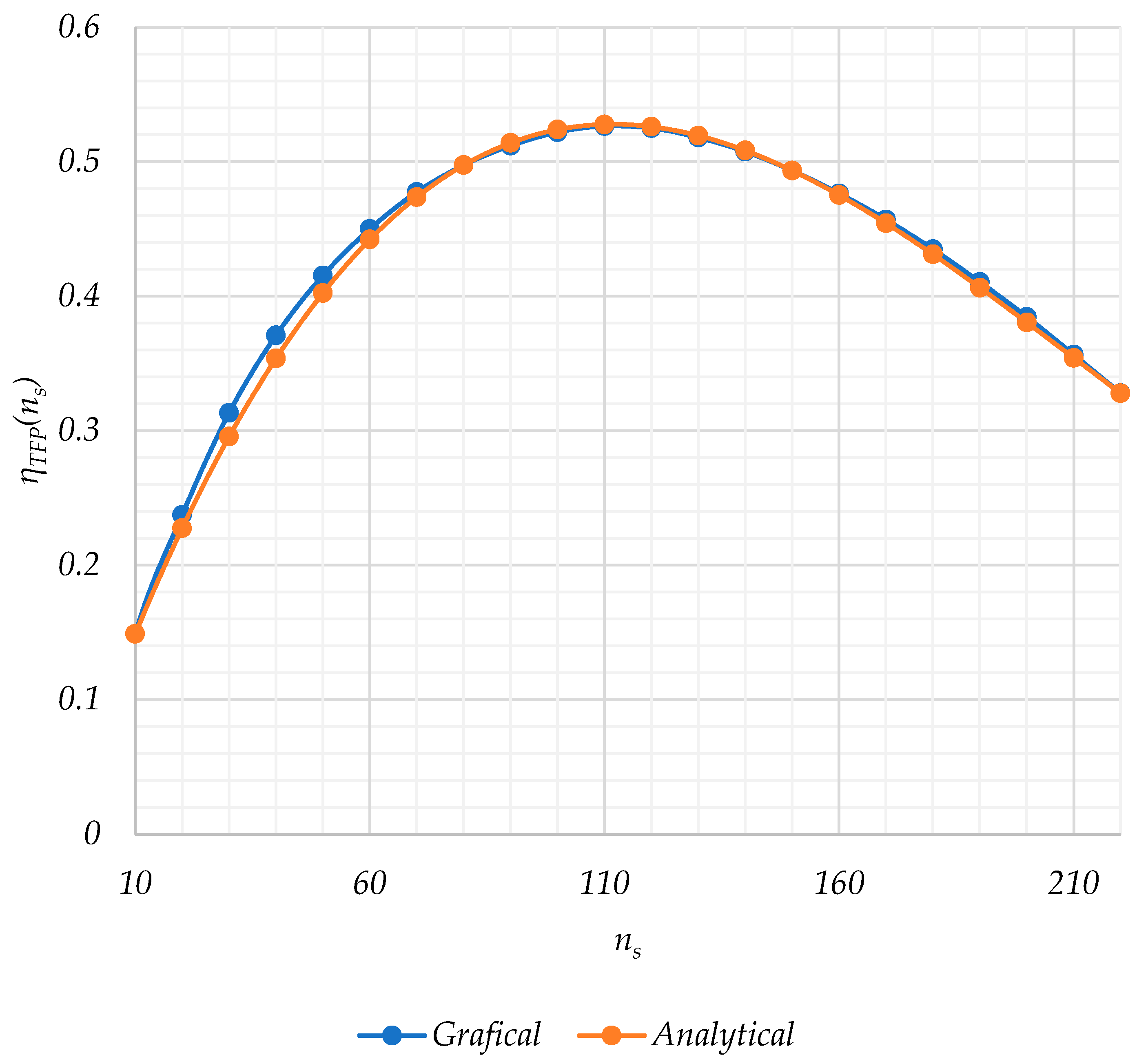


| Specific Speed, ns | Efficiency of the Torque-Flow Pump, η | Difference (Dimensionless) | Relative Difference, % | |
|---|---|---|---|---|
| Graphical Method | Lagrange Interpolation (7) | |||
| 0 | 0 | 0.0593 | 0.0593 | - |
| 10 | 0.149 | 0.1490 | 0 | 0 |
| 20 | 0.2375 | 0.2276 | –0.0099 | –4.2 |
| 30 | 0.3133 | 0.2957 | –0.0176 | –5.6 |
| 40 | 0.3710 | 0.3538 | –0.0172 | –4.6 |
| 50 | 0.4155 | 0.4024 | –0.0131 | –3.1 |
| 60 | 0.4500 | 0.4422 | –0.0078 | –1.7 |
| 70 | 0.4775 | 0.4737 | –0.0038 | –0.8 |
| 80 | 0.4975 | 0.4975 | 0 | 0 |
| 90 | 0.5120 | 0.5140 | 0.0020 | 0.4 |
| 100 | 0.5220 | 0.5240 | 0.0020 | 0.4 |
| 110 | 0.5265 | 0.5278 | 0.0013 | 0.2 |
| 120 | 0.5250 | 0.5261 | 0.0011 | 0.2 |
| 130 | 0.5180 | 0.5195 | 0.0015 | 0.3 |
| 140 | 0.5075 | 0.5084 | 0.0009 | 0.2 |
| 150 | 0.4935 | 0.4935 | 0 | 0 |
| 160 | 0.4765 | 0.4753 | –0.0012 | –0.3 |
| 170 | 0.4570 | 0.4543 | –0.0027 | –0.6 |
| 180 | 0.4350 | 0.4312 | –0.0038 | –0.9 |
| 190 | 0.4106 | 0.4064 | –0.0042 | –1.0 |
| 200 | 0.3847 | 0.3806 | –0.0041 | –1.1 |
| 210 | 0.3565 | 0.3542 | –0.0023 | –0.6 |
| 220 | 0.32 | 0.3279 | 0 | 0 |
| Specific Speed, ns | Efficiency of the Torque-Flow Pump, η | Difference (Dimensionless) | Relative Difference, % | |
|---|---|---|---|---|
| Graphical Method | Lagrange Interpolation (8) | |||
| 10 | 0.578 | 0.578 | 0 | 0 |
| 20 | 0.681 | 0.626 | –0.055 | –8.1 |
| 30 | 0.719 | 0.667 | –0.052 | –7.2 |
| 40 | 0.745 | 0.703 | –0.043 | –5.7 |
| 50 | 0.762 | 0.732 | –0.029 | –3.9 |
| 60 | 0.774 | 0.757 | –0.017 | –2.3 |
| 70 | 0.784 | 0.776 | –0.008 | –1.0 |
| 80 | 0.792 | 0.792 | 0 | 0 |
| 90 | 0.798 | 0.803 | 0.005 | 0.6 |
| 100 | 0.803 | 0.812 | 0.008 | 1.0 |
| 110 | 0.808 | 0.817 | 0.009 | 1.1 |
| 120 | 0.812 | 0.820 | 0.008 | 1.0 |
| 130 | 0.816 | 0.822 | 0.006 | 0.8 |
| 140 | 0.819 | 0.822 | 0.004 | 0.4 |
| 150 | 0.822 | 0.822 | 0 | 0 |
| 160 | 0.824 | 0.821 | –0.003 | –0.4 |
| 170 | 0.827 | 0.820 | –0.007 | –0.8 |
| 180 | 0.829 | 0.820 | –0.009 | –1.1 |
| 190 | 0.831 | 0.821 | –0.010 | –1.2 |
| 200 | 0.833 | 0.824 | –0.009 | –1.1 |
| 210 | 0.834 | 0.829 | –0.006 | –0.7 |
| 220 | 0.836 | 0.836 | 0 | 0 |
| Specific Speed, ns | Efficiency of the Vortex Operating Process, ηOP | |
|---|---|---|
| Not Including ηV BP (4) | Including ηV BP (5) | |
| 0 | 0.297 | 0.341 |
| 10 | 0.364 | 0.397 |
| 20 | 0.443 | 0.475 |
| 30 | 0.504 | 0.533 |
| 40 | 0.550 | 0.577 |
| 50 | 0.585 | 0.611 |
| 60 | 0.610 | 0.635 |
| 70 | 0.629 | 0.652 |
| 80 | 0.640 | 0.662 |
| 90 | 0.646 | 0.666 |
| 100 | 0.646 | 0.665 |
| 110 | 0.641 | 0.659 |
| 120 | 0.632 | 0.649 |
| 130 | 0.618 | 0.634 |
| 140 | 0.601 | 0.615 |
| 150 | 0.579 | 0.592 |
| 160 | 0.554 | 0.566 |
| 170 | 0.526 | 0.537 |
| 180 | 0.495 | 0.505 |
| 190 | 0.462 | 0.471 |
| 200 | 0.428 | 0.436 |
| 210 | 0.297 | 0.341 |
| 220 | 0.364 | 0.397 |
Disclaimer/Publisher’s Note: The statements, opinions and data contained in all publications are solely those of the individual author(s) and contributor(s) and not of MDPI and/or the editor(s). MDPI and/or the editor(s) disclaim responsibility for any injury to people or property resulting from any ideas, methods, instructions or products referred to in the content. |
© 2025 by the authors. Licensee MDPI, Basel, Switzerland. This article is an open access article distributed under the terms and conditions of the Creative Commons Attribution (CC BY) license (https://creativecommons.org/licenses/by/4.0/).
Share and Cite
Kondus, V.; Pavlenko, I.; Ochowiak, M.; Krupińska, A.; Matuszak, M.; Włodarczak, S. Interpolation-Based Evaluation and Prediction of Vortex Efficiency in Torque-Flow Pumps. Appl. Sci. 2025, 15, 12395. https://doi.org/10.3390/app152312395
Kondus V, Pavlenko I, Ochowiak M, Krupińska A, Matuszak M, Włodarczak S. Interpolation-Based Evaluation and Prediction of Vortex Efficiency in Torque-Flow Pumps. Applied Sciences. 2025; 15(23):12395. https://doi.org/10.3390/app152312395
Chicago/Turabian StyleKondus, Vladyslav, Ivan Pavlenko, Marek Ochowiak, Andżelika Krupińska, Magdalena Matuszak, and Sylwia Włodarczak. 2025. "Interpolation-Based Evaluation and Prediction of Vortex Efficiency in Torque-Flow Pumps" Applied Sciences 15, no. 23: 12395. https://doi.org/10.3390/app152312395
APA StyleKondus, V., Pavlenko, I., Ochowiak, M., Krupińska, A., Matuszak, M., & Włodarczak, S. (2025). Interpolation-Based Evaluation and Prediction of Vortex Efficiency in Torque-Flow Pumps. Applied Sciences, 15(23), 12395. https://doi.org/10.3390/app152312395