Article

Crosswind-Induced Hazards of Railway Bridge Auxiliary Fixtures: An IDDES Study on Walkway Slabs and Cable Troughs

1
Key Laboratory of Traffic Safety on Track of Ministry of Education, School of Traffic & Transportation Engineering, Central South University, Changsha 410075, China
2
The State Key Laboratory of Heavy-Duty and Express High-Power Electric Locomotive, Central South University, Changsha 410075, China
3
Key Laboratory of Railway Industry of Aerodynamics, Central South University, Changsha 410075, China
4
Institute of Science & Technology, China Railway Urumqi Group Co., Ltd., Urumqi 830011, China
*
Author to whom correspondence should be addressed.
Appl. Sci. 2025, 15(22), 12104; https://doi.org/10.3390/app152212104
Submission received: 10 October 2025 / Revised: 6 November 2025 / Accepted: 11 November 2025 / Published: 14 November 2025
(This article belongs to the Special Issue Rail Transport Aerodynamics)

Abstract

This study presents a comprehensive numerical investigation into the aerodynamic behavior of pedestrian walkway slabs and cable troughs mounted on high-speed railway bridges under crosswind conditions. Using a full-scale T-beam bridge model with auxiliary components, unsteady flow simulations were performed employing the Improved Delayed Detached-Eddy Simulation (IDDES) approach coupled with the Shear Stress Transport (SST) k-ω turbulence model. Both steady and unsteady flow fields were examined to characterize velocity and pressure distributions, vortex shedding mechanisms, and aerodynamic force responses over a range of attack angles (α = –20° to +20°), yaw angles (β = 0° to 60°), and wind speeds (20–40 m/s). Results reveal that vortex-induced oscillations dominate at negative attack angles, while high positive angles suppress shedding and widen spectral energy. Spanwise flow effects persist across large yaw angles, maintaining consistent wake patterns but with reduced magnitudes. Aerodynamic coefficients of lift on slabs and troughs peak near α = 0°, with failure wind speeds computed at approximately 35 m/s for slabs and 22 m/s for troughs. Based on these findings, design recommendations are proposed to mitigate uplift and vibration risks in auxiliary bridge fixtures under extreme wind conditions. This work advances the assessment of crosswind safety for railways by incorporating the indirect effects of line-side structures on train operations, providing a basis for defining critical wind speed thresholds for railway bridge safety.

1. Introduction

With the rapid development of China’s railway system, the operational speed of high-speed trains has increased significantly, and the service network has expanded across diverse regions, from the eastern coastal areas to the inland provinces such as Xinjiang [1]. The combination of complex and variable environmental conditions and elevated train speeds places more stringent demands on operational safety and structural integrity [2,3,4]. To meet these challenges—particularly in regions characterized by harsh environments and complex terrain—extensive construction of railway bridges is required to ensure that track gradients and curve radii remain within the limits specified by design standards [5].
As critical nodes within high-speed railway networks, railway bridges are structurally more vulnerable to aerodynamic disturbances compared to ground-level tracks and embankments due to their relatively low deck stiffness (see Figure 1) [6,7,8]. This vulnerability is further exacerbated when trains cross elevated viaducts supported by tall piers, which are often situated in valleys frequently subjected to strong and persistent crosswinds that directly impact the moving trains [9,10]. In addition, the inherently high length-to-height ratio of high-speed trains significantly compromises their aerodynamic stability under crosswind conditions, particularly for the leading car, which is most exposed to lateral wind loads [11].
Railway bridges come in a variety of structural forms. In addition to the common beam bridges, arch bridges and cable-stayed bridges may include trusses, cables and other elements; these configurations alter the organization of the flow field, affect the environmental characteristics experienced by passing trains, and thus influence their aerodynamic performance. Cable-stayed bridges typically employ a semi-floating system and exhibit high structural flexibility, making them prone to large deformations under wind loads [12]. Due to differences in deck structure, the mean wind speed, turbulence intensity and turbulence integral length along the span display marked spatial non-uniformity: the mean wind speed at the side spans of the main girder is lower than that at mid-span, while the turbulence intensity is higher. Consequently, the aerodynamic forces acting on a train traversing a real canyon bridge can be considerably more complex [13].
The vehicle–bridge coupling effect leads to markedly different aerodynamic responses [14,15,16]. It has been observed that when trains operate on truss-equipped railway bridges, the lateral force decreases with increasing wind speed, suggesting a deviation from the expected quadratic relationship—likely due to the shielding effect of the truss members [17]. Additionally, the presence of trusses affects how aerodynamic coefficients vary with yaw angle under combined wind conditions [18]. Similarly, when trains pass by bridge towers at high speed, the sudden blockage caused by the towers results in rapid unloading and reloading of wind forces on each train car [19]. Bridge deck cross-sections also play a critical role: wedge-shaped girders, for instance, have been shown to aggravate unfavorable aerodynamic effects on trains under crosswind conditions [20]. Suzuki et al. [21] investigated the aerodynamic responses of four types of rolling stock on three different bridge configurations. Their results indicated that trains running on the windward track of a double-track bridge experienced significantly higher lateral aerodynamic loads compared to those on the leeward side, with single-track bridges exhibiting intermediate behavior. Furthermore, the lateral dynamic response of both the train and bridge becomes more pronounced during crosswind bridge crossings. While lateral displacements of the bridge are primarily wind-induced, vertical displacements and vertical accelerations are largely driven by train motion. As a result, while vertical ride comfort typically remains within acceptable limits, lateral ride comfort may be compromised under windy conditions [22,23].
As a critical part of the railway line, high-speed train bridges are prone under crosswind conditions to incidents such as overhead contact line detachment, ballast splashing, and floor panel detachment. Due to the pantograph’s complex three-dimensional geometry, structural characteristics, and its interaction with the flexible overhead contact line, strong winds can lead to significant variations in the contact force between the pantograph and the catenary system [24]. Such variations may cause the contact force to fall outside the acceptable safety range, potentially compromising current collection performance. The presence of lateral winds intensifies catenary oscillations, while aerodynamic lift can further disrupt the contact interface by inducing relative displacement between the pantograph and the overhead line. Excessive relative motion may ultimately result in pantograph-catenary detachment [25].
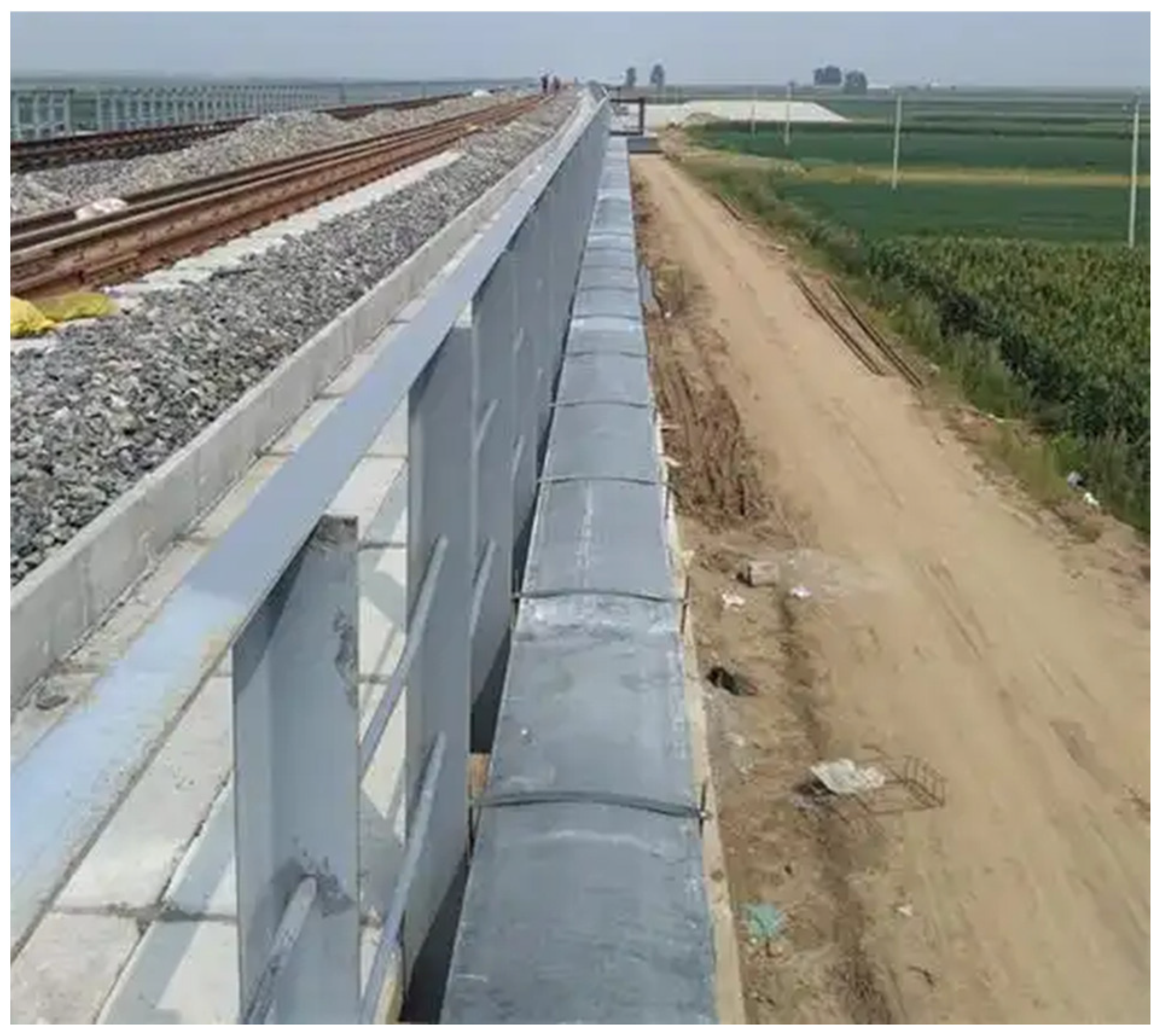
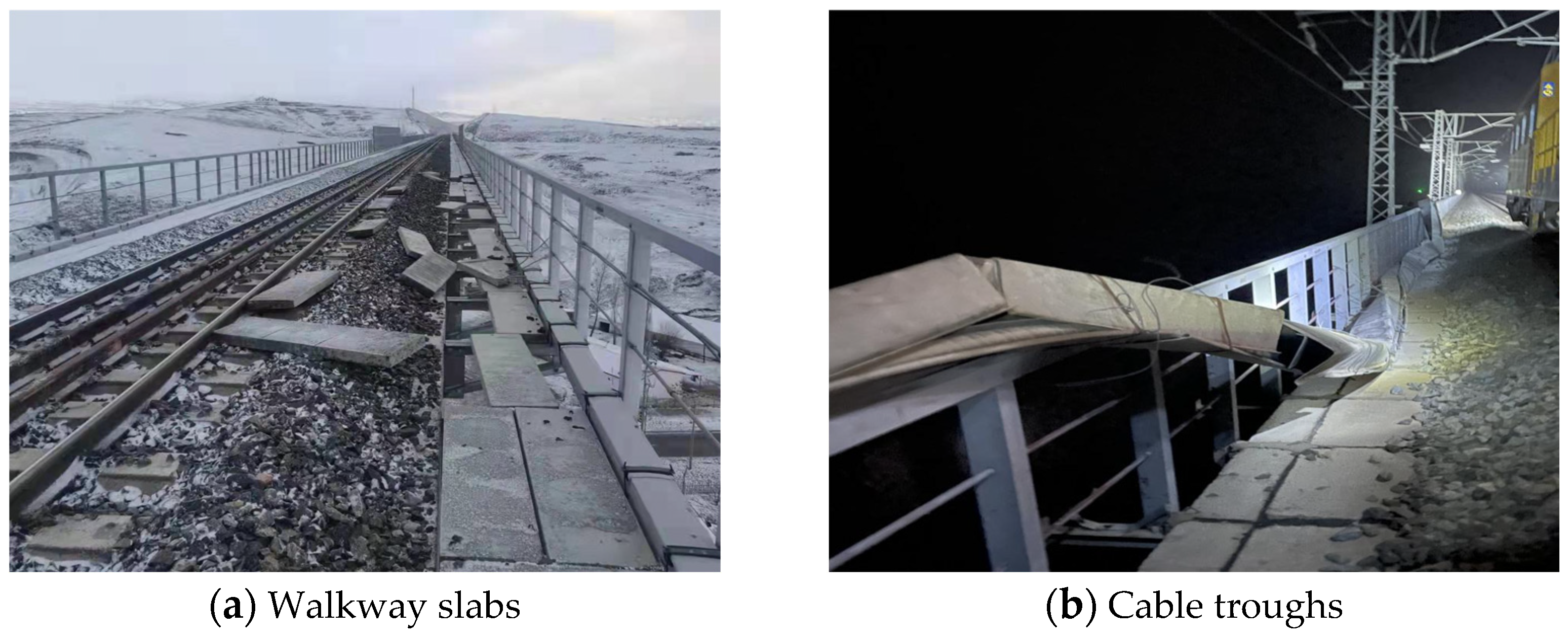
Under crosswind conditions, not only do high-speed trains experience severe aerodynamic loads, but the safety and reliability of bridge-mounted auxiliary components are also directly affected [26]. In China, typical auxiliary facilities installed on railway bridge decks include cable troughs, cover plates, shading panels, railings, and noise barriers [27]. Traditionally, walkway slabs have been constructed using conventional reinforced concrete slabs [28]. However, these slabs are prone to degradation and fracture, posing serious safety risks and being difficult to replace. As a result, rubber-based walkway slabs have been increasingly adopted, and various types of composite walkway slabs are currently being trialed [29]. Nevertheless, in strong wind environments, these walkway slabs are susceptible to aerodynamic lift. Due to their lightweight construction and weakly constrained installation, the slabs are more prone to being dislodged or uplifted, representing a significant falling-object hazard (see Figure 2a). More critically, these auxiliary components often carry multiple types of functional loads. For example, cable troughs (Figure 2b) must support the self-weight and tension of high-voltage cables, while walkway panels may be subjected to pedestrian-induced dynamic loads. These mechanical demands lead to complex multi-physics interactions. Under extreme conditions, such coupling can trigger dynamic instabilities or even cascading failures. Therefore, from a bridge safety perspective, it is essential to investigate the aerodynamic loads acting on auxiliary facilities under crosswind conditions.
Research on crosswind effects in rail transport has largely centered on the direct impact of wind on running safety, particularly the stability of trains crossing bridges under strong lateral winds [10]. However, crosswind safety is a broader, system-level issue that also includes indirect effects arising from wind-induced disturbances along the railway line. Among these, the aerodynamic response of trackside and bridge-mounted auxiliary structures can influence operational safety but has received limited attention in existing studies.
This study focuses on railway bridge auxiliary structures to evaluate their aerodynamic stability and determine the critical wind conditions under which they may endanger train operation. To this end, we conduct a detailed investigation of the aerodynamic behavior of bridge-mounted components subjected to crosswinds. The Section 2 first introduces the geometric models used in the numerical simulations, followed by a detailed description of the computational domain and boundary conditions. Mesh parameters, numerical schemes, and the selected turbulence model are also discussed. In Section 3, both steady and unsteady flow characteristics are examined to reveal the spatial development of the flow field. The aerodynamic responses of walkway slabs and cable troughs are analyzed in detail. Finally, engineering recommendations are proposed based on the findings to enhance the safety and reliability of bridge auxiliary systems. The primary contribution of this study is a more comprehensive assessment of railway crosswind safety that accounts for the indirect aerodynamic influence of line-side structures—providing a foundation for defining critical wind speed thresholds for railway operations.
Although bridge appendages often appear geometrically simple—somewhat resembling square columns whose flows have been extensively studied—their aerodynamic behavior can be complex. The aspect ratio of such elements can significantly alter flow topology, leading to distinct vortex structures and pressure distributions. Moreover, auxiliary components are often positioned within the wakes of other structures, creating additional flow interference effects. Therefore, idealized models based on isolated square columns cannot adequately predict the flow characteristics around bridges and their auxiliary fixtures. This study thus contributes to a more realistic understanding of wind–structure interactions on railway bridges.

2. Methods

This study investigates the crosswind safety of railway bridge ancillary structures, specifically walkway slabs and cable troughs. The primary approach involves numerical simulations to evaluate the aerodynamic forces acting on these components, with particular emphasis on the lift variations under different angles of attack and yaw angles. These simulations also provide detailed predictions of the surrounding velocity and pressure fields, enabling the identification of critical flow features that influence structural response. Based on the simulation results, potential design optimizations are proposed to enhance the aerodynamic stability of the ancillary structures. The overall simulation workflow is illustrated in Figure 3.

2.1. Bridge Model

Figure 4a,b present the T-beam bridge model used in this study. The construction height, defined as the vertical distance from the top of rail to the lowest point of the bridge span structure is 3.35 m.
The bridge is equipped with walkway slabs on both the windward and leeward sides of the T-beam flange. On each side, two walking boards are installed: the one adjacent to the flange is referred to as the inner walkway slab, and the one farther from the flange as the outer walkway slab. Each walkway slab measures 1580 mm in length, 400 mm in width, and 80 mm in thickness. A 12 mm gap separates the inner walkway slab from the flange itself, and another 12 mm gap separates the inner the outer walkway slabs. For simplification, supporting structures beneath the walkway slabs are not included in the model.
Cable troughs are positioned on both the windward and leeward sides of the bridge. Each cabinet measures 4000 mm in length, 460 mm in width, and 270 mm in height, and is spaced 66 mm from the adjacent outer walkway slab. As with the walkway slabs, support members for the cabinets are omitted in the simulation. Taking into account the walkway slabs and cable troughs, the total width of the bridge reaches 7.6 m.
In the simulation, aerodynamic forces are monitored only on six components: the four walkway slabs labeled in red in Figure 4b (windward outer, windward inner, leeward inner, and leeward outer) and the two cable troughs labeled in blue (windward and leeward). Forces on any additional walkway slabs or cable troughs are not considered in the analysis.

2.2. Computational Domain and Boundary Conditions

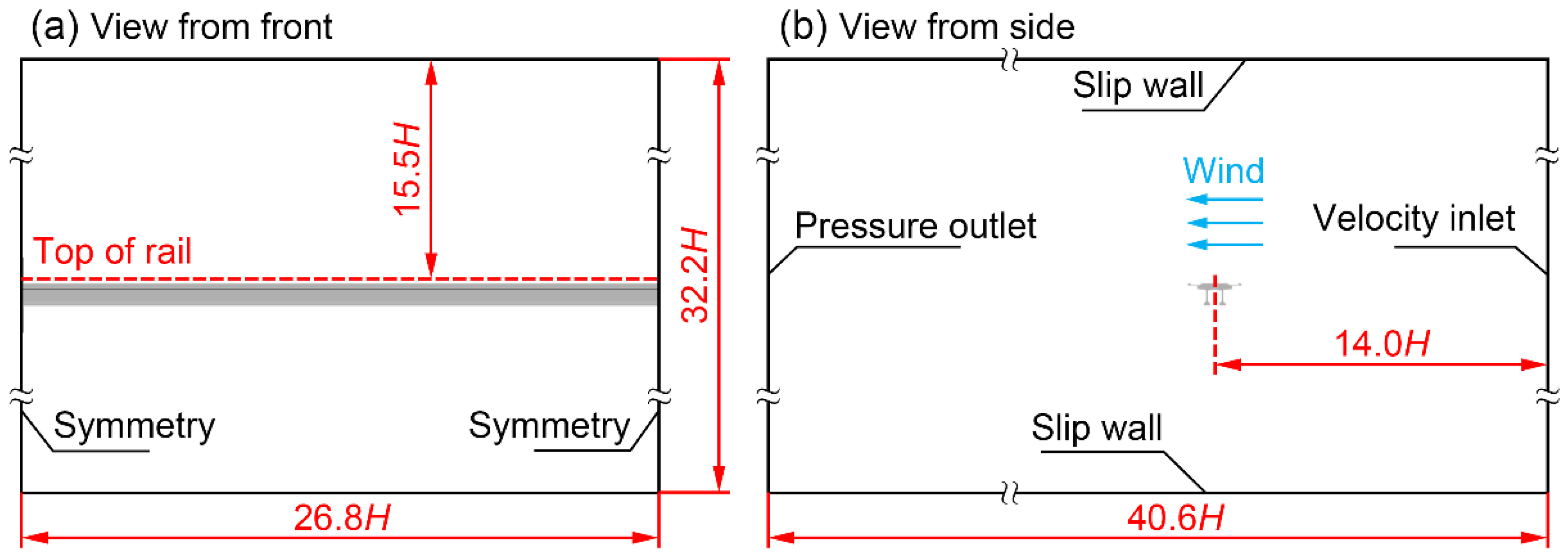
Figure 5 illustrates the computational domain and boundary conditions, where H represents the construction height of the bridge (H = 3.35 m). All model dimensions are at full scale.
The computational domain extends 14.0H upstream and 26.6H downstream from the bridge, yielding a total streamwise length of 40.6H. Vertically, the domain is 32.2H high, with the bridge positioned approximately at mid-height to minimize the influence of the top and bottom boundaries on the flow field. These domain extents are designed in accordance with the European Standard [30] to avoid artificial interference with the flow around the bridge.
At the inlet, a uniform velocity profile is applied. A constant-pressure condition is imposed at the outlet. The bridge surfaces are modeled as no-slip walls, with the top and bottom boundaries are treated as slip walls.
This study investigates the aerodynamic behavior of auxiliary components on railway bridges under five wind attack angles (−20°, −10°, 0°, 10°, and 20°) and three yaw angles (0°, 30°, and 60°). For the case with a yaw angle of 0°, symmetry boundary conditions are applied to the lateral (side) boundaries.
It is important to note that the objective of this work is to obtain generalized aerodynamic characteristics of bridge auxiliary components, rather than to simulate a specific bridge height or site condition. Therefore, the bridge model is placed at mid-height within the computational domain, and the effects of the atmospheric boundary layer are not considered.
The Reynolds number, based on the incoming flow velocity and the construction height of the bridge (3.35 m), is calculated as 6.8 × 10⁶. This value satisfies the requirements specified in the European Standard [30]. Additionally, verification tests confirm that the simulation results are nearly independent of the Reynolds number (see Aerodynamic Characteristic Analysis section).

2.3. Computational Mesh

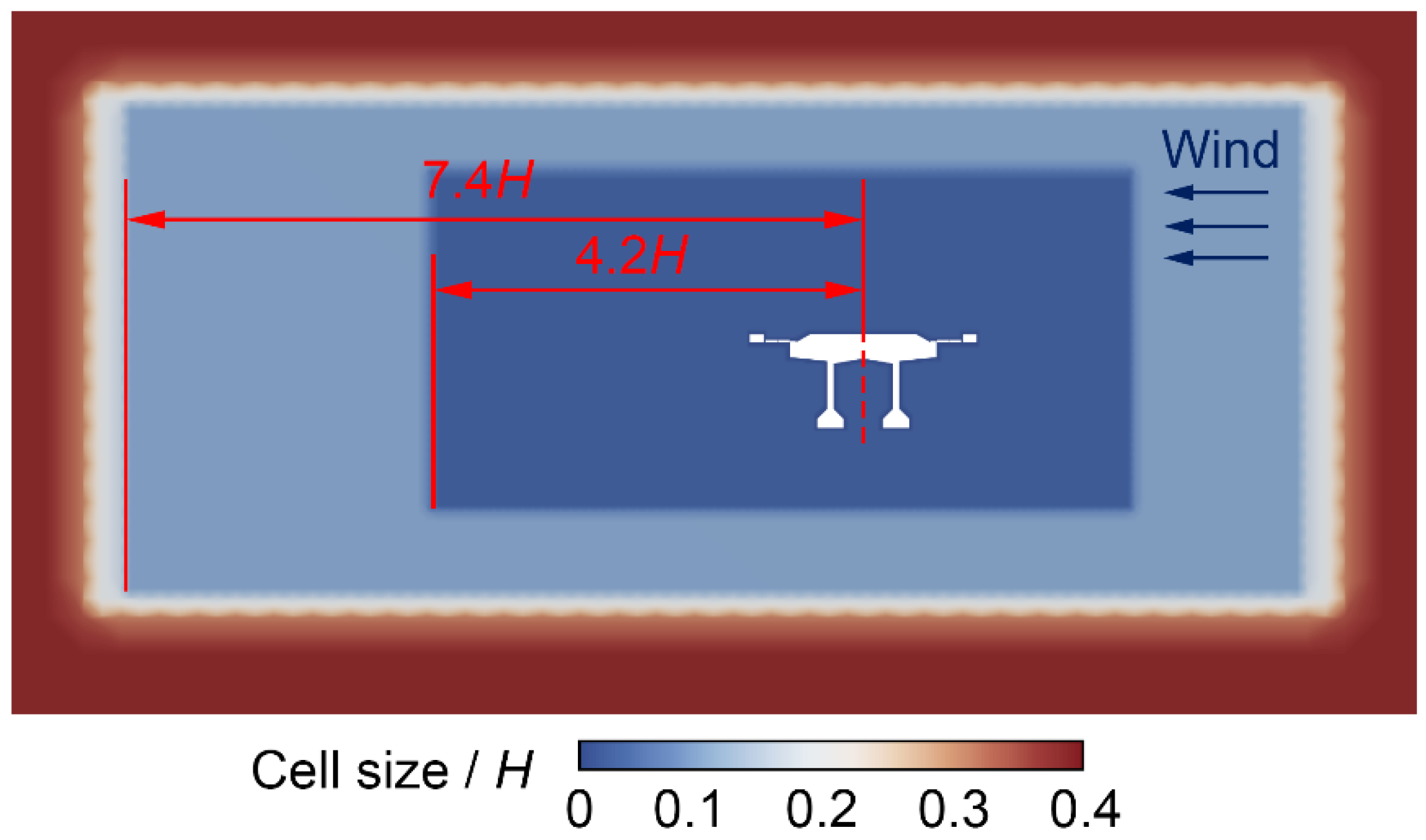
The computational mesh is composed of trimmed cells and prismatic layers. To accurately resolve near-wall flow behavior, ten layers of prismatic cell are applied adjacent to the bridge surfaces. A uniform surface mesh size of 0.02 m is used on all bridge components to ensure sufficient resolution of flow features around small-scale auxiliary structures. Figure 6 illustrates the cell size and distribution.
The mesh contains approximately 132 million cells in total. Two levels of mesh refinement are applied in regions with high pressure or velocity gradients. This ensures accurate resolution of key flow features such as boundary layers, vortices, stagnation zones, recirculation regions, wake development, and flow acceleration. The mesh design meets the requirements specified in the European Standard [30].
Mesh independency for this bridge model has been verified in our previous work [31].

2.4. Computational Method and Turbulence Modeling

Fluid motion is governed by the fundamental laws of conservation of mass and momentum. These physical principles are expressed mathematically by the continuity and Navier–Stokes equations:
ρ t + x i ρ u i = 0
t ρ u i + x j ρ u i u j = p x i + x j τ i j
where ρ is the air density, t is time, and ui (i = 1, 2, 3) represents the velocity components in the xi directions. Here, p denotes pressure, and τij is the viscous stress tensor arising from molecular viscosity.
The simulations employ the Improved Delayed Detached-Eddy Simulation (IDDES) approach, as proposed by Shur et al. [32]. This method effectively captures unsteady, three-dimensional, viscous, and turbulent flow, including regions with strong separation. IDDES provides a balance between accuracy and computational efficiency, outperforming similar hybrid models in predicting separated and recirculating flows while maintaining robustness and ease of implementation [32]. Previous studies [33] by the authors have verified the predictive capability of this method by comparing numerical results with wind tunnel measurements of aerodynamic forces on trains under crosswind conditions.
Turbulence is modeled using the shear stress transport (SST) k-ω model developed by Menter [34]. This model combines the advantages of the k-ω formulation in resolving near-wall boundary layers with the strengths of the k-ε model in capturing free shear flow and separation [35]. It is particularly suited for simulations involving complex flow structures and strong separation [36].
The formulation of the IDDES turbulence model is expressed as follows:
t ρ k + x j ρ u j k = x j μ + μ t σ k x j + τ i j S i j ρ k 3 / 2 l RANS   or   l HYBRID
where k is the turbulent kinetic energy, μ is the dynamic viscosity, μt is the turbulent viscosity, σ is an empirical constant, and Sij is the mean strain rate. The turbulence length scales lRANS and lHYBRID correspond to the RANS and IDDES regions, respectively, and are defined differently depending on the local flow conditions.
The transition between the RANS and LES regions is achieved by continuously varying the eddy viscosity based on the characteristic length scale, using the following blending function [37]:
ϕ HS = γ ϕ SOU + 1 γ ϕ BCD
where ϕSOU and ϕBCD denote variable values computed by the second-order upwind and bounded central differencing (BCD) schemes, respectively, and ϕHS is the blended value. The blending coefficient γ is an empirical function controlling the transition between schemes. In regions dominated by RANS behavior (γ ≈ 1), the solution follows the second-order upwind scheme, while in LES regions (γ ≈ 0), the BCD scheme prevails. The transition between the two occurs smoothly as γ varies between 0 and 1.
The suitability of this numerical approach has been validated in our previous work [31] by comparing simulation results with wind tunnel measurements. Additionally, earlier studies [38,39,40] have successfully applied the IDDES method with the SST k-ω turbulence model to investigate the aerodynamic effects of bridge accessory structures and trains, consistently yielding reliable results. A time step of 0.001 s is used in the simulations, with a second-order temporal scheme applied, ensuring a Courant number below 1 to maintain numerical stability and temporal accuracy.
Table 1 summarizes the key simulation parameters employed in this work.

3. Results and Discussion

3.1. Overall Flow Characteristics

This section first focuses on the overall flow field characteristics of the bridge. Starting from the steady-state flow behavior, the analysis clarifies the distributions of velocity and pressure, as well as aerodynamic force characteristics under various angles of attack and wind directions. Then, the unsteady features of the flow field are further examined to identify how flow instability affects the overall structural performance of the bridge. Finally, based on the local force characteristics of auxiliary components, a safety assessment is conducted, leading to the identification of aerodynamic performance patterns influenced by the pedestrian walkway slabs and cable troughs.

3.1.1. Time-Averaged Features of Flow Field

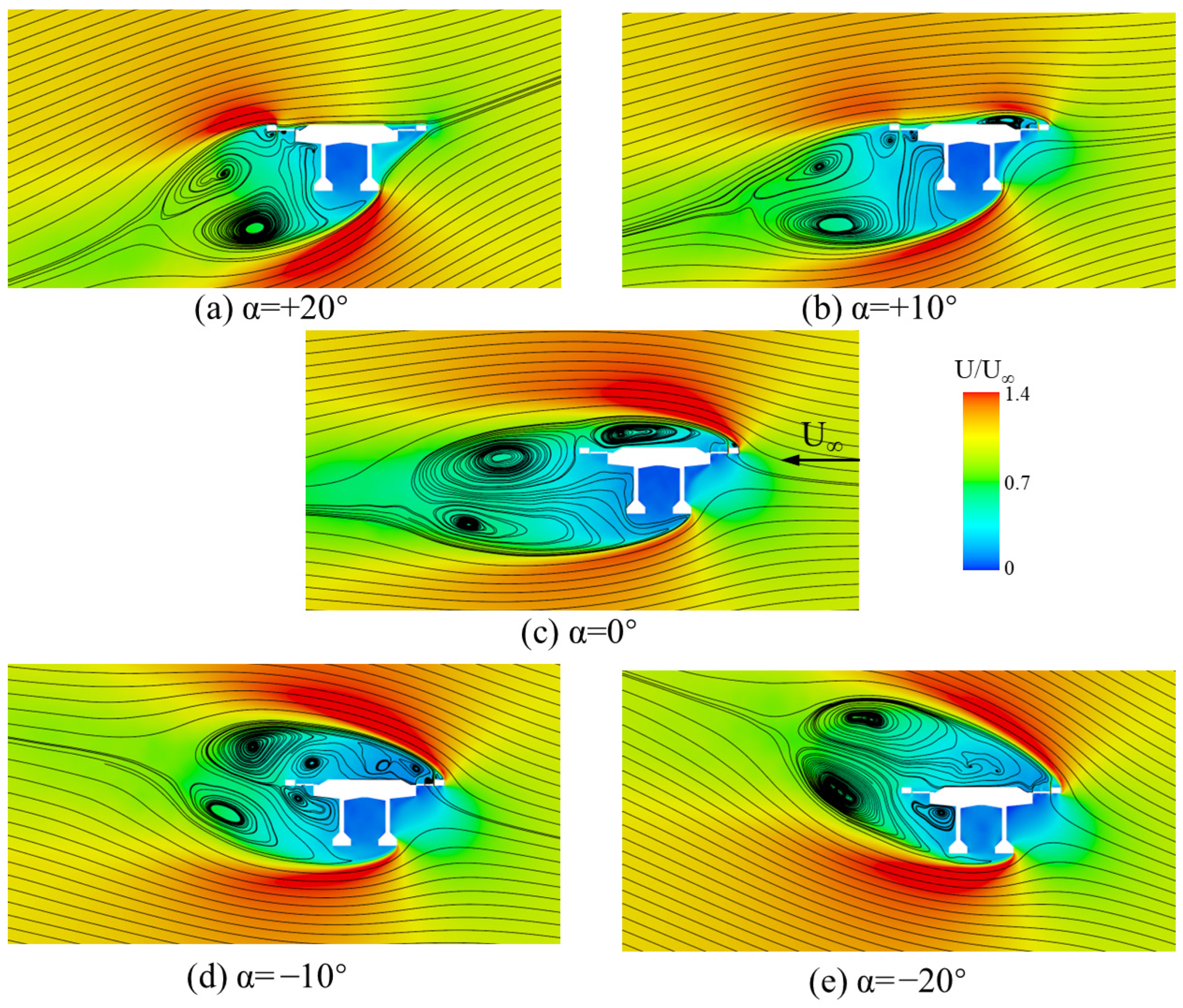
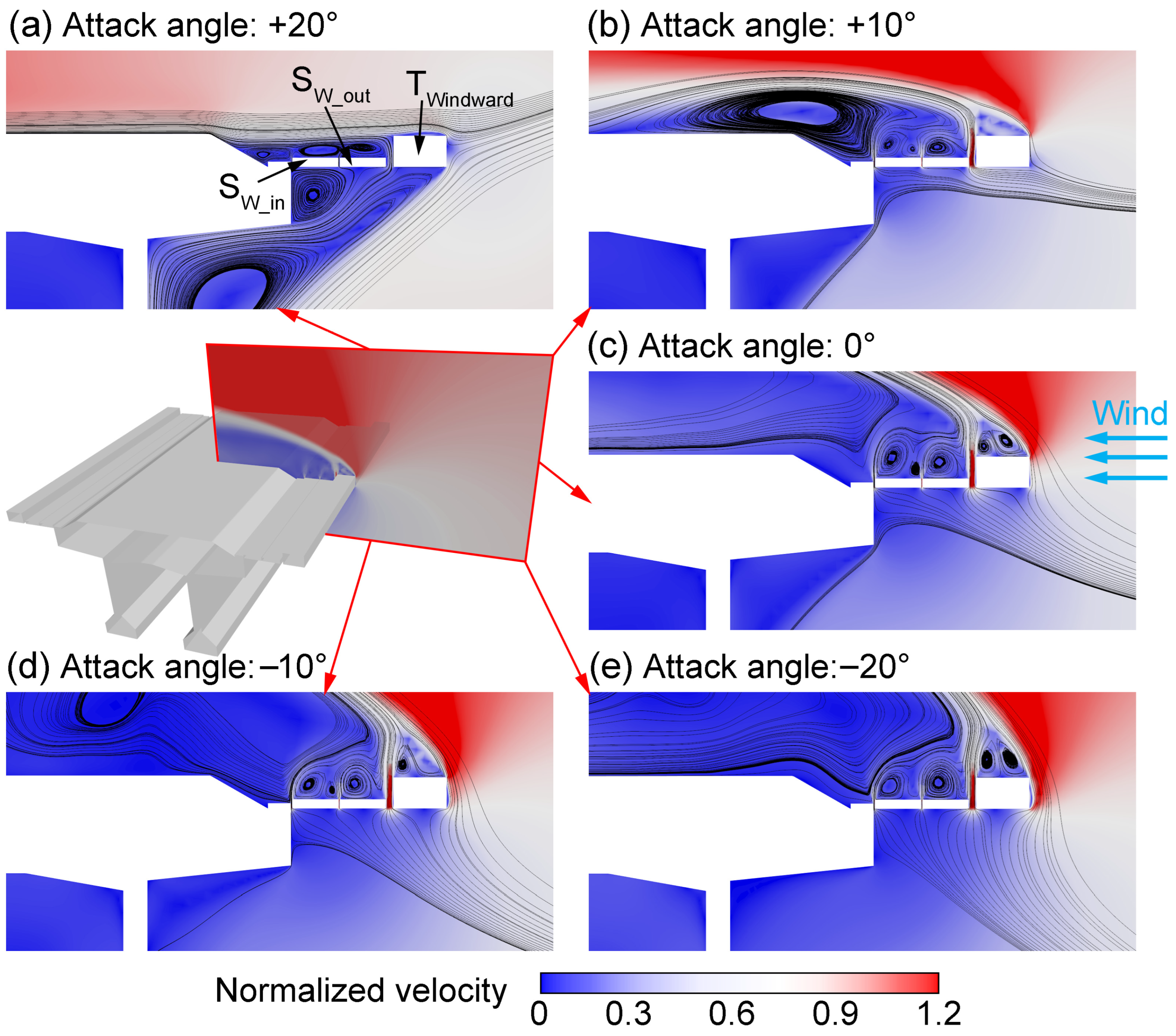
To evaluate the aerodynamic characteristics of the pedestrian walkway slabs and cable troughs on a railway bridge under different angles of attack (α), a study was conducted on the distribution of mean velocity and streamlines around the bridge cross-section under representative attack angles, as shown in Figure 7. Here, α > 0 indicates a downward-sloping wind impinging from above the bridge deck, while α < 0 corresponds to an upward-sloping wind from below. The background color in the figure indicates the velocity magnitude, with the incoming flow direction from right to left. From the figure, it can be observed that the velocity contours (in m/s) and streamlines clearly illustrate the flow structure and its variation. As the angle of attack α decreases, significant changes occur in the upstream and downstream flow fields around the bridge. At α = +20° and +10°, as shown in Figure 7a,b, the airflow exhibits no significant separation at the leading edge compared to the other three cases. This allows the flow to remain attached over the upper surface of the bridge deck. However, at α = 10°, a small separation bubble is present, located near the walkway slab, which may induce local oscillations, while the flow at α = 20° does not show the small bubble. This separation bubble at α = 10° is caused by the relatively high position of the cable trough.
When the angle of attack decreases further (Figure 7d,e), the incoming flow is directed more upward, a noticeable flow separation occurs on the top surface of the bridge. The strong shear layers and near-wall recirculation zones develop above the bridge deck, indicating intensified flow disturbance caused by the auxiliary structures. This can easily induce unstable vortex formations, leading to increased fluctuations in aerodynamic loads on the bridge structure. Indeed, the fluctuation may negatively affect structural fatigue resistance and the stability of the cable troughs. The wake region at α = 0° significantly expands (Figure 7c), particularly beneath the bridge deck. The streamlines become distorted, and sharp velocity gradients appear in localized areas. At α = –10°, multiple small-scale vortices form above the deck, suggesting complex multi-scale vortex interactions that, while transient in nature, appear as averaged features in the time-mean flow field.
The variation in flow separation across attack angles aligns with the numerical findings of Guo et al. [39]. The suction forces generated by the vortices over the bridge deck can reduce the stability of the auxiliary structures, posing potential risks to train operation. Previous studies have primarily focused on the direct aerodynamic effects of crosswinds on moving trains, neglecting the indirect influence of bridge-mounted components. The present work helps address this gap by elucidating how these auxiliary structures contribute to crosswind-induced hazards.
An interesting topological feature appears at α = +10° (Figure 7b), where reattachment occurs above the deck. The small separation bubble at the leading edge destabilizes the flow, making it sensitive to small variations in attack angle—behavior reminiscent of elongated cross-sections.
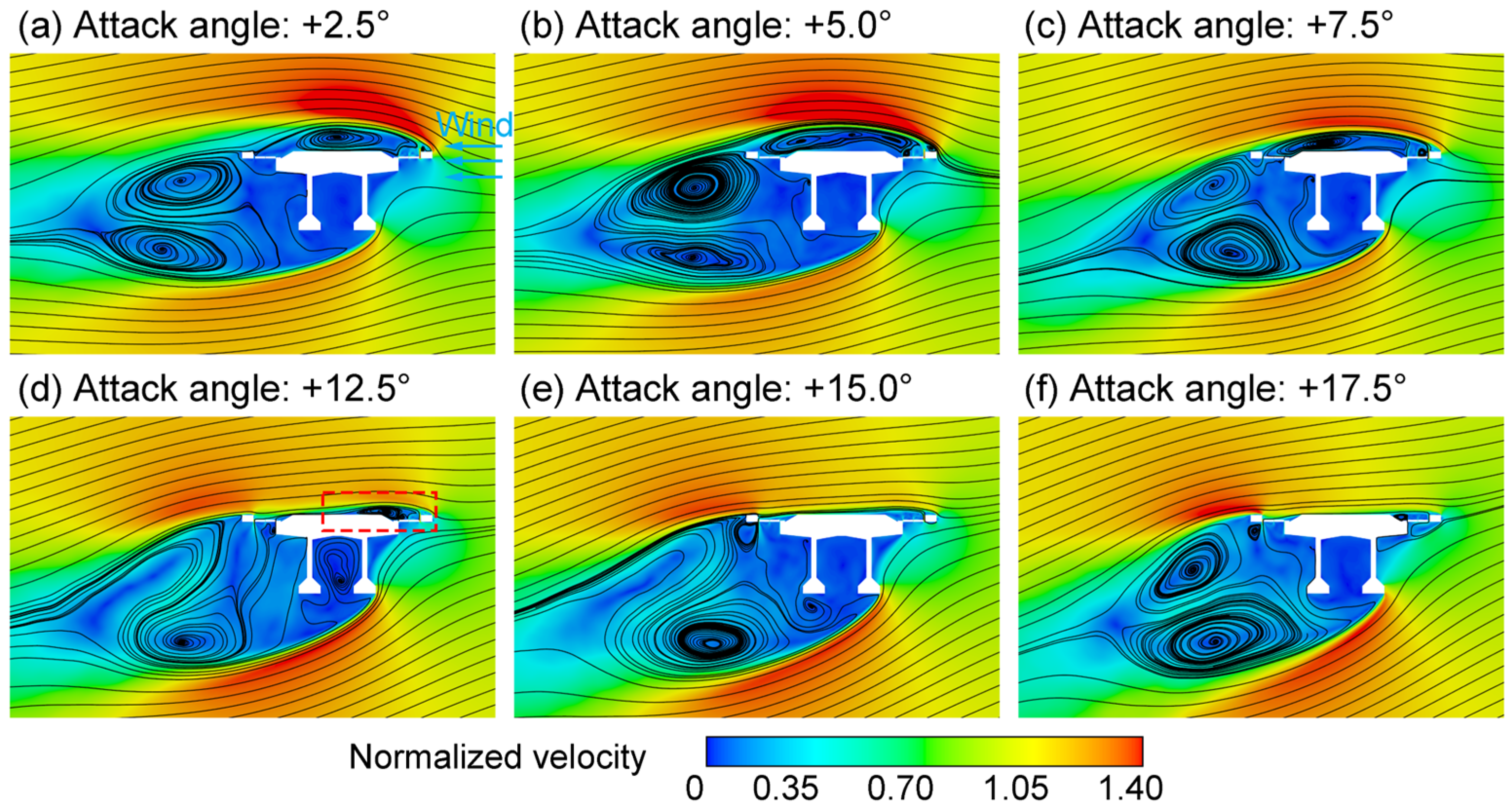
Figure 8 further illustrates the normalized velocity and two-dimensional streamlines on the lateral center plane (y-axis) at additional attack angles. At α = +2.5°, +5°, and +7.5°, the flow topology resembles that at α = 0° (Figure 7c), whereas at α = +12.5° it transitions toward the pattern observed at α = +10° (Figure 7b). Similarly, the flow at α = +15° and +17.5° resembles that at α = +20° (Figure 7a). These comparisons indicate that the threshold attack angle separating the no-reattachment and reattachment topologies lies between 7.5° and 10°, while the transition between the +10° and +20° configurations occurs between 12.5° and 15°. Further investigation is needed to precisely determine these critical thresholds.
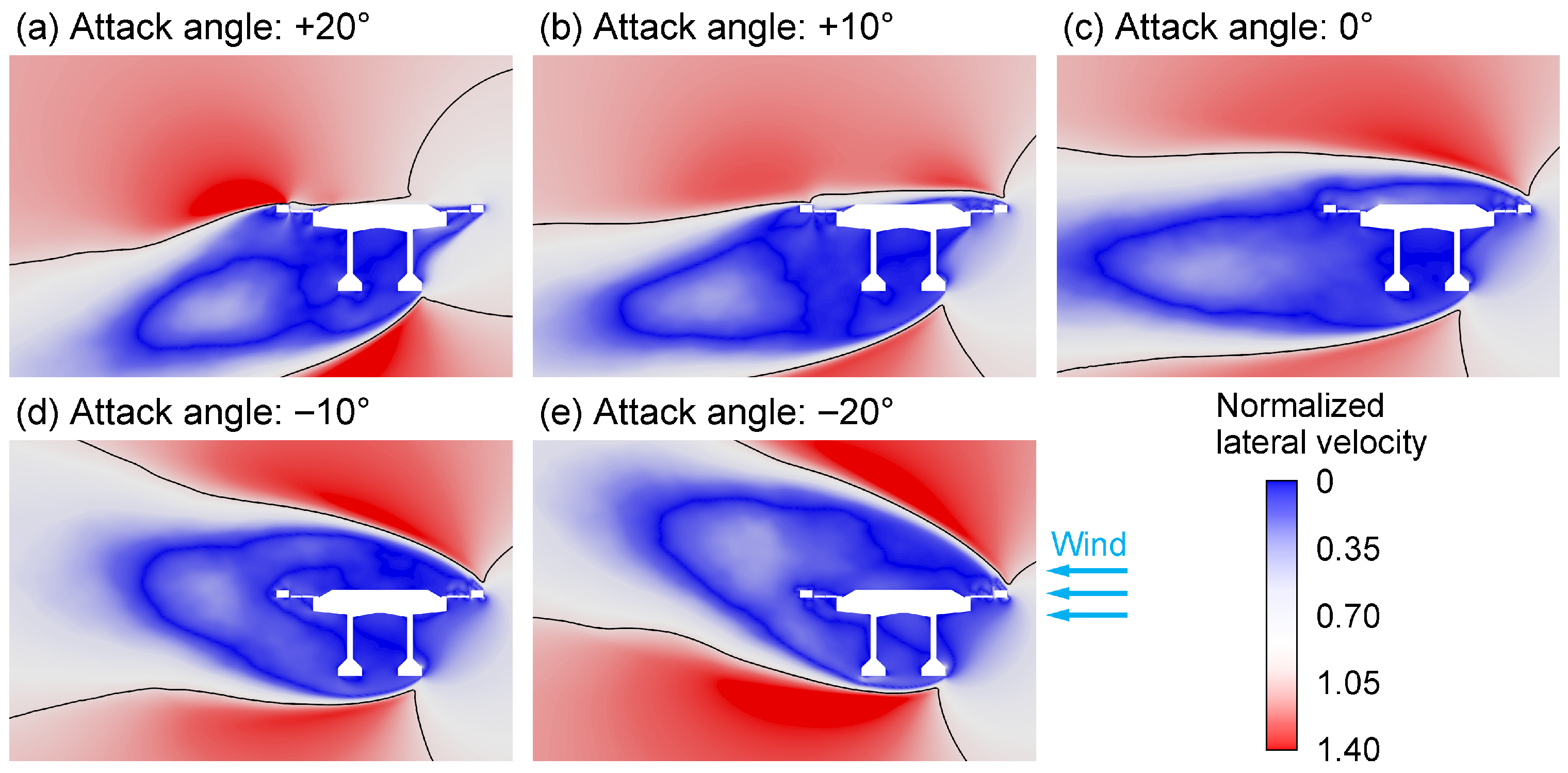
Figure 9 shows the normalized lateral velocity field along the lateral center plane at different attack angles. The black contour lines indicate regions where the normalized velocity equals 0.99, marking the outer edge of the shear layer. As the magnitude of the attack angle decreases, this shear-layer boundary gradually moves away from the deck surface, consistent with the trends observed in Figure 7.
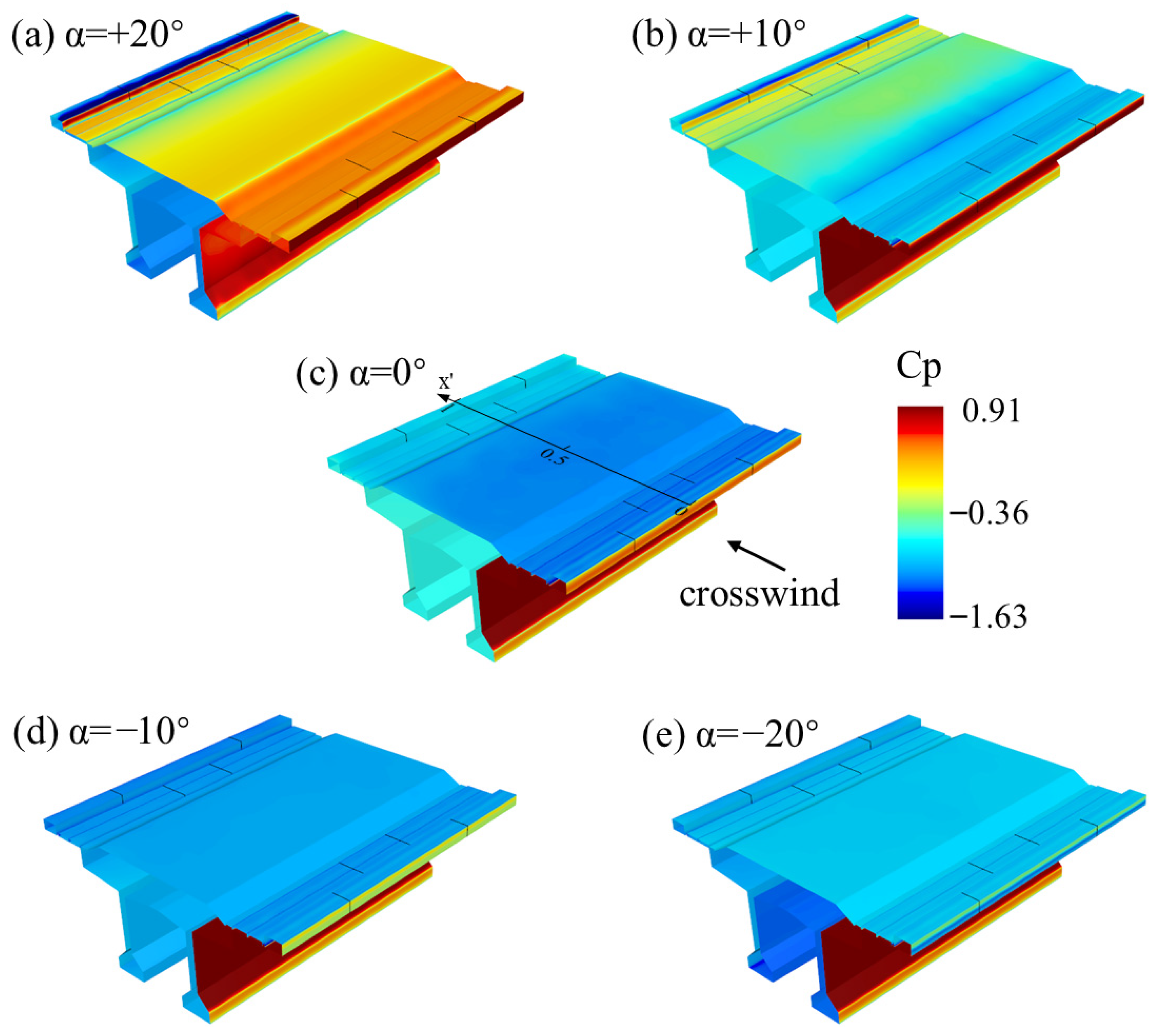
Figure 10 presents the mean surface pressure coefficient (Cp) distributions on the bridge surface for five angles of attack (α). At α = +20° (Figure 10a), the upper surface of the walkway slab experiences strong stagnation, with Cp approaching +0.9 near the leading edge. On the downstream, cable trough side surface at rear edge of the slab experiences a pronounced positive pressure while the top surface of the trough shows a deep negative pressure (Cp about –1.6). This is due to the flow accelerates in the local region (see Figure 10a), resulting in negative pressure.
When α decreases to +10° (Figure 10b), the high-pressure region on the slab leading edge weakens (Cp ≈ +0.6), and the suction peaks on the downstream face are less intense (Cp ≈ –1.2). This moderates the aerodynamic loads, though significant pressure asymmetry remains. At α = 0° (Figure 10c), the flow is parallel to the bridge surface. Cp varies modestly between +0.2 on the windward face and –0.5 on the leeward face. Under negative angles (α = –10° and –20°, Figure 7d,e), the high-pressure region shifts to the underside of the slab, the top surface of the bridge exhibits stronger suction, effectively reversing the sign of the net lift force compared to positive α.
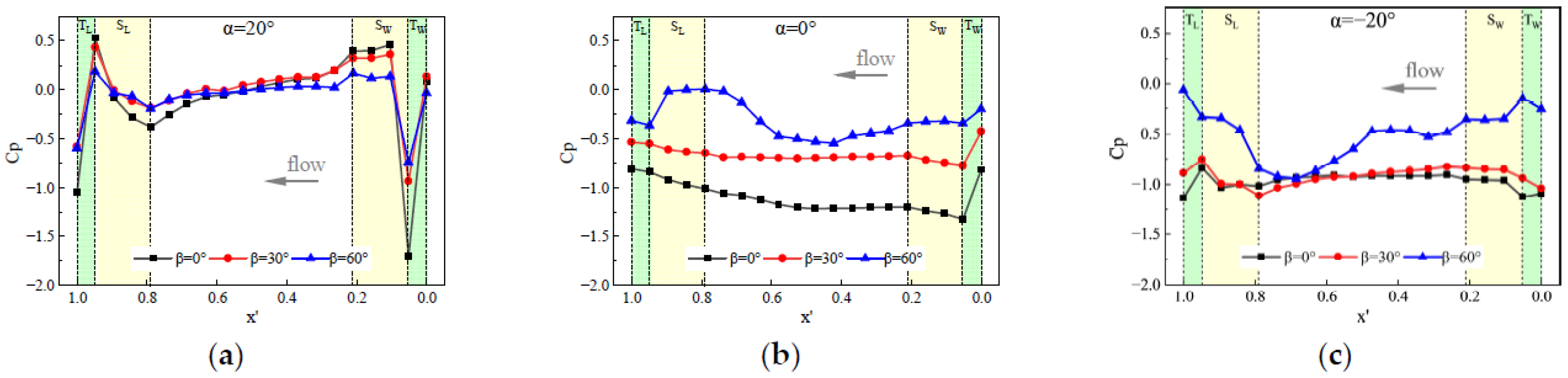
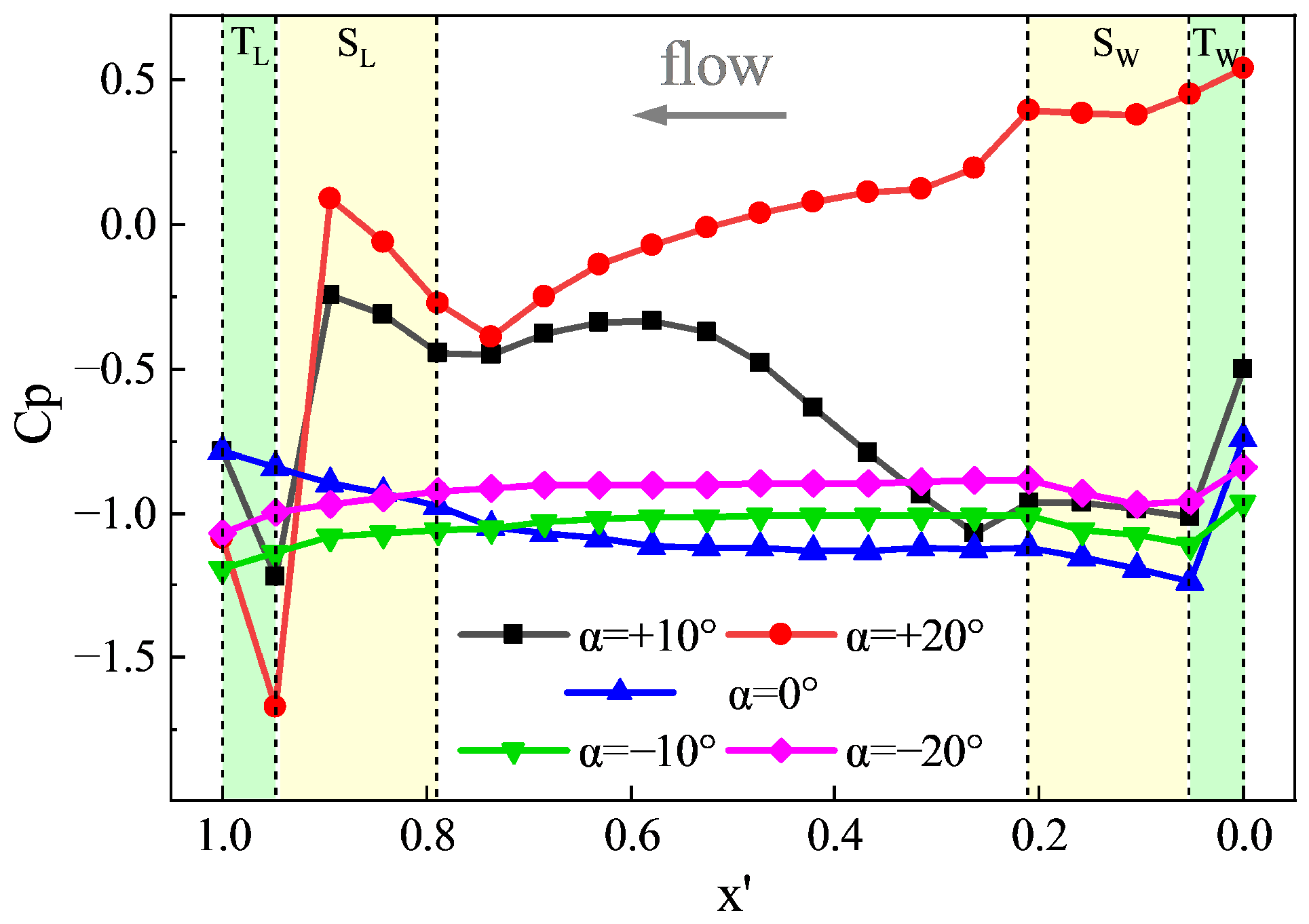
Figure 11 shows the pressure distribution at measurement points located 10 mm above the bridge deck. The x’ axis represents the normalized distance, with the outer edge of the windward cable trough set as 0 and the outer edge of the leeward cable trough as 1 (as illustrated in Figure 10c), and 20 pressure monitoring points are evenly distributed across this span. The TW and TL region in the figure corresponds to the cable trough area, while SW and SL denotes the walkway slab region. It can be observed that under a large attack angle (α = +20°), the windward cable trough experiences the highest pressure. A slight pressure drop is seen on the adjacent walkway slab, and a sharp pressure drop appears near the deck leading edge (around x’ = 0.2), which is related to the accelerated flow over the sloped surface of the walkway slab toward the bridge deck (Figure 10b). The pressure then gradually decreases across the bridge deck. In the leeward SL area, the downwash from the sloped deck encounters the flat surface of the walkway slab, resulting in flow obstruction and a pressure increase. This is followed by a sudden drop in pressure at the TL boundary due to step-induced flow separation, after which a slight pressure recovery occurs on the cable trough surface.
For α = +10°, the windward-side pressure trend is similar to that of α = +20°, but with reduced magnitude. On the bridge deck, however, greater differences are observed. The pressure on the windward side of the bridge deck reaches a low value of Cp ≈ –1.0 and then shows a recovery trend similar to the +20° case. This difference is due to the presence of a recirculation zone on the windward deck under the +10° case, where pressure drops sharply and then gradually recovers due to the blocking effect of the recirculating flow. In the leeward SL and TL regions, the trend is similar to that observed under the large attack angle of +20°.
Under the parallel inflow condition (α = 0°), pressure variations are very mild. A sharp pressure drop occurs in the windward TW region due to flow separation behind the step, followed by a gradual change. A pressure rise is observed on the leeward side.
For negative attack angles, the pressure variation is similar. Due to the shielding effect of the underside of the bridge, pressure changes across the bridge span are minimal, and the overall Cp distribution remains negative. The tendency for uplift of the walkway slab and cable trough may be more pronounced.
From the above analysis, it can be seen that the pressure in the walkway slab and cable trough regions is heavily influenced by the flow field. The highest positive pressure occurs at +20°, while the strongest local negative pressure on the windward SW region appears at 0°. Based on this, the flow field effects under different yaw angles will be studied next for three representative attack angles: +20°, 0°, and –20°.
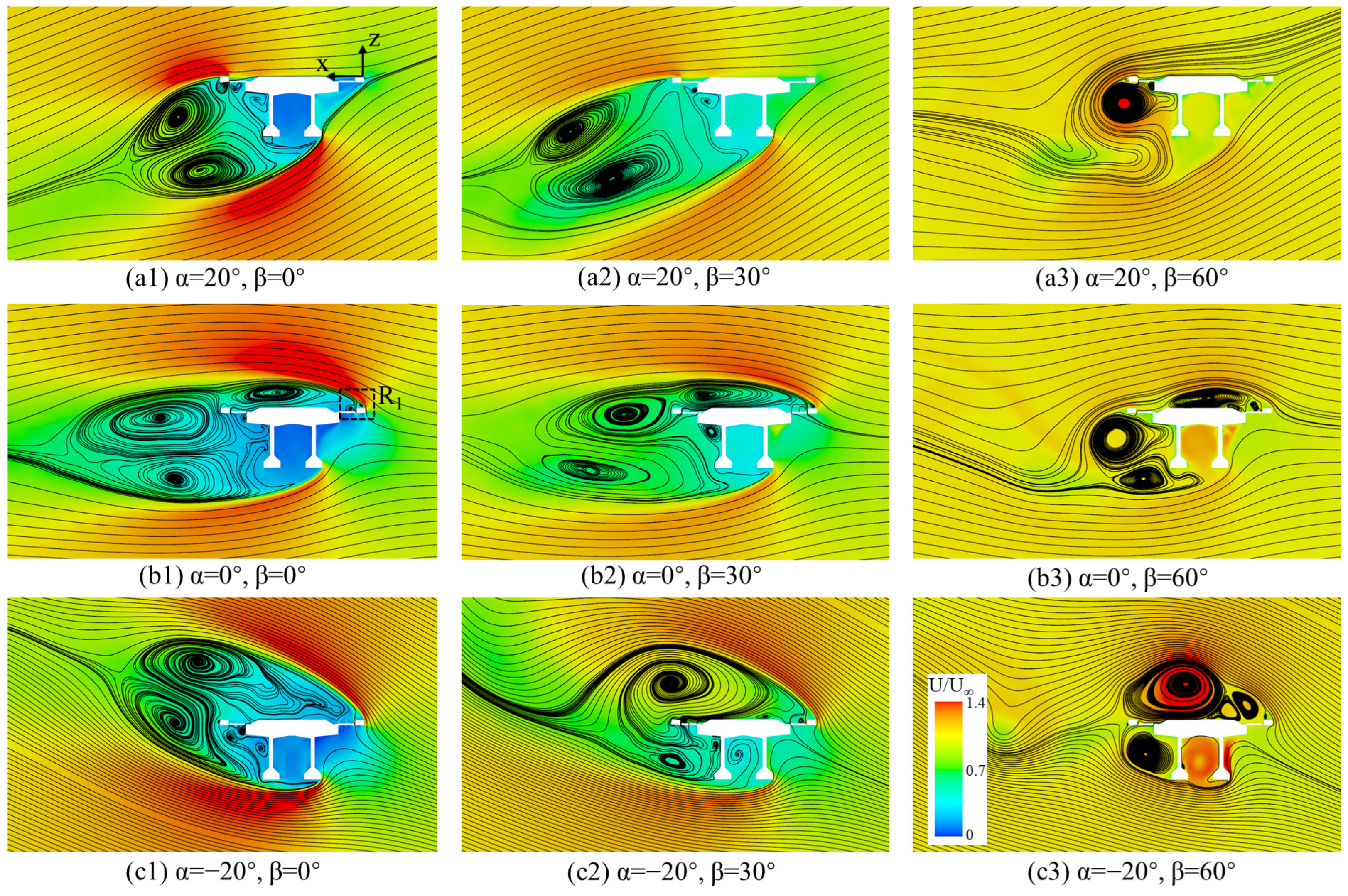
Figure 12 illustrates effects of yaw angle of crosswinds on the velocity contour at three typical attack angles of α = +20°, 0°, –20°. From the figure, we can see how the wind-direction yaw (β = –20°, 0°, +20°) shape the mean velocity field and streamline topology around the bridge cross-section. At α = +20°, with a zero yaw (Figure 12(a1)), the walking slab’s upper surface generates a strong stagnation zone at the trailing edge, feeding a high-velocity shear layer that detaches from the cable trough next to it and rolls into a large, symmetric recirculation bubble downstream. Introducing a larger yaw (β = +30°, see Figure 12(a2)) delay this wake far behind: the acceleration above the leeward cable through significantly weakens, accompanied with a pair of trailing vortices located more downstream. A further yaw (β = 60°, Figure 12(a3)) brings totally different flow patterns, only a single vortex appears right under the bridge leeward with a surrounding high velocity distribution, which is due to that a large yaw results in a weaker velocity of the spanwise component.
With the bridge deck aligned to the freestream at α = 0° (see Figure 12(b1)–(b3)), most flow patterns at three yaw angles are similar to counterparts in that of α = 20°, an obvious discrepancy lay on the vortex attaching to the bridge upper surface in cases of α = 0°. This is because the sharp cable through leading edge at windward (see frame R1 in Figure 12(b1)) causes flow separates clearly, at a small yaw β = 0° and 30°, the larger velocity spanwise component stretches the vortex elongated till the trailing wake. While a larger yaw makes the vortex on the bridge with less momentum thus the spanwise range is reduced.
At α = –20°, as shown in Figure 12(c1)–(c3), the incoming flow angles upward relative to the deck. At β = 0°, the shear layer detaches from the cable through’s leading edge, generating a vortex V1 in diagonal direction of far wake; also, flow detach from the leeward slab’s underside, creating a dominant recirculation zone V2 in the wake, showing a pair of counter-rotating vortices together. Yawing the wind to β = +20° forces V1 closer to the bridge and dominated with V2 upon the slab’s and through’s faces on the lee side, intensifying reverse flow and producing a compact, high-shear region. Furthermore, β = –20° yields an elevated separation bubble right above the slab: a series of new vortices emerges atop the deck and a strong vortex impinging the underside of the slab and through at leeward. In practice a closer vortex could increase fluctuating forces on the walkway slabs and cable troughs, with potential implications for fatigue life, vibration response, and overall structural integrity under crosswinds.
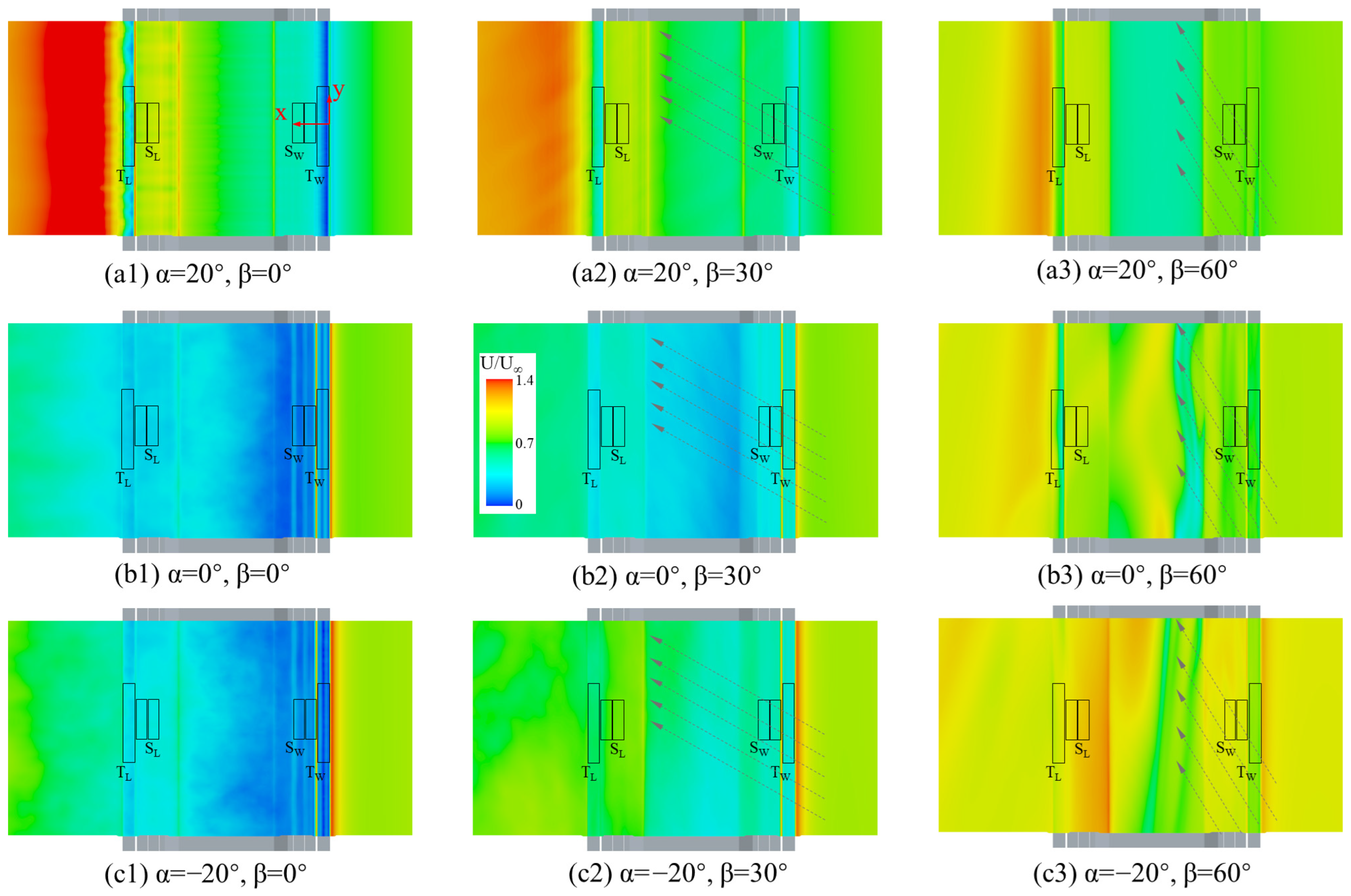
Figure 13 shows the velocity distribution of the airflow at 10 mm above the bridge deck in the horizontal plane. When the yaw angle is β = 0°, the flow speed is uniformly distributed along the bridge’s spanwise (y) direction, exhibiting a clear two-dimensional character (Figure 13(a1,b1,c1)). Under a wind direction of β = 30° and an attack angle of α = 20° (Figure 13(a2)), the plan-view speed contours remain nearly invariant along y and closely resemble those in Figure 13(a1), indicating that spanwise flow dominates at high attack angles. This behavior persists in Figure 13(a3) at large yaw angles: the pattern of the velocity field is similar to that at other attack angles, although its magnitude is reduced due to a smaller spanwise component. At α = 0° and –20° (Figure 13(b2,c2)), the velocity gradually increases along y, and the velocity gradient aligns almost parallel to the wind direction, demonstrating the flow deflection induced by yaw; this also causes the TL trough region to show a velocity variation along y. In subfigures (Figure 13(b3,c3)), obliquely downward streaks appear on the deck, reflecting the more complex vortex structures that develop at large yaw angles.
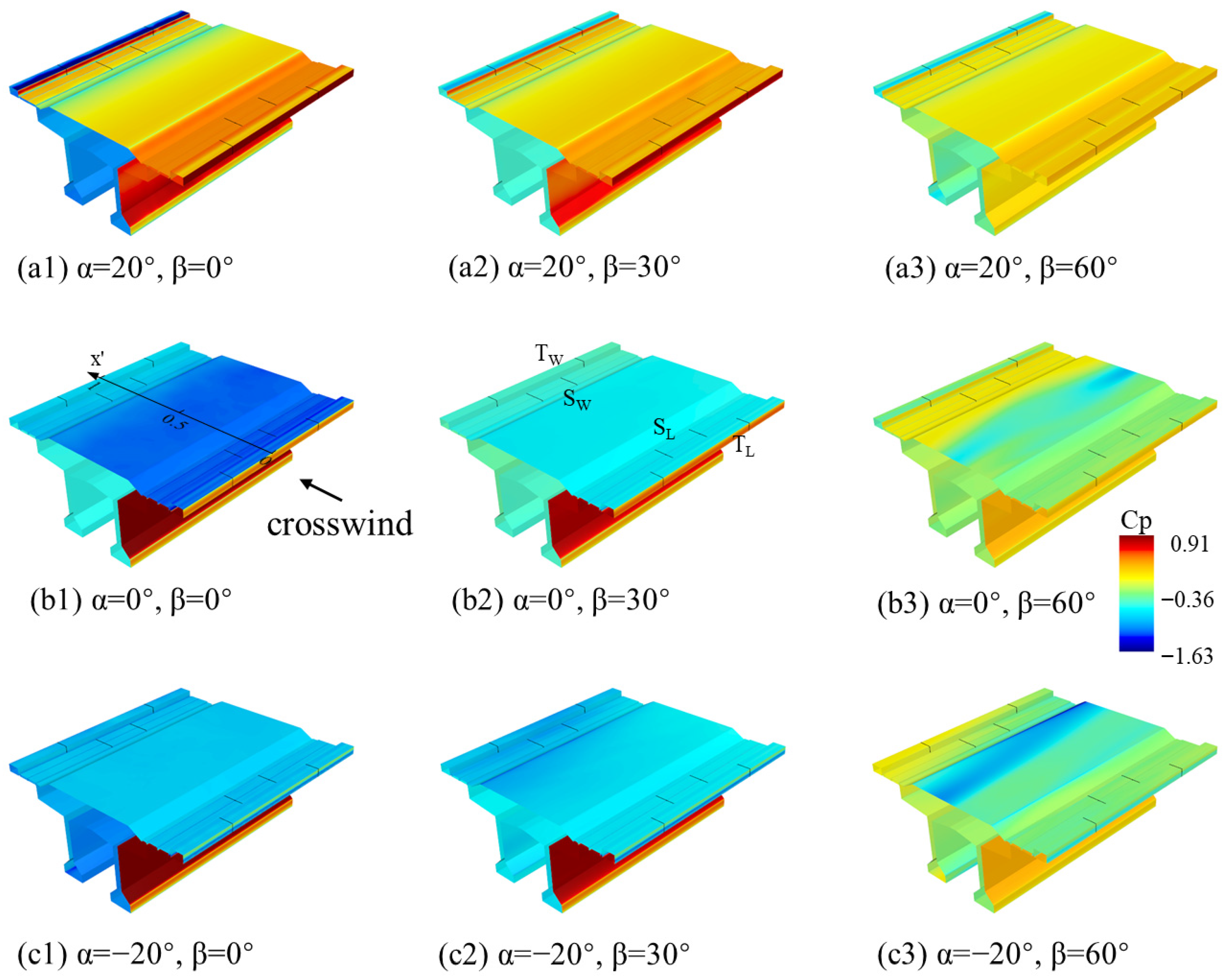
Figure 14 illustrates the distribution of mean pressure coefficients on the bridge deck and its auxiliary components under different attack angles (α = +20°, 0°, –20°) and yaw angles (β = 0°, 30°, 60°). When α = +20° and β = 0° (a1), a distinct high-pressure stagnation zone (Cp ≈ +0.9) forms along the windward edge of the bridge deck, while strong suction regions (Cp ≈ –1.6) develop on the downstream edges and within the troughs, resulting in the largest pressure difference. As β increases to 30° (a2), the high-pressure region shifts along the windward side, and suction on the leeward face of the trough weakens. At β = 60°, with flow nearly lateral, elongated low-pressure bands form along the top surface in the wind direction, and the overall pressure gradient significantly decreases.
At α = 0°, β = 0° corresponds to flow parallel to the bridge deck without yaw. Due to seam-induced effects on the windward side, surface pressure tends to be lower near the windward edge and gradually increases toward the leeward side. With β = 30°, the pressure on the bridge deck increases, but the distribution remains relatively uniform. At β = 60°, surface pressure rises further, and oblique low-pressure streaks appear on the deck, corresponding to regions of vortex core extension shown in Figure 13 and Figure 14, where abrupt pressure drops occur.
At α = –20°, the incoming flow impacts the underside of the bridge deck. When β = 0°, a clear high-pressure region (Cp ≈ +0.7) forms on the bottom surface, while suction appears on the upper surface. With β = 30°, the high-pressure zone shifts toward the leeward side, resulting in intensified negative pressure on the slab and trough surfaces and localized force amplification. At β = 60°, the extent of the bottom high-pressure region decreases, elongated low-pressure zones form on the top slab, suction weakens, and its distribution becomes more scattered, with the pressure gradient highly influenced by wind direction.
Overall, increasing the attack angle (α) intensifies the high pressure on the windward face and suction on the leeward face, leading to greater lift forces on auxiliary structures. Increasing the yaw angle (β) causes the pressure field to shift laterally along the bridge deck, producing pronounced asymmetric loading under negative attack angles. Therefore, design considerations must account for the combined effects of both attack and yaw angles to ensure aerodynamic stability and structural safety of walkway slabs and cable troughs under multiple operating conditions.
Figure 15 presents the centerline pressure distribution along the walkway slab and cable trough under different yaw angles for three representative attack angles.
At α = +20° (Figure 15a), the pressure coefficient (Cp) distribution exhibits a distinct positive peak on the windward side of the upstream cable trough, followed by a sharp pressure drop across the transition from the trough to the walkway slab. A localized positive peak then appears over the slab, likely caused by flow acceleration through the gap between the trough and slab. At β = 0°, this peak reaches approximately Cp = 0.48, but decreases to about 0.18 at β = 60°, indicating that increasing yaw angles reduce direct flow impingement and thus weaken pressure buildup. As the slab region continues downstream, a slight drop in Cp is observed near the trough interface, followed by a continuous decay in the range of x′ ≈ 0.2–0.8, with the most rapid decay occurring at β = 0°. Near the leeward walkway slab, a pressure recovery is seen for all three yaw angles, attributed to the recessed geometry and stronger flow impingement in this region. A sudden pressure rise (–0.2 to 0.45) occurs at the transition between the walkway slab and the cable trough due to the step-like obstruction from the trough’s side wall—this corresponds to a step-induced stagnation effect in the flow field. The subsequent pressure drop is caused by flow separation around the protruding trough structure. Under α = +20°, the peak pressure location within the trough remains nearly unchanged across different yaw angles, indicating that the flow impingement location is not significantly affected by yaw. The pressure distribution pattern is primarily governed by the spatial arrangement of the bridge-mounted components.
Figure 15b corresponds to the α = 0° parallel inflow condition, where the Cp remains negative along the entire bridge span. For β = 0° and β = 30°, Cp remains nearly flat between –1.35 and –0.75, indicating a uniform suction load. A suction peak (–1.33) appears in the trough region (x′ ≈ 0.05), followed by a gradual recovery in the x′ ≈ 0.2–0.7 range due to boundary layer redevelopment. At β = 60°, the pressure recovery downstream of x′ ≈ 0.6 is attributed to separation vortices being limited to the upstream section of the deck. The slight positive pressure downstream and over the leeward slab arises from downward flow deflection induced by the upstream deck vortex (see Figure 12(b3)). Compared to β = 0°, β = 30° slightly suppresses suction near mid-span, highlighting the influence of small yaw angles on boundary layer development.
Figure 15c illustrates the case of negative attack angle (α = –20°), where Cp remains negative across all yaw angles. For β = 0° and β = 60°, Cp values in the trough region (x′ ≈ 0.0–0.05) are approximately –1.1, and remain nearly flat across x′ = 0.1–0.8. On the leeward side (x′ > 0.8), the curves converge to Cp ≈ –0.95, indicating reduced sensitivity to small yaw angles. However, at β = 60°, a strong pressure recovery occurs around x′ ≈ 0.6 (Cp ≈ –0.25), driven by the larger vortex scales observed in Figure 12(c1)–(c3). A slight suction drop is also noted near the edge of the walkway slab. Notably, under negative attack angles, the influence of yaw angle on pressure distribution is polarized: small yaw angles have a minimal effect, while large yaw angles lead to substantial pressure recovery, significantly increasing the pressure on the upper surfaces of both the slab and trough, thereby enhancing their aerodynamic stability. In summary, smaller yaw angles tend to induce stronger negative pressure (suction) over the bridge deck, increasing uplift forces and raising the risk of cover plate instability.

3.1.2. Unsteady Features of Surrounding Flows

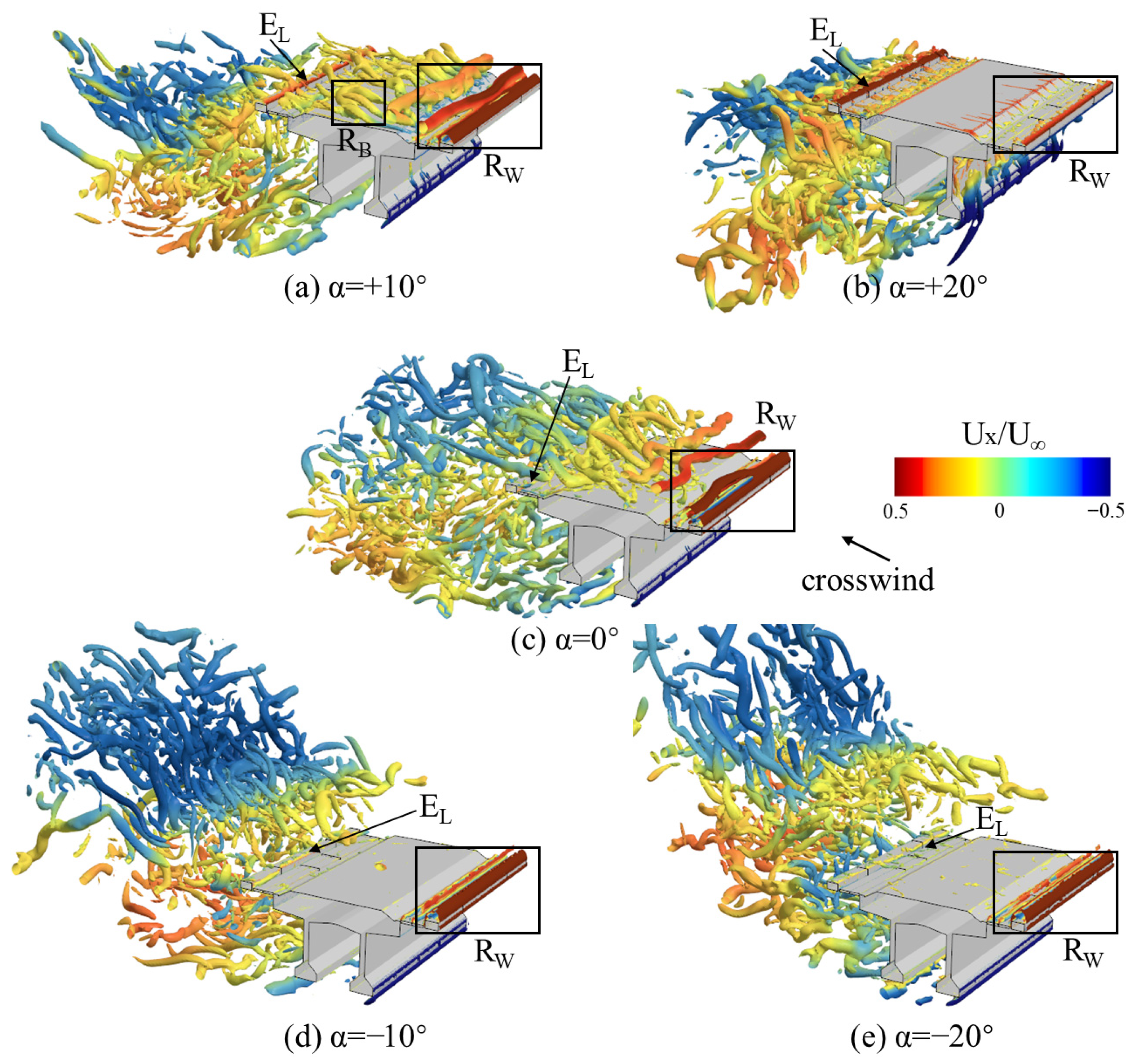
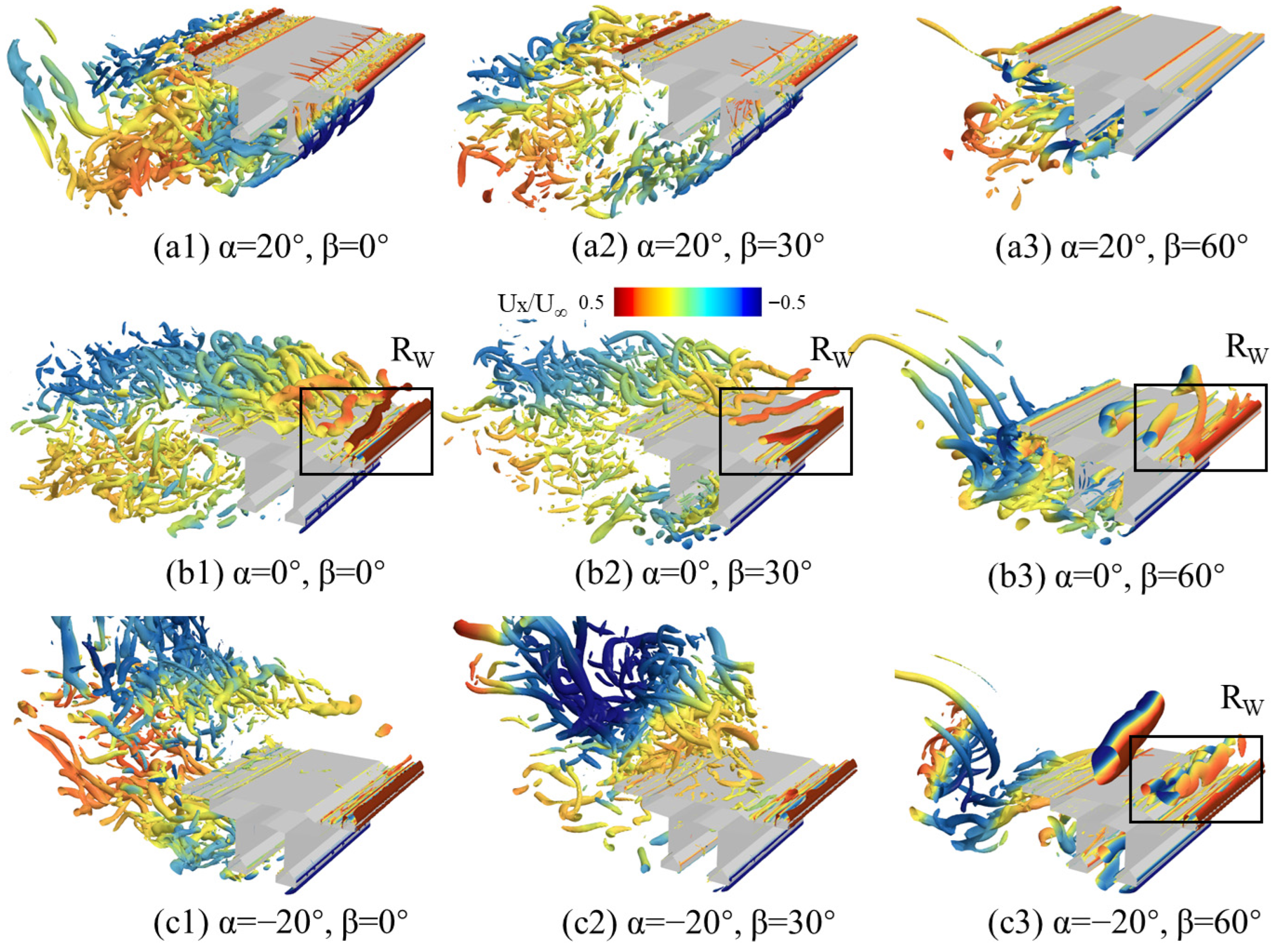
Figure 16 presents instantaneous iso-surfaces of the Q-criterion colored by the spanwise velocity component, depicting the unsteady flow characteristics around the bridge structure and its auxiliary components (cable troughs and walkway slabs) under different angles of attack.
Under a positive attack angle of α = +10° (Figure 16a), prominent vortex shedding is observed near the upper edge of the windward cable trough (RW region), where the shedding vortices form a series of intermittent, tubular coherent structures along the flow direction. This indicates the presence of periodic vortex-induced oscillations in this region. Upon impacting the bridge deck, part of the flow is lifted upward along the surface shear layer, generating a typical horseshoe vortex system (RB) near the leading edge of the cable trough, which extends spanwise to the leeward walkway slab. At the leeward edge of the cable trough (EL), flow separation induced by geometric discontinuity also results in vortex shedding, though with smaller scale and lower intensity than in the RW region. A large recirculation zone develops in the downstream wake, clearly indicated by the low spanwise velocity region in the visualization.
When the attack angle increases to α = +20° (Figure 16b), the stronger inflow impact leads to more intense interaction with the deck surface, yet no distinct vortex shedding structures are observed in the RW region. The shear layer development over the deck appears vaguer and more indistinct. Only scattered small-scale turbulent vortices with low energy and poor coherence are present on the leeward walkway slab. Near the cable trough edge (EL), a notable flow acceleration occurs, resulting in stronger downstream separation and vortex shedding.
Under the parallel inflow condition of α = 0° (Figure 16c), similar tubular vortex shedding structures appear near the RW region. However, compared to α = +10°, the vortex cores are shed farther from the bridge deck and persist longer, even extending to the upper edge of the leeward walkway slab and cable trough. This causes the region to remain in a prolonged separated low-speed zone, thereby preventing the formation of significant secondary turbulent separation near the EL region.
In the negative attack angle conditions of α = –10° and –20° (Figure 16d,e), the incoming flow approaches from below the deck, and the shielding effect of the bridge body on the upper flow field intensifies. As a result, no obvious shear layer develops over the deck. On the upper surface of the windward cable trough, flow accelerates rapidly and separates, with the resulting turbulent vortices continuously acting near the walkway slab (RW). Flow over the leeward walkway slab is extremely weak, and only a few faint vortex structures can be observed near the cable trough edge (EL), which may exhibit minor spanwise oscillatory instability.
In region RW of Figure 16c, the visible tube is the spanwise K-H roller issued from the windward leading edge. Its spanwise ripple is the phenomenon of a secondary three-dimensional instability, which is likely caused by the oblique K-H mode imposing a spanwise phase variation. The instability mechanism imprints a preferred wavelength that scales with the local shear-layer thickness, despite the spanwise-uniform geometry and zero yaw. The spanwise corrugation of the leading-edge shear layer disrupts spanwise coherence, accelerates transition and entrainment, thickens the separated region, and shifts energy to broadband turbulence, generally reducing globally coherent force oscillations.
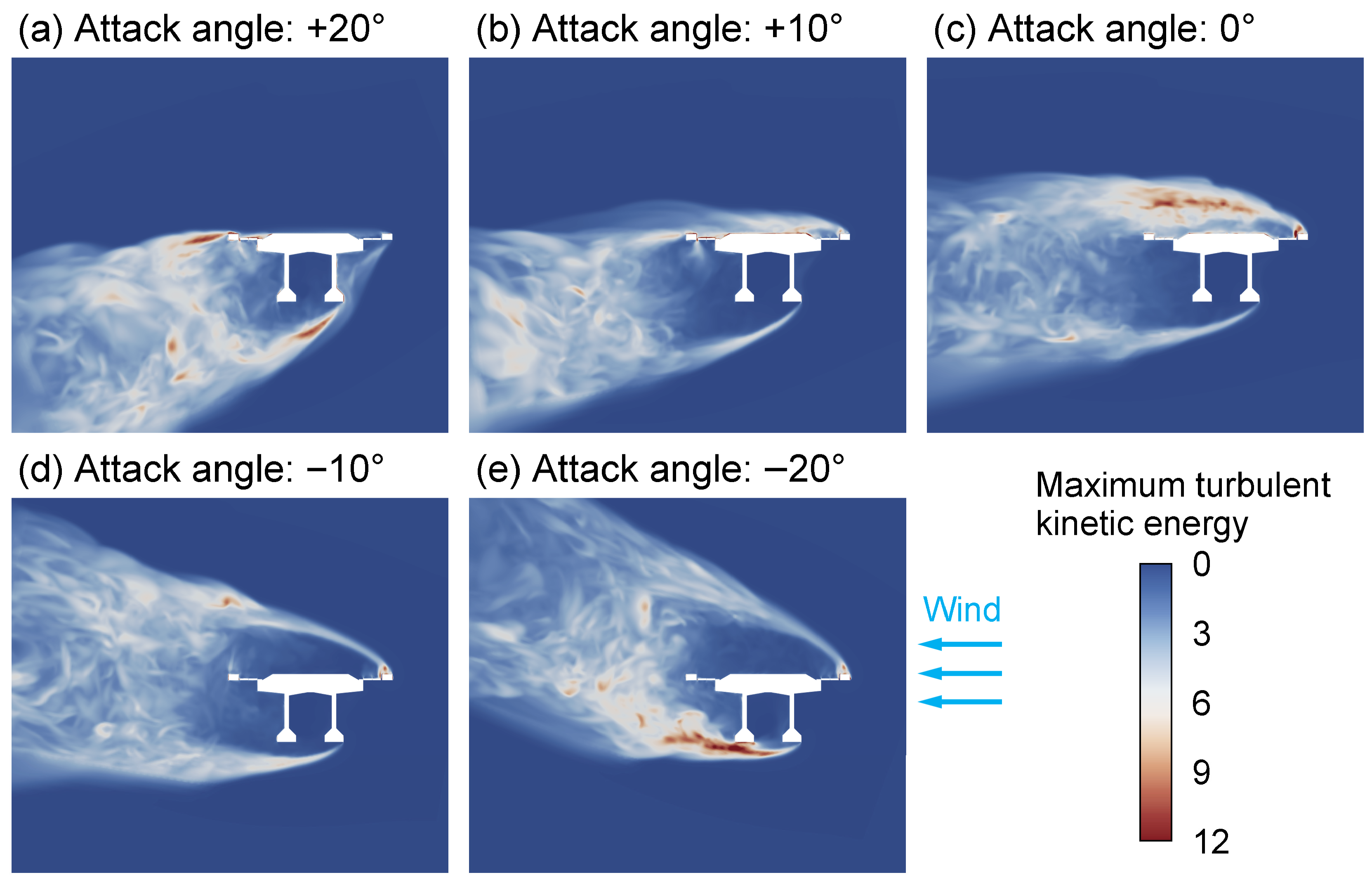
Figure 17 illustrates the maximum turbulent kinetic energy (TKE)—defined as the peak value over the sampled time span—on the lateral center plane (along the y-axis) around the bridge for various angles of attack. At α = +20°, high TKE levels are concentrated downstream of the leeward cable trough. At α = 0°, significant TKE appears above the bridge deck and the windward cable trough. When the attack angle decreases to –10° and –20°, intense TKE regions are mainly observed above the windward cable trough.
Comparison of these TKE distributions with the time-averaged flow structures shown in Figure 7 reveals a strong macroscopic correspondence, though localized discrepancies remain at smaller scales. This indicates that, while the general flow topology is preserved, local vortex dynamics exhibit considerable temporal variability—highlighting the inherently unsteady nature of the flow around the bridge and its auxiliary components.
It is also worth noting that under turbulent winds or extreme meteorological conditions (e.g., typhoons, tornadoes, or thunderstorms), both separated and reattached flow patterns are expected to undergo substantial modifications [41,42]. Investigating these effects will form an important direction for future work.
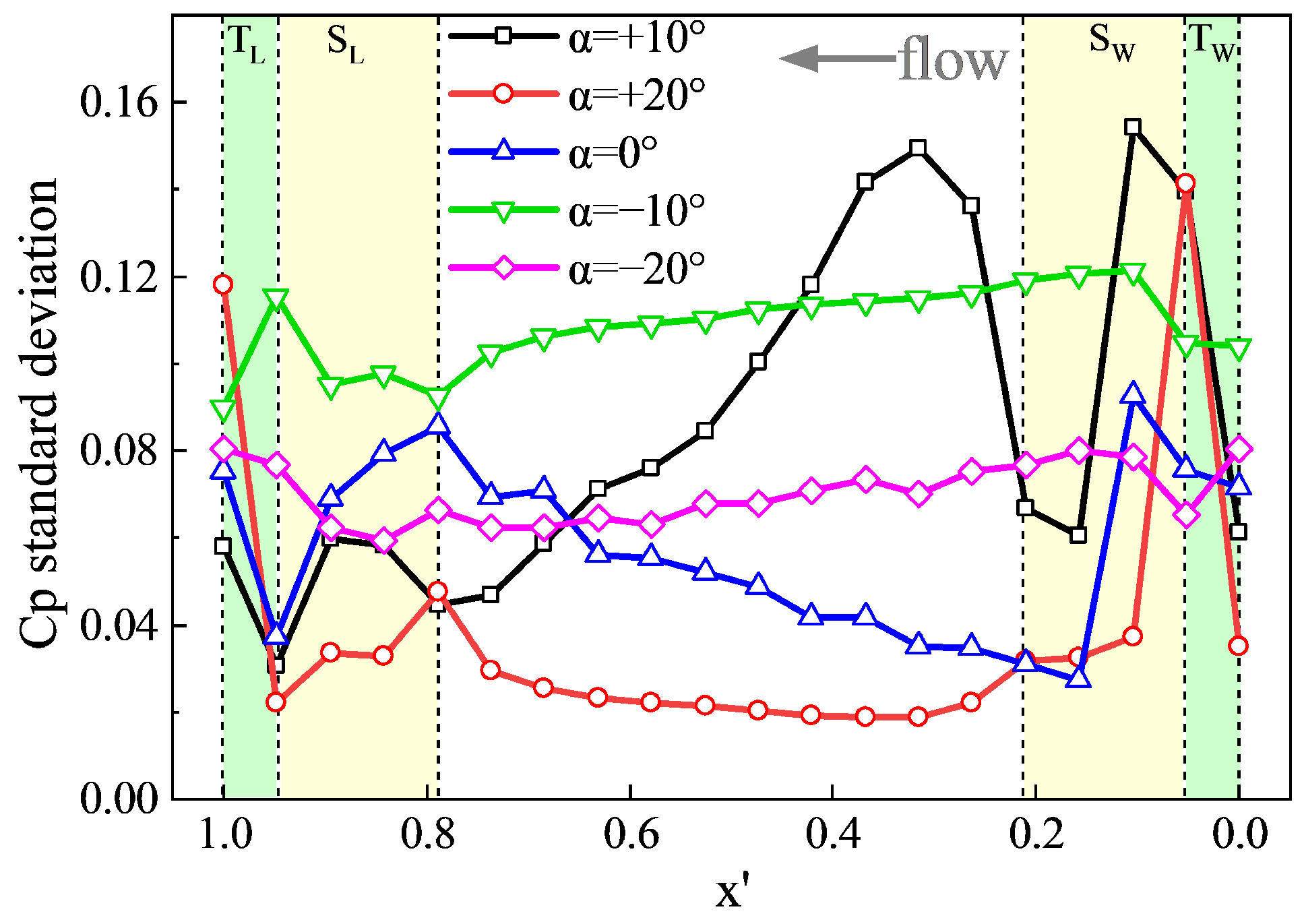
To quantify the influence of unsteady characteristics in different regions, Figure 18 presents the distribution of pressure standard deviation along the bridge deck centerline, as indicated in Figure 14(b1), under various angles of attack. Under the α = +10° condition, a distinct surge in standard deviation appears at the normalized spanwise position x′ ≈ 0.2. This location corresponds to the end of the windward slope—precisely where the wall-attached tubular vortex shedding is observed on the right side of the RB region in Figure 16a. Local flow separation leads to significantly intensified surface pressure fluctuations. As the vortex structures decay along the deck’s shear layer, their unsteady energy gradually diminishes, resulting in a slow decrease in standard deviation from x′ = 0.2 toward both the windward and leeward directions.
For a higher attack angle of α = +20°, a sharp rise in pressure standard deviation is observed at the transition between the TL and SW regions. This is closely associated with strong disturbances caused by the abrupt geometric interface at this location under high-angle inflow. A secondary peak is also present in the downstream section of the TL region, further confirming that geometric transitions trigger localized flow instabilities. Due to the nearly perpendicular impact of the incoming flow at higher attack angles, flow separation over the deck is largely suppressed, resulting in overall lower standard deviation levels compared to the +10° condition.
Under the parallel inflow case (α = 0°), localized flow separation first occurs at the leading edge of TW, causing a short-term surge in fluctuation intensity within the TW and SW regions. As the separated vortex structures shed, near-wall pressure fluctuations decrease. However, due to the cumulative effect of recirculating vortices in the downstream region of the deck, the standard deviation increases steadily again, only gradually declining in the leeward SL region.
For negative attack angles α = –10° and –20°, where the inflow approaches from below the deck, the shielding effect of the bridge body on the upper flow field becomes more prominent, resulting in a relatively flat distribution of pressure standard deviation. Under the –10° condition, root-mean-square pressure values remain higher than those at –20°, and notable local variations persist in regions near TW, SW, SL, and TL, indicating stronger flow instabilities in these areas. In contrast, the –20° condition exhibits more suppressed flow behavior, with lower overall fluctuation levels and a more uniform distribution.
Figure 19 illustrates the changes in vortex structures induced by varying yaw angles. For α = 20°, since the incoming flow directly impinges on the bridge deck, changes in yaw angle primarily affect the direction of the wake, with relatively minor influence on the overall distribution of flow structures over the deck.
Under parallel inflow conditions, increasing yaw angle first alters the vortex evolution near the leading edge of the cable trough in the Rw region. The originally spanwise-aligned tubular vortices begin to tilt in the direction of the incoming flow, a phenomenon that becomes more pronounced at a yaw angle of 60°, while simultaneously weakening the vortex structures over the bridge deck.
For the negative attack angle case of α = –20°, most vortex structures under a 0° yaw angle detach from the bridge deck and remain relatively distant. As the yaw angle increases, the turbulent vortices within the recirculation zone tend to move closer to the bridge surface. Additionally, under large yaw conditions such as β = 60°, strong vortex formation and clear shedding are observed near the windward leading edge of the Rw region—an effect that is not present under small yaw angles.


3.2. Local Analysis of Ancillary Facilities

3.2.1. Aerodynamic Performance of Walkway Slabs

The above understanding of the overall flow phenomena described above provides a foundation for the quantitative analysis of aerodynamic responses in auxiliary components of high-speed railway bridges. This section focuses on the localized aerodynamic performance of the walkway slabs.
Aerodynamic Characteristic Analysis
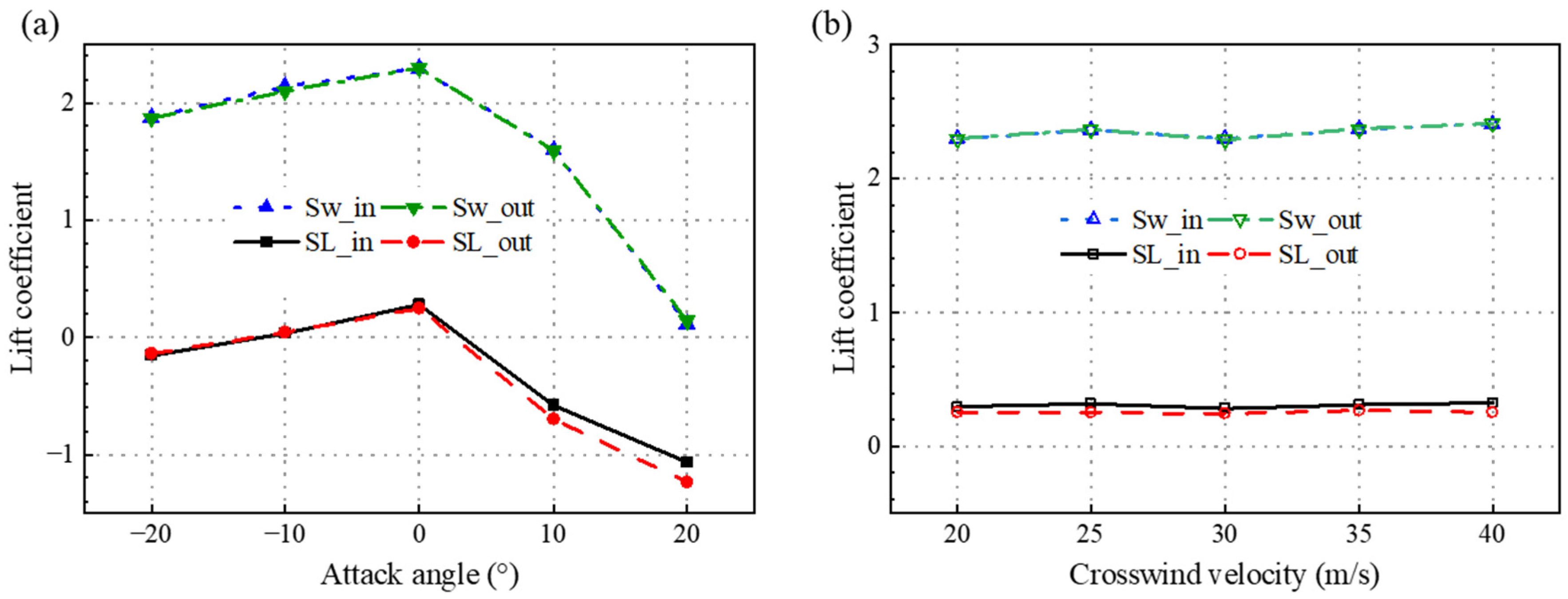
Figure 20a presents the lift coefficients of four walkway slabs under different angles of attack, including the windward inner slab (Sw_in), windward outer slab (Sw_out), leeward inner slab (SL_in), and leeward outer slab (SL_out). A negative angle of attack represents an upward wind direction (from below), while a positive angle indicates wind blowing downward. Overall, the lift coefficients increase with the angle of attack, peaking around α = 0°, and then decrease. For the two windward slabs, the lift coefficients remain positive—indicating upward aerodynamic forces—throughout all conditions. Notably, the lift under negative angles is greater than under positive angles, implying that upward-blowing wind poses a higher risk to the slabs. At α = +20°, the lift coefficient drops sharply, attributed to the direct impingement of the incoming flow, which enhances the downward component of aerodynamic force. Under negative angles of attack, the windward inner slab shows slightly higher lift than the outer slab, with a maximum difference of only 1.6%. For the two leeward slabs, a brief increase in lift is observed at α = 0°, while under negative angles the lift decreases significantly. At positive angles, the leeward inner slab exhibits higher lift than the outer one, with a maximum difference of 14%.
Interestingly, Figure 20a reveals an unusual trend: as the negative angle of attack increases (upward wind), the lift on the walkway slabs does not show the expected increase.
Figure 20b shows the lift coefficients of the same four walkway slabs under different wind speeds at a fixed attack angle of α = 0°. The lift coefficients remain nearly constant with increasing wind speed. The maximum variation in lift for the same slab is about 5.2% on the windward side and 15.7% on the leeward side, further confirming near Reynolds-number independence.
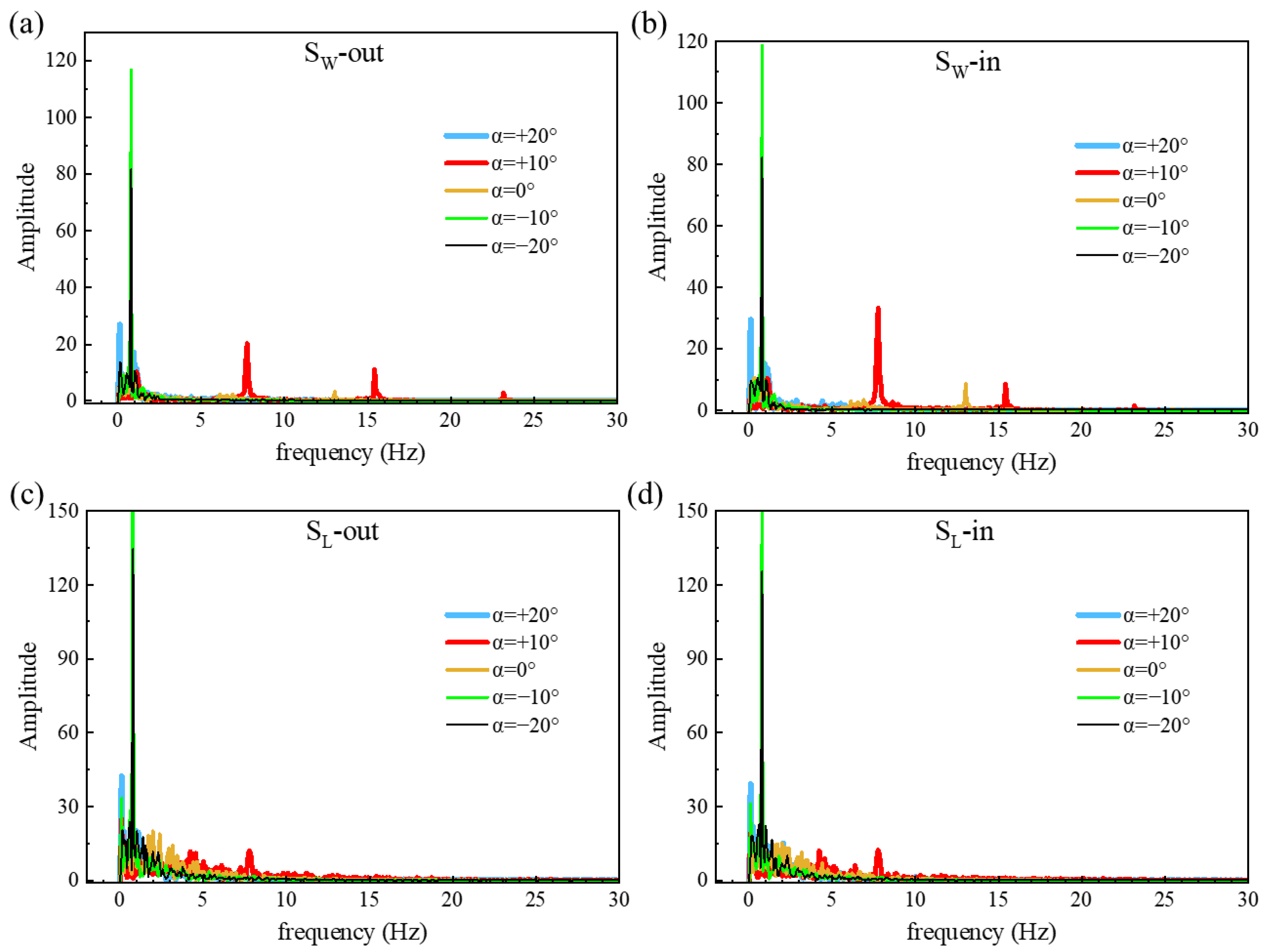
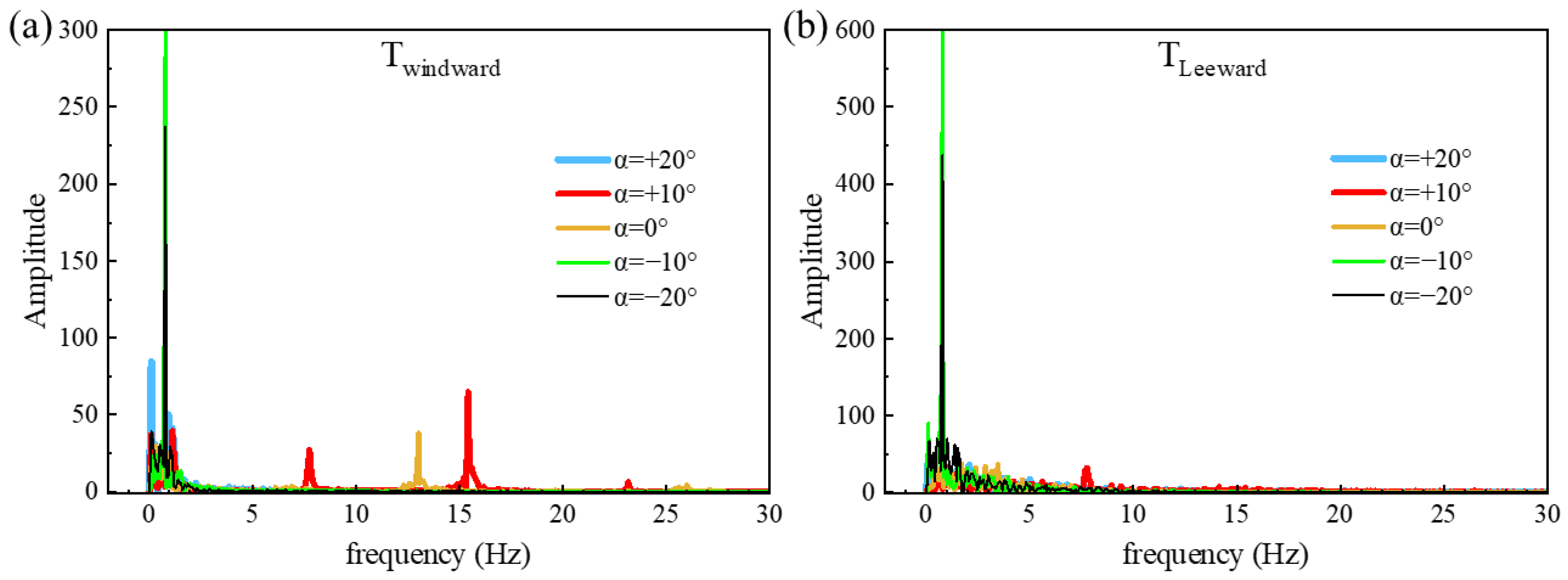
Figure 21 presents the frequency-domain distribution of lift forces on the bridge walkway slabs under different angles of attack. For the outer slab windward (Figure 21a), when the attack angles are α = –20° and –10°, the spectrum shows a dominant peak around 1 Hz, which corresponds to a Strouhal number (St) of approximately 0.1 based on a characteristic bridge height of 3.35 m. This falls within the typical range for bridge deck sections (St ≈ 0.10–0.20), indicating that the slab is undergoing unsteady vortex-induced oscillations. The Strouhal number, a dimensionless parameter characterizing flow periodicity, is defined as
S t = H f v a
where H is the characteristic length, f is the oscillation frequency, and va is the relative wind velocity.
At α = +10° (red line), the strongest peak appears around f ≈ 8 Hz, accompanied by a secondary harmonic at f ≈ 15 Hz (amplitude ≈ 8), which corresponds to vortex shedding from the leading edge of the slab. At α = 0° (yellow line) and +20° (blue line), no dominant frequency is observed; the spectral energy is more broadband and decaying, reflecting less coherent unsteady behavior.
For the inner windward slab (Figure 21b), a similar trend is observed. Under negative attack angles (black and green lines), a strong dominant frequency again indicates vortex-induced oscillations. The α = +10° case (red line) shows a clear primary peak around f ≈ 8 Hz, although the secondary harmonic is less pronounced compared to (a). For α = 0° (yellow line), a small peak appears around f ≈ 13 Hz. When α = +20° (blue line), the energy is concentrated mainly in the low-frequency range below 3 Hz, with no distinct narrowband peak.
For the outer leeward slab (Figure 21c), the frequency characteristics under negative attack angles are similar to those on the windward side. At α = 0° (yellow line), a broadband rise around f ≈ 2 Hz is observed, corresponding to large-scale separated vortices. At α = +10° (red line), the dominant shedding frequency at f ≈ 8 Hz reappears. In contrast, α = +20° primarily shows average-level responses without any significant narrowband peaks. The inner leeward slab (Figure 21d) shows a similar spectral distribution to that in (c), with only limited unsteady energy and an overall decaying trend in amplitude, indicating weak and incoherent vortex activity.
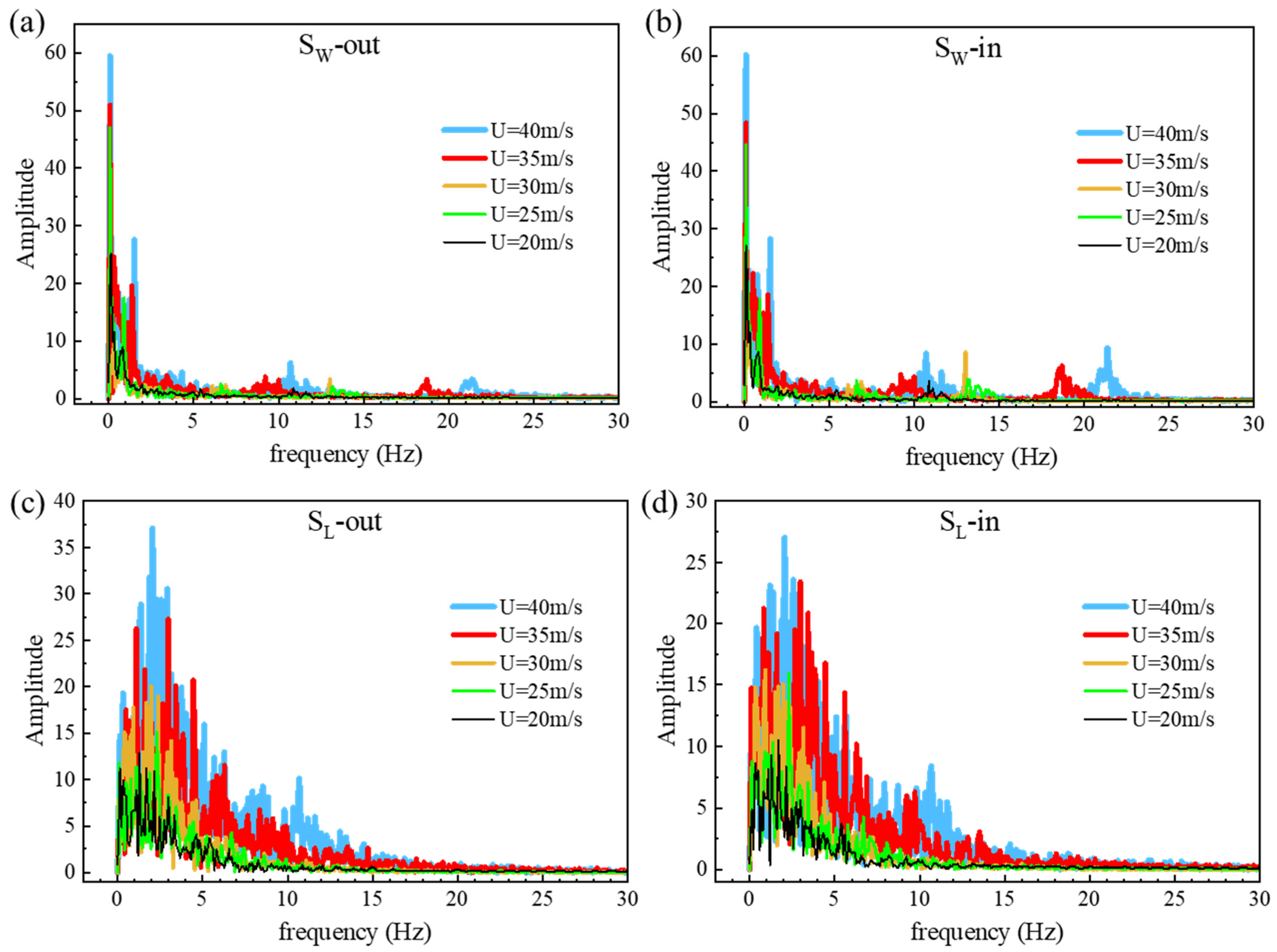
Figure 22 shows the frequency-domain distribution of lift forces on the bridge walkway slabs under different incoming wind speeds. For the outer windward walkway slab (Figure 22a), the dominant peak at zero frequency, representing the constant bias, is the most prominent across all wind speeds. At wind speeds of 40 m/s and 35 m/s, a secondary peak appears around 1.5 Hz, and a broader energy distribution is observed in the f < 5 Hz range, indicating that at higher wind speeds, the scale of separated vortices increases and the frequency spectrum becomes more dispersed.
For the inner windward walkway slab (Figure 22b), the low-frequency components are similarly distributed, but noticeable energy concentrations appear between 7 and 13 Hz across all wind speeds. Resonance phenomena are also observed, which are associated with flow separation caused by geometric discontinuities on the windward side. The ratio of the main peak to the broadband energy decreases accordingly.
The distribution for the outer leeward walkway slab (Figure 22c) differs significantly from that of the windward side. The spectral distribution is more dispersed, which can be attributed to the development of viscous shear in the flow field that introduces a broader range of turbulence scales and more random unsteady behavior. At all wind speeds, the main peak appears around 2 Hz, but the amplitude is only about 60% of that observed on the windward side, corresponding to larger-scale flow separation. As frequency increases, narrowband peaks gradually disappear.
For the inner leeward walkway slab (Figure 22d), the spectrum exhibits a stronger broadband characteristic. This difference is mainly due to the fact that the outer leeward slab is adjacent to the cable trough wall, resulting in spatial confinement and more regular flow behavior compared to the more open area around the inner slab. This indicates that the unsteady response in the inner leeward slab region is dominated by large-scale separated vortices and broadband turbulent excitation.
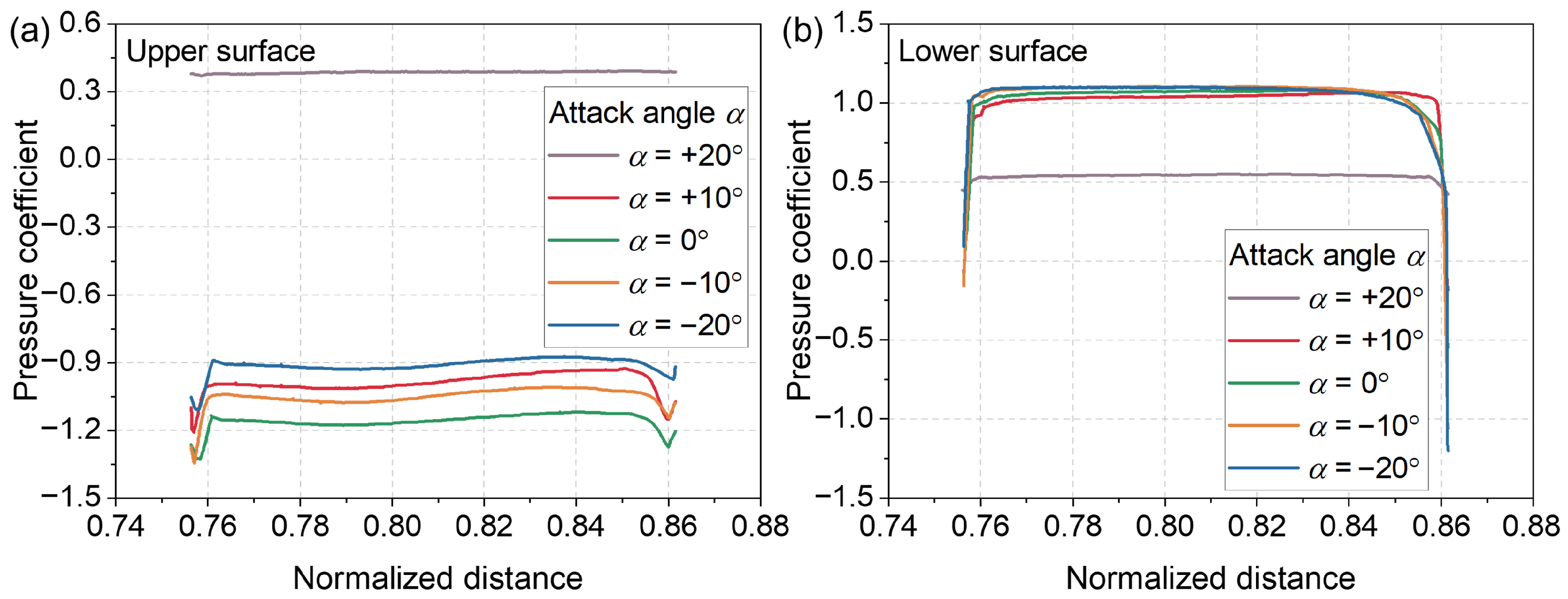
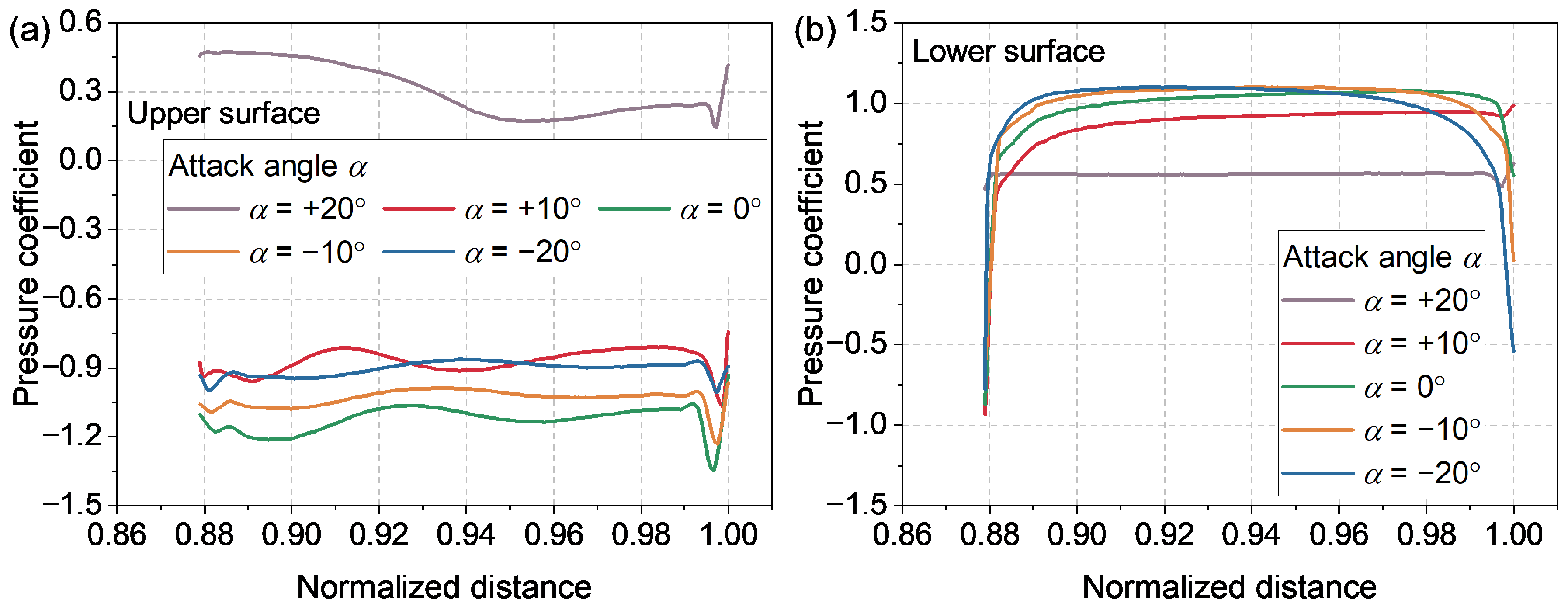
Figure 23a,b show the pressure coefficients along the lateral centerline (y-axis) on the upper and lower surfaces of the walkway slabs at various angles of attack. The horizontal axis represents the normalized distance, defined as the lateral distance from the slab surface to the bridge center, divided by the bridge half-width. Based on the findings in Figure 20, the lift on the windward slabs is significantly higher than on the leeward slabs, with the windward outer and inner slabs exhibiting similar lift characteristics. Therefore, Figure 23 focuses on the pressure coefficients of the windward outer slab only.
At an attack angle of +20°, both the upper and lower surfaces of the slab experience positive pressure. For other attack angles, the upper surface shows negative pressure, while the lower surface experiences positive pressure (of similar magnitude across different angles). Notably, the pressure coefficient on the lower surface is significantly higher at angles other than +20°. The lift on the slab is primarily driven by the negative pressure on the upper surface. At an attack angle of 0°, the upper surface reaches its maximum negative pressure, resulting in the highest lift at this angle. At −20°, the negative pressure on the upper surface is lower than at −10°, leading to reduced lift at −20°. These findings align with the results presented in Figure 20a.
Figure 24 illustrates the normalized two-dimensional velocity (the vector sum of the y-axis and z-axis velocities) and streamlines on the lateral center plane (y-axis) around the windward bridge fixtures, including the windward inner walkway slab (SW_in), windward outer slab (SW_out), and windward cable trough (Twindward) at different attack angles. At negative attack angles, the flow strikes the lower surface of the walkway slabs from below, forming small-scale vortices above the slabs. Figure 7 show that the vortex size above the bridge increases with more negative attack angles, with larger vortices forming at −20° compared to −10°. These larger vortices suppress the development of smaller vortices above the slabs, particularly at −20°, which leads to a lower negative pressure on the upper surface of the outer slab at this angle compared to −10°. This effect also helps explain why the low-frequency amplitude is smaller at −20° than at −10° (Figure 21a,b).
In summary, the lift on the walkway slabs is influenced by both the flow impact on the lower surface and the vortex formation above the slabs. As the negative attack angle increases (with flow coming from below), the positive pressure on the lower surface of the slab increases slightly. However, the larger vortices above the bridge suppress smaller vortices near the slabs, reducing the negative pressure on the upper surface. As a result, the overall lift on the slab decreases with higher negative attack angles.
Failure Analysis
Table 2 lists the failure wind speeds of the bridge walkway slabs under different angles of attack (0–20°). The failure wind speed, denoted as vfS, is determined using
v fS = 2 m S g ρ C F z S A S
The calculation considers the mass of the walkway slab mS = 115 kg, gravitational acceleration g = 9.81 m/s2, air density ρ = 1.225 kg/m3, lift coefficient CFzS (obtained from Figure 20a), and reference area AS = 0.632 m2.
It can be seen that the failure wind speed of the bridge walkway slab is 35.6 m/s, with the inner windward slab being the first to fail.
Considering that wind monitoring systems on conventional-speed railway bridges commonly use horizontal (two-dimensional) wind speed and direction sensors, which can only measure the wind speed in the horizontal plane, the failure wind speeds in Table 2 are converted into equivalent horizontal failure wind speeds. These more practically meaningful values are shown in Table 3. It is evident that the horizontal failure wind speed for the bridge walkway slabs is 35.6 m/s.

3.2.2. Aerodynamic Performance of Cable Troughs

Aerodynamic Performance
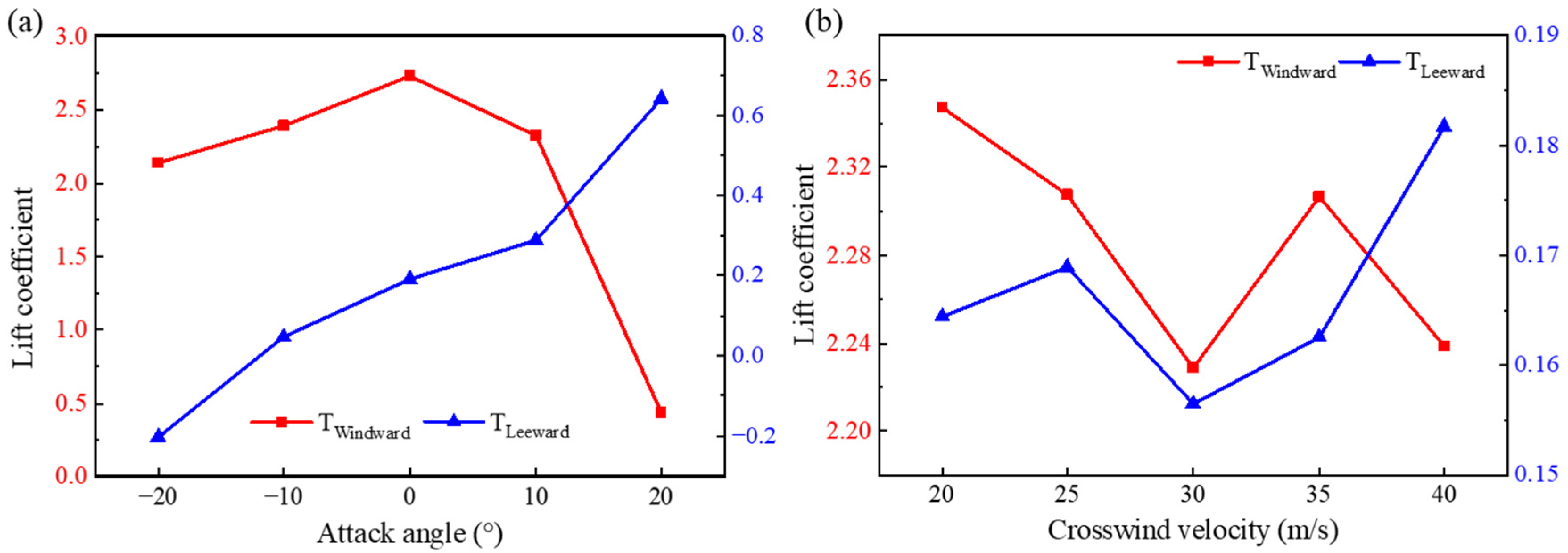
Figure 25a shows the lift coefficients of bridge cable troughs under different angles of attack. As in previous sections, a positive angle of attack indicates wind blowing upward from below, while a negative angle represents wind blowing downward from above. For the windward cable trough, the lift coefficient increases first and then decreases with increasing angle of attack, with a turning point at α = 0°, similar to the trend observed in the walkway slabs. The lift coefficient of the windward cable trough remains positive throughout, indicating an upward aerodynamic force. Under positive attack angles, the lift coefficients are lower than those under negative angles, suggesting that wind blowing from below poses a greater risk to the cable trough. The lift coefficient of the leeward cable trough fluctuates within the range of –0.2 to 0.6 and remains relatively small. Due to the shielding effect of the bridge body, the lift coefficient becomes negative at α = –20°, and increases as the angle of attack increases.
Figure 25b shows the lift coefficients of the cable troughs at an angle of attack of 0° under different wind speeds. The values for the windward side are plotted against the left vertical axis, and those for the leeward side are plotted against the right axis. As indicated by the limited range of both axes, the lift coefficients show minimal variation with wind speed. The maximum difference in lift coefficient for the windward cable trough across all wind speeds is only 5%, while for the leeward cable trough it is 13.9% (with an absolute difference of 0.025). Therefore, the lift coefficients provided in Figure 25 can be directly used to calculate the failure wind speed of the bridge cable troughs.
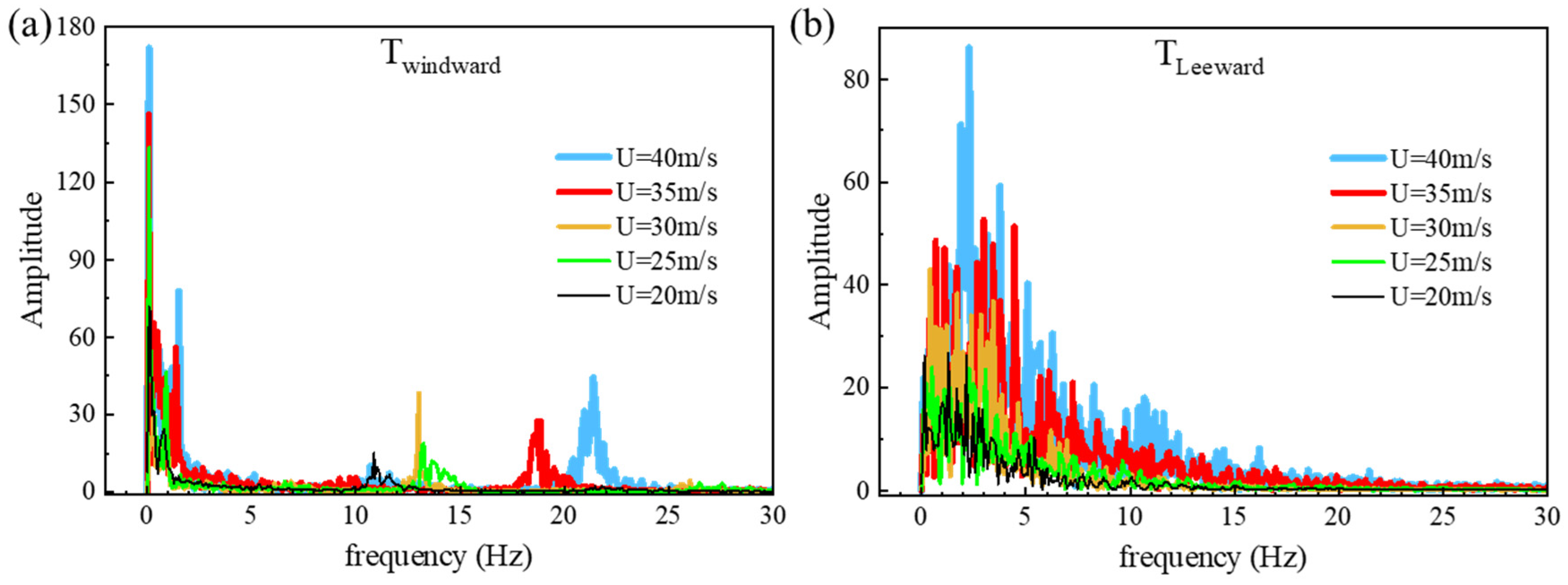
Figure 26 shows the frequency-domain distribution of lift forces on the bridge cable troughs under different wind speeds. Similarly to the walkway slabs, the windward cable trough exhibits distinct primary frequencies and harmonic characteristics (Figure 26a). At wind speeds of 40 m/s and 35 m/s, a secondary peak appears around 1.5 Hz, reflecting the unsteady influence of vortex-induced effects. Multiple harmonic peaks between approximately 13–23 Hz indicate the impact of vortex shedding in this frequency range. For the leeward side, the frequency-domain distribution exhibits broadband characteristics due to shear dissipation and the wide range of turbulence scales (Figure 26b), resulting in lift responses that are spread across a broader frequency range under varying inflow speeds.
Figure 27 displays the frequency-domain distribution of lift forces on the bridge cable troughs under different angles of attack. For the windward side (Figure 27a), the dominant spectral peak at 1 Hz appears again at attack angles α = –20° and –10°, indicating the presence of unsteady vortex-induced oscillations, consistent with the spectral features observed in the walkway slabs. At α = +10°, the strongest peak appears around f ≈ 8 Hz, with a secondary harmonic at f ≈ 15 Hz, corresponding to leading-edge vortex shedding from the cable trough. For α = 0°, a noticeable peak is observed at 14 Hz, while energy at other frequencies remains relatively weak.
On the leeward side (Figure 27b), the cable trough still shows dominant spectral peaks under negative attack angles, suggesting that vortex-induced oscillations remain the primary mechanism. However, at other angles, the frequency-domain energy is considerably lower, showing a different trend compared to the walkway slabs.
Figure 28a,b show the pressure coefficients along the lateral centerline (y-axis) on the upper and lower surfaces of the windward cable trough at various attack angles. Based on the results from Figure 25, the lift on the windward cable trough is generally higher than on the leeward trough. Therefore, Figure 28 focuses solely on the surface pressure coefficients for the windward cable trough.
The pressure distribution on the windward cable trough mirrors that on the windward outer walkway slab (Figure 23). At an attack angle of +20°, both the upper and lower surfaces of the trough experience positive pressure. At other attack angles, the upper surface shows negative pressure, while the lower surface experiences positive pressure. Notably, the pressure on the lower surface exceeds that at +20°. At an attack angle of 0°, the negative pressure on the upper surface reaches its maximum absolute value. Overall, the pressure on the lower surface of the trough remains similar across attack angles of 0°, −10°, and −20°.
Figure 24 illustrates the normalized two-dimensional velocity and streamlines on the lateral center plane (y-axis) around the windward cable trough at various attack angles. The flow pattern around the cable trough is similar to that around the walkway slabs. At attack angles other than +20°, the flow strikes the trough’s lower surface directly from below, forming vortices above the trough.
Failure Analysis of Troughs
Table 4 presents the failure wind speeds of the bridge cable troughs under different angles of attack (0–20°). The failure wind speed, denoted as vfT, is calculated using
v fT = 2 m T g ρ C F z T A T
The calculation is based on the mass of the cable trough (mT = 160 kg), the lift coefficient (CFzT, as shown in Figure 23a), and the reference area (AT = 1.84 m2).
It can be seen that the failure wind speed of the bridge cable trough is 22.6 m/s, with the windward cable trough being the first to fail.
Considering that conventional-speed railway wind monitoring systems typically use horizontal (two-dimensional) wind direction and speed sensors that can only measure wind speed within the horizontal plane, the failure wind speeds in Table 4 are converted into horizontal failure wind speeds to provide more practical values. These are listed in Table 5. It can be seen that the horizontal failure wind speed of the bridge cable trough is 22.6 m/s.

4. Conclusions and Outlooks

4.1. Key Findings

This work employed IDDES numerical simulations with SST k-ω to elucidate the complex aerodynamic interactions between crosswinds and bridge-mounted auxiliary structures, highlighting key phenomena that govern their performance and safety.
Vortex-induced oscillations dominate the aerodynamic response of walkway slabs and cable troughs at negative attack angles, with Strouhal numbers in the typical bridge-section range (St ≈ 0.10–0.20). Positive attack angles (>+10°) suppress narrow-band vortex shedding, broadening the energy spectrum and shifting peak frequencies upward, indicative of more irregular, multi-scale separation behavior.
Yaw effects (β up to 60°) preserve spanwise wake patterns while reducing overall force magnitudes, confirming the spanwise component’s primary role in wake formation across large wind direction angles. The maximum lift coefficients on both slabs and troughs occur near α = 0°, corresponding to the most critical aerodynamic loading conditions. Based on these results, the failure wind speeds are estimated to be 35.6 m/s for walkway slabs and 22.6 m/s for cable troughs, providing quantitative benchmarks for crosswind safety assessment of bridge auxiliary structures.

4.2. Design Implications

Design implications include optimizing slab mass and fixing methods, increasing trough anchorage strength, and incorporating flow–break devices to disrupt coherent vortex formation and reduce uplift risk.

4.3. Limitations and Future Work

This study has three primary limitations, which will be addressed in future research.
(1)
Bridge type and generality.
The present investigation focuses on a T-beam bridge, which represents the predominant cross-sectional form used in conventional-speed railway bridges in China. The simulated flow patterns above the bridge deck align closely with previous findings for box-girder bridges [39], suggesting that the methodology and qualitative conclusions presented here have a degree of general applicability. Nonetheless, future work will extend the analysis to other bridge cross-sectional configurations to verify the broader relevance of these results and to establish a comprehensive database of failure wind speeds for various bridge auxiliary structures.
(2)
Wind conditions.
This study considers only steady crosswind conditions. Under turbulent or extreme wind events—such as typhoons, tornadoes, or thunderstorms—both separated and reattached flow patterns around bridges may change substantially [41,42]. Future studies will therefore incorporate unsteady inflow conditions to capture the dynamic aerodynamic responses of bridge-mounted components under realistic wind environments.
(3)
Structural response and fluid–structure interaction.
The current work does not consider changes in aerodynamic characteristics once the auxiliary structures begin to move. However, the unsteady aerodynamic data obtained here provide a solid foundation for subsequent flow-induced vibration and fluid–structure interaction (FSI) studies. Future work will focus on quantifying the motion trajectories of activated components and identifying the critical wind speeds at which these movements may interfere with railway operations or compromise structural safety.

Author Contributions

H.Y.: Writing—original draft, Formal analysis. T.L.: Writing—review & editing, Funding acquisition, Supervision, Conceptualization. X.C.: Writing—review & editing, Methodology, Validation, Methodology. H.C.: Software, Visualization. H.G.: Writing—review & editing, Investigation. X.L.: Supervision. The data that support the findings of this study are available from the corresponding author upon reasonable request. All authors have read and agreed to the published version of the manuscript.

Funding

This work was supported by the National Natural Science Foundation of China-Fundamental Science Center (Grant No. 52388102), the National Natural Science Foundation of China (Grant No. 52472373), the State Key Laboratory of High-speed Maglev Transportation Technology (Grant No. SKLMSFCF-2023-017), and China Railway Urumqi Group Co., Ltd. (Grants No. RD2024B001 and No. 2023-kj-48).

Institutional Review Board Statement

Not applicable.

Informed Consent Statement

Not applicable.

Data Availability Statement

Data will be made available on request.

Conflicts of Interest

Author Hongkai Yan was employed by the company China Railway Urumqi Group Co., Ltd. The remaining authors declare that the research was conducted in the absence of any commercial or financial relationships that could be construed as a potential conflict of interest.

References

  1. Tian, H.-Q. Review of research on high-speed railway aerodynamics in China. Transp. Saf. Environ. 2019, 1, 1–21. [Google Scholar] [CrossRef]
  2. Dai, Z.; Li, T.; Zhang, W.; Zhang, J. Investigation on aerodynamic characteristics of high-speed trains with shields beneath bogies. J. Wind Eng. Ind. Aerodyn. 2024, 246, 105666. [Google Scholar] [CrossRef]
  3. Gao, H.; Liu, T.; Chen, X.; Zeng, H.; Chen, G.; Chen, Z.; Zhang, J.; Khoo, B.C. Flow characteristics induced by a multiform windbreak in complex terrains with and without a train: A simplified method for calculating aerodynamic loads. Phys. Fluids 2024, 36, 125115. [Google Scholar] [CrossRef]
  4. Gao, H.; Liu, T.; Chen, X.; Zeng, H.; Jiang, J.; Wang, X.; Khoo, B.C. Turbulence correlation between moving trains and anemometer towers: Theoretical analysis, field measurements and simulation. J. Wind Eng. Ind. Aerodyn. 2024, 255, 105949. [Google Scholar] [CrossRef]
  5. He, X.-H.; Li, H. Review of aerodynamics of high-speed train-bridge system in crosswinds. J. Central South Univ. 2020, 27, 1054–1073. [Google Scholar] [CrossRef]
  6. Bai, H.; Yang, G.; Wang, H.; Zhang, H. Aerodynamic interference effects on a new bridge from adjacent parallel existing bridge. Phys. Fluids 2025, 37, 073605. [Google Scholar] [CrossRef]
  7. Cheli, F.; Corradi, R.; Rocchi, D.; Tomasini, G.; Maestrini, E. Wind tunnel tests on train scale models to investigate the effect of infrastructure scenario. J. Wind Eng. Ind. Aerodyn. 2010, 98, 353–362. [Google Scholar] [CrossRef]
  8. He, X.; Wu, T.; Zou, Y.; Chen, Y.F.; Guo, H.; Yu, Z. Recent developments of high-speed railway bridges in China. Struct. Infrastruct. Eng. 2017, 13, 1584–1595. [Google Scholar] [CrossRef]
  9. Antolín, P.; Zhang, N.; Goicolea, J.M.; Xia, H.; Astiz, M.Á.; Oliva, J. Consideration of nonlinear wheel–rail contact forces for dynamic vehicle–bridge interaction in high-speed railways. J. Sound Vib. 2013, 332, 1231–1251. [Google Scholar] [CrossRef]
  10. Gao, H.; Liu, T.; Chen, X.; Chen, Z.; Zhang, J.; Khoo, B.C. Aerodynamic and dynamic behaviour of a train in cutting-viaduct-cutting sections with windbreaks in complex terrains under crosswinds: Key factors. Eng. Struct. 2025, 328, 119728. [Google Scholar] [CrossRef]
  11. Liu, D.; Liang, X.; Zhou, W.; Zhang, L.; Lu, Z.; Zhong, M. Contributions of bogie aerodynamic loads to the crosswind safety of a high-speed train. J. Wind Eng. Ind. Aerodyn. 2022, 228, 105082. [Google Scholar] [CrossRef]
  12. Guo, W.-W.; Cai, B.-S.; Sun, F.-X.; Ni, B.-Z.; Chen, P.-Y. Aerodynamic characteristics of a train on a long-span bridge with steel truss section under crosswinds. J. Wind Eng. Ind. Aerodyn. 2022, 231, 105215. [Google Scholar] [CrossRef]
  13. Wang, M.; He, H.; Li, X.; Ma, C.; Ren, W.; Zhou, Q. Effects of Nonuniform Crosswinds in Valleys on Dynamic Responses of High-Speed Trains and Long-Span Suspension Bridges. J. Bridg. Eng. 2024, 29, 04023105. [Google Scholar] [CrossRef]
  14. Song, Y.; Ti, Z.; Deng, H.; Li, Y. Vortex-induced vibrations of sea-crossing bridge deck subject to dynamic wave boundary layer airflows. Phys. Fluids 2025, 37, 055111. [Google Scholar] [CrossRef]
  15. Yao, Z.; Zhang, N.; Chen, X.; Zhang, C.; Xia, H.; Li, X. The effect of moving train on the aerodynamic performances of train-bridge system with a crosswind. Eng. Appl. Comput. Fluid Mech. 2020, 14, 222–235. [Google Scholar] [CrossRef]
  16. Zou, S.; He, X.; Wang, H. Numerical investigation on the crosswind effects on a train running on a bridge. Eng. Appl. Comput. Fluid Mech. 2020, 14, 1458–1471. [Google Scholar] [CrossRef]
  17. Wang, M.; Li, X.-Z.; Xiao, J.; Zou, Q.-Y.; Sha, H.-Q. An experimental analysis of the aerodynamic characteristics of a high-speed train on a bridge under crosswinds. J. Wind Eng. Ind. Aerodyn. 2018, 177, 92–100. [Google Scholar] [CrossRef]
  18. Li, X.-Z.; Wang, M.; Xiao, J.; Zou, Q.-Y.; Liu, D.-J. Experimental study on aerodynamic characteristics of high-speed train on a truss bridge: A moving model test. J. Wind Eng. Ind. Aerodyn. 2018, 179, 26–38. [Google Scholar] [CrossRef]
  19. Li, Y.; Hu, P.; Cai, C.S.; Zhang, M.; Qiang, S. Wind Tunnel Study of a Sudden Change of Train Wind Loads due to the Wind Shielding Effects of Bridge Towers and Passing Trains. J. Eng. Mech. 2013, 139, 1249–1259. [Google Scholar] [CrossRef]
  20. Ishak, I.A.; Maruai, N.; Sakri, F.M.; Mahmudin, R.; Samiran, N.A.; Sulaiman, S.; Abidin, S.F.Z.; Hassan, N.N.M. Numerical Analysis on the Crosswind Influence Around a Generic Train Moving on Different Bridge Configurations. J. Adv. Res. Fluid Mech. Therm. Sci. 2021, 89, 76–98. [Google Scholar] [CrossRef]
  21. Suzuki, M.; Tanemoto, K.; Maeda, T. Aerodynamic characteristics of train/vehicles under cross winds. J. Wind Eng. Ind. Aerodyn. 2003, 91, 209–218. [Google Scholar] [CrossRef]
  22. Wu, J.; Cai, C.; Li, X.; Liu, D. Dynamic analysis of train and bridge in crosswinds based on a coupled wind-train-track-bridge model. Adv. Struct. Eng. 2023, 26, 904–919. [Google Scholar] [CrossRef]
  23. Xu, Y.; Zhang, N.; Xia, H. Vibration of coupled train and cable-stayed bridge systems in cross winds. Eng. Struct. 2004, 26, 1389–1406. [Google Scholar] [CrossRef]
  24. Zhao, M.; Duan, Y.; Lan, X.; Jia, Z. Research on the Uplift Characteristics of Pantographs of High-Speed Trains Under Crosswind Conditions. Appl. Sci. 2024, 14, 9739. [Google Scholar] [CrossRef]
  25. Yang, J.; Piao, M.; Gao, W.; Fu, K.; Gao, H. Lateral vibration reduction technical strategy of high-speed pantograph based on wheel-rail and pantograph-catenary dual coupling interactions. Comput. Integr. Manuf. Syst. 2019, 25, 1908–1919. [Google Scholar]
  26. Huang, L.; Wang, Q.; Liao, H. Effective wind fairing combination aerodynamic measures against vortex-induced vibrations of Π-shaped composite bridge decks. Phys. Fluids 2025, 37, 037174. [Google Scholar] [CrossRef]
  27. Yin, J.; Li, W.; Chen, S. Design and Research on Deck System of Box Girder Prefabricated Bridge for Mixed Passenger and Freight Railway. Railw. Eng. 2021, 61, 20–23. [Google Scholar]
  28. Yin, J.; Ge, K.; Li, L.; Du, X. Research on Application of Basalt Fiber in RPC Cover Plate of Railway Bridge. Railw. Eng. 2019, 59, 30–33. [Google Scholar]
  29. Zeng, Z. Technical Requirements and Structural Selection of Sidewalk Walking Board of Railway Concrete Girder. Railw. Eng. 2019, 59, 42–44. [Google Scholar]
  30. EN 14067-6:2018+A1:2022; Railway Applications—Aerodynamics Part 6: Requirements and Test Procedures for Cross Wind Assessment. European Committee for Standardization (CEN), The British Standards Institution: London, UK, 2022.
  31. Liu, Z.; Liu, T.; Gao, H.; Gu, H.; Xia, Y.; Xu, B. Flow characteristics and wind-sheltering performance of wind barriers with different diameters of holes on railway viaducts. Int. J. Numer. Methods Heat Fluid Flow 2023, 33, 3748–3769. [Google Scholar] [CrossRef]
  32. Shur, M.L.; Spalart, P.R.; Strelets, M.K.; Travin, A.K. A hybrid RANS-LES approach with delayed-DES and wall-modelled LES capabilities. Int. J. Heat Fluid Flow 2008, 29, 1638–1649. [Google Scholar] [CrossRef]
  33. Huo, X.-S.; Liu, T.-H.; Chen, Z.-W.; Li, W.-H.; Gao, H.-R.; Xu, B. Comparison of RANS, URANS, SAS and IDDES for the prediction of train crosswind characteristics. Wind Struct. 2023, 37, 303–314. [Google Scholar]
  34. Menter, F.R. Two-equation eddy-viscosity turbulence models for engineering applications. AIAA J. 1994, 32, 1598–1605. [Google Scholar] [CrossRef]
  35. Li, T.; Qin, D.; Zhang, J. Effect of RANS turbulence model on aerodynamic behavior of trains in crosswind. Chin. J. Mech. Eng. 2019, 32, 85. [Google Scholar] [CrossRef]
  36. Niu, J.-Q.; Liang, X.-F.; Zhou, D.; Wang, Y.-M. Numerical investigation of the aerodynamic characteristics of a train subjected to different ground conditions. Proc. Inst. Mech. Eng. Part F J. Rail Rapid Transit 2018, 232, 2371–2384. [Google Scholar] [CrossRef]
  37. Travin, A.; Shur, M.; Strelets, M.; Spalart, P.R. Physical and numerical upgrades in the detached-eddy simulation of complex turbulent flows. In Advances in LES of Complex Flows; Friedrich, R., Rodi, W., Eds.; Kluwer Academic Publishers: Cham, Switzerland, 2002; pp. 239–254. [Google Scholar]
  38. Gu, H.; Liu, T.; Jiang, Z.; Guo, Z. Research on the wind-sheltering performance of different forms of corrugated wind barriers on railway bridges. J. Wind Eng. Ind. Aerodyn. 2020, 201, 104166. [Google Scholar] [CrossRef]
  39. Guo, Z.; Liu, T.; Liu, Z.; Chen, X.; Li, W. An IDDES study on a train suffering a crosswind with angles of attack on a bridge. J. Wind Eng. Ind. Aerodyn. 2021, 217, 104735. [Google Scholar] [CrossRef]
  40. Zeng, J.; Yang, M.-Z.; Zhang, L.; Lin, T.; Zhong, S.; Tao, Y. Structural dynamic responses evaluation of pedestrian bridge under effect of aerodynamic disturbance of high-speed train. Int. J. Numer. Methods Heat Fluid Flow 2024, 35, 3664–3684. [Google Scholar] [CrossRef]
  41. Brusco, S.; Buresti, G.; Lo, Y.-L.; Piccardo, G. Constant-frequency time cells in the vortex-shedding from a square cylinder in accelerating flows. J. Wind Eng. Ind. Aerodyn. 2022, 230, 105182. [Google Scholar] [CrossRef]
  42. Morello, M.; Lunghi, G.; Mariotti, A.; Salvetti, M.V. Influence of Time-Varying Freestream Velocity on the Flow Characteristics of Elongated Rectangular Cylinders. Flow Turbul. Combust. 2025, 115, 1585–1611. [Google Scholar] [CrossRef]
Figure 1. Photograph of auxiliary components of a typical railway bridge.
Applsci 15 12104 g001
Figure 2. Failure of (a) walkway slabs and (b) cable troughs.
Applsci 15 12104 g002
Figure 3. Flowchart for simulation workflow.
Applsci 15 12104 g003
Figure 4. Bridge model: (a) view from side and (b) isometric view.
Applsci 15 12104 g004
Figure 5. Computational domain and boundary conditions: (a) view from front and (b) view from side.
Applsci 15 12104 g005
Figure 6. Size and distribution of computational cells, the bridge cross section is shown in white.
Applsci 15 12104 g006
Figure 7. Average velocity distribution and streamlines around the bridge at different attack angles.
Applsci 15 12104 g007
Figure 8. Normalized velocity and two-dimensional streamlines on lateral center plane (along y-axis) around bridge at different attack angles: (a) +2.5°, (b) +5.0°, (c) +7.5°, (d) +12.5°, (e) +15.0°, and (f) +17.5°.
Applsci 15 12104 g008
Figure 9. Normalized lateral velocity on lateral center plane (along y-axis) around bridge at different attack angles: (a) +20°, (b) +10°, (c) 0°, (d) −10°, and (e) −20°.
Applsci 15 12104 g009
Figure 10. Average pressure distribution on the bridge and its sidewalk surface at different attack angles.
Applsci 15 12104 g010
Figure 11. Pressure distribution on the centerline of the bridge at different attack angles.
Applsci 15 12104 g011
Figure 12. Cross-sectional velocity distribution at different yaws at typical α = 20°, 0°, and −20°.
Applsci 15 12104 g012
Figure 13. Average air velocity distribution along the horizontal plane 10 mm above the bridge deck.
Applsci 15 12104 g013
Figure 14. Distribution of average pressure coefficient of bridge deck and attached components at different attack angles (α = +20°, 0°, –20°) and wind directions (β = 0°, 30°, 60°).
Applsci 15 12104 g014
Figure 15. Pressure distribution on the centerline of the walkway slabs and cable troughs under different wind directions at three typical attack angles: (a) α = +20°. (b) α = 0°. (c) α = −20°.
Applsci 15 12104 g015
Figure 16. Q-criterion surface around the bridge at different attack angles.
Applsci 15 12104 g016
Figure 17. Maximum turbulent kinetic energy on lateral center plane (along y-axis) around bridge at different attack angles: (a) +20°, (b) +10°, (c) 0°, (d) −10°, and (e) −20°.
Applsci 15 12104 g017
Figure 18. Distribution of standard deviation of pressure at the centerline and different attack angles.
Applsci 15 12104 g018
Figure 19. Q-criterion surface around the bridge at different yaw angles.
Applsci 15 12104 g019
Figure 20. Lift coefficient of bridge walkway slab under different working conditions: (a) different flow direction (b) different flow velocity.
Applsci 15 12104 g020
Figure 21. Spectra distribution of lift force on bridge walkway slab under different attack angles of incoming flow: (a) outer side at windward (b) inner side at windward (c) outer side at leeward (d) inner side at leeward.
Applsci 15 12104 g021
Figure 22. Spectra distribution of lift force on bridge walkway slab under different crosswind velocities: (a) outer side at windward (b) inner side at windward (c) outer side at leeward (d) inner side at leeward.
Applsci 15 12104 g022
Figure 23. Pressure coefficients on lateral centerlines (along y-axis) of windward outer walkway slabs at different attack angles on (a) upper surface and (b) lower surface.
Applsci 15 12104 g023
Figure 24. Normalized two-dimensional velocity and streamlines on lateral center plane (along y-axis) around windward ancillary facilities of bridge at different attack angles: (a) +20°, (b) +10°, (c) 0°, (d) −10°, and (e) −20°.
Applsci 15 12104 g024
Figure 25. Lift coefficient of bridge cable trough under different working conditions: (a) different flow direction (b) different flow velocity.
Applsci 15 12104 g025
Figure 26. Spectra distribution of lift force on bridge cable trough under different wind speeds: (a) windward side, (b) leeward side.
Applsci 15 12104 g026
Figure 27. Frequency domain distribution of lift force on bridge cable trough at different attack angles: (a) windward side, (b) leeward side.
Applsci 15 12104 g027
Figure 28. Pressure coefficients on lateral centerlines (along y-axis) of windward cable trough at different attack angles on (a) upper surface and (b) lower surface.
Applsci 15 12104 g028
Table 1. Key simulation parameters.
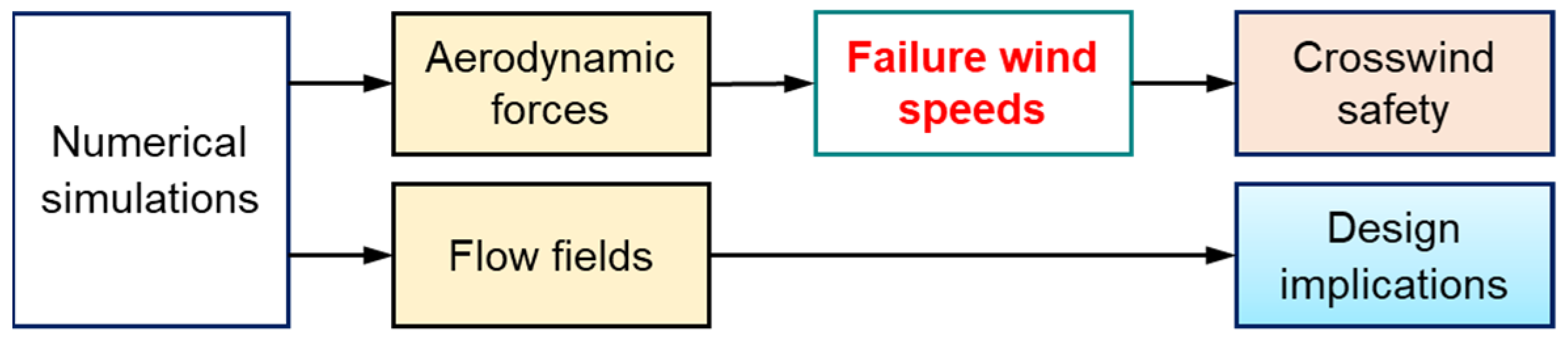
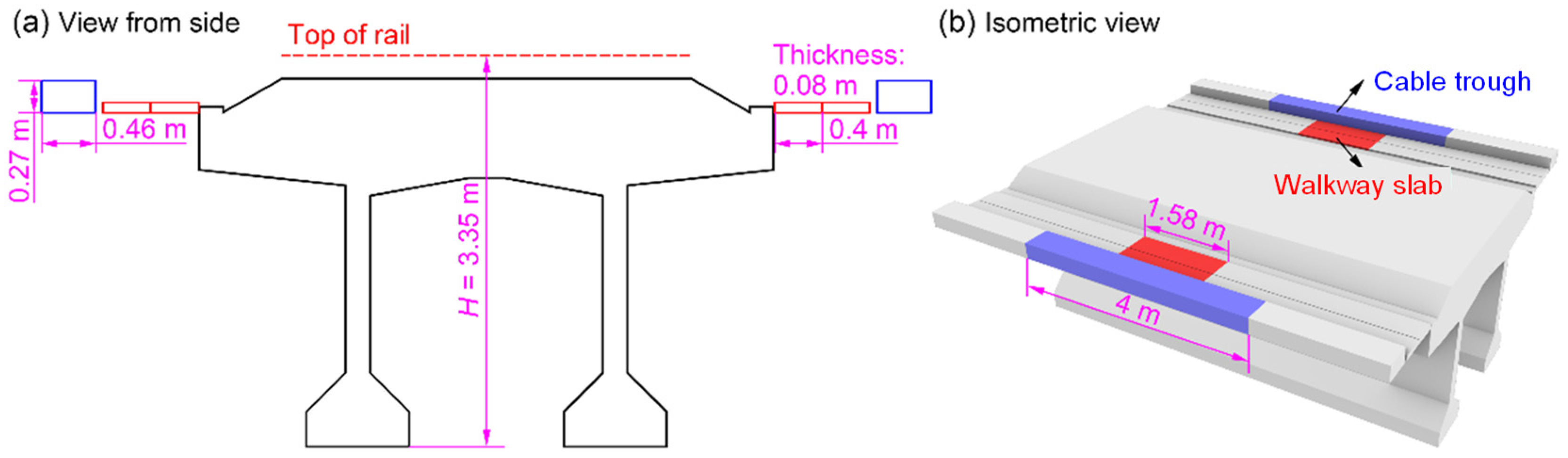
Computational DomainComputational MeshTurbulence ModelingReynolds Number
LengthWidthHeightLayers of Prismatic CellSurface Mesh SizeTurbulence ModelTime Step
26.8H40.6H32.2H100.02 mIDDES based on SST k-ω model0.001 s6.8 × 106
Table 2. Failure Wind Speeds of Bridge Walkway Slabs under Different Angles of Attack.
Attack Angle (°)01020
First Failing SlabWindward Inner SlabWindward Inner SlabWindward Inner Slab
Failure Wind Speed (m/s)35.636.939.4
Table 3. Horizontal Failure Wind Speeds of Slabs under Different Angles of Attack.
Attack Angle (°)01020
First Failing SlabWindward Inner SlabWindward Inner SlabWindward Inner Slab
Horizontal Failure Wind Speed (m/s)35.636.437.0
Table 4. Failure Wind Speeds of Bridge Cable Troughs under Different Angles of Attack.
Attack Angle (°)01020
First Failing Cable TroughWindward Cable TroughWindward Cable TroughWindward Cable Trough
Failure Wind Speed (m/s)22.624.125.5
Table 5. Horizontal Failure Wind Speeds of Bridge Cable Troughs under Different Angles of Attack.
Attack Angle (°)01020
First Failing Cable TroughWindward Cable TroughWindward Cable TroughWindward Cable Trough
Horizontal Failure Wind Speed (m/s)22.623.824.0
Disclaimer/Publisher’s Note: The statements, opinions and data contained in all publications are solely those of the individual author(s) and contributor(s) and not of MDPI and/or the editor(s). MDPI and/or the editor(s) disclaim responsibility for any injury to people or property resulting from any ideas, methods, instructions or products referred to in the content.