


Visualizing Driving Maneuvers Through Peripheral Displays: A Comparative Study of iHMI Design in Autonomous Vehicles

 ,
,
Abstract
1. Introduction
- RQ1 How effectively do different HMI designs (LED panels, LED strips, conventional displays) communicate vehicle maneuvers to passengers?
- RQ2 Do these HMI designs differ in the distraction they cause from a visual NDRT?
- RQ3 Does seating orientation (forward vs. rearward-facing) influence the effectiveness and distraction of each HMI design?
2. Materials and Methods
2.1. Design
2.2. Dependent Variables
2.2.1. Motion Perception
2.2.2. Distraction
2.3. Control Variables
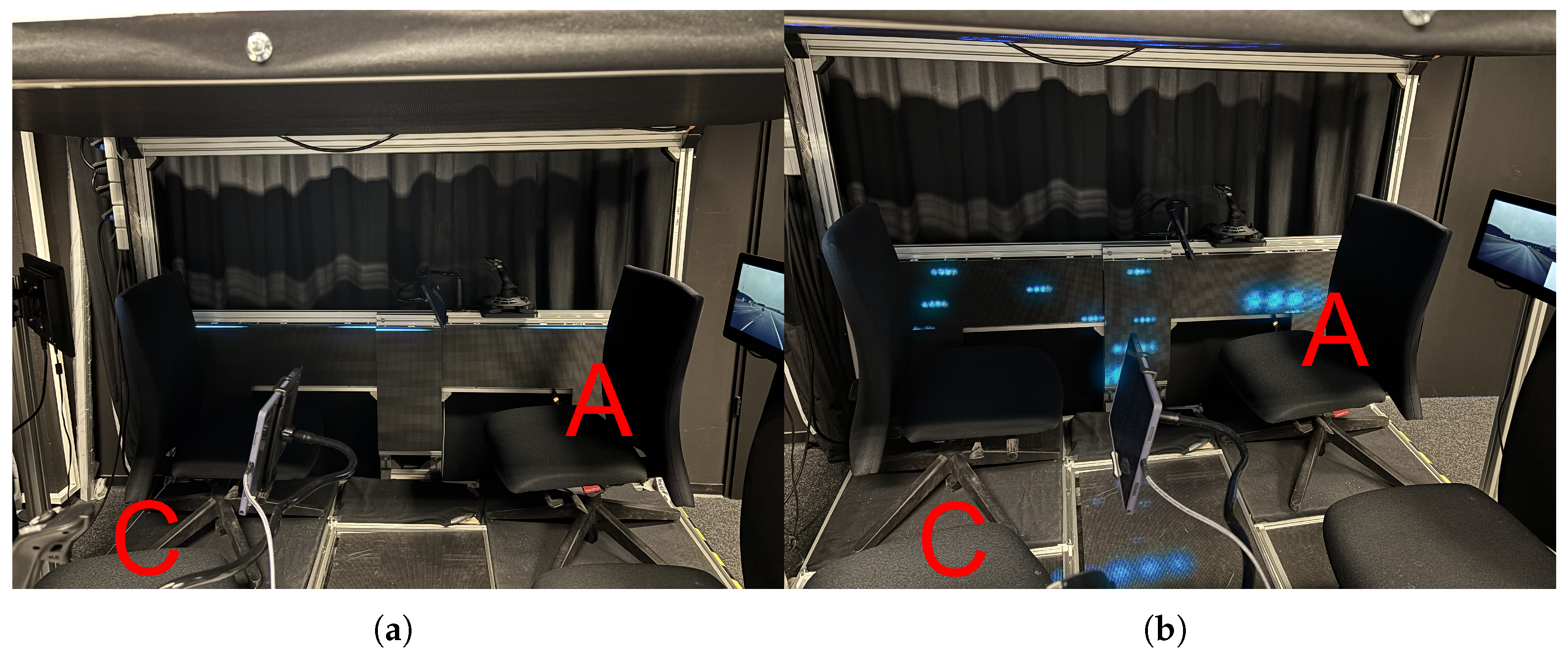
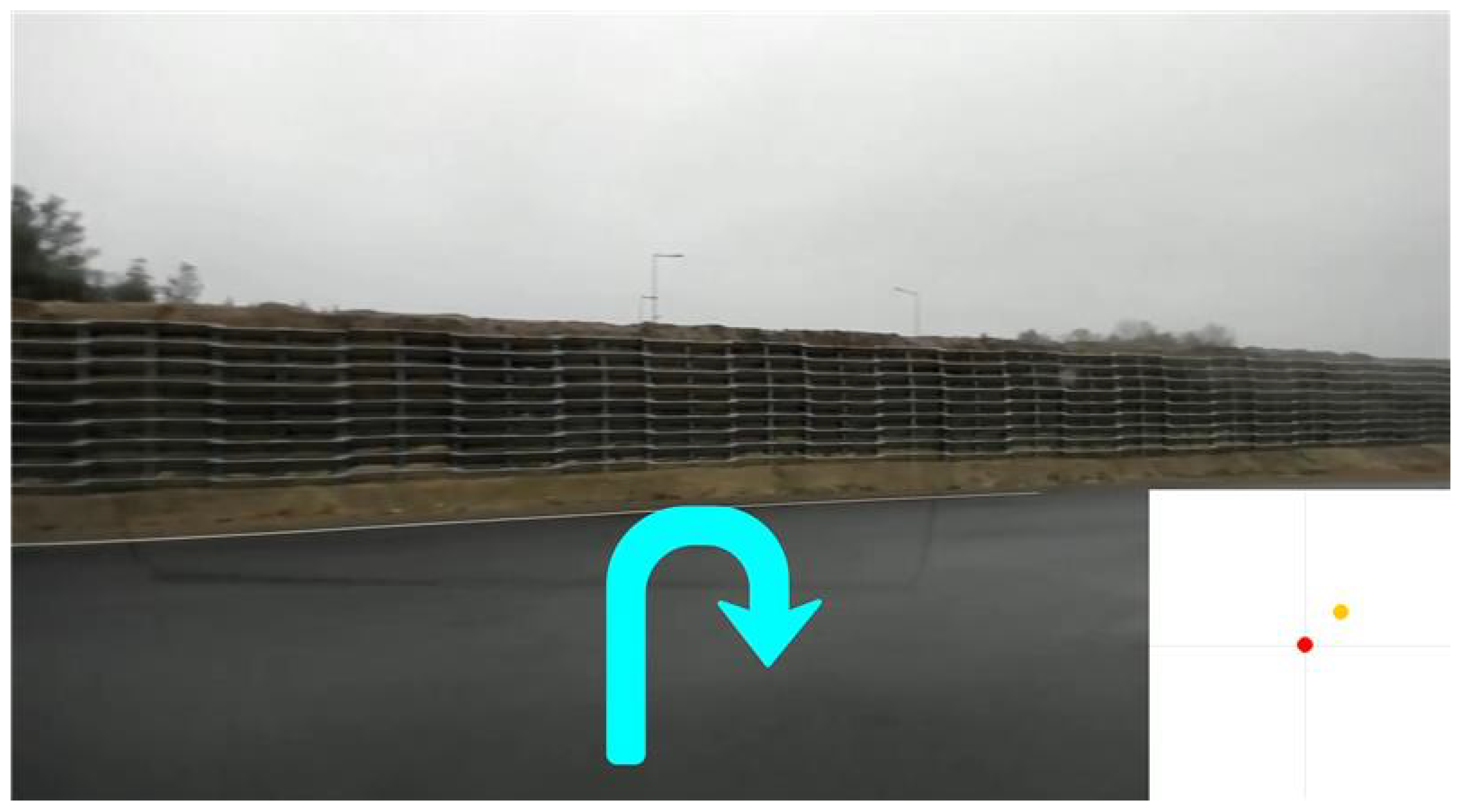
2.4. Apparatus
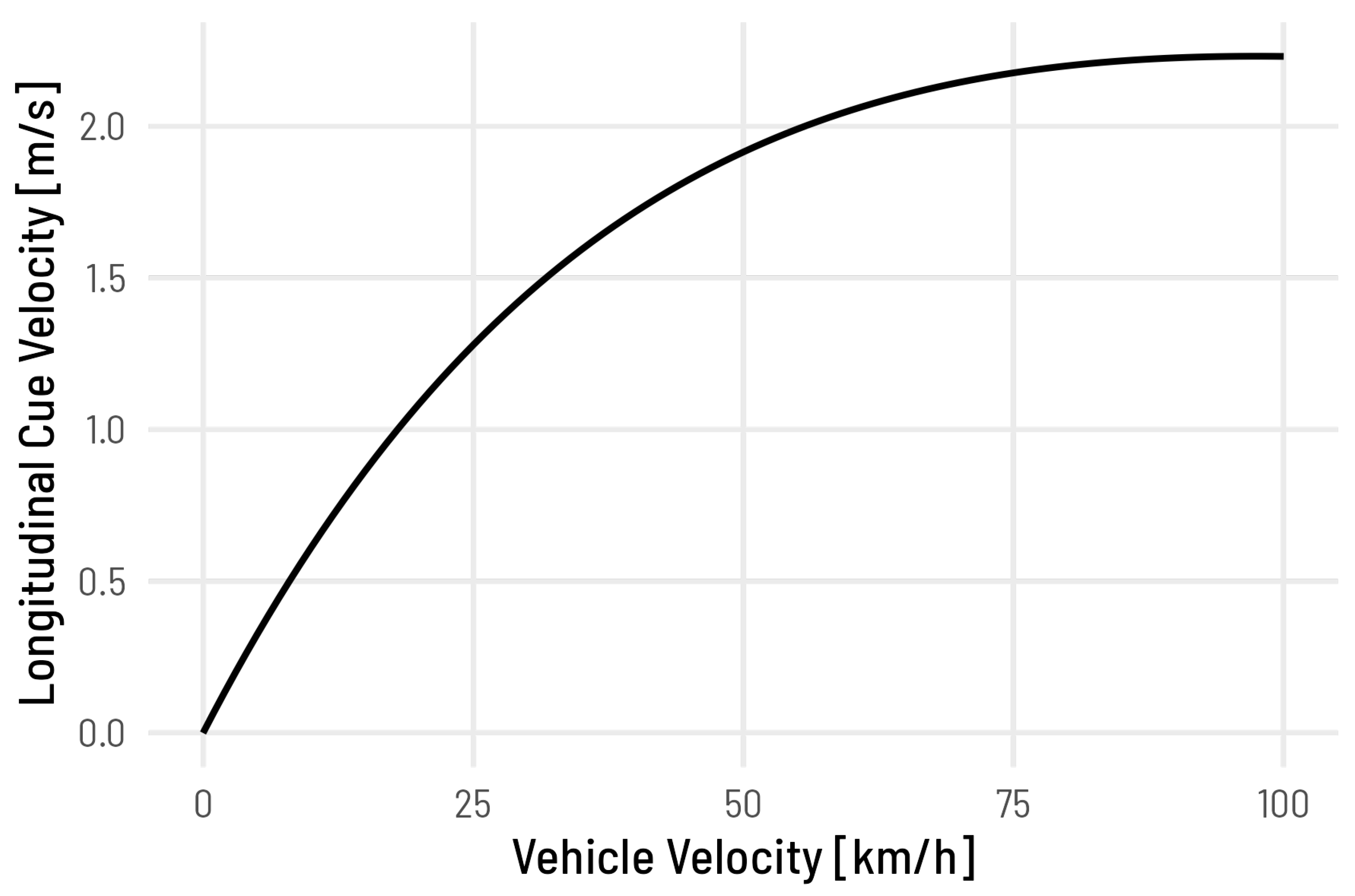
- is the longitudinal cue velocity in m/s;
- is the vehicle velocity in km/h.
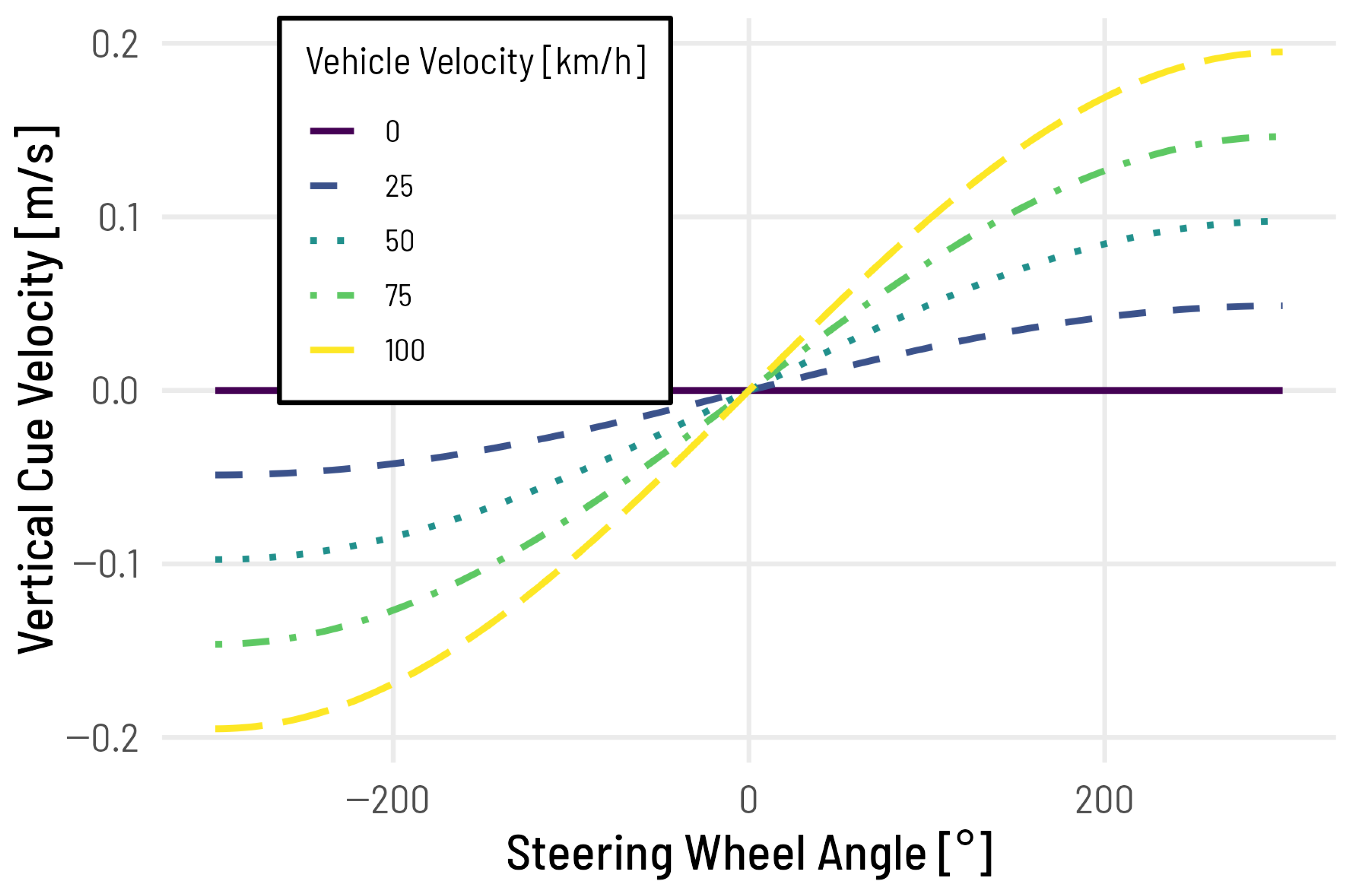
- is the vertical cue velocity in m/s,
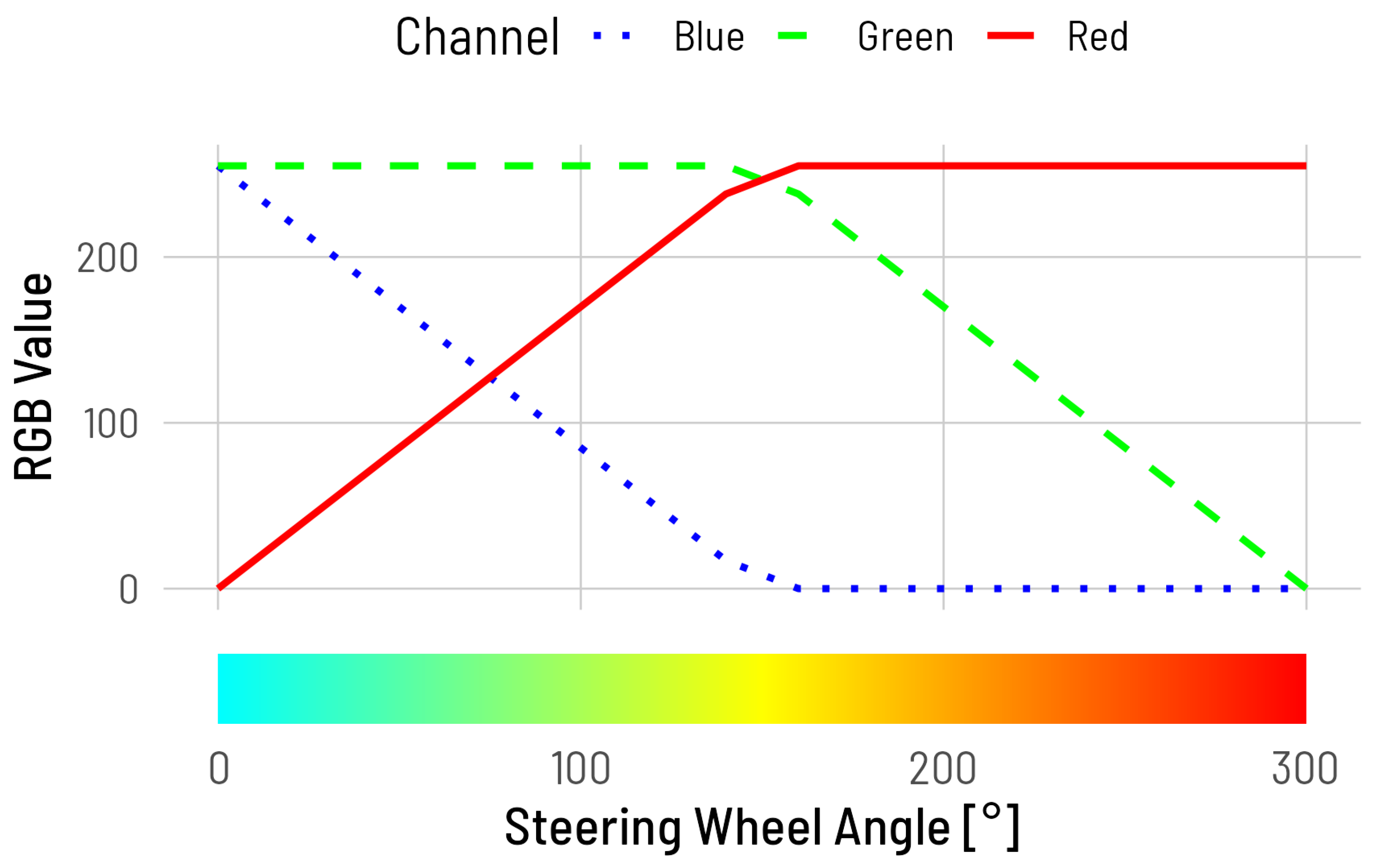
- is the steering wheel angle in degrees,
- is the vehicle velocity in km/h,
- is the product of the pixel pitch (3.9 mm) and a damping factor (0.5).
2.5. NDRT
2.6. Procedure
2.7. Sample
3. Results
3.1. Motion Perception
3.2. Distraction
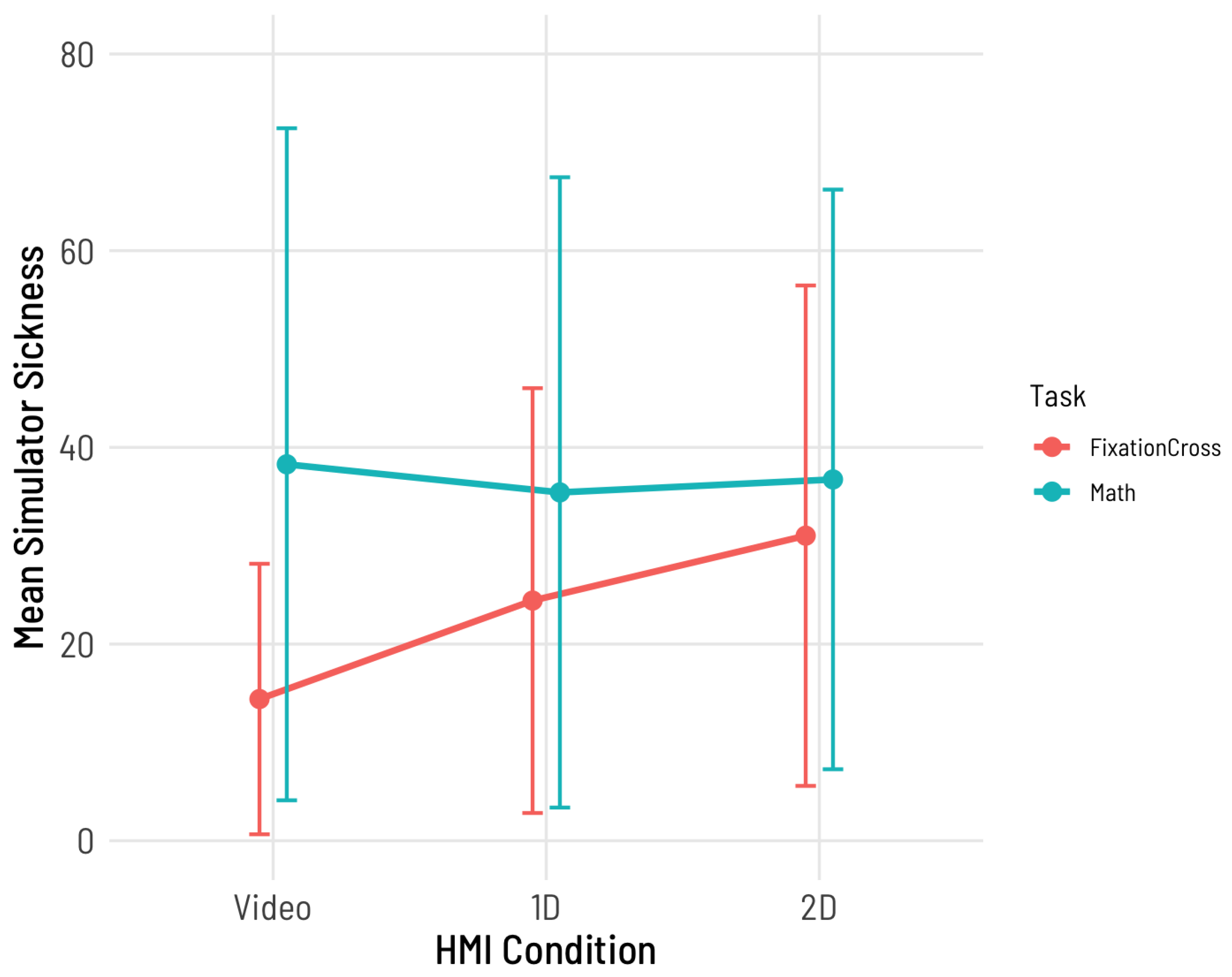
3.3. Simulator Sickness
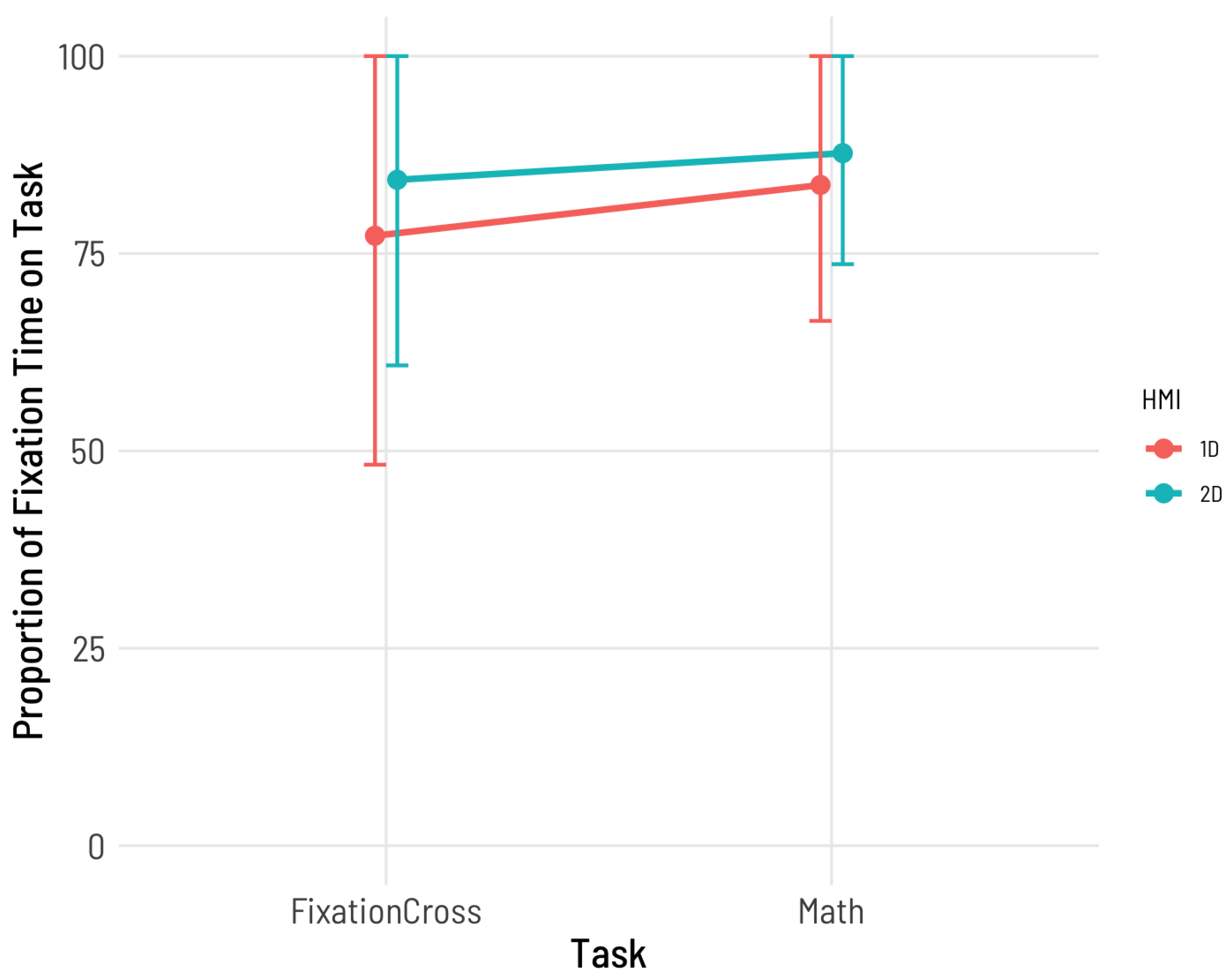
3.4. Peripheral Perception
4. Discussion
4.1. Limitations
4.2. Future Research
5. Conclusions
Author Contributions
Funding
Institutional Review Board Statement
Informed Consent Statement
Data Availability Statement
Acknowledgments
Conflicts of Interest
Abbreviations
| AV | Autonomous Vehicle |
| HMI | Human-Machine Interface |
| NDRT | Non-Driving Related Task |
| SSQ | Simulator Sickness Questionnaire |
Appendix A. Descriptive Statistics

| HMI | Task | Seating Orientation | Joystick Deviation | Math Score | Mental Demand | Simulator Sickness | Proportion Peripheral | |||||
|---|---|---|---|---|---|---|---|---|---|---|---|---|
| M | SD | M | SD | M | SD | M | SD | M | SD | |||
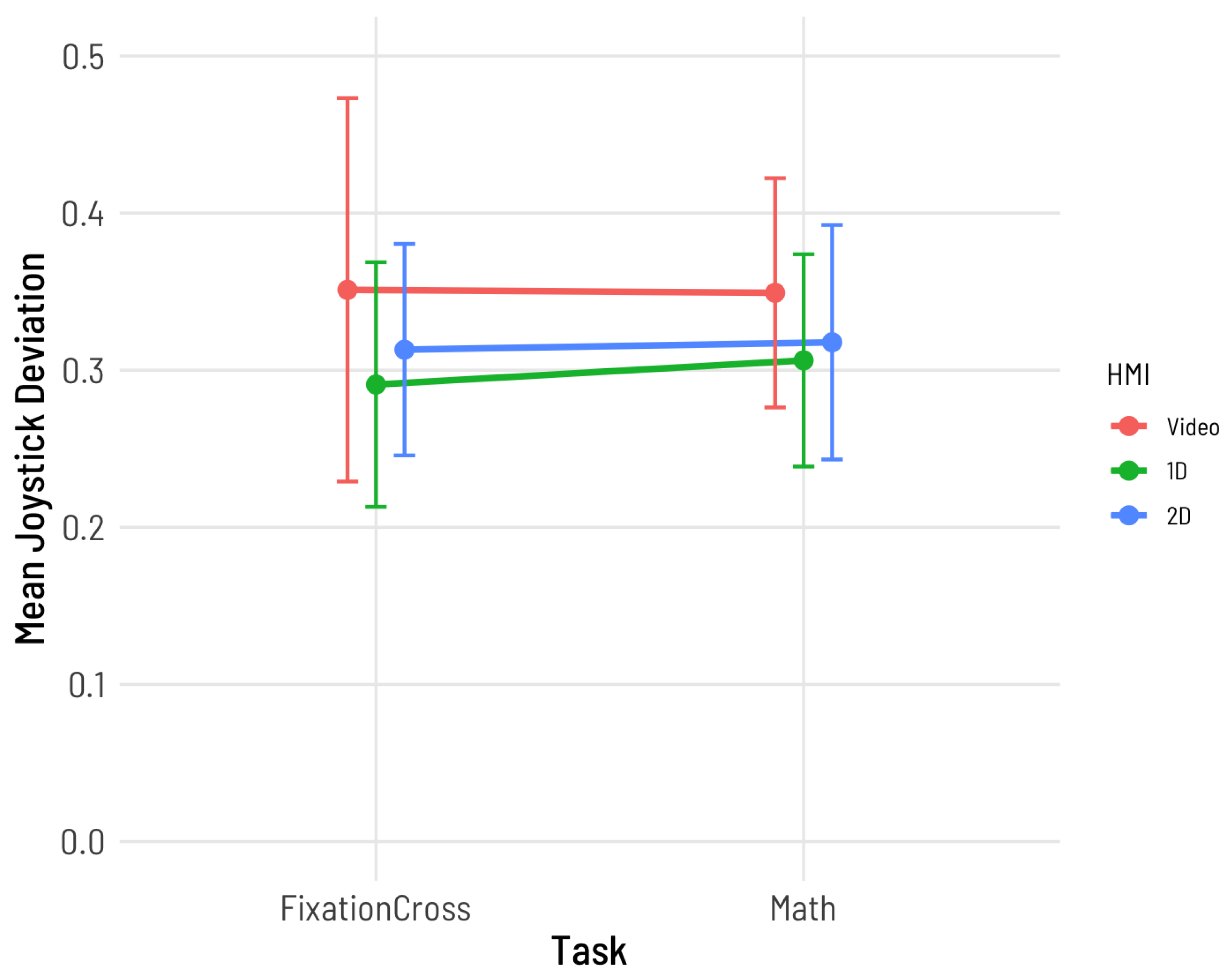
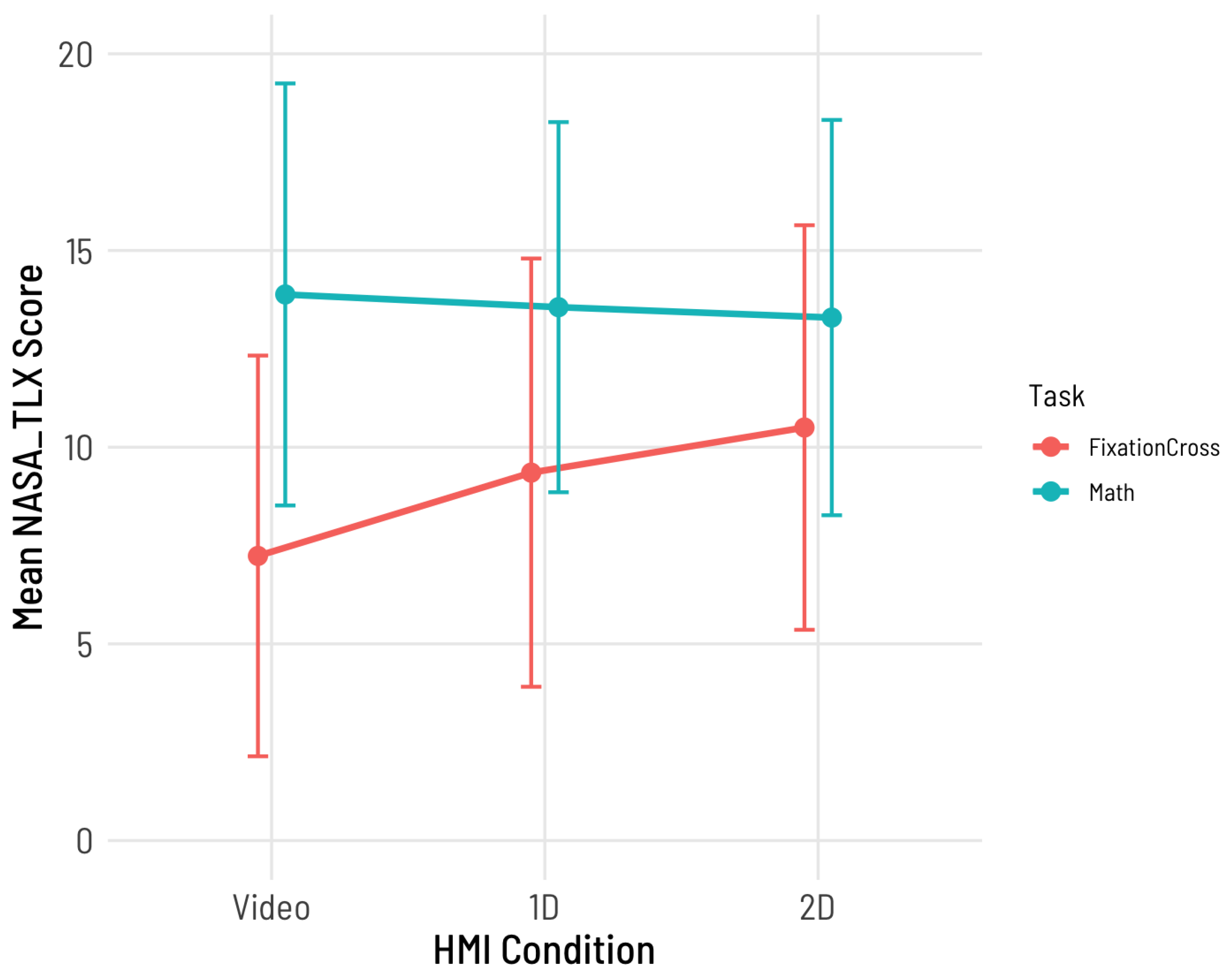
| Video | FixationCross | rearward | 0.337 | 0.118 | - | - | 6.294 | 4.254 | 16.060 | 15.910 | - | - |
| Video | FixationCross | forward | 0.370 | 0.129 | - | - | 8.176 | 5.790 | 12.760 | 11.456 | - | - |
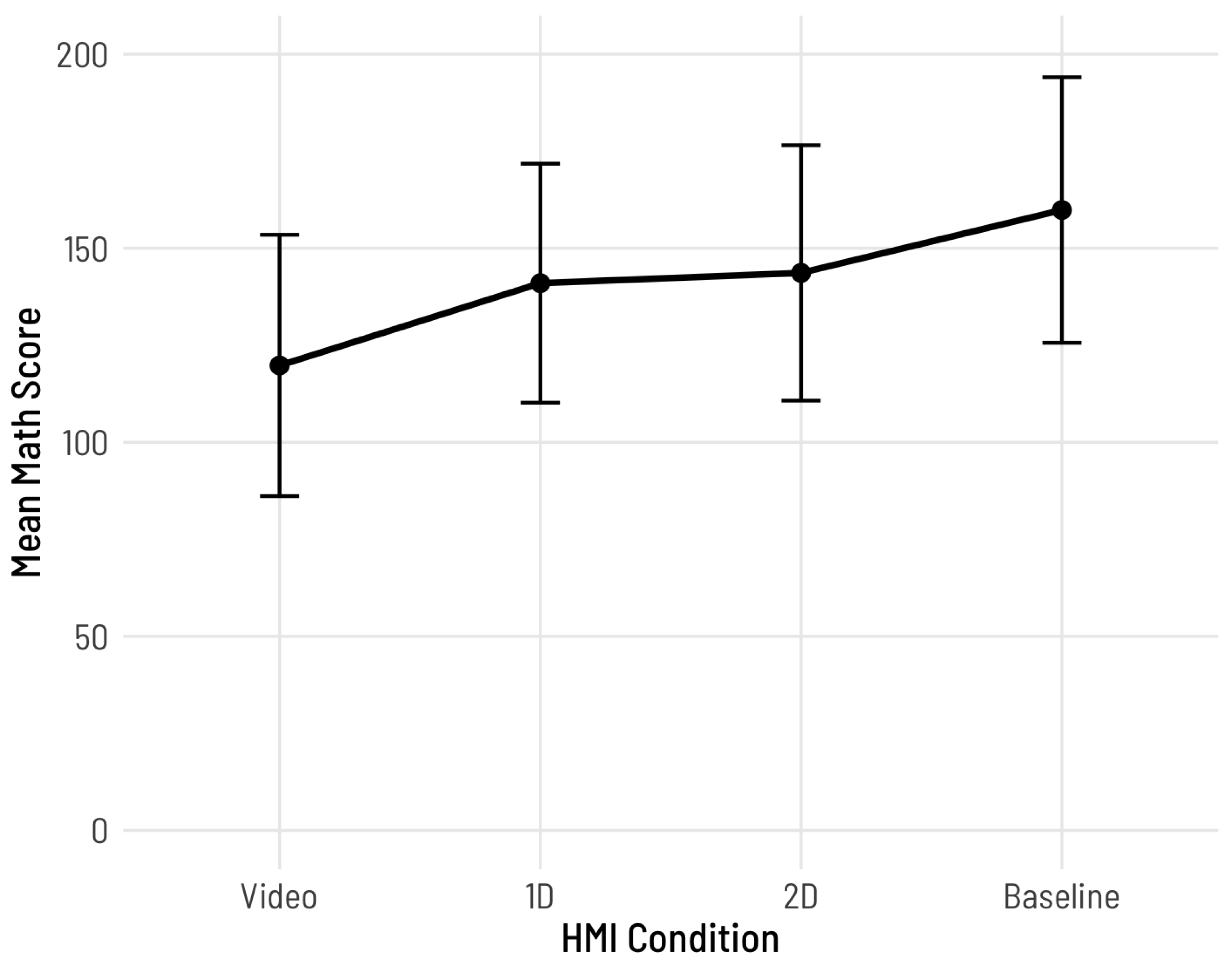
| Video | Math | rearward | 0.360 | 0.064 | 114.471 | 35.134 | 14.412 | 5.363 | 44.880 | 39.845 | - | - |
| Video | Math | forward | 0.339 | 0.081 | 125.118 | 32.295 | 13.353 | 5.477 | 31.680 | 26.973 | - | - |
| 1D | FixationCross | rearward | 0.299 | 0.077 | - | - | 8.824 | 5.399 | 28.380 | 24.095 | 66.810 | 37.325 |
| 1D | FixationCross | forward | 0.283 | 0.080 | - | - | 9.882 | 5.600 | 20.4607 | 18.659 | 87.042 | 13.038 |
| 1D | Math | rearward | 0.321 | 0.057 | 139.412 | 32.797 | 13.235 | 5.333 | 36.300 | 34.067 | 79.336 | 21.086 |
| 1D | Math | forward | 0.292 | 0.076 | 142.588 | 29.583 | 13.882 | 4.121 | 34.540 | 30.912 | 87.761 | 11.885 |
| 2D | FixationCross | rearward | 0.316 | 0.067 | - | - | 10.000 | 5.339 | 33.000 | 22.056 | 79.894 | 31.180 |
| 2D | FixationCross | forward | 0.310 | 0.069 | - | - | 11.000 | 5.050 | 29.040 | 28.986 | 88.502 | 12.644 |
| 2D | Math | rearward | 0.327 | 0.086 | 137.176 | 32.765 | 12.765 | 5.032 | 40.260 | 34.189 | 82.226 | 18.258 |
| 2D | Math | forward | 0.308 | 0.062 | 150.118 | 32.713 | 13.824 | 5.114 | 33.220 | 24.413 | 92.849 | 5.107 |
| Baseline | Math | rearward | - | - | 156.647 | 38.839 | - | - | - | - | - | - |
| Baseline | Math | forward | - | - | 163.059 | 29.733 | - | - | - | - | - | - |
| HMI | Task | Seating Orientation | Joystick Deviation | Math Score | Mental Demand | Simulator Sickness | Proportion Peripheral | |||||
|---|---|---|---|---|---|---|---|---|---|---|---|---|
| M | SD | M | SD | M | SD | M | SD | M | SD | |||
| Video | FixationCross | rearward | 0.288 | 0.079 | - | - | 5.091 | 2.468 | 18.700 | 17.622 | - | - |
| Video | FixationCross | forward | 0.400 | 0.139 | - | - | 8.077 | 5.408 | 13.234 | 12.739 | - | - |
| Video | Math | rearward | 0.350 | 0.074 | 111.091 | 30.015 | 12.909 | 5.718 | 42.160 | 38.798 | - | - |
| Video | Math | forward | 0.326 | 0.089 | 132.692 | 30.261 | 13.923 | 4.804 | 37.975 | 28.023 | - | - |
| 1D | FixationCross | rearward | 0.288 | 0.081 | - | - | 7.182 | 3.737 | 24.820 | 15.535 | 89.882 | 8.887 |
| 1D | FixationCross | forward | 0.283 | 0.089 | - | - | 10.077 | 5.107 | 21.577 | 20.664 | 89.360 | 8.804 |
| 1D | Math | rearward | 0.323 | 0.058 | 134.000 | 31.116 | 11.909 | 5.467 | 32.300 | 30.626 | 93.900 | 5.943 |
| 1D | Math | forward | 0.294 | 0.083 | 149.615 | 30.110 | 14.462 | 3.256 | 40.852 | 32.799 | 91.151 | 8.185 |
| 2D | FixationCross | rearward | 0.320 | 0.072 | - | - | 8.364 | 4.478 | 31.280 | 19.597 | 93.069 | 6.589 |
| 2D | FixationCross | forward | 0.316 | 0.072 | - | - | 11.154 | 4.879 | 31.646 | 31.610 | 93.571 | 5.354 |
| 2D | Math | rearward | 0.314 | 0.077 | 137.091 | 28.137 | 11.364 | 5.464 | 34.000 | 23.740 | 94.872 | 5.615 |
| 2D | Math | forward | 0.307 | 0.057 | 155.769 | 33.799 | 14.308 | 4.590 | 37.400 | 26.180 | 93.165 | 5.841 |
| Baseline | Math | rearward | - | - | 147.091 | 33.851 | - | - | - | - | - | - |
| Baseline | Math | forward | - | - | 165.923 | 32.186 | - | - | - | - | - | - |
Appendix B. Correlations
| Variable | Proportion Peripheral | Joystick Accuracy | Math Score | Simulator Sickness | Mental Demand |
|---|---|---|---|---|---|
| Proportion Peripheral | 1.000 | −0.081 | 0.307 * | −0.163 | −0.256 * |
| Joystick Accuracy | −0.081 | 1.000 | −0.021 | 0.014 | 0.009 |
| Math Score | 0.307 * | −0.021 | 1.000 | −0.297 * | −0.256 |
| Simulator Sickness | −0.163 | 0.014 | −0.297 * | 1.000 | 0.517 * |
| Mental Demand | −0.256 * | 0.009 | −0.250 | 0.517 * | 1.000 |
References
- Benleulmi, A.Z.; Blecker, T. Investigating the Factors Influencing the Acceptance of Fully Autonomous Cars. In Proceedings of the Hamburg International Conference of Logistics (HICL), Hamburg, Germany, 12–13 October 2017; 23. epubli: Berlin, Germany, 2017; pp. 99–115. [Google Scholar] [CrossRef]
- Diels, C.; Bos, J.E. Self-Driving Carsickness. Appl. Ergon. 2016, 53, 374–382. [Google Scholar] [CrossRef]
- Nordhoff, S.; Kyriakidis, M.; Van Arem, B.; Happee, R. A Multi-Level Model on Automated Vehicle Acceptance (MAVA): A Review-Based Study. Theor. Issues Ergon. Sci. 2019, 20, 682–710. [Google Scholar] [CrossRef]
- Nordhoff, S.; Madigan, R.; Van Arem, B.; Merat, N.; Happee, R. Interrelationships among Predictors of Automated Vehicle Acceptance: A Structural Equation Modelling Approach. Theor. Issues Ergon. Sci. 2021, 22, 383–408. [Google Scholar] [CrossRef]
- Nordhoff, S.; Malmsten, V.; Van Arem, B.; Liu, P.; Happee, R. A Structural Equation Modeling Approach for the Acceptance of Driverless Automated Shuttles Based on Constructs from the Unified Theory of Acceptance and Use of Technology and the Diffusion of Innovation Theory. Transp. Res. Part F Traffic Psychol. Behav. 2021, 78, 58–73. [Google Scholar] [CrossRef]
- Osswald, S.; Wurhofer, D.; Trösterer, S.; Beck, E.; Tscheligi, M. Predicting Information Technology Usage in the Car: Towards a Car Technology Acceptance Model. In Proceedings of the 4th International Conference on Automotive User Interfaces and Interactive Vehicular Applications, Portsmouth, NH, USA, 17–19 October 2012; pp. 51–58. [Google Scholar] [CrossRef]
- Rahim, A.N.; Fonzone, A.; Fountas, G.; Downey, L. On the Attitudes Toward Automation in Determining the Intention to Use Automated Buses in Scotland. Transp. Res. Rec. 2023, 2677, 384–396. [Google Scholar] [CrossRef]
- Venkatesh, V.; Thong, J.Y.L.; Xu, X. Consumer Acceptance and Use of Information Technology: Extending the Unified Theory of Acceptance and Use of Technology. MIS Q. 2012, 36, 157. [Google Scholar] [CrossRef]
- Xu, Z.; Zhang, K.; Min, H.; Wang, Z.; Zhao, X.; Liu, P. What Drives People to Accept Automated Vehicles? Findings from a Field Experiment. Transp. Res. Part C Emerg. Technol. 2018, 95, 320–334. [Google Scholar] [CrossRef]
- Zhang, T.; Tao, D.; Qu, X.; Zhang, X.; Lin, R.; Zhang, W. The Roles of Initial Trust and Perceived Risk in Public’s Acceptance of Automated Vehicles. Transp. Res. Part C Emerg. Technol. 2019, 98, 207–220. [Google Scholar] [CrossRef]
- Zhang, T.; Zeng, W.; Zhang, Y.; Tao, D.; Li, G.; Qu, X. What Drives People to Use Automated Vehicles? A Meta-Analytic Review. Accid. Anal. Prev. 2021, 159, 106270. [Google Scholar] [CrossRef]
- Zhang, Q.; Wallbridge, C.D.; Jones, D.M.; Morgan, P.L. Public Perception of Autonomous Vehicle Capability Determines Judgment of Blame and Trust in Road Traffic Accidents. Transp. Res. Part A Policy Pract. 2024, 179, 103887. [Google Scholar] [CrossRef]
- Zou, X.; Logan, D.B.; Vu, H.L. Modeling Public Acceptance of Private Autonomous Vehicles: Value of Time and Motion Sickness Viewpoints. Transp. Res. Part C Emerg. Technol. 2022, 137, 103548. [Google Scholar] [CrossRef]
- Jorlöv, S.; Bohman, K.; Larsson, A. Seating Positions and Activities in Highly Automated Cars—A Qualitative Study of Future Automated Driving Scenarios. In Proceedings of the IRCOBI Conference Proceedings, Antwerp, Belgium, 13–15 September 2017; pp. 13–22. [Google Scholar]
- Pettersson, I.; Karlsson, I.M. Setting the Stage for Autonomous Cars: A Pilot Study of Future Autonomous Driving Experiences. IET Intell. Transp. Syst. 2015, 9, 694–701. [Google Scholar] [CrossRef]
- Sun, X.; Cao, S.; Tang, P. Shaping Driver-Vehicle Interaction in Autonomous Vehicles: How the New in-Vehicle Systems Match the Human Needs. Appl. Ergon. 2021, 90, 103238. [Google Scholar] [CrossRef]
- Salter, S.; Diels, C.; Herriotts, P.; Kanarachos, S.; Thake, D. Motion Sickness in Automated Vehicles with Forward and Rearward Facing Seating Orientations. Appl. Ergon. 2019, 78, 54–61. [Google Scholar] [CrossRef]
- Metzulat, M.; Metz, B.; Edelmann, A.; Neukum, A.; Kunde, W. Sick of Being Driven?—Prevalence and Modulating Factors of Carsickness in the European Population in Context of Automated Driving. arXiv 2025, arXiv:2505.04210. [Google Scholar] [CrossRef]
- Reason, J.T. Motion Sickness Adaptation: A Neural Mismatch Model. J. R. Soc. Med. 1978, 71, 819–829. [Google Scholar] [CrossRef] [PubMed]
- Rottmann, L.; Johannsen, A.; Niedling, M.; Vollrath, M. Influence of Seating Orientation on Motion Sickness in Autonomous Vehicles. Appl. Ergon. 2026, 130, 104643. [Google Scholar] [CrossRef] [PubMed]
- Diels, C. Will Autonomous Vehicles Make Us Sick? In Contemporary Ergonomics and Human Factors 2014; Sharples, S., Shorrock, S., Eds.; Taylor & Francis: Abingdon, UK, 2014; pp. 301–307. [Google Scholar] [CrossRef]
- Griffin, M.J.; Newman, M.M. Visual Field Effects on Motion Sickness in Cars. Aviat. Space Environ. Med. 2004, 75, 739–748. [Google Scholar]
- Rottmann, L.; Waldmann, A.; Johannsen, A.; Vollrath, M. Rearward Seating Orientation Decreases Trust and Increases Motion Sickness in Autonomous Vehicles. Preprint, 2025; preprint. [Google Scholar] [CrossRef]
- Chang, C.C.; Grier, R.A.; Maynard, J.; Shutko, J.; Blommer, M.; Swaminathan, R.; Curry, R. Using a Situational Awareness Display to Improve Rider Trust and Comfort with an AV Taxi. Proc. Hum. Factors Ergon. Soc. Annu. Meet. 2019, 63, 2083–2087. [Google Scholar] [CrossRef]
- Hanau, E.; Popescu, V. MotionReader: Visual Acceleration Cues for Alleviating Passenger E-Reader Motion Sickness. In Proceedings of the 9th International Conference on Automotive User Interfaces and Interactive Vehicular Applications Adjunct, Oldenburg, Germany, 24–27 September 2017; pp. 72–76. [Google Scholar] [CrossRef]
- Kuiper, O.X.; Bos, J.E.; Diels, C. Looking Forward: In-vehicle Auxiliary Display Positioning Affects Carsickness. Appl. Ergon. 2018, 68, 169–175. [Google Scholar] [CrossRef]
- Oliveira, L.; Burns, C.; Luton, J.; Iyer, S.; Birrell, S. The Influence of System Transparency on Trust: Evaluating Interfaces in a Highly Automated Vehicle. Transp. Res. Part F Traffic Psychol. Behav. 2020, 72, 280–296. [Google Scholar] [CrossRef]
- Choi, J.K.; Ji, Y.G. Investigating the Importance of Trust on Adopting an Autonomous Vehicle. Int. J. Hum.-Comput. Interact. 2015, 31, 692–702. [Google Scholar] [CrossRef]
- Diels, C.; Thompson, S. Information Expectations in Highly and Fully Automated Vehicles. In Advances in Human Aspects of Transportation, Proceedings of the AHFE 2017, Los Angeles, CA, USA, 17–21 July 2017; Stanton, N.A., Ed.; Springer: Cham, Switzerland, 2018; pp. 742–748. [Google Scholar] [CrossRef]
- Hoff, K.A.; Bashir, M. Trust in Automation: Integrating Empirical Evidence on Factors That Influence Trust. Hum. Factors 2015, 57, 407–434. [Google Scholar] [CrossRef] [PubMed]
- Diels, C.; Bos, J. Great Expectations: On the Design of Predictive Motion Cues to Alleviate Carsickness. In HCI in Mobility, Transport, and Automotive Systems; Krömker, H., Ed.; Springer International Publishing: Cham, Switzerland, 2021; Volume 12791, pp. 240–251. [Google Scholar] [CrossRef]
- Bohrmann, D.; Bruder, A.; Bengler, K. Effects of Dynamic Visual Stimuli on the Development of Carsickness in Real Driving. IEEE Trans. Intell. Transp. Syst. 2022, 23, 4833–4842. [Google Scholar] [CrossRef]
- Hainich, R.; Drewitz, U.; Ihme, K.; Lauermann, J.; Niedling, M.; Oehl, M. Evaluation of a Human–Machine Interface for Motion Sickness Mitigation Utilizing Anticipatory Ambient Light Cues in a Realistic Automated Driving Setting. Information 2021, 12, 176. [Google Scholar] [CrossRef]
- De Winkel, K.N.; Pretto, P.; Nooij, S.A.; Cohen, I.; Bülthoff, H.H. Efficacy of Augmented Visual Environments for Reducing Sickness in Autonomous Vehicles. Appl. Ergon. 2021, 90, 103282. [Google Scholar] [CrossRef]
- Wickens, C.D. Multiple Resources and Performance Prediction. Theor. Issues Ergon. Sci. 2002, 3, 159–177. [Google Scholar] [CrossRef]
- Girard, J.M.; Wright, A.G.C. DARMA: Software for Dual Axis Rating and Media Annotation. Behav. Res. Methods 2017, 50, 902–909. [Google Scholar] [CrossRef]
- Hart, S.G. NASA Task Load Index (TLX): Computerized Version—Volume 1.0; NASA: Pasadena, CA, USA, 1986. [Google Scholar]
- De Winkel, K.N.; Talsma, T.M.W.; Happee, R. A Meta-Analysis of Simulator Sickness as a Function of Simulator Fidelity. Exp. Brain Res. 2022, 240, 3089–3105. [Google Scholar] [CrossRef]
- Metzulat, M.; Metz, B.; Landau, A.; Neukum, A.; Kunde, W. Too Sick to Take over?—Impact of Car Sickness on Cognitive Performance Related to Driving in the Context of Automated Driving. Transp. Res. Part F Traffic Psychol. Behav. 2025, 109, 480–500. [Google Scholar] [CrossRef]
- Kennedy, R.S.; Lane, N.E.; Berbaum, K.S.; Lilienthal, M.G. Simulator Sickness Questionnaire: An Enhanced Method for Quantifying Simulator Sickness. Int. J. Aviat. Psychol. 1993, 3, 203–220. [Google Scholar] [CrossRef]
- Golding, J.F. Predicting Individual Differences in Motion Sickness Susceptibility by Questionnaire. Personal. Individ. Differ. 2006, 41, 237–248. [Google Scholar] [CrossRef]
- Franke, T.; Attig, C.; Wessel, D. A Personal Resource for Technology Interaction: Development and Validation of the Affinity for Technology Interaction (ATI) Scale. Int. J. Hum.-Interact. 2019, 35, 456–467. [Google Scholar] [CrossRef]
- Rottmann, L.; Stang, A.; Johannsen, A.; Niedling, M. Designing a Light-Based Extension of the Vehicle Environment for Motion Sickness Mitigation. In Proceedings of the 16th International Symposium on Automotive Lighting 2025, Darmstadt, Germany, 22–24 September 2025; Volume 21, pp. 184–193. [Google Scholar] [CrossRef]
- Künzer, L. “Alarmstufe Rot!” oder “Alles im grünen Bereich!” Farben im Kontext von Gefahr und Sicherheit. Ph.D. Thesis, Universität Regensburg, Regensburg, Germany, 2016. [Google Scholar]
- Wobbrock, J.O.; Findlater, L.; Gergle, D.; Higgins, J.J. The Aligned Rank Transform for Nonparametric Factorial Analyses Using Only Anova Procedures. In Proceedings of the SIGCHI Conference on Human Factors in Computing Systems, New York, NY, USA, 7–12 May 2011; CHI ’11. pp. 143–146. [Google Scholar] [CrossRef]
- Cohen, J. Statistical Power Analysis for the Behavioral Sciences, 2nd ed.; Routledge: New York, NY, USA, 1988. [Google Scholar] [CrossRef]
- Levi, D.M.; Klein, S.A.; Aitsebaomo, P. Detection and Discrimination of the Direction of Motion in Central and Peripheral Vision of Normal and Amblyopic Observers. Vis. Res. 1984, 24, 789–800. [Google Scholar] [CrossRef]
- McManus, M.; D’Amour, S.; Harris, L.R. Using Optic Flow in the Far Peripheral Field. J. Vis. 2017, 17, 3. [Google Scholar] [CrossRef]
- Hanssens, J.M.; Piponnier, J.C.; Faubert, J. Influence of Central and Peripheral Visual Field on the Postural Control When Viewing an Optic Flow Stimulus. J. Vis. 2008, 8, 858. [Google Scholar] [CrossRef]
- Riccio, G.E.; Stoffregen, T.A. An Ecological Theory of Motion Sickness and Postural Instability. Ecol. Psychol. 1991, 3, 195–240. [Google Scholar] [CrossRef]
- Leukel, C.; Lundbye-Jensen, J.; Christensen, M.S.; Gollhofer, A.; Nielsen, J.B.; Taube, W. Subconscious Visual Cues during Movement Execution Allow Correct Online Choice Reactions. PLoS ONE 2012, 7, e44496. [Google Scholar] [CrossRef]
- Vater, C.; Wolfe, B.; Rosenholtz, R. Peripheral Vision in Real-World Tasks: A Systematic Review. Psychon. Bull. Rev. 2022, 29, 1531–1557. [Google Scholar] [CrossRef]
- Liang, Z.; Wang, Y.; Qian, C.; Wang, Y.; Zhao, C.; Du, H.; Deng, J.; Li, X.; He, Y. A Driving Simulator Study to Examine the Impact of Visual Distraction Duration from In-Vehicle Displays: Driving Performance, Detection Response, and Mental Workload. Electronics 2024, 13, 2718. [Google Scholar] [CrossRef]
- Karjanto, J.; Yusof, N.; Hassan, M.Z.; Terken, J.; Rauterberg, M. An On-Road Study in Mitigating Motion Sickness When Reading in Automated Driving. J. Hunan Univ. Nat. Sci. 2021, 48, 95–109. [Google Scholar]
- Keshavarz, B.; Hecht, H.; Zschutschke, L. Intra-Visual Conflict in Visually Induced Motion Sickness. Displays 2011, 32, 181–188. [Google Scholar] [CrossRef]
Disclaimer/Publisher’s Note: The statements, opinions and data contained in all publications are solely those of the individual author(s) and contributor(s) and not of MDPI and/or the editor(s). MDPI and/or the editor(s) disclaim responsibility for any injury to people or property resulting from any ideas, methods, instructions or products referred to in the content. |
© 2025 by the authors. Licensee MDPI, Basel, Switzerland. This article is an open access article distributed under the terms and conditions of the Creative Commons Attribution (CC BY) license (https://creativecommons.org/licenses/by/4.0/).
Share and Cite
Rottmann, L.; Stang, A.; Johannsen, A.; Niedling, M.; Vollrath, M. Visualizing Driving Maneuvers Through Peripheral Displays: A Comparative Study of iHMI Design in Autonomous Vehicles. Appl. Sci. 2025, 15, 12044. https://doi.org/10.3390/app152212044
Rottmann L, Stang A, Johannsen A, Niedling M, Vollrath M. Visualizing Driving Maneuvers Through Peripheral Displays: A Comparative Study of iHMI Design in Autonomous Vehicles. Applied Sciences. 2025; 15(22):12044. https://doi.org/10.3390/app152212044
Chicago/Turabian StyleRottmann, Leonhard, Anastasia Stang, Aniella Johannsen, Mathias Niedling, and Mark Vollrath. 2025. "Visualizing Driving Maneuvers Through Peripheral Displays: A Comparative Study of iHMI Design in Autonomous Vehicles" Applied Sciences 15, no. 22: 12044. https://doi.org/10.3390/app152212044
APA StyleRottmann, L., Stang, A., Johannsen, A., Niedling, M., & Vollrath, M. (2025). Visualizing Driving Maneuvers Through Peripheral Displays: A Comparative Study of iHMI Design in Autonomous Vehicles. Applied Sciences, 15(22), 12044. https://doi.org/10.3390/app152212044


