
Development, Implementation, and Experimental Validation of a Novel Thermal–Optical–Electrical Model for Photovoltaic Glazing

 , , , and
Abstract
1. Introduction

| Author | Device Type | Thermal Model | Optical Model | Results |
|---|---|---|---|---|
| Qiu et al. [30] | Vacuum Solar PV glass | EnergyPlus + WINDOW | N/A | 58% heating energy savings (Harbin–severe climates). Increased cooling demand in moderate climates (Kunming–moderate climates). |
| Wei et al. [32,33] | Hybrid Cd-Te-PCMG module (Solar PV with phase-change material). | Coupled optical–thermal–electrical model (parametric analysis of PCM thickness and PV coverage). | Global properties (no spectral discrimination). | Improvement of 0.53–0.99% in daily electrical generation. |
| Alsukkar et al. [31] | PV louvres integrated with Solar PV glass. | N/A | Parametrised optical model (DIALux evo) for light distribution and transmittance analysis. | Light uniformity of 0.70 with rear louvres. Optimal transmittance 50–70%. |
| Xu et al. [34] | Bifacial thermochromic Solar PV wall (BPVW-TC). | Thermal model with phase-change simulation (35.8 °C). | Global properties (no spectral discrimination). | Maximum efficiency 20.25% in summer. Thermal error 1.4 °C. |
| Yao et al. [14] | Semi-transparent Solar PV curtain walls. | RC model with thermal–electrical coupling (layered energy balance). | Average optical coefficients (no spectral discrimination). | RMSE 1.10 W in electrical generation. |
| Wang et al. [15] | Ventilated double glazing with Solar PV louvres. | Quasi-steady RC model with temperature correction. | Integrated absorption and emission coefficients (no spectral detail). | Maximum error 7.2% (electrical) and 6.5% (thermal). |
| Yu et al. [16] | Semi-transparent double-glazing Solar PV. | 1D nodal model with average thermal coefficients. | Average optical coefficients (no spectral discrimination). | Cv(RMSE): 9.64% (PV temp.), 5.21% (rear glass temp.), 18.11% (electrical generation). |
| Ding et al. [17] | Semi-transparent Solar PV insulating glass. | RC model with uniform radiation absorption. | Constant optical coefficients (transmittance and absorptance). | Cv(RMSE): 8.56–17.28% for surface temperature and electrical generation. |
| Fayaz et al. [18] | Hybrid PVT and PVT-PCM systems. | 3D model (COMSOL) with conduction equations and thermal source terms. | Integrated optical properties (surface emissivity and absorptance). | Differences < 1% in electrical efficiency (12.4% simulated vs. 12.28% experimental). |
| Huang et al. [20] | Vacuum Solar PV glass. | 3D FEM model (COMSOL). | Surface emissivity and absorptance adjusted for long-/short-wave radiation. | Error < 5% in heat transfer coefficient (U-value). |
| Youseff et al. [21] | Transparent walls integrated with Solar PV. | 3D model (ANSYS) for heat transfer and convection. | Lighting simulation (DIALux evo). Global optical properties in two spectral bands. | Daily generation ~394 Wh/m2. Electricity consumption reduced by 46.9–79.3%. |
| Du et al. [24] | Crystalline silicon Solar PV modules (GG and GB). | Multilayer heat transfer model (COMSOL) with glass, EVA, and silicon layers. | Integrated optical properties (absorptance and transmittance). | Maximum error 9.7% in cell temperature. |
| Han et al. [25] | Vacuum glass. | 3D FEM model (ANSYS) for conduction through pillars and radiation between panes. | N/A | 3.14% error in heat transfer coefficient. |
| Wang et al. [26] | Insulating glass with a-Si Solar PV. | EnergyPlus model with U-value and SHGC. | Spectral optical model (WINDOW/OPTICS) and Sandia PV simulation for electrical generation. | Temperature deviation up to 3.5 °C (Cv(RMSE) 2.8%). Electrical power error 22.8% due to spectral variability. |
2. Materials and Methods
2.1. Proposed Model
2.1.1. Governing Equations
2.1.2. Numerical Resolution
2.2. Experiment
2.3. Reference Models
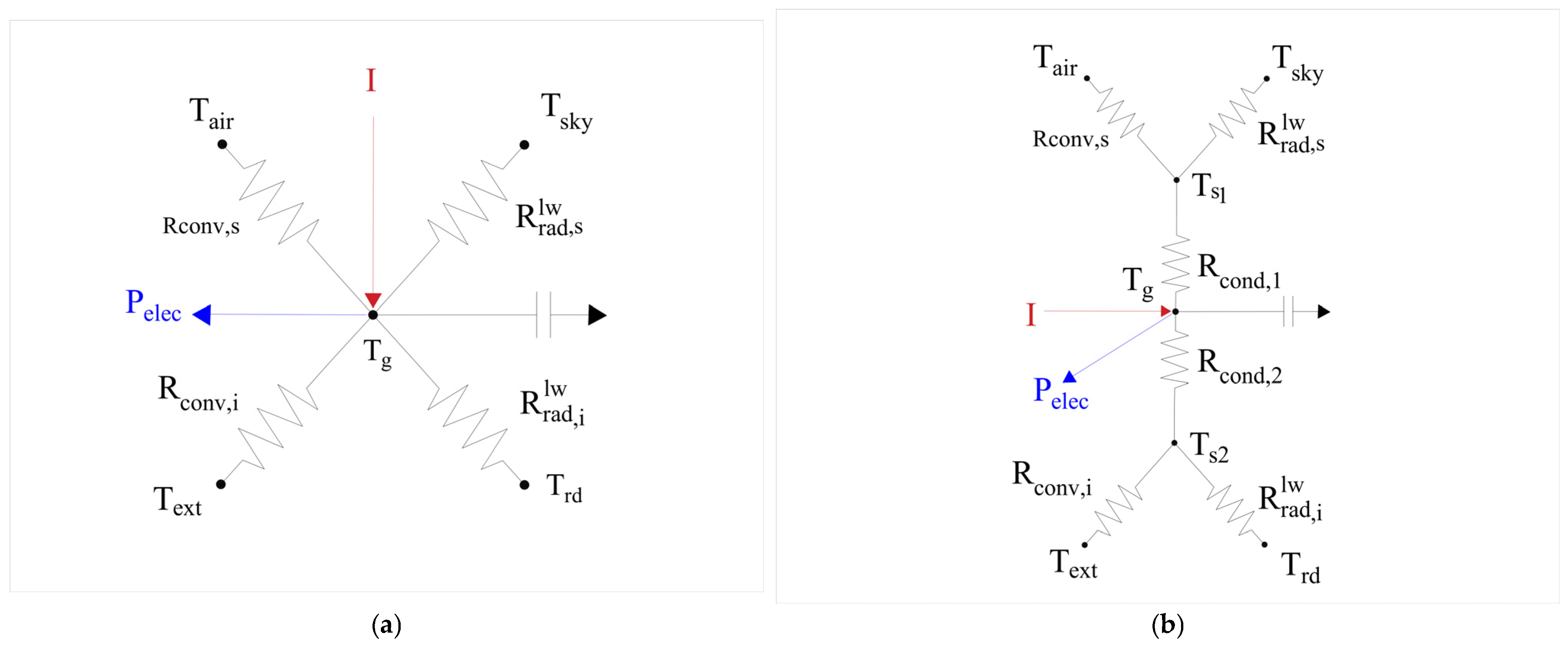
2.3.1. RC-Based Models
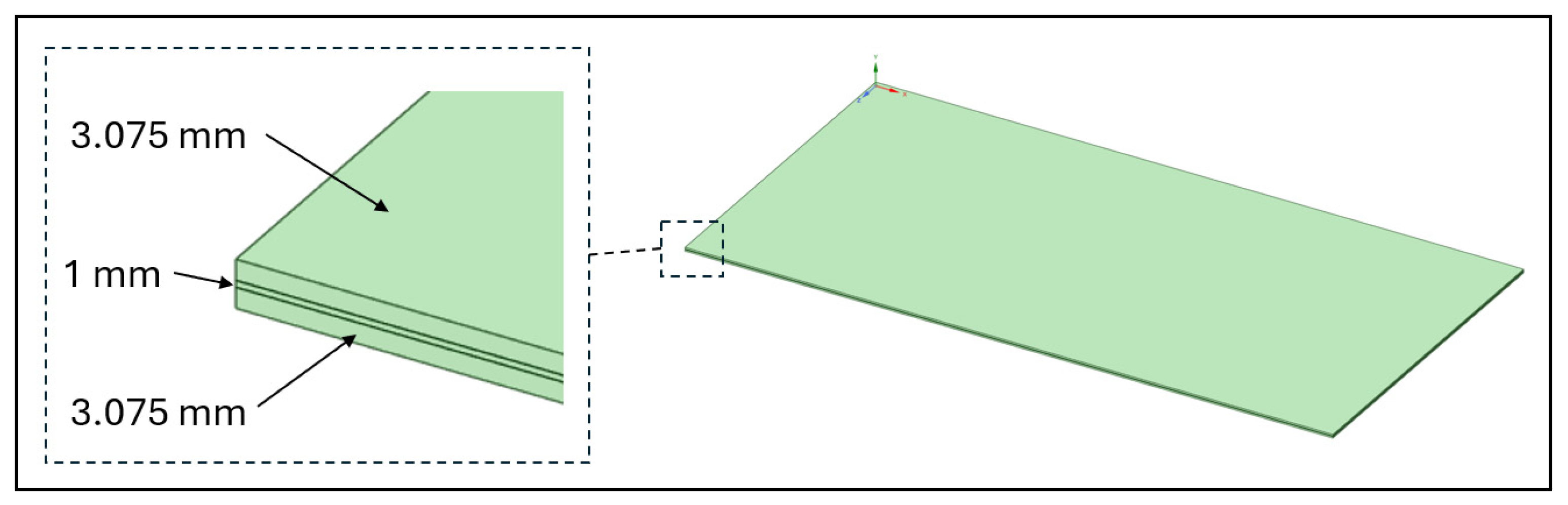
2.3.2. Thermal FVM-Based Model
3. Results
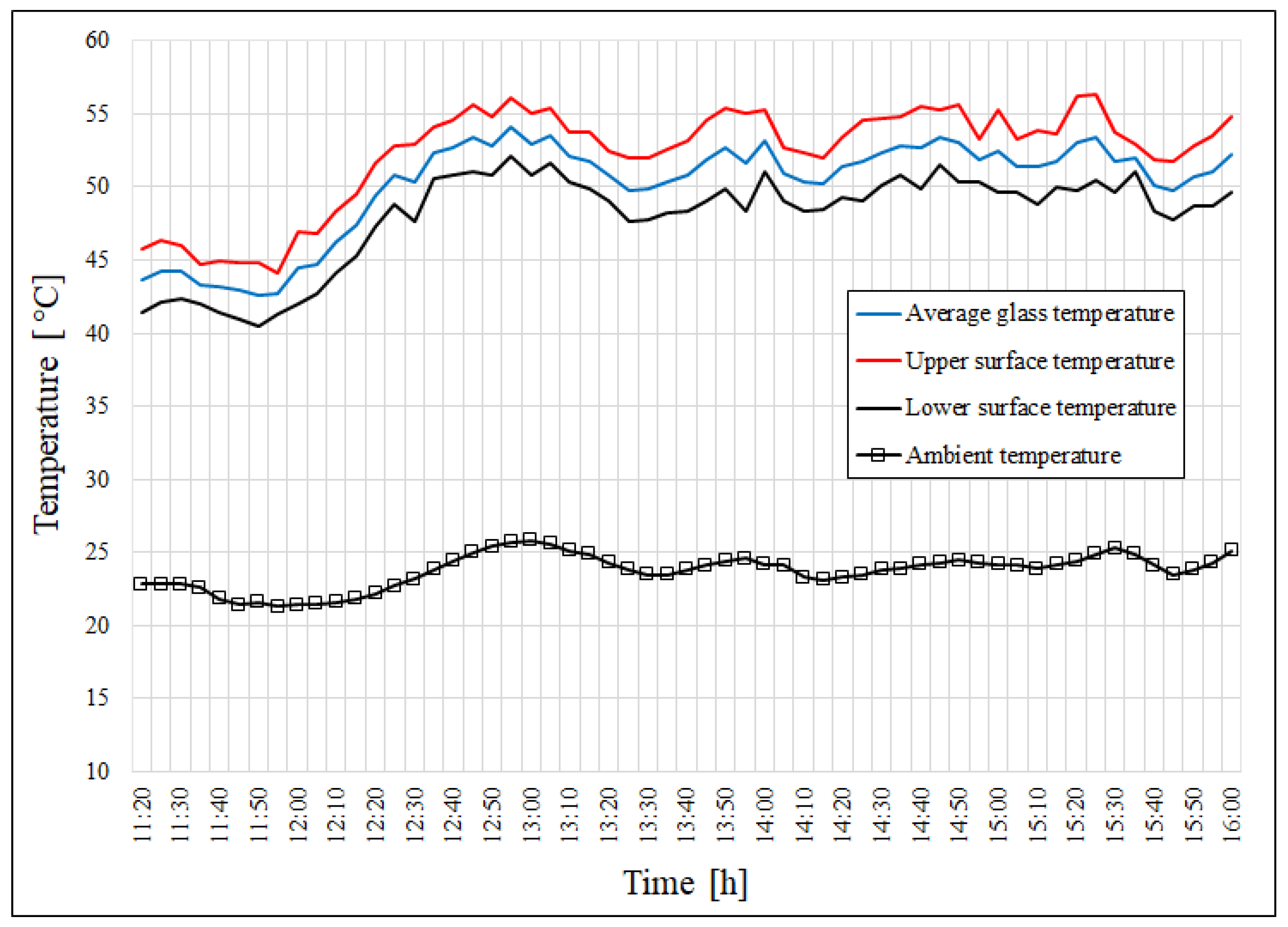
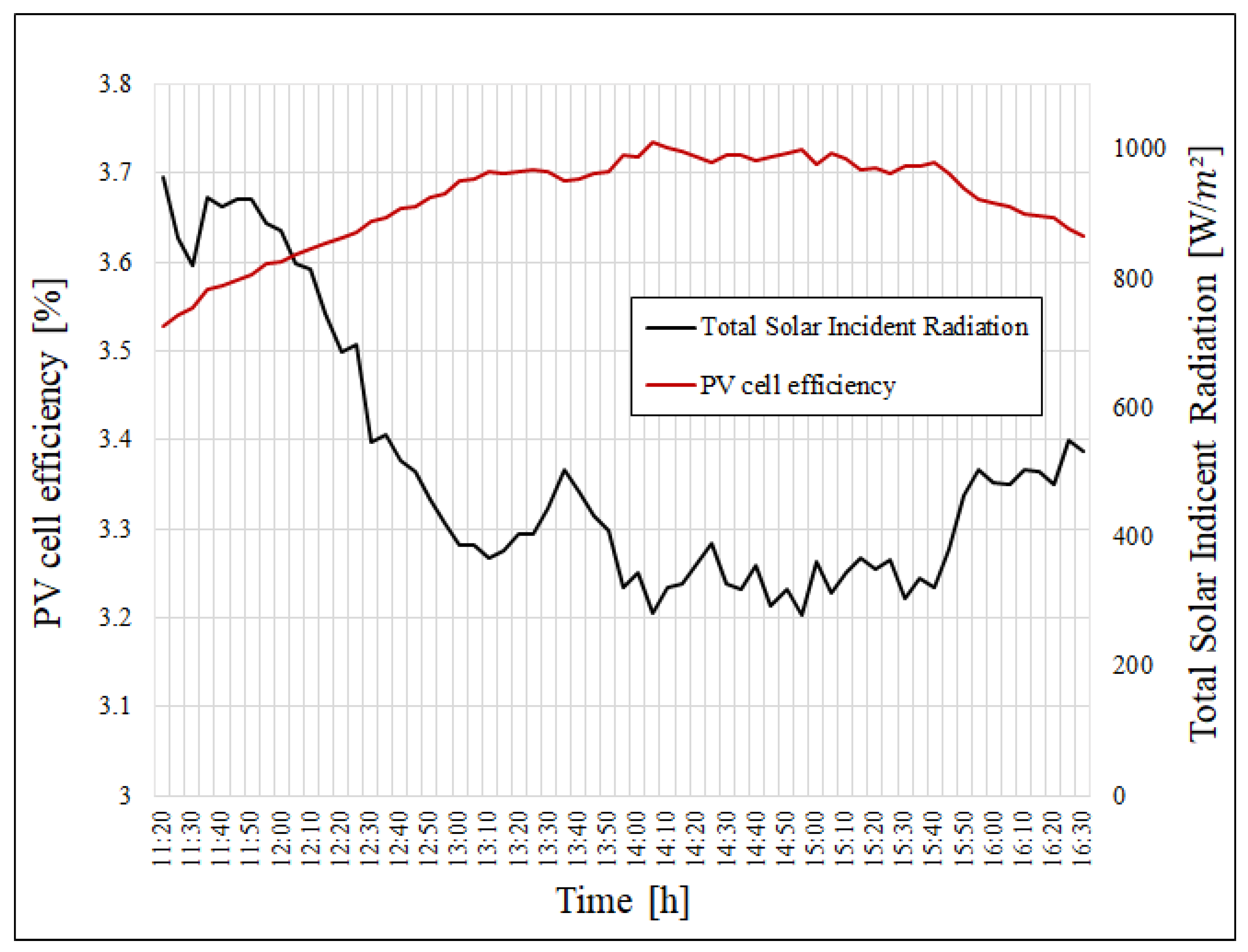
3.1. Experimental Results
3.2. Proposed Model Validation
3.3. Reference Models Comparison
4. Conclusions
5. Future Work
Author Contributions
Funding
Institutional Review Board Statement
Informed Consent Statement
Data Availability Statement
Conflicts of Interest
Nomenclature
| Symbol | Description | Units |
| Azimuth angle | ° | |
| Specific heat at constant pressure | ||
| d | Number of year day | - |
| e | Thickness | m |
| g | Solar factor | - |
| H | Hour angle | ° |
| Convective heat flux at the lower surface | ||
| Convective heat flux at the upper surface | ||
| I | Solar irradiance | |
| Blackbody intensity | ||
| k | Thermal conductivity | |
| L | Local latitude | ° |
| LST | Local solar time | h |
| λ | Wavelength | m |
| Refractive index | - | |
| Solid angle | sr | |
| Electrical power generation | ||
| Conductive heat flux | ||
| Convective heat flux at the lower surface | ||
| Convective heat flux at the upper surface | ||
| Radiative heat flux at the lower surface | ||
| Radiative heat flux at the upper surface | ||
| R | Reflectivity | - |
| Conductive thermal resistance | ||
| Convective thermal resistance of the lower surface | ||
| Convective thermal resistance of the upper surface | ||
| Radiative thermal resistance of the lower surface | ||
| Radiative thermal resistance of the upper surface | ||
| Ray direction | - | |
| T | Transmissivity | - |
| Ambient temperature | K | |
| Dew point temperature | K | |
| Average volumetric Solar PV temperature | K | |
| Reference temperature | K | |
| Exterior surface temperature | K | |
| Surface temperature | K | |
| Sky temperature | K | |
| Absorption coefficient | - | |
| Solar altitude | ° | |
| Solar PV cell temperature coefficient | ||
| Solar declination | ° | |
| Emissivity | - | |
| Efficiency | - | |
| Reference efficiency | - | |
| Radiation propagation angle | ° | |
| Density, Reflection factor | , - | |
| Stefan–Boltzmann constant | ||
| Transmittance factor | - |
References
- Delmastro, C.; De Bienassis, T.; Goodson, T.; Lane, K.; Le Marois, J.-B.; Martinez-Gordon, R.; Husek, M. Buildings; Tracking Report. September 2022; International Energy Agency (IEA): Paris, France, 2022. [Google Scholar]
- IEA. Renewables 2022. Analysis and Forecast to 2027; International Energy Agency: Paris, France, 2022. [Google Scholar]
- Yüksek, İ.; Karadağ, İ. Use of renewable energy in buildings. In Renewable Energy-Technologies and Applications; BoD—Books on Demand: Hamburg, Germany, 2021. [Google Scholar]
- Aljashaami, B.A.; Ali, B.M.; Salih, S.A.; Alwan, N.T.; Majeed, M.H.; Ali, O.M.; Alomar, O.R.; Velkin, V.I.; Shcheklein, S.E. Recent improvements to heating, ventilation, and cooling technologies for buildings based on renewable energy to achieve zero-energy buildings: A systematic review. Results Eng. 2024, 23, 102769. [Google Scholar] [CrossRef]
- Skandalos, N.; Karamanis, D. PV glazing technologies. Renew. Sustain. Energy Rev. 2015, 49, 306–322. [Google Scholar] [CrossRef]
- Romaní, J.; Ramos, A.; Salom, J. Review of Transparent and Semi-Transparent Building-Integrated Photovoltaics for Fenestration Application Modeling in Building Simulations. Energies 2022, 15, 3286. [Google Scholar] [CrossRef]
- Husain, A.A.; Hasan, W.Z.W.; Shafie, S.; Hamidon, M.N.; Pandey, S.S. A review of transparent solar photovoltaic technologies. Renew. Sustain. Energy Rev. 2018, 94, 779–791. [Google Scholar] [CrossRef]
- Norton, B.; Eames, P.C.; Mallick, T.K.; Huang, M.J.; McCormack, S.J.; Mondol, J.D.; Yohanis, Y.G. Enhancing the performance of building integrated photovoltaics. Sol. Energy 2011, 85, 1629–1664. [Google Scholar] [CrossRef]
- Chen, X.; Qiu, Y.; Wang, X. A systematic review of research methods and economic feasibility of photovoltaic integrated shading device. Energy Build. 2024, 311, 114172. [Google Scholar] [CrossRef]
- Shi, S.; Zhu, N. Challenges and Optimization of Building-Integrated Photovoltaics (BIPV) Windows: A Review. Sustainability 2023, 15, 15876. [Google Scholar] [CrossRef]
- Ghosh, A.; Norton, B. Advances in switchable and highly insulating autonomous (self-powered) glazing systems for adaptive low energy buildings. Renew. Energy 2018, 126, 1003–1031. [Google Scholar] [CrossRef]
- U.S. Department of Energy. EnergyPlusTM Version 22.1.0 Documentation. Engineering Reference; U.S. Department of Energy: Washington, DC, USA, 2022.
- Musameh, H.; Alrashidi, H.; Al-Neami, F.; Issa, W. Energy performance analytical review of semi-transparent photovoltaics glazing in the United Kingdom. J. Build. Eng. 2022, 54, 104686. [Google Scholar] [CrossRef]
- Yao, L.; Zhang, W.; Huang, F.; Zhao, R.; Tang, K. Experimental and simulation study on the thermoelectric performance of semi-transparent crystalline silicon photovoltaic curtain walls. J. Build. Eng. 2024, 90, 109421. [Google Scholar] [CrossRef]
- Wang, Y.; Hu, X.; Gu, T.; Ji, J.; Li, N.; Yu, B. The design, experimental and numerical study on a novel double-skin glass ventilation wall with PV blind integrated with thermal catalytic materials for synergistic energy generation and air purification. Energy 2024, 313, 134028. [Google Scholar] [CrossRef]
- Yu, G.; Chen, M.; Chen, Y. Simplified dynamic model and comprehensive performance analysis for semi-transparent photovoltaic double glazing and comparison with double glazing. Sol. Energy 2025, 288, 113257. [Google Scholar] [CrossRef]
- Ding, H.; Yu, G. Development of a simplified resistance-capacity network thermal model for semi-transparent photovoltaic insulating glass unit. Sol. Energy 2022, 245, 165–182. [Google Scholar] [CrossRef]
- Fayaz, H.; Rahim, N.; Hasanuzzaman, M.; Nasrin, R.; Rivai, A. Numerical and experimental investigation of the effect of operating conditions on performance of PVT and PVT-PCM. Renew. Energy 2019, 143, 827–841. [Google Scholar] [CrossRef]
- COMSOL AB. COMSOL Multiphysics® v. 6.3; COMSOL: Stockholm, Sweden, 2025; Available online: www.comsol.com (accessed on 9 November 2025).
- Huang, J.; Chen, X.; Peng, J.; Yang, H. Modelling analyses of the thermal property and heat transfer performance of a novel compositive PV vacuum glazing. Renew. Energy 2021, 163, 1238–1252. [Google Scholar] [CrossRef]
- Marei, Y.A.; Emam, M.; Ahmed, M.E.; Attia, A.A.; Abdelrahman, M. Thermal and optical investigations of various transparent wall configurations and building integrated photovoltaic for energy savings in buildings. Energy Convers. Manag. 2024, 299, 117817. [Google Scholar] [CrossRef]
- ANSYS, Inc. ANSYS Fluent User’s Guide, Release 23; ANSYS, Inc.: Canonsburg, PA, USA, 2023. [Google Scholar]
- DIAL GmbH. DIALux evo: Lighting Design Software; DIAL GmbH: Lüdenscheid, Germany, 2025. [Google Scholar]
- Du, Y.; Tao, W.; Liu, Y.; Jiang, J.; Huang, H. Heat transfer modeling and temperature experiments of crystalline silicon photovoltaic modules. Sol. Energy 2017, 146, 257–263. [Google Scholar] [CrossRef]
- Han, Z.M.; Bao, Y.W.; Wu, W.D.; Liu, Z.Q.; Liu, X.G.; Tian, Y. Evaluation of thermal performance for vacuum glazing by using three-dimensional finite element model. Key Eng. Mater. 2012, 492, 328–332. [Google Scholar] [CrossRef]
- Wang, M.; Peng, J.; Li, N.; Lu, L.; Ma, T.; Yang, H. Assessment of energy performance of semi-transparent PV insulating glass units using a validated simulation model. Energy 2016, 112, 538–548. [Google Scholar] [CrossRef]
- Lawrence Berkeley National Laboratory. WINDOW 6.3; Lawrence Berkeley National Laboratory: Berkeley, CA, USA, 2010.
- Lawrence Berkeley National Laboratory. Optics 6; Lawrence Berkeley National Laboratory: Berkeley, CA, USA, 2010.
- Peng, J.; Lu, L.; Yang, H.; Ma, T. Validation of the Sandia model with indoor and outdoor measurements for semi-transparent amorphous silicon PV modules. Renew. Energy 2015, 80, 316–323. [Google Scholar] [CrossRef]
- Qiu, C.; Yang, H.; Sun, H. Investigation on the thermal performance of a novel vacuum PV glazing in different climates. Energy Procedia 2019, 158, 706–711. [Google Scholar] [CrossRef]
- Alsukkar, M.; Hu, M.; Alkhater, M.; Su, Y. Daylighting performance assessment of a split louver with parametrically incremental slat angles: Effect of slat shapes and PV glass transmittance. Sol. Energy 2023, 264, 112069. [Google Scholar] [CrossRef]
- Ke, W.; Ji, J.; Zhang, C.; Xie, H. Field experimental test and performance analysis of a novel hybrid CdTe PV glass module integrated with phase change materials. Renew. Energy 2023, 217, 119196. [Google Scholar] [CrossRef]
- Ke, W.; Ji, J.; Zhang, C.; Xie, H. Modelling analysis and performance evaluation of a novel hybrid CdTe-PCM PV glass module for building envelope application. Energy 2023, 284, 129182. [Google Scholar] [CrossRef]
- Xu, S.; Li, C.; He, W.; Chu, W.; Hu, Z.; Lu, B. Experimental study of bifacial photovoltaic wall system incorporating thermochromic material. Sustain. Cities Soc. 2024, 106, 105372. [Google Scholar] [CrossRef]
- Siegel, R.H.J.; Howell, J.R. Thermal Radiation Heat Transfer; National Aeronautics and Space Administration (NASA): Washington, DC, USA, 1973.
- Duffie, J.A.; Beckman, W.A. Solar Engineering of Thermal Processes; Wiley: Hoboken, NJ, USA, 2013. [Google Scholar]
- Incropera, F.P.; De Witt, D.P. Fundamentos de Transferencia de Calor y Masa; Prentice Hall: Naucalpan de Juárez, Mexico, 1999. [Google Scholar]
- Villalva, M.G.; Gazoli, J.R.; Ruppert Filho, E. Modeling and circuit-based simulation of photovoltaic arrays. In Proceedings of the 2009 Brazilian Power Electronics Conference (COBEP), Bonito-Mato Grosso do Sul, Brazil, 27 September–1 October 2009; pp. 1244–1250. [Google Scholar] [CrossRef]
- Wamalwa, F.; Ishimwe, A. Optimal energy management in a grid-tied solar PV-battery microgrid for a public building under demand response. Energy Rep. 2024, 12, 3718–3731. [Google Scholar] [CrossRef]
- Joseph, D.; Perez, P.; El Hafi, M.; Cuenot, B. Discrete ordinates and Monte Carlo methods for radiative transfer simulation applied to computational fluid dynamics combustion Modeling. J. Heat Transf. 2009, 131, 052701. [Google Scholar] [CrossRef]
- OnyxSolar. OnyxSolar Technical Guide. Available online: https://onyxsolar.com/images/3.resources/Technical_guide_EN-ES_231218.pdf (accessed on 9 November 2025).
- UNE-EN 410:2011; Glass in Building—Determination of Luminous and Solar Characteristics of Glazing. CEN: Brussels, Belgium, 2011.


| Model | Onyx a-Si Dark 10% PV Glass (Onyx Solar Energy S.L) |
|---|---|
| Dimensions [mm] | 1245 × 635 × 7.15 |
| Light transmission short wavelength [%] | 10.8 |
| Light reflection short wavelength [%] | 8.3 |
| Light transmission long wavelength [%] | 0 |
| Light reflection long wavelength [%] | 16 |
| Nominal peak Power [Wp] | 29 |
| Open-circuit voltage [V] | 47 |
| Short-circuit current [A] | 1.11 |
| Band | T [%] | R [%] | n [-] | [m−1] | Ɛ [-] |
|---|---|---|---|---|---|
| 0–2.5 μm | 10.8 | 8.3 | 1.75 | 289.51 | - |
| 2.5–5000 μm | 1 | 15 | 2.25 | 599.11 | 0.84 |
| Number of Elements | Upper Surface Temperature [°C] | Lower Surface Temperature [°C] | Upper Surface Relative Change [%] | Lower Surface Relative Change [%] | |
|---|---|---|---|---|---|
| Mesh 1 | 175,960 | 28.56 | 28.47 | - | - |
| Mesh 2 | 792,456 | 28.50 | 28.32 | 0.21 | 0.53 |
| Mesh 3 | 1,755,450 | 28.54 | 28.36 | 0.14 | 0.14 |
| Property | Value |
|---|---|
| Density | 2500 |
| Thermal conductivity | 0.8 |
| Specific heat | 500 |
| RMSE (Relative Error, %) | Reference Model 1 | Reference Model 2 | Reference Model 3 | Proposed Model |
|---|---|---|---|---|
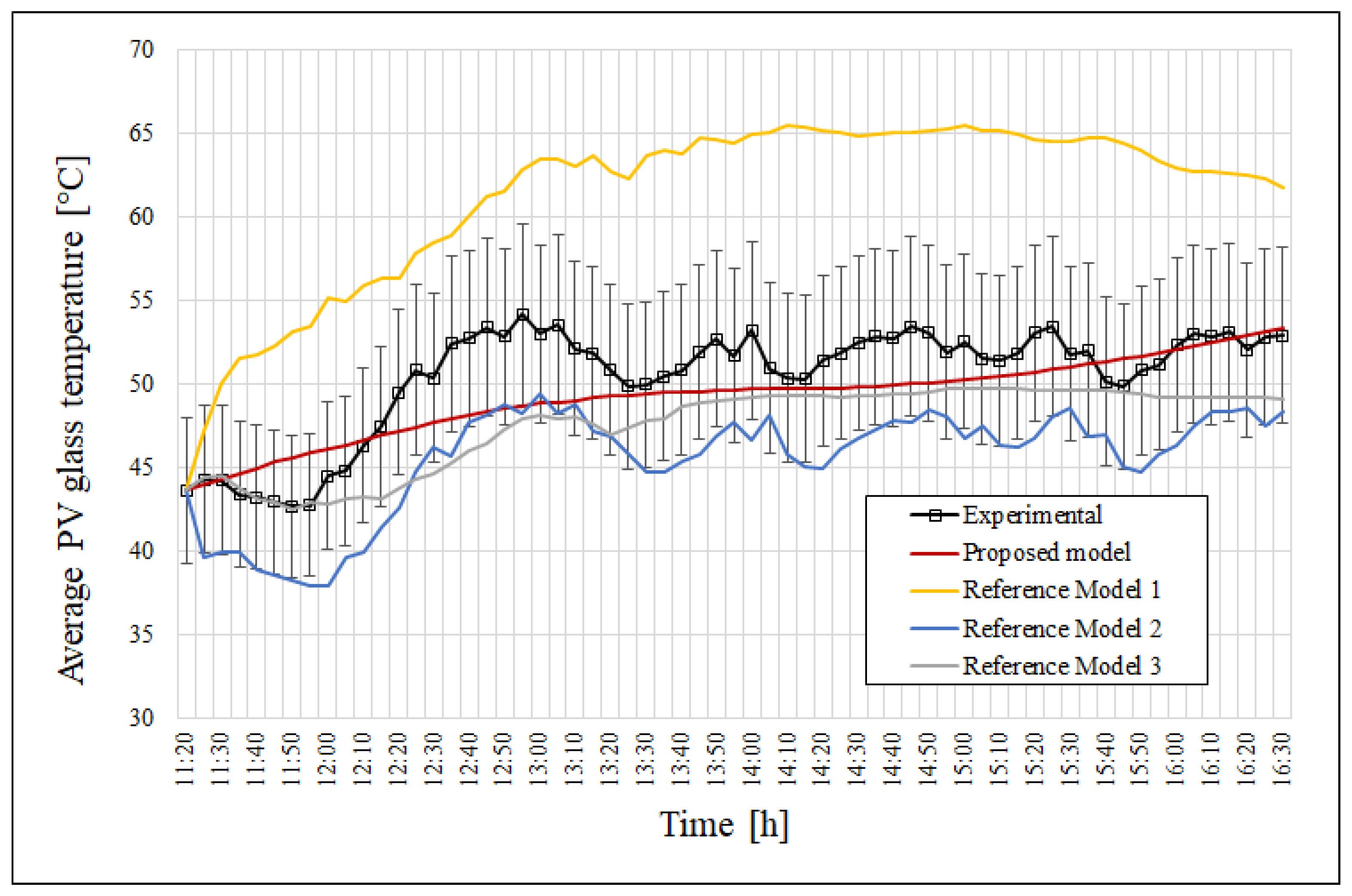
| Temperature (°C) | 11.2 (21.4) | 5.1 (9.8) | 3.5 (5.7) | 2.4 (3.8) |
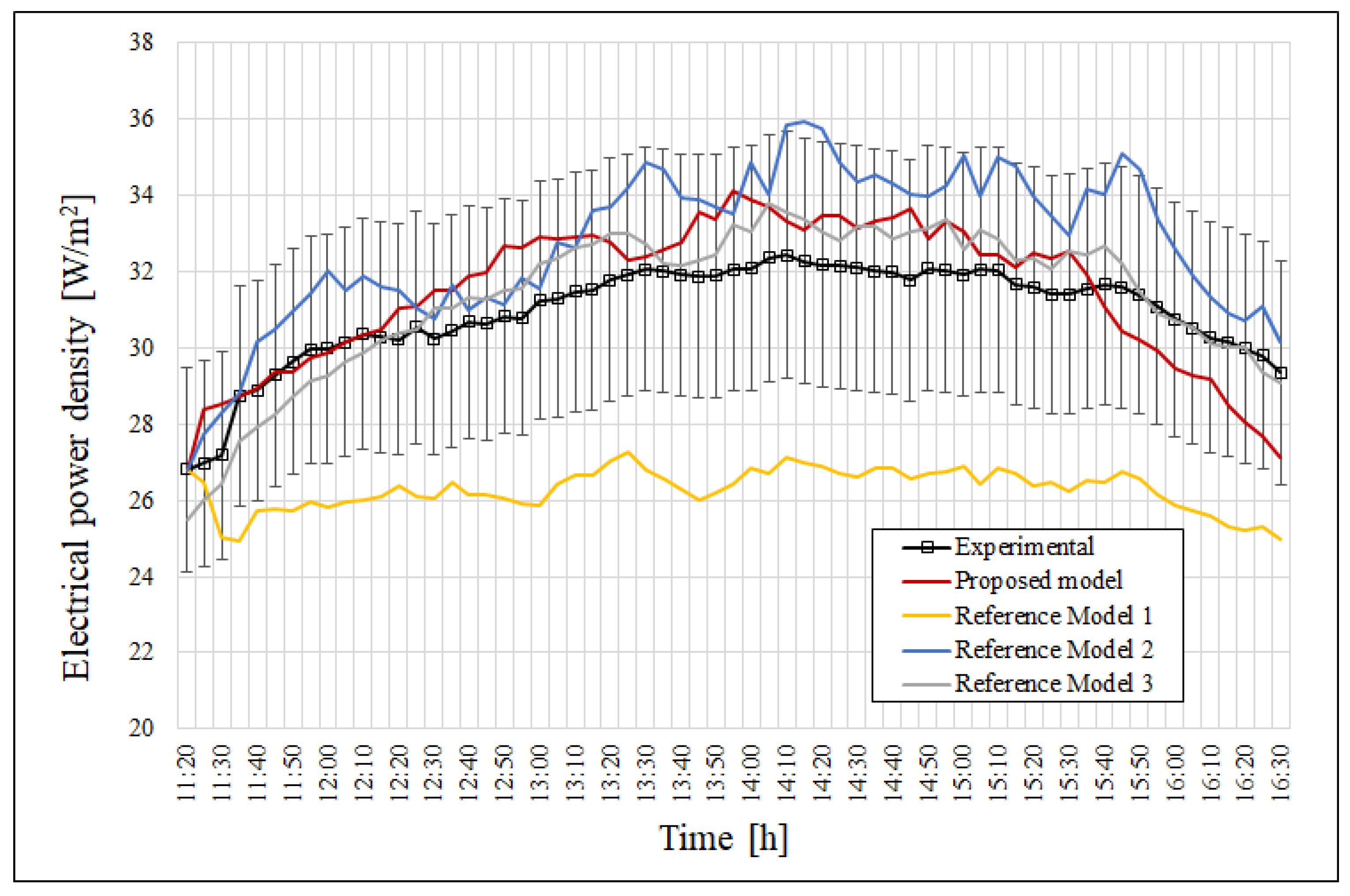
| Electrical generation (W/m2) | 4.8 (14.9) | 2.0 (5.7) | 0.8 (2.4) | 1.2 (3.3) |
| Solar Factor (%) | - | - | - | 10.3 (3.0) |
Disclaimer/Publisher’s Note: The statements, opinions and data contained in all publications are solely those of the individual author(s) and contributor(s) and not of MDPI and/or the editor(s). MDPI and/or the editor(s) disclaim responsibility for any injury to people or property resulting from any ideas, methods, instructions or products referred to in the content. |
© 2025 by the authors. Licensee MDPI, Basel, Switzerland. This article is an open access article distributed under the terms and conditions of the Creative Commons Attribution (CC BY) license (https://creativecommons.org/licenses/by/4.0/).
Share and Cite
Foncubierta Blázquez, J.L.; Mena Baladés, J.D.; Sánchez Orihuela, I.; Jiménez Come, M.J.; González Siles, G. Development, Implementation, and Experimental Validation of a Novel Thermal–Optical–Electrical Model for Photovoltaic Glazing. Appl. Sci. 2025, 15, 12041. https://doi.org/10.3390/app152212041
Foncubierta Blázquez JL, Mena Baladés JD, Sánchez Orihuela I, Jiménez Come MJ, González Siles G. Development, Implementation, and Experimental Validation of a Novel Thermal–Optical–Electrical Model for Photovoltaic Glazing. Applied Sciences. 2025; 15(22):12041. https://doi.org/10.3390/app152212041
Chicago/Turabian StyleFoncubierta Blázquez, Juan Luis, Jesús Daniel Mena Baladés, Irene Sánchez Orihuela, María Jesús Jiménez Come, and Gabriel González Siles. 2025. "Development, Implementation, and Experimental Validation of a Novel Thermal–Optical–Electrical Model for Photovoltaic Glazing" Applied Sciences 15, no. 22: 12041. https://doi.org/10.3390/app152212041
APA StyleFoncubierta Blázquez, J. L., Mena Baladés, J. D., Sánchez Orihuela, I., Jiménez Come, M. J., & González Siles, G. (2025). Development, Implementation, and Experimental Validation of a Novel Thermal–Optical–Electrical Model for Photovoltaic Glazing. Applied Sciences, 15(22), 12041. https://doi.org/10.3390/app152212041