Article

Effects of a History of Adductor-Related Groin Pain on Kicking Biomechanics and HAGOS Subscales in Male Soccer Players: A Comprehensive Analysis Using 1D-SPM


1
Department of Rehabilitation, Faculty of Health Science, Fukui Health Science University, Fukui 910-3190, Japan
2
Department of Legal Medicine, Shiga University of Medical Science, Otsu 520-2192, Japan
3
Department of Rehabilitation, Kumamoto Health Science University, Kumamoto 861-5598, Japan
4
Department of Orthopedics, Fukui General Hospital, Fukui 910-8561, Japan
5
Graduate School of Health Science, Fukui Health Science University, Fukui 910-3190, Japan
*
Author to whom correspondence should be addressed.
Appl. Sci. 2025, 15(22), 12003; https://doi.org/10.3390/app152212003
Submission received: 29 September 2025 / Revised: 31 October 2025 / Accepted: 7 November 2025 / Published: 12 November 2025
(This article belongs to the Special Issue Advances in Sports Science and Biomechanics)

Featured Application

This research provides compelling biomechanical evidence that shifts the clinical paradigm for adductor-related groin pain (AGP) in soccer players. Its primary application lies in the development of more effective, evidence-based rehabilitation and prevention programs. Practitioners can move beyond isolated adductor strengthening and instead design kinetic chain-oriented interventions focused on restoring coordinated trunk-pelvic control and enhancing stance leg function. This approach directly targets the dysfunctional movement patterns identified in the study, offering a robust strategy to mitigate the high recurrence rates of this chronic injury and optimize athletic performance.

Abstract

Adductor-related groin pain (AGP) is a prevalent and frequently recurrent chronic injury among soccer players. This study investigated the impact of AGP history on kicking kinematics, kinetics, and patient-reported outcomes in regional-league soccer players using one-dimensional statistical parametric mapping (1D-SPM). Twenty male athletes were allocated to a group with prior AGP (GP group: n = 8) or without AGP (non-GP group, n = 12), and evaluated during maximal instep and inside-foot kicks using three-dimensional motion analysis and the Copenhagen Hip and Groin Outcome Score (HAGOS). The GP group reported significantly lower HAGOS for pain and quality of life. The 1D-SPM analysis revealed that the GP group employed a compensatory kinetic chain strategy, characterized by impaired trunk–pelvis rotation, increased reliance on the stance leg (SL) for stability, and altered kicking leg (KL) mechanics with reduced hip flexion power. These findings reveal that the underlying deficit in AGP is not isolated muscle weakness but a ‘lack of adaptability in motor control’, resulting in inefficient load distribution and contributing to the high recurrence rates in the adductors and SL. Rehabilitation should adopt a kinetic chain-oriented approach that also addresses stance limb function to mitigate recurrence and optimize performance.

1. Introduction

Soccer, a widely played global sport, demands highly dynamic movements, including kicking, heading, jumping, cutting maneuvers, and sprinting [1,2]. Consequently, players are at considerable risk of sustaining sports-related injuries, with groin pain (GP) representing a significant clinical concern, accounting for approximately 5–16% of all soccer-related injuries. Characterized by prolonged symptoms, high recurrence rates, and challenging clinical management, GP severely impairs performance and participation [3].
Among various etiologies, adductor-related groin pain (AGP), defined by the Doha Agreement [4], constitutes nearly 62% of cases [5], and the kicking motion has been identified as the primary mechanism of injury [6]. Previous studies have identified several risk factors, including reduced hip joint flexibility [7,8,9], decreased adductor muscle strength [8,9,10], and an imbalance between hip abductor and adductor strength [9,10]. However, beyond static assessments, dynamic analysis of sport-specific movements is essential for a comprehensive understanding of the AGP risk.
While several studies have investigated the kinematics and muscle activity during kicking, most have traditionally relied on discrete point analysis (e.g., peak or mean values at isolated time points) [11,12,13,14,15]. Although these studies have successfully identified potential risk factors, such as adductor longus mechanics (e.g., Charnock et al. [16]) or specific hip kinematics (e.g., Fujisaki et al. [17]), this approach inherently overlooks the continuous temporal structure of movement, including the quality of motion, timing, and inter-segmental coordination. This limitation may obscure the underlying mechanisms of AGP’s high recurrence rate, which likely stem from persistent maladaptive movement patterns rather than isolated strength deficits.
To address this gap, analysis of the entire movement waveform is necessary. One-dimensional Statistical Parametric Mapping (1D-SPM) [18] is a powerful technique that enables the statistical comparison of continuous movement trajectories. This approach has proven effective in other sports injury contexts, identifying subtle, time-dependent kinematic differences that discrete analysis methods might miss. For instance, 1D-SPM has successfully characterized altered landing kinematics in athletes following anterior cruciate ligament (ACL) reconstruction (e.g., Hughes-Oliver et al. [19]; Sole et al. [20]) and identified atypical knee joint patterns associated with overuse running injuries (e.g., de Bleecker et al. [21]). Therefore, applying 1D-SPM to soccer kicking offers a robust and novel methodology to elucidate the complex, whole-body compensatory strategies associated with a history of AGP.
This study examined the effects of AGP history on the soccer kicking motion, a fundamental technical skill, from both biomechanical and patient-reported outcome (PRO) perspectives. Kinematic and kinetic characteristics of inside and instep kicks were compared between players with a history of AGP and healthy controls using 1D-SPM alongside scores from the Copenhagen Hip and Groin Outcome Score (HAGOS) [22]. This analysis identified maladaptive movement patterns associated with persistent symptoms and recurrence of AGP, providing insights into potential preventive and rehabilitative strategies.
We hypothesized that, compared with healthy controls, players with a history of AGP would report lower quality of life (QOL) scores on the HAGOS and demonstrate compensatory kinetic chain patterns during kicking, characterized by inefficient load distribution to the groin region.

2. Materials and Methods

2.1. Participants

Male soccer players from a regional first-division league (2018–2019) were screened for participation. Of the 34 players initially assessed, exclusions included goalkeepers (n = 4) for their distinct movement profiles, players with a left kicking leg (KL) (n = 6) to control for limb dominance effects [23,24], players with a GP history predating the last two seasons (n = 4) due to historical diagnostic uncertainties, and those with any current structural pathology (e.g., fractures or ligament injuries) of the trunk or lower extremities preventing full participation in soccer.
The final cohort (n = 20) was stratified into a GP group (n = 8) and a non-GP group (n = 12) based on diagnosis within the past two seasons.
AGP diagnosis required documentation of a time-loss injury (≥1 d) attributable to GP [25], exclusion of overt structural pathology through clinical examination, and confirmation of AGP per the Doha agreement [4], including adductor resistance test and tenderness upon palpation. The participant selection process is illustrated in Figure 1.
All participants provided written informed consent after receiving a detailed explanation of the study procedures. The protocol was approved by the Ethics Committee of Nittazuka Medical Welfare Center (Approval No. 29-108) and adhered to the Declaration of Helsinki (2013 Fortaleza revision) [26].

2.2. Subjective Assessment Using HAGOS

All participants completed the Japanese version of the HAGOS, a validated PRO measure of hip- and groin-related symptoms. The HAGOS includes 37 items across six subscales: symptoms (seven items), pain (10 items), activities of daily living (ADL) (five items), function in sports and recreation (eight items), participation in physical activities (PA) (two items), and QOL (five items). Each subscale is scored on a normalized 0–100-point scale, with higher scores indicating fewer problems [22].

2.3. Experimental Protocol

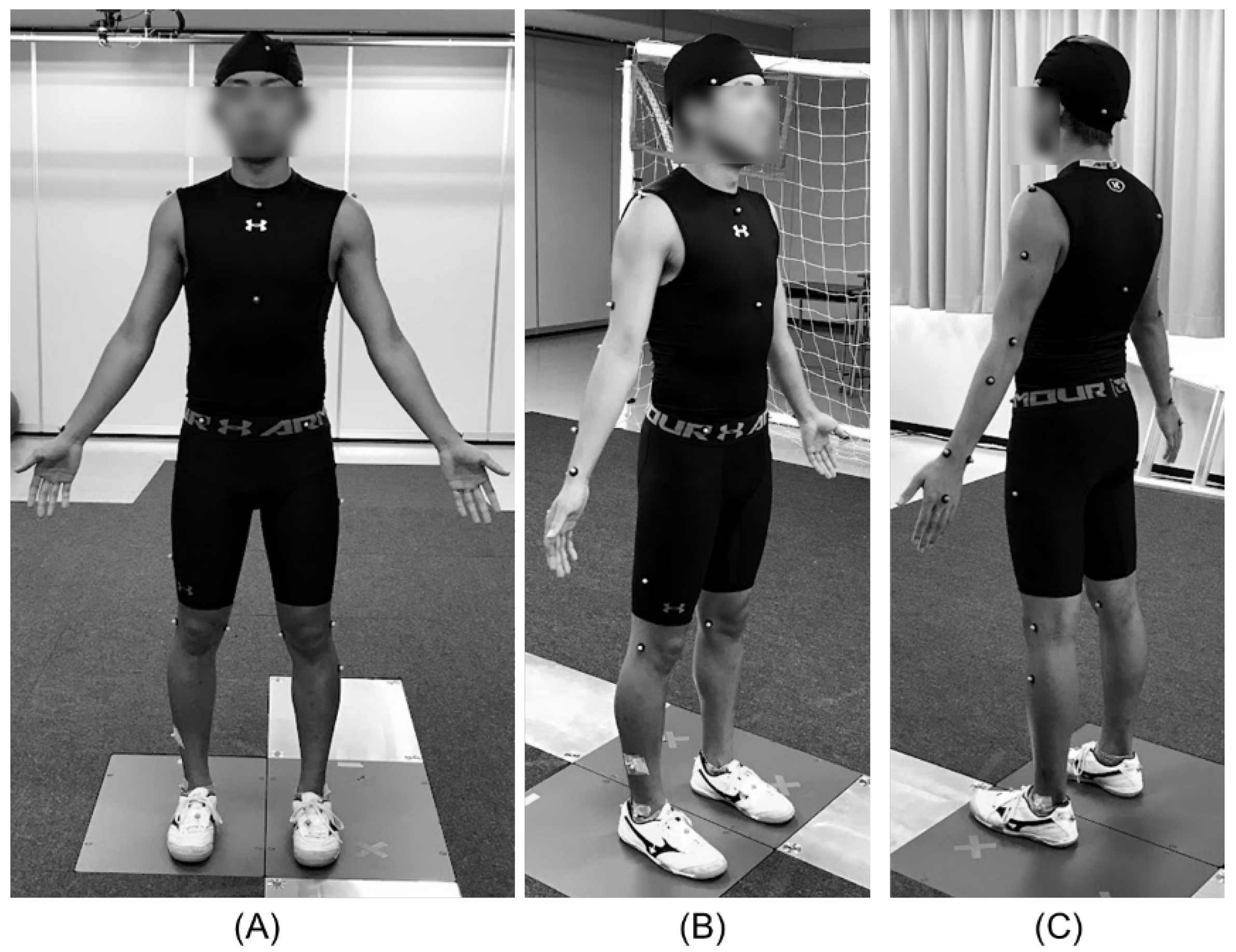
Kinematic data were acquired in a laboratory using an eight-camera three-dimensional (3D) motion capture system (Vantage V5, Vicon, Oxford, UK; 250 Hz), and kinetic data were recorded from two force plates (OR6, AMTI, Watertown, MA, USA; 1000 Hz). Forty-one reflective markers (9.5 mm diameter) were affixed to each participant based on the Vicon Plug-in Gait model [27], with two additional markers placed on the femoral epicondyles (Figure 2). Three markers were mounted on a FIFA-approved size 5 soccer ball (Peleḍa 4000 F5L4000, Molten, Hiroshima, Japan) to determine the velocity and moment of impact.
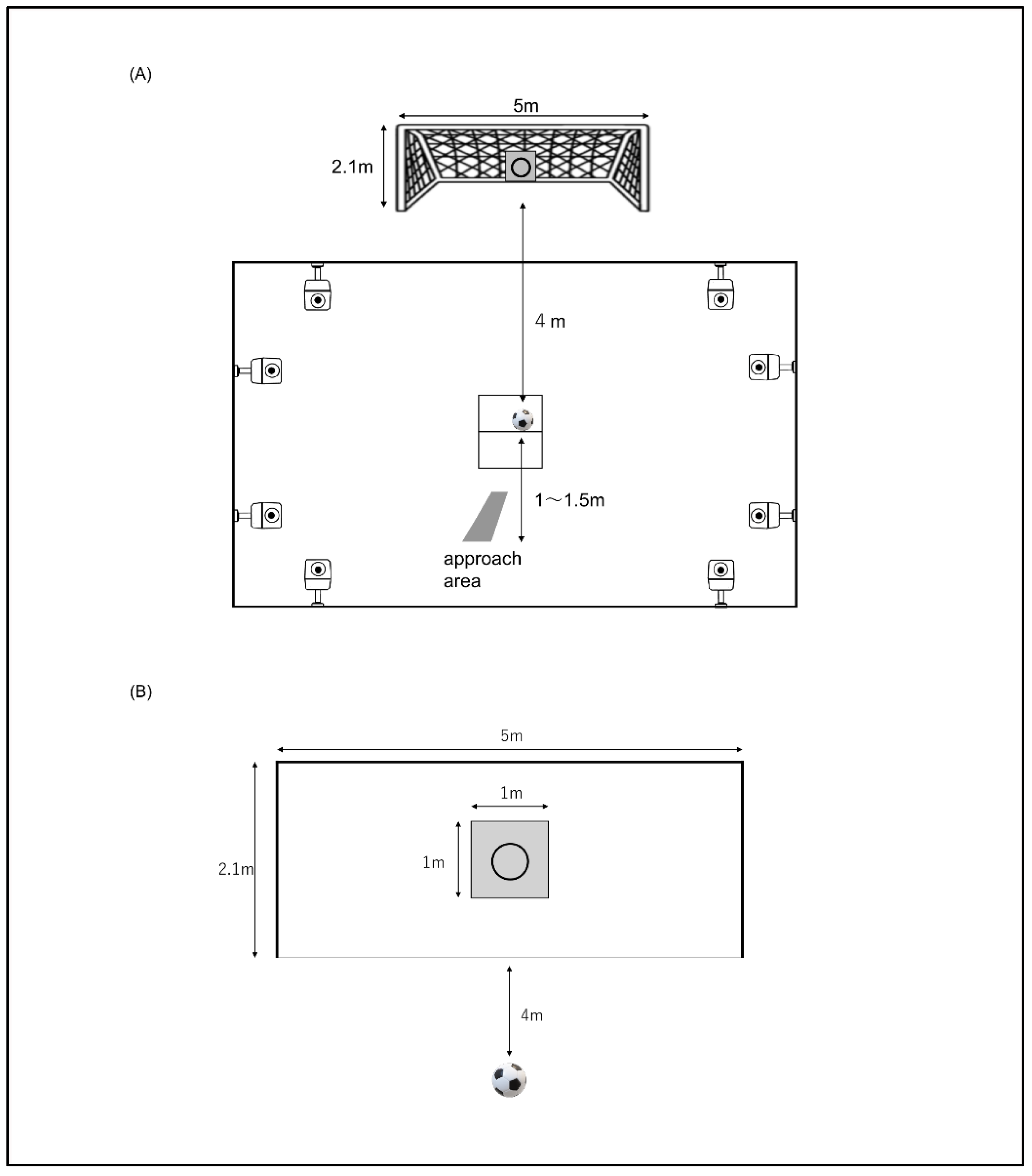
Following a standardized five-minute warm-up (cycling at 50W on an ergometer (EC-1200, Cat Eye, Osaka, Japan)) and practice kicks, the participants wore futsal shoes and tight-fitting sportswear. The task was to perform maximal effort inside and instep kicks from a self-selected, consistent run-up (1.5–2.0 m, 20–45 angle) toward a 1.0 m2 target centered in a 2.0 × 5.0 m goal positioned 4.0 m away (Figure 3). For each kick type, the third, fourth, and fifth successful trials that struck the target were selected for analysis. All data were processed using Vicon Nexus software (Ver. 2.10.1).

2.4. Data Processing and Analysis

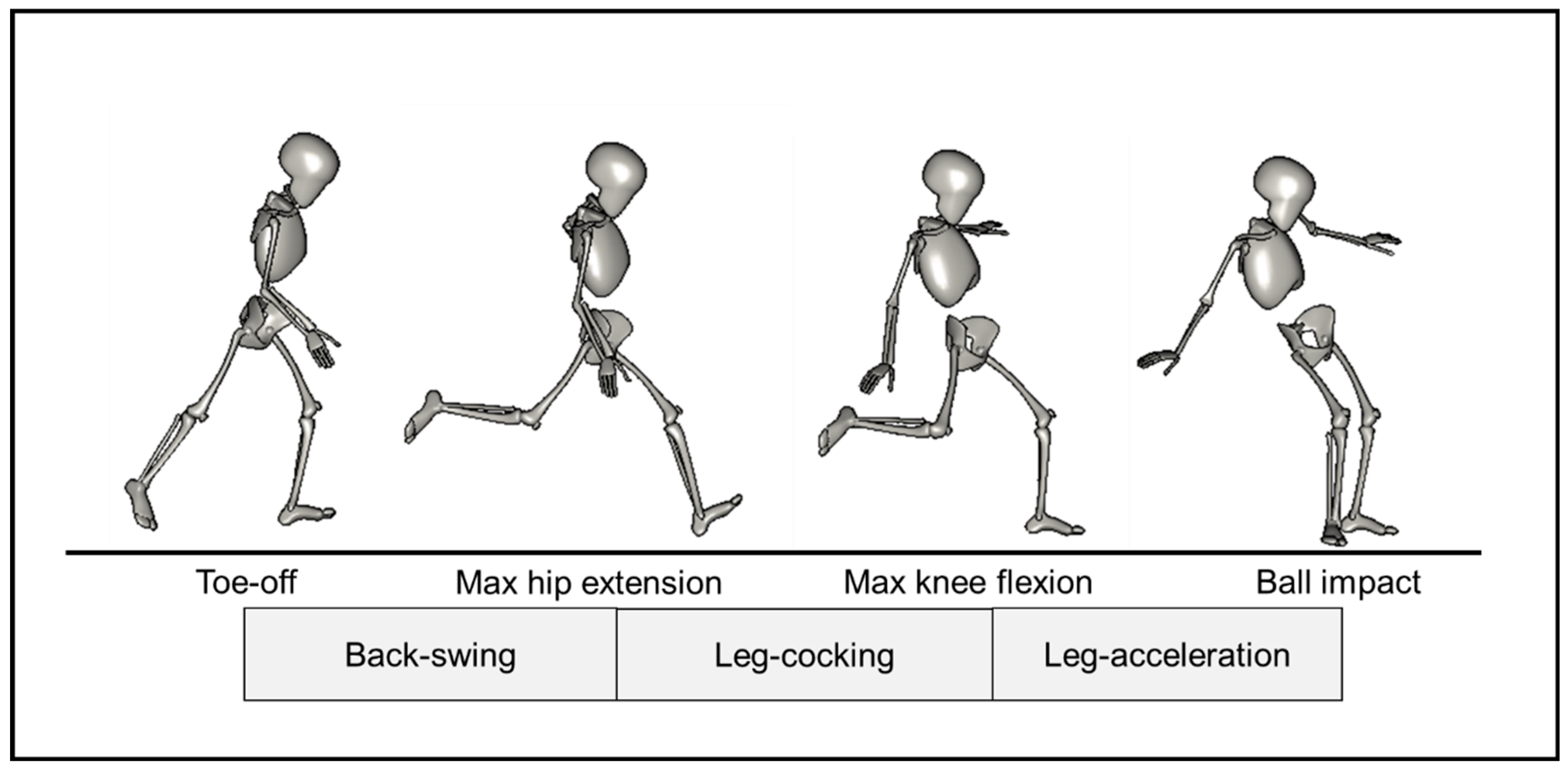
Raw marker trajectories and ground reaction forces (GRF) data were filtered using fourth-order zero-lag low-pass Butterworth filters with cutoff frequencies of 12 Hz [28] and 20 Hz [29], respectively. Kinematic and kinetic variables were computed using inverse dynamics in the Vicon Plug-in-gait model, which utilizes Dempster’s anthropometric body segment parameters [30]. Joint moments were normalized to body weight, and joint power was calculated as the product of body weight and height. The kicking motion was analyzed in five phases based on key events: heel strike (stance leg), toe-off (KL), and ball impact [11,31] (Figure 4). The time from KL toe-off to ball impact was normalized to 100% using Polygon(Ver.4.4.6 Vicon, Oxford, UK). Analyzed variables included 3D kinematics (angles, angular velocities, and accelerations) for the trunk, pelvis, and both hip joints, 3D kinetics (moments and power) for both hips, and mediolateral (X) and anteroposterior (Y) distance between the center of mass (COM) and center of pressure (COP) as postural stability metrics.

2.5. Statistical Analysis

2.5.1. Sample Size Estimation and Justification

Given the relatively small sample GP group (n = 8), a priori statistical power analysis was performed. Statistical power for between-group comparisons of kinematic and kinetic data was estimated through Monte Carlo simulations using the 1D-SPM library (spm1d.org, accessed on 25 November 2024) [32] in a Python environment. Pilot data from 10 participants (five per group) were used to calculate an expected difference curve and the covariance matrix of the three-trial averaged data. For each group (n = 8), 1000 iterations were simulated. In each iteration, three single trials were generated by superimposing Gaussian noise on the expected difference curve, incorporating the covariance structure. The trials were averaged, and a 1D-SPM two-tailed independent t-test (α = 0.05) was applied to the entire waveform.
Power was defined as the proportion of iterations in which a significant difference was detected. Although the power varied across the waveform, a high power of 0.97 was obtained for the primary outcome measure. This Monte Carlo simulation framework for waveform-based power estimation aligns with the established approaches [33,34].

2.5.2. Comparative Analysis

Statistical analyses were performed using IBM SPSS Statistics for Windows, version 26 (IBM Corp., Armonk, NY, USA) and Python (ver. 3.8.5). Statistical significance was set at p ≤ 0.05. First, baseline comparability between groups was assessed for all demographic variables. Demographic variables were assessed for normality and homogeneity of variance using the Shapiro–Wilk and Levene’s tests, respectively. Between-group differences were compared using independent t-tests (for normal/homoscedastic data) or Mann–Whitney U tests for continuous variables, and Fisher’s exact test for categorical variables. HAGOS subscale scores were compared using the Mann–Whitney U test, with the Hodges–Lehmann estimate [35] used to evaluate estimated differences, and the effect size was calculated as the Common Language Effect Size (CLES) [36].
Biomechanical waveform data, encompassing kinematics, kinetics, and COM-COP, were evaluated by time-normalizing and smoothing three-trial curves using a Savitzky–Golay filter. Subsequently, 1D-SPM [32] was used for group comparisons. The SPM{t} statistic, equivalent to an independent t-test, was applied across each time point. Given the small sample sizes of our groups (n = 8 and n = 12), the effect size was represented by Hedges’ g [37], which corrects for small sample bias, and was interpreted according to Sawilowsky’s criteria [38], with the average Hedges’ g reported as statistically significant (p < 0.05).
An artificial intelligence (AI) language model (ChatGPT, OpenAI, San Francisco, CA, USA; version 3.5) was employed to support code development and debugging during Python-based analysis. All AI-assisted codes were reviewed and validated by authors for accuracy and appropriateness, with full responsibility assumed for the final implementation and the results.

3. Results

3.1. Participant Characteristics (Table 1)

No significant between-group differences were observed in demographic variables (all p > 0.05).

3.2. Comparison of HAGOSs

Scores for the six HAGOS subscales (pain, symptoms, ADL, sports/recreation, PA, and QOL) are presented in Table 2. Significant differences were identified or the pain and QOL subscales, whereas no significant differences were observed in the remaining subscales.
The pain score was significantly higher in the non-GP group (99.2 ± 2.9) compared with the GP group (93.4 ± 10.0) (p = 0.047). The CLES was 0.77, indicating a significant effect, and the Hodges–Lehmann estimate was 2.5. The QOL score was also higher for the non-GP group (98.3 ± 4.4) than the GP group (76.3 ± 26.1) (p = 0.003). The CLES for this subscale measured 0.89, suggesting a substantial effect, and the Hodges–Lehmann estimate was 10.0.

3.3. Kinematic and Kinetic Analysis

3.3.1. Overview of 1D-SPM Findings

The 1D-SPM analysis revealed numerous significant differences in movement waveforms between the GP and non-GP groups for both kick types. The statistical details for significant findings are presented in Table 3 (Inside Kick) and Table 4 (Instep Kick). The full statistical comparison, including all non-significant parameters, is available in the Supplementary Materials (Tables S1 and S2). All waveform graphs are available in the Supplementary Materials (Figures S1–S39).
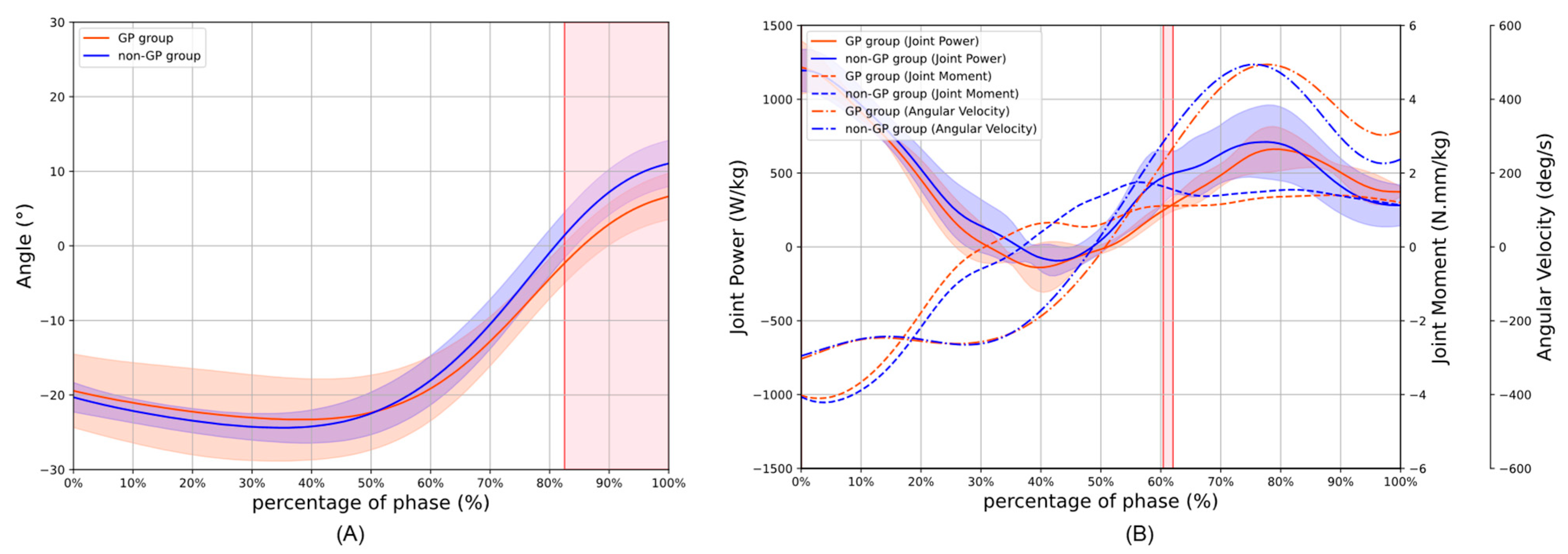
To highlight the most critical findings that form the basis of our discussion, Figure 5 illustrates the key compensatory patterns observed during the power-demanding instep kick. These patterns demonstrate a breakdown in the kinetic chain of the GP group, specifically characterized by impaired trunk rotation and reduced kicking leg power.

3.3.2. Between-Group Differences in the Inside Kick (Table 3)

As detailed in Table 3, the GP group demonstrated a significantly altered kinetic chain. Notably, they employed a strategy involving smaller KL hip extension (21–40%) and greater KL hip abduction (15–100%). This was coupled with altered SL mechanics, including a greater SL hip abduction angle (15–94%). At the trunk, the GP group showed reduced rotation and lateral flexion compared to the non-GP group just before impact, suggesting the beginning of the compensatory patterns seen more clearly in the instep kick.

3.3.3. Between-Group Differences in the Instep Kick (Table 4)

The compensatory patterns were more pronounced during the instep kick (Table 4). As illustrated in Figure 5A, the GP group failed to use the efficient “cross-motion” strategy, showing significantly less trunk rotation (83–100%) than the non-GP group. This rotational deficit was associated with a significant reduction in the primary power source for the kick, with the GP group producing significantly less hip flexion power in the kicking leg (Figure 5B, 60–62%).
To compensate for this core instability and power deficit, the GP group demonstrated increased reliance on other segments. They maintained a greater hip abduction angle in both the KL (20–100%) and SL (15–85%). Furthermore, they generated significantly greater power and moments at the stance leg (e.g., SL adduction power, 59–65%), indicating an overload of the SL to stabilize the body in the absence of stable trunk-pelvic control.

4. Discussion

This study aimed to examine the effects of AGP history on HAGOSs and kicking biomechanics in male soccer players. Participants were stratified into GP and non-GP groups based on AGP history, and HAGOSs were compared, and 1D-SPM was applied to compare their kinematic/kinetic characteristics during inside and instep kicks.
Regarding the PROs, the GP group demonstrated significantly lower scores on the pain and QOL subscale scores than the non-GP group. This suggests that an AGP history may have long-term adverse effects on perceived pain and QOL, corroborating previous research [39]. The substantial reduction in the QOL score indicates the broader impact of AGP beyond athletic performance, affecting daily functioning and overall well-being [40].
Kinematic and kinetic analyses using the SPM revealed numerous significant between-group differences during both kicking motions.

4.1. Inside Kick

In the KL, the GP group exhibited a significantly smaller hip extension angle during the mid-backswing (21–40%) and a larger abduction angle from the early backswing through impact (15–100%). This abduction-dominant strategy, which was supported by the angular velocity patterns, indicated an abrupt switch to adduction at impact, likely increasing the load on the adductor muscles. This finding aligns with research indicating that hip abduction in an extended position increases mechanical stress on the adductor longus [41] and that an abductor-adductor imbalance is a risk factor for GP [42,43,44]. Therefore, the inhibited extension and emphasized abduction in the GP group likely increased the mechanical stress on the adductors. The pronounced adduction in the late kicking phase suggests elevated mechanical stress and eccentric loading on the adductor group, including the gracilis, consistent with the findings of Dupré et al. [12]. Furthermore, the GP group exhibited a significantly greater internal rotation angular acceleration with delayed peak timing during the late backswing and early leg cocking phases (42–51%), suggesting a deviation from an efficient kinetic chain that may reflect injury-induced alterations, performance deficits, or other kinetic chain deviations [14,45,46].
At the SL hip, the GP group exhibited a significantly larger abduction angle (15–94%) and greater initial abduction angular velocity, suggesting increased activity of the SL hip abductors as compensation for decreased trunk and pelvic stability during single-leg support [47]. Early in the aerial phase (0–1%), the GP group showed greater adduction power, likely to control segmental motion rather than reflect GRF-derived power. A contrasting acceleration pattern followed (21–25%), with adduction acceleration during abduction, possibly decelerating the motion. After SL ground contact (78–82%), a higher adduction angular acceleration indicated a greater effort to maintain balance against the KL swing and ball impact.
These unique SL movement patterns are likely related to increased KL adductor loading. The combination of a large SL hip abduction angle, active SL control, and altered KL kinematics (i.e., smaller hip extension and larger abduction) in the GP group may synergistically increase stress on the KL adductors [41]. Such compensatory kinetic chains are critical for assessing the risk of symptom recurrence in players with a history of chronic GP [48,49].
The pelvis and trunk are crucial for energy transfer and balance [50,51]. During leg acceleration (76–97%), trunk rotation was different; the GP group rotated leftward, while the non-GP group rotated rightward. Although leftward pelvic rotation is common [14], the rightward trunk rotation in the non-GP group likely reflects efficient motor control. A core component of the GP group’s compensatory pattern was a significantly greater posterior pelvic tilt angular velocity immediately before the impact (96–100%). This may represent a compensatory trunk-stiffening mechanism involving abdominal contractions and assisted hip flexion. However, simultaneous rectus abdominis and hip adductors contraction places high shear stress on the pubic symphysis [52], placing the GP group in a mechanical dilemma, wherein stabilization increases the groin load, contributing to symptom recurrence.

4.2. Instep Kick

During the more power-demanding instep kick, the GP group generated significantly less KL hip flexion power mid-swing (60–62%) (Figure 5B), suggesting a decline in the primary power source due to a lack of trunk and pelvic stability. To compensate for this, the GP group relied heavily on hip adduction for propulsion, potentially placing an extremely high load on muscles with a history of AGP. This reliance may be amplified beyond that observed in healthy players at high ball velocities [53]. This strategy is evident in the greater ‘abduction’ power generated mid-swing (45–47%), indicating that the adductors work eccentrically to decelerate abduction, thereby controlling the kick energy with high tensile stress instead of with flexion power. However, this compensation overloads the previously injured muscles, and the delayed peak in the adduction angular acceleration before impact suggests an inefficient kinetic chain. Overall, the instep kick in the GP group was characterized by a compensatory kinetic chain of trunk/pelvic instability→, insufficient hip flexion power, → reliance on eccentric adductor activity, which increases the long-term risk of AGP symptom recurrence.
The GP group’s SL demonstrated an active compensatory strategy featuring a larger hip abduction angle to compensate for poor trunk-pelvic stability. This stabilization process involves two stages. First, excessive ‘preparatory muscle activity’ [11,54,55] was seen as greater hip flexion power during the aerial phase (13–15%), suggesting an attempt to over-prepare the distal joint. Second, after landing, greater hip adduction power was generated (59–65%), indicating powerful eccentric braking of the landing-induced abduction motion. This demanding two-stage control (‘excessive preparation’ and ‘powerful braking’) is a core compensation for KL dysfunction and increases the risk of secondary injury to the SL. This finding illustrates a specific manifestation of compensations suggested by Severin et al. [56], highlighting that rehabilitation for players with a history of AGP must include assessment and training of the overloaded SL to prevent recurrence.
The complex pelvic and trunk strategies of the GP group for the instep kick were characterized by a breakdown of the coordinated diagonal cross-motion. Lacking the significant trunk rotation observed in the non-GP group (Figure 5A), they could not effectively utilize this primary power-generating mechanism, which relies on the opposing rotation of the pelvis and trunk for efficient energy transfer (as described in Santana’s Anterior Power Sling model [57]). This rotational deficit is critical, given the established positive correlation between trunk counter-rotation and ball velocity [58]. The GP group was unable to generate power efficiently through rotation, which was compensated for by stiffening their trunk while using the other degrees of freedom. This alternative strategy, which involves greater leftward lateral trunk flexion, a contrasting pelvic tilt pattern, and a large posterior pelvic tilt angular velocity before impact, represents an inefficient, high-load approach that is the key to understanding the pathophysiology of AGP.
The COM-COP distance, which is an indicator of dynamic balance, indicated inefficient motor control in the GP group. Their strategy was reversed by the kick type; during the inside kick, a larger COM-COP distance suggested instability from the breakdown of the cross-motion. Conversely, during the high-load instep kick, the distance decreased significantly, suggesting a switch to a defensive, stiffened motor mode due to fear of re-injury. Therefore, the fundamental problem is not only poor balance, but also a lack of adaptability in motor control, which is the inability to flexibly select the appropriate movement for the task. This lack of strategic adaptability is an essential factor underlying the prolongation of AGP symptoms and the risk of recurrence.
These results indicate that players with a history of AGP face deep-rooted challenges beyond muscle strength and flexibility. Our findings have elucidated a mechanism whereby inefficient trunk and pelvic control causes the breakdown of the entire kinetic chain, consequently overloading the adductor muscles and SL.

4.3. Clinical Implications

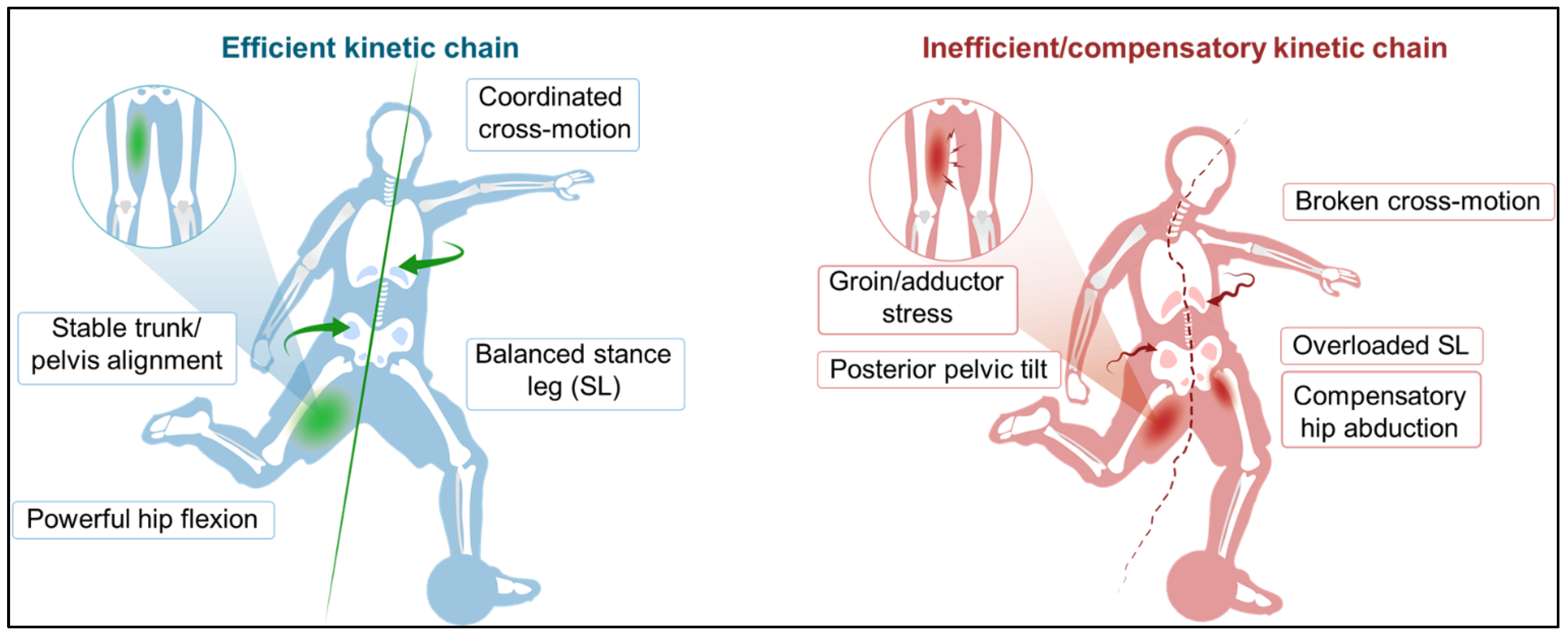
These findings provide essential perspectives on rehabilitation. The primary intervention goal should be correcting the dysfunctional trunk and pelvic control, specifically, re-educating cross-motion, rather than focusing solely on local adductor strengthening. As illustrated in Figure 6, rehabilitation should focus on restoring this efficient kinetic chain. To reduce compensatory reliance on the adductors, improving the primary power sources (hip extension and flexion) is necessary. Rehabilitation must address both KL and SL, enhancing dynamic stability and shock absorption. Correcting inefficient movement patterns aims to reduce the mechanical stress on the groin, improve AGP, and prevent recurrence. Therefore, clinical interventions should focus on retraining coordinated motor control—such as re-establishing trunk-pelvic dissociation to restore the cross-motion—rather than relying solely on isolated adductor strengthening.

4.4. Limitations

This study has some limitations. Firstly, the cross-sectional design precludes conclusions regarding causality, making it unclear whether the observed movement patterns were a cause or a consequence of prior AGP injury. Secondly, while baseline demographics (Table 1) were not significantly different, we cannot rule out the influence of unmeasured confounding factors, such as individual anthropometric differences (e.g., muscle mass, body composition) or other musculoskeletal conditions (e.g., lower back pain) that may accompany a history of AGP. Thirdly, laboratory data may not fully reflect the biomechanics under game-like conditions involving fatigue and opponent pressure. Finally, the findings are specific to right-footed male collegiate players and may not be generalizable to other populations, specifically female, youth, or left-footed athletes.

4.5. Future Perspectives

Several avenues for future investigation emerge from this study.
1. Prospective cohort studies: Prospective research is required to overcome the limitations of this cross-sectional study. Tracking a large cohort of healthy players pre-season and throughout the entire season would make it possible to identify the true biomechanical risk factors that predict AGP onset and distinguish them from the consequences of injury.
2. Validation of rehabilitation programs: Based on our finding that AGP is linked to a dysfunctional kinetic chain centered on poor trunk and pelvic control, new training programs targeting these specific inefficiencies should be developed. The efficacy of such programs must then be validated through robust methods like randomized controlled trials; validating whether these interventions can improve kicking mechanics and lower recurrence rates would be of significant clinical benefit.
3. Ecologically valid biomechanical analysis: To overcome the limitations of our controlled laboratory setting, future studies should investigate kicking biomechanics under more game-like conditions. Examining how factors, including fatigue and opponent pressure, alter the observed compensatory patterns is critical for developing more practical and effective injury prevention strategies.
4. Broader population validation: Our findings should be validated in a diverse and broader population. As this study was limited to right-footed male collegiate players; consequently, future research is needed to determine whether similar compensatory mechanisms are present in other groups, including left-footed players, female players, and young athletes at various stages of development.
Collectively, these research endeavors will deepen our understanding of AGP and facilitate the establishment of more effective evidence-based strategies for its prevention, training, and rehabilitation.

5. Conclusions

In conclusion, male soccer players with a history of AGP exhibited a dysfunctional kinetic chain during kicking, rather than isolated muscle deficits. These alterations were characterized by poor trunk–pelvis rotation, overreliance on the SL for stability, and modified KL mechanics. Our findings suggest that the fundamental issue is the lack of adaptability in motor control, creating a dilemma in which compensatory strategies for trunk stabilization overload the groin and contralateral SL muscles. Consequently, AGP rehabilitation should address the entire kinetic chain, focusing on restoring trunk–pelvis control and SL function to prevent recurrence and optimize performance.

Supplementary Materials

The following supporting information can be downloaded at https://www.mdpi.com/article/10.3390/app152212003/s1: Table S1: Full comparison of kinematic and kinetic parameters during the inside kick; Table S2: Full comparison of kinematic and kinetic parameters during the instep kick; Figure S1–S15: Detailed group comparison of kinematic and kinetic waveforms during the inside kick; Figure S16–S39: Detailed group comparison of kinematic and kinetic waveforms during the instep kick.

Author Contributions

Conceptualization, T.S. and R.K.; methodology, T.S. and R.K.; software, T.S.; formal analysis, T.S.; investigation, T.S.; writing—original draft, T.S.; writing—review and editing, R.K., S.H., Y.K., and M.H.; supervision, M.H.; funding acquisition, T.S. All authors have read and agreed to the published version of the manuscript.

Funding

This study was supported by the Japan Society for the Promotion of Science under Grant No. 17K18312.

Institutional Review Board Statement

The study was conducted in accordance with the Declaration of Helsinki and approved by the Ethics Committee of Nittazuka Medical Welfare Center (Approval No. 29-108, 10 February 2018).

Informed Consent Statement

Written informed consent for participation was obtained from all subjects involved in the study.

Data Availability Statement

The data that support the findings of this study are available from the corresponding author upon reasonable request. The data are not publicly available due to ethical restrictions and participant privacy.

Acknowledgments

The authors are grateful to all the soccer players for their time, effort, and commitment to this study. An artificial intelligence (AI) language model, specifically ChatGPT (OpenAI; version 3.5), was used to support the research presented in this manuscript. Tool used: ChatGPT (OpenAI; version 3.5); How it was used: The tool was employed to assist in the development and debugging of Python scripts for the 1D-SPM analysis; Reason for use: To improve the efficiency of code development and to help identify and resolve programming errors. All AI-assisted code was carefully reviewed and validated by the authors, who assume full responsibility for the final implementation and the results presented in this paper.

Conflicts of Interest

The authors declare no conflicts of interest.

Abbreviations

The following abbreviations are used in this manuscript:
AGPAdductor-related Groin Pain
COMCenter of Mass
COPCenter of Pressure
GPGroin Pain
HAGOSCopenhagen Hip and Groin Outcome Score
KLKicking Leg
SLStance Leg
PROPatient-Reported Outcome
QOLQuality of Life
SPMStatistical Parametric Mapping
1D-SPMOne-Dimensional Statistical Parametric Mapping
ADLActivities of Daily Living
PAParticipation in Physical Activity
GRFGround Reaction Force

References

  1. FIFA. Professional Football Report 2019; FIFA: Zurich, Switzerland, 2019. [Google Scholar]
  2. Stølen, T.; Chamari, K.; Castagna, C.; Wisløff, U. Physiology of soccer: An update. Sports Med. 2005, 35, 501–536. [Google Scholar] [CrossRef]
  3. Ekstrand, J.; Hägglund, M.; Waldén, M. Injury incidence and injury patterns in professional football: The UEFA injury study. Br. J. Sports Med. 2011, 45, 553–558. [Google Scholar] [CrossRef]
  4. Weir, A.; Brukner, P.; Delahunt, E.; Ekstrand, J.; Griffin, D.; Khan, K.M.; Lovell, G.; Meyers, W.C.; Muschaweck, U.; Orchard, J.; et al. Doha agreement meeting on terminology and definitions in groin pain in athletes. Br. J. Sports Med. 2015, 49, 768–774. [Google Scholar] [CrossRef] [PubMed]
  5. Renström, P.; Peterson, L. Groin injuries in athletes. Br. J. Sports Med. 1980, 14, 30–36. [Google Scholar] [CrossRef]
  6. Hölmich, P. Long-standing groin pain in sportspeople falls into three primary patterns, a “clinical entity” approach: A prospective study of 207 patients. Br. J. Sports Med. 2007, 41, 247–252; discussion 252. [Google Scholar] [CrossRef]
  7. Tak, I.; Engelaar, L.; Gouttebarge, V.; Barendrecht, M.; Van den Heuvel, S.; Kerkhoffs, G.; Langhout, R.; Stubbe, J.; Weir, A.; Stubbe, J.; et al. Is lower hip range of motion a risk factor for groin pain in athletes? A systematic review with clinical applications. Br. J. Sports Med. 2017, 51, 1611–1621. [Google Scholar] [CrossRef]
  8. Tyler, T.F.; Nicholas, S.J.; Campbell, R.J.; McHugh, M.P. The association of hip strength and flexibility with the incidence of adductor muscle strains in professional ice hockey players. Am. J. Sports Med. 2001, 29, 124–128. [Google Scholar] [CrossRef]
  9. Whittaker, J.L.; Small, C.; Maffey, L.; Emery, C.A. Risk factors for groin injury in sport: An updated systematic review. Br. J. Sports Med. 2015, 49, 803–809. [Google Scholar] [CrossRef] [PubMed]
  10. Engebretsen, A.H.; Myklebust, G.; Holme, I.; Engebretsen, L.; Bahr, R. Intrinsic risk factors for groin injuries among male soccer players: A prospective cohort study. Am. J. Sports Med. 2010, 38, 2051–2057. [Google Scholar] [CrossRef] [PubMed]
  11. Brophy, R.H.; Backus, S.I.; Pansy, B.S.; Lyman, S.; Williams, R.J. Lower extremity muscle activation and alignment during the soccer instep and side-foot kicks. J. Orthop. Sports Phys. Ther. 2007, 37, 260–268. [Google Scholar] [CrossRef]
  12. Dupré, T.; Funken, J.; Müller, R.; Mortensen, K.R.L.; Lysdal, F.G.; Braun, M.; Krahl, H.; Potthast, W.; Potthast, W. Does inside passing contribute to the high incidence of groin injuries in soccer? A biomechanical analysis. J. Sports Sci. 2018, 36, 1827–1835. [Google Scholar] [CrossRef]
  13. Dupré, T.; Tryba, J.; Potthast, W. Muscle activity of cutting manoeuvres and soccer inside passing suggests an increased groin injury risk during these movements. Sci. Rep. 2021, 11, 7223. [Google Scholar] [CrossRef]
  14. Nunome, H.; Asai, T.; Ikegami, Y.; Sakurai, S. Three-dimensional kinetic analysis of side-foot and instep soccer kicks. Med. Sci. Sports Exer. 2002, 34, 2028–2036. [Google Scholar] [CrossRef] [PubMed]
  15. Nunome, H.; Ikegami, Y.; Kozakai, R.; Apriantono, T.; Sano, S. Segmental dynamics of soccer instep kicking with the preferred and non-preferred leg. J. Sports Sci. 2006, 24, 529–541. [Google Scholar] [CrossRef]
  16. Charnock, B.L.; Lewis, C.; Garrett, W.; Queen, R. Adductor Longus Mechanics During the Maximal Effort Soccer Kick. Sports Biomech. 2009, 8, 223–234. [Google Scholar] [CrossRef]
  17. Fujisaki, K.; Akasaka, K.; Otsudo, T.; Hattori, H.; Hasebe, Y.; Hall, T. Risk Factors for Groin Pain in Male High School Soccer Players Undergoing an Injury Prevention Program: A Cluster Randomized Controlled Trial. Trauma Care 2022, 2, 238–250. [Google Scholar] [CrossRef]
  18. Pataky, T.C.; Robinson, M.A.; Vanrenterghem, J. Vector field statistical analysis of kinematic and force trajectories. J. Biomech. 2013, 46, 2394–2401. [Google Scholar] [CrossRef]
  19. Hughes-Oliver, C.; Harrison, K.; Williams, D.; Queen, R. Statistical Parametric Mapping as a Measure of Differences Between Limbs: Applications to Clinical Populations. J. Appl. Biomech. 2019, 35, 377–387. [Google Scholar] [CrossRef] [PubMed]
  20. Sole, G.; Pataky, T.; Tengman, E.; Häger, C. Analysis of Three-Dimensional Knee Kinematics During Stair Descent Two Decades Post-ACL Rupture—Data Revisited Using Statistical Parametric Mapping. J. Electromyogr. Kinesiol. 2016, 32, 44–50. [Google Scholar] [CrossRef] [PubMed]
  21. De Bleecker, C.; Vermeulen, S.; De Blaiser, C.; Willems, T.; de Ridder, R.; Roosen, P. Relationship Between Jump-Landing Kinematics and Lower Extremity Overuse Injuries in Physically Active Populations: A Systematic Review and Meta-Analysis. Sports Med. 2020, 50, 1515–1532. [Google Scholar] [CrossRef]
  22. Thorborg, K.; Hölmich, P.; Christensen, R.; Petersen, J.; Roos, E.M. The Copenhagen Hip and Groin Outcome Score (HAGOS): Development and validation according to the COSMIN checklist. Br. J. Sports Med. 2011, 45, 478–491. [Google Scholar] [CrossRef]
  23. Dörge, H.C.; Anderson, T.B.; Sørensen, H.; Simonsen, E.B. Biomechanical differences in soccer kicking with the preferred and the non-preferred leg. J. Sports Sci. 2002, 20, 293–299. [Google Scholar] [CrossRef] [PubMed]
  24. Zago, M.; Motta, A.F.; Mapelli, A.; Annoni, I.; Galvani, C.; Sforza, C. Effect of leg dominance on the center-of-mass kinematics during an inside-of-the-foot kick in amateur soccer players. J. Hum. Kinet. 2014, 42, 51–61. [Google Scholar] [CrossRef] [PubMed]
  25. Fuller, C.W.; Ekstrand, J.; Junge, A.; Andersen, T.E.; Bahr, R.; Dvorak, J.; Hägglund, M.; McCrory, P.; Meeuwisse, W.H.; McCrory, P.; et al. Consensus statement on injury definitions and data collection procedures in studies of football (soccer) injuries. Br. J. Sports Med. 2006, 40, 193–201. [Google Scholar] [CrossRef] [PubMed]
  26. World Medical Association. Declaration of Helsinki—Ethical Principles for Medical Research Involving Human Participants; WMA: Ferney-Voltaire, France, 2013. [Google Scholar]
  27. Davis, R.B.; Õunpuu, S.; Tyburski, D.; Gage, J.R. A gait analysis data collection and reduction technique. Hum. Mov. Sci. 1991, 10, 575–587. [Google Scholar] [CrossRef]
  28. Winter, D.A. Biomechanics and Motor Control of Human Movement, 4th ed.; John Wiley & Sons: Chichester: New York, NY, USA, 2009. [Google Scholar] [CrossRef]
  29. David, S.; Komnik, I.; Peters, M.; Funken, J.; Potthast, W. Identification and risk estimation of movement strategies during cutting maneuvers. J. Sci. Med. Sport 2017, 20, 1075–1080. [Google Scholar] [CrossRef]
  30. Dempster, W.T. Space Requirements of the Seated Operator; Geometrical, Kinematic, and Mechanical Aspects of the Body with Special Reference to the Limbs [WADC Technical Report]. Available online: https://apps.dtic.mil/sti/tr/pdf/AD0087892.pdf (accessed on 28 September 2025).
  31. Brophy, R.H.; Backus, S.; Kraszewski, A.P.; Steele, B.C.; Ma, Y.; Osei, D.; Williams, R.J. Differences between sexes in lower extremity alignment and muscle activation during soccer kick. J. Bone Jt. Surg. Am. 2010, 92, 2050–2058. [Google Scholar] [CrossRef]
  32. Pataky, T.C. One-dimensional statistical parametric mapping in Python. Comput. Methods Biomech. Biomed. Eng. 2012, 15, 295–301. [Google Scholar] [CrossRef]
  33. Pataky, T.C.; Robinson, M.A.; Vanrenterghem, J. Region-of-interest analyses of one-dimensional biomechanical trajectories: Bridging 0D and 1D theory, augmenting statistical power. PeerJ 2016, 4, e2652. [Google Scholar] [CrossRef]
  34. Robinson, M.A.; Vanrenterghem, J.; Pataky, T.C. Sample size estimation for biomechanical waveforms: Current practice, recommendations and a comparison to discrete power analysis. J. Biomech. 2021, 122, 110451. [Google Scholar] [CrossRef]
  35. Hodges, J.L.; Lehmann, E.L. Estimates of Location Based on Rank Tests. In Selected Works of E.L. Lehmann; Rojo, J., Ed.; Springer: Berlin/Heidelberg, Germany, 2012; pp. 287–300. [Google Scholar] [CrossRef]
  36. McGraw, K.O.; Wong, S.P. A common language effect size statistic. Psychol. Bull. 1992, 111, 361–365. [Google Scholar] [CrossRef]
  37. Hedges, L.V. Distribution theory for Glass’s estimator of effect size and related estimators. J. Educ. Stat. 1981, 6, 107–128. [Google Scholar] [CrossRef]
  38. Sawilowsky, S.S. New effect size rules of thumb. J. Mod. Appl. Stat. Meth. 2009, 8, 597–599. [Google Scholar] [CrossRef]
  39. Thorborg, K.; Branci, S.; Stensbirk, F.; Jensen, J.; Hölmich, P. Copenhagen hip and groin outcome score (HAGOS) in male soccer: Reference values for hip and groin injury-free players. Br. J. Sports Med. 2014, 48, 557–559. [Google Scholar] [CrossRef]
  40. Harøy, J.; Bache-Mathiesen, L.K.; Andersen, T.E. Lower HAGOS subscale scores associated with a longer duration of groin problems in football players in the subsequent season. BMJ Open Sport Exerc. Med. 2024, 10, e001812. [Google Scholar] [CrossRef]
  41. Kato, T.; Taniguchi, K.; Kodesho, T.; Nakao, G.; Yokoyama, Y.; Saito, Y.; Katayose, M. Quantifying the shear modulus of the adductor longus muscle during hip joint motion using shear wave elastography. Sci. Rep. 2023, 13, 9510. [Google Scholar] [CrossRef] [PubMed]
  42. Belhaj, K.; Meftah, S.; Mahir, L.; Lmidmani, F.; Elfatimi, A. Isokinetic imbalance of adductor-abductor hip muscles in professional soccer players with chronic adductor-related groin pain. Eur. J. Sport Sci. 2016, 16, 1226–1231. [Google Scholar] [CrossRef]
  43. Jaenada-Carrilero, E.; Baraja-Vegas, L.; Blanco-Giménez, P.; Gallego-Estevez, R.; Bautista, I.J.; Vicente-Mampel, J. Association between hip/groin pain and hip ROM and strength in elite female soccer players. J. Clin. Med. 2024, 13, 5648. [Google Scholar] [CrossRef]
  44. Moreno-Pérez, V.; Peñaranda, M.; Soler, A.; López-Samanes, Á.; Aagaard, P.; Del Coso, J. Effects of whole-season training and match-play on hip adductor and abductor muscle strength in soccer players: A pilot study. Sports Health 2022, 14, 912–919. [Google Scholar] [CrossRef]
  45. Chu, S.K.; Jayabalan, P.; Kibler, W.B.; Press, J. The kinetic chain revisited: New concepts on throwing mechanics and injury. PM R 2016, 8 (Suppl. l), S69–S77. [Google Scholar] [CrossRef] [PubMed]
  46. Owens, L.P.; Coyles, G.; Khaiyat, O. Alterations to the kinetic chain sequence after a shoulder injury in throwing athletes. Orthop. J. Sports Med. 2024, 12, 23259671241288889. [Google Scholar] [CrossRef]
  47. Lanza, M.B.; Arbuco, B.; Ryan, A.S.; Shipper, A.G.; Gray, V.L.; Addison, O. Systematic review of the importance of hip muscle strength, activation, and structure in balance and mobility tasks. Arch. Phys. Med. Rehabil. 2022, 103, 1651–1662. [Google Scholar] [CrossRef] [PubMed]
  48. Mansourizadeh, R.; Letafatkar, A.; Khaleghi-Tazji, M. Does athletic groin pain affect the muscular co-contraction during a change of direction. Gait Posture 2019, 73, 173–179. [Google Scholar] [CrossRef]
  49. Morrissey, D.; Graham, J.; Screen, H.; Sinha, A.; Small, C.; Twycross-Lewis, R.; Woledge, R. Coronal plane hip muscle activation in football code athletes with chronic adductor groin strain injury during standing hip flexion. Man. Ther. 2012, 17, 145–149. [Google Scholar] [CrossRef]
  50. Carvalho, D.D.S.; Ocarino, J.M.; Cruz, A.C.; Barsante, L.D.; Teixeira, B.G.; Resende, R.A.; Fonseca, S.T.; Souza, T.R.; Souza, T.R. The trunk is exploited for energy transfers of maximal instep soccer kick: A power flow study. J. Biomech. 2021, 121, 110425. [Google Scholar] [CrossRef]
  51. Chen, J.; Peek, K.; Sanders, R.H.; Lee, J.; Pang, J.C.Y.; Ekanayake, K.; Fu, A.C.L. The role of upper body motions in stationary ball-kicking motion: A systematic review. J. Sci. Sport Exer. 2024, 6, 1–26. [Google Scholar] [CrossRef]
  52. Omar, I.M.; Zoga, A.C.; Kavanagh, E.C.; Koulouris, G.; Bergin, D.; Gopez, A.G.; Morrison, W.B.; Meyers, W.C.; Meyers, W.C. Athletic pubalgia and “sports hernia”: Optimal MR imaging technique and findings. RadioGraphics 2008, 28, 1415–1438. [Google Scholar] [CrossRef] [PubMed]
  53. Watanabe, K.; Nunome, H.; Inoue, K.; Iga, T.; Akima, H. Electromyographic analysis of hip adductor muscles in soccer instep and side-foot kicking. Sports Biomech. 2020, 19, 295–306. [Google Scholar] [CrossRef]
  54. Bechet, R.; Tisserand, R.; Fradet, L.; Colloud, F. Evidence of invariant lower-limb kinematics in anticipation of ground contact during drop-landing and drop-jumping. Hum. Mov. Sci. 2024, 98, 103297. [Google Scholar] [CrossRef]
  55. Mrdakovic, V.; Ilic, D.B.; Jankovic, N.; Rajkovic, Z.; Stefanovic, D. Pre-activity modulation of lower extremity muscles within different types and heights of deep jump. J. Sports Sci. Med. 2008, 7, 269–278. [Google Scholar] [PubMed]
  56. Severin, A.C.; Mellifont, D.B.; Sayers, M.G.L. Influence of previous groin pain on hip and pelvic instep kick kinematics. Sci. Med. Footb. 2017, 1, 80–85. [Google Scholar] [CrossRef]
  57. Santana, J.C.; McGill, S.M.; Brown, L.E. Anterior and posterior serape. Strength Cond. J. PDF 2015, 37, 8–13. [Google Scholar] [CrossRef]
  58. Fullenkamp, A.M.; Campbell, B.M.; Laurent, C.M.; Lane, A.P. The contribution of trunk axial kinematics to poststrike ball velocity during maximal instep soccer kicking. J. Appl. Biomech. 2015, 31, 370–376. [Google Scholar] [CrossRef] [PubMed]
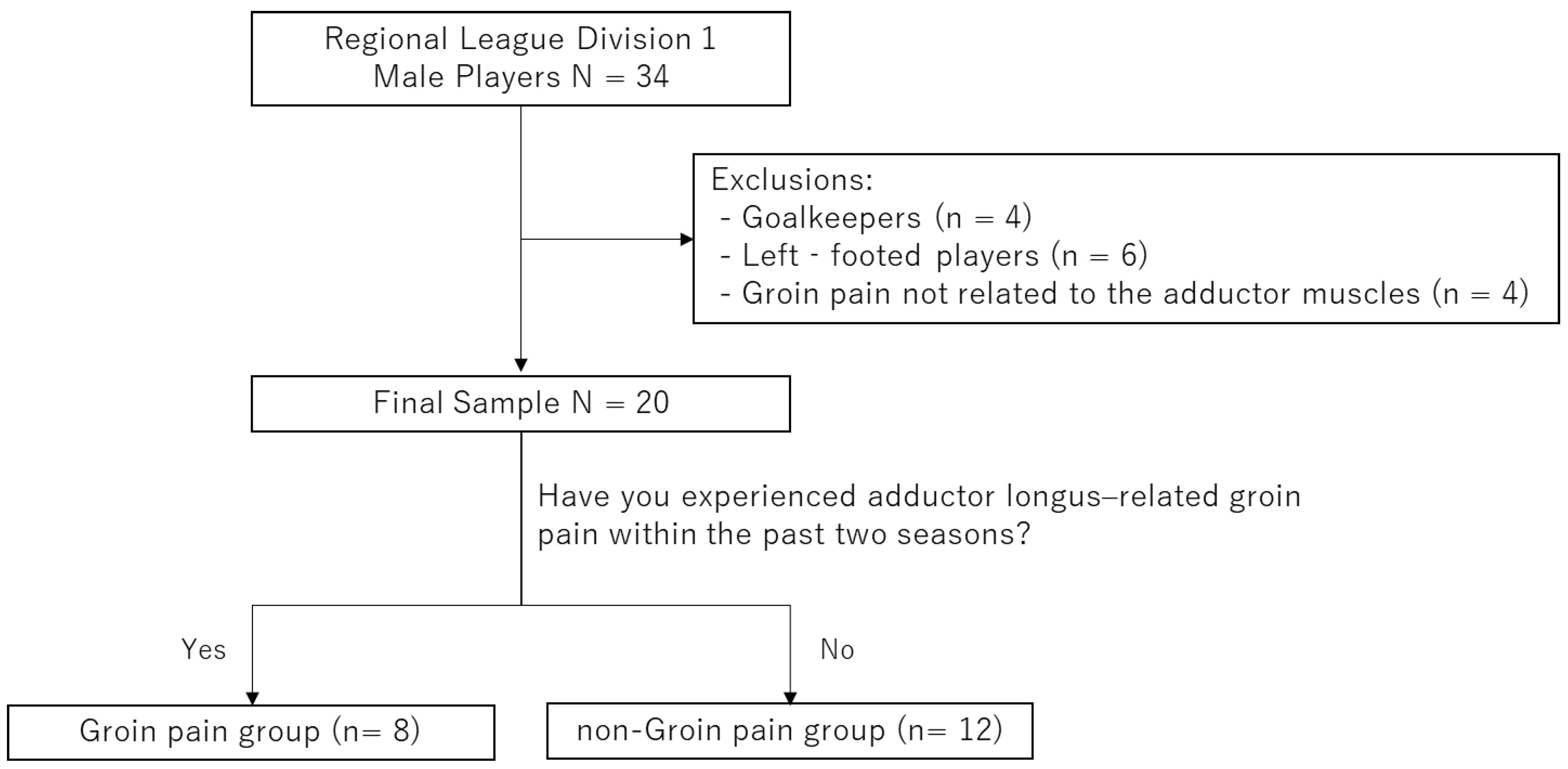
Figure 1. Flowchart of the participant selection process. The diagram illustrates the process of screening an initial pool of 34 players, applying exclusion criteria, and allocating the final 20 eligible participants into the groin pain (GP; n = 8) and non-GP (n = 12) groups.
Applsci 15 12003 g001
Figure 2. Placement of the 41 reflective markers based on the Vicon Plug-in Gait model, shown on a participant in the laboratory, displaying (A) frontal view, (B) antero-lateral view, and (C) postero-lateral view. This visual confirmation addresses the reviewer’s request for photographic evidence of the experimental procedure.
Applsci 15 12003 g002
Figure 3. Schematic of the experimental setup for kicking analysis. The laboratory setup showing (A) a top-down view and (B) a front view. The setup included a soccer goal (2.0 m height × 5.0 m width) with a 1.0 m2 target at its center, positioned 4.0 m from the kicking spot. Two force plates were placed to capture ground reaction forces from the stance leg. Participants approached the ball with a run-up of 1.5–2.0 m at a self-selected angle between 20° and 45°. Eight 3D motion capture cameras were positioned around the capture volume to record the movement.
Applsci 15 12003 g003
Figure 4. Definition of the analysis interval for the kicking motion. The analysis interval was defined as the period from the toe-off of the kicking leg to the moment of ball impact. This interval was time-normalized to 100% for subsequent analysis.
Applsci 15 12003 g004
Figure 5. Key kinematic and kinetic differences during the instep kick, moved from Supplementary Materials to improve clarity. Waveforms for the GP group are shown in red/orange, and the non-GP group in blue. Shaded areas represent one standard deviation. Red vertical bars indicate phases of significant difference (p < 0.05). (A) Trunk rotation angle (from Figure S32), showing a significantly reduced rotation in the GP group before impact (83–100% phase). (B) Kicking leg hip flexion power (from Figure S21), showing a significant power deficit in the GP group during the mid-swing (60–62% phase).
Applsci 15 12003 g005
Figure 6. Schematic of the inefficient (compensatory) kinetic chain observed in the GP group (right, shown in red) versus the efficient kinetic chain that rehabilitation should target (left, shown in blue) (based on the Graphical Abstract). The GP group’s strategy (right) is characterized by a “Broken cross-motion,” leading to trunk instability, which is compensated for by posterior pelvic tilt and overloading of the stance leg (SL), ultimately increasing stress on the groin/adductors.
Applsci 15 12003 g006
Table 1. Participant characteristics.
VariableTotal (n = 20)GP Group Mean (SD)
n = 8
Non-GP Group Mean (SD)
n = 12
p-ValueEstimated
Difference
95% CI
Age (years)24.6 (3.5)25.5 (3.4)24.0 (3.6)0.3641.5−1.88–4.88
Height (cm)176.6 (6.3)174.3 (5.0)178.2 (6.8)0.178−3.9−9.79–1.96
Weight (kg)70.3 (7.0)68.8 (4.6)71.3 (8.3)0.449−2.5−9.28–4.28
Body Mass Index (kg/m2)22.5 (1.5)22.6 (0.6)22.4 (1.9)0.2100.2−1.26–1.68
Soccer Experience (years)18.0 (3.6)18.1 (3.0)17.9 (4.0)0.9020.2−3.31–3.72
Position aFW: 6/MF: 5/DF: 9FW: 4/MF: 1
/DF: 3
FW: 2/MF:4
/DF: 6
0.189--
Ball Speed
Inside kick (m/s)23.7 (1.7)23.7 (1.5)23.7 (1.9)0.9910.0−1.74–1.73
In front kick (m/s)26.3 (2.2)25.9 (2.2)26.7 (2.2)0.443−0.8−2.93–1.34
Inside Kick phase point
Max Hip Extension (%)45.7 (4.3)46.1 (4.6)45.5 (4.2)0.7630.6−3.58–4.80
Max Knee Flexion (%)75.4 (1.9)75.9 (2.2)75.1 (1.8)0.3840.7−2.25–0.70
Instep Kick phase point
Max Hip Extension (%)47.5 (3.5)48.6 (2.7)46.8 (3.8)0.2651.8−1.49–5.10
Max Knee Flexion (%)74.3 (2.0)74.5 (2.4)75.1(1.8)0.7770.3−1.71–2.25
Notes: Values are presented as mean ± standard deviation or n (%). Differences between groups were compared using an independent t-test for continuous variables and Fisher’s exact test for categorical variables. A hyphen (-) indicates values that are not applicable, as ‘Position’ was analyzed using Fisher’s exact test. a Data for the ‘Position’ variable were analyzed using Fisher’s exact test. Abbreviations: BMI, Body Mass Index; cm, centimeters; GP, groin pain; kg, kilograms; n, number of participants.
Table 2. Comparison of HAGOS subscale scores between the GP and non-GP groups.
HAGOS SubscaleGP Group Mean (SD)
n = 8
Non-GP Group Mean (SD)
n = 12
p-ValueHodges-Lehmann Estimate95% CIEffect Size ([CLES])
Pain93.4 (10.0)99.2 (2.9)0.047 *2.50.0–15.00.77
Symptoms84.4 (10.3)92.9 (7.6)0.0697.10.0–17.90.75
ADL100.0 (0.0)99.6 (1.4)0.7920.00.0–0.00.46
Sport/Rec89.8 (15.9)97.7 (7.2)0.0823.10.0–18.80.73
PA85.9 (35.0)93.8 (10.0)0.8510.0−12.5–0.00.47
QOL76.3 (26.1)98.3 (4.4)0.003 **10.05.0–45.00.89
Notes: Values are presented as median [interquartile range]. Differences between groups were compared using the Mann–Whitney U test. * p < 0.05; ** p < 0.01. Abbreviations: ADL, activities of daily living; CI, confidence interval; CLES, common language effect size; HAGOS, Copenhagen hip and groin outcome score; PA, participation in physical activity; QOL, quality of life; Sport/Rec, sport and recreation.
Table 3. Summary of significant between-group differences identified by SPM during the inside kick.
CategoryParameterSidep-ValueTime Interval(s) of Significant Difference (% of Kick Cycle)Effect Size (Hedges’ g)Movement DirectionGroup Difference
AngleHip Flexion/Extension (°)KL0.027 *21.34–39.571.52−: ExtensionGP > non-GP
Hip Abduction/Adduction (°)KL<0.001 ***14.93–100.000.83−: Abductionnon-GP > GP
SL<0.001 ***14.71–93.51−1.79−: Abductionnon-GP > GP
Thorax-Pelvis Lateral Flexion (°)0.030 *86.59–100.00−1.63+: Right lateral flexionnon-GP > GP
Thorax-Pelvis Rotation (°)0.019 *76.00–96.65−1.39+: Right Axial Rotation/
−: Left Axial Rotation
non-GP > GP
Angular VelocityHip Abduction/Adduction (deg/s)KL0.006 **, 0.043 *19.01–30.71, 96.00–100−1.68,
1.62
−: Abduction, + Adductionnon-GP > GP, GP > non-GP
SL<0.001 ***3.10–21.43−1.72−: Abductionnon-GP > GP
Pelvis Tilt (deg/s)0.046 *96.36–100.00−1.60−: Posterior Tiltnon-GP > GP
Pelvis Obliquity (deg/s)0.044 *82.15–84.1−1.46+: Right down/−: Left Downnon-GP > GP
Thorax-Pelvis Lateral Flexion (deg/s)0.030 *91.97–100.00−1.53−: Left lateral flexionnon-GP > GP
Thorax-Pelvis Rotation (deg/s)0.005 **47.45–62.40−1.93+: Right Axial Rotationnon-GP > GP
Angular AccelerationHip Abduction/Adduction (deg/s2)SL0.032 *, 0.029 *21.21–24.80, 78.38–82.081.57,
1.70
+: Positive/−: Negative,
+: Positive
GP > non-GP,
GP > non-GP
Hip Rotation (deg/s2)KL0.002 **42.13–50.632.17+: PositiveGP > non-GP
PowerHip Abduction/Adduction (W/kg)SL0.048 *0.00–1.462.04+: Positive valuesGP > non-GP
COM-COP distanceMedio-Lateral (mm)0.049 *, 0.049 *60.18–62.38, 83.15–85.10−0.86,
−0.74
−: Towards the supporting leg,
−: Towards the supporting leg
non-GP > GP, non-GP > GP
Notes: Only parameters with a statistically significant difference (p ≤ 0.05) are shown. For a complete list of all parameters, see Supplementary Table S1. Data are presented as mean waveform ± standard deviation. Group differences were assessed using one-dimensional statistical parametric mapping (SPM{t}). The effect size was calculated as Hedges’ g. * p < 0.05; ** p < 0.01; *** p < 0.001. An em dash (—) in the ‘Side’ column indicates ‘Not Applicable’ (e.g., for trunk or pelvic parameters). Abbreviations: COM, center of mass; COP, center of pressure; deg, degrees; GP, groin pain; KL, kicking leg; SL, stance leg; SPM, statistical parametric mapping.
Table 4. Summary of significant between-group differences identified by SPM during the instep kick.
CategoryParameterSidep-ValueTime Interval(s) of Significant Difference (% of Kick Cycle)Effect Size (Hedges’ g)Movement DirectionGroup Difference
AngleHip Abduction/Adduction (°)KL<0.001 ***20.39–100.00−3.12−: Abductionnon-GP > GP
SL<0.001 ***, 0.027 *14.77–67.80, 68.20–85.28−1.71,
−1.36
−: Abductionnon-GP > GP
Thorax-Pelvis Rotation (°)0.040 *82.52–100.00−1.36+: Right Axial Rotationnon-GP > GP
Angular VelocityHip Flexion/Extension (deg/s)KL0.044 *83.77–86.891.47+: FlexionGP > non-GP
SL0.035 *58.65–62.69−1.59−: Extensionnon-GP > GP
Hip Abduction/Adduction (deg/s)KL< 0.001 ***, 0.033 *26.10–41.25, 94.57–98.55−1.98,
1.64
−: Abductionnon-GP > GP
SL0.013 *6.84–16.43−1.60−: Abductionnon-GP > GP
Pelvis Tilt (deg/s)0.029 *93.56–100.00−2.07−: Posterior Tiltnon-GP > GP
Thorax-Pelvis Flexion/Extension (deg/s)< 0.001 ***0–21.342.03−: ExtensionGP > non-GP
Thorax-Pelvis Lateral Flexion (deg/s)0.037 *93.29–100−1.69−: Left lateral flexionnon-GP > GP
Thorax-Pelvis Rotation (deg/s)0.005 **47.45–62.40−1.19+: Right Axial Rotationnon-GP > GP
Angular AccelerationHip Flexion/Extension (deg/s2)SL0.026 *67.87–71.531.67−: NegativeGP > non-GP
Hip Abduction/Adduction (deg/s2)KL0.040 *85.66–87.811.73+: PositiveGP > non-GP
SL0.031 *77.77–81.351.71+: PositiveGP > non-GP
Pelvis Obliquity (deg/s2)0.013 *43.73–48.741.96+: Positive/−: NegativeGP > non-GP
Thorax-Pelvis Lateral Flexion (deg/s2)0.014 *78.38–84.96−1.90−: Negativenon-GP > GP
MomentHip Flexion/Extension (N.mm/kg)KL0.048 *48.68–49.66−1.55+: Flexion momentnon-GP > GP
SL0.043 *12.66–15.391.59−: Extension momentGP > non-GP
Hip Abduction/Adduction (N.mm/kg)SL< 0.001 ***41.00–60.332.37+: Adduction momentGP > non-GP
PowerHip Flexion/Extension (W/kg)KL0.045 *60.43–62.03−1.62+: Positive valuesnon-GP > GP
SL0.045 *12.50–14.931.44+: Positive valuesGP > non-GP
Hip Abduction/Adduction (W/kg)KL0.040 *44.77–47.20−1.57−: Negative valuesnon-GP > GP
SL0.025 *58.79–64.641.62+: Positive valuesGP > non-GP
COM-COP distanceMedio-Lateral (mm)0.050 *71.95–72.04−0.26−: Towards the supporting legGP > non-GP
Notes: Only parameters with a statistically significant difference (p ≤ 0.05) are shown. For a complete list of all parameters, see Supplementary Table S2. Data are presented as mean waveform ± standard deviation. Group differences were assessed using one-dimensional statistical parametric mapping (SPM{t}). The effect size was calculated as Hedges’ g. * p < 0.05; ** p < 0.01; *** p < 0.001. An em dash (—) in the ‘Side’ column indicates ‘Not Applicable’ (e.g., for trunk or pelvic parameters). Abbreviations: COM, center of mass; COP, center of pressure; deg, degrees; GP, groin pain; KL, kicking leg; SL, stance leg; SPM, statistical parametric mapping.
Disclaimer/Publisher’s Note: The statements, opinions and data contained in all publications are solely those of the individual author(s) and contributor(s) and not of MDPI and/or the editor(s). MDPI and/or the editor(s) disclaim responsibility for any injury to people or property resulting from any ideas, methods, instructions or products referred to in the content.