Article

From Genes to Organs: A Multi-Level Neurotoxicity Assessment Following Dietary Exposure to Glyphosate and Its Metabolite Aminomethylphosphonic Acid in Common Carp (Cyprinus carpio)

1
Department of Chemical, Biological, Pharmaceutical and Environmental Sciences, University of Messina, Viale Ferdinando Stagno d’Alcontres, 31, 98166 Messina, Italy
2
Department of Animal Protection and Welfare and Veterinary Public Health, University of Veterinary Sciences Brno, Palackeho tr. 1946/1, 612 42 Brno, Czech Republic
3
Department of Infectious Diseases and Preventive Medicine, Veterinary Research Institute, Hudcova 296/70, 621 00 Brno, Czech Republic
4
Department of Anatomy, Histology and Embryology, University of Veterinary Sciences Brno, Palackeho tr. 1946/1, 612 42 Brno, Czech Republic
5
Department of Eco-Sustainable Marine Biotechnology, Stazione Zoologica Anton Dohrn, 80121 Naples, Italy
*
Author to whom correspondence should be addressed.
Appl. Sci. 2025, 15(22), 11877; https://doi.org/10.3390/app152211877
Submission received: 22 September 2025 / Revised: 15 October 2025 / Accepted: 6 November 2025 / Published: 7 November 2025

Abstract

Herbicide glyphosate and its main metabolite, aminomethylphosphonic acid (AMPA), have raised concerns due to their potential neurotoxicity in non-target aquatic species. This study evaluated neurotoxic effects in common carp (Cyprinus carpio) following a 28-day dietary exposure to glyphosate (325.2 and 3310.0 μg/kg) and AMPA (335.2 and 3441.0 μg/kg) at two concentrations, including control and four treatment groups. Brain acetylcholinesterase activity was significantly (p < 0.05) reduced in all exposed groups, while muscle acetylcholinesterase activity remained unchanged. Brain dopamine was significantly (p < 0.05) decreased only in the highest AMPA group. Plasma butyrylcholinesterase activity increased significantly (p < 0.05) in the low-dose glyphosate group. The level of mRNA expression of ache was significantly (p < 0.05) downregulated in the brain across all treatments and upregulated in the gills only at the highest AMPA concentration. Histological analysis of the brain revealed vascular congestion in both glyphosate-exposed groups, indicating pathological changes. These results suggest that dietary exposure to glyphosate and AMPA can affect cholinergic and dopaminergic pathways in fish, with the brain being a particularly sensitive target tissue. Our findings contribute to understanding the potential neurotoxic risks posed by glyphosate-based compounds in aquatic environments.

1. Introduction

Glyphosate [N-(phosphonomethyl)glycine] is one of the most widely used non-selective, post-emergence herbicides worldwide, valued for its broad-spectrum activity and effectiveness in genetically modified crop systems. Glyphosate-based formulations are applied to control annual and perennial plants, as well as aquatic weeds in ponds, lakes, canals, and other water bodies [1,2,3]. The herbicidal action of glyphosate is based on inhibition of the shikimic acid pathway, which is essential for the biosynthesis of aromatic amino acids in plants, fungi, and certain microorganisms. Specifically, glyphosate targets the enzyme 5-enolpyruvylshikimate-3-phosphate synthase, leading to a reduction in the synthesis of the aromatic amino acids (tyrosine, phenylalanine, and tryptophan), ultimately impairing protein production [4,5].
Due to its strong affinity for aluminum and iron oxides, glyphosate binds readily to soil particles, allowing for soils to act as reservoirs [6,7]. Nevertheless, it can leach into groundwater or be transported via runoff to surface waters, where it may accumulate in sediments and remain mobile [3,8]. Its half-life in water and soil ranges from a few days to several hundred days, depending on temperature, salinity, and light, with bacterial degradation being the primary pathway [1,9,10,11]. In seawater, persistence can be extreme: Mercurio et al. [12] reported 47 days under low-light at 25 °C, extending to 267 days in darkness at 25 °C and 315 days at 31 °C. Globally, glyphosate is frequently detected at concentrations ranging from hundreds of ng/L to several hundred µg/L in water, and in the µg/kg range in sediments. Examples include up to 260 ng/L in surface water and 15 µg/kg in sediments in the Venice Lagoon [13], 200 µg/L in U.S. surface waters [14], 1.42 µg/L in Mexican groundwater [15], and 32.49 µg/L in surface water and 2.09 µg/L in groundwater in China [16].
In the environment, glyphosate is primarily degraded through microbial activity, producing aminomethylphosphonic acid (AMPA) as its primary metabolite [3,8]. AMPA is also formed during the breakdown of other phosphonate herbicides and generally exhibits lower water solubility and a longer half-life than glyphosate, indicating greater environmental stability [17]. Consequently, AMPA can persist for extended periods in soils, sediments, and aquatic systems, where it is frequently detected—often at concentrations comparable to or even exceeding those of its parent compound [3,16,17]. For example, Konecna et al. [18] monitored selected pesticides in surface water in the Czech Republic. They detected AMPA in all samples, with average concentrations of 258.7 µg/kg in stream sediments, 205.3 µg/kg in reservoir sediments, and 0.31 µg/L in surface water. Similarly, in rice fields in Argentina, AMPA was detected throughout the entire cultivation cycle, not only in abiotic matrices (water and sediment), but also in biotic matrices, namely in fish. The highest average concentrations were 3.4 µg/L in water and 83.9 µg/kg in sediment, while residues in fish tissues reached hundreds of µg/kg in the liver and were also present in the muscle [19]. Despite its persistence and widespread occurrence, AMPA is often overlooked in toxicological assessments. Its accumulation in aquatic environments—including bioaccumulation in organisms and potential transfer through the food web—raises concerns about possible ecological impacts, particularly risks to non-target species such as fish [7,20].
While the toxic effects of glyphosate on various physiological systems in fish are increasingly well documented [2,3,21,22,23,24,25], its potential neurotoxicity remains insufficiently explored [5,26]. A similar knowledge gap exists for its primary degradation product, AMPA [3,27,28,29,30,31]. For instance, the potential neurotoxic effects of glyphosate remain a subject of debate. According to the European Food Safety Authority [32], there is no evidence of glyphosate-induced neurotoxicity. Neurotoxic effects have also not been demonstrated in experimental models such as rats and chickens. But a growing number of recent studies suggest otherwise, indicating that glyphosate may adversely affect the central nervous system in various living organisms. Reported effects include oxidative stress, neuroinflammation, glutamate excitotoxicity, alterations in neurotransmitter profiles, and behavioral changes. However, these findings have predominantly been observed at extremely high concentrations, raising uncertainty about whether environmentally relevant levels of glyphosate are capable of inducing similar neurotoxic outcomes [23,33,34,35,36,37,38]. In general, the nervous system is highly sensitive to chemical pollutants, and neurotoxic damage can impair behavior, disrupt sensory perception, and ultimately threaten survival. As the central organ regulating physiological functions, the brain plays a pivotal role in maintaining homeostasis, highlighting its significance in environmental risk assessments. Enzymatic activities, neurotransmitter levels, and mRNA expression in brain tissue are widely recognized as sensitive biomarkers of aquatic contamination and serve as valuable tools for assessing the neurotoxic effects of pollutant exposure in fish [34,39,40,41]. Therefore, elucidating the effects of glyphosate and its main metabolite, AMPA, on fish neurobiology is essential for a comprehensive ecotoxicological risk assessment.
This study examines and directly compares the neurotoxic potential of glyphosate and its primary metabolite, AMPA, in a freshwater model species, the common carp (Cyprinus carpio). The common carp, a widely distributed species, is well-established in ecotoxicological testing and is known for its sensitivity to a broad spectrum of environmental contaminants [42]. Moreover, it is used as a model organism because of its significant economic and ecological importance. Over four weeks, fish were exposed via feed to two concentrations of each compound, administered separately. To gain a comprehensive picture of the potential neurotoxic effects, we assessed a suite of sensitive biomarkers: acetylcholinesterase (AChE) activity in the brain and muscle, dopamine concentration in the brain, butyrylcholinesterase (BChE) activity in plasma, histology of the brain, and the level of mRNA expression of ache in the gill and brain. What sets this study apart is its integrative approach—linking neurochemical, enzymatic, molecular, and histological endpoints—to compare, for the first time, the distinct neurotoxic profiles of both glyphosate and AMPA following subchronic dietary exposure. This multifaceted evaluation offers new insights into the underestimated risks posed by these widely occurring environmental contaminants.

2. Materials and Methods

2.1. Experimental Design and Sampling

A total of 140 one-year-old juvenile common carp (C. carpio) with an average body weight of 48.5 ± 1.0 g were used in the experiment. The fish were obtained from an accredited facility at Mendel University in Brno (Czechia). The experiment was conducted at the University of Veterinary Sciences Brno (Czechia) under the approved experimental protocol MSMT-7295/2024-3. Fish were randomly allocated to ten 200 L flow-through aquaria. Water in the system was renewed every 12 h. The experimental design included a two-week acclimation period followed by a four-week exposure phase.
The experiment included a total of five experimental groups: one control group and four treated groups exposed to either glyphosate (GLF) or its primary metabolite aminomethylphosphonic acid (AMPA) at two different concentrations in the diet (i.e., low and high concentration). Each treatment group consisted of two replicate tanks containing 14 fish per tank, resulting in a total of 28 fish per group. The lower tested concentration was selected based on values reported in the literature [19] and was established at 350 µg/kg (designated as GLF 350 and AMPA 350). The higher concentration (3500 µg/kg; GLF 3500 and AMPA 3500) was included to assess the potential dose–response relationship. Test substances were incorporated into the feed using procedures described in our previous studies [43,44]. The actual concentrations of active compounds in the feed were verified using liquid chromatography coupled with mass spectrometry (LC-MS) (for details see Section 2.3) and are as follows: 325.2 ± 31.6 μg/kg for GLF 350, 3310.0 ± 234.9 μg/kg for GLF 3500, 335.2 ± 27.0 μg/kg for AMPA 350 and 3441.0 ± 217.1 μg/kg for AMPA 3500. The concentrations of both compounds in control feed samples were below the detection limits. The diets (Skretting C-3 Carpe F) were administered according to the manufacturer’s guidelines (Stavanger, Norway) at a feeding rate of 3% of body weight per day, divided into three daily portions.
Throughout the experiment, water quality parameters included pH (7.8 ± 0.4), temperature (21.9 ± 0.5 °C), dissolved oxygen (exceeding 80% saturation), and concentrations of nitrites (0.9 ± 0.5 mg/L) and ammonium (1.1 ± 0.4 mg/L). Throughout the toxicity test, the health status of the fish was assessed once daily during morning feeding by a trained and qualified person with several years of experience in fish toxicity testing and certified for animal experimentation. During these routine observations, no mortality was recorded, and no clinical signs of disease, intoxication, or abnormal behavior (e.g., surface respiration, uncoordinated movements, or changes in feeding activity) were observed.
At the end of the four-week exposure period, fish were stunned with a blow to the head, bled to death by cutting their gill arches, and blood and tissue samples were collected for further analyses. Blood was drawn into Eppendorf tubes containing sodium heparin (10 µL per 1 mL of blood) to obtain plasma for the measurement of butyrylcholinesterase (BChE) activity. During dissection, tissues from the brain, muscle, and gill were sampled. The selected tissues were used for AChE and dopamine analysis, gene expression, and histological examination. Samples for biochemical examination were stored at −80 °C until analysis; only samples for histological analysis were fixed in 10% neutral buffered formalin. A detailed description of the individual methodologies is provided in the following sections.

2.2. Verification of Glyphosate and AMPA Concentrations in Feed

The feed samples (n = 5 per group) were ground in a mortar and extracted (3 g) with 25.0 mL of water for 10 min using an ultrasonication bath (Bandelin Electronic GmbH & Co., Berlin, Germany). The extracts were centrifuged (Centrifuge 5702 R, Eppendorf, Hamburg, Germany) at 800× g for 15 min. The extraction process was repeated, and the supernatants were combined. Then, 2 mL of the combined supernatant was filtered through a 0.22 µm cellulose acetate filter (Millipore, Burlington, MA, USA) and used for LC/MS analysis. A Thermo Scientific Ultra-High-Performance Liquid Chromatography Vanquish F system was connected to a Thermo Scientific TSQ Quantis Plus Triple Quadrupole Instrument (Thermo Scientific, Waltham, MA, USA) equipped with a heated electrospray ionization probe. An anionic polar pesticide column (Waters, Milford, MA, USA) was used at a constant flow rate of 250 μL/min. The mobile phase consisted of a 1.2% water solution of formic acid (solvent A) and a 0.5% acetonitrile solution of formic acid (solvent B). The gradient used was: 0.0–3.0 min L gradient from 10 to 90% B; 3.0–15.0 min held at 90% B; 15.0–18.0 min from 90 to 10% B, and 18.0–21.0 min held at 10% B for the column to re-equilibrate before the next injection. The full loop injection volume of the sample was set at 2 μL. The heated electrospray ionization was operated in the negative-ion mode under the following conditions: capillary temperature: 325 °C; vaporizer temperature: 300 °C; sheath gas pressure: 35 psi; auxiliary (drying) gas: 10 a.u.; spray voltage: 3300 V. For our quality assurance and quality control program, the instrument was calibrated daily with multi-level matrix-matched calibration curves. Procedural blank and solvent blank were analysed for every set of 10 samples. The inter-day precision expressed as a relative standard deviation was 13.9% for glyphosate and 15.6% for AMPA. The limit of detection determined as 3:1 signal versus noise value was 10.6 ng/g for glyphosate and 15.7 ng/g for AMPA. All feed samples were analysed in duplicate to ensure the reliability and accuracy of the quantification of the tested compounds. Standards of glyphosate and AMPA were purchased from MilliporeSigma (Merck), (Burlington, MA, USA). Acetonitrile was purchased from Chromservis (Prague, Czech Republic) and was of LC/MS purity (≥99.9%).

2.3. Acetylcholinesterase

Brain (n = 12 per group, i.e., six fish sampled from each of the two aquaria per treatment group) and muscle (n = 12 per group, i.e., six fish sampled from each of the two aquaria per treatment group) tissues were homogenized in phosphate buffer (pH 7.2) containing EDTA as an antioxidant (100 mg of tissue per 1 mL of buffer) using a TissueLyser II homogenizer (Qiagen, Hilden, Germany). The homogenate was centrifuged under the following conditions: 20 min at 10,000× g and 4 °C. The resulting supernatant was collected and stored at −80 °C until further analysis. The activity of acetylcholinesterase (AChE) was determined using a widely applied spectrophotometric method based on thiocholine esters as substrates and 5,5′-dithiobis (2-nitrobenzoic acid) (DTNB) as the thiol reagent. This method relies on the enzymatic hydrolysis of the synthetic substrate acetylthiocholine chloride (10 mmol/L), which releases thiocholine. Thiocholine then reacts with DTNB (5 mmol/L) to form 5-thio-2-nitrobenzoic acid, a yellow-colored product that can be quantified by measuring absorbance at 412 nm [45]. The change in absorbance was monitored over 5 min using a Varioskan Flash microplate reader (Thermo Fisher Scientific, Waltham, MA, USA), and activity was calculated from the rate of absorbance change per unit time and normalized to the protein content, which was determined spectrophotometrically using the bicinchoninic acid (BCA) method [46]. AChE activity was measured in triplicate for both tissues to ensure the reliability and accuracy of the assay.

2.4. Dopamine

Before analysis, brain tissue (n = 8 per group, i.e., four fish sampled from each of the two aquaria per treatment group) was homogenized in phosphate buffer (pH 7.2) containing EDTA as an antioxidant (100 mg of tissue per 1 mL of buffer), using a TissueLyser II homogenizer (Qiagen, Hilden, Germany). The homogenate was centrifuged (20 min, 10,000× g, 4 °C), and the resulting supernatant was collected and stored at −80 °C until analysis. Dopamine concentrations were normalized to the protein content using the BCA method [46].
Dopamine concentration was determined using a competitive enzyme immunoassay with a fish-specific commercial kit (Cusabio, catalog number: CS-EQ027496FI, CUSABIO Biotech Co., Ltd., Wuhan, China) according to the manufacturer’s instructions [47]. The detection range of the assay was 62.5 to 1000 pg/mL. A volume of 50 µL of either standards or samples was added to the appropriate wells of a microtiter plate pre-coated with biotin-conjugated dopamine. Subsequently, 50 µL of biotin-conjugated dopamine was added, and the plate was incubated for 60 min at 37 °C. After washing, 50 µL of avidin-conjugated horseradish peroxidase was added to each well, followed by a second incubation for 30 min at 37 °C. The plate was washed again, and 50 µL of substrate solution A and 50 µL of substrate solution B were added. After a 15 min incubation at 37 °C, the enzymatic reaction was stopped with 50 µL of stop solution. The color intensity was measured at 470 nm using a Varioskan Flash microplate reader (Thermo Fisher Scientific, Waltham, MA, USA). Each brain sample was analysed in duplicate to ensure measurement reliability and accuracy. According to the manufacturer’s validation data, both intra-assay (within-assay) and inter-assay (between-assay) precision values were <15%. As all procedures were performed strictly in accordance with the manufacturer’s protocol, no additional validation was conducted.

2.5. Butyrylcholinesterase

Determination of BChE activity in plasma (n = 12 per group, i.e., six fish sampled from each of the two aquaria per treatment group) was performed using a commercial kit from Sentinel Diagnostics (Italy) and a Konelab 20i biochemical analyzer (Thermo Fisher Scientific, USA). The method is based on the enzymatic hydrolysis of butyrylthiocholine by BChE, resulting in the formation of butyrate and thiocholine. Thiocholine subsequently reduces hexacyanoferrate (III) to hexacyanoferrate (II). The decrease in absorbance is directly proportional to BChE activity. Certified reference materials TruLab U, TruLab N, and TruLab P (DiaSys Diagnostic Systems GmbH, Holzheim, Germany) were used for calibration and quality control. Plasma samples were analysed in duplicate to ensure the reliability and accuracy of the measurements.

2.6. Gene Expression

The level of mRNA expression of ache was performed in the brain and gill tissues (n = 10 per group, i.e., five fish sampled from each of the two aquaria per treatment group) using real-time quantitative reverse transcription PCR (qRT-PCR). Immediately after sampling, tissues were preserved in RNAlater solution (Thermo Fisher Scientific, USA), stored at 4 °C for 24 h, and then frozen at −80 °C until further analysis. Primers for the amplification of the ache were adapted from Xing et al. [48] and had the following sequences—forward: 5′-GGTGTAAATCAGGATGAGGGA-3′ and reverse: 5′-GATAACTGCCTCCAAGCCAAT-3′. The reference gene β-actin was selected based on expression stability analysis using NormFinder software (version 0.953; Aarhus University, Aarhus, Denmark), with the following primer sequences—forward: 5′-CCGTAAGGACCTGTATGCCAAC-3′ and reverse: 5′-GACAGAGTATTTACGCTCAGGTGG-3′. Quantification of gene expression was performed using QuantiTect SYBR Green PCR Kit (Qiagen, Hilden, Germany) on a LightCycler 480 system (Roche). Data were analysed using LightCycler 480 SW 1.5 software. The thermal cycling conditions consisted of an initial denaturation at 95 °C for 15 min, followed by 45 cycles of 95 °C for 15 s, 58 °C for 30 s, and 72 °C for 30 s. A melting curve analysis was carried out from 60 °C to 95 °C to confirm the presence of a single, specific amplification product with no primer-dimer formation. The predicted amplicon size for the ache gene was within the range of 60–150 bp, as recommended for qPCR assay. PCR amplification efficiency was assumed to be 100% (E = 2.0) for all primer pairs, which is a standard assumption for the comparative 2Δ threshold cycle (Ct) method. Relative expression levels were calculated according to the following formula: [1/(2Ct of ache)]/[1/(2Ct of β-actin)]. Detailed information on sample processing and gene expression quantification is thoroughly described in our previous study [49]. All qPCR reactions were carried out in duplicate for each biological sample to ensure the reliability and accuracy of the measurements.

2.7. Brain Histology

Given the focus on neurotoxicity, histological evaluation was performed exclusively on brain tissue. The assessment was conducted qualitatively, focusing on the identification of structural alterations and the general condition of neural tissue. In total, six samples from each experimental group were analysed (i.e., three fish sampled from each of the two aquaria per treatment group). Immediately after dissection, brain samples were fixed in 10% neutral buffered formalin. Following fixation, tissues were dehydrated in a graded series of isopropanol, embedded in paraffin wax, sectioned using a rotary microtome at a thickness of 4 μm, and stained with haematoxylin and eosin. Histological evaluation was performed using light microscopy. The evaluation was conducted in a blinded manner to ensure objectivity and eliminate potential bias.

2.8. Data Analysis

Statistical analyses were performed using Unistat for Excel, version 6.5 (Unistat Ltd., London, UK). Each treatment was carried out in duplicate tanks containing 14 fish per tank. For subsequent analyses, an equal number of fish were randomly selected from each duplicate tank to ensure balanced representation (the total number of analysed samples per treatment ranged from 8 to 12, depending on the parameter assessed). Before data pooling, results from duplicate tanks were compared, and no significant differences were observed within the same treatment. Depending on the normality of the data, either an unpaired t-test or a Mann–Whitney U test was used for this comparison. Therefore, data from both tanks were merged and treated as a single experimental group for further statistical analysis.
Data normality was assessed using the Shapiro–Wilk test and homogeneity of variances using Levene’s test. If assumptions of normality and homoscedasticity were met, one-way ANOVA followed by Tukey’s HSD post hoc test was used to assess pairwise differences among groups (applied to dopamine, BChE activity in the plasma, and AChE activity in the brain and muscle). For non-normally distributed data, the Kruskal–Wallis ANOVA test was applied. If significant, pairwise comparisons were performed using a Dunn’s post hoc test (applied to ache mRNA expression). Statistical significance was set at p < 0.05. Data are presented either in tables as mean ± standard error of the mean or using boxplots.

3. Results

3.1. Acetylcholinesterase

AChE activity was monitored in two tissues—brain and muscle. For the evaluation of treatment effects, one-way ANOVA was applied, revealing a highly significant effect in the brain (F(4,55) = 10.715, p = 0.000), while significant differences were also observed in the muscle (F(4,55) = 3.378, p = 0.016). The more pronounced changes were observed in the brain, where as expected, a statistically significant (p < 0.05) decrease was detected in all exposed groups compared to the control group. In the muscle, no statistically significant differences (p > 0.05) were found compared to the control. Detailed results are presented in Figure 1.

3.2. Dopamine

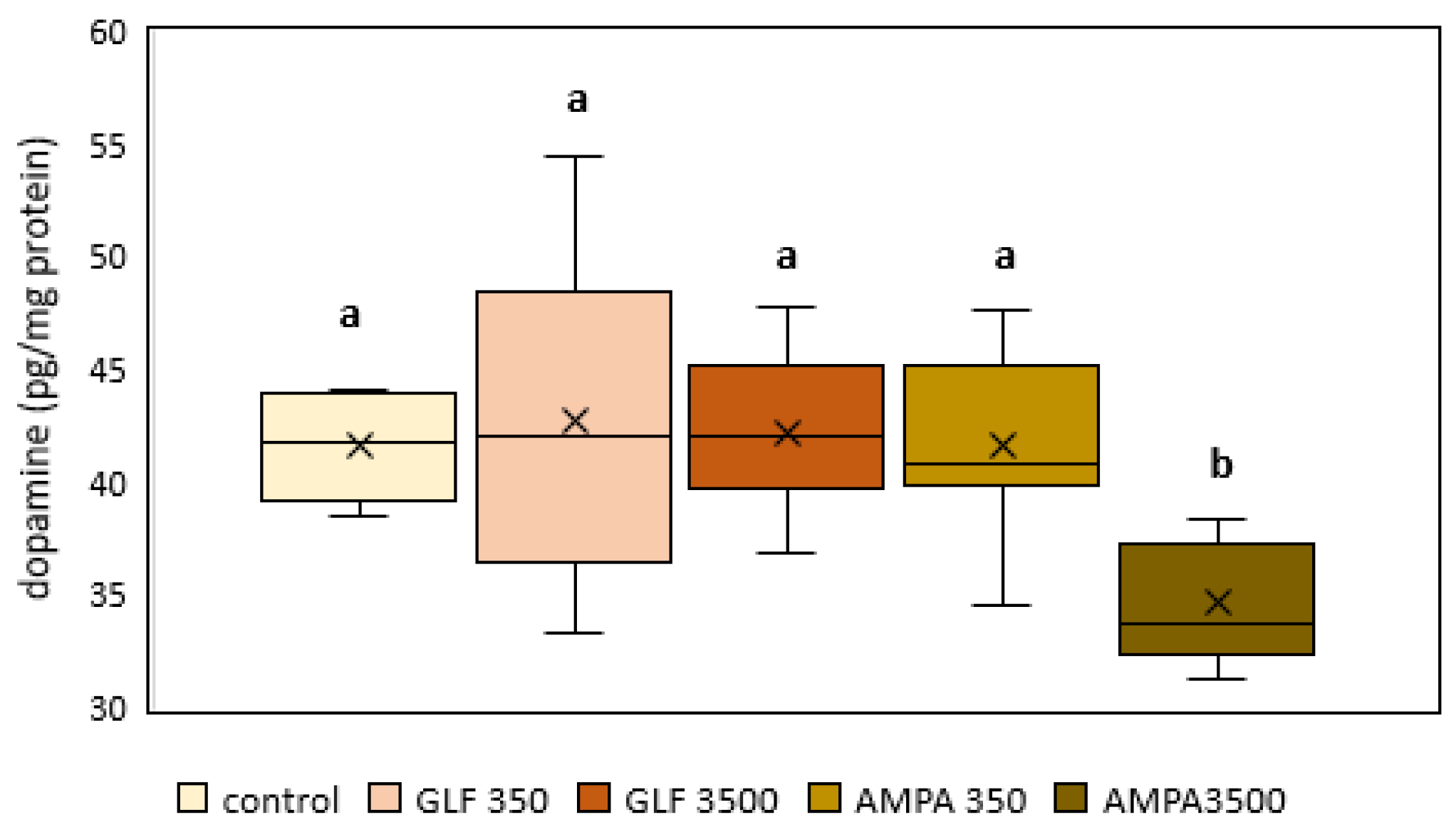
One-way ANOVA revealed a significant effect of treatment on dopamine concentration in the brain (F(4,35) = 4.737, p = 0.004). Subsequent comparisons indicated that a statistically significant difference (p < 0.05) compared to the control group was observed only in the high-dose AMPA group (i.e., AMPA 3500). The results are presented in Figure 2.

3.3. Butyrylcholinesterase

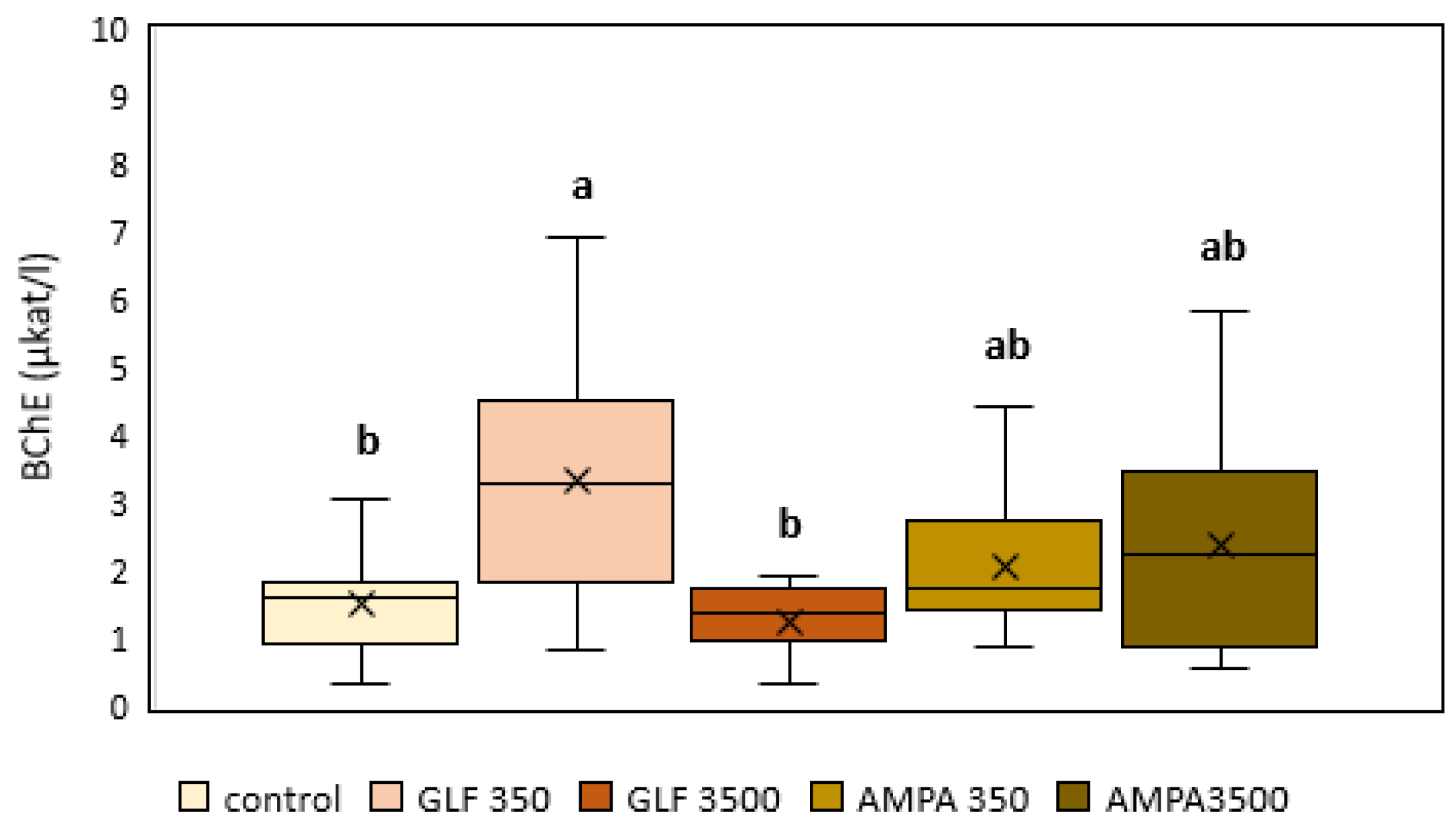
BChE activity in blood plasma was analysed using one-way ANOVA, which indicated a significant effect of treatment (F(4,55) = 4.915, p = 0.002). Analysis of group differences showed that only the fish exposed to a low concentration of glyphosate (i.e., GLF 350) exhibited a statistically significant increase compared to the control group. The results are presented in Figure 3.

3.4. Gene Expression

The level of mRNA expression of ache was measured in the brain and gill tissues (Table 1). Nonparametric Kruskal–Wallis ANOVA confirmed significant differences in both tissues (brain: DF = 4, χ2 = 13.761, p = 0.008; gill: DF = 4, χ2 = 6.7925, p = 0.042). More pronounced changes were observed in the brain tissue, where all experimental groups exhibited a significant downregulation (p < 0.05) compared to the control group. In the gill tissue, significant changes were detected only at the highest tested concentration of AMPA, where ache expression was significantly (p < 0.05) upregulated compared to the control group.

3.5. Brain Histology

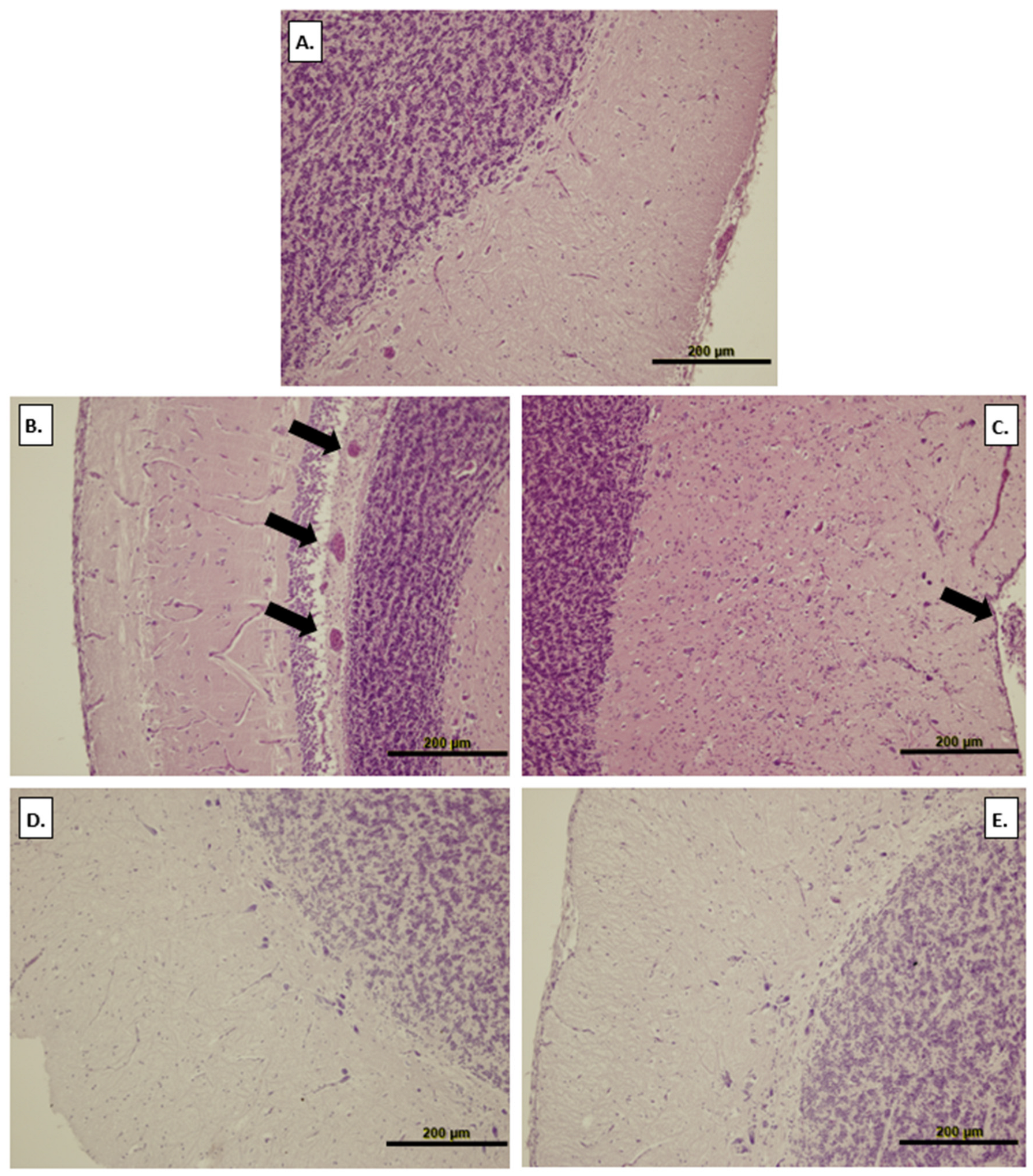
Histological examination of the brain tissue (Figure 4) revealed only pathological findings in the experimental groups exposed to both tested concentrations of glyphosate, confirming the consistent presence of vascular congestion in all analysed samples. No pathological alterations were observed in groups exposed to the tested concentrations of AMPA.

4. Discussion

Due to extensive use and persistence in the aquatic environment, glyphosate and its primary metabolite, AMPA, are contaminants of global concern. Their frequent detection in surface waters highlights the need to understand their effects on non-target aquatic species. In fish, particular attention has recently been paid to possible impacts on the nervous system, as even sublethal disturbances may compromise behavior, survival, and ecological fitness [3,34,39,40,41,50]. Using common carp (C. carpio) as a model organism, this study provides new insights into the neurotoxic potential of glyphosate and its primary metabolite, AMPA, under controlled experimental conditions. Importantly, neurotoxicity was assessed at multiple biological levels, ranging from ache gene expression in the brain and gill, quantification of dopamine and AChE activity in the brain and muscle, and BChE activity in the plasma, to histological examination of brain tissue. This multi-level approach enabled a comprehensive evaluation of the potential impact of these substances on the fish’s nervous system. Based on the current literature, the selected parameters represent sensitive indicators of possible disruption to cholinergic and monoaminergic signaling pathways [51,52].
Acetylcholinesterase activity is widely recognized as a sensitive and reliable biomarker of neurotoxicity [51,53,54]. It is a key enzyme responsible for regulating cholinergic neurotransmission by catalyzing the hydrolysis of the neurotransmitter acetylcholine at synaptic junctions. Its inhibition leads to the accumulation of acetylcholine, resulting in disrupted neuronal signaling and neurotoxic effects, particularly in tissues such as the brain and muscle [53,55]. These neurophysiological disturbances may, in turn, affect vital biological functions such as swimming and feeding behavior, growth, survival, and reproduction in fish exposed to environmental contaminants [22,56]. Owing to its well-characterized physiological role and high sensitivity to various pollutants (e.g., organophosphates, carbamates), AChE activity is routinely used to evaluate the neurotoxic potential of chemical exposures in aquatic organisms [57,58].
We found that the significant (p < 0.05) decrease in AChE activity in the brain of all exposed groups indicates a disruption of cholinergic neurotransmission, which is consistent with findings reported in other ecotoxicological studies [41,56,59]. The absence of significant changes in muscle, despite its relevance for neurotoxicity assessments, suggests a tissue-specific response or differential sensitivity of neural and muscular tissues to glyphosate and AMPA exposure. Our enzymatic findings in the brain are corroborated by gene expression analysis, revealing a consistent downregulation of ache gene expression in the brain of exposed fish. Interestingly, a significant upregulation of ache gene expression in the gill was detected in the group exposed to the highest concentration of AMPA, which may reflect a compensatory mechanism aimed at restoring enzymatic function or indicate a concentration-dependent shift in the molecular response. Such alterations may also be linked to oxidative stress, as confirmed by similar studies [60]. This non-linear pattern highlights the complexity of neurotoxic effects. It suggests that different molecular pathways may be activated at varying exposure levels, as it is also described in a study by Lopes et al. [26]. They reported that zebrafish males exposed to glyphosate for 24 and 96 h exhibited no significant changes in AChE activity in either brain or muscle, which contrasts with our results in the brain, but aligns with the absence of changes observed in muscle. However, their study demonstrated a time-dependent modulation of ache gene expression, with a decrease in the brain after 24 h, followed by an increase in both brain and muscle at 96 h. This suggests that glyphosate can affect cholinergic regulation at the transcriptional level even when enzymatic activity remains unchanged. Our findings of brain ache downregulation and gill upregulation under longer exposure support the idea of complex, tissue-specific, and time-dependent molecular responses to glyphosate-related compounds.
Another important enzyme commonly analysed in neurotoxicity studies is BChE, which is measured in blood. Similarly to AChE, BChE hydrolyzes choline esters and contributes to cholinergic neurotransmission; however, its physiological functions are less well defined and may also involve detoxification of xenobiotics and regulation of neuroinflammation. BChE is often considered a complementary biomarker to AChE because it can exhibit different responses to chemical exposure, providing additional insight into the mechanisms of neurotoxic effects [53,61,62,63]. For instance, alterations in BChE activity have been observed in fish exposed to pharmaceutical or organophosphate pesticides, sometimes preceding detectable changes in AChE activity. Therefore, simultaneous analysis of AChE and BChE provides a more comprehensive assessment of cholinergic system disruption and may help identify tissue-specific and compensatory responses to neurotoxic compounds [64,65,66]. In our study, a significant (p < 0.05) increase in plasma BChE activity was observed only in the group exposed to the lowest concentration of glyphosate, while AMPA exposure had no effect. This suggests a potential compensatory or adaptive response at low exposure levels, possibly aimed at maintaining cholinergic homeostasis when AChE activity was reduced in the brain. Similar adaptive increases in BChE activity at low contaminant concentrations have been reported in other toxicological studies. They are often interpreted as a hormetic effect, where low doses stimulate defense mechanisms. In contrast, higher doses may impair these responses or cause systemic toxicity, limiting the organism’s ability to compensate [67]. Elevation of BChE was also reported by Geetha [68] in Labeo rohita exposed to Roundup® (Monsanto India Private Limited, Thane, India, active substance glyphosate), where increased activity during the initial 10 days helped reduce stress caused by herbicide exposure. However, this compensatory capacity was eventually exhausted, leading to significant biochemical alterations. The absence of BChE elevation at higher glyphosate concentrations in our experiment may indicate that this protective mechanism is either insufficient or overwhelmed under a greater toxicant load.
Dopaminergic function, specifically brain dopamine levels, was also evaluated as part of the neurotoxicity assessment. Dopamine plays a crucial role in the central nervous system of teleost fish, regulating motor control, reward signaling, and neuroendocrine processes [69,70]. Moreover, dopaminergic pathways are essential for behavioral responses to environmental stimuli and for maintaining homeostatic functions [71,72]. In our study, a significant (p < 0.05) reduction in brain dopamine concentration was observed only in the group exposed to the highest concentration of AMPA. This finding suggests that dopaminergic disruption may require a higher toxicant burden or involve AMPA-specific mechanisms, potentially linked to oxidative stress, as previously reported in studies on pesticide-induced neurotoxicity in aquatic organisms [29,73]. In contrast, several studies have demonstrated significant alterations in dopamine levels following glyphosate exposure. For example, Faria et al. [23] reported that chronic waterborne exposure (0.3 and 3 μg/L for two weeks) in zebrafish significantly increased dopamine and serotonin levels in the anterior brain, altered dopamine turnover ratios, and downregulated genes associated with dopaminergic signaling. Similarly, Huang et al. [74] observed that red swamp crayfish exposed to environmentally relevant glyphosate concentrations (0.1–10 μg/L) exhibited elevated dopamine levels along with downregulation of dopaminergic genes. These neurochemical alterations were accompanied by oxidative stress, suggesting a mechanistic link between oxidative damage and dopaminergic disruption. An increase in dopamine following glyphosate exposure has been reported by Bellot et al. [75] in zebrafish, where among other findings, induction of oxidative stress in the brain was also confirmed, which may indirectly contribute to disruption of neurotransmitter homeostasis. The discrepancies between these findings and our results may be explained by species-specific sensitivity, differences in exposure routes (dietary vs. waterborne), duration of exposure, or variations in glyphosate formulation. Additionally, behavioral and neurochemical responses can differ substantially between zebrafish, crayfish, and common carp due to differences in neurophysiology and metabolic capacity. Taken together, our findings suggest that dopaminergic endpoints may be generally less sensitive than cholinesterase activity, but they can reveal additional neurotoxic impacts under specific conditions or in response to certain compounds. It should be noted that all brain neurotoxicity markers (i.e., AChE activity, dopamine, and ache expression) were performed using whole-brain homogenates due to the small size of the fish brain and limited tissue availability. While this approach provides an overall view of neurotoxic effects, it may mask potential region-specific differences in response, which should be addressed in future studies employing region-specific analysis.
To enable a more comprehensive assessment of neurotoxicity, histology examination of brain tissue was also performed. This analysis is essential, as structural and cellular changes can complement or clarify biochemical and neurochemical findings [5,51]. In our study, histological assessment revealed only the presence of vascular congestion in both glyphosate-treated groups, while no pathological alterations were observed in groups exposed to AMPA. Similarly to our findings, other studies have also reported histopathological changes in the brain following exposure to glyphosate. For instance, studies on livebearer (Jenynsia multidentata) exposed to various Roundup® formulations demonstrated histological damage in the brain, such as glial proliferation and edema, with severity increasing over exposure time. Interestingly, differences were observed between formulations and between sexes, with certain formulations causing more pronounced brain alterations. These findings highlight that glyphosate-based formulations can induce structural brain changes even at environmentally relevant concentrations (tested concentration of glyphosate—500 µg/L), reinforcing the relevance of histological biomarkers in neurotoxicity assessment [76]. Moreover, Erhunmwunse et al. [77] observed the degeneration of dark-stained Purkinje neurons, edema, vacuolar changes with empty spaces appearing as moth-eaten areas, and showed proliferation of glial cells in African catfish (Clarias gariepinus) following glyphosate exposure. However, these findings were observed at high concentrations (in the range of tens of mg/L), which are not environmentally relevant. This supports the notion that biochemical and neurochemical alterations often precede overt structural damage, suggesting a functional phase of neurotoxicity rather than a structural one at environmentally relevant concentrations.

5. Conclusions

This multi-level assessment revealed that dietary exposure to glyphosate and its metabolite AMPA can induce neurotoxic effects in common carp (Cyprinus carpio), particularly in the brain tissue. Alterations were observed across several biological levels, including enzymatic activities, gene expression, neurotransmitter concentration, and tissue structure. Both compounds affected cholinergic pathways, whereas a significant reduction in brain dopamine levels was observed only in the group exposed to the highest concentration of AMPA. These findings suggest that even environmentally relevant concentrations may disrupt nervous system function. However, based on the present results, it cannot be unequivocally concluded whether the metabolite or the parent compound exerts a stronger toxic effect. Therefore, more detailed and comparative investigations are required to disentangle their relative impacts. To gain a more comprehensive understanding of the ecological risks associated with glyphosate-based compounds, future research should focus on earlier developmental stages and extended exposure durations covering multiple life stages.

Author Contributions

Conceptualization, J.B. and P.M. (Premysl Mikula); methodology, J.B. and P.M. (Premysl Mikula); validation, J.B., P.M. (Petr Marsalek) and A.H.; formal analysis, J.B. and P.M. (Premysl Mikula); investigation, J.B., P.M. (Petr Marsalek), A.H. and F.T.; data curation, J.B.; writing—original draft preparation, S.F. and J.B.; writing—review and editing, J.B.; visualization, J.B.; supervision, Z.S. and C.F.; project administration, J.B.; funding acquisition, J.B. All authors have read and agreed to the published version of the manuscript.

Funding

The research was funded by the Internal Grant of the University of Veterinary Sciences Brno (Czechia)—ITA VETUNI 2024ITA26 (“Influence of selected factors on animal welfare”).

Institutional Review Board Statement

This study was conducted at the University of Veterinary Sciences Brno (Czechia) under experimental protocol MSMT-7295/2024-3, approved by the Institutional Animal Care and Use Committee of the University of Veterinary Sciences Brno on 27 May 2024.

Informed Consent Statement

Not applicable.

Data Availability Statement

The raw data supporting the conclusions of this article will be made available by the authors on request.

Acknowledgments

We would like to thank Ekaterina Koriakina for her valuable technical support.

Conflicts of Interest

The authors declare that they have no conflicts of interest.

Abbreviations

AChEacetylcholinesterase
AMPAaminomethylphosphonic acid
AMPA 350experimental group exposed to 335.2 ± 27.0 µg/kg of AMPA
AMPA 3500experimental group exposed to 3441.0 ± 217.1 µg/kg of AMPA
BCAbicinchoninic acid
BChEbutyrylcholinesterase
Ctthreshold cycle
DTNB5,5′-dithiobis (2-nitrobenzoic acid)
GLFglyphosate
GLF 350experimental group exposed to 325.2 ± 31.6 µg/kg of glyphosate
GLF 3500experimental group exposed to 3310.0 ± 234.9 µg/kg of glyphosate
qRT-PCRreal-time quantitative reverse transcription PCR

References

  1. Szekacs, A.; Darvas, B. Forty years with glyphosate. In Herbicides-Properties, Synthesis and Control of Weeds; IntechOpen: London, UK, 2012; Volume 14, pp. 247–284. [Google Scholar] [CrossRef]
  2. Solomon, K.R.; Thompson, D.G. Ecological risk assessment for aquatic organisms from over-water uses of glyphosate. J. Toxicol. Environ. Health Part B 2003, 6, 289–324. [Google Scholar] [CrossRef]
  3. Tresnakova, N.; Stara, A.; Velisek, J. Effects of glyphosate and its metabolite AMPA on aquatic organisms. Appl. Sci. 2021, 11, 9004. [Google Scholar] [CrossRef]
  4. Klatyik, S.; Simon, G.; Olah, M.; Takacs, E.; Mesnage, R.; Antoniou, M.N.; Zaller, J.G.; Szekacs, A. Aquatic ecotoxicity of glyphosate, its formulations, and co-formulants: Evidence from 2010 to 2023. Environ. Sci. Eur. 2024, 36, 22. [Google Scholar] [CrossRef]
  5. Costas-Ferreira, C.; Duran, R.; Faro, L.R. Toxic effects of glyphosate on the nervous system: A systematic review. Int. J. Mol. Sci. 2022, 23, 4605. [Google Scholar] [CrossRef]
  6. Babic, S.; Zelenika, A.; Macan, J.; Kastelan-Macan, M. Ultrasonic extraction and TLC determination of glyphosate in the spiked red soils. Agric. Conspec. Sci. 2005, 70, 99–103. [Google Scholar]
  7. Brovini, E.M.; Cardoso, S.J.; Quadra, G.R.; Vilas-Boas, J.A.; Paranaiba, J.R.; Pereira, R.O.; Mendonca, R.F. Glyphosate concentrations in global freshwaters: Are aquatic organisms at risk? Environ. Sci. Pollut. Res. 2021, 28, 60635–60648. [Google Scholar] [CrossRef]
  8. Blake, R.J.; Pallet, K. The environmental fate and ecotoxicity of glyphosate. Outlooks Pest Manag. 2018, 29, 266–269. [Google Scholar] [CrossRef]
  9. Mamy, L.; Barriuso, E.; Gabrielle, B. Glyphosate fate in soils when arriving in plant residues. Chemosphere 2016, 154, 425–433. [Google Scholar] [CrossRef] [PubMed]
  10. Gonçalves, B.B.; Giaquinto, P.C.; Silva, D.S.; Neto, C.M.S.; de Lima, A.A.; Darosci, A.A.B.; Portinho, J.L.; Carvalho, W.F.; Rocha, T.L. Ecotoxicology of glyphosate-based herbicides on aquatic environment. In Organic Pollutants; IntechOpen: London, UK, 2019; pp. 1–24. [Google Scholar] [CrossRef]
  11. Giesy, J.P.; Dobson, S.; Solomon, K.R.E. Ecotoxicological risk assessment for Roundup® herbicide. Rev. Environ. Contam. Toxicol. 2000, 167, 35–120. [Google Scholar] [CrossRef]
  12. Mercurio, P.; Flores, F.; Mueller, J.F.; Carter, S.; Negri, A.P. Glyphosate persistence in seawater. Mar. Pollut. Bull. 2014, 85, 385–390. [Google Scholar] [CrossRef]
  13. Feltracco, M.; Barbaro, E.; Morabito, E.; Zangrando, R.; Piazza, R.; Barbante, C.; Gambaro, A. Assessing glyphosate in water, marine particulate matter, and sediments in the Lagoon of Venice. Environ. Sci. Pollut. Res. 2022, 29, 16383–16391. [Google Scholar] [CrossRef] [PubMed]
  14. U.S. EPA (United States Environmental Protection Agency). Preliminary Ecological Risk Assessment in Support of the Registration Review of Glyphosate and Its Salts; U.S. EPA: Washington, DC, USA, 2015; p. 318.
  15. Rendon-von Osten, J.; Dzul-Caamal, R. Glyphosate residues in groundwater, drinking water and urine of subsistence farmers from intensive agriculture localities: A survey in Hopelchén, Campeche, Mexico. Int. J. Environ. Res. Public Health 2017, 14, 595. [Google Scholar] [CrossRef] [PubMed]
  16. Geng, Y.; Jiang, L.; Zhang, D.; Liu, B.; Zhang, J.; Cheng, H.; Wang, L.; Peng, Y.; Wang, Y.; Zhao, Y.; et al. Glyphosate, aminomethylphosphonic acid, and glufosinate ammonium in agricultural groundwater and surface water in China from 2017 to 2018: Occurrence, main drivers, and environmental risk assessment. Sci. Total Environ. 2021, 769, 144396. [Google Scholar] [CrossRef] [PubMed]
  17. Grandcoin, A.; Piel, S.; Baures, E. Aminomethylphosphonic acid (AMPA) in natural waters: Its sources, behavior and environmental fate. Water Res. 2017, 117, 187–198. [Google Scholar] [CrossRef]
  18. Konecna, J.; Zajicek, A.; Sanka, M.; Halesova, T.; Kaplicka, M.; Novakova, E. Pesticides in small agricultural catchments in the Czech Republic. J. Ecol. Eng. 2023, 24, 99–112. [Google Scholar] [CrossRef]
  19. Fanton, N.; Cazenave, J.; Michlig, M.P.; Repetti, M.R.; Rossi, A. Biomarkers of exposure and effect in the armoured catfish Hoplosternum littorale during a rice production cycle. Environ. Pollut. 2021, 287, 117356. [Google Scholar] [CrossRef]
  20. Qu, M.; Wang, L.; Xu, Q.; An, J.; Mei, Y.; Liu, G. Influence of glyphosate and its metabolite aminomethylphosphonic acid on aquatic plants in different ecological niches. Ecotoxicol. Environ. Saf. 2022, 246, 114155. [Google Scholar] [CrossRef]
  21. Fiorino, E.; Sehonova, P.; Plhalova, L.; Blahova, J.; Svobodova, Z.; Faggio, C. Effects of glyphosate on early life stages: Comparison between Cyprinus carpio and Danio rerio. Environ. Sci. Pollut. Res. 2018, 25, 8542–8549. [Google Scholar] [CrossRef]
  22. Lopes, A.R.; Moraes, J.S.; Martins, C.M.G. Effects of the herbicide glyphosate on fish from embryos to adults: A review addressing behavior patterns and mechanisms behind them. Aquat. Toxicol. 2022, 251, 106281. [Google Scholar] [CrossRef]
  23. Faria, M.; Bedrossiantz, J.; Ramirez, J.R.R.; Mayol, M.; Garcia, G.H.; Bellot, M.; Prats, E.; Garcia-Reyero, N.; Gomez-Canela, C.; Gomez-Olivan, L.M.; et al. Glyphosate targets fish monoaminergic systems leading to oxidative stress and anxiety. Environ. Int. 2021, 146, 106253. [Google Scholar] [CrossRef]
  24. Liu, Z.; Shangguan, Y.; Zhu, P.; Sultan, Y.; Feng, Y.; Li, X. Developmental toxicity of glyphosate on embryo-larval zebrafish (Danio rerio). Ecotoxicol. Environ. Saf. 2022, 236, 113493. [Google Scholar] [CrossRef]
  25. Azadikhah, D.; Varcheh, M.; Yalsuyi, A.M.; Forouhar Vajargah, M.; Mansouri Chorehi, M.; Faggio, C. Hematological and histopathological changes of juvenile grass carp (Ctenopharyngodon idella) exposed to lethal and sublethal concentrations of roundup (glyphosate 41% SL). Aquac. Res. 2023, 1, 4351307. [Google Scholar] [CrossRef]
  26. Lopes, F.M.; Caldas, S.S.; Primel, E.G.; da Rosa, C.E. Glyphosate adversely affects Danio rerio males: Acetylcholinesterase modulation and oxidative stress. Zebrafish 2017, 14, 97–105. [Google Scholar] [CrossRef]
  27. Mao, T.; Gan, J.; Yuan, K.; Yu, Y.; Liu, Z.; Zhou, Y.; Wu, G. Effects of aminomethylphosphonic acid on the transcriptome and metabolome of red swamp crayfish, Procambarus clarkii. Int. J. Mol. Sci. 2024, 25, 943. [Google Scholar] [CrossRef] [PubMed]
  28. Guilherme, S.; Santos, M.A.; Gaivao, I.; Pacheco, M. DNA and chromosomal damage induced in fish (Anguilla anguilla L.) by aminomethylphosphonic acid (AMPA)–the major environmental breakdown product of glyphosate. Environ. Sci. Pollut. Res. 2014, 21, 8730–8739. [Google Scholar] [CrossRef] [PubMed]
  29. Cheron, M.; Brischoux, F. Aminomethylphosphonic acid alters amphibian embryonic development at environmental concentrations. Environ. Res. 2020, 190, 109944. [Google Scholar] [CrossRef] [PubMed]
  30. Matozzo, V.; Fabrello, J.; Marin, M.G. The effects of glyphosate and its commercial formulations to marine invertebrates: A review. J. Mar. Sci. Eng. 2020, 8, 399. [Google Scholar] [CrossRef]
  31. Yu, T.; Songyan, L.; Honglin, L.; Di, H.; Yiqun, T.; Rui, Q.; Hailin, T.; Schichao, Z.; Yuanfei, L.; Yingping, H.; et al. Reproductive toxicity of glyphosate and its main metabolite aminomethyl phosphonic acid (AMPA) on zebrafish (Danio rerio). Chemosphere 2025, 385, 144548. [Google Scholar] [CrossRef]
  32. European Food Safety Authority (EFSA). Conclusion on the peer review of the pesticide risk assessment of the active substance glyphosate. EFSA J. 2015, 13, 4302. [Google Scholar] [CrossRef]
  33. Cattani, D.; Cavalli, V.L.L.O.; Rieg, C.E.H.; Domingues, J.T.; Dal-Cim, T.; Tasca, C.I.; Silva, F.R.M.B.; Zamoner, A. Mechanisms underlying the neurotoxicity induced by glyphosate-based herbicide in immature rat hippocampus: Involvement of glutamate excitotoxicity. Toxicology 2014, 320, 34–45. [Google Scholar] [CrossRef]
  34. Roy, N.M.; Carneiro, B.; Ochs, J. Glyphosate induces neurotoxicity in zebrafish. Environ. Toxicol. Pharmacol. 2016, 42, 45–54. [Google Scholar] [CrossRef] [PubMed]
  35. Hernandez-Plata, I.; Giordano, M.; Diaz-Munoz, M. The herbicide glyphosate causes behavioral changes and alterations in dopaminergic markers in male Sprague-Dawley rat. NeuroToxicology 2015, 46, 79–91. [Google Scholar] [CrossRef] [PubMed]
  36. Cattani, D.; Cesconetto, P.A.; Tavares, M.K.; Parisotto, E.B.; De Oliveira, P.A.; Rieg, C.E.H.; Leite, M.C.; Prediger, R.D.S.; Wendt, N.C.; Razzera, G.; et al. Developmental exposure to glyphosate-based herbicide and depressive-like behavior in adult offspring: Implication of glutamate excitotoxicity and oxidative stress. Toxicology 2017, 387, 67–80. [Google Scholar] [CrossRef]
  37. Gallegos, C.E.; Bartos, M.; Bras, C.; Gumilar, F.; Antonelli, M.C.; Minetti, A. Exposure to a glyphosate-based herbicide during pregnancy and lactation induces neurobehavioral alterations in rat offspring. NeuroToxicology 2016, 53, 20–28. [Google Scholar] [CrossRef] [PubMed]
  38. Martinez, M.A.; Ares, I.; Rodriguez, J.L.; Martinez, M.; Martinez-Larranaga, M.R.; Anadon, A. Neurotransmitter changes in rat brain regions following glyphosate exposure. Environ. Res. 2018, 161, 212–219. [Google Scholar] [CrossRef]
  39. Sandoval-Herrera, N.; Mena, F.; Espinoza, M.; Romero, A. Neurotoxicity of organophosphate pesticides could reduce the ability of fish to escape predation under low doses of exposure. Sci. Rep. 2019, 9, 10530. [Google Scholar] [CrossRef]
  40. Kar, S.; Senthilkumaran, B. Recent advances in understanding neurotoxicity, behavior and neurodegeneration in siluriformes. Aquac. Fish. 2024, 9, 404–410. [Google Scholar] [CrossRef]
  41. Zhang, D.; Ding, W.; Liu, W.; Li, L.; Zhu, G.; Ma, J. Single and combined effects of chlorpyrifos and glyphosate on the brain of common carp: Based on biochemical and molecular perspective. Int. J. Mol. Sci. 2023, 24, 12934. [Google Scholar] [CrossRef]
  42. Goktug, G.U.L.; Yuce, P.A.; Gunal, A.Ç.; Faggio, C. Short-term effects of acetamiprid on common carp: Genotoxic, biochemical, and histopathological responses. Environ. Toxicol. Pharmacol. 2025, 118, 104787. [Google Scholar] [CrossRef]
  43. Franc, A.; Muselik, J.; Rabiskova, M.; Dobiskova, R. Pharmaceutical Pellets Composition with a Particle Size of 0.1 to 10 mm for Oral Use for Aquatic Animals How to Prepare It. Available online: https://patents.google.com/patent/CZ308210B6/en (accessed on 1 July 2020).
  44. Mikula, P.; Hollerova, A.; Hodkovicova, N.; Doubkova, V.; Marsalek, P.; Franc, A.; Sedlackova, L.; Hesova, R.; Modra, H.; Svobodova, Z.; et al. Long-term dietary exposure to the non-steroidal anti-inflammatory drugs diclofenac and ibuprofen can affect the physiology of common carp (Cyprinus carpio) on multiple levels, even at “environmentally relevant” concentrations. Sci. Total Environ. 2024, 917, 170296. [Google Scholar] [CrossRef]
  45. Ellman, G.L.; Courtney, D.; Andres, V.; Featherstone, R.M. A new and rapid colorimetric determination of acetylcholinesterase activity. Biochem. Pharmacol. 1961, 7, 88–95. [Google Scholar] [CrossRef]
  46. Smith, P.K.; Krohn, R.I.; Hermanson, G.T.; Mallia, A.K.; Gartner, F.H.; Provenzano, M.D.; Fujimoto, E.K.; Goeke, N.M.; Olson, B.J.; Klenk, D.C. Measurement of protein using bicinchoninic acid. Anal. Biochem. 1985, 150, 76–85. [Google Scholar] [CrossRef]
  47. Cusabio Technology, L.L.C. Fish Dopamine (DA) ELISA Kit. Available online: https://www.cusabio.com/ELISA-Kit/Fish-dopamineDA-ELISA-kit-118627.html (accessed on 15 October 2025).
  48. Xing, H.; Han, Y.; Li, S.; Wang, J.; Wang, X.; Xu, S. Alterations in mRNA expression of acetylcholinesterase in brain and muscle of common carp exposed to atrazine and chlorpyrifos. Ecotoxicol. Environ. Saf. 2010, 73, 1666–1670. [Google Scholar] [CrossRef] [PubMed]
  49. Hodkovicova, N.; Hollerova, A.; Caloudova, H.; Blahova, J.; Franc, A.; Garajova, M.; Lenz, J.; Tichy, F.; Faldyna, M.; Kulich, P.; et al. Do foodborne polyethylene microparticles affect the health of rainbow trout (Oncorhynchus mykiss)? Sci. Total Environ. 2021, 793, 148490. [Google Scholar] [CrossRef] [PubMed]
  50. Yalsuyi, A.M.; Vajargah, M.F.; Hajimoradloo, A.; Galangash, M.M.; Prokić, M.D.; Faggio, C. Evaluation of behavioral changes and tissue damages in common carp (Cyprinus carpio) after exposure to the herbicide glyphosate. Vet. Sci. 2021, 8, 218. [Google Scholar] [CrossRef] [PubMed]
  51. Formicki, G.; Goc, Z.; Bojarski, B.; Witeska, M. Oxidative stress and neurotoxicity biomarkers in fish toxicology. Antioxidants 2025, 14, 939. [Google Scholar] [CrossRef]
  52. Fitzegerald, J.A.; Konemann, S.; Krümpelmann, L.; Zupanic, A.; vom Berg, C. Approaches to test the neurotoxicity of environmental contaminants in the zebrafish model: From behavior to molecular mechanisms. Environ. Toxicol. Chem. 2021, 40, 989–1006. [Google Scholar] [CrossRef]
  53. Jebali, J.; Khedher, S.B.; Sabbagh, M.; Kamel, N.; Banni, M.; Boussetta, H. Cholinesterase activity as biomarker of neurotoxicity: Utility in the assessment of aquatic environment contamination. J. Integr. Coast. Zone Manag. 2013, 13, 525–537. [Google Scholar] [CrossRef]
  54. Bang, J.H.; Ku, H.O.; Kang, H.G.; Kim, H.; Kim, S.; Park, S.W.; Kim, Y.S.; Jang, I.; Bae, Y.C.; Woo, G.H.; et al. Acetylcholinesterase activity in the brain of wild birds in Korea—2014 to 2016. J. Vet. Sci. 2019, 20, e9. [Google Scholar] [CrossRef]
  55. Colovic, M.B.; Krstic, D.Z.; Lazarevic-Pasti, T.D.; Bondzic, A.M.; Vasic, V.M. Acetylcholinesterase inhibitors: Pharmacology and toxicology. Curr. Neuropharmacol. 2013, 11, 315–335. [Google Scholar] [CrossRef]
  56. Cattaneo, R.; Clasen, B.; Loro, V.L.; de Menezes, C.H.C.; Pretto, A.; Baldisserotto, B.; Santi, A.; de Avila, L.A. Toxicological responses of Cyprinus carpio exposed to a commercial formulation containing glyphosate. Bull. Environ. Contam. Toxicol. 2011, 87, 597–602. [Google Scholar] [CrossRef] [PubMed]
  57. Olivares-Rubio, H.F.; Espinosa-Aguirre, J.J. Acetylcholinesterase activity in fish species exposed to crude oil hydrocarbons: A review and new perspectives. Chemosphere 2021, 264, 128401. [Google Scholar] [CrossRef] [PubMed]
  58. Merola, C.; Fabrello, J.; Matozzo, V.; Faggio, C.; Iannetta, A.; Tinelli, A.; Crescenzo, G.; Amorena, M.; Perugini, M. Dinitroaniline herbicide pendimethalin affects development and induces biochemical and histological alterations in zebrafish early-life stages. Sci. Total Environ. 2022, 828, 154414. [Google Scholar] [CrossRef] [PubMed]
  59. Braz-Mota, S.; Sadauskas-Henrique, H.; Duarte, R.M.; Val, A.L.; Almeida-Val, V.M.F. Roundup exposure promotes gills and liver impairments, DNA damage and inhibition of brain cholinergic activity in the Amazon teleost fish Colossoma macropomum. Chemosphere 2015, 135, 53–60. [Google Scholar] [CrossRef]
  60. Ma, J.; Zhu, J.; Wang, W.; Ruan, P.; Rajeshkumar, S.; Li, X. Biochemical and molecular impacts of glyphosate-based herbicide on the gills of common carp. Environ. Pollut. 2019, 252, 1288–1300. [Google Scholar] [CrossRef]
  61. Ballard, C.G.; Greig, N.H.; Guillozet-Bongaarts, A.L.; Enz, A.; Darvesh, S. Cholinesterases: Roles in the brain during health and disease. Curr. Alzheimer Res. 2005, 2, 307–318. [Google Scholar] [CrossRef]
  62. Johnson, G.; Moore, S.W. Why has butyrylcholinesterase been retained? Structural and functional diversification in a duplicated gene. Neurochem. Int. 2012, 61, 783–797. [Google Scholar] [CrossRef]
  63. Salles, J.B.; Bastos, V.C.; Silva Filho, M.V.; Machado, O.L.T.; Salles, C.M.C.; De Simone, S.G.; Bastos, J.C. A novel butyrylcholinesterase from serum of Leporinus macrocephalus, a neotropical fish. Biochimie 2006, 88, 59–68. [Google Scholar] [CrossRef]
  64. Ghazala Mahboob, S.; Ahmad, L.; Sultana, S.; Alghanim, K.; Al-Misned, F.; Ahmad, Z. Fish cholinesterases as biomarkers of sublethal effects of organophosphorus and carbamates in tissues of Labeo rohita. J. Biochem. Mol. Toxicol. 2014, 28, 134–142. [Google Scholar] [CrossRef]
  65. Santana, M.S.; Sandrini-Neto, L.; Domenico, M.D.; Prodocimo, M.M. Pesticide effects on fish cholinesterase variability and mean activity: A meta-analytic review. Sci. Total Environ. 2021, 757, 143829. [Google Scholar] [CrossRef]
  66. Blahova, J.; Mikula, P.; Marsalek, P.; Svobodova, Z. Biochemical and antioxidant responses of common carp (Cyprinus carpio) exposed to sublethal concentrations of the antiepileptic and analgesic drug gabapentin. Vet. Med. 2025, 70, 20–29. [Google Scholar] [CrossRef] [PubMed]
  67. Li, S.; Tan, Y. Hormetic response of cholinesterase from Daphnia magna in chronic exposure to triazophos and chlorpyrifos. J. Environ. Sci. 2011, 23, 852–859. [Google Scholar] [CrossRef] [PubMed]
  68. Geetha, N. Mitigatory role of butyrylcholinesterase in freshwater fish Labeo rohita exposed to glyphosate based herbicide Roundup®. Mater. Today Proc. 2021, 47, 2030–2035. [Google Scholar] [CrossRef]
  69. Barsagade, V.G. Dopamine system in the fish brain: A review on current knowledge. J. Entomol. Zool. Stud. 2020, 8, 2549–2555. [Google Scholar] [CrossRef]
  70. Soares, M.C. The neurobiology of mutualistic behavior: The cleaner fish swims into the spotlight. Front. Behav. Neurosci. 2017, 11, 191. [Google Scholar] [CrossRef]
  71. Sousa, B.; Nunes, B. Reliability of behavioral test with fish: How neurotransmitters may exert neuromodulatory effects and alter the biological responses to neuroactive agents. Sci. Total Environ. 2020, 734, 139372. [Google Scholar] [CrossRef]
  72. Antunes, D.F.; Soares, M.C.; Taborsky, M. Dopamine modulates social behaviour in cooperatively breeding fish. Mol. Cell. Endocrinol. 2022, 550, 111649. [Google Scholar] [CrossRef]
  73. Barreto, L.S.; De Souza, T.L.; de Morais, T.P.; de Oliveira Ribeiro, C.A. Toxicity of glyphosate and aminomethylphosphonic acid (AMPA) to the early stages of development of Steindachneridion melanodermatum, an endangered endemic species of Southern Brazil. Environ. Toxicol. Pharmacol. 2023, 102, 104232. [Google Scholar] [CrossRef]
  74. Huang, Y.; Li, T.; Hu, X.; Qi, D.; Li, X.; Huang, Z.; Wu, S.; Hong, Y. Dopaminergic system disruption induced by environmentally realistic glyphosate leads to behavioral alteration in crayfish, Procambarus clarkii. Ecotoxicol. Environ. Saf. 2025, 301, 118509. [Google Scholar] [CrossRef]
  75. Bellot, M.; Carrillo, M.P.; Bedrossiantz, J.; Zheng, J.; Mandal, R.; Wishart, D.S.; Gómez-Canela, C.; Vila-Costa, M.; Prats, E.; Pina, B.; et al. From dysbiosis to neuropathologies: Toxic effects of glyphosate in zebrafish. Ecotoxicol. Environ. Saf. 2024, 270, 115888. [Google Scholar] [CrossRef]
  76. Sanchez, J.A.A.; da Costa Klosterhoff, M.; Romano, L.A.; Martins, C.D.M.G. Histological evaluation of vital organs of the livebearer Jenynsia multidentata (Jenyns, 1842) exposed to glyphosate: A comparative analysis of Roundup® formulations. Chemosphere 2019, 217, 914–924. [Google Scholar] [CrossRef]
  77. Erhunmwunse, N.O.; Ekaye, S.A.; Ainerua, M.O.; Ewere, E.E. Histopathological changes in the brain tissue of Africa catfish exposure to glyphosate herbicide. J. Appl. Sci. Environ. Manag. 2014, 18, 275–280. [Google Scholar] [CrossRef]
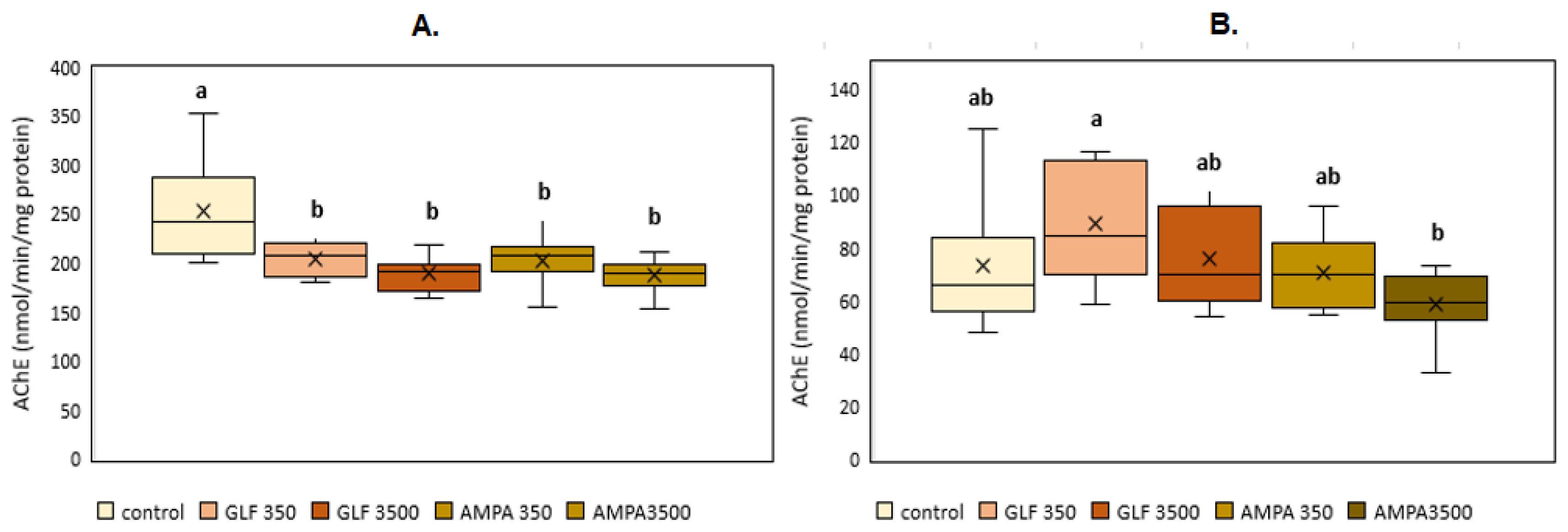
Figure 1. Activity of acetylcholinesterase (AChE) in the brain (A) and muscle (B) of C. carpio after four weeks of dietary exposure to glyphosate (GLF 350–325.2 ± 31.6 μg/kg; GLF 3500–3310.0 ± 234.9 μg/kg) and its metabolite aminomethylphosphonic acid (AMPA 350–335.2 ± 27.0 μg/kg and AMPA 3500–3441.0 ± 217.1 μg/kg). Horizontal line indicates median value, cross represents mean value, and box extends from the 25th to the 75th percentile of the group’s value distribution. Upper and lower whiskers represent the highest and lowest values within 1.5 times the interquartile range above the 75th and below the 25th percentile, respectively. Different alphabetical superscripts indicate significant differences (p < 0.05) among groups.
Applsci 15 11877 g001
Figure 2. Concentration of dopamine in the brain of C. carpio after four weeks of dietary exposure to glyphosate (GLF 350–325.2 ± 31.6 μg/kg; GLF 3500–3310.0 ± 234.9 μg/kg) and its metabolite aminomethylphosphonic acid (AMPA 350–335.2 ± 27.0 μg/kg and AMPA 3500–3441.0 ± 217.1 μg/kg). Horizontal line indicates median value, cross represents mean value, and box extends from the 25th to the 75th percentile of the group’s value distribution. Upper and lower whiskers represent the highest and lowest values within 1.5 times the interquartile range above the 75th and below the 25th percentile, respectively. Different alphabetical superscripts indicate significant differences (p < 0.05) among groups.
Applsci 15 11877 g002
Figure 3. Activity of butyrylcholinesterase (BChE) in the blood plasma of C. carpio after four weeks of dietary exposure to glyphosate (GLF 350–325.2 ± 31.6 μg/kg; GLF 3500–3310.0 ± 234.9 μg/kg) and its metabolite aminomethylphosphonic acid (AMPA 350–335.2 ± 27.0 μg/kg and AMPA 3500–3441.0 ± 217.1 μg/kg). Horizontal line indicates median value, cross represents mean value, and box extends from the 25th to the 75th percentile of the group’s value distribution. Upper and lower whiskers represent the highest and lowest values within 1.5 times the interquartile range above the 75th and below the 25th percentile, respectively. Different alphabetical superscripts indicate significant differences (p < 0.05) among groups.
Applsci 15 11877 g003
Figure 4. Histological examination of the brain—(A) control group (no pathological changes); (B) glyphosate 325.2 ± 31.6 µg/kg (vascular congestion); (C) glyphosate 3310.0 ± 234.9 µg/kg (vascular congestion); (D) AMPA 335.2 ± 27.0 µg/kg (no pathological changes); (E) AMPA 3441.0 ± 217.1 µg/kg (no pathological changes). Arrows indicate the described changes—magnification 200×.
Applsci 15 11877 g004
Table 1. The level of mRNA expression of ache in the brain and gill of C. carpio after four weeks of dietary exposure to glyphosate and its metabolite, aminomethylphosphonic acid. Data are presented as the mean ± standard error of the mean. Different alphabetical superscripts indicate significant differences (p < 0.05) among groups. The significant difference compared to the control is highlighted in bold, with an arrow indicating the direction of regulation. The expression of the ache gene was normalized to the reference gene—β-actin.
GroupBrainGill
Control0.0203 ± 0.0043 a0.0003 ± 0.0000 a
GLF 3500.0002 ± 0.0000 c 0.0004 ± 0.0000 ab
GLF 35000.0009 ± 0.0007 cd 0.0003 ± 0.0000 ab
AMPA 3500.0062 ± 0.0038 bd 0.0003± 0.0000 ab
AMPA 35000.0113 ± 0.0047 b 0.0004 ± 0.0001 b 
Notes: GLF 350–325.2 ± 31.6 μg/kg of glyphosate; GLF 3500–3310.0 ± 234.9 μg/kg of glyphosate; AMPA 350–335.2 ± 27.0 μg/kg of aminomethylphosphonic acid and AMPA 3500–3441.0 ± 217.1 μg/kg of aminomethylphosphonic acid.
Disclaimer/Publisher’s Note: The statements, opinions and data contained in all publications are solely those of the individual author(s) and contributor(s) and not of MDPI and/or the editor(s). MDPI and/or the editor(s) disclaim responsibility for any injury to people or property resulting from any ideas, methods, instructions or products referred to in the content.