


Abstract
Industrial machine tools are both performance assets and environmental hotspots over their long service lives. Maintenance is traditionally optimized to safeguard availability, quality and cost. However, maintenance choices also determine the energy consumption, footprints, component duration and end-of-life pathways. In this study, we present a decision framework to compare performance-only maintenance (POM) with sustainability-aware maintenance (SAM) for machine tools. The framework integrates degradation and Remaining Useful Life (RUL) estimation, Life Cycle Assessment (LCA) and Life Cycle Costing (LCC). Outcomes are summarized with a Sustainable Maintenance Balance (SMB) index. We test the proposed approach on a horizontal machining center for aluminum, validated by running a Monte Carlo simulation over a 1000 h functional unit. Across empirical data and simulation, SAM—compared to POM—demonstrated an ability to improve availability, reduces downtime and scrap, and lower total LCC while cutting carbon emissions. The proposed method is proposed as readily deployable in real plants, supporting robust sustainable-production decisions.
1. Introduction
Industrial machine tools are both high-performance assets and environmental hotspots over their long service lives [1]. As sustainability expectations for manufacturing intensify, researchers note the need to look beyond immediate process parameters to the full spectrum of resources and flows involved in machining [2]. Although numerous elements contribute to the sustainable performance of production systems, e.g., the layout planning [3], maintenance emerges as a primary operational lever, as it shapes impactful parameters such as tool-wear trajectories, thermal–mechanical stability during cutting and timing and scope of overhauls, as well as influencing end-of-life options (e.g., refurbishment or remanufacturing instead of disposal) [4].
Traditionally, maintenance strategies (whether run-to-failure corrective, time-based preventive, or data-driven predictive/proactive) are judged by classic Key Performance Indicators (KPIs) [5] like availability, Mean Time Between Failures (MTBF), quality and direct costs [6]. Yet, these same strategies also alter the machine’s life-cycle footprint [1]. For instance, it is recognized that process stability and tool wear progression affect the energy consumption [7]. Remanufacture and repair choices determine component durability, thus the product’s useful life, and act on the feasibility of end-of-life options that can reduce the impact of buying new equipment [8]. Maintenance policies are typically based on early detection of wear [9] and incipient failures [10] in order to reduce scrap and unexpected repairs, often yielding larger environmental gains than marginal process-energy improvements. Assessing these combined effects requires a coherent sustainability accounting aligned with life-cycle thinking. Prior work [11] has shown that Life Cycle Assessment (LCA) for environmental impacts, Life Cycle Costing (LCC) for costs and Cost–Benefit Analysis (CBA) offer complementary—but sometimes conflicting—views. Therefore, careful integration is needed to avoid double counting and to keep environmental and economic pillars interpretable [12]. Building on these insights, this study positions maintenance policy within a Life Cycle Sustainability Assessment (LCSA) perspective [13], where environmental indicators, cost elements and—where applicable—social concerns are combined consistently to support operational and through-life decisions.
In summary, the present study is guided by two primary research questions (RQs):
RQ1: how much additional life-cycle value (in reduced LCC and improved LCA metrics) does a sustainability-aware maintenance (SAM) policy deliver compared to a performance-only maintenance (POM) policy for the same machine and production scenario?
RQ2: which technological actions or mechanisms contribute most to SAM’s advantages, and under what operating conditions do these effects remain robust or introduce trade-offs?
In addressing these questions, the paper provides three main contributions: (i) a framework and quantitative model that embeds degradation management and Remaining Useful Life (RUL) estimation into an LCSA-ready evaluation of maintenance strategies; (ii) a case study on a horizontal machining center (HMC) for aluminum using non-invasive spindle power monitoring integrated with a Manufacturing Execution System (MES) to trigger proactive interventions; (iii) tables of indicators and computational steps suitable for immediate industrial adoption as a sustainable maintenance actionable playbook.
Background
Over the past two decades, the sustainability of machine tools has been addressed from multiple angles, ranging from process-level optimization to system-level life cycle management [14]. Recent research calls for shifting from isolated machinability metrics to integrated “total machining performance” able to balance productivity, reliability and sustainability trade-offs [15]. At the process scale, numerous studies have demonstrated that optimizing cutting parameters, tool coatings and lubrication strategies can reduce energy demand or cutting fluid consumption [16]. The consumables used in machining—cutting tools, coolants and other auxiliary materials—as well as the scrap and rework generated by unstable processes often dominate the life-cycle footprint of machining systems [17]. In other words, the energy and material embodied in workpiece material (especially if scrapped) and in tool manufacture can outweigh the incremental gains from tweaking process efficiency. This realization has shifted the focus toward maintenance impacts [18], which ultimately determines how these consumables are used and replaced, and whether stable machining conditions are maintained to avoid waste. Accordingly, maintenance strategies have evolved substantially to face those challenges [19]. Recent bibliometric evidence shows a clear convergence of data-driven analytics with predictive and condition-based maintenance, with sustainability consistently among the leading research themes [20]. In fact, corrective and time-based preventive approaches are now increasingly supplemented by predictive and proactive maintenance enabled by digital monitoring and advanced analytics, exploiting on-field sensor signals to infer machinery and component health states [21]. These methods inherently reduce unplanned downtime, but also align operational reliability with sustainability objectives such as minimizing wasted resources, extending component lifetimes, or optimizing the consumption of energy [22]. In this perspective, maintenance acts as a lever connecting day-to-day production efficiency with long-term sustainability outcomes: a suitable and tailored maintenance program would give substantial environmental benefits by preventing energy waste, avoiding failures that could scrap product batches and prolonging the service life of both tools and machine components.
From a methodological standpoint, a wide range of assessment tools has been applied to evaluate the sustainability of industrial equipment. LCA provides the environmental dimension by quantifying the measurable impacts over the machine tool’s life cycle [23]. Recent work also couples LCA with multi-criteria decision-making and optimization to practically support manufacturing decisions and performance indicator integration [24]. LCC translates the same life-cycle stages into economic terms [25], while traditional Cost–Benefit Analysis (CBA) extends beyond direct financial flows by assigning monetary values to broader societal effects, such as environmental emissions or social impacts, so that these can be compared on the same economic scale as conventional costs and revenues. Each of the mentioned methods has its strengths, but also limitations, and they may produce conflicting recommendations if applied in isolation. In fact, as remarked by Hoogmartens et al. [11], integrating LCA, LCC and CBA requires careful handling to avoid double-counting environmental impacts or costs across the approaches. In response to these challenges, the LCSA concept has gained traction, aiming to integrate LCA, LCC and (where relevant) social LCA or externality valuation into a coherent framework for decision support. Hence, the evaluation of maintenance strategies is an emerging application area for such integrated assessments, as it inherently involves trade-offs between cost, availability and environmental performance. In this scenario, the sustainability of machine tools needs to be examined from a circular perspective, oriented to extend the operational life of machine tools, thus yielding greater environmental benefits. Keeping an existing machine in service longer, e.g., through remanufacture upgrades [4], can avoid the substantial impacts of buying new equipment. Predictive maintenance helps prevent failures and track machine health, preserving the integrity of critical components, thereby enabling cost-effective life extension while also protecting product global value [26].
On the sustainability of industrial processes, three main recommendations emerge from prior literature. The first is that process efficiency, alone, is insufficient to guarantee sustainability [27]. The impacts from consumables, machine wear/failures and major overhauls often dominate the environmental footprint of machining systems, so a narrow focus on cutting energy or cycle time misses significant opportunities [17]. The second recommendation is that maintenance strategy directly shapes both short-term performance and long-term sustainability. Maintenance policies that incorporate condition monitoring and RUL estimation can improve immediate metrics like uptime and quality while also prolonging equipment and tool life, thereby reducing waste and resource consumption over time [22]. Third: life-cycle-based frameworks are essential for capturing trade-offs. Integrated assessment is needed to evaluate how maintenance decisions influence cost, availability and environmental outcomes in tandem, ensuring that improvements in one dimension do not cause disproportionate harm in another [12].
Building on these foundations, the next section introduces a framework for quantitatively comparing performance-only maintenance (POM) and sustainability-aware maintenance (SAM) strategies in machine tools. The objective is to integrate degradation modelling with LCA/LCC metrics to support maintenance decisions in life-cycle sustainability approaches.
2. Materials and Methods
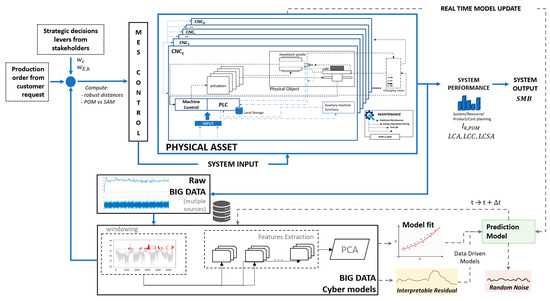
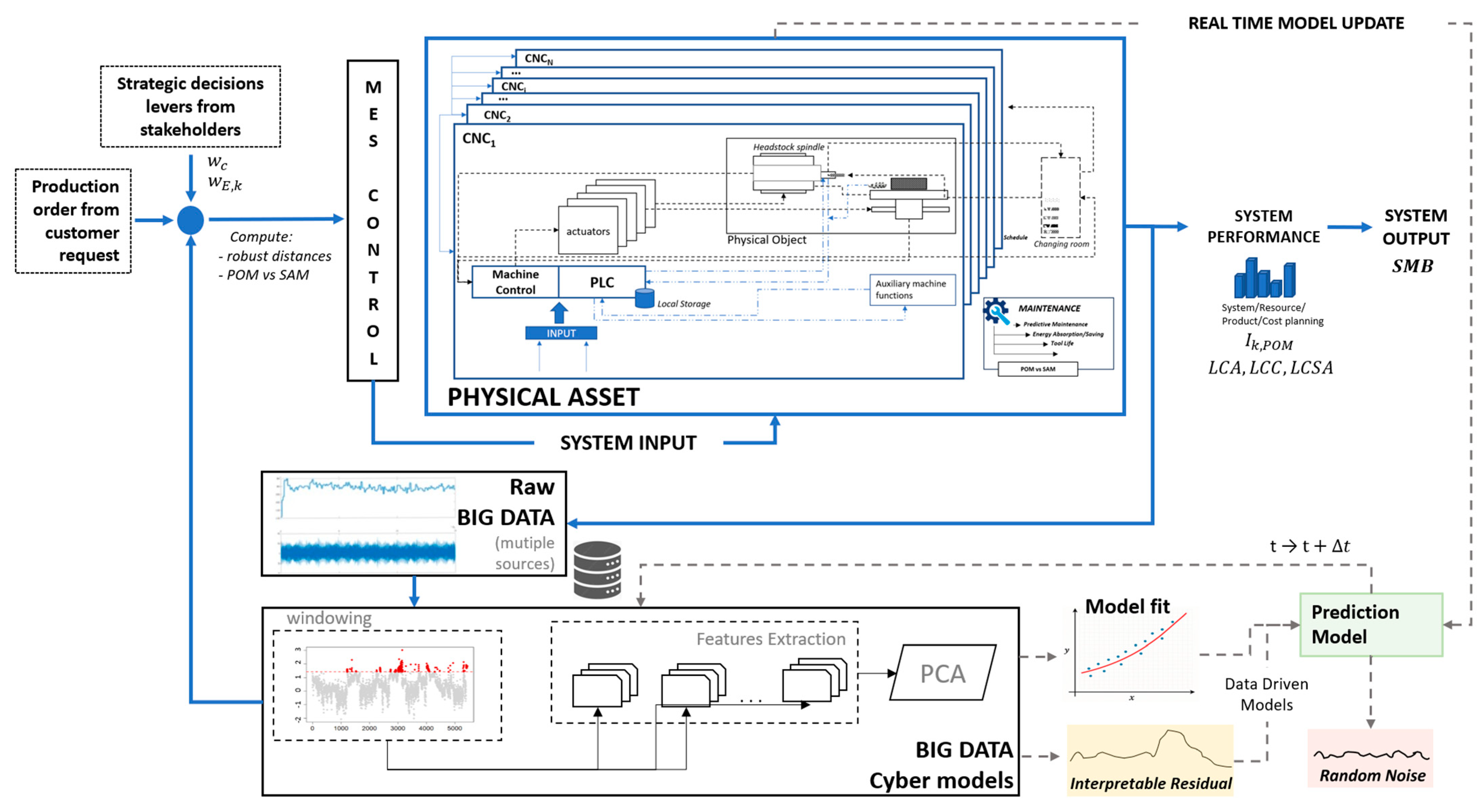
This study develops a framework to evaluate how maintenance strategies influence machine-tool performance and life-cycle sustainability outcomes. Maintenance effectiveness assessments, here, go beyond availability, Mean Time Between Failures (MTBF) or cost by embedding degradation management and RUL estimation within an LCSA perspective. This enables a comparison between POM and SAM strategies. Figure 1 presents the proposed framework in which on-machine sensors feed a digital model with real-field data. An MES interfaces the machines, processing production orders and strategic decision levers weighted for cost and environmental impact. Asset-level data are mapped to performance indicators and, in real time, coupled to a predictive model that denoises the signals, extracts principal process components and forecasts key variables. Under the chosen maintenance strategies (POM and SAM), the framework assesses deviations between planned, current and admissible actions to select interventions that maximize sustainability outcomes.
Figure 1.
Proposed framework: evaluation of SMB across the physical-to-digital asset interface to support predictive and sustainable decision-making. Physical and digital assets converge in the strategic decision layer, expanding the information derived from machine data and external sensors.
2.1. Problem Formulation
The analysis begins with the definition of system boundaries and a functional unit to ensure comparability between strategies. The functional unit is set to 1000 operating hours of machining, which can be translated to a given number of conforming parts for managerial interpretation. The system boundary covers all energy and material flows directly related to machine operation and maintenance. It includes electricity consumed during both machining and idle periods, as well as the use of cutting tools, coolants, spare parts and component replacements. Both planned and unplanned maintenance activities are included, and quality-related losses such as scrap and rework are also considered. Capital equipment is included only when maintenance strategies extend its service life, e.g., by allowing refurbishment or remanufacturing instead of disposal.
Within this scope, two contrasting maintenance approaches are modeled: POM and SAM. Under POM, interventions are scheduled according to fixed intervals or executed only after failures, with decision-making guided by cost and performance KPIs. A similar approach often results in premature replacement of tools, unexpected breakdowns, or disruptive failures. By contrast, SAM employs non-invasive monitoring to detect degradation and trigger proactive interventions before failures occur.
In the present case, we monitor the spindle power of a Toyoda HMC via the plant MES, sampling at 0.5 Hz. Cutting cycles are segmented, and average spindle power during cutting is compared against a baseline established from the first 10 cycles of a new tool. Deviations above calibrated thresholds (+15% alert, +30% critical) indicate progressive or critical wear. SAM, then, schedules a proactive tool change in an appropriate maintenance window, or pauses operations if a critical threshold is approached. This power-based method is consistent with prior research on tool wear and spindle degradation monitoring, such as that of Kolář et al. [28]. Implementation uses existing machine signals integrated with the MES; no additional dedicated sensors were installed, and computation runs on the plant’s MES/IT stack. This aligns with current practice of using computer numerical control without the need of additional hardware and, when power-based monitoring is used, installation is minimal and does not alter the machine design and operation [29]. The incremental energy and hardware attributable to monitoring are, therefore, negligible relative to machine operation and are not material drivers in LCA and LCC for this case. Where additional hardware is required in other deployments, its electricity use and amortized cost can be explicitly added to the inventories. To capture the effects of each strategy tested, an inventory is constructed that records energy use, consumable consumption, spare parts, downtime, maintenance labor and scrap.
Environmental impacts are evaluated through LCA according to International Organization for Standardization (ISO) 14040/44 standards [30,31]. Consistent with ISO 14040/14044 goal–scope rules, the principal indicator reported is Global Warming Potential (GWP), measured in kg carbon dioxide equivalent (kg CO2eq), supplemented where possible by resource and waste categories. In this machining case, the dominant contributors within the system boundary (i.e., electricity use during operation/idle and scrap/replacements with their embodied burdens) are most directly and comparably captured by GWP. After all, GWP is a widely used, cumulative (time-integrated) and relative LCA metric [32], which supports a transparent, decision-oriented comparison and combination with LCC in the SMB index, while avoiding double counting. Economic flows are recorded following LCC, including maintenance labor, consumables, energy tariffs, downtime penalties and scrap costs. Because cost and environmental indicators change differently over time, LCC values are discounted where multi-year horizons are considered, while environmental indicators are reported both in physical units and, if needed, monetized through shadow prices in line with LCSA practice. To synthesize results while preserving transparency, the study defines a Sustainable Maintenance Balance (SMB) index, inspired by multi-criteria integration methods in LCSA, in particular following the approach of Finkbeiner et al. introducing factors weighting [33], focusing on cost and environmental indicators as per Heijungs [34]. For each strategy s, let Cs represent life cycle cost (expressed in EUR) and Ik,s the value of the environmental indicator k (expressed in kg CO2eq). The improvement of SAM compared to POM in terms of reduced costs is as follows:
and the environmental improvement is as follows:
∆C = (CPOM − CSAM)/CPOM [€]
∆Ik = (Ik,POM − Ik,SAM)/Ik,POM [kgCO2eq]
Fixing and as the stakeholder-defined weights on costs and environmental impact, respectively, we construct the SMB index as follows:
SMB = wc * ∆C + Σk wE,k * ∆Ik [kgCO2eq]
This formulation combines costs and environmental improvements in a single, representative value—SMB—while still being reported separately in detailed tables.
Table 1 summarizes the main indicators and data sources used to populate the inventories for POM and SAM in the Toyoda HMC case study.
Table 1.
Indicators and data sources (per 1000 operating hours).
For the 1000 h functional unit, we reconstructed the POM baseline from plant records as follows: availability and downtime from MES state codes and event timestamps (scheduled vs. stopped; planned vs. unplanned); scrap rate from the quality management system (non-conformance and rework logs matched to production counts); energy consumption from machine-level power metering stored in MES (machining and idle modes); tools and coolant from the tool-management system and supplier delivery notes (tool changes/inserts; coolant make-up volume); spare parts from maintenance work orders (preventive and corrective). These measurements represent the empirical POM baseline used for calibration and comparison.
3. Results
3.1. Simulation Design
To complement the empirical comparison, we developed a stochastic Monte Carlo simulation in Python version 3.13.7 to emulate POM and SAM approaches over the 1000 h horizon. The Monte Carlo simulation parameters were derived from the Toyoda HMC’s historical data and maintenance logs. Data are extracted by a collection of 12 months in a combination of CNC signal, field data signals and paper-based material. Data were accessible from a Manufacturing Execution System (MES) platform with a digital sampling frequency of 0.5 Hz. The worked material is aluminum while using a face milling cutting size of 63. This calibration ensures that the simulated scenarios closely reflect the observed behavior of the machine under POM and SAM. Therefore, the model incorporates inputs estimated directly from plant data, reflecting the system boundary by accounting for machining and idle electricity, tool wear and replacement, breakdown probabilities and downtime, scrap generation and embodied impacts of major component replacements. Economic outputs include direct costs of maintenance, energy, coolant, downtime penalties, scrap and replacement. Environmental outputs quantify energy-related and embodied GWP. The SMB index aggregates the relative improvements in cost and GWP using stakeholder weights (baseline ).
Key Assumptions
- Tool life has a lognormal distribution with mean = 35 cutting hours, coefficient of variation = 0.25;
- Unplanned major breakdowns estimated with Poisson rate 0.8 events per 1000 h under POM; SAM reduces this rate by 75%;
- Downtime per breakdown follows normal distribution with mean 30 h, and standard deviation 6 h, truncated at zero;
- Degradation effects: cutting power increases linearly with wear;
- SAM policy: proactive replacement at 85% of predicted useful life (RUL 15%), aligned where possible with planned maintenance windows every 50 h (0.2 h planned change vs. 0.7 h unplanned). This policy is linked to RUL estimation as follows. Let A be the average spindle power during cutting for the current cycle, A0 the baseline resulting as the mean over the first 10 cycles with a new tool, and AC the critical threshold (A0 + 30%). With the assumption that power increases with wear, we define the consumed life fraction LC as follows:
LC = (A − A0)/(AC − A0) truncated to [0,1]
- The RUL fraction is, therefore, 1 − LC. The +15% rise is used as an alert (typically LC is about 0.5–0.6, i.e., RUL is about 40–50%) to enable scheduling. The replacement trigger is set close to 85% consumed life (i.e., RUL about 15%), which under the linear mapping corresponds to a power increase of about +25%, safely before the +30% critical threshold;
- Experiment design: 400 replications per strategy with a fixed random seed (n = 42). Results reported as replication means;
- As a check, simulated POM outputs were compared with the measured POM baseline, and model means tracked the measurements; the chosen number of replications was sufficient for stable central tendencies.
3.2. Performance Comparison
Applying the framework to the Toyoda HMC case study revealed clear differences between POM and SAM over 1000 operating hours. SAM incurs slightly higher direct maintenance due to proactive tool changes, but this is more than offset by lower downtime and scrap, yielding both economic and environmental improvements. Results are reported alongside the measured POM baseline defined in Section 2.1. The calibrated model reproduces the observed POM patterns. SAM improvements are computed under identical accounting rules. The relative change values (Δ%) in Table 2 are computed as (SAM − POM)/POM × 100, representing the percentage variation of SAM with respect to POM.
Table 2.
Comparative outcomes of POM vs. SAM simulation (per 1000 operating hours).
Availability was computed from the active-cutting state and its observed up-time variability, without auxiliary sensors. Evidence came from MES logs at 0.5 Hz (spindle power/current), standard CNC parameters (spindle speed, feed), the built-in tool-length probe and operator panel alarms and corrections. Within the draft schema, we modeled tool-edge failures: crater wear (rake-face cavity from high temperature/abrasives), flank wear (clearance-face loss from prolonged cutting on hard materials), chipping (localized edge fractures from vibration/excess feed), catastrophic breakage (sudden insert/cutter failure due to excessive feed, collisions, chip jamming), built-up edge (work material accretion under inadequate lubrication/low speed), workpiece nonconformances, out-of-tolerance features (deformation/setup error), poor surface finish (parameter mismatch or worn tool), thermal distortion (excess heat/nonuniform cooling), burr formation (dull tool or missing finish pass) and micro-cracks (thermal/mechanical stress). Progressive wear was reflected by gradual increases in spindle power and tool offset drift, often accompanied by surface-finish alarms. Chipping and breakage appeared as sudden current spikes or emergency-stop events. Product defects were detected through probe corrections, operator interventions, or downstream quality flags. All these signals were integrated to quantify availability within the monitoring framework. Downtime aggregates all stoppages (planned and unplanned). Both are reconstructed from event timestamps and state codes recorded in the MES and cross-checked against maintenance management system work orders. Scrap rate is the share of parts failing to meet specifications at final inspection. It is calculated from non-conformance and rework data registered in the quality management system, ensuring consistency with production counts. Energy consumption includes machining and idle modes, derived from machine-level power metering (or line meters apportioned) stored in the MES, aggregated over the functional unit. Tools consumption is measured as the number of tool changes/inserts used; coolant is tracked as make-up volume. Quantities are retrieved from the tool management system and reconciled with supplier delivery notes. Spare-part usage counts component replacements recorded as closed work orders, including preventive and corrective actions. Life Cycle Cost compiles direct maintenance labor and materials, energy and coolant purchases, downtime penalties, scrap costs and major replacements using internal cost centers and tariffs. Environmental indicators include energy-related and embodied impacts expressed as GWP.
These results indicate that SAM delivers a net cost reduction (about 8%), driven by avoided stoppages and lower scrap of aluminum parts, and a substantial reduction in GWP (about 18%). The simulation reproduces the observed patterns: SAM increases planned tool-change activity but markedly lowers unplanned downtime and scrap. The average effects over replications align closely with the empirical results, supporting the validity of the framework. Table 3 reports the sensitivity analysis of the SMB index under different cost–environment weightings.
Table 3.
Sensitivity of the SMB index to cost–environment weighting and resulting SMB index.
The baseline shows equal weight on cost and environment, resulting in SMB varying from +11 to +13%. The larger emissions reduction (from about +15 to +18% ΔGWP) and solid cost saving (from about +8 to +9% ΔCost) jointly yield a clearly positive balance.
The cost-oriented weighting emphasizes the influence of ΔCost relative to ΔGWP, producing an SMB of about +11%. The index remains positive because SAM still delivers meaningful cost savings even before accounting for environmental benefits.
Prioritizing environmental performance raises SMB to about +15%, as the larger ΔGWP receives greater weight. This scenario underscores SAM’s strong emissions advantage while preserving cost benefits.
4. Discussion
The evidence from the case study and the Monte Carlo simulation indicates that SAM improves both operational and life-cycle metrics relative to POM, with patterns that are consistent across data sources. Three effects explain the outcome: (i) proactive, well-timed tool changes avoid critical wear; (ii) the likelihood and duration of unplanned breakdowns decline; and (iii) process stability improves, lowering scrap and rework. These effects reduce cutting energy intensity and avoid embodied impacts associated with spare parts and remanufacture of defective parts. The resulting savings outweigh the modest increase in direct maintenance. By intervening at RUL 15% (in SAM) instead of at failure, i.e., RUL 0% (in POM), it is possible to avoid in-cut failures; this is the key driver of the reductions in unplanned downtime and scrap shown in Table 2.
The magnitude of benefits is conditioned by context. Cost advantages are strongest where downtime penalties and scrap costs are material (e.g., high-value aluminum parts), while environmental gains persist even under lower grid-carbon intensities because scrap and replacements carry non-trivial embodied impacts. Conversely, overly conservative monitoring thresholds or frequent false positives can induce premature replacements that erode environmental and cost gains. Scheduling changes into opportunistic windows mitigates this risk by reducing disruption per intervention. Sensitivity to parameters such as tool-life variability, failure rates, and the energy/scrap relationships suggests that plant-specific calibration is advisable when transferring the method.
Practically, the framework shown in Figure 1 is easily implementable with routine data infrastructure. With sensor-to-MES data flow and real-time coupling to the digital model and predictive layer, the decision module that weights cost and environmental objectives via the SMB index can be easily integrated with maintenance management for interventions and spares, as well as with quality management systems for non-conformances. The SMB index offers a compact synthesis of LCC and GWP improvements that is useful as decision support and portfolio screening, also contributing to maintenance management for geographically distributed assets [35]. In this sense, maintenance policy becomes a lever that links day-to-day reliability decisions with long-term sustainability performance and circular options.
This study has limitations that inform next steps. Our analysis focuses on LCC and LCA as well-established, data-rich and directly comparable dimensions across scenarios. Although no social metrics are modeled in the SMB at this stage, SAM’s operating mode is consistent with several indirect social benefits, such as fewer emergency call-outs, less overtime linked to unplanned stoppages and safer, pre-planned maintenance tasks. Conceptually, those benefits could be incorporated within the SMB introducing a normalized social term. Actually, the analysis centers on a single HMC and emphasizes GWP as the principal environmental indicator. Extending to additional impact categories, multiple machine types/lines, and time-varying tariffs or grid mixes would test the generalizability of the proposed approach also in other areas, such as the energy-intensive foundry industry [36]. Nevertheless, the magnitude of SAM’s benefits may vary with different scenarios, particularly in case of multiple machine tools or production lines with different reliability characteristics. For instance, equipment with higher baseline failure rates might see even greater cost and downtime savings under SAM, whereas extremely reliable machines might show smaller gains. Similarly, the material (i.e., aluminum) being processed can influence outcomes: if a process involves materials with higher economic value or environmental impact, reducing scrap and extending tool life would yield more significant cost savings and carbon footprint reductions. Data were collected in a coarse phase, and those need to be refined during drilling and contour milling. The system does not make use of a visual tool for chip analysis. Moreover, the quality of the cutting fluid was not taken into consideration. On the other hand, for less impactful or lower-cost materials, the environmental and economic benefits of SAM, while still positive, might be less pronounced. These considerations suggest that our results are directionally robust, but the exact benefits of SAM will depend on the specific machine context and material profile. Testing the framework on diverse machine types and materials in future work will help SAM generalizability. As a next step, we will apply a multiple-machine Bayesian maintenance-scheduling method that updates reliability estimates as new data arrive, improving maintenance schedule robustness and decision confidence [37]. Moreover, the simulation abstracts monitoring quality: explicitly modeling false positives/negatives and adaptive thresholding would clarify when condition-based actions risk premature replacement. Finally, end-of-life pathways for capital equipment were considered when life extension is affected by maintenance. Deeper modeling of refurbishment/remanufacturing economics and impacts would strengthen guidance for end-of-life decisions.
5. Conclusions
Embedding degradation management and RUL estimation within an LCSA-ready maintenance framework turns maintenance from a cost-containment activity into a strategic lever for sustainable production. In the Toyoda HMC case, the sustainability-aware maintenance policy consistently delivered a “sustainability dividend”: lower life cycle cost, markedly lower GWP, higher availability and reduced downtime and scrap, with convergence between empirical evidence and simulation. Because SAM relies on standard plant data and simple, power-based rules, it is readily deployable without bespoke instrumentation. Simulation results are grounded on real plant data (calibrated to measured POM performance) and represent deployment estimates for SAM. The sustainable maintenance balance provides a transparent, weightable metric that aligns operational reliability with environmental performance and is robust across stakeholder priorities. Collectively, these findings show that maintenance policy is a practical pathway to decarbonization and resource efficiency, extending component life, preventing failure-induced waste and enabling circular options such as refurbishment and remanufacturing. While the current study quantifies economic and environmental outcomes, the SAM approach is also consistent with indirect social improvements. Future extensions will incorporate social indicators within the SMB, advancing the framework toward a complete sustainability balance across the economic, environmental and social dimensions.
Author Contributions
Conceptualization, F.M. and F.F.; methodology, F.M. and F.F.; software, F.F., A.L. and A.B.; validation, F.F., F.M. and A.B.; formal analysis, F.F. and F.M.; investigation, F.M. and A.B.; resources, A.L. and A.B.; data curation, A.L. and F.F.; writing—original draft preparation, F.M., F.F. and A.B.; writing—review and editing, F.M. and F.F.; visualization, F.F., F.M., A.L. and A.B.; supervision, F.F.; project administration, F.F. and A.L.; funding acquisition, F.F. and A.L. All authors have read and agreed to the published version of the manuscript.
Funding
This research was funded by Bando “Ricerca & Innova” POR FESR 2021–2027 Regione Lombardia—Project “SAAR4PM: Riconoscere le anomalie per integrare la predittività di performance” ID: 4521585.
Data Availability Statement
The data presented in this study are available on reasonable request from the corresponding author. The underlying datasets were generated/collected within private industrial experimental settings and are subject to confidentiality agreements and privacy/data-protection obligations (privacy rights of the company and any involved personnel). Where feasible, de-identified summary outputs and simulation parameterizations can be shared under a data-use agreement.
Conflicts of Interest
Author Antonio Laforgia was employed by the company Saar Meccanica srl. The remaining authors declare that the research was conducted in the absence of any commercial or financial relationships that could be construed as a potential conflict of interest.
Abbreviations
The following abbreviations are used in this manuscript:
| CBA | Cost–Benefit Analysis |
| CO2eq | Carbon dioxide equivalent |
| EPR | Extended Producer Responsibility |
| GWP | Global Warming Potential |
| HMC | Horizontal Machining Center |
| ISO | International Organization for Standardization |
| KPI | Key Performance Indicator |
| LCA | Life Cycle Assessment |
| LCC | Life Cycle Cost |
| LCSA | Life Cycle Sustainability Assessment |
| MES | Manufacturing Execution System |
| MTBF | Mean Time Between Failures |
| POM | Performance-Only Maintenance |
| RQ | Research Question |
| RUL | Remaining Useful Life |
| SAM | Sustainability-Aware Maintenance |
| SMB | Sustainable Maintenance Balance |
References
- Daniyan, I.; Mpofu, K.; Ramatsetse, B.; Gupta, M.K. Review of life cycle models for enhancing machine tools sustainability: Lessons, trends and future directions. Heliyon 2021, 7, e06790. [Google Scholar] [CrossRef] [Scilit]
- Wang, L.; Cai, W.; He, Y.; Peng, T.; Xie, J.; Hu, L.; Li, L. Equipment–process–strategy integration for sustainable machining: A review. Front. Mech. Eng. 2023, 18, 36. [Google Scholar] [CrossRef] [Scilit]
- Cantini, A.; De Carlo, F.; Tucci, M. Application of the lean layout planning system in a leather bags manufacturing plant and proposal of an approach to engage the company’s staff in the research of the layout solution. In Proceedings of the Summer School “Francesco Turco”—Industrial Systems Engineering, Bergamo, Italy, 9–11 September 2020. [Google Scholar]
- Zacharaki, A.; Vafeiadis, T.; Kolokas, N.; Vaxevani, A.; Xu, Y.; Peschl, M.; Ioannidis, D.; Tzovaras, D. RECLAIM: Toward a new era of refurbishment and remanufacturing of industrial equipment. Front. Artif. Intell. 2020, 3, 570562. [Google Scholar] [CrossRef] [Scilit]
- Fantozzi, I.; Di Luozzo, S.; Schiraldi, M.M. Industrial performance measurement systems coherence: A comparative analysis of current methodologies, validation and introduction to key activity indicators. Appl. Sci. 2023, 13, 235. [Google Scholar] [CrossRef] [Scilit]
- Lundgren, C.; Bokrantz, J.; Skoogh, A. Performance indicators for measuring the effects of Smart Maintenance. Int. J. Prod. Perform. Manag. 2020, 70, 1291–1316. [Google Scholar] [CrossRef] [Scilit]
- Younas, M.; Jaffery, S.H.I.; Khan, M.; Ahmad, R.; Ali, L.; Khan, Z.; Khan, A. Tool wear progression and its effect on energy consumption in turning of titanium alloy (Ti-6Al-4V). Mech. Sci. 2019, 10, 373–382. [Google Scholar] [CrossRef] [Scilit]
- Peng, S.; Ping, J.; Li, T.; Wang, F.; Zhang, H.; Liu, C. Environmental benefits of remanufacturing mechanical products: A harmonized meta-analysis of comparative life cycle assessment studies. J. Environ. Manag. 2022, 306, 114479. [Google Scholar] [CrossRef] [Scilit]
- Aldekoa, I.; del Olmo, A.; Sastoque-Pinilla, L.; Sendino-Mouliet, S.; López-Novoa, U.; López de Lacalle, L.N. Early detection of tool wear in electromechanical broaching machines by monitoring main stroke servomotors. Mech. Syst. Signal Process. 2023, 204, 110773. [Google Scholar] [CrossRef] [Scilit]
- Zhu, W.; Fouladirad, M.; Bérenguer, C. Condition-based maintenance policies for a combined wear and shock deterioration model with covariates. Comput. Ind. Eng. 2015, 85, 268–283. [Google Scholar] [CrossRef] [Scilit]
- Hoogmartens, R.; Van Passel, S.; Van Acker, K.; Dubois, M. Bridging the gap between LCA, LCC and CBA as sustainability assessment tools. Environ. Impact Assess. Rev. 2014, 48, 27–33. [Google Scholar] [CrossRef] [Scilit]
- Luthin, A.; Backes, J.G.; Traverso, M. A framework to identify environmental–economic trade-offs by combining life cycle assessment and life cycle costing—A case study of aluminium production. J. Clean. Prod. 2021, 321, 128902. [Google Scholar] [CrossRef] [Scilit]
- Hackenhaar, I.C.; Moraga, G.; Thomassen, G.; Taelman, S.E.; Dewulf, J.; Bachmann, T.M. A comprehensive framework covering life cycle sustainability assessment, resource circularity and criticality. Sustain. Prod. Consum. 2024, 45, 509–524. [Google Scholar] [CrossRef] [Scilit]
- Shokrani, A.; Arrazola, P.J.; Biermann, D.; Mativenga, P.; Jawahir, I.S. Sustainable machining: Recent technological advances. CIRP Ann. 2024, 73, 483–508. [Google Scholar] [CrossRef] [Scilit]
- Jawahir, I.S.; Attia, H.; Dix, M.; Ghadbeigi, H.; Liao, Z.; Schoop, J.; Shokrani, A. Revisiting machinability assessment: Towards total machining performance. CIRP Ann. 2025, 74, 817–842. [Google Scholar] [CrossRef] [Scilit]
- El Abdelaoui, F.Z.; Jabri, A.; El Barkany, A. Optimization techniques for energy efficiency in machining processes—A review. Int. J. Adv. Manuf. Technol. 2023, 125, 2967–3001. [Google Scholar] [CrossRef] [Scilit] [PubMed]
- Alswat, H.M.; Mativenga, P.T. Modelling the direct and embodied energy requirements of machining. J. Clean. Prod. 2022, 366, 132767. [Google Scholar] [CrossRef] [Scilit]
- Franciosi, C.; Voisin, A.; Miranda, S.; Riemma, S.; Iung, B. Measuring maintenance impacts on sustainability of manufacturing industries: From a systematic literature review to a framework proposal. J. Clean. Prod. 2020, 260, 121065. [Google Scholar] [CrossRef] [Scilit]
- Silvestri, L.; Forcina, A.; Introna, V.; Santolamazza, A.; Cesarotti, V. Maintenance transformation through Industry 4.0 technologies: A systematic literature review. Comput. Ind. 2020, 123, 103335. [Google Scholar] [CrossRef] [Scilit]
- Sala, R.; Francalanza, E.; Arena, S. A Review on Three Decades of Manufacturing Maintenance Research: Past, Present and Future Directions. Prod. Manuf. Res. 2025, 13, 2469037. [Google Scholar] [CrossRef] [Scilit]
- Sarda, K.; Del Vecchio, C.; Fruggiero, F.; Mancusi, F.; Menchetti, F.; Natale, R. Physics-enhanced digital twin–based solution to control process state in a steel manufacturing plant. IFAC-Pap. 2024, 58, 31–36. [Google Scholar] [CrossRef] [Scilit]
- Cinar, Z.M.; Nuhu, A.A.; Zeeshan, Q.; Korhan, O.; Asmael, M.; Safaei, B. Machine learning in predictive maintenance towards sustainable smart manufacturing in Industry 4.0. Sustainability 2020, 12, 8211. [Google Scholar] [CrossRef] [Scilit]
- Ercan, E.M. Global Warming Potential of a Smartphone—Using Life Cycle Assessment Methodology. Master’s Thesis, Royal Institute of Technology (KTH), Stockholm, Sweden, 2013. [Google Scholar]
- Raut, J.M.; Pande, P.B.; Madurwar, K.V.; Bhagat, R.M.; Uparkar, S.S.; Shelke, N.; Isleem, H.F.; Arpita; Vairagade, V.S. Life Cycle Assessment and Multicriteria Decision Making Analysis of Additive Manufacturing Processes towards Optimal Performance and Sustainability. Sci. Rep. 2025, 15, 25167. [Google Scholar] [CrossRef] [Scilit]
- Swarr, T.E.; Hunkeler, D.; Klöpffer, W.; Pesonen, H.-L.; Ciroth, A.; Brent, A.C.; Pagan, R. Environmental life-cycle costing: A code of practice. Int. J. Life Cycle Assess. 2011, 16, 389–391. [Google Scholar] [CrossRef] [Scilit]
- Mancusi, F.; Fruggiero, F.; Santarsiero, A. A value-oriented maintenance approach for product protection in EPR policies. In Proceedings of the XXIX AIDI “Francesco Turco” Summer School—Industrial Systems Engineering, Otranto, Italy, 11–13 September 2024. [Google Scholar]
- Duflou, J.R.; Dornfeld, D.; Herrmann, C.; Jeswiet, J.; Kara, S.; Hauschild, M.; Kellens, K. Towards energy and resource efficient manufacturing: A processes and systems approach. CIRP Ann. 2012, 61, 587–609. [Google Scholar] [CrossRef] [Scilit]
- Kolář, P.; Burian, D.; Fojtů, P.; Mašek, P.; Fiala, Š.; Chladek, S.; Petracek, P.; Sveda, J.; Rytir, M. Indirect drill condition monitoring based on machine tool control system data. MM Sci. J. 2022, 2022, 5905–5912. [Google Scholar] [CrossRef] [Scilit]
- Bombiński, S.; Kossakowska-Skajster, J.; Jemielniak, K. New developments and future prospects in commercial tool condition monitoring systems. Measurement 2025, 255, 118037. [Google Scholar] [CrossRef] [Scilit]
- ISO 14040:2006; Environmental Management—Life Cycle Assessment—Principles and Framework. ISO: Geneva, Switzerland, 2020.
- ISO 14044:2006; Environmental Management—Life Cycle Assessment—Requirements and Guidelines. ISO: Geneva, Switzerland, 2020.
- Zieger, V.; Lecompte, T.; Hellouin de Menibus, A. Impact of GHGs temporal dynamics on the GWP assessment of building materials: A case study on bio-based and non-bio-based walls. Build. Environ. 2020, 185, 107210. [Google Scholar] [CrossRef] [Scilit]
- Finkbeiner, M.; Schau, E.M.; Lehmann, A.; Traverso, M. Towards life cycle sustainability assessment. Sustainability 2010, 2, 3309–3322. [Google Scholar] [CrossRef] [Scilit]
- Heijungs, R. Ratio, sum, or weighted sum? The curious case of BASF’s eco-efficiency analysis. ACS Sustain. Chem. Eng. 2022, 10, 8754–8762. [Google Scholar] [CrossRef] [Scilit]
- Manco, P.; Rinaldi, M.; Caterino, M.; Fera, M.; Macchiaroli, R. Maintenance management for geographically distributed assets: A criticality-based approach. Reliab. Eng. Syst. Saf. 2022, 218, 108148. [Google Scholar] [CrossRef] [Scilit]
- Leoni, L.; Cantini, A.; De Carlo, F.; Salvio, M.; Martini, C.; Toro, C.; Martini, F. Energy-saving technology opportunities and investments of the Italian foundry industry. Energies 2021, 14, 8470. [Google Scholar] [CrossRef] [Scilit]
- Leoni, L.; BahooToroody, F.; Khalaj, S.; De Carlo, F.; BahooToroody, A.; Abaei, M.M. Bayesian estimation for reliability engineering: Addressing the influence of prior choice. Int. J. Environ. Res. Public Health 2021, 18, 3349. [Google Scholar] [CrossRef] [Scilit] [PubMed]

Disclaimer/Publisher’s Note: The statements, opinions and data contained in all publications are solely those of the individual author(s) and contributor(s) and not of MDPI and/or the editor(s). MDPI and/or the editor(s) disclaim responsibility for any injury to people or property resulting from any ideas, methods, instructions or products referred to in the content. |
© 2025 by the authors. Licensee MDPI, Basel, Switzerland. This article is an open access article distributed under the terms and conditions of the Creative Commons Attribution (CC BY) license (https://creativecommons.org/licenses/by/4.0/).