Article

Agricultural Water–Land Matching and Functional Zoning in Northern Shaanxi

1
College of Geology and Environment, Xi’an University of Science and Technology, Xi’an 710054, China
2
Key Laboratory of Eco-Hydrology and Water Security in Arid and Semi-Arid Regions of Ministry of Water Resources, Chang’an University, Xi’an 710054, China
*
Author to whom correspondence should be addressed.
Appl. Sci. 2025, 15(21), 11306; https://doi.org/10.3390/app152111306
Submission received: 12 September 2025 / Revised: 15 October 2025 / Accepted: 20 October 2025 / Published: 22 October 2025
(This article belongs to the Section Agricultural Science and Technology)

Abstract

Water and land resources are fundamental to agricultural production, and their spatiotemporal matching and utilization efficiency have a profound impact on agricultural sustainability and food security. Utilizing data from 25 counties in Northern Shaanxi (NS) from 2010 to 2021, this study applied the Gini coefficient, generalized matching coefficient, spatial correlation analysis, and clustering techniques to analyze the spatiotemporal matching patterns of agricultural water and land resources (AWLRs) and propose a functional zoning scheme. The results revealed significant spatial disparities in AWLR matching. The AWLR matching coefficient in NS was below the provincial average and substantially lower than the national average, indicating a generally poor level of matching. From 2010 to 2021, the Gini coefficient of AWLR decreased, reflecting an improvement from a severe mismatch to a generally balanced state. A significant positive spatial correlation was observed between AWLR matching and agricultural development levels. Counties with high AWLR matching but low agricultural development were mainly concentrated in the north, whereas southern counties exhibited both high AWLR matching and high agricultural development. The coordinated development degrees among agricultural development level, agricultural water use benefit, and cultivated land use benefit in the 25 counties were at low or relatively low levels. Furthermore, the K-Means++-AHC clustering algorithm demonstrated better applicability for functional zoning, dividing NS into four distinct agricultural zones: Zone I (good AWLR match but low agricultural development); Zone II (low utilization efficiency and AWLR match); Zone III (water scarcity and high land reclamation, sustaining high agricultural development despite poor AWLR match); and Zone IV (the core agricultural area with comprehensive advantages). The results clarify the matching degree of AWLRs and their utilization potential in NS and the zoning framework will guide targeted interventions to enhance agricultural efficiency in water-scarce regions.

1. Introduction

Water and land resources (WLRs) constitute the fundamental basis for human survival and development, and are essential to ensuring national and regional food security and social stability [1,2]. However, economic development, population growth, urbanization and climate change have exerted great pressure on the limited availability of WLRs, particularly agricultural water and land resources (AWLRs) [3]. According to the Food and Agriculture Organization of the United Nations, the status of AWLRs continues to deteriorate globally. For instance, soil degradation affects 34% of the world’s agricultural land, while water scarcity threatens the livelihoods of 3.2 billion people in agricultural regions [4]. As a major agricultural country with severe water shortages, China faces significant challenges in AWLR utilization. Approximately 64% of the cultivated land is located north of the Qinling Mountains–Huaihe River line, while the six first-level water resource regions in the north account for only 19.3% of the nation’s total water resources [1,5]. The irrigation water use efficiency in China is only 0.565, which is considerably lower than that of developed countries, which typically ranges between 0.7 and 0.8 [6,7]. Confronting the endowment disparities of AWLRs and objectively analyzing their spatial matching and utilization status and functional zoning for planning and management, are prerequisites for ensuring scientific utilization, mitigating the negative impacts caused by current disparities in AWLR matching and uneven development, and maintaining national food security and agricultural sustainable development
The matching of agricultural water and land resources is defined as an equilibrious state of utilization [8]. Studies at the temporal dimension have contributed to improved agricultural water use efficiency, while matching at the spatial dimension has characterized the proportional relationship in the allocation and utilization of AWLRs geographically [9,10]. Scholars have conducted extensive research on the matching of AWLRs from various perspectives, including natural endowments [11], water footprint [12], carrying capacity [13], utilization level [14], and economic output [15,16,17]. Also, multiple methods, such as the Gini coefficient, matching coefficient, data envelopment analysis (DEA) model, set pair analysis, and Theil index, were adopted to evaluate the matching degree of AWLRs or their correlation with economic output [5,18,19]. These studies mainly focus on the analysis and evaluation of the current situation of the matching between agricultural water and soil resources. Research on the spatiotemporal evolution trends of agricultural water and land resources remains limited, and there is a lack of in-depth analysis regarding their matching and coordination levels and the associated functional zoning for planning and management.
The coupling of agricultural water and land resources refers to an interdependent relationship in agricultural production, where water resources, land resources, and other production factors interact and constrain each other in terms of natural endowments, matching patterns, utilization processes, and state responses [20,21]. Previous studies on AWLR-related functional zoning have addressed various aspects, including cultivated land use, ecological zoning, soil erosion, vegetation regionalization, and AWLR carrying capacity [22,23,24,25,26,27]. Most existing zoning approaches are primarily based on physical geographical conditions, AWLR utilization, or agricultural output, with relatively little attention paid to the matching of AWLRs or their coordination with agricultural output.
Northern Shaanxi (NS), located in the central part of China’s Loess Plateau, is characterized by limited water resources, a fragile ecological environment, and severe soil erosion. In this region, approximately 42% of the farmland has slopes between 6° and 25°, implying that a similar proportion of cropland is susceptible to soil erosion. Furthermore, over 20% of the slope farmland exceeds 25°, rendering it extremely difficult to cultivate and utilize [28]. The regional water use efficiency is merely 40%, and the per capita water resource availability is only one-fifth of the national average [29,30]. The scarcity and limited carrying capacity of AWLRs in NS have intensified the imbalance between resource supply and agricultural demand. Therefore, under the rigid constraints of water and land availability, enhancing the spatial matching and implementing functional zoning of AWLRs are crucial for improving resource utilization efficiency and promoting sustainable agricultural development in the related regions. Studies based on the matching and utilization status of AWLRs in NS have achieved a series of results, which mainly focused on productivity evaluation, carrying capacity effect, spatial matching, or economic benefit [13,31,32,33]. However, no study has integrated spatiotemporal matching, coordination analysis, and comparative advantages of indicators to guide functional zoning in Northern Shaanxi
Accordingly, the primary objectives of this paper are to (1) investigate the spatiotemporal matching status of agricultural water land resources from 2010 to 2021 in Northern Shaanxi; (2) explore the spatial correlation between agricultural development level and AWLR matching to reveal profound impacts; (3) identify the coordinated development degrees of agricultural water benefit, cultivated land benefit, and agricultural development level; and (4) apply the proposed K-Means++-AHC clustering algorithm to obtain the functional zoning results of AWLRs.

2. Materials and Methods

2.1. Study Area

The Northern Shaanxi region (35°02′–39°35′ N, 107°15′–111°00′ E) is located in the central Loess Plateau of China with a dry climate, scarce precipitation, and fragile eco-environment. The total area is about 8.0 × 10⁴ km2, which accounts for about 40% of Shaanxi Province and includes 25 counties of Yan’an and Yulin City (Figure 1). The geomorphological types from north to south are sequentially distributed as the aeolian sand and grassland area, the loess hilly and gully region, and the loess ridge and hillock area. Because of its geographic features, Northern Shaanxi has suffered severe soil erosion [25,28]. The erosion modulus reaches 10,000~30,000 t/(km2·a) and the area of soil erosion is about 80% of the total, which greatly restricts the ability of agricultural production. Owing to the semi-arid continental monsoon climate, this area is characterized by a hot summer and cold winter with low precipitation. The annual average precipitation and evaporation are 430 mm and 1650 mm [30]. Moreover, the average annual water resources are 3.51 × 10⁹ m3, accounting for only 7.8% of Shaanxi Province, and the area of cultivated land accounts for 44% of the whole province’s cultivated land [31,32]. Moreover, Northern Shaanxi has abundant coal resources and is an important base of energy and heavy chemical industry in China; however, underground coal mine mining has caused negative environmental effects, such as the widespread mined-out area and vegetation degeneration.

2.2. Data

The data of agricultural water consumption, land use, agricultural output, and cultivated land were obtained from the Yan’an City Statistical Yearbook (2010–2021) and the Yulin City Statistical Yearbook (2010–2021); moreover, the data on the utilization of water resources from 2010 to 2021 are based on the water resources bulletin from the Yan’an City Water Affairs Bureau and the Yulin City Water Affairs Bureau. All data analysis in this study was conducted at the county-level administrative scale. Specifically, the data cover all county-level administrative districts (totaling 25 counties) under the jurisdiction of Yan’an City and Yulin City in the Northern Shaanxi region. The study utilized absolute indicators to serve an analytical purpose. The soil texture data were extracted from HWSDv2.0 (Harmonized World Soil Database), and the soil erosion data were provided by the Data Center for Resources and Environmental Sciences, Chinese Academy of Sciences (https://www.resdc.cn/, accessed on 10 August 2024). The DEM data, with an accuracy of 30 m, was obtained from the geospatial data cloud (https://www.gscloud.cn/, accessed on 20 July 2024). In order to ensure high-quality series, we eliminated outliers, and filled in the missing data through data interpolation.

2.3. Methodology

This paper employed the Gini coefficient and matching coefficient to analyze the spatial and temporal matching characteristics of AWLRs. The bivariate spatial autocorrelation was adopted to study the spatial correlation between AWLR matching and agricultural development level; moreover, the coordination development model was used to explore the coordinated development level between agricultural water resources, cultivated land, and the agricultural development level. Meanwhile, the functional zoning results of AWLRs was obtained by K-means++-AHC. All analysis were conducted by R.

2.3.1. Matching Coefficient of Agricultural Water and Land Resource

The agricultural water and land resources matching coefficient reflects the matching relationship between agricultural water resources and cultivated land. In this study, it is used to express the extent to which agricultural water resources in different counties of Northern Shaanxi satisfy the demand for cultivated land resources. A larger matching coefficient indicates a higher degree of satisfaction of agricultural water resources for cultivated land, as well as a larger proportion of agricultural water use in the total water supply. Conversely, a smaller coefficient indicates a lower degree of satisfaction for agricultural water use [1,5]. The calculation formulas can be given as follows:
R i j w s = W i j · α i j / S i j
where R i j w s is the matching coefficient of AWLRs for county i in j year (m3/hm2);  Q i j is the available water resources for county i in j year (m3), α i j is the proportion of agricultural water for county i in j year; and S i j is the cultivated land area for county i in j year (hm2);
R i j q l = Q i j / L i j
where R i j q l is the natural WLR matching coefficient for county i in j year (m3/hm2); Q i j is the total amount of water resources for county i in j year (m3); and L i j is the total land area for county i in j year (hm2).

2.3.2. Gini Coefficient

The Gini coefficient is primarily used to measure income inequality among residents within countries and regions. Due to the similar disparities in the spatial distribution of water and cropland resources compared to the “population-income” distribution, many researchers have applied the Gini coefficient to assess the matching degree of agricultural water and land resources [34]. This paper used the Gini coefficient to study the matching degree of AWLRs and their economic benefits in Northern Shaanxi by constructing the Lorenz curve. According to the United Nations’ criteria for the Gini coefficient, the matching level can be divided into five levels, including highly matching ( 0   <   G     0.2 ), good matching ( 0.2   <   G     0.3 ), generally matching ( 0.3   <   G     0.4 ), big matching gap ( 0.4   <   G     0.5 ), and great matching gap ( 0.5   <   G     1 ). The calculation formula is as follows:
G = S A / S A + S B
where G is the Gini coefficient, SA is the area surrounded by the Lorenz curve and the fair curve, and SB is the area surrounded by the Lorenz curve and the abscissa.

2.3.3. Bivariate Spatial Autocorrelation

Moran’s I is usually adopted to investigate the spatial agglomeration of a single geographic event or the similarity of neighboring data, which can be classified as global Moran’s I and local Moran’s I [35], while the bivariate Moran’s I is used for identifying the spatial correlation and the dependency between two geographic events. Considering excessively fine grids may produce numerous cells with zero or missing values, while coarser grids can obscure internal heterogeneity within units. In this study, the Northern Shaanxi region was divided into 5 km × 5 km grids, and the Bivariate Local Moran’s Index and Bivariate Global Moran’s I were employed to analyze the spatial correlation between the matching coefficient of AWLRs and agricultural development level:
I = i = 1 n j = 1 n w i j y j y ¯ x i x ¯ S 2 i = 1 n j = 1 n w i j
where I is the Bivariate Global Moran’s I; n is the number of spatial units; x i refers to the matching coefficient of AWLRs of unit i; y i is the agricultural development level of unit j (this paper used the proportion of agricultural output to represent the agricultural development level); x ¯ is the average matching coefficient of WALRs of the study area; S is the variance of the given sample; and w i j is the spatial weight matrix, which is determined by the Queen contiguity in GeoDa 1.20 in this paper. I ranges from −1 to 1. If I < 0, the spatial matching coefficients of AWLRs is considered negatively correlated to the agricultural development level. If I > 0, the spatial matching coefficients of AWLRs is identified as positively correlated to the agricultural development:
I i = Z i x j = 1 n w i j Z j y
where I i is the Bivariate Local Moran’s Index, which is employed to describe the local correlation between the matching coefficient of AWLRs of unit i and the agricultural development of the neighboring unit. Z i x and Z j y represent the variance normalization value of the matching coefficient of AWLRs in unit i and the variance normalization value of the agricultural development level in unit j, respectively.
In this paper, spatial analysis was performed in GeoDa1.20 using Queen contiguity, and the spatial response of agricultural development level to the AWLR matching coefficient was studied by the bivariate spatial autocorrelation analysis at a 5 km × 5 km resolution. This resolution was chosen because a preliminary test with a 1 km × 1 km grid resulted in about 55% of cells being empty. Furthermore, the area of counties in NS exhibited great differences, ranging from 420.8 km2 to 7474.6 km2; the 5 km × 5 km resolution effectively balanced the need for spatial detail with the practical constraints of data distribution and computational efficiency across diverse geographical units
Moreover, the High–High cluster type indicates a hot spot. Both the region and its surrounding areas exhibit high values, which shows strong positive spatial autocorrelation, meaning high values are clustered together; the Low–Low cluster type indicates a cold spot. Both the region and its surrounding areas exhibit low values, which shows strong positive spatial autocorrelation, but with low values clustering together; the High–Low cluster represents an isolated hot spot or a spatial outlier. The region is a high-value point surrounded by low-value areas, which indicates negative spatial autocorrelation; the Low–High type represents an isolated cold spot or a spatial outlier. The region is a low-value point surrounded by high-value areas, which indicates negative spatial autocorrelation.

2.3.4. Coordination Development Model

Since agricultural water resources, cultivated land, and agricultural development have close interactions, we use the coordination development model to explore their coordinated development levels. According to the conception of the barometer of sustainable development by the United Nations [36], a three-dimensional concept evaluation model was established, in which the dimensions are land benefit (F(x)), agricultural water benefit (H(y)), and proportion of agricultural output (T(z)). With references to previous relevant studies [37,38,39] and the actual situation of AWLRs in the study area, each dimension is equally divided into five levels, low (0–0.2), relatively low (0.2–0.4), ordinary (0.4–0.6), relatively high (0.6–0.8), and high (0.8–1), thus the evaluation system can be divided into 125 successive inner spaces. Moreover, the coordinated development degree determined by these three dimensions is correspondingly expressed in five continuous space sets in this model. This model will intuitively describe the agricultural development level of each unit in each dimension and the mutual restriction of the three dimensions. The coordinated development sets are as follows:
High coordinated development degree   S 1 :
F x 0.80 H y T z 0.80
Relatively high coordinated development degree S2:
F x 0.60 H y 0.60 T z 0.60 S 1
Ordinary coordinated development degree S3:
F x 0.40 H y 0.40 T z 0.40 S 1 S 2
Relatively low coordinated development degree S4:
F x 0.20 H y 0.2 T z 0.20 S 1 S 2 S 3
Low coordinated development degree S5:
F ( x ) < 0.20 H ( y ) < 0.20 T ( z ) < 0.20
where x represents the benefit of irrigation water, defined as the agricultural output per unit of irrigation water consumption; y represents the benefit of cultivated land, defined as the agricultural output per unit area of cultivated land; and z represents the agricultural development level, defined as the proportion of agricultural output to total output value.
Therefore, the three dimensional model, taking the lowest dimension as the benchmark, is more scientific in terms of the coordinated development degree. As long as any dimension is at a low level, then the level will be used as the criterion.

2.3.5. Functional Zoning Model of AWLRs

Zoning Index System and the K-means++-AHC Clustering Method
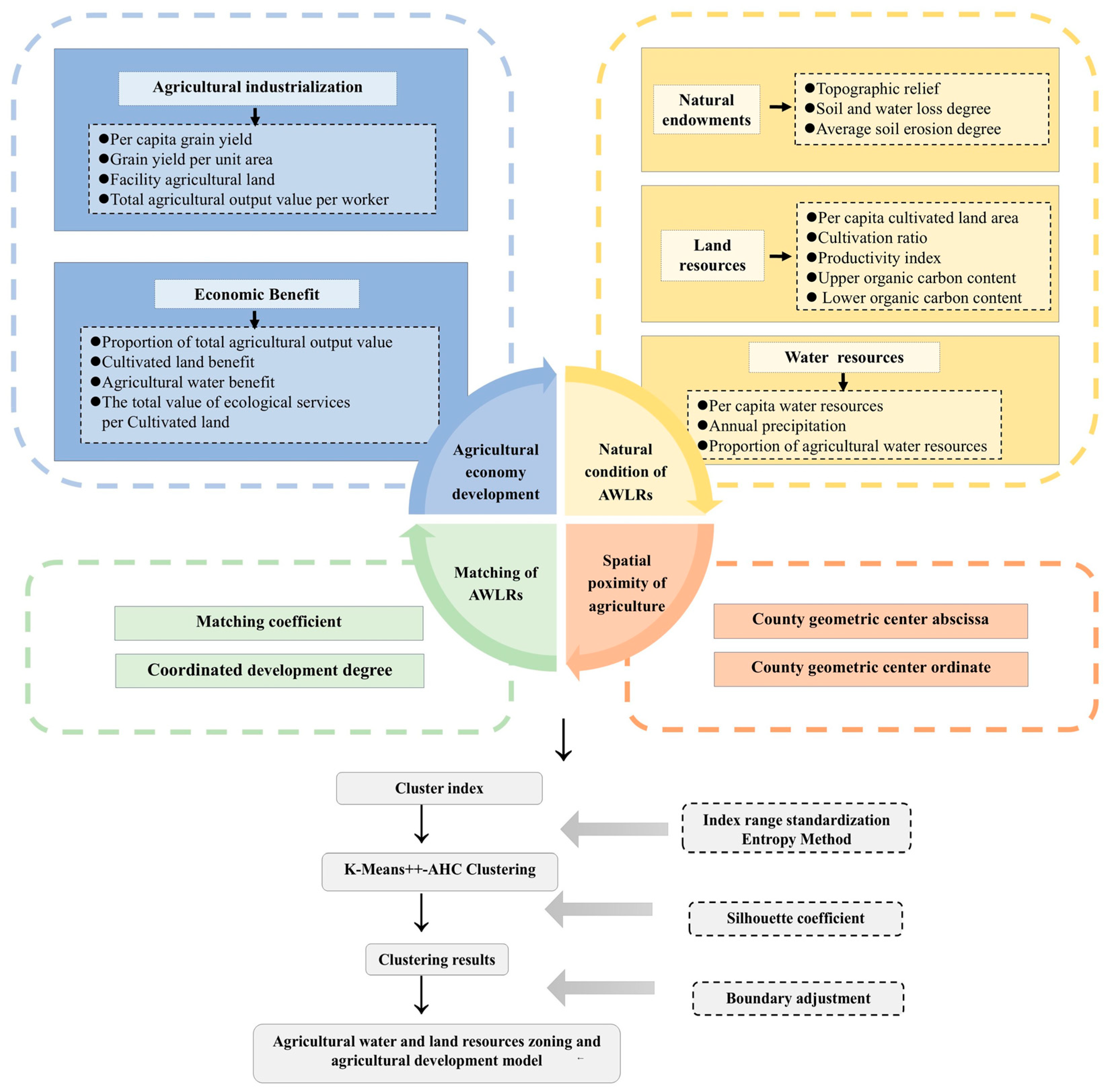
In this paper, 23 indicators (Figure 2) were selected to construct a zoning system of AWLRs from 4 aspects: the agricultural economy benefit, natural conditions, matching of AWLRs, and spatial proximity of AWLRs. All 23 zoning indicators exhibited low Variance Inflation Factor (VIF) values (ranging from 1.2 to 3.4), confirming that multicollinearity did not exert influence on the zoning results. The entropy method was used to determine the weight of each index, and Min–Max Normalization was performed on the data before the weighting process [40,41].
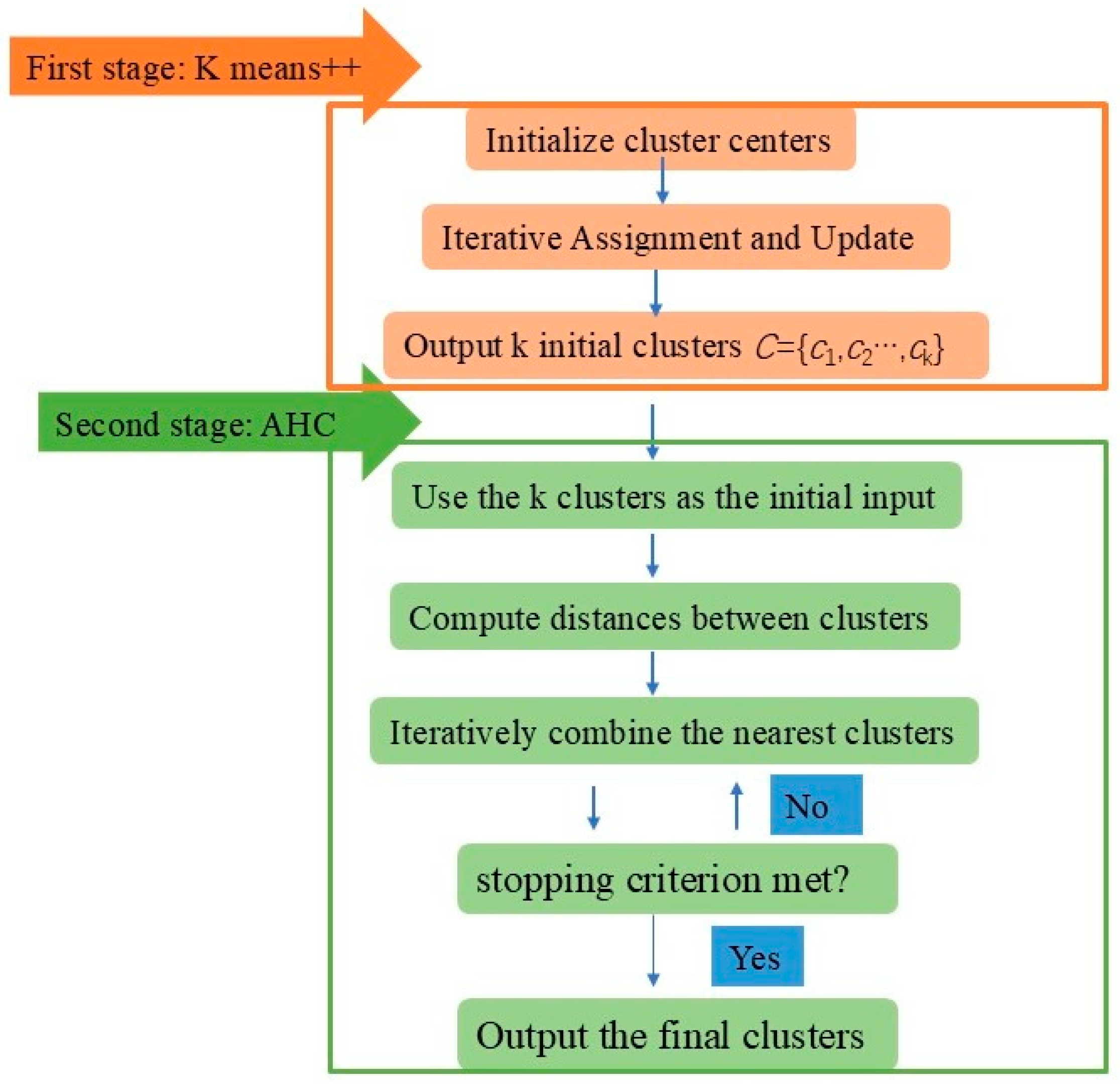
The clustering analysis method is widely used for comprehensive zoning, which can take multiple factors into consideration and help to avoid deviation from objective reality [42,43,44]. This paper optimized the K-means ++ Clustering Method with Agglomerative Hierarchical Clustering (AHC) to obtain the zoning scheme of AWLRs in Northern Shaanxi. The process of K-means++-AHC two-stage clustering analysis is as follows:
For a K-means++ problem, we are given a set of n data points X = x 1 ,   x 2 ,   x 3 , x n , of which the clusters are set as k, the cluster center is denoted by center, and then the algorithm process is as follows:
(a)
Arbitrarily choose an initial cluster center x i from X;
(b)
Calculate the square Euclidean distance [42] D x j 2 between x j x j = θ x c e n t e r and the cluster center;
(c)
Calculate the probability P x j of data point x j , which will be taken as a new center:
P x j = D x j 2 / x j θ x c e n t e r D x j 2
where D x j   is the Euclidean distance between a data point and any of the currently chosen cluster centers; θ x c e n t e r   is the cluster center. If P has the highest value, then xj will be selected as the new center. The process is as follows:
(d)
Repeat step (b) and (c) until the taken k centers are together, which will be set as the initial centers C = c 1 , c 2 , c 3 , c k ;
(e)
For each i 1 ,   2 ,   3 , k , set the cluster Ci to the set points in X that are closer to ci than they are to c j for all j i ;
(f)
For each i 1 ,   2 ,   3 , k , set c i to be the center of mass of all points in C i ,
C i = 1 / C i × x C i x
where C i is the number of data points contained in cluster C i ;
(g)
Repeat step (d) and (e) until C no longer changes.
AHC is a bottom-up algorithm, whose basic theory is grouping the similar data points to form a hierarchical structure by calculating the distance between different data points. Combining the characteristics of K-means++ and AHC, we use K-means++ for data processing and AHC for secondary cluster analysis, the K-Means++-AHC algorithm can be summarized as follows:
(a)
Calculate k clusters of the data points by K-means++;
(b)
Set the k clusters as the initial clusters, calculate the Euclidean distance between each pair of clusters and merge the two nearest clusters;
(c)
Repeat step (2) until the final Kp (kpk) clusters are obtained.
Clustering was implemented in R 4.2.3 with random seed 42. The flowchart of K-means++-AHC two-stage clustering is described as Figure 3.
Silhouette Coefficient
The silhouette coefficient is used to evaluate the clustering effect, which combines the cohesion of a cluster and the separation between clusters to describe how well a given cluster is separated from the others [45]:
S = ( b a ) / max ( a , b )
where a is the average distance between a sample and other samples in its cluster; b is the average distance between a sample and other clusters.
The average silhouette coefficient   S c can be expressed as follows:
S c = ( 1 / M ) × t = 1 M S i
where M is the number of corresponding sample points; S i is the silhouette coefficient of the i sample. The larger the value of S c , the better the clustering result.

2.3.6. The NRCA Index

The Normalized Revealed Comparative Advantage (NRCA) Index proposed by Yu [46] is widely used in energy utilization, spatial advantage function identification, and spatial optimization of national land and other aspects. This paper employed the NRCA to identify the advantage function of agricultural regionalization. The mathematical expression is as follows:
N R C A j i = x j i / x x j x / x x i
where x j i is the value of the j index for i county; x j represents the total value of the j index for the whole area; x i is the total value of all indexes for i county; and x is the total value of all indexes of the whole area. Because the calculation result is too small, in order to facilitate the analysis, the calculation results were multiplied by 1000, retaining two decimal points. N R C A j i > 0 demonstrates that the j index has a comparative advantage in i county; N R C A j i < 0 demonstrates that the j index does not have a comparative advantage in i county.

3. Results

3.1. Spatial Distribution of Water Resources and Land Reclamation Rate

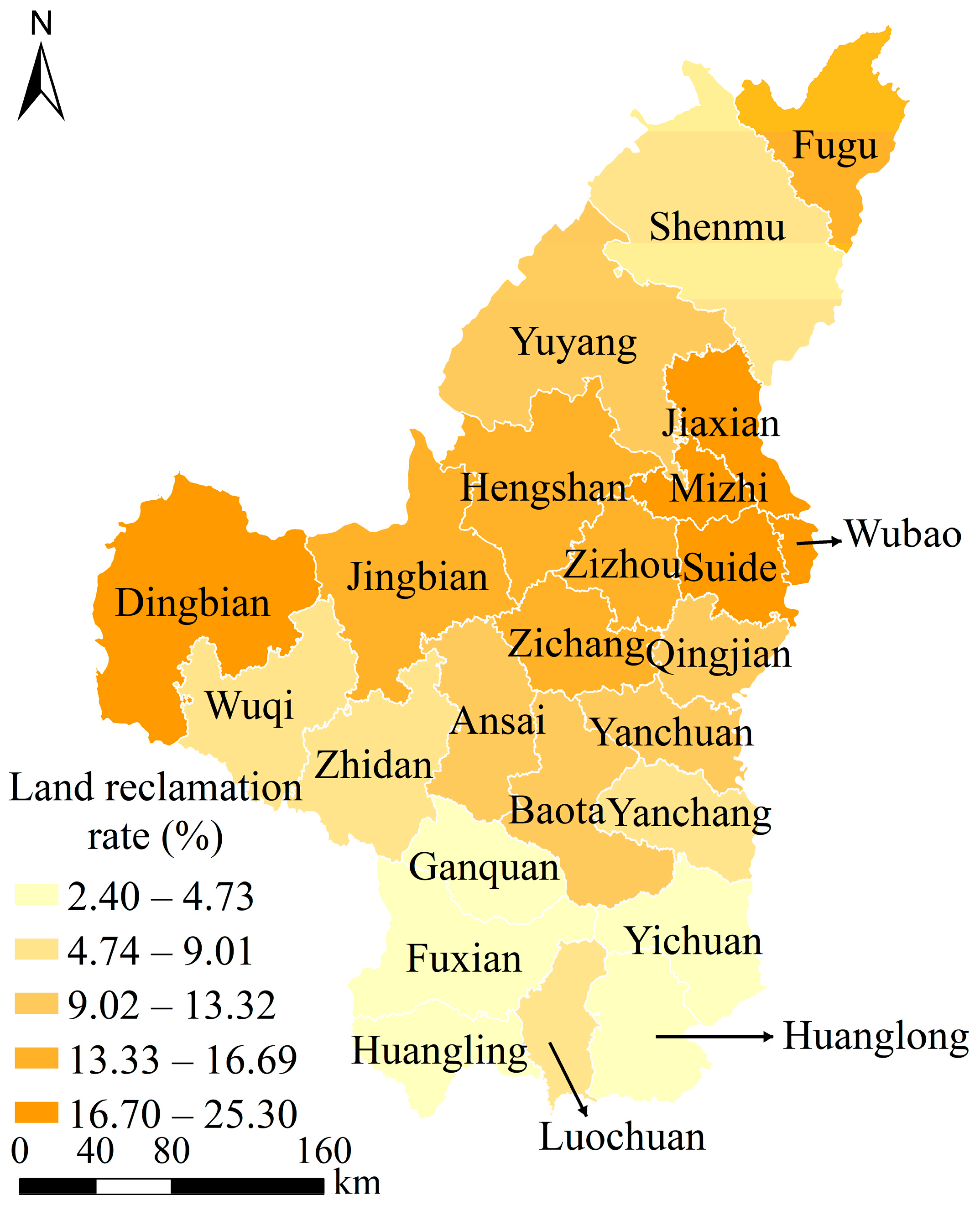
As shown in Figure 4, the spatial distribution of the land reclamation rate exhibited a spatial pattern of “low in the north and south, high in the center”. The highest rates, exceeding 20% and surpassing the national average, were primarily concentrated in Dingbian, Jiaxian, Mizhi, and Suide. The central counties had reclamation rates ranging from 14.1% to 19.2%. In contrast, the northern counties of Yuyang, Shenmu, and Fugu, located on the southern edge of the Mu Us Desert with extensive aeolian sandy soils, had less farmland. Due to the mountainous terrain, the southern counties had the lowest reclamation rates, all below 5%.
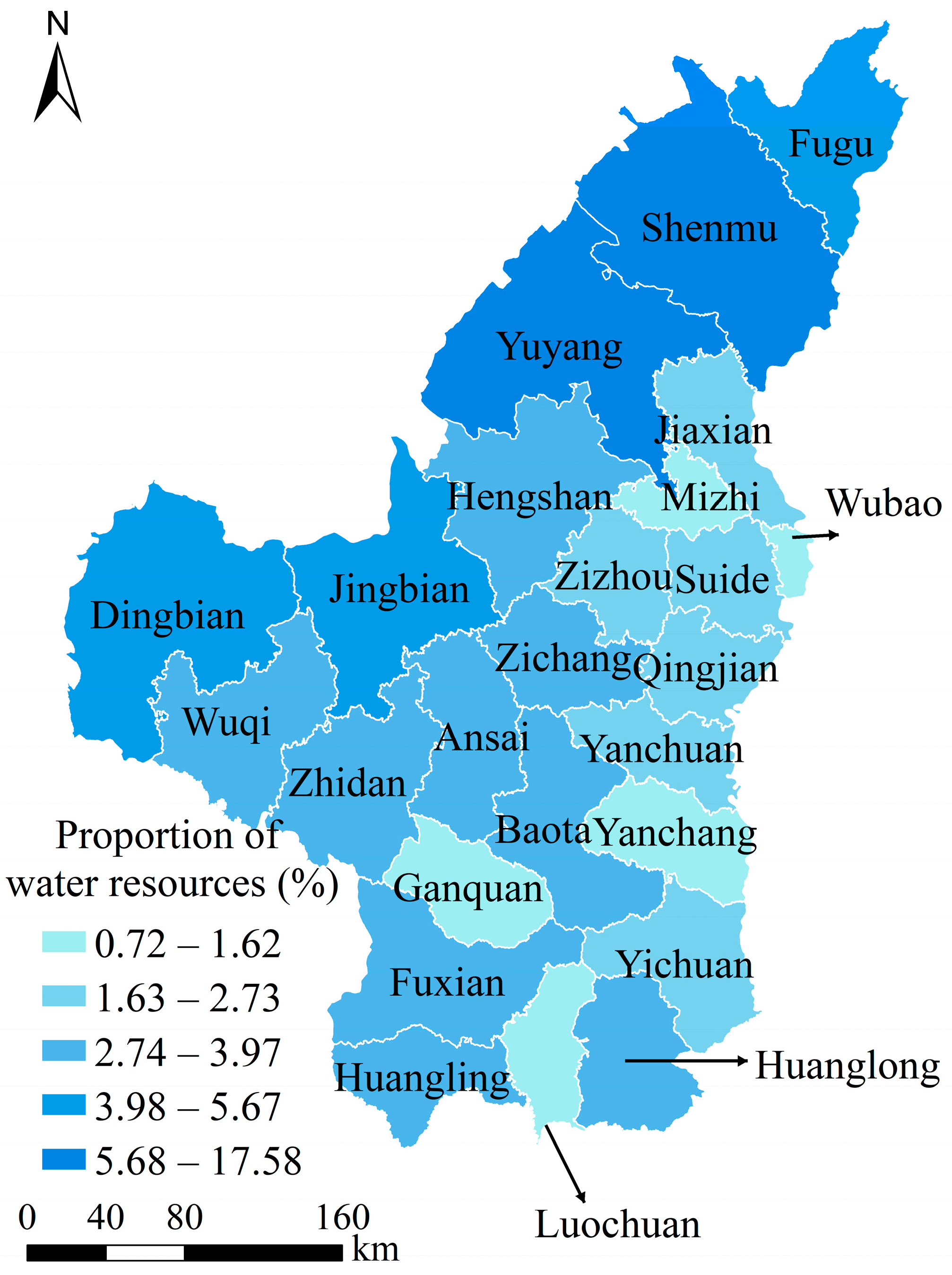
According to Figure 5, the six northern counties were rich in water resources, accounting for about 55% of the total. In contrast, Mizhi, Wubao, Ganquan, Luochuan, and Yangchang had proportions of water resources below 1.62%. Wubao possessed the least water resources, with only 0.28 × 10⁸ m3. Overall, there existed spatial dislocation between water resources and cultivated land; central counties were characterized by “more farmland with less water”, while the northernmost and southernmost areas had “fewer farmland but more water”. The spatial mismatch of AWLRs significantly limited local agricultural productivity and sustainable management.

3.2. Matching Features of Agricultural Water and Land Resources

3.2.1. Spatial Matching Pattern of Agricultural Water and Land Resources

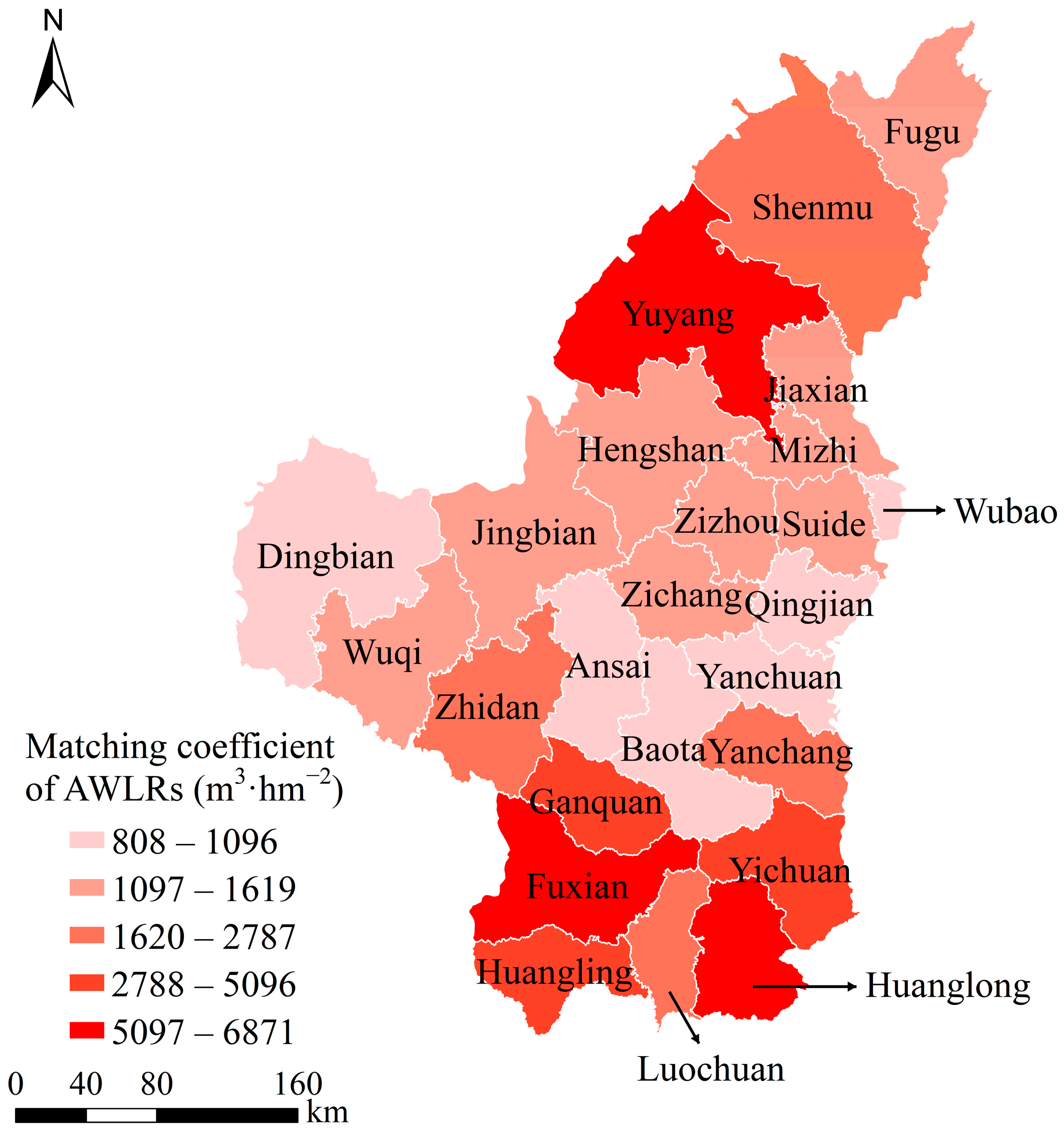
The average matching coefficient of AWLRs from 2010 to 2021 in NS was 0.24 × 10⁴ m3/hm2, which is much lower than the provincial average level (0.43 × 10⁴ m3/hm2) and far below the national average level (0.55 × 10⁴ m3/hm2), suggesting a poor matching degree between agricultural water resources and cultivated land in NS. As can be seen from the spatial distribution of the AWLR matching pattern (Figure 6), the matching degree of AWLRs in the southern area was the best, the northern area came next, and the central area exhibited the lowest matching coefficient.
Huanglong had the highest matching coefficient of AWLRs while Wubao had the lowest. Huangling, Fuxian, Ganquan, Huanglong, and Yichuan have flourishing forestry and fruit growing industries; these areas are characterized by rich water resources due to the high precipitation and the largest river crossing (Beiluohe River); moreover, the cultivation ratios of these counties were the lowest in the study area, thus the matching coefficient of AWLRs was over 4400 m3·hm−2, indicating the most favorable matching degree. In contrast, Luochuan has a flatter terrain compared to its neighboring counties, leading to a larger cultivated area. However, as its water resources are the second lowest in NS, the AWLR matching coefficient is relatively low. Yuyang and Shenmu possess the most abundant water resources, accounting for over 15% of the regional total, plus these counties have limited cultivation areas, resulting in a high AWLR matching degree. Yanchang and Zhidan have intermediate levels of water resources, with cultivation ratios slightly below the average, leading to an average AWLR matching degree. Although Dingbian is rich in water resources, its available water quantity is limited due to contamination. Combined with the highest reclamation rate (25.3%) in NS, the AWLR matching degree is poor. In Wuqi, Jingbian, Hengshan, Jiaxian, Mizhi, Suide, Zizhou, Zichang, and Fugu, water resources are at an average level, but their land reclamation rates are among the highest. The AWLR matching coefficients in these counties range from 1229.5 to 1619.2 m3·hm−2, which is far below the average, indicating a poor matching degree. Ansai, Baota, Yanchuan, Qingjian, and Wubao have scarce water resources but higher reclamation rates, resulting in the lowest AWLR matching coefficients (below 1000 m3·hm−2).

3.2.2. Gini Coefficient of Agricultural Water and Land Resources

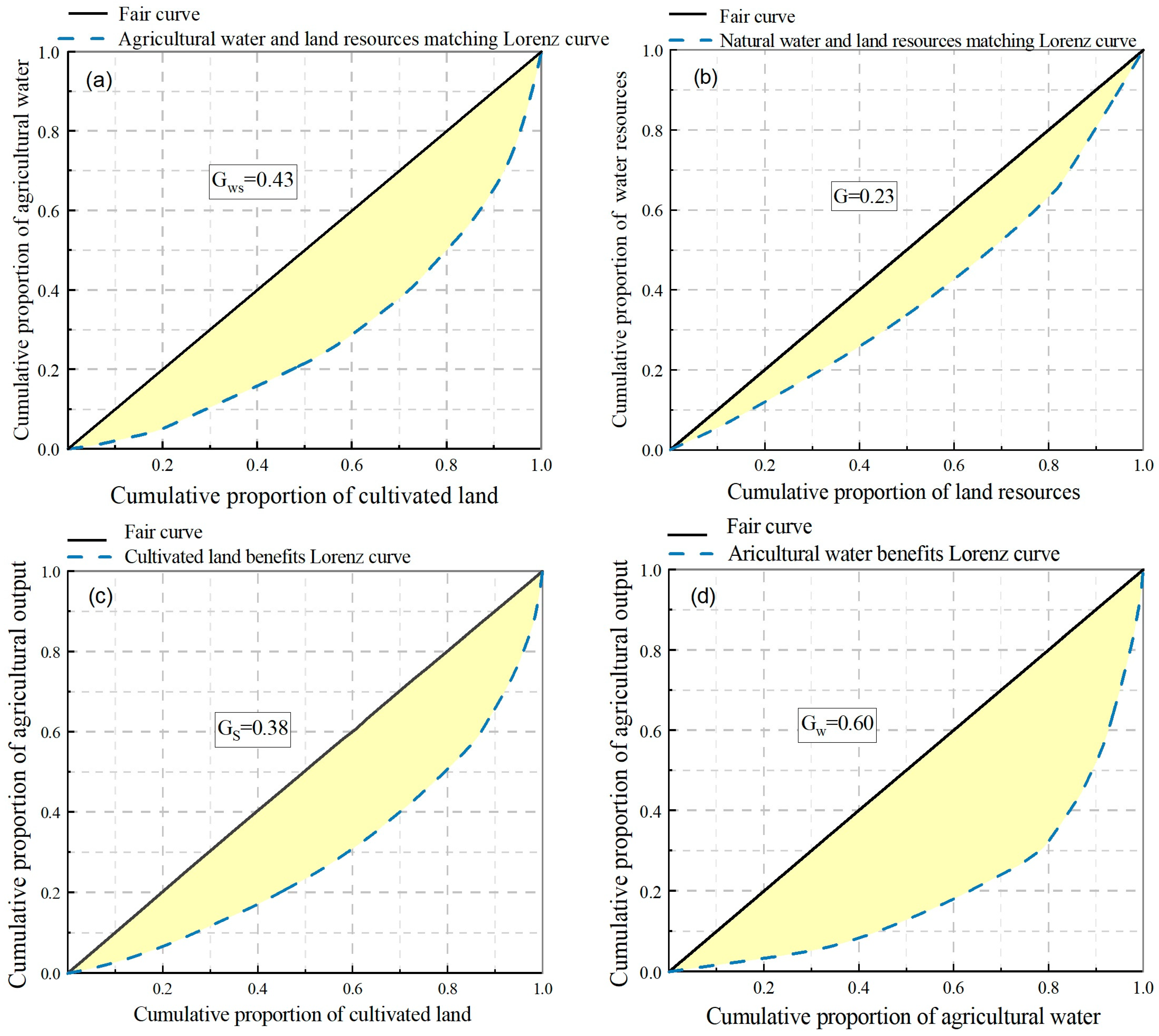
According to the Lorenz curve of AWLRs (Figure 7a), the Gini coefficient of AWLRs was 0.43, indicating a large matching gap between agricultural water and cultivated land in NS. This finding is consistent with the results of the AWLR matching coefficient. However, the Gini coefficient for WLRs was 0.23 (Figure 7b), where 70% of the land area contains about 51% of the water resources, suggesting a relatively good matching between land and water resources. Figure 7c,d, shows the Lorenz curve of the cultivated land benefit, which was closer to the fair curve than the Lorenz curve of agricultural water. Specifically, according to the Lorenz curve, 31% agricultural output corresponded to 85% agricultural water and 59% cultivated land. That is, the matching degree between agricultural output and cultivated land was better than agricultural water resource. Overall, a significant matching gap was observed between agricultural water resource and agricultural output, along with a relatively big matching gap between the agricultural output and cultivated land. These results reflected a very low economic benefit of agricultural water, and a relatively low economic benefit of cultivated land in NS.
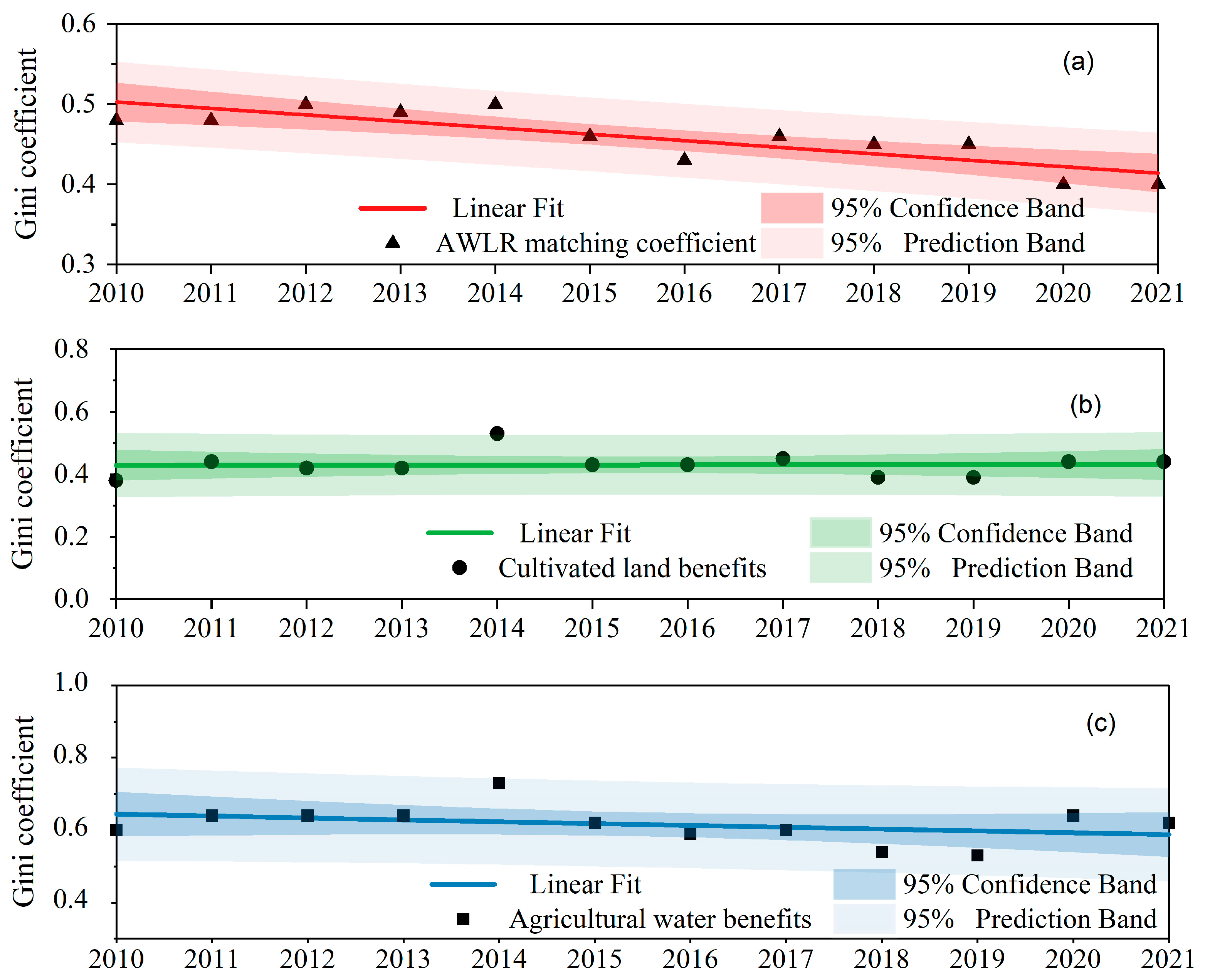
Figure 8 illustrates the temporal variations in the Gini coefficients for the agricultural water benefit, the cultivated land benefit, and AWLRs. As shown in Figure 7a and Table 1, the Gini coefficient for AWLRs exhibited a declining trend, indicating a continuous improvement in the matching conditions of AWLRs in NS. The matching degree of AWLRs evolved from a big matching gap to a generally matched level, which may be related to water diversion projects, such as the Yellow River Water Diversion Project. In contrast, the Gini coefficient for the cultivated land benefit consistently fluctuated around 0.42 without a significant trend (Figure 7b), reflecting a persistent and substantial mismatch between cultivated land and agricultural output in the region. Although the Gini coefficient for the agricultural water benefit showed a decline (Figure 7c), suggesting a slight improvement in the alignment between agricultural water use and output, a considerable matching gap remained. Moreover, this trend indirectly indicated a modest increase in agricultural water use efficiency.

3.3. Spatial Autocorrelation Between AWLR Matching and Agricultural Development Level

3.3.1. Analysis of Global Spatial Autocorrelation

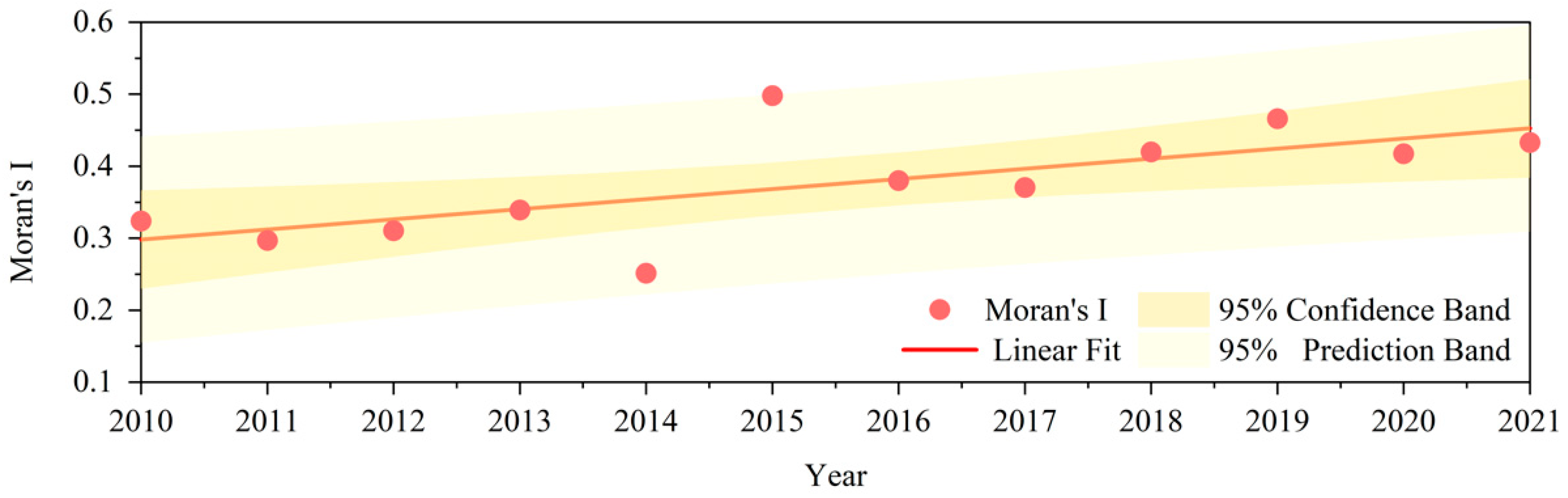
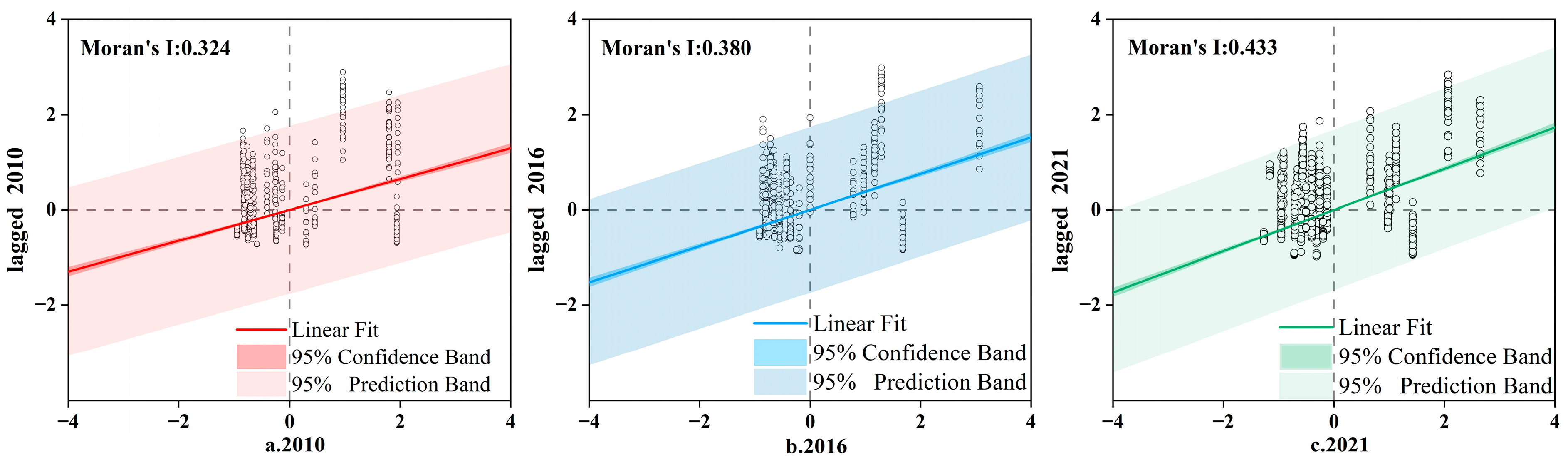
As shown in Figure 9 and Figure 10, Table 1, a statistically significant spatial correlation was observed between the AWLR matching coefficient and agricultural development (p = 0.01). The Moran’s I index showed a consistent upward trend from 2010 to 2021, indicating a positive spatial correlation between the two variables. This suggests that agricultural development levels improved with increasing AWLR matching coefficients, and that this relationship has strengthened in recent years.

3.3.2. Analysis of Local Spatial Autocorrelation

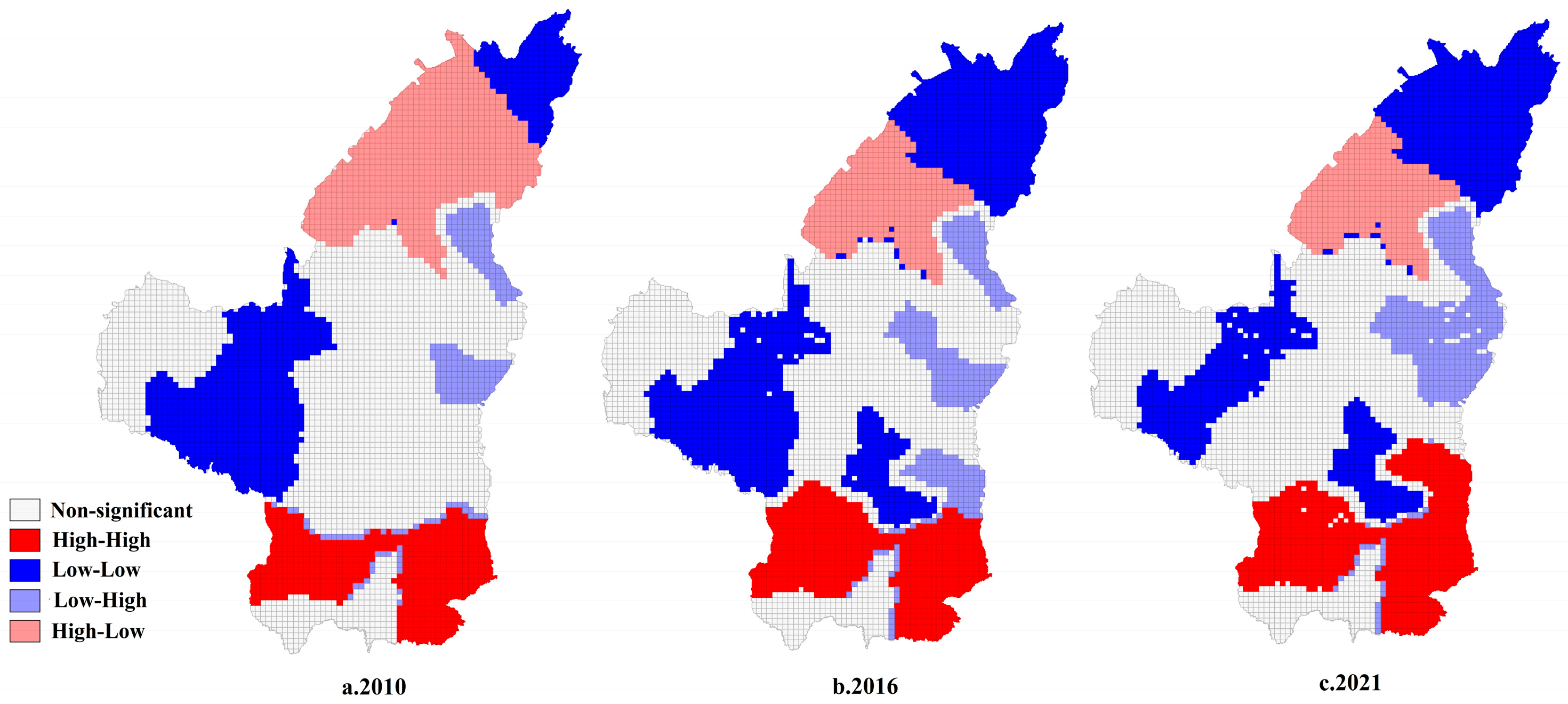
According to the spatial LISA clustering diagram of the AWLR matching coefficient and 378 agricultural development levels in NS from 2010 to 2021 (Figure 11), the correlation between the AWLR matching coefficient and agricultural development levels exhibited a significant spatial differentiation; all the four types of clusters were found in NS.
Spatial clusters characterized by high AWLR matching and high agricultural development levels (High–High) were identified in southern counties such as Fuxian and Huanglong. These areas benefit from abundant water resources and have well-developed grain and fruit industries. In contrast, Shenmu and Yuyang exhibited high AWLR matching but low agricultural development (High–Low). As a national heavy-chemical industry base with abundant coal resources, the agricultural development in this region was at low level. The Low–Low cluster type (low AWLR matching and low agricultural development) was primarily observed in western counties, including Jingbian, Wuqi, and Zhidan, where the economy relies heavily on oil and gas extraction. The high coverage of forestry and grassland in these areas also limited the proportion of agricultural output. Similarly, Fugu displayed this cluster type due to its rich mineral resources and aeolian landforms with poor soil quality. Eastern counties such as Jiaxian, Qingjian, Zizhou, and Wubao formed a Low–High cluster, with low AWLR matching but high agricultural development levels.
Overall, the extent of High–Low clusters has declined, likely due to the crowding-out effect of coal industry development. Meanwhile, the expansion of Low–High and High–High clusters suggests improvements in agricultural production technologies in these areas.

3.4. Analysis of the Coordinated Development Degree Model of Agricultural Development Level and the AWLR Benefit

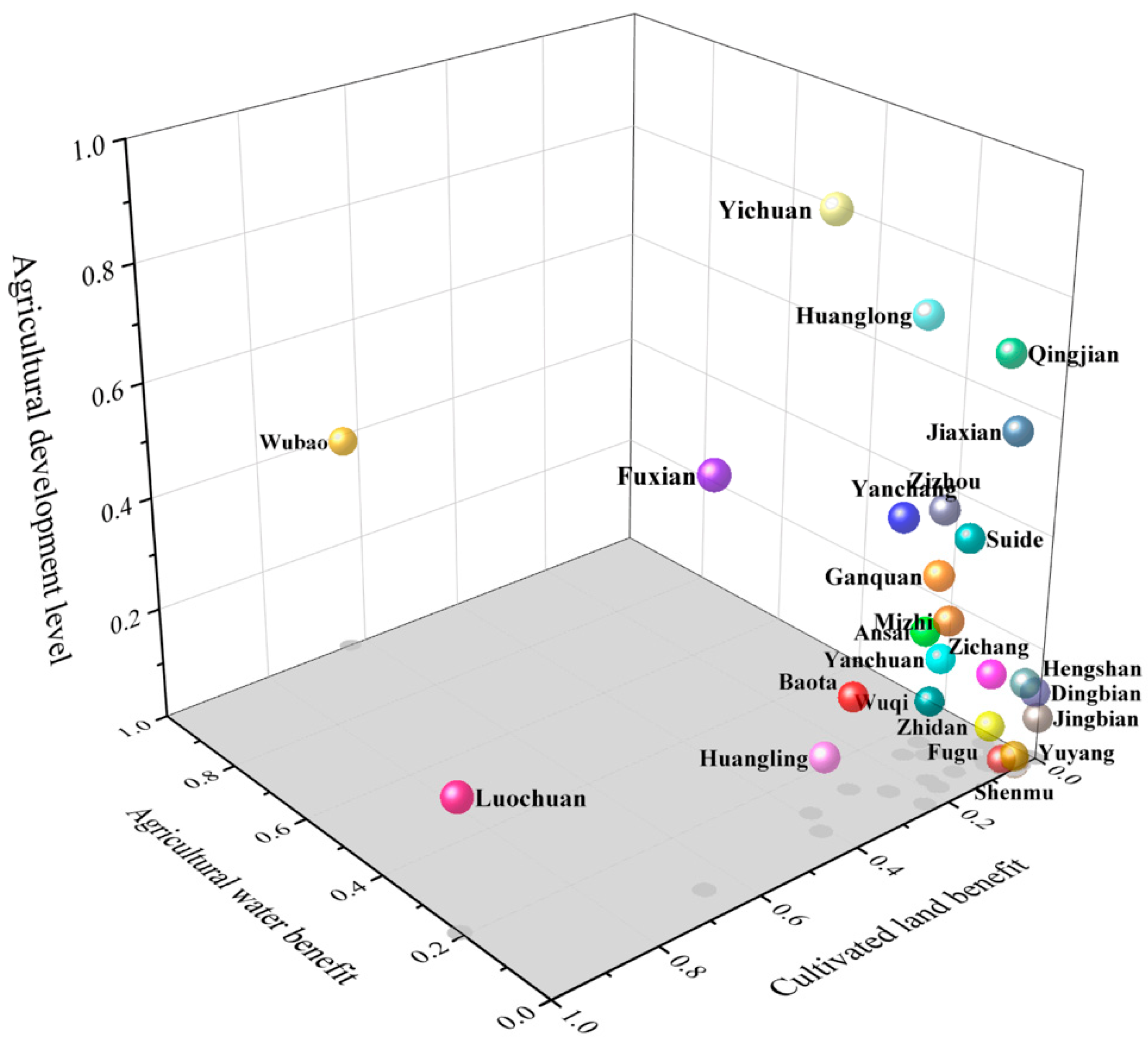
According to the three-dimensional coordinated development degree model (Figure 12), the coordination between the agricultural water and land resources benefit and the agricultural development level primarily ranged from 0 to 0.4, indicating a state of highly uncoordinated development of AWLRs in the study area. Significant differentiations were observed among the three dimensions: agricultural development level, agricultural water benefit, and cultivated land benefit. Specifically, the agricultural development levels of 96% of the counties were concentrated within the 0–0.2 range. Similarly, the agricultural water benefits for 80% of the counties and the cultivated land benefits for 68% of the counties were concentrated in the 0–0.4 range. In terms of coordinated development, Wubao and Luochuan counties were classified into the relatively low coordination grade (S4), while all other counties fell into the low coordination grade (S5).
The six northern counties (Fugu, Shenmu, Yuyang, Jingbian, Hengshan, and Dingbian), along with Zhidan County, exhibited the lowest levels of agricultural development, agricultural water benefit, and cultivated land benefit. Although many counties were categorized under the same coordinated development degree, notable disparities existed in their agricultural water benefit, cultivated land benefit, and agricultural development levels. In Huangling, Zizhou, Yichuan, Yanchang, Fuxian, Ganquan, and Mizhi, agricultural water benefits were significantly lower than their cultivated land benefits and agricultural development levels, indicating that agricultural water utilization is a key constraint on agricultural development in these areas. The significant imbalance among agricultural development level, cultivated land benefit, and agricultural water benefit is the primary reason for the low coordinated development degree in the NS region. For instance, Fuxian had an agricultural development level of 0.69 and a cultivated land benefit of approximately 0.65, but its agricultural water benefit was only 0.06, resulting in a low overall coordinated development degree. Wubao, characterized by the highest agricultural water benefit and cultivated land benefit (both ranging between 0.6 and 0.8), had an agricultural development level of only 0.39, leading to its classification in the relatively low coordinated development category (S4).

3.5. Functional Zoning Results of AWLRs

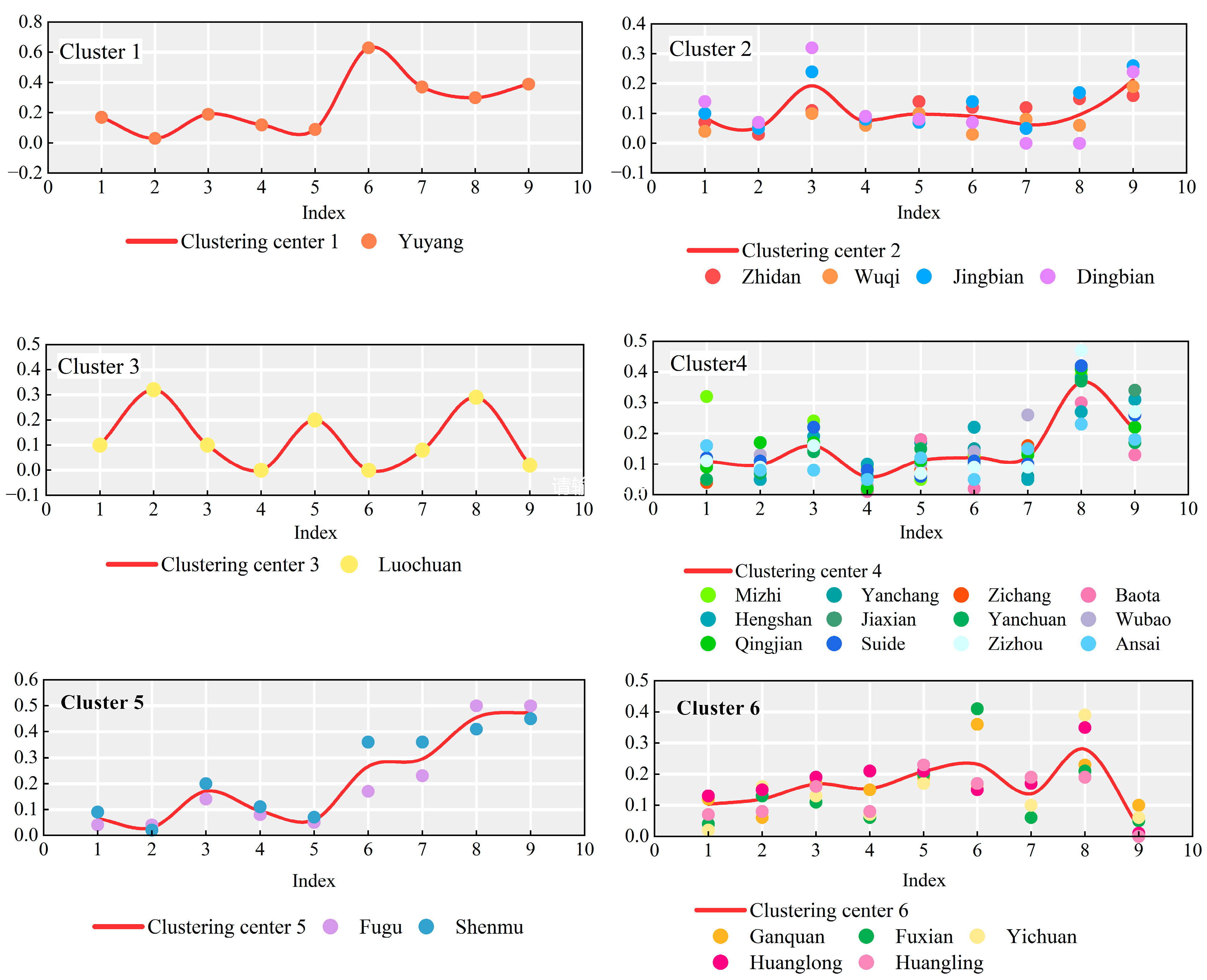
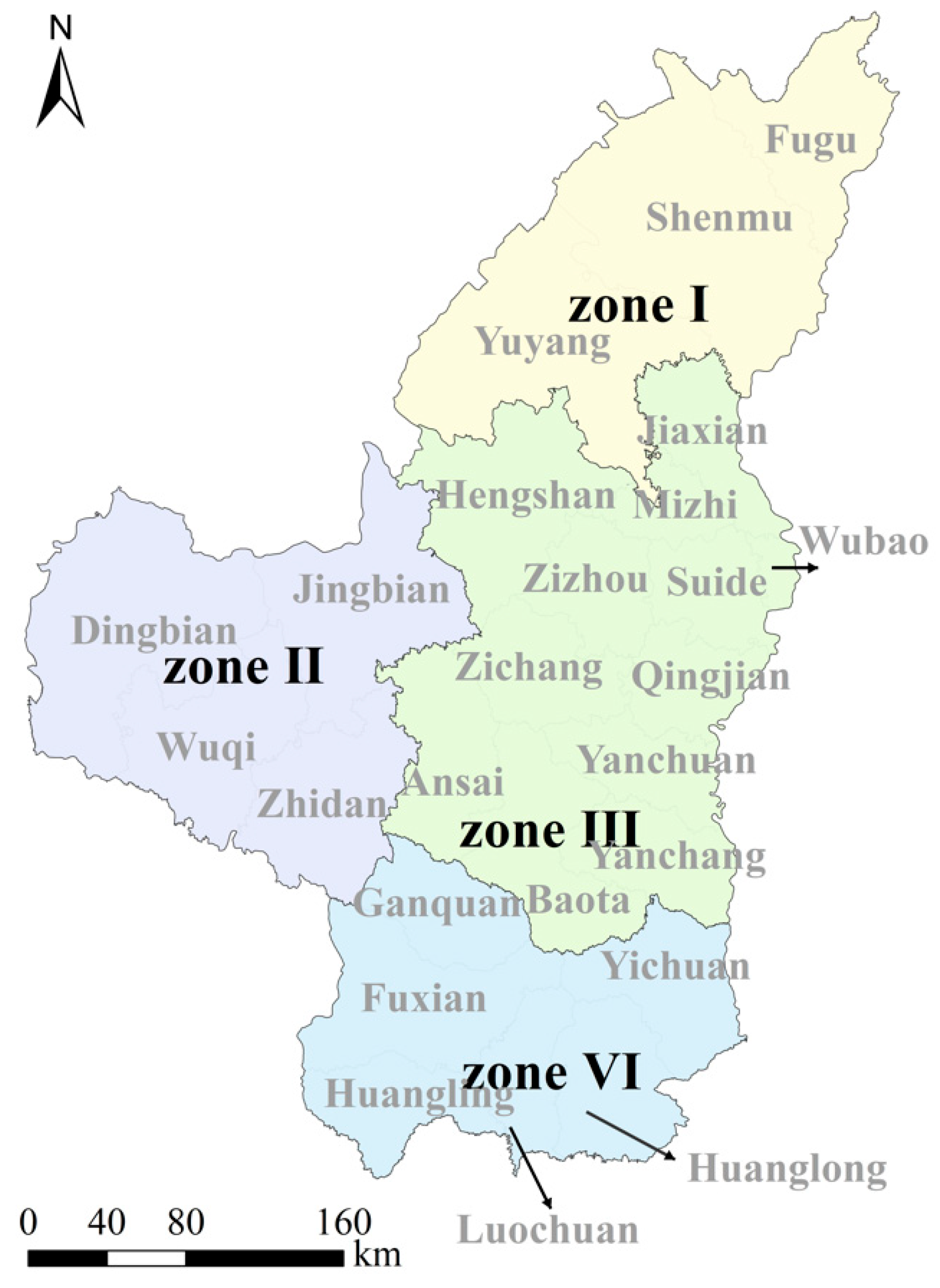
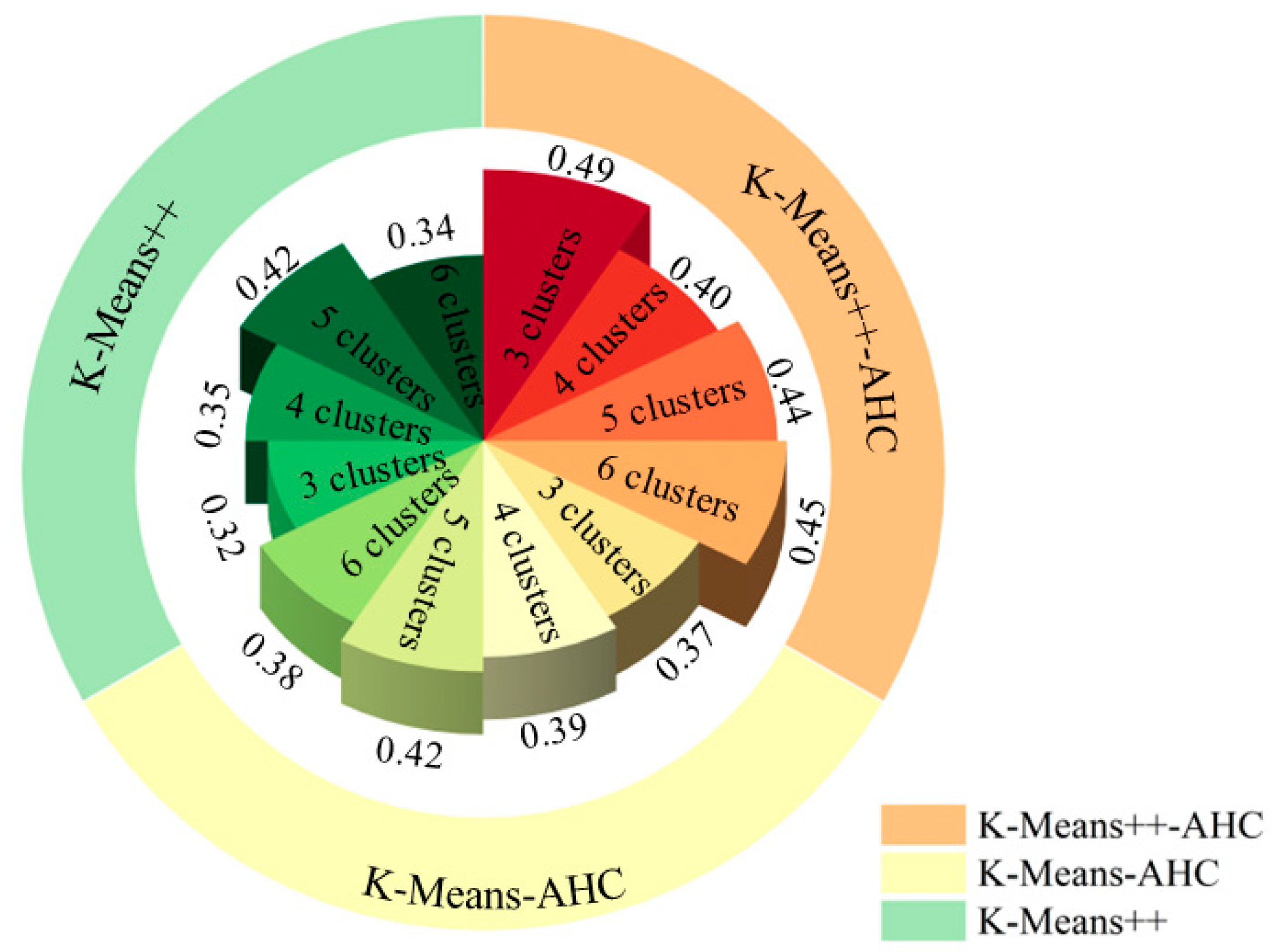
Based on the zoning indicator system presented in Figure 2, agricultural water and land resources (AWLRs) were classified using the K-Means++-AHC clustering algorithm. The algorithm was run for 1000 iterations, yielding silhouette coefficients of 0.49, 0.40, 0.43, and 0.45 for cluster numbers 3, 4, 5, and 6, respectively. Although a higher silhouette coefficient generally indicates better clustering performance, the three-cluster solution, despite having the highest value (0.49), grouped 22 counties into a single zone, thereby offering limited value for targeted strategy formulation. Consequently, the six-cluster scheme, which achieved the next-highest silhouette coefficient (0.45), was selected. As shown in Figure 13, the results demonstrate a well-formed cluster structure, with all 25 counties’ indicator values closely distributed around their respective cluster centers. The final AWLR clustering zones for NS are displayed in Figure 14, and the corresponding NRCA values for each zone are provided in Table 1.
Zone I, including Fugu, Yuyang, and Shenmu, demonstrated a comparative advantage in the matching of AWLRs (NRCA = 70). However, due to severe soil erosion, widespread sandy land distribution, and existing farmland being threatened by intensive coal mining activities, the region’s agricultural economic benefit (NRCA = −29.26) and coordinated development degree (NRCA = −63.62) remained relatively disadvantaged. Agriculture contributes minimally to the total economic output. Therefore, it is imperative to improve the current situation by enhancing agricultural production technologies and strengthening land reclamation efforts, particularly by promoting farmland protection and reclamation projects in mining areas. This is crucial for achieving sustainable agricultural development in the region.
Zone II contains Jingbian, Dingbian, Wuqi, and Zhidan. As shown in Table 2, this region demonstrated comparative advantages in agricultural production (NRCA = 6.13), natural resource endowments (NRCA = 4.44), and the matching degree of AWLRs (NRCA = 2.04). Despite better natural endowments of AWLRs, the region exhibits low AWLR utilization efficiency, limited agricultural economic benefit (NRCA = −3.57), and poor coordination between AWLRs and economic benefits (NRCA = −33.31). To address these issues, it is essential to adjust agricultural production modes, enhance irrigation water use efficiency, and optimize cropping structures. These measures would promote the effective utilization of AWLRs and make full use of the natural advantages of resources.
The twelve counties involved in Zone III, respectively, were Hengshan, Jiaxian, Mizhi, Zizhou, Suide, Wupu, Zichang, Qingjian, Yanchuan, Yanchang, Ansai, and Baota. The agricultural economy development (NRCA = 3.9) and spatial proximity (NRCA > 0) had comparative advantages in this region, suggesting a higher agricultural output and a better spatial integrity. However, in a situation of water scarcity with low efficiency of water utilization, as well as less per capita farmland caused by severe soil erosion, the matching degree of AWLRs (NRCA = −7.76) and coordinated development degree demonstrated comparative disadvantages (NRCA = −22.61). Therefore, more attention should be paid to investment in water conservancy projects and irrigation facilities; moreover, further control of soil erosion, farmland improvement, and water saving irrigation are crucial for the sustainable management of AWLRs in such areas.
Zone IV, comprising Ganquan, Fuxian, Huangling, Luochuan, Huanglong, and Yichuan, is considered the core agricultural development area in NS. All evaluated indicators demonstrate comparative advantages, particularly in agricultural water–land resource (AWLR) matching and spatial proximity. Characterized by high matching degree of AWLRs and better coordination among agricultural water, cultivated land, and economic benefits, the agricultural economy in this region demonstrated notable strengths with high efficiency in cultivated land and agricultural water use, and the agricultural output value constitutes a significant proportion of the local economy. However, the fruit industry predominates agricultural production in this area, and constraints such as limited facility agriculture and low value-added per worker requires enhanced training and management for agricultural practitioners. This should be coupled with an expansion of facility agriculture to ensure production efficiency.

3.6. Comparison of Clustering Algorithms

This paper proposed the K-means++-AHC clustering algorithm to obtain the zoning results of AWLRs in NS. The proposed algorithm optimizes initialization procedures, reduces sensitivity to cluster center selection, and minimizes the impact of random errors on clustering outcomes. For validation, three UCI datasets—Iris, Seeds, and Teaching Assistant Evaluation (TEA) were employed, with Purity, Adjusted Rand Index (ARI), Adjusted Mutual Information (AMI), and Normalized Mutual Information (NMI) selected as evaluation metrics [47]. As summarized in Table 3, the scores of K-means++-AHC in the data set of Iris and TEA were higher than other algorithms, especially in the performances of AMI and NMI. In the dataset of Seeds, the scores of K-means++-AHC were approximately equal to K-means++, but higher than K-means++-AHC. That is, from the perspective of evaluation indexes, K-means++-AHC was more stable in the performance of cluster zoning of AWLRs in NS. Moreover, as shown in Figure 15, the silhouette coefficient results of K-means++-AHC under different clusters were greater than the other two methods, suggesting a better clustering effect.

4. Discussion

4.1. Coupling of Agricultural Water and Land Resources

AWLRs are critical components of production, and thus research on their coordination is fundamental to regional agricultural output and the efficient allocation of resources. Based on the Gini coefficient and spatial autocorrelation analysis, this paper studied the matching patterns of AWLRs in NS. The results are basically consistent with the findings of Bai [32] and Li [13]. The matching degree of AWLRs in NS was poor, lower than the average level of Shaanxi Province and far below the national level. Affected by the topography and spatial distribution of water resources, the matching coefficients of AWLRs in the southern counties were higher than that in northern and central areas.
The rapid progression of urbanization, industrialization, and agricultural modernization has intensified the limitations and pressures associated with AWLRs, making their rational distribution essential for the sustainable development of regional economies [48]. Previous studies in this region have primarily focused on the coupling relationships between AWLRs, neglecting the interaction between the agricultural economy and AWLRs. This study investigated the coupling relationship between AWLRs and agricultural economic development. The results indicated a huge mismatch between AWLRs and agricultural output in NS; water shortage and low water resource utilization efficiency were identified as the main factors for limiting agricultural development, particularly in Yan’an City. Since 2010, the dependence of agricultural economic development on the matching of AWLRs has increased in NS; both the area of low AWLR matching and high agricultural development level and the area of high AWLR matching and high agricultural development level expanded due to the improvement of the agricultural water production technique, the construction of water diversion projects, and the cultivation of low-water-consumption cash crops. Further research may be required to study the interplay of ecological environments, climate change, water resource allocation, and other factors with AWLRs to provide a better guidance for sustainable AWLR utilization.

4.2. Zoning Results

Previous studies about agricultural functional zoning mainly focused on natural endowments or the utilization of AWLRs [7,49]. This research conducted the function zoning of AWLRs by considering the agricultural economy system, natural conditions, the matching of AWLRs, the coordinated development degree of the agricultural development level and AWLR benefit, and spatial proximity. The findings provide comprehensive and reliable references on the rational allocation of AWLRs and the sustainable development of agriculture in the region.
The AWLR zoning of Shaanxi Province by Ren [50] and the modern agricultural zoning in China by Liu [29], whose nested zoning index systems for secondary division were established by considering the meteorological condition and the utilization of water resources and cultivated land, mainly focused on natural resources utilization. This paper constructed a first-level zoning system based on AWLR matching at a county-level study scale. The proposed framework incorporated AWLR utilization efficiency, natural endowment conditions, and agricultural development levels, specifically addressing the coordinated relationship between AWLR matching and agricultural benefits. Moreover, the AWLR zoning for Shaanxi and the modern agricultural zoning in China divided the NS into two or three regions from north to south, which was basically consistent with the zoning trend of this paper. The four-zone classification scheme comprehensively reflected the natural conditions and utilization of AWLRs, the current economic development level of agriculture, and clarified the matching degree of AWLRs. Furthermore, the zoning results demonstrated close correspondence to the regional topography and administrative boundaries, making it more targeted and flexible for planning and management of agricultural water and land resources.

5. Conclusions

The spatial distribution of cultivated land in Northern Shaanxi was highly heterogeneous, with a greater concentration in the north than in the south. Water resources were primarily concentrated in six northern counties, leading to severe water scarcity in the southern and especially eastern counties. Consequently, the regional average matching coefficient of agricultural water and land resources (AWLRs) was 0.24 × 10⁴ m3/hm2, which is lower than the provincial average and substantially below the national average, indicating a generally poor level of matching. Notably, the southern region exhibited a higher matching degree than the north, while the central counties recorded the lowest values. Despite this spatial disparity, the declining trend in the Gini coefficient from 2010 to 2021 revealed a continuous improvement in the AWLR matching status in NS.
The coordination development degree of agricultural water benefit, cultivated land benefits, and agricultural development level mainly ranged from 0~0.2 and 0~0.4, suggesting a highly uncoordinated development of AWLRs in NS. That is, the development of AWLRs was inconsistent, with long-term benefits from cultivated land exceeding those from water. Since 2010, the spatial positive correlation between the matching of AWLRs and agricultural development level enhanced, and the correlation between the AWLR matching coefficient and agricultural development levels exhibited a significant spatial differentiation; all the four types of clusters were found in NS. From 2010 to 2021, the area of High–High type and Low–High type increased, suggesting improvements in agricultural production technologies in related areas.
This paper integrated agricultural economy development, natural conditions, matching of AWLRs, spatial proximity of agriculture, and coordination analysis to guide functional zoning of AWLRs in NS. The K-means++-AHC Clustering Method was employed to obtain the zoning scheme, which divided the research area into four regions. Zone I had a comparative advantage in the matching degree of AWLRs but low agricultural development level. Zone II exhibited favorable conditions for AWLRs. Zone III was characterized by comparative advantages in agricultural economic development and spatial proximity of agriculture. Zone IV was identified as the core area of agricultural development. The zoning results accurately revealed the matching degree and the development potential of AWLRs in Northern Shaanxi, providing valuable information for targeted investment and utilization of AWLRs in NS.
Based on data from the Water Resources Bulletin and statistical yearbooks, this paper investigated the matching pattern and functional zoning of AWLRs in Northern Shaanxi. It is important to note that some data may contain errors or missing values. Particularly regarding irrigation water usage, this data is typically estimated based on quotas rather than actual measurements, which may lead to systematic bias. Future research could integrate remote sensing inversion, field monitoring, and hydrological modeling data to establish a more precise land–water resources database. Furthermore, the K-means++-AHC algorithm mitigated sensitivity to initial values by optimizing the selection of the initial center and achieves better performance compared to other two algorithms, considering the zoning results depend on the choice of the number of clusters (k), and different selections of k can lead to different outcomes. In this paper, the silhouette coefficient was used, combined with the actual conditions of the study area, to optimize the selection of k. However, determining the optimal number of clusters still requires further research. Moreover, this study can be expanded to analyze the early-warning mechanism of “state-pressure-response” in NS, which will help to address the challenges of ecological environment protection challenges and promote sustainable agricultural development and rural revitalization.

Author Contributions

Conceptualization, H.L. and H.Z.; methodology, H.L., Y.L. and Y.M.; validation, H.L. and H.Z.; formal analysis, H.L., Y.L. and Y.M.; investigation, H.L. and Y.L.; data curation, H.L. and Y.L.; writing—review and editing, H.L. and Y.L.; supervision, H.L. and H.Z.; funding acquisition, H.L. and H.Z. All authors have read and agreed to the published version of the manuscript.

Funding

This research was supported by the National Natural Science Foundation of China (42007186) and the Open Fund of the Key Laboratory of Eco-hydrology and Water Security in Arid and Semi-arid Regions of the Ministry of Water Resources (300102293509).

Institutional Review Board Statement

Not applicable.

Informed Consent Statement

Not applicable.

Data Availability Statement

The raw data and code supporting the conclusions of this article are available from the authors upon request.

Conflicts of Interest

The authors declare no conflict of interest.

Abbreviations

The following abbreviations are used in this manuscript:
WLRsWater and Land Resources
AWLRsAgricultural Water and Land Resources
NSNorthern Shaanxi
NRCANormalized Revealed Comparative Advantage
AHCAgglomerative Hierarchical Clustering
VIFVariance Inflation Factor

References

  1. Liu, T.; Fang, Y.; Huang, F.; Wang, S.; Du, T.; Kang, S. Dynamic evaluation of the matching and utilization of generalized agricultural water and soil resources in China. Trans. Chin. Soc. Agric. Eng. 2020, 39, 56–65. [Google Scholar] [CrossRef]
  2. Han, X.; Boota, M.W.; Soomro, S.E.H.; Memon, A.A.; Soomro, S.A.; Ali, S.; Ali, M.; Khan, M.Z.; Hussain, A.; Bai, Y.; et al. Water strategies and management: Current paths to sustainable water use. Appl. Water Sci. 2024, 14, 154. [Google Scholar] [CrossRef]
  3. Li, M.; Cao, X.; Liu, D.; Fu, Q.; Li, T.; Shang, R. Sustainable management of agricultural water and land resources under changing climate and socio-economic conditions: A multi-dimensional optimization approach. Agric. Water Manag. 2022, 259, 107235. [Google Scholar] [CrossRef]
  4. Zhou, Y.; Li, W.; Li, H.; Wang, Z.; Zhang, B.; Zhong, K. Impact of water and land resources matching on agricultural sustainable economic growth: Empirical analysis with spatial spillover effects from Yellow River Basin, China. Sustainability 2022, 14, 2742. [Google Scholar] [CrossRef]
  5. Wang, Y.; Jiang, Z.; Chu, J.; Zhang, H.; Liu, X.; Lin, Y. Study on the spatiotemporal matching relationship of agricultural water and land resources in the Tarim River basin. J. Agric. Resour. Environ. 2024, 41, 360–370. [Google Scholar] [CrossRef]
  6. Jiang, Q.; Luo, B.; Guo, P.; Wu, H. Agricultural water and land resources management in Hetao Irrigation District based on the regulation of food production safety. J. China Agric. Univ. 2022, 27, 42–58. [Google Scholar] [CrossRef]
  7. Tan, K.; Zhao, X.; Pu, J.; Li, S.; Li, Y.; Miao, P.; Wang, Q. Zoning regulation and development model for water and land resources in the Karst Mountainous Region of Southwest China. Land Use Policy 2021, 109, 105683. [Google Scholar] [CrossRef]
  8. Xu, N.; Zhang, J.; Zhang, R. Study on utilization efficiency and matching features of agricultural soil and water resources in inland river basin of Gansu Province based on Malmquist DEA. J. Agric. Sci. Technol. 2020, 22, 115–122. [Google Scholar] [CrossRef]
  9. Li, S.; Chen, X.; Singh, V.; Qi, X.; Zhang, L. Tradeoff for water resources allocation based on updated probabilistic assessment of matching degree between water demand and water availability. Sci. Total Environ. 2020, 716, 134923. [Google Scholar] [CrossRef] [PubMed]
  10. Nan, J.; Wang, J.; Qin, A.; Liu, Z.; Ning, D.; Zhao, B. Study on utilization potential of agricultural soil and water resources in Northwest Arid Area. J. Nat. Resour. 2017, 32, 292–300. [Google Scholar] [CrossRef]
  11. Gao, Y.; Qi, X.; Li, P.; Liang, Z.; Zhang, Y. Analysis on spatial-temporal matching characteristics of agricultural water and soil resources in the Yellow River Basin. J. Irrig. Drain. 2021, 40, 113–118. [Google Scholar] [CrossRef]
  12. Fan, H.; Fu, W. Analysis of water and soil resources matching and agricultural economic growth in China from the perspective of water footprint: Taking the Yangtze River economic belt as an example. Chin. J. Agric. Resour. Reg. Plan. 2020, 41, 193–203. [Google Scholar] [CrossRef]
  13. Li, H.; Zhou, W.; Zhuang, Y.; Ma, C.; Liu, B. Agricultural water and soil resources matching patterns and carrying capacity in Yan’an City. Trans. Chin. Soc. Agric. Eng. 2016, 32, 156–162. [Google Scholar] [CrossRef]
  14. He, C.; Yao, H.; Yu, G.; Guan, W.; Xu, B.; She, D. Balance between water resources and soil resource in coastal regions of Jiangsu Province and its economic analysis. J. Irrig. Drain. 2023, 42, 110–116. [Google Scholar] [CrossRef]
  15. Han, Y.; Jia, S.; Lu, C.; Lv, A. Spatiotemporal matching between water resources and social economy: A case study in Zhangjiakou. J. Nat. Resour. 2020, 35, 1392–1401. [Google Scholar] [CrossRef]
  16. Zhang, Y.; Lei, G.; Zhang, H.; Lin, J. Spatiotemporal dynamics of land and water resources matching of cultivated land use based on micro scale in Naoli River Basin. Trans. Chin. Soc. Agric. Eng. 2019, 35, 185–194. [Google Scholar] [CrossRef]
  17. Zhang, Y.; Li, X. Analyses of supply-demand balance of agricultural products in China and its policy implication. J. Nat. Resour. 2021, 36, 1573–1587. [Google Scholar] [CrossRef]
  18. Li, W.; Xu, W.; Bao, A.; Lv, Y. Analysis of cultivated land change and water-land matching characteristics in Amu Darya River basin. Water Resour. Prot. 2021, 37, 80–86. [Google Scholar] [CrossRef]
  19. Zhou, G.; Jin, L.; Zhou, Y.; Wu, C.; Zhou, R.; Cui, Y. Matching of agricultural water and soil resources in Jianghuai Hilly Area based on set pair analysis. Water Resour. Prot. 2023, 39, 118–125. [Google Scholar] [CrossRef]
  20. Huang, X.; Fang, F.; Wu, M.; Cao, X. Assessment of the regional agricultural water-land Nexus in China: A green-blue water perspective. Sci. Total Environ. 2022, 804, 150192. [Google Scholar] [CrossRef]
  21. Yang, J.; Zhou, D.; Ma, J.; Zhu, X.; Jin, Y.; Zhou, F.; Zhang, J. Spatial and temporal matching characteristics of agricultural land and water resources in the Shule River Basin. Arid Land Geogr. 2023, 46, 982–992. [Google Scholar] [CrossRef]
  22. Geng, Q.; Wu, P.; Zhao, X.; Wang, Y. A framework of indicator system for zoning of agricultural water and land resources utilization: A case study of Bayan Nur, Inner Mongolia. Ecol. Indic. 2014, 40, 43–50. [Google Scholar] [CrossRef]
  23. Jiang, Y.; Zhang, Q.; Zhao, X.; Wang, L.; Zhang, X. A geogrid-based framework of agricultural zoning for planning and management of water & land resources: A case study of northwest arid region of China. Ecol. Indic. 2018, 89, 874–879. [Google Scholar] [CrossRef]
  24. Yuan, Y.; Hao, H.; Ma, N.; Wu, F.; Wang, S.; Liu, T.; Wang, A. Division method and index system of key prevention regions of soil and water loss in Shaanxi Province. Bull. Soil Water Conserv. 2017, 37, 333–337. [Google Scholar] [CrossRef]
  25. Wang, M.; Bai, Z.; Dong, X. Land consolidation zoning in Shaanxi Province based on the supply and demand of ecosystem services. China Land Sci. 2018, 32, 73–80. [Google Scholar] [CrossRef]
  26. Geng, Y.; Liang, X.; Li, T.; Liu, D.; Xu, J. The spatiotemporal differentiation and functional regionalization of land use functions in the Loess Plateau in Northern Shaanxi Province. J. Northwest Univ. (Nat. Sci. Ed.) 2022, 52, 32–42. [Google Scholar]
  27. Liu, Y.; Zhang, Z.; Wang, J. Regional differentiation and comprehensive regionalization scheme of modern agriculture in China. Acta Geogr. Sin. 2018, 73, 203–218. [Google Scholar] [CrossRef]
  28. Yang, H.; Zhao, Y.; Wang, D.; Han, J. Characteristics of spatial distribution of cultivated land grade in Shaanxi Province. Res. Soil Water Conserv. 2020, 27, 271–276. [Google Scholar] [CrossRef]
  29. Liu, Y.; Zhang, Z.; Wang, J. Evaluation of agricultural water demand under future climate change scenarios in the Loess Plateau of Northern Shaanxi, China. Ecol. Indic. 2018, 84, 811–819. [Google Scholar] [CrossRef]
  30. Shi, J.; Liang, X.; Wei, Z.; Li, H. Spatial-temporal heterogeneity in the influence of landscape patterns on trade-offs/synergies among ecosystem services: A case study of the Loess Plateau of northern Shaanxi. Environ. Sci. Pollut. Res. 2024, 31, 6144–6159. [Google Scholar] [CrossRef]
  31. Ma, T.; Han, S.; Li, F.; Li, W.; Zhao, M.; Li, H. Water resource carrying capacity and coordinated development in Yulin City of Shaanxi Province. Bull. Soil Water Conserv. 2023, 43, 248–255. [Google Scholar] [CrossRef]
  32. Bai, J.; Li, Y.; Zhou, W. Matching and carrying capacity of agricultural water and soil resources in Yulin City. J. Drain. Irrig. Mach. Eng. 2017, 35, 609–615. [Google Scholar] [CrossRef]
  33. Wang, Z.; Wu, J.; Bai, S.; Shi, F.; Han, Z. Spatiotemporal changes of sloping farmland resources and its soil erosion effects in Yan’an City. Res. Soil Water Conserv. 2022, 29, 100255. [Google Scholar] [CrossRef]
  34. Zhang, W.; Liu, Q.; Wang, H.; Chen, B. Analysis of matching characteristics and scarcity of agricultural water and land resources in Shandong Province based on water footprint. Acta Ecol. Sin. 2023, 43, 4943–4953. [Google Scholar] [CrossRef]
  35. Lee, J.; Li, S. Extending Moran’s index for measuring spatiotemporal clustering of geographic events. Geogr. Anal. 2017, 49, 36–57. [Google Scholar] [CrossRef]
  36. Yang, Y.; Liu, Y. Spatio-temporal analysis of urbanization and land and water resources efficiency of oasis cities in Tarim River Basin. J. Geogr. Sci. 2014, 24, 509–525. [Google Scholar] [CrossRef]
  37. Tang, S.; Guo, Y.; Qian, H.; Xu, P. Comprehensive evaluation and coupling coordination of water resources carrying capacity in Guanzhong region. Ecol. Sci. 2025, 44, 70–79. [Google Scholar] [CrossRef]
  38. Zhang, H.; Feng, S.; Qu, F. Research on coupling coordination among cultivated land protection, construction land intensive use and urbanization. J. Nat. Resour. 2017, 32, 1002–1015. [Google Scholar] [CrossRef]
  39. Wang, S.; Kong, W.; Ren, L.; Zhi, D.; Dai, B. Research on misuses and modification of coupling coordination degree model in China. J. Nat. Resour. 2021, 36, 793–810. [Google Scholar] [CrossRef]
  40. Zhao, J.; Ji, G.; Tian, Y.; Chen, Y.; Wang, Z. Environmental vulnerability assessment for mainland China based on entropy method. Ecol. Indic. 2018, 91, 410–422. [Google Scholar] [CrossRef]
  41. Kumar, R.; Singh, S.; Bilga, P.S.; Jatin; Singh, J.; Singh, S.; Scutaru, M.L.; Pruncu, C.I. Revealing the benefits of entropy weights method for multi-objective optimization in machining operations: A critical review. J. Mater. Res. Technol. 2021, 10, 1471–1492. [Google Scholar] [CrossRef]
  42. Yan, T.; Shen, S.; Zhou, A.; Chen, X. Prediction of geological characteristics from shield operational parameters by integrating grid search and K-fold cross validation into stacking classification algorithm. J. Rock Mech. Geotech. Eng. 2022, 14, 1292–1303. [Google Scholar] [CrossRef]
  43. Ghezelbash, R.; Maghsoudi, A.; Shamekhi, M.; Pradhan, B.; Daviran, M. Genetic algorithm to optimize the SVM and K-means algorithms for mapping of mineral prospectivity. Neural Comput. Appl. 2023, 35, 719–733. [Google Scholar] [CrossRef]
  44. Sharma, A.; Ching, J.; Phoon, K.K. A spectral algorithm for quasi-regional geotechnical site clustering. Comput. Geotech. 2023, 161, 105624. [Google Scholar] [CrossRef]
  45. Bagirov, A.M.; Aliguliyev, R.M.; Sultanova, N. Finding compact and well-separated clusters: Clustering using silhouette coefficients. Pattern Recognit. 2023, 135, 109144. [Google Scholar] [CrossRef]
  46. Yu, R.; Cai, J.; Leung, P. The normalized revealed comparative advantage index. Ann. Reg. Sci. 2009, 43, 267–282. [Google Scholar] [CrossRef]
  47. Zhu, E.; Sun, Y.; Zhang, Y.; Gao, X.; Ma, R.; Li, X. Optimal clustering number determining algorithm by the new clustering method. J. Softw. 2021, 32, 3085–3103. [Google Scholar] [CrossRef]
  48. Peng, L.; Deng, W.; Tan, J.; Lin, L. Restriction of economic development in the Hengduan Mountains Area by land and water resources. Acta Geogr. Sin. 2020, 75, 1996–2008. [Google Scholar] [CrossRef]
  49. Xiao, Y.; Xiong, Q.; Liang, P.; Xiao, Q. Potential risk to water resources under eco-restoration policy and global change in the Tibetan Plateau. Environ. Res. Lett. 2021, 16, 094004. [Google Scholar] [CrossRef]
  50. Ren, S.; Xu, Y.; Zhang, Q.; Yang, X. Geogrid-based framework of agricultural zoning for planning and management of water and land resources in Shaanxi Province. Res. Soil Water Conserv. 2022, 29, 192–198. [Google Scholar] [CrossRef]
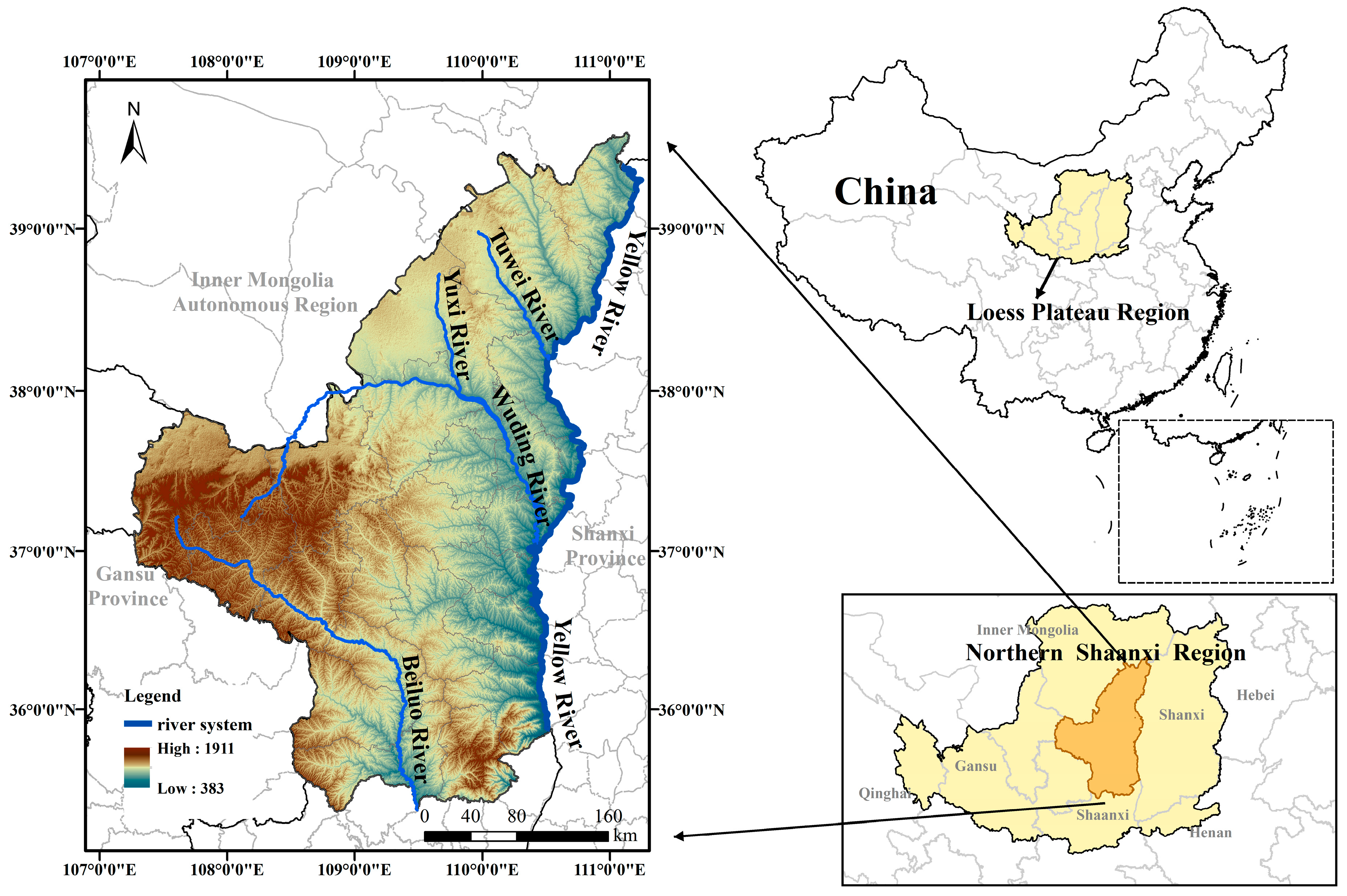
Figure 1. The study area.
Applsci 15 11306 g001
Figure 2. The zoning index system of AWLRs and processing technology.
Applsci 15 11306 g002
Figure 3. Two-stage K-Means++-AHC workflow.
Applsci 15 11306 g003
Figure 4. Spatial distribution of cultivated land.
Applsci 15 11306 g004
Figure 5. Spatial distribution of water resources.
Applsci 15 11306 g005
Figure 6. Spatial distribution of the AWLR matching pattern in Northern Shaanxi.
Applsci 15 11306 g006
Figure 7. Lorenz curve and Gini coefficient in NS from 2010 to 2021. (a) Lorenze curve between cultivated land and agricultural water, (b) Lorenze curve between land resources and water resources, (c) Lorenze curve between cultivated land agricultural output, (d) Lorenze curve between agricultural water and agricultural water output. Note: Gws is the Gini coefficient of agricultural water and land resources; G is the Gini coefficient of water and land resources; Gs is the Gini coefficient of cultivated land and agricultural output; and Gw is the Gini coefficient of agricultural water and agricultural output.
Applsci 15 11306 g007
Figure 8. Variation in the Gini coefficients from 2010 to 2021. (a) Variation in Gini coefficients of AWLR matching coefficient, (b) Variation in Gini coefficients of cultivated land benefits, (c) Variation in Gini coefficients of agricultural water benefits.
Applsci 15 11306 g008
Figure 9. Variation in Moran’s I between the AWLR matching coefficient and agricultural development level from 2010 to 2021.
Applsci 15 11306 g009
Figure 10. Scatter plots of Moran’ I between the AWLR matching coefficient and agricultural development level. (a) Scatter plots of Moran’ I in 2010, (b) Scatter plots of Moran’ I in 2016, (c) Scatter plots of Moran’ I in 2021.
Applsci 15 11306 g010
Figure 11. Spatial LISA clustering diagram of 5 km grid scale of AWLR matching and agricultural development levels in NS. (a) Spatial LISA clustering diagram in 2010, (b) Spatial LISA clustering diagram in 2016, (c) Spatial LISA clustering diagram in 2021.
Applsci 15 11306 g011
Figure 12. Coordination between agricultural development level and AWLR benefits.
Applsci 15 11306 g012
Figure 13. Clustering results of different cluster numbers.
Applsci 15 11306 g013
Figure 14. Zoning results.
Applsci 15 11306 g014
Figure 15. Silhouette coefficients of the three clustering algorithms.
Applsci 15 11306 g015
Table 1. Key statistical trends of AWLR matching, 2010 and 2021.
Statistic20102021
AWLR matching coefficient2029.02 m3/hm22390.67 m3/hm2
Gini coefficient of AWLRs0.480.40
Moran’s I0.320.43
Table 2. Values of NRCA for AWLRs in each zone.
ZoneAgricultural
Industrial
Economic
Benefit
Land
Resources
Water
Resources
Natural
Endowments
Matching CoefficientCoordinated Development DegreeXY
I−9.72−29.26−11.002.39−26.8670.00−63.62−0.2051.73
II6.13−3.5724.517.274.442.04−33.31−36.6220.44
III3.900.53−1.31−6.03−6.16−7.76−22.6119.177.72
IV10.1615.1714.6816.988.5937.5977.1523.9217.14
Note: X is the X-coordinate of the county centroid; Y is the Y-coordinate of the county centroid.
Table 3. Comparison of the three clustering algorithms using different evaluation indexes.
DatasetAlgorithmScore of Evaluation Indexes
PurityARIAMINMI
K-means++0.8730.7070.7550.758
IrisK-means-AHC0.8620.6870.7390.742
K-means++-AHC0.8850.7160.7740.777
K-means++0.8910.7110.6920.695
SeedsK-means-AHC0.8570.6400.6730.672
K-means++-AHC0.8920.7170.7040.728
K-means++0.3620.3890.5210. 663
TEAK-means-AHC0.4630.4360.6350.730
K-means++-AHC0.4760.4890.6990.834
Disclaimer/Publisher’s Note: The statements, opinions and data contained in all publications are solely those of the individual author(s) and contributor(s) and not of MDPI and/or the editor(s). MDPI and/or the editor(s) disclaim responsibility for any injury to people or property resulting from any ideas, methods, instructions or products referred to in the content.