1. Introduction
As typical representatives of cable-supported bridges, hybrid cable-stayed suspension bridges (HCSSBs) are increasingly adopted for bridges with span lengths exceeding 2000 m in highway projects or over 1000 m in rail–highway combined projects. Yet there is currently a lack of dedicated design specifications for HCSSBs, and thus they have been designed by resorting to specifications for either suspension bridges or cable-stayed bridges. Wind loads tend to induce torsional vibrations, dynamic instability, and fatigue damage in stay cables and deck systems [
1,
2,
3], while temperature loads cause combined bending–torsional deformation of box girders, alter material properties, and change structural stiffness [
4,
5,
6]. Long-span HCSSBs have a flexible hybrid cable system and significantly higher load sensitivity than conventional bridges due to their complex structural system. Both loads alone can significantly affect their structural safety. Moreover, the two loads often act concomitantly in service, so quantifying their combined effect becomes necessary to avoid design bias. HCSSBs’ geometric nonlinearity originates from the beam-column effect, large displacement effect, and cable sag effect [
7]. This nonlinearity is deeply coupled with wind–temperature loads, further amplifying structural response deterioration. Such coupling makes linear analysis alone prone to large deviations [
8,
9,
10,
11]; thus, load effect calculations must fully account for the combined action of multiple loads. Existing mainstream design specifications (Chinese JTG series, European Eurocode EN 1990 [
12], AASHTO LRFD) are tailored for conventional bridges, not for HCSSBs. These specifications ignore two core mechanical characteristics of HCSSBs: geometric nonlinearity derived from the beam-column effect and cable sag, and wind–temperature load correlation [
13]. For long-span HCSSBs with hybrid cable systems, directly adopting code-specified wind–temperature combination values may lead to overly conservative designs or insufficient safety reserves. This risk is further amplified by the structure’s inherent high load sensitivity. Thus, there is an urgent need to conduct specialized research into the mechanism of wind–temperature load combination and coefficient quantification for HCSSBs.
To address this gap, the analysis starts with examining engineering modeling conventions. In practice, a single load is typically treated as a random variable to simplify modeling [
14]. The core of reliable load combination research, however, lies in addressing three key issues: load correlation, nonlinearity, and rational combination coefficients. These factors directly determine the accuracy of structural load effect calculation and the balance between safety and economy. Existing studies gradually clarify the necessity of these issues and explore corresponding solutions, while also exposing limitations in adapting to long-span HCSSBs.
Regarding load correlation, it is essential for reflecting the actual co-occurrence law of multi-dimensional loads. Ignoring this correlation will distort load effect calculations. Academia has optimized multi-variable joint analysis methods [
15,
16,
17] to characterize load correlation more accurately. These methods include Archimedean copulas, C-vine copulas, and bivariate joint probability models, and they have proven effective in transportation and civil engineering. For example, they are used to analyze wind speed–direction joint distribution [
18,
19], quantify multi-station wind spatial correlation [
20,
21], and explore coupling effects of single load pairs (e.g., wind-direction and wind–rain) [
22,
23]. Such applications not only confirm the methods’ effectiveness in capturing practical load characteristics but also provide technical support for accurately describing load co-occurrence laws and improving the accuracy of load combination research. However, existing correlation research mostly focuses on conventional cable-stayed or suspension bridges, with no targeted analysis of wind–temperature correlation for HCSSBs. These studies fail to address two key features of HCSSBs: one relates to the unique coupling between wind–temperature loads and the hybrid cable system, which amplifies stress responses via cable sag and tower–girder interaction; the other concerns the rare co-occurrence law of extreme wind and temperature at long-span bridge sites [
13]. Even early joint calibration frameworks (e.g., Thoft-Cristensen [
24] based on the design value method [
25]) omitted wind–temperature correlation, further widening the research gap for HCSSBs. Notably, extreme wind and temperature rarely co-occur at bridge sites, which makes the independent assumption in conventional methods more unreasonable. Conventional methods ignore the actual correlation between wind and temperature, leading to inaccurate load effect calculations.
For nonlinearity, which is an inevitable requirement for long-span cable-supported bridges, ignoring HCSSBs’ geometric nonlinearity will seriously distort structural response calculations. Existing studies have proposed three solutions for addressing nonlinearity in load combination, but all are ill-suited for HCSSBs. One approach is nonlinear failure surface linearization [
26,
27], which approximates the expected exceedance rate by simplifying nonlinear relationships and has been applied to optimize the Ferry Borges–Castanheta combination rule [
28], but it is only suitable for mild nonlinear scenarios. Another is Breitung’s asymptotic solutions [
29,
30], which can improve the accuracy of extreme effect estimation for moderately nonlinear structures. The third is stochastic simulation methods such as directional simulation [
31,
32], which handle complex nonlinear integral problems but face large computational loads when applied to HCSSBs. Moreover, HCSSBs’ nonlinearity further amplifies structural responses under wind–temperature coupling conditions. This amplification exacerbates the deviation of linear analysis results, which conventional methods rely on. In general, these methods have adaptability or efficiency limitations for HCSSBs.
As for load combination coefficients and methods, which are key to connecting load characteristics with structural design, unreasonable coefficients cause excessive conservatism such as increasing dead load and cost or insufficient safety that undermines reliability. Typical existing schemes for load combination include two main types: One is the fixed-coefficient Turkstra rule [
33]. It is based on the “single load peak” assumption and widely adopted in Chinese JTG 2120-2020 [
34]. The other is the “dominant load + reduction coefficient” mode of Eurocode (EN 1990 [
35]). However, these schemes have obvious limitations for HCSSBs: the Turkstra rule ignores load correlation and structural nonlinearity, while Eurocode’s mode, though more consistent with actual load action laws, lacks adjustments for HCSSBs’ unique geometric nonlinearity. Both schemes rely on semi-probabilistic simplification strategies developed for conventional bridges, which fail to account for HCSSBs’ “correlation–nonlinearity coupling” feature. There are also Copula-derived load-level coefficients that cannot link load reduction effects with structural nonlinear responses, leading to inconsistencies between coefficient values and actual structural load effect laws. Most existing coefficients are calibrated for conventional bridges, and no specialized research has integrated load correlation and structural nonlinearity to develop coefficients for HCSSBs. For example, Sørensen [
36] proposed a coefficient quantification method by comparing the design value method and FORM-based approach, but this method still relies on linear load effect assumptions, which contradicts the actual mechanical behavior of HCSSBs under wind–temperature coupling conditions.
In view of the above limitations, this study proposes an integrated framework for HCSSBs to quantify wind–temperature load combination coefficients, which systematically incorporates load correlation and structural nonlinearity. Initially, long-sequence meteorological data are used to construct joint probability models to characterize load correlation [
37]. Subsequently, nonlinear finite element simulation is employed to map load scenarios to structural stress responses. Ultimately, statistical fitting of extreme responses is conducted to derive combination coefficients, converting environmental parameter joint distributions into extreme response distributions for more direct long-term extreme response estimation [
38]. This framework bridges the gap between traditional simplified methods and the actual mechanical behavior of HCSSBs, providing a reliable technical path for load combination design.
The remaining structure of this paper is arranged as follows:
Section 2 elaborates on the methodology for wind–temperature load combination coefficient calculation of HCSSBs, focusing on addressing load correlation and structural nonlinearity.
Section 3 presents a case study where this methodology is applied to an HCSSB with a 2300 m main span. Finally,
Section 4 summarizes the conclusions and puts forward relevant recommendations.
2. Methodology
2.1. General Concepts
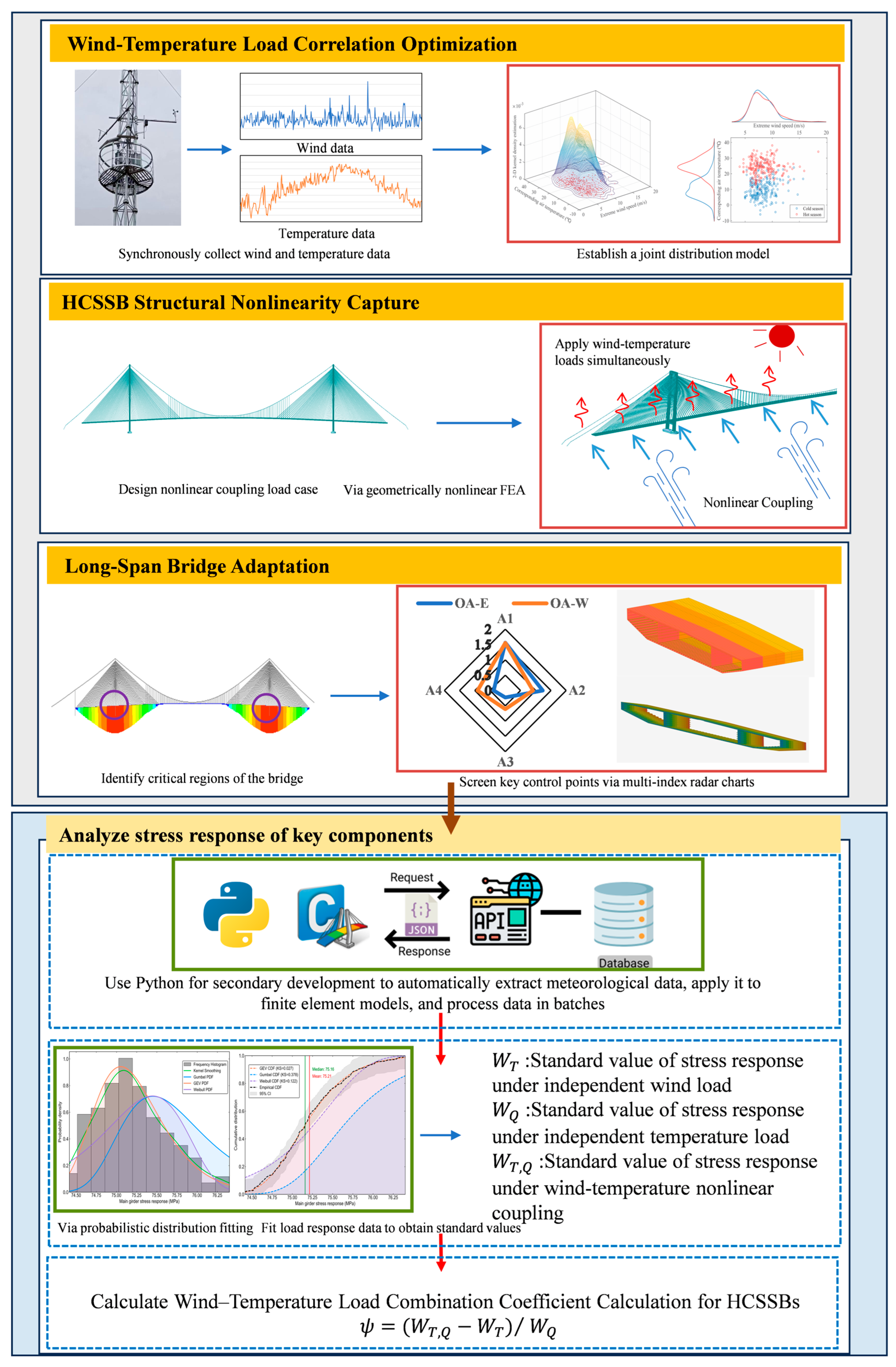
To address the specific challenges faced by HCSSBs in maintaining compatibility with conventional design systems, a three-strategy framework was developed to determine load combination coefficients. The first strategy quantifies the co-occurrence law of wind and temperature loads to adjust input parameters to compensate for the “independent assumption” defect in traditional specifications. The second strategy involves designing nonlinear coupled load cases that simultaneously apply wind and temperature loads, in which structural responses, including geometric nonlinear effects, are directly obtained to ensure full capture of nonlinearity. The third strategy identifies and screens sensitive control points of the structure to eliminate interference from non-critical areas and enables the specification framework to focus on HCSSBs’ core response characteristics. As illustrated in
Figure 1, this calculation logic incorporates key influencing factors, including load correlation and structural nonlinearity within the existing specification system. Notably, the wind load considered in this study refers specifically to static (quasi-static) wind load—consistent with the three-strategy framework’s focus on long-term extreme load combination. Wind-induced dynamic aerodynamic effects mentioned in the Introduction are beyond the scope of this static load combination research as they require wind tunnel tests or dynamic time-history analysis; these dynamic effects will be explored in subsequent multi-hazard coupling studies.
This approach avoids the need to reconstruct methodological frameworks, thereby facilitating code adaptation while maintaining alignment with engineering practice.
2.2. Derivation of Wind–Temperature Load Combination Coefficient
To address the limitations of traditional methods ignoring load correlation and nonlinearity, the core formula for the wind–temperature load combination coefficient for HCSSBs is proposed. This formula is rational as it combines structural mechanics principles, compatibility with design codes, and engineering practicality.
The core formula connects the independent wind load effect (
), independent temperature load effect (
), and wind–temperature nonlinear coupling effect (
) as
In the formula,
is the standard value of structural stress response under independent wind load,
is the standard value of structural stress response under independent temperature load, and
is the standard value of structural stress response under wind–temperature nonlinear coupling conditions—notably,
inherently incorporates geometric nonlinear effects as it is obtained through wind–temperature nonlinear load coupling calculations that involve a nonlinear method with stiffness matrix updating. All three standard values comply with JTG D60-2015 [
39], ensuring consistency with the existing bridge design code system.
Figure 1.
Technical roadmap for HCSSB wind–temperature load combination coefficient research.
Figure 1.
Technical roadmap for HCSSB wind–temperature load combination coefficient research.
The rationality of this formula can be illustrated from four perspectives. Starting with the actual working state of HCSSBs, in conventional load scenarios, HCSSBs mainly operate in the elastic stage with small deformations. Although geometric nonlinearities such as beam-column action and cable sag exist, their impact on load effects is moderate—this makes a simplified form of “linear expression + coefficient correction” feasible, eliminating the need for complex nonlinear equations. In terms of adaptability to common engineering methods, the formula utilizes the mature “equivalent linearization” approach widely used in the industry. It takes a linear expression as the foundation and uses the combination coefficient to correct the deviation between the linear expression and the actual nonlinear coupling effect, balancing calculation efficiency and result accuracy while retaining the linear analysis logic familiar to engineers. From the perspective of compatibility with design codes: the formula strictly follows the core framework of “standard value × combination coefficient” in the above-mentioned specifications. This avoids code adaptation issues caused by reconstructing the method system, ensuring the derived combination coefficients can be directly applied to engineering design. Regarding the correction of flaws in traditional methods, traditional methods assume loads are independent and ignore nonlinearity. In contrast, this formula incorporates load correlation through . This term reflects the structural stress response under the combined effect of wind and temperature. Meanwhile, the formula addresses nonlinearity through . In this way, it directly remedies the defects of traditional methods.
The combination coefficient
is used to quantify the equivalent contribution of temperature load in the nonlinear coupling scenario by rearranging the formula as follows:
The following sections focus on accurately obtaining three core parameters (,, and ) via targeted technical steps—this ensures the combination coefficient is both rational and accurate.
2.3. Probability Distribution Fitting of Load Effects with Key Control Points
To calculate the wind–temperature load combination coefficient
in
Section 2.2, we need to first determine the load effect standard values. Determining these standard values relies on two key technical actions. One key action is screening key control points, which ensures stress data reflects the most unfavorable state of the structure. The other key action is conducting probability distribution fitting, which extracts the statistical characteristics of the data. This section details these two actions. They together provide a basis for determining the load effect standard values of wind, temperature, and wind–temperature coupling loads.
2.3.1. Selection of Key Control Points
Load effect standard values depend on reliable data, which can include stress, displacement, and internal force. If such data does not represent the structure’s most unfavorable state, calculated parameters will be biased. In HCSSBs, stress is a core indicator of structural safety and nonlinear response because the stress concentration and extreme stress levels directly reflect the structure’s load-bearing limit. Thus, this subsection focuses on selecting key control points to ensure the stress data used for calculating load effect standard values represents the structure’s most unfavorable state under wind and temperature effects.
Key control points are selected based on two core principles. Mechanical criticality guides the prioritization of areas with concentrated stress or abrupt stiffness changes as these regions are sensitive to load effects and directly relate to structural safety reserves. Meanwhile, engineering operability is addressed by selecting points where stress can be easily extracted from finite element models, and structural symmetry is leveraged to reduce computational effort while preserving the representativeness of the results.
Three complementary indicators are used for screening, targeted at the sensitivity characteristics of HCSSBs regarding wind–temperature coupling—this ensures selected control points can reflect the most unfavorable structural state and support accurate calculation of , , and .
(1) The Comprehensive Load Effect Index (
) integrates extreme load effect indices in linear superposition (LSP) and nonlinear coupling (NLC) scenarios. The traditional Extreme Intensity Index (
EII) for a single scenario is defined as
where
denotes the mean of load effects,
denotes the coefficient of variation of load effects, and “Base Intensity” is the reference stress level. The comprehensive index is then
where
and
are the extreme indices in linear and nonlinear scenarios, respectively. The core purpose of setting
is to avoid the one-sidedness of traditional single-scenario screening. Under wind–temperature coupling conditions in HCSSBs, both linear effects and nonlinear effects significantly affect stress responses. Relying solely on
may lead to the omission of nonlinear-sensitive areas, while focusing only on
deviates from conventional engineering analysis logic. Taking the average of the two ensures the screening results cover both stress mechanisms and accurately locate the most unfavorable sensitive areas of the structure.
(2) The combined load proportion (
) quantifies the contribution of wind–temperature loads relative to dead load:
where
is the stress under wind–temperature linear superposition conditions, and
is the stress under dead load alone. The key value of setting
lies in adapting to the stress differences of the hybrid cable system in HCSSBs. Different components vary greatly in sensitivity to wind–temperature loads. By quantifying the contribution of wind–temperature loads relative to dead load through
, areas with negligible wind–temperature effects can be quickly excluded, avoiding invalid calculations from occupying resources. This ensures subsequent analysis focuses on core components where wind–temperature effects are significant.
(3) The Nonlinear Influence Degree (
) measures the impact of geometric nonlinearity:
where
is the stress under nonlinear coupling conditions. Setting
is specifically to address the limitations of traditional linear analysis. The geometric nonlinearity of HCSSBs significantly changes stress distribution, and calculations based solely on linear stress
tend to cause result deviations.
can quantitatively determine the degree of nonlinear influence on each control point, ensuring only areas with significant nonlinear effects are included in key analysis, balancing calculation accuracy and efficiency.
Through the above three indicators, key control points were determined for subsequent stress analysis. This ensures the representativeness of , , and in the combination coefficient formula. The stress data collected from these key control points were used to conduct probability distribution fitting as described in the following subsection, laying a data foundation for determining load effect standard values.
2.3.2. Probability Distribution Fitting of Load Effects
Based on the representative stress data of key control points, it is necessary to characterize the probabilistic characteristics of wind, temperature, and wind–temperature coupling load effects through distribution fitting. This subsection focuses on probability distribution fitting of these load effects, which provides a statistical basis for determining their standard values.
Only with representative stress data can the fitted distribution accurately reflect the statistical characteristics of load effects, avoiding bias in standard value calculation. To characterize the probabilistic characteristics of wind, temperature, and wind–temperature coupling load effects, three extreme value distributions widely used in structural reliability analysis were selected for fitting: Gumbel, Generalized Extreme Value (GEV), and Weibull. Their cumulative distribution functions (CDFs) and probability density functions (PDFs) are shown in
Table 1.
A multi-criteria evaluation system was established to select the optimal distribution model—this ensures the accuracy of the 0.95 quantile calculation. Quantitative indicators include Root Mean Square Error (RMSE), the Akaike Information Criterion (AIC), and the Bayesian Information Criterion (BIC).
RMSE reflects fitting accuracy and is calculated as
where
denotes the theoretical cumulative probability,
denotes the empirical cumulative probability, and n denotes the sample size.
The AIC and BIC balance model complexity and goodness-of-fit and are calculated as
where
denotes the number of model parameters,
is the likelihood function value, and
is the sample size.
Qualitative verification was conducted through two methods. The Kolmogorov–Smirnov (KS) test uses a significance level of
, judging the overall consistency of the distribution by the global maximum deviation, calculated as
2.4. Design of Load Scenarios
The three types of load effects (individual wind, individual temperature, and wind–temperature coupling) corresponding to the combination coefficient formula need to be obtained through targeted load scenarios. This section focuses on the design of load scenarios, where different scenarios are tailored to separately obtain load effects of individual wind, individual temperature, and wind–temperature nonlinear coupling.
To obtain accurate individual and coupled load effects, four scenarios were designed. They work together to provide the three core parameters for the combination coefficient formula.
Scenario design focused on transverse winds. Transverse winds are the most significant direction for HCSSBs because they induce asymmetric internal forces and large vibrations. Four load scenarios with dead load as the baseline were designed. Each scenario undertakes a distinct task to acquire the three core parameters for the combination coefficient formula:
(1) Individual temperature load (EHT)
This scenario applies extreme high-temperature loads to the structure as nodal temperature rises. It obtains the standard value of temperature load effect , which is the independent temperature parameter for the combination coefficient formula.
(2) Individual wind load (ECC)
This scenario applies transverse winds in opposing directions. Wind loads are applied to the entire structure, with concentrated forces on cables and distributed forces on the main tower and girder. This bidirectional setup covers symmetric stress states of HCSSBs, ensuring the representativeness of the wind load effect standard value .
(3) Wind–temperature linear superposition (LSP)
Wind and temperature loads are applied at the same time, with geometric nonlinearity turned off in the finite element model. This scenario follows the linear combination method in traditional design codes. It acts as a benchmark for comparison with nonlinear coupling results and shows why considering nonlinearity is necessary.
(4) Wind–temperature nonlinear coupling (NLC)
This scenario simulates the actual service state of HCSSBs in which wind and temperature load act together, accompanied by inherent geometric nonlinear effects. Wind and temperature loads are applied simultaneously, and the geometric nonlinearity switch in the finite element model is turned on to account for stiffness changes caused by structural deformation. This scenario is used to obtain the coupling effect standard value , with the calculated results inherently reflecting nonlinear responses. It avoids errors from traditional linear analysis (which simply adds individual load effects) by directly simulating the nonlinear coupling of combined loads.
These four scenarios form a coordinated technical framework to support the combination coefficient formula. By integrating independent effect measurement (EHT and ECC), linear method benchmarking (LSP), and actual coupling effect acquisition (NLC), they ensure the reliable acquisition of all required parameters. This design bridges the gap between targeted load scenario design and accurate coefficient calculation, laying a solid foundation for the application of the combination coefficient formula.
3. Case Study
3.1. Engineering Background
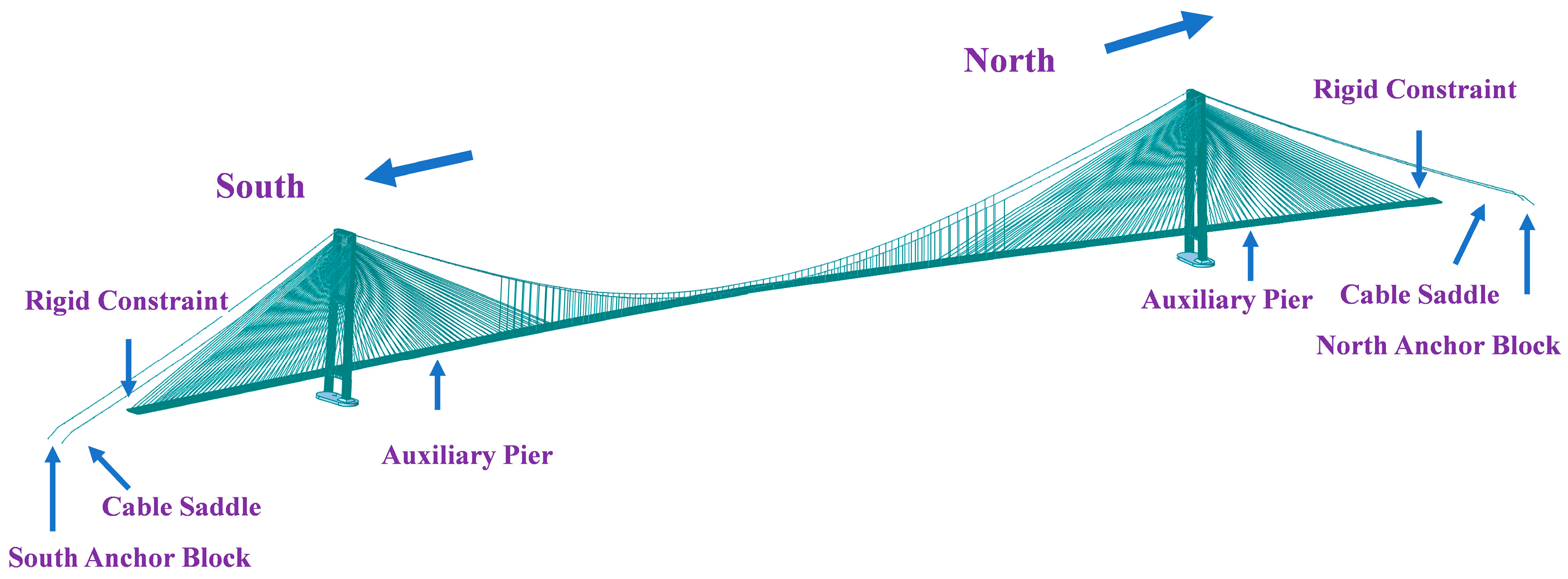
This study takes an HCSSB as the engineering case. The bridge is designed to have two-way eight lanes, with a design reference period of 100 years. The bridge uses an elastically supported semi-floating support system: rigid tension-compression bearings are installed at the main towers, auxiliary piers, and transition piers to provide vertical constraints. Longitudinally, displacement is restricted by a “limit stops + dampers” system; transversely, wind-resistant bearings at each pier and tower provide transverse constraints. The anchorage is a gravity-type structure; the cable saddle pier and front anchor chamber are constructed using C40 concrete, the anchor block using C30 concrete, and the foundation is a group pile foundation. The overall layout of the bridge is illustrated in
Figure 2.
3.2. Establishment of Finite Element Model
The main cable system comprises two cables with a center-to-center distance of 43.0 m. Fabricated via the Preformed Parallel Wire Strand (PPWS) method, each main cable consists of 169 full-length strands, including 4 backstay strands on the south side and 8 backstay strands on the north side. Each strand is composed of 127 high-strength galvanized aluminum wires with a diameter of 5.75 mm, and the nominal tensile strength of the wires is 2200 MPa; the hangers are constructed using 1770 MPa parallel steel wire strands, with 2 strands installed at each hanging point; and the stay cables use 2100 MPa parallel steel wires. The main girder features a single-box double-chamber section with inclined webs, with a height of 4.0 m, top plate width of 19.95 m, bottom plate width of 10.9 m, flange cantilever length of 3.275 m, and overall standard width of 40.6 m. The cable tower, with main steel grade Q420qD, includes a portal frame structure where three crossbeams divide it into upper, middle, and lower tower columns. The key parameters of the aforementioned main structural components are detailed in
Table 2.
The bridge’s finite element model (FEM) was established using Midas Civil NX software (
Figure 3). The full-bridge model includes 2838 nodes and 3016 elements, enabling refined simulation of key components. For the cable system—acting as the core load-bearing component driving the catenary effect—tension-only truss elements were used as the primary type, with cable elements as auxiliary support. This combination ensures cables only bear axial tension (avoiding compressive instability) and directly enables the simulation of the catenary effect. Specifically, the auxiliary cable elements inherently account for cable sag (the key mechanical feature of the catenary effect); meanwhile, in the dead load scenario, gravity, temperature loads, node forces, and element continuous forces were applied to correct the unstressed length of all structural components. This full-bridge correction targets length deviations induced by the cable system’s catenary effect, which in turn calibrates the actual sag–span ratio of the cable system and further ensures accurate capture of the catenary effect.
For material constitutive models, all components have elastic constitutive relations: steel components use parameters consistent with conventional bridge engineering practices, and concrete components (anchor blocks, piers) reference the elastic modulus provisions in “Code for Design of Highway Bridges and Culverts” (JTG D60–2015). Hysteresis rules were not applied as the study focuses on static wind–temperature load combination, and the structure remains in the elastic stage under the designed load conditions, with no cyclic or dynamic loading scenarios involved.
The completed state of the bridge was determined using the analytical method [
40]. This method, though not exclusive to HCSSBs, exhibits strong adaptability to the structural characteristics of the studied HCSSB—specifically, it effectively addresses the force-deformation coordination of hybrid cable systems (main cables + stay cables), which aligns with the bridge’s design parameters outlined in
Section 3.1.
Core input parameters for this analytical method, including the initial geometry of main cables and pre-tension strain of stay cables, are derived from the bridge’s design values. The catenary shape of main cables is calculated based on the design span and sag–span ratio, while the pre-tension strain of stay cables (2100 MPa parallel steel wires) refers to the recommended values in JTG D60-2015. This ensures consistency with the structural material properties detailed in
Section 3.2.
Notably, the method integrates key mechanical behaviors of the studied HCSSB—such as the cable sag effect of main cables and elastic deformation of stay cables—into force balance and geometric deformation equations. This integration guarantees the rationality of the completed state parameters (alignment and strain), which are subsequently imported into the finite element model for further analysis.
3.3. Meteorological Data Processing
For long-span HCSSBs, extreme high temperatures, 100-year return period wind speeds, and their coupling effects are critical load factors. This study adopted long-sequence meteorological data verified by regional stations. Reference [
13] used this dataset specifically to derive wind–temperature statistical correlation coefficients: it utilized Archimedean copulas to construct the wind–temperature bivariate joint distribution, first quantifying the dependence between wind and temperature via Kendall’s τ (a core indicator for measuring statistical correlation), then calibrating the copula parameter θ to optimize the distribution’s fit to the actual co-occurrence characteristics of wind and temperature. This validated Copula-based framework, together with the confirmed rare co-occurrence law of extreme wind and temperature, provides a reliable basis for the probabilistic modeling of load combinations in this study.
To address the defect of ignoring wind–temperature load correlation in traditional methods, Monte Carlo simulation was used to generate load samples. Taking the Copula-based wind–temperature bivariate joint distribution as input, this simulation effectively captured the actual co-occurrence law of wind and temperature. From the verified meteorological data, three 100-year load sequences for scenario input were generated: independent high-temperature (Sequence A), independent wind speed (Sequence B), and correlated wind–temperature (Sequence C). With a final sample size N = 250, convergence was verified using the coefficient of variation (CV) stability method—where the CV of stress responses (e.g., main girder A1, main tower B6) fluctuated by less than 5% over 3 consecutive simulation rounds—alongside a stress response error of less than 3% relative to the theoretical mean, ensuring reliability for subsequent finite element simulations.
Notably, the generated sequences A, B, and C are raw atmospheric data that cannot directly meet the load demand of bridge finite element models. Ambient temperature fails to reflect structural thermal stress from temperature differences, and ambient wind speed cannot be directly loaded as a force on components. Thus, subsequent steps will convert these raw meteorological data into structural load inputs for scenario simulations via Equations (11)–(15).
3.3.1. Temperature Data Processing
Extreme high-temperature sequences are converted to average bridge temperatures using the following equation:
where
denotes the average bridge temperature,
denotes the high temperature sequence in the sample set—this transformation adapts JTG D60–2015’s [
39] general provisions to the study bridge’s regional climate. The temperature action difference is calculated as
where
denotes the bridge closure temperature, taken as 15 °C according to Reference [
13], and
denotes the temperature action difference.
3.3.2. Wind Speed and Wind Pressure Calculation
Wind speeds are first converted to the 10 m benchmark height using
where
denotes the original wind speed sequence in the sample set, and
denotes the converted reference wind speed at the 10 m benchmark height.
Subsequently, in accordance with “Specifications for Wind Resistance Design of Highway Bridges” (JTG/T 3360-01-2018) [
41], wind speeds at the target structural height are obtained via height correction:
where
denotes the target wind-affected height of the bridge structure, determined in combination with the overall layout of the bridge;
denotes the wind speed profile index of the atmospheric boundary layer—valued according to the site landform type as specified in JTG/T 3360-01-2018 [
41]—and the specific value
is determined according to Reference [
13] through regional landform analysis and long-term on-site wind monitoring.
Wind pressure
acting on the structure is calculated as
where
denotes the air density, taken as
under standard conditions, and
denotes the shape coefficient of the component, which varies due to differences in the aerodynamic shape of different components and needs to be valued separately according to characteristics.
3.3.3. Load Sequence Processing for Scenario Input
Via Equations (11)–(15), sequences A, B, and C were processed into practical load inputs: A’ for the individual temperature load (EHT) scenario, B’ for the individual wind load (ECC) scenario and combined scenarios, and C’ for the wind–temperature linear superposition (LSP) and nonlinear coupling (NLC) scenarios. These inputs supported subsequent scenario simulations.
3.4. Working Scenario Settings
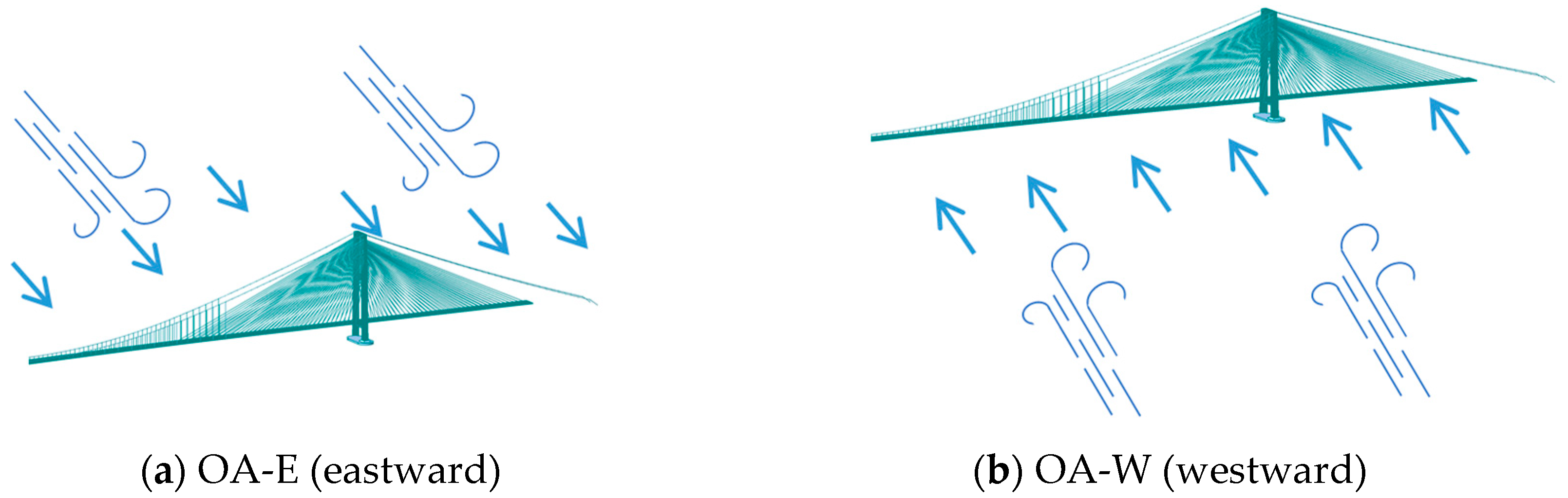
Transverse winds are the most influential direction for HCSSBs as they induce asymmetric internal forces and large vibrations. Considering the structural symmetry of the bridge, two transverse wind scenarios were designed: OA-E (eastward,
Figure 4a) and OA-W (westward,
Figure 4b).
For each direction, four loading scenarios were set with dead load as the baseline. For the NLC scenarios (OA-E4, OA-W4) corresponding to wind–temperature coupling, geometric nonlinearity was modeled in the Midas Civil finite element model as follows: the “Geometric Nonlinearity” switch was enabled, the Newton–Raphson method was used for nonlinear solution, and loads were applied incrementally with the structural stiffness matrix updated at each step. These measures ensure the stress responses of NLC scenarios fully include nonlinear effects. The scenarios directly match the processed load sequences (A’, B’, and C’) from
Section 3.3, and their key parameter correspondences are detailed in
Table 3.
3.5. Preliminary Selection of Control Points
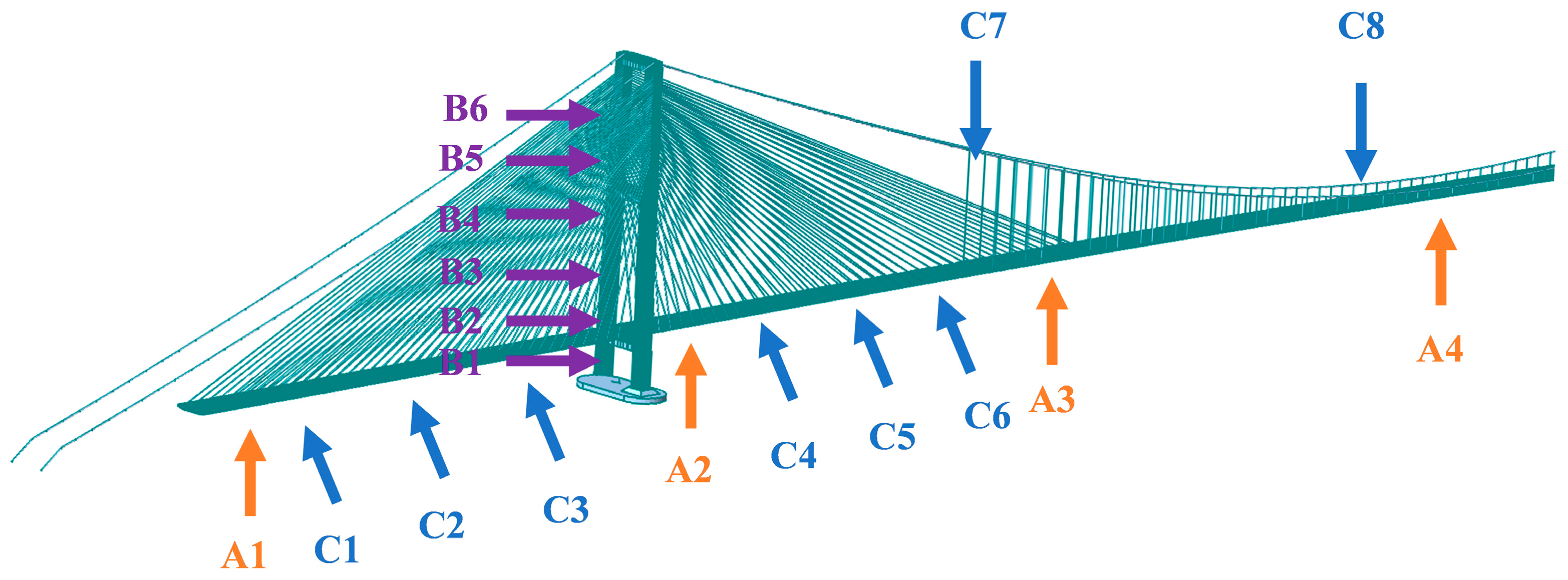
In the analysis of the probability distribution of bridge structural stress responses, the selection of control points is critical. These points are defined as preliminary control points, serving as candidates for subsequent key control point screening. Following the control point selection principles, specific locations for the main girder, main tower, and cable system were selected as shown in
Table 4,
Table 5 and
Table 6, with their specific location information corresponding to
Figure 5. Stress data of these control points were monitored, collected, and used for in-depth probabilistic analysis of stress responses. This data supports evaluating the bridge’s mechanical properties in different scenarios. Furthermore, due to the bridge’s symmetry, only half of the structure was selected for analysis in this study.
3.6. Key Control Point Screening
To determine control points that support accurate load combination coefficient calculation, stress responses of the preliminary control points (main girder: A1–A4; main tower: B1–B6; and cable system: C1–D2) were statistically analyzed in eastward (OA-E) and westward (OA-W) wind–temperature scenarios, with the derived statistical results used for subsequent sensitivity screening.
Three indicators are used for screening: the Comprehensive Load Effect Index (), combined load proportion (), and Nonlinear Influence Degree (). Their calculation formulas are given in Equations (3)–(6). All parameter values in these formulas are derived from the study’s methodological details.
For Equation (3), (mean of load effects) and (coefficient of variation) are the statistical results of 250 stress samples of each preliminary control point in the LSP or NLC scenario; “Base Intensity” is uniformly set to 50 MPa to standardize the calculation scale across components.
For Equation (4), and are the Equation (3)-derived EII values of the same control point in the LSP scenario (geometric nonlinearity off) and NLC scenario (geometric nonlinearity on), respectively; their average comprehensively characterizes load sensitivity for both linear and nonlinear mechanisms.
Equation (5) quantifies wind–temperature load contribution relative to dead load: is the arithmetic mean of 250 stress samples of the control point in the LSP scenario (eliminating single-sample randomness), and is a deterministic value from single finite element calculation under dead load alone.
For Equation (6), which measures geometric nonlinearity impact, is consistent with that in Equation (5), and is the arithmetic mean of 250 stress samples of the same control point in the NLC scenario (incorporating nonlinear responses).
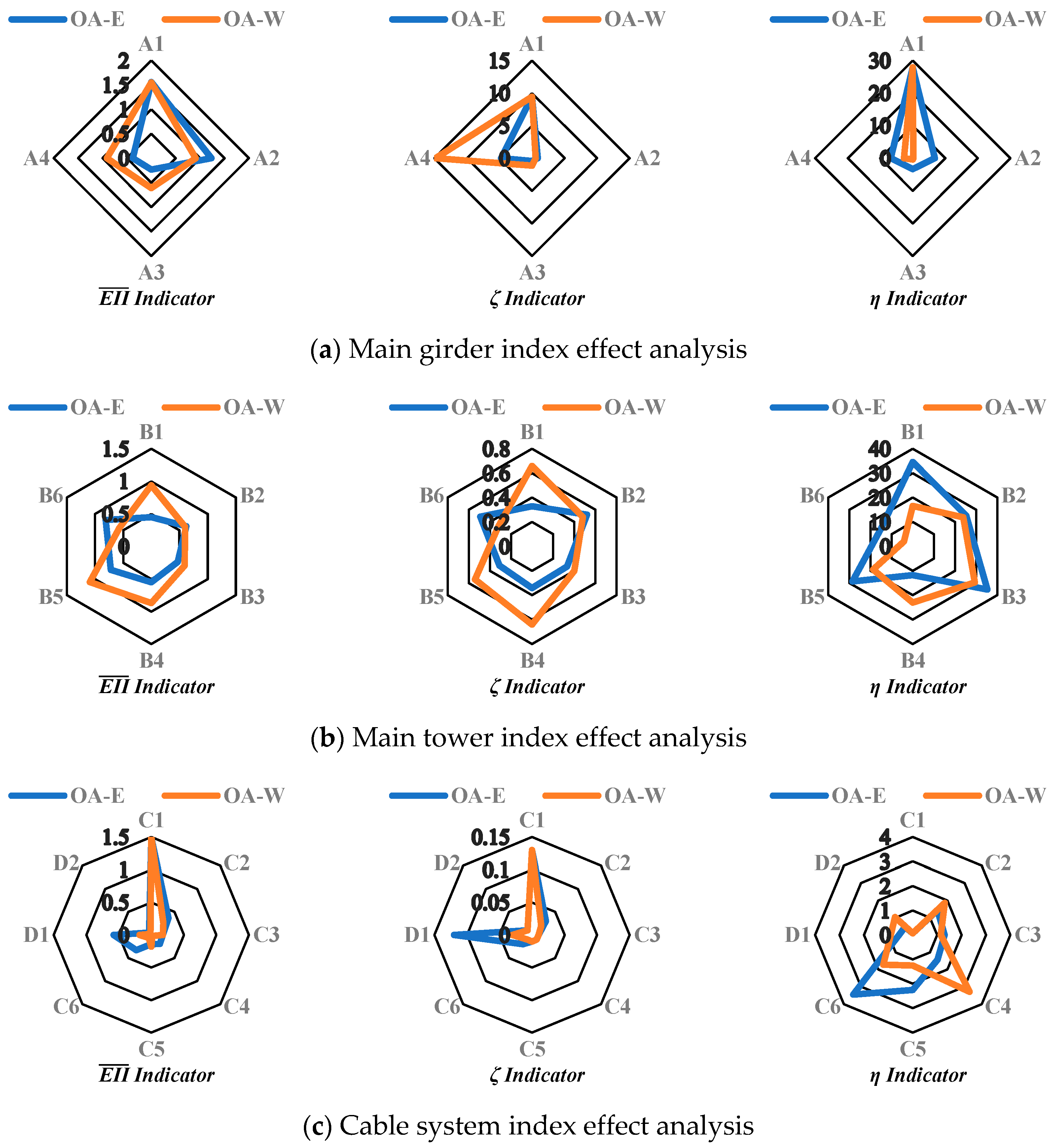
Radar charts (
Figure 6) visualize these indicators for the main girder, main tower, and cable system in OA-E and OA-W scenarios. The analysis results confirm that the geometric nonlinearity of HCSSBs under wind–temperature loads cannot be ignored.
For the main girder, point A1 was confirmed as the key control point. Its (1.55–1.56) and (9.45–9.46) are significantly higher than other preliminary points, indicating high sensitivity to wind–temperature coupling—consistent with the requirement to reflect the most unfavorable structural state.
For the main tower, key control points vary with wind direction: point B6 (OA-E) and point B5 (OA-W) were selected. Both points have critical (0.81–1.09) and (0.49–0.54), ensuring they capture the tower’s stress response characteristics under wind–temperature loads.
For the cable system, no key control points were selected. Most preliminary points have < 0.05, meaning wind–temperature loads contribute minimally to their stress; even points with slightly higher do not affect the overall load combination logic, so they were excluded from subsequent analysis.
3.7. Probability Modeling of Stress Response and Calculation of Load Combination Coefficients
To derive wind–temperature load combination coefficients via probability modeling, the analysis was conducted within a scenario framework that aligns with HCSSBs’ structural characteristics and the load-action logic defined in
Section 2.4 and
Section 3.4. This framework comprises two transverse wind direction scenarios and three core load scenarios directly supporting coefficient calculation. The transverse wind direction scenarios are eastward (OA-E) and westward (OA-W)—selected for their significant impact on HCSSBs as elaborated in
Section 3.4. The three core load scenarios are individual wind load (ECC), individual temperature load (EHT), and wind–temperature nonlinear coupling (NLC)—consistent with the load design in
Section 2.4 to obtain the three key stress standard values
,
, and
required for coefficient calculation.
Probability modeling focuses on the stress responses of key control points (main girder A1, main tower B5 for OA-W, main tower B6 for OA-E) for each combination of wind direction and load scenario. Specifically, modeling for the ECC scenario aims to determine (standard stress under independent wind load); modeling for the EHT scenario targets (standard stress under independent temperature load); and modeling for the NLC scenario focuses on (standard stress under nonlinear coupling conditions, incorporating geometric nonlinear effects). This scenario-specific approach ensures the statistical characteristics of stress responses, and thus the derived combination coefficients are traceable to actual structural service conditions.
To derive wind–temperature load combination coefficients, probability modeling was conducted on stress responses of the key control points. Three extreme value distributions (Gumbel, GEV, and Weibull) were used for fitting, with model screening based on the multi-criteria evaluation system defined in
Section 2.3 (RMSE, AIC, BIC, and KS test).
The optimal distribution model was identified via this evaluation system: it effectively captured the probabilistic characteristics of stress responses under wind–temperature loads, with detailed fitting parameters presented in
Appendix A (
Table A1 and
Table A2).
For the main girder, the Generalized Extreme Value (GEV) distribution is the dominant optimal model, applicable to EHT, OA-E/ECC, and NLC scenarios. This is supported by its minimal Root Mean Square Error (RMSE ≤ 0.021) and Akaike Information Criterion (AIC ≤ 302.3) among the three distributions (
Table A1). The only exception is the OA-W/ECC scenario, where the Weibull distribution is preferred—this is due to the non-negative, right-skewed stress data of the main girder’s side-span auxiliary pier area under westward wind conditions, and Weibull’s superior fitting performance for such data (RMSE = 0.019, the smallest among three models).
For the main tower, the GEV distribution is the optimal choice for all scenarios and both wind directions. As shown in
Table A2, GEV consistently achieves the smallest RMSE (≤0.017) and AIC (≤1235.2) and passes the Kolmogorov–Smirnov (KS) test (α = 0.05). This consistency stems from the stable load transfer path of the portal-frame tower, where stress responses under wind–temperature loads exhibit smooth extreme value characteristics that match GEV’s adaptability to diverse tail distributions.
Notably, the Gumbel distribution was not selected as optimal in any scenario as its symmetric extreme value assumption fails to capture the slight skewness of HCSSB stress responses induced by asymmetric load transfer (e.g., tower–cable interaction and inclined web section of the main girder).
This distribution selection result confirms that GEV is the most reliable model for HCSSB key component stress responses under wind–temperature loads—its adaptability to diverse load-induced extreme value characteristics ensures the accuracy of subsequent quantile calculations. The only Weibull-based exception (main girder OA-W/ECC) is scenario-specific and does not affect the overall reliability of probability modeling as it is strictly supported by data characteristics. Based on the HCSSB’s 100-year design reference period, the 0.95 quantile of the optimal distribution was defined as the stress standard value, with specific results provided in
Table 7 and
Table 8. These standard values were substituted into Equations (1) and (2). Considering the unavoidable geometric nonlinear effect of wind–temperature coupling, the load combination coefficients for critical structural components were finally calculated: for the main girder, the coefficients are 0.60 (OA-E, eastward) and 0.59 (OA-W, westward); for the main tower, the coefficients are 0.51 (OA-E) and 0.58 (OA-W).
3.8. Summary of Key Results
The key results of the wind–temperature load combination coefficients for the 2300 m long HCSSB are summarized as follows: The main girder coefficients are 0.60 (OA-E) and 0.59 (OA-W), with a minimal directional difference of 0.01; the main tower coefficients are 0.51 (OA-E) and 0.58 (OA-W), with a more significant directional difference of 0.07.