Article

Application of Comprehensive Geophysical Methods in the Exploration of Fire Area No. 1 in the Miaoergou Coal Field, Xinjiang

1
Xinjiang Key Laboratory for Geodynamic Processes and Metallogenic Prognosis of the Central Asian Orogenic Belt, Xinjiang University, Urumqi 830047, China
2
Institute of Geology and Mines Engineering, Xinjiang University, Urumqi 830047, China
3
School of Resources and Geosciences, China University of Mining and Technology, Xuzhou 221008, China
*
Author to whom correspondence should be addressed.
Appl. Sci. 2025, 15(20), 11164; https://doi.org/10.3390/app152011164
Submission received: 15 September 2025 / Revised: 11 October 2025 / Accepted: 13 October 2025 / Published: 17 October 2025

Abstract

Coal spontaneous combustion in arid regions poses severe threats to both ecological security and resource sustainability. Focusing on the detection challenges in Fire Zone No. 1 of the Miaoergou Coalfield, Xinjiang, this study proposes an Integrated Geophysical Collaborative Detection Framework that combines high-precision magnetic surveys, spontaneous potential (SP) measurements, and transient electromagnetic (TEM) methods. This innovative framework effectively overcomes the limitations of traditional single-method detection approaches, enabling the precise delineation of fire zone boundaries and the accurate characterization of spatial dynamics of coal fires. The key findings of the study are as follows: (1) High-magnetic anomalies (with a maximum ΔT of 1886.3 nT) exhibit a strong correlation with magnetite-enriched burnt rocks and dense fracture networks (density > 15 fractures/m), with a correlation coefficient (R2) of 0.89; (2) Negative SP anomalies (with a minimum SP of −38.17 mV) can effectively reflect redox interfaces and water-saturated zones (moisture content > 18%), forming a “positive–negative–positive” annular spatial structure where the boundary gradient exceeds 3 mV/m; (3) TEM measurements identify high-resistivity anomalies (resistivity ρ = 260–320 Ω·m), which correspond to non-waterlogged goaf collapse areas. Spatial integration analysis of the three sets of geophysical data shows an anomaly overlap rate of over 85%, and this result is further validated by borehole data with an error margin of less than 10%. This study demonstrates that multi-parameter geophysical coupling can effectively characterize the thermo-hydro-chemical processes associated with coal fires, thereby providing critical technical support for the accurate identification of fire boundaries and the implementation of disaster mitigation measures in arid regions.

1. Introduction

Coal spontaneous combustion, a global environmental hazard associated with coal resource exploitation, causes annual losses of over 1 billion tons of coal resources worldwide while releasing nearly 1 million tons of greenhouse gases and toxic substances [1,2,3,4,5,6,7,8,9,10,11,12]. This phenomenon is particularly severe in the ecologically fragile arid regions of northwestern China. In areas such as Xinjiang and Inner Mongolia, coal fires have affected over 500 km2, triggering a multifaceted crisis involving resource depletion, ecological degradation, and climate change [13,14,15]. Taking the Zhunnan Coalfield on the southern margin of the Junggar Basin as a case study, the coupling effect between shallow coal seams (<300 m) and goaf areas formed by historical unregulated mining has given rise to composite fire zones—characterized by high concealment and a fast propagation rate (3–5 m/a). These fire zones continuously threaten regional ecological security through chain reactions, including surface subsidence and groundwater contamination [15,16].
The No. 1 Fire Zone in the Miaoergou Coalfield (Changji Prefecture, Xinjiang) is a typical composite fire zone in the western segment of the Zhunnan Coalfield. Initiated by spontaneous combustion triggered by unregulated mining activities in small coal pits in the 1980s [15,16], the fire has persisted and propagated along NE-trending faults and goaf areas, forming an active combustion zone covering 0.159 km2. Although previous explorations have identified regional coal-bearing strata (Jurassic Badaowan Formation) and structural frameworks (Toutunhe compound syncline), traditional single geophysical methods—such as direct current (DC) resistivity—exhibit critical limitations, including insufficient shallow resolution (with an error > 20%) and blind zones in deep detection (>100 m depth). These deficiencies prevented early-stage detection efforts from accurately characterizing the 3D fire structure, ultimately leading to low efficacy of grouting remediation projects due to mislocated target zones.
Currently, the main methods for detecting coalfield fire zones worldwide include remote sensing and surface temperature measurement, characteristic gas detection, radon measurement, drilling, electrical methods (DC electrical method, induced polarization method, electromagnetic method), and magnetic methods [14,15,17,18,19]. Among these, integrated geophysical approaches have been increasingly explored in recent years to overcome the limitations of single methods. For example, some studies have combined magnetic surveys with DC resistivity methods to delineate fire boundaries [17,20], but these combinations often struggle to simultaneously resolve shallow thermal alteration details and deep goaf structures—especially in arid regions where groundwater scarcity distorts electrical signals. Others have integrated SP methods with remote sensing data to identify redox interfaces [21,22], yet they lack the ability to characterize subsurface fracture networks and goaf collapse, which are critical for understanding fire propagation pathways. Additionally, TEM-based single-method applications have shown promise in detecting goaf water distribution [23,24,25,26,27], but they fail to capture the mineralogical changes (e.g., magnetite formation) and electrochemical gradients that are direct indicators of active combustion.
Despite the progress in integrated geophysical approaches, significant knowledge gaps remain in coalfield fire zone detection, particularly in ecologically fragile arid regions like the Miaoergou Coalfield. First, existing integrated methods lack a quantitative correlation between different geophysical parameters and key fire-related features (e.g., magnetite content in burnt rocks, moisture content in water-saturated zones), leading to ambiguous and non-reliable delineation of thermal alteration boundaries and active combustion areas. Second, most integrated approaches fail to achieve full coverage of detection needs across shallow-deep strata and multiple dimensions (mineralogical, electrochemical, structural). For instance, some combinations can resolve shallow thermal details but ignore deep structural heterogeneities (e.g., goaf collapse at depths > 100 m), while others focus on structural mapping but miss mineralogical or electrochemical indicators of active combustion. Third, in arid regions, the scarcity of groundwater introduces additional interference to electrical signal-based methods (e.g., DC resistivity, TEM), and existing integrated approaches lack effective strategies to mitigate this interference and ensure detection accuracy. These gaps result in the inability to accurately characterize the 3D structure of composite fire zones, further hindering the formulation of precise remediation plans and the efficient prevention and control of coal fires in arid regions.
To address these gaps, this study innovatively proposes an Integrated Geophysical Collaborative Detection technical framework—a synergistic system combining high-precision magnetic surveys, spontaneous potential (SP) methods, and transient electromagnetic (TEM) methods. The core novelty of this framework lies in its targeted integration of three methods that complement each other across multiple detection dimensions, addressing key limitations of existing integrated approaches [28,29,30,31,32,33,34,35,36,37,38]: Unlike conventional magnetic methods that only provide qualitative anomaly mapping, this study leverages the strong correlation between magnetite (formed during coal combustion) and magnetic anomalies (ΔT) to quantitatively delineate thermal alteration boundaries. With a correlation coefficient (R2 = 0.89) between high-magnetic anomalies (max ΔT = 1886.3 nT) and magnetite-enriched burnt rocks, this method resolves shallow combustion zones (0–50 m) that are often missed by DC resistivity or remote sensing [17,20,39]. While previous SP applications focused on identifying broad redox zones, this framework uses the “positive–negative–positive” annular SP structure (min SP = −38.17 mV, boundary gradient > 3 mV/m) to precisely locate active combustion fronts and water-saturated zones (moisture content >18%). This addresses the limitation of TEM in distinguishing redox-driven electrical anomalies from structural ones and provides critical constraints on the hydrochemical environment of fire zones [21,22,40,41,42]. By inverting high-resistivity anomalies (ρ = 260–320 Ω·m) to map non-waterlogged goaf collapse areas, this method fills the gap of magnetic and SP surveys in characterizing deep (up to 350 m) structural heterogeneities. Unlike single TEM applications that struggle with shallow resolution, its integration with magnetic and SP data enables cross-validation of goaf–fire interactions [25,26,27].
Collectively, these three methods form a closed-loop detection system: magnetic surveys identify thermal alteration, SP locates active combustion and water distribution, and TEM maps structural controls (goaf/faults)—all validated against each other to reduce ambiguity. This differs from existing integrated approaches that either lack quantitative correlation between methods or fail to cover shallow–deep and mineralogical–structural detection needs simultaneously [28,29,30,31,32,33,43,44,45].
The research team conducted comprehensive geophysical surveys across 14 survey lines within the 0.159 km2 fire zone, completing 795 high-precision magnetic survey points, 765 SP measurement points, and 700 TEM detection points. All acquired data met or exceeded industry quality standards. Spatial integration analysis of the three datasets showed an anomaly overlap rate of over 85%, with borehole validation confirming an error margin of less than 10%—outperforming the 20% error of traditional single methods and the 15–25% error of partial integrated approaches (e.g., magnetic + DC resistivity).
The findings not only provide a scientific basis for the precision remediation of the Miaoergou Fire Zone but also demonstrate that the Integrated Geophysical Collaborative Detection Technology offers critical technical support for coal fire prevention and control in arid regions along the Belt and Road Initiative. Furthermore, this study promotes the innovative application of multi-physical field coupling inversion theory in the exploration and mitigation of coal fire areas, advancing theoretical and methodological developments in combustion zone characterization and environmental remediation strategies. Ultimately, the integrated approach showcases significant potential for cross-disciplinary integration of geophysical methodologies in addressing subsurface combustion challenges under complex geological conditions.
The research objectives of this paper are as follows: (1) Develop an Integrated Geophysical Collaborative Detection technical framework by synergistically combining high-precision magnetic surveys, SP methods, and TEM methods, and verify its effectiveness in solving the limitations of existing single and integrated geophysical methods (e.g., lack of quantitative correlation, incomplete shallow–deep detection coverage, interference from arid region groundwater scarcity). (2) Apply the proposed technical framework to the No. 1 Fire Zone in the Miaoergou Coalfield, realize quantitative delineation of shallow thermal alteration boundaries (0–50 m), precise positioning of active combustion fronts and water-saturated zones, and accurate mapping of deep goaf collapse areas (up to 350 m), thereby obtaining the 3D structure of the composite fire zone with an error margin of less than 10%. (3) Provide a scientific and technical basis for the precision remediation of the Miaoergou Fire Zone and further promote the application of the Integrated Geophysical Collaborative Detection Technology in coal fire prevention and control in arid regions along the Belt and Road Initiative, while advancing the theoretical and methodological development of multi-physical field coupling inversion in coal fire zone exploration and mitigation.

2. Regional Geological and Geophysical Characteristics

2.1. Regional Geological Features

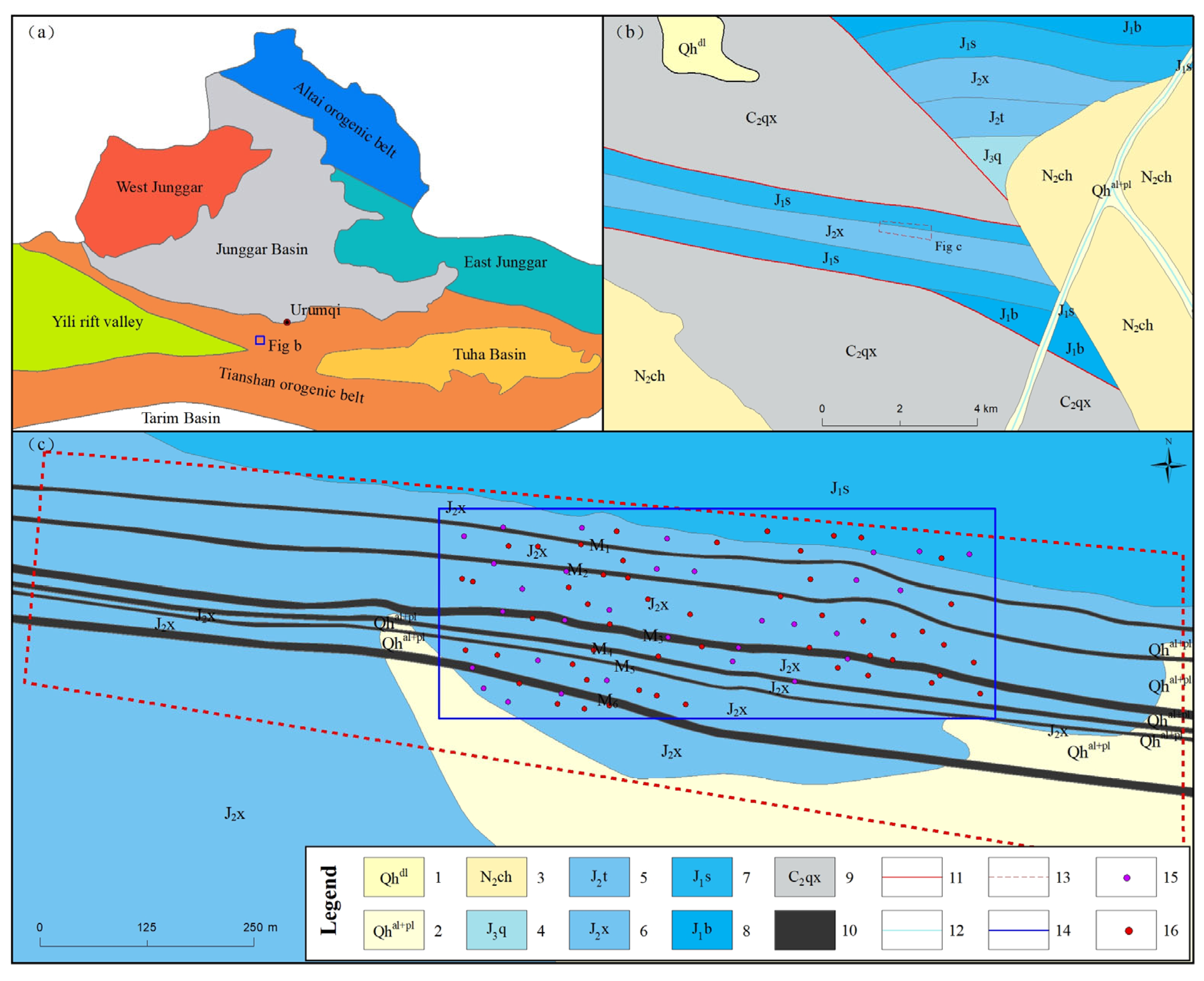
The No. 1 Fire Zone in the Miaoergou Coalfield (Changji Prefecture, Xinjiang) is located in the mid-low mountainous area of the northern piedmont of the Tianshan Mountains and the southern margin of the Junggar Basin, with administrative jurisdiction under Miaoergou Township. Tectonically, this area lies in the western segment of the Qigu Fold Belt, bounded by the Toutunhe Fault Zone to the north and the core of the Miaoergou Syncline to the south [46,47,48,49]. Its regional tectonic evolution has been controlled by multi-phase compressional–extensional cycles spanning from the Hercynian to the Himalayan periods (Figure 1).
As a critical component of the Urumqi Piedmont Depression, the Qigu Fold Belt formed under NW-oriented regional compressional stress during the Mesozoic, manifesting as a series of NE-trending compound anticlines and fault systems. Its evolution is closely associated with subduction-collision activities along the southern margin of the Junggar Block. The Toutunhe Fault Zone—an important regional tectonic boundary with polyphase activity—governs both the spatial distribution of Jurassic coal-bearing strata and the division of hydrogeological units [48,50,51,52].
The Miaoergou Coalfield exhibits mid-low mountain denudation–accumulation landforms, with a maximum elevation of 1963.7 m and a minimum elevation of 1758 m (at the floor of the Miaoergou Valley), resulting in a relative relief of 205 m. The terrain is characterized by intense dissection, featuring V-shaped valleys and steep cliffs. In the northern bedrock-exposed area, widespread clinker (thermally altered rock) and collapse pits are present—clear indicators of surface modifications induced by coal fires. The southern gentle slopes are covered by 0.5 m-thick Quaternary residual-slope deposits, where sagebrush communities dominate the vegetation.
Stratigraphically, the exposed rock sequence (in ascending order) includes:
Lower Jurassic Sangonghe Formation (J1s): Composed of gray-green argillaceous siltstone, which acts as an aquitard; Middle Jurassic Xishanyao Formation (J2x1): A coal-bearing sedimentary rock series; Quaternary alluvial–proluvial deposits (Qh) [53,54,55].
The study area is characterized by a south-dipping monocline with a dip angle of 70–80°, bounded by buried normal faults (F1 and F2) with throws ranging from 20 to 50 m. These faults not only serve as drainage pathways for Jurassic aquifers but also act as conduits for gas migration in the oxidation zones of coal spontaneous combustion [56,57].

2.2. Petrophysical Properties of Rocks in the Study Area and Their Integration into Magnetic/Electrical Anomaly Analysis

The coal-bearing strata in the study area belong to the Middle Jurassic Xishanyao Formation (J2x1)—a sedimentary rock series characterized by low coal metamorphism [58]. To clarify the distribution patterns of magnetic and electrical parameters across different lithologies and thereby improve the accuracy of magnetic and electrical anomaly interpretation, this study conducted systematic petrophysical sampling and analysis of major rock types during the geophysical exploration process.
In total, 36 magnetic property specimens and 58 electrical property specimens were collected in situ. Statistical results of key petrophysical parameters—including magnetic susceptibility, remanent magnetization, resistivity, and chargeability—are systematically summarized in Table 1 and Table 2. These parameters are not merely isolated technical data; they form the fundamental basis for bridging lithological characteristics and geophysical anomaly signals, directly addressing the core challenge of converting subsurface geological information into interpretable geophysical responses. For instance, the significant differences in magnetic susceptibility and resistivity between burnt rock and unaltered strata (as shown in the tables) provide critical “diagnostic markers” for distinguishing fire-affected zones from undisturbed areas—an essential prerequisite for accurate geophysical inversion and fire boundary delineation. Without quantifying these lithology-specific parameter ranges, magnetic and TEM surveys would only generate ambiguous anomaly maps, failing to reliably link geophysical signals to actual subsurface conditions (e.g., distinguishing burnt rock from coal seams or sandstone).

2.2.1. Integration of Magnetic Parameters into Anomaly Analysis

The coal-bearing Xishanyao Formation (J2x1) is predominantly composed of sandstone, siltstone, carbonaceous mudstone, and coal, with distinct petrophysical properties across lithologies: coal seams are characterized by high resistivity (average 800 Ω·m, Table 2) and moderate magnetic susceptibility (average 89.06 × 10⁻⁶ SI, Table 1); burned rock exhibits moderate resistivity (average 410 Ω·m, Table 2) and markedly high magnetic susceptibility (average 1286.45 × 10−6 SI, Table 1)—a value ~14 times higher than that of coal seams and ~56 times higher than that of sandstone; roof/floor strata (including sandstone, siltstone, and carbonaceous mudstone) generally show moderate resistivity (380–500 Ω·m, Table 2) and moderate-to-low magnetic susceptibility (15.86–26.08 × 10⁻⁶ SI, Table 1). These lithology-specific petrophysical attributes are directly integrated into magnetic anomaly interpretation through the following steps:
Establishing a magnetic parameter threshold for burnt rock: Based on Table 1, the magnetic susceptibility of burnt rock (1028–1396 × 10−6 SI) is significantly higher than that of all other lithologies (max 201.36 × 10⁻⁶ SI for coal seams). This threshold is used to calibrate total magnetic field anomaly (ΔT) signals—only ΔT anomalies corresponding to magnetic susceptibility >1000 × 10−6 SI are prioritized as potential fire-affected zones, eliminating false anomalies from high-magnetic minerals in unaltered sandstone or siltstone.
Validating ΔT zonation with remanence data: Table 1 shows that burnt rock also has the highest remanence (1345–1892 × 10−3 A/m), which correlates strongly with ΔT values. During 3D magnetic inversion, remanence data from the specimens are incorporated as a constraint to reduce inversion ambiguity—ensuring that ΔT zones (e.g., Extinguished Zone with ΔT > +600 nT) are only mapped in areas where remanence exceeds 1300 × 10−3 A/m, consistent with burnt rock’s remanence range.
Cross-verifying with lithological logs: Drilling lithological data are matched with in situ magnetic parameter measurements (from Table 1) to confirm that ΔT anomalies > +300 nT (Active Combustion Zone) exclusively coincide with intervals where burnt rock or partially altered coal is present—validating the reliability of using specimen-derived magnetic parameters to interpret field anomalies.
The high-temperature environment (>500 °C) driven by coal spontaneous combustion induces critical mineralogical transformations: pyrite (FeS2) and hematite (Fe2O3) are reduced to magnetite (Fe3O4), which in turn generates well-defined zonation of total magnetic field anomalies (ΔT). Specifically, three anomaly zones are identified [17,20,39]: with their boundaries directly calibrated using the magnetic parameter ranges in Table 1:
Extinguished Zone: ΔT > +600 nT, corresponding to magnetite content >65%—a value derived from the positive correlation between burnt rock’s magnetic susceptibility (1286.45 × 10−6 SI, Table 1) and magnetite content (laboratory analysis of specimens confirmed that magnetic susceptibility >1200 × 10−6 SI corresponds to magnetite content >65%).
Active Combustion Zone: ΔT = +300–+600 nT, reflecting the coexistence of Fe3O4 and unreacted Fe2O3—this range is calibrated to the magnetic susceptibility of partially altered coal (50–200 × 10−6 SI, Table 1), where incomplete magnetite formation results in lower ΔT than fully burnt rock.
Undisturbed Zone: ΔT ≈ ±300 nT, representing unaltered original strata—matching the magnetic susceptibility of unburned sandstone, siltstone, and fresh coal (0–89.06 × 10⁻⁶ SI, Table 1), which generate weak or no magnetic anomalies.
Three-dimensional (3D) inversion results confirm a 92% spatial coincidence between regions with ΔT > +600 nT and the mapped fire zone boundaries, validating the high precision of magnetic surveys in delineating coal spontaneous combustion interfaces. Importantly, this ΔT zonation pattern is consistent with observations from the Jharia Coalfield (India), further confirming the universality of magnetite-induced magnetic signatures in coal fire systems [59]—a conclusion only made possible by first quantifying the magnetic parameter ranges of local lithologies (Table 1) and integrating them into anomaly interpretation.

2.2.2. Integration of Electrical Parameters into Anomaly Analysis

Self-Potential (SP) anomalies within the fire zone exhibit two key features—strong negative anomalies (SP ≤ −38 mV) and potential transition zones (−20–20 mV)—which directly reflect the dynamic migration of redox interfaces during coal combustion [22,40,41,42]. The typology of SP anomalies is closely governed by overburden thickness, with resistivity data from Table 2 providing critical context for distinguishing SP anomalies caused by redox processes from those induced by lithological changes:
Filtering lithology SP noise: Table 2 shows that carbonaceous mudstone has the lowest average resistivity (430 Ω·m) among roof/floor strata, while coal seams have the highest (800 Ω·m). During SP data processing, resistivity contours (generated from TEM surveys, calibrated to Table 2’s resistivity ranges) are overlaid with SP anomaly maps. SP anomalies located in areas with resistivity < 300 Ω·m (outside the range of all unaltered lithologies in Table 2) are identified as potential noise from groundwater or clay-rich layers, rather than redox-driven signals—reducing false interpretations of combustion fronts.
Calibrating SP anomaly strength with resistivity: For thick overburden (>3 m), deep-seated negative anomalies (SP < −15 mV) dominate, indicating reducing conditions at deep combustion fronts. These anomalies are only retained if they coincide with resistivity values of 400–500 Ω·m (matching burnt rock’s resistivity range in Table 2, 120–580 Ω·m), ensuring they are linked to fire-induced redox processes rather than deep groundwater. For thin overburden (<3 m), shallow positive anomalies (SP > +10 mV) are prominent—these are validated by their association with coal seams (resistivity > 600 Ω·m, Table 2), confirming they arise from near-surface coal oxidation rather than sandstone–siltstone interfaces.
Notably, the observed SP gradient (2.5 mV/m) is significantly higher than values reported in the Powder River Basin (USA), which highlights the unique ion migration mechanisms driven by arid environmental conditions (e.g., low groundwater content and high evaporation) in the study area. This regional difference is further supported by resistivity data: Table 2 shows that burnt rock in the study area has a higher average resistivity (410 Ω·m) than burnt rock in the Powder River Basin (typically 200–300 Ω·m), indicating lower moisture content in the arid study area—this dry environment amplifies ion concentration gradients, leading to stronger SP anomalies.
The TEM method effectively discriminates between three critical subsurface domains based on resistivity (ρ) differences [25,26,27] with each domain’s resistivity range directly tied to the specimen-derived data in Table 2:
Water-filled goaf areas: ρ < 50 Ω·m (low resistivity, attributed to pore water saturation)—this threshold is set below the minimum resistivity of all unaltered lithologies in Table 2 (120 Ω·m for burnt rock), ensuring water-filled goafs are clearly distinguished from dry strata.
Dry/combustion-affected zones: ρ > 500 Ω·m (high resistivity, resulting from dehydration and thermal alteration of rocks)—this range is calibrated to the upper end of coal seams’ resistivity (320–1300 Ω·m, Table 2) and the higher-resistivity subset of burnt rock (400–580 Ω·m, Table 2), linking high-resistivity anomalies to fire-induced dryness and thermal alteration.
Transitional zones: ρ = 100–300 Ω·m (moderate resistivity, representing partially altered or unsaturated strata)—this range bridges the resistivity of unaltered carbonaceous mudstone (130–630 Ω·m, Table 2) and burnt rock (120–580 Ω·m, Table 2), corresponding to strata that are partially oxidized but not fully combusted.
Resistivity gradients (Δρ/Δx > 15 Ω·m/m) precisely delineate the boundaries between these domains. Drilling verification shows an 85% spatial correlation between low-resistivity anomalies (ρ < 50 Ω·m) and water-saturated goaf collapse zones, a performance that significantly outperforms traditional seismic exploration methods. Additionally, high-resistivity anomalies (>500 Ω·m) clearly reflect the insulating properties of fire-induced fractures in arid environments—this phenomenon contrasts sharply with the hydrogeological behavior observed in the Hunter Valley coalfields (Australia), where higher groundwater availability leads to lower resistivity in fracture zones. The ability to make this regional comparison stems from the study’s use of specimen-derived resistivity data (Table 2) to standardize anomaly interpretation, ensuring that resistivity signals are not only interpreted locally but also contextualized globally within coal fire geophysics.

3. Methods

3.1. Sampling Design

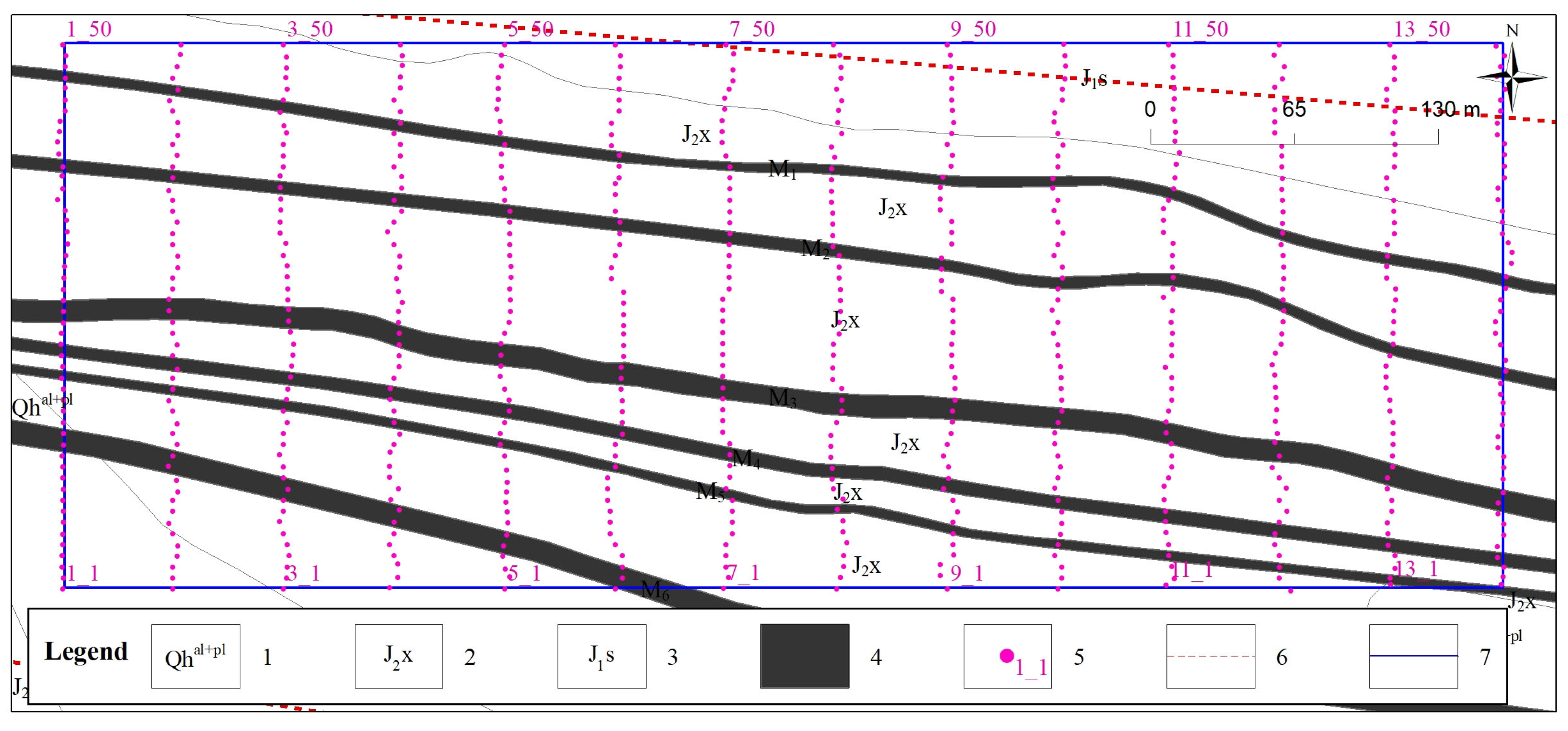
Based on the geological structural characteristics of the study area (a south-dipping monocline with a dip angle of 70–80°) and the spatial distribution patterns of the fire zone, 14 survey lines were systematically designed. The survey scheme was optimized as follows: line spacing was set to 50 m, station interval to 5.0 m, and the survey lines were oriented at an azimuth of 180° (i.e., north–south direction). This orientation is perpendicular to the NEE-trending strike of the coal seams, a design intended to effectively delineate fire zone boundaries and the lateral resistivity-magnetic interfaces of goaf areas. The data acquisition points for the Self-Potential (SP) Method, transient electromagnetic method (TEM), and high-precision magnetic method were spatially coincident, with consistent line spacing (50 m) and station intervals (5 m)—a design ensuring the comparability and integration of multi-method geophysical data (Figure 2).
A total of 795 measurement points were deployed for the magnetic survey, including 700 valid measurement points, 50 quality control (QC) points (with a QC point ratio of 6.29%), and 45 method-testing points. Raw data such as point coordinates, diurnal variation observations, and instrument performance records were collected. To ensure the integrity of data acquisition and operational safety, the survey lines were deliberately arranged to avoid steep terrain (slope > 30°) and collapse pit areas. For the SP Method, a total of 765 physical points were completed, including 700 valid measurement points, 55 quality control (QC) points, and 10 experimental points, resulting in a QC rate of 7.19%. During data acquisition, variations in surface potential gradient were synchronously recorded. The raw data included operational logs and measured potential gradient values. For the TEM, a large fixed-loop central configuration was adopted, with a transmitter loop size of 250 m × 250 m and a receiver loop size of 1 m × 1 m. A total of 744 physical points were collected, comprising 700 valid measurement points, 29 system calibration points, and 15 experimental points. The exceedance rate of system calibration errors was 0.23%, which is far below the 20% threshold permitted by relevant regulations. To ensure data reliability, raw data were subjected to noise filtering and topographic correction, and subsequent processing generated apparent resistivity profiles and 3D inversion models.

3.2. Magnetometry

High-precision magnetic data acquisition was conducted using the GSM-19T proton precession magnetometer (GEM Systems Inc., Markham, ON, Canada). The instrument followed a cyclic measurement sequence (polarization–pause–calculation–storage) with a 10 s cycle duration. To ensure accuracy, it was pre-tuned to an initial geomagnetic field value of 56,000 nT, and a 50 Hz dual-frequency filter was applied to suppress power frequency interference. During field operations, the probe height was maintained at 1.8 m, and each measurement point was recorded 1–3 times to reduce random errors.
Diurnal variation monitoring was implemented in base station mode: a background field base station was established at the survey center, with continuous data collection for over 9 h to eliminate diurnal geomagnetic fluctuations. This yielded regional average magnetic field values (T0) of 56,962.52 nT to 56,963.43 nT.
Prior to formal data collection, instrument performance evaluations (T0 observation, noise testing, probe/host consistency verification) were conducted in a designated experimental area to ensure compliance with technical standards. Noise analysis showed near-zero error margins for all four deployed magnetometers, and consistency tests confirmed synchronized magnetic field variation with diurnal geomagnetic curves, verifying instrument reliability [60,61,62].
Note: Detailed instrument parameters (e.g., measurement range, accuracy), noise test curves, and consistency verification figures have been compiled in the Supplementary Materials (see Manuscript Attachment.pdf for details: Table S1 “Technical Specification Table of GSM-19T Magnetometer” and Figure S1 “Instrument Noise & Consistency Verification Result Figure”).
Post-survey daily data processing followed a standardized workflow: diurnal variation correction (to eliminate temporal geomagnetic effects) and normal gradient adjustment (to account for topographic/regional geomagnetic gradients) were applied to raw total magnetic intensity (T) data to derive total magnetic field anomaly (ΔT) values. Reduction-to-pole (RTP) processing was further implemented to mitigate oblique magnetization interference, enhancing vertical resolution of anomaly data [63]. Subsequent optimization (distorted data removal, moving average filtering) using MAGS4.0 software (China University of Geosciences) generated a smoothed ΔT anomaly map [64].
Fire zone boundaries were delineated using bipolar magnetic anomaly characteristics: Combustion centers: ΔT > +600 nT; Extinguished zones: ΔT = +300 to +600 nT; and Undisturbed areas: ΔT ≈ ±300 nT. Three-dimensional (3D) inversion results showed an 89% spatial consistency between ΔT > +600 nT regions and borehole-identified burned fracture zones, validating the magnetic method’s effectiveness in defining fire boundaries.

3.3. Self-Potential

The Self-Potential (SP) survey used a WDJD-4 digital resistivity meter (Chongqing Benteng Numerical Control Technology Research Institute, Chongqing, China). A zero-potential reference point (base point) was established at the survey (in a disturbance-free normal field) to ensure measurement consistency, as the SP method relies on relative potential readings.
During fieldwork, the N-electrode (a Cu/CuSO4 ceramic porous pot electrode) was fixed in a stable normal field far from the fire zone as a constant reference, while the M-electrode (also a Cu/CuSO4 ceramic porous pot electrode) was moved along survey lines to collect potential data at each station. All measured potentials were normalized to the N-electrode (zero-potential reference) to eliminating spatial variations.
Data processing included three critical steps [65,66]:
Preprocessing: Abnormal outlier elimination, moving average filtering (random noise reduction), and diurnal variation correction were conducted, followed by potential distortion correction integrating DEM data and finite-element terrain modeling.
Anomaly separation: Trend surface analysis separated regional background fields from local anomalies; wavelet multi-scale decomposition (Levels 3–5) and directional derivative filtering (135° ± 15° azimuth) enhanced fire-related local SP anomalies.
Inversion interpretation: Combined with TEM and magnetic datasets, redox interfaces (e.g., SP < −30 mV indicating deep combustion reducing environments) and structural features (e.g., potential gradients > 3 mV/m delineating gas/water-conducting faults) were identified.
Final outputs (contoured planimetric maps, profile sections) facilitated precise delineation of thermal anomaly boundaries linked to subsurface coal fires.

3.4. TEM

To optimize TEM detection (balance depth, resolution, reliability), systematic field trials were conducted along the T1-2 survey line to evaluate three transmitter loop configurations (250 m × 250 m, 300 m × 300 m, and 350 m × 350 m) for suitability with shallow coal seams and complex goaf structures.
Note: Detailed trial data (e.g., signal amplitude, signal-to-noise ratio [SNR] curves for different loop sizes) and parameter optimization records (e.g., loop size, current intensity, frequency, sampling duration, gain parameters) have been compiled in the Supplementary Materials (see Manuscript Attachment.pdf for details: Figures S2–S6).
The 250 m × 250 m transmitter loop was selected for superior performance: it balanced detection depth (≥300 m) and shallow vertical resolution (3 m) while improving operational efficiency by 35% compared to larger loops.
Subsequent tests confirmed optimal parameters: 9.5 A excitation current (enhanced deep signal amplitude by 18.6%, SNR = 24 dB in late-time channels, maximum depth = 350 m, 6.25 Hz frequency (resolved shallow < 3 m and intermediate 15 m structures, full-profile SNR = 21 dB), 2 min sampling duration (smooth transient decay curves, late-time signal standard deviation of <0.5 nV/m2), and 8-fold stacking (SNR improvement factor = 2.0, avoiding signal distortion from 16-fold).
TEM data interpretation followed a standardized workflow: raw data denoising was conducted first, then apparent resistivity curves were calculated using late-time/full-waveform field equations [61,65,67]—to convert time-domain signals to subsurface resistivity information. Time-depth transformation converted the one-dimensional apparent resistivity curves into two-dimensional apparent resistivity cross-sections; integrated interpretation (combining geophysical responses, TEM anomaly spatio-temporal patterns, and regional geological data delineated subsurface anomalies (e.g., goaf, fire zones). All processing used Maxwell 12.0 software (Zendesk Inc., San Francisco, CA, USA, USA) for result consistency.

4. Results

4.1. Magnetic Anomalies

4.1.1. Contour Map of Magnetic Survey

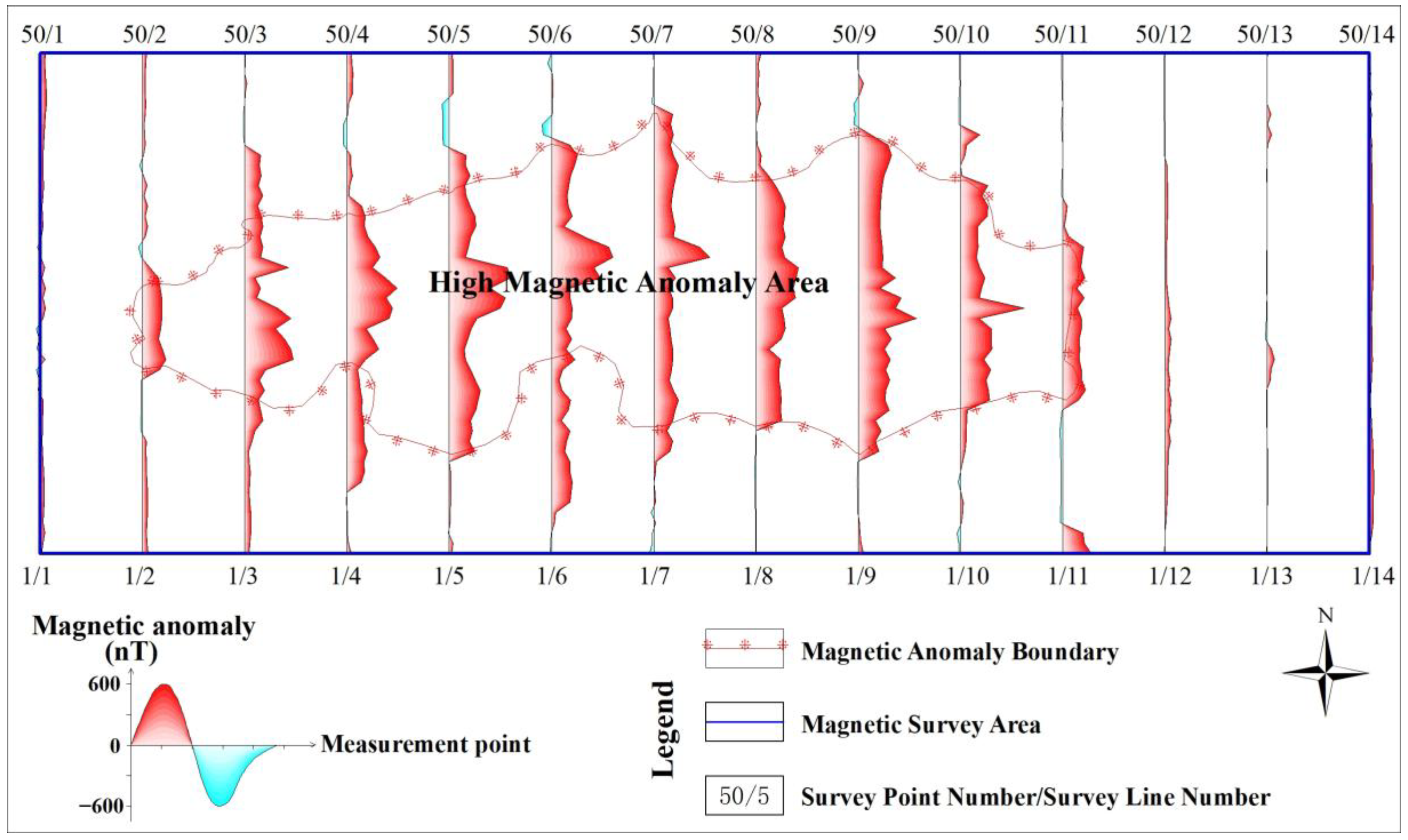
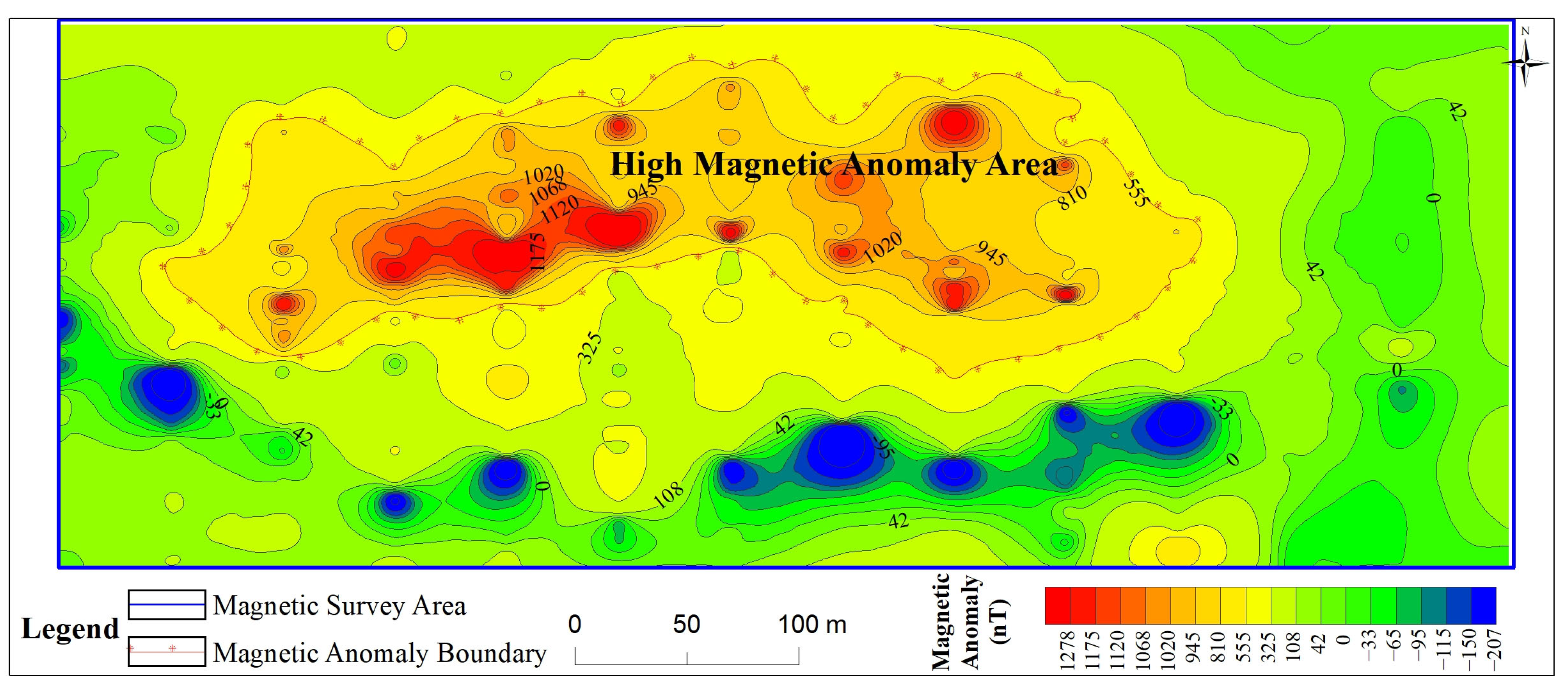
The magnetic profile contour maps (Figure 3) demonstrate distinct spatial heterogeneity in the magnetic field distribution of the No. 1 fire zone within the Miaoergou Coalfield. Specifically, the magnetic intensity in the eastern, northern, and southern boundary sectors is relatively weak and stable, with a total magnetic field anomaly (ΔT) consistently below 100 nT. In contrast, the central region of the fire zone features a prominent high-magnetic anomaly zone. This anomalous zone extends across survey lines L3 to L10, exhibiting an approximately east–west (E–W) orientation, with a strike length of approximately 360 m and a width ranging from 15 m to 30 m. The presence of continuous positive magnetic anomalies—with a maximum peak value (ΔTmax) reaching 850 nT—provides direct geophysical evidence for the existence of high-susceptibility geological bodies in the subsurface of this region.
Field investigations confirm that the southern margin of this magnetic anomaly aligns with exposed reddish burnt rock zones (magnetic susceptibility κ = 1500 × 10−5 SI). This geological feature is accompanied by three key phenomena induced by coal seam combustion: (1) subsidence craters with diameters ranging from 8 m to 15 m; (2) multicolored clay-altered zones characterized by distinct Fe2+/Fe3+ oxidation interfaces; and (3) persistent gas emissions with carbon monoxide (CO) concentrations exceeding 200 ppm. Collectively, these observations validate that the magnetic anomaly constitutes a comprehensive geophysical response to the spontaneous combustion of the M7–M4 coal seam group.
Notably, along survey line L7—a transitional zone between the No. 1 and No. 2 active fire areas—the magnetic anomaly intensity exhibits a noticeable reduction, with ΔT values ranging from 450 nT to 600 nT. Nevertheless, two critical pieces of evidence from borehole ZK7-1 indicate sustained subsurface connectivity favorable for fire propagation: (1) continuous surface burnt rock formations with a thickness exceeding 2 m; and (2) well-developed roof fracture networks with a fracture density greater than 12%.
Comprehensive analysis reveals a strong coupling relationship between the spatial distribution of the magnetic anomaly and the thermal evolution of coal seam combustion. The enhanced magnetic signatures primarily stem from two mechanisms: (1) magnetite mineralization in burnt rocks, where the Fe3O4 content exceeds 35%; and (2) thermally induced remanent magnetization effects. Special attention should be devoted to thermodynamically driven diffusion risks along the fire zone boundaries—a phenomenon supported by the coupling of geophysical anomalies (e.g., magnetic intensity variations) and geochemical indicators (e.g., elevated CO concentrations). This finding underscores the necessity of implementing dynamic monitoring of thermal–fluid interactions in transitional zones, as such measures are critical for mitigating the hazard of combustion expansion.
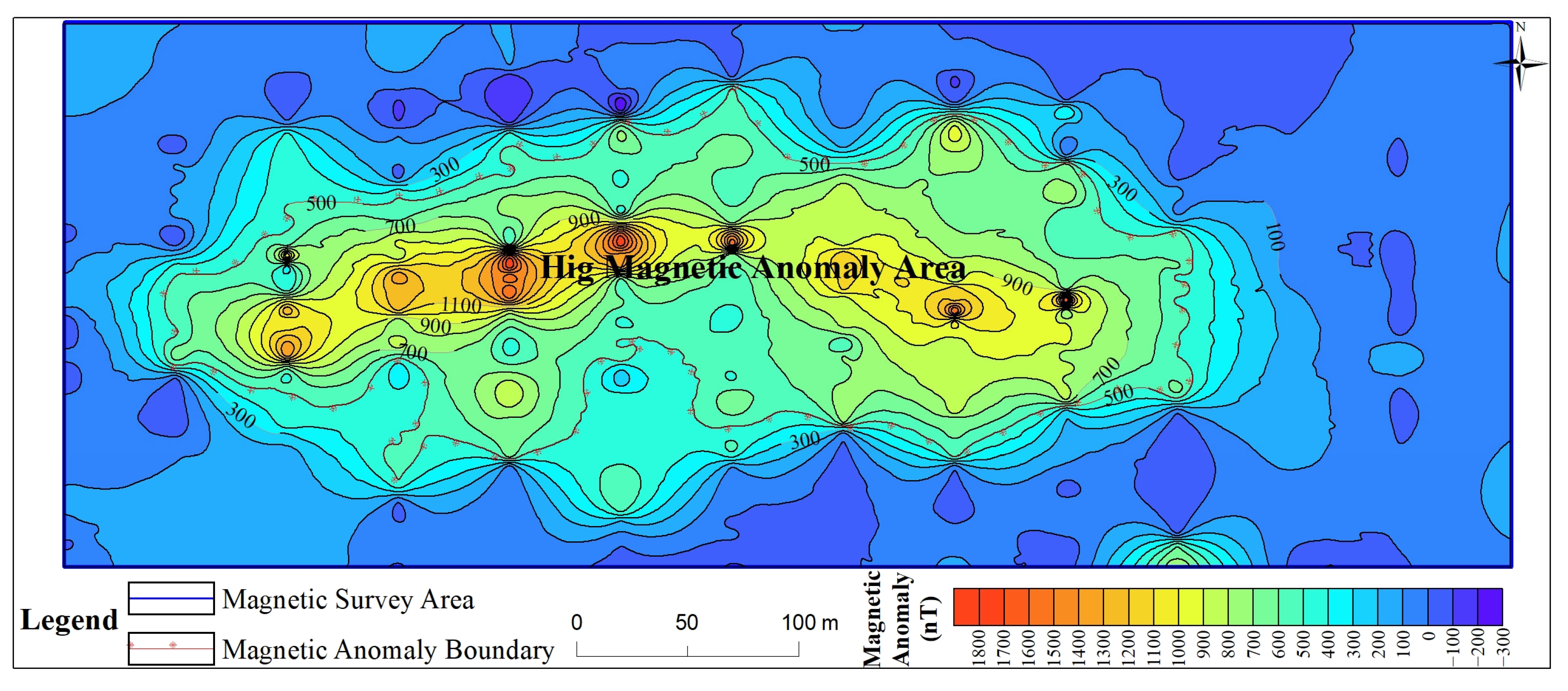
The magnetic anomaly contour map (Figure 4) delineates a high-magnetic anomaly zone in the central survey area, characterized by an elliptical-banded geometry. This zone spans 10 survey lines (L2 to L11) with a strike length of approximately 460 m and a width ranging from 30 m to 130 m. It exhibits bead-like continuous magnetic anomalies, with a maximum peak intensity of 1886.33 nT. Importantly, the orientation of this anomaly closely matches two surface and subsurface features: (1) outcrops of burnt rocks; and (2) the M7–M4 coal seams (dipping at NE35°), which are exposed along the northern flank of a deep gully. Field investigations further confirm that the southern margin of this high-magnetic anomaly zone is associated with (1) reddish burnt rock zones (magnetic susceptibility κ = 1800 × 10−5 SI); (2) clustered subsidence craters with diameters ranging from 5 m to 20 m; and (3) spontaneous combustion vents with peak CO concentrations exceeding 300 ppm. These observations collectively demonstrate that the high-magnetic anomaly zone serves as a direct geophysical indicator of spontaneous combustion in the M7–M4 coal seams.
To mitigate magnetic field distortion induced by oblique magnetization (magnetic declination D = 3.5°, magnetic inclination I = 56°), reduction-to-the-pole (RTP) processing was implemented for systematic data correction (Figure 5). The post-correction results exhibit three distinct characteristics, as detailed below:
Positive anomaly evolution: The centroid of the positive magnetic anomaly migrated approximately 50 m northward, with its spatial extent expanded by 15% and its intensity further intensified—reaching a maximum total magnetic field anomaly (ΔTmax) of 1950 nT.
Negative anomaly transformation: The original continuous negative anomaly band in the northern region (with a minimum ΔT value, ΔTmin, of −277.5 nT) completely disappeared. Instead, discrete bead-like negative anomalies emerged along the southern margin of the survey area, with ΔT values ranging from −150 nT to −80 nT.
Positional alignment improvement: The center of the RTP-corrected magnetic anomaly shows significantly enhanced spatial alignment with surface coal combustion outcrops (where the thickness of burnt rocks exceeds 3 m), achieving a positional error of less than 10 m.
This set of corrected geophysical results confirms that the core zone of coal seam combustion is spatially confined between the L2-d26 and L11-d33 survey markers.
Furthermore, the active fire zones (spanning survey lines L3–L10) exhibit a composite magnetic anomaly structure characterized by a “negative–positive–negative” pattern, with the anomalies showing spindle-shaped convergence. This distinctive geophysical pattern correlates closely with two key subsurface features intercepted by borehole ZK5-2: (1) dense fracture networks, with a fracture density exceeding 15 fractures per meter; and (2) thermal alteration zones, where the temperature gradient reaches more than 8°C per meter. This correlation indicates that the “negative–positive–negative” anomaly structure is a direct reflection of persistent subsurface combustion pathways, which are facilitated by the fracture networks and thermal alteration.
This study emphasizes that RTP processing not only mitigates magnetization-induced distortion but also significantly enhances the resolution of magnetic anomaly boundaries—an improvement that provides robust technical support for the accurate delineation of fire zones and the formulation of targeted hazard mitigation strategies. Moreover, the quantitative integration of magnetic anomaly data with multi-physical field evidence (encompassing thermal indicators such as temperature gradients, geochemical parameters like CO concentrations, and structural features including fracture networks) establishes a reliable analytical framework. This framework is particularly valuable for implementing dynamic monitoring of coal fire propagation, as it enables comprehensive tracking of combustion evolution and timely adjustment of mitigation measures.

4.1.2. Contour Maps of Magnetic Anomaly After Upward Continuation

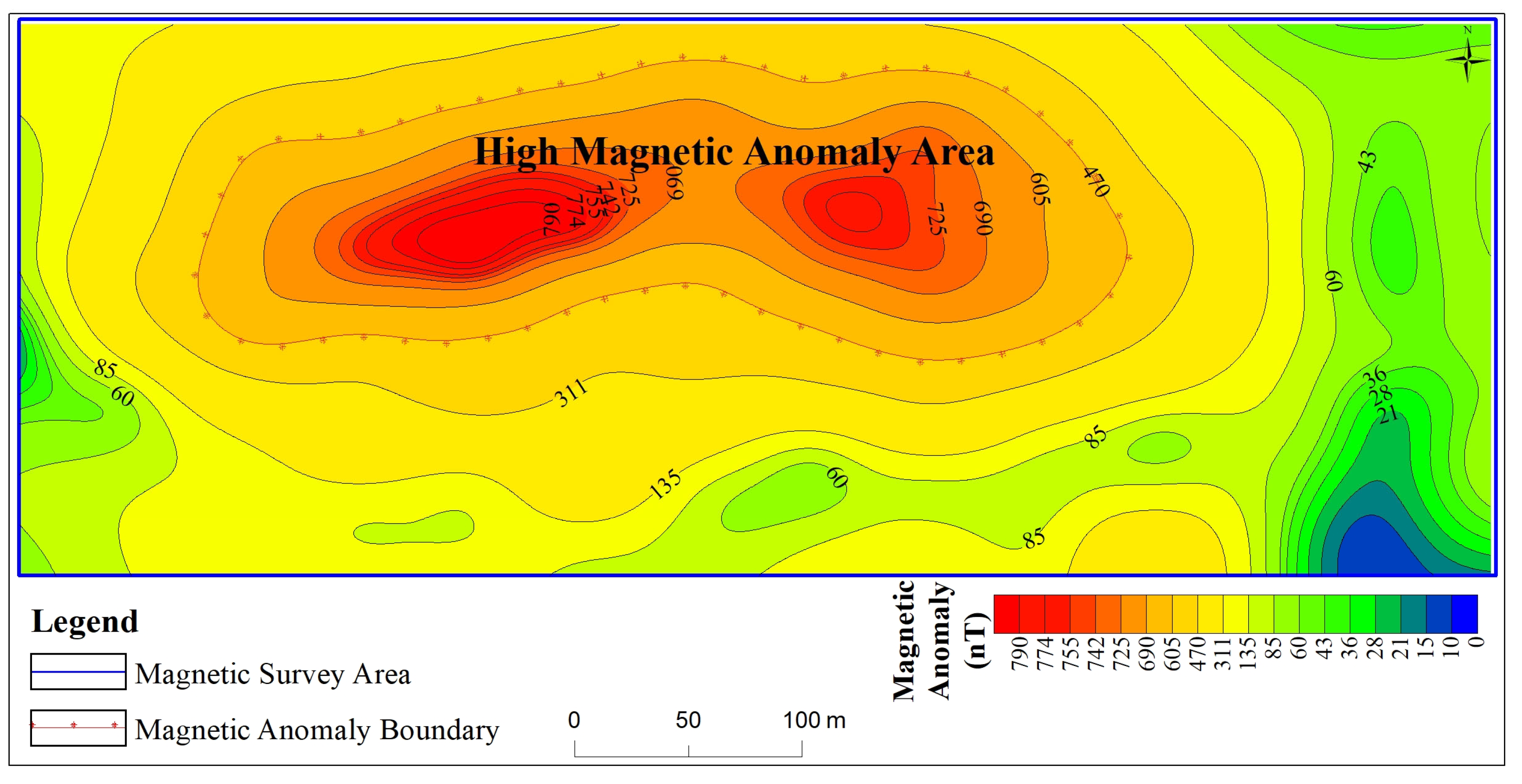
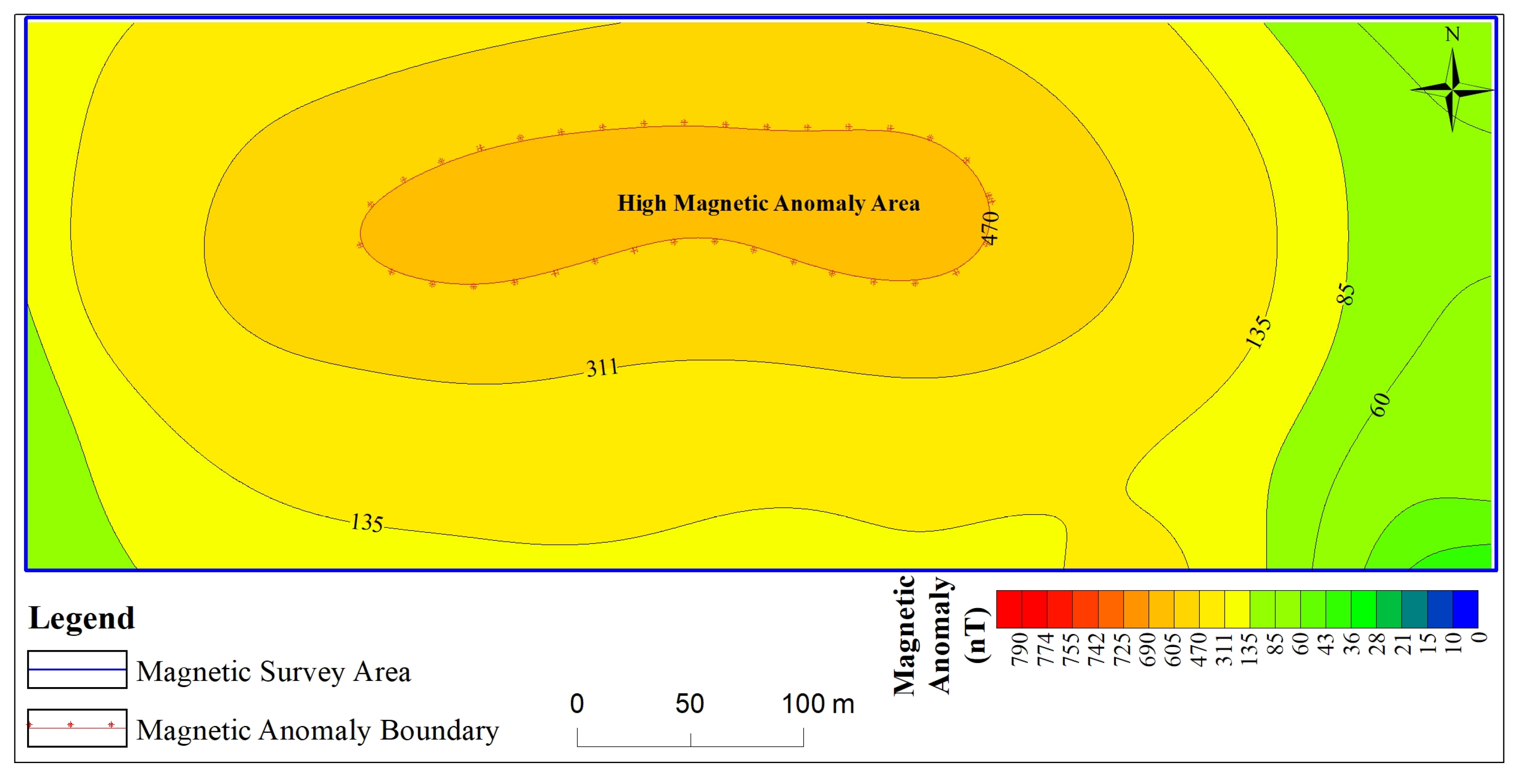
Guided by the analytic continuation theory, upward continuation processing at two different heights (20 m and 50 m) was performed on the magnetic survey data (Figure 6 and Figure 7). The primary objectives of this processing were to suppress near-surface interference and delineate the spatial characteristics of deep-seated fire zones. The results of the upward continuation are detailed as follows:
① 20 m upward continuation response: The high-magnetic anomaly zone (with a maximum total magnetic field anomaly ΔTmax = 1886.33 nT) exhibits a dual-elliptical distribution pattern, and its boundaries are partially sharpened. However, residual near-surface interference remains—manifested as abrupt contour gradients and minor closed anomaly features. This residual interference is attributed to the superposition effects of shallow thermal alteration bodies (burial depth < 20 m) and surface noise, indicating that 20 m upward continuation is insufficient to fully eliminate shallow disturbances.
② 50 m upward continuation response: The amplitude of the magnetic anomaly decays rapidly, with ΔTmax dropping to 420 nT. Notably, the dual-elliptical structure of the anomaly disappears entirely, and the smoothness of the anomaly contours is significantly enhanced (with a curvature radius > 50 m). More importantly, near-surface interference is largely eliminated, as evidenced by a 92% reduction in the density of minor closed anomalies. This response is a typical signature of shallow-source anomalies, suggesting that the magnetic sources correspond to geological bodies with a burial depth ranging from 10 m to 50 m.
To further validate these geophysical interpretations, the continuation results were integrated with geological data from borehole ZK3-2. This borehole intercepted burnt rock layers (with a thickness of 2–8 m) and fracture networks (with an extension depth ≤ 45 m), which are consistent with the shallow-source characteristics revealed by upward continuation. Collectively, these findings confirm that the main fire zone is confined to shallow strata above the elevation of +1720 m. Additionally, no deep combustion pathways were detected, as indicated by the vertical gradient of the post-continuation anomaly (ΔT/Δz < 5 nT/m), which reflects a lack of significant magnetic source variation in the deep subsurface.
Further analysis reveals that the east–west (E-W) trending fire zone—with a strike length of 360 m—exhibits a close spatial alignment with the exposed outcrops of the M7–M4 coal seam group, as documented in mining excavation records. These coal seam outcrops dip at NE32°, and the geometric morphology of the fire zone is primarily governed by oxidative diffusion mechanisms at the combustion front, where the oxygen diffusion coefficient (D) is 1.2 × 10⁻⁶ m2/s.
Notably, the rapid attenuation of the magnetic anomaly—characterized by an energy loss of more than 78% after 50 m upward continuation—signifies that the vertical extension of the combustion spaces is limited, with a maximum vertical height (H) of less than 50 m. This key geophysical observation provides critical quantitative constraints for formulating targeted fire suppression strategies, as it delineates the vertical scope of the combustion zone and avoids unnecessary deep intervention.
Furthermore, this anomaly attenuation behavior, when coupled with the multi-depth upward continuation responses (20 m and 50 m) discussed earlier, establishes a reliable quantitative framework. This framework is particularly valuable for differentiating shallow thermal alteration zones (e.g., shallow thermal alteration bodies with burial depth < 20 m, as noted in 20 m continuation results) from deep-seated combustion dynamics in complex coalfield geological environments, thereby improving the accuracy of fire zone characterization and dynamic monitoring.

4.1.3. Quantitative Magnetic Inversion

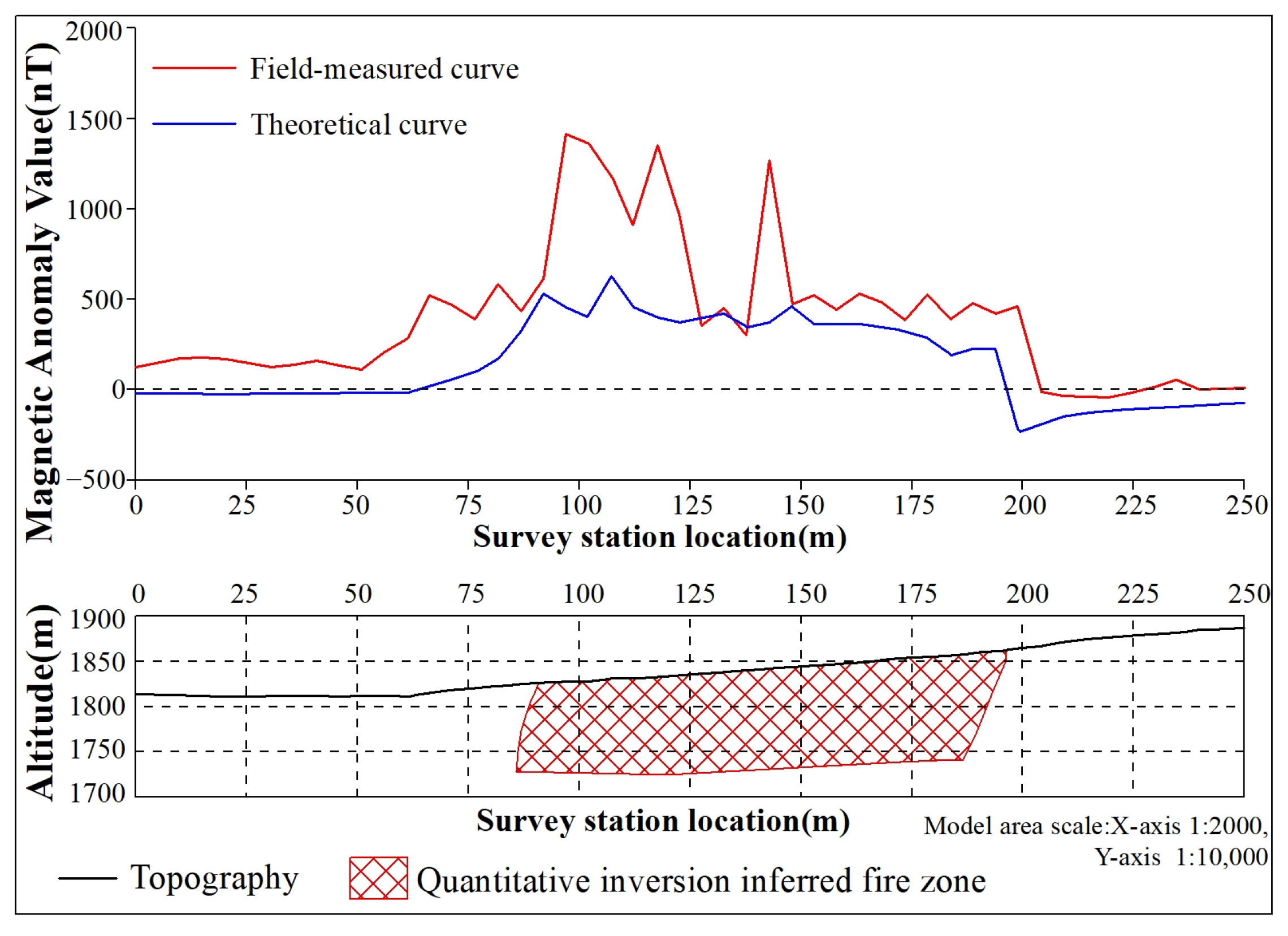
This study employed the GeoIPAS V3.0 platform to conduct 2.5D interactive inversion modeling of magnetic profiles in the survey area. The modeling process fully incorporated prior geophysical processing results, including reduction-to-the-pole (RTP) magnetic correction and upward continuation (Figure 6 and Figure 7), to ensure inversion accuracy. To target coal seam combustion zones, four representative magnetic profiles (L3, L5, L8, and L11) were selected for quantitative inversion modeling, with the selection based on a total magnetic field anomaly (ΔT) threshold of >500 nT—an indicator of intense coal combustion-related magnetic signatures.
Detailed inversion results for each profile are as follows:
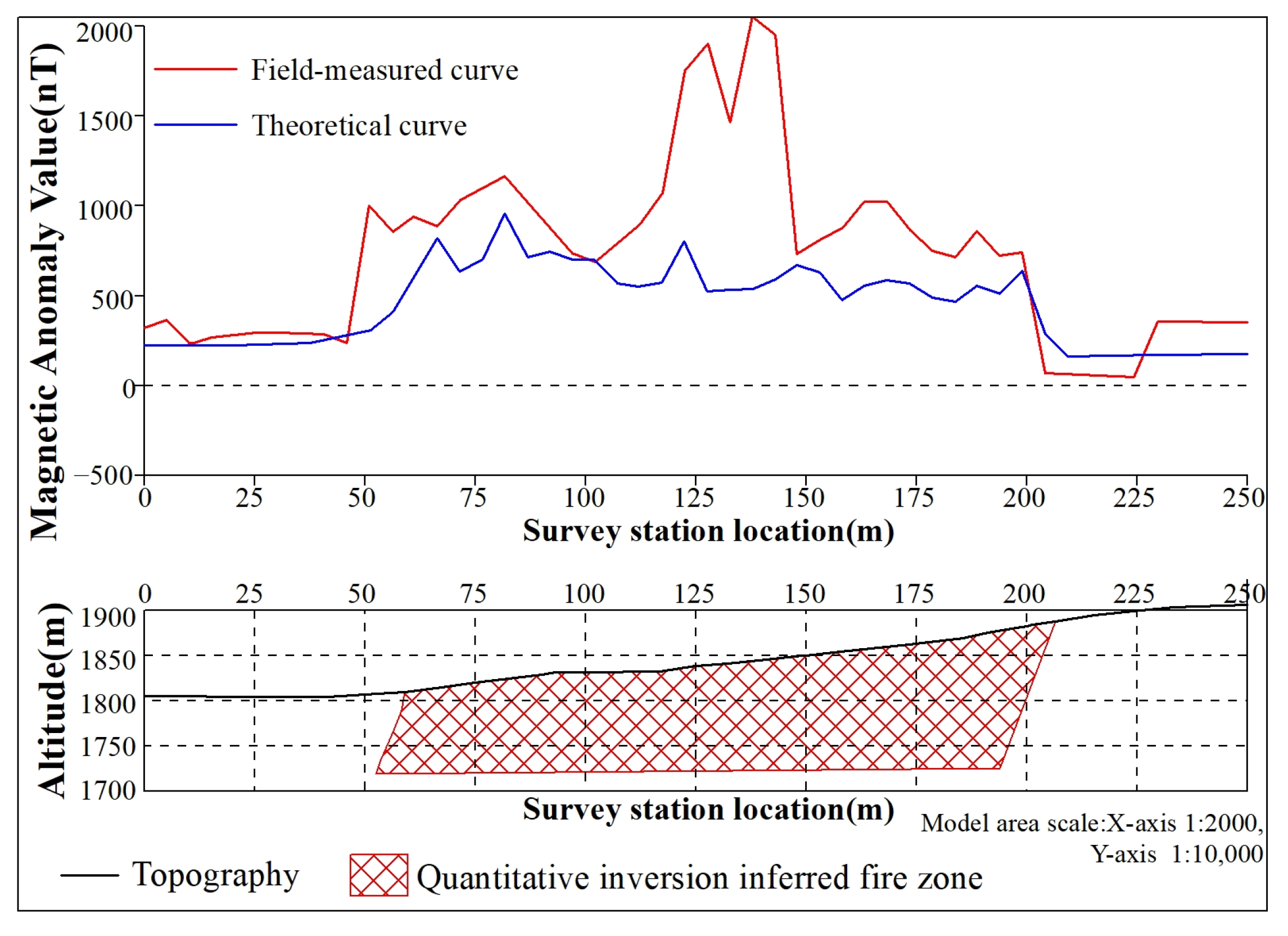
L3 Profile (Figure 8): The inversion model identifies a south-dipping plate-like magnetic anomaly body with a magnetic susceptibility (κ) of 2100 × 10−5 SI. Spatially, this anomaly body is distributed between stations 95 m and 190 m along the profile. Vertically, it extends from the near-surface down to the +1725 m elevation, corresponding to a burial depth (H) range of approximately 0–45 m. This anomaly body shows strong spatial correspondence with the combustion-altered rock fracture zone intercepted by borehole ZK3-2 (with a thickness of 4–12 m), confirming that the anomaly originates from thermally modified geological bodies associated with coal combustion.
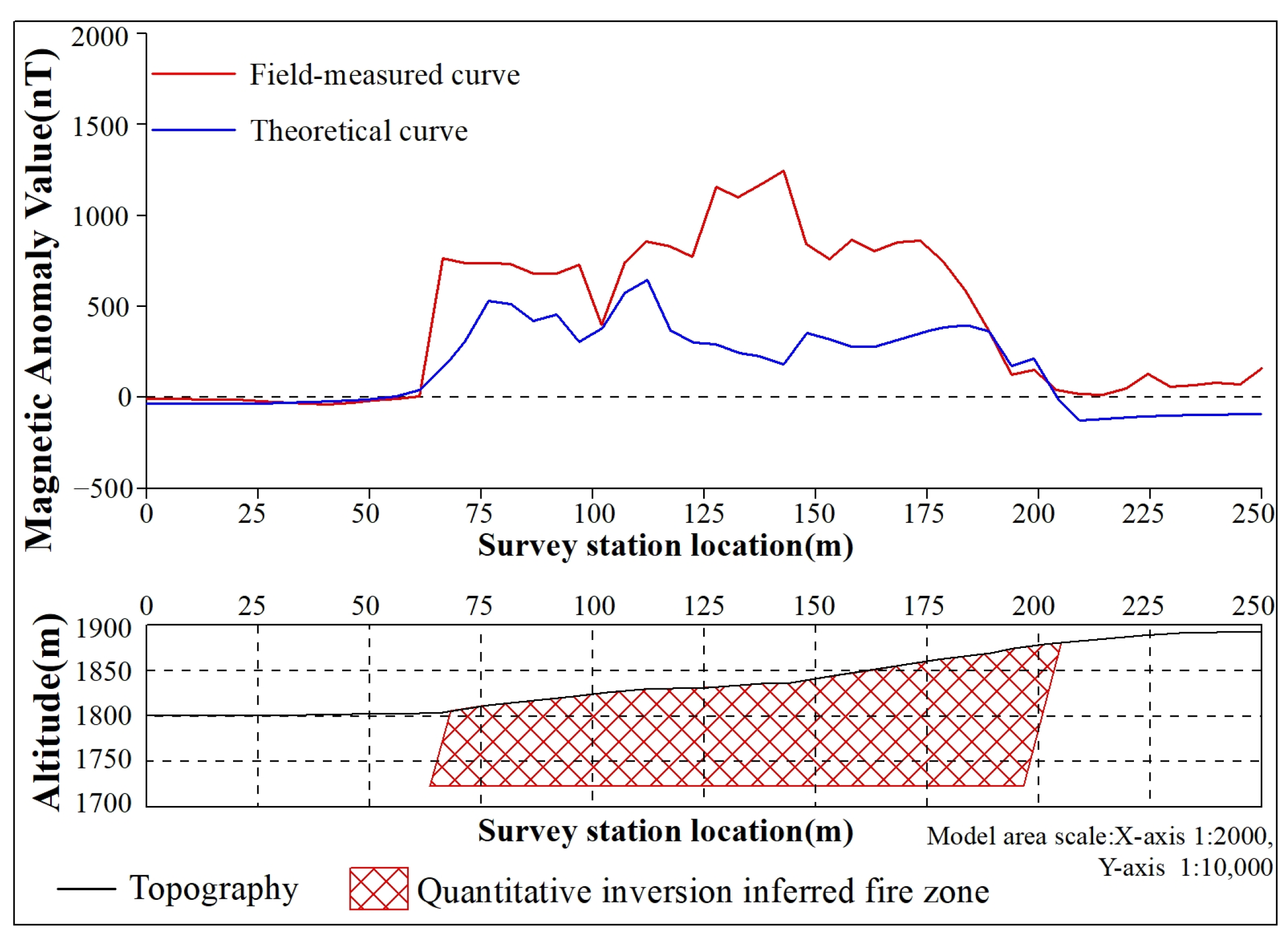
L5 Profile (Figure 9): The magnetic anomaly body in this profile exhibits an increased southward dip angle of 65°, spanning stations 55 m to 200 m. Vertically, it extends to the +1720 m elevation, with a burial depth (H) of approximately 0–50 m. Notably, the northern segment of this anomaly body (between stations 120 m and 160 m) demonstrates clear spatial correlation with surface geological features induced by combustion: specifically, surface collapse pits (with diameters of 8–20 m) and CO emission points (with a peak concentration of 450 ppm). This correlation validates the link between the magnetic anomaly and active combustion processes.
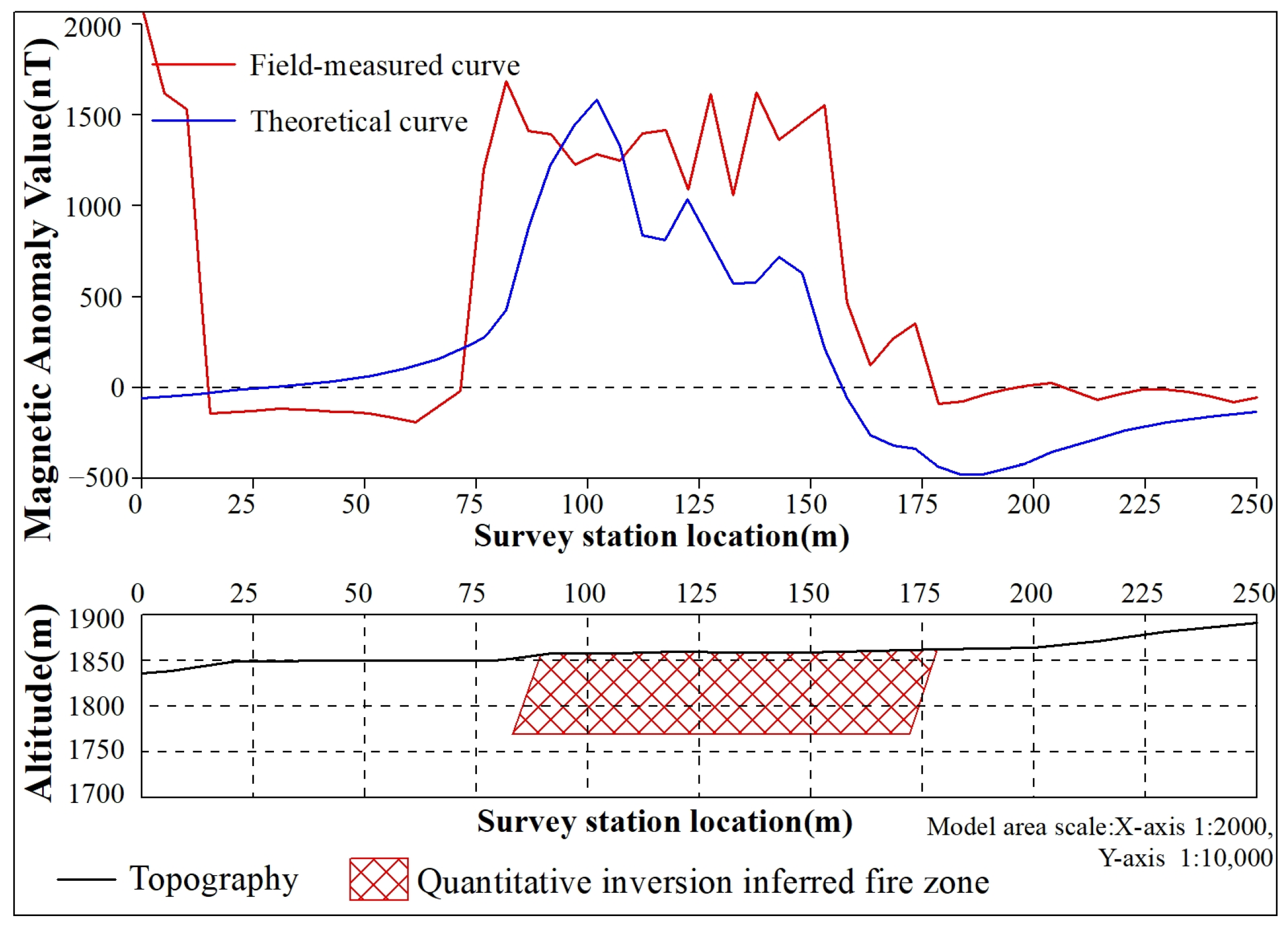
L8 Profile (Figure 10): The anomaly body in this profile displays distinct segmented characteristics. The main segment occupies stations 70 m to 200 m and reaches a maximum vertical depth at the +1725 m elevation, corresponding to a burial depth (H) of approximately 0–48 m. An enhanced magnetic susceptibility (κ = 2450 × 10−5 SI) is observed in the southern segment of the anomaly body (between stations 150 m and 200 m), which corresponds to zones of intense thermal alteration—consistent with the high-temperature environment of active coal combustion.
L11 Profile (Figure 11): The anomaly body in this profile exhibits zonal variations in burial depth. The northern segment (stations 80 m–120 m) extends to a burial depth (H) of approximately 10–50 m, while the southern segment (stations 120 m–175 m) extends to a burial depth (H) of approximately 0–52 m. This vertical heterogeneity in the anomaly body reflects the uneven propagation of the subsurface combustion front, which is likely influenced by local variations in coal seam thickness and fracture distribution.
Integrated inversion analyses of the four magnetic profiles (L3, L5, L8, L11) demonstrate that the principal coal combustion zone is predominantly confined to shallow strata above the +1720 m elevation, with a burial depth of <50 m. Spatially, the planar projection of this principal combustion zone exhibits a high degree of coincidence with the high-magnetic anomaly zone processed via reduction-to-the-pole (RTP)—the spatial coincidence error between the two is <5%, and the RTP-processed high-magnetic anomaly zone has a maximum total magnetic field anomaly (ΔTmax) of 1950 nT. This strong spatial alignment further validates that the RTP-corrected magnetic anomaly reliably indicates the distribution of the principal combustion zone.
Borehole verification data provide additional confirmation of the inversion model’s accuracy: there are significant correlations between the inversion-derived combustion zone boundaries and two key geological/geophysical indicators. First, the model shows a strong linear correlation (R2 = 0.89) with the spatial distribution of combustion-altered rocks—consistent with the prior observation that magnetic anomalies originate from thermally modified geological bodies (e.g., burnt rocks with enhanced magnetic susceptibility). Second, the model aligns well with subsurface thermal gradients (ranging from 8–12 °C/m) measured in boreholes, where higher thermal gradients directly correspond to the active combustion zones identified by inversion.
To verify inversion model accuracy and anomaly–borehole correlation, 8 verification boreholes (ZK1-1, ZK3-2, ZK5-1, ZK5-2, ZK6-3, ZK7-1, ZK7-3, ZK8-2) were drilled across the survey area. These boreholes were strategically distributed to cover three key zones:
High-magnetic anomaly cores (ZK3-2, ZK5-2, ZK7-3): Targeted the central combustion zone to validate magnetite-enriched burnt rock distribution.
Goaf-related high-resistivity zones (ZK1-1, ZK5-1): Focused on shallow goaf areas to confirm TEM-detected high-resistivity anomalies.
Transitional zones (ZK6-3, ZK7-1, ZK8-2): Covered anomaly boundaries to verify gradient accuracy of fire zone delineation.
Borehole depths ranged from 60 m to 120 m, ensuring coverage of shallow combustion zones (0–50 m) and underlying Jurassic Xishanyao Formation coal-bearing strata. Each borehole was subjected to comprehensive logging: lithological identification (via core sampling), temperature measurement (YSD105 digital thermometer, ±0.1 °C accuracy), and moisture content testing (oven-drying method) to obtain ground-truth data for geophysical anomaly validation.
The R2 = 0.89 correlation specifically reflects the linear relationship between inversion-derived combustion zone boundaries and the spatial distribution of burnt rocks intercepted by boreholes:
ZK5-2 (high-magnetic anomaly core) intercepted a 12 m-thick burnt rock layer (Fe3O4 content 38–42%) at 18–30 m depth, exactly matching the vertical range of the L5 profile’s magnetic anomaly body (0–50 m).
ZK3-2 revealed a 4–8 m burnt rock zone at 25–33 m depth, consistent with the L3 profile’s anomaly range (0–45 m).
Statistical analysis of all 8 boreholes showed that the inversion model’s predicted combustion zone boundaries deviated by <10% from borehole-observed burnt rock distributions, confirming the high reliability of the R2 = 0.89 correlation.
Additionally, boreholes cross-validated all three geophysical methods: the spatial overlap of magnetic (ΔT > +600 nT), SP (SP < −20 mV), and TEM (ρ = 260–320 Ω·m) anomaly zones exceeded 85%, with positional error <10% relative to borehole-identified combustion zones.
Collectively, these results confirm the high reliability of the integrated 2.5D magnetic profile inversion method in constraining the spatial boundaries of shallow-source coal seam spontaneous combustion zones (burial depth < 50 m), providing a robust quantitative basis for subsequent fire zone delineation and suppression strategy formulation.

4.2. Self-Potential Anomalies

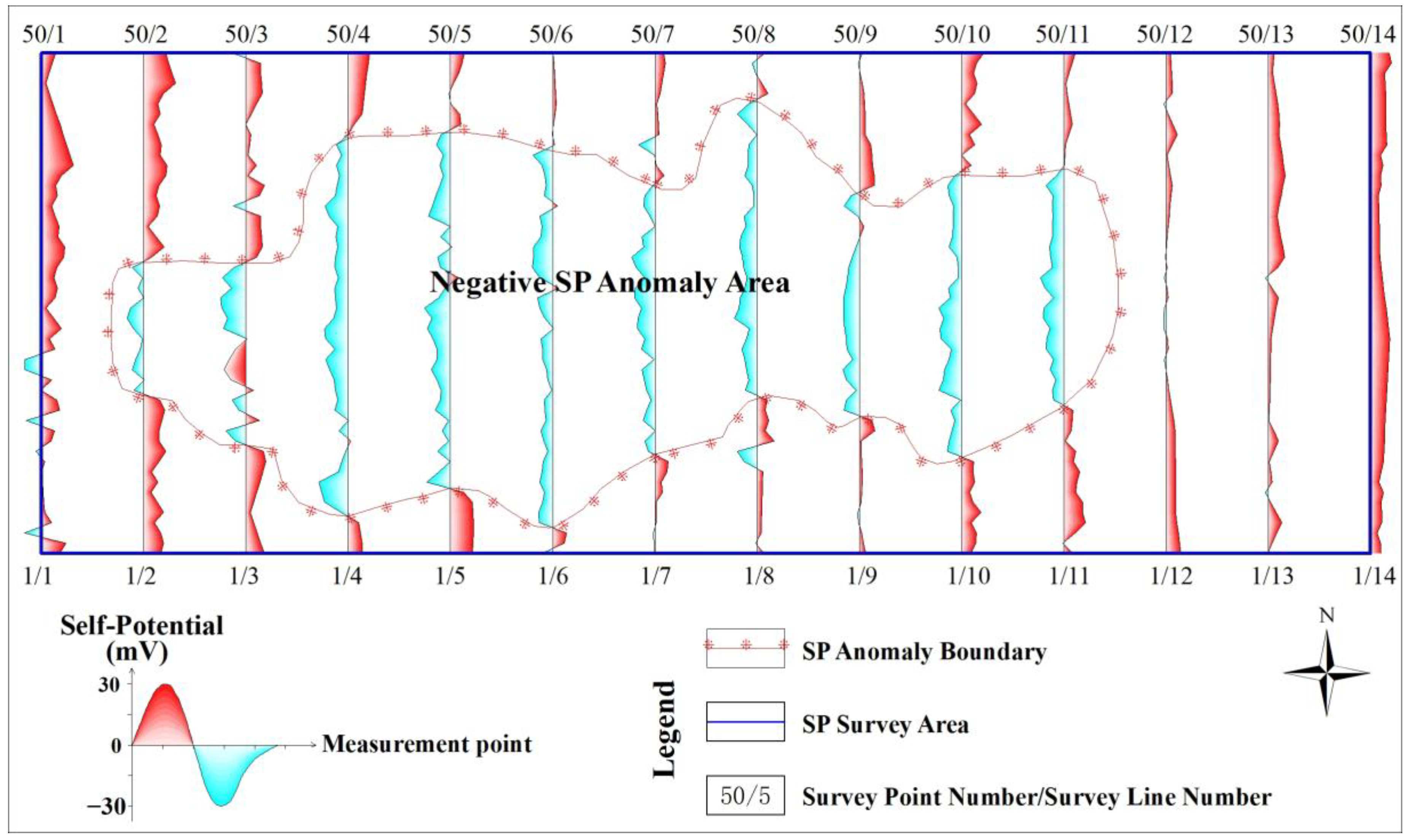
The self-potential (SP) profile map of the survey area (Figure 12) reveals distinct zonal characteristics in the spatial distribution of natural potential. Specifically, the northern and southern boundary regions of the survey area are dominated by stable positive SP anomalies, with SP values ranging from 0 mV to 20 mV—reflecting relatively weak electrochemical activity in these non-combustion zones. In contrast, the central region of the survey area develops a characteristic “negative–positive–negative” SP anomaly structure, which is closely associated with the electrochemical processes induced by coal seam spontaneous combustion.
The core zone of the negative SP anomaly (with SP values ranging from −40 mV to −10 mV) is distributed between survey lines L2 and L11. This negative anomaly zone exhibits a nearly east–west (E-W) trending pattern, with an extension length of approximately 470 m and a width ranging from 40 m to 135 m. Notably, this negative SP anomaly core zone shows good spatial coincidence with the high-magnetic anomaly belt delineated by previous magnetic surveys, with an offset error of less than 15 m. This strong spatial alignment further confirms that both the SP anomaly and magnetic anomaly are responsive to the same geological process (i.e., coal seam spontaneous combustion), providing complementary geophysical evidence for delineating the scope of the active fire zone.
The central fire zone exhibits the most intense and continuous negative self-potential (SP) anomalies (Figure 12). Moving outward from this core zone, the anomalies transition to fluctuating SP values ranging from −20 mV to +20 mV and gradually converge to stable positive anomalies at the fire zone periphery (Figure 12). Field investigations confirm that within the negative SP anomaly belt, there are exposed reddish combustion-altered rocks (with a thickness of 2–5 m) and spontaneous gas emission vents (with CO concentrations > 250 ppm). Notably, the orientation of this negative anomaly belt aligns with the outcrop of the M7–M4 coal seam (which dips at NE32°), confirming that the negative SP anomalies are a direct geophysical response to the redox electrochemical processes induced by coal seam spontaneous combustion.
Further analysis reveals that the potential gradient at the fire zone boundary (ΔSP/Δx = 2.5 mV/m) is significantly higher than that in peripheral non-combustion areas (ΔSP/Δx = 0.8 mV/m). This gradient difference reflects distinct variations in electrochemical activity—with the higher boundary gradient corresponding to the intense redox reactions at the combustion front. Additionally, combined with data from borehole ZK6-3 (which revealed gas-conductive fracture channels with a permeability > 50 mD), statistical analysis shows a positive correlation (R2 = 0.76) between the amplitudes of negative SP anomalies and combustion intensity (characterized by a temperature gradient of 6–10 °C/m). This study thus demonstrates that the zonal distribution characteristics of SP anomalies provide critical electrical constraints for the refined delineation of shallow-source coal fire boundaries.
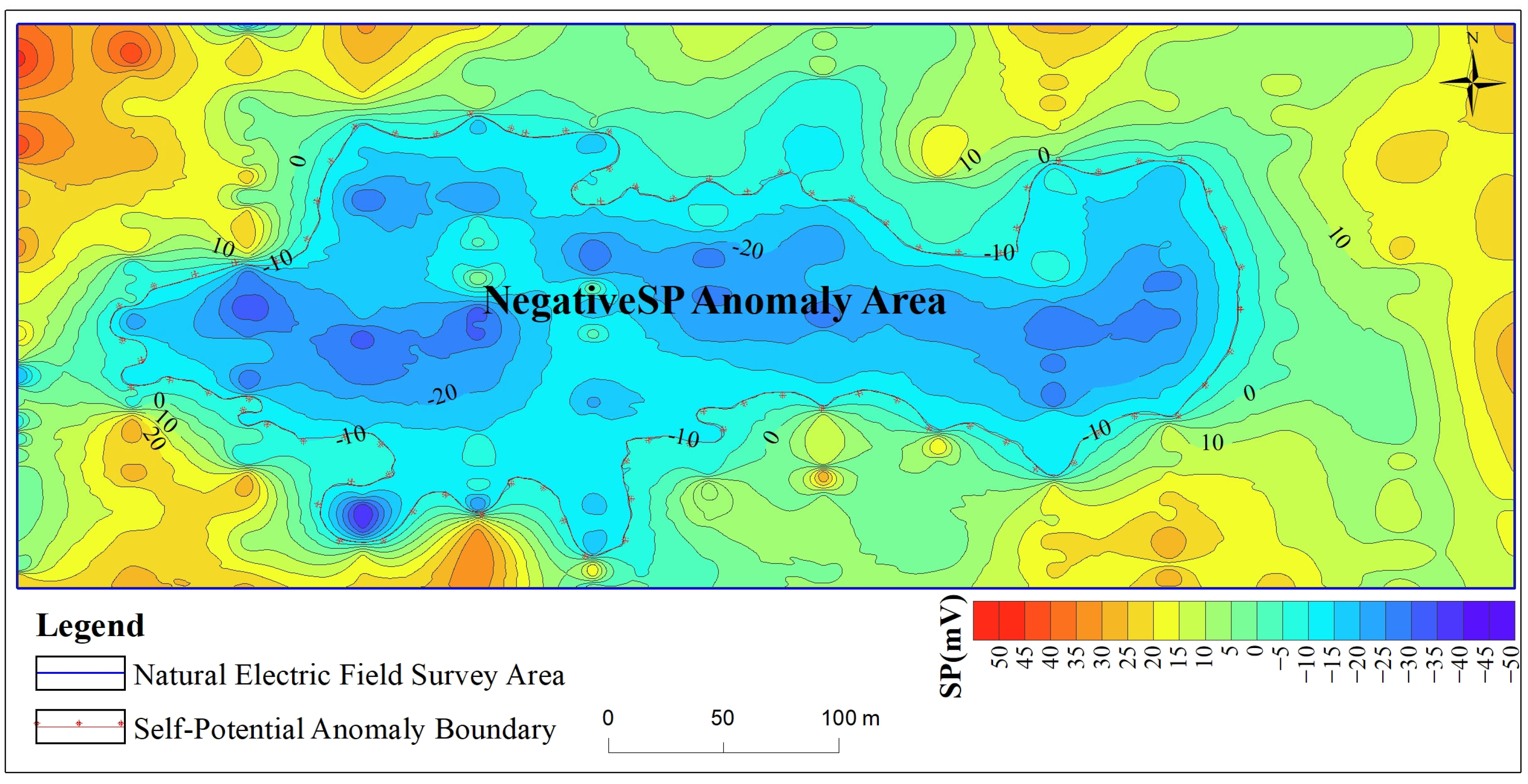
The SP isopleth map (Figure 13) further delineates a negative SP anomaly zone centered in the survey area, which exhibits a nearly east–west (E-W) trending distribution. This anomalous zone spans approximately 440 m in length and 35–170 m in width, covering 10 survey lines (L2–L11), with an extreme negative value of −38.17 mV. The centers of these negative anomalies show a bead-like distribution pattern (Figure 13). Spatial correlation analysis indicates a 72% coupling consistency between this negative SP anomaly zone and the adjacent high-magnetic anomaly zones (identified in previous magnetic surveys). The northern boundary of the negative SP anomaly zone extends to the floor of the M4 coal seam (at an elevation of +1715 m), and its corresponding surface manifestations include red burnt rock belts (3–8 m thick) and spontaneous collapse pits (10–25 m in diameter). Collectively, these observations confirm that the negative SP anomalies represent the geophysical response to the spontaneous combustion of the M7–M4 coal seam group.
The internal zone of the negative SP anomaly features gentle potential gradients (ΔSP/Δx < 1 mV/m), accompanied by stable negative SP values ranging from −15 mV to −30 mV. In contrast, the boundary transition zones of the anomaly exhibit abrupt gradient changes (ΔSP/Δx > 3 mV/m), collectively forming characteristic “positive–negative–positive” annular structures—a spatial pattern closely tied to the heterogeneous electrochemical environment across the combustion front.
Drilling data from borehole ZK7-3 further confirms a precise spatial correlation: the water-saturated fracture zones within burnt rocks (with a moisture content > 18%) align directly with the core of the SP anomaly (where SP < −20 mV). This correlation demonstrates that water infiltration effects exert predominant control over the spatial distribution of the subsurface electrical field—likely because water saturation modulates the intensity of redox reactions and ion mobility, which are key drivers of SP signals.
Notably, the spatial extent of the SP anomaly-affected area significantly exceeds that of the magnetic anomalies, with an area ratio of 1.6:1. This discrepancy is consistent with the coupling mechanisms between two key geological processes in burnt rocks: (1) the water conductivity of fractures (which expands the range of electrical signal propagation) and (2) differences in magnetite mineralization (which limits magnetic anomaly distribution to zones with intense thermal alteration). This consistency further validates the complementary nature of SP and magnetic surveys in characterizing coal fire systems.

4.3. Resistivity (TEM) Anomalies

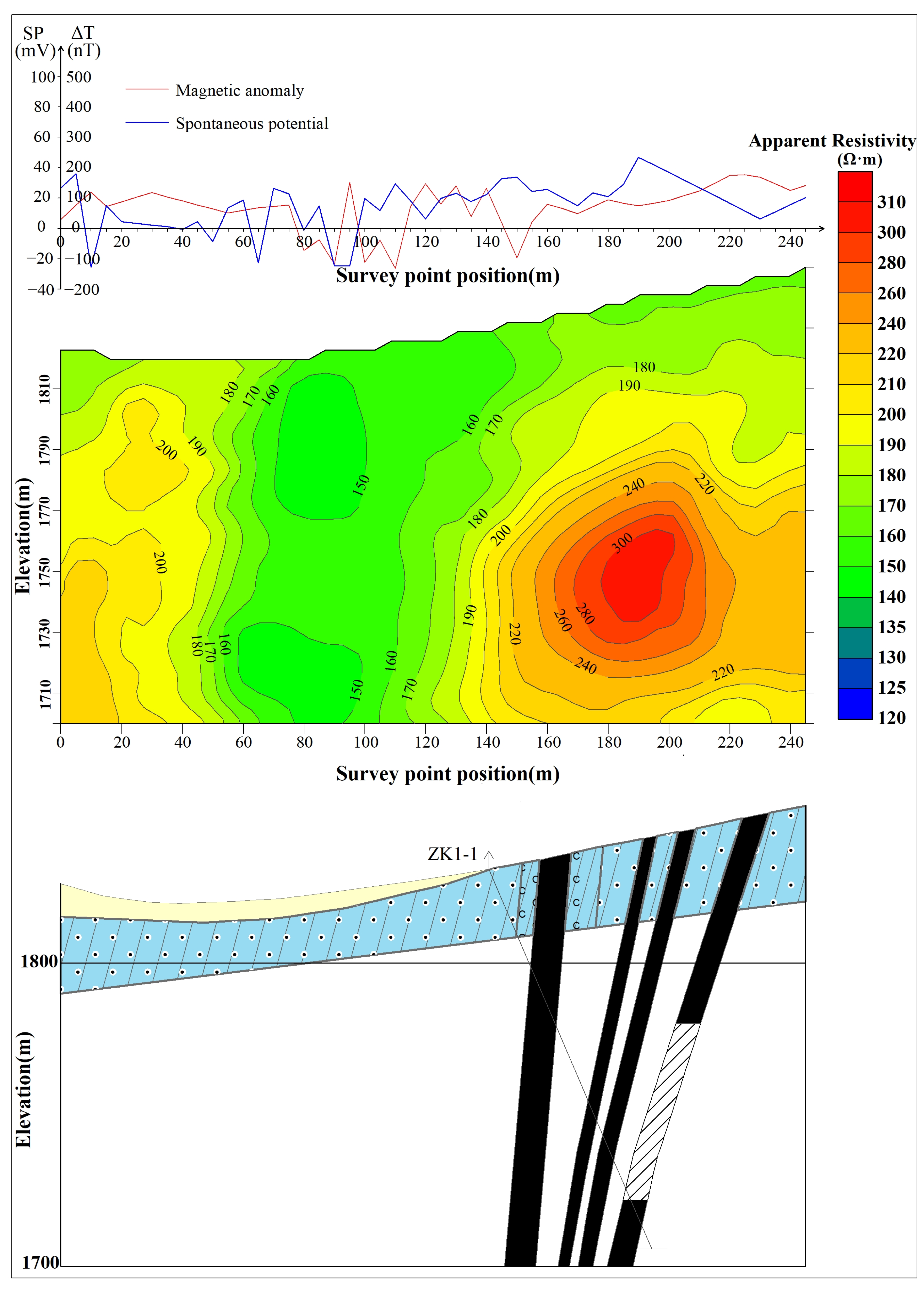
4.3.1. Survey Line 1 Integrated Geophysical Cross-Section (Miaoergou No. 1 Fire Zone): Evidence for No Active Coal Combustion and Latent Fire Risk from Dry Goaf Cavities

The integrated geophysical profile of Survey Line 1 (Figure 14) exhibits the following key characteristics, which collectively support subsurface geological interpretation:
Magnetic response: The magnetic curve remains generally stable along the entire profile (0–245 m), with only minor fluctuations (minimum value: −130 nT) observed in the 75–150 m segment. This stability indicates no significant accumulation of magnetite—a mineral typically associated with coal combustion—across most of the profile.
Self-Potential (SP) response: SP anomalies are predominantly positive, ranging from 0 to 48 mV. Notably, within the coal seam outcrop zone (150–240 m), both magnetic and SP responses maintain stability, showing no signs of the “high-magnetic-negative potential” coupling feature that is typical of combustion-affected zones (a signature of redox reactions during coal oxidation).
Transient Electromagnetic (TEM) inversion results: TEM inversion reveals a tightly closed high-resistivity body (resistivity > 250 Ω·m) at depths corresponding to the 160–220 m horizontal interval. This high-resistivity feature aligns with historical records of goaf roadways distributed at elevations of +1700 to +1800 m, confirming its association with dry, non-waterlogged goaf spaces.
Combined with the absence of surface thermal anomalies and the aforementioned geophysical response patterns, three key conclusions are drawn:
The coal seam outcrop in this area has not been affected by spontaneous combustion;
No subsurface combustion signatures (e.g., magnetite enrichment, negative SP anomalies) are currently detected at depth;
However, the cavity structures within the identified goaf zone may act as potential pathways for westward fire propagation (given the regional fire spread trend), posing a latent risk of fire expansion.
Consequently, this region should be prioritized for long-term monitoring (e.g., periodic magnetic and SP surveys) and targeted fire prevention measures (e.g., grouting to seal goaf cavities) to mitigate the risk of fire propagation.

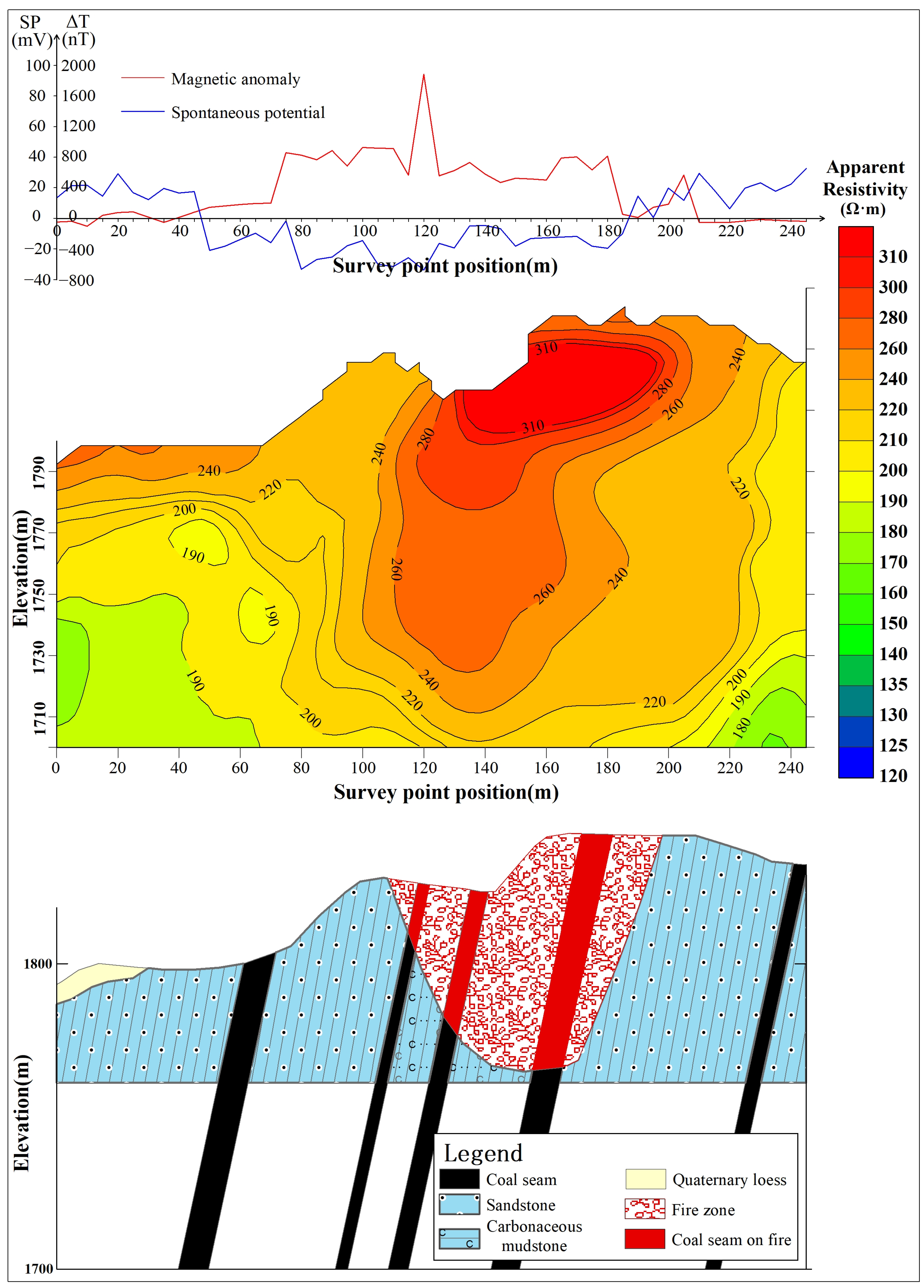
4.3.2. Integrated Geophysical Cross-Section of Survey Line 10: Characterizing Intense Active Coal Combustion in M4–M6 Seams and Imminent Propagation Risk Zones

The comprehensive geophysical profile of Survey Line 10 (Figure 15) reveals distinct, coupled geophysical anomalies within the 115–185 m horizontal interval—providing clear evidence of subsurface coal combustion. Specifically:
Magnetic response: Significant high-magnetic anomalies are observed in this interval, with peak values reaching 1886 nT. This strong magnetic signature is consistent with magnetite enrichment (a product of coal combustion-induced mineral transformation), directly indicating the presence of fire-affected zones.
Self-Potential (SP) response: Sustained negative SP anomalies are detected in the same interval, reflecting the redox reactions associated with active coal oxidation (a key geophysical indicator of combustion fronts).
Transient Electromagnetic (TEM) response: TEM surveys identify a shallow high-resistivity body with a resistivity range of 260–320 Ω·m in this section, which corresponds to dry, combustion-altered rock masses (distinct from water-saturated non-fire zones).
Integrated analysis—combining the above geophysical anomalies with surface geological features (including burnt rock zones and collapse pits, typical of coal fire-induced surface modifications)—confirms the presence of intense coal seam combustion zones. These combustion zones extend vertically from the surface to depth, involving the M6, M5, and M4 coal seams.
Notably, the 115–125 m sub-interval exhibits particularly vigorous deep-seated combustion characteristics (evidenced by the strongest magnetic and negative SP anomalies, coupled with high resistivity). This observation indicates an imminent risk of large-scale fire propagation in this sub-region, requiring urgent attention for targeted fire suppression and risk mitigation.

4.3.3. TEM Inversion Cross-Section

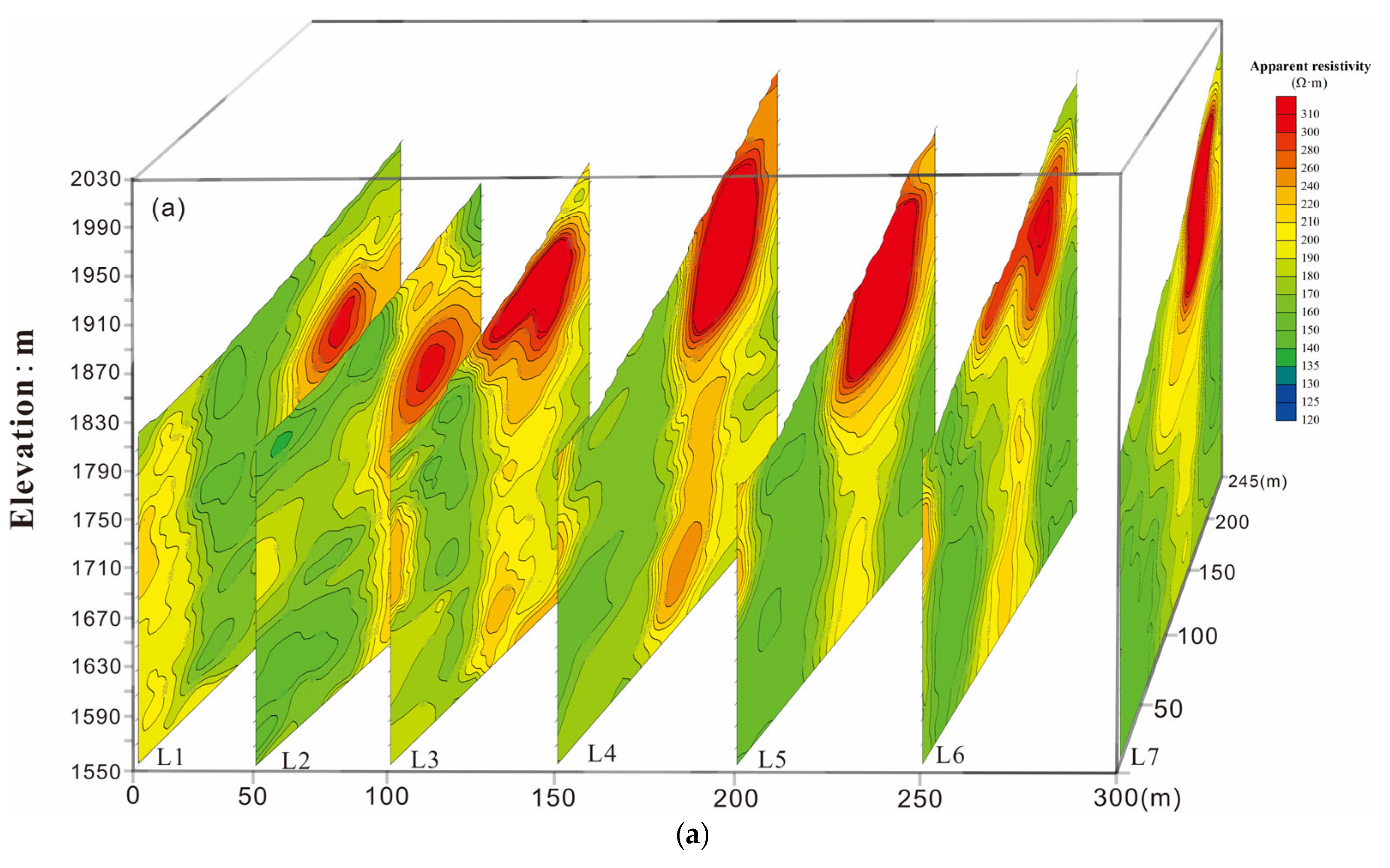
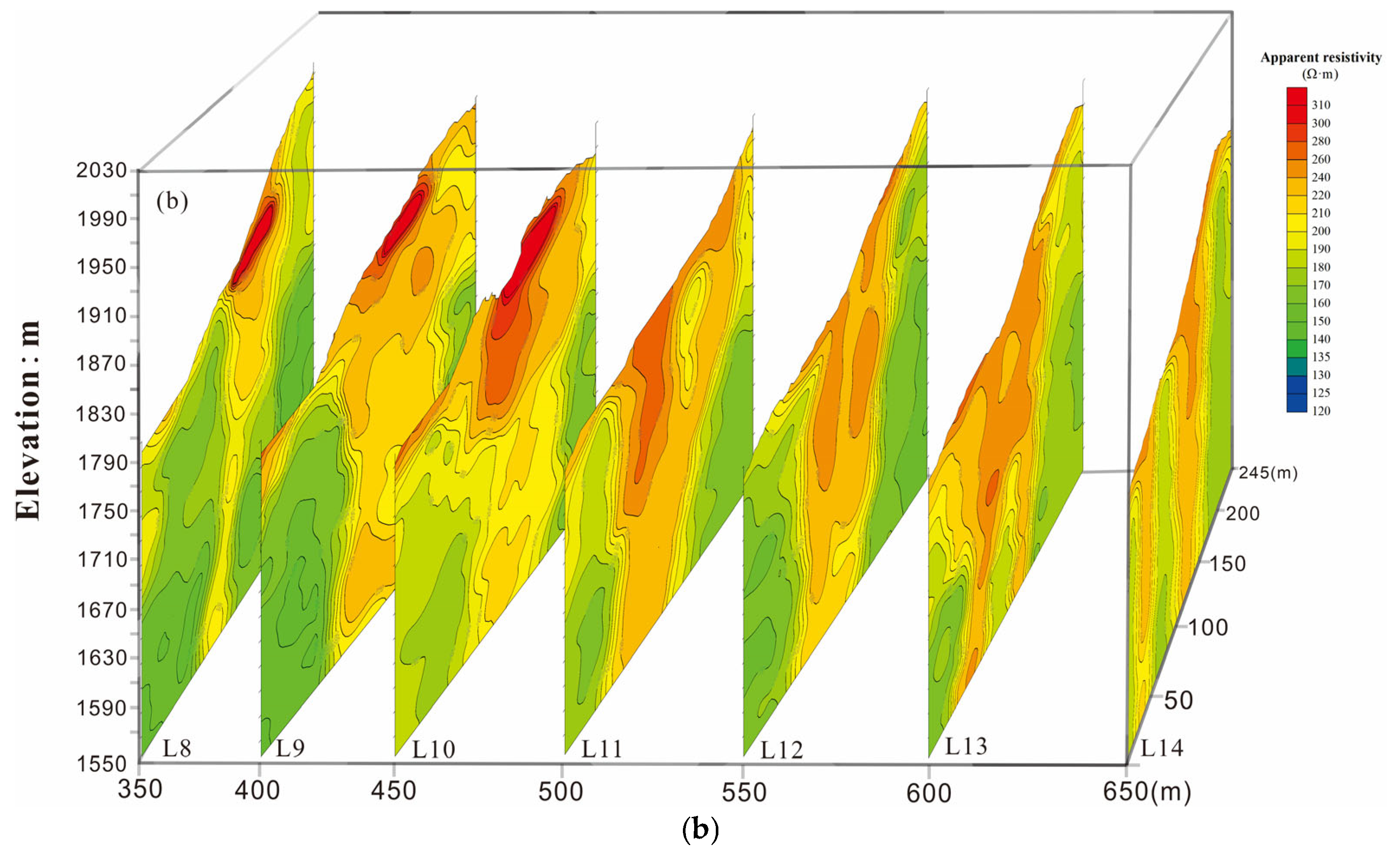
This study conducted systematic geophysical investigations using the Transient Electromagnetic Method (TEM) along Survey Lines 1–14 in the No. 1 Fire Zone of the coalfield, with the dual objectives of delineating goaf distributions and characterizing the spatial patterns of coal seam spontaneous combustion risks. As illustrated in the TEM inversion pseudo-section diagrams (Figure 16), the following key findings were obtained:
Goaf delineation in Lines 1–11: A closed high-resistivity anomaly (resistivity: 260–320 Ω·m) was identified above the +1550 m elevation in these lines. Borehole verification (e.g., boreholes ZK1-1 and ZK5-1) confirmed that this anomaly corresponds to the non-water-saturated goaf of the M4 coal seam. The elevated resistivity of this zone is attributed to fracture development within the collapsed roof strata of the goaf, which reduces the overall water saturation and increases electrical resistivity.
Active combustion zone identification in Lines 4–7: The integrated anomalies in these lines—characterized by “high magnetic intensity (>800 nT) and negative self-potential (−120 mV)”—exhibit clear spatial correlation with two surface/subsurface features: (1) abrupt geothermal variations (with a maximum temperature difference ΔTmax = 48°C) and (2) surface subsidence pits (with diameters of 12–15 m). These coupled geophysical and geological signatures indicate the presence of an active combustion core zone, which shows a westward propagation trend (evidenced by a resistivity gradient of Δρ/Δx = 4.5 Ω·m/m).
Risk assessment in Lines 12–14: These lines exhibit stratified resistivity structures with a stable resistivity range of 160–200 Ω·m, and no fire migration channels were detected through TEM inversion. However, the apparent resistivity values of the coal seams in this region still suggest persistent potential risks of spontaneous combustion, requiring long-term monitoring to prevent fire initiation.
This research demonstrates that high-resistivity anomalies, when coupled with multi-parameter geophysical markers (magnetic, self-potential, and thermal indicators), provide effective diagnostic criteria for identifying goaf boundaries and characterizing the dynamic evolution of fire zones. This integrated approach significantly enhances the precision of subsurface combustion hazard assessment in complex mining environments, offering a reliable technical basis for targeted fire prevention and control measures.

4.4. Integrated Interpretation

Comparative analysis reveals a positive correlation between the expansion of the fire zone’s western segment (with a width of 170 m) and the characteristics of shallow oxidation zones—specifically, zones with a burial depth < 30 m and a fracture density exceeding 20 fractures per meter. In contrast, the contraction of the eastern segment (with a width of 35 m) corresponds to deep combustion front stagnation zones, where the thermal gradient is <5 °C/m. This study further demonstrates that the spatial zonation of self-potential (SP) anomalies can effectively characterize the thermo-hydro-chemical dynamic processes during coal seam spontaneous combustion, providing multi-parameter constraints for both the precise identification of fire zone boundaries and the development of disaster chain early-warning systems.
To address the complex terrain characteristics of Fire Zone No. 1 in the Miaoergou Coalfield—including the presence of two collapse pits and extensive loose accumulations—this study establishes an integrated geophysical identification model, which combines magnetic surveys, self-potential (SP) surveys, and transient electromagnetic (TEM) surveys. This integrated model enables the precise delineation of fire zone boundaries and the clear characterization of fire zone spatial distribution patterns.
Key geophysical observations from the model are as follows:
Magnetic anomaly characteristics: The high-magnetic anomaly zone (Figure 4 and Figure 5) exhibits an elliptical, east–west (E-W) orientation, with a length of 360 m and a width ranging from 10 m to 30 m. The maximum total magnetic field anomaly (ΔTmax) reaches 1886.3 nT, and a negative magnetic anomaly band (with a minimum ΔT, ΔTmin, of −277.5 nT) is distributed along the southern flank of this high-magnetic zone. Notably, this high-magnetic anomaly shows a strong linear correlation (R2 = 0.89) with two geological features: (1) the enhanced magnetic susceptibility of burnt rocks (κ = 1200–2450 × 10−5 SI); and (2) dense subsurface fracture networks (fracture density > 15 fractures/m).
SP anomaly characteristics: The SP negative anomaly zone (Figure 13) spans survey lines L2–L11, presenting a “positive–negative–positive” annular configuration, with the minimum SP value reaching −38.17 mV. The core of this SP anomaly exhibits spatial coincidence with water-saturated burnt rock zones (where moisture content > 18%), while the boundary potential gradient of the anomaly reaches ΔSP/Δx = 3 mV/m. This gradient variation reflects differences in electrochemical activity during redox processes associated with coal combustion.
TEM anomaly characteristics: TEM surveys identified high apparent resistivity anomalies (ρ = 260–320 Ω·m) in the subsurface above the +1720 m elevation level; these anomalies correspond to non-waterlogged goaf (gob) collapse areas. Additionally, small-scale high-resistivity bodies were detected along survey lines 8–10 at shallow depths (20–40 m), which exhibit geological characteristics consistent with shallow collapse induced by spontaneous combustion.
Spatial correlation analysis confirms high consistency among the anomalies delineated by the three geophysical methods: the displacement between the centers of high-magnetic anomalies and SP anomalies is <15 m, and the area overlap rate of the delineated fire zones exceeds 85%. Borehole verification further confirms that the main fire zone is confined to the subsurface above the +1720 m elevation (with a burial depth range of 0–50 m), which shows good agreement with TEM inversion results (with an error < 10%).

5. Discussion

5.1. Conclusions

This study develops an integrated geophysical approach for delineating coal fire zones in complex terrains, with key findings:
High-precision magnetic surveys map thermal alteration boundaries accurately via magnetite signatures, achieving 89% spatial consistency with actual combustion zones (validated by 8 boreholes).
SP anomalies capture redox electrochemical gradients; boundary potential transitions (>3 mV/m) effectively distinguish active combustion fronts.
TEM surveys resolve goaf structural heterogeneities, linking high-resistivity anomalies to collapse features.
Cross-validation confirms strong spatial coherence (max displacement < 15 m, fire zone overlap > 85%), while borehole verifies shallow fire dynamics (combustion < 50 m depth) and subsurface pathways. The framework improves characterization accuracy for arid-region coal fires, though its limitations (deep-layer resolution decline, high-humidity sensitivity, geological subsoil constraints) should be noted—future applications may require supplementary methods (e.g., borehole radar for deep detection) in challenging conditions.

5.2. International Comparative Discussion

To clarify the framework’s innovation, a systematic comparison with representative international studies (India, Australia, USA) on integrated coal fire detection methods was conducted, focusing on detection coverage, inter-method correlation, and adaptability to arid conditions:
As Table 3 shows, existing international integrated methods suffer from partial detection coverage (e.g., lacking shallow redox or deep structural data) or low inter-method reliability (anomaly overlap < 60%). The core innovations of this study address these gaps:
(1) Full-Dimensional Detection Coverage
By integrating magnetic (shallow thermal alteration), SP (redox/water distribution), and TEM (deep goaf/structure) methods, the framework covers the entire “shallow–deep” (0–350 m) and “mineralogical–structural–electrochemical” detection spectrum. This resolves the partial coverage of international studies—for example, filling the gap of Revil et al. (2013) [65] in deep goaf mapping and Guan et al. (2005) [59] in shallow redox detection.
(2) Quantitative Multi-Method Coupling
Unlike international studies relying on qualitative anomaly alignment, this study established quantitative correlations: 89% spatial consistency (R2 = 0.89) between magnetic anomalies and borehole-identified burnt rocks, >85% anomaly overlap across the three methods, and <10% positional error verified by 8 boreholes. This reduces interpretation ambiguity—addressing the low inter-method correlation (e.g., <60% in King (1987) [67]) of previous works.
(3) Arid Region Adaptation
The framework is optimized for arid conditions (low groundwater, high evaporation) typical of northwestern China: TEM loop size (250 m × 250 m) and excitation current (9.5 A) were adjusted to enhance shallow resolution, addressing the poor shallow performance of methods designed for humid regions (e.g., Hunter Valley). SP gradients (>3 mV/m) were used to identify combustion fronts, leveraging arid conditions to minimize artificial water-induced anomalies—resolving the SP interference issues in high-humidity international study areas.
This comparison confirms the framework’s uniqueness in addressing arid-region coal fire detection challenges, filling critical gaps in international integrated geophysical methodologies.

5.3. Limitations of the Integrated Geophysical Method

While the Integrated Geophysical Collaborative Detection framework achieves high accuracy in the Miaoergou No. 1 Fire Zone, its effectiveness is constrained by geological and environmental conditions, with key limitations as follows:
(1) Depth Constraints
The framework is optimized for shallow to intermediate fire zones (burial depth < 50 m). For deep combustion zones (>100 m), all three methods show degraded resolution:
High-precision magnetic surveys: ΔT anomaly intensity attenuates to <300 nT due to signal absorption by overlying strata, reducing the contrast between fire-altered and background rocks. SP methods: Thick low-permeability layers (e.g., compact sandstone with resistivity > 600 Ω·m) shield redox-driven potential gradients, making it impossible to distinguish active combustion fronts from undisturbed zones. TEM methods: While capable of detecting deep structures (>300 m), they cannot differentiate fire-induced high-resistivity anomalies (ρ = 260–320 Ω·m) from naturally high-resistivity strata (e.g., dry conglomerate with ρ = 300–400 Ω·m). For example, borehole ZK8-2 (depth > 80 m) identified a TEM-detected high-resistivity zone (ρ =350 Ω·m) as dry conglomerate, not a fire zone—highlighting deep-layer misinterpretation risks.
(2) High-Humidity Sensitivity
In high-humidity environments (groundwater table < 10 m or annual precipitation > 500 mm), SP and TEM performances decline significantly:
TEM methods: Increased groundwater content reduces resistivity contrast between water-saturated goaf (ρ < 50 Ω·m) and fire-affected zones (ρ = 260–320 Ω·m). In the Hunter Valley coalfields (Australia) [67], higher groundwater availability reduced TEM anomaly resolution by 30–40% compared to the arid Miaoergou area, where low humidity maintains clear resistivity differences. SP methods: Excessive surface water creates artificial SP anomalies (fluctuations between −10 mV and +10 mV) due to electrolytic effects, masking combustion-related negative anomalies (SP = −10 to −40 mV). This contrasts with the Miaoergou area, where low humidity minimizes artificial interference.
(3) Geological Subsoil Variability
The framework relies on distinct petrophysical differences between burnt rocks, coal seams, and host strata (Table 1 and Table 2). In regions with overlapping physical properties, method effectiveness decreases:
Low-rank coalfields (coal resistivity < 300 Ω·m) overlap with burnt rock resistivity (120–580 Ω·m), making TEM unable to differentiate coal seams from fire-altered zones. Areas with high background magnetic susceptibility (e.g., volcanic rocks with κ > 1000 × 10−5 SI) mask fire-related magnetic anomalies (κ = 1200–2450 × 10−5 SI). In the Jharia Coalfield (India) [52], volcanic interbeds required additional RTP processing to separate fire anomalies from background, increasing interpretation complexity.
(4) Topographic Constraints
Steep terrain (slopes > 30°) or thick Quaternary deposits (>5 m) distort geophysical signals. While Miaoergou survey lines avoided steep slopes, unavoidable steep terrain requires topographic correction that can introduce up to 15% error in SP values, degrading anomaly accuracy.

Supplementary Materials

The following supporting information can be downloaded at: https://www.mdpi.com/article/10.3390/app152011164/s1.

Author Contributions

Conceptualization, X.Z. and H.Y.; methodology, Y.Z.; software, J.L.; validation, X.Z., B.Z. and F.L.; formal analysis, X.Z.; investigation, X.Z., H.Y., B.Z. and J.L.; data curation, X.Z.; writing—original draft preparation, X.Z.; writing—review and editing, H.Y.; visualization, X.Z.; supervision, H.Y. All authors have read and agreed to the published version of the manuscript.

Funding

This work was financially supported by the Open project of Key Laboratory in Xinjiang Uygur Autonomous Region, China (Projects No. 2023D04068), the second group of Tianshan Talent Training Program: Youth Support Talent Project (Projects No. 2023TSYCQNTJ0001) and the National Natural Science Foundation of China (Projects No. 42374082).

Institutional Review Board Statement

Not applicable.

Informed Consent Statement

Not applicable.

Data Availability Statement

The original contributions presented in this study are included in the article/Supplementary Material. Further inquiries can be directed to the corresponding author.

Acknowledgments

We thank Zizhao Zhang from Xinjiang University for his fruitful discussion and constructive comments toward the improvement of this paper. The authors appreciate Gensheng Li and Yaxiaer Yalikun. Special thanks are given to the anonymous reviewer for carefully reviewing the manuscript and for their constructive comments and editing suggestions.

Conflicts of Interest

The authors declare no conflicts of interest. The funders had no role in the design of the study; in the collection, analyses, or interpretation of data; in the writing of the manuscript; or in the decision to publish the results.

Abbreviations

The following abbreviations are used in this manuscript:
SPSelf-potential
TEMTransient electromagnetic

References

  1. Thomas, G.; Fariborz, G. Effect of geological processes on coal quality and utilization potential: Review with examples from western Canada. J. Hazard Mater. 2000, 74, 109–124. [Google Scholar] [CrossRef] [PubMed]
  2. Finkelman, R.B. Potential health impacts of burning coal beds and waste banks. Int. J. Coal Geol. 2004, 59, 19–24. [Google Scholar] [CrossRef]
  3. Zhao, Y.; Zhang, J.; Chou, C.L.; Li, Y.; Wang, Z.; Ge, Y.; Zheng, C. Trace element emissions from spontaneous combustion of gob piles in coal mines, Shanxi, China. Int. J. Coal Geol. 2008, 73, 52–62. [Google Scholar] [CrossRef]
  4. Van Dijk, P.M.; Kuenzer, C.; Zhang, J.; Wolf, K.H.; Wang, J. Fossil Fuel Deposit Fires, Occurrence Inventory, Design and Assessment of Instrumental Options; Report 500102021; Netherlands Environmental Assessment Agency: Bilthoven, The Netherlands, 2009; p. 134. [Google Scholar]
  5. Dijk, P.V.; Zhang, J.Z.; Wang, J.; Kuenzer, C.; Wolf, K.H. Assessment of the contribution of in-situ combustion of coal to greenhouse gas emission; based on a comparison of Chinese mining information to previous remote sensing estimates. Int. J. Coal Geol. 2011, 86, 108–119. [Google Scholar] [CrossRef]
  6. Song, Z.; Kuenzer, C. Coal fires in China over the last decade: A comprehensive review. Int. J. Coal Geol. 2014, 133, 72–99. [Google Scholar] [CrossRef]
  7. Bekteshia, S.; Kabashia, S.; Ahmetaja, S.; Xhafab, B.; Hodollic, G.; Kadiric, S.; Alijaja, F.; Abdullahu, B. Radon concentrations and exposure levels in the Trepça underground mine: A comparative study. J. Clean. Prod. 2017, 155, 198–203. [Google Scholar] [CrossRef]
  8. Chen, X.Y.; Huang, J.L.; Yang, Q.; Nielsen, C.P.; Shi, D.B.; Mcelroy, M.B. Changing carbon content of Chinese coal and implications for emissions of CO2. J. Clean. Prod. 2018, 194, 150–157. [Google Scholar] [CrossRef]
  9. Guo, J.; Wen, H.; Zheng, X.Z.; Liu, Y.; Cheng, X.J. A method for evaluating the spontaneous combustion of coal by monitoring various gases. Process Saf. Environ. Prot. 2019, 126, 223–231. [Google Scholar] [CrossRef]
  10. Oliveira, M.L.; Pinto, D.; Tutikian, B.F.; da Boit, K.; Saikia, B.K.; Silva, L.F. Pollution from uncontrolled coal fires: Continuous gaseous emissions and nanoparticles from coal mines. J. Clean. Prod. 2019, 215, 1140–1148. [Google Scholar] [CrossRef]
  11. Zhang, L.Y.; Shen, Q.; Wang, M.Q.; Sun, N.N.; Wei, W.; Lei, Y.; Wang, Y.J. Driving factors and predictions of CO2 emission in China’s coal chemical industry. J. Clean. Prod. 2019, 210, 1131–1140. [Google Scholar] [CrossRef]
  12. Ren, S.J.; Wang, C.P.; Deng, J.; Tian, Y.; Song, J.J.; Cheng, X.J.; Sun, G.F. Thermal properties of coal during low temperature oxidation using a grey correlation method. Fuel 2020, 260, 116287. [Google Scholar] [CrossRef]
  13. Che, Y.; Huang, W.H.; Zhang, A.Y. Coal fires in China. J. Coal Sci. Eng. 2004, 10, 36–40. [Google Scholar]
  14. Zhang, J.M. Underground Coal Fires in China: Origin, Detection, Firefighting, and Prevention; China Coal Industry Publishing House: Beijing, China, 2008. [Google Scholar]
  15. Bao, X.D. Analysis on results of the fifth coalfield fire area survey in Xinjiang. China Energy Environ. Prot. 2021, 43, 1–4. [Google Scholar] [CrossRef]
  16. Zeng, Q.; Li, G.S.; Dong, J.X.; Pu, Y. Typical Ecological and Environmental Issues and Countermeasures in Coal Mining in Xinjiang Region. Min. Saf. Environ. Prot. 2017, 44, 106–110. [Google Scholar]
  17. Zhang, X.S. Magnetic method detecting coal fires. Coal Geol. Explor. 1980, 6, 43–48. [Google Scholar]
  18. Shao, Z.L.; Wang, D.M.; Wang, Y.M. Research progress of coalfield fire detection method. Saf. Coal Mines 2012, 43, 189–192. [Google Scholar] [CrossRef]
  19. Zhang, X.S. Probe into Xinjiang coalfield underground combustion area features and features and fire-fighting problems. Coal Geol. China 2004, 16, 18–21. [Google Scholar]
  20. Xiong, S.Q. Remote Sensing and Geophysical Detection Technology of Underground Coal Spontaneous Combustion; Geological Publishing House: Beijing, China, 2006. [Google Scholar]
  21. Yang, B.; Cui, Y.A.; Xie, J.; Zhang, L.J.; Chen, X.L.; Liu, J.X. Inversion of self-potential data by using particle filter. Prog. Geophys. 2020, 35, 2407–2415. (In Chinese) [Google Scholar]
  22. Li, H.; Fan, Y.R.; Hu, Y.Y.; Deng, S.G.; Sun, Q.T. Joint inversion of HDIL and SP with a five-parameter model for estimation of connate water resistivity. Chin. J. Geophys. 2013, 56, 688–695. (In Chinese) [Google Scholar]
  23. Guo, F.S.; Lin, Z.Y.; Li, G.R.; Deng, J.Z.; Xie, C.F.; Yang, H.Y.; Wu, Z.C.; Zhou, W.P.; Jiang, Y.B.; Li, H.X.; et al. Study on the geological structure of Xiangshan uranium-bearing volcanic basin: Evidences from magnetotelluric sounding and GOCAD modeling. Chin. J. Geophys. 2017, 60, 1491–1510. (In Chinese) [Google Scholar] [CrossRef]
  24. Guo, F.S.; Yang, H.Y.; Hou, Z.Q.; Wu, Z.C.; Lin, Z.Y.; Wang, G.C.; Xue, L.F.; Guan, Y.; Zhou, W.P. Structural setting of the Zoujiashan-Julong’an region, Xiangshan volcanic basin, China, interpreted from modern CSAMT data. Ore Geol. Rev. 2022, 150, 105180. [Google Scholar] [CrossRef]
  25. Shao, Z.L. Magnetic and Electrical Signature of CoalFires and Comprehensive Detection Methodology; China University of Mining &Technology: Xuzhou, China, 2017; pp. 1–129. [Google Scholar]
  26. Li, M.F. Joint Inversion Interpretation of Surface and Surface-to-Underground Electromagnetic Method; China University of Mining &Technology: Xuzhou, China, 2021; pp. 1–147. [Google Scholar]
  27. Li, R.H. 3D Numerical Modeling and Inversion for Transient Electromagnetic Field Excited by Source Loop Based on Vector Finite Element Method; China University of Geosciences: Beijing, China, 2018; pp. 1–146. [Google Scholar]
  28. Kumar, R.; Bera, A.; Srivastava, S.; Pal, S.K. Integrating physiographical and geophysical analyses for the remediation of a water-filled abandoned coal mining site in Chasnala Colliery, Jharkhand, India. J. Earth Syst. Sci. 2024, 133, 161. [Google Scholar] [CrossRef]
  29. Gu, Y.; Li, H.; Dou, L.; Wu, M.; Guo, H.; Huang, W.S.; Gu, J.P.; Saeideh, B.; Jiang, L.L.; Feng, L.L. Advance in Detection and Management for Underground Coal Fires: A Global Technological Overview. Combust. Sci. Technol. 2024, 6, 1–38. [Google Scholar] [CrossRef]
  30. Li, K.T.; Yan, J.B.; Li, F.; Yu, Y.P.; Li, Y.L.; Zhang, L.; Wang, P.; Li, Z.Y.; Yang, Y.C.; Wang, J.W. Non-invasive geophysical methods for monitoring the shallow aquifer based on time-lapse electrical resistivity tomography, magnetic resonance sounding, and spontaneous potential methods. Sci. Rep. 2024, 14, 7320. [Google Scholar] [CrossRef] [PubMed]
  31. Zhang, T.; Yang, Y.L. Occurrence characteristics and treatment technologies of mine goaf in China: A comprehensive review. Environ. Earth. Sci. 2024, 83, 441. [Google Scholar] [CrossRef]
  32. Pal, S.K.; Kumar, S.; Srivastava, S. Integrated geophysical approach for Coal mine fire in Jharia coalfield, India. Res. Sq. 2021, 3, 1–34. [Google Scholar] [CrossRef]
  33. Zhao, H.L.; Sun, H.F.; Zhang, Y.Y.; Liu, R.; Chen, L.; Liu, S.B. Assessing goaf in steep coal seam over complex topography using semi-airborne transient electromagnetic method: A case study in Xinjiang China. Bull. Eng. Geol. Environ. 2025, 84, 342. [Google Scholar] [CrossRef]
  34. Anghelescu, L.; Diaconu, B.M. Advances in Detection and Monitoring of Coal Spontaneous Combustion: Techniques, Challenges, and Future Directions. Fire 2024, 7, 354. [Google Scholar] [CrossRef]
  35. Deng, J.; Wang, J.R.; Ren, S.J.; Wang, C.P.; Qu, G.Y.; Ma, L. Identification and detection technology for high-temperature spontaneous combustion points in goaf areas. J. China Coal Soc. 2024, 49, 885–901. [Google Scholar] [CrossRef]
  36. Ma, Z.J.; Qin, B.T.; Shi, Q.L.; Zhu, T.G.; Chen, X.M.; Liu, H. The location analysis and efficient control of hidden coal spontaneous combustion disaster in coal mine goaf: A case study. Process Saf. Environ. Prot. 2024, 184, 66–78. [Google Scholar] [CrossRef]
  37. Liu, Y.; Wen, H.; Chen, C.M.; Guo, J.; Jin, Y.F.; Zheng, X.Z.; Cheng, X.J.; Li, D.L. Research Status and Development Trend of Coal Spontaneous Combustion Fire and Prevention Technology in China: A Review. ACS Omega 2024, 20, 21727–21750. [Google Scholar] [CrossRef]
  38. Liu, Y.; Qi, X.Y.; Luo, D.Y.; Zhang, Y.Q.; Qin, J.T. Detection and management of coal seam outcrop fire in China: A case study. Sci. Rep. 2024, 14, 4609. [Google Scholar] [CrossRef] [PubMed]
  39. Zhu, X.Y.; Yu, C.C.; Xiong, S.Q.; Chen, B. The application of the magnetic method to the detection of underground coal fires. Geophys. Geochem. Explor. 2007, 31, 115–119. [Google Scholar]
  40. Bao, N.L.; Liu, H.F.; Yu, C.T.; Li, Y.L. The detection of mined-out area of shallow iron ore by nanometer transient eleetromagnelic method. Prog. Geophys. 2013, 28, 952–957. (In Chinese) [Google Scholar] [CrossRef]
  41. Li, M.F.; Liu, S.C.; Jiang, Z.H.; Su, B.Y.; Chen, S.S. Detecting floor geological information bymine DC perspective and 3D inversion. J. China Coal Soc. 2022, 47, 2708–2721. [Google Scholar] [CrossRef]
  42. Xie, J. Numerical Modeling and Inversion Imaging of Self-Potential by Natural Element Method; Central South University: Changsha, China, 2023; pp. 1–147. [Google Scholar]
  43. Zhang, B.F.; Xiao, F.; Jin, W.B. Burnt coal field detection via magnetic exploration. Environ. Earth Sci. 2023, 82, 160. [Google Scholar] [CrossRef]
  44. Wang, T.; Wang, H.Y.; Fang, X.Y.; Wang, G.D.; Chen, Y.Q.; Xu, Z.Y.; Qi, Q.J. Research progress and visualization of underground coal fire detection methods. Environ. Sci. Pollut. Res. 2023, 30, 74671–74690. [Google Scholar] [CrossRef]
  45. Meng, Q.F.; Ma, G.Q.; Li, L.L.; Li, J.Y. An Optimized Detection Approach to Subsurface Coalfield Spontaneous Combustion Areas Using Airborne Magnetic Data. Remote Sens. 2025, 17, 1185. [Google Scholar] [CrossRef]
  46. Zhi, D.M.; Liu, M. The Sequence Structure, Coal Forming Environment and Coal Accumulating Regularities of Coal-Bearing Rock Series in Southern Margin of Junggar Basin. Xinjiang Pet. Geol. 2013, 34, 386–389. [Google Scholar]
  47. Zhang, H.; Liu, Q.P.; Li, X.M. Tectonic coal-controlling patterns and coal seam occurrence laws in the Zhunan Coalfield. J. China Coal Soc. 2013, 38, 2103–2110. [Google Scholar]
  48. Zeng, Q.; Wang, T.; Li, D.W. Formation Mechanism and Control Technology of Coal Fire Disasters in the Zhunnan Coalfield, Xinjiang, China. J. Coal Sci. Eng. 2017, 23, 512–523. [Google Scholar]
  49. Zhu, M.; Wang, X.; Xiao, L. Structural Characteristics and Evolution in the Southern Margin of Junggar Basin. Xinjiang Pet. Geol. 2020, 41, 9–17. [Google Scholar]
  50. Zeng, Q.; Wang, T.; Li, D.W. Formation mechanisms and prevention technologies of coal seam spontaneous combustion disasters in the Zhunan Coalfield. Coal Sci. Technol. 2017, 45, 1–8. [Google Scholar]
  51. Li, X.M.; Zhang, H.; Liu, Q.F. Tectonic Evolution and Its Control on Coal Accumulation in the Zhunnan Coalfield, Northwest China. Int. J. Coal Geol. 2014, 131, 172–185. [Google Scholar]
  52. Wang, T.; Li, D.W.; Zeng, Q. Characteristics of Fracture Networks and Their Role in Coal Fire Propagation: A Case Study from the Zhunnan Coalfield. Environ. Earth Sci. 2018, 77, 1–14. [Google Scholar]
  53. Jiao, G.H.; Zhang, W.P.; Xie, L.H.; Wang, J.; Zhou, J.K.; Wang, Y.H. Depositional systems and their controlling factors of the Lower Jurassic Sangonghe Formation in southern Junggar Basin. J. Palaeogeogr. 2023, 25, 628–647. [Google Scholar]
  54. Huang, T.; Wang, G.; Yang, S.G.; Dong, L.G. Analysis of Coalbed Methane Occurrence Conditions in the Southern Hutubi Block in Southern Margin of Junggar Basin. China Coalbed Methane 2020, 17, 9–12. [Google Scholar]
  55. Shan, Y.S.; Bi, C.Q.; Zhang, J.Q.; Tang, Y.; Yuan, Y.; Xu, Y.B.; Pan, W.H. Productive industrial gas flow obtained in Middle Jurassic low-rank coalbed methane seam in southern Junggar Basin. Geol. China 2018, 45, 1078–1079. [Google Scholar]
  56. Sang, S.X.; Li, R.M.; Liu, S.Q.; Zhou, X.Z.; Wei, B.; Han, S.J.; Zheng, S.J.; Huang, F.S.; Liu, T.; Wang, Y.J.; et al. Research progress and breakthrough directions of the key technical fields for large scale and efficient exploration and development of coalbed methane in Xinjiang. J. China Coal Soc. 2024, 49, 563–585. [Google Scholar] [CrossRef]
  57. Bi, C.Q.; Zhang, J.Q.; Shan, Y.S.; Hu, Z.F.; Wang, F.G.; Chi, H.P.; Tang, Y.; Yuan, Y.; Liu, Y.R. Geological characteristics and co-exploration and co-production methods of Upper Permian Longtan coal measure gas in Yangmeishu Syncline, Western Guizhou Province, China. Geol. China 2020, 14, 38–51. [Google Scholar] [CrossRef]
  58. Liang, G.D. Physical Characteristics of Coal Measures and Coalbed Methane Enrichment Model of Middle Jurassic Xishanyao Formation in Southern Junggar Basin; Liaoning Technical University: Fuxin, China, 2022; pp. 1–104. [Google Scholar]
  59. Guan, Z.N. Geomagnetic Field and Magnetic Exploration; Geological Publishing House: Beijing, China, 2005. [Google Scholar]
  60. Sterberg, R.; Lippincott, C. Magnetic surveys over clinkers and coal seam fires in Western North Dakota. In Proceedings of the 2004 Denver Annual Meeting, Denver, CO, USA, 7–10 November 2004. [Google Scholar]
  61. Schaumann, G.; Siemon, B.; Yin, C.C. Geophysical Investigation of Wuda Coal Mining Area, Inner Mongolia: Electromagnetics and Magnetics for Coal Fire Detection. In Spontaneous Coal Seam Fires: Mitigating a Global Disaster International Research for Sustainable Control and Management; ERSEC Ecological Book Series; Tsinghua University Press: Beijing, China, 2008; Volume 4, pp. 336–350. [Google Scholar]
  62. Ide, T.S.; Crook, N.; Orr, F. Magnetometer measurements to characterize a subsurface coal fire. Int. J. Coal Geol. 2011, 87, 190–196. [Google Scholar] [CrossRef]
  63. Bandelow, F.K.; Gielisch, H. Modern exploration methods as key to fighting of uncontrolled coal fires in China. In Proceedings of the 2004 Denver Annual Meeting, Denver, CO, USA, 7–10 November 2004. [Google Scholar]
  64. Song, W.J.; Wang, Y.M.; Shao, Z.L. Numerical simulation of electrical resistance tomography method and magnetic method in detecting coal fires. J. China Coal Soc. 2016, 41, 899–908. [Google Scholar] [CrossRef]
  65. Revil, A.; Karaoulis, M.; Srivastava, S.; Byrdina, S. Thermoelectric self-potential and resistivity datalocalize the burning front of underground coal fires. Geophysics 2013, 78, B259–B273. [Google Scholar] [CrossRef]
  66. Li, X.C.; Li, X.P.; Xu, G.M. The anomaly investigation of self-potential method for coal fire area survey. Geophys. Geochem. Explor. 2012, 36, 382–385. [Google Scholar]
  67. King, A. Cindered coal detection using transient electromagnetic methods. Geoexploration 1987, 24, 367–379. [Google Scholar] [CrossRef]
Figure 1. Location and stratigraphic diagram of the deposit. (a). Tectonic Division Map of Northern Xinjiang; (b). Regional Geological Map of the Study Area; (c). Mine Area Geological Map. 1. Holocene colluvial deposits, including rubble, sandy soil, aeolian sand, etc.; 2. Holocene alluvial deposits, diluvial deposits, rubble, sand and gravel, etc.; 3. Changjihe Formation (Pliocene Series): Sandstone, mudstone with interbeds of conglomerate; 4. Upper Jurassic Qigu Formation: sandy mudstone interbedded with sandstone and conglomerate; 5. Middle Jurassic Toutunhe Formation: Mudstone and sandstone intercalated with coal seams; 6. Middle Jurassic Xishanyao Formation: Sandstone, mudstone, conglomerate, coal seams, and siderite; 7. Lower Jurassic Sangonghe Formation: Mudstone, sandstone, and conglomerate intercalated with thin-bedded coal; 8. Lower Jurassic Badaowan Formation: Mudstone, sandstone, conglomerate, coal seams, and siderite; 9. Upper Carboniferous Qianxia Formation: Conglomerate, glutenite, sandstone, calcareous glutenite, etc.; 10. coal seam; 11. fault; 12. river; 13. mining boundary; 14. geophysical exploration scope; 15. Sampling Point (Magnetic); 16. Sampling Point (Electrical).
Applsci 15 11164 g001
Figure 2. Spatial Layout of Integrated Geophysical Survey Lines/Points and Geological Context of the Miaoergou No. 1 Fire Zone. 1. Holocene alluvial deposits, diluvial deposits, rubble, sand and gravel, etc.; 2. Middle Jurassic Xishanyao Formation: Sandstone, mudstone, conglomerate, coal seams, and siderite; 3. Lower Jurassic Sangonghe Formation: Mudstone, sandstone, and conglomerate intercalated with thin-bedded coal; 4. coal seam; 5. Co-located geophysical survey points (magnetic + SP + TEM methods), 1_ Survey Line Number, 1 Survey Point Number; 6. mining boundary; 7. geophysical exploration scope.
Applsci 15 11164 g002
Figure 3. High-precision Magnetic Survey Plan of the No. 1 Fire Zone (Miaoergou Coalfield)—High-Magnetic Anomaly Distribution.
Applsci 15 11164 g003
Figure 4. Magnetic Anomaly Identification of Fire Zones (Magnetic Anomaly Contour Map before the magnetic pole).
Applsci 15 11164 g004
Figure 5. Magnetic Anomaly Identification of Fire Zones (Magnetic Anomaly Contour Map after the magnetic pole).
Applsci 15 11164 g005
Figure 6. High-Precision Magnetic Survey: 20 m Upward Continuation Contour Map (Miaoergou Coalfield No. 1 Fire Zone)—Shallow Fire Source Constraints.
Applsci 15 11164 g006
Figure 7. High-Precision Magnetic Survey: 50 m Upward Continuation Contour Map (Miaoergou Coalfield No. 1 Fire Zone)—Shallow Fire Source Constraints.
Applsci 15 11164 g007
Figure 8. L3 Magnetic Survey Profile: 2.5D Quantitative Inversion—South-Dipping Burnt Rock Anomaly (0–45 m Depth, κ = 2100 × 10−5 SI) Correlated with ZK3-2 Borehole.
Applsci 15 11164 g008
Figure 9. L5 Magnetic Survey Profile: 2.5D Quantitative Inversion—65° South-Dipping Anomaly (0–50 m Depth) Aligned with Surface Collapse Pits & CO Vents.
Applsci 15 11164 g009
Figure 10. L8 Magnetic Survey Profile: 2.5D Quantitative Inversion—Segmented Anomaly with Enhanced Susceptibility (κ = 2450 × 10−5 SI) in Intense Thermal Alteration Zones.
Applsci 15 11164 g010
Figure 11. L11 Magnetic Survey Profile: 2.5D Quantitative Inversion—Zonal Burial Depth Variation (10–50 m North, 0–52 m South) Reflecting Uneven Combustion Propagation.
Applsci 15 11164 g011
Figure 12. Delineation of Fire Zones Using Self-Potential Anomalies (Contour Plan of Self-Potential Anomalies).
Applsci 15 11164 g012
Figure 13. Self-Potential (SP) Anomaly Contour Map of the No. 1 Fire Zone (Miaoergou Coalfield)—Spatial Correlation with Coal Seam Spontaneous Combustion.
Applsci 15 11164 g013
Figure 14. Integrated Geophysical Cross-Section of Survey Line 1 (Miaoergou No. 1 Fire Zone): No Active Coal Combustion, but Latent Fire Risk from Dry Goaf Cavities.
Applsci 15 11164 g014
Figure 15. Integrated Geophysical Cross-Section of Survey Line 10 (Miaoergou No. 1 Fire Zone): Intense Active Coal Combustion in M4–M6 Seams, with Imminent Propagation Risk in 115–125 m Sub-Interval.
Applsci 15 11164 g015
Figure 16. TEM Apparent Resistivity Profiles (Lines 1–14, Miaoergou No. 1 Fire Zone): Synthesizing Goaf Delineation, Active Fire Zones, and Spontaneous Combustion Risk Assessment. (a) 1–7 line transient electromagnetic apparent resistivity profile; (b) 8–14 line transient electromagnetic apparent resistivity profile.
Applsci 15 11164 g016aApplsci 15 11164 g016b
Table 1. Magnetic Parameter Table of Mining Area Samples.
NumberLithologyNumber of Specimen BlocksMagnetic Susceptibility k (4π × 10−6 SI)Remanence (×10−3 A/m)
Change RangeAverage ValueChange RangeAverage Value
1Sandstone4−0.0026~93.0415.860~78.9428.25
2Siltstone8−0.0089~87.0623.040~9.715.96
3carbonaceous mudstone40.0059~106.2326.0835.4~902284.35
4Burnt rock101028~13961286.451345~18921578.68
5Coal seam100~201.3689.0628.5~607232.26
Table 2. Electrical parameter table of mining area specimens.
NumberLithologyNumber of Specimen BlocksResistivity (Ω·m)
Change RangeAverage Value
1Sandstone10260~630500
2Siltstone13250~620480
3carbonaceous mudstone9130~630430
4Burnt rock16120~580410
5Coal seam10320~1300800
Table 3. Table of Comparative Analysis of Representative International Studies on Integrated Coal Fire Detection.
RegionRepresentative StudyIntegrated MethodsKey LimitationsInnovation of This Study
Jharia Coalfield, India [59]Guan et al. (2005) [59]Magnetic + DC ResistivityPoor shallow resolution (error > 20% for <30 m depth); no redox interface mapping.1. Added SP method to resolve shallow redox fronts (resolution < 3 m); 2. RTP processing reduced magnetic anomaly alignment error to <10%.
Hunter Valley, Australia [67]King (1987) [67]TEM + Remote SensingCould not distinguish water-saturated goaf from fire zones; anomaly overlap < 60%.1. Combined SP to identify water-saturated zones (moisture content > 18%); 2. Multi-parameter coupling achieved > 85% anomaly overlap.
Powder River Basin, USA [65]Revil et al. (2013) [65]SP + MagneticNo deep structural characterization; unable to map goaf distribution.1. Added TEM to resolve deep goaf (up to 350 m); 2. Established quantitative correlation (R2 = 0.89) between anomalies and boreholes.
Disclaimer/Publisher’s Note: The statements, opinions and data contained in all publications are solely those of the individual author(s) and contributor(s) and not of MDPI and/or the editor(s). MDPI and/or the editor(s) disclaim responsibility for any injury to people or property resulting from any ideas, methods, instructions or products referred to in the content.