Article

Overburden Damage in High-Intensity Mining: Effects of Lithology and Formation Structure

1
State Key Laboratory of Water Resource Protection and Utilization in Coal Mining, Beijing 102209, China
2
School of Energy and Mining Engineering, China University of Mining and Technology-Beijing, Beijing 100083, China
*
Author to whom correspondence should be addressed.
Appl. Sci. 2025, 15(19), 10518; https://doi.org/10.3390/app151910518
Submission received: 25 August 2025 / Revised: 23 September 2025 / Accepted: 26 September 2025 / Published: 28 September 2025
(This article belongs to the Special Issue Mining-Induced Rock Strata Damage and Mine Disaster Control)

Abstract

This study addresses pivotal scientific questions regarding the evolution of overburden strata during high-intensity mining in the Shendong coal mining area. Through a comprehensive research methodology combining physical similarity tests and numerical simulations, we systematically quantified the influence of key stratum thickness, key stratum location, and mining thickness on overburden damage and fracture propagation dynamics. The results reveal that: (1) The fractal dimension of the fracture network in the damaged overburden ranges from 1.2 to 1.5; a reduction in the thickness of the key layer results in the most severe overburden damage, whereas a decrease in mining height leads to the least damage. (2) A reduction in key stratum thickness accelerates structural failure initiation, expanding rock subsidence area (16.7% increase) while constraining fracture zone vertical development (8.3% reduction). (3) Raising the key stratum position demonstrates dual suppression effects, decreasing both subsidence magnitude (22.4%) and spatial extent (18.6%) of overburden movement. (4) Conversely, a decrease in mining thickness induces the amplified subsidence responses (20% increase), accompanied by enhanced fracture zone vertical propagation. This study provides an important reference for the systematic investigation and comparison of the impacts and prevention strategies associated with high-intensity mining in the Shendong mining area.

1. Introduction

Safe production and reduced mining losses are paramount in underground mines [1,2,3]. A scientific understanding of roof behavior and overburden damage evolution is a prerequisite for achieving these objectives. Currently, numerous theories and technical methods have been developed to guide the control of overburden movement and damage. Regarding overburden damage control, Fu et al. conducted true triaxial hydraulic fracturing experiments to investigate the generation and morphology of hydraulic fractures under multi-lithological conditions [4]. Gong et al. classified the direct roof into three categories based on different rock formations, and discussed the rock layer movement and damage for each category [5].
Overburden migration and damage are a central focus and a challenging issue in the research of safe coal mining and damage prevention. Extensive long-term research by scholars worldwide has continually investigated this fundamental theory and has advanced our understanding of rock damage and movement mechanisms, as well as control measures [6,7,8]. Lu et al. performed a large-scale three-dimensional physical similarity model experiment and found that as the distance from the excavation face increased, the fractal dimensions of the overburden fractures gradually became stable [9]. Numerical simulation methods are also used to verify the reliability of physical model tests. According to Yuan et al., the middle and lower key layers are broken when the mining height is greater than 3 m, and the masonry beam structure is formed after the middle key layer is broken [10]. Lang et al. studied the influences of the lithology combination on the height of the water-conducting fracture zone in the Xiaoji Mine and Bulianta Mine using the FLAC3D 7.0 numerical simulation software [11]. Jin et al. analyzed the evolution of vertical stress in the rock surrounding the hanging wall of the reverse fault under different lithology combinations during the advance of a working face toward the fault [12]. Arka et al. evaluated the energy accumulation, strain burst potential and stability of rock mass during underground extraction of a highly stressed coal seam with large mining height. The results show that the burst potential index, whose maximum values reach 628 kJ/m3 and 47.6% during depillaring operations [13]. Lin et al. provided data support for addressing roof instability after mining numerical work under eight different lithology combinations [14]. There is an obvious restrictive function to the depth of failure floor and deformation degree by the composite structure, weak intercalation being the main weak surface, which has a strong constraint effect on the depth of failure floor [15]. Singh et al. discussed the research upshots of strata movement during underground mining of a thick coal seam below hilly terrain [16]. Zhang et al. discussed the influence of different lithologic combinations on the calculation results of mining subsidence under the same geological mining conditions, and analyzed the spatial effect and layer effect of subsidence under different lithologic combinations [17]. The presence of a thick, hard rock layer in the middle stratum is more critical to reducing overburden movement than the ratio of overburden to interburden thickness [18]. By using similar physical experiments, Li et al. studied the overburden movement law of steeply inclined coal seams. With increasing mining height in a steep seam, the initial breakage distance decreases, while the heights of the water-conducted fracture zone and the initial breakage increase [19]. He et al. studied the movement boundary shapes of bedrock and unconsolidated stratum by means of theoretical analysis, physical simulation and numerical simulation [20]. The movement pattern and pressure distribution characteristics of the overlying rock layer on the 8.2 m fully mechanized mining face in Jinjitan Coal Mine were analyzed from the perspective of theoretical analysis, field monitoring data, and numerical simulation [21]. Zhang et al. evaluated the height of the caving zone in one-time full-height mining [22]. Combining discrete element numerical simulation with laboratory similarity simulation, the development of overlying strata separation and its correlation with coal seam water inrush under fully mechanized caving mining conditions were investigated [23,24]. Furthermore, simulation and analysis reveal the stress and failure characteristics of coal-rock structures under various mining conditions. Complementing this, Zhang et al. observed that the deformation and failure of overlying strata in a deep, large-height stope were progressive rather than instantaneous [25].
Although scholars have carried out a series of research works, a number of challenges remain. For instance, in situ water-retaining mining and discontinuous surface damage control, particularly under shallow burial depth, large mining heights, and high-intensity mining conditions in the Shendong mining area, have yet to be fully resolved. The common basis of these problems is the migration of overburden caused by high-intensity mining. Thus, this work conducted comparative physical similarity tests and numerical simulations to examine the overburden migration and damage progression under different conditions. The research results provide a reference for the mechanism and prevention of mining damage.

2. Characteristics of High Intensity Mining in Shendong Mining Area China

The Shendong mining area is a typical shallow-buried coal seam characterized by thin bedrock and a thick overburden of unconsolidated layers. Geological data from boreholes at different coal mines are compiled, summarizing key parameters such as coal thickness, lithology of the key layer, distance between the key layer and the coal seam, and thickness of the key layer. These are summarized in Figure 1. As illustrated in the statistical Figure 1, the thickness of the coal seam ranges from 5 m to 10 m, and the lithology of the key layer is mostly siltstone. The distance between the key layer and the coal seam is mostly in the range of 20 m to 50 m, and the thickness of the key layer is in the range of 20 m to 60 m. This compiled dataset provides a critical foundation for establishing the parameters in subsequent physical similarity tests and numerical simulations.

3. Scaled Model Research Plan

This section outlines the research framework employing two primary methodologies: physical similarity test and numerical simulation, which are based on similarity theory and computational mechanics method, respectively. According to these technical theories, the absolute values obtained from these two methods may be different, but the evolution laws reflected with the correlation variables are consistent and mutually validating.

3.1. Physical Similarity Test Setup and Model Parameters

This study utilized the geological conditions of the Shangwan Coal Mine as the prototype for physical similarity simulation tests. The effects of the mining thickness, key stratum location, and key stratum thickness on the damage progression during the working face mining process were examined. The model dimensions were 3 m × 0.3 m × 1.2 m (length × width × height). The geometric similarity ratio was C l = 1 : 200 , and the bulk density similarity ratio was set to C γ = 1 : 1.6 , yielding a stress similarity ratio of C p = 1 : 320 and a time similarity ratio of C t = 1 : 12 .
Four distinct models were designed to investigate the influences of individual variables (Table 1). In terms of the materials used in these tests, the aggregate was fine river sand, and cement and gypsum were used as the binding agents. Borax was incorporated as a setting powder, which was applied between the layers to simulate the rock interfaces and joint surfaces. The compressive strengths of the coal seams and roof and floor strata were analyzed.
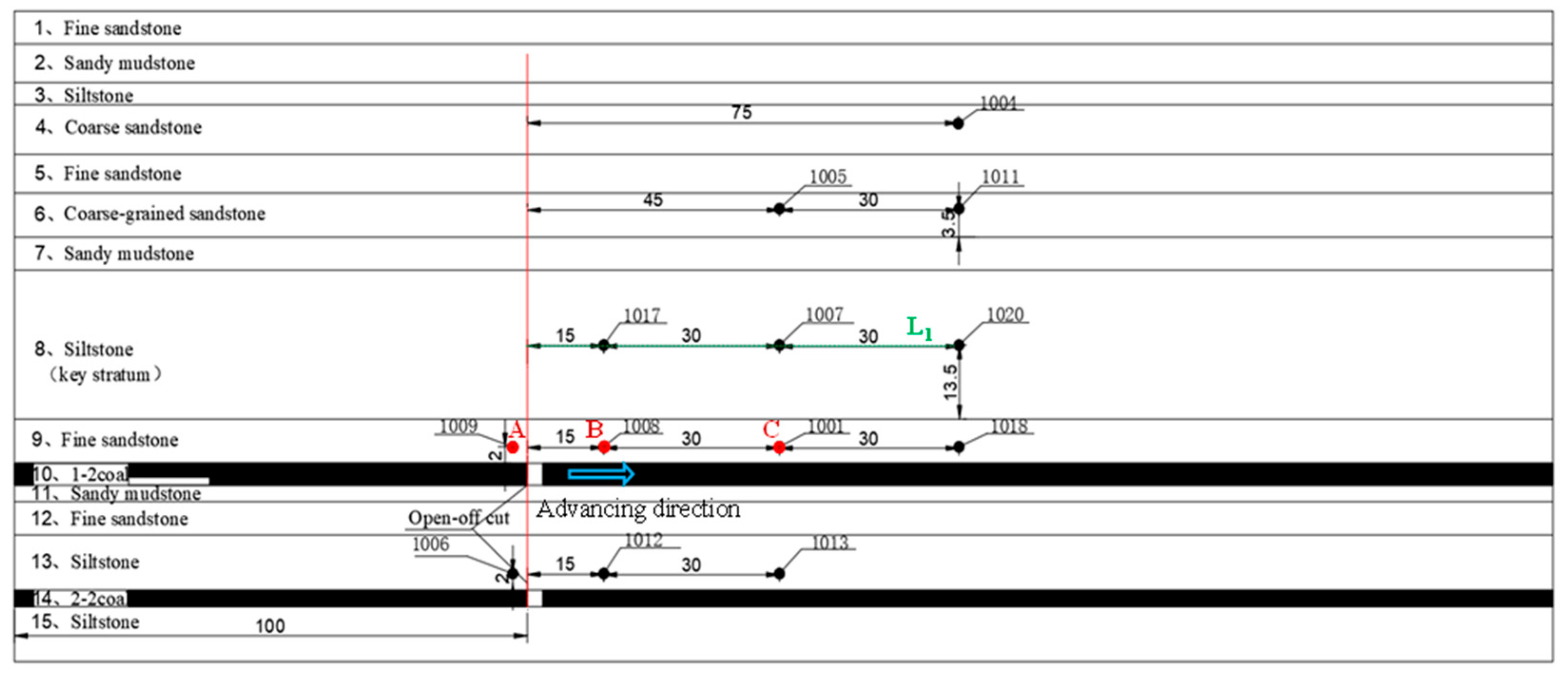
To accurately capture stress variations across different strata layers, pressure sensors were installed in accordance with the configuration illustrated in Figure 2. The surface displacement was measured using a three-dimensional full-field strain measurement and analysis system (XTDIC-VL800), and the stress was recorded using a static stress–strain analysis system (DH3816N).
The baseline model was configured based on the geological conditions of the Shangwan Coal Mine. The key stratum consisted of a 27 cm thick siltstone layer, while the 1−2 coal seam, with a thickness of 4 cm, was located 8 cm below the key stratum. Table 2 shows the specific parameters that were verified and calibrated prior to the physical similarity tests. The average advancement speed of the working face was 12 m/day, and the excavation rate during the testing was maintained at 10 cm/h.
In the model with reduced key stratum thickness, the key stratum was reduced to 15 cm in thickness, and the distance from the coal seam remained unchanged. Correspondingly, the thickness of the softer sandy mudstone overlying the key stratum was increased by 15 cm. In the model with an elevated key stratum, the key stratum was moved 21 cm upward. Specifically, the siltstone layer (Layer 8) was repositioned above the coarse-grained sandstone layer (Layer 6). In the model with reduced mining thickness, the thickness of the 1−2 coal seam was reduced to 2 cm, and the thickness of the floor stratum was increased by 2 cm.
Pressure sensors were positioned at three locations in the roof of the coal seam: 10 m ahead of the open-off cut (A), 30 m behind the open-off cut (B), and 90 m behind the open-off cut (C). A survey line (L1) was established 40 m above the coal seam. During each excavation, the migration of the overburden was monitored, and photographs were taken prior to excavation. To eliminate boundary effects, a 100 cm buffer was maintained on the left side of the coal seam, and the effective mining width was set to 195 cm.

3.2. Numerical Simulations and Model Parameters

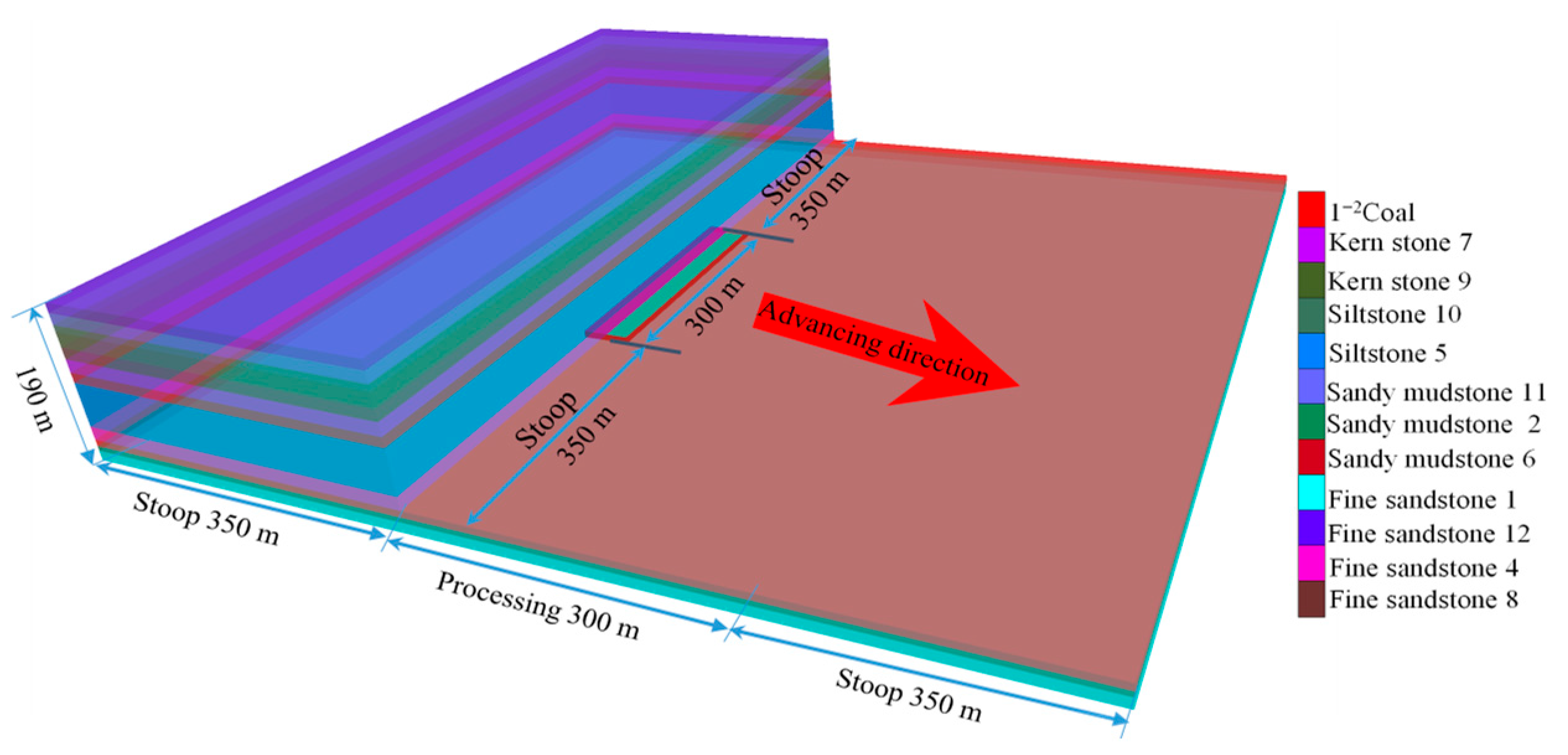
The FLAC3D software was used to carry out numerical simulations of the overburden damage and stress field evolution. The dimensions of the geometric model were 1000 m × 1000 m × 190 m (length × width × height). The stratigraphic properties are presented in Table 2 and Figure 2. The strike length and dip length of the working face were both set to 300 m (Figure 3). In order to eliminate the boundary effects, 350 m coal pillars were left on both sides of the strike and dip. Rock mass failure was simulated using the Mohr–Coulomb criterion, and the displacement boundary conditions were applied to the front, back, left, and right sides of the model, which were constrained. In the simulation, the excavation was advanced from the open-off cut located 350 m from the left boundary toward the right side, and the excavation was stopped at 350 m from the right boundary of the model.

4. Experimental Observation of Overburden Damage Progression Under Different Lithology Combinations

4.1. Quantification of Overburden Damage Based on Fractal Dimension of Fracture Network

As the working face advances, fractures in the overlying strata exhibit a dynamic evolution characterized by the sequential pattern of “development–expansion–closure”. To quantitatively describe this damaging process, the fractal theory of rock fractures is introduced. Fractal dimension serves as a metric for quantifying fractal features, allowing precise numerical characterization of irregular and complex natural morphologies of rock fractures. Among various methods to estimate fractal dimension, the box-counting method is one of the most widely used approaches.
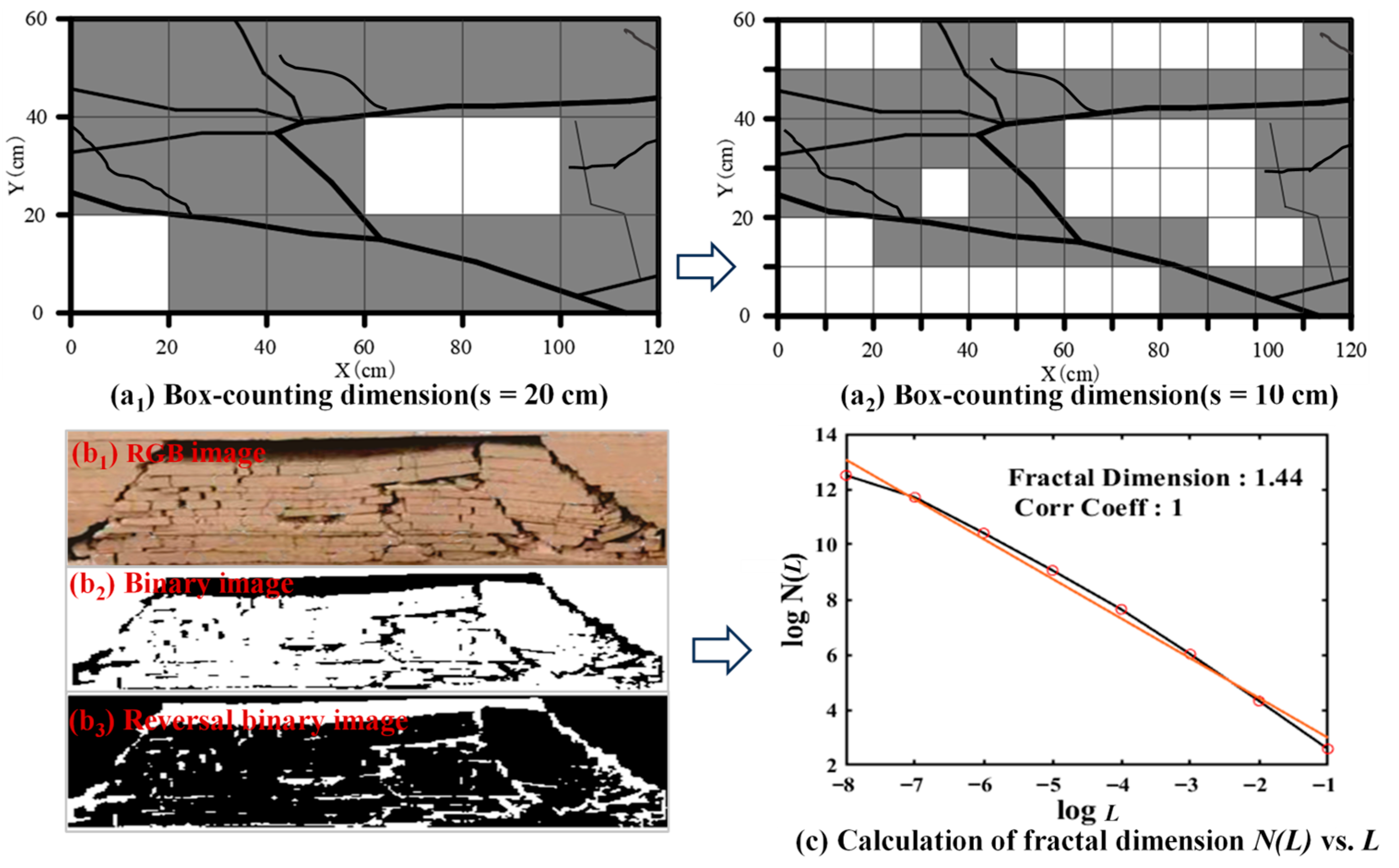
As illustrated in Figure 4, the overburden fracture image is discretized into square grids of side length s , which are used to cover the fracture network (Figure 4a1,a2). Here, N ( L ) denotes the total number of grids intersecting with fractures. This procedure is repeated for varying values of L , and the corresponding values of N ( L ) are recorded. By taking the logarithm of each box size L and the corresponding N ( L ) , the fractal dimension D f of the fracture network is determined from the slope of the linear relationship as expressed by [26]:
D f = lim L 0 l o g N ( L ) log L
This ratio reflects the scaling invariance of the fracture morphology across various measurement scales.
For fractures at different advancement stages in physical simulation experiments, image processing and fractal dimension calculations were performed using MATLAB R2022a in combination with FracLab 5.0. The original fracture image (Figure 4b1) was subjected to binarization processing wherein fracture regions were set to black and the background to white (Figure 4b2). Finally, the binary image was inverted to produce the result shown in Figure 4b3. The fractal dimension of the processed fracture images was computed using FracLab, whereby the slope of the linear regression that is fitted to the log–log data yields the fractal dimension, as depicted in Figure 4c.
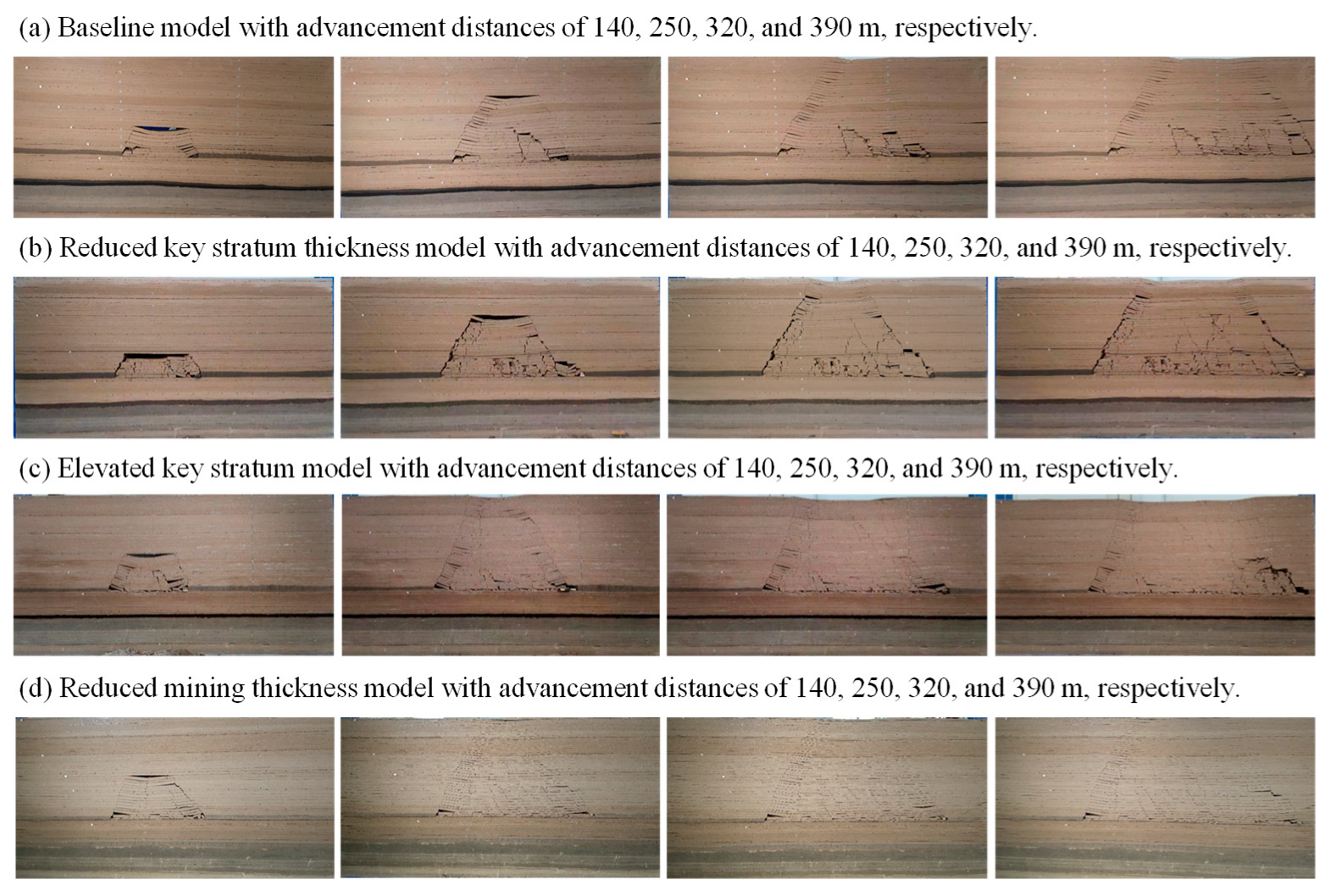
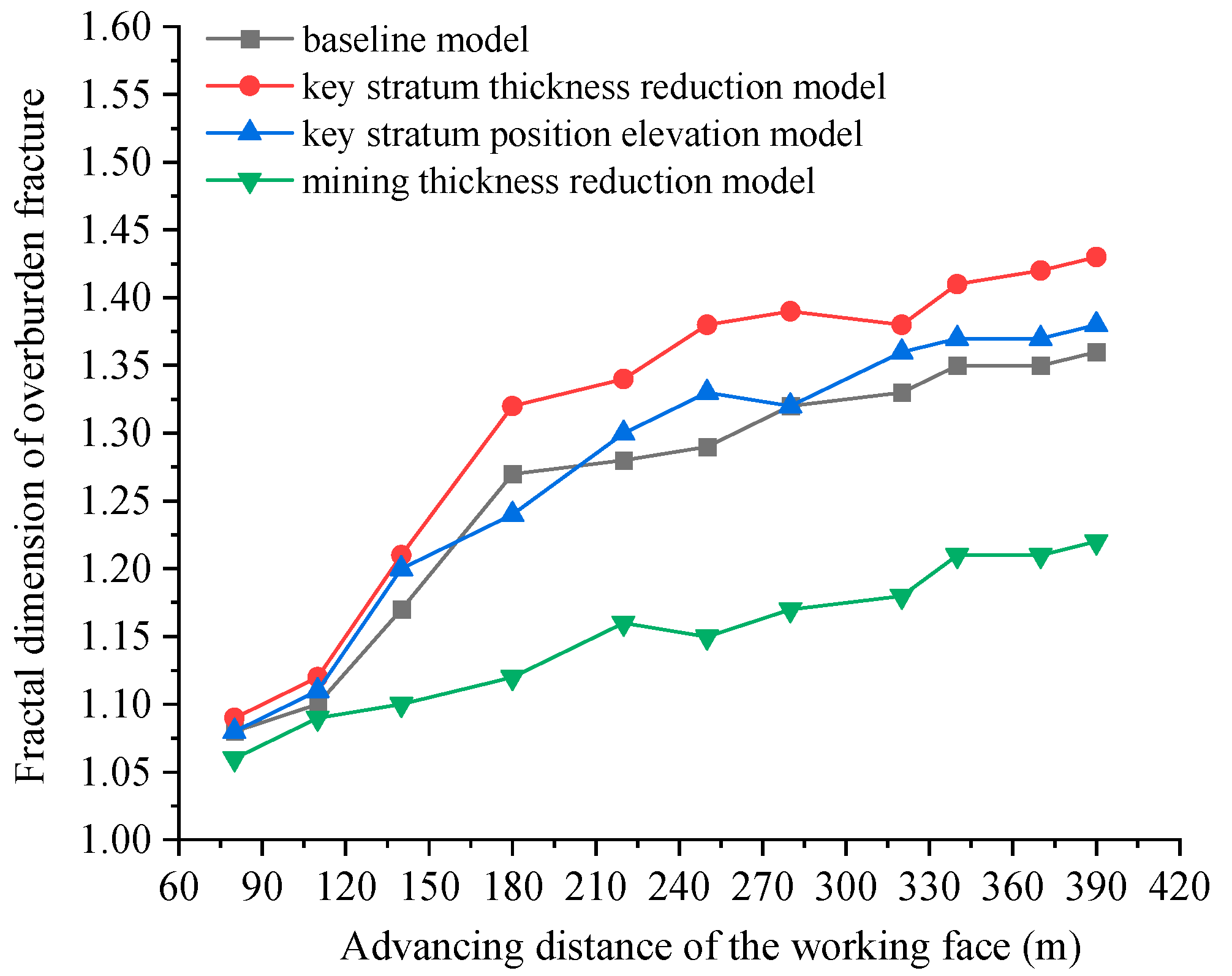
Figure 4 and Figure 5 show the overburden damage progression under different lithologies and the evolution of the fractures′ fractal dimension, respectively. The fractal dimension exhibits an exponential-like growth trend with the advancement distance (Figure 6). When the mining advance reaches approximately 390 m, the fractal dimension stabilizes at a constant value, the fracture density in the overburden rock essentially remains constant, and the extent of damage reaches its maximum. The fractal dimension of the overburden damage ranges from 1.2 to 1.5. A comparative analysis of the four scenarios reveals that a reduction in the thickness of the key layer resulted in the most severe overburden damage, whereas a decrease in mining height leads to the least damage.

4.2. Effect of Key Stratum Thickness

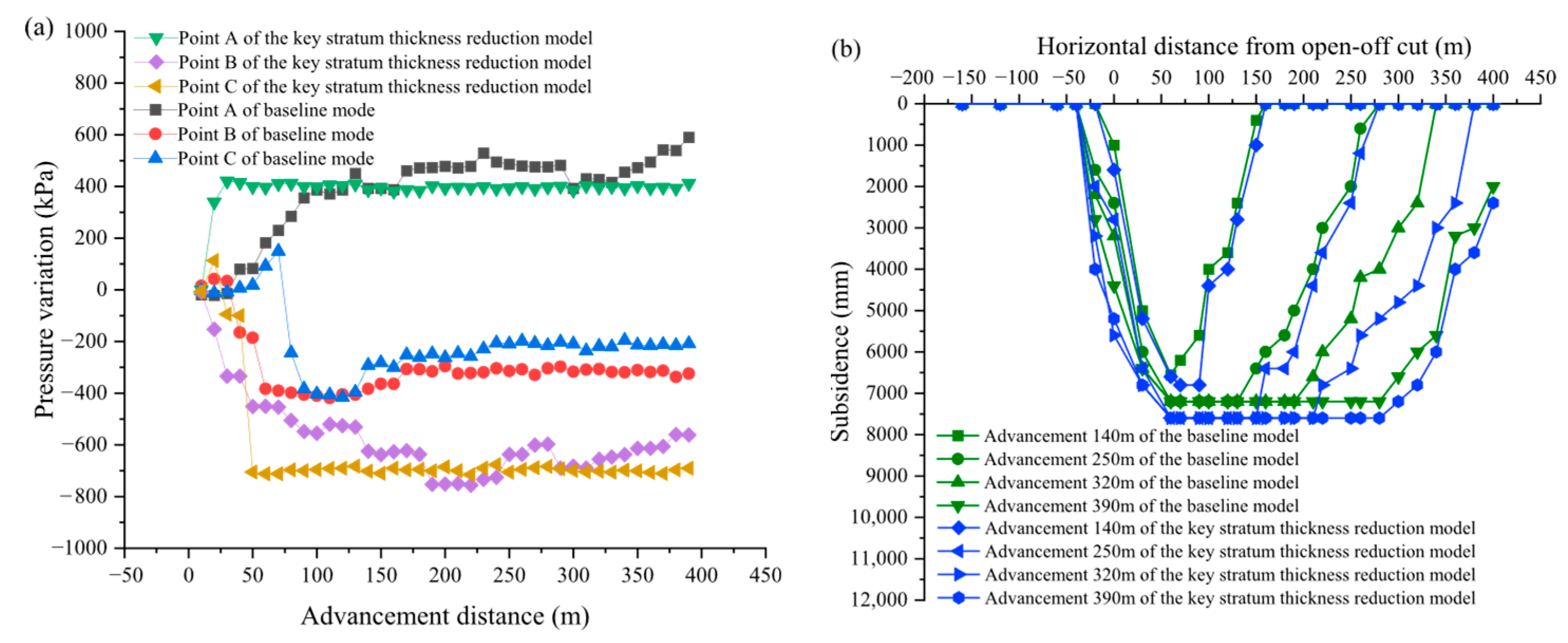
The changes in the overburden pressure under different key stratum thickness conditions at varying advancement distances are presented in Figure 7a. The key stratum thickness was reduced by 40 m relative to the baseline model, while the distance from the key stratum to the coal seam was maintained.
As the working face started advancing, the pressures at point A and point B increased. The stratum at point A collapsed after advancement by 220 m, causing the pressure to decrease slightly. The pressure at point B peaked when the advancement distance reached 100 m. The stress at point A in the model with reduced key stratum thickness increased sharply after advancement to 30 m. However, the stress at point A in the baseline model began to increase sharply from the beginning of the excavation. Compared with the baseline model, the sharp increase in the overburden stress at 30 m behind the open-off cut in this model was delayed by 30 m.
Figure 7b shows the data for the survey line (L1) as the working face advanced to varying distances. When the advancement distance reaches 140 m, in the reduced key stratum thickness model and the baseline model, the maximum subsidence at 40 m above the coal seam reaches 6600 and 6400 mm, respectively. At 250 m of advance, the maximum subsidence increased to 7600 and 7200 mm, respectively. Between 160 m and 195 m of advancement, in both models, the maximum subsidence at 40 m above the coal seam remained unchanged, while the subsidence of the rear of the rock mass gradually reached the maximum value as the advancement distance increased over time. For all of the advancement distances, the subsidence at 40 m above the coal seam was the greatest.

4.3. Effect of Key Stratum Location Conditions

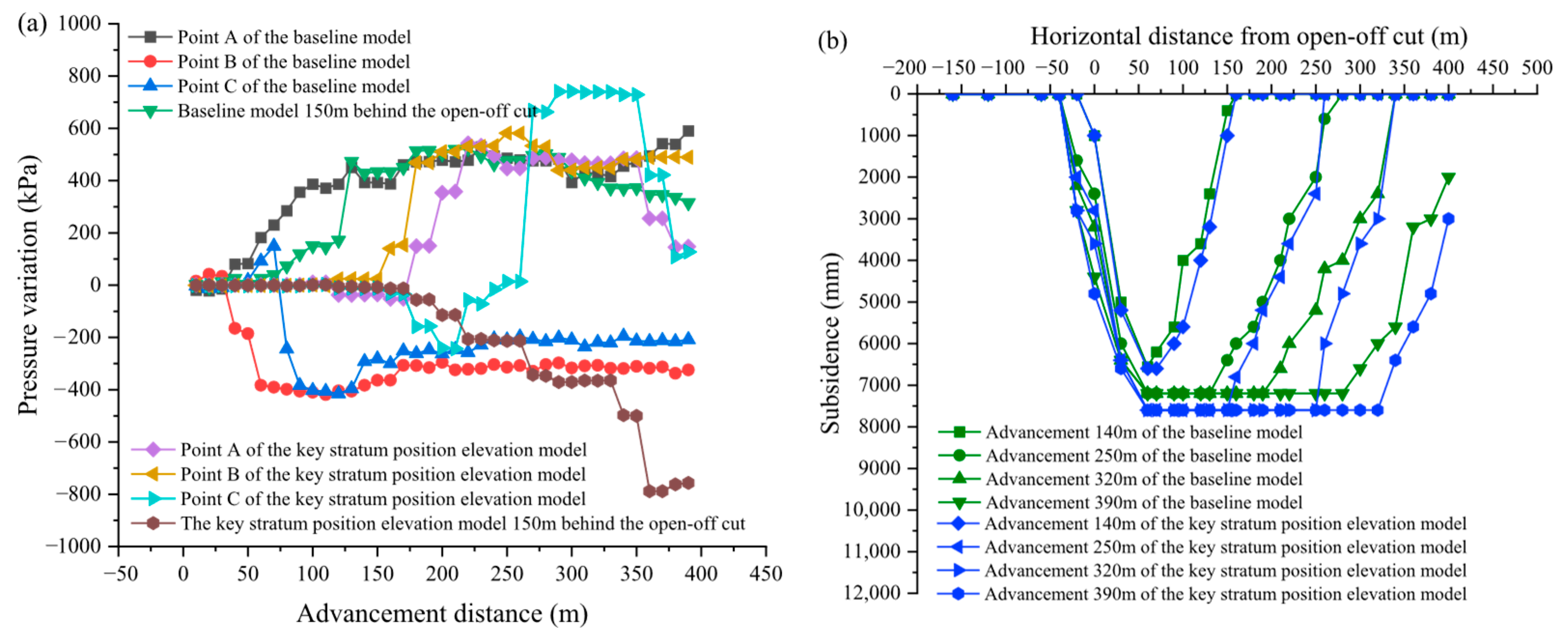
The lateral stress on the coal seam roof under different key stratum location conditions is shown in Figure 8a. In the elevated key stratum model, the key stratum was elevated by 40 m compared to the baseline model. When the advancement distance reached 90 m, the first collapse occurred, and this collapse was limited in scope. The pressures at points A, B, and C were not affected. In contrast, the first collapse in the baseline model occurred at 140 m of advancement, indicating that the elevation of the key stratum location shifted the initial weighting interval by 50 m.
When the advancement distance reached 100 m, the second collapse occurred in the elevated key stratum model, while the second collapse occurred at 180 m in the baseline model. Periodic collapse began at 120 m in the elevated key stratum model. When the advancement distance reached 200 m, the key stratum fractured, causing a sudden increase in the height of the fracture zone, and large-scale collapse of the overburden followed. At points A, B, and C, the upper rock mass was re-compacted, leading to significant changes in the pressures at these points. The 150 m rock mass behind the working face formed a masonry beam, and the pressure increased slightly in this region.
When the advancement distance was between 210 m and 300 m, the overburden experienced two periodic collapses. The pressure at point A initially increased to its maximum value at 110 m of advancement, and then decreased to its minimum value at 130 m. At point B, the pressure peaked at 130 m and then began to decrease slowly, reaching its minimum value at 150 m. The pressure at point C decreased to its minimum value at 120 m, increased as the working face advanced, and reached its maximum value at 150 m. It can be concluded that when the key stratum was elevated by 40 m, the initial weighting interval decreased, resulting in greater pressure. As a result of the elevation of the key stratum, the fracture of the key stratum was delayed. Before the key stratum fractured, the arch foot range of the pressure arch expanded. After the fracturing, severe stress concentration occurred, indicating the occurrence of significant pressure.
Survey line L1, located 40 m above the coal seam, was in the rock mass below the key stratum in the elevated key stratum model. As shown in Figure 8b, when the advancement distance reached 140 m, the maximum subsidence at 40 m above the coal seam in the elevated key stratum model and the baseline model reached 6600 and 6400 mm, respectively. At 250 m of advancement, the maximum subsidence at 40 m above the coal seam increased to 7600 mm in the elevated key stratum model and 7200 mm in the baseline model. After the key stratum is elevated by increasing its distance between the key stratum and the coal seam, the subsidence and range of the subsided rock mass below the key stratum increase by the same advancement distance compared to the baseline model. In addition, the subsidence and range at 160 m above the coal seam (near the surface) decreased. The subsidence and range at 100 m above the coal seam (i.e., the rock mass above the key stratum) also decreased. In contrast, at 20 m above the coal seam (i.e., the rock mass below the key stratum), both the subsidence and range of the subsided rock mass increased.

4.4. Effect of Mining Thickness Conditions

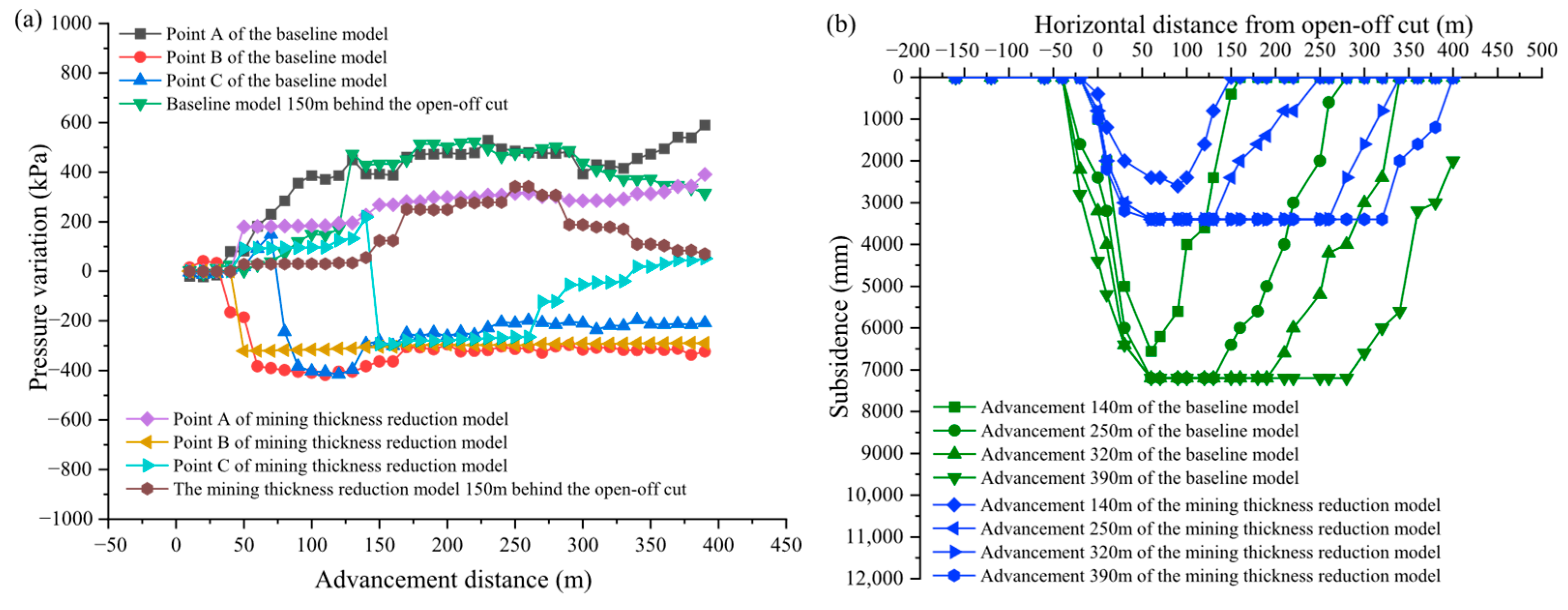
Figure 9a shows the lateral stress variations at 10 m above the coal seam under different mining thickness conditions. In this model, the mining thickness was reduced by 4 m. When the advancement distance reached 70 m, the first collapse occurred. The pressures at points A, B, and C began to increase at 50 m of advancement and stabilized by 60 m. At 100 m of advancement, the second collapse occurred, and the pressure at point A remained stable, exhibiting a trend similar to that in the baseline model. However, the pressure changes in the reduced mining thickness model began 10 m later than those in the baseline model. From 70 m to the end of the excavation, the pressure change at point B was stable in both models, but the reduced mining thickness model had a smaller variation amplitude. As the advancement distance increased, in the reduced mining thickness model, the pressure at point C initially increased and then decreased, whereas in the baseline model, the pressure at point C initially increased and then plateaued.
Survey line L1, located 40 m above the coal seam, was still in the key stratum in the reduced mining thickness model. As shown in Figure 9b, when the advancement distance reached 140 m, the maximum subsidence at 40 m above the coal seam in the reduced mining thickness model and the baseline model reached 30 mm and 6400 mm, respectively. At 250 m of advancement, the maximum subsidence increased to 3400 mm and 7200 mm in the reduced mining thickness model and the baseline model, respectively. As the advancement distance increased, the overburden experienced periodic collapse, and the subsidence at the key stratum progressively increased to its maximum. In the reduced mining thickness model, the overall subsidence and the range of the subsided rock at the key stratum decreased compared to those at the same advancement distance in the baseline model. The reduction of the mining thickness resulted in decreases in the subsidence and range at 40 m above the coal seam (i.e., the rock mass at the key stratum).

4.5. Ratio of Fractured Zone Height to Mining Height

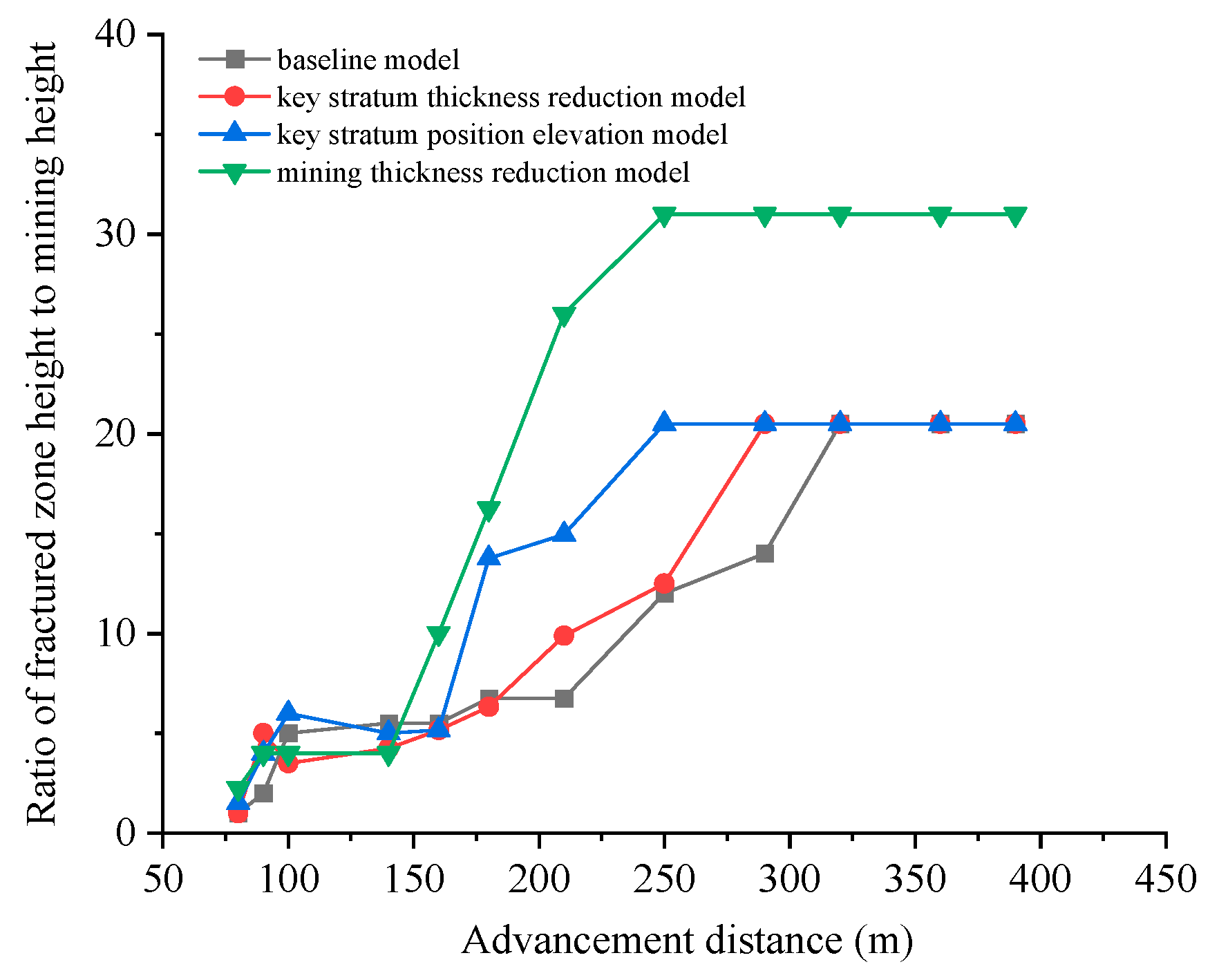
Figure 10 compares the ratios of fractured zone height to mining height with advancement distance under different model scenarios. One can find that the ratios of fractured zone height to mining height are relatively small when the mining advancement distance is less than 150 m, and then, increase quickly with the mining distance. Compared with the baseline model, the increasing rate of increase in the mining thickness reduction model is the greatest, the key stratum position elevation model is the second, and the key stratum thickness reduction model is the third. In addition, the ratio in the mining thickness reduction model reaches 30%, larger than the 20% observed in the other models.

5. Effects of Formation Structure on Overburden Stress and Damage Evolution Based on Scenario Numerical Simulations

5.1. Effect of Key Stratum Thickness on Overburden Stress and Damage

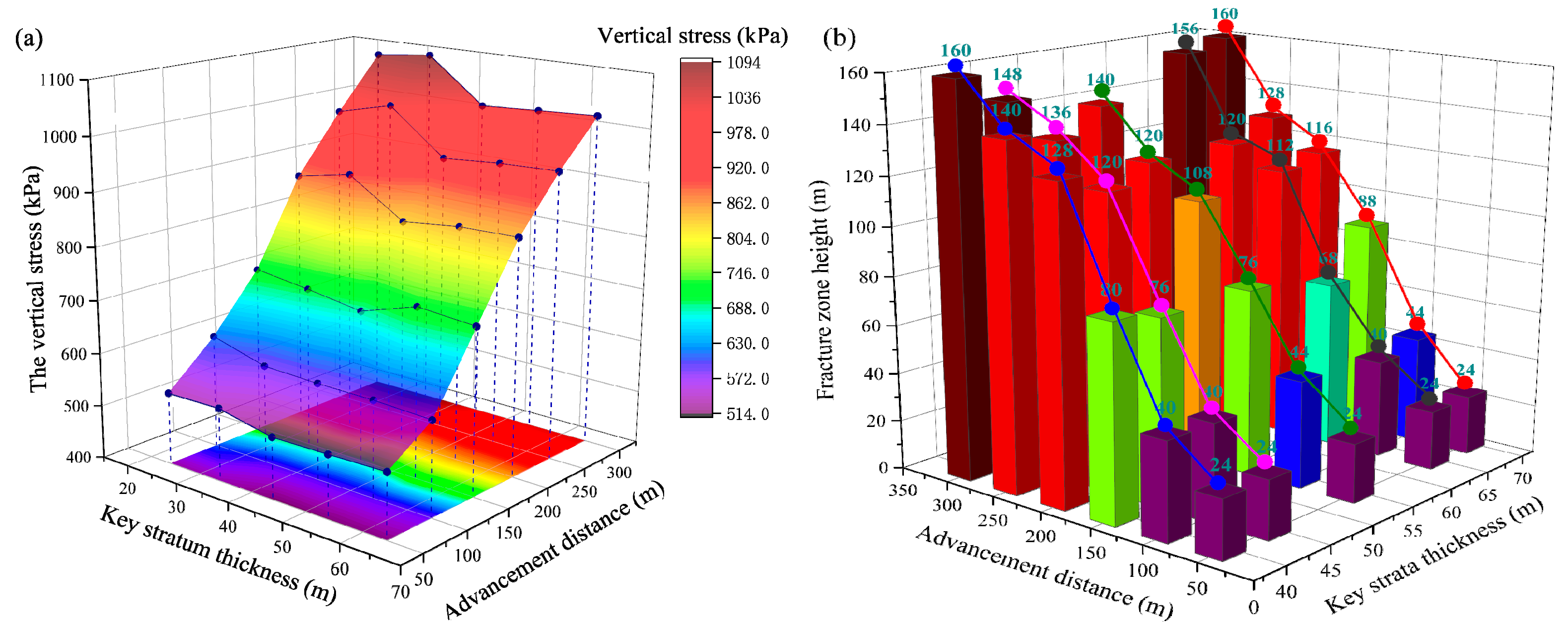
In order to analyze the overburden stress field under varying key stratum thickness conditions, the variations in the vertical stress 15 m ahead of the open-off cut at different advancement distances were recorded (Figure 11a). When the advancement distance reached 50 m, the vertical stress at point A initially decreased and then increased slightly as the key stratum thickness increased. This suggests that when the key stratum was thin, it collapsed at 50 m of advancement, leading to stress concentration at point A. As the key stratum thickness increased, the key stratum did not completely fracture when the advancement distance reached 50 m, causing the vertical stress at point A to increase. At an advancement of 200 m, the vertical stress at point A increased initially and subsequently decreased with increasing key stratum thickness.
Figure 11b shows the progression of the overburden damage under varying key stratum thickness conditions. When the advancement distance increased to 50 m, the fracture zone had not yet extended to the key stratum, and the changes in the key stratum thickness exerted no significant influence on the height of the fracture zone. When the working face advanced to 100 m, the fracture zone expanded to the key stratum but did not penetrate through it. When the thickness of the key stratum continued to increase, the height of the fracture zone remained largely consistent. When the advancement distance reached 150 m, the fracture zone penetrated the key stratum, and as the key stratum thickness increased, the height of the fracture zone initially stabilized and then increased. When the working face advanced to within the range of 200–300 m, the fracture zone penetrated the key stratum, and the height of the fracture zone initially decreased and then increased as the thickness of the key stratum increased.

5.2. Effect of Key Stratum Location on Overburden Stress and Damage

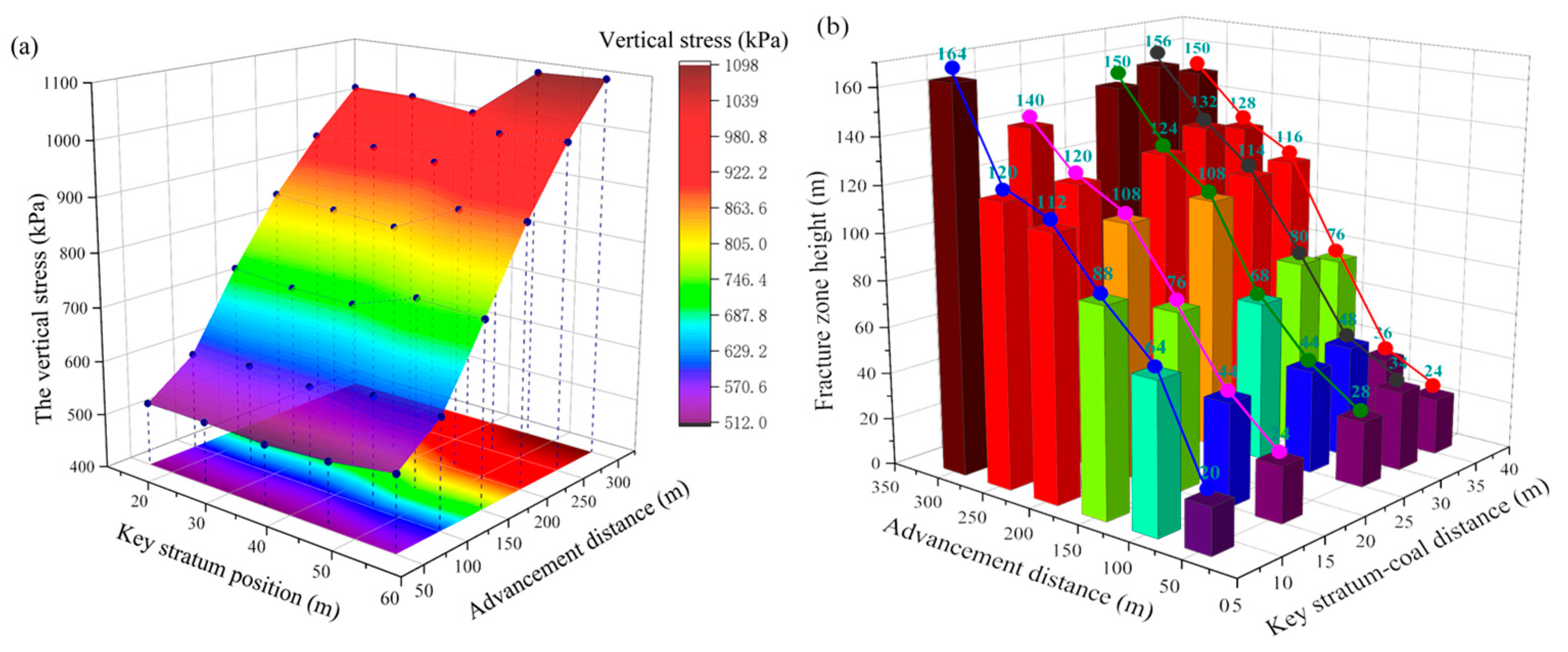
In order to analyze the overburden stress field under different key stratum location conditions, the variations in vertical stress at 15 m in front of the open-off cut under varying advancement distances were recorded (Figure 12a). When the advancement distance reached 50 m, the vertical stress at point A decreased as the distance between the key stratum and the coal seam increased. When the advancement distance reached 100 m, the vertical stress at point A increased, indicating that when the distance between the key stratum and the coal seam was 6 m, the key stratum had fractured at an advancement distance of 100 m. As the distance between the key stratum and the coal seam increased, the impact of the mining on the key stratum decreased, delaying the collapse of the key stratum. At an advancement distance of 100 m, the disturbance from the key stratum to the working face was minimal, but the rock mass below the key stratum collapsed, contributing to a significant increase in the vertical stress at point A. The vertical stress at point A initially increased and then decreased as the distance between the key stratum and the coal seam increased. At this stage, all key strata fractured, and the vertical stress at point A increased as the advancement distance continued to increase.
Figure 12b illustrates the influence of the key stratum positioning on the progression of the overburden damage. At an advancement distance of 50 m, as the distance between the key stratum and the coal seam increased, the height of the fracture zone initially increased and then decreased. When the advancement distance reached 100 m, the height of the fracture zone increased slightly before decreasing. When the advancement distance reached 150 m, the height of the fracture zone initially decreased, then increased, and ultimately stabilized. Within the advancement range of 200–250 m, variations in fracture zone height were minimal, showing an initial decrease succeeded by a gradual increase. These observations indicate that the changes in the mechanical strength of the key stratum had an insignificant effect on the progression of the overburden damage. When the advancement distance reached 300 m, the fracture zone height again demonstrated a decreasing-increasing trend.

5.3. Effect of Mining Thickness on Overburden Stress and Damage

In order to analyze the overburden stress field under different mining thickness conditions, the variations in the vertical stress at 15 m ahead of the open-off cut under varying advancement distances were recorded (Figure 13a). When the advancement distance ranged between 50 m and 200 m, the vertical stress at point A increased linearly with greater mining thickness.
As shown in Figure 12b, under different mining thickness conditions, when the advancement distance reached 50 m, the height of the fracture zone initially increased and then plateaued as the mining thickness increased. At an advancement distance of 100 m, the key stratum experienced partial damage, and the height of the fracture zone varied slightly under different mining thickness conditions. When the advancement distance reached 150 m, the fracture zone penetrated the key stratum, and the height of the fracture zone increased with increasing mining thickness. When the advancement distance reached 200 m, the height of the fracture zone increased with increasing mining thickness, but the change was minimal when the mining thickness was 4 m or 6 m. When the mining thickness reached 8 m, the fracture zone height increased slightly before stabilizing with further increases in mining thickness. At advancement distances of 250–300 m, the fracture zone height remained stable as mining thickness increased, indicating diminishing progression of the overburden damage.

5.4. Effect of Key Stratum Hardness on Overburden Stress and Damage

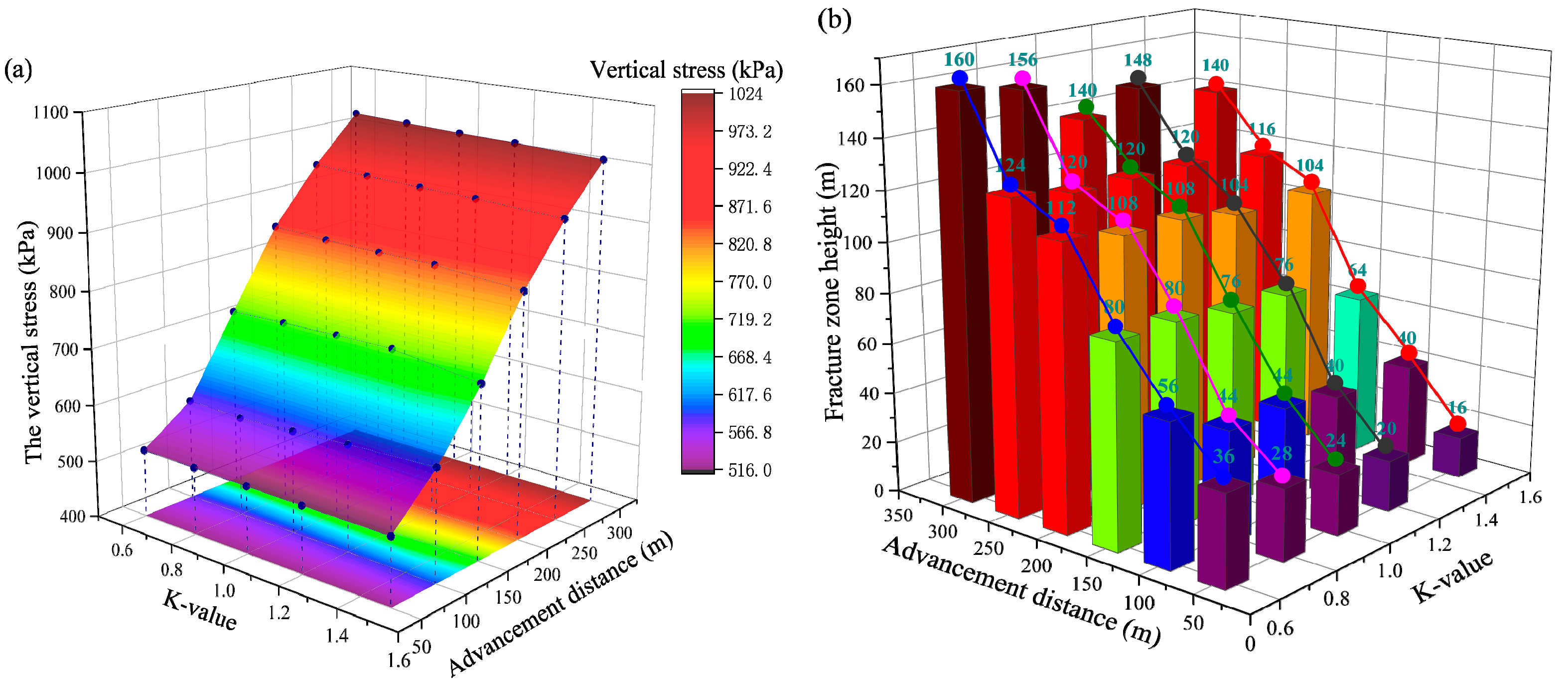
In order to analyze the overburden stress field under varying key stratum hardness, characterized by the parameter K (defined as the ratio of the bulk modulus of the key stratum to that in the baseline model), changes in vertical stress 15 m ahead of the open-off cut at different advancement distances were recorded (Figure 14a). When the working face advanced to 50 m, the vertical stress at point A decreased and then stabilized as the K value increased. The higher the hardness of the key stratum, the stronger its bearing capacity, resulting in reduced vertical stress at A. When the working face advanced to 200 m, the vertical stress at point A continued to decrease with increasing key stratum hardness. During this phase, all key strata fractured. As the advancement distance increased further, the vertical stress at point A initially increased and subsequently decreased.
When the advancement distance reached 50 m, as the hardness of the key stratum increased, the height of the fracture zone decreased (Figure 14b). At an advancement distance of 100 m, the fracture zone reached the key stratum but did not penetrate it. The height of the fracture zone initially decreased and then stabilized. When the advancement distance reached 150 m, the fracture zone penetrated the key stratum, and its height initially stabilized and then decreased. When the advancement distance was between 200 and 250 m, the height of the fracture zone remained stable. Finally, at 300 m of advancement, the overall height of the fracture zone exhibited a decreasing trend.

6. Conclusions

(1)
A reduction in the thickness of the key stratum leads to the most severe overburden damage. The key stratum fractures earlier, and the maximum subsidence decreases approximately 16.7%. Following the initiation of fracturing, an increase in key stratum thickness is associated with a reduction in the fracture zone height (by 8.3%) and a decrease in the volume of the plastic zone.
(2)
When the key stratum is positioned higher, the subsidence and its extent at 40 m above the coal seam increase, while they decrease at 100 m and 160 m above the coal seam, leading to a delay in key stratum fracturing. The height of the fracture zone initially decreases and then increases. As the working face advanced, the plastic zone volume initially increased, then decreased, and subsequently increased again.
(3)
A decrease in mining thickness induces amplified subsidence responses (about 20% increase) accompanied by enhanced fracture zone vertical propagation. The subsidence at 100 m and 160 m above the coal seam decreases, while it increases at 40 m above the coal seam. Additionally, the height of the fracture zone and the volume of the plastic zone increase with increasing mining thickness.
(4)
As the hardness of the key stratum increases, the fracturing of the key stratum is delayed. Correspondingly, both the height of the fracture zone and the volume of the plastic zone decreased with increasing key stratum hardness.

Author Contributions

T.T.: writing—review and editing, writing—original draft, visualization, methodology, validation, formal analysis, and data curation. Z.X.: writing—review and editing, methodology, validation, conceptualization, and formal analysis. Y.W.: writing—review and editing. All authors have read and agreed to the published version of the manuscript.

Funding

The authors are grateful for the financial support from the Open Funds of State Key Laboratory of Water Resource Protection and Utilization in Coal Mining (WPUKFJJ2022-17) and the National Key R&D Program of China (2022YFC3004602).

Data Availability Statement

Dataset available upon request from the authors; the raw data supporting the conclusions of this article will be made available by the authors upon request.

Conflicts of Interest

The authors declare no competing interests.

References

  1. Fan, J.S.; Yuan, Q.; Chen, J.; Ren, Y.W.; Zhang, D.D.; Yao, H.; Hu, B.; Qu, Y.H. Investigation of surrounding rock stability during proximal coal seams mining process and feasibility of ground control technology. Process Saf. Environ. Prot. 2024, 186, 1447–1459. [Google Scholar] [CrossRef]
  2. Ghose, A.K. Underground methods of extraction of thick coal seams-a global survey. Min. Sci. Technol. 1984, 2, 17–32. [Google Scholar] [CrossRef]
  3. Jiang, D.; Tang, Y.; Huang, W.; Hou, K.; Luo, Y.; Liu, J. Research on the height of the water-conducting fracture zone in fully mechanized top coal caving face under combined-strata structure. Sustainability 2022, 14, 13781. [Google Scholar] [CrossRef]
  4. Fu, S.H.; Hou, B.; Xia, Y.; Chen, M.; Tan, P.; Luo, R.K. Experimental research on hydraulic fracture propagation in integrated fracturing for layered formation with multi-lithology combination. J. China Coal Soc. 2021, 46, 377–384. [Google Scholar]
  5. Gong, P.L.; Jin, Z.M. Mechanical model study on roof control for fully mechanized coal face with large mining height. Chin. J. Rock. Mech. Eng. 2008, 27, 193–198. [Google Scholar]
  6. Gandhe, A.; Venkateswarlu, V.; Gupta, R.N. Extraction of coal under a surface water body-a strata control investigation. Rock Mech. Rock Eng. 2005, 38, 399–410. [Google Scholar] [CrossRef]
  7. Xu, J.P.; Bian, K.; Cheng, J.L.; Qi, Y.M. Study of water-flow fractue-zone height based on the critical value of rock angular displacement. J. China Univ. Min. Technol. 2011, 40, 536–539. [Google Scholar]
  8. Peta, K.; Stemp, W.J.; Stocking, T.; Chen, R.; Love, G.; Gleason, M.A.; Houk, B.A.; Brown, C.A. Multiscale geometric characterization and discrimination of dermatoglyphs (fingerprints) on hardened clay—A novel archaeological application of the gelSight max. Materials 2025, 18, 2939. [Google Scholar] [CrossRef]
  9. Lu, J.; Jiang, C.B.; Jin, Z.; Wang, W.S.; Zhuang, W.J.; Yu, H. Three-dimensional physical model experiment of mining-induced deformation and failure characteristics of roof and floor in deep underground coal seams. Process Saf. Environ. Protect. 2021, 150, 400–415. [Google Scholar] [CrossRef]
  10. Yuan, F.Z.; Ma, K.; Tang, C.A.; Wang, S.J.; Guo, H.Y. Movement of overburden with different mining thickness and response characteristics of surrounding rock under multi-key layer structure. Coal Sci. Technol. 2022, 50, 211–218. [Google Scholar]
  11. Lang, Z.J.; Feng, X. Research on the influence of lithological combination characteristics on the height of water conducting fracture zones. Energy Technol. Manag. 2019, 44, 86–88. [Google Scholar]
  12. Jin, B.; Zuo, Y.J.; Lin, J.Y.; Sun, W.B.; Chen, B. Study on the activation characteristics of reverse faults by the combination structure of roof lithology. China Min. Mag. 2021, 30, 172–180. [Google Scholar]
  13. Arka, J.D.; Prabhat, K.M.; Nilabjendu, G.; Awanindra, P.S.; Ranjan, K.; Subhashish, T.; Rana, B. Evaluation of energy accumulation, strain burst potential and stability of rock mass during underground extraction of a highly stressed coal seam under massive strata-a field study. Eng. Geol. 2023, 322, 107178. [Google Scholar] [CrossRef]
  14. Lin, J.Y.; Zuo, Y.J.; Wang, H.; Yu, M.L.; Shui, Y.; Dai, Y.J.; Liu, R.B. Research on roof mining effect under different lithological combinations. J. Guizhou Univ. Nat. Sci. 2019, 36, 44–49. [Google Scholar]
  15. Zhu, S.Y.; Cao, D.T.; Zhou, H.Y.; Yang, C.W.; Liu, J.G. Restrictive function of lithology and its composite structure on deformation and failure depth of mining coal seam floor. J. Min. Saf. Eng. 2014, 31, 90–96. [Google Scholar]
  16. Singh, R.; Mandal, P.K.; Singh, A.K.; Kumar, R.; Maiti, J.; Ghosh, A.K. Upshot of strata movement during underground mining of a thick coal seam below hilly terrain. Int. J. Rock. Mech. Min. Sci. 2008, 45, 29–46. [Google Scholar] [CrossRef]
  17. Zhang, Q.S.; Gao, Y.F.; Sun, Z.J.; Liu, S.Y. Analysis of spatial effect and layer effect in numerical calculation of mining subsidence. Rock. Soil. Mech. 2004, 25, 940–942. [Google Scholar]
  18. Li, Y.; Wang, J.P.; Chen, Y.D.; Lei, M.X.; Yang, D.P.; Yang, K.P.; Yuan, Y.H. Study on effect of interburden on movement of overburden in multiple coal seams. Coal Sci. Technol. 2020, 48, 246–255. [Google Scholar]
  19. Li, Y.M.; Liu, C.Y.; Huang, B.X.; Yang, J.X. Mining height effect of overlying strata breakage and water flowing fracture evolution in steep seam. J. Hunan Univ. Sci. Technol. Nat. Sci. Ed. 2012, 27, 10–15. [Google Scholar]
  20. He, C.C.; Xu, J.L.; Wang, F.; Wang, F. Movement boundary shape of overburden strata and its influencing factors. Energies 2018, 11, 742. [Google Scholar] [CrossRef]
  21. Zhang, J.C.; Li, X.L.; Qin, Q.Z.; Wang, Y.B.; Gao, X. Study on overlying strata movement patterns and mechanisms in super-large mining height stopes. Bull. Eng. Geol. Environ. 2023, 82, 142. [Google Scholar] [CrossRef]
  22. Zhang, Q.L.; Guo, J.P.; Lu, X.W.; Ding, K.P.; Yuan, R.F.; Wang, D.C. Simulation and on-site detection of the failure characteristics of overlying strata under the mining disturbance of coal seams with thin bedrock and thick alluvium. Sensors 2024, 24, 1748. [Google Scholar] [CrossRef]
  23. Sakhno, I.; Zuievska, N.; Xiao, L.; Zuievskyi, Y.; Sakhno, S.; Semchuk, R. Prediction of water inrush hazard in fully mechanized coal seams’ mining under aquifers by numerical simulation in ANSYS software. Appl. Sci. 2025, 15, 4302. [Google Scholar] [CrossRef]
  24. Liang, S.; Zhang, X.; Ke, F.; Liu, J.; Yao, Q.; Luo, H.; Li, X.; Xu, Y. Evolution of overlying strata bed separation and water inrush hazard assessment in fully mechanized longwall top-coal caving of an ultra-thick coal seam. Water 2025, 17, 850. [Google Scholar]
  25. Zhang, J.G.; Qin, X.F.; Liu, S.T.; Su, H.J.; Yang, Z.B.; Zhang, G.C. Study on overburden fracture and structural distribution evolution characteristics of coal seam mining in deep large mining height working face. Sustainability 2023, 15, 13365. [Google Scholar] [CrossRef]
  26. Teng, T.; Li, Z.L.; Liu, K.; Zhu, Y.Z.; Jia, W.J. Overburden failure and fracture propagation behavior under repeated mining. Min. Metall. Explor. 2025, 42, 219–234. [Google Scholar]
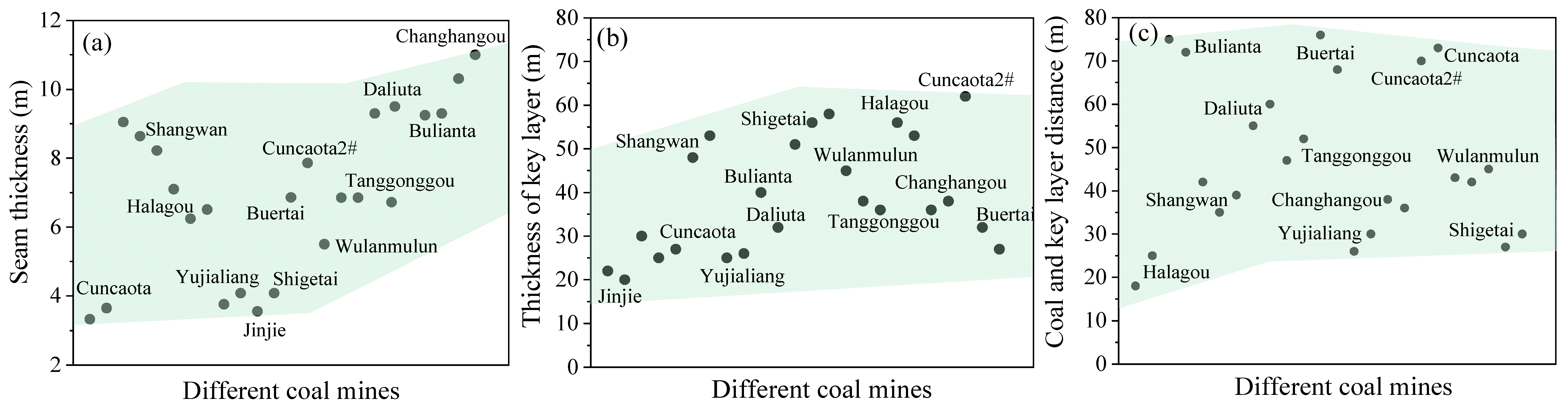
Figure 1. Statistics of geological and mining parameters in Shendong mining area: (a) seam thickness; (b) thickness of key layer; (c) coal and key layer distance.
Applsci 15 10518 g001
Figure 2. Layout of pressure sensors.
Applsci 15 10518 g002
Figure 3. Numerical model established in this study.
Applsci 15 10518 g003
Figure 4. Quantitative evaluation of fractal dimensions for fracture patterns via box-counting.
Applsci 15 10518 g004
Figure 5. Results of rock strata movements in different models.
Applsci 15 10518 g005
Figure 6. Fractal dimension evolution of overburden fracture.
Applsci 15 10518 g006
Figure 7. Evolutions of overburden stress and migration under different key stratum thicknesses. (a) Variations in the lateral stress at points A, B and C; (b) subsidence at line L1.
Applsci 15 10518 g007
Figure 8. Evolutions of overburden stress and migration under different key stratum locations. (a) Variations in the lateral stress at points A, B, and C; (b) subsidence at line L1.
Applsci 15 10518 g008
Figure 9. Evolutions of overburden stress and migration under different mining thicknesses. (a) Variations in the lateral stress at points A, B and C; (b) subsidence at line L1.
Applsci 15 10518 g009
Figure 10. Comparison of the ratios of fractured zone height to mining height.
Applsci 15 10518 g010
Figure 11. Effects of key stratum thickness. (a) Vertical stress at 15 m in front of the open-off cut; (b) progression of the overburden damage.
Applsci 15 10518 g011
Figure 12. Effects of key stratum location. (a) Vertical stress at 15 m in front of the open-off cut; (b) progression of the overburden damage.
Applsci 15 10518 g012
Figure 13. Effects of mining thickness. (a) Vertical stress at 15 m in front of the open-off cut; (b) progression of the overburden damage.
Applsci 15 10518 g013
Figure 14. Effects of key stratum hardness. (a) Vertical stress at 15 m in front of the open-off cut; (b) progression of the overburden damage.
Applsci 15 10518 g014
Table 1. Schemes of the physical similarity test.
TestKey Stratum Thickness (cm)Key Stratum LocationMining Thickness (cm)
1278 cm from coal seam4
2168 cm from coal seam4
32729 cm from coal seam4
4278 cm from coal seam2
Table 2. Parameters of the baseline model.
Layer No.LithologyLayer
Thickness (m)
Bulk
Modulus
(GPa)
Shear
Modulus
(GPa)
Cohesion
C (MPa)
Internal
Friction Angle φ (°)
Matching Number
1/5/9/12Fine sandstone12/14/16/122.85.797.321664
2/7/11Sandy mudstone14/12/61.643.285.521964
3/8/13/15Siltstone8/54/20/202.88.7622674
4/6Coarse sandstone18/1648.14.633764
10/14Coal8/62.85.797.321664
Disclaimer/Publisher’s Note: The statements, opinions and data contained in all publications are solely those of the individual author(s) and contributor(s) and not of MDPI and/or the editor(s). MDPI and/or the editor(s) disclaim responsibility for any injury to people or property resulting from any ideas, methods, instructions or products referred to in the content.