Article

Ultrasound-Assisted Extraction of Polyphenols from Laurus nobilis Leaves: Effects of Process Parameters


by
Zoran Zorić
1,†,
Sandra Pedisić
2,
Mladen Brnčić
2,
Angela Matanović
2,
Ivona Marjanović
2 and
Antonela Ninčević Grassino
2,*,†
1
Department of Ecology, Agronomy and Aquaculture, University of Zadar, Trg Kneza Višeslava 9, 23 000 Zadar, Croatia
2
Faculty of Food Technology and Biotechnology, University of Zagreb, Pierottijeva 6, 10 000 Zagreb, Croatia
*
Author to whom correspondence should be addressed.
These authors contributed equally to this work.
Appl. Sci. 2025, 15(17), 9347; https://doi.org/10.3390/app15179347
Submission received: 29 July 2025 / Revised: 18 August 2025 / Accepted: 22 August 2025 / Published: 26 August 2025
(This article belongs to the Section Applied Biosciences and Bioengineering)

Abstract

Featured Application

By manipulating the ultrasound-assisted extraction parameters in combination with different solvents, it is possible to produce a variety of extracts that differ in colour intensity and have a rich phenolic composition. These can be further used as natural colourants and functional ingredients with various applications in the food and food packaging industries.

Abstract

Due to the increasing demand for herbal supplements, this study investigates the effects of the ultrasound-assisted extraction (UAE) parameters (amplitude, time and temperature) on the extraction of polyphenols from laurel leaves, as this method enables the production of a range of extracts in a shorter time. UAE affects the colour of the extracts when an amplitude of 60, 80 and 100%, a time period of 3, 6 and 9 min and acetone or ethanol (30 and 70%, v/v) are used. The solvent had the greatest influence on the colour of the extract, which was positively related to the parameters b and ΔE (Std. Coeff. = 0.9696 and 0.9354) and negatively related to the values a and L (Std. Coeff. = −0.9741 and −0.5733). The solvent also influenced the recovery of total phenols and flavonoids, as well as most phenolic compounds. The highest levels of phenols and flavonoids were determined for 70% ethanol (28.04 and 10.73 mg/g) and 70% acetone (32.10 and 12.13 mg/g) at an amplitude of 100% for 9 min. Meanwhile, 70% ethanol at an amplitude of 100% for 9 min gave the highest amount of rosmarinic acid, with values of 216.32 mg/L, showing that it dominates among the phenolic compounds.

1. Introduction

The global herbal nutraceuticals market has grown in recent years and is estimated to reach USD 33.75 billion in 2022, with a projected compound annual growth rate (CAGR) of 7.5% from 2023 to 2030 [1]. This market is gaining strong traction due to the increasing awareness of the health benefits of herbs [2,3,4], with laurel playing a dominant role due to its multiple uses, including in food and beverages, pharmaceuticals and cosmetic products, and it is expected to reach a CAGR of around 4.16% between 2023 and 2030 [5].
Laurel, also known as bay laurel, sweet laurel, laurel tree, Roman laurel, Greek laurel or, scientifically, Laurus nobilis, belongs to the laurel family (Lauraceae) and is an aromatic evergreen tree or large shrub with green leaves. The natural habitat of laurel is the Mediterranean region, which is why this plant is traditionally used in Mediterranean cuisine to flavour various dishes, such as soups, stews, sauces and sausages. Laurel leaves, fruits, flowers and seeds are also used in the form of decoctions, infusions, oils, etc., to treat cardiovascular diseases, gastrointestinal and gynaecological problems and respiratory and nervous system disorders [6]. Due to its positive antimicrobial, antifungal, antispasmodic, antioxidant, anti-inflammatory, anticancer, neuroprotective and anticholinergic properties, laurel, especially the essential oil, has become an excellent dietary supplement [7,8,9,10,11]. The chemical composition of laurel, especially laurel leaves, has been extensively studied, and some of the metabolites are phenolic compounds, alkaloids, sugars, polysaccharides, organic acids, fatty acids, tocopherols, etc. [6,12,13,14,15,16,17,18,19,20,21].
The yield and bioactivity of these compounds—and, consequently, the quality of the laurel end-product and its use—depend largely on the techniques and methods of extraction, ranging from traditional to newer ones [4,11,15,22]. Faster extraction techniques are favoured as they reduce the potential degradation of the active ingredients due to the shorter extraction time compared to the time-consuming traditional techniques. Besides saving time, these techniques offer a simple extraction process with lower solvent consumption and improved yields and quality of extracts. Most of the traditional and advanced techniques are mainly used to extract essential oils [7,11,23,24] and polyphenols from laurel, and these were summarised in the work of Dobroslavić et al. [25] with their advantages, disadvantages and precautions. More recent publications have also reported on the extraction of polyphenols by PLE [22], hydrodistillation [24], MAE [15,21], bath shaker extraction [16,18] and, additionally, UAE.
In UAE, a high-frequency pulse (20 to 2000 kHz) is used to generate sound waves that form cavitation bubbles as they pass through the solvent, which are responsible for the disruption of the sample tissue.
However, most ultrasonic processing occurs at 20 kHz–100 kHz, which is below the appropriate power level for “power ultrasound” [26].
Ultrasonic treatment depends on three main points. The first is the geometry of the ultrasonic setup (the sonotrode length and diameter); the second is the input—the power, frequency, cycle, amplitude and treatment duration; and the third is measurable outputs—the temperature and intensity (by sonotrode diameter or per sample volume). The combination of the abovementioned and some other factors, such as, in our case, the homogeneity of the sample—i.e., its pore formation as a result of cavitation, the composition of the solvent and appropriate agitation—are important in determining the yields of analytes [26,27].
Considering the increasing demand for herbal supplements, among which laurel is less utilised [9], and the advantages of UAE, wherein a range of extracts can be produced in less time, we have combined laurel extraction with UAE technology in this work. Given, the lack of scientific studies on the extraction of polyphenols from laurel leaves using UAE technology, with the exception of the recent work by Dobroslavić et al. [15], this would provide an additional contribution to the field of herbal dietary supplements. The aim of the present work is therefore to show the effects of the solvent (ethanol and acetone with volume fractions of 30 and 70%), the amplitude (60, 80 and 100%) and the time (3, 6 and 9 min) set during the UAE of laurel leaves and, consequently, the temperature change on the colour of the extracts and the recovery of polyphenols and to define the optimal parameters allowing the further use of the extracts.

2. Materials and Methods

2.1. Chemicals

All reagents, standards and solvents were of analytical quality. Acetone (99%), ethanol (96%), methanol (99.8%), aluminium chloride hexahydrate, sodium carbonate, sodium hydroxide, sodium nitrite and Folin–Ciocalteu reagent were purchased from Kefo (Zagreb, Croatia). Acetonitrile and formic acid were HPLC-grade and purchased from BDH Prolabo, VWR (Leicestershire, UK). Commercial standards for caffeic acid, chlorogenic acid, ferulic acid, gallic acid, p-coumaric acid, rosmarinic acid, rutin and syringic acid were purchased from Sigma Aldrich (Saint Luis, MO, USA). Apigenin, kaempferol-3-glucoside, quercetin-3-glucoside and luteolin were purchased from Extrasynthese (Genay, France). Milli-Q-grade water (Millipore, Bedford, MA, USA) was used for the preparation of reagents, standards and solvents.

2.2. Plant Materials

Fresh leaves of laurel (Laurus nobilis L.) were collected in early August 2016 in Trogir (latitude: 43.508929, longitude: 16.260645) in the region of Dalmatia (Croatia). Trogir was chosen because the laurel is a typical tree in this town and in the Dalmatia region, along with two others (Istria and Kvarner) that contain it as an autochthonous species. In addition, the collection period was the beginning of August, as laurel leaves develop their best flavour and strongest scent in summer. The leaves were air-dried for one week at a temperature of 20 °C and then packed in polythene bags and stored in the dark in a cool place until use. Before extraction, the laurel leaves were ground using a household blender (Tefal, 180 W, GT 1108, Hong Kong, China) and then the dry matter content was determined at 105 °C to a constant mass. The result is given as the mean value ± standard deviation of three measurements, i.e., 93.08 ± 0.15%.

2.3. Ultrasound-Assisted Extraction

Ultrasound-assisted extraction (UAE) was performed using an ultrasound device (“Dr. Hielscher”, Teltow, Germany) with a constant frequency of 30 kHz at a maximum nominal output power of 400 W and a working amplitude of 60, 80 and 100% in continuous mode, i.e., with one cycle = 1. The 22 mm flat tip (“Dr. Hielscher”, Teltow, Germany) was immersed directly in an extraction mixture of ground laurel leaves (3 g) and 100 mL solvent (ethanol or acetone with volume fractions of 30 and 70%). The sonication times were 3, 6 and 9 min. The temperature was measured at the beginning and end of the UAE. The values are listed in Appendix A (Table A1), together with the other parameters used. After extraction, the mixture was allowed to cool at room temperature and then filtered through Whatman No. 40 filter paper and reconstituted to 100 mL in a volumetric flask. The extracts were collected and stored at −8 °C until further analysis.

2.4. Colour of Extracts

The colour of the extracts was determined immediately after UAE and subsequent cooling. The colour parameters (L*, a* and b*) of the extracts were measured using the calibrated spectrophotometer CM-3500d (Konica Minolta Sensing, Inc., Osaka, Japan) connected to the Spectra Magic NX software and expressed as lightness L* (0 = black, 100 = white), redness–greenness a* (−a = greenness, +a = redness) and blueness–yellowness b* (−b = blueness, +b = yellowness). The colour difference value (ΔE) was calculated as ΔE = [(ΔL)2 + (Δa)2 + (Δb)2]1/2 [28], with water extracts as controls.

2.5. Total Phenol and Flavonoid Content

The total phenol (TP) and total flavonoid (TF) content in laurel leaf extracts after UAE was determined using the Folin–Ciocalteu method [29] and aluminium chloride assay [30], respectively. The measurements were performed using a UV/Vis spectrophotometer (Lambda 1, Perkin-Elmer, Shelton, CT, USA) at wavelengths of 760 and 510 nm for TP and TF, respectively. Gallic acid was used as a standard to generate a calibration curve for TP determination. The linear regression equation with R2 = 0.9977 was A760 = 0.0739 × γ (gallic acid)/(mg/L). For the preparation of a calibration curve for TF determination, a methanolic solution of rutin was used as a standard. The linear regression equation with R2 = 0.9996 was A510 = 0.0441 × γ (rutin)/(mg/L). The results were expressed in mg of gallic acid and rutin equivalents for TP and TF, respectively, per L of laurel extract or as mg of gallic acid and rutin equivalents for TP and TF, respectively, per g of laurel sample. All experiments were performed in triplicate, and the presented results are the mean values ± standard deviation (SD).

2.6. High-Performance Liquid Chromatography Analysis of Phenolic Compounds

The qualitative and quantitative analysis of the individual phenolic compounds in the laurel leaf extracts was performed using high-performance liquid chromatography (HPLC) on an Agilent Infinity HPLC-PDA system (Agilent 1260 series, California, CA, USA) equipped with a quaternary pump, an injector, a TCC column compartment and a UV/Vis-PDA VL+ detector and controlled by the OpenLAB ChemStation software v. C.01.03 (Agilent, Santa Clara, CA, USA). The phenolic compounds were separated on a Luna 100–5 C18 column (250 × 4.6 mm, 5 µm; Phenomenex, Torrance, CA, USA). The column temperature was set to 30 °C and the injection volume was 20 µL. The solvent composition and the gradient conditions used were previously described by Bilušić et al. [31]. For gradient elution, mobile phase A contained 3% formic acid in acetonitrile (v/v), while solution B contained 3% formic acid in Milli-Q water (Millipore Corp., Bedford, MA, USA). The elution consisted of a linear gradient from 90 to 60% B in 25 min, followed by a linear gradient from 60 to 30% B in the next 5 min and finally from 30 to 90% B for up to 35 min at a constant flow rate of 0.9 mL/min. The identification of phenolic compounds was based on retention times and spectral data compared to standards, including gallic, caffeic, chlorogenic, p-coumaric, ferulic, syringic and rosmarinic acids, as well as quercetin-3-glucoside, kaempferol-3-glucoside, luteolin and apigenin. Phenolic acids and their derivatives were identified at 278 nm, while flavonol glycosides and their derivatives were identified at 340 nm. The phenolic compounds were quantified using the calibration curves of the standards mentioned above. The content of hydroxybenzoic acid was calculated as gallic acid equivalents and that of isorhamnetin-O-hexoside as quercetin-3-glucoside equivalents. Results were expressed as mg of the identified phenolic compound per L of laurel extract or as mg of the phenolic compound per g of laurel sample.

2.7. Statistical Analysis

The partial least squares regression (PLS-R) approach was used to investigate the effects of specific predictors on the colour parameters and the content of total phenols, total flavonoids and individual phenolic compounds. The explanatory variables (predictors, X) were the temperature, solvent, time and amplitude. We calculated standardised coefficients (Std. Coeff.) to investigate how changes in the predictors affected the response variables and which predictors had a greater influence on the response variables. The closer the standard coefficient is to the absolute value of 1, the stronger the effect of this predictor on the response variable (taking into account other variables in the equation). In order to investigate which of the predictors had the highest explanatory power for the model, a variable importance in projection (VIP) procedure was also carried out. Parameters with a VIP value > 1 were considered relevant for the explanation of the response variable (Y) and contributed significantly to the model, while parameters with a VIP value < 0.8 contributed little [32]. Analyses were performed using the statistical software R v. 3.6.2 [33], where PLS-R analysis was performed using the “plsdepot” package according to Bertrand and Sanchez [34].
In addition, the statistical analyses of the phenolic compounds were performed using the Statistica software, version 12.0 (StatSoft Inc., Tulsa, OK, USA). Data were analysed using multivariate analysis of variance (MANOVA), and marginal means were compared using Tukey’s HSD test. A statistically significant difference was considered at the level of p ≤ 0.05.

3. Results and Discussion

3.1. Correlations of UAE Parameters

In this study, the influence of the amplitude (60, 80 and 100%) and time (3, 6 and 9 min) set during UAE and, consequently, the temperature changes (ΔT) from the beginning (To) to the end (Te) of the sonication of laurel leaves in 30 and 70% ethanol and acetone was investigated (Appendix A, Table A1). The results of the statistical analysis show (Figure 1) that the extraction time has the greatest influence on ΔT compared to other predictors, e.g., the amplitude and solvent. Their standardised coefficients (Std. Coeff.) are 0.7563, 0.5100 and 0.1502 for the time, amplitude and solvent, respectively, confirming that the time has the strongest influence on ΔT.
When the amplitude was reduced from 100 to 80 and 60%, ΔT decreased as a function of the extraction time and the solvent used (Appendix A, Table A1). For example, when using 30% ethanol and an extraction time of 9 min, ΔT decreased from 30.6 to 23.7 and 16.9 at 100, 80 and 60% amplitudes, respectively. A similar trend was also observed when using 70% ethanol and 30 and 70% acetone. Upon increasing the extraction time from 3 to 9 min, the values of ΔT also increased, so that the highest temperatures were reached after 9 min of sonication at a 100% amplitude, regardless of the solvent. The extraction temperature is a critical factor in sonication as it promotes the diffusion and permeation of the solvent into the solid matrix. A higher temperature can lead to better extraction, but increasing the temperature up to 50 °C, which is usually associated with a high amplitude and long duration, can promote the degradation of heat-sensitive compounds. According to Ranjha et al. [35], this is the case when the sonication temperature is above the boiling point of the solvent, i.e., when the critical limit is exceeded.
The comparison of the two solvents used with the same volume fractions shows that 70% ethanol yields slightly higher ΔT values compared to 70% acetone at extraction times of 3, 6 and 9 min and amplitudes of 60, 80 and 100%. On the other hand, 30% acetone gave a similar or slightly higher ΔT value than 30% ethanol at the same amplitudes and times. However, when 70% acetone was used in combination with other parameters, i.e., amplitude and time, the lowest temperature was obtained compared to 30% acetone. The decrease in ΔT from 31.9 °C to 25.2 °C from 30 to 70% acetone is particularly evident when an amplitude of 100% is applied for 9 min of extraction, compared to 3 or 6 min of extraction. Considering that the amplitude, time, solvent and temperature [35] influence the solubility of the analyte, we assume that a different combination of these parameters would lead to differences in the colours of the extracts and the amounts of total phenols and flavonoids, as well as individual phenolic compounds.

3.2. Influence of UAE Parameters on Colour of Laurel Leaf Extracts

The colour of plant extracts is an important issue, especially when they are added to or admixed with various foods or food packaging [18,21,28,36]. Therefore, in this study, the colour of the extracts obtained after the UAE of laurel leaves was measured with the aim of their further possible use. The work of López-Rodríguez et al. [37], for example, showed the use of natural pigments from different Mediterranean plants, e.g., chamomile, poppy, madder, etc., instead of synthetic pigments, and the determination of their colour parameters. Thus, laurel leaf extracts can offer an additional contribution to the field of natural pigments. Alirezalu et al. [38] and Bolouri et al. [39] showed that selected Mediterranean plants, e.g., rosemary, garlic, lavender, oregano, etc., can be added to meat and meat products in a concentrated form as extracts or essential oils. Thus, knowledge of their colour, which was not determined in their study, could be valuable for the consumer.
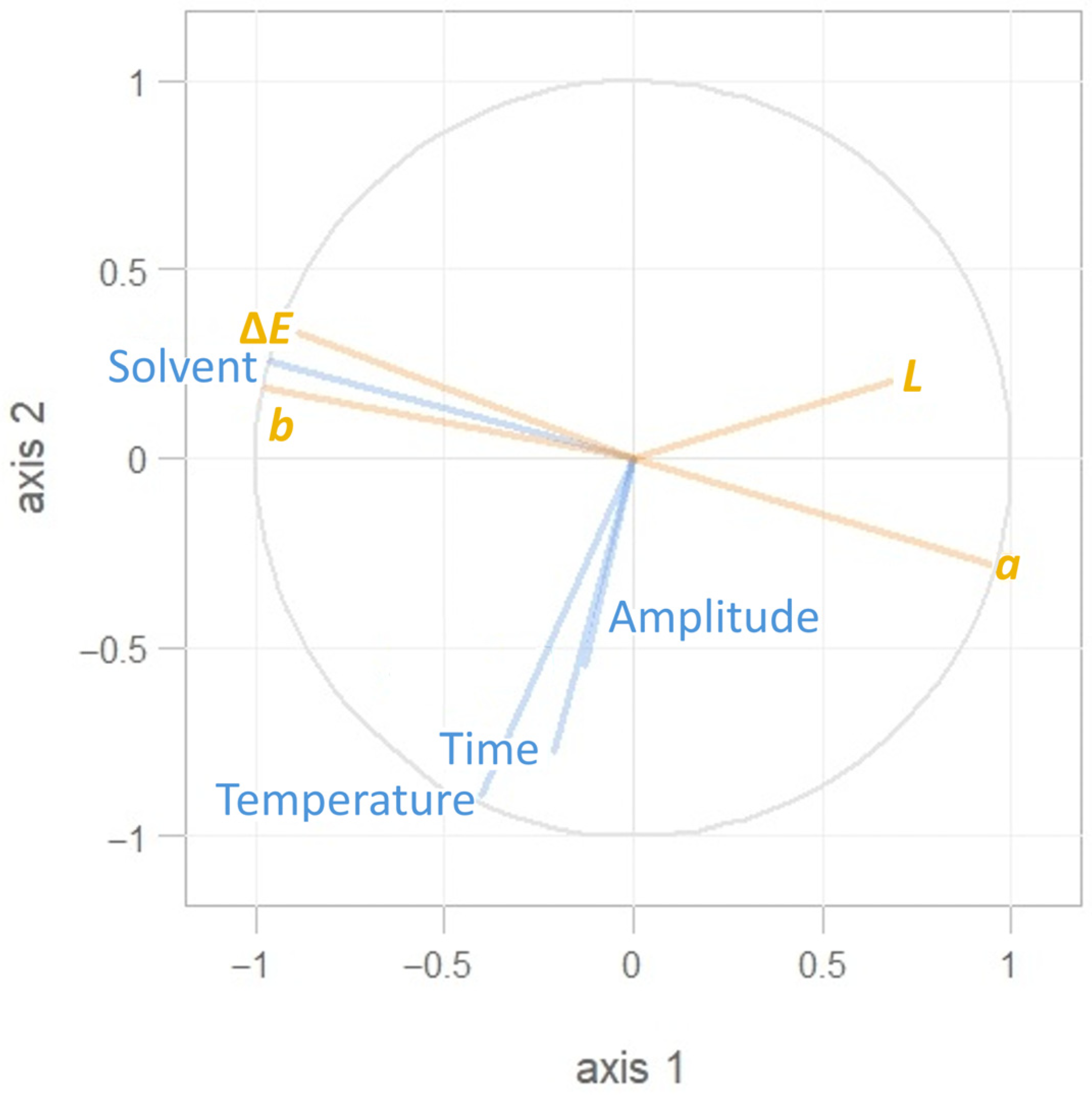
This work shows that the colour parameters L, a, b and ΔE depend to a certain extent on the amplitude, time, solvent and temperature (Figure 2). The solvent had the greatest influence and was positively related to b (Std. Coeff. = 0.9696) and ΔE (Std. Coeff. = 0.9354) and negatively related to the a (Std. Coeff. = −0.9741) and L values (Std. Coeff. = −0.5733) (Figure S1a, Supplementary Materials (SM)).
Compared to the solvent, the influence of the amplitude (Std. Coeff. = −0.0837), time (Std. Coeff. = −0.1300) and temperature (Std. Coeff. = −0.2280) was smaller and independent of the L parameter. When using 30 and 70% ethanol, the brightness values were obtained at the lowest amplitude of 60%, i.e., 84.12–85.85 and 75.62–81.95 for most extracts, respectively, compared to the values at 80 and 100% amplitudes (Figure 3a). Regardless of the amplitude, extracts sonicated for 9 min showed lower L values than those sonicated for 3 or 6 min. For example, when using 30% ethanol, a 100% amplitude and a duration of 9 min, extracts with lower L values (71.03) were obtained. Similar results were also obtained with 70% ethanol for 9 min and a 100% amplitude (L = 75.03). Although 30% acetone extracts follow the same trends as the two ethanol extracts regardless of the sonication duration, some discrepancy is observed when different amplitudes are applied, i.e., an 80% amplitude gave slightly lower L values than 100% (Figure 3a). Compared to 30% acetone, 70% acetone gave lower L values (72.1–76.95) at all applied amplitudes and times, indicating that its effect is more pronounced, i.e., the colour of the extracts is more intense.
Regardless of the a parameter, the highest reddening values for 30% ethanol and acetone were mainly obtained at an extraction time of 9 min, depending on the amplitude used (Figure 3b). Although green values were obtained for 70% ethanol and acetone, the most intense green colouration was observed for 70% acetone, especially at an amplitude of 100% at 9 min.
Higher b values of 87.8 to 96.18 and 95.25 to 99.52 were obtained for 70% ethanol and acetone extracts than for 30% ethanol (42.38–55.67) and 30% acetone extracts (45.69–55.98) (Figure 3c). The lowest ΔE was obtained when using 30% ethanol, followed by 70% ethanol and 30 and 70% acetone (Figure 3d). The largest changes were observed when using 70% acetone, which correlated well with the other colour parameters.
From the results obtained, it can be concluded that UAE significantly influences the colour of laurel extracts when applying different parameter combinations. However, the solvents played an important role in improving the colour of the extracts (Figure S1a,b). Thus, by manipulating the UAE factors in combination with the solvent, it is possible to produce a variety of extracts with different intensities, providing useful data with regard to their use in different food or cosmetic applications.

3.3. Influence of UAE Parameters on Content of Total Phenols and Flavonoids in Laurel Leaf

The influence of the UAE parameters, i.e., the amplitude and time, set during the sonication of laurel leaves in ethanol and acetone with volume fractions of 30 and 70%, as well as the temperature changes from the beginning to the end of sonication, resulted in certain amounts of total phenols (TP) and total flavonoids (TF). As Table S1 (SM) shows, the levels of TP and TF in the laurel extracts ranged from 594.38 to 939.45 mg/L and 209.47 to 363.95 mg/L, corresponding to 19.81 to 32.10 mg/g and 6.98 to 12.13 mg/g TP and TF in the samples, respectively.
The TP values found in this work are comparable to those of Dobroslavić et al. [15], although they used 50 and 70% ethanol in UAE, with time periods of 5, 10 and 15 min and amplitudes of 50, 75 and 100%. They found 24.43 and 36.74 mg/g TP. Apart from their work, there are no scientific works in which ultrasonic technology has been used for the extraction of phenols from laurel leaves, especially flavonoids, so the results shown in our study are compared with those of other recently used techniques. For example, Dobroslavić et al. [15,22] described the use of MAE and PLE, with higher TP values than those shown in this work. Accordingly, MAE and PLE yielded 30.88 to 53.57 mg/g and 31.87 to 49.30 mg/g, respectively, which were dependent on the temperature, time, solvent, extraction cycle, etc. Maleš et al. [18] showed higher content of TP in laurel leaf extracts (1.18 g/L) and lower content of TF (0.14 g/L) than in our study when extracted in a water bath shaker at 60 °C for 30 min, with water as the solvent. Rincón et al. [40] reported that Soxhlet, UAE and MAE extracts yielded different levels of phenols depending on the extraction parameters, e.g., solvent (water, methanol and ethanol), time and temperature. Soxhlet extraction yielded 10.42, 11.74 and 12.59 mg/g (dw) TP when using ethanol, methanol and water, respectively. UAE yielded 3.3 to 24.77 mg/g (dw) and MAE yielded 2.74 to 21.56 mg/g (dw) of TP. In addition to these papers, the review paper by Dobroslavić et al. [25] should be mentioned, which reports on the TP and TF content found in various studies up to 2022 with regard to conventional and advanced extraction methods. This shows that the TP and TF content varies and depends not only on the extraction technique but also on the extraction parameters used, e.g., the solvent, time, temperature and solid–liquid ratio. It is also worth mentioning that spent laurel leaf residues can also be used as a useful source of phenols and flavonoids. Trifan et al. [14], for example, showed that spent material that was ultrasonically treated at room temperature for 30 min and in three cycles with different solvents, e.g., hexane, dichloromethane, methanol/water and methanol, had different TP and TF content. The values of 22.49, 24.29, 48.95 and 75.53 mg/g for TP and 0.50, 0.55, 19.50 and 27.33 mg/g for TF when using hexane, dichloromethane, methane/water and methanol, respectively, showed that the solvent had a major influence on the content. The effects of solvents were also demonstrated by Tometri et al. [41] in the extraction of laurel leaves via an ultrasonic bath (45 °C, 20 min and 20 kHz). The TP and TF content was higher when 50% ethanol was used as a solvent than with water or pure ethanol. Accordingly, alcoholic solvents yielded 796.94 and 398.71 µ/g (dw) of TP and TF.

3.3.1. Influence of UAE Parameters on Content of Total Phenols in Laurel Leaf

The results of our study (Table S1) also show that the solvent has a significant influence on the TP content compared to other analysed parameters (Figure 4).
The result was within a very narrow range (Figure 5), with similar values for 30% ethanol (21.10 to 25.51 mg/g) and 70% ethanol (19.81 to 28.04 mg/g), in addition to 30% acetone (22.52 to 26.01 mg/g). Slightly higher values were found with 70% acetone, i.e., 23.48 to 32.10 mg/g, depending on the amplitude and time.
Although increasing the amplitude and time did not have as strong an effect as the solvent on the TP content, slightly higher amounts of phenols were obtained when the amplitude and time were increased from 60 to 100% and from 3 to 9 min, respectively. Thus, the highest TP content is obtained at an amplitude of 100% and a duration of 9 min, i.e., 25.51, 28.04 and 32.10 mg/g, when 30% ethanol, 70% ethanol and 70% acetone are used, respectively. These results seem reasonable considering the general observation that increasing the extraction time and amplitude increases the diffusion of phenols, leading to higher yields. In addition, due to the cavitation effect of the ultrasonic waves, the amplitude increases the local pressure and temperature and consequently the breakage of the plant material, leading to a better mass transfer rate [35]. As the results showed, increasing the amplitude from 60 to 100% led to an increase in temperature (Appendix A, Figure A1) for all solvents used, and the values obtained at the end of sonication were between 28.30 and 54.0 and between 31.90 and 61.8 °C for 30 and 70% ethanol, while they were between 28.60 and 54.20 and between 33.6 and 48.40 °C for 30 and 70% acetone. The highest temperatures of 54.0, 61.8, 54.2 and 48.4 were reached at a 100% amplitude and 9 min with 30% ethanol, 70% ethanol, 30% acetone and 70% acetone, respectively. Obviously, the temperature increase correlates well with the amounts of TP extracted with both ethanol fractions (Figure 5). However, in the case of 30% acetone, the increase in temperature resulted in similar TP values for all applied amplitudes and times. On the other hand, the highest TP content is obtained with 70% acetone, although the temperature rise is the lowest compared to the other solvents. As mentioned in Section 3.1, a higher temperature can lead to better extraction, but its increase can promote the degradation of the compounds, so, with 70% acetone, the optimum temperature is reached and consequently the highest TP content is obtained. Furthermore, we hypothesise that, in addition to the parameters set, the solvents themselves have a significant influence on phenol extraction, probably due to the composition of the sample and the polarity (un) of the desired phenols and flavonoids, as well as the matrix constituents affecting their yields due to similarities, i.e., similar solutes are soluble in similar solvents.
As in this work, in other studies, it has also been found that the solvent and its volume fractions significantly affect the total amount of phenols. For example, Dobroslavić et al. [22] reported that 50% ethanol gave higher phenol content than 70% ethanol when PLE was performed. Accordingly, the volume fractions of ethanol (50 and 70%) had a significant effect on the TP content in UAE [15], with higher values obtained with 70% ethanol, which is also confirmed in our study. On the other hand, Dobroslavić et al. [15] showed that the volume fractions of ethanol (50% and 70%) had no influence on phenol extraction under reflux and MAE. Obviously, the phenol content varies across scientific papers and depends significantly (or not) on the parameters used in the different extraction processes.

3.3.2. Influence of UAE Parameters on Content of Total Flavonoids in Laurel Leaf

In agreement with the TP values, the TF content was also within a small range, i.e., 7.16 to 9.56, 7.08 to 10.73, 6.98 to 10.43 and 8.05 to 12.13 mg/g for 30% ethanol, 70% ethanol, 30% acetone and 70% acetone, respectively (Table S1), and it followed the same trend as the phenol values. This means that, by increasing the amplitude and time (Figure 6), slightly higher amounts of flavonoids were obtained at 30 and 70% ethanol and 70% acetone, although some discrepancy was observed at 30% acetone (slightly higher values at an 80% amplitude). As in the case of TP, the highest TF content of 9.56, 10.73 and 12.13 mg/g was obtained for 30% ethanol, 70% ethanol and 70% acetone, respectively, at a 100% amplitude and 9 min sonication. The highest yield was obtained using 70% acetone, with a value of 12.13 mg/g, which again confirms that a temperature of 48.4 °C can be considered optimal for flavonoid extraction.
As the results of the statistical analysis show (Figure 4), the positively correlated influence of the amplitude and especially the solvent is more pronounced than for the temperature and time. Although the solvent and amplitude had an identical influence for phenols and flavonoids, where their corresponding standard coefficients were 0.4377 and 0.3808 and 0.2788 and 0.2633, respectively, the influence of the temperature and time is stronger in the case of flavonoids than for phenols (Figure 7). The standard coefficients of the temperature are 0.23430 and 0.08734, while those of the time are 0.1628 and 0.0176, for TP and TF, respectively.
From the results obtained, it can be concluded that the solvent (Figure 7 and Figure S2) has the strongest influence on the yields of phenols and flavonoids and that, in particular, 70% ethanol and acetone can be further utilised at an amplitude of 100% and a duration of 9 min. In addition, the VIP value of the temperature is also high (>1), indicating that this process parameter influences the phenol and flavonoid yields.

3.4. Influence of UAE Parameters on Content of Phenolic Compounds in Laurel Leaf

Recently, some scientific works have shown the application of ultrasound technology for the extraction of some plants, e.g., Erodium glaucophyllum L., olive, fig, lavandula, chamomile, nettle and carob, mainly via an ultrasonic bath [42,43,44,45,46,47] and less often via an ultrasonic probe [44]. Although ultrasound-assisted technology was used in these studies, the individual phenolic compounds were not determined in most of them. Therefore, this paper presents UAE using a 22 mm flat-head probe for the extraction and determination of the total phenols and flavonoids, as well as for the identification and quantification of individual phenolic compounds. Although acetone extracts yielded high amounts of phenols and flavonoids (Section 3.2), HPLC analysis was only performed with ethanolic extracts, as ethanol is more commonly used in the food industry compared to acetone.
The results show (Table 1) that the following phenolic acids were identified in 30 and 70% ethanol extracts: gallic acid, p-coumaric acid, rosmarinic acid and its derivatives, as well as flavonoid glycosides, e.g., quercetin-3-O-rutinoside, quercetin-O-hexoside, kaempferol-3-O-rutinoside, isorhamnetin-O-hexoside, kaempferol-O-hexoside I and II as flavonols and luteolin-6-C-glucoside as a flavone. Ferulic acid, caffeic acid, syringic acid, chlorogenic acid, p-hydroxybenzoic acid and luteolin-O-hexoside were found in some extracts in very low concentrations—up to 0.02, 0.04, 0.09, 0.15, 0.17 and 0.09 mg/g, respectively—in 30% ethanolic extracts, while apigenin-6-C-glucoside was not detected, although other work has shown amounts of 0.0009 mg/g [15] and 0.71% [16]. Considering that this compound was not present in any laurel extracts analysed, we assume that an increase in the amplitude and time, and thus the temperature, could not induce the degradation of apigenin-6-C-glucoside. For example, most of the temperatures measured were below 50 °C (at this temperature, heat-sensitive compounds may be degraded), and we assume that its absence in our extracts was due to a natural deficiency.
The content of other individual phenolic compounds, as shown in Table 1, is significantly (p < 0.05) influenced by the defined UAE parameters, e.g., amplitude and time. In addition, temperature changes during sonication, and the sample/solvent medium, can also effect their yields.
Gallic acid is one of the dominant phenolic acids, and the amounts obtained ranged from 23.17 to 89.26 mg/L and 71.59 to 87.34 mg/L for 30 and 70% ethanol, respectively, depending on the amplitude and time. Although the solvents (Std. Coeff. = 0.2466) affected the gallic acid yield more than other factors evaluated, e.g., amplitude, time and temperature (Figure 8a,b), their effect was not as strong, resulting in very similar values (except for the value obtained for 6 min at a 100% amplitude in 30% ethanol). The highest content of gallic acid was obtained in 30% ethanol at 3 min sonication with an amplitude of 100% (89.26 mg/L), followed by 80% (85.28 mg/L) and 60% amplitudes (85.05 mg/L). With increasing extraction periods of up to 3 or 6 min (depending on the solvent), higher values were obtained for gallic acid, after which its content decreased significantly (Table 1), indicating possible degradation.
The content of p-coumaric acid was also more strongly influenced by the solvent (Std. Coeff. = −0.5191) than other parameters (Figure 8a,b), so that higher amounts were found in 30% ethanolic extracts than in 70% ethanolic extracts. Up to an extraction time of 6 min in 30% ethanol, the highest yields of 17.96 mg/L (100%) and 13.80 mg/L (80%) were obtained, after which they decreased significantly (Table 1). On the other hand, the content of p-coumaric acid at the lowest amplitude of 60% increased significantly from 2.19 to 17.30 mg/L at an extraction time of 3 to 9 min, indicating that a good yield can be obtained even with mild extraction conditions. In addition to this observation, the performance of 70% ethanol in terms of p-coumaric acid degradation is more pronounced than when using 30% ethanol, i.e., the values obtained are between 2.94 and 5.60 mg/L (Table 1).
The solvent effect is stronger for rosmarinic acid and its derivatives (Std. Coeff. = 0.7194 and 0.68032) than for gallic acid and p-coumaric acid (Figure 8b), and, in contrast to these findings, 70% ethanol provided significantly increased amounts (p < 0.05) at up to 9 min of sonication, i.e., 219.32, 186.34 and 203.53 mg/L for 100, 80 and 60% amplitudes, respectively, making this acid the predominant one. In addition to 70% ethanol, extending the extraction time from 3 to 9 min and using 30% ethanol also led to a significant increase (p < 0.05) in rosmarinic acid content; again, the highest values were found for 9 min of extraction, namely 181.15 mg/L (100%), 68.74 mg/L (80%) and 22.58 mg/L (60%). In addition to the solvent, the influence of the temperature (Figure 8a) should not be neglected in the case of rosmarinic acid (Std. Coeff. = 0.3383, Figure 8b), which exhibited high quantities in combination with 70% ethanol.
Similarly to rosmarinic acid, the content of its derivatives increases to 16.22, 15.14 and 16.63 mg/L when sonicated for 9 min in 70% ethanol with an amplitude of 100, 80 and 60%, respectively, confirming that the sonication time and amplitude significantly (p < 0.05) affect the yield (Table 1). When using 30% ethanol, the content of rosmarinic acid derivatives is about two to three times lower than with 70% ethanol. For this volume fraction, the highest amounts are obtained at 9 min sonication with an amplitude of 100% (8.71 mg/L), followed by 80% (4.85 mg/L). No rosmarinic acid derivative was found at an amplitude of 60% for 3 to 9 min of sonication, again confirming the significant (p < 0.05) differences between the parameters applied (Table 1).
For the individual phenolic acids, the sum of total phenolic acids is also higher when 70% ethanol is used; thus, again, the greatest influence of the solvent (Std. Coeff. = 0.7173) can be verified, in addition to the other factors investigated. Although 30% ethanol yielded high amounts of total phenolic acids, namely 284.91, 157.34 and 121.95 mg/L, respectively, especially in the 9 min extraction protocol with 100, 80 and 60% amplitudes, 70% ethanol yielded the highest amounts of 311.69, 294.27 and 311.75 mg/L at the same amplitude, again with 9 min sonication (Appendix A, Figure A2).
In comparison to this work, Dobroslavić et al. [15] reported much lower values, not only for gallic acid (0.45 to 1.05 mg/100 g) but also for p-coumaric acid (0.82 to 1.40 mg/100 g) and rosmarinic acid (0.53 to 1.44 mg/100 g), depending on the extraction technique used, e.g., reflux, MAE or UAE. Dobroslavić et al. [22] also reported values of 0.28, 0.99 and 4.25 mg/100 g for gallic acid, rosmarinic acid and p-coumaric acid when using PLE. Maleš et al. [18] reported 140 and 6060 mg/L for rosmarinic and gallic acid in water extracts, respectively. These differences can be explained primarily by the samples analysed, as the authors used commercial laurel leaf from a supplier, and secondarily by the techniques and parameters used, e.g., ethanol (50 and 70%), amplitude (50, 75 and 100%), time (5, 10 and 15 min), frequency (24 kHz), etc., in the case of UAE. In contrast to this work, the laurel leaf extracts of Dobroslavić et al. [15] contained caffeic acid as the most abundant substance, followed by 3,4-dihidrobenzoic acid and protocatechuic acid. Maleš et al. [18] reported that protocatechuic acid was the most common.
Among the flavonoid glycosides, kaempferol-3-O-rutinoside predominates, with amounts ranging from 20.18 to 125.33 mg/L and 48.47 to 81.89 mg/L in 30 and 70% ethanolic extracts, respectively, and its content was significantly (p < 0.05) affected by the amplitude and time used (Table 1). The amounts found (0.67–4.18 mg/g) are much higher than those reported by other authors [15,23], who showed that the yield was related to the extraction method, e.g., MAE (0.056 mg/g), PLE (0.06 mg/g), UAE (0.075 mg/g) or reflux (0.242 mg/g). On the other hand, Maleš et al. [18] reported a higher value of 1.10 g/L when using an ultrasonic bath. In this work, with the exception of the value of 125.33 mg/L found in 30% ethanolic extracts at 6 min sonication with a 100% amplitude, all amounts of kaempferol-3-O-rutinoside were lower (20.18–61.89 mg/L) than the values determined in 70% ethanolic extracts, indicating that the solvent has a significant influence on the yield (Std. Coeff. = 0.2249). The influence of the temperature is slightly stronger (Std. Coeff. = 0.3227) than that of the solvent, indicating that both factors ensure the good extraction of this compound.
The second most abundant flavonol is isorhamnetin-O-hexoside, which was found in amounts ranging from 2.48 to 22.54 mg/L and 7.48 to 19.21 mg/L in 30 and 70% ethanolic extracts. As the results show (Table 1), its yield of up to 0.75 mg/g is slightly higher than the values reported by other authors [15,23], i.e., 0.21 mg/g (UAE), 0.25 mg/g (MAE), 0.25 mg/g (PLE) and 0.41 mg/g (reflux), and is strongly influenced by the temperature (Std. Coeff. = 0.4019, Figure 8b).
The quercetin-3-O-rutinoside levels ranged from 7.48 to 14.82 mg/L in 70% ethanolic extracts (Table 1), with the highest values found mainly at 9 min sonication at 100 and 80% amplitudes, with very similar values of 12.76 and 12.40 mg/L at 6 and 9 min at a 60% amplitude. Compared to 70% ethanol, 30% ethanol cannot be considered a suitable choice for the further extraction of this compound due to the very low levels found, mainly at 9 min sonication.
Quercetin-O-hexoside also showed the highest amount at 9 min sonication for a 100% amplitude (10.24 mg/L) in 30% ethanolic extracts (Table 1). When the amplitude was reduced from 100 to 60%, this compound was not detected at 3 to 6 min sonication, while values of 3.08 mg/L (80%) and 2.00 mg/L (60%) were detected at 9 min sonication. In contrast to the data obtained with 30% ethanol, higher values were obtained using 70% ethanol, ranging from 8.93 to 21.69 mg/L. These results again show that the solvent has a significant influence (Std. Coeff. = 0.7967) on the yield. Although the values found for 80 and 60% amplitudes are not negligible, the highest yield was achieved at a 100% amplitude with 9 min of sonication. For comparison, 0.51 mg/g (reflux), 0.92 mg/g (UAE), 0.94 mg/g (PLE) and 1.03 mg/g (MAE) were reported by other authors [15,23], and these are close to the results of this study (0.72 mg/g, 100% and 9 min).
Kaempferol-O-hexoside I as a dominant flavonoid was also found in 70% ethanolic extracts, with values between 8.46 and 21.70 mg/L (Table 1), depending on the amplitude and time. Compared to 70% ethanol, which gave high yields, 30% ethanol did not prove to be a suitable solvent, considering that high values were again only found in the sample sonicated for 9 min at a 100% amplitude (17.58 mg/L). At the lowest amplitude of 60%, this compound was not detected.
Although kaempferol-O-hexoside II is found in high amounts when using 30% ethanol but only at a 100% amplitude, with values of 4.81, 7.49 and 5.74 mg/g for 3, 6 and 9 min, respectively, higher values were obtained when using 70% ethanol—not only at a 100% amplitude but also at 80 and 60% (Table 1).
The yield of luteolin-6-C-glucoside (Table 1) decreased in comparison to the other compounds, the content of which generally increases significantly when 70% ethanol is used. It therefore appears that lower volume fractions of ethanol and a shorter extraction time lead to higher content. The results show that the polarity of the solvent has a significant influence on the extraction of most of the identified phenolic compounds. Moreover, 70% ethanol improved their recovery and can be further used for extraction. This finding also confirms the values obtained for the total sum of phenolic acids and the total sum of flavonoid glycosides (Table 1, Appendix A, Figure A2). As the results of the statistical analysis show (Figure 8a,b and Figure S3), the temperature had a significant but smaller effect on the yield than the solvent. Compared to the effects of the solvent and temperature, increasing the sonication time from 3 to 9 min and the amplitude from 60 to 100% had a smaller effect on the yield, although slightly higher values were obtained at a 100% amplitude and 9 min of sonication.

4. Conclusions

It is confirmed that, by varying the UAE parameters, e.g., the amplitude, time and solvent, numerous extracts can be produced that differ in colour and in the amounts of phenols, flavonoids and individual phenolic compounds. Among the parameters, the influence of the solvent is the most pronounced. It is possible to obtain lighter- or darker-coloured extracts by varying ethanol or acetone at 30 or 70% (v/v). For example, 70% acetone is suitable for obtaining a darker-coloured extract, while 30% ethanol produces a lighter extract. Moreover, 70% acetone yielded higher amounts of total phenols and flavonoids than the other solvents used. For phenolic compounds, 70% ethanol gave a higher yield of most individual phenolic compounds, e.g., rosmarinic acid and its derivatives, quercetin-3-O-rutinoside, quercetin-O-hexoside, kaempferol-3-O-rutinoside, kaempferol-O-hexoside I and II, than 30% ethanol. On the other hand, 30% ethanol is a better solvent for the extraction of gallic acid, p-coumaric acid and luteolin-6-C-glucoside. For kaempferol-3-O-rutinoside and isorhamnetin-O-hexoside, the effect of the temperature was slightly stronger than that of the solvent. Although this work has shown that the influence of the solvent and temperature is stronger than that of the amplitude and time, it should be emphasised that higher content of phenols and flavonoids, as well as most phenolic compounds (rosmarinic acid and its derivatives, followed by quercetin-3-O-rutinoside, quercetin-O-hexoside, kaempferol-3-O-rutinoside and kaempferol-O-hexoside I and II), is obtained at an amplitude of 100% and 9 min of sonication. This observation does not apply to the extraction of gallic acid, p-coumaric acid and luteolin-6-C-glucoside, whose amounts decrease with increasing sonication times, although an amplitude of 100% is still sufficient for their extraction. In conclusion, we suggest that further UAE should be performed mainly with higher volume fractions of solvents, the highest amplitude of 100% and a time period of 9 min. Otherwise, lower amplitudes and times can also be used, depending on the further use of the extracts and the desired colour intensity, as well as the required amounts of phenols, flavonoids and phenolic compounds, in different food applications. In addition, economic feasibility, which was not determined in this work, could also be considered in a further study as a trade-off between mining efficiency and economic suitability.

Supplementary Materials

The following supporting information can be downloaded at: https://www.mdpi.com/article/10.3390/app15179347/s1. Figure S1a: Standardised coefficients (Std. Coeff.) representing the relationships between the response variable (L, a, b and ΔE)) and the predictors (amplitude, time, solvent and temperature) during the UAE of laurel leaf; Figure S1b: Variable importance in projection (VIP) of the first two components (t1 and t2). VIP > 1 indicates that the solvent among the predictors (amplitude, time, solvent and temperature) contributes significantly to the PLS model of the colour of the extracts during the UAE of laurel leaf; Figure S2: Variable importance in projection (VIP) of the first two components (t1 and t2). VIP > 1 means that the solvent, followed by the temperature, among the predictors (amplitude, time, solvent and temperature) contributes significantly to the PLS model of the total phenolic and flavonoid content during the UAE of laurel leaf; Figure S3: Variable importance in projection (VIP) of the first two components (t1 and t2). VIP > 1 indicates that the solvent, followed by the temperature, among the predictors (amplitude, time, solvent and temperature) contributes significantly to the PLS model of the phenolic compound content during the UAE of laurel leaf; Table S1. Content of total phenols (TP) and total flavonoids (TF) in laurel leaves obtained by UAE with 30 and 70% (v/v) ethanol (EtOH) and acetone (Ace) at amplitudes of 60, 80 and 100% and time periods of 3, 6 and 9 min.

Author Contributions

Conceptualization, A.N.G. and Z.Z.; methodology, A.N.G., M.B., S.P. and Z.Z.; software, A.N.G., M.B., S.P. and Z.Z.; validation, A.N.G., S.P. and Z.Z.; formal analysis, A.N.G., A.M., I.M., S.P., M.B. and Z.Z.; investigation, A.N.G., A.M., I.M., M.B., S.P. and Z.Z.; resources, A.N.G., M.B., S.P. and Z.Z.; data curation, A.N.G., A.M., I.M., S.P. and Z.Z.; writing—original draft preparation, A.N.G. and Z.Z.; writing—review and editing, A.N.G., M.B., S.P. and Z.Z.; visualization, A.N.G., M.B., S.P. and Z.Z.; supervision, A.N.G. and M.B. All authors have read and agreed to the published version of the manuscript.

Funding

This research received no external funding.

Institutional Review Board Statement

Not applicable.

Informed Consent Statement

Not applicable.

Data Availability Statement

The original contributions presented in this study are included in the article/Supplementary Materials. Further inquiries can be directed to the corresponding author.

Acknowledgments

The authors would like to thank the University of Zagreb Faculty of Food Technology and Biotechnology for supporting this research. Many thanks also to Darjan Pipić, technical assistant at the Laboratory for Unit Operation, for the assistance with the ultrasound extraction of laurel leaves.

Conflicts of Interest

The authors declare no conflicts of interest.

Appendix A

Table A1. Ultrasound-assisted extraction (UAE) of polyphenols from laurel leaves with 30 and 70% ethanol (EtOH) and acetone (Ace) at amplitudes of 60, 80 and 100% and times of 3, 6 and 9 min. The ΔT shows the temperature difference in the solution at the beginning (o) and at the end (e) of the UAE of laurel leaf.
SampleAmplitude
(%)
Time
(min)
Temperature (o)
(°C)
Temperature (e)
(°C)
ΔTSolvent
A1100323.534.210.730% (v/v) EtOH
2623.446.322.9
3923.454.030.6
B180323.232.59.3
2623.241.418.2
3923.347.023.7
C160322.628.35.7
2622.835.412.6
3923.140.016.9
D1100323.542.418.970% (v/v) EtOH
2623.754.530.8
3923.961.837.9
E180323.137.214.1
2623.648.925.3
3923.255.932.7
F160321.931.910.0
2622.139.517.4
3922.446.223.8
G1100322.735.913.230% (v/v) Ace
2621.948.226.3
3922.354.231.9
H180321.032.511.5
2622.440.718.3
3921.547.325.8
I160322.128.66.5
2622.235.112.9
3922.240.618.4
J1100322.735.713.070% (v/v) Ace
2622.744.421.7
3923.248.425.2
K180323.233.610.4
2622.639.316.7
3922.746.223.5
L160321.829.07.2
2622.034.912.9
3921.840.318.5
Figure A1. Influence of the amplitude (60, 80 and 100%) and time (3, 6 and 9 min) on the temperature rise during the UAE of laurel leaf in ethanol (EtOH) and acetone (Ace) with volume fractions of 30 and 70% (v/v). Temperature (e) = temperature at the end of sonication.
Applsci 15 09347 g0a1
Figure A2. Influence of the amplitude (60, 80 and 100%), the time (3, 6 and 9 min) and the volume fractions of ethanol (EtOH) (30 and 70%, v/v) on the sum of phenolic acids, sum of flavonoids and their total sum.
Applsci 15 09347 g0a2

References

  1. Insights, C.M. Title of Report. Available online: https://www.coherentmarketinsight.com (accessed on 15 June 2025).
  2. Chauhan, B.; Kumar, G.; Kalam, N.; Ansari, S.H. Current concepts and prospects of herbal nutraceutical: A review. J. Adv. Pharm. Technol. 2013, 4, 4–8. [Google Scholar] [CrossRef]
  3. Pelvan, E.; Karaoglu, O.; Firat, E.O.; Kalyon, K.B.; Ros, E.; Alasalvar, C. Immunomodulatory effects of selected medicinal herbs and their essential oils: A comprehensive review. J. Funct. Foods 2022, 94, 105108. [Google Scholar] [CrossRef]
  4. Bommakanti, V.; Ajikumar, A.P.; Sivi, C.M.; Prakash, G.; Mundanat, A.S.; Ahmad, F.; Haque, S.; Prieto, M.A.; Rana, S.S. An Overview of Herbal Nutraceuticals, Their Extraction, Formulation, Therapeutic Effects and Potential Toxicity. Separations 2023, 10, 177. [Google Scholar] [CrossRef]
  5. Research, Z.M. Bay Leaf Market. Available online: www.zionmarketresearch.com (accessed on 10 June 2025).
  6. Anzano, A.; de Falco, B.; Grauso, L.; Motti, R.; Lanzotti, V. Laurel, Laurus nobilis L.: A review of its botany, traditional uses, phytochemistry and pharmacology. Phytochem. Rev. 2022, 21, 565–615. [Google Scholar] [CrossRef]
  7. Belasli, A.; Ben Miri, Y.; Aboudaou, M.; Ouahioune, L.A.; Montanes, L.; Ariño, A.; Djenane, D. Antifungal, antitoxigenic, and antioxidant activities of the essential oil from laurel (Laurus nobilis L.): Potential use as wheat preservative. Food Sci. Nutr. 2020, 8, 4717–4729. [Google Scholar] [CrossRef]
  8. Nenadis, N.; Papapostolou, M.; Tsimidou, M.Z. Suggestions on the Contribution of Methyl Eugenol and Eugenol to Bay Laurel (Laurus nobilis L.) Essential Oil Preservative Activity through Radical Scavenging. Molecules 2021, 26, 2342. [Google Scholar] [CrossRef]
  9. Ordoudi, S.A.; Papapostolou, M.; Nenadis, N.; Mantzouridou, F.T.; Tsimidou, M.Z. Bay Laurel (Laurus nobilis L.) Essential Oil as a Food Preservative Source: Chemistry, Quality Control, Activity Assessment, and Applications to Olive Industry Products. Foods 2022, 11, 752. [Google Scholar] [CrossRef]
  10. Paparella, A.; Nawade, B.; Shaltiel-Harpaz, L.; Ibdah, M. A Review of the Botany, Volatile Composition, Biochemical and Molecular Aspects, and Traditional Uses of Laurus nobilis. Plants 2022, 11, 1209. [Google Scholar] [CrossRef]
  11. Sousa, V.I.; Parente, J.F.; Marques, J.F.; Forte, M.A.; Tavares, C.J. Microencapsulation of Essential Oils: A Review. Polymers 2022, 14, 1730. [Google Scholar] [CrossRef]
  12. Petkova, Z.; Stefanova, G.; Girova, T.; Antova, G.; Stoyanova, M.; Damianova, S.; Gochev, V.; Stoyanova, A.; Zheljazkov, V.D. Phytochemical Investigations of Laurel Fruits. Nat. Prod. Commun. 2019, 14, 1934578X19868876. [Google Scholar] [CrossRef]
  13. Chrysargyris, A.; Mikallou, M.; Petropoulos, S.; Tzortzakis, N. Profiling of Essential Oils Components and Polyphenols for Their Antioxidant Activity of Medicinal and Aromatic Plants Grown in Different Environmental Conditions. Agronomy 2020, 10, 727. [Google Scholar] [CrossRef]
  14. Trifan, A.; Zengin, G.; Brebu, M.; Skalicka-Wozniak, K.; Luca, S.V. Phytochemical Characterization and Evaluation of the Antioxidant and Anti-Enzymatic Activity of Five Common Spices: Focus on Their Essential Oils and Spent Material Extractives. Plants 2021, 10, 2692. [Google Scholar] [CrossRef]
  15. Dobroslavic, E.; Garofulic, I.E.; Zoric, Z.; Pedisic, S.; Dragovic-Uzelac, V. Polyphenolic Characterization and Antioxidant Capacity of Laurus nobilis L. Leaf Extracts Obtained by Green and Conventional Extraction Techniques. Processes 2021, 9, 1840. [Google Scholar] [CrossRef]
  16. Berendika, M.; Drozdek, S.D.; Odeh, D.; Orsolic, N.; Dragicevic, P.; Sokolovic, M.; Garofulic, I.E.; Dikic, D.; Jurcevic, I.L. Beneficial Effects of Laurel (Laurus nobilis L.) and Myrtle (Myrtus communis L.) Extract on Rat Health. Molecules 2022, 27, 581. [Google Scholar] [CrossRef] [PubMed]
  17. de Falco, B.; Grauso, L.; Fiore, A.; Bonanomi, G.; Lanzotti, V. Metabolomics and chemometrics of seven aromatic plants: Carob, eucalyptus, laurel, mint, myrtle, rosemary and strawberry tree. Phytochem. Anal. 2022, 33, 696–709. [Google Scholar] [CrossRef] [PubMed]
  18. Males, I.; Dragovic-Uzelac, V.; Jerkovic, I.; Zoric, Z.; Pedisic, S.; Repajic, M.; Garofulic, I.E.; Dobrincic, A. Non-Volatile and Volatile Bioactives of Salvia officinalis L., Thymus serpyllum L. and Laurus nobilis L. Extracts with Potential Use in the Development of Functional Beverages. Antioxidants 2022, 11, 1140. [Google Scholar] [CrossRef]
  19. Awada, F.; Hamade, K.; Kassir, M.; Hammoud, Z.; Mesnard, F.; Rammal, H.; Fliniaux, O. Leaves and Fruits: A Review of Metabolite Composition and Interest in Human Health. Appl. Sci. 2023, 13, 4606. [Google Scholar] [CrossRef]
  20. Dobroslavic, E.; Garofulic, I.E.; Ilich, J.Z. Potential of Laurel (Laurus nobilis L.) Leaf Polyphenols for Modulation of Body Composition. Appl. Sci. 2023, 13, 2275. [Google Scholar] [CrossRef]
  21. Dobroslavic, E.; Garofulic, I.E.; Zoric, Z.; Pedisic, S.; Roje, M.; Dragovic-Uzelac, V. Physicochemical Properties, Antioxidant Capacity, and Bioavailability of Laurus nobilis L. Leaf Polyphenolic Extracts Microencapsulated by Spray Drying. Foods 2023, 12, 1923. [Google Scholar] [CrossRef]
  22. Dobroslavic, E.; Garofulic, I.E.; Separovic, J.; Zoric, Z.; Pedisic, S.; Dragovic-Uzelac, V. Pressurized Liquid Extraction as a Novel Technique for the Isolation of Laurus nobilis L. Leaf Polyphenols. Molecules 2022, 27, 5099. [Google Scholar] [CrossRef]
  23. Miljanovic, A.; Dent, M.; Grbin, D.; Pedisic, S.; Zoric, Z.; Marijanovic, Z.; Jerkovic, I.; Bielen, A. Sage, Rosemary, and Bay Laurel Hydrodistillation By-Products as a Source of Bioactive Compounds. Plants 2023, 12, 2394. [Google Scholar] [CrossRef]
  24. Miljanović, A.; Bielen, A.; Grbin, D.; Marijanović, Z.; Andlar, M.; Rezić, T.; Roca, S.; Jerković, I.; Vikić-Topić, D.; Dent, M. Effect of Enzymatic, Ultrasound, and Reflux Extraction Pretreatments on the Chemical Composition of Essential Oils. Molecules 2020, 25, 4818. [Google Scholar] [CrossRef]
  25. Dobroslavić, E.; Repajić, M.; Dragović-Uzelac, V.; Elez Garofulić, I. Isolation of Laurus nobilis preLeaf Polyphenols: A Review on Current Techniques and Future Perspectives. Foods 2022, 11, 235. [Google Scholar] [CrossRef] [PubMed]
  26. Shen, L.; Pang, S.; Zhong, M.; Sun, Y.; Qayum, A.; Liu, Y.; Rashid, A.; Xu, B.; Liang, Q.; Ma, H.; et al. A comprehensive review of ultrasonic assisted extraction (UAE) for bioactive components: Principles, advantages, equipment, and combined technologies. Ultrason. Sonochem. 2023, 101, 106646. [Google Scholar] [CrossRef] [PubMed]
  27. Šic Žlabur, J.; Brajer, M.; Voca, S.; Galic, A.; Radman, S.; Rimac-Brncic, S.; Xia, Q.; Zhu, Z.Z.; Grimi, N.; Barba, F.J.; et al. Ultrasound as a Promising Tool for the Green Extraction of Specialized Metabolites from Some Culinary Spices. Molecules 2021, 26, 1866. [Google Scholar] [CrossRef] [PubMed]
  28. Moura-Alves, M.; Souza, V.G.L.; Silva, J.A.; Esteves, A.; Pastrana, L.M.; Saraiva, C.; Cerqueira, M.A. Characterization of Sodium Alginate-Based Films Blended with Olive Leaf and Laurel Leaf Extracts Obtained by Ultrasound-Assisted Technology. Foods 2023, 12, 4076. [Google Scholar] [CrossRef]
  29. Spanos, G.A.; Wrolstad, R.E. Influence of processing and storage on the phenolic composition of Thompson Seedless grape juice. J. Agric. Food Chem. 1990, 38, 1565–1571. [Google Scholar] [CrossRef]
  30. Jia, Z.; Tang, M.; Wu, J. The determination of flavonoid contents in mulberry and their scavenging effects on superoxide radicals. Food Chem. 1999, 64, 555–559. [Google Scholar] [CrossRef]
  31. Bilušić, T.; Drvenica, I.; Kalušević, A.; Marijanović, Z.; Jerković, I.; Mužek, M.N.; Bratanić, A.; Skroza, D.; Zorić, Z.; Pedisić, S.; et al. Influences of freeze- and spray-drying vs. encapsulation with soy and whey proteins on gastrointestinal stability and antioxidant activity of Mediterranean aromatic herbs. Int. J. Food Sci. Technol. 2021, 56, 1582–1596. [Google Scholar] [CrossRef]
  32. Henningsson, M.; Sundbom, E.; Armelius, B.Å.; Erdberg, P. PLS model building:: A multivariate approach to personality test data. Scand. J. Psychol. 2001, 42, 399–409. [Google Scholar] [CrossRef]
  33. Team, R.C. A Language and Environment for Statistical Computing; R Foundation for Statistical Computing: Vienna, Austria, 2018. [Google Scholar]
  34. Bertrand, F.; Sanches, G. Partial Least Squares (PLS) Data Analysis Methods, 0.2.0. 2023. Available online: https://rdrr.io/cran/plsdepot/ (accessed on 6 June 2025).
  35. Ranjha, M.M.A.N.; Irfan, S.; Lorenzo, J.M.; Shafique, B.; Kanwal, R.; Pateiro, M.; Arshad, R.N.; Wang, L.F.; Nayik, G.A.; Roobab, U.; et al. Sonication, a Potential Technique for Extraction of Phytoconstituents: A Systematic Review. Processes 2021, 9, 1406. [Google Scholar] [CrossRef]
  36. Plaskova, A.; Mlcek, J. New insights of the application of water or ethanol-water plant extract rich in active compounds in food. Front. Nutr. 2023, 10, 1118761. [Google Scholar] [CrossRef] [PubMed]
  37. López-Rodríguez, D.; Micó-Vicent, B.; Jordán-Núñez, J.; Belda, A. Extraction of natural pigments from Mediterranean environments plants. Ind. Crops Prod. 2024, 221, 119352. [Google Scholar] [CrossRef]
  38. Alirezalu, K.; Pateiro, M.; Yaghoubi, M.; Alirezalu, A.; Peighambardoust, S.H.; Lorenzo, J.M. Phytochemical constituents, advanced extraction technologies and techno-functional properties of selected Mediterranean plants for use in meat products. A comprehensive review. Trends Food Sci. Technol. 2020, 100, 292–306. [Google Scholar] [CrossRef]
  39. Bolouri, P.; Salami, R.; Kouhi, S.; Kordi, M.; Lajayer, B.A.; Hadian, J.; Astatkie, T. Applications of Essential Oils and Plant Extracts in Different Industries. Molecules 2022, 27, 8999. [Google Scholar] [CrossRef]
  40. Rincón, E.; Balu, A.M.; Luque, R.; Serrano, L. Mechanochemical extraction of antioxidant phenolic compounds from Mediterranean and medicinal Laurus nobilis L: A comparative study with other traditional and green novel techniques. Ind. Crops Prod. 2019, 141, 111805. [Google Scholar] [CrossRef]
  41. Tometri, S.S.; Ahmady, M.; Ariaii, P.; Soltani, M.S. Extraction and encapsulation of Laurus nobilis leaf extract with nano-liposome and its effect on oxidative, microbial, bacterial and sensory properties of minced beef. J. Food Meas. Charact. 2020, 14, 3333–3344. [Google Scholar] [CrossRef]
  42. Abdelkebir, R.; Alcántara, C.; Falcó, I.; Sánchez, G.; Garcia-Perez, J.V.; Neffati, M.; Lorenzo, J.M.; Barba, F.J.; Collado, M.C. Effect of ultrasound technology combined with binary mixtures of ethanol and water on antibacterial and antiviral activities of Erodium glaucophyllum extracts. Innov. Food Sci. Emerg. 2019, 52, 189–196. [Google Scholar] [CrossRef]
  43. Alcántara, C.; Zugcic, T.; Abdelkebir, R.; García-Pérez, J.V.; Jambrak, A.R.; Lorenzo, J.M.; Collado, M.C.; Granato, D.; Barba, F.J. Effects of Ultrasound-Assisted Extraction and Solvent on the Phenolic Profile, Bacterial Growth, and Anti-Inflammatory/Antioxidant Activities of Mediterranean Olive and Fig Leaves Extracts. Molecules 2020, 25, 1718. [Google Scholar] [CrossRef]
  44. Šic Žlabur, J.; Zutic, I.; Radman, S.; Plesa, M.; Brncic, M.; Barba, F.J.; Rocchetti, G.; Lucini, L.; Lorenzo, J.M.; Domínguez, R.; et al. Effect of Different Green Extraction Methods and Solvents on Bioactive Components of Chamomile (Matricaria chamomilla L.) Flowers. Molecules 2020, 25, 810. [Google Scholar] [CrossRef]
  45. Mansinhos, I.; Gonçalves, S.; Rodríguez-Solana, R.; Ordóñez-Díaz, J.L.; Moreno-Rojas, J.M.; Romano, A. Ultrasonic-Assisted Extraction and Natural Deep Eutectic Solvents Combination: A Green Strategy to Improve the Recovery of Phenolic Compounds from Lavandula pedunculata subsp. lusitanica (Chaytor) Franco. Antioxidants 2021, 10, 582. [Google Scholar] [CrossRef] [PubMed]
  46. Šic Žlabur, J.; Radman, S.; Opačić, N.; Rašić, A.; Dujmović, M.; Brnčić, M.; Barba, F.J.; Castagnini, J.M.; Voća, S. Application of Ultrasound as Clean Technology for Extraction of Specialized Metabolites From Stinging Nettle (Urtica dioica L.). Front. Nutr. 2022, 9, 870923. [Google Scholar] [CrossRef] [PubMed]
  47. Cegledi, E.; Dobroslavic, E.; Zoric, Z.; Repajic, M.; Garofulic, I.E. Antioxidant Activity of Carob Tree (Ceratonia siliqua L.) Leaf Extracts Obtained by Advanced Extraction Techniques. Processes 2024, 12, 658. [Google Scholar] [CrossRef]
Figure 1. Correlation radar illustrating the relationships between the response variable (temperature, represented by the orange line) and the predictors (represented by the blue lines).
Applsci 15 09347 g001
Figure 2. Correlation radar illustrating the relationships between the response variable (L, a, b and ΔE, represented by the orange line) and the predictors (represented by the blue lines) during the UAE of laurel leaf.
Applsci 15 09347 g002
Figure 3. (a). Influence of the amplitude (60, 80 and 100%), the time (3, 6 and 9 min) and the volume fractions of ethanol (EtOH) and acetone (Ace) (30 and 70%, v/v) on the colour parameter L during the UAE of laurel leaf. (b). Influence of the amplitude (60, 80 and 100%), the time (3, 6 and 9 min) and the volume fractions of ethanol (EtOH) and acetone (Ace) (30 and 70%, v/v) on the colour parameter a during the UAE of laurel leaf. (c). Influence of the amplitude (60, 80 and 100%), the time (3, 6 and 9 min) and the volume fractions of ethanol (EtOH) and acetone (Ace) (30 and 70%, v/v) on the colour parameter b during the UAE of laurel leaf. (d). Influence of the amplitude (60, 80 and 100%), the time (3, 6 and 9 min) and the volume fractions of ethanol (EtOH) and acetone (Ace) (30 and 70%, v/v) on the colour parameter b during the UAE of laurel leaf.
Applsci 15 09347 g003aApplsci 15 09347 g003b
Figure 4. Correlation radar illustrating the relationships between the response variable (total phenols and total flavonoids, represented by the orange line) and the predictors (represented by the blue lines) during the UAE of laurel leaf.
Applsci 15 09347 g004
Figure 5. Influence of the amplitude (60, 80 and 100%), the time (3, 6 and 9 min) and the volume fractions of ethanol (EtOH) and acetone (Ace) (30 and 70%, v/v) on the total phenol (TP) content during the UAE of laurel leaf.
Applsci 15 09347 g005
Figure 6. Influence of the amplitude (60, 80 and 100%), the time (3, 6 and 9 min) and the volume fractions of ethanol (EtOH) and acetone (Ace) (30 and 70%, v/v) on the total flavonoid (TF) content during the UAE of laurel leaf.
Applsci 15 09347 g006
Figure 7. Standardised coefficients (Std. Coeff.) representing the relationships between the response variable (total phenols and total flavonoids) and the predictors (amplitude, time, solvent and temperature) during the UAE of laurel leaf.
Applsci 15 09347 g007
Figure 8. (a) Correlation radar illustrating the relationships between the response variable (phenolic compounds, represented by the orange line) and the predictors (represented by the blue lines) during the UAE of laurel leaf. (b) Standardised coefficients (Std. Coeff.) representing the relationships between the response variable (phenolic compounds) and the predictors (amplitude, time, solvent and temperature) during the UAE of laurel leaf.
Applsci 15 09347 g008
Table 1. Concentrations of individual phenolic compounds (PC) in extracts obtained by HPLC analysis after UAE of laurel leaves with 30% (v/v) and 70% (v/v) ethanol (EtOH) at amplitudes of 60, 80 and 100% and time periods of 3, 6 and 9 min.
Identified PCγ (PC)/(mg/L)
30% (v/v) EtOH
Amplitude (%)
1008060
Time (min)
369369369
Gallic acid89.26 (2.98) a23.17 (0.77) g77.91 (2.60) d85.28 (2.84) b76.85 (2.56) d69.15 (2.30) e85.03 (2.83) b66.33 (2.21) f79.68 (2.66) c
p-coumaric acid9.40 (0.31) c17.96 (0.60) a5.13 (0.17) f4.67 (0.16) f13.80 (0.46) b7.71 (0.26) d2.19 (0.07) g6.58 (0.22) e17.30 (0.58) a
Rosmarinic acidnd64.19 (2.14) c181.15 (6.04) and7.06 (0.24) e68.74 (2.29) bndnd22.58 (0.75) d
Rosmarinic acid (der.)nd6.17 (0.21) b8.71 (0.29) andnd4.85 (0.16) cndndnd
∑sum of phenolic acids96.66 (3.29)122.30 (4.08)284.91 (9.50)89.96 (3.00)97.70 (3.26)157.34 (5.24)87.22 (2.91)72.91 (2.43)121.95 (4.06)
Quercetin-3-O-rutinosidend11.24 (0.37) a7.34 (0.24) bnd0.95 (0.03) e6.13 (0.20) cndnd4.33 (0.14) d
Quercetin-O-hexosidend 4.43 (0.15) b 10.24 (0.34) andnd 3.08 (0.10) cnd nd2.00 (0.07) d 
Kaempferol-3-O-rutinoside44.68 (1.49) d125.33 (4.18) a61.89 (2.06) b,c32.52 (1.08) e43.17 (1.44) d62.73 (2.09) b22.47 (0.75) f20.18 (0.67) f60.59 (2.02) c
Isorhamnetin-O-hexoside6.68 (0.22) c22.48 (0.75) a22.54 (0.75) a5.91 (0.20) c4.58 (0.15) d14.91 (0.50) b4.47 (0.15) d2.48 (0.08) e6.46 (0.22) c
Kaempferol-O-hexoside Ind6.45 (0.21) b17.58 (0.59) andnd7.03 (0.23) bndndnd
Luteolin-6-C-glucoside6.24 (0.21) a,b4.26 (0.14) c1.99 (0.07) d6.41 (0.21) a5.35 (0.18) b,c2.48 (0.08) d5.05 (0.17) c4.91 (0.16) cnd
Kaempferol-O-hexoside II4.81 (0.16) c7.49 (0.25) a5.74 (0.19) bndndndndndnd
∑ Sum of flavonoid glycosides62.41 (2.08)181.69 (6.06)130.50 (4.35)46.15 (1.54)55.80 (1.86)98.65 (3.29)32.80 (1.09)28.47 (0.95)75.62 (2.52)
Total sum161.07 (5.37)303.99 (10.13)415.40 (13.85)136.10 (4.54)153.51 (5.12)256.00 (8.53)120.02 (4.00)101.38 (3.38)197.57 (6.59)
Identified PCγ(PC)/(mg/L)
70% (v/v) EtOH
Amplitude (%)
1008060
Time (min)
369369369
Gallic acid87.34 (2.91) a72.65 (2.42) c71.59 (2.39) c79.62 (2.65) b80.34 (2.68) b75.35 (2.51) b,c74.00 (2.47) b,c85.25 (2.84) a79.04 (2.68) b
p-coumaric acid4.94 (0.16) a,b5.05 (0.17) a,b5.24 (0.17) a,b5.30 (0.18) a,b4.68 (0.16) b5.18 (0.17) a,b2.94 (0.10) c5.60 (0.19) a5.45 (0.18) a
Rosmarinic acid180.83 (6.03) e186.05 (6.20) d216.32 (7.21) a190.43 (6.35) c,d186.34 (6.21) d191.14 (6.37) c,d108.05 (3.60) f196.39 (6.55) c203.52 (6.78) b
Rosmarinic acid (der.)14.6 (10.49) c14.90 (0.50) c16.22 (0.54) a,b15.68 (0.52) b,c14.09 (0.47) c15.14 (0.50) b,cnd16.52 (0.55) a16.63 (0.55) a
∑ Sum of phenolic acids289.24 (9.64)281.22 (9.37) 311.69 (10.39)295.72 (9.86)292.28 (9.74)294.27 (9.81)185.00 (6.17)311.10 (10.37)311.75 (10.39)
Quercetin-3-O-rutinoside9.93 (0.33) e13.00 (0.40) b14.82 (0.49) a11.30 (0.38) c,d11.26 (0.38) d12.43 (0.41) b,c7.48 (0.25) f12.76 (0.43) b12.40 (0.41) b,c
Quercetin-O-hexoside16.59 (0.55) c19.19 (0.64) b21.69 (0.72) a17.55 (0.58) c16.44 (0.55) c18.66 (0.62) b8.93 (0.30) d19.63 (0.65) b19.15 (0.64) b
Kaempferol-3-O-rutinoside62.47 (2.08) c72.43 (2.41) b81.89 (2.73) a68.34 (2.28) c67.51 (2.25) c72.95 (2.43) b48.47 (1.62) d75.26 (2.51) b76.15 (2.54) b
Isorhamnetin-O-hexoside11.74 (0.39) e15.58 (0.52) b19.21 (0.64) a12.70 (0.42) e13.70 (0.46) c,d15.05 (0.50) b,c7.33 (0.24) f13.55 (0.45) c,d12.69 (0.42) d,e
Kaempferol-O-hexoside I15.64 (0.52) e18.91 (0.63) b21.70 (0.72) a16.47 (0.55) c,d16.07 (0.54) d,e18.37 (0.61) b,c8.46 (0.28) f17.53 (0.58) c,d16.92 (0.56) c,d
Luteolin-6-C-glucosidendndndndndndndndnd
Kaempferol-O-hexoside II5.82 (0.19) b6.34 (0.21) a,b7.50 (0.25) a5.82 (0.19) b5.67 (0.19) b6.36 (0.21) a,b3.11 (0.10) c6.26 (0.21) b5.99 (0.20) b
∑ Sum of flavonoid glycosides122.19 (4.07)145.46 (4.85)166.81 (5.56)132.17 (4.41)130.65 (4.35)14,382 (4.79)83.78 (2.79)144.99 (4.85)143.31 (4.78)
Total sum411.43 (13.71)426.68 (14.22)478.50 (15.95)422.93 (14.26)438.09 (14.10)438.09 (14.60)268.78 (8.96)456.09 (15.20)455.06 (15.17)
The values in bold correspond to the PC content in the sample (mg/g) and not in the extracts (mg/L); nd—not detected. a–g Data were analysed using a two-way ANOVA model; values with the same letter within a row are not significantly different at p ≤ 0.05.
Disclaimer/Publisher’s Note: The statements, opinions and data contained in all publications are solely those of the individual author(s) and contributor(s) and not of MDPI and/or the editor(s). MDPI and/or the editor(s) disclaim responsibility for any injury to people or property resulting from any ideas, methods, instructions or products referred to in the content.