DynseNet: A Dynamic Dense-Connection Neural Network for Land–Sea Classification of Radar Targets


Abstract
1. Introduction
2. The Proposed Methodology
2.1. Data Processing
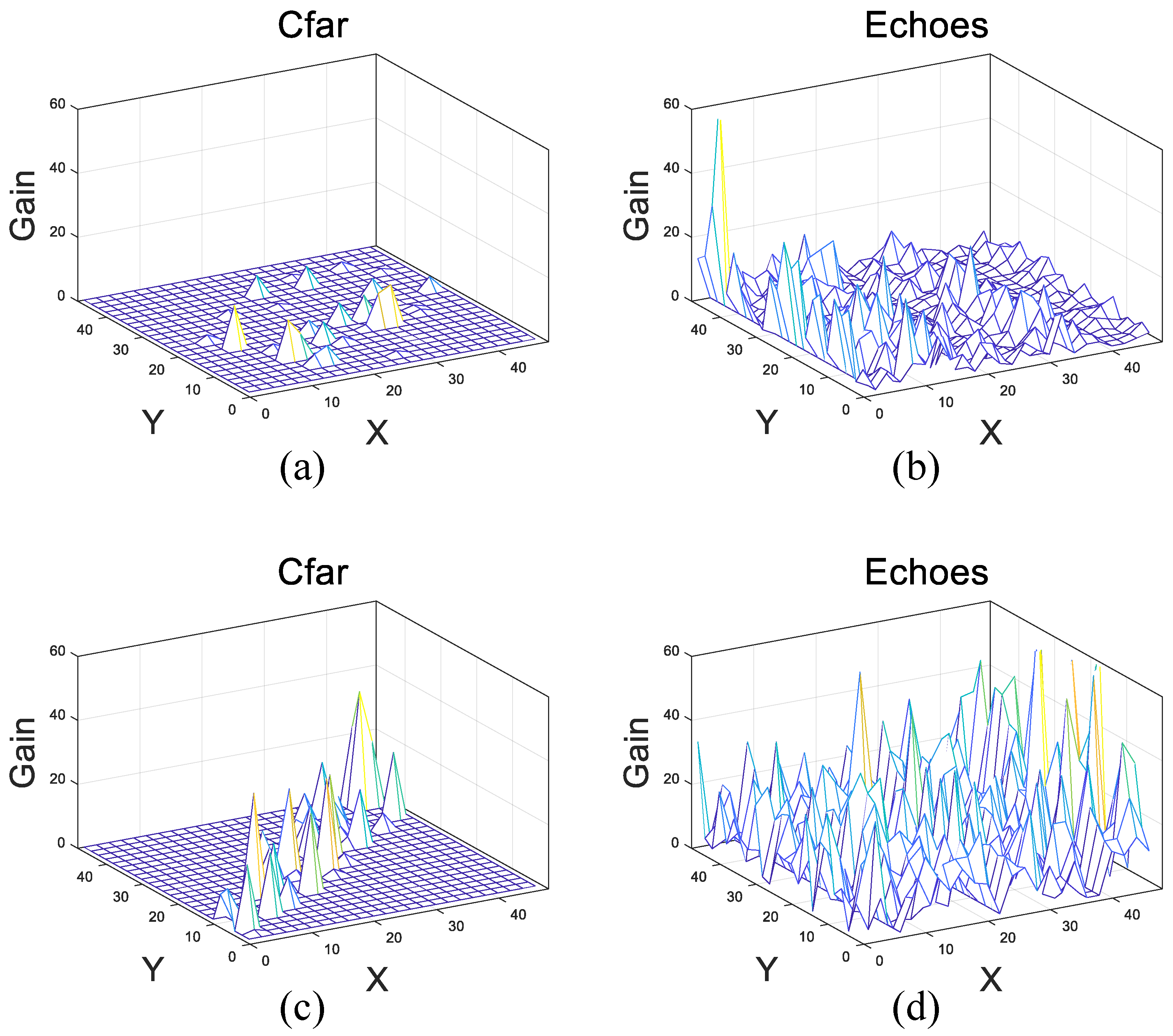
- Perform matched filtering and CA-CFAR detection on the radar echo data to obtain a frame of radar point cloud data, including the detected target point positions and and their echo intensities.
- Use the Density-Based Spatial Clustering of Applications with Noise (DBSCAN) algorithm described in [11] to cluster and merge the target points into clusters. The specific steps are as follows:
- (a)
- Initialize the distance threshold and the target number threshold .
- (b)
- Randomly select a detected target point, and use this point as the center to search for neighboring target points within a radius of .
- (c)
- If the number of neighboring target points , then the selected target point is considered a core point.
- (d)
- Then, randomly select another target point from the remaining target points and determine whether it is a core point.
- (e)
- Repeat the previous step until all the target points in the current frame have been traversed.
- (f)
- Traverse each core point, search for neighboring core points within the distance threshold Dis, and classify them into the same cluster.
- For each cluster, define the bounding rectangle based on the boundary of its core points. Each cell in the matrix corresponds to a target point within the cluster, with the cell value representing the echo intensity of the corresponding target point in the matched filtering data. The cell values of non-target point positions in the rectangle are set to 0.
- Obtain the center coordinates of each bounding rectangle. In the rectangle, reverse search the corresponding echo intensity in the matched filtering data. Fill the coordinate cells within the bounding rectangle that have a value of 0 with the echo intensity retrieved from the corresponding positions.
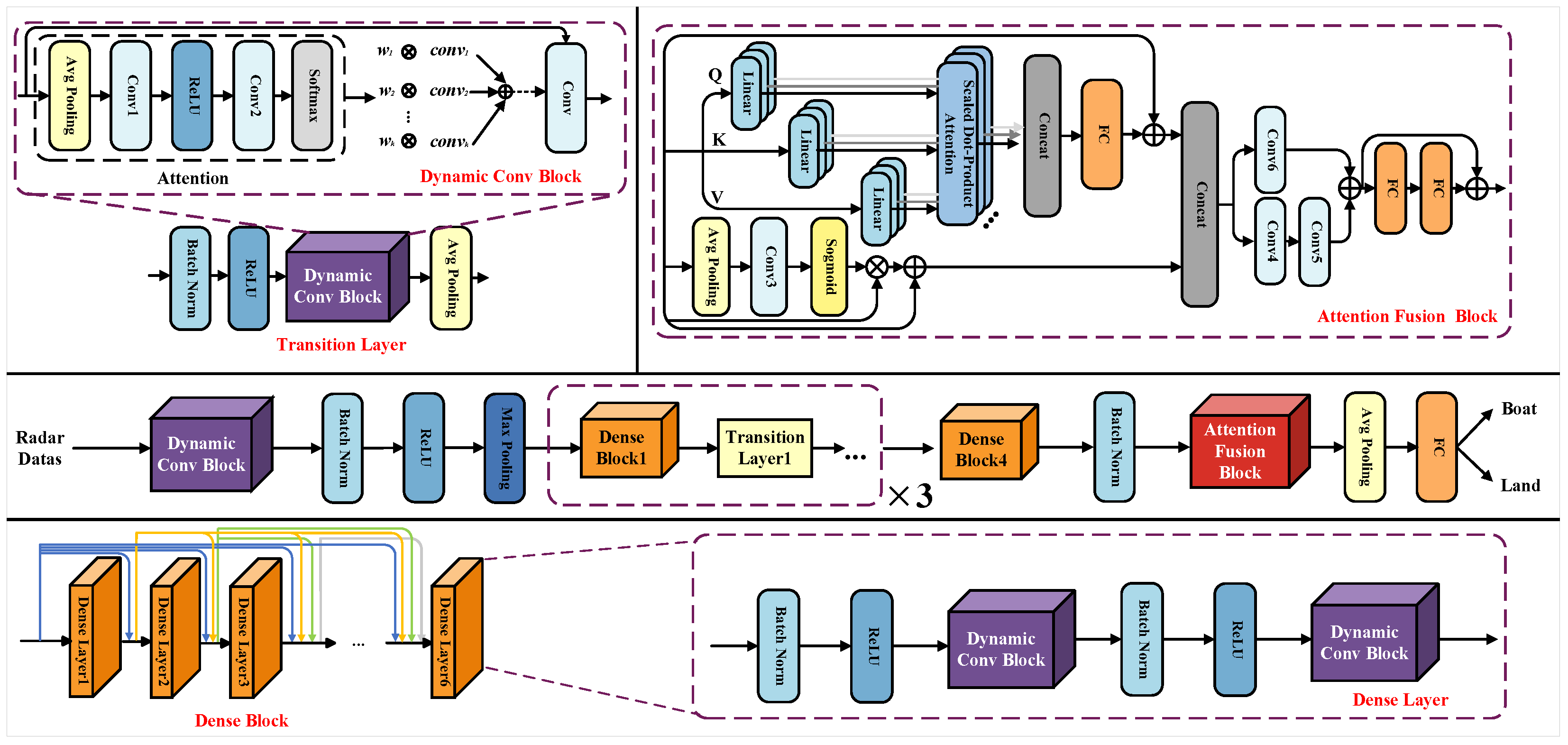
2.2. Dynamic Convolution Module
2.3. Dense Block
2.4. Attention Fusion Block
2.5. Training Loss
3. Experiments and Discussion
3.1. Comparison Methods and Evaluation Metrics
3.2. Performance Analysis
4. Conclusions
Author Contributions
Funding
Data Availability Statement
Acknowledgments
Conflicts of Interest
References
- Wang, X.; Wang, Y.; Zang, C.; Chen, X.; Ren, H.; Cui, G. Intelligent Maritime Radar Target Detection With Partial Annotation via Progressive Learning. IEEE Sens. J. 2024, 24, 34987–34998. [Google Scholar] [CrossRef]
- Chen, X.; Su, N.; Huang, Y.; Guan, J. False-Alarm-Controllable Radar Detection for Marine Target Based on Multi Features Fusion via CNNs. IEEE Sens. J. 2021, 21, 9099–9111. [Google Scholar] [CrossRef]
- Xue, J.; Fan, Z.; Xu, S. Adaptive Coherent Detection for Maritime Radar Range-Spread Targets in Correlated Heavy-Tailed Sea Clutter With Lognormal Texture. IEEE Geosci. Remote Sens. Lett. 2024, 21, 3505805. [Google Scholar] [CrossRef]
- Li, S.; Yang, X.; Wang, J. Sea Surface Object Detection Based on Background Dynamic Perception and Cross-Layer Semantic Interaction. In Proceedings of the 2023 IEEE International Conference on Multimedia and Expo (ICME), Brisbane, QLD, Australia, 10–14 July 2023; pp. 72–77. [Google Scholar] [CrossRef]
- Wang, J.; Li, S. Maritime Radar Target Detection Model Self-Evolution Based on Semisupervised Learning. IEEE Trans. Geosci. Remote Sens. 2024, 62, 5101011. [Google Scholar] [CrossRef]
- Wan, H.; Tian, X.; Liang, J.; Shen, X. Sequence-Feature Detection of Small Targets in Sea Clutter Based on Bi-LSTM. IEEE Trans. Geosci. Remote Sens. 2022, 60, 4208811. [Google Scholar] [CrossRef]
- Su, N.; Chen, X.; Guan, J.; Huang, Y.; Wang, X.; Xue, Y. Radar Maritime Target Detection via Spatial–Temporal Feature Attention Graph Convolutional Network. IEEE Trans. Geosci. Remote Sens. 2024, 62, 5102615. [Google Scholar] [CrossRef]
- Zhao, W.; Jin, M.; Cui, G.; Wang, Y. Eigenvalues-Based Detector Design for Radar Small Floating Target Detection in Sea Clutter. IEEE Geosci. Remote Sens. Lett. 2022, 19, 3509105. [Google Scholar] [CrossRef]
- Zhang, J.; Ding, T.; Zhang, L. Longtime Coherent Integration Algorithm for High-Speed Maneuvering Target Detection Using Space-Based Bistatic Radar. IEEE Trans. Geosci. Remote Sens. 2022, 60, 5100216. [Google Scholar] [CrossRef]
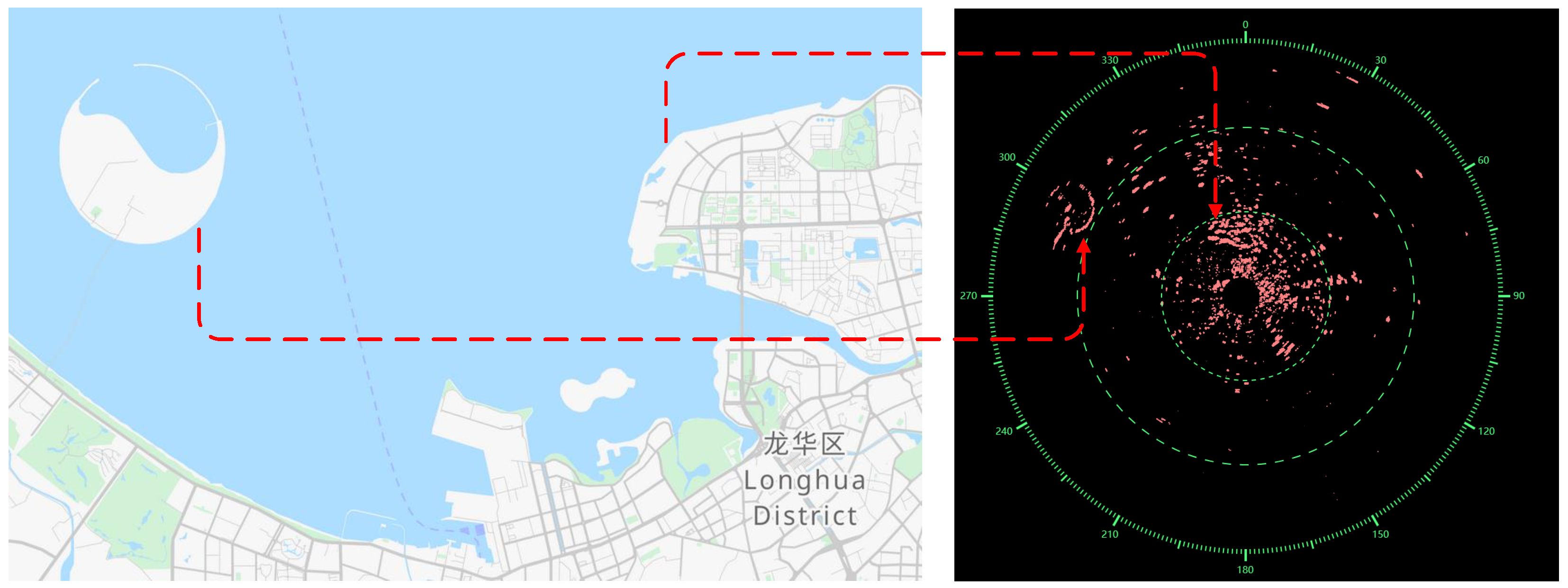
- OpenStreetMap. Available online: https://www.openstreetmap.org (accessed on 29 July 2025).
- Cheng, D.; Zhang, C.; Li, Y.; Xia, S.; Wang, G.; Huang, J.; Zhang, S.; Xie, J. GB-DBSCAN: A fast granular-ball based DBSCAN clustering algorithm. Inf. Sci. 2024, 674, 120731. [Google Scholar] [CrossRef]
- Guo, P.; Liu, Z.; Wang, J. Radar group target recognition based on HRRPs and weighted mean shift clustering. J. Syst. Eng. Electron. 2020, 31, 1152–1159. [Google Scholar] [CrossRef]
- Guo, Z.; Liu, H.; Pang, L.; Fang, L.; Dou, W. DBSCAN-based point cloud extraction for Tomographic synthetic aperture radar (TomoSAR) three-dimensional (3D) building reconstruction. Int. J. Remote Sens. 2021, 42, 2327–2349. [Google Scholar] [CrossRef]
- Li, J.; Cheng, X.; Wu, Z.; Guo, W. An Over-Segmentation-Based Uphill Clustering Method for Individual Trees Extraction in Urban Street Areas From MLS Data. IEEE J. Sel. Top. Appl. Earth Obs. Remote Sens. 2021, 14, 2206–2221. [Google Scholar] [CrossRef]
- Zhou, M.; Ma, L.; Wang, N.; Yang, Y.; Sun, J. Land-sea separation algorithm based on phase correlation for marine surveillance radar. In Proceedings of the 2019 IEEE International Conference on Signal, Information and Data Processing (ICSIDP), Chongqing, China, 11–13 December 2019; pp. 1–4. [Google Scholar] [CrossRef]
- Xu, S.; Bai, X.; Ren, Q.; Li, D. Sea–Land Segmentation Algorithm Based on Multiframe Radar Echoes. IEEE Trans. Geosci. Remote Sens. 2023, 61, 5110310. [Google Scholar] [CrossRef]
- Shui, P.L.; Xia, X.Y.; Zhang, Y.S. Sea–Land Segmentation in Maritime Surveillance Radars via K-Nearest Neighbor Classifier. IEEE Trans. Aerosp. Electron. Syst. 2020, 56, 3854–3867. [Google Scholar] [CrossRef]
- Zhu, R.; Zhang, T.; Li, J.; Wei, F.; Yu, W. A Network for Merging SAR Image Sea-Land Segmentation and Coastline Detection Tasks. IEEE Geosci. Remote Sens. Lett. 2024, 21, 4017305. [Google Scholar] [CrossRef]
- Li, K.; Shan, T.; Zhang, Y. Sea-Land Clutter Segmentation Algorithm Based on Multi-measure Fusion with SVM Classifier. In Proceedings of the 2021 13th International Conference on Communication Software and Networks (ICCSN), Chongqing, China, 4–7 June 2021; pp. 94–98. [Google Scholar] [CrossRef]
- Garcia, F.D.A.; Rodriguez, A.C.F.; Fraidenraich, G.; Filho, J.C.S.S. CA-CFAR Detection Performance in Homogeneous Weibull Clutter. IEEE Geosci. Remote Sens. Lett. 2019, 16, 887–891. [Google Scholar] [CrossRef]




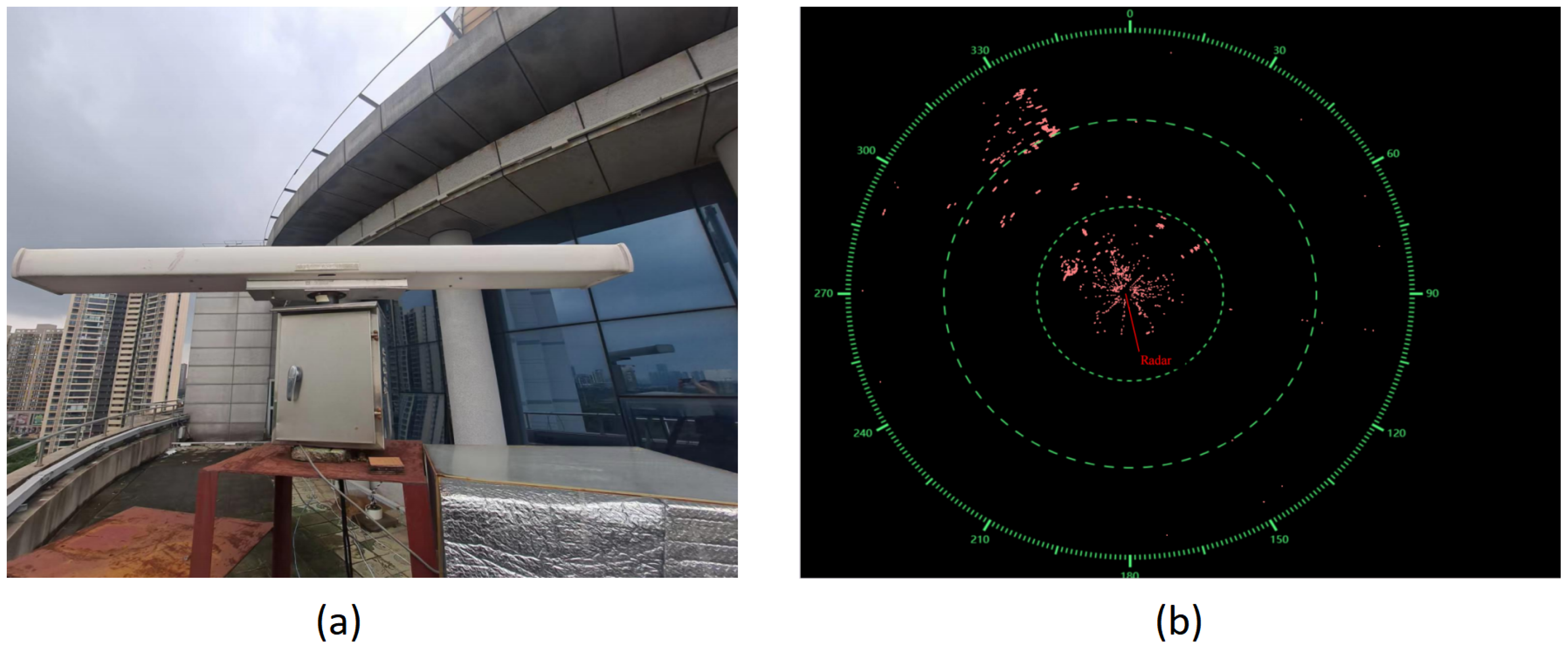
| Parameter | Frequency Range | Pulse Width | Antena Speed | Antena Length | Antena Mode | Polarization | Horizontal Beam Width | Vertical Beam Width |
|---|---|---|---|---|---|---|---|---|
| Value | 9.38–9.44 GHz | 4 s | 24 rpm | 2 m | Spin | HH |
| Subset | Observation Periods | Number of Land Samples | Number of Vessel Samples | Number of Total Samples | Weather | |
|---|---|---|---|---|---|---|
| Training Set | D1 | 84 | 3650 | 3187 | 6837 | Sunny |
| D2 | 438 | 24,143 | 21,524 | 45,667 | Sunny | |
| Test Set | D1 | 230 | 9290 | 16,387 | 25,677 | Rainy |
| D2 | 277 | 16,787 | 10,720 | 27,507 | Sunny |
| Index | Model Variant | Accuracy | |||
|---|---|---|---|---|---|
| Unfilled | Filled | ||||
| D1 | D2 | D1 | D2 | ||
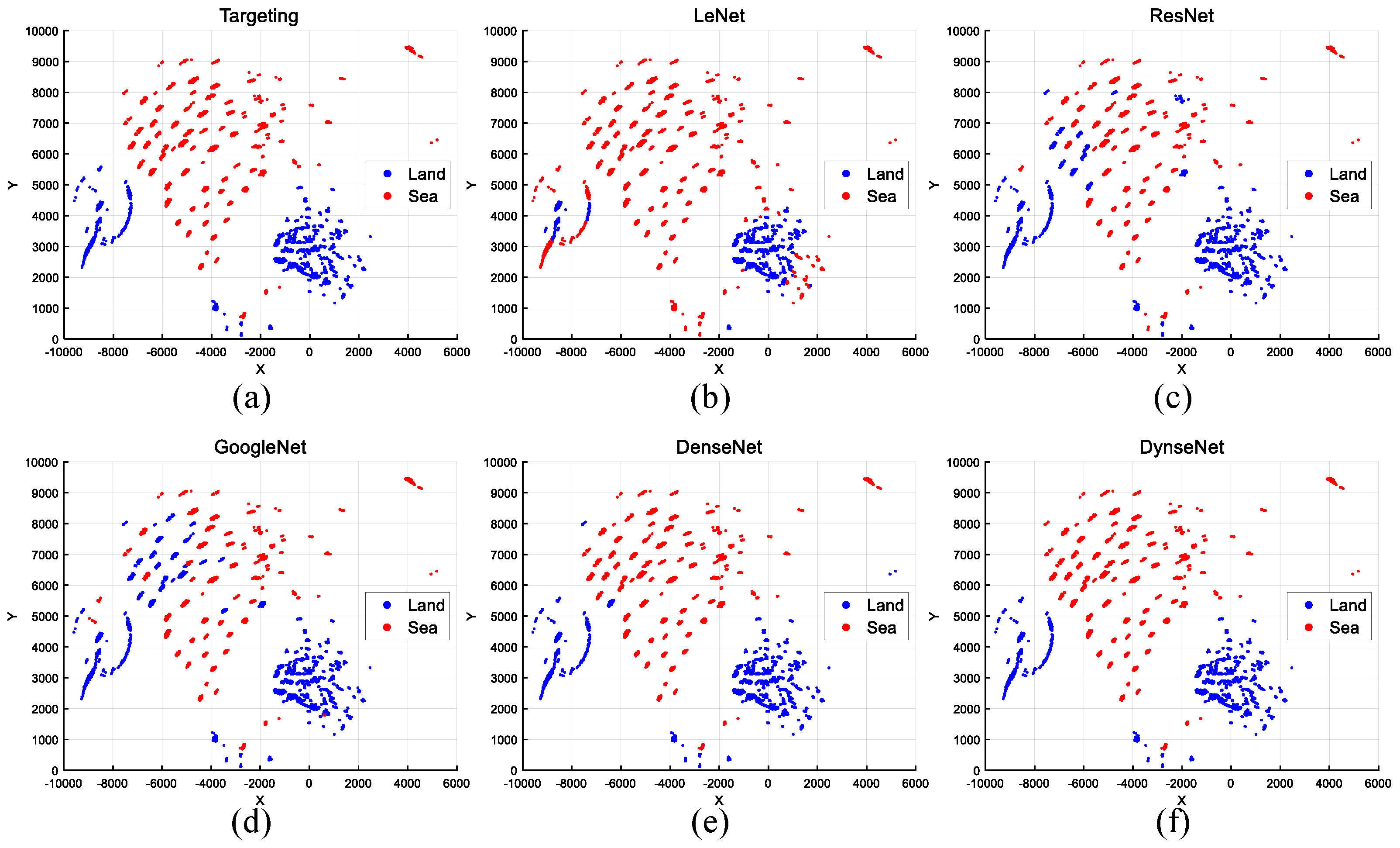
| #1 | LeNet | 0.6321 | 0.6384 | 0.7420 | 0.8738 |
| #2 | ResNet | 0.8672 | 0.7984 | 0.8968 | 0.9545 |
| #3 | GoogleNet | 0.8934 | 0.8068 | 0.9332 | 0.9555 |
| #4 | DenseNet | 0.8949 | 0.8268 | 0.9476 | 0.9636 |
| #5 | DynseNet | 0.9067 | 0.8316 | 0.9636 | 0.9757 |
Disclaimer/Publisher’s Note: The statements, opinions and data contained in all publications are solely those of the individual author(s) and contributor(s) and not of MDPI and/or the editor(s). MDPI and/or the editor(s) disclaim responsibility for any injury to people or property resulting from any ideas, methods, instructions or products referred to in the content. |
© 2025 by the authors. Licensee MDPI, Basel, Switzerland. This article is an open access article distributed under the terms and conditions of the Creative Commons Attribution (CC BY) license (https://creativecommons.org/licenses/by/4.0/).
Share and Cite
Wang, J.; Xiao, T.; Chen, K.; Liu, P. DynseNet: A Dynamic Dense-Connection Neural Network for Land–Sea Classification of Radar Targets. Appl. Sci. 2025, 15, 8703. https://doi.org/10.3390/app15158703
Wang J, Xiao T, Chen K, Liu P. DynseNet: A Dynamic Dense-Connection Neural Network for Land–Sea Classification of Radar Targets. Applied Sciences. 2025; 15(15):8703. https://doi.org/10.3390/app15158703
Chicago/Turabian StyleWang, Jingang, Tong Xiao, Kang Chen, and Peng Liu. 2025. "DynseNet: A Dynamic Dense-Connection Neural Network for Land–Sea Classification of Radar Targets" Applied Sciences 15, no. 15: 8703. https://doi.org/10.3390/app15158703
APA StyleWang, J., Xiao, T., Chen, K., & Liu, P. (2025). DynseNet: A Dynamic Dense-Connection Neural Network for Land–Sea Classification of Radar Targets. Applied Sciences, 15(15), 8703. https://doi.org/10.3390/app15158703