Article

Alluvial Fan Fringe Reservoir Architecture Anatomy—A Case Study of the X4-X5 Section of the Xihepu Formation in the Kekeya Oilfield
School of Geosciences, Yangtze University, Wuhan 430102, China
*
Author to whom correspondence should be addressed.
Appl. Sci. 2025, 15(15), 8547; https://doi.org/10.3390/app15158547
Submission received: 19 May 2025 / Revised: 27 June 2025 / Accepted: 20 July 2025 / Published: 31 July 2025

Abstract

The Kekeya oilfield is located at the southwestern edge of the Tarim Basin, in the southern margin of the Yecheng depression, at the western end of the second structural belt of the northern foothills of the Kunlun Mountains. It is one of the important oil and gas fields in western China, with significant oil and gas resource potential in the X4-X5 section of the Xihepu Formation. This study focuses on the edge of the alluvial fan depositional system, employing various techniques, including core data and well logging data, to precisely characterize the sand body architecture and comprehensively analyze the reservoir architecture in the study area. First, the regional geological background of the area is analyzed, clarifying the sedimentary environment and evolutionary process of the Xihepu Formation. Based on the sedimentary environment and microfacies classification, the sedimentary features of the region are revealed. On this basis, using reservoir architecture element analysis, the interfaces of the reservoir architecture are finely subdivided. The spatial distribution characteristics of the planar architecture are discussed, and the spatial distribution and internal architecture of individual sand body units are analyzed. The study focuses on the spatial combination of microfacies units along the profile and their internal distribution patterns. Additionally, a quantitative analysis of the sizes of various types of sand bodies is conducted, constructing the sedimentary model for the region and revealing the control mechanisms of different sedimentary architectures on reservoir properties and oil and gas accumulation patterns. This study pioneers a quantitative model for alluvial fan fringe in gentle-slope basins, featuring the following: (1) lobe width-thickness ratios (avg. 128), (2) four base-level-sensitive boundary markers, and (3) a retrogradational stacking mechanism. The findings directly inform reservoir development in analogous arid-climate systems. This research not only provides a scientific basis for the exploration and development of the Kekeya oilfield but also serves as an important reference for reservoir architecture studies in similar geological contexts.

1. Introduction

Alluvial fans are fan-shaped accumulations formed when rivers (or floods) lose lateral constraint after exiting mountain ranges, leading to a decrease in flow velocity and the deposition of a large amount of material [1,2,3]. These are high-energy environment deposits. Previous studies, based on climate classification, have identified two types of alluvial fans: humid and arid [4,5,6,7]. According to sediment transport mechanisms, alluvial fans can be further categorized into three types: debris flow-dominated, meandering river-dominated, and braided river-dominated fans [8,9]. Compared to other types of land-based clastic deposits [10,11], alluvial fans exhibit more complex internal structures. Zhang Yiji, in his study of the Triassic modern alluvial fan in Karamay, subdivided the internal structure into three subfacies: fan root, fan middle, and fan edge, in a downstream direction. The sedimentary mechanisms and characteristics of these three areas vary significantly [12,13]. The fan root has both debris flow and traction flow sedimentary mechanisms, while the fan middle and fan edge are primarily dominated by traction flow [14,15]. The reservoir architecture in different subfacies of the alluvial fan is highly complex. Wu Shenghe and others made a more detailed subdivision, dividing the fan root into three architectural elements: channel flow zone, sheet flow zone, and overbank flow zone. The fan middle was divided into a braided flow zone and an overbank flow zone, while the fan edge was divided into a runoff zone and an overbank flow zone [8,16,17]. With continuous research on the complex architecture of alluvial fans, scholars have recognized significant differences in the architecture of different types of alluvial fans. However, due to the influence of multiple factors on sedimentary mechanisms and processes, the reservoir quality characteristics of alluvial fans vary, leading to the concept of “thousand fans, thousand faces” [18]. Therefore, establishing a highly generalized model with universal applicability is challenging, and it is necessary to conduct specific studies on the target fan architecture in the study area, considering its actual geological background. While building on Wu Shenghe’s framework, our work advances three key innovations: (1) Quantitative scaling relationships for arid-climate alluvial fan fringes (Section 4.4), (2) Evidence of base-level control on lobe connectivity (Section 4.2), and (3) Operational criteria for boundary identification (Section 3.3). These contributions address the “thousand fans” paradox by providing measurable parameters for gentle-slope systems.
The Kekeya oil and gas field represents one of the early discoveries in the Tarim Basin, featuring a structurally controlled stratified hydrocarbon reservoir with primary production from the Neogene Xihepu Formation and Paleogene Kalatar Formation [19,20,21]. However, the field’s complex geological setting has posed significant challenges in identifying high-quality remaining hydrocarbon-rich zones within its main producing intervals. Initial reservoir characterization efforts treated the target formation as a single connected sand body system, constrained by limited understanding of sedimentary distribution patterns at the well-group scale. This simplified approach has become increasingly inconsistent with accumulated production data, while current challenges of low formation pressure further necessitate refined reservoir characterization for development optimization.
The complex architecture of fluvial sand bodies in this setting results from multiple controlling factors, including sediment source variations, topographic influences, and climatic conditions. These sand bodies exhibit characteristic lateral channel migration and vertical stacking patterns that create significant heterogeneity in spatial distribution and connectivity. Modern characterization approaches integrate multiple techniques: (1) analog studies from modern depositional systems, (2) core-log-production data synthesis, (3) seismic inversion methods, and (4) 3D geological modeling [22,23,24,25].
This study specifically targets the X4 and X5 members of the Xihepu Formation, employing integrated core, log, and production data analysis to: (1) characterize alluvial fan fringe reservoir architectures, (2) establish detailed single sand body correlations, and (3) clarify both lateral distribution patterns and vertical stacking relationships. The results provide critical insights for ongoing field development and production optimization strategies.

2. Geological Setting

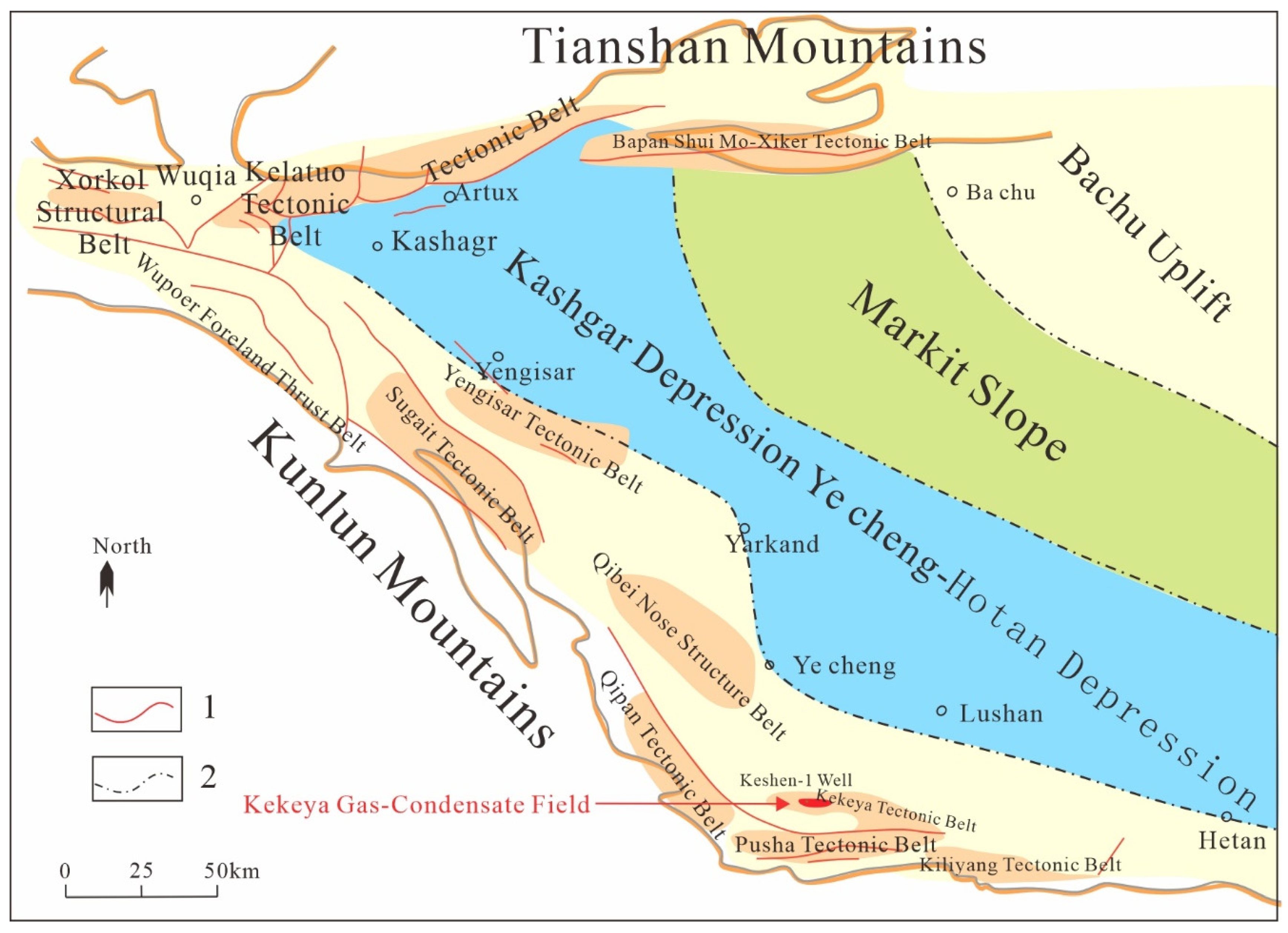
The study block, the Kekeya condensate gas field, is located at the western end of the second tectonic belt on the southern edge of the Yecheng depression in the southwest of the Tarim Basin, at the northern foot of the Kunlun Mountains. It belongs to the Kekeya fold belt and is administratively located within Yecheng County, Xinjiang Uygur Autonomous Region, approximately 50 km south of Yecheng County [26,27] (Figure 1).
The main area of the Kekeya condensate gas field features a relatively simple terrain, consisting of a Gobi plain with an elevation ranging from 1830 to 1890 m. To the south, there are sand dunes, and the region experiences a typical continental arid climate. To the west, the structure connects to an anticline with a chessboard-like nose, while to the east, it gradually rises, narrows, and is thrust-covered by the Fushakriyong tectonic belt. The structure is a short-axis anticline, with a slightly steeper northern wing and a slightly gentler southern wing, nearly symmetrical in shape. Except for the outcropping Tertiary strata in the axial part, the surface is mostly covered by Quaternary strata. The Kekeya structure has undergone tectonic movements during the late Hercynian, Indosinian, and Yanshan periods. The structural prototype began to take shape in the late Miocene Kiziloy period and early Anjuan period. The late Pliocene to Quaternary was the formation and large-scale development period of the anticline trap, and from the late Oligocene to the late Miocene, the Kekeya area continued to rise and become structurally defined [28,29].
The Kekeya structure was discovered in 1956, and drilling began on 1 May 1976. On 17 May 1977, Well Kekeya−1 produced a high-yield oil and gas flow, leading to the discovery of the Kekeya condensate gas field. As of 17 May 2022, the Kekeya condensate gas field has cumulatively produced 5.188 million tons of crude oil and 12.41 billion cubic meters of natural gas, with an oil and gas equivalent of 15.07 million tons.
In the reservoir of the study area, the primary types of reservoir space are primary porosity, secondary porosity, and microfractures. The porosity types are mainly intergranular porosity and intragranular porosity, with good connectivity. The average permeability is 19.4 × 10⁻³ μm2, classifying it as a low-to-medium permeability reservoir. The distribution of the reservoir is uneven in the plane, controlled by sedimentary facies and lithology, with better connectivity in the north-south direction and poorer connectivity in the east-west direction. The study area developed thick layers of continental clastic rocks, with the Miocene to Pliocene clastic deposits gradually becoming coarser, indicating a tectonic uplift of the basin’s source area. The sediment thickness of the Miocene Xihepu Formation reflects the area’s rapid subsidence rate and abundant sediment supply, indicative of its paleogeographic characteristics. There are significant lithological differences between the study area and the central depression, mainly characterized by the absence of thick gravel facies, and instead, red fine sandstones, siltstones, and sandstone mudstones dominate. Medium− to coarse-grained sandstones and gravels appear only as interlayers. The sedimentary characteristics suggest that during the deposition of the Miocene, the depositional water energy in the area was relatively weak [30,31,32,33].
Currently, due to the long-term depletion-style development of the oil and gas field, formation pressure has decreased, resulting in a decline in production capacity, which poses significant challenges for subsequent development. Early on, due to insufficient production data, there was a lack of understanding regarding the distribution characteristics of the sand bodies and the reservoir’s extent. The target formation in the study area was treated as a uniformly connected reservoir sand body for research, without focusing on characterization at the wellbore or well group level. As production data has continuously been updated, discrepancies with earlier understandings have become more evident. Additionally, with the issue of decreasing formation pressure, both development planning and potential tapping require a strengthened re-evaluation and characterization of the reservoir sand bodies.

3. Materials and Methods

In sedimentary geology research, a detailed description of sedimentary features is the foundation for accurately dissecting reservoir architecture and understanding hydrocarbon enrichment patterns. In an alluvial fan system, the depositional environment and microfacies characteristics jointly determine the distribution of reservoirs, their petrophysical properties, and the distribution patterns of hydrocarbons. The X4-X5 sections of the West River Group in the Kekeya oilfield are located in a typical alluvial fan system, exhibiting significant variations in depositional facies belts and complex sand body distribution. To fully understand the sedimentary processes in this area, an in-depth analysis of the depositional environment and microfacies characteristics is crucial for revealing the reservoir heterogeneity and hydrocarbon enrichment patterns. To achieve this, we first analyzed core and well-log data to classify sedimentary microfacies and then applied architectural element analysis to delineate interfaces [34,35,36,37].

3.1. Sedimentary Environment Analysis

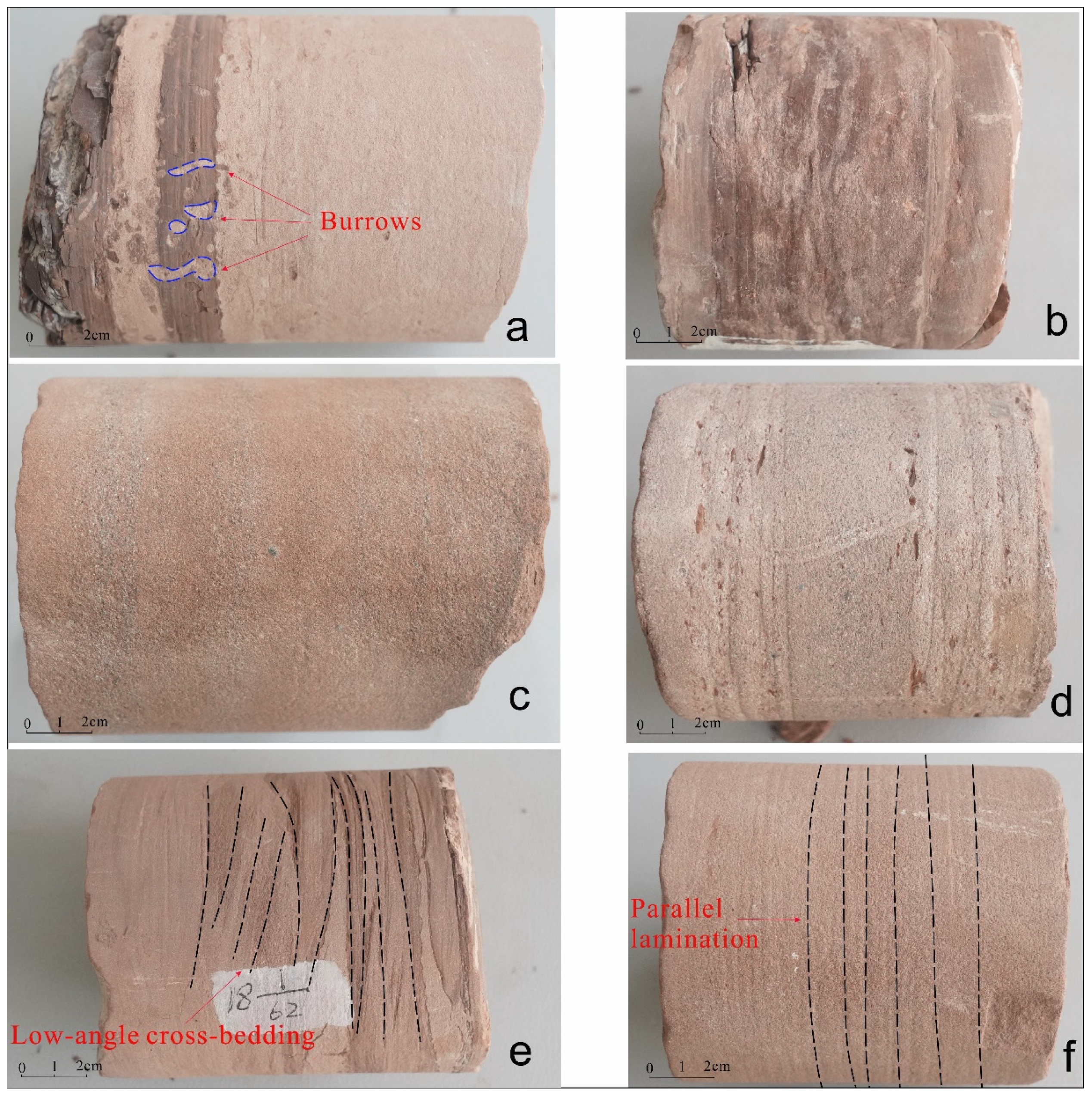
In terms of biological activity, the core samples from the X51-X42 layers lack both biotic and trace fossils, indicating that the sedimentary environment of these two layers belongs to a terrestrial setting. In contrast, the X41 layer core contains numerous burrows, with vertical and oblique holes distributed chaotically. These are frequently developed in the mudstone section, suggesting that this layer was deposited in a short-lived aquatic environment, specifically in a shallow water area on the fan edge. The sedimentation process of this layer is controlled by flood events (Figure 2a).
The sediment color mainly consists of brownish-red and reddish-brown, indicating a high content of iron oxides or hydroxides, which confirms that the sedimentary medium was oxidizing or under strongly oxidizing conditions. Red sediments are typically found in terrestrial or coastal transition sediments under hot and humid climatic conditions, and the color of the sediment is a typical feature of exposed sediment (Figure 2b). Regarding sediment grain size, fine sandstone and siltstone are dominant, with coarse sandstone being rare. Large, angular to subrounded mud clasts can be observed at the bottom and middle of the thin sandstone layers, indicating that the sediment is fine-grained and derived from distant sources. These characteristics are typical of fan-edge deposits (Figure 2c,d). Sedimentary structures include low-angle to near-horizontal cross-bedding and ripple lamination in the sandstone-siltstone section, suggesting a lack of large river deposits during the sedimentation process. In the mudstone-conglomerate section, blocky and graded bedding are dominant, with individual mudstone-conglomerate layers generally less than 30 cm thick, indicating the presence of minor shallow channels in the strata (Figure 2e,f). The rhythmical features of the sand bodies are primarily anti-rhythmic and homogenously rhythmic, which suggests that the sedimentary environment was not underwater but was the product of progradational body deposition.
The X4 section is primarily composed of fine sandstone, with lithology consisting of thick to very thick layers of light brown, light brownish-yellow muddy sandstone, siltstone, fine sandstone, brown sandy mudstone, and mudstone. The division of this section is based on the 25m thick noticeable cap layer at the top, with multiple sand lithologic and electrical cyclic characteristics below. The sorting and rounding are good, with high compositional maturity and structural layer maturity. The bedding is well-developed, primarily parallel bedding and inclined bedding, with the sandstone layers generally thin at the top and thicker at the bottom. There is strong heterogeneity. The interbedded fine sandstone, muddy siltstone, and sandy mudstone are characteristic of fan-edge deposits in alluvial fan systems. The natural gamma ray curve exhibits box-shaped, funnel-shaped, and bell-shaped composite rhythmic sedimentation with both positive and negative rhythms.
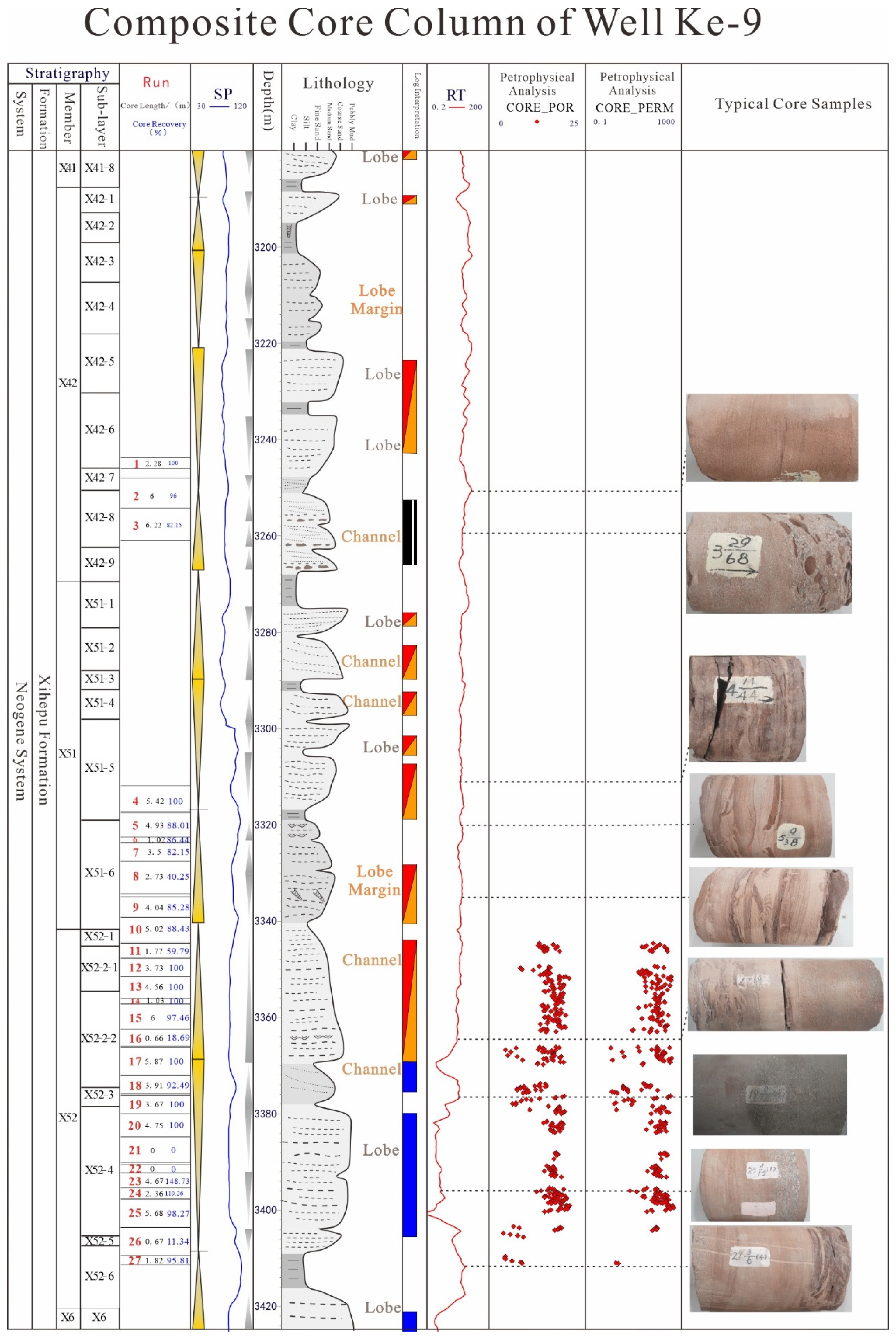
The X5 section is mainly composed of thick, homogeneous sand bodies, with lithology consisting of thick layers of brownish-brown and brown fine sandstone, siltstone, muddy siltstone, gray-green conglomerate, and medium-thick layers of brown sandy mudstone interbedded with thin mudstone layers. The division of this section is based on the 20-m-thick cap layer at the top. The section primarily consists of fine sandstone, with good sorting and rounding and high compositional and structural maturity. Bedding is well-developed, with parallel bedding and inclined bedding as the main types, and the thickness is greater, with weaker heterogeneity. This section is divided into two cycles. Within each cycle, the sedimentary rhythm changes from fine sandstone to medium sandstone or fine sandstone to coarse sandstone, with a gradual increase in grain size, and the gamma curve predominantly shows a bell-shaped, a funnel-shaped, or a combination of both, with both positive and negative rhythms present (Figure 3).
In summary, the strata in the study area are rich in sandstone, mudstone, and siltstone, with predominant brownish-brown and reddish-brown transitional lithologic sedimentation. The sediment grain size is relatively fine, with good sorting, and the bedding types mainly include massive bedding and parallel bedding. These features are typical lithologic markers of fan-edge deposits in an alluvial fan system. Therefore, the sedimentary facies in the study area are classified as the fan edge of an alluvial fan.

3.2. Sedimentary Microfacies Classification

Based on the analysis of stratigraphic litho-electric combinations, sedimentary cycles, and sedimentary structures, the sedimentary facies of the study area are divided into three microfacies. The main microfacies types include channel microfacies, lobe microfacies, and lobe edge microfacies. These microfacies have distinctive characteristics in both plan-view and cross-section deposition patterns. The well-log microfacies description is based on core observation and research, where the responses of different sedimentary microfacies are analyzed using natural gamma (GR) and spontaneous potential (SP) curves. The natural gamma curve in the study area shows a high correspondence with lithology. By analyzing factors such as curve shape, amplitude, and smoothness, the response characteristics of different microfacies in the study area are identified (Table 1).

3.2.1. Channel Microfacies

The lithology is mainly brown siltstone and fine sandstone, characterized by massive bedding and parallel bedding. The grain size of the sandstone gradually becomes finer from bottom to top within the sand body. The well log response of this microfacies is mainly characterized by low natural potential (SP: 75–90 mV), low gamma ray (GR: 50–80 API), low resistivity, and high sonic travel time (AC: 70–85 μs/ft). The well log curve is typically box-shaped, with numerous serrated features, and the curve shape is relatively regular. There is a trend of increasing amplitude toward the direction of the sediment source.

3.2.2. Lobe Microfacies

The lithology is primarily brownish mudstone-rich siltstone and siltstone. The grain size of the sandstone gradually fines upward. The composition and structural maturity of the sandstone are moderate. The well log characteristics of this microfacies are characterized by moderate natural potential (SP: 20–60 mV), intermediate gamma ray (GR: 45–70 API), low resistivity, and intermediate sonic travel time (AC: 60–70 μs/ft). The well log curve shapes are primarily finger-like or bell-shaped, with amplitudes generally smaller than those of the braided channel microfacies.

3.2.3. Outer Lobe Microfacies

The log curve of this microfacies is characterized by intermediate natural potential (SP: 40–55 mV), high gamma ray (GR: 60–70 API), low resistivity, and variable sonic travel time (AC: 60–75 μs/ft). The log curve morphology is predominantly finger-like or bell-shaped, with amplitudes generally smaller than those of the lobe margin. The curve shapes are irregular, including funnel, diamond, and bell shapes. The thickness is relatively thin, with small amplitude fluctuations, and both positive and negative cycles are present (Table 1).

3.3. Architecture Element Boundary Identification Methodology

This study is primarily based on the clastic sedimentary architecture classification scheme proposed by Wu Shenghe et al. [38,39,40] to characterize the architecture of reservoirs in different depositional facies. In their scheme, the 7th to 9th grade architectural units are defined as facies architecture units. In this study, the braided sand body architecture corresponds to the 8th-grade architectural unit, which is surrounded by continuous mudstone barriers or laterally connected sand body edges. The study focuses on characterizing the 8th-grade architectural unit.
After determining the reservoir structure division scheme, the authors conducted a study on the reservoir structure in the research area. The study of reservoir architecture follows the principle of “vertical stratification and lateral boundary delineation.” This means that structural sequence identification is carried out on wells, while sedimentary structure boundaries are determined on the plane. The study of structural sequences in wells is primarily conducted through core wells, followed by establishing the rock-electric response relationship of the structural sequences to guide the division of structural sequences in non-core wells. This study is no different from sedimentary facies research. Lateral boundary delineation, on the other hand, focuses on establishing standards to identify the boundaries of a single lobe, thereby anatomizing the connected sand bodies and delineating the boundaries of individual lobes. The main focus of the reservoir architecture study is to identify lateral boundaries. Through continuous well profiles, boundary identification markers for the continuous well structure were established, creating a set of markers for identifying lobe boundaries.

3.3.1. Sedimentary Facies Change

The appearance of mudstone and lobe edge sedimentation often indicates the presence of boundaries. If mudstone lakes or lobe edge sediments appear on a cross-section, marking a change in sedimentary facies, the lobe boundary is located at the point where the facies change occurs.
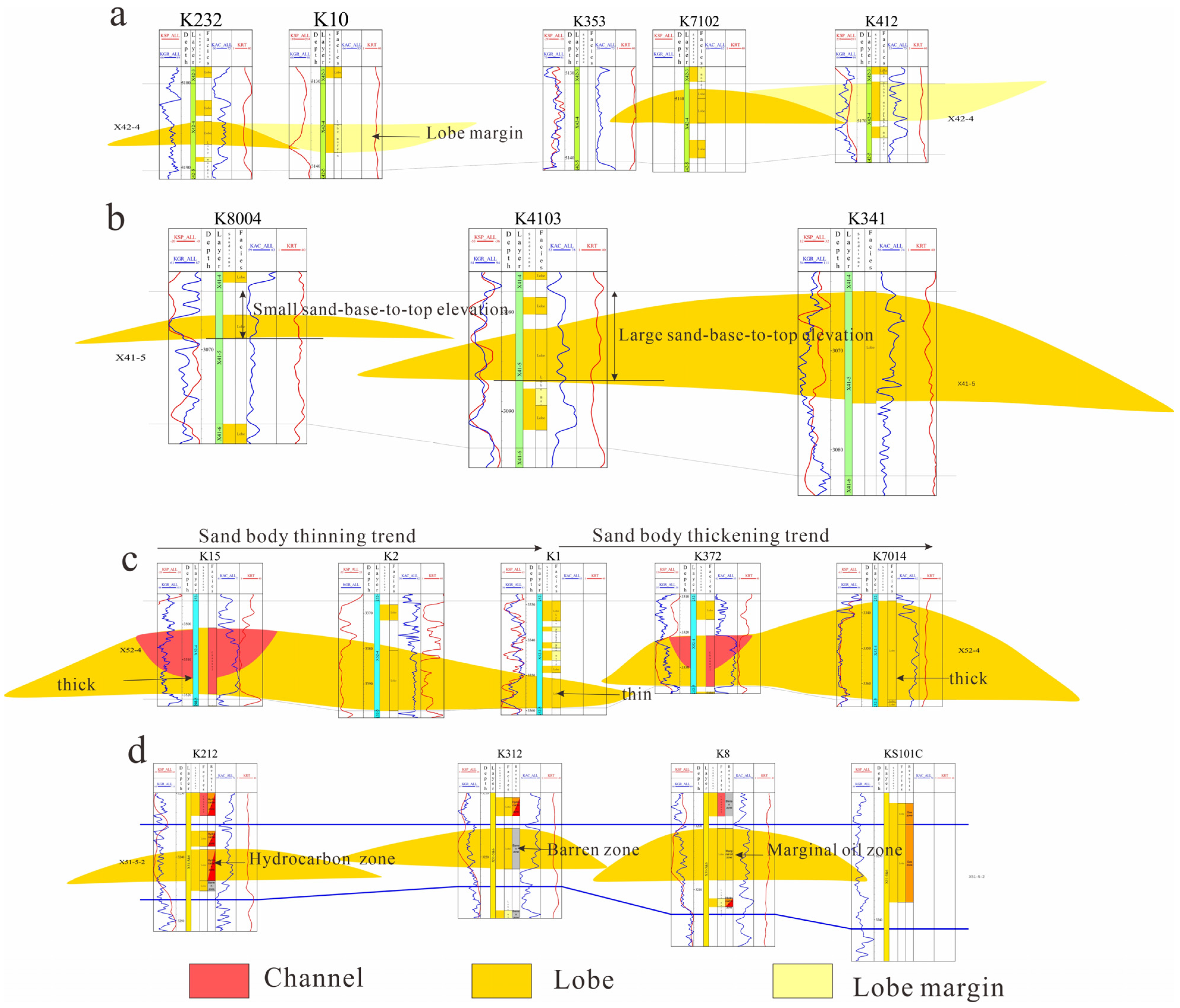
Of course, the same sand body may exhibit bifurcations due to sedimentary topography differences, leading to the appearance of lobe edges or mudstone in the middle. In such cases, it is necessary to make a comprehensive judgment using the planar diagram, sand body trends, and thickness (Figure 4a). For instance, between wells K232 and K7102, mudstone and lobe edge sediments appear, leading to the judgment that they represent different lobes.

3.3.2. Sand Body Base Elevation Difference

The base elevation of a sand body formed by a single lobe of sediment should be consistent. However, different lobes may show elevation differences due to variations in ancient topography and developmental stages. If the base of the sand body is observed at different elevations on a profile, it can be concluded that the sediments belong to different lobes, and the boundary is located between the two wells. As shown in Figure 4b, with the X41−5 formation displayed in a flattened-top state, it can be observed that the elevation difference between the lobe base and the formation top is relatively small in Well K8004, while significantly larger in Well K4103. Therefore, these two sand bodies can be identified as belonging to different lobes, with the boundary located between these two wells.

3.3.3. Sand Body Thickness Variation Trend

In the deposition of a single lobe, the thickness of the sand body is thickest in the center of the lobe, with a tendency to thin towards the edges. Therefore, if there is a situation where the middle is thinner and the edges are thicker, it can be considered as the boundary of lobes from different sedimentation periods. As illustrated in Figure 4c, the lobe thickness exhibits a progressive thinning trend from Well K15 through Well K2 to Well K1, followed by a distinct thickening trend from Well K1 through Well K372 to Well K7014. Collectively, the five wells demonstrate a thick-thin-thick thickness variation pattern laterally, indicating the presence of two distinct lobe complexes. Furthermore, the elevation difference between the sand base and formation top observed between Well K1 and Well K372 (as previously described) provides additional evidence for lobe differentiation. Consequently, the boundary between these two sedimentary lobes is interpreted to lie between Well K1 and Well K372.

3.3.4. Differences in Oil and Gas Content

Generally, sand bodies from the same lobe, after excluding structural differences, will have similar oil and gas content. During development, the characteristics of contemporaneous lobes should also be similar. If two nearby wells reveal significant differences in oil and gas content within their channel sand bodies, it can be concluded that they do not belong to the same lobe sedimentation period. For example, the sand body in well K212 is interpreted as an oil and gas reservoir, while the sand body in well K312 is interpreted as a dry layer, and the sand body in well K8 is interpreted as a poor oil layer. Therefore, a boundary between lobes must exist between these wells, and they are interpreted as different lobes (Figure 4d).
While the four boundary identification markers were established with quantitative criteria and supported by field examples (Figure 4), practical application faces two key constraints. First, subjectivity in ambiguous cases, approximately 12% of lobe boundaries simultaneously satisfy multiple criteria, requiring contextual prioritization. Second, the absence of high-resolution seismic profiles (due to Gobi terrain acquisition challenges) limits lateral continuity validation between wells > 500 m apart, potentially affecting lobe connectivity interpretations. In practice, a comprehensive analysis integrating geological context, dynamic production data, and probabilistic modeling is recommended when encountering complex boundary scenarios.

3.4. Single Sand Body Architectural Classification Methodology

Based on the detailed characterization of the reservoir architecture in both the plane and profile directions in the study area, and referring to previous research on sand body contact styles, two main architecture patterns of single sand bodies in the study area have been summarized: the stacked architecture and the isolated architecture (Table 2).

3.4.1. Contact Architecture Patterns

The stacked architecture refers to the contact relationships of different sand bodies formed during the same time period from different river channels or branches of the same river, or from different periods of lobe formation, in either the horizontal or vertical plane. These sand bodies are in direct contact with each other in space.
(1)
Lateral splicing
In this pattern, lobes from different contemporaneous river channels or different branches of the same river advance and form sand bodies that are laterally spliced. On the plane, this results in large and wide sand bodies where adjacent sand bodies do not cut each other but only make contact at the lobe edges. In cases of subsequent lateral cutting, the laterally formed lobe will cut the earlier lobe.
(2)
Stacking
In this pattern, lobes formed by two different river channels are stacked vertically. The earlier deposited sand bodies are not eroded or scoured by the later ones. The stacking part exhibits poor connectivity, forming thick layers of sand bodies in the vertical direction.
(3)
Overlapping cutting
Lobe-on-Lobe Overlap: The lobe sand bodies formed by two stages of river channel advancement make vertical contact, where the earlier deposited sand body is cut, eroded, and scoured by the later deposited sand body. This type of contact pattern mainly occurs during the early and middle stages of base level rise and the middle and late stages of base level fall. Based on the differences in the vertical cutting locations of the sand bodies, two types of overlap patterns can be identified: lateral overlap and vertical overlap.

3.4.2. Isolated Architecture Mode

(1)
Planar Separation Type
Mud-rich sediments are deposited between the sand bodies formed by different river channels or different branches of the same river channel advancing synchronously, preventing contact between the sand bodies. This type of contact is primarily developed in the distal parts of the river channels in the study area.
(2)
Vertical Isolation Type
Mud-rich sediments are deposited between sand bodies formed by two different river channels, preventing direct contact between them. The sand bodies remain vertically isolated from each other. This contact style mainly forms during the late stages of a rising base level cycle.

4. Architecture Distribution Characteristics

4.1. Planar Architecture Distribution Characteristics

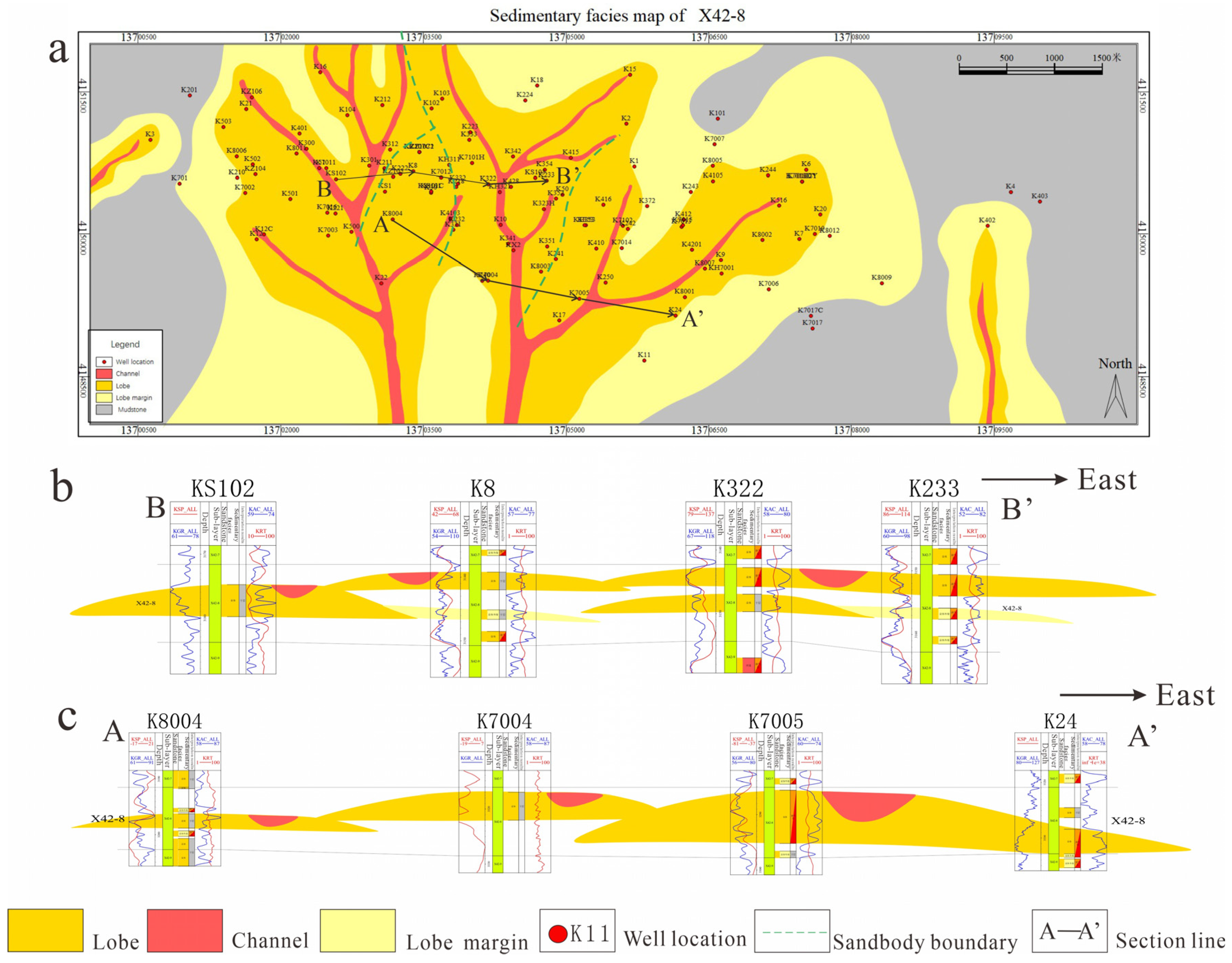
On a plane, based on the previously described architecture interface division method, the planar facies map of the X42-8 sublayer was analyzed (Figure 5a). The alluvial fan in the study area is characterized by lobes formed by different stages of river channel advancement or by different branches of the same main river channel. The river channels in this sublayer are well-developed, and the lobes are widespread, with large areas of lobe edges distributed around the periphery. There are numerous branches of the same river channel, with the main river channel orientation trending from south to north. In terms of scale, the river channels gradually transition from coarse to fine from south to north, and as the distance from the sediment source increases, the river width decreases, consistent with the weakening of hydrodynamic conditions.
The lobes in this sublayer exhibit superposition or lateral juxtaposition at the outer edges, forming a connected pattern in plan view. Lobes are generally separated by their edges, with minimal development of mudstone between sand bodies, forming a “widely connected body.” The main river channels are distant from each other at the proximal area, while in the distal region, where the river network is more intertwined, the distance between channels decreases, leading to the appearance of superposition and lateral juxtaposition between lobes. Based on these characteristics, a comparison profile was constructed in the vertical direction from the sediment source, and the boundaries of the lobes were identified using the four lateral recognition markers. These boundaries were marked on the planar diagram (Figure 5a).
Observation of the proximal Profile AA’ (Figure 5c) reveals that among the traversed channels, the easternmost channel advanced first, with its lobe deposited earliest (exhibiting the smallest elevation difference between the sand body base and the sublayer bottom). This lobe displays relatively larger dimensions. Subsequently, the westernmost channel branch advanced; being a minor distributary, it formed a comparatively smaller lobe. The final deposition occurred along the central main channel, representing the latest advancing branch whose lobe consequently incised the laterally adjacent lobes. The distal Profile BB’ (Figure 5b) demonstrates that the main trunk of the western channel deposited first, followed by the main trunk of the eastern channel, corroborating the depositional sequence observed in Profile AA’. Later-deposited lobes progressively incised earlier ones, exhibiting mutual intercutting relationships. These lobes display sheet-like distribution patterns on the planar view with extensive areal coverage.

4.2. Alluvial Fan Sand Body Sedimentary Evolution

In the early stages of sedimentary evolution (corresponding to the X5 section), the sedimentary system was dominated by alluvial fan deposition at the fan margin. Intense tectonic uplift and flooding caused rapid deposition of material sources. The sediments mainly consist of medium− to coarse-grained sandstones and a small amount of gravel, reflecting the typical depositional features of a flood-dominated alluvial fan. The lithology is characterized by thick, massive sandstones, locally interbedded with mud-conglomerate layers, with sedimentary structures primarily consisting of massive and graded bedding, indicating strong hydrodynamic conditions. The sorting and roundness of the sediments are relatively poor, reflecting the short transport distance and rapid accumulation. In this stage, the sand body is large in scale, widely distributed, and shows strong lateral connectivity, with channel deposits dominating.
As the sedimentary system evolved, the base level began to rise, and material supply gradually weakened. Channel deposits were no longer dominated, and the system transitioned to deposits from braided channels and fan bodies. The middle to late X51 section and the X42 section represent this evolutionary stage. During this period, the sediment grain size gradually decreased, mainly consisting of fine sandstones and siltstones. Sorting and roundness improved, reflecting weakened hydrodynamics and a more stable depositional environment. The lateral continuity of the sedimentary bodies decreased, and channels frequently bifurcated, forming multiple stages of fan body deposition.
The sedimentary structures during this stage are characterized by a positive cycle, with a coarse-to-fine sedimentary rhythm, reflecting the gradual retrogradation of the channel system and the transition from the fan margin to the plain environment. In the sedimentary profiles, fan body deposits alternate with fan body outer edge deposits, intercalated with mudstones, reflecting the periodic scouring and deposition by floods.
In the late stages of the alluvial fan (X4 section), the sedimentary system exhibits typical characteristics of distal fan body and alluvial plain deposition. The base level continued to rise, and sediments gradually migrated further from the source area. The sediment grain size further decreased, mainly consisting of siltstones and mudstones, with local development of small amounts of fine sandstone. The fan bodies became smaller in scale, and their thickness was significantly reduced.
In the late evolutionary stage, sedimentary rhythms became more evident, with positive cycle sequences dominating, showing the gradual outward migration of the fan bodies. Mudstone layers became thicker and more widespread, reflecting a stable depositional environment with weaker hydrodynamics, as the distal alluvial fan gradually transitioned to lake or plain depositional environments. The frequent bifurcation of channels and multiple stages of fan body overlap formed a complex sedimentary architecture, with fan body deposits exhibiting low connectivity and high heterogeneity in space.

4.3. Control Factors of Alluvial Fan Sedimentary Evolution

The evolution of alluvial fan sedimentation is controlled by multiple factors, including tectonic activity, climate conditions, base level changes, and material source supply. These factors work together to determine the supply, distribution, and evolutionary direction of the sedimentary system. In the evolution of the alluvial fan in the Kekeya area, the influence of these factors is particularly evident.

4.3.1. Tectonic Activity

Tectonic activity is one of the core factors controlling the evolution of alluvial fan sedimentary systems. The Kekeya area is located on the southwestern edge of the Tarim Basin, adjacent to the front structural zone of the Kunlun Mountains, where tectonic movements are frequent. The uplift and elevation of the basin’s edge directly impact sediment supply and sedimentation rates. During the early stages of sedimentation, intense tectonic uplift caused the nearby mountains to rapidly rise, providing abundant clastic material. As tectonic activity gradually weakened, sediment supply decreased, and the depositional environment transitioned from the high-energy fan edge environment to the lower-energy plain and fan lobe environments [41].
Fault activity also played a local controlling role in the evolution of the Kekeya alluvial fan. The development and movement of faults affected the distribution of sediments, changing the orientation of river channels and the range of drainage basins. This led to sediment deposition in different tectonic units, creating complex sedimentary patterns.

4.3.2. Climate Conditions

Climate conditions, particularly rainfall and seasonal flooding, are key controlling factors in the sedimentation of alluvial fans. The Kekeya area is characterized by an arid to semi-arid climate, with low annual rainfall but significant seasonal flooding. During the rainy season, frequent floods in the foothill areas transport large amounts of coarse-grained sediments, which rapidly accumulate and form thick layers of sandstone and conglomerates, especially at the fan edge. The intense flushing power of the floods causes rapid sediment deposition [42].
In the mid-late stages of sedimentation, as the climate becomes more arid and the frequency of floods decreases, sediment supply gradually declines. The flushing capacity of floods weakens, leading to a reduction in sediment grain size. The sedimentary system shifts towards the distal regions, ultimately forming finer-grained lobes and mudstone deposits. This climatic change has had a significant impact on the evolution of the alluvial fan sedimentary system, driving changes in sediment grain size and the retrogradational nature of the sedimentary system.

4.3.3. Base-Level Changes

Fluctuations in base level directly influence the depositional patterns and evolutionary processes of alluvial fans. During base-level rise, the depositional system exhibits a retrogradational trend, with sediment transport shifting toward more distal areas. This results in a reduction in sand body thickness and a gradual fining of sediment grain size, ultimately evolving into lobe and alluvial plain deposits. The cyclic nature of base-level rise is particularly evident in the sedimentary evolution of the Kekeya region, reflecting a transition from coarse-grained channel deposits to fine-grained mud-rich deposits.
Base-level changes not only affect the spatial distribution of sediments but also control the accumulation rate of the depositional system. During base-level rise, sediment accumulation rates tend to be relatively low, leading to finer and more homogeneous deposits. Conversely, base-level fall is characterized by the rapid deposition of coarse-grained sediments, indicative of a high-energy depositional environment [43].

4.3.4. Sediment Supply

Sediment supply is a fundamental controlling factor in alluvial fan deposition. In the Kekeya region, the primary sediment source originates from the weathering and erosion of the southern Kunlun Mountain foreland highlands. Intense tectonic uplift has resulted in rapid erosion and sediment transport, particularly during the early depositional stage when an abundant sediment supply facilitated the deposition of medium− to coarse-grained sandstone and conglomerate. Well-developed channel deposits formed thick sandstone and conglomerate layers during this period.
As time progressed, sediment supply gradually decreased, leading to a reduction in grain size and an expansion of the depositional environment toward more distal areas. In the middle to late stages of deposition, the diminishing sediment supply promoted the development of finer-grained lobe deposits. Throughout this process, changes in sediment supply not only influenced grain size distribution but also dictated the evolutionary trajectory of the depositional system, transitioning from coarse-grained deposits at the fan margin to fine-grained deposits in the alluvial plain [44].

4.3.5. Hydrodynamic Conditions

Hydrodynamic conditions are another crucial factor influencing sediment transport and deposition. The alluvial fan deposits in the Kekeya region are primarily driven by seasonal floods, where the flow intensity in channels directly affects sediment sorting and depositional patterns. In the fan-margin areas, strong flow scouring rapidly transports and deposits sediments, forming thick coarse-grained sandstone and conglomerate layers. In contrast, within lobe depositional zones, the decreasing hydrodynamic energy results in finer-grained deposits, predominantly siltstone and fine sandstone.
Hydrodynamic conditions not only determine the spatial distribution of sediments but also influence sedimentary architecture. Variations in flow energy drive frequent channel migration and continuous lobe development, leading to complex depositional architectures [45], a characteristic well-exemplified in the sedimentary system of the Kekeya region.
Under the combined influence of these controlling factors, the evolution of alluvial fan deposits in the Kekeya region follows a typical pattern: an initial high-energy environment dominated by coarse-grained accumulation gradually transitions into a low-energy setting characterized by fine-grained deposition. The interplay of these factors not only dictates sediment distribution but also shapes the structure of the alluvial fan depositional system and the architecture of sand bodies within it [46].

4.4. Quantitative Analysis of Lobe Dimensions

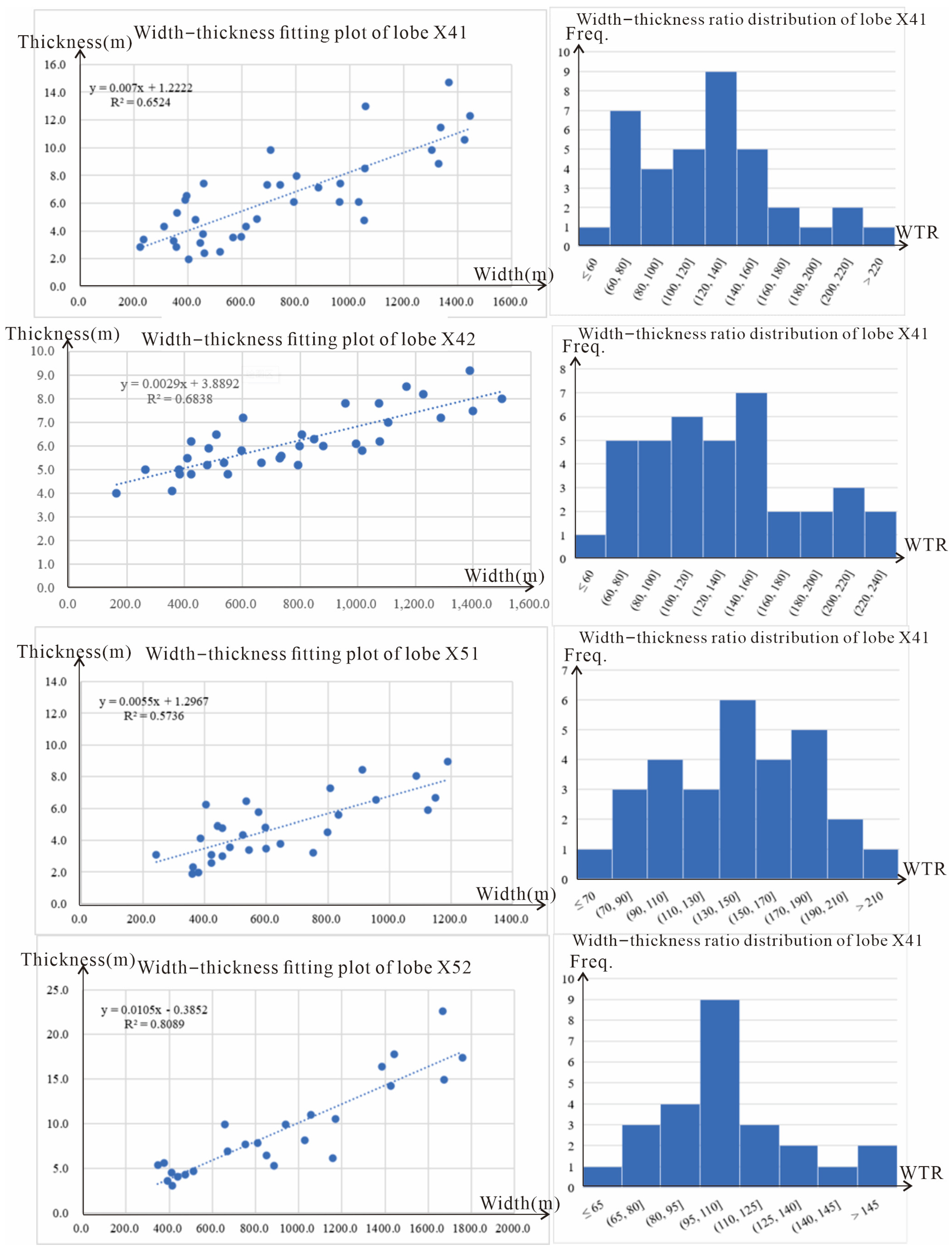
The individual lobe is the most developed and widely distributed architectural element in the study area. Based on the single-sand-body architectural dissection results for each sublayer, a statistical analysis of lobe dimensions was conducted. The results indicate that, overall, lobe thickness and width exhibit a linear correlation, with width-to-thickness ratios predominantly ranging from 70 to 170, averaging around 128 (Figure 6).
At the sublayer level: During the X52–X51 period, lobe development initially intensified and then weakened. In the early stages, lobes had relatively small width-to-thickness ratios. By the middle to late depositional stages, channels became shallower, lobe connectivity increased, and width-to-thickness ratios grew, primarily clustering around 130. During the X42 period, width-to-thickness ratios exhibited a broader range, with varying intensities of channels and lobes. By the X41 period, channel-lobe preservation stabilized, with width-to-thickness ratios predominantly between 120 and 140.
Comprehensive analysis reveals a positive correlation between lobe thickness and width: larger lobes tend to be both thicker and wider. In proximal areas, lobes exhibit smaller width-to-thickness ratios, whereas in distal areas, increased lobe connectivity leads to progressively larger width-to-thickness ratios. This relationship provides a basis for estimating lobe development scale and depositional positioning.

4.5. Sedimentary Model

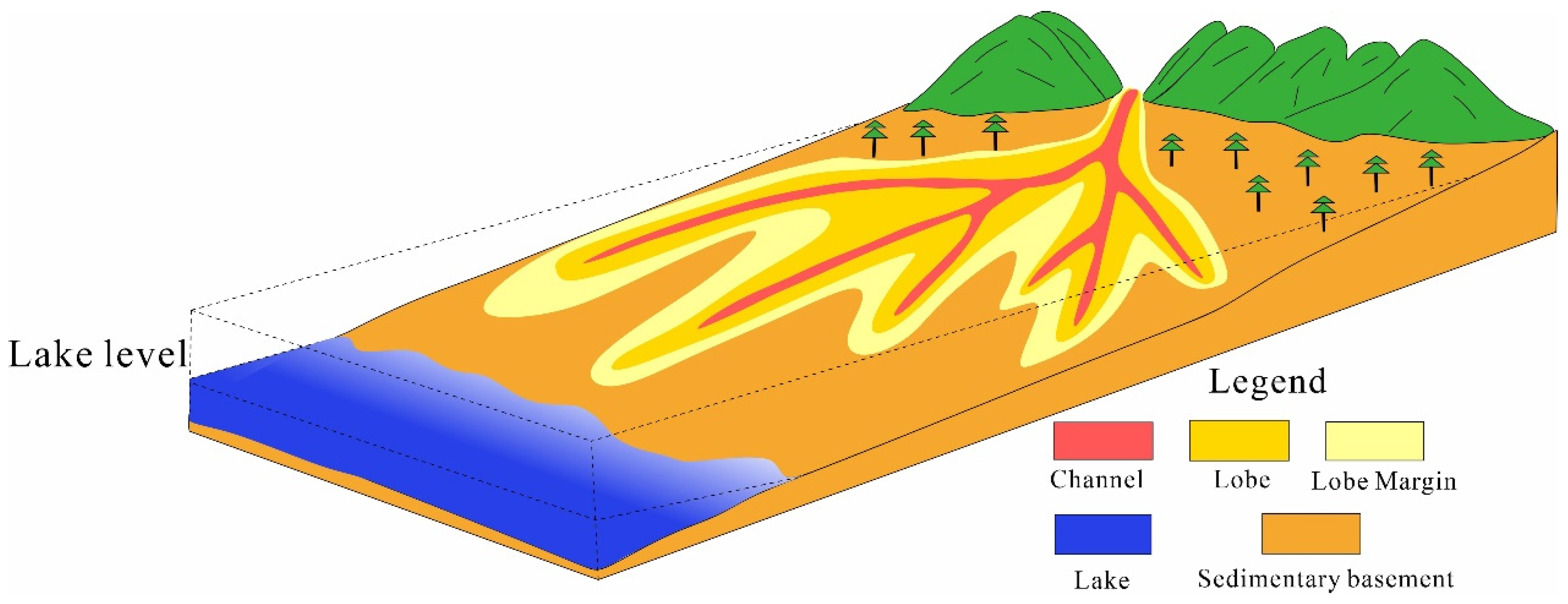
By refining and summarizing the research findings on the distribution characteristics, quantitative scale, and stacking patterns of single sand body architecture in the study area, this paper establishes a sedimentary architecture model of the alluvial fan fringe derived from southern provenance. The sand bodies in the study area are widely distributed, with fine-grained, well-sorted sandstones predominantly consisting of small-scale, high-energy channel-prograded lobe deposits, which conform to the gentle-slope alluvial fan model. The alluvial fan fringe primarily develops architectural elements such as channels, lobes, lobe margins, and mudstone.
The channels in the study area are small in scale and extend over long distances along the sediment transport direction. Channel development involves multiple stages of in situ incision, with few channel bifurcations. The combination of channels and lobes appears elongated and sinuous, with weak lateral amalgamation and insignificant vertical aggradation. Under the established sedimentary model of this area, as rivers exit the mountain front, the slope of the foreland hills is relatively gentle. The main channel continuously advances away from the sediment source, and due to the gentle slope, channel flow directions become variable, gradually forming branches. The lobes advance in a divergent pattern around the channel. Once a lobe is formed, new lobes can be generated by channel branching, cutting into previously formed lobes.
In terms of lobe dimensions, lobes closer to the sediment source are wider and thicker, with a lower width-to-thickness ratio. As the channel advances and hydrodynamic energy decreases, lobe thickness decreases, connectivity increases, and the width-to-thickness ratio gradually increases. Near the source, lobes are relatively isolated, but as channels branch, they become increasingly interconnected and stacked. The river network in this model is highly developed, with small-scale channels. Successive periods of channel advancement result in complex spatial arrangements of channel-lobe combinations. Over time, the channel-lobe assemblages undergo frequent lateral migration across the alluvial fan fringe, but the degree of lateral overlap remains low, and the recurrence interval of channels at the same location is relatively long (Figure 7).

5. Conclusions

  • The target formation in the study area develops a set of terminal fan deposits at the margin of an alluvial fan. Controlled by the long-term rise of the base level, these deposits exhibit a retrogradational stacking pattern. The terminal fan formed in a gentle-slope zone under an arid climate and was controlled by episodic flood events. It is dominated by fine sandstone, with multiple channel bifurcations forming large-scale lobes along their margins. Frequent channel bifurcations and multi-stage evolution led to the lateral amalgamation of lobes in plan view and their vertical stacking over multiple depositional phases.
  • Well log data were used to identify channels, lobes, lobe margins, and interlobe mudstone. By delineating the boundaries and spatial distribution of sedimentary microfacies, an architecture analysis of the X42−8 sublayer was conducted. The results indicate that long-term to mid-term base-level cycles controlled the advance and retreat of the terminal fan, systematically regulating its scale and distribution pattern. From bottom to top, the deposits transition from laterally extensive thick sand bodies to more dispersed thin lobe deposits. Overall, lobe width and thickness exhibit a linear correlation, with an average ratio of approximately 128.
  • The lobe, classified as an eighth-order architectural element within the sand bodies of the study area, was identified as the key research focus. Four indicators were used to identify its lateral boundaries: sedimentary facies transitions, variations in sand body basal elevation, trends in sand body central thickness, and differences in hydrocarbon content. The contact relationships between single-sand-body lobes at the alluvial fan fringe were categorized into two types: stacked and isolated. Stacked lobes exhibit three subtypes—lateral amalgamation, vertical stacking, and incision—while isolated lobes are classified into laterally separated and vertically isolated types. As the base level changes, the contact patterns of individual sand bodies also vary accordingly.
  • In the study area, channels are small in width and thickness but extend long distances along the transport direction. Channel development involves multiple phases of in situ incision, with limited bifurcation. The combination of channels and lobes is elongated and sinuous, with weak lateral amalgamation and insignificant vertical accretion.
  • A 3D sedimentary architecture model of the alluvial fan fringe derived from the southern provenance has been established. The model is characterized by a main distributary channel system that progressively branches downstream. Along the channel margins, lobes, lobe margins, and interlobe mudstones develop from proximal to distal locations. The channel-lobe assemblages form complex lateral amalgamations in plan view, resulting in extensive sand-body connectivity, while in the vertical dimension, they exhibit offset stacking, creating a complex spatial architecture.

Author Contributions

Conceptualization, B.Z. and L.W.; methodology, B.Z. and Y.Y.; software, L.W.; validation, B.Z., L.W. and Y.Y.; formal analysis, B.Z. and L.W.; investigation, Y.Y.; resources, Y.Y. and L.W.; data curation, B.Z. and L.W.; writing—original draft preparation, B.Z.; writing—review and editing, B.Z. and Y.Y.; visualization, L.W.; supervision, Y.Y.; project administration, Y.Y. and L.W.; funding acquisition, Y.Y. All authors have read and agreed to the published version of the manuscript.

Funding

This research received no external funding.

Institutional Review Board Statement

Not applicable.

Informed Consent Statement

Not applicable.

Data Availability Statement

All data and materials are available on request from the corresponding author. The data are not publicly available due to ongoing research using a part of the data.

Conflicts of Interest

The authors declare no conflicts of interest.

References

  1. Galloway, W.; Hobday, D. Terrigenous Clastic Depositional Systems; Springer: New York, NY, USA, 1983; pp. 29–59. [Google Scholar]
  2. Stanistreet, I.G.; McCarthy, T.S. The Okavango fan and the classification of subaerial fan systems. Sediment. Geol. 1993, 85, 115–133. [Google Scholar] [CrossRef]
  3. Densmore, A.L.; Allen, P.A.; Simpson, G. Sediment flux from an uplifting fault block. Basin Res. 2020, 32, 456–472. [Google Scholar]
  4. Harvey, A.M.; Wells, S.G.; Mather, A.E. Response of alluvial fan systems to late Quaternary climatic and tectonic forcing: A global synthesis. Earth-Sci. Rev. 2021, 215, 103527. [Google Scholar]
  5. Ventra, D.; Clarke, L.E. Alluvial fans and their natural distinction from rivers based on morphology, hydraulic processes, sedimentary processes, and facies assemblages. J. Sediment. Res. 2020, 90, 453–476. [Google Scholar]
  6. Stokes, M.; Mather, A.E.; Belfoul, M. Controls on dryland alluvial fan development: Insights from the Atlas Mountains, Morocco. Geomorphology 2022, 398, 108025. [Google Scholar]
  7. Whipple, K.X.; Tucker, G.E.; Hancock, G.R. The influence of sediment supply on alluvial fan morphology. Nat. Geosci. 2023, 16, 301–308. [Google Scholar]
  8. Alasad, R.; Olariu, C.; Steel, R.J. Alluvial fan and fan delta facies architecture recording initial marine flooding in the Mio-Pliocene syn-rift sequence of the Fish Creek-Vallecito Basin, southern California. Basin Res. 2023, 35, 567–589. [Google Scholar] [CrossRef]
  9. Clarke, L.E.; Ventra, D. Autogenic cycles in experimental alluvial fans. Sedimentology 2025, 72, 210–235. [Google Scholar]
  10. Grant, J.A.; Wilson, S.A.; Mangold, N. The timing of alluvial activity in Gale crater, Mars. Geophys. Res. Lett. 2014, 41, 1142–1148. [Google Scholar] [CrossRef]
  11. Blair, T.C.; McPherson, J.G. Alluvial fan processes and forms. Geomorphology 1994, 10, 1–68. [Google Scholar]
  12. Harvey, A.M. The role of base-level change in the dissection of alluvial fans: Case studies from southeast Spain and Nevada. Geomorphology 2002, 45, 67–87. [Google Scholar] [CrossRef]
  13. Zhang, J.Y. Some Sedimentary Characteristics and Microfacies Division of Coarse Clastic Alluvial Fans. Acta Sedimentol. Sin. 1985, 75–85. (In Chinese) [Google Scholar]
  14. Bull, W.B. Geomorphic Responses to Climatic Change; Oxford University Press: Oxford, UK, 1991; 326p. [Google Scholar]
  15. Ritter, J.B.; Miller, J.R.; Enzel, Y. Reconciling the roles of tectonics and climate in Quaternary alluvial fan evolution. Geology 1995, 23, 245–248. [Google Scholar] [CrossRef]
  16. Wu, S.H.; Feng, W.J.; Yin, S.L.; Yu, C.; Zhang, K. Research Advances in Alluvial Fan Sedimentary Architecture. J. Palaeogeogr. 2016, 18, 497–512. (In Chinese) [Google Scholar]
  17. Leeder, M.R.; Mack, G.H. Alluvial fan sedimentation. Sedimentology 2013, 60, 1–45. [Google Scholar]
  18. Almond, P.C.; Berryman, K.; Villamor, P. Alluvial fan response to Alpine Fault earthquakes on the Westland piedmont, Whataroa, Aotearoa-New Zealand. Earth Surf. Process. Landf. 2023, 48, 892–910. [Google Scholar] [CrossRef]
  19. Woor, S.; Thomas, D.S.G.; Durcan, J.A.; Burrough, S.L.; Parton, A. Orbital forcing of alluvial fan dynamics in arid Arabia: Evidence from luminescence dating of mid-late Quaternary systems. Quat. Sci. Rev. 2024, 328, 108541. [Google Scholar]
  20. Ventra, D.; Clarke, L.E. Autogenic vs. climatic controls on fan stratigraphy: A global synthesis of Quaternary systems. Sedimentology 2021, 68, 2102–2135. [Google Scholar]
  21. Dahl, J.E.; Moldowan, J.M.; Peters, K.E. Diamondoid hydrocarbons as quantitative indicators of natural oil cracking. Nature 1999, 399, 54–57. [Google Scholar] [CrossRef]
  22. Li, J.; Philp, R.P.; Cui, M. Methyl-diamantane index as a maturity parameter for Lower Paleozoic carbonate rocks at high maturity and overmaturity. Org. Geochem. 2000, 31, 267–272. [Google Scholar]
  23. Williams, R.M.E.; Irwin, R.P.; Zimbelman, J.R. Alluvial fans on Earth and Mars: A comparative planetary geology study. Icarus 2021, 354, 114097. [Google Scholar]
  24. Faber, E. Zur Isotopengeochemie gasförmiger Kohlenwasserstoffe. Erdöl Erdgas Kohle 1987, 103, 210–218. [Google Scholar]
  25. Xu, Z.B.; Yang, H.T.; He, G.M.; Fan, J. Quantitative evaluation of reservoirs in Member Xi-5-2 of Kekeya condensate gas field, Tarim Basin. Pet. Geol. Eng. 2012, 26, 68–70. (In Chinese) [Google Scholar]
  26. Tang, Y.J.; Hou, D.J.; Xiao, Z.Y.; Xu, Y.D. Genesis of natural gas in Kekeya area. Offshore Oil 2006, 18–22. (In Chinese) [Google Scholar]
  27. Li, H.Q.; Jiang, Z.X.; Qiu, L.W.; Deng, X.L.; Zhao, S.Y.; Lu, H.B. Study on sedimentary characteristics of seasonal rivers in Xihepu Formation of Miocene in Kekeya condensate gas field. Xinjiang Geol. 2003, 69–73. (In Chinese) [Google Scholar]
  28. Peters, K.E.; Walters, C.C.; Moldowan, J.M. The Biomarker Guide; Cambridge University Press: Cambridge, UK, 2022; Volume 2, pp. 475–510. [Google Scholar]
  29. Milkov, A.V.; Etiope, G. Revised genetic diagrams for natural gases based on a global dataset. Earth-Sci. Rev. 2022, 224, 103871. [Google Scholar]
  30. He, D.F.; Chen, H.Y.; Liu, S.B.; Zhu, R.K.; Deng, X.L. Accumulation mechanism of Kekeya condensate oil and gas field. Petroleum Explor. Dev. 1997, 28–32+99. (In Chinese) [Google Scholar]
  31. Yang, X.M.; Wang, J.J. Study on stratigraphic division and correlation of Tertiary trace elements in Kekeya area. J. Xinjiang Pet. Inst. 2000, 1–7. (In Chinese) [Google Scholar]
  32. Stokes, M.; Mather, A.E.; Belfoul, M. Dryland alluvial fan morphodynamics: Insights from Atlas Mountain catchments, Morocco. Geomorphology 2022, 412, 108301. [Google Scholar]
  33. Wang, X.Y.; Mou, W.J.; Ding, G.F.; Lu, K.F.; Lv, J.Y. Development practice of volatile reservoirs in Kekeya condensate gas field. Pet. Explor. Dev. 2004, 93–95. (In Chinese) [Google Scholar]
  34. Wu, S.H.; Yue, D.L.; Feng, W.J.; Zhang, J.J.; Xu, Z.H. Several advances on sedimentary architecture of clastic rocks. J. Palaeogeogr. 2021, 23, 245–262. (In Chinese) [Google Scholar]
  35. Moldowan, J.M.; Dahl, J.; McCaffrey, M.A. Diamondoid analysis of ultra-deep natural gases in the Tarim Basin. Org. Geochem. 2021, 152, 104175. [Google Scholar]
  36. Liu, Q.; Worden, R.H.; Jin, Z. TSR versus non-TSR processes and their impact on gas geochemistry. Geochim. Cosmochim. Acta 2021, 292, 1–18. [Google Scholar] [CrossRef]
  37. Philp, R.P.; Li, J.; Allen, J. Geochemical characteristics of ultra-deep natural gases in northwest China. AAPG Bull. 2020, 104, 1289–1312. [Google Scholar]
  38. Xie, Q.H.; Chen, P.Y.; Xu, Z.B.; Xue, T.F.; Jia, Z.Y.; Liang, H.L.; Zhao, Z.P. Study on sedimentary facies of Formation in Kekeya condensate gas field. Xinjiang Geol. 2013, 31, 217–222. (In Chinese) [Google Scholar]
  39. Wu, S.H.; Ji, Y.L.; Yue, D.L.; Yin, S.L. Discussion on classification scheme of clastic sedimentary geologic architecture. Geol. J. Univ. 2013, 19, 12–22. (In Chinese) [Google Scholar] [CrossRef]
  40. Wan, J.H. Discussion on the Classification Scheme of Clastic Sedimentary Geological Architecture. Technol. Innov. 2018, 121–122. (In Chinese) [Google Scholar]
  41. Brooke, S.A.S.; Whittaker, A.C.; Armitage, J.J.; D’Arcy, M.; Watkins, S.E. Quantifying Sediment Transport Dynamics on Alluvial Fans From Spatial and Temporal Changes in Grain Size, Death Valley, California. Geophys. Res. Earth Surf. 2018, 123, 2039–2067. [Google Scholar] [CrossRef]
  42. Dong, G.; He, Y.; Leng, C.; Gao, L. Mechanism of Sand Body Prediction in a Continental Rift Basin by Coupling Paleogeomorphic Elements under the Control of Base Level. Pet. Explor. Dev. 2016, 43, 579–590. [Google Scholar] [CrossRef]
  43. Harvey, A.M. Differential Effects of Base-Level, Tectonic Setting and Climatic Change on Quaternary Alluvial Fans in the Northern Great Basin, Nevada, USA. Geol. Soc. Lond. Spec. Publ. 2005, 251, 117–131. [Google Scholar] [CrossRef]
  44. Gilmullina, A.; Klausen, T.G.; Doré, A.G.; Rossi, V.M.; Suslova, A.; Eide, C.H. Linking Sediment Supply Variations and Tectonic Evolution in Deep Time, Source-to-Sink Systems—The Triassic Greater Barents Sea Basin. GSA Bull. 2021, 134, 1760–1780. [Google Scholar] [CrossRef]
  45. Winsemann, J.; Hartmann, T.; Lang, J.; Fälber, R.; Lauer, T. Depositional Architecture and Aggradation Rates of Sand-Rich, Supercritical Alluvial Fans: Control by Autogenic Processes or High-Frequency Climatic Oscillations? Sediment. Geol. 2022, 440, 106238. [Google Scholar] [CrossRef]
  46. Nicholas, A.P.; Aalto, R.E.; Sambrook Smith, G.H.; Schwendel, A.C. Hydrodynamic Controls on Alluvial Ridge Construction and Avulsion Likelihood in Meandering River Floodplains. Geology 2018, 46, 639–642. [Google Scholar] [CrossRef]
Figure 1. Regional tectonic setting of the Kekeya Gas-Condensate Field (after PetroChina Tarim Oilfield Company).
Applsci 15 08547 g001
Figure 2. Core photographs of the Xihepu Formation, Kekeya Gas-Condensate Field. (a) Bioturbation structures in X41 member core; (b) Brown-red to reddish-brown core; (c,d) Fine sandstone and siltstone cores; (e) Low-angle cross-bedding; (f) Horizontal bedding.
Applsci 15 08547 g002
Figure 3. Composite Core Column of Well Ke−9.
Applsci 15 08547 g003
Figure 4. Identification markers of lobe boundaries. (a) Facies transition; (b) Elevation difference at sand body base; (c) Thickness variation trend at sand body center; (d) Hydrocarbon-bearing property contrast.
Applsci 15 08547 g004
Figure 5. Planar architectural distribution characteristics of layer X42-8. (a) Planar facies map of layer X42-8; (b) Cross-section BB’; (c) Cross-section AA’.
Applsci 15 08547 g005
Figure 6. Width-thickness relationship of lobes in the study area(WTR, Width-Thickness Ratio).
Applsci 15 08547 g006
Figure 7. Sedimentary facies model diagram of the study area.
Applsci 15 08547 g007
Table 1. Log response characteristics of different sedimentary microfacies in the study area.
Architectural ElementLog ResponseCurve CharacteristicsLithological CharacteristicsSedimentary StructureSedimentary Rhythm
ChannelApplsci 15 08547 i001High GR/SP amplitudes, box-shaped with sharp top/base boundaries, and slightly serrated GR curveDominantly brown siltstone and fine sandstoneScour structure
Massive bedding
Parallel bedding
Coarsening-upward succession
LobeApplsci 15 08547 i002Moderate-to-high amplitude SP/GR curves showing bell-shaped or serrated bell-shaped patterns, with low resistivity and high acoustic travel timeBrownish argillaceous siltstone and siltstoneLow-angle cross-bedding
Parallel bedding
Fining-upward succession
Composite rhythm
Lobe marginApplsci 15 08547 i003Moderate-to-low amplitude SP/GR curves, predominantly finger-shaped with occasional funnel and diamond patterns, and low resistivitySiltstone
Argillaceous siltstone
Silty mudstone
Horizontal bedding
Deformation bedding
Non-rhythmic
Table 2. Contact styles of single sand bodies.
Contact Relationship TypesContact Style MorphologyConnectivity
Contact Configuration PatternLateral splicingButt-jointed typeLateral truncation typeDisconnected;
Well-connected
Applsci 15 08547 i004Applsci 15 08547 i005
SuperpositionLateral superpositionVertical superpositionDisconnected;
Weakly connected
Applsci 15 08547 i006Applsci 15 08547 i007
Superimposed cuttingVertical superimposition-cuttingLateral superimposition-cuttingWell-connected
Applsci 15 08547 i008Applsci 15 08547 i009
Isolated configuration patternPlanar detachmentApplsci 15 08547 i010Unconnected
Vertically isolated typeVertical detachmentLateral detachmentUnconnected
Applsci 15 08547 i011Applsci 15 08547 i012
Applsci 15 08547 i013
Disclaimer/Publisher’s Note: The statements, opinions and data contained in all publications are solely those of the individual author(s) and contributor(s) and not of MDPI and/or the editor(s). MDPI and/or the editor(s) disclaim responsibility for any injury to people or property resulting from any ideas, methods, instructions or products referred to in the content.