Article

From Youth to Senior: External Load Progression and Positional Differences in Spanish Women’s National Teams During World Cup Competitions


by
Ismel Mazola
1,2,
Miguel Valdés
3,
Blanca Romero-Moraleda
1,2 and
Jaime González-García
2,4,*
1
Department of Physical Education, Sport and Human Movement, Autonomous University of Madrid, 28049 Madrid, Spain
2
Performance Area, Royal Spanish Football Federation, 28232 Las Rozas, Spain
3
Faculty of Health Science, Universidad Europea de Madrid, 28670 Madrid, Spain
4
Exercise and Sport Sciences, Faculty of Health Science, Universidad Francisco de Vitoria, 28223 Pozuelo, Spain
*
Author to whom correspondence should be addressed.
Appl. Sci. 2025, 15(15), 8421; https://doi.org/10.3390/app15158421
Submission received: 2 June 2025 / Revised: 15 July 2025 / Accepted: 24 July 2025 / Published: 29 July 2025

Abstract

The aim of this study was to analyze and compare the external load demands of players from the Spanish women’s national football teams across the U-17, U-20, and senior categories during their respective FIFA World Cup participations. Key kinematic variables were assessed via global positioning systems (GPS), including total distance (TD), high-speed running (HSR; ≥18 km·h−1), sprint distance (≥21 km·h−1), accelerations (>3 m·s−2), decelerations (<–3 m·s−2), and high metabolic load distance (HMLD) during 3 world cups (U17, U20 and senior). Significant differences were observed between the senior team and both U-20 and U-17 in nearly all variables, with greater magnitude as the intensity of the metrics increased, showing effect sizes ranging from moderate to very large (d = 0.95 to 4.76). Positional analysis by categories showed that senior full backs (FB) and central midfielders (CM) showed higher demands compared to U-20 and U-17. For TD, senior covered more than U-17 (FB: p = 0.001; d = 1.11 | CM: p = 0.023; d = 0.97), with small differences vs. U-20 (d ≤ 0.54). In HSR, both positions outperformed U-17 and U-20 (FB: p ≤ 0.007; d = 0.87–1.15 | CM: p ≤ 0.031; d = 0.71–1.11). In HMLD, both FB and CM displayed very large differences compared to U-17 and U-20 (all p < 0.001; d = 2.54–6.16). These findings underscore the need for progressive development of locomotor capacities from early stages, considering both age category and playing position, to facilitate a more seamless transition to elite-level football.

1. Introduction

Women’s football has experienced substantial growth in recent years, marked by a significant rise in visibility and increased investment from clubs and federations toward its professionalization. This evolution has positively influenced the technical and tactical development of female players. As the game has advanced, international women’s teams now face greater physical demands. The rising intensity of play suggests that teams are covering more distance at higher speeds, contributing to an overall faster pace [1].
Recent studies report that sprint distance, as a percentage of total distance, increased by 29% to 36% in the 2019 and 2023 FIFA Women’s World Cups compared to 2015 [2]. This shift has raised the level of preparation required, as players must manage these physical demands to reduce injury risk. A comparative study across age categories, conducted with Brazilian U-17, U-20, and senior players [3], reported a general increase in key performance indicators, such as total distance (TD) covered and high-intensity actions. Moreover, progressive increases in both TD and sprint distance were observed with advancing age among U-15, U-16, and U-17 players [4]. Kobal et al. (2022) [5] highlighted this by showing that professional players outperform their U-17 and U-20 counterparts in sprint distance and top speed. The greater frequency of sprints performed indicates that the capacity to sustain repeated high-intensity sprint efforts may represent a critical determinant in the progression to senior-level competition.
In addition to traditional locomotor variables such as total distance, high-speed running (HSR) distance, and sprint distance, neuromuscular metrics, particularly accelerations and decelerations, have gained increasing importance in performance analysis [6]. Their direct association with repeated explosive efforts and the overall mechanical load borne by players makes them a key performance indicator [6]. These variables reflect short, high-intensity movements that do not necessarily result in large displacements but involve a high frequency of neuromuscular demanding actions. Considering these variables is especially relevant given the inherent nature of football, which involves continuous changes of direction, both with and without the ball, leading to a constant repetition of such efforts throughout the match [6]. Vescovi et al. (2021) [7] reported that youth and collegiate players display a lower frequency of accelerations and decelerations compared to elite-level athletes, suggesting a reduced tolerance to neuromuscular load during early developmental stages. Similarly, Ramos et al. (2019) [3] observed significant increases in accelerative actions with age progression, reinforcing the notion that these variables are critical for distinguishing between competitive levels. In terms of playing position, central midfielders (CM) and full backs (FB) appear to record the highest values in these metrics, likely due to their constant involvement in both attacking and defensive transitions [8]. However, it is evident that these patterns are strongly influenced by contextual factors such as the team’s tactical model or opponent quality, among others.
Furthermore, the inclusion of high metabolic load distance (HMLD) has proven useful for synthesizing the energetic demands imposed by HSR, accelerations, and decelerations into a single, integrated metric [9]. HMLD refers to the distance covered while exceeding a metabolic power threshold of 25.5 W·kg−1, thereby capturing complex high-intensity movement patterns that may not be fully reflected by speed-based metrics alone. Despite its growing relevance in the literature on male football, studies investigating HMLD in elite female players remain notably scarce, and none have explored its application across age categories or in high-level international contexts. This gap underscores the need to examine this variable more closely to inform more accurate load monitoring and age-specific training prescriptions.
Expanding the current understanding of external load demands across competitive levels in women’s football—particularly in the context of top-tier international tournaments—may contribute to optimizing physical preparation, reducing injury risk, and supporting long-term athlete development. Despite the growing body of research on external load in women’s football, there remains a significant gap in the literature regarding how these demands vary across competitive levels, particularly within elite international tournaments. Most existing studies have focused on domestic leagues or isolated matches, limiting our ability to generalize findings to the unique physical and tactical contexts of top-tier competitions. Therefore the aim of the present study was to address this gap by analyzing a comprehensive set of kinematic metrics, including total distance, HSR distance, sprint distance, HMLD, accelerations, and decelerations, across age categories and playing positions, with the goal of establishing a reference framework to support a more individualized transition from youth to senior level competition.

2. Materials and Methods

2.1. Design

A retrospective, observational, transversal, and comparative study was conducted to compare the kinematic profile of players from the Spanish women’s national football teams in the U-17, U-20, and senior categories during their respective World Cups. To better understand the physical demands according to competitive level, different performance variables were analyzed using Global Positioning System (GPS) devices, considering both playing category and field position. The variables examined included total and high-intensity distance covered, the total number of high-intensity accelerations and decelerations, and the TD covered during high metabolic load actions throughout the matches played in each tournament.

2.2. Participants

Eighteen U-17 players, eighteen U-20 players, and twenty senior players (Table 1) from the Spanish women’s national football teams participated in the study. Data collection took place during the FIFA U-17 Women’s World Cup in the Dominican Republic in October and November 2024, the FIFA U-20 Women’s World Cup in Colombia in September 2024, and the FIFA Women’s World Cup in Australia and New Zealand in July and August 2023. Exclusion criteria included any serious injury sustained within the year preceding the tournament or any condition that impeded participation with the national team during the competition. Goalkeepers were also excluded from the study due to the specificity of their role and the different nature of GPS-derived variables compared to outfield players. Players were categorized into five groups based on their playing position: central-backs (CB), full backs (FB), central midfielders (CM), wingers (WG), and strikers (ST), according to teams’ technical staff. All players consented to their participation in the study and data collection and signed an informed consent form on behalf of their national team. All procedures were approved by the Human Ethics Committee of Universidad Autónoma de Madrid (CEI-124-2528), in accordance with the Declaration of Helsinki.

2.3. Procedures

Kinematic activity data were collected during each World Cup, encompassing a total of 7 matches in the senior category, 4 matches in the U-20 category, and 6 matches in the U-17 category. Only players who completed 80 min or more during a match were included in the analysis. As a result, 52 observations were recorded for the senior category (13 CB, 12 FB, 17 CM, 4 WG, and 6 ST), 27 for the U-20 category (6 CB, 7 FB, 6 CM, 6 WG, and 2 ST), and 45 for the U-17 category (11 CB, 10 FB, 12 CM, 8 WG, and 4 ST). All match activity was recorded using the WIMU PRO GPS device (RealtrackSystems S.L., Almeria, Spain). Intra- and inter-unit reliability was considered acceptable, with an intraclass correlation coefficient of 0.65 for the x-coordinate and 0.85 for the y-coordinate in the systems analyzed [10]. GPS devices were activated 15 min before players put them on to ensure adequate satellite signal acquisition. Prior to the start of the pre-match warm-up, players placed the device into a vest worn on their upper back at scapular level. Each player consistently used the same GPS unit to minimize inter-unit measurement error. Upon match completion, GPS data were extracted and analyzed using SPRO Software (version 958; RealtrackSystems, Almeria, Spain). These procedures were part of the standard pre-match protocol, ensuring that players did not deviate from their usual routines.
The variables analyzed for each match included TD, HSR distance (HSR; ≥18 km·h−1), and sprint distance (≥21 km·h−1) [11]. Additionally, the number of high-intensity accelerations (>3 m·s−2) and decelerations (<–3 m·s−2) were recorded [12], as well as HMLD, defined as the distance covered while expending more than 25.5 W·kg−1. HMLD provides a comprehensive measure of high-intensity activity, as it incorporates not only HSR (≥19.8 km·h−1), but also accelerations and decelerations within a range of 2 m·s−2 to 4 m·s−2 [13,14].

2.4. Statistical Analysis

Statistical analyses were performed using IBM SPSS Statistics version 26.0 (IBM Corp., Armonk, NY, USA), and graphs were created using Graphpad Prism version 9.0 (San Diego, CA, USA). Results are presented as mean ± standard deviation (SD), and the level of significance was set at p < 0.05. Normality was assessed using the Shapiro–Wilk test, and homogeneity of variance was verified through Levene’s test. Locomotor activity parameters obtained via GPS for the three study categories (Senior, U-20, and U-17) were analyzed using linear mixed models with a 95% confidence interval (95% CI). Due to unequal sample sizes across age and categories, linear mixed models were fitted with random intercepts for players and matches. Players were nested within age categories and playing positions, which were included as fixed effects. For multiple comparisons, Bonferroni’s post hoc test was applied for its conservative control of Type I error. Additionally, effect sizes (Cohen’s d) were calculated to compare the different conditions and were categorized as follows: ≤0.2 (trivial), ≥0.2–0.6 (small), ≥0.6–1.2 (moderate), ≥1.2–2.0 (large), and ≥2.0 (very large) [15].

3. Results

3.1. Main Effects and Interaction

A significant main effect of playing category was found across all variables: TD (p < 0.001; η2 = 7.51), HSR (p < 0.001; η2 = 0.406), sprint (p < 0.001; η2 = 0.325), accelerations (p < 0.001; η2 = 0.482), decelerations (p < 0.001; η2 = 0.312), and HMLD (p < 0.001; η2 = 0.874). Similarly, playing position had a main effect on all metrics: TD (p = 0.001; η2 = 0.152), HSR (p < 0.001; η2 = 0.251), sprint (p < 0.001; η2 = 0.309), accelerations (p < 0.001; η2 = 0.280), decelerations (p < 0.001; η2 = 0.245), and HMLD (p < 0.001; η2 = 0.185). A significant interaction between category and position was found only for accelerations (p = 0.007; η2 = 0.171).

3.2. Category and Positional Differences for Total Distance, HSR, Sprint, and HMLD

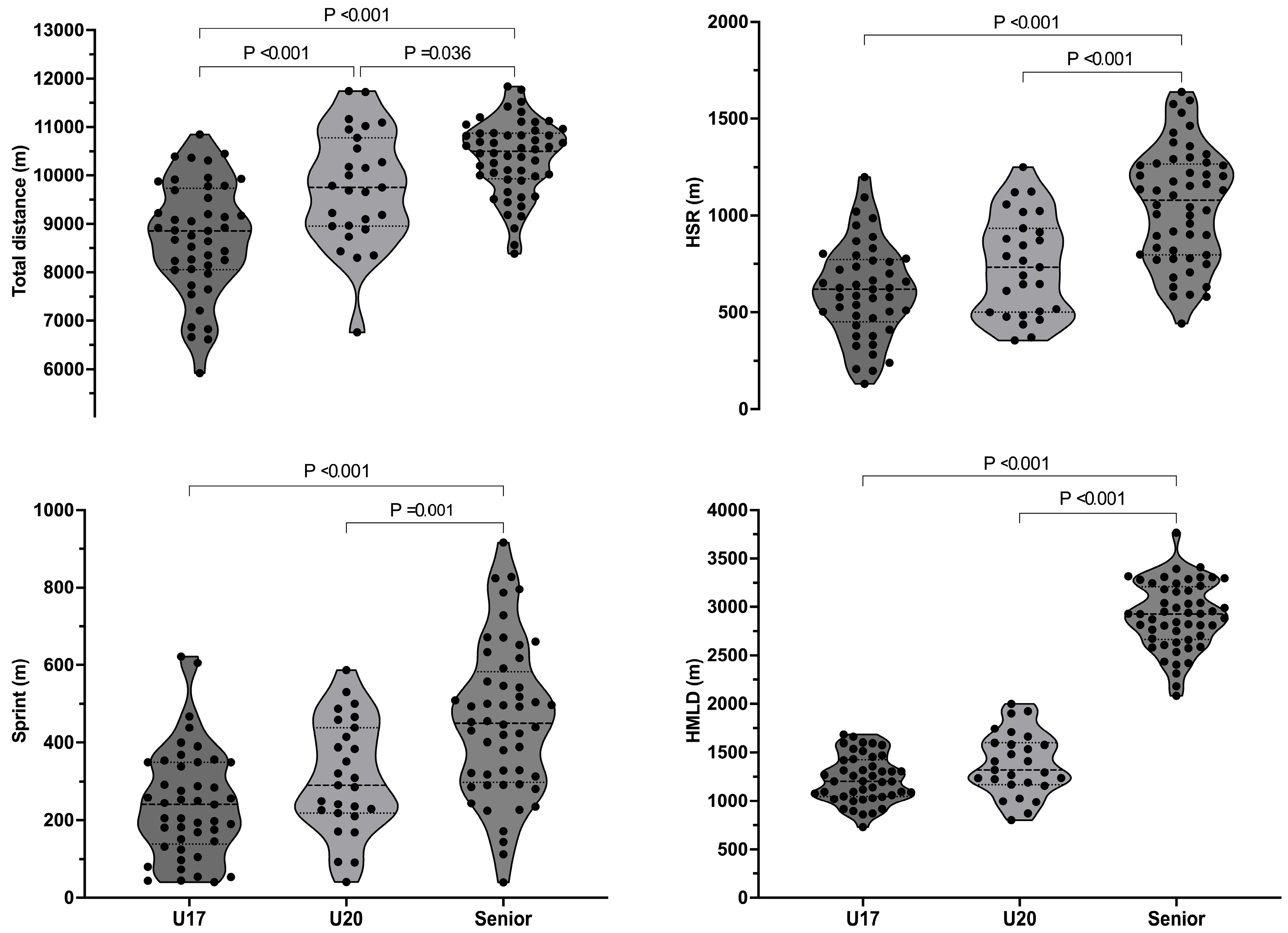
Table 2 shows category and positional comparisons for TD, HSR, sprint, and HMLD. Category-level differences were found in TD between senior and U-17 (p < 0.001; d = 1.75) and between U-20 and U-17 (p < 0.001; d = 1.26). HSR was significantly higher in seniors compared to U-17 (p < 0.001; d = 2.01) and U-20 (p < 0.001; d = 1.36). Sprint distance also favored seniors over U-17 (p < 0.001; d = 1.59) and U-20 (p < 0.001; d = 0.95). For HMLD, senior players outperformed both U-17 (p < 0.001; d = 4.76) and U-20 (p < 0.001; d = 4.29) (Figure 1). By playing position, significant differences in TD between the senior and U-17 groups were found for CB (p = 0.001; d = 1.88), FB (p = 0.001; d = 1.11), CM (p = 0.023; d = 0.97), WG (p = 0.006; d = 1.11), and ST (p = 0.005; d = 1.21). For HSR, differences were also significant between senior and U-17 players in CB (p < 0.001; d = 1.60), FB (p < 0.001; d = 1.15), CM (p = 0.005; d = 0.71), WG (p = 0.004; d = 1.68), and ST (p = 0.022; d = 0.59). Regarding sprint distance, significant differences were found for CB (p < 0.001; d = 1.36), FB (p < 0.001; d = 1.02), WG (p = 0.046; d = 1.46), and ST (p = 0.016; d = 0.46), with no significant difference observed for CM. For HMLD, senior players showed significantly higher values than U-17 across all positions: CB (p < 0.001; d = 5.11), FB (p < 0.001; d = 4.73), CM (p < 0.001; d = 6.16), WG (p < 0.001; d = 4.67), and ST (p < 0.001; d = 2.46). Comparisons between U-20 and U-17 revealed significant differences in TD for CB (p = 0.033; d = 1.34) and WG (p = 0.023; d = 1.02), and in sprint distance for WG (p = 0.046; d = 1.10). Between senior and U-20 players, significant differences in HSR were found for CB (p = 0.001; d = 2.01), FB (p = 0.007; d = 0.87), and CM (p = 0.031; d = 1.11); in sprint distance for CB (p = 0.012; d = 2.07) and FB (p = 0.002; d = 1.08); and in HMLD across all positions: CB (p < 0.001; d = 4.76), FB (p < 0.001; d = 2.54), CM (p < 0.001; d = 3.06), WG (p < 0.001; d = 1.73), and ST (p < 0.001; d = 5.22).

3.3. Category and Positional Differences for High Intensity Accelerations and Decelerations

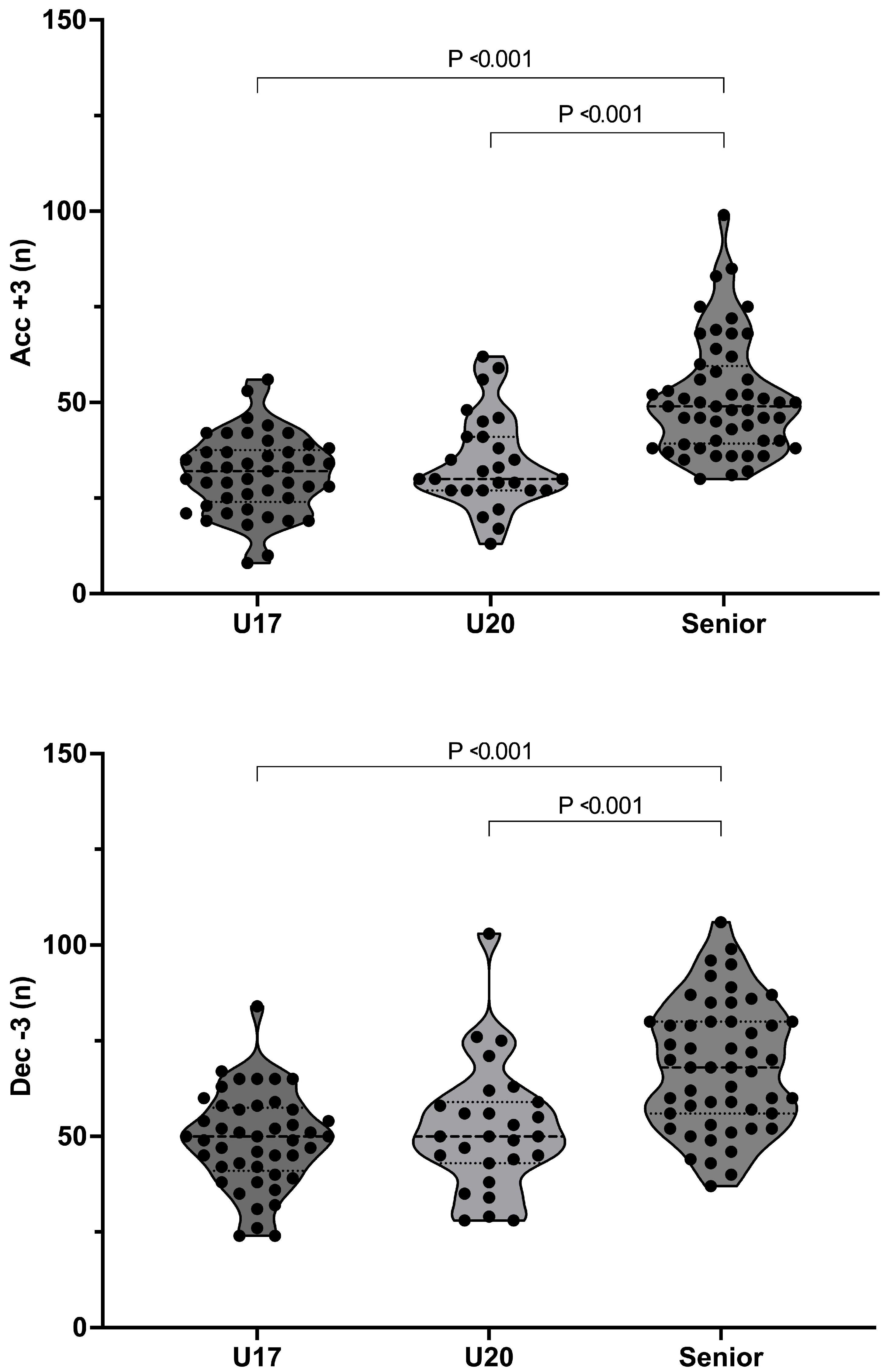
Table 3 shows group and positional comparisons for high-intensity accelerations (>3 m·s2) and decelerations (<–3 m·s2). At the group level, seniors outperformed U-17 in accelerations (p < 0.001; d = 1.70) and decelerations (p < 0.001; d = 1.92), and also U-20 (acc: p < 0.001; d = 2.10; dec: p < 0.001; d = 0.99). No differences were found between U-20 and U-17 (Figure 2). By position, seniors showed higher accelerations than U-17 in CB (p < 0.001; d = 1.54), FB (p < 0.001; d = 2.13), CM (p = 0.010; d = 1.42), and ST (p < 0.001; d = 1.87), with no difference in WG. For decelerations, differences were found in CB (p = 0.010; d = 1.13), FB (p < 0.001; d = 2.43), CM (p = 0.010; d = 1.35), and ST (p = 0.008; d = 1.43). Compared to U-20, seniors had higher accelerations in CB (p = 0.011; d = 2.04), FB (p < 0.001; d = 1.31), CM (p = 0.033; d = 1.41), and ST (p < 0.001; d = 1.07); and more decelerations in FB (p = 0.008; d = 0.77) and CM (p < 0.001; d = 1.57). Although not all differences were significant across every position and variable, the overall pattern remained consistent across most metrics: Senior > U-20 > U-17.

4. Discussion

The aim of this study was to describe and compare the kinematic demands of the Spanish women’s national football teams in the U-17, U-20, and senior categories during their respective FIFA World Cup participations. Significant differences were found across several performance variables between categories. The main findings were: (1) Significant differences were observed between the senior team and both U-17 and U-20 in all variables, except TD, where no difference appeared between senior and U-20. TD also differed significantly between U-17 and U-20. (2) TD, HSR, and sprint distances were greater in the senior category compared to U-17 across all positions, except for CM in sprint distance. Differences between senior and U-20 were noted in HSR for CB, FB, and CM, and in sprint for CB and FB. (3) Accelerations were significantly higher in the senior group than in both U-17 and U-20 across all positions. (4) For decelerations, significant differences emerged between senior and U-17 across all positions except WG, and between senior and U-20 in CM and FB. (5) HMLD differed significantly across all positions between senior and both U-17 and U-20.
The analysis of distance-related variables showed that senior players recorded higher TD, HSR, sprint, and HMLD values than U-20 and U-17 players. This pattern aligns with previous studies reporting greater locomotor demands in elite senior players compared to younger counterparts [4,5,16,17,18]. This progressive rise from U-17 to senior levels may suggest improved physical performance associated with biological maturation, potentially influenced not only by physiological or structural factors, but also by an increase in match tempo, reflecting enhanced technical-tactical demands at higher levels of competition [17,19]. Notably, differences between categories increased with variable intensity. Seniors covered 4% and 16% more TD than U-20 and U-17, respectively; 30% and 40% more HSR; and 32% and 47% more sprint distance. This trend highlights the need for age-specific training interventions that progressively enhance physical capacities in accordance with the escalating technical-tactical and physiological demands of elite competition. Regarding position-specific physical demands, patterns in distance covered were similar across all categories. In terms of TD, CM covered the greatest distances, followed by FB, while attacking players (WG and ST) covered less. On the one hand, despite covering less total distance, ST exhibited higher physical demands in HSR, HMLD, and sprint distance, ranking among the positions with the highest values in these variables. This pattern suggests that while ST performs less overall movement, the intensity of their efforts is substantially higher. On the other hand, FB appeared to have the greatest kinematic demands. Across all variables, players in this position covered the highest distances, indicating the need for a high level of physical conditioning to meet the demands of match play, as highlighted in previous studies [14,20]. Therefore, teams’ staff during international competitions should make informed decisions about the types of training drills to implement, depending on whether the physical objective is to replicate match demands or to reduce exposure to high-intensity efforts during congested competitive periods [21]. In the latter case, moderating physical loads may be essential to promote adequate recovery and maintain performance capacity across successive matches.
The inclusion of HMLD in this study adds valuable information, as it reflects sustained physical effort and metabolic demands beyond speed thresholds, making it a strong indicator of overall physical load during matches [13,14]. In our study, senior players covered 53% and 58% more distance than U20 and U17 players, respectively. The differences between senior players and their U20 and U17 counterparts were notably significant, as senior players doubled the distance covered at high metabolic load. Regarding positional comparison, significant differences were found across all positions between the senior category and both the U20 and U17 categories. The players who covered the greatest HMLD in all categories were ST and FB, while CB covered the least distance, which is consistent with previous studies [22,23].
Neuromuscular kinematic variables (accelerations and decelerations) showed a clear progression with age. Similar to our findings, acceleration and deceleration profiles in male soccer players from the U17, U19, and B team categories (mean age: 21 years) reported a progressive increase in neuromuscular demands as players matured and advanced to higher competitive levels [24]. Furthermore, the authors emphasized the importance of developing both acceleration and deceleration capacities from early stages, acknowledging that these abilities should not be trained with the same volume or under identical criteria. While accelerations occur more frequently within low to moderate intensity ranges, decelerations tend to increase at higher intensities, as they are typically executed after reaching elevated running speeds [24]. This asymmetry in the load profile supports the need for a differentiated training approach, considering not only the intensity and frequency of these actions but also their tactical relevance and positional specificity. In our study, senior players performed 33% and 39% more accelerations, and 23% and 28% more decelerations than U20 and U17 players, respectively, reflecting greater neuromuscular demands at elite levels [5,25,26]. It is worth noting that, unlike other studies [3] that report higher counts of these actions due to the use of broader thresholds, the present study only quantified high-intensity accelerations and decelerations (>3 m·s−2 and <–3 m·s−2, respectively). This decision followed the methodology established by the Performance Area of the Spanish Women’s National Team, aiming to better capture the physiological load and injury risk associated with high-intensity actions. When comparing these actions by position, a trend was observed in which FB and ST registered the highest counts, while CB recorded the lowest. This is particularly relevant, as these neuromuscular variables can impose considerable mechanical stress on players, especially decelerations, which involve significant eccentric and quasi-isometric work and therefore result in greater muscle damage [27]. Football is recognized as a deceleration-dominant sport [6], and the mechanical stress, fatigue, and tissue damage accumulated from these actions may account for up to 65% more impact on physical load than any other kinematic variable, and up to 37% more than accelerations [28]. In this context, it is essential to implement targeted recovery strategies for players in FB and ST positions, particularly during periods of highly competitive density, when accumulated load may compromise performance and increase injury risk.
Furthermore, it would be beneficial to systematically reinforce the musculature involved in deceleration actions through microdosed strength training aimed at inducing protective adaptations. Furthermore, female athletes tend to exhibit a more pronounced dynamic knee valgus and greater frontal-plane trunk motion during braking tasks, both biomechanical factors associated with an elevated injury risk, especially at the knee joint [29,30]. Consequently, the development of neuromuscular strengthening programs targeting these structures, along with specific movement skill training, is essential for players in these positions given their higher exposure to high-intensity deceleration actions during match play.
Although similar studies exist, this is the first to compare female national teams from the same country throughout the FIFA World Cup. It is important to note that data collected during World Cups represent a qualitatively distinct competitive context compared to friendly or qualification matches. Studies such as Datson et al. (2017) [8] have reported greater physical demands (TD and HSR) in official competitions; however, even these do not fully capture the unique environment of a World Cup, characterized by elite opponents, knockout-stage pressure, and intense media exposure. While Ramos et al. (2019) [3] also reported a progression in physical performance with age, their analysis involved teams competing in different tournaments (South American Championship and Olympic Games), whereas the present study compares all categories within the same tournament and under a highly demanding context. Therefore, this research provides a novel contribution to the literature by examining how kinematic profiles evolve under the highest levels of international competition.
Due to its ecological design, this study has certain limitations that should be considered when interpreting the results. First, contextual match variables such as opponent level, tactical approach, and final score were not controlled, despite their known impact on locomotor demands [31,32]. Although hormonal and psychological factors in female athletes were monitored, they were not deeply analyzed. Second, locomotor activity was measured across various venues and under differing environmental conditions throughout the World Cups, meaning factors like temperature and humidity could not be standardized and may have influenced the results. Future research should explore the effects of contextual variables, nutrition, and menstrual cycle on kinematic performance across age groups in elite women’s football.

5. Conclusions

The present study demonstrates that senior players attain higher values across all analyzed variables, indicating a progressive increase in kinematic demands with age and competitive level. Moreover, the greater the intensity of the variable assessed, the larger the performance gap observed between categories. As such, it is crucial to develop these physical capacities from early stages in a progressive manner, ensuring that players progressively meet the physical performance thresholds characteristic of the next competitive level of the next category by the final stages of their transition. This approach promotes a more effective adaptation to increased competitive demands. Additionally, position-specific physical demands must be considered. The data suggest that FB and ST require a strong ability to repeatedly perform high-intensity efforts, while CM covers extensive distances during matches. It is also important to consider that physical demands may vary depending on contextual factors such as match status (e.g., whether the team is winning or losing) or the strength of the opponent, which can influence both the intensity and type of physical actions required. Lastly, it is important to highlight that only approximately 17% of players from youth national teams succeed in establishing themselves at the senior level [33]. This statistic underscores the challenge of transitioning to the top tier and reinforces the need to monitor and interpret key physical variables to support optimal development and long-term performance progression.

Author Contributions

Conceptualization, I.M. and B.R.-M.; methodology, B.R.-M. and J.G.-G.; formal analysis, I.M., M.V.; B.R.-M. and J.G.-G.; investigation, I.M. and B.R.-M.; resources, B.R.-M. and J.G.-G.; data curation, I.M. and M.V.; writing—original draft preparation, I.M., M.V. and B.R.-M.; writing—review and editing, B.R.-M. and J.G.-G., visualization, I.M. and J.G.-G.; supervision, B.R.-M. and J.G.-G.; project administration, B.R.-M. and J.G.-G. All authors have read and agreed to the published version of the manuscript.

Funding

This research received no external funding.

Institutional Review Board Statement

The study was conducted in accordance with the Declaration of Helsinki and approved by the Institutional Review Board (or Ethics Committee) of Universidad Autónoma de Madrid (CEI-124-2528).

Informed Consent Statement

Informed consent was obtained from all subjects involved in the study.

Data Availability Statement

Data supporting the findings of this study are available from the corresponding author upon reasonable request.

Conflicts of Interest

The authors declare no conflicts of interest.

References

  1. Bradley, P.S. ‘Setting the Benchmark’ Part 3: Contextualising the Match Demands of Specialised Positions at the FIFA Women’s World Cup Australia and New Zealand 2023. Biol. Sport 2025, 42, 99–111. [Google Scholar] [CrossRef]
  2. Bradley, P.S. ‘Setting the Benchmark’ Part 4: Contextualising the Match Demands of Teams at the FIFA Women’s World Cup Australia and New Zealand 2023. Biol. Sport 2025, 42, 57–69. [Google Scholar] [CrossRef]
  3. Ramos, G.P.; Nakamura, F.Y.; Penna, E.M.; Wilke, C.F.; Pereira, L.A.; Loturco, I.; Capelli, L.; Mahseredjian, F.; Silami-Garcia, E.; Coimbra, C.C. Activity Profiles in U17, U20, and Senior Women’s Brazilian National Soccer Teams During International Competitions: Are There Meaningful Differences? J. Strength Cond. Res. 2019, 33, 3414–3422. [Google Scholar] [CrossRef]
  4. Vescovi, J. Motion Characteristics of Youth Women Soccer Matches: Female Athletes in Motion (FAiM) Study. Int. J. Sports Med. 2013, 35, 110–117. [Google Scholar] [CrossRef] [PubMed]
  5. Kobal, R.; Carvalho, L.; Jacob, R.; Rossetti, M.; de Paula Oliveira, L.; Do Carmo, E.C.; Barroso, R. Comparison among U-17, U-20, and Professional Female Soccer in the GPS Profiles during Brazilian Championships. Int. J. Environ. Res. Public Health 2022, 19, 16642. [Google Scholar] [CrossRef] [PubMed]
  6. Harper, D.J.; Carling, C.; Kiely, J. High-Intensity Acceleration and Deceleration Demands in Elite Team Sports Competitive Match Play: A Systematic Review and Meta-Analysis of Observational Studies. Sports Med. 2019, 49, 1923–1947. [Google Scholar] [CrossRef] [PubMed]
  7. Vescovi, J.D.; Fernandes, E.; Klas, A. Physical Demands of Women’s Soccer Matches: A Perspective Across the Developmental Spectrum. Front. Sports Act. Living 2021, 3, 634696. [Google Scholar] [CrossRef]
  8. Datson, N.; Drust, B.; Weston, M.; Jarman, I.H.; Lisboa, P.J.; Gregson, W. Match Physical Performance of Elite Female Soccer Players During International Competition. J. Strength Cond. Res. 2017, 31, 2379–2387. [Google Scholar] [CrossRef]
  9. Osgnach, C.; Poser, S.; Bernardini, R.; Rinaldo, R.; DI Prampero, P.E. Energy Cost and Metabolic Power in Elite Soccer. Med. Sci. Sports Exerc. 2010, 42, 170–178. [Google Scholar] [CrossRef]
  10. Hernández-Belmonte, A.; Bastida-Castillo, A.; Gómez-Carmona, C.D.; Pino-Ortega, J. Validity and Reliability of an Inertial Device (WIMU PROTM) to Quantify Physical Activity Level through Steps Measurement. J. Sports Med. Phys. Fit. 2019, 59, 587–592. [Google Scholar] [CrossRef]
  11. Gualtieri, A.; Rampinini, E.; Dello Iacono, A.; Beato, M. High-Speed Running and Sprinting in Professional Adult Soccer: Current Thresholds Definition, Match Demands and Training Strategies. A Systematic Review. Front. Sports Act. Living 2023, 5, 1116293. [Google Scholar] [CrossRef] [PubMed]
  12. Cotteret, C.; González-de-la-Flor, Á.; Prieto Bermejo, J.; Almazán Polo, J.; Jiménez Saiz, S.L. A Narrative Review of the Velocity and Acceleration Profile in Football: The Influence of Playing Position. Sports 2025, 13, 18. [Google Scholar] [CrossRef] [PubMed]
  13. Tierney, P.J.; Young, A.; Clarke, N.D.; Duncan, M.J. Match Play Demands of 11 versus 11 Professional Football Using Global Positioning System Tracking: Variations across Common Playing Formations. Hum. Mov. Sci. 2016, 49, 1–8. [Google Scholar] [CrossRef] [PubMed]
  14. Martín-García, A.; Casamichana, D.; Gómez Díaz, A.; Cos, F.; J Gabbet, T. Positional Differences in the Most Demanding Passages of Play in Football Competition. J. Sports Sci. Med. 2018, 17, 563–570. [Google Scholar]
  15. Cohen, J. Statistical Power Analysis for the Behavioral Sciences; Erlbaum: Mahwah, NJ, USA, 1998. [Google Scholar]
  16. Bradley, P.S.; Di Mascio, M.; Peart, D.; Olsen, P.; Sheldon, B. High-Intensity Activity Profiles of Elite Soccer Players at Different Performance Levels. J. Strength Cond. Res. 2010, 24, 2343–2351. [Google Scholar] [CrossRef]
  17. Mainer-Pardos, E.; Gonzalo-Skok, O.; Nobari, H.; Lozano, D.; Pérez-Gómez, J. Age-Related Differences in Linear Sprint in Adolescent Female Soccer Players. BMC Sports Sci. Med. Rehabil. 2021, 13, 97. [Google Scholar] [CrossRef]
  18. Goto, H.; Saward, C. The Running and Technical Performance of U13 to U18 Elite Japanese Soccer Players During Match Play. J. Strength Cond. Res. 2020, 34, 1564–1573. [Google Scholar] [CrossRef]
  19. Buchheit, M.; Horobeanu, C.; Mendez-Villanueva, A.; Simpson, B.M.; Bourdon, P.C. Effects of Age and Spa Treatment on Match Running Performance over Two Consecutive Games in Highly Trained Young Soccer Players. J. Sports Sci. 2011, 29, 591–598. [Google Scholar] [CrossRef]
  20. Delaney, J.A.; Thornton, H.R.; Rowell, A.E.; Dascombe, B.J.; Aughey, R.J.; Duthie, G.M. Modelling the Decrement in Running Intensity within Professional Soccer Players. Sci. Med. Footb. 2018, 2, 86–92. [Google Scholar] [CrossRef]
  21. González-García, J.; Romero-Moraleda, B. The Impact of a Congested Competition Schedule on Load, Recovery, and Well-Being in Under-16 Female Soccer Players: A Comparison between Starters and Non-Starters during a Development Tournament. Appl. Sci. 2024, 14, 8066. [Google Scholar] [CrossRef]
  22. García-Calvo, T.; Ponce-Bordón, J.C.; Pons, E.; López del Campo, R.; Resta, R.; Raya-González, J. High Metabolic Load Distance in Professional Soccer According to Competitive Level and Playing Positions. PeerJ 2022, 10, e13318. [Google Scholar] [CrossRef] [PubMed]
  23. Kutnjak, M.; Bjelica, D.; Modric, T. Positional Differences in Match Running Performance of Women Soccer Players. European Eur. J. Hum. Mov. 2023, 51, 5–17. [Google Scholar] [CrossRef]
  24. Vampola, J.; Stastny, P.; Musalek, M.; Varjan, M.; Maly, T.; Castellano, J.; Kokstejn, J. Comparison of Match Accelerations and Decelerations Using Continuous Absolute Thresholds in Czech U17, U19, and B Team Academy Soccer Players. Sport Sci. Health 2025, 1–9. [Google Scholar] [CrossRef]
  25. Gaudino, P.; Alberti, G.; Iaia, F.M. Estimated Metabolic and Mechanical Demands during Different Small-Sided Games in Elite Soccer Players. Hum. Mov. Sci. 2014, 36, 123–133. [Google Scholar] [CrossRef]
  26. Thoseby, B.; Govus, A.D.; Clarke, A.C.; Middleton, K.J.; Dascombe, B.J. Peak Match Acceleration Demands Differentiate between Elite Youth and Professional Football Players. PLoS ONE 2023, 18, e0277901. [Google Scholar] [CrossRef]
  27. Harper, D.J.; Kiely, J. Damaging Nature of Decelerations: Do We Adequately Prepare Players? BMJ Open Sport Exerc. Med. 2018, 4, e000379. [Google Scholar] [CrossRef]
  28. Dalen, T.; Jørgen, I.; Gertjan, E.; Geir Havard, H.; Ulrik, W. Player Load, Acceleration, and Deceleration During Forty-Five Competitive Matches of Elite Soccer. J. Strength Cond. Res. 2016, 30, 351–359. [Google Scholar] [CrossRef]
  29. Hewett, T.E.; Myer, G.D.; Ford, K.R.; Heidt, R.S.; Colosimo, A.J.; McLean, S.G.; van den Bogert, A.J.; Paterno, M.V.; Succop, P. Biomechanical Measures of Neuromuscular Control and Valgus Loading of the Knee Predict Anterior Cruciate Ligament Injury Risk in Female Athletes: A Prospective Study. Am. J. Sports Med. 2005, 33, 492–501. [Google Scholar] [CrossRef]
  30. Malachy Belkhelladi, B.; Tanya Cierson, B.; Paul A Martineau, M. Biomechanical Risk Factors for Increased Anterior Cruciate Ligament Loading and Injury: A Systematic Review. Orthop. J. Sports Med. 2025, 13, 23259671241312681. [Google Scholar] [CrossRef]
  31. Marcelli, L.; Silvestri, F.; Di Pinto, G.; Gallotta, M.C.; Curzi, D. How Match-Related Variables Influence the Physical Demands of Professional Female Soccer Players during the Regular Season. J. Funct. Morphol. Kinesiol. 2024, 9, 149. [Google Scholar] [CrossRef]
  32. Morgans, R.; Radnor, J.; Fonseca, J.; Rhodes, D.; Ryan, B.; King, M.; Zmijewski, P.; Oliveira, R. Comparison of Running and Accelerometry Variables Based on Match Outcome, Match Location and Quality of Opponent in Elite Professional Soccer Players. A Five-Season Study. Biol. Sport 2025, 42, 67–79. [Google Scholar] [CrossRef]
  33. Brustio, P.R.; Modena, R.; Boccia, G.; Vogliazzo, M.; Kelly, A.L. Youth-to-Senior Transition in Women’s and Girls’ Football: Towards a Better Understanding of Relative Age Effects and Gender-Specific Considerations. PLoS ONE 2023, 18, e0283781. [Google Scholar] [CrossRef]
Figure 1. Match external load metrics across age categories during the FIFA Women’s World Cup tournaments.
Applsci 15 08421 g001
Figure 2. High-Intensity Accelerations and Decelerations in U17, U20, and Senior Players During FIFA Women’s World Cup Matches.
Applsci 15 08421 g002
Table 1. Descriptive Characteristics of Players by Age Category.
VariableSeniorU20U17
MeanSDMeanSDMeanSD
Age (years)24.93.519.20.816.80.5
Body mass (Kg)62.16.461.86.160.64.4
Height (cm)167.56.4164.45.8161.74.8
Kg = kilograms; cm = centimeters.
Table 2. Mean (±SD) and effect size of total distance (TD), high-speed running (HSR), sprint distance, and high metabolic load distance (HMLD) by playing position across the three age categories of elite female soccer players.
PositionSENIORU20U17Senior vs. U20
ES (95% CI)
ABS vs. U17
ES (95% CI)
U20 vs. U17
ES (95% CI)
TD (m)CB10,160.7 ± 264.09557.3 ± 388.68309.6 ± 287.1 ∤ ∦0.77 (−0.1;1.64)1.88 (1.09;2.67)1.34 (−0.16;2.84)
FB10,518.4 ± 274.89941.8 ± 359.88863.5 ± 301.1 ∤0.54 (−0.07;1.15)1.11 (0.38;1.84)0.62 (−0.56;1.81)
CM10,685.3 ± 230.910,110.7 ± 388.69709.5 ± 274.8 ∤0.39 (−1.92;2.35)0.97 (0.14;1.81)−0.15 (−2.84;2.54)
WG9854.9 ± 476.09414.3 ± 388.68017.4 ± 336.6 ∤ ∦0.22 (−1.92;2.35)1.11 (−0.66;2.89)1.02 (−0.04;2.07)
ST9989.6 ± 388.69671.1 ± 673.27994.2 ± 476.0 ∤−0.10 (−4.6;4.39)1.21 (−0.48;2.91)0.88 (−7.78;9.53)
TEAM10,241.8 ± 151.89739.1 ± 203.58578.9 ± 153.4 ∤ ∦1.38 (0.99;1.77)1.75 (1.14;2.36)1.26 (0.57;1.95)
HSR (m)CB1021.1 ± 237.5595.7 ± 153.8 ∤477.8 ± 151.3 ∤2.01 (0.70;3.31)1.60 (0.91;2.28)1.02 (−0.17;2.21)
FB1268.5 ± 205.2915.4 ± 266.2 ∤752.5 ± 266.8 ∤0.87 (0.11;1.63)1.15 (0.36;1.94)0.58 (−0.71;1.88)
CM848.5 ± 281.7554.2 ± 183.9 ∤558.1 ± 227.0 ∤1.11 (−0.05;2.28)0.71 (−0.08;1.5)0.66 (−0.41;1.73)
WG1090.5 ± 210.7841.9 ± 267.3606.0 ± 213.7 ∤0.2 (−0.38;0.79)1.68 (−0.45;3.81)0.79 (−0.77;2.34)
ST1224.8 ± 305.9833.6 ± 142.6806.2 ± 305.4 ∤0.88 (−1.39;3.14)0.59 (−0.43;1.60)0.40 (−3.43;4.22)
TEAM1050.6 ± 296.2741.7 ± 256.9 ∤612.3 ± 243.9 ∤1.36 (0.90;1.83)2.01 (1.36;2.67)0.57 (−0.07;1.22)
Sprint (m)CB446.2 ± 139.5245.8 ± 58.9 ∤182.6 ± 86.2 ∤2.07 (0.65;3.48)1.36 (0.65;2.06)1.16 (0.33;1.99)
FB627.3 ± 121.4399.9 ± 117 ∤350.5 ± 150.3 ∤1.08 (0.36;1.80)1.02 (0.27;1.76)0.47 (−0.75;1.69)
CM307.3 ± 170.6171.8 ± 112.7191.3 ± 102.10.44 (−0.95;1.84)0.45 (−0.26;1.15)0.39 (−0.79;1.56)
WG405.8 ± 110.6397.8 ± 139.4214.9 ± 117.3 ∦−0.17 (−0.6;0.26)1.46 (−0.28;3.21)1.10 (−0.10;2.30)
ST591.2 ± 220.9347.6 ± 167.5338.3 ± 217.9 ∤0.42 (−0.91;1.76)0.46 (−0.72;1.64)0.49 (−2.87;3.85)
TEAM456.2 ± 197.6310.6 ± 143.2 ∤241.8 ± 139.9 ∤0.95 (0.30;1.60)1.59 (1.10;2.09)0.49 (−0.30;1.37)
HMLD (m)CB2776.3 ± 286.81184.7 ± 183.2 ∤1022.3 ± 184.5 ∤4.76 (3.73;5.79)5.11 (4.34;5.88)1.09 (0.13;2.05)
FB3110.3 ± 403.81560.1 ± 359.3 ∤1376.9 ± 210.7 ∤2.54 (1.83;3.24)4.73 (3.74;5.72)0.61 (−1.19;2.41)
CM2891.01 ± 289.71228.4 ± 291.1 ∤1301.8 ± 154.5 ∤3.06 (2.04;4.09)6.16 (5.43;5.72)−0.39 (−2.14;1.35)
WG2772.9 ± 402.11454.1 ± 341.9 ∤1104.5 ± 208.4 ∤1.73 (0.49;2.97)4.67 (2.21;7.13)1.24 (−0.09;2.56)
ST2920.1 ± 362.71588.5 ± 12.2 ∤1417.6 ± 271.1 ∤5.22 (3.19;9.25)2.46 (1.03;3.88)0.28 (−3.12;3.67)
TEAM2907.2 ± 344.71381.5 ± 320.1 ∤1225.4 ± 240.5 ∤4.29 (3.45;5.14)4.76 (4.0;5.51)0.67 (−0.15;1.50)
Data is presented as mean± standard deviation. CB = central back; FB = full back; CM = central midfielder; WG = winger; ST = striker; TEAM = group mean; ∤ = Different from SENIOR; ∦ = Different from U20.
Table 3. Mean (±SD) and effect size of acceleration (Acc > 3 m.s2) and deceleration (Dec < −3 m.s2) for the different playing positions among the 3 age categories of elite female soccer players.
PositionSENIORU20U17Senior vs. U20
ES (95% CI)
ABS vs. U17
ES (95% CI)
U20 vs. U17
ES (95% CI)
Acc > 3 m.s2CB44.69 ± 7.5 29.67 ± 3.5 ∤22.09 ± 8.4 ∤2.04 (0.37;3.71)1.54 (0.93;2.15)0.65 (−0.44;1.75)
FB61.08 ± 13.138.86 ± 13.1 ∤35.3 ± 7.8 ∤1.31 (0.58;2.04)2.13 (0.99;3.28)0.52 (−0.70;1.74)
CM42.29 ± 6.929.67 ± 9.2 ∤30.67 ± 7.1 ∤1.41 (0.46;2.37)1.42 (0.65;2.18)0.05 (−1.90;2)
WG48.75 ± 11.840.67 ± 15.534.5 ± 10.70.11 (−1.3;1.51)0.66 (−1.36;2.68)0.19 (−0.52;0.89)
ST73.83 ± 18.227 ± 19.7 ∤41.5 ± 10.4 ∤1.07 (−0.94;3.08)1.87 (−0.27;4.01)−1.90 (−13.95;10.14)
TEAM51.37 ± 15.134.3 ± 12.2 ∤31.24 ± 10.1 ∤2.10 (0.41;3.80)1.70 (1.01;2.38)0.06 (−1.11;1.24)
Dec < −3 m.s2 CB54.69 ± 10.6140.33 ± 10.839 ± 11.3 ∤0.81 (−0.34;1.96)1.13 (0.24;2.01)0.40 (−0.46;1.26)
FB83.08 ± 14.464.29 ± 19.6 ∤49.7 ± 9.25 ∤0.77 (−0.03;1.56)2.43 (1.68;3.19)1.11 (−0.07;2.29)
CM66.76 ± 15.9241.83 ± 10.87 ∤52.25 ± 8.27 ∤1.57 (0.18;2.96)1.35 (0.18;3.19)−1.53 (−3.78;0.72)
WG63.25 ± 9.755.67 ± 10.755 ± 17.10.52 (−1.62;2.66)0.32 (−1.97;2.61)0.06 (−0.45;0.57)
ST77.83 ± 7.9162.5 ± 17.652.5 ± 10.2 ∤0.58 (−1.77;2.93)1.43 (−0.34;3.20)0.15 (−4.52;4.83)
TEAM68.52 ± 16.551.93 ± 16.6 ∤48.96 ± 12.3 ∤0.99 (0.43;1.56)1.92 (0.88;2.96)0.30 (−1.04;1.64)
CB = central back; FB = full back; CM = central midfielder; WG = winger; ST = striker; TEAM = group mean; ∤ = Different from SENIOR.
Disclaimer/Publisher’s Note: The statements, opinions and data contained in all publications are solely those of the individual author(s) and contributor(s) and not of MDPI and/or the editor(s). MDPI and/or the editor(s) disclaim responsibility for any injury to people or property resulting from any ideas, methods, instructions or products referred to in the content.