1. Introduction
Reinforced concrete has been a core material in structural engineering for over a century, combining the compressive strength of concrete with the tensile strength of embedded steel reinforcement. Despite its robustness, concrete is susceptible to time-dependent degradation processes, such as cracking, delamination, corrosion of rebars, and moisture ingress. These issues, often developing below the surface, may remain invisible until structural integrity is compromised. Therefore, accurate and regular non-destructive inspection of reinforced concrete is essential for the safe operation and maintenance of infrastructure systems [
1,
2,
3,
4]. Detecting and characterizing embedded steel reinforcement in concrete remains a critical aspect of structural diagnostics, particularly in aging or deteriorating infrastructure. Accurate localization of rebars is vital not only for assessing current structural conditions, but also for guiding repair, retrofitting, or demolition work. Inaccurate detection can result in ineffective interventions, increased maintenance costs, or even unintended damage to the structure during mechanical work. Furthermore, detailed knowledge of the reinforcement layout is often essential in safety assessments and finite element modeling of structural behavior.
Traditional non-destructive testing (NDT) methods—including ultrasonic pulse velocity, ground-penetrating radar (GPR), and electromagnetic sensing—offer important insights into the internal condition of concrete elements [
5,
6,
7,
8,
9,
10,
11,
12,
13,
14]. However, these methods present several limitations. GPR performance, for instance, is highly sensitive to the electrical properties of concrete, which vary with moisture content, material heterogeneity, and aggregate composition. Electromagnetic methods may struggle in reinforced or saturated structures, especially when rebars are closely spaced or located deep beneath the surface. Moreover, most traditional NDT techniques require physical contact or close-range scanning (in the case of ultrasonic testing), are time-consuming over large areas, and often demand expert interpretation of ambiguous signals. Active infrared thermography (IRT) has emerged as a promising alternative that enables visualization of near-surface subsurface features based on thermal responses to controlled heating. Conventional heating sources, such as flash lamps or hot air systems, are typically limited to shallow inspections due to their surface-constrained heat delivery [
15,
16,
17,
18,
19]. To overcome this limitation, recent studies have proposed using microwave excitation as a volumetric heat source for active thermography. Microwave energy interacts with the material, allowing localized heating of internal volumes, particularly in heterogeneous systems like concrete [
20,
21,
22,
23]. However, in the case of metallic elements such as steel rebars, direct microwave penetration is minimal due to the very low skin depth of conductive materials at GHz-range frequencies. As such, rebars do not heat directly under microwave exposure. Instead, they behave as thermal and electromagnetic discontinuities that strongly influence the surrounding material response. Specifically, the cement matrix immediately above the reinforcement bars heats more intensely than the adjacent areas. This occurs because steel rebars, having high thermal conductivity, act as barriers to heat diffusion, causing heat accumulation in the thin volume of concrete cover directly above them. In addition, the presence of metal inclusions introduces interference and diffraction phenomena, altering the electromagnetic field distribution in complex ways. These effects manifest as distinctive surface temperature patterns that are observable through infrared imaging, which can indicate the presence and location of embedded steel elements [
24,
25].
Previous research has explored these mechanisms in controlled settings, analyzing microwave–concrete–metal interactions through both simulations and experiments [
26,
27]. However, a key limitation remains: the interpretation of thermal data still relies heavily on expert knowledge and manual analysis. As reinforcement layouts become more complex, or signals become noisy, traditional approaches become less practical for rapid or large-scale inspections. To address this challenge, the present study proposes a novel framework that combines active microwave thermography with deep learning-based image analysis for the detection and localization of reinforcement bars in concrete. Artificial neural networks are increasingly employed to support and enhance non-destructive testing (NDT) techniques by enabling automated interpretation of complex data and improving the reliability of defect detection [
28,
29,
30]. The core objective of this study is to test the possibility of automating the interpretation of thermal patterns induced by microwave excitation, allowing reliable identification of internal steel elements without surface contact or destructive access.
A major innovation of this work is the use of numerical simulations to generate synthetic thermal image datasets. These simulations model the propagation of microwave fields through concrete, the indirect heating effects around steel rebars, and the resulting surface temperature distributions under both continuous and modulated excitation. A large set of synthetic thermograms was created for diverse reinforcement configurations and material properties. The simulated data was used to train a deep convolutional neural network (CNN) based on the ResNet-18 architecture, a residual network known for its strong performance in pattern recognition tasks with limited training data [
31,
32,
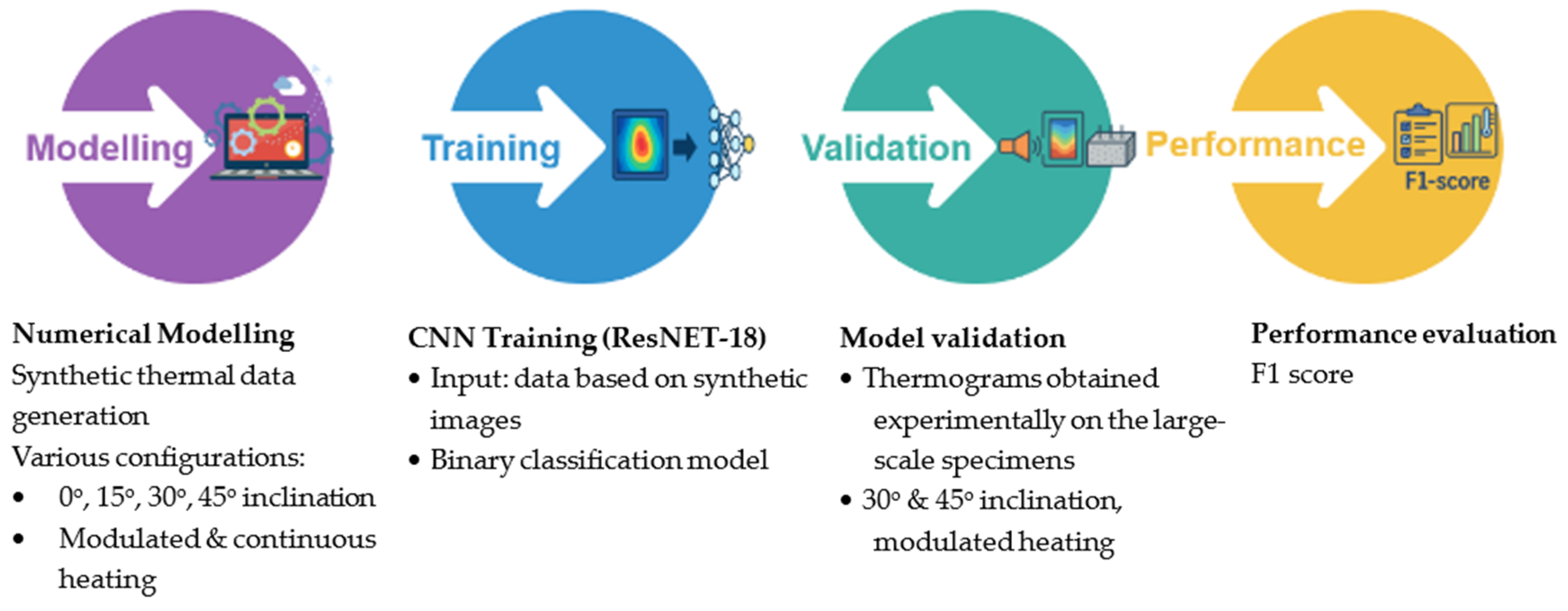
33]. The use of numerically generated data in the training process offers several key advantages. First, it enables the creation of large, diverse, and precisely labeled datasets that would be prohibitively time-consuming or impractical to obtain through physical experiments alone. This includes full control over variables such as rebar spacing, depth, inclination, and concrete properties, allowing the network to learn from a broad range of scenarios and improve its generalization capability. Second, numerical simulations are noise-free and repeatable, which supports stable and efficient convergence during network training. Third, synthetic data can be systematically augmented and adapted to test specific hypotheses or sensor configurations, making the approach highly flexible and scalable. Moreover, simulation-based training can serve as a valuable tool in early-stage development, where experimental data is limited or unavailable. Finally, by modeling the underlying physics of microwave heating and thermal responses, numerical datasets can expose the neural network to subtle but physically meaningful patterns that may be difficult to isolate in empirical data alone. The network was designed to detect and localize steel bars within thermal images, learning to recognize the subtle features associated with rebar-induced heat accumulation and electromagnetic effects. Following training, the model was evaluated on a separate set of experimental thermal images, acquired from real concrete specimens with known rebar layouts, heated using microwave excitation under controlled conditions. Detection accuracy was assessed using the F1-score, a harmonic mean of precision and recall that provides a balanced measure of binary classification performance. In the best test cases, the network achieved F1-scores exceeding 0.9, demonstrating excellent agreement with ground truth and confirming the effectiveness of the simulation-based training approach. The step-by-step approach employed in this research is presented in
Figure 1.
In summary, this study presents a data-driven methodology for non-contact, automated detection of reinforcement bars in concrete using thermal imaging under microwave excitation. The approach addresses limitations of traditional NDT techniques by leveraging both physical modeling and artificial intelligence to improve interpretability, efficiency, and scalability. While this work focuses on rebar localization, the framework can be extended in the future to support the estimation of geometric parameters or detection of defects such as corrosion or voids, contributing to more intelligent infrastructure assessment tools.
2. Numerical Modelling
To investigate the thermal response of reinforced concrete under microwave excitation, we employed a two-stage approach combining numerical simulation with experimental verification. The first stage focuses on computational modeling, where we developed a simulation environment capturing key aspects of the physical setup. The central aim of the numerical modeling performed in this study was to generate a set of synthetic thermal images to be used for training a convolutional neural network (ResNet-18) tasked with detecting the position of reinforcement bars within concrete structures. The thermograms were not intended as isolated simulations for analytical evaluation but rather as a curated dataset reflecting controlled physical conditions under which specific surface thermal signatures emerge due to microwave excitation.
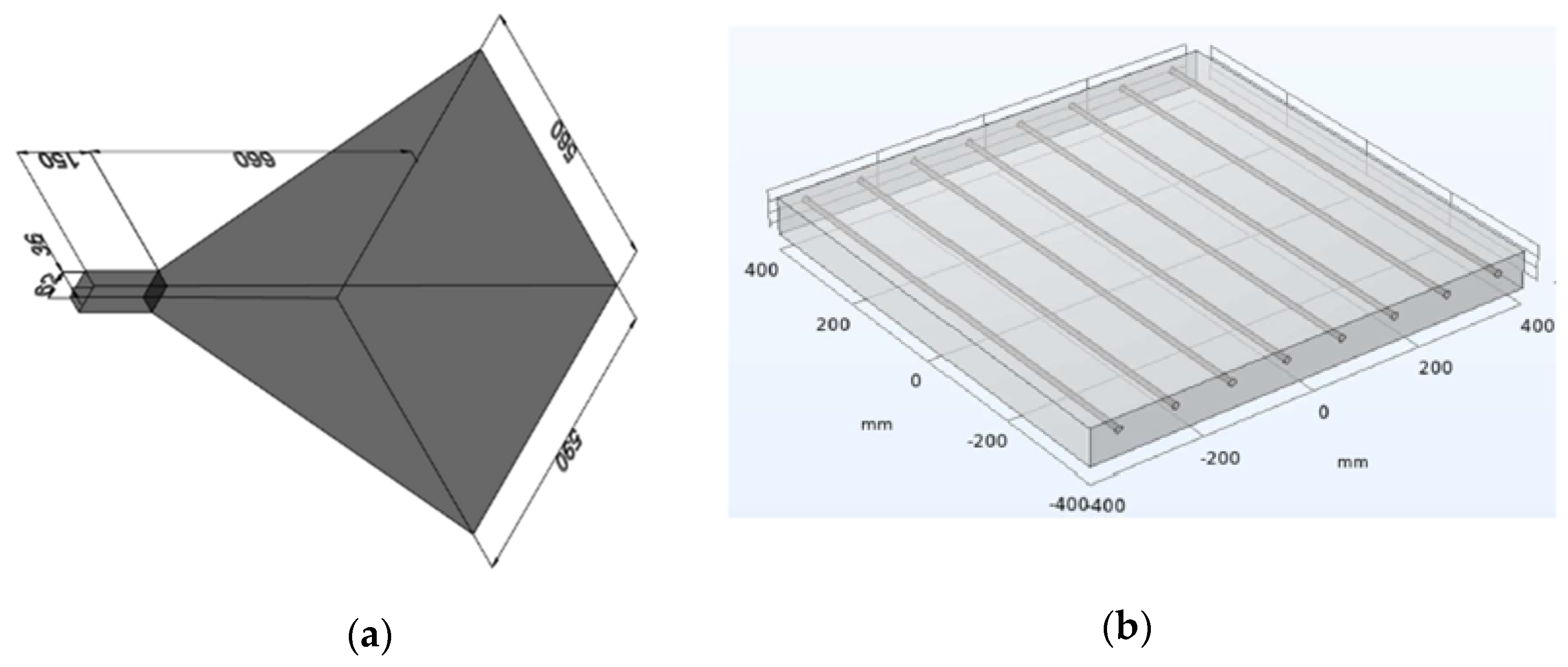
The simulated system included a broadband aluminum horn antenna as the microwave radiation source and a reinforced concrete slab containing eight parallel steel rebars. The layout of the reinforcement bars remained constant throughout all simulations: the bars had a diameter of 12 mm, were arranged with 100 mm spacing, and were embedded in a concrete block measuring 800 mm × 800 mm × 65 mm, with a 15 mm cover layer above the rebar on the side facing the antenna. These particular elements of the setup are presented in
Figure 2.
The variations introduced in the simulations are related to external measurement conditions and geometry. Specifically, two modes of microwave excitation were considered:
Continuous mode, in which power was supplied at a constant rate over a fixed duration;
Modulated mode, where the input power followed a predefined periodic function.
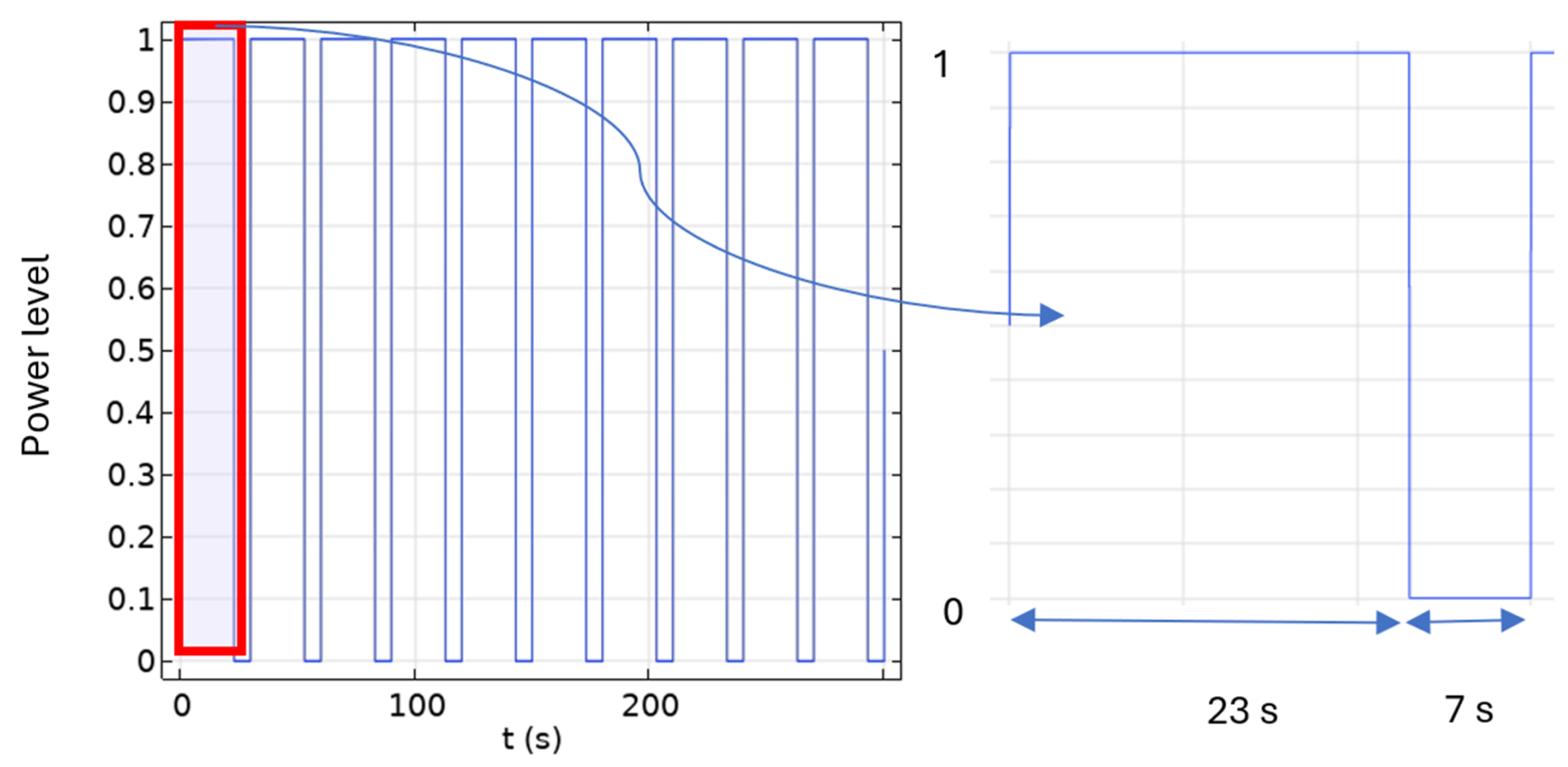
In the modulated mode, the power input was governed by a cyclical pattern, as depicted in
Figure 3. The modulation protocol implemented a 30 s repeating cycle, consisting of 23 s of sustained maximum power delivery, followed by a 7 s interval during which no power was applied.
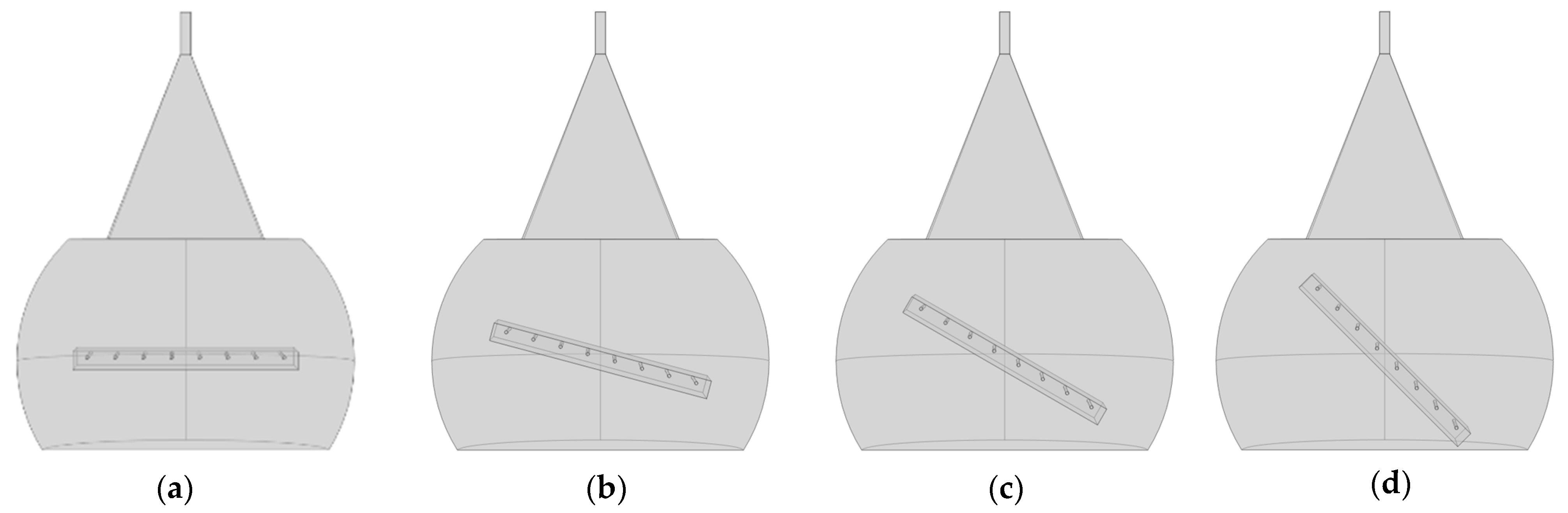
Additionally, the orientation of the specimen with respect to the antenna was systematically varied. Different angles of inclination were modeled to analyze how the spatial relationship between the antenna and sample affects the microwave energy distribution, and consequently, the resulting thermal pattern on the surface. Precisely speaking, the angle between the sample and the antenna was parameterized in the conducted simulation, taking on four values: 0, 15, 30, and 45 degrees, as illustrated in
Figure 4.
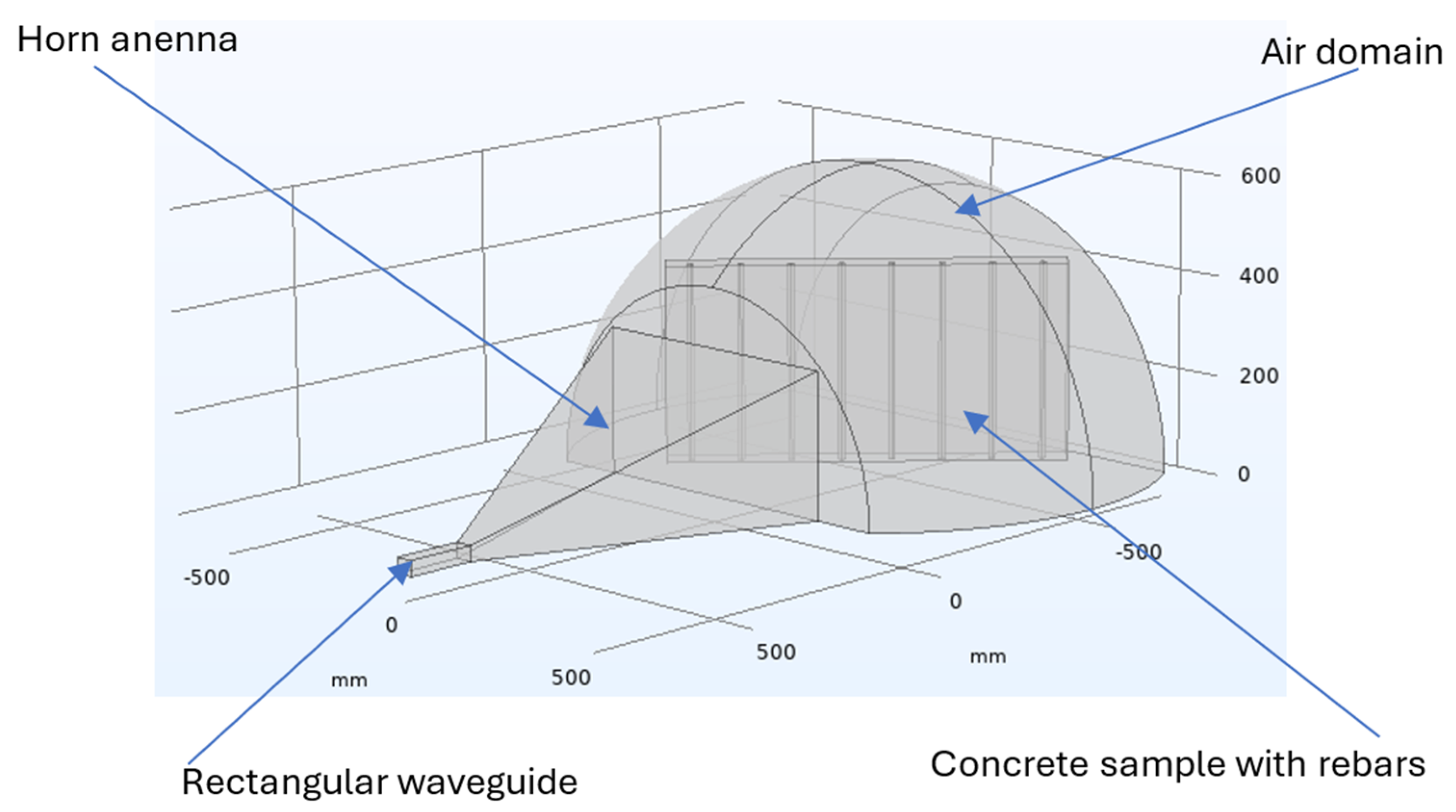
Simulations were carried out using COMSOL Multiphysics 6.3, which allowed us to couple electromagnetic wave propagation with transient heat transfer in a unified finite element framework. Of particular importance was the thermal behavior of the concrete immediately above the reinforcement bars. While microwaves do not significantly penetrate or directly heat the steel (due to its extremely low skin depth), the steel acts as a thermal and electromagnetic disturbance. It impedes heat dissipation into the bulk material and causes localized heating of the concrete layer above. Moreover, due to the conductive nature of the steel, electromagnetic wave interference and diffraction were observed, further influencing the surface temperature distribution. The geometry of the proposed numerical model is depicted in
Figure 5.
In the designed model, the electromagnetic wave propagation in the computational domain is described by the Helmholtz equation [
34]:
where
μ denotes the magnetic permeability,
ϵ is the electric permittivity,
σ represents the electric conductivity,
ω is the angular frequency, and E is the electric field vector. This formulation accounts for both dielectric and conductive losses, which are critical for modeling wave interactions within heterogeneous materials like reinforced concrete.
Thermal behavior is governed by the heat equation [
35]:
where
ρ is the material density,
Cp denotes the material heat capacity,
q is the heat flux associated with the convection phenomenon,
T is the temperature, k denotes the thermal conductivity, and Q denotes the external heat source. The electromagnetic loss-induced heat source is defined as follows [
34]:
where Re indicates the real part of the value. The simulations considered two excitation modes: continuous and modulated. In both cases, the heat source was applied across the entire sample, encompassing both concrete and steel. For continuous heating, the total electromagnetic loss was used directly. For modulated heating, the loss was scaled by a time-dependent function (see
Figure 3) to mimic periodic power variations. The model used a TE
10 mode at 2.45 GHz, a standard ISM frequency, with a 300 s heating duration. Excitation was applied via a port boundary condition on one waveguide wall, replicating the experimental setup. The key material parameters used in the model are summarized in
Table 1.
The generated thermograms were used as the exclusive input for training the deep learning model, allowing the network to learn and generalize spatial and thermal cues associated with rebar locations. This simulation-driven approach enabled efficient, repeatable dataset generation without the need for extensive experimental annotation, while maintaining physical realism and measurement relevance.
3. Experimental Methodology
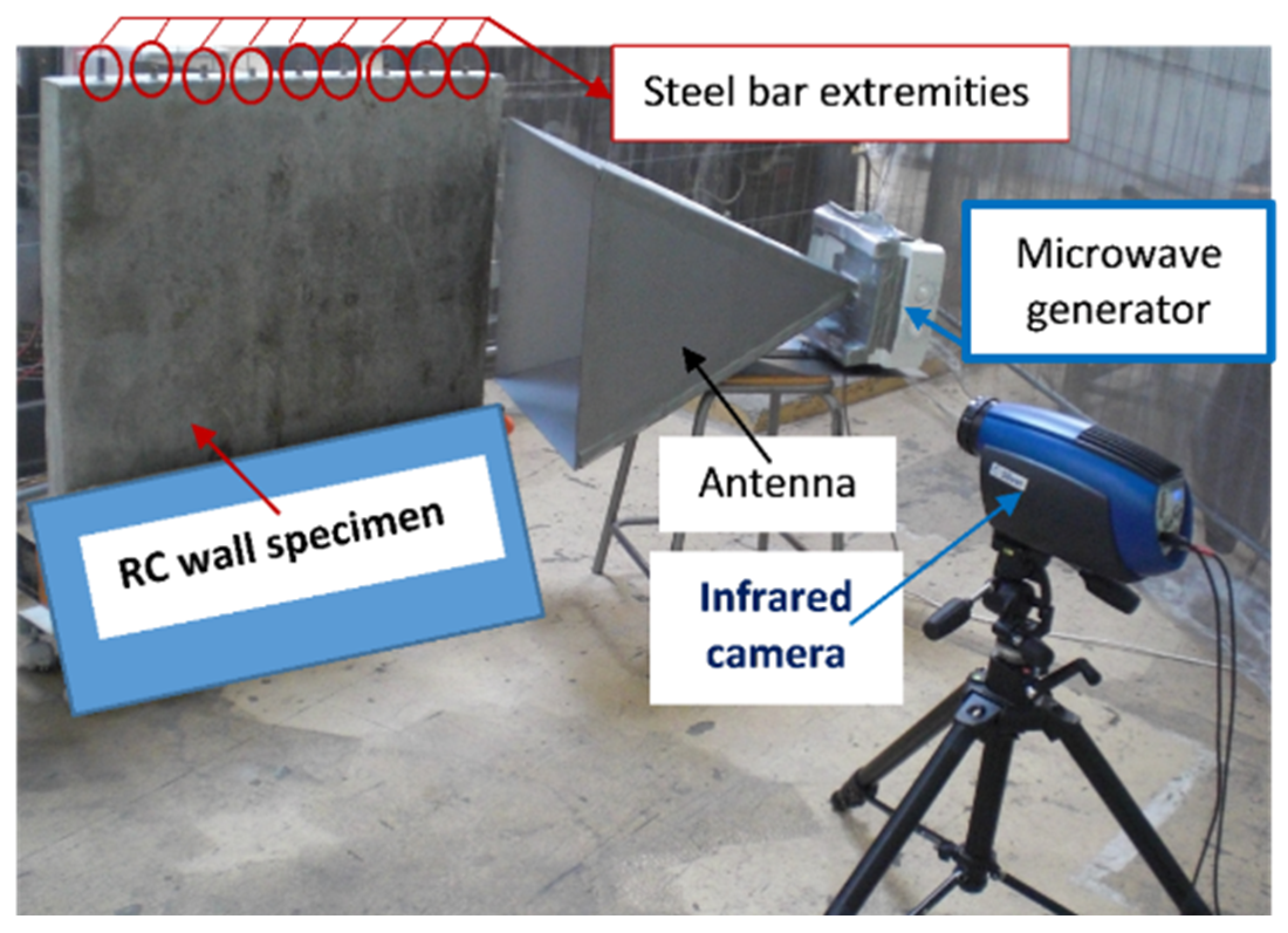
Two experimental campaigns were carried out to investigate the thermal response of a reinforced concrete (RC) wall subjected to microwave heating, using a setup designed to closely replicate the conditions modeled in the numerical simulation. The RC specimen featured exposed ends of steel reinforcement bars extending from the top surface, enabling accurate identification and tracking of each bar throughout the experiment. This configuration was essential for analyzing the thermal behavior of the embedded reinforcement. The experimental apparatus is depicted in
Figure 6.
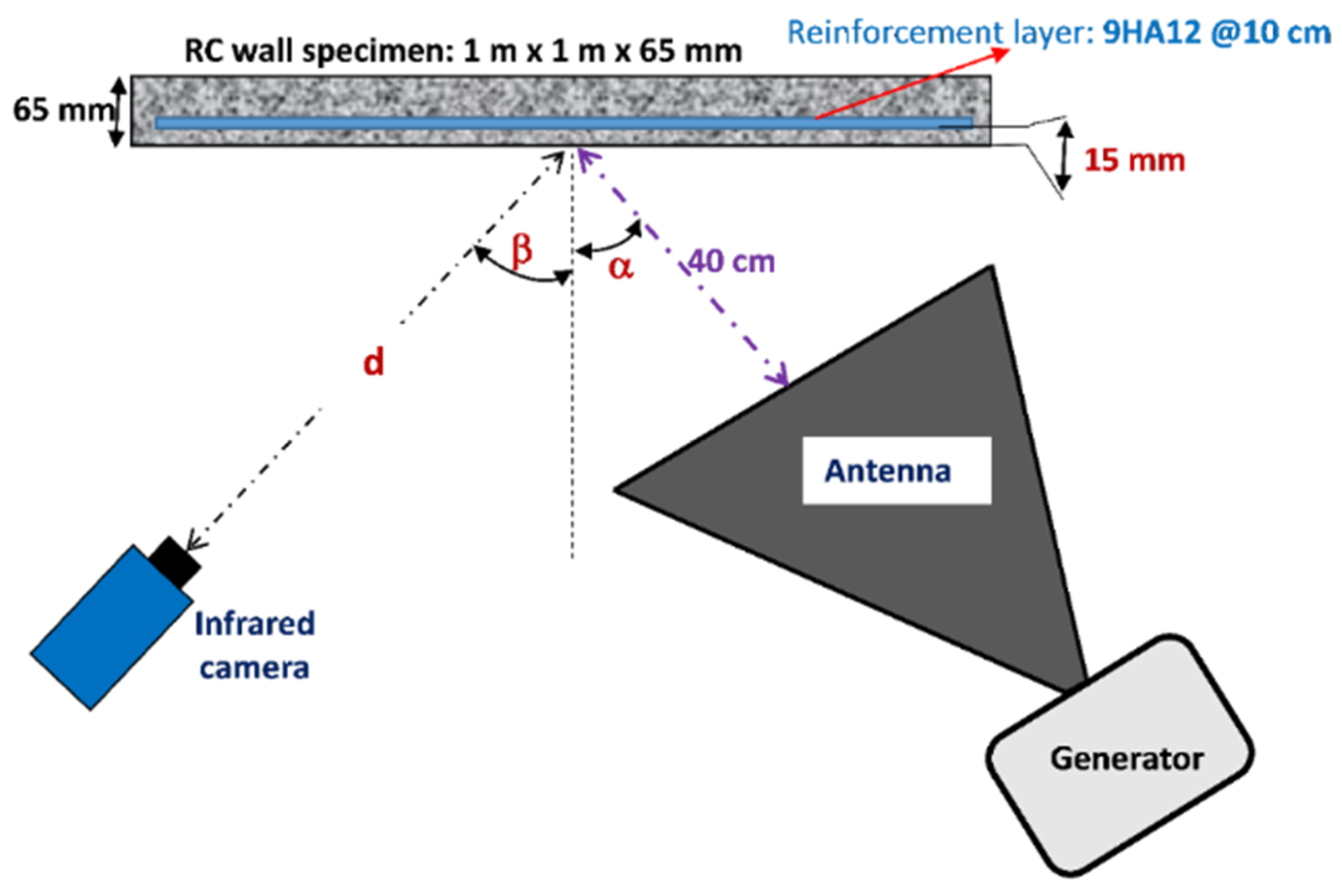
A 2.45 GHz microwave system, matching the configuration of the numerical model, was employed to heat the RC wall specimen. The test was conducted exclusively in modulation mode, applying an average power of 600 W over 300 s. The wall incorporated nine steel bars (12 mm diameter) spaced at 100 mm intervals within the concrete, enabling the assessment of thermal effects across different reinforcement positions. The concrete cover facing the antenna measured 15 mm, reflecting common structural configurations and allowing the evaluation of microwave penetration. Microwave energy was delivered via a pyramidal horn antenna positioned 40 cm from the wall surface. Two antenna orientations were tested to investigate directional heating effects: 30° (α) and 45° (β), as shown in
Figure 7.
Thermal data were captured using an infrared camera operating at 5 frames per second, ensuring precise monitoring of temperature evolution. For each antenna orientation, the camera was placed in two distinct positions to ensure full surface coverage. When the antenna was set at 30° (α), the camera was located 2.11 m away along the 45° (β) direction; conversely, for a 45° (β) antenna position, the camera was placed 2.32 m away in the 30° (α) direction. This arrangement provided comprehensive and angle-sensitive thermal imaging. In the experimental investigations, only one microwave heating mode was employed—modulated heating—where the periodic function matched that used in the simulations (see
Figure 3).
4. Results of Numerical and Experimental Approaches
This section presents a comparative analysis of the thermograms obtained from both numerical simulations and experimental measurements. The numerical results encompass two microwave heating modes—continuous and modulated—and cover all antenna-to-sample angles considered in the study. In parallel, experimental thermograms are provided for two antenna orientations, allowing a direct comparison between modeled and observed thermal responses under varying exposure conditions.
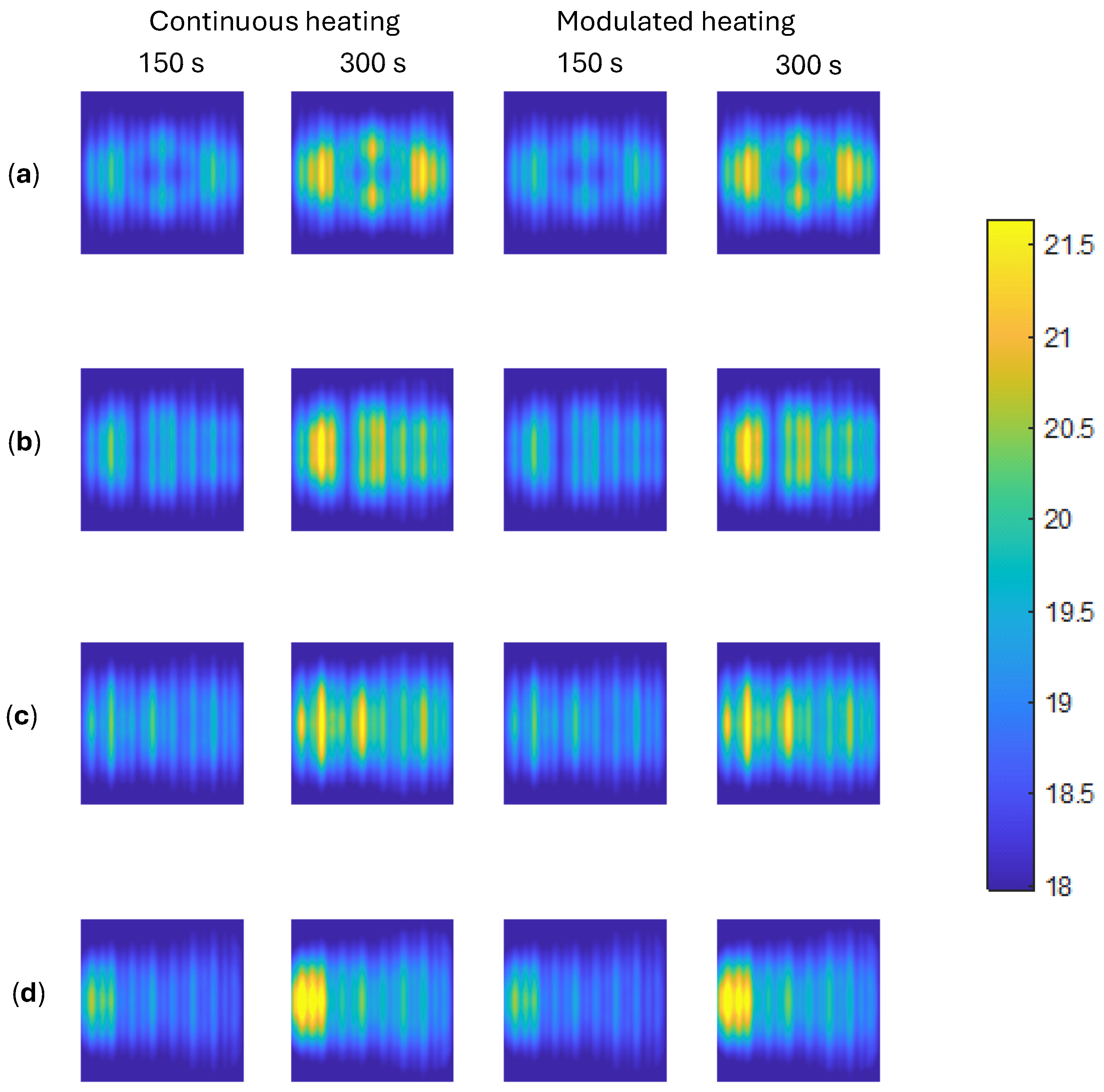
Figure 8 illustrates the outcomes of the numerical simulations at selected time points. The thermograms display temperature distributions marked by characteristic stripe patterns, which correspond to the locations of steel reinforcement bars embedded within the concrete. Despite this visual correlation, accurately pinpointing the exact positions of the bars remains challenging. This limitation stems from non-uniform heating, which is significantly affected by the directional radiation pattern of the microwave antenna and the inclined orientation of the samples with respect to the source. The figure further compares thermal fields for both heating strategies—continuous and modulated. The spatial distribution of temperature in both cases remains largely consistent, with no pronounced differences in how heat propagates through the sample. This suggests that microwave power modulation has minimal influence on the resulting temperature patterns within the concrete.
Moreover, a detailed comparison of the peak temperature values between the two heating modes shows negligible discrepancies, with variations not exceeding a few tenths of a degree Celsius. These results indicate that the intermittent power delivery that is characteristic of modulated heating does not lead to significant cooling during off cycles. Instead, the inherent thermal inertia of the concrete maintains heat accumulation at levels comparable to those achieved with uninterrupted (continuous) power input.
In the experimental component of the study, only the modulated heating mode was employed. The applied modulation profile replicated the periodic function used in the simulations (refer to
Figure 3), ensuring consistency between the numerical and physical testing conditions.
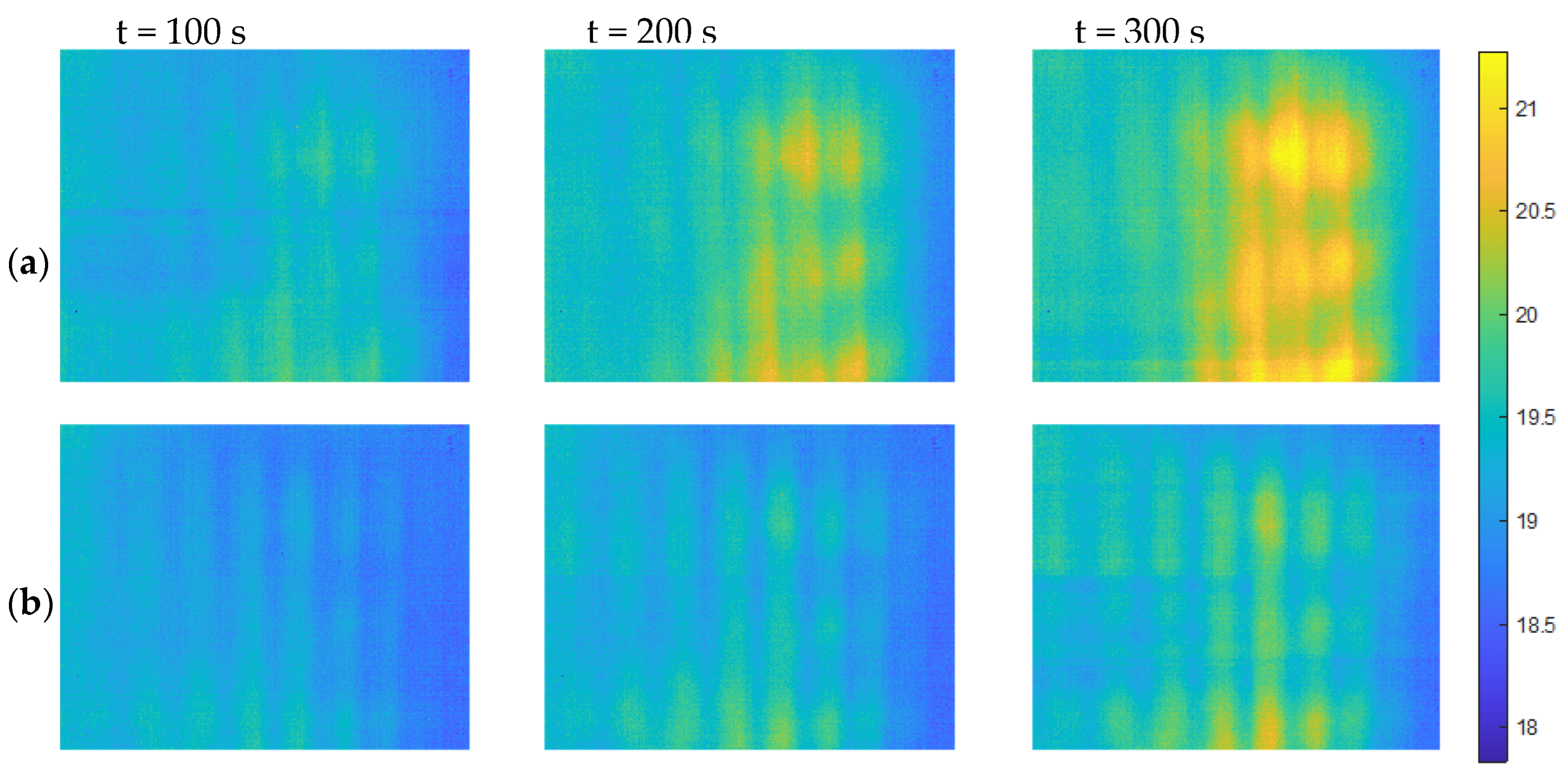
Figure 9 presents the unprocessed infrared measurements for the two experimental configurations: one with the sample oriented at a 30° angle and the other at 45° relative to the antenna. These images capture the surface temperature distributions over time, offering direct insight into the development of heating patterns during microwave exposure. To enhance clarity and focus the analysis, the recorded thermographic data were cropped to isolate the region of interest—namely, the heated surface of the concrete specimen. Consistent with the numerical results, the experimental thermograms reveal a striped temperature pattern indicative of the embedded steel reinforcement. These patterns highlight the influence of the reinforcement on local heat dissipation, confirming its role in shaping the surface’s temperature distribution. However, the images also exhibit signs of non-uniform heating, which can be attributed to the directional radiation characteristics of the horn antenna and the angular positioning of the sample relative to the microwave source. These factors lead to uneven energy distribution across the surface, which, in turn, reduces the sharpness and clarity of the reinforcement’s thermal signature in the recorded data.
As can be clearly observed from the direct comparison of
Figure 8c,d with
Figure 9a,b, the results of the numerical modeling differ visually from the experimental findings. Although the characteristic pattern of temperature bands—closely corresponding to the position of the reinforcement—is preserved in both cases, and the temperature ranges are in close agreement (with a maximum temperature of 21.6 °C in the numerical results and 21.4 °C in the experimental data), the distribution of these bands varies to some extent. This discrepancy arises primarily from the inherent differences in how the data were obtained. The numerical results represent the simulated surface temperature distribution of the specimen, while the experimental data were acquired using a thermal imaging camera with a specific accuracy, positioned at an angle relative to the specimen and at a considerable distance (precisely 2.32 m). Moreover, the numerical model was developed using predefined material properties obtained from the literature, which, although representative, may not precisely match the properties of the materials used in the physical specimen. The model further assumes an idealized configuration, including perfectly aligned reinforcement bars and a uniform concrete cover thickness throughout the structure. In reality, small deviations in bar placement or variations in cover thickness can have a local impact on heat distribution, which the model does not capture. Additionally, the numerical simulation does not account for all environmental influences present during the experimental measurements, such as ambient air movement, humidity, or varying emissivity due to surface conditions, all of which may affect the accuracy of thermal imaging data. Nevertheless, for the purpose of this study, it is sufficient that the numerical results replicate the overall trends observed in the experimental data. That is, the temperature maxima should coincide with the actual locations of the reinforcement bars, the average temperature in the vicinity of the reinforcement should be comparable, and—most importantly, as demonstrated in the following
Figure 10 and
Figure 11—the temperature–time characteristics of the averaged temperature within the reinforced zones should exhibit a similar profile in both the numerical and experimental results.
Figure 10 and
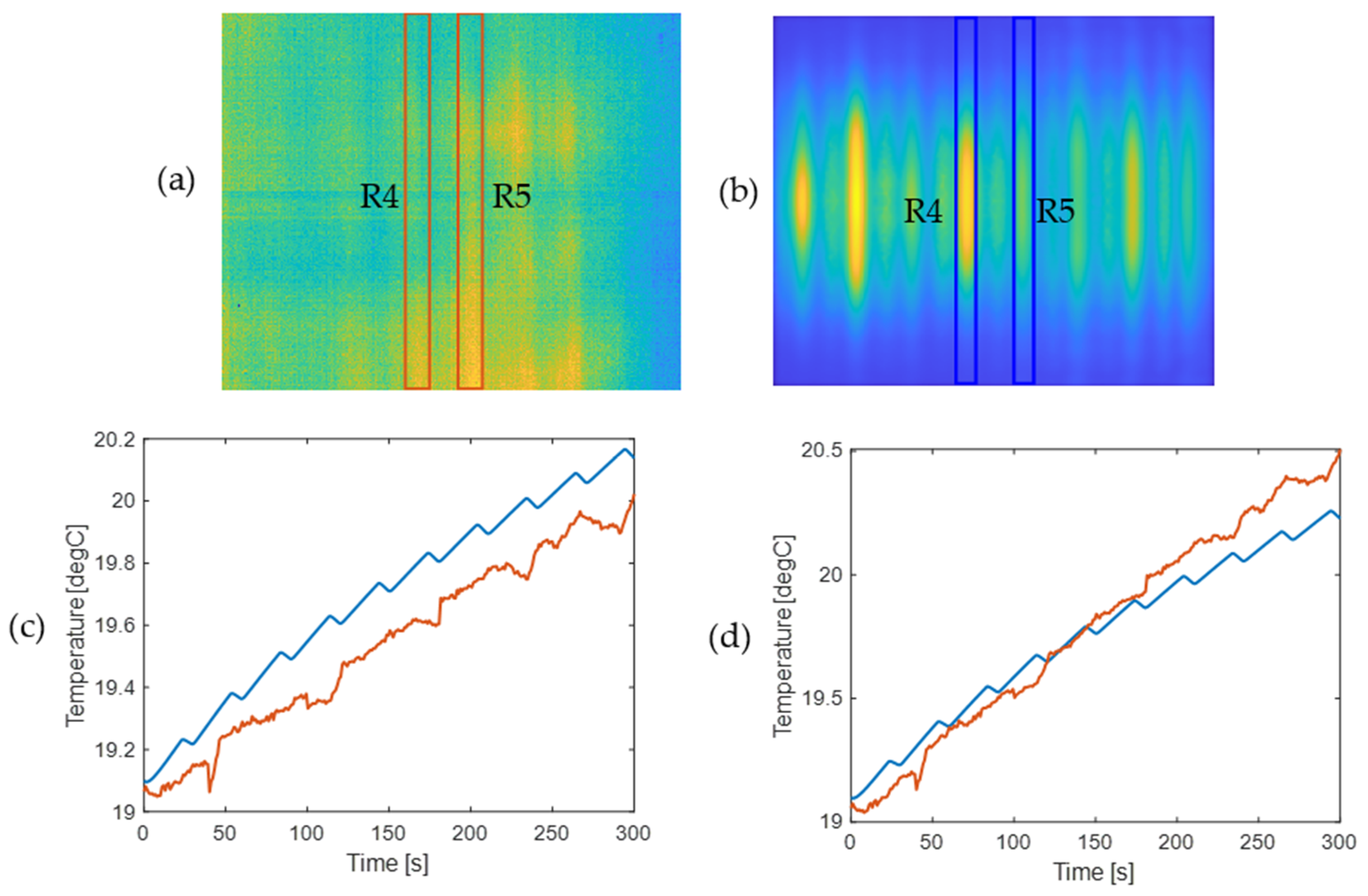
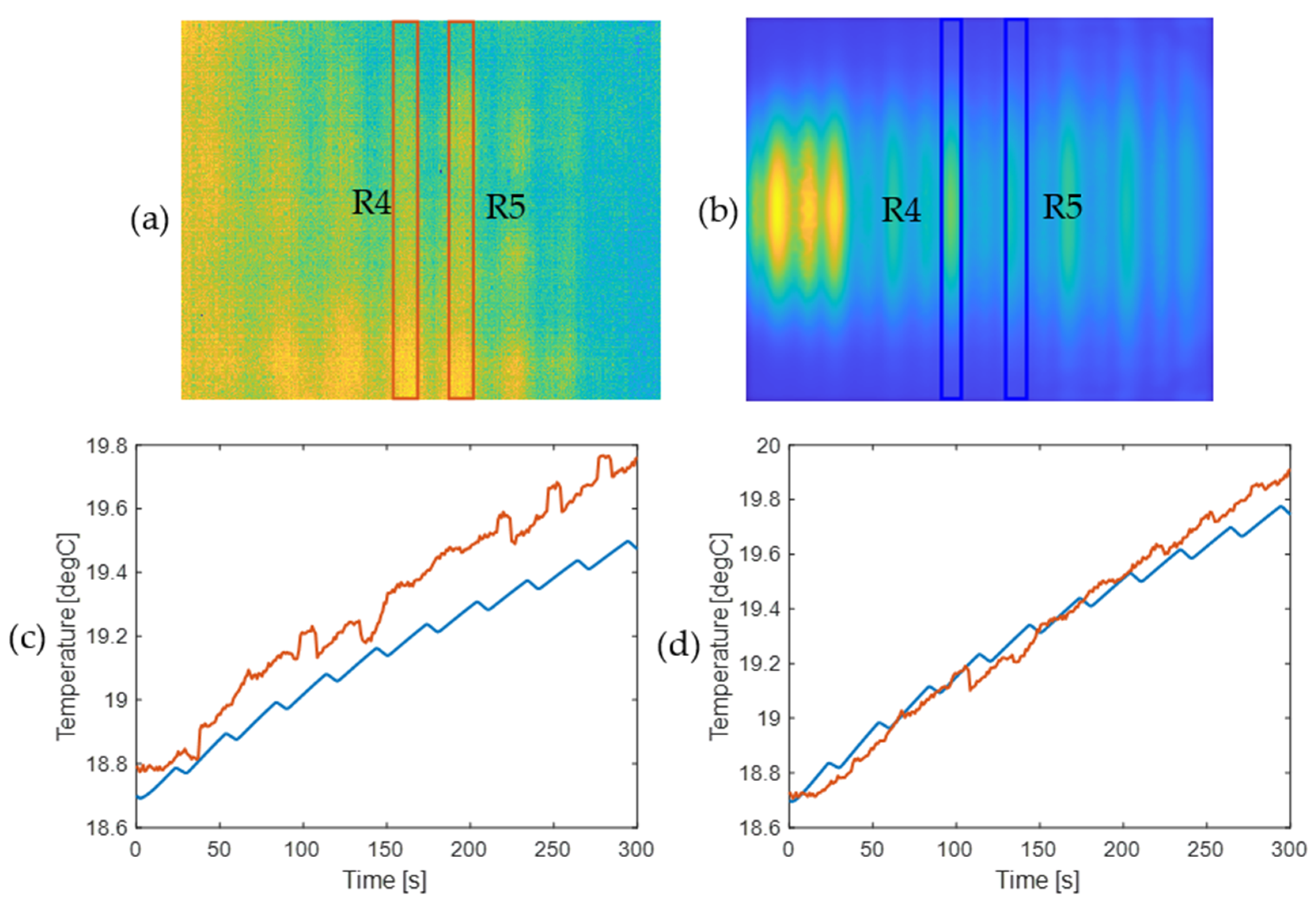
Figure 11 illustrate the comparison between the numerical and experimental time–temperature characteristics for two selected reinforcement bars, R4 and R5, in two analyzed configurations with bar inclinations of 30° and 45°, respectively. The temperature profiles were obtained by averaging the temperature values over designated regions surrounding the reinforcement bars, as marked on the thermograms. In the case of the 30° configuration,
Figure 10a shows the experimental thermogram with the locations of rebars R4 and R5 clearly indicated, while
Figure 10b presents the corresponding numerical thermogram with the same areas marked.
Figure 10c,d displays the resulting time–temperature curves for rebar R4 and R5, respectively, with blue lines representing the numerical data and red lines representing the experimental measurements. Similarly, for the 45° configuration, the thermographic regions used for averaging are shown on the experimental thermogram in
Figure 11a and on the numerical thermogram in
Figure 11b. The corresponding time–temperature characteristics for R4 and R5 are presented in
Figure 11c,d, respectively.
As evidenced by the plots, the numerical and experimental results show strong agreement, particularly in terms of the overall trend of temperature increase over time. The shape and slope of the curves remain consistent across both approaches. Moreover, the observed deviations between the two datasets do not exceed 0.3 °C in any of the analyzed cases, which confirms the reliability of the numerical model for capturing the thermal behavior in the vicinity of the reinforcement bars under the given conditions.
5. Rebars’ Detection Methodology and Results
The accurate detection of reinforcement bars within concrete structures is essential for structural diagnostics and integrity assessment, particularly when employing non-destructive testing methods such as active microwave thermography. However, the interpretation of thermographic images obtained through microwave excitation is inherently complex. As shown in the previous section, the observed temperature patterns are not a direct representation of the reinforcement layout; instead, they result from intricate interactions between the electromagnetic field and the heterogeneous structure of reinforced concrete. As mentioned earlier, microwaves do not directly heat steel bars more efficiently than concrete. Rather, the presence of reinforcement alters the electromagnetic field distribution, often intensifying heating in the concrete above the bars. This effect, combined with diffraction and interference phenomena, leads to thermographic patterns that are highly dependent on the depth, orientation, and spatial configuration of the rebars. Consequently, the resulting thermal images are difficult to interpret using conventional image analysis techniques. To address this challenge, this study explores the use of convolutional neural networks (CNNs) for automated rebar localization in thermographic data. As a first step, we assess the network’s ability to detect the position of reinforcement bars based on thermal patterns. A distinctive aspect of our methodology is the use of a digital twin—a high-fidelity numerical model replicating the experimental setup—to generate synthetic training data. This approach enables the production of diverse and well-annotated datasets without the need for extensive physical experiments, facilitating efficient and scalable model training.
The following section presents the proposed methodology for rebar detection, outlining the data preparation, network architecture, and training strategy, with a focus on leveraging simulation-based data for real-world applications.
5.1. Training Database Preparation
The dataset used for analysis was derived from thermographic images generated through numerical modeling. These images simulate microwave heating scenarios and serve as the foundation for training the neural network. Two distinct heating modes were represented in the dataset: modulated and continuous. In addition, the images were categorized according to the angular orientation of the sample relative to the antenna, with four angles considered: 0°, 15°, 30°, and 45°. These parameters allowed for the creation of a diverse dataset, encompassing variations in both the heating strategy and geometric configuration, thereby increasing the robustness of the training process.
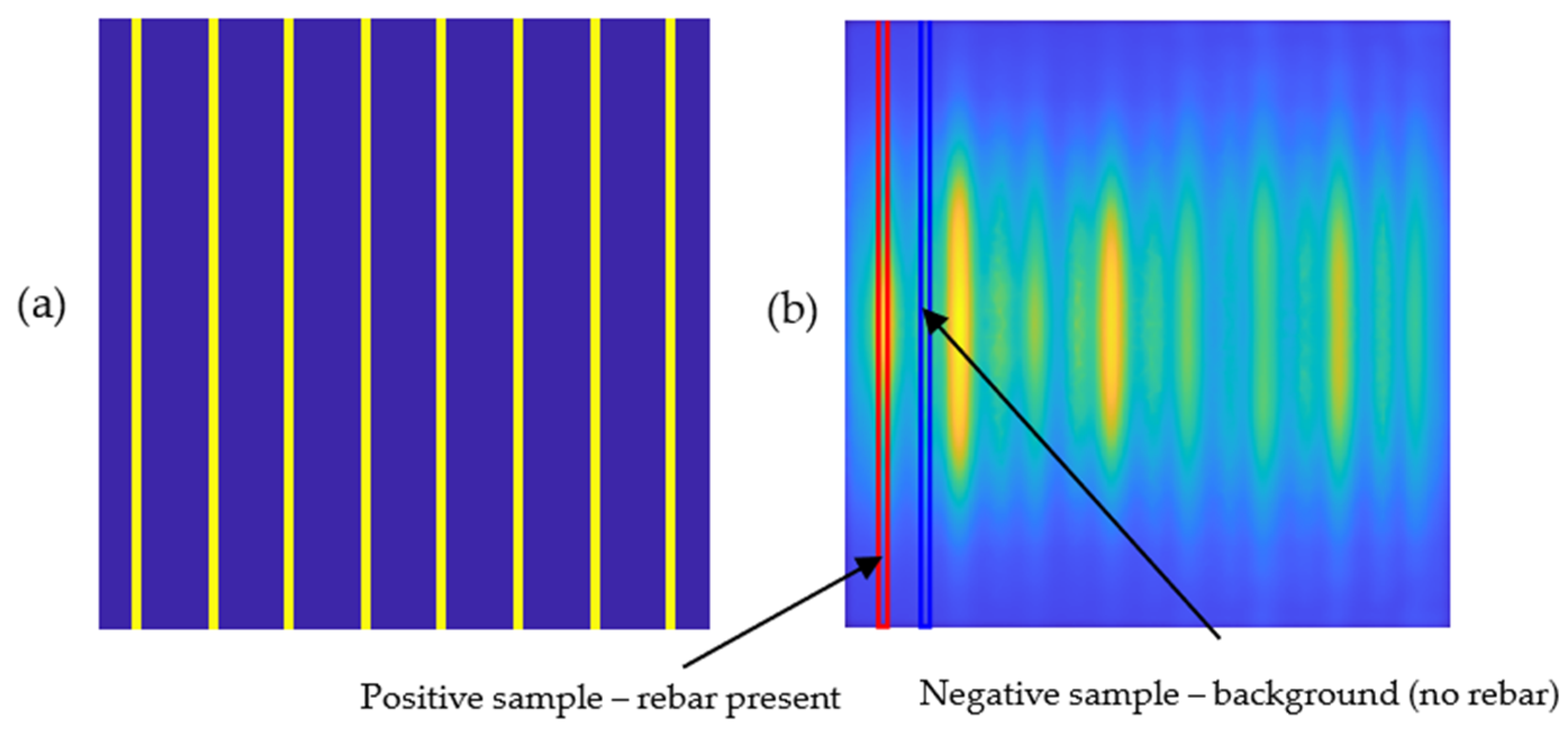
To prepare the data for input into the convolutional neural network, thermal images were segmented into smaller vertical strips measuring 8 × 239 pixels. These fragments corresponded to regions containing heated reinforcement bars and were selected based on reference data that precisely identified the location of the rebars within the sample. To ensure a balanced dataset for binary classification, an equal number of image strips representing areas without reinforcement were randomly extracted (
Figure 12).
As a result, the rebar detection task was formulated as a binary classification problem, distinguishing between regions with and without embedded steel bars. The final dataset comprised two balanced classes, each containing 9600 examples. For the training process, the data were split into three subsets: 70% for training, 15% for validation, and 15% for testing. This partitioning ensured that model performance could be objectively evaluated on unseen data, supporting reliable generalization of the trained network.
5.2. Binary Classification Model
In this study, the ResNet-18 convolutional neural network was employed to analyze thermographic images obtained through active microwave thermography [
36]. ResNet-18, a member of the Residual Network (ResNet) family, introduces a key architectural innovation known as residual connections. These connections help mitigate the vanishing gradient problem that often occurs in deep neural networks, particularly during the training of very deep architectures. Instead of learning direct mapping from input to output, the network learns the residual—that is, the difference between the input and the desired output. This approach facilitates the flow of gradients during backpropagation, allowing for more stable and efficient training, even in deeper networks.
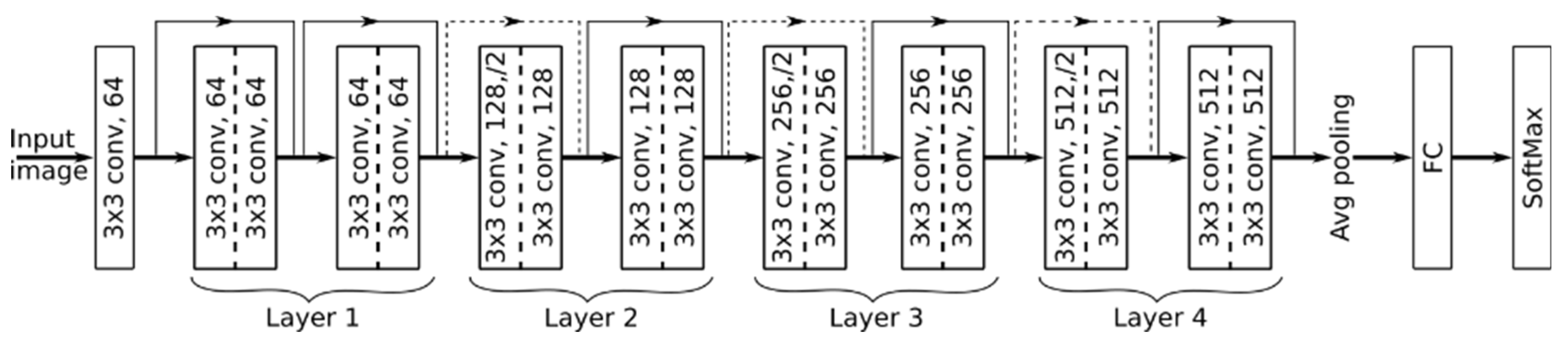
The ResNet-18 architecture consists of 18 layers with learnable weights, including four residual blocks, each comprising two convolutional layers. As the network progresses through these blocks, the number of feature channels increases—from 64 in the initial layers to 512 in the final residual block—enabling the extraction of increasingly complex features from the input images. At the end of the architecture, a global average pooling layer reduces the spatial dimensions of the feature maps, followed by a fully connected classification layer that produces the final output (
Figure 13). This structure is particularly well-suited for image classification tasks, as it balances model depth with computational efficiency, making it appropriate for applications involving moderately sized datasets, such as those used in this work. ResNet-18’s ability to preserve important spatial and semantic features while maintaining training stability makes it an effective choice for the task of detecting embedded reinforcement patterns in thermographic data.
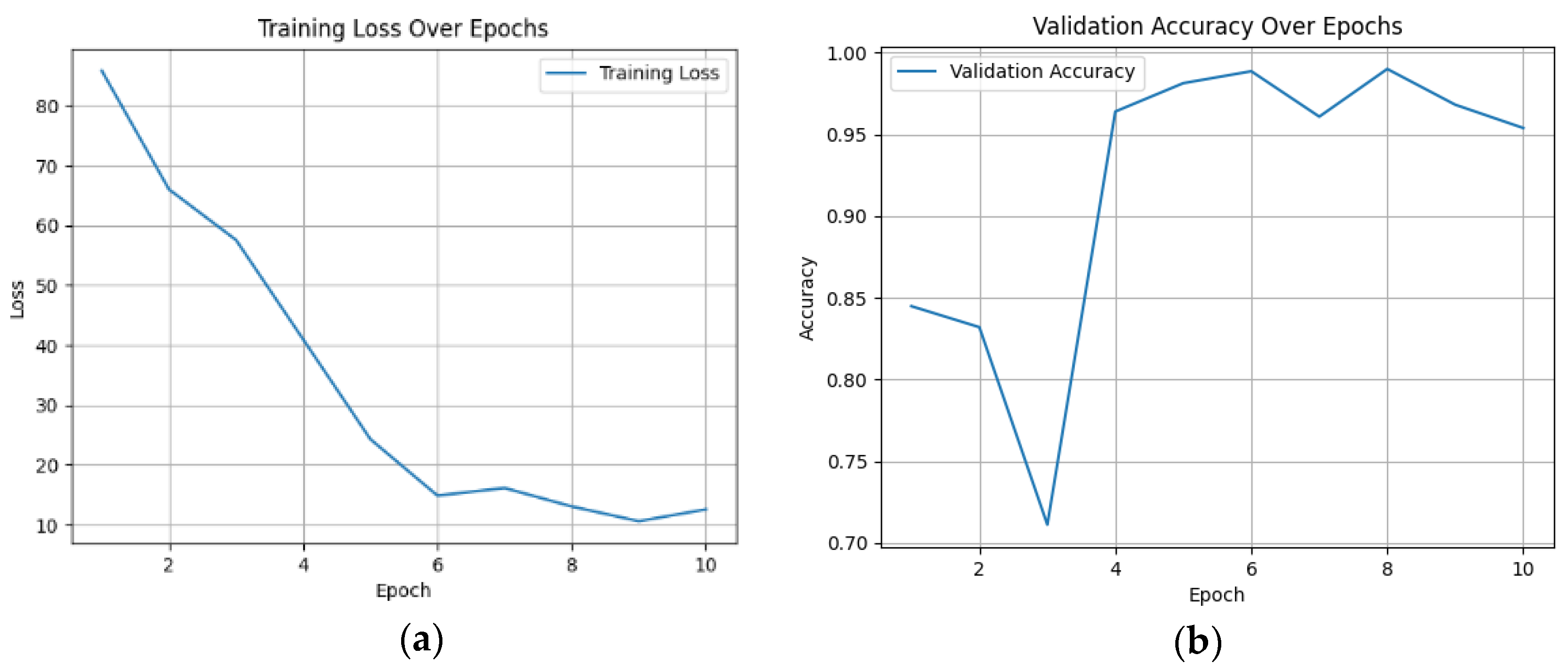
The model training process was carried out over 10 epochs, during which the binary classification network was iteratively optimized using the simulation dataset. The training resulted in high classification accuracy, consistently exceeding 90%, which indicates the model’s strong ability to distinguish between the two target classes. The final size of the trained model is approximately 40 MB, which makes it compact enough for practical deployment while preserving predictive performance. To illustrate the learning dynamics and generalization behavior, the training and validation curves are presented in
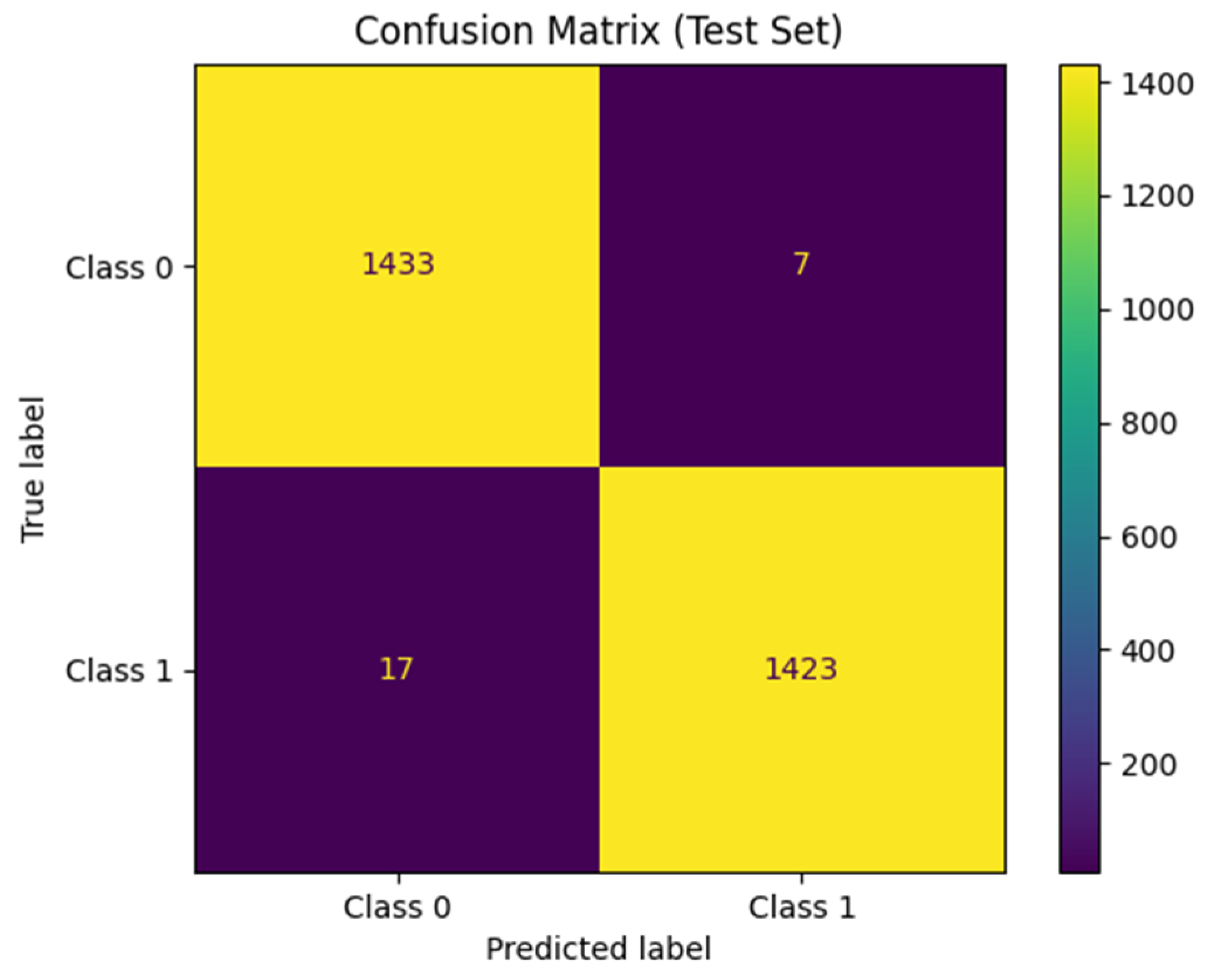
Figure 14. These curves reflect the evolution of the loss function and accuracy metrics over successive epochs. Furthermore, the confusion matrix obtained on the training data is shown in
Figure 15, providing a detailed overview of the model’s classification outcomes.
Following the training phase conducted exclusively on numerically simulated data, the trained model was subsequently evaluated on experimental thermal images to assess its generalization capability and practical effectiveness. As presented in
Section 3 and
Section 4, the experimental data were obtained from two separate measurement setups, which differed in the inclination angle of the antenna relative to the sample surface. Accordingly, two scenarios are analyzed: one with an inclination angle of 30 degrees, and another with 45 degrees. To maintain clarity throughout the discussion, these configurations will be referred to as “Experiment Scenario 30” and “Experiment Scenario 45”, respectively.
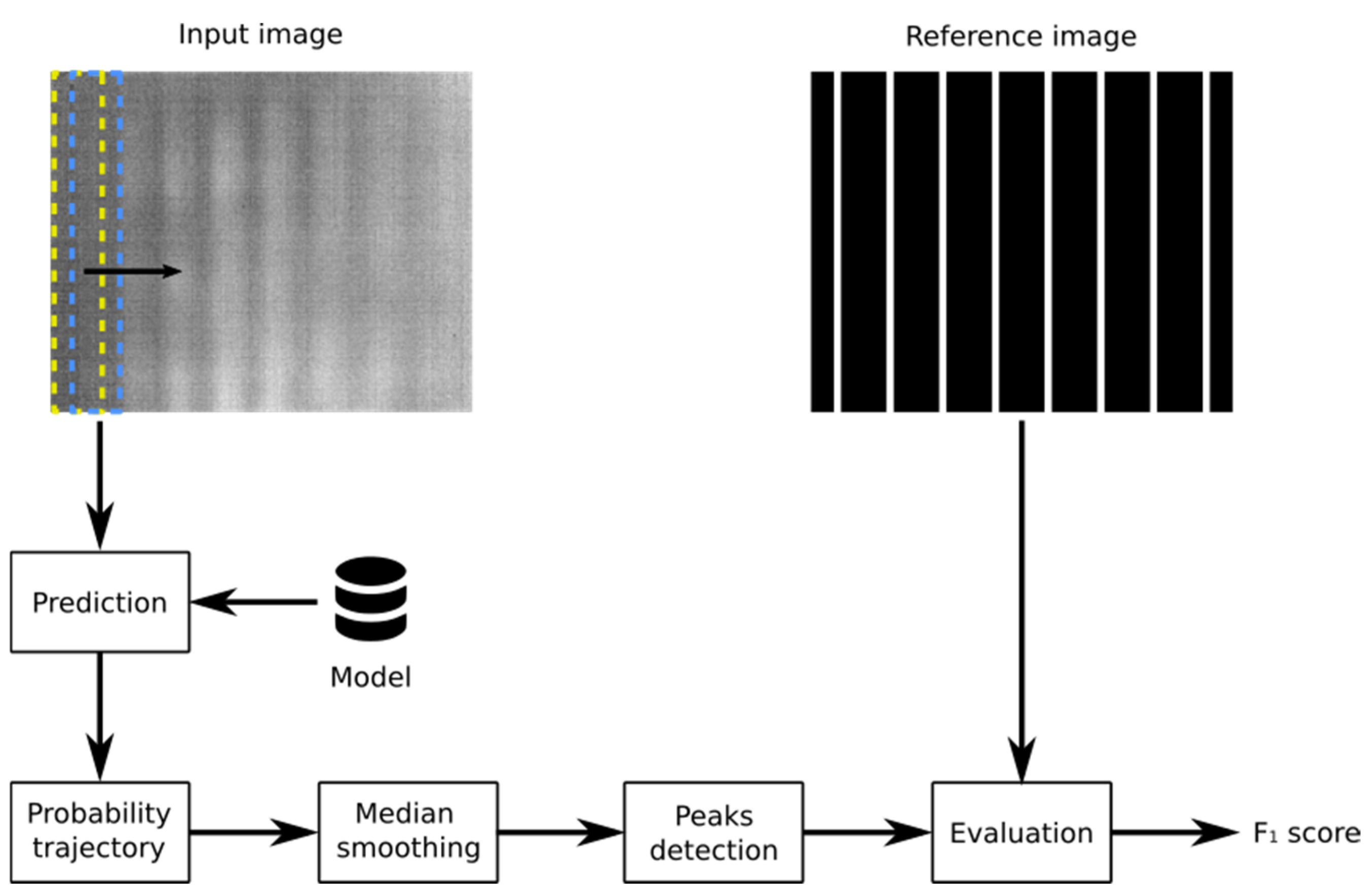
For the thermal images obtained from experiments, a classification procedure was carried out using a sliding window approach. Starting from the left edge of the image, a fragment of fixed size (8 × 239 pixels) was extracted. For each such fragment, a prediction was generated using the previously trained binary classification model. The output of the model at each position was interpreted as the probability of the presence of a reinforcement bar within the corresponding window. The window was successively shifted one pixel at a time along the horizontal axis until the right edge of the image was reached, as depicted in
Figure 16. This process yielded a continuous probability profile across the image, representing the likelihood of rebar presence at each horizontal location.
Notably, variations in this trajectory, and in particular its local maxima, were found to correlate strongly with the actual positions of reinforcement bars, as verified against reference data. In order to eliminate transient noise and improve robustness, the resulting probability signal was then processed using a median filter. Subsequently, peak detection was performed with a defined tolerance margin to identify the most probable rebar locations. Given that each image fragment used for classification spanned 8 pixels in width, a tolerance of 16 pixels was adopted during the evaluation stage to account for possible localization shifts and to assess detection accuracy.
5.3. Detection Performance Evaluation
To evaluate the classification performance, the F1-score metric was employed. The F1-score represents the harmonic mean of precision (P) and recall (R), and is particularly effective in scenarios involving imbalanced classes or when both false positives and false negatives have significant implications [
37]. It is defined as follows:
where
is the precision,
is the recall and TP, FP, and FN denote true positives, false positives, and false negatives, respectively. In addition to this quantitative evaluation, a visual assessment of detection quality was performed using graphical representations of the results.
Figure 17 and
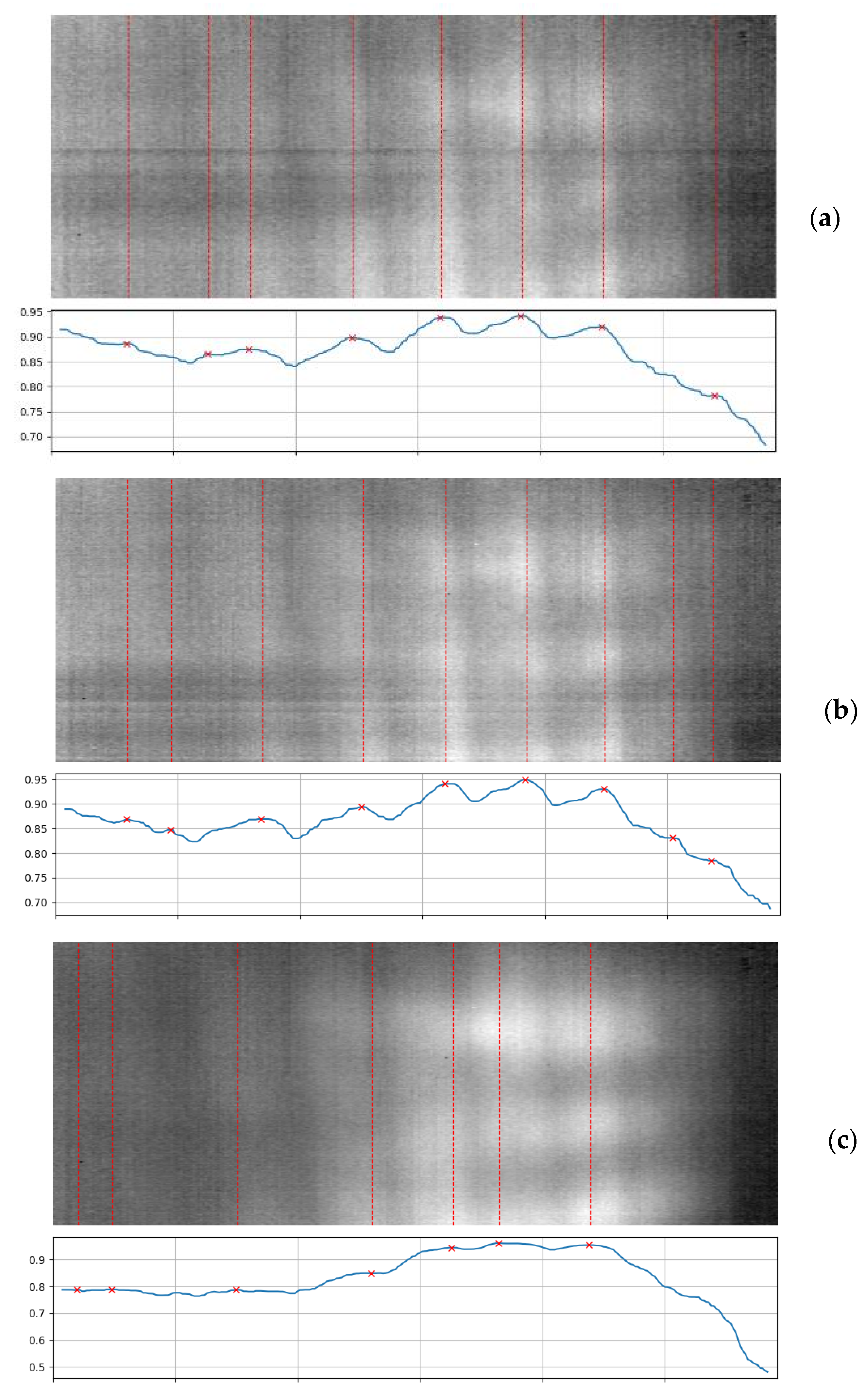
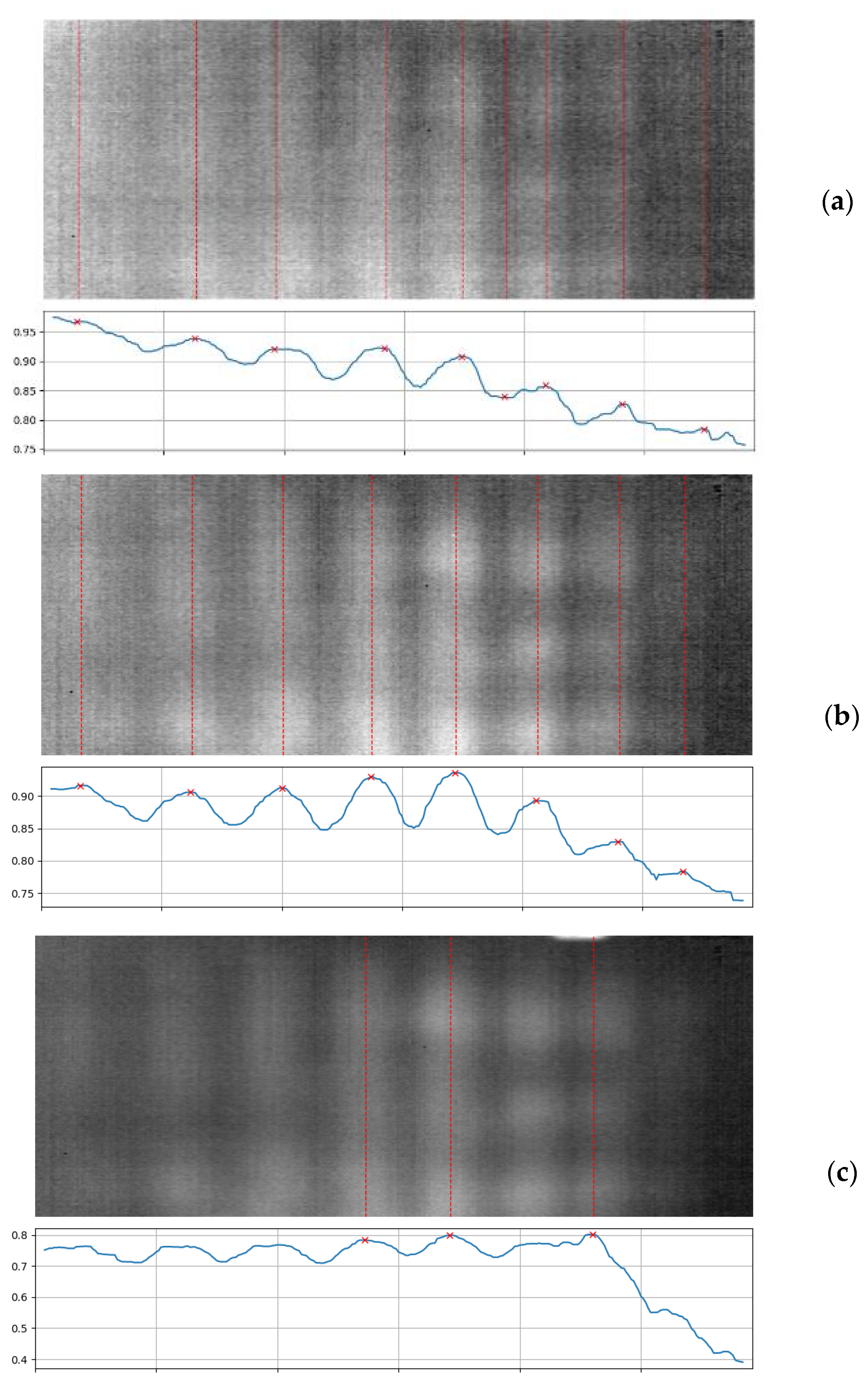
Figure 18 present the outputs obtained for exemplary, chosen thermograms for the case of Experiment Scenario 30 and Experiment Scenario 45, respectively. The top part of each figure shows the thermal image, where vertical bright bands indicate potential reinforcement bars in concrete. Red dashed lines mark the locations identified by the model as containing reinforcement. The lower part of each figure illustrates the probability trajectory, i.e., the output signal of the model across the scanned image. Red ‘x’ markers denote local maxima of the predicted probability, which are interpreted as likely rebar locations. A strong correlation is observed between the bright vertical patterns in the thermal images and the peaks in the probability curves, confirming the consistency between model predictions and visual features.
In
Figure 17a, the probability values produced by the model are generally high, with peaks reaching approximately 0.90–0.92. Well-defined probability spikes correspond to the locations of individual reinforcement bars. The valleys between the peaks are also pronounced, indicating the model’s strong ability to differentiate between rebar regions and background areas. A total of eight reinforcement bars were identified; nonetheless, slight misalignments between the predicted and actual positions were observed, suggesting that while detection was generally successful, the localization precision was not entirely accurate. In
Figure 17b, the reinforcement bars are clearly visible in the thermal image, and the red dashed detection lines closely align with the central axes of the visible bars, suggesting quite accurate localization. The predicted probability values are very high, with several peaks exceeding 0.90 and approaching 0.95. The peaks are sharp and well-separated from the surrounding valleys, which reflects the model’s high confidence and strong signal contrast. In this case, nine bars were detected, which visually appears consistent with the number of observable structures; however, the actual number of bars present is eight, indicating a false-positive detection. In contrast,
Figure 17c illustrates a case with lower detection performance. Although reinforcement bars are still partially visible, they exhibit reduced contrast and a more diffuse structure compared to
Figure 17a,b. This is especially noticeable in the left and right regions of the image, where the bars are poorly defined. The red detection lines show that only three bars were identified, despite the visual presence of approximately eight to nine bars. This corresponds to a high number of false negatives, i.e., missed detections, resulting in low recall. Although the locations of the three detected bars are accurate, many others were not identified by the model. The maximum probability values in this case are substantially lower, reaching only around 0.79–0.80. The trajectory is noticeably flatter, and the peaks are less distinct. The valleys between adjacent bars are shallow, making it difficult for the peak detection algorithm to reliably distinguish rebar regions from the background. In the right portion of the image, the probabilities decrease to approximately 0.50 or lower, suggesting the lack of a detectable thermal response from the reinforcement in those regions. This scenario corresponds to a case with a low F1-score. The reduced performance in this instance may result from the poor quality of the input thermal data. The thermal image may be noisier, with weaker contrast between the bars and the surrounding concrete. Additionally, in Experiment Scenario 30, the bars are not perfectly aligned, which may hinder the effectiveness of the fixed-size sliding window, making it more difficult to accurately capture features of interest. Furthermore, the presence of structural disturbances, such as cracks or surface irregularities, may disrupt the thermal pattern and interfere with the detection process.
For the case of Experiment Scenario 45, where the overall detection performance was superior,
Figure 18a illustrates a situation in which vertical thermal patterns corresponding to reinforcement bars are clearly visible. The red dashed detection lines are largely consistent with the positions of these patterns. One centrally located bar appears somewhat blurred, yet it was successfully detected. The predicted probability values are high, with peaks exceeding 0.90 in several regions. These distinct peaks are well-aligned with individual bars, and the valleys between them are well-defined, indicating the model’s effective ability to distinguish bar regions from surrounding concrete. A total of eight bars were detected, which corresponds exactly to the number of reinforcement elements that are visually observable in the thermal image. This instance represents a high-performance detection case, yielding an F1-score of 1.0. Under the conditions of Experiment Scenario 45, the model demonstrated excellent predictive capabilities.
Figure 18b, also from Experiment Scenario 45, shows similarly strong performance. The reinforcement bars are sharply defined, and the detection lines align accurately with the bar centers. The model predicts consistently high probabilities, with numerous peaks above 0.90, some approaching 0.95. These peaks are sharp and clearly separated, reflecting the model’s high confidence and robustness in localizing the bars. The deep valleys between peaks confirm strong signal contrast. Although nine bars were detected visually, the actual number of embedded rebars was eight, indicating one false positive. Nevertheless, the detection achieves a very high F1-score of 0.9412, suggesting that Experiment Scenario 45 offers optimal imaging conditions for the applied methodology. In contrast,
Figure 18c—also part of Experiment Scenario 45—demonstrates reduced detection accuracy. Although reinforcement bars remain partially visible, they are less distinct and more diffuse, particularly in the right-hand section of the image. Only three bars were detected, while visual inspection reveals many more (approximately eight to nine), implying a high rate of false negatives and thus low recall. The maximum predicted probabilities are considerably lower, reaching only around 0.79–0.80. The signal trajectory is flattened, with less pronounced peaks, and the valleys are shallow, complicating reliable peak discrimination. In the rightmost region, probability values drop to around 0.40, indicating a very weak thermal response. This case is associated with a low-performance outcome, reflected by an F1-score of 0.5455, and underscores the limitations of the detection approach when exposed to noisy thermal data, suboptimal contrast, or structural disturbances. The diminished contrast may stem from poorer thermal image quality, blurred bar outlines, or non-uniform bar alignment, all of which negatively affect the effectiveness of the fixed-size sliding window approach used in this study.
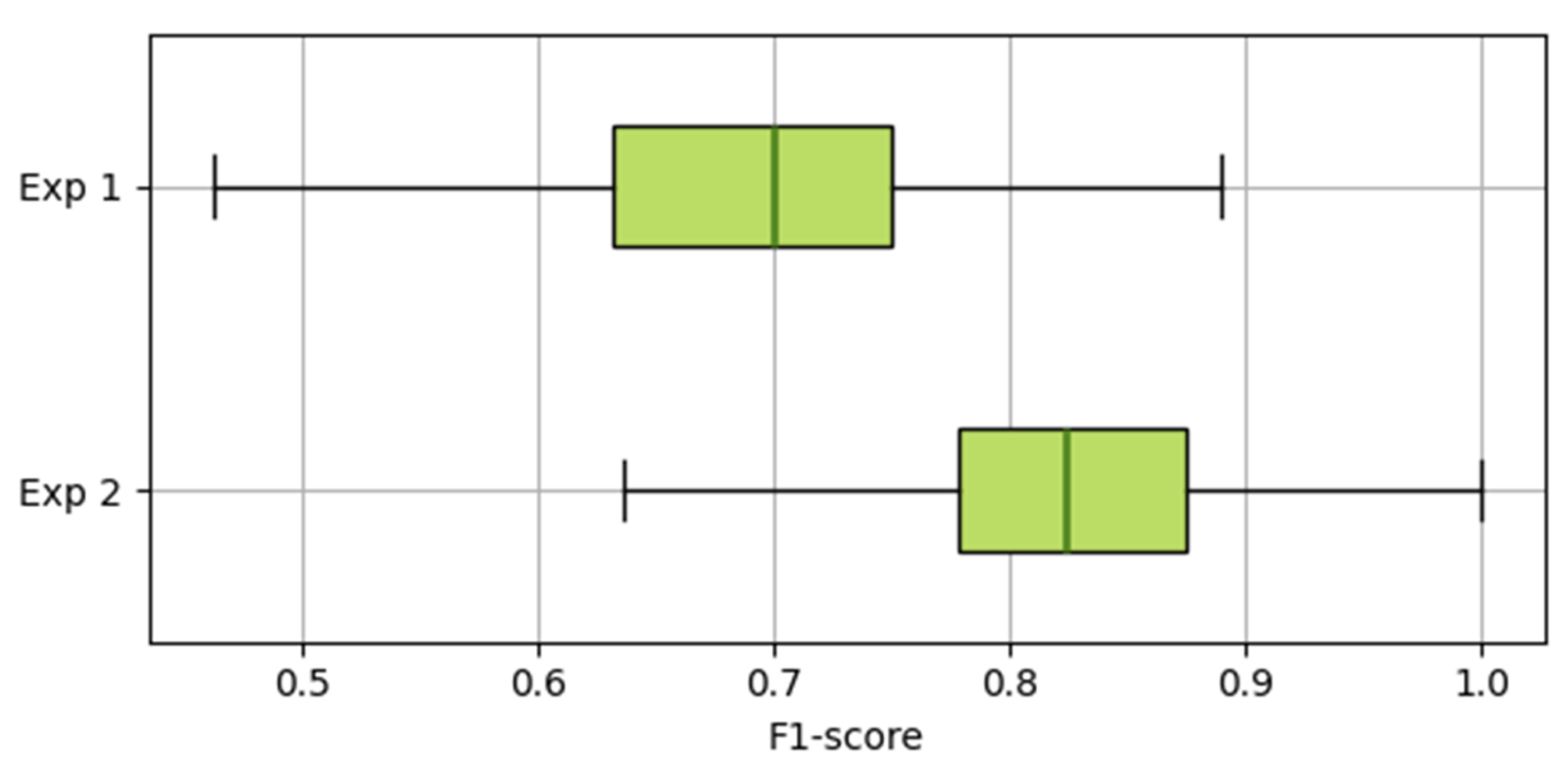
Figure 19 presents a visualization of the distribution of F1-score values for the two experimental configurations: Experiment Scenario 30 and Experiment Scenario 45. It is evident that Experiment Scenario 45 consistently achieves higher F1-score values compared to Experiment Scenario 30. Both the median and the entire distribution for Scenario 45 are shifted to the right, toward higher values. The results obtained under Experiment Scenario 45 are also more stable and consistent, exhibiting lower variability across different samples. This suggests that, regardless of the specific sample analyzed in Scenario 45, the expected F1-score tends to remain close to the median with limited fluctuation. In contrast, the F1-score distribution for Experiment Scenario 30 is significantly broader, indicating greater variability in detection performance. In some cases, the effectiveness drops below 0.5, while in others it may reach levels comparable to the top-performing results in Scenario 45 (approaching 0.9). The maximum F1-score observed—nearly 1.0—was achieved under Experiment Scenario 45, confirming its overall superiority. The chart clearly indicates that Experiment Scenario 45 not only delivers a higher average detection accuracy, but also ensures greater repeatability and robustness of the results compared to Scenario 30.
6. Conclusions
This study presented a novel approach for the detection and localization of steel reinforcement bars in concrete structures using active microwave thermography supported by deep learning techniques. A hybrid methodology was proposed, combining numerical modeling of the microwave heating process with the training of a convolutional neural network to enable automated and robust interpretation of thermal images.
The numerical models were developed to simulate heat distribution in reinforced concrete elements under both continuous and modulated microwave excitation, with different angular orientations between the sample and the antenna. These simulations provided a diverse and controlled dataset of thermographic responses, which served as the training base for a ResNet-18 neural network. The trained model was subsequently evaluated on experimental data acquired under two distinct physical configurations, referred to as Experiment Scenario 30 and Experiment Scenario 45. The detection performance was assessed using the F1-score metric. The results indicate that the model is capable of achieving high detection accuracy, with F1-scores exceeding 0.9 in favorable conditions. Notably, Experiment Scenario 45 consistently yielded superior results, both in terms of average performance and repeatability. In contrast, Scenario 30 exhibited greater variability and a higher incidence of missed detections, particularly when thermal contrast was reduced or the spatial alignment of bars was suboptimal. The findings confirm that the integration of numerical thermography with deep learning offers a promising path toward efficient, non-contact evaluation of internal concrete reinforcement. The proposed methodology enables automated processing of thermographic data, reducing the need for manual interpretation and increasing the objectivity of assessments.
A distinctive feature of this work is the use of large-scale concrete slabs (1 m × 1 m × 65 mm) containing embedded reinforcement, which reflects a more realistic structural context compared to prior studies focused mainly on simple specimens with single rebars. This experimental setup allowed for testing the approach under conditions that more closely approximate field applications, introducing spatial complexity, edge effects, and non-uniform heating that are typical in real structures. Future work will focus on expanding the diversity of simulated training data, improving robustness to noise and structural disturbances, and extending the approach to multi-class classification, such as the estimation of bar diameter or cover thickness. In addition, further experimental campaigns are planned to include more complex and volumetric reinforcement arrangements—such as orthogonal meshes and spatially distributed bars—as well as alternative reinforcement materials, including fiber-reinforced polymer (FRP) bars. These efforts will aim to validate and generalize the proposed method across a broader range of concrete reinforcement scenarios.
Author Contributions
Conceptualization, B.S., M.K. and S.A.K.; methodology, B.S. and M.K.; software, B.S. and M.K.; validation, B.S. and M.K., formal analysis, B.S. and M.K.; investigation, B.S., M.K. and S.A.K.; resources, B.S., M.K., S.A.K., F.B. and D.D.; data curation, B.S. and M.K.; writing—original draft preparation, B.S. and M.K.; writing—review and editing, B.S. and M.K.; visualization, B.S. and M.K.; supervision, B.S., S.A.K., D.D. and F.B.; project administration, B.S., S.A.K., D.D. and F.B. All authors have read and agreed to the published version of the manuscript.
Funding
This research received no external funding.
Institutional Review Board Statement
Not applicable.
Informed Consent Statement
Not applicable.
Data Availability Statement
The raw data supporting the conclusions of this article will be made available by the authors on request.
Conflicts of Interest
The authors declare no conflicts of interest.
References
- Rangel, C.S.; Pepe, M.; Amario, M.; Menegatti, L.C.; Martinelli, E.; Filho, R.D.T. Effects of Freeze-Thaw and Wet-Dry Cycles on Tension Stiffening Behavior of Reinforced RAC Elements. Appl. Sci. 2021, 11, 10063. [Google Scholar] [CrossRef]
- Clayton, D.A. Nondestructive Evaluation of Thick Concrete Structures. In Proceedings of the International Symposium Non-Destructive Testing in Civil Engineering (NDT-CE), Berlin, Germany, 15–17 September 2015. [Google Scholar]
- Herki, B.A.; Khatib, J.; Ramadhan, Z.; Hamadameen, B. Condition assessment of building concrete structures using ndts—Case study. Int. Conf. Recent Acad. Stud. 2023, 1, 158–171. [Google Scholar] [CrossRef]
- Martínez-Molina, W.; Torres-Acosta, A.A.; Jáuregui, J.C.; Chávez-García, H.L.; Alonso-Guzmán, E.M.; Graff, M.; Arteaga-Arcos, J.C. Predicting concrete compressive strength and modulus of rupture using different NDT techniques. Adv. Mater. Sci. Eng. 2014, 2014, 742129. [Google Scholar] [CrossRef]
- Sakata, Y.; Ohtsu, M. Crack evaluation in concrete members based on ultrasonic spectroscopy. ACI Mater. J. 1995, 92, 686–698. [Google Scholar] [CrossRef] [PubMed]
- Schickert, M. Ultrasonic NDE of concrete. In Proceedings of the 2002 IEEE Ultrasonics Symposium, Munich, Germany, 8–11 October 2003; pp. 739–748. [Google Scholar]
- Lorenzi, A.; Tisbierek, F.T.; Silva, L.C.P. Ultrasonic Pulse Velocity Analysis in Concrete Specimens. In Proceedings of the IV Conferencia Panamericana de END, Buenos Aires, Argentina, 22–26 October 2007. [Google Scholar]
- Al-Qadi, L.; Lahour, S. Ground Penetrating Radar: State of the Practice for Pavement Assessment. J. Mater. Eval. 2004, 42, 759–763. [Google Scholar]
- Morcous, G.; Erdogmus, E. Use of Ground Penetrating Radar for Construction Quality Assurance of Concrete Pavement; NDOR Project Number P307; Final Report; University of Nebraska-Lincoln: Lincoln, NE, USA, 2009. [Google Scholar]
- Maierhofer, C. Nondestructive Evaluation of Concrete Infrastructure with Ground Penetrating Radar. ASCE J. Mater. Civ. Eng. 2003, 15, 287–297. [Google Scholar] [CrossRef]
- Hasan, M.I.; Yazdani, N. Ground penetrating radar utilization in exploring inadequate concrete covers in a new bridge deck. Case Stud. Construct. Mater. 2014, 1, 104–114. [Google Scholar] [CrossRef]
- Frankowski, P.K.; Chady, T. Impact of Magnetization on the Evaluation of Reinforced Concrete Structures Using DC Magnetic Methods. Materials 2022, 15, 857. [Google Scholar] [CrossRef]
- Frankowski, P.K.; Chady, T. Evaluation of Reinforced Concrete Structures with Magnetic Method and ACO (Amplitude-Correlation-Offset) Decomposition. Materials 2023, 16, 5589. [Google Scholar] [CrossRef]
- Frankowski, P.K.; Chady, T.; Zieliński, A. Magnetic force induced vibration evaluation (M5) method for frequency analysis of rebar-debonding in reinforced concrete. Measurement 2021, 182, 109655. [Google Scholar] [CrossRef]
- Clark, M.; McCann, D.; Forde, M. Application of infrared thermography to the non-destructive testing of concrete and masonry bridges. NDTE Int. 2003, 36, 265–275. [Google Scholar] [CrossRef]
- Maierhofer, C.; Arndt, R.; Řollig, M.; Rieck, C.; Walther, A.; Scheel, H.; Hillemeier, B. Application of impulse-thermography for non-destructive assessment of concrete structures. Cem. Concr. Compos. 2006, 28, 393–401. [Google Scholar] [CrossRef]
- Singla, R.; Sharma, S.; Sharma, S. Infrared imaging for detection of defects in concrete structures. Iop Conf. Ser. Mater. Sci. Eng. 2023, 1289, 012064. [Google Scholar] [CrossRef]
- Pozzer, S.; Rosa, F.; Pravia, Z.; Azar, E.; Maldague, X. Long-term numerical analysis of subsurface delamination detection in concrete slabs via infrared thermography. Appl. Sci. 2021, 11, 4323. [Google Scholar] [CrossRef]
- Cotič, P.; Kolarič, D.; Bokan-Bosiljkov, V.; Bosiljkov, V.; Jagličić, Z. Determination of the applicability and limits of void and delamination detection in concrete structures using infrared thermography. NDT E Int. 2015, 74, 87–93. [Google Scholar] [CrossRef]
- Mirala, A.; Ghasr, M.T.; Donnell, K.M. Nondestructive assessment of microwave absorbing structures via active microwave thermography. In Proceedings of the 2018 IEEE International Instrumentation and Measurement Technology Conference (I2MTC), Houston, TX, USA, 14–17 May 2018; pp. 1–6. [Google Scholar]
- He, H.; Zhao, Y.; Lu, B.; He, Y.; Shen, G.; He, Z.; Wang, H. Detection of Debonding Defects Between Radar Absorbing Material and CFRP Substrate by Microwave Thermography. IEEE Sens. J. 2022, 22, 4378–4385. [Google Scholar] [CrossRef]
- Foudazi, A.; Donnell, K.M.; Ghasr, M.T. Application of Active Microwave Thermography to delamination detection. In Proceedings of the 2014 IEEE International Instrumentation and Measurement Technology Conference (I2MTC) Proceedings, Montevideo, Uruguay, 12–15 May 2014; pp. 1567–1571. [Google Scholar] [CrossRef]
- Zhang, H.; Yang, R.; He, Y.; Foudazi, A.; Cheng, L.; Tian, G. A review of microwave thermography nondestructive testing and evaluation. Sensors 2017, 17, 1123. [Google Scholar] [CrossRef] [PubMed]
- Szymanik, B.; Frankowski, P.K.; Chady, T.; John Chelliah, C.R.A. Detection and Inspection of Steel Bars in Reinforced Concrete Structures Using Active Infrared Thermography with Microwave Excitation and Eddy Current Sensors. Sensors 2016, 16, 234. [Google Scholar] [CrossRef]
- Keo, S.A.; Brachelet, F.; Breaban, F.; Defer, D. Steel Detection in Reinforced Concrete Wall by Microwave Infrared Thermography. NDT E Int. 2014, 62, 172–177. [Google Scholar] [CrossRef]
- Keo, S.A.; Yune, C.Y.; Dragan, R.G.; Defer, D.; Breaban, F. Analysis of effects of diffraction and interference on detection by microwave thermography. J. Civ. Struct. Health Monit. 2019, 9, 153–167. [Google Scholar] [CrossRef]
- Keo, S.A.; Szymanik, B.; Le Roy, C.; Brachelet, F.; Defer, D. Defect Detection in CFRP Concrete Reinforcement Using the Microwave Infrared Thermography (MIRT) Method—A Numerical Modeling and Experimental Approach. Appl. Sci. 2023, 13, 8393. [Google Scholar] [CrossRef]
- Al-Neshawy, F.; Ferreira, M.; Puttonen, J. Ndt assessment of a thick-walled reinforced concrete mock-up of npp concrete structures. E-J. Nondestruct. Test. 2022, 27, 1–10. [Google Scholar] [CrossRef]
- Hena, B.; Wei, Z.; Ibarra-Castanedo, C.; Maldague, X. Deep learning neural network performance on ndt digital x-ray radiography images: Analyzing the impact of image quality parameters—An experimental study. Sensors 2023, 23, 4324. [Google Scholar] [CrossRef]
- Shih, Y.; Wang, Y.; Wei, S.; Chen, C. Improving non-destructive test results using artificial neural networks. Int. J. Mach. Learn. Comput. 2015, 5, 480–483. [Google Scholar] [CrossRef]
- Thongpance, N.; Dangyai, P.; Roongprasert, K.; Wongkamhang, A.; Saosuwan, R.; Chotikunnan, R.; Imura, P.; Nirapai, A.; Chotikunnan, P.; Sangworasil, M.; et al. Exploring resnet-18 estimation design through multiple implementation iterations and techniques in legacy databases. Journal of Robotics and Control. J. Robot. Control. 2023, 4, 650–661. [Google Scholar] [CrossRef]
- Wang, C.; Ni, P.; Cao, M. Research on crop disease recognition based on multi-branch resnet-18. J. Phys. Conf. Ser. 2021, 1961, 012009. [Google Scholar] [CrossRef]
- Shukla, P.; Kumar, M. Explicating resnet for facial expression recognition. Int. J. Comput. Intell. Commun. Technol. 2022, 11, 1–6. [Google Scholar] [CrossRef]
- Kong, J.A. Electromagnetic Wave Theory; EMW Publishing: Cambridge, MA, USA, 2000. [Google Scholar]
- Maldague, X.P.V. Theory and Practice of Infrared Technology for Nondestructive Testing; Wiley Series in Microwave and Optical Engineering; John Wiley & Son: New York, NY, USA, 2001. [Google Scholar]
- He, K.; Zhang, X.; Ren, S.; Sun, J. Deep Residual Learning for Image Recogniition. In Proceedings of the IEEE Conference on Computer Vision and Pattern Recognition, Las Vegas, NV, USA, 27–30 June 2016; pp. 770–778. [Google Scholar]
- Sokolova, M.; Lapalme, G. A systematic analysis of performance measures for classification tasks. Inf. Process. Manag. 2009, 45, 427–437. [Google Scholar] [CrossRef]
Figure 1.
The schematic representation of the research process.
Figure 1.
The schematic representation of the research process.
Figure 2.
Geometric components used in the numerical model: (a) broadband horn antenna; (b) concrete specimen with embedded steel reinforcement bars.
Figure 2.
Geometric components used in the numerical model: (a) broadband horn antenna; (b) concrete specimen with embedded steel reinforcement bars.
Figure 3.
Time-dependent modulation signal applied as a heating excitation in numerical modelling.
Figure 3.
Time-dependent modulation signal applied as a heating excitation in numerical modelling.
Figure 4.
Four numerical simulation scenarios: (a) sample positioned directly in front of the antenna (0°), (b) sample inclined at 15°, (c) sample inclined at 30°, and (d) sample inclined at 45°.
Figure 4.
Four numerical simulation scenarios: (a) sample positioned directly in front of the antenna (0°), (b) sample inclined at 15°, (c) sample inclined at 30°, and (d) sample inclined at 45°.
Figure 5.
Model geometry.
Figure 5.
Model geometry.
Figure 6.
The experimental setup.
Figure 6.
The experimental setup.
Figure 7.
Experimental setup visualization showing various inclination angles of the sample relative to the antenna.
Figure 7.
Experimental setup visualization showing various inclination angles of the sample relative to the antenna.
Figure 8.
Temperature maps at the sample surface after 150 s and 300 s of heating, comparing continuous and modulated excitation for four antenna–sample inclination angles: (a) 0°, (b) 15°, (c) 30°, and (d) 45°.
Figure 8.
Temperature maps at the sample surface after 150 s and 300 s of heating, comparing continuous and modulated excitation for four antenna–sample inclination angles: (a) 0°, (b) 15°, (c) 30°, and (d) 45°.
Figure 9.
Temperature distribution at the surface of the sample after 100 s, 200 s, and 300 s of heating, presented for two experimental configurations: (a) 30° inclination and (b) 45° inclination with respect to the antenna axis.
Figure 9.
Temperature distribution at the surface of the sample after 100 s, 200 s, and 300 s of heating, presented for two experimental configurations: (a) 30° inclination and (b) 45° inclination with respect to the antenna axis.
Figure 10.
Comparison of time–temperature characteristics for regions containing two selected reinforcement bars—rebar 4 (R4) and rebar 5 (R5)—based on experimental and numerical results for the configuration with a 30° inclination: (a) identification of the regions encompassing both rebars on a selected experimental thermogram, (b) corresponding indication of these regions on a representative numerical thermogram, (c) comparison of the time–temperature profiles for rebar 4 (blue: numerical result; red: experimental result), and (d) analogous comparison for rebar 5.
Figure 10.
Comparison of time–temperature characteristics for regions containing two selected reinforcement bars—rebar 4 (R4) and rebar 5 (R5)—based on experimental and numerical results for the configuration with a 30° inclination: (a) identification of the regions encompassing both rebars on a selected experimental thermogram, (b) corresponding indication of these regions on a representative numerical thermogram, (c) comparison of the time–temperature profiles for rebar 4 (blue: numerical result; red: experimental result), and (d) analogous comparison for rebar 5.
Figure 11.
Comparison of time–temperature characteristics for regions containing two selected reinforcement bars—rebar 4 (R4) and rebar 5 (R5)—based on experimental and numerical results for the configuration with a 45° inclination: (a) identification of the regions encompassing both rebars on a selected experimental thermogram, (b) corresponding indication of these regions on a representative numerical thermogram, (c) comparison of the time–temperature profiles for rebar 4 (blue: numerical result; red: experimental result), and (d) analogous comparison for rebar 5.
Figure 11.
Comparison of time–temperature characteristics for regions containing two selected reinforcement bars—rebar 4 (R4) and rebar 5 (R5)—based on experimental and numerical results for the configuration with a 45° inclination: (a) identification of the regions encompassing both rebars on a selected experimental thermogram, (b) corresponding indication of these regions on a representative numerical thermogram, (c) comparison of the time–temperature profiles for rebar 4 (blue: numerical result; red: experimental result), and (d) analogous comparison for rebar 5.
Figure 12.
Illustration of input data preparation for neural network training: (a) reference image with annotated rebar positions and (b) corresponding thermal image with selected 8 × 239-pixel vertical strips. The red strip represents a region containing reinforcement, while the blue strip corresponds to a background area without rebar.
Figure 12.
Illustration of input data preparation for neural network training: (a) reference image with annotated rebar positions and (b) corresponding thermal image with selected 8 × 239-pixel vertical strips. The red strip represents a region containing reinforcement, while the blue strip corresponds to a background area without rebar.
Figure 13.
ResNet-18 architecture.
Figure 13.
ResNet-18 architecture.
Figure 14.
Training process visualization: (a) loss function curve and (b) classification accuracy over epochs.
Figure 14.
Training process visualization: (a) loss function curve and (b) classification accuracy over epochs.
Figure 15.
Confusion matrix for the test data.
Figure 15.
Confusion matrix for the test data.
Figure 16.
Procedure for detecting reinforcement bars in a thermographic image.
Figure 16.
Procedure for detecting reinforcement bars in a thermographic image.
Figure 17.
Detection quality assessment for Experiment Scenario 30: (a) F1-score = 1.000, (b) F1-score = 0.9412, and (c) F1-score = 0.5333.
Figure 17.
Detection quality assessment for Experiment Scenario 30: (a) F1-score = 1.000, (b) F1-score = 0.9412, and (c) F1-score = 0.5333.
Figure 18.
Detection quality assessment for Experiment Scenario 45: (a) F1-score = 1.000, (b) F1-score = 0.9412, and (c) F1-score = 0.5455.
Figure 18.
Detection quality assessment for Experiment Scenario 45: (a) F1-score = 1.000, (b) F1-score = 0.9412, and (c) F1-score = 0.5455.
Figure 19.
Visualization of F1-score distributions obtained for Experiment Scenario 30 (Exp 1) and Experiment Scenario 45 (Exp 2).
Figure 19.
Visualization of F1-score distributions obtained for Experiment Scenario 30 (Exp 1) and Experiment Scenario 45 (Exp 2).
Table 1.
Thermal and electrical parameters of chosen materials used in the numerical model.
Table 1.
Thermal and electrical parameters of chosen materials used in the numerical model.
| | Aluminum | Steel | Concrete |
|---|
| Heat capacity: Cp [J/(kg·K)] | NA | 475 | 880 |
| Density: [kg/m3] | NA | 7850 | 2300 |
| Relative permittivity: | 1 | 1 | 8.5 − 0.86j |
| Thermal conductivity: k [W/(m·K)] | NA | 44.5 | 0.8 |
| Electrical conductivity: [S/m] | 3.77 × 10⁷ | 4.032 × 10⁶ | 0.1 |
| Relative permeability: | 1 | 1 | 1 |
| Disclaimer/Publisher’s Note: The statements, opinions and data contained in all publications are solely those of the individual author(s) and contributor(s) and not of MDPI and/or the editor(s). MDPI and/or the editor(s) disclaim responsibility for any injury to people or property resulting from any ideas, methods, instructions or products referred to in the content. |
© 2025 by the authors. Licensee MDPI, Basel, Switzerland. This article is an open access article distributed under the terms and conditions of the Creative Commons Attribution (CC BY) license (https://creativecommons.org/licenses/by/4.0/).