1. Introduction
For every technical object operating under specific usage conditions, proper functioning within a defined timeframe is required. The impact of external forcing factors often leads to changes in the object’s properties, resulting, after some time, in the loss of at least one of the characteristics necessary for its correct operation. The same applies to railway traffic control devices [
1,
2]. The implementation of ever-newer generations of railway traffic control systems and the rapid pace of technological advancement mean that the current maintenance strategy and maintenance system model require innovative approaches to the management of the operation process, including the diagnostics of railway traffic control devices.
The role of railway automation devices is to ensure the required level of railway traffic safety and efficiency, allowing each object to be used in accordance with its intended purpose [
3,
4,
5]. Therefore, online-acquired information about their technical and exploitation condition is particularly important.
Modeling exploitation processes is especially effective when using the latest technical solutions, which allow for easy acquisition of information about device condition. At the same time, it is necessary to develop models that enable effective maintenance decision-making. This requires the continuous collection and processing of information on the condition of railway traffic control devices, the progress of process implementation, and the phenomena occurring in their environment. To achieve this, IT systems are essential—systems that allow for the monitoring of device states, powered by data automatically collected and stored in Big Data sets, as well as specialized software [
6,
7,
8,
9]. Properly organized collection of exploitation data from railway traffic control devices and their analysis should not disrupt the operation and working conditions of the systems.
This publication presents the concept of the SADEK system, designed for the acquisition and analysis of service data from railway traffic control devices, along with preliminary research results on the functioning of this system, taking into account reliability and safety aspects [
10]. An important issue discussed is also the appropriate selection of IT tools that support the process of maintenance decision-making based on the collected data from railway traffic control devices, as well as the presentation of an original model of railway traffic control systems. Information about the condition of railway automation devices and the events occurring in their environment is crucial for making effective maintenance decisions that affect railway traffic safety [
11].
2. The Development of Methods and Systems for the Collection and Processing of Data
In recent years, there has been considerable development in the methods employed for the collection and processing of information. The process under discussion has been especially influenced by technological progress, digitization, and the development of artificial intelligence. In the span of two decades, methodologies for the automated aggregation of substantial data sets, their processing, and their analysis have undergone significant development.
Key stages in this process include
Between 2000 and 2010: Digitalization and the beginning of Big Data [
6,
8,
9].
Digital transformation of organizations—gradual transfer of data to digital systems and the development of MES and ERP systems.
Big Data—in relation to data sets so large and complex that they cannot be analyzed by traditional methods (e.g., sensor data and CCTV cameras).
Analytical tools gained importance.
From 2010 to the present: Industry 4.0 [
5,
10].
Internet of Things (IoT)—billions of connected devices (smart sensors) that collect data in real time.
The development of mobile technologies.
The development of cloud computing—data are stored and analyzed in remote data centers.
The rapid development of AI and machine learning—systems learning from data are starting to recognize patterns and predict behavior.
The development of predictive analytics—using data not only to describe the past, but also to predict future events.
Digital twins are emerging—virtual representations of machines or processes.
Blockchain—enables decentralized and secure storage and the verification of data.
Autonomous systems that make decisions without human intervention.
These processes have led to intelligent systems based on automatic information processing and inference.
This development has also influenced railway traffic control systems. Modern railway systems collect operating data in the form of Big Data on the state of the railway infrastructure, train movements, and operational events from actuators, i.e., railway light signals, switch drives, track sensors and axle counters, and relay devices. Currently, Maintenance and Diagnostic Centers (MDCs) are responsible for collecting operational data in rail transport in Poland. MDCs are points of collection and presentation of technical and operational data of railway traffic control devices for a selected area of the railway network. The collection of operational data from railway traffic control devices and systems is an important element of modern railway infrastructure management [
1,
2]. It enables not only rapid response to failures, but also the implementation of advanced maintenance and analytical strategies, supported by technologies, i.e., IoT or AI [
10]. Integration of these data with central systems can increase the safety, efficiency, and reliability of rail transport [
4,
11].
3. Operational Strategies in the Maintenance of Railway Traffic Control Devices
Proper management of railway traffic control devices is essential for their rational use, maintenance, and restoration of operational readiness (the maintenance process). A key element that influences the course of the management process, as well as the goals set and actions taken, is the current maintenance strategy for the devices [
12,
13,
14].
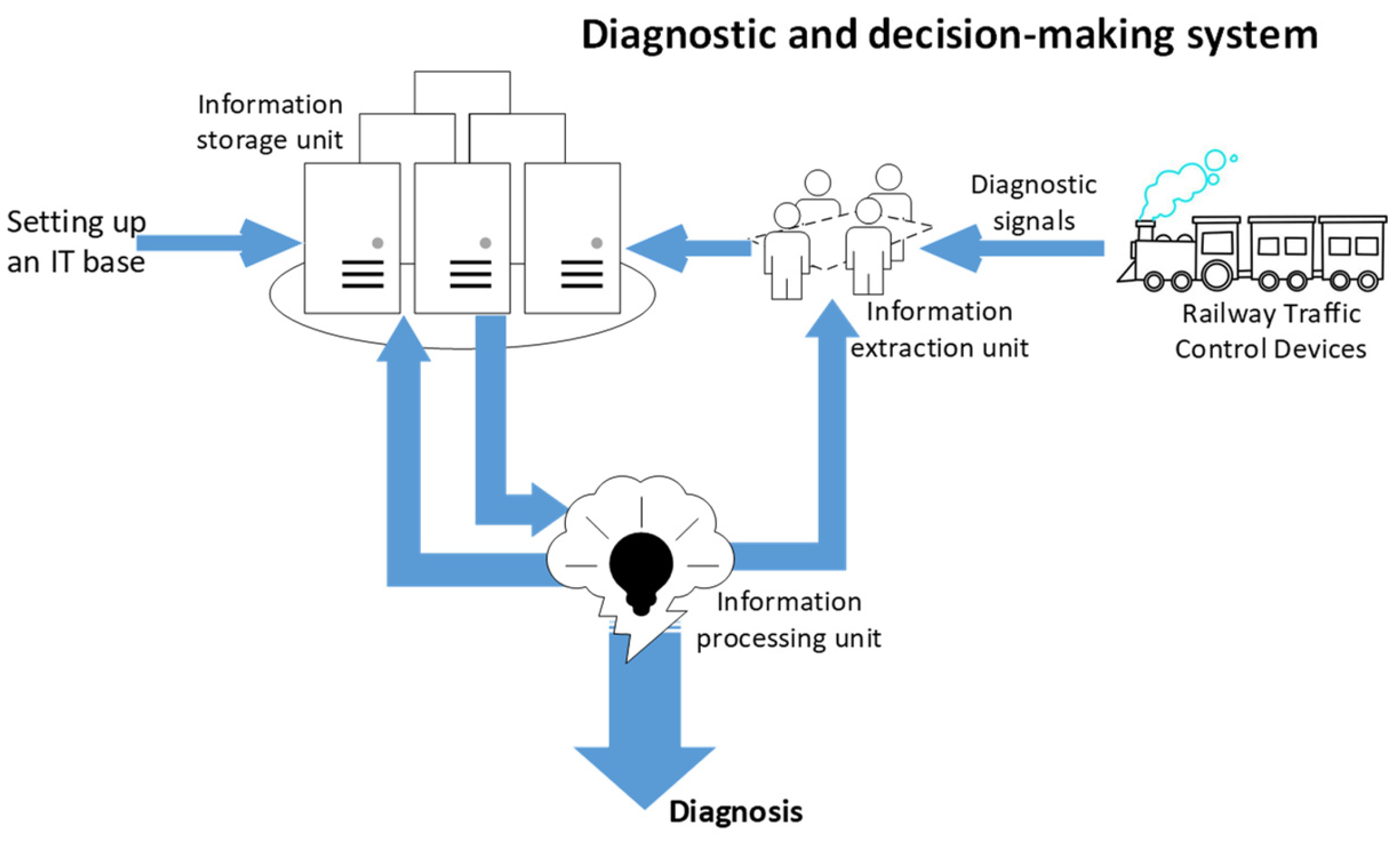
The general structure for the dynamic formulation of diagnostic and decision-making rules for railway traffic control devices is presented in
Figure 1.
The accuracy and effectiveness of decisions in this process depend primarily on the flow of information used during the decision-making (inference) phase. This often involves large data sets (Big Data). However, it is important to remember that simply using a sufficiently large stream of information does not guarantee the usefulness of the decision, even if the inference process itself is error-free. What matters is the alignment of information about the object with its actual properties.
Knowledge about an exploitation facility is often based on the experience gained from operating an entire class of similar facilities, as well as on data provided by designers, engineers, or manufacturers. However, specific conditions of manufacturing, usage, or maintenance can significantly alter the actual properties of a given facility, not to mention the changes that occur over time (for example, due to changing exploitation conditions). Therefore, to ensure correct decisions, information about an object’s properties should refer to the specific object in question and should be updated based on the actual (observed) operational events.
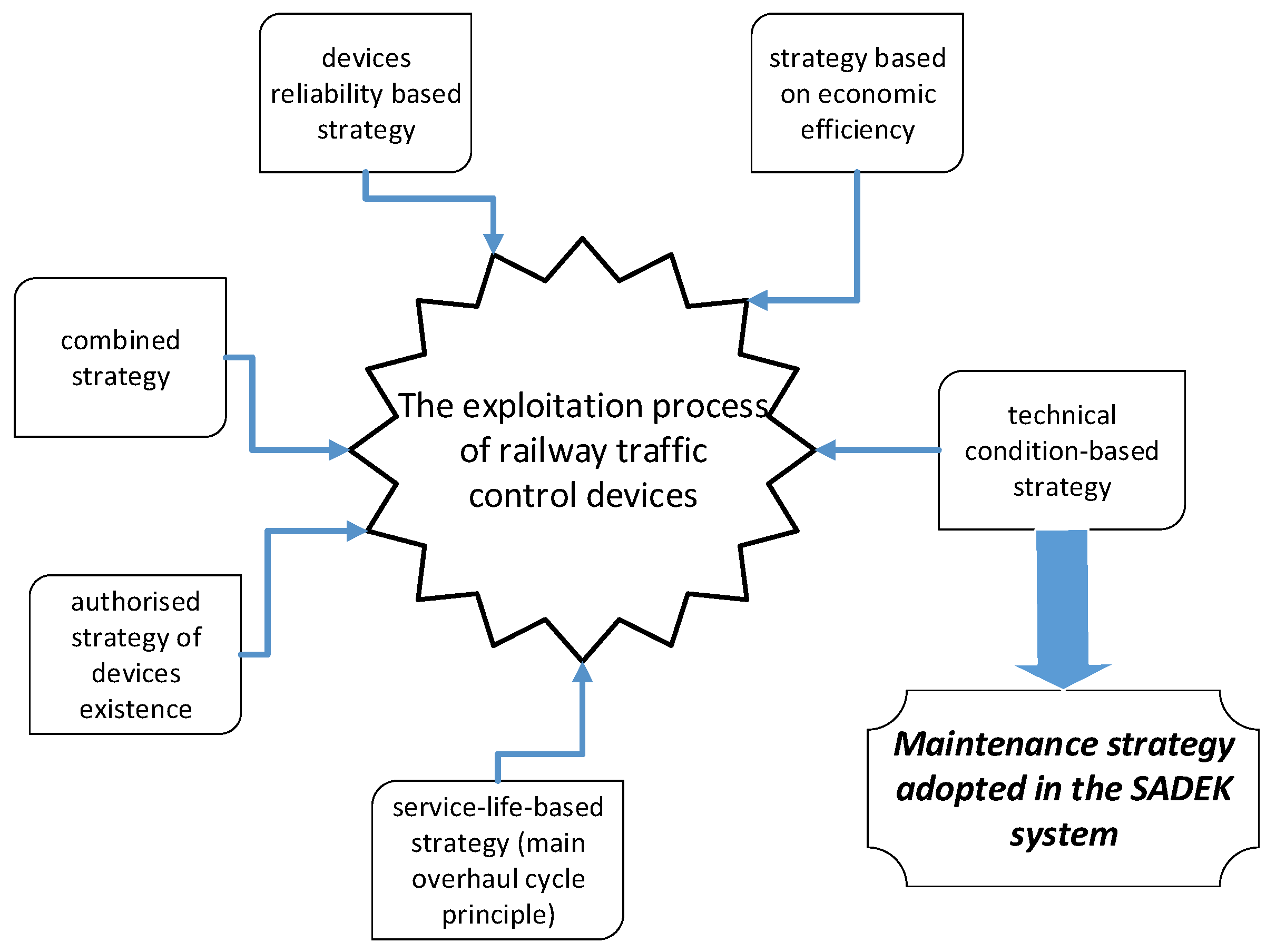
The operation of technical facilities usually follows one of several known strategies. The term “strategy” refers to defining methods of use and maintenance, and in particular, the relationship between these processes. The main maintenance strategies include [
15]
Reliability-based strategy—Maintenance tasks are scheduled based on the reliability indicators of the devices and their components. Reliability studies, which help determine the necessary characteristics and indicator values, are conducted using statistical methods by observing exploitation events.
Economic efficiency-based strategy—Maintenance decisions are made by optimizing economic outcomes using information on the reliability of devices, the costs of their use, and the costs of performing maintenance tasks.
Service-life-based strategy—The frequency and scope of each maintenance activity are fixed, regardless of the actual technical condition of the device. Each higher-level maintenance includes tasks from the more frequently performed lower-level maintenance.
Condition-based strategy—Maintenance decisions, particularly the timing and scope of maintenance tasks, are based on the current assessment of the technical condition of the devices, their components, and elements. This requires continuous monitoring of technical conditions and the preparation of diagnostic information, which forms the basis for actions tailored to the needs and capabilities of the system during exploitation.
Authorized strategies—The management of the exploitation process includes planning maintenance work (scope and methods, as well as timing of halts in operation and transitions to maintenance), directing work teams, and controlling the execution of planned tasks at every stage. The scope of management, the types of decisions made, and the degree of human involvement in these processes depend on the organizational structure in place, the level of management, the adopted planning framework, and the available resources and methods of task execution.
4. Decision Support Method for Operational Decisions of Railway Traffic Control Devices
The adopted maintenance strategy for railway traffic control devices is a key element that influences the course of the management process and, consequently, the exploitation process itself. Since the renewal of devices can be carried out according to various maintenance strategies, it is extremely important to determine how to properly select the appropriate renewal method.
Strategies regarding maintenance (what and when?) for railway traffic control devices (whose technical condition is restorable) should be formulated based on the reliability and durability characteristics of the individual components of the device, taking into account reliability and technical criteria (
Figure 2) [
16].
Among the various maintenance strategies for railway traffic control systems, the most commonly used is the service-life-based strategy (also known as the main overhaul cycle principle). This approach involves performing maintenance and repair tasks at predefined intervals, regardless of the actual wear of components and subsystems [
17,
18].
A significantly more advantageous method is the technical condition-based strategy [
19,
20,
21]. The renewal strategy based on technical condition involves periodic or continuous monitoring of the technical condition of railway traffic control devices (referred to as a monitoring-based strategy) and developing diagnostic information from this monitoring to support rational decision-making [
11,
22,
23]. In this strategy, fixed service intervals are not defined. Decisions regarding maintenance are made based on available diagnostic information. The operation is thus based on the current condition of the traffic control device [
24].
The drawback of this strategy lies in the relatively high costs of designing and building diagnostic subsystems with high reliability, as well as information and decision-support systems [
25,
26].
The condition-based renewal strategy for railway traffic control systems is based on the forecast of the system’s remaining operating hours until failure. Predicting this remaining lifespan is one of the most critical exploitation challenges due to the continuous variation in the system’s technical parameters, driven by variable loads during use—especially under harsh environmental conditions [
27].
The problem of predicting the number of operating hours until failure can be illustrated using the classical wear curve (z), which includes the following phases:
Break-in wear period—initial phase where components are adjusting.
Stable (normal) wear period—the main operational phase with consistent wear.
Accelerated (catastrophic) wear period—aging and degradation of components and elements.
The wear and tear of the railway infrastructure, on the existence of which the correct operation of the railway traffic control system depends, may vary from zero to a critical wear value z*, after which, at time t*, a failure occurs. The critical value z* and therefore also the instant t* depends not only on the type of wear but also on the properties of the dependency systems present in the devices and the external conditions or disturbances implying the operation of these systems. It is obvious that the time t*, after which the failure occurs, is a random realization of the time of correct operation, which is a random variable with the corresponding distribution F1(t).
Assuming a priori the required value of the confidence level
β, it is possible to estimate the resource of operating hours
t* of the selected components of the railway traffic control systems using the following relation:
The resource of operating hours of the railway traffic control systems can be defined as follows:
where
I is the number of subsystems distinguished.
In the prediction of the stock of operating hours of railway traffic control devices, the most important is the period of stabilized wear. For this period, a wear model with the following properties can be adopted:
Average rate of wear of individual subsystems.
Rate of wear of individual subsystems is subject only to random fluctuations resulting from the effects of factors unforeseen for the conditions of their use.
Distinguished subsystems are completely homogeneous at the initial moment of operation.
Failure of individual subsystems of the railway traffic control system occurs at z(t) ≥ zgr.
In connection with the above and on the basis of the analyses carried out, it has been assumed that the time of correct operation of railway traffic control devices can be described by a gamma distribution. For this distribution, Formula (1) will take the following form:
For total
r, estimating the potential hours of operation of such systems can be reduced to determining the value of
t* for a given
β,
r and
λ satisfying the following condition:
The estimators of the parameters
r (shape parameter) and
λ (scale parameter) are the values of (specific statistics)
r* and
λ*, which can be determined from the following formulae:
where
—average value of the wear increment in a given sub-assembly in all the systems studied,
Zgr—limiting wear in a given sub-assembly,
—average variance of wear increments in a given sub-assembly in all tested systems.
The values of quantity
and
can be determined from the following relation:
where
—the average value of the wear increase for the whole time of observation of the wear of the i-th component,
—the variance of the consumption increments in the i-th sub-component of the system,
—variance of the consumption increments in the i-th system, the consumption increment observed in the j-th observation interval of Δt in the i-th system.
The individual values of the quantities
and
are calculated from the following formulae:
The linear process of consumption can also be described mathematically using a normal distribution. In this case, it is necessary to find the value of
t* for a given
β,
E(
T) and
D2(
T) satisfying the following condition:
whereby
where
Zgr,
,
, and
are the designation, as in Formula (5).
The Bernstein variational distribution can also be used to describe the time of correct operation of the railway traffic control system. It is then necessary to find the value of
t* for a given
β,
Zgr,
E(
z0),
E(
ν),
D2(
ν),
D2(
z0) satisfying the following condition:
where
,
,
, and
are the values of the estimators, respectively:
E(
z0),
E(
ν),
D2(
ν),
D2(
z0).
The values of the individual estimators can be determined from the following relationships:
where
Z0i—initial value of wear in the i-th realization of the wear process,
—average value of initial wear,
νi—wear rate in the i-th realization of the wear process,
—average value of the wear rate.
In both models for predicting the stock of tp* and t* hours of operation of the railway traffic control system up to failure (by resurfacing and by state of repair), and therefore also the renewal of its technical or exploitation condition, point estimation of the expected value of the individual random variables was used. As maintenance decisions are made on the basis of different information, it is more convenient to use interval estimation. An estimate of the expected value is then obtained in the form of an interval, which, with a priori defined probability, covers the unknown expected value of the quantity under consideration, e.g., wear.
5. Modeling of Operational Indicators of Railway Traffic Control Devices
The
S-system, of which the railway traffic control device is a component, operating over a defined area, can be represented by the separable subsystems
Si satisfying the following conditions:
where
I is the number of subsystems distinguished.
The
Si subsystems operate in such sub-areas where the set
II can be treated as a set of sub-area numbers:
In each of these, the number of control devices—
bi (
i = 1, 2, …,
I)—can be determined, which form subsets
Bi of the following form:
where
βid—the next d-th block device located in the i-th sub-area,
bi—number of devices in subset Bi.
It should be noted that all block devices are built from a finite number of components that can be described by vectors
αi,d (in binary notation):
where
kdi—number of elements in the d-th device of the i-th subsystem.
In order to properly design the reliability model of the railway traffic control system, it is necessary to introduce the concept of device type.
The device type is a vector
with fixed component values
:
Any device in the
i-th sub-area that meets the following condition
Is a device of type
, which can be represented as follows:
This means that the device belongs to the same class, with
I components. If we assume that time is a random variable, then the reliability indices will be stochastic (random) in nature. Distributor of a random variable:
Determines the probability of the event that the τ
i,d,k correct operation time of the
k-th element in the
d-th block device, operating in the
i-th sub-area, is less than a preset value
t. On this basis, it is possible to consider a system of random variables that characterize the reliability parameters of the entire system under study
S:
Layout (21) represents the operation of each block device element occurring in the first sub-area. There are as many such arrangements as there are subsystems in the railway traffic control system under analysis. On the basis of relations (20) and (21), the distribution system for the first sub-area can be determined:
Similar arrangements can be presented for the other sub-areas.
The average time of correct operation of the
k-th component included in the
d-th device in the
i-th subsystem
can be determined from the following formula:
where
fi,d,k(
t) is probability distribution density of a random variable
τi,d,k.
There is a sequence of average values for the
i-th subsystem
for
d = 1, 2, …,
bi;
k = 1, 2, …,
kdi,
While for the whole area there is a set
C* = {
Ci:
i = 1, 2, …,
I} with elements, which are sets of averages of correct operation of the elements of block devices distributed in the analyzed area. The variance of the mean time of correct operation of the
k-th component included in
d of this device located in the
i-th sub-area is expressed by the following formula:
where
D2(
τi,d,k) is variance of a random variable
τi,d,k.
For the
i-th sub-area, a sequence of variances can be found (similarly i.e.,)
For d = 1, 2, …, bi; k = 1, 2, …, kdi
And for the entire area the collection D* = {Di2: i = 1, 2, …, I}.
The following assumptions should be made for the determination of subsequent reliability indices:
The failure of a component operating in a particular railway traffic control device causes the device to fail, but does not disrupt the whole system Si.
A failed element can be repaired at a random time.
The repair time of the failed element is a random variable with a known distribution.
According to the above assumptions, we introduce into the considerations a random variable
δni,d,k defining the repair time of the
n-th technology of the
k-th component included in the
d-th device located in the
i-th subsystem. The mean value of this variable is
We assume that the random variable
δni,d,k has the following distribution:
This means that the probability of the event that the repair time of this component is less than a given value t can be determined.
For all repair technologies of the
k-th component, there is a sequence:
where
Ni,d,k is count of the
i-th subsystem
d-th device
k-th element.
There is a sequence for all
kdi:
For all devices, the following collection:
and for all devices, the following collection:
Containing the distributions of the repair times of all elements located in the study area.
If all technologies differ in their repair time distributions, then the set count
Δ* reaches a value:
The simple indicators related to the individual elements are
- (a)
reliability function
where
Fi,d,k(t) is the distribution defining the correct operation time
τi,d,k of an element.
- (b)
damage intensity function:
where
is the probability density of component failure.
Since the time of correct operation of a given component depends on the repair technology used for this component, it is possible to determine a quality index
describing the probability of the time of the correct operation of the
k-th component in the
d-th device
i-th subsystem after a repair with the
n-th technology using the following relationship:
where
is a random variable describing the time of correct operation of the
k-th component after repair by the
n-th technology.
This indicator is the cumulative distribution function of correct operation times and determines the reliability of the renewal process.
6. Concept of Service Data Acquisition and Analysis System for Railway Traffic Control Devices
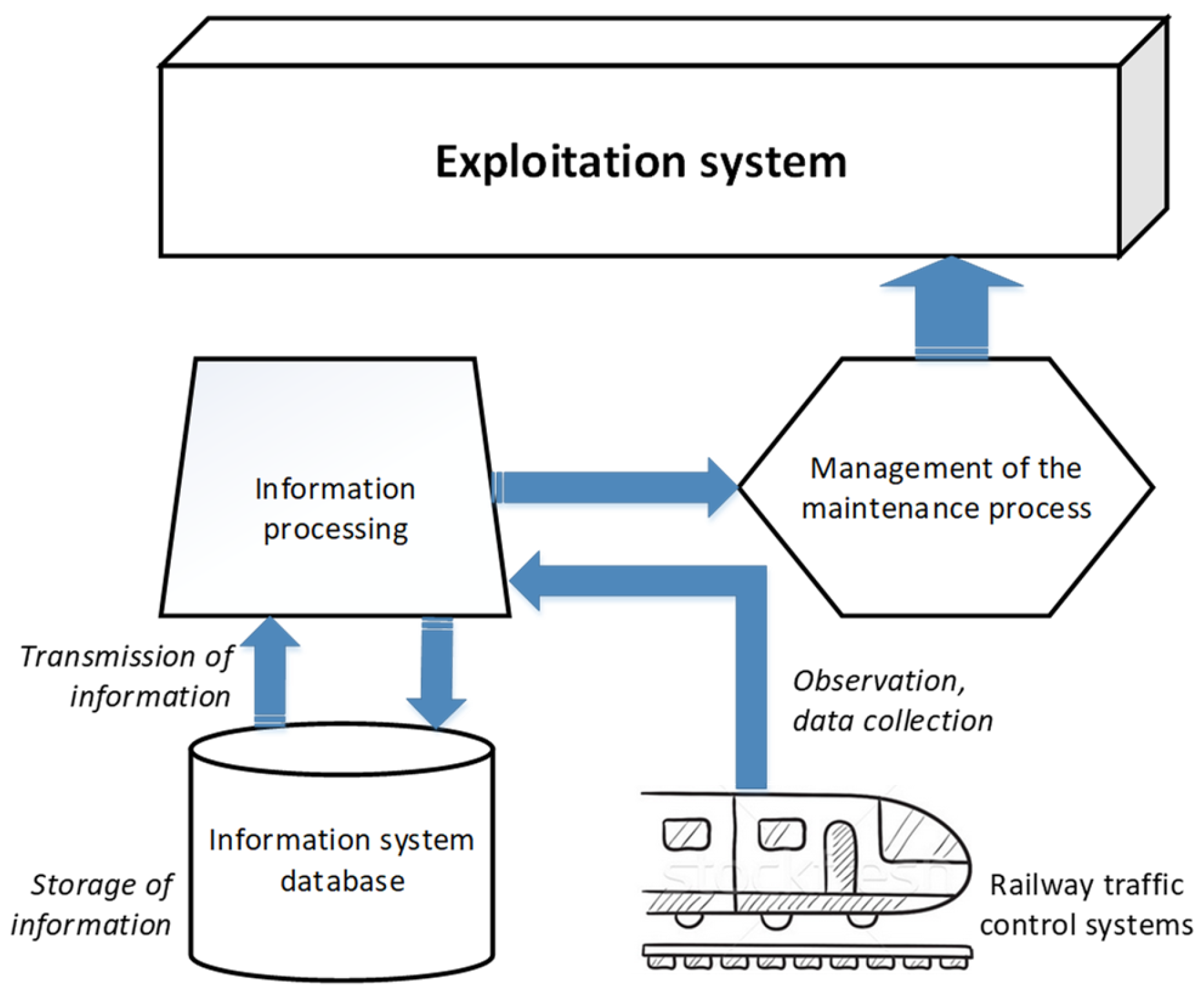
The basis for efficient and effective management of the exploitation process of railway traffic control devices is a maintenance decision support system, an example block diagram that is shown in
Figure 3.
Due to the growing importance of rationalizing the maintenance and renewal processes of railway traffic control systems, a significant issue is the continuous identification of their technical condition, including the forecasting of their reliability. Railway traffic control is a component of the railway transport system that significantly affects the safety and efficiency of the movement of people and goods. Therefore, the rationalization of maintenance and renewal processes is particularly relevant for railway traffic control systems, which often operate under difficult exploitation conditions.
Assuming that the maintenance decision support system for railway traffic control devices will be based on a condition-based strategy (points 2 and 3) and using the railway traffic control system model (point 4), a system for the acquisition and analysis of service data from railway traffic control devices (SADEK) has been proposed [
10].
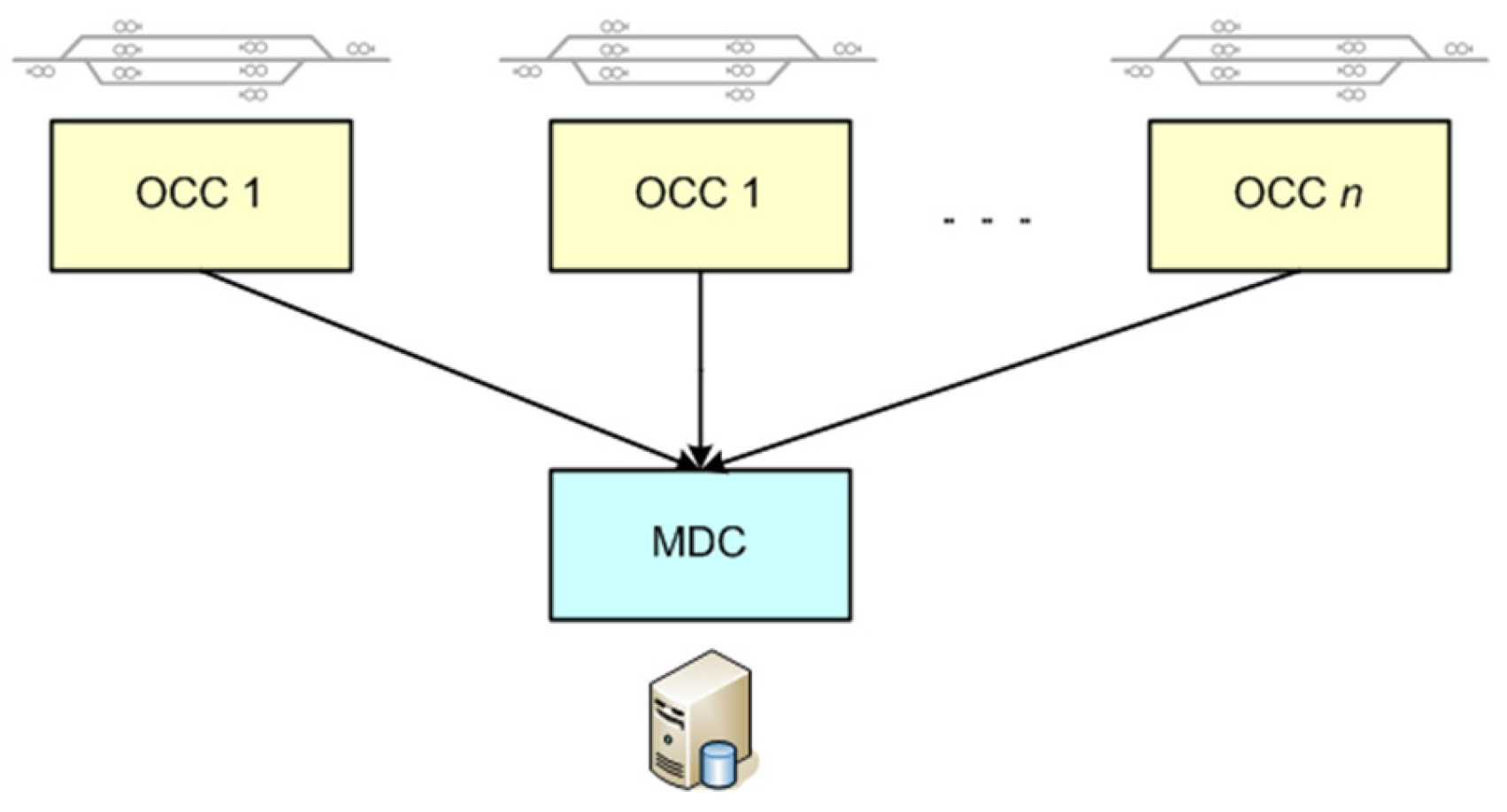
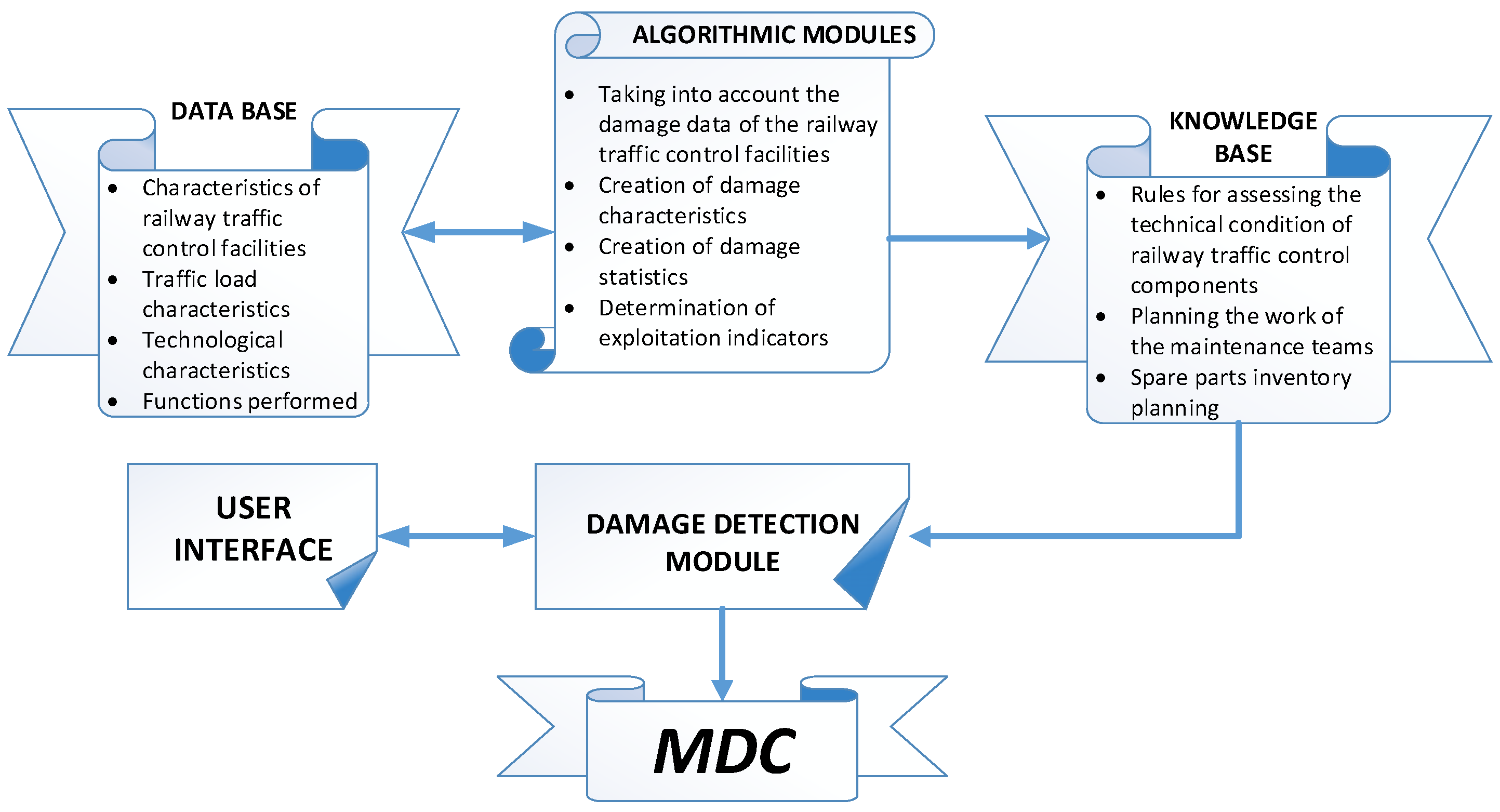
The SADEK system, as an IT system, has a distributed structure. Data collection and processing from railway traffic control devices and systems take place at the level of the Operation Control Centre (OCC). At the same time, damage detection inference is also conducted at the OCC level. This information is then sent to the Maintenance and Diagnostics Centre (MDC) for the purpose of making service-related decisions (see
Figure 4).
The process of inferring the type of failure or the probability of its occurrence is based on large data sets (Big Data) collected at the Operation Control Centre (OCC). These data are obtained from computerized railway traffic control systems based on defined communication protocols, while in the case of devices and systems built with older technologies, they are mainly collected using Internet of Things (IoT) sensors [
28,
29,
30]. A block diagram of the decision-making process for fault detection, carried out at the OCC level, is presented in
Figure 5.
7. Methods and Tools for Data Processing in the SADEK System
Due to the wide variety of railway traffic control devices and systems (axle counter systems, interlocking systems, signaling block systems, and level crossing systems) and the technology in which they are implemented (mechanical, electromechanical, relay-based, hybrid, and electronic devices), we decided to perform data collection and processing, including fault inference, at the OCC level.
The SADEK system is designed to collect data from railway traffic control devices, i.e.,
Light signals (current flow in the bulb or LED circuit, control of the correctness of the displayed signal, lighting time, and response time to commands).
Switch drives (switching force based on current measurement, turnout switching time and number of switching cycles in a given period, turnout position, environmental parameters—temperature and humidity).
Track sensors and axle counters (number of detected axles and direction of vehicle movement, interface control, and detection of communication errors).
Control elements and modules, including relays (output voltages of actuators, status of relays, test results of safety circuits, environmental parameters, and system logs).
The SADEK system is based on a maintenance strategy according to the technical condition and makes rational service decisions online based on the collected diagnostic data. For this purpose, using the model presented in the article, a classification of various types of technical objects was conducted, followed by the development of fault signatures. These signatures represent combinations of symptoms that indicate the occurrence of a fault for each of these objects. Using probabilistic reasoning and relying on historical data stored in Big Data collections together with the observed combinations of symptoms, possible faults are identified.
For example, the conditional probabilities
P(fk|sj) of a
fk failure at an observed symptom of
sj, assuming the independence of symptoms, can be determined using the following formula [
31]:
where
K is the number of possible failures, and
J is the number of failure signature elements.
If the
n-th symptom does not have to occur, according to the failure signature, then we insert it into Formula (38):
In equation (38), the left-hand side is the sought-after value of the a posteriori probabilities, while the right-hand side depends on the corresponding a priori probabilities, the value of which is mostly unknown. In the context of technical problems, the values of these probabilities can be estimated through estimation. Therefore, the values of the probabilities
P(
fk) and
P(
sj|fk) can be estimated from random sample data:
where
is the number of
fk failures, and
nf is the number of all registered failures.
where
is the number of occurrences of
sj symptoms for
fk failures,
—number of fk failures.
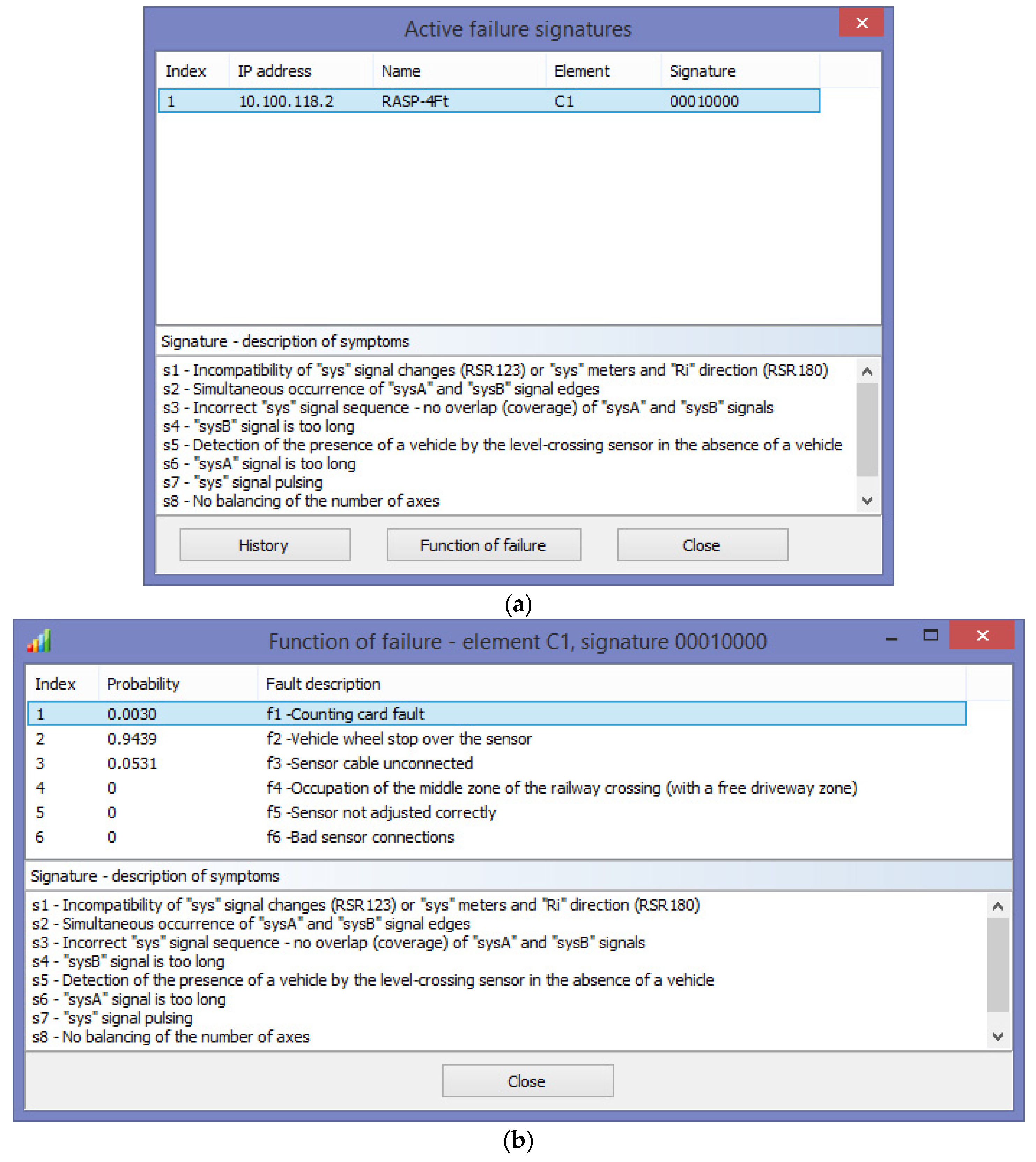
The wheel sensor faults of the Level Crossing Protection System (LCPS) will be used as an example for further consideration. Pursuant to the analysis, the following defects were identified:
f1—counting card fault
f2—vehicle wheel stop over the sensor
f3—sensor cable unconnected
f4—occupation of the middle zone of the railway crossing (with a free driveway zone)
f5—sensor not adjusted correctly
f6—bad sensor connections
And symptoms of failure:
s1—incompatibility of “sys” signal or “sys” signal and “Ri” direction
s2—simultaneous occurrence of “sysA” and “sysB” signal edges
s3—incorrect “sys” signal sequence—no overlap (coverage) of “sysA” and “sysB” signals
s4—“sysB” signal is too long
s5—detection of the presence of a vehicle by the sensor in the absence of a vehicle
s6—“sysA” signal is too long
s7—“sys” signal pulsing
s8—no balancing of the number of axes
What results from the analysis is that a majority of signatures are connected with single failures, and thereby, observing these combinations of symptoms allows us to explicitly indicate a type of failure. Unfortunately, for signatures
V8 = f1 + f2 + f3, V
17 =
f1 + f2 + f3, V
25 =
f1 + f2 + f3, it is not possible to explicitly tell which failure occurred in the system. Therefore, using the relationship (38)–(41), based on random sample data, the probability of damage for each signature was estimated:
From the presented analysis, in all cases, the most probable was the f2 failure.
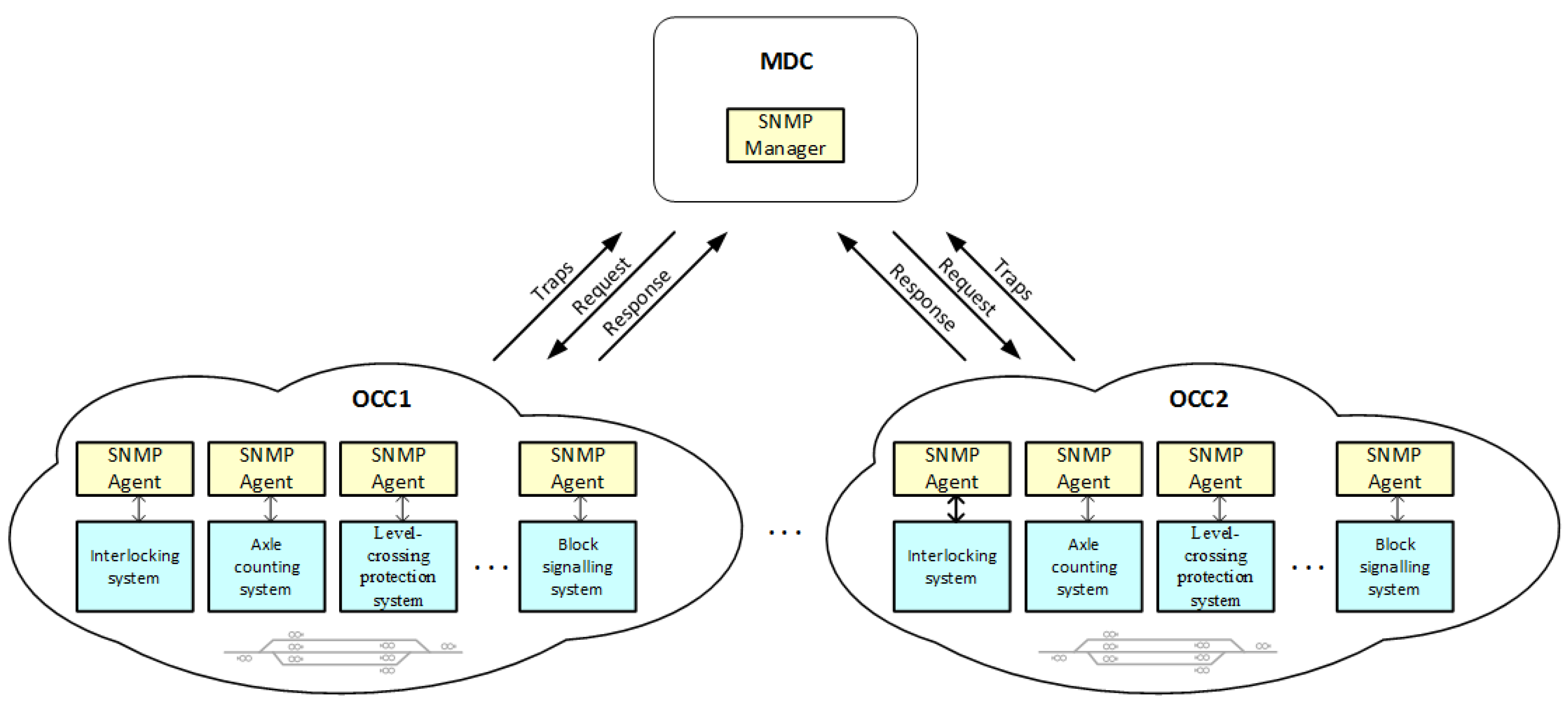
Communication between the OCC and the MDC is based on the SNMP protocol, known as a Simple Network Management Protocol. Each railway traffic control system being diagnosed at the OCC level is managed by a separate SNMP agent. The architecture of the SADEK system based on SNMP technology is presented in
Figure 6.
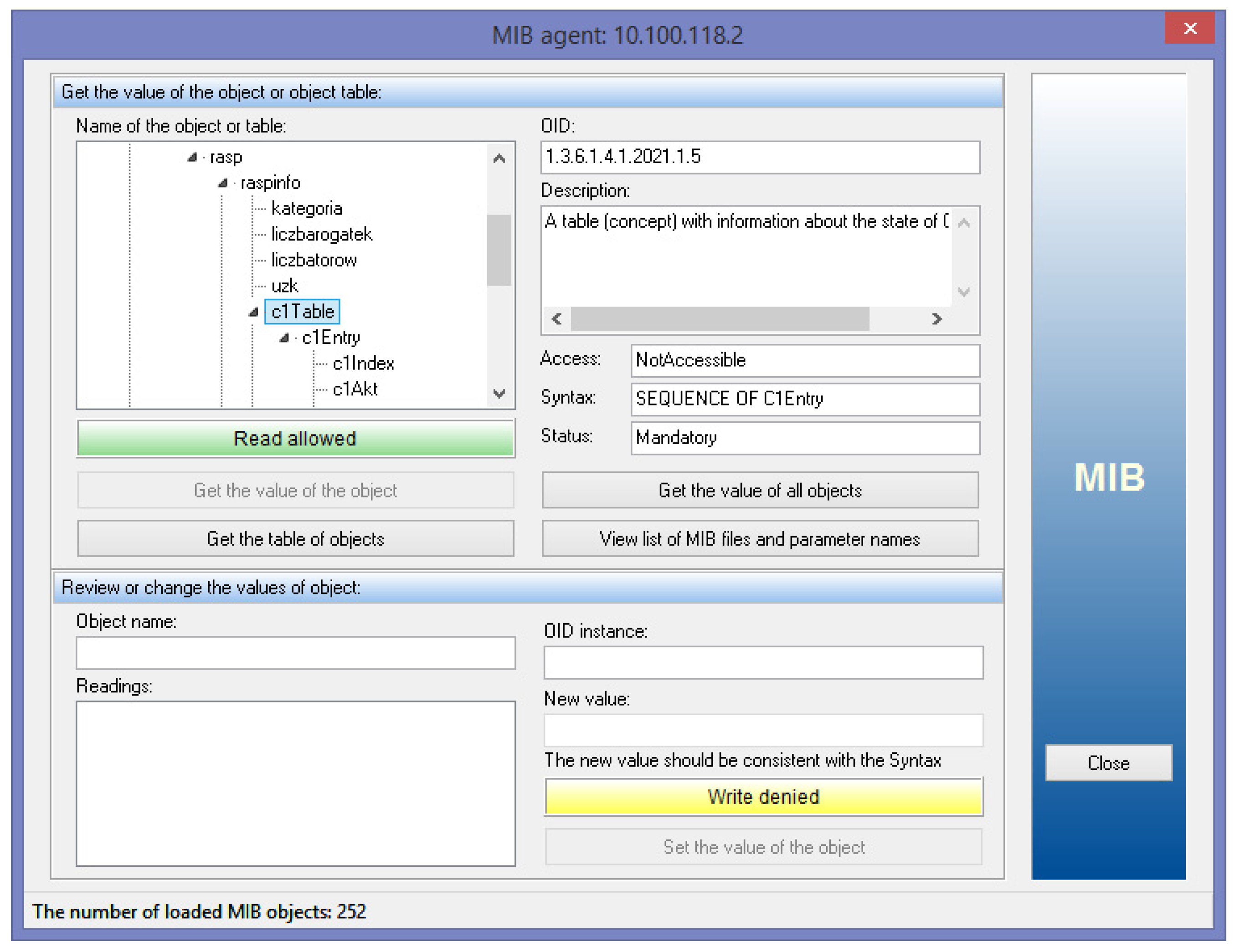
The occurrence of a combination of symptoms matching a fault signature triggers the sending of an SNMP trap to the Network Management Station (NMS) located at the MDC. At the same time, on the NMS level, before performing any maintenance actions, it is possible to read the probability values of potential faults as determined by the SNMP agent. This ultimately contributes to reducing the duration of maintenance activities. An example window of the NMS software showing the ability to browse the Management Information Base (MIB) is presented in
Figure 7, while a window displaying a fault notification is shown in
Figure 8.
8. Verification of the Method of Maintenance of Railway Traffic Control Equipment
The SADEK system is dedicated to a variety of railway control equipment and systems. The article presents a quantitative analysis of a selected system, designated the Level Crossing Protection System (LCPS).
Operational data obtained from LCPS devices during the implementation of the SADEK system over two consecutive years were utilized to verify the method. These data contain information regarding damage to LCPS devices on the selected E-20 railway line, specifically on the Opole–Wrocław–Zgorzelec section (327.3 km). In the initial year, 511 defects were documented, while the subsequent year witnessed an increase to 768 defects (
Table 1).
The quantitative analysis entailed a comparison of the results of damage forecasting performed on actual data, including the total number of failures of LCPS equipment, the number of failures for selected equipment and components, and an analysis of damage duration and failure-free operation.
Statistical analysis of the collected operational data and forecasting results show that the simulation of the LCPS equipment operation process is close to the real process (
Table 1).
Verification confirmed the correctness of the adopted method of maintaining railway traffic control equipment. As illustrated in
Table 1, there is a slight disparity between the observed and anticipated outcomes. This phenomenon may be attributed to the limited sample size of identified defects within a specified timeframe. The model’s low saturation level may lead to suboptimal model stability during the observation period.
9. Conclusions
The collection and analysis of exploitation data from railway traffic control devices are fundamental organizational activities in the process of train traffic management. To obtain relevant diagnostic information, it is necessary to collect data in Big Data repositories and to continuously process and update operational data.
Systems for the acquisition and analysis of service data for railway traffic control devices are playing an increasingly important role, improving the efficiency, safety, and reliability of the entire transport infrastructure. The utilization of contemporary Information Technology (IT) instruments facilitates uninterrupted observation of the technical status of railway infrastructure components. The real-time collection and analysis of data facilitates the early detection of anomalies, thereby enabling the scheduling of maintenance activities prior to the occurrence of major faults or accidents.
The integration of maintenance support systems, underpinned by technologies such as the Internet of Things (IoT), Big Data, or artificial intelligence, facilitates the prediction of component deterioration, optimization of maintenance schedules, and reduction in recovery times. Moreover, they facilitate more precise resource planning, which may result in financial savings and greater availability of technical systems.
Systems for the acquisition and analysis of service data in railway traffic control devices are also an important tool for management, providing access to up-to-date information on the condition of the railway infrastructure, which assists in making sound maintenance and strategic decisions. Consequently, the overall efficiency of railway undertakings and the level of service provided is enhanced.
It is important to note that the development of this technology also promotes an increase in the level of safety, both by improving the reliability parameters of technical devices and by being able to react quickly in critical situations. Consequently, in an era characterized by escalating expectations of railway transport, computer-aided operation is emerging as an indispensable component of contemporary railway infrastructure management.
In the current practice on the railway network in Poland, the operational data of traffic control devices are recorded manually in the form of EXCEL files, for small areas of the railway network. Interpretation of the database created in this way is cumbersome and time-consuming. The SADEK system automatically collects data and generates large data sets (Big Data), enabling real-time statistical analysis and enhancing the accuracy of operational decisions.
This article proposed an original solution for the acquisition and analysis of service data from railway traffic control devices, called SADEK. This system performs, among others, the following functions:
Automatic collection of information from railway traffic control devices.
Exchange of information with external systems.
Archiving of information in a Big Data database.
Monitoring the current operational status of devices and systems.
Providing information to defined recipients.
Supervision of the maintenance process.
Reporting to the railway infrastructure manager regarding the reliability of devices and systems (for example, for estimating Life Cycle Cost).
The SADEK system has a distributed structure. At the OCC level, data are collected in Big Data repositories and then used for probabilistic reasoning about potential failures. This information is ultimately sent to the MDC, where service decisions are made. The system provides a comprehensive solution for managing the exploitation process of railway traffic control devices and systems. The SADEK comprehensively solves problems in the management of the process of operation of rail traffic control equipment and systems. At the same time, due to its modular design, it can be expanded with new analytical functions, such as those supported by artificial intelligence, resulting from new needs.