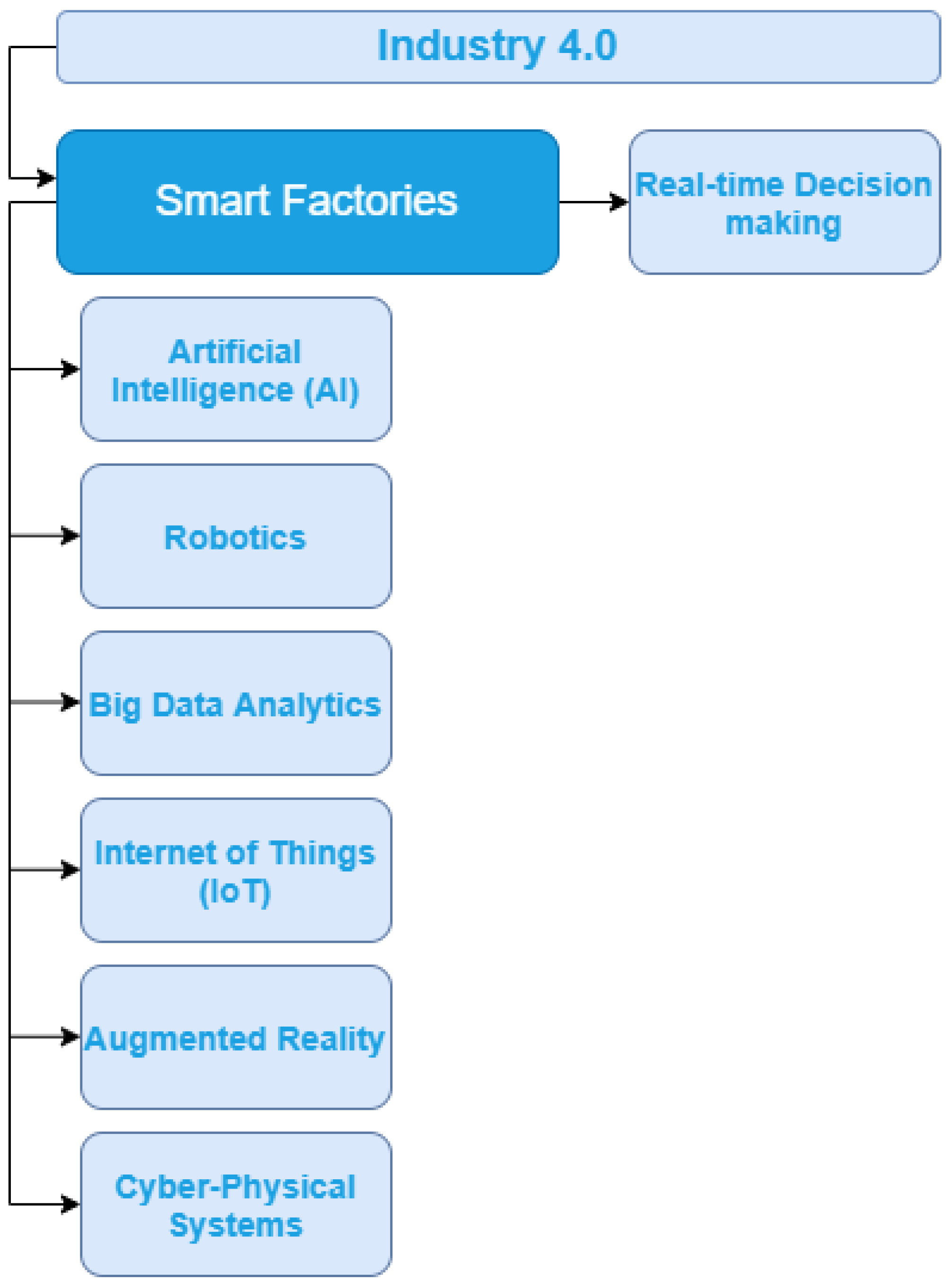
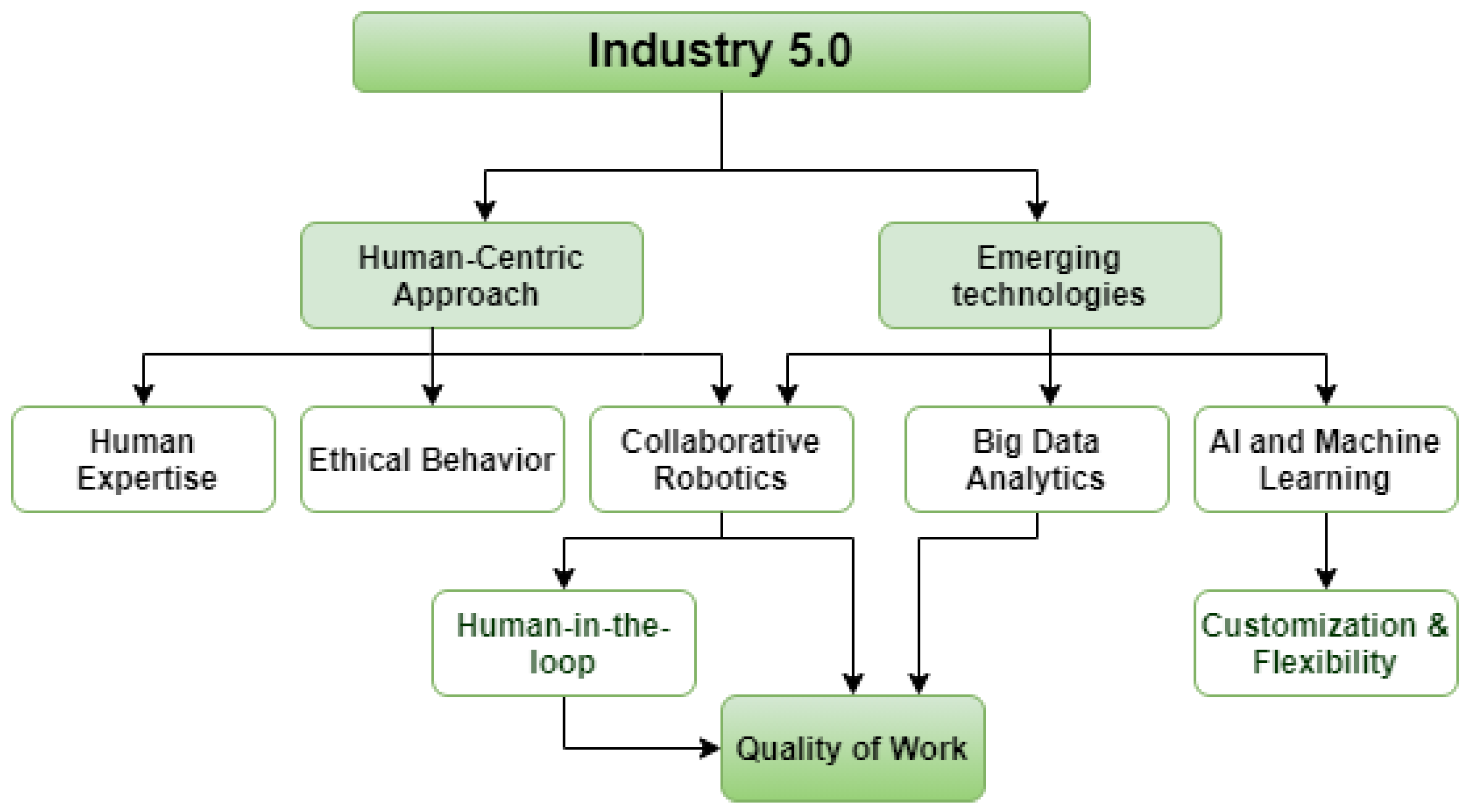
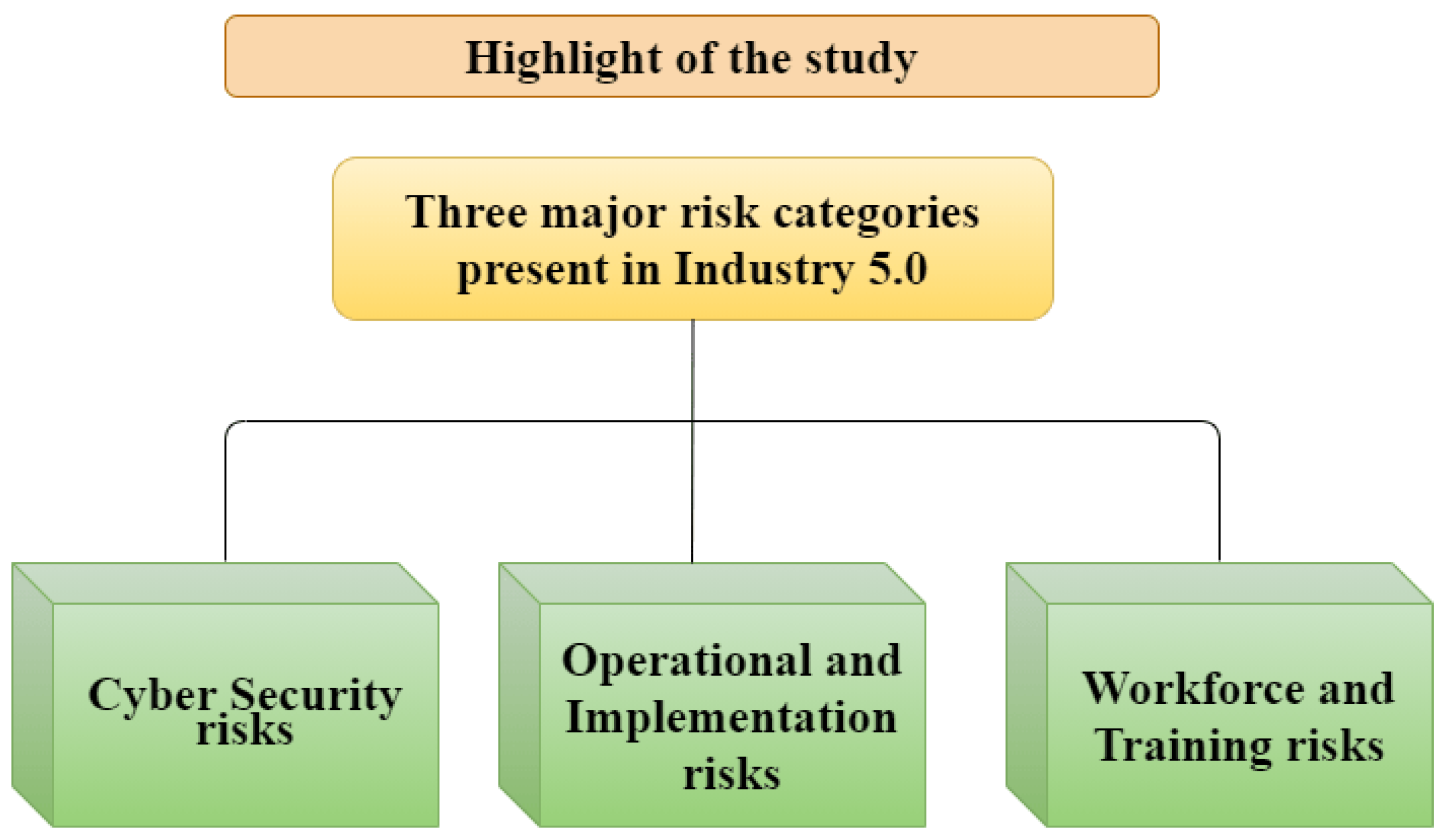
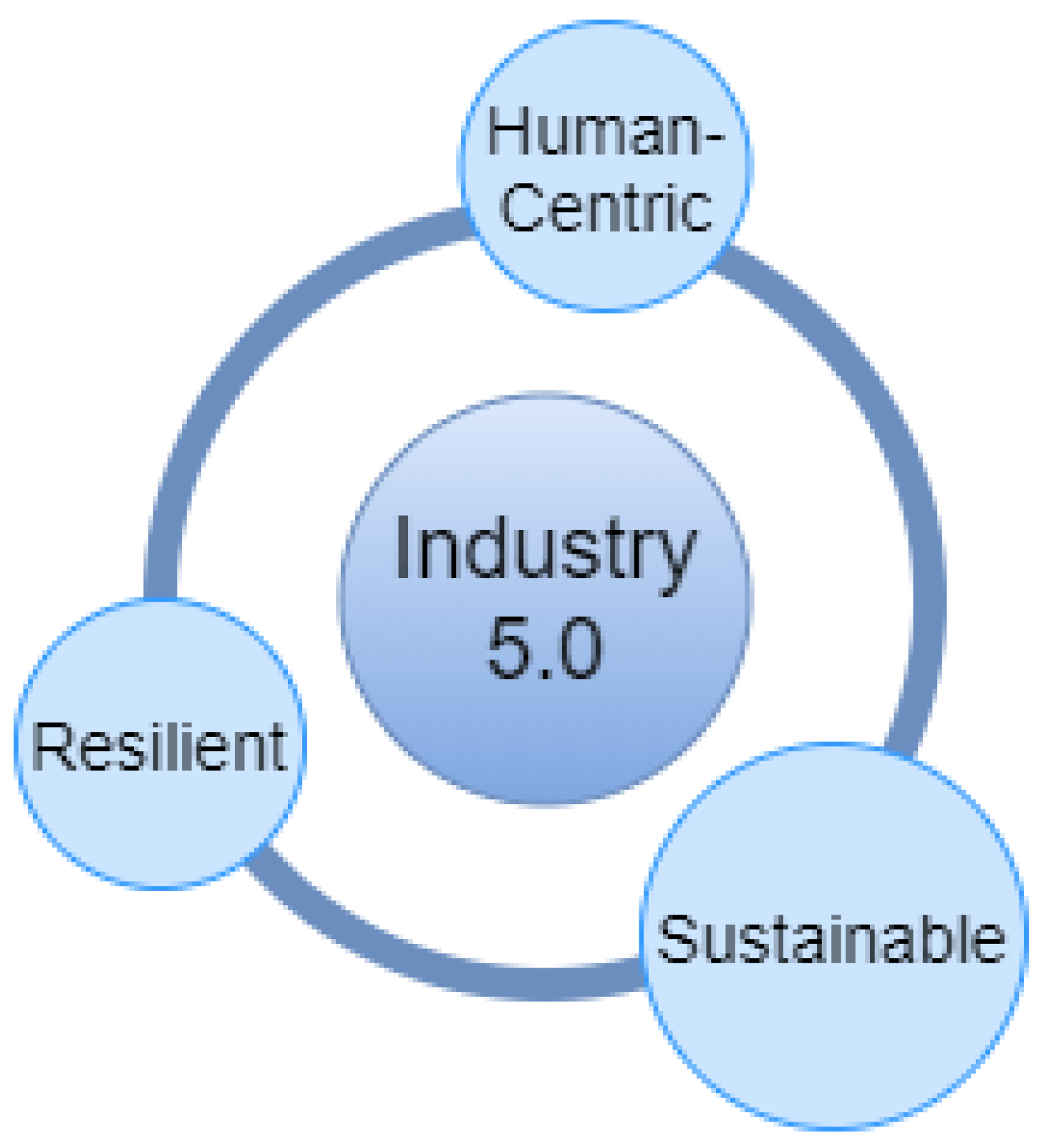
Systematic Analysis of Risks in Industry 5.0 Architecture

 ,
,  , and
, and
Abstract
1. Introduction
1.1. Industry 4.0 Overview
1.2. Industry 5.0 Overview
1.3. Concept of Industry 5.0
1.4. Difference between Industry 4.0 and Industry 5.0
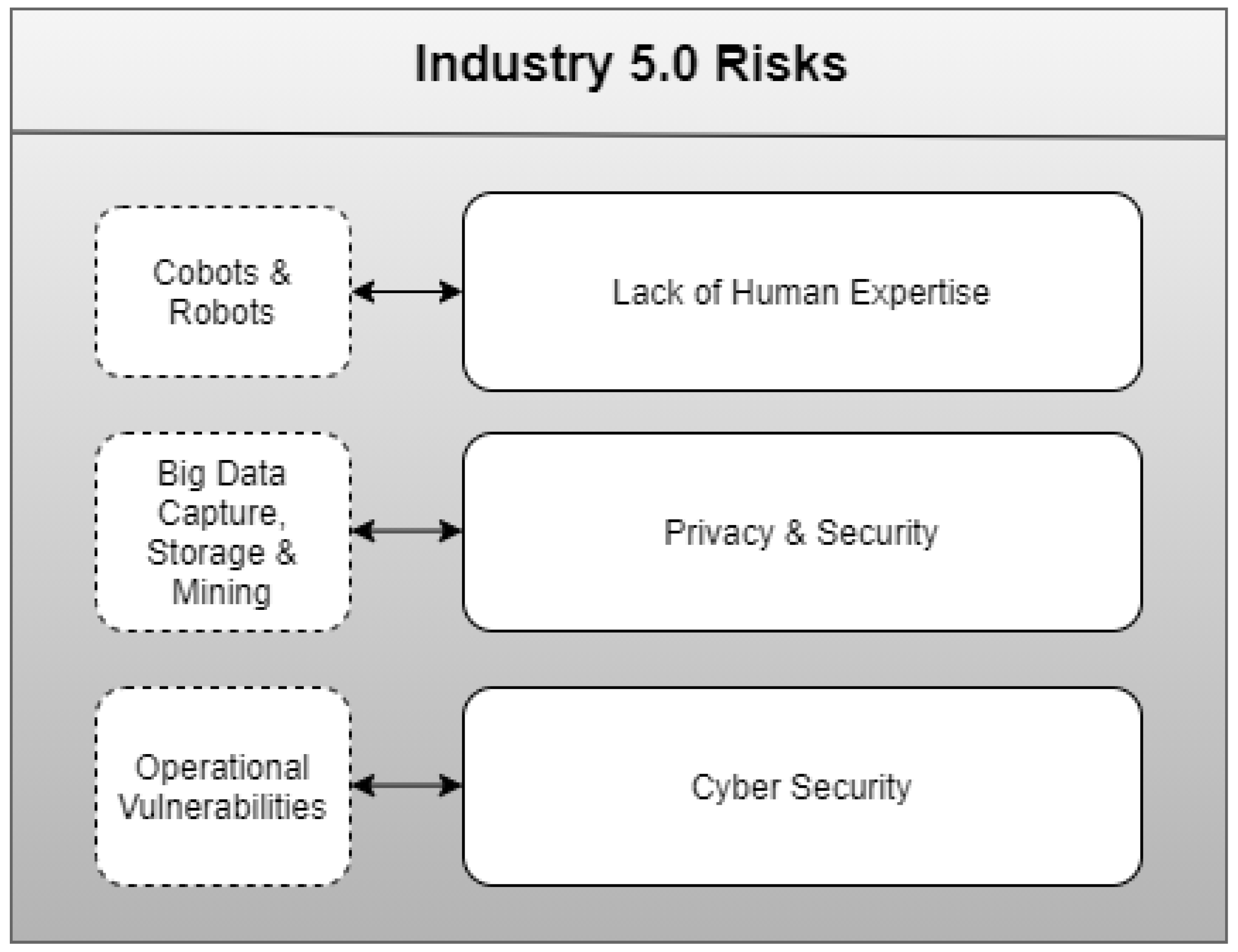
1.5. Threats and Risks Involved
- Research Question 1: What are the potential challenges in the adoption of Industry 5.0, considering factors like compatibility with existing systems, workforce training, and technological complexities?The motivation behind this research question is to address the potential issues related to the adoption of Industry 5.0, which are crucial if one is to fully profit from it. It is important to comprehend these difficulties, including compatibility with current systems, workforce training, and technological complexity, to ensure a successful and seamless transition to Industry 5.0.
- Research Question 2: What technologies Industry 5.0 may use for supply chain transparency and traceability have for data privacy?The purpose of this research question is to address issues including product safety, labor rights, and environmental sustainability. There has been a growing focus on increasing supply chain transparency and traceability. Industry 5.0 can provide a chance to accomplish these objectives.
- Research Question 3: What issues should be taken into account while using Industry 5.0 to enhance security, worker safety, and wellbeing?The goal of this research question is to investigate how Industry 5.0 might be used to enhance worker safety and wellbeing in light of increased automation and the expanding usage of robotics and AI in production.
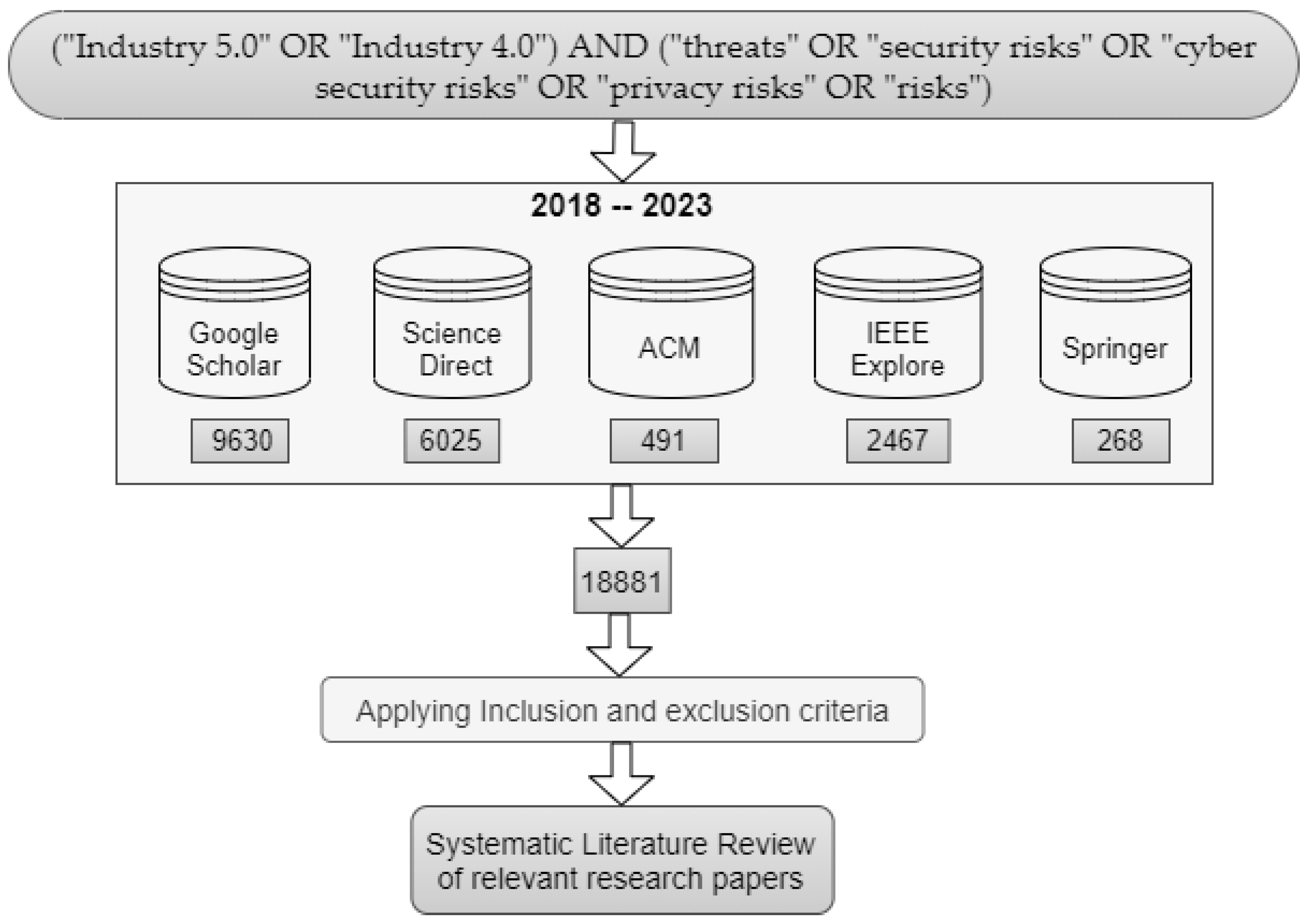
2. Methodology
3. Literature Review
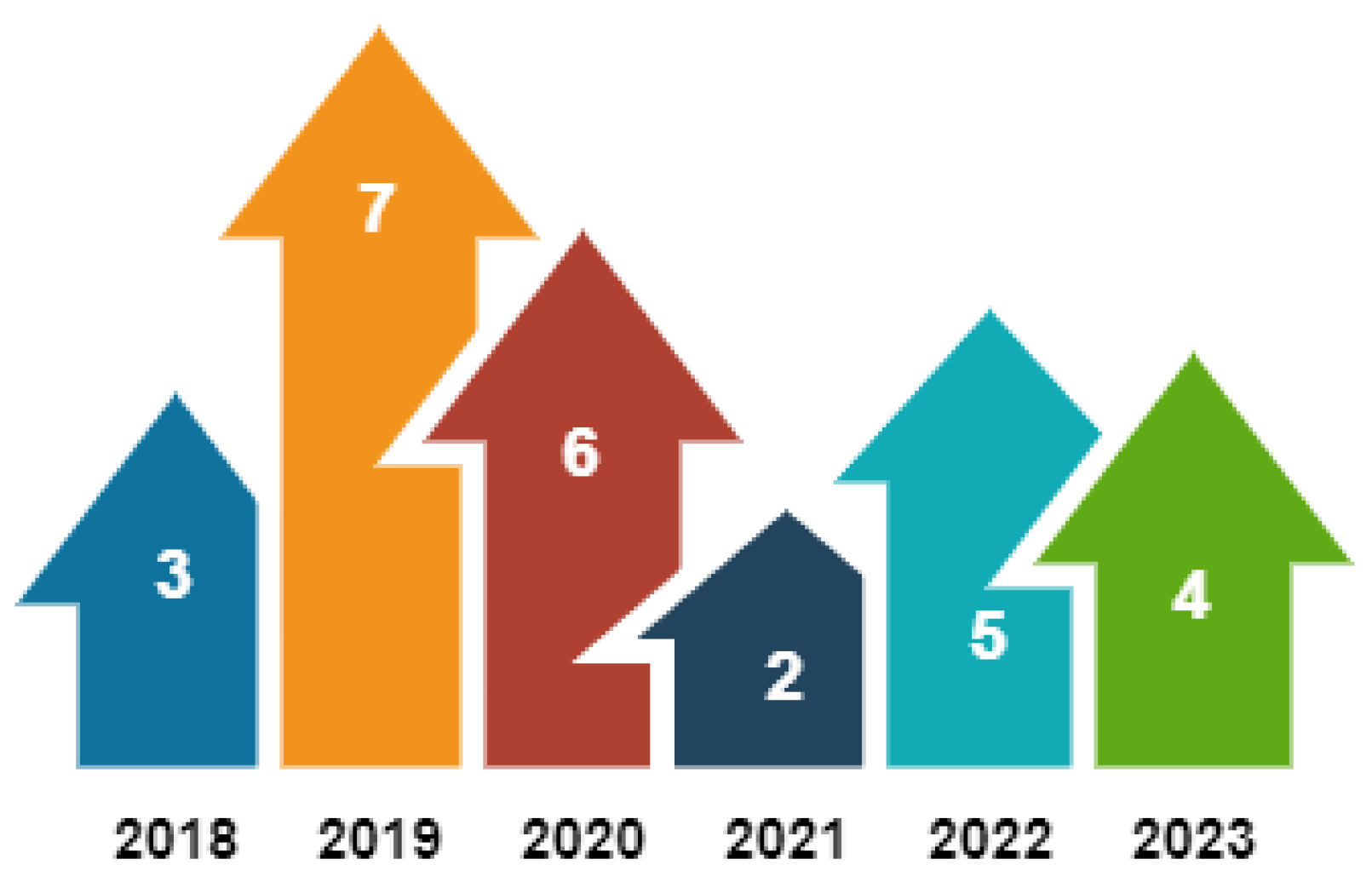
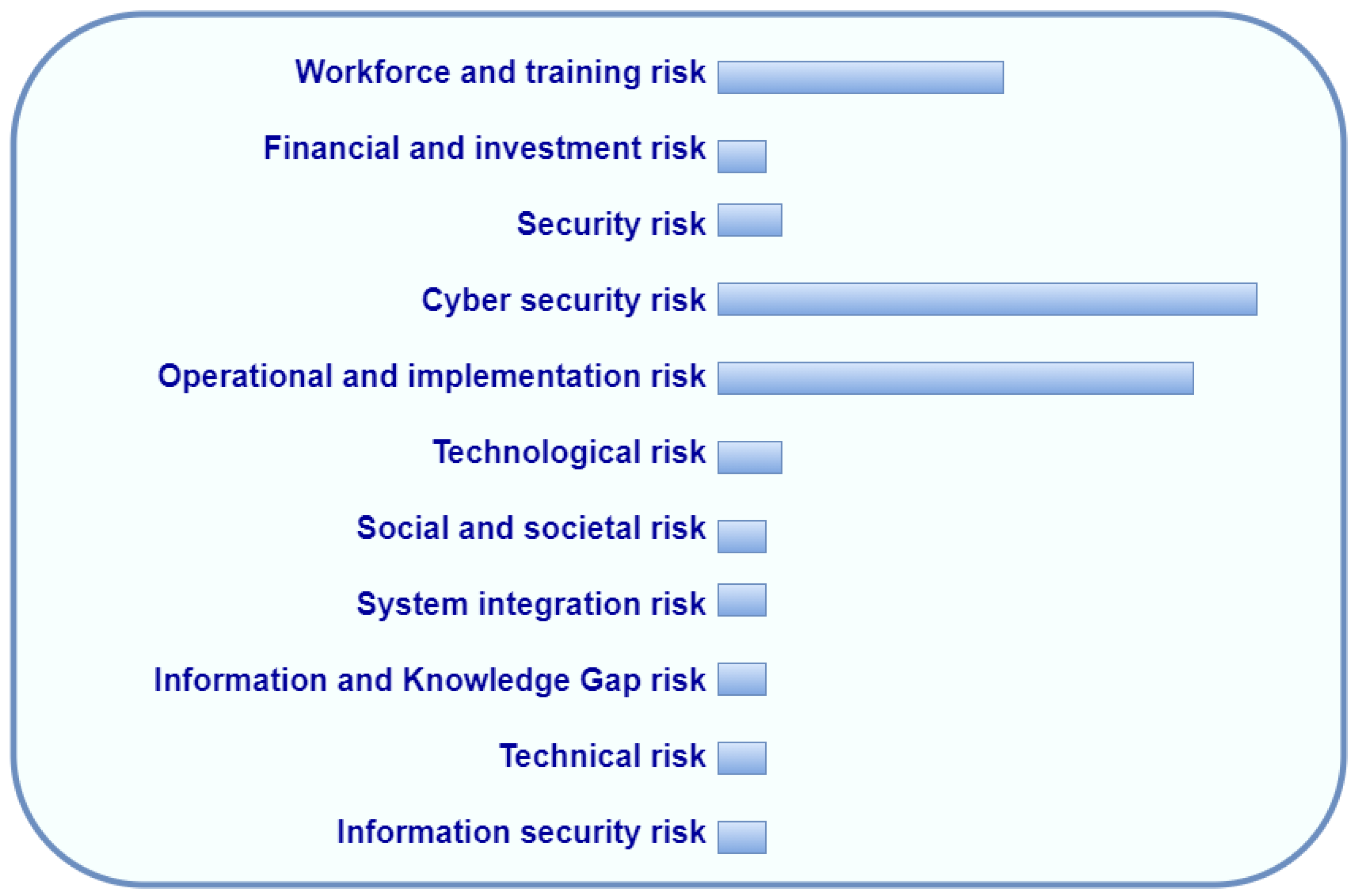
4. Outcomes of the Studies
4.1. Cybersecurity Risks
4.2. Operational and Implementation Risks
4.3. Workforce and Training Risks
5. Discussion
6. Solution
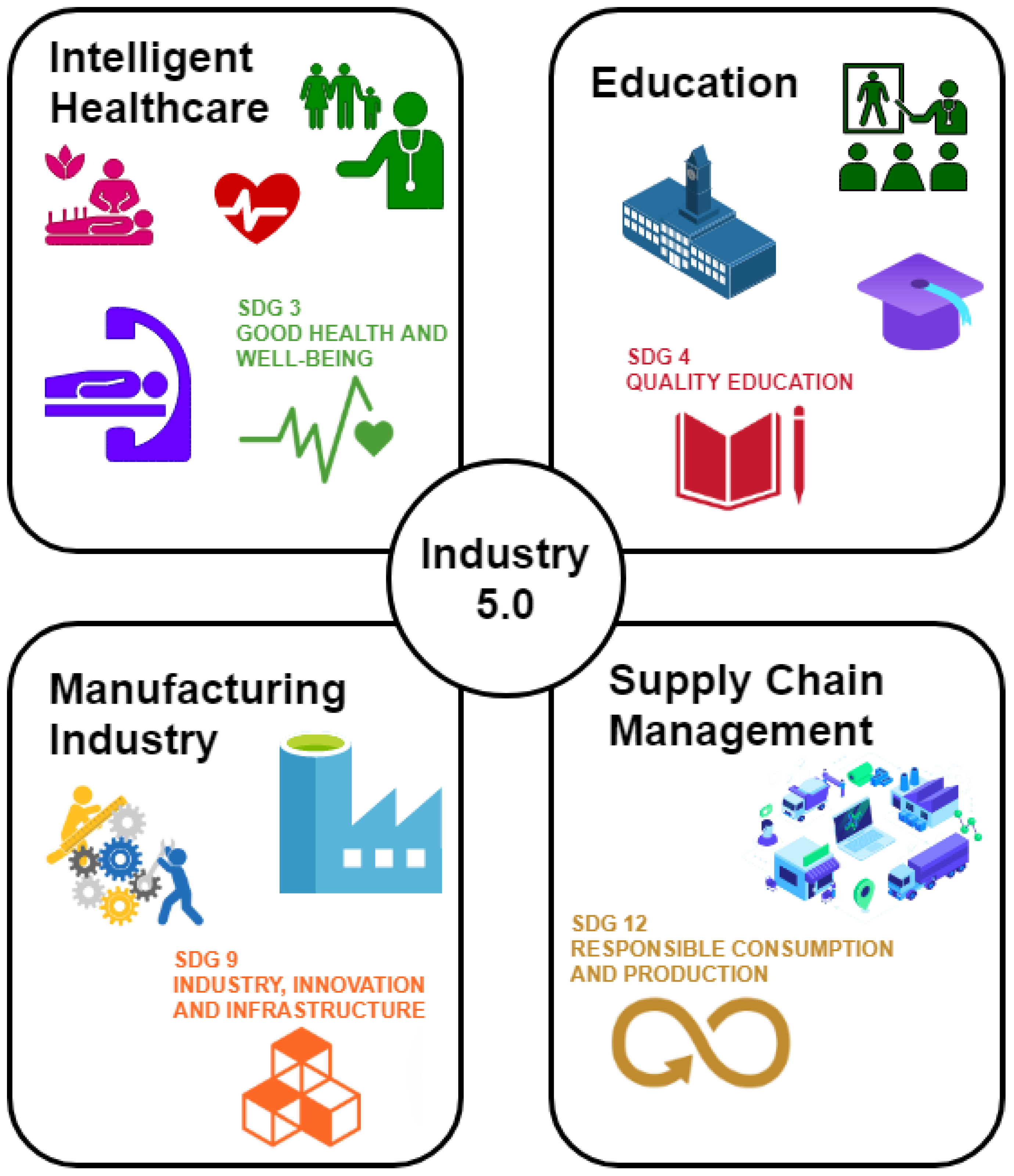
7. Applications
7.1. Manufacturing Industry
7.2. Education
7.3. Intelligent Healthcare
7.4. Supply Chain Management
8. Limitations and Future Work
9. Conclusions
Author Contributions
Funding
Institutional Review Board Statement
Informed Consent Statement
Data Availability Statement
Conflicts of Interest
References
- Apriliyanti, M. Challenges of The Industrial Revolution Era 1.0 to 5.0: University Digital Library In Indoensia. Libr. Philos. Pract. 2022, 1–17. [Google Scholar]
- Yavari, F.; Pilevari, N. Industry revolutions development from Industry 1.0 to Industry 5.0 in manufacturing. J. Ind. Strateg. Manag. 2020, 5, 44–63. [Google Scholar]
- Castelo-Branco, I.; Oliveira, T.; Simões-Coelho, P.; Portugal, J.; Filipe, I. Measuring the fourth industrial revolution through the Industry 4.0 lens: The relevance of resources, capabilities and the value chain. Comput. Ind. 2022, 138, 103639. [Google Scholar] [CrossRef]
- Soori, M.; Arezoo, B.; Dastres, R. Internet of things for smart factories in industry 4.0, a review. Internet Things Cyber-Phys. Syst. 2023, 3, 192–204. [Google Scholar] [CrossRef]
- Akundi, A.; Euresti, D.; Luna, S.; Ankobiah, W.; Lopes, A.; Edinbarough, I. State of Industry 5.0—Analysis and identification of current research trends. Appl. Syst. Innov. 2022, 5, 27. [Google Scholar] [CrossRef]
- Zizic, M.C.; Mladineo, M.; Gjeldum, N.; Celent, L. From industry 4.0 towards industry 5.0: A review and analysis of paradigm shift for the people, organization and technology. Energies 2022, 15, 5221. [Google Scholar] [CrossRef]
- Golovianko, M.; Terziyan, V.; Branytskyi, V.; Malyk, D. Industry 4.0 vs. Industry 5.0: Co-existence, Transition, or a Hybrid. Procedia Comput. Sci. 2023, 217, 102–113. [Google Scholar] [CrossRef]
- Gladysz, B.; Tran, T.a.; Romero, D.; van Erp, T.; Abonyi, J.; Ruppert, T. Current development on the Operator 4.0 and transition towards the Operator 5.0: A systematic literature review in light of Industry 5.0. J. Manuf. Syst. 2023, 70, 160–185. [Google Scholar] [CrossRef]
- Adel, A. Future of industry 5.0 in society: Human-centric solutions, challenges and prospective research areas. J. Cloud Comput. 2022, 11, 40. [Google Scholar] [CrossRef] [PubMed]
- Wang, B.; Zhou, H.; Li, X.; Yang, G.; Zheng, P.; Song, C.; Yuan, Y.; Wuest, T.; Yang, H.; Wang, L. Human Digital Twin in the context of Industry 5.0. Robot. Comput.-Integr. Manuf. 2024, 85, 102626. [Google Scholar] [CrossRef]
- Paschek, D.; Mocan, A.; Draghici, A. Industry 5.0—The expected impact of next industrial revolution. In Proceedings of the Thriving on Future Education, Industry, Business, and Society, Piran, Slovenia, 15–17 May 2019; MakeLearn and TIIM International Conference. pp. 15–17. [Google Scholar]
- Longo, F.; Padovano, A.; Umbrello, S. Value-oriented and ethical technology engineering in industry 5.0: A human-centric perspective for the design of the factory of the future. Appl. Sci. 2020, 10, 4182. [Google Scholar] [CrossRef]
- Ghobakhloo, M.; Iranmanesh, M.; Mubarak, M.F.; Mubarik, M.; Rejeb, A.; Nilashi, M. Identifying industry 5.0 contributions to sustainable development: A strategy roadmap for delivering sustainability values. Sustain. Prod. Consum. 2022, 33, 716–737. [Google Scholar] [CrossRef]
- Grabowska, S.; Saniuk, S.; Gajdzik, B. Industry 5.0: Improving humanization and sustainability of Industry 4.0. Scientometrics 2022, 127, 3117–3144. [Google Scholar] [CrossRef] [PubMed]
- Moroa, S.; Cauchick-Miguela, P.; de Sousa-Zomerb, T.; de Sousa Mendesc, G. Design of a sustainable electric vehicle sharing business model in the Brazilian context. Int. J. Ind. Eng. Manag. (IJIEM) 2023, 14, 147–161. [Google Scholar] [CrossRef]
- Jankovic-Zugic, A.; Medic, N.; Pavlovic, M.; Todorovic, T.; Rakic, S. Servitization 4.0 as a Trigger for Sustainable Business: Evidence from Automotive Digital Supply Chain. Sustainability 2023, 15, 2217. [Google Scholar] [CrossRef]
- Sofic, A.; Rakic, S.; Pezzotta, G.; Markoski, B.; Arioli, V.; Marjanovic, U. Smart and Resilient Transformation of Manufacturing Firms. Processes 2022, 10, 2674. [Google Scholar] [CrossRef]
- Dave, D.M. Advancing Resilience and Agility in Manufacturing through Industry 5.0: A Review of Digitization, Automation, and Advanced Analytics. Int. J. New Technol. Res. (IJNTR) 2023, 9, 5–12. [Google Scholar]
- Alves, J.; Lima, T.M.; Gaspar, P.D. Is Industry 5.0 a Human-Centred Approach? A Systematic Review. Processes 2023, 11, 193. [Google Scholar] [CrossRef]
- Maddikunta, P.K.R.; Pham, Q.V.; Prabadevi, B.; Deepa, N.; Dev, K.; Gadekallu, T.R.; Ruby, R.; Liyanage, M. Industry 5.0: A survey on enabling technologies and potential applications. J. Ind. Inf. Integr. 2022, 26, 100257. [Google Scholar] [CrossRef]
- Turner, C.J.; Garn, W. Next generation DES simulation: A research agenda for human centric manufacturing systems. J. Ind. Inf. Integr. 2022, 28, 100354. [Google Scholar] [CrossRef]
- Eriksson, K.; Alsaleh, A.; Behzad Far, S.; Stjern, D. Applying Digital Twin Technology in Higher Education: An Automation Line Case Study. Adv. Transdiscipl. Eng 2022, 21, 461–472. [Google Scholar]
- Pozo, E.; Patel, N.; Schrödel, F. Collaborative Robotic Environment for Educational Training in Industry 5.0 Using an Open Lab Approach. IFAC-PapersOnLine 2022, 55, 314–319. [Google Scholar] [CrossRef]
- Fatima, Z.; Tanveer, M.H.; Waseemullah; Zardari, S.; Naz, L.F.; Khadim, H.; Ahmed, N.; Tahir, M. Production plant and warehouse automation with IoT and industry 5.0. Appl. Sci. 2022, 12, 2053. [Google Scholar] [CrossRef]
- Clim, A. Cyber security beyond the Industry 4.0 era. A short review on a few technological promises. Inform. Econ. 2019, 23, 34–44. [Google Scholar] [CrossRef]
- Toma, A.; Constantinescu, R.; Zota, R. Enhancing administrative services through document models. In Proceedings of the 5th International Conference Knowledge Management: Projects, Systems and Technologies, Bucuresti, Romania, 12–13 November 2010; pp. 94–102. [Google Scholar]
- Tinica, G.; Bostan, I.; Grosu, V. The dynamics of public expenses in healthcare and demographic evolution in Italy and Romania. Rev. Romana Bioet. 2008, 6, 48–63. [Google Scholar]
- Kamel, S.O.M.; Hegazi, N.H. A proposed model of IoT security management system based on a study of internet of things (IoT) security. Int. J. Sci. Eng. Res. 2018, 9, 1227–1244. [Google Scholar]
- Sanmartin, P.; Rojas, A.; Fernandez, L.; Avila, K.; Jabba, D.; Valle, S. Sigma routing metric for RPL protocol. Sensors 2018, 18, 1277. [Google Scholar] [CrossRef] [PubMed]
- Waslo, R.; Lewis, T.; Hajj, R.; Carton, R. Industry 4.0 and cybersecurity: Managing risk in an age of connected production. Erişim tarihi 2017, 15. [Google Scholar]
- Pedreira, V.; Barros, D.; Pinto, P. A review of attacks, vulnerabilities, and defenses in industry 4.0 with new challenges on data sovereignty ahead. Sensors 2021, 21, 5189. [Google Scholar] [CrossRef] [PubMed]
- Huang, S.; Wang, B.; Li, X.; Zheng, P.; Mourtzis, D.; Wang, L. Industry 5.0 and Society 5.0—Comparison, complementation and co-evolution. J. Manuf. Syst. 2022, 64, 424–428. [Google Scholar] [CrossRef]
- Leng, J.; Zhong, Y.; Lin, Z.; Xu, K.; Mourtzis, D.; Zhou, X.; Zheng, P.; Liu, Q.; Zhao, J.L.; Shen, W. Towards resilience in Industry 5.0: A decentralized autonomous manufacturing paradigm. J. Manuf. Syst. 2023, 71, 95–114. [Google Scholar] [CrossRef]
- Khan, M.; Haleem, A.; Javaid, M. Changes and improvements in Industry 5.0: A strategic approach to overcome the challenges of Industry 4.0. Green Technol. Sustain. 2023, 1, 100020. [Google Scholar] [CrossRef]
- Sklyar, V.; Kharchenko, V. ENISA documents in cybersecurity assurance for industry 4.0: IIoT threats and attacks scenarios. In Proceedings of the 10th IEEE International Conference on Intelligent Data Acquisition and Advanced Computing Systems: Technology and Applications (IDAACS), Metz, France, 8–21 September 2019; Volume 2, pp. 1046–1049. [Google Scholar]
- Sanchez, D.O.M. Sustainable development challenges and risks of Industry 4.0: A literature review. In Proceedings of the Global IoT Summit (GIoTS), Aarhus, Denmark, 17–21 June 2019; pp. 1–6. [Google Scholar]
- Bécue, A.; Praça, I.; Gama, J. Artificial intelligence, cyber-threats and Industry 4.0: Challenges and opportunities. Artif. Intell. Rev. 2021, 54, 3849–3886. [Google Scholar] [CrossRef]
- Rubio, J.E.; Roman, R.; Lopez, J. Analysis of cybersecurity threats in industry 4.0: The case of intrusion detection. In Proceedings of the Critical Information Infrastructures Security: 12th International Conference—CRITIS 2017, Lucca, Italy, 8–13 October 2017; Revised Selected Papers 12. pp. 119–130. [Google Scholar]
- Prinsloo, J.; Sinha, S.; von Solms, B. A review of industry 4.0 manufacturing process security risks. Appl. Sci. 2019, 9, 5105. [Google Scholar] [CrossRef]
- Lezzi, M.; Lazoi, M.; Corallo, A. Cybersecurity for Industry 4.0 in the current literature: A reference framework. Comput. Ind. 2018, 103, 97–110. [Google Scholar] [CrossRef]
- Mullet, V.; Sondi, P.; Ramat, E. A review of cybersecurity guidelines for manufacturing factories in industry 4.0. IEEE Access 2021, 9, 23235–23263. [Google Scholar] [CrossRef]
- Corallo, A.; Lazoi, M.; Lezzi, M. Cybersecurity in the context of industry 4.0: A structured classification of critical assets and business impacts. Comput. Ind. 2020, 114, 103165. [Google Scholar] [CrossRef]
- Radanliev, P.; De Roure, D.; Page, K.; Nurse, J.R.; Mantilla Montalvo, R.; Santos, O.; Maddox, L.; Burnap, P. Cyber risk at the edge: Current and future trends on cyber risk analytics and artificial intelligence in the industrial internet of things and industry 4.0 supply chains. Cybersecurity 2020, 3, 2020. [Google Scholar] [CrossRef]
- Rudenko, R.; Pires, I.M.; Oliveira, P.; Barroso, J.; Reis, A. A Brief Review on Internet of Things, Industry 4.0 and Cybersecurity. Electronics 2022, 11, 1742. [Google Scholar] [CrossRef]
- Tamvada, J.P.; Narula, S.; Audretsch, D.; Puppala, H.; Kumar, A. Adopting new technology is a distant dream? The risks of implementing Industry 4.0 in emerging economy SMEs. Technol. Forecast. Soc. Chang. 2022, 185, 122088. [Google Scholar] [CrossRef]
- Sweeney, D.; Nair, S.; Cormican, K. Scaling AI-based industry 4.0 projects in the medical device industry: An exploratory analysis. Procedia Comput. Sci. 2023, 219, 759–766. [Google Scholar] [CrossRef]
- Capodieci, A.; Mainetti, L.; Dipietrangelo, F. Model-Driven approach to Cyber Risk Analysis in Industry 4.0. In Proceedings of the 10th International Conference on Information Systems and Technologies, Lecce, Italy, 4–5 June 2020; pp. 1–7. [Google Scholar]
- Rezqianita, B.L.; Ardi, R. Drivers and barriers of industry 4.0 adoption in Indonesian manufacturing industry. In Proceedings of the 3rd Asia Pacific Conference on Research in Industrial and Systems Engineering, Depok, Indonesia, 16–17 June 2020; pp. 123–128. [Google Scholar]
- Digmayer, C.; Jakobs, E.M. Employee Empowerment in the Context of domain-specific Risks in Industry 4.0. In Proceedings of the IEEE International Professional Communication Conference (ProComm), Toronto, ON, Canada, 22–25 July 2018; pp. 125–133. [Google Scholar]
- Kurt, R. Industry 4.0 in terms of industrial relations and its impacts on labour life. Procedia Comput. Sci. 2019, 158, 590–601. [Google Scholar] [CrossRef]
- Zimmermann, M.; Rosca, E.; Antons, O.; Bendul, J.C. Supply chain risks in times of Industry 4.0: Insights from German cases. IFAC-PapersOnLine 2019, 52, 1755–1760. [Google Scholar] [CrossRef]
- Leng, J.; Sha, W.; Wang, B.; Zheng, P.; Zhuang, C.; Liu, Q.; Wuest, T.; Mourtzis, D.; Wang, L. Industry 5.0: Prospect and retrospect. J. Manuf. Syst. 2022, 65, 279–295. [Google Scholar] [CrossRef]
- Polak-Sopinska, A.; Wisniewski, Z.; Walaszczyk, A.; Maczewska, A.; Sopinski, P. Impact of industry 4.0 on occupational health and safety. In Advances in Manufacturing, Production Management and Process Control, Proceedings of the AHFE 2019 International Conference on Human Aspects of Advanced Manufacturing, and the AHFE International Conference on Advanced Production Management and Process Control, Washington DC, USA, 24–28 July 2019; Springer: Cham, Switzerland, 2020; pp. 40–52. [Google Scholar]
- Barraza de la Paz, J.V.; Rodríguez-Picón, L.A.; Morales-Rocha, V.; Torres-Argüelles, S.V. A Systematic Review of Risk Management Methodologies for Complex Organizations in Industry 4.0 and 5.0. Systems 2023, 11, 218. [Google Scholar] [CrossRef]
- Raj, A.; Dwivedi, G.; Sharma, A.; de Sousa Jabbour, A.B.L.; Rajak, S. Barriers to the adoption of industry 4.0 technologies in the manufacturing sector: An inter-country comparative perspective. Int. J. Prod. Econ. 2020, 224, 107546. [Google Scholar] [CrossRef]
- Pacaux-Lemoine, M.P.; Trentesaux, D. Ethical risks of human-machine symbiosis in industry 4.0: Insights from the human-machine cooperation approach. IFAC-PapersOnLine 2019, 52, 19–24. [Google Scholar] [CrossRef]
- Bragança, S.; Costa, E.; Castellucci, I.; Arezes, P.M. A brief overview of the use of collaborative robots in industry 4.0: Human role and safety. In Occupational and Environmental Safety and Health; Springer: Cham, Switzerland, 2019; pp. 641–650. [Google Scholar]
- Rea-Guaman, A.; San Feliu, T.; Calvo-Manzano, J.; Sánchez-García, I.D. Systematic review: Cybersecurity risk taxonomy. In Trends and Applications in Software Engineering, Proceedings of the 6th International Conference on Software Process Improvement (CIMPS 2017), Zacatecas, Mexico, 18–20 October 2017; Springer: Cham, Switzerland, 2018; pp. 137–146. [Google Scholar]
- Jarrow, R.A. Operational risk. J. Bank. Financ. 2008, 32, 870–879. [Google Scholar] [CrossRef]
- Lee, J.; Bagheri, B.; Kao, H.A. A cyber-physical systems architecture for industry 4.0-based manufacturing systems. Manuf. Lett. 2015, 3, 18–23. [Google Scholar] [CrossRef]
- Nah, E.H.; Cho, S.; Kim, S.; Cho, H.I.; Stingu, C.S.; Eschrich, K.; Thiel, J.; Borgmann, T.; Schaumann, R.; Rodloff, A.C.; et al. International organization for standardization (ISO) 15189. Ann. Lab. Med. 2017, 37, 365–370. [Google Scholar]
- Kalloniatis, C.; Kavakli, E.; Gritzalis, S. Addressing Privacy in Traditional and Cloud-Based Systems. Int. J. Appl. Ind. Eng. (IJAIE) 2014, 2, 14–40. [Google Scholar] [CrossRef][Green Version]
- Ateş, A.; Açıkbaş, S.; Söylemez, M.T. Comparison of Disturbance Resolution between Timetable and Headway Based Regulations in CBTC: A Case Study of Marmaray. In Proceedings of the 11th International Conference on Electrical and Electronics Engineering (ELECO), Bursa, Turkey, 28–30 November 2019; pp. 1060–1065. [Google Scholar]
- Cybersecurity, C.I. Framework for Improving Critical Infrastructure Cybersecurity. 2018. Available online: https://nvlpubs.nist.gov/nistpubs/cswp/nist.cswp.04162018.pdf (accessed on 18 December 2023).
- Kasinathan, P.; Pugazhendhi, R.; Elavarasan, R.M.; Ramachandaramurthy, V.K.; Ramanathan, V.; Subramanian, S.; Kumar, S.; Nandhagopal, K.; Raghavan, R.R.V.; Rangasamy, S.; et al. Realization of Sustainable Development Goals with Disruptive Technologies by Integrating Industry 5.0, Society 5.0, Smart Cities and Villages. Sustainability 2022, 14, 15258. [Google Scholar] [CrossRef]


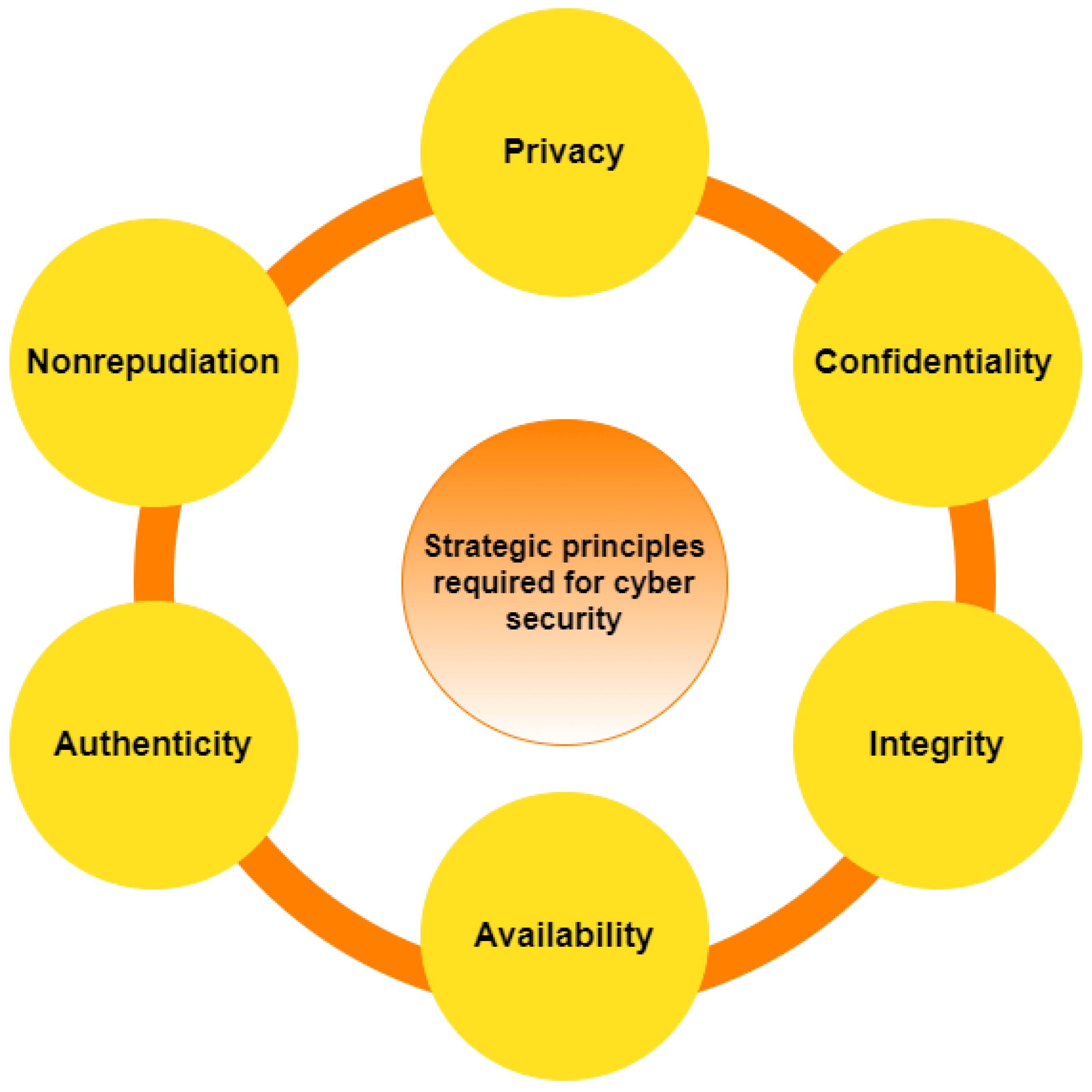
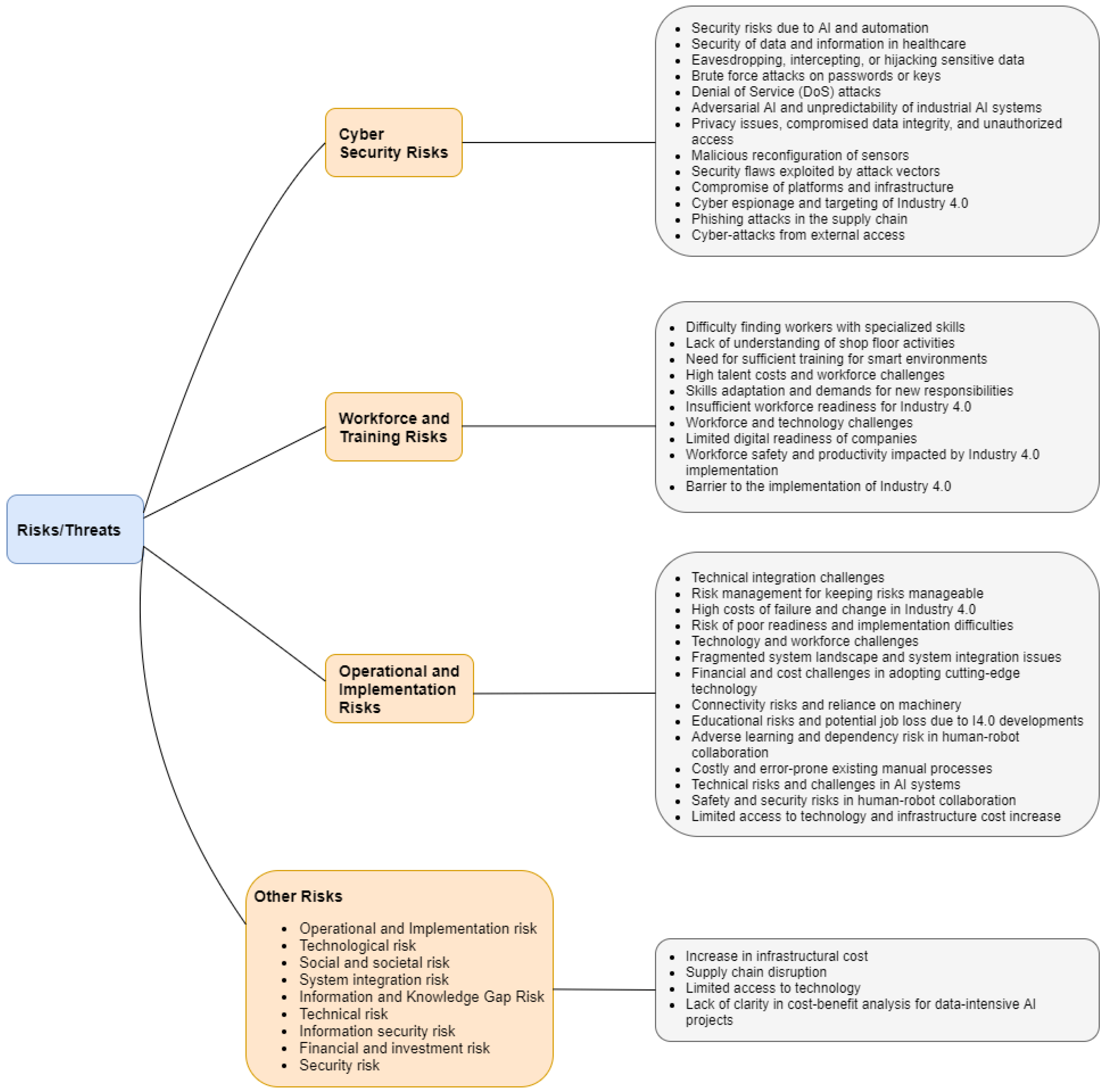
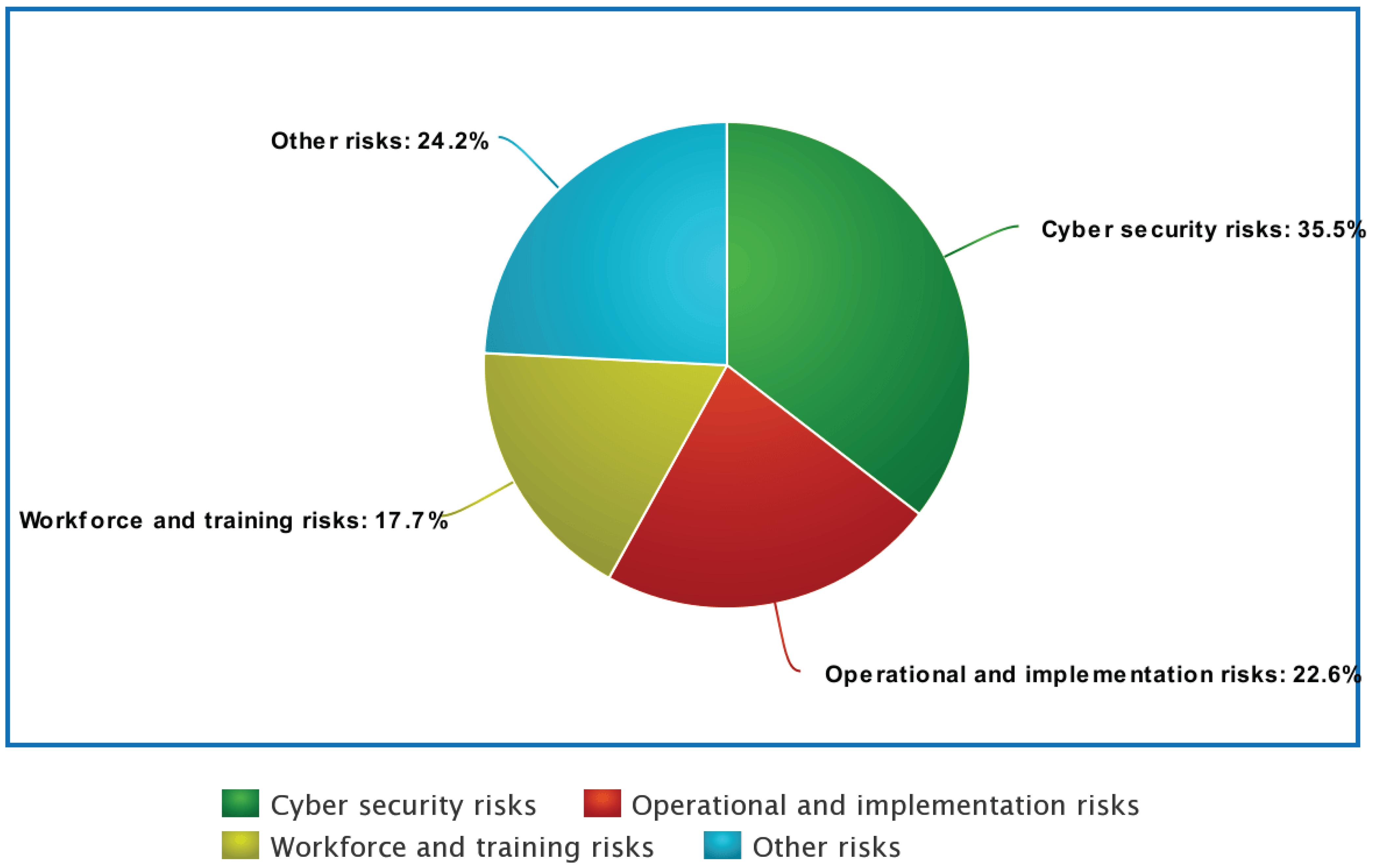

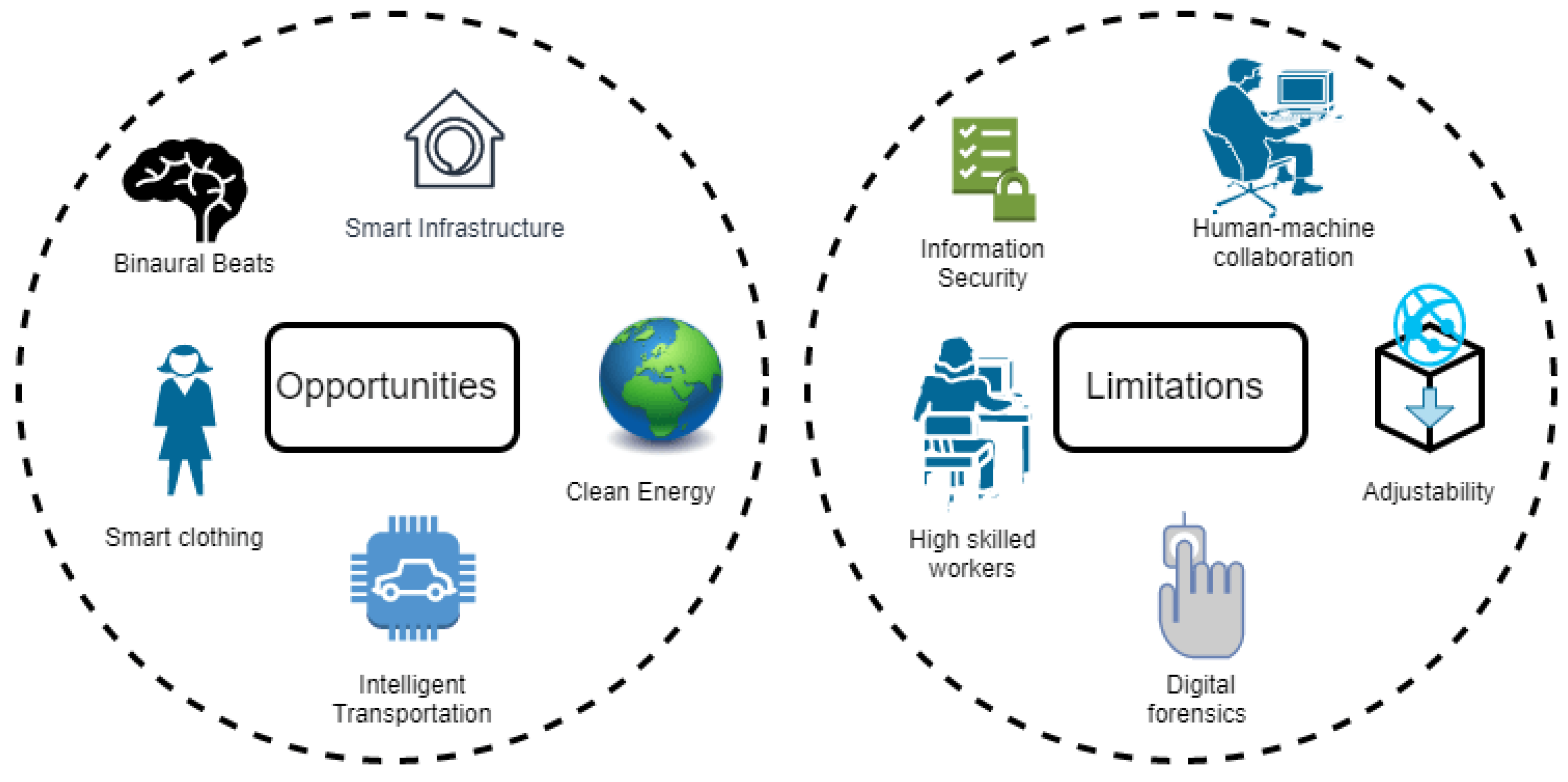

| Ref. Study | Risks Identified | Assets Affected | Risk Mitigation Strategies | Challenges |
|---|---|---|---|---|
| [9] | Trust risk: there are significant risks because of AI and automation, and there is a need to build trust in ecosystems. | ICT (Information and Communications Technology) systems, Data | The deployment of IoT nodes using “Authentication” and “trusted security” as a security mechanism when interacting with diverse devices. | Establishing security and trust in ecosystems. |
| [32] | The possibility of cyber-physical vulnerabilities resulting from the integration of cyberspace and physical space in Human-cyber-physical systems (HCPS) raises the possibility of compromised decision-making processes, data breaches, and system malfunctions. | cyber-physical systems, data confidentiality, and security | To protect data and system integrity, mitigation techniques may involve putting strong cybersecurity measures in place, such as intrusion detection systems, access limits, and encryption. | Some of the challenges that may arise are making sure that cyber and physical components are compatible and interoperable, addressing privacy issues regarding the collecting and use of personal data in HCPS, and encouraging stakeholders to trust and accept automated decision-making processes. |
| [33] | Smart contracts enhance security in decentralized asset management (DAM), but their irreversible nature poses risks, as hackers can use faults to steal tokens, posing a threat to blockchain transactions. | Integrity and security of financial assets, data saved and exchanged on blockchain networks. | Adopt secure coding standards, code audits, and testing for smart contract vulnerabilities, incorporating encryption and multi-factor authentication to protect private information and prevent illegal transactions. | Smart contract transactions are irreversible, making it challenging to identify and correct mistakes or fraudulent activity and retrieve lost or stolen money due to security breaches or malicious activity. |
| [34] | Data privacy risks in healthcare, particularly IoT-based systems, pose a significant challenge in supply chain management, particularly in managing data privacy and integration. | Data, supply chain, planning cycles | Industry 5.0 utilizes decentralized IIOT (Industrial Internet of Things), blockchain middleware, and mass customization to integrate data in smart manufacturing from numerous sources and services. | One of the key challenges faced by the shipping sector is data privacy. |
| [35,36] | Eavesdropping, intercepting, or hijacking: Unauthorized access or management of sensitive data | IIoT communication channels, network setup | Implement secure communication protocols and encryption | Protecting wireless networks and avoiding “man-in-the-middle” attacks |
| [35] | Brute force attacks: Constant and repeated efforts to guess passwords or keys | IIoT end devices, servers, and applications | Implement secure password guidelines and account lockout features. | Security and usability must be balanced, and access credentials must be managed. |
| [35] | Denial of Service: Interruption of processes and potential physical threats | IIoT end devices, Industrial Control Systems | Network segmentation and intrusion detection systems implementation | Timely component and configuration vulnerability analysis |
| [37] | Security risks include adversarial AI, the responsibility gap, and the unpredictable nature of industrial AI-based systems. | Industrial AI systems, critical industrial assets | ML (Machine-Learning) algorithms should be improved and tested against adversarial AI. | Costly failures and changes, price of skill, high standards for regulations, legal and regulatory difficulties. |
| [38] | Privacy issues may include compromised data integrity and confidentiality, unauthorized access and theft of node identities | IIoT devices, data | Implement encryption, secure authentication, and access control measures. | Limited autonomy, a lack of computational resources, and efficient access control mechanisms. |
| [38] | Data exposure, data integrity difficulties, confidentiality issues, DoS (Denial of Service) attacks, and authentication challenges | Cloud/Fog services, data, Big data repositories, Virtualized resources. | Implement reliable monitoring, encryption, and access control procedures. | Challenging to detect fraudulent behavior, lack of trust in service providers, and lack of control over access policies. |
| [39] | Malicious reconfiguration of sensors | Sensors, manufacturing information architecture | Put security measures in place to stop unauthorized sensor reconfiguration. | Systems of the next generation do not prioritize security. |
| [39] | Security flaws being exploited by attack vectors. | Industrial manufacturing equipment, manufacturing information architecture | Regularly update software and firmware, create firewalls and network segments, and evaluate the security situation in industrial equipment design. | Problems with security implementation’s compatibility. Security of networked systems is difficult. |
| [39] | Compromise of platforms and infrastructure | Computers used for Computer-aided Design (CAD) design, industrial network domain | Put strong cybersecurity safeguards in place for CAD design machines. Apply security patches and software updates on a regular basis. Implement strict access and authentication controls. | The widespread use of cloud-based architecture creates new security difficulties. Providing uniform security measures across platforms and infrastructure can be challenging. |
| [40] | Cybersecurity threats like direct and indirect attacks on service providers’ IT systems. | Industrial networks, transportation systems, and manufacturing-related items and equipment with connectivity. | The process of improving industrial control systems’ cybersecurity resilience involves system identification, vulnerability analysis, stakeholder involvement, NIST Framework, DevOps approach, improved attack tree, risk evaluation methods, and STRIDE security analysis. | The importance of cyber security in industrial systems is crucial for Industry 4.0 management, and enhancing industrial management support is vital for comprehensive studies. |
| [41] | Cyber espionage: Industry 4.0 is exposed to cyber espionage due to smart and linked corporate operations. Industry 4.0 has become a favorite target for well-organized cybercriminal gangs looking to steal intellectual property and sensitive data. | Virtual data, violation of commercial agreements, industrial control systems. | Technologies for intrusion detection and prevention and security evaluation, and industrial control systems (ICS) risk management, software updates, secure communication | Integrity protection, layered encryption. |
| [41] | DoS attacks are common in factories due to interdependent equipment and the importance of the unavailability of certain devices in the production environment. | Cloud services, servers. | Encryption of data streams, access control/multiple authorization. | These attacks are unpredictable and difficult to handle. |
| [42] | Industry 4.0 businesses face significant cybersecurity risks due to the increased interconnectivity of smart devices, sensors, and actuators, including Industrial Control Systems and IIoT gateways. | Data integrity, data confidentiality and data availability, productive time, violation of commercial agreements. | The DevOps approach enhances industrial security, visualizes security risks using an attack tree, assesses risks in smart manufacturing systems using a hierarchical model, and calculates IoT cyber risk economic impacts. | Modern industrial equipment with smart devices and wireless networks or wired Ethernet can create potential entry points for cyberattacks due to the lack of proper design for cybersecurity. |
| [43] | Small and Medium-Sized Enterprises (SMEs) face cybersecurity risks due to weak supply chain links and lack of awareness in Industry 4.0, resulting in inconsistent measurements of supply chain cyber risks. | Recovery planning in the supply chains of Small and Medium-Sized Enterprises. | SMEs must invest a sizable amount of money in cyber security and recovery planning; cyber risk puts them at a disadvantage. | In all the examined Industry 4.0 technical advancements, there is a lack of clarity regarding disaster recovery plans. |
| [44] | Computational load for IoT devices, blockchain implementation, and security risks in IoT | IoT devices like sensors. | Implement a blockchain-based IoT framework to stop different attacks and use machine learning to lighten the computational load on IoT devices. | Blockchain communication protocols may cause data corruption, while IoT devices may face high computational burden due to machine-learning solutions, impacting their functionality and usage. |
| [45] | Loss of intellectual property and security of the data. | Data, intellectual property | Implementation of data security measures. | Protection of sensitive information. |
| [46] | The study predicts an increase in future cyberattacks on AI projects, particularly in medical devices and data, necessitating a robust cybersecurity strategy. | Medical devices and data | To ensure sustainable and scalable AI projects, it is crucial to have a robust security architecture, educate staff on security measures, and foster trust within the project environment. | Analyze the medical device industry’s awareness of security issues and the approaches used to address them. |
| [47] | Cyber-attack. | Information systems, infrastructures, computer networks, and personal electronic devices. | The Industrial Process System Environment Strategy uses the Cyber Risk Analysis in the Industrial Process (CRISP) approach to evaluate how cyberattacks will affect specific devices or the system as a whole. | To effectively implement the CRISP approach, access to process documentation and the Asset Management System is crucial for risk assessment. |
| [48] | Cybersecurity risk, implementation cost, lack of financial resources, lack of skilled workers. | Data, human resources, businesses. | N/A | Resistance of employees to change. |
| [49] | Cybersecurity risks due to inadequate infrastructure in Industry 4.0 | Machines and data | N/A | By connecting devices to the Internet without taking adequate security precautions, unauthorized users can access the devices remotely and cause damage. |
| Ref. Study | Risks Identified | Assets Affected | Risk Mitigation Strategies | Challenges |
|---|---|---|---|---|
| [36,50,51] | Human resource risk: It will be difficult to find workers with the specialized skills required for the new procedures in Industry 4.0, which also calls for better pay. | Human capital and employee engagement. | Universities and educational institutions must ensure that study programs are updated because Industry 4.0 is made up of many different technologies. This will ensure that there are enough people available to execute Industry 4.0. | Train labor to work with robots and machines. |
| [52] | Industry 5.0 demands multidisciplinary and multi-technical knowledge, increasing demand for well-trained workers. | Efficiency and effectiveness of training programs. | N/A | Training becomes challenging, especially in sustainable development goals emphasizing lifelong learning for future worker development. |
| [51] | Lack of understanding of the circumstances and activities taking place on the shop floor. | Shop floor personnel, machine statuses, order progress. | Enable real-time monitoring and improve data visibility. | Training and awareness, data security and privacy |
| [34] | Human resource risk: To work in such an atmosphere, the staff need sufficient training. To enable these smart workers to work in the manufacturers’ smart environments, strong management practices are needed. | Human capital and employee engagement. | Industry 5.0 is built on effective communication between humans and robots with a focus on human centricity. | Train labor to work with robots and machines.Predictive maintenance of machines required. |
| [9] | Skills gap and training challenges: To effectively collaborate with advanced robots and smart machines, human workers must have competency skills. | Human workers | N/A | Adoption of advanced technology, training, and skill development. |
| [53] | Industry 4.0 adoption may face workforce and technological challenges, including digital skills shortages, competency gaps, employee wellbeing concerns, and cybersecurity threats. | Workforce wellbeing and safety, data. | Workforce training and up skilling. | The implementation of worker wellbeing monitoring technologies, particularly among the aging workforce and persons with impairments. There is a dearth of skilled employees with digital capabilities. |
| [49] | Adaptation of skills: The days of standard employment profiles are over. Workers in Industry 4.0 must adapt to jobs and abilities that are outside the scope of their current responsibilities. | Employee, organization, human resources. | N/A | Such demands may put staff under excessive strain and may reduce support for Industry 4.0 techniques. |
| [44] | Technology and workforce challenges | Technology, workforce | N/A | Industry 4.0 implementation may pose challenges to worker safety and productivity due to inadequate digital skills training and competency gaps. |
| Ref. Study | Risks Identified | Assets Affected | Risk Mitigation Strategies | Challenges |
|---|---|---|---|---|
| [34] | Technical integration: Producing low-quality products can result from the use of technologies that are not capable of coping with digitalization. | Low-quality products. | Industry 5.0 promotes human centricity, blending creativity with machine accuracy and deploying robots for repetitive tasks to increase productivity and enhance product quality. | New IT (Information Technology) technology installation calls for more effort. |
| [54] | To keep risks at a manageable level, risk management entails risk identification, assessment, and mitigation. | Objectives of the organization, a range of objectives, options for the organization, and risk management options. | Risk management involves identifying, assessing, and reducing potential hazards through systematic strategies, comparing alternatives, and following cycles for creating, planning, assessing, and deciding on acceptable risks. | Ensuring that risk management is integrated into general management; understanding the permitted ranges and risk characteristics; recording and sharing results to aid in making decisions; ensuring the efficacy and acceptability of the solutions selected |
| [37] | Operational risks and challenges: High talent costs, high regulatory constraints, and high costs of failure and change. | Human resources, existing investments. | Demonstrate compelling Return On Investment (ROI), Enhance recruitment and retention strategies. | Costs associated with change and failure, competing for the best talent, prerequisites for adhering to compliance requirements are crucial challenges in the realm of industrial AI. |
| [53] | Organizations’ inadequate readiness for Industry 4.0, including inadequate planning for new supply models and smart technologies, may hinder the realization of benefits during the transitional period. | Organization | Implementing smart safety technologies, integration of self-learning machines, and adoption of cobots. | Organizations are lagging in readiness for Industry 4.0, with only 20% of new supply models and 15% of smart and autonomous technologies considered ready. |
| [44] | Poor readiness of Industry 4.0. | Industry 4.0’s implementation. | N/A | Insufficient planning for new supply models and smart technologies could cause transitory phase issues and hinder the realization of their benefits. |
| [44] | Implementation and complexity problems, insufficient justification, and lack of understanding | ML for cyber security, intelligent factory integration. | The integration of blockchain and machine-learning technology in intelligent manufacturing requires technical expertise and careful configuration, as machine-learning results can be challenging to interpret and comprehend. | Organizations struggle with designing and integrating blockchain and machine-learning technologies for enhanced security due to complexity, requiring clear explanations and vision for effective training and security analysis. |
| [55] | Barriers to the implementation of Industry 4.0 | Industry 4.0’s implementation | The task involves a comprehensive analysis of all factors influencing Industry 4.0 adoption, considering inter-dependencies. | Concerns about data security, a competent workforce, workplace disputes, a lack of financial resources, and a lack of digital readiness. |
| [51] | Supply chain disruption. | Supply chain operations. | Supply chain diversification and risk analysis should be used. | Keeping a global supply chain’s complexity and cooperation under control. |
| [55] | Companies in both developed and developing countries lack digital readiness. | Small and medium-sized companies. | Gain more understanding of Industry 4.0, concentrate on strategic rather than purely financial issues, and handle organizational opposition. | Lack of awareness of Industry 4.0’s strategic importance, organizational resistance on the part of workers, and middle management levels. |
| [49] | Failure of machines: cascade machine failures, which occur when one machine failure leads to another, and significant costs associated with enhancing machine security. | Machines | N/A | N/A |
| Ref. Study | Risks Identified | Assets Affected | Risk Mitigation Strategies | Challenges |
|---|---|---|---|---|
| [51] | Fragmented system landscape and difficulties in system integration | IT Systems. | Create standards for system interoperability and use integration frameworks. | Compatibility with legacy systems, technical difficulty. |
| [9] | Investments are needed to adopt cutting-edge technology like cobots in Industry 5.0, covering the costs of technology acquisition and human workforce training. | Human resources, company finances | N/A | Financial and cost management |
| [36] | Connectivity risk: In Industry 4.0, technology is heavily reliant on machinery. | Network connection and communication channels. | It is imperative to identify and address any new, unique machinery demands as soon as feasible. | Utilize sensing techniques for data collection, learning, and automated decision-making, ensuring components can be tracked throughout the value chain for each created item. |
| [36] | Educational risks: Industry 4.0’s new developments could lead to increased inequality and societal splintering, as well as the loss of numerous jobs. | Learning and development. | Universities and educational institutions must ensure that study programs are updated because Industry 4.0 is made up of many different technologies. This will ensure that there are enough people available to execute Industry 4.0. | Industry 4.0 implementations demand specialized knowledge in numerous technology fields. |
| [56] | Adverse learning and dependency risk involves the development of bad habits and poor decisions due to machines learning in good faith, leading to increased reliance on machines, potentially causing harm. | Workforce and organizational resilience. | The Human–Machine Cooperation (HMC) approach is a model involving cooperative agents, humans and machines, working together to achieve common goals and manage interferences to modify their decisions and actions. | N/A |
| [51] | Existing manual processes are costly and prone to mistakes. | Labor-intensive processes, production systems. | Automation and robotics implementation, improved process documentation. | The initial investment in automation and resistance to change. |
| [37] | Technical risks or challenges include those related to training, testing costs and complexity, huge state spaces, and data storage and collection. | Industrial AI systems, data storage and acquisition infrastructure. | Enhance preprocessing methods and data quality and employ high-fidelity simulations. | Cost and complexity of data acquisition, limited labeled training data, testing disruption, complexity of industrial systems. |
| [57] | Safety and security risks in human-robot collaboration. | Workers’ mental health, robots, collaborative workspace, industrial process, control systems. | Calculate the degree of injuries caused by collision.Reduce injury in interactions between humans and robots.Prevent crashes and accidental contact. | Understanding human limits and pain tolerance is crucial for developing safe, effective human-robot collaboration systems in Industry 4.0, requiring effective mechanical systems and collision detection procedures. |
| [45] | Limited access to technology | Technology | N/A | Unclear cost–benefit analysis, high investment levels. |
| [46] | Businesses need to efficiently handle data for scalable AI solutions, requiring a strong data environment to handle large volumes of computational demands. | Data-intensive AI projects. | Cost–benefit analysis. | High cost and investments. |
| Risks | Reference Studies |
|---|---|
| Workforce and training risk | [9,34,36,44,48,49,50,51,52,53] |
| Financial and investment risk | [9,46,48] |
| Security risk | [9,37] |
| Cybersecurity risk | [32,33,34,35,36,38,39,40,41,42,43,44,45,46,47,48,49,55] |
| Operational and implementation risk | [34,35,37,43,44,49,51,53,54,55,57] |
| Technological risk | [36,45,56] |
| Social and societal risk | [36] |
| System integration risk | [34,51] |
| Information and Knowledge Gap Risk | [51] |
| Technical risk | [37] |
| Information security risk | [38,45] |
Disclaimer/Publisher’s Note: The statements, opinions and data contained in all publications are solely those of the individual author(s) and contributor(s) and not of MDPI and/or the editor(s). MDPI and/or the editor(s) disclaim responsibility for any injury to people or property resulting from any ideas, methods, instructions or products referred to in the content. |
© 2024 by the authors. Licensee MDPI, Basel, Switzerland. This article is an open access article distributed under the terms and conditions of the Creative Commons Attribution (CC BY) license (https://creativecommons.org/licenses/by/4.0/).
Share and Cite
Hassan, M.A.; Zardari, S.; Farooq, M.U.; Alansari, M.M.; Nagro, S.A. Systematic Analysis of Risks in Industry 5.0 Architecture. Appl. Sci. 2024, 14, 1466. https://doi.org/10.3390/app14041466
Hassan MA, Zardari S, Farooq MU, Alansari MM, Nagro SA. Systematic Analysis of Risks in Industry 5.0 Architecture. Applied Sciences. 2024; 14(4):1466. https://doi.org/10.3390/app14041466
Chicago/Turabian StyleHassan, Muhammad Ali, Shehnila Zardari, Muhammad Umer Farooq, Marwah M. Alansari, and Shimaa A. Nagro. 2024. "Systematic Analysis of Risks in Industry 5.0 Architecture" Applied Sciences 14, no. 4: 1466. https://doi.org/10.3390/app14041466
APA StyleHassan, M. A., Zardari, S., Farooq, M. U., Alansari, M. M., & Nagro, S. A. (2024). Systematic Analysis of Risks in Industry 5.0 Architecture. Applied Sciences, 14(4), 1466. https://doi.org/10.3390/app14041466