


SEM Studies Assessing the Efficacy of Laser Treatment for Primary Teeth: A Systematic Review

 ,
,  ,
,  and
and 
Abstract
1. Introduction
2. Materials and Methods
2.1. Focused Question
2.2. Protocol
2.3. Eligibility Criteria
- Changes in the specified surfaces of human teeth were evaluated using an optical microscope and/or scanning electron microscope (SEM) and/or profilometers and/or micro-computed tomography (Micro-CT).
- Studies involving the use of lasers to irradiate tooth structures.
- In vitro studies
- Studies in English
- Clinical trials
- Non-randomized controlled clinical trials (NRS); and
- Randomized controlled clinical trials (RCT).
- Non-English papers
- Clinical reports
- Opinions
- Editorial papers
- Review articles
- No full-text accessible
- Duplicated publications
2.4. Information Sources, Search Strategy, and Study Selection
2.5. Data Collection Process and Data Items
2.6. Risk of Bias and Quality Assessment
2.7. Quality Assessment (QA)
3. Results
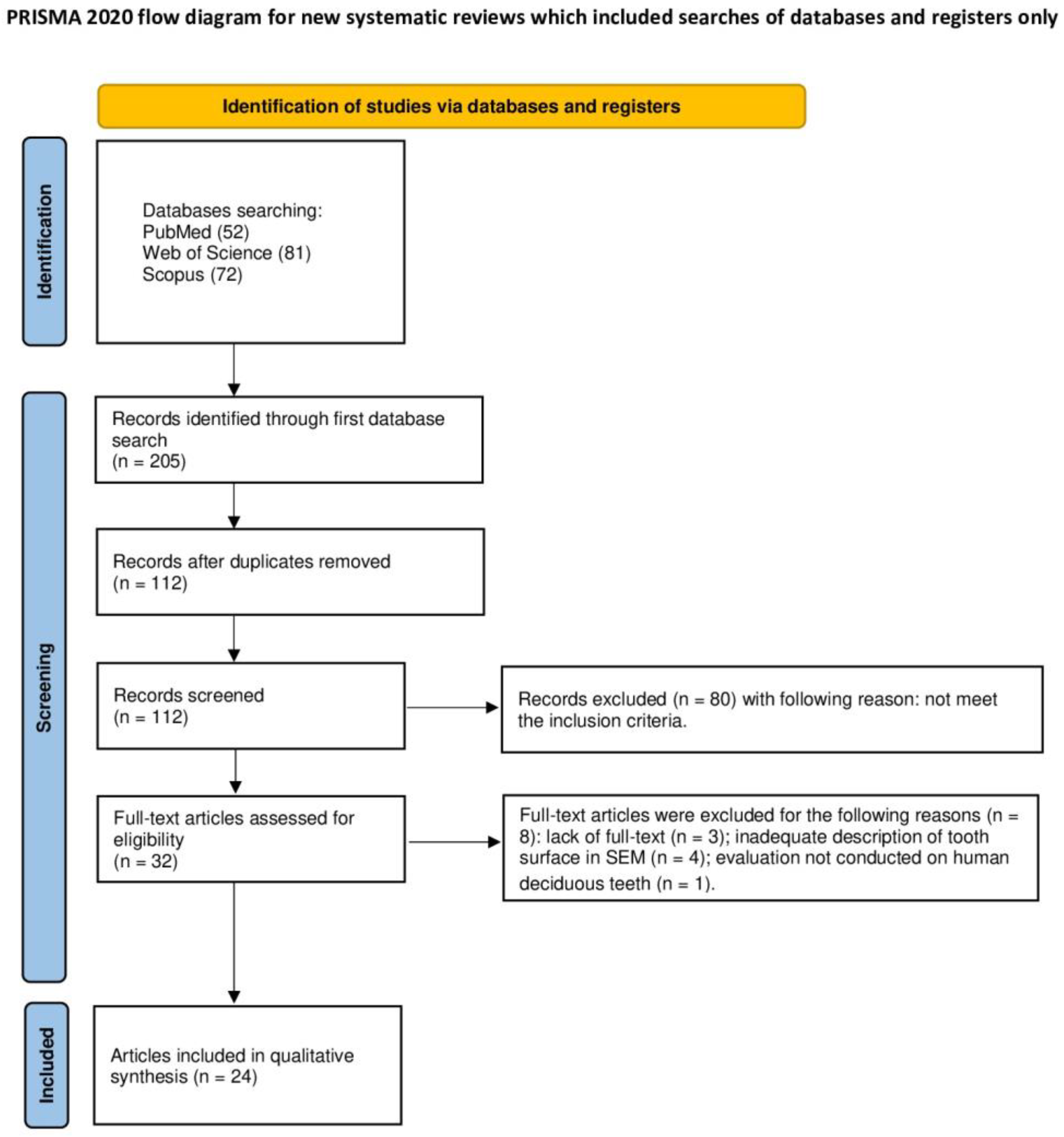
3.1. Study Selection
3.2. General Characteristics of the Included Studies
3.3. Main Study Outcomes
3.3.1. Dentin Surface Characterization
3.3.2. Enamel Surface Characterization
3.4. General Study Outcomes
3.5. Quality Assessment (QA)
4. Discussion
5. Conclusions
Author Contributions
Funding
Institutional Review Board Statement
Informed Consent Statement
Data Availability Statement
Conflicts of Interest
References
- Sugars and Dental Caries. Available online: https://www.who.int/news-room/fact-sheets/detail/sugars-and-dental-caries (accessed on 19 December 2023).
- Duruk, G.; Kizilci, E.; Malkoç, M.A. Effectiveness of Different Methods in Removing Dentin Caries of Primary Teeth: Micro-CT and SEM Evaluation. J. Clin. Pediatr. Dent. 2022, 46, 211–218. [Google Scholar] [CrossRef]
- Bossù, M.; Matassa, R.; Relucenti, M.; Iaculli, F.; Salucci, A.; Di Giorgio, G.; Familiari, G.; Polimeni, A.; Di Carlo, S. Morpho-Chemical Observations of Human Deciduous Teeth Enamel in Response to Biomimetic Toothpastes Treatment. Materials 2020, 13, 1803. [Google Scholar] [CrossRef] [PubMed]
- Jenkins, N. Materials for Paediatric Dentistry Part 1: Background to the Treatment of Carious Primary Teeth. Dent. Update 2017, 42, 905–910. [Google Scholar] [CrossRef] [PubMed]
- Itthagarun, A.; King, N.M.; Rana, R. Effects of Child Formula Dentifrices on Artificial Caries like Lesions Using in Vitro PH-Cycling: Preliminary Results. Int. Dent. J. 2007, 57, 307–313. [Google Scholar] [CrossRef]
- Bajaj, M.; Poornima, P.; Praveen, S.; Nagaveni, N.B.; Roopa, K.B.; Neena, I.E.; Bharath, K.P. Comparison of CPP-ACP, Tri-Calcium Phosphate and Hydroxyapatite on Remineralization of Artificial Caries Like Lesions on Primary Enamel -An in Vitro Study. J. Clin. Pediatr. Dent. 2016, 40, 404–409. [Google Scholar] [CrossRef] [PubMed]
- González-Sotelo, A.; Contreras-Bulnes, R.; Rodríguez-Vilchis, L.E.; Moyaho-Bernal, M.D.; Rubio-Rosas, E.; Cerna-Cortez, J.R. Enamel Demineralization Model in Primary Teeth: Micro-CT and SEM Assessments of Artificial Incipient Lesion. Microsc. Res. Tech. 2021, 84, 1577–1585. [Google Scholar] [CrossRef]
- Fleming, G.J.; Burke, F.J.; Watson, D.J.; Owen, F.J. Materials for Restoration of Primary Teeth: 1. Conventional Materials and Early Glass Ionomers. Dent. Update 2017, 28, 486–491. [Google Scholar] [CrossRef]
- Olczak-Kowalczyk, D.; Szczepańska, J.; Kaczmarek, U. Współczesna Stomatologia Wieku Rozwojowego; MED. TOUR PRESS Int. Sp. z oo: Otwock, Poland, 2017; pp. 31–75+195–261. [Google Scholar]
- Scanning Electron Microscopes|Thermo Fisher Scientific—PL. Available online: https://www.thermofisher.com/pl/en/home/electron-microscopy/products/scanning-electron-microscopes.html?cid=msd_ms_sbu_xmkt_sem_123456_emea_pso_gaw_l8o63m&gad_source=1&gclid=EAIaIQobChMI9vH0h8_hggMV0ItoCR3g1Qs0EAAYASAAEgJazPD_BwE (accessed on 19 December 2023).
- AlHumaid, J. Efficacy and Efficiency of Papacarie versus Conventional Method in Caries Removal in Primary Teeth: An SEM Study. Saudi J. Med. Med. Sci. 2020, 8, 41. [Google Scholar] [CrossRef]
- Tannure, P.N.; Barcelos, R.; Portela, M.B.; Gleiser, R.; Primo, L.G. Histopathologic and SEM Analysis of Primary Teeth with Pulpectomy Failure. Oral Surg. Oral Med. Oral Pathol. Oral Radiol. Endod. 2009, 108, e29–e33. [Google Scholar] [CrossRef]
- Kohara, E.K.; Hossain, M.; Kimura, Y.; Matsumoto, K.; Inoue, M.; Sasa, R. Morphological and Microleakage Studies of the Cavities Prepared by Er:YAG Laser Irradiation in Primary Teeth. J. Clin. Laser Med. Surg. 2004, 20, 141–147. [Google Scholar] [CrossRef]
- Deeb, J.G.; Smith, J.; Belvin, B.R.; Grzech-Leśniak, K.; Lewis, J. Er:YAG Laser Irradiation Reduces Microbial Viability When Used in Combination with Irrigation with Sodium Hypochlorite, Chlorhexidine, and Hydrogen Peroxide. Microorganisms 2019, 7, E612. [Google Scholar] [CrossRef]
- Ulusoy, N.B.; Akbay Oba, A.; Cehreli, Z.C. Effect of Er,Cr:YSGG Laser on the Prevention of Primary and Permanent Teeth Enamel Demineralization: SEM and EDS Evaluation. Photobiomodul. Photomed. Laser Surg. 2020, 38, 308–315. [Google Scholar] [CrossRef]
- Flury, S.; Koch, T.; Peutzfeldt, A.; Lussi, A. Micromorphology and Adhesive Performance of Er:YAG Laser-Treated Dentin of Primary Teeth. Lasers Med. Sci. 2012, 27, 529–535. [Google Scholar] [CrossRef] [PubMed]
- Wang, J.H.; Yang, K.; Zhang, B.Z.; Zhou, Z.F.; Wang, Z.R.; Ge, X.; Wang, L.L.; Chen, Y.J.; Wang, X.J. Effects of Er:YAG Laser Pre-Treatment on Dentin Structure and Bonding Strength of Primary Teeth: An in Vitro Study. BMC Oral Health 2020, 20, 1–10. [Google Scholar] [CrossRef] [PubMed]
- Kahvecioglu, F.; Kahraman, K.; Akman, H.; Tosun, G. Effects of Er:YAG Laser Treatment on the Mineral Content and Morphology of Primary Tooth Enamel. Photomed. Laser Surg. 2018, 36, 680–686. [Google Scholar] [CrossRef] [PubMed]
- Teutle-Coyotecatl, B.; Contreras-Bulnes, R.; Scougall-Vilchis, R.J.; Almaguer-Flores, A.; Rodríguez-Vilchis, L.E.; Velazquez-Enriquez, U.; Alatorre, J.Á.A. Effect of Er:YAG Laser Irradiation on Deciduous Enamel Roughness and Bacterial Adhesion: An in Vitro Study. Microsc. Res. Tech. 2019, 82, 1869–1877. [Google Scholar] [CrossRef] [PubMed]
- Guler, C.; Malkoc, M.A.; Gorgen, V.A.; Dilber, E.; Bulbul, M. Effects of Er:YAG Laser on Mineral Content of Sound Dentin in Primary Teeth. Sci. World J. 2014, 2014, 578342. [Google Scholar] [CrossRef] [PubMed]
- Bahrololoomi, Z.; Dadkhah, A.; Alemrajabi, M. The Effect of Er: YAG Laser Irradiation and Different Concentrations of Sodium Hypochlorite on Shear Bond Strength of Composite to Primary Teeth’s Dentin. J. Lasers Med. Sci. 2017, 8, 29–35. [Google Scholar] [CrossRef]
- Al-Batayneh, O.B.; Seow, W.K.; Walsh, L.J. Assessment of Er:YAG Laser for Cavity Preparation in Primary and Permanent Teeth: A Scanning Electron Microscopy and Thermographic Study. Pediatr. Dent. 2014, 36, 90–94. [Google Scholar]
- Memarpour, M.; Shafiei, F.; Razmjoei, F.; Kianimanesh, N. Effect of Laser Preparation on Adhesion of a Self-Adhesive Flowable Composite Resin to Primary Teeth. Microsc. Res. Tech. 2016, 79, 334–341. [Google Scholar] [CrossRef]
- Monghini, E.M.; Wanderley, R.L.; Pécora, J.D.; Palma Dibb, R.G.; Corona, S.A.M.; Borsatto, M.C. Bond Strength to Dentin of Primary Teeth Irradiated with Varying Er:YAG Laser Energies and SEM Examination of the Surface Morphology. Lasers Surg. Med. 2004, 34, 254–259. [Google Scholar] [CrossRef]
- Wanderley, R.L.; Monghini, E.M.; Pecora, J.D.; Palma-Dibb, R.G.; Borsatto, M.C. Shear Bond Strength to Enamel of Primary Teeth Irradiated with Varying Er:YAG Laser Energies and SEM Examination of the Surface Morphology: An In Vitro Study. Photomed. Laser Surg. 2005, 23, 260–267. [Google Scholar] [CrossRef] [PubMed]
- Zhang, S.; Chen, T.; Ge, L.H. Scanning Electron Microscopy Study of Cavity Preparation in Deciduous Teeth Using the Er:YAG Laser with Different Powers. Lasers Med. Sci. 2012, 27, 141–144. [Google Scholar] [CrossRef]
- Öznurhan, F.; Ölmez, A. Nanoleakage in Primary Teeth Prepared by Laser Irradiation or Bur. Lasers Med. Sci 2013, 28, 1099–1105. [Google Scholar] [CrossRef] [PubMed]
- Yilmaz, N.; Baltaci, E.; Baygin, O.; Tüzüner, T.; Ozkaya, S.; Canakci, A. Effect of the Usage of Er,Cr:YSGG Laser with and without Different Remineralization Agents on the Enamel Erosion of Primary Teeth. Lasers Med. Sci 2020, 35, 1607–1620. [Google Scholar] [CrossRef]
- Erkmen Almaz, M.; Ulusoy, N.B.; Akbay Oba, A.; Erdem, Ü.; Doğan, M. Thermal, Morphological, and Spectral Changes after Er, Cr:YSGG Laser Irradiation at Low Fluences on Primary Teeth for Caries Prevention. Microsc. Res. Tech. 2021, 84, 150–159. [Google Scholar] [CrossRef]
- Öznurhan, F.; Ölmez, A. Morphological Analysis of the Resin-Dentin Interface in Cavities Prepared with Er,Cr:YSGG Laser or Bur in Primary Teeth. Photomed. Laser Surg. 2013, 31, 386–391. [Google Scholar] [CrossRef]
- Arslan, I.; Baygin, O.; Tuzuner, T.; Erdemir, F.; Canakcı, A.; Korkmaz, F.M. The Effects of Cavity Disinfection on the Nanoleakage of Compomer Restorations: An in Vitro Study. Eur. Oral Res. 2020, 54, 16–24. [Google Scholar] [CrossRef]
- Neto, W.R.; Lepri, C.P.; Romano, J.J.F.; Fernandes, F.S.; De Castro Raucci, L.M.S.; Bachmann, L.; Dibb, R.G.P. Chemical and Morphological Changes of Primary Teeth Irradiated with Nd:YAG Laser: An Ex Vivo Long-Term Analysis. Photomed. Laser Surg. 2015, 33, 266–273. [Google Scholar] [CrossRef]
- Asl-Aminabadi, N.; Najafpour, E.; Samiei, M.; Erfanparast, L.; Anoush, S.; Jamali, Z.; Pournaghi-Azar, F.; Ghertasi-Oskouei, S. Laser-Casein Phosphopeptide Effect on Remineralization of Early Enamel Lesions in Primary Teeth. J. Clin. Exp. Dent. 2015, 7, e261–e267. [Google Scholar] [CrossRef]
- Reddy Banda, N.; Reddy, G.V.; Shashikiran, N. Evaluation of Primary Tooth Enamel Surface Morphology and Microhardness after Nd: YAG Laser Irradiation and APF Gel Treatment—An in Vitro Study. J. Clin. Pediatr. Dent. 2011, 35, 377–382. [Google Scholar] [CrossRef]
- Guglielmi, C.A.B.; Müller Ramalho, K.; Scaramucci, T.; Da Silva, S.R.E.P.; Imparato, J.C.P.; Pinheiro, S.L. Evaluation of the Furcation Area Permeability of Deciduous Molars Treated by Neodymium:Yttrium-Aluminum-Garnet Laser or Adhesive. Lasers Med. Sci 2010, 25, 873–880. [Google Scholar] [CrossRef]
- Bolukbasi, B.; Kucukyilmaz, E. Evaluation of the Bond Strengths of Restorative Materials to Primary Tooth Dentin Treated with Different Pulpotomy Techniques. Microsc. Res. Tech. 2021, 84, 1309–1320. [Google Scholar] [CrossRef]
- Das, B.; Barman, S.; Baishya, A.; Haloi, R.; Das, D. Knowledge, Awareness, and Practice of Pediatricians Regarding Infant Oral Health Care and Early Childhood Caries in the State of Assam, India. Cureus 2024, 16, e52060. [Google Scholar] [CrossRef]
- Splieth, C.H.; Banerjee, A.; Bottenberg, P.; Breschi, L.; Campus, G.; Ekstrand, K.R.; Giacaman, R.A.; Haak, R.; Hannig, M.; Hickel, R.; et al. How to Intervene in the Caries Process in Children: A Joint ORCA and EFCD Expert Delphi Consensus Statement. Caries Res. 2020, 54, 297–305. [Google Scholar] [CrossRef] [PubMed]
- Khalilak, Z.; Vatanpour, M.; Bineshmarvasti, D. Intrapulpal Temperature Rise Following Two Dentin Hypersensitivity Treatment Protocols Using Diode Laser: A Randomized Clinical Trial. Lasers Dent. Sci. 2021, 5, 27–33. [Google Scholar] [CrossRef]
- El-Dehna, A.M.; Alyaski, M.A.; Mostafa, M.H. Clinical Evaluation of Laser Versus Conventional Cavity Preparation Methods in Primary Teeth Restorations. Al-Azhar Dent. J. Girls 2021, 8, 483–489. [Google Scholar] [CrossRef]
- Di Giorgio, G.; Relucenti, M.; Iaculli, F.; Salucci, A.; Donfrancesco, O.; Polimeni, A.; Bossù, M. The Application of a Fluoride-and-Vitamin D Solution to Deciduous Teeth Promotes Formation of Persistent Mineral Crystals: A Morphological Ex-Vivo Study. Materials 2023, 16, 4049. [Google Scholar] [CrossRef] [PubMed]
- Grzech-Leśniak, K.; Matys, J.; Zmuda-Stawowiak, D.; Mroczka, K.; Dominiak, M.; Brugnera, A.; Gruber, R.; Romanos, G.E.; Sculean, A. Er:YAG Laser for Metal and Ceramic Bracket Debonding: An In Vitro Study on Intrapulpal Temperature, SEM, and EDS Analysis. Photomed. Laser Surg. 2018, 36, 595–600. [Google Scholar] [CrossRef] [PubMed]
- Kiryk, J.; Matys, J.; Nikodem, A.; Burzyńska, K.; Grzech-Leśniak, K.; Dominiak, M.; Dobrzyński, M. The Effect of Er:YAG Laser on a Shear Bond Strength Value of Orthodontic Brackets to Enamel—A Preliminary Study. Materials 2021, 14, 2093. [Google Scholar] [CrossRef] [PubMed]
- Zakrzewski, W.; Dobrzynski, M.; Kuropka, P.; Matys, J.; Malecka, M.; Kiryk, J.; Rybak, Z.; Dominiak, M.; Grzech-Lesniak, K.; Wiglusz, K.; et al. Removal of Composite Restoration from the Root Surface in the Cervical Region Using Er: YAG Laser and Drill—In Vitro Study. Materials 2020, 13, 3027. [Google Scholar] [CrossRef] [PubMed]
- Kiryk, J.; Matys, J.; Grzech-Leśniak, K.; Dominiak, M.; Małecka, M.; Kuropka, P.; Wiglusz, R.J.; Dobrzyński, M. SEM Evaluation of Tooth Surface after a Composite Filling Removal Using Er:YAG Laser, Drills with and without Curettes, and Optional EDTA or NaOCl Conditioning. Materials 2021, 14, 4469. [Google Scholar] [CrossRef] [PubMed]
- Matys, J.; Romeo, U.; Mroczka, K.; Grzech-Lésniak, K.; Dominiak, M. Temperature Changes and SEM Effects of Three Different Implants-Abutment Connection during Debridement with Er:YAG Laser: An Ex Vivo Study. Materials 2019, 12, 3748. [Google Scholar] [CrossRef] [PubMed]
- Deeb, J.G.; Grzech-Leśniak, K.; Weaver, C.; Matys, J.; Bencharit, S. Retrieval of Glass Fiber Post Using Er:YAG Laser and Conventional Endodontic Ultrasonic Method: An In Vitro Study. J. Prosthodont. 2019, 28, 1024–1028. [Google Scholar] [CrossRef]
- Ansari, G.; Chitsazan, A.; Fekrazad, R.; Javadi, F. Clinical and Radiographic Evaluation of Diode Laser Pulpotomy on Human Primary Teeth Diod Laser Pulpotomy of Primary Teeth. Laser Ther. 2018, 27, 187–192. [Google Scholar] [CrossRef]
- Roy, S.; Garg, N.; Pathivada, L.; Choudhary, R.; Kaur, H.; Yeluri, R. Comparative Evaluation of Low-Level Diode Laser and Electrosurgical Pulpotomy in Primary Molars. Int. J. Clin. Pediatr. Dent. 2023, 16, 612. [Google Scholar] [CrossRef]
- Boutsiouki, C.; Frankenberger, R.; Krämer, N. Clinical and Radiographic Success of (Partial) Pulpotomy and Pulpectomy in Primary Teeth: A Systematic Review. Eur. J. Paediatr. Dent. 2021, 22, 273–285. [Google Scholar] [CrossRef]
- Phyo, W.M.; Saket, D.; da Fonseca, M.A.; Auychai, P.; Sriarj, W. In Vitro Remineralization of Adjacent Interproximal Enamel Carious Lesions in Primary Molars Using a Bioactive Bulk-Fill Composite. BMC Oral Health 2024, 24, 37. [Google Scholar] [CrossRef]
- Ramesh, S.; Govula, K.; Padarthi, L.C.; Anumula, L.; Chinni, S.K.; Sannapureddy, S. Evaluation of Composite Restoration in Posterior Teeth with Proanthocyanidin Pretreatment Liner Using Fédération Dentaire Internationale Criteria: A Split-Mouth Randomized Controlled Trial. Int. J. Prosthodont. Restor. Dent. 2023, 13, 191–200. [Google Scholar] [CrossRef]
- Ankita; Paul, B.; Mantri, S.K.; Dube, K.; Akhtar, F.; Singh, N.; Sinha, P. Comparative Evaluation of Shear Bond Strength and Failure Pattern of Three Different Dentin Adhesive Systems—An In Vitro Study. J. Popul. Ther. Clin. Pharmacol. 2024, 31, 912–920. [Google Scholar] [CrossRef]
- Thaweboon, S.; Saito, T.; Thaweboon, B. Inhibition of the Biofilm Formation of Anaerobic Bacteria Involved in Secondary Caries by Dental Adhesive. J. Biomim. Biomater. Biomed. Eng. 2023, 62, 21–26. [Google Scholar] [CrossRef]
- Selvam, R.; Hiremath, P.; Cs, S.K.; Ramakrishna Bhat, R.; Thomas, A.A.; Shenoy, N.; Kini, S.; Somayaji, K.; Mujawar, A.; Hegde, V.; et al. Comparative Evaluation of the Microleakage of Two Bonding Systems Pretreated with Chitosan Nanoparticles and Restored with Composite Resin: An In Vitro Study. Eng. Proc. 2023, 59, 110. [Google Scholar] [CrossRef]
- Sahu, T.; Soni, M.; Sahu Senior Resident, T. Assessing Microbial Dynamics in Carious Lesions: Exploring the Role of Er:YAG Laser in Conservative Dentistry. Int. J. Life Sci. 2023, 12. [Google Scholar]
- Khan, B.S.; Setty, J.V.; Srinivasan, I.; Kibriya, S.; Anu, S.; Radhakrishna, S.; Milit, Y. Low-Level Laser Therapy to Alleviate Pain of Local Anesthesia Injection in Children: A Randomized Control Trial. Int. J. Clin. Pediatr. Dent. 2024, 16, S283–S287. [Google Scholar] [CrossRef]
- Uchôa, S.A.C.L.; Corrêa, S.C.L.; Corrêa, D.L.; Corrêa, V.C. The Management of Patients with Autism in Pediatric Dental Clinics: A Review of the Literature. In Health of Tomorrow: Innovations and Academic Research; Seven Publicações Ltda.: São José dos Pinhais, Brazil, 2024. [Google Scholar] [CrossRef]
- Corrêa, S.C.L.; Uchôa, S.A.C.L.; Corrêa, D.L.; Corrêa, V.C.; Dias, H.B. The Practice of Pediatric Dentistry after the COVID-19 Pandemic. In Health of Tomorrow: Innovations and Academic Research; Seven Publicações Ltda.: São José dos Pinhais, Brazil, 2024. [Google Scholar] [CrossRef]
- Umamaheswari, N.; Ravi, S.; John, J.; Mohan, M. Effect of Sound Masking Using Child-Friendly Masker Sounds on the Perception of the Dental Drill Noise in Pediatric Dental Practice: An Interventional Study. SRM J. Res. Dent. Sci. 2023, 14, 70. [Google Scholar] [CrossRef]
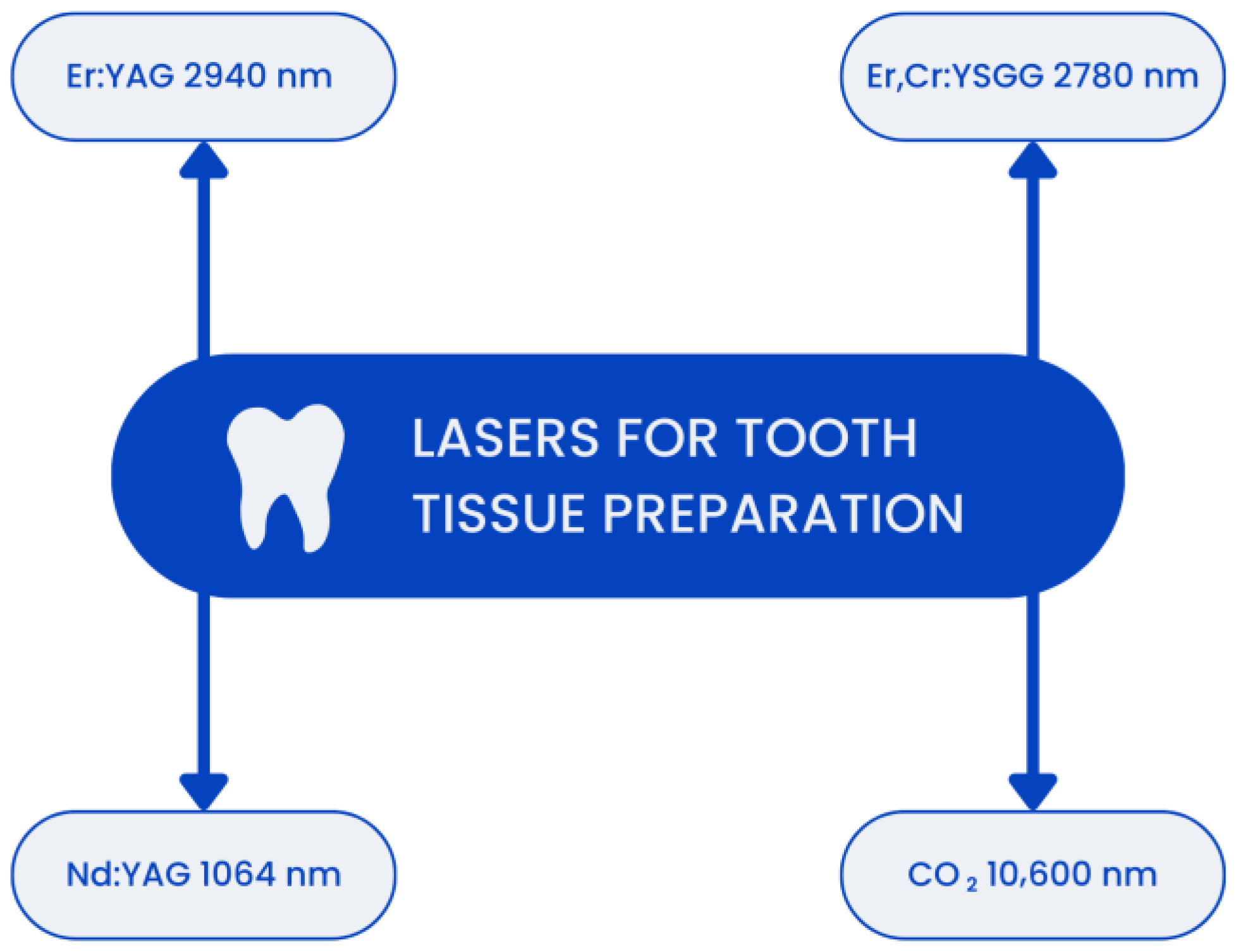

| Type of Laser | |||||
|---|---|---|---|---|---|
| Er:YAG | Er,Cr:YSGG | Nd:YAG | |||
| Duruk et al. [2] Kohara et al. [13] Flury et al. [16] Wang et al. [17] Kahvecioglu et al. [18] Teutle-Coyotecatl et al. [19] Guler et al. [20] Bahrololoomi et al. [21] Al-Batayneh et al. [22] Memarpour et al. [23] Monghini et al. [24] Wanderley et al. [25] Zhang et al. [26] | Ulusoy et al. [15] Öznurhan et al. [27] Yilmaz et al. [28] Almaz et al. [29] Öznurhan et al. [30] Arslan et al. [31] | Neto et al. [32] Asl-Aminabadi et al. [33] Banda et al. [34] Guglielmi et al. [35] Bolukbasi et al. [36] | |||
| SEM Images | |||||
| Dentin | Enamel | Dentin + Enamel | |||
| Duruk et al. [2] Kohara et al. [13] Flury et al. [16] Wang et al. [17] Guler et al. [20] Bahrololoomi et al. [21] Monghini et al. [24] Zhang et al. [26] Öznurhan et al. [27] Öznurhan et al. [30] Guglielmi et al. [35] Bolukbasi et al. [36] | Ulusoy et al. [15] Kahvecioglu et al. [18] Teutle-Coyotecatl et al. [19] Wanderley et al. [25] Yilmaz et al. [28] Almaz et al. [29] Arslan et al. [31] Neto et al. [32] Asl-Aminabadi et al. [33] Banda et al. [34] | Al-Batayneh et al. [22] Memarpour et al. [23] | |||
| Other Parameters | |||||
| Shear Bond Strength | Microleakage | Hybrid Layer Thickness | Remineralization of Enamel | ||
| Wang et al. [17] Bahrololoomi et al. [21] Memarpour et al. [23] Monghini et al. [24] Wanderley et al. [25] Bolukbasi et al. [36] | Kohara et al. [13] Öznurhan et al. [27] Arslan et al. [31] | Öznurhan et al. [27] Öznurhan et al. [30] | Yilmaz et al. [28] Asl-Aminabadi et al. [33] | ||
| Thermal Effects on the Pulp | Demineralization of Enamel | Bacterial Adhesion | Microhardness | ||
| Al-Batayneh et al. [22] Almaz et al. [29] | Ulusoy et al. [15] | Teutle-Coyotecatl et al. [19] | Banda et al. [34] | ||
| Dentin Surface Irregularities | |
|---|---|
| Er:YAG Laser | Er,Cr:YSGG Laser |
| Duruk et al. [2] Kohara et al. [13] Flury et al. [16] Wang et al. [17] Guler et al. [20] Bahrololoomi et al. [21] Memarpour et al. [23] Monghini et al. [24] Zhang et al. [26] Öznurhan et al. [27] | Öznurhan et al. [27] |
| Patency of Dentinal Tubules | |
| Open (Completely or Partially) | Closed |
| Kohara et al. [13] Flury et al. [16] Wang et al. [17] Al-Batayneh et al. [22] Memarpour et al. [23] Zhang et al. [26] Öznurhan et al. [30] | Duruk et al. [2] |
| Presence of Smear Layer | |
| Present | Absent |
| Bahrololoomi et al. [21] | Kohara et al. [13] Al-Batayneh et al. [22] Memarpour et al. [23] Zhang et al. [26] Öznurhan et al. [30] Bolukbasi et al. [36] |
| Reference Number | Laser Type | Investigation | Surface Characterization |
|---|---|---|---|
| Öznurhan [27] | Er,Cr:YSGG 2780 nm, 140–200 μs, 20 Hz | 10 human teeth hybrid layer thickness and the amount of silver ions | (dentin) Irregular surface Decrease in collagen content due to ablation |
| Duruk [2] | Er:YAG 200 mJ, 2 Hz | 60 human teeth effect on dentin morphology | (dentin) Closed dentinal tubules Rough surface Ablation craters |
| Neto [32] | Nd:YAG 100 mJ, 5 Hz, 0.5 W | 186 human teeth effect on enamel morphology | (enamel) Smoother surface after using the laser and fluorine than after the laser alone No cracking, melting, or glazing |
| Flury [16] | Er:YAG 200 mJ, 25 Hz, 5 W; 100 mJ, 35 Hz, 3.5 W; 400 mJ/20 Hz, 8 W; 100 mJ, 35 Hz, 3.5 W; 50 mJ, 35 Hz, 1.75 W. | 18 human teeth (cut into dentin samples) effect on dentin morphology | (dentin) Irregular and flaky surface, open tubules, no smear layer Greater ablation in the intertubular dentin than in the peritubular dentin No thermal damage, carbonization, or cracks |
| Ulusoy [15] | Er,Cr:YSGG 20 Hz + 0.25 W, 4.42 J/cm 2 (L1 and L4), 0.50 W, 8.84 J/cm 2 (L2 and L5), 0.75 W, 13.26 J/cm 2 (L3 and L6) | 225 human teeth resistance of enamel to demineralization | (enamel) In the control group, an image of a honeycomb In the fluoride group, an image of a honeycomb with a cloudy surface In places of contact with the laser beam, there are craters with exposed enamel prisms, separated from the normal enamel by a sharp edge. Increasing power = enlarging craters and creating cracks In the group with water cooling, more extensive craters and protruding edges Craters deeper in primary teeth than in permanent teeth |
| Wang [17] | Er:YAG 10 Hz, 2940 nm + (50 mJ, 100 mJ, 150 mJ, 200 mJ, 250 mJ, and 300 mJ) 100 mJ, 5 Hz + (10 Hz, 15 Hz, 20 Hz, 25 Hz, and 30 Hz) | 80 human teeth effect on dentin morphology, shear bond strength of composite resin to dentin | (dentin) Same energy level, different frequency: 5–15 Hz protrusion of peritubular dentin, ichthyosis appearance, lamellar, irregular surface, open dentinal tubules 15 Hz single cracks 20 Hz ichthyosis appearance, lamellar surface, open channels, deeper cracks 25 Hz larger cracks, blurred border between channels, collapsed structure 30 Hz disorganization of collagen fibers, carbonization Fixed frequency, different energy: 50 mJ open dentinal tubules, irregular surface, no smear layer, protrusion of peritubular dentin 100–200 mJ open dentinal tubules, irregular surface, no smear layer 150 mJ single cracks 200 mJ clear, deep cracks 250 mJ smooth surface, blurred boundaries between channels, larger cracks, collapsed structure 300 mJ collapsed structure, disorganization of collagen fibers, signs of carbonization |
| Yilmaz [28] | Er,Cr:YSGG 0.5 W, 20 Hz, 25 mJ, 8.84 J/cm2, 60 μs, 600 μm | 89 human teeth enamel remineralization | (enamel) Rough irregular surface, cracks and craters, melted enamel |
| Almaz [29] | Er,Cr:YSGG I: 0.25 W, 20 Hz, II: 0.50 W, 20 Hz, III: 0.75 W, 20 Hz. | 60 human teeth Thermal effects on the pulp | (enamel) Irregular surface, numerous conical craters, ablation areas The depth and number of craters increase as the laser power increases |
| Asl-Aminabadi [33] | Nd:YAG 200 μm, 15 s, 100 mJ, 125 J/cm2, 10 Hz, 1 W | 80 human teeth enamel remineralization | (enamel) In the laser only group, melting of the enamel, irregular, wavy surface with no continuity, numerous cracks and pits No visible enamel prisms In the fluorine laser group, the surface is smoother and there are fewer cracks |
| Kahvecioglu [18] | Er:YAG Group I: 0.40 W, 2 Hz, and 200 mJ Group II: 0.60 W, 3 Hz, and 200 mJ Group III: 2 W, 10 Hz, and 200 mJ Group IV: 0.50 W, 2 Hz, and 250 mJ Group V: 0.75 W, 3 Hz, and 250 mJ Group VI: 2.5 W, 10 Hz, and 250 mJ Group VII: 0.60 W, 2 Hz, and 300 mJ Group VIII: 0.90 W, 3 Hz, and 300 mJ Group IX: 3 W, 10 Hz, and 300 mJ | 45 human teeth effect on enamel morphology | (enamel) Appearance of a lava stream, more irregular surface at 250 mJ than 200 mJ Cracks, no signs of enamel degradation |
| Teutle-Coyotecatl [19] | Er:YAG 100, 7 Hz, 400 μs | 54 human teeth effect on bacterial adhesion, effect on enamel morphology and bacterial adhesion | (enamel) Rough, scaly surface with clearly defined areas of smooth molten enamel No visible enamel prisms |
| Guler [20] | Er:YAG 3.5 W, 175 mJ, 20 Hz | 36 human teeth effect on surface roughness, effect on dentin morphology | (dentin) Rough, crystalline surface |
| Öznurhan [30] | Er,Cr:YSGG 3.5 W, 20 Hz | 20 human teeth hybrid layer thickness | (dentin) Wavy surface, few cracks, exposed dentinal tubules, no smear layer |
| Bahrololoomi [21] | Er:YAG 200 mJ, 10 Hz | 48 human teeth effect on dentin morphology, shear bond strength of composite resin to dentin | (dentin) Irregular, flaky surface, slight smear layer When additionally using NaOCl 5.25%, the surface is smoother, there are more open dentinal tubules, and there is no smear layer |
| Al-Batayneh [22] | Er:YAG 200 mJ, 10 Hz | 80 human teeth (40 primary and 40 permanent) thermal effects on the pulp | (enamel) Visible crater-like cavities with smooth edges and a rough bottom (dentine) No smear layer, open dentinal tubules |
| Memarpour [23] | Er:YAG 20 mJ, 10 Hz, 1.20 W | 120 human teeth shear bond strength of composite resin to dentin | (enamel) Irregular surface without smear layer. (dentine) Irregular surface, no smear layer, open dentinal tubules, no visible surface damage |
| Banda [34] | Nd:YAG The laser parameters were not described | 10 human Teeth effect on microhardness | (enamel) In the laser-only group, there is an irregular, rough, wrinkled surface with numerous cavitations and craters In the laser + fluorine group, a homogeneous surface with small porosities and no cracks In the fluorine + laser group, a porous surface with numerous cracks |
| Monghini [24] | Er:YAG 60 mJ/2 Hz (G2), 80 mJ/2 Hz (G3), 100 mJ/2 Hz (G4) | 21 human teeth shear bond strength of composite resin to dentin | (dentin) Uneven, peeling surface, craters and grooves present, and areas where laser radiation did not reach |
| Wanderley [25] | Er:YAG 60 mJ/2 Hz (G2), 80 mJ/2 Hz (G3), and 100 mJ/2 Hz (G4) | 48 human teeth shear bond strength of composite resin to dentin | (enamel) With parameters of 60 mJ/2 Hz, an uneven surface, without a specific etching pattern At 80 mJ/2 Hz, irregular surface, visible cracks, and small melt areas; no specific etching pattern With parameters of 100 mJ/2 Hz, anphractic surface with numerous gaps, without a specific etching pattern |
| Zhang [26] | Er:YAG 10 Hz/200 mJ, 10 Hz/300 mJ and 10 Hz/400 mJ | 8 human teeth effect on dentin morphology | (dentine) No smear layer in 3 cases. Scaly, uneven surface, open dentinal tubules Cracks and melting present only at parameters 400 mJ/10 Hz |
| Kohara [13] | Er:YAG 300 mJ, 4 H | 30 human teeth microleakage at cavities | (dentine) No smear layer, exposed dentinal tubules, micro irregularities, greater ablation of intertubular than peritubular dentin |
| Arslan [31] | Er,Cr:YSGG 940 nm, 20-Hz; 2780 nm, 20-Hz, | 40 human teeth microleakage at cavities | (enamel) Visible cracks on the surface |
| Guglielmi [35] | Nd:YAG 064 nm, 100 μs, 100 mJ, 15 Hz,1.5 W | 39 human teeth effect on dentin morphology | (dentine) Melted surface with areas of recrystallization, dentinal tubule orifices closed with molten material |
| Bolukbasi [36] | Nd:YAG 2 W, 20 Hz power/cm 2, 100 mJ | Human teeth divided into 240 specimens shear bond strength of composite resin to dentin | (dentin) Smear layer completely removed, dentinal tubules partially open |
| Reference Publications/Criteria | Group Size of min. 10 Samples | Control Group | Sample Size Calculation | Detailed Laser Parameters (Power, Frequency, Wavelength, Spot Size, etc.) | Irradiation Protocol (Distance, Time, Passages) | Detailed Description of Efficacy of the Treatment | Total Points | Risk of Bias |
|---|---|---|---|---|---|---|---|---|
| Öznurhan et al. [27] | 0 | 0 | 0 | 1 | 1 | 1 | 3 | Moderate |
| Duruk et al. [2] | 1 | 0 | 0 | 1 | 1 | 1 | 4 | Moderate |
| Neto et al. [32] | 0 | 1 | 0 | 1 | 1 | 1 | 4 | Moderate |
| Flury et al. [16] | 0 | 1 | 0 | 1 | 1 | 1 | 4 | Moderate |
| Ulusoy et al. [15] | 1 | 1 | 0 | 1 | 1 | 1 | 5 | Low |
| Wang et al. [17] | 1 | 1 | 1 | 1 | 1 | 1 | 6 | Low |
| Yilmaz et al. [28] | 1 | 1 | 1 | 1 | 0 | 1 | 5 | Low |
| Almaz et al. [29] | 1 | 1 | 1 | 1 | 1 | 1 | 6 | Low |
| Asl-Aminabadi et al. [33] | 1 | 1 | 1 | 1 | 1 | 1 | 6 | Low |
| Kahvecioglu et al. [18] | 0 | 1 | 1 | 1 | 1 | 1 | 5 | Low |
| Teutle-Coyotecatl et al. [19] | 1 | 1 | 0 | 1 | 1 | 1 | 5 | Low |
| Guler et al. [20] | 1 | 1 | 0 | 1 | 1 | 1 | 5 | Low |
| Öznurhan et al. [30] | 1 | 0 | 0 | 1 | 0 | 1 | 3 | Moderate |
| Bahrololoomi et al. [21] | 1 | 0 | 0 | 1 | 0 | 1 | 3 | Moderate |
| Al-Batayneh et al. [22] | 1 | 1 | 0 | 1 | 1 | 1 | 5 | Low |
| Memarpour et al. [23] | 1 | 0 | 0 | 1 | 1 | 1 | 4 | Moderate |
| Banda et al. [34] | 1 | 1 | 0 | 0 | 0 | 1 | 3 | Moderate |
| Monghini et al. [24] | 1 | 1 | 0 | 1 | 1 | 1 | 5 | Low |
| Wanderley et al. [25] | 1 | 1 | 0 | 1 | 1 | 1 | 5 | Low |
| Zhang et al. [26] | 0 | 1 | 0 | 1 | 0 | 1 | 3 | Moderate |
| Kohara et al. [13] | 1 | 1 | 0 | 1 | 0 | 1 | 4 | Moderate |
| Arslan et al. [31] | 1 | 1 | 0 | 1 | 0 | 1 | 4 | Moderate |
| Guglielmi et al. [35] | 1 | 1 | 0 | 1 | 1 | 1 | 5 | Low |
| Bolukbasi et al. [36] | 1 | 1 | 1 | 1 | 1 | 1 | 6 | Low |
Disclaimer/Publisher’s Note: The statements, opinions and data contained in all publications are solely those of the individual author(s) and contributor(s) and not of MDPI and/or the editor(s). MDPI and/or the editor(s) disclaim responsibility for any injury to people or property resulting from any ideas, methods, instructions or products referred to in the content. |
© 2024 by the authors. Licensee MDPI, Basel, Switzerland. This article is an open access article distributed under the terms and conditions of the Creative Commons Attribution (CC BY) license (https://creativecommons.org/licenses/by/4.0/).
Share and Cite
Struzik, N.; Wiśniewska, K.; Piszko, P.J.; Piszko, A.; Kiryk, J.; Matys, J.; Dobrzyński, M. SEM Studies Assessing the Efficacy of Laser Treatment for Primary Teeth: A Systematic Review. Appl. Sci. 2024, 14, 1107. https://doi.org/10.3390/app14031107
Struzik N, Wiśniewska K, Piszko PJ, Piszko A, Kiryk J, Matys J, Dobrzyński M. SEM Studies Assessing the Efficacy of Laser Treatment for Primary Teeth: A Systematic Review. Applied Sciences. 2024; 14(3):1107. https://doi.org/10.3390/app14031107
Chicago/Turabian StyleStruzik, Natalia, Kamila Wiśniewska, Paweł J. Piszko, Aleksandra Piszko, Jan Kiryk, Jacek Matys, and Maciej Dobrzyński. 2024. "SEM Studies Assessing the Efficacy of Laser Treatment for Primary Teeth: A Systematic Review" Applied Sciences 14, no. 3: 1107. https://doi.org/10.3390/app14031107
APA StyleStruzik, N., Wiśniewska, K., Piszko, P. J., Piszko, A., Kiryk, J., Matys, J., & Dobrzyński, M. (2024). SEM Studies Assessing the Efficacy of Laser Treatment for Primary Teeth: A Systematic Review. Applied Sciences, 14(3), 1107. https://doi.org/10.3390/app14031107

