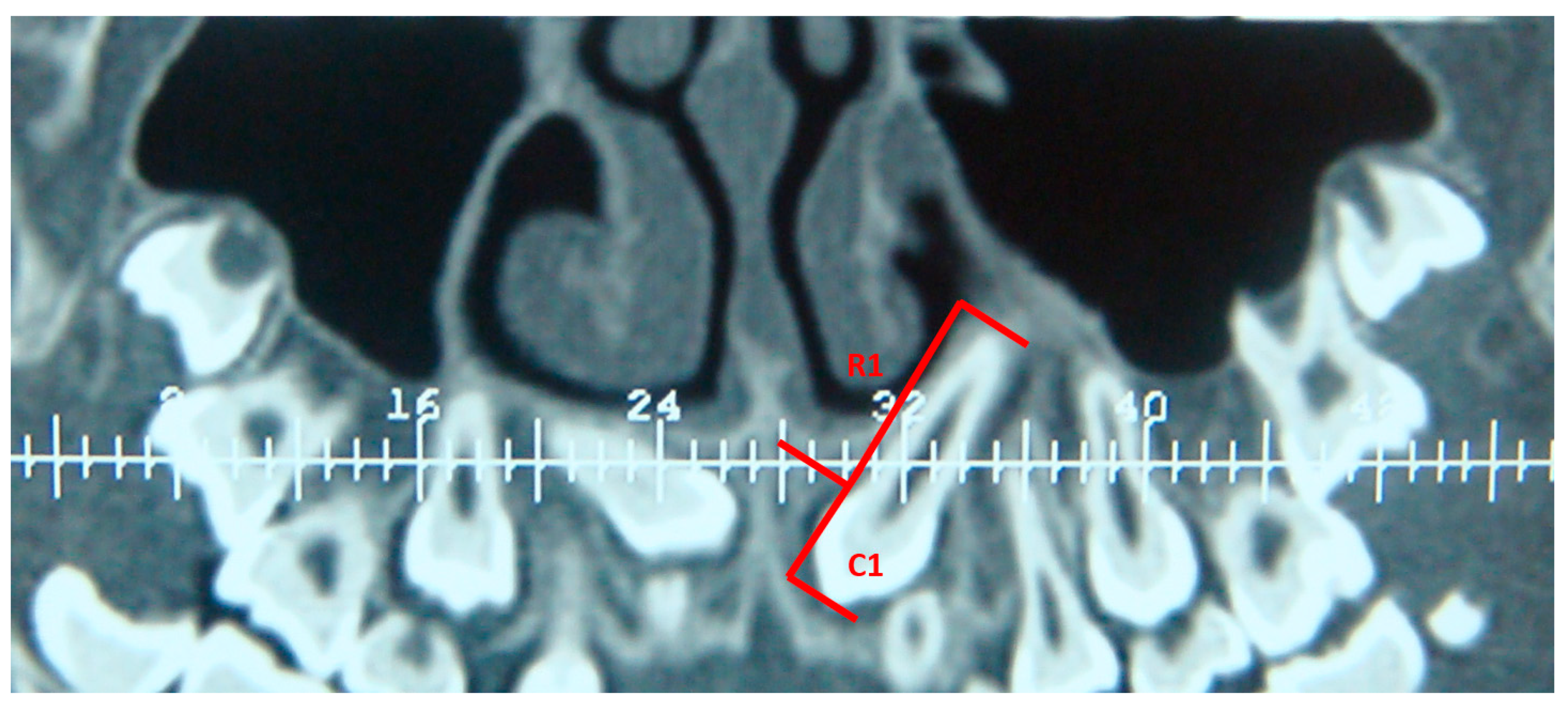
Cone Beam Computed Tomography (CBCT) Aid in the Management of Apical Root Resorption of Impacted Maxillary Canines and Physiologically Erupted Maxillary Canines after Orthodontic Treatment

 ,
, 
 ,
,  ,
, Abstract
Share and Cite
Bianco, E.; Mirabelli, L.; Basilicata, M.; Bruno, G.; De Stefani, A.; Du, L.; Maddalone, M. Cone Beam Computed Tomography (CBCT) Aid in the Management of Apical Root Resorption of Impacted Maxillary Canines and Physiologically Erupted Maxillary Canines after Orthodontic Treatment. Appl. Sci. 2024, 14, 886. https://doi.org/10.3390/app14020886
Bianco E, Mirabelli L, Basilicata M, Bruno G, De Stefani A, Du L, Maddalone M. Cone Beam Computed Tomography (CBCT) Aid in the Management of Apical Root Resorption of Impacted Maxillary Canines and Physiologically Erupted Maxillary Canines after Orthodontic Treatment. Applied Sciences. 2024; 14(2):886. https://doi.org/10.3390/app14020886
Chicago/Turabian StyleBianco, Edoardo, Luca Mirabelli, Michele Basilicata, Giovanni Bruno, Alberto De Stefani, Linda Du, and Marcello Maddalone. 2024. "Cone Beam Computed Tomography (CBCT) Aid in the Management of Apical Root Resorption of Impacted Maxillary Canines and Physiologically Erupted Maxillary Canines after Orthodontic Treatment" Applied Sciences 14, no. 2: 886. https://doi.org/10.3390/app14020886
APA StyleBianco, E., Mirabelli, L., Basilicata, M., Bruno, G., De Stefani, A., Du, L., & Maddalone, M. (2024). Cone Beam Computed Tomography (CBCT) Aid in the Management of Apical Root Resorption of Impacted Maxillary Canines and Physiologically Erupted Maxillary Canines after Orthodontic Treatment. Applied Sciences, 14(2), 886. https://doi.org/10.3390/app14020886