Article

Differences in Physical Indexes between Football Players of Different Playing Positions and Correlation to the Weekly Training Load


by
Lazaros Vardakis
1,
Marianthi Koutsokosta
1,
Yiannis Michailidis
1,*,
Athanasios Mandroukas
1,
Andreas Stafylidis
1,
Vasilis Kanaras
1,
Charalampos Bamplekis
1,
Andreas Fousekis
1,
Konstantinos Stamatelos
1,
Ioannis Metaxas
2,
Charalambos Zelenitsas
3,
Panagiotis Topalidis
1,
Angelos E. Kyranoudis
1 and
Thomas I. Metaxas
1
1
Laboratory of Evaluation of Human Biological Performance, Department of Physical Education and Sports Sciences, Aristotle University of Thessaloniki, 57001 Thessaloniki, Greece
2
Department of Physical Education and Sports Sciences, Aristotle University of Thessaloniki, 62100 Serres, Greece
3
Section of Sport Medicine and Biology of Exercise, School of Physical Education and Sport Science, National and Kapodistrian University of Athens, 15784 Athens, Greece
*
Author to whom correspondence should be addressed.
Appl. Sci. 2024, 14(11), 4469; https://doi.org/10.3390/app14114469
Submission received: 22 April 2024 / Revised: 16 May 2024 / Accepted: 21 May 2024 / Published: 23 May 2024

Abstract

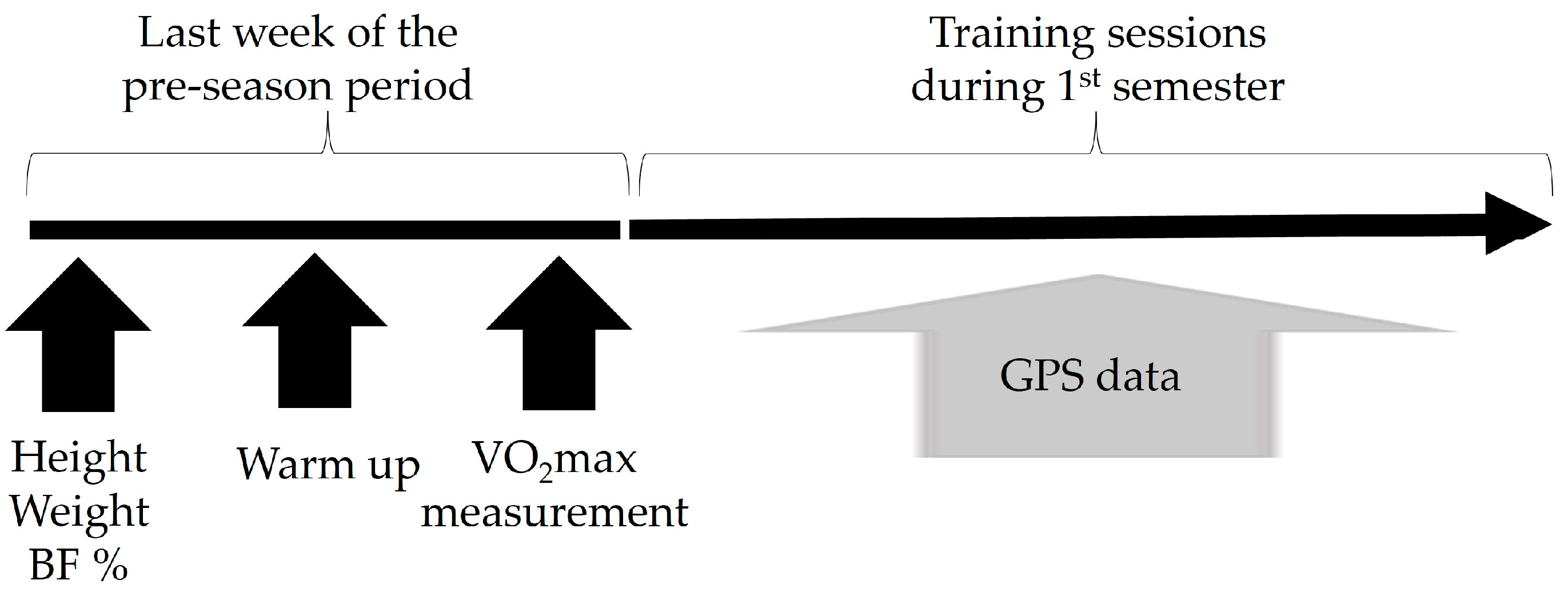
The aim of this study was twofold: (a) to examine the differences on physical indexes between players of different playing positions and (b) to reveal the correlations between their physical parameters and the running profile within the weekly microcycles. The subjects (n = 44) were separated into five positions: central defenders (n = 7), wide defenders (n = 9), midfielders (n = 13), wingers (n = 8) and strikers (n = 7), and all of them belonged to a professional 1st division European team during the 2020–21 and 2021–22 seasons. An incremental treadmill protocol was used to assess the VO2max, vVO2max and the vRER in the last week before the regular season. Then, during the first semesters, external load data were collected for two consecutive seasons to analyze the running profiles of the different positions. There were no differences on physical parameters between the players of various positions, but interestingly there were different correlations with the external load during the microcycles. Central defenders did not show any correlation. For the other positions, correlations were found between respiratory exchange ratio (vRER) and metabolic power efforts (MPWEF) (p = 0.028, r = 0.721) for wide defenders, between vRER and medium intensity accelerations (ACC2) (p = 0.004, r = 0.741) for midfielders, medium intensity decelerations (DEC2) (p = 0.01, r = 0.685), metabolic power zone 5 (MPW5) (p = 0.016, r = 0.652), MPWEF (p = 0.005, r = 0.725), and also between maximal rate of oxygen consumption (VO2max) and high intensity decelerations (DEC3) (p = 0.045, r = 0.564), metabolic power zone 4 (MPW4) (p = 0.026, r = 0.614), MPW5 (p = 0.017, r = 0.646), MPWEF (p = 0.01, r = 0.685). A correlation between velocity on VO2max (vVO2max) and ACC2 (p = 0.038, r = 0.733), MPW5 (p = 0.005, r = 0.873), and MPWEF (p = 0.009, r = 0.84) was found for the wingers. Finally, there was a correlation between vRER and MPWEF (p = 0.026, r = 0.866), and between vVO2max and high intensity accelerations (ACC3) (p = 0.03, r = 0.801) for the strikers. Our study supports that the external load of players in different positions during the training sessions is correlated with their physical indexes. These correlations are determined mostly by their tactical role, but not from their physical level, as there were no differences.
Keywords: microcycles load; external load; aerobic capacity; physical profile; positional profile; tactical role; relations microcycles load; external load; aerobic capacity; physical profile; positional profile; tactical role; relations