An Experimental Investigation of the Impact of Surface Tension and Viscosity on the Atomization Effect of a Solid Cone Nozzle



Abstract
1. Introduction
2. Experimental Test Scheme
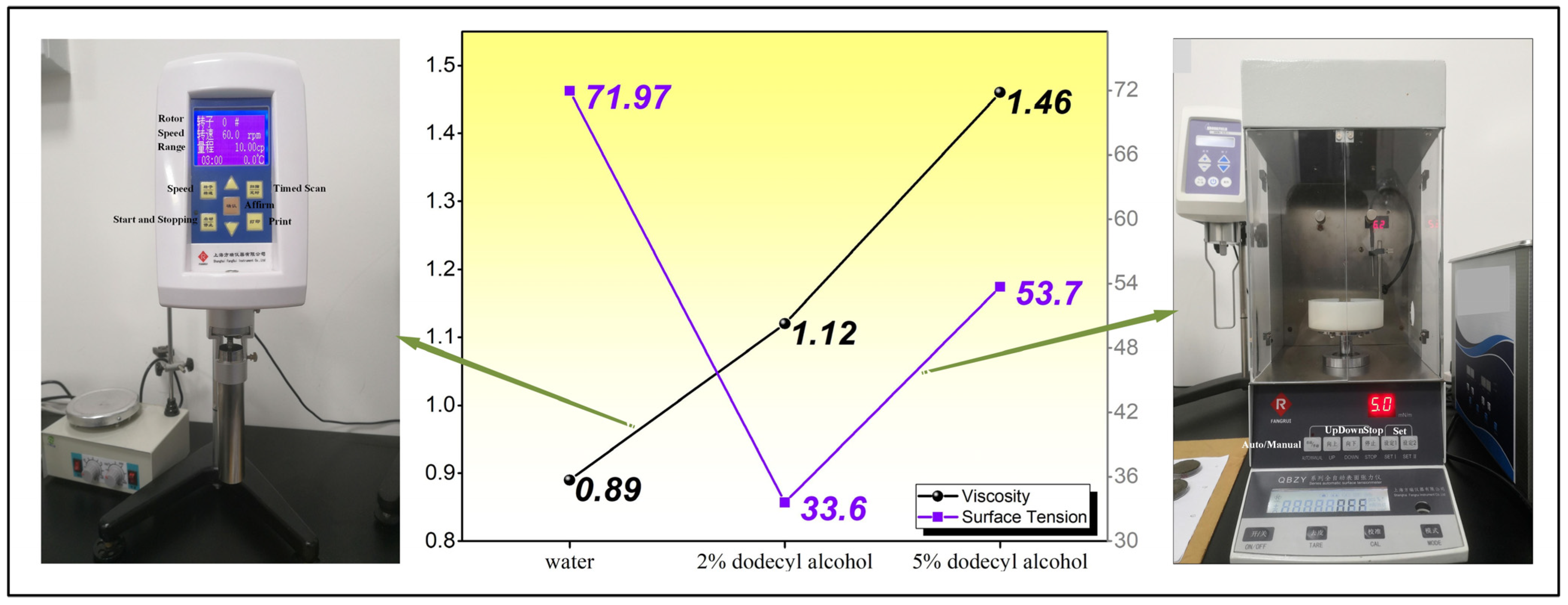
2.1. Dust Suppression Solution Preparation
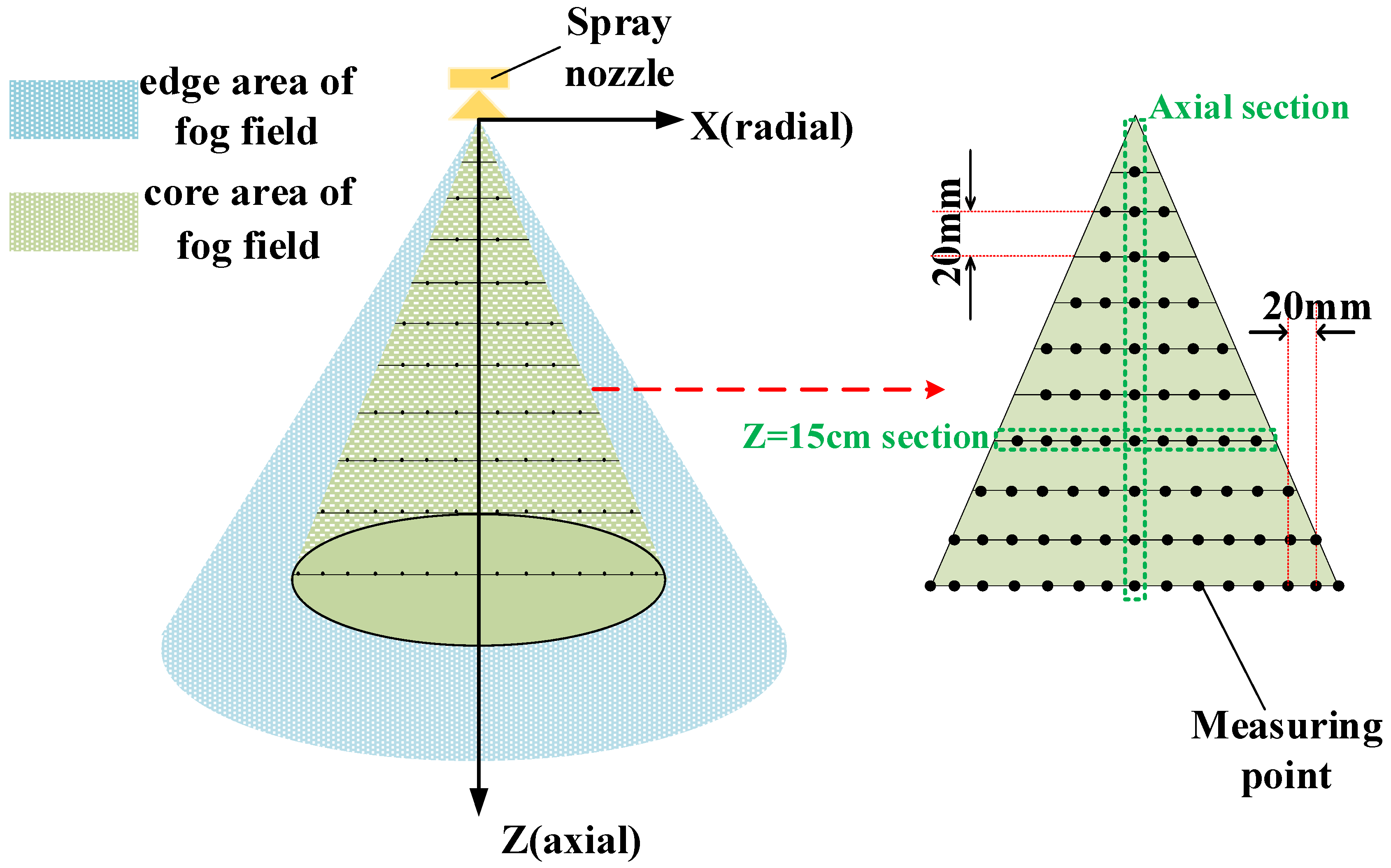
2.2. Spray Nozzle Preparation
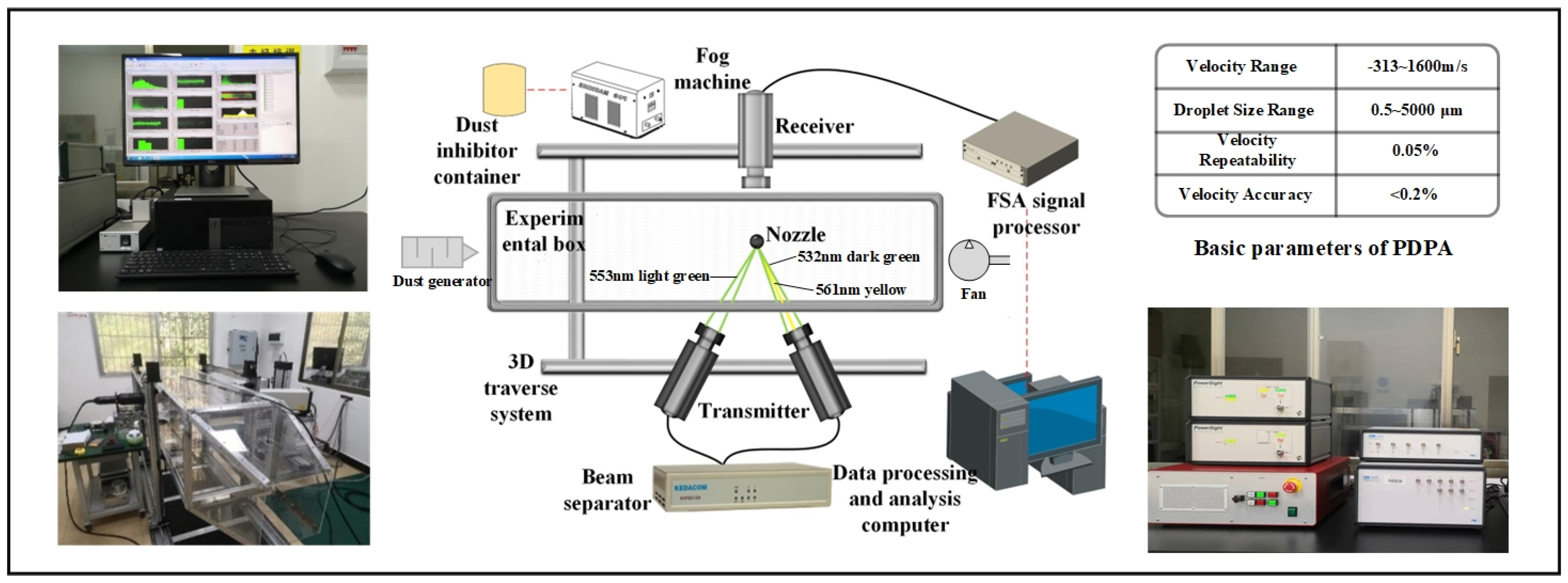
2.3. PDPA Test Experimental System
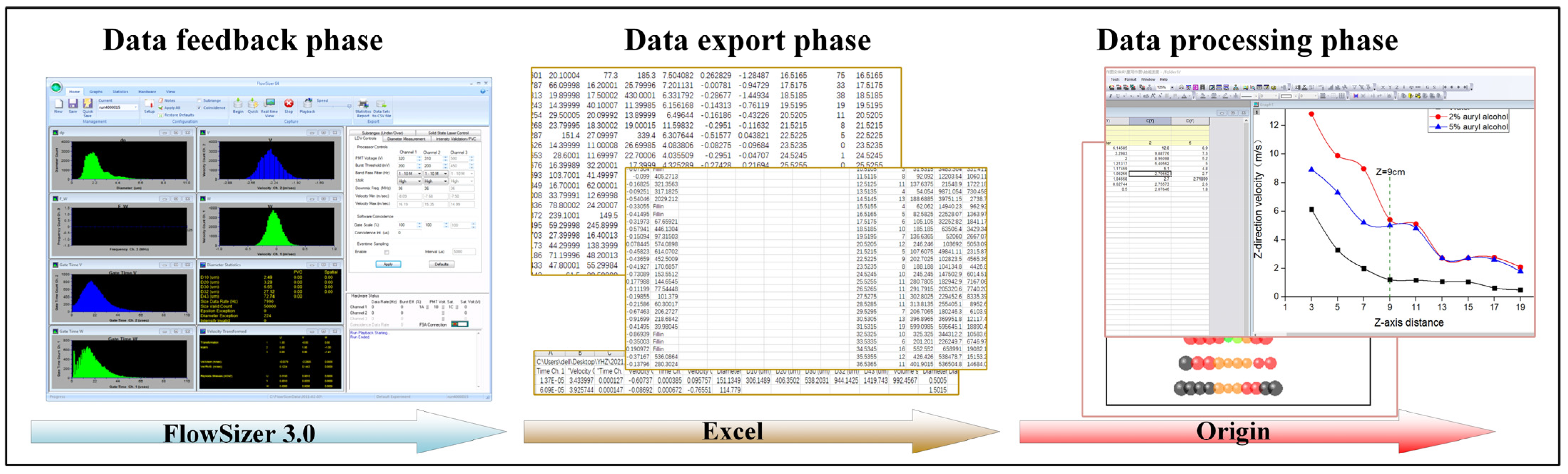
3. Experimental Data Processing Method
4. Experimental Results and Discussion
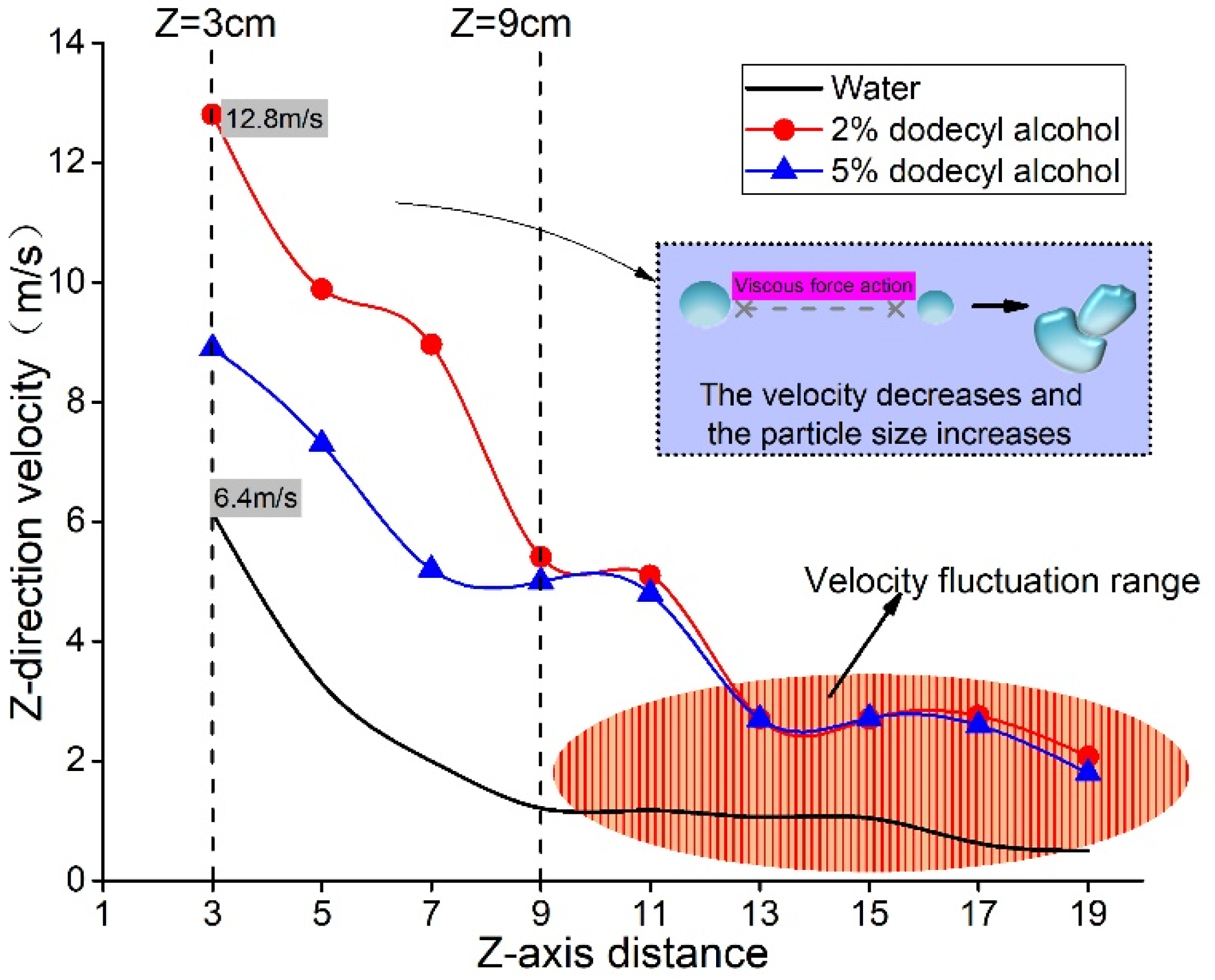
4.1. Droplet Size and Velocity Distribution on Axis Direction
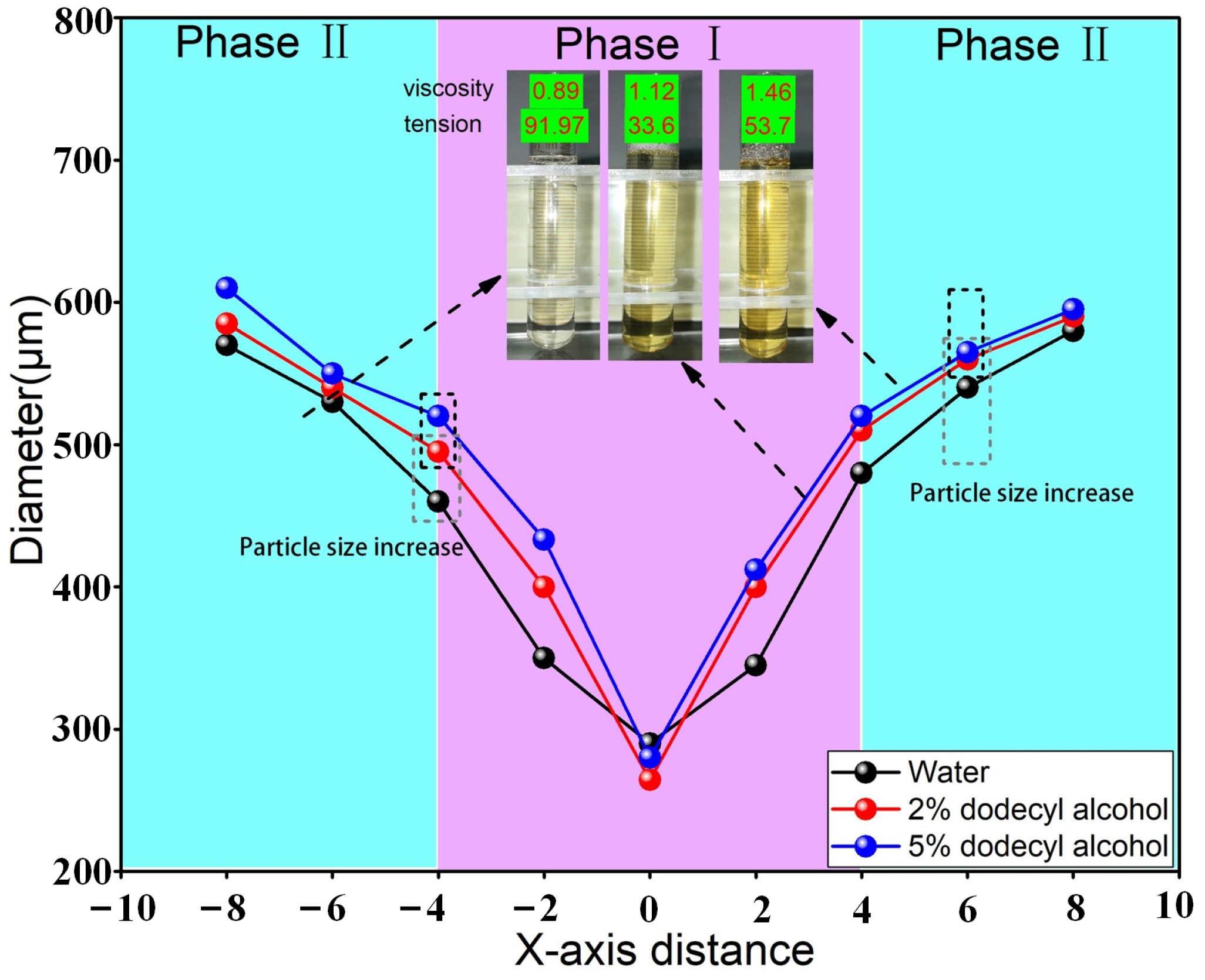
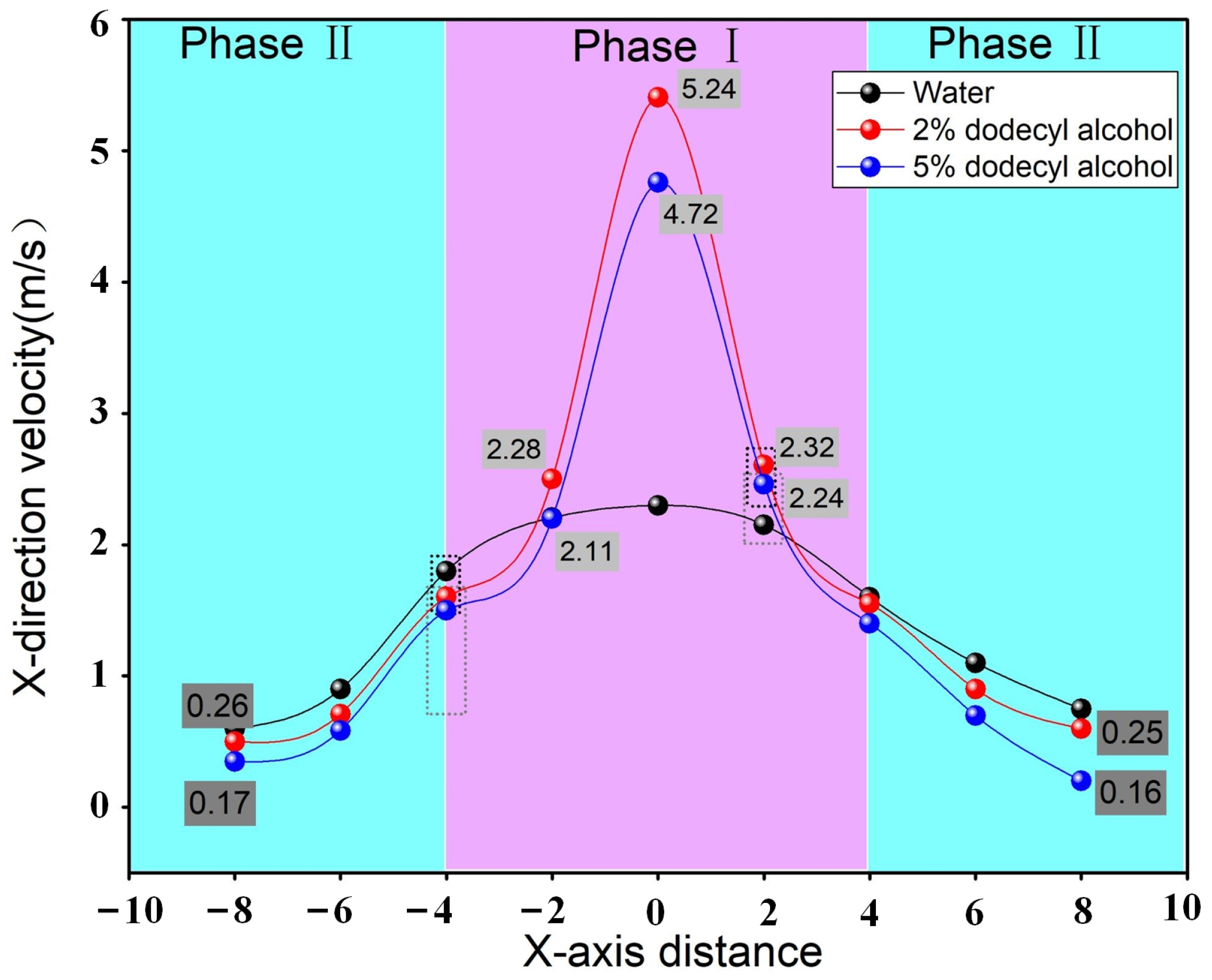
4.2. Droplet Size and Velocity Distribution on Radial Direction
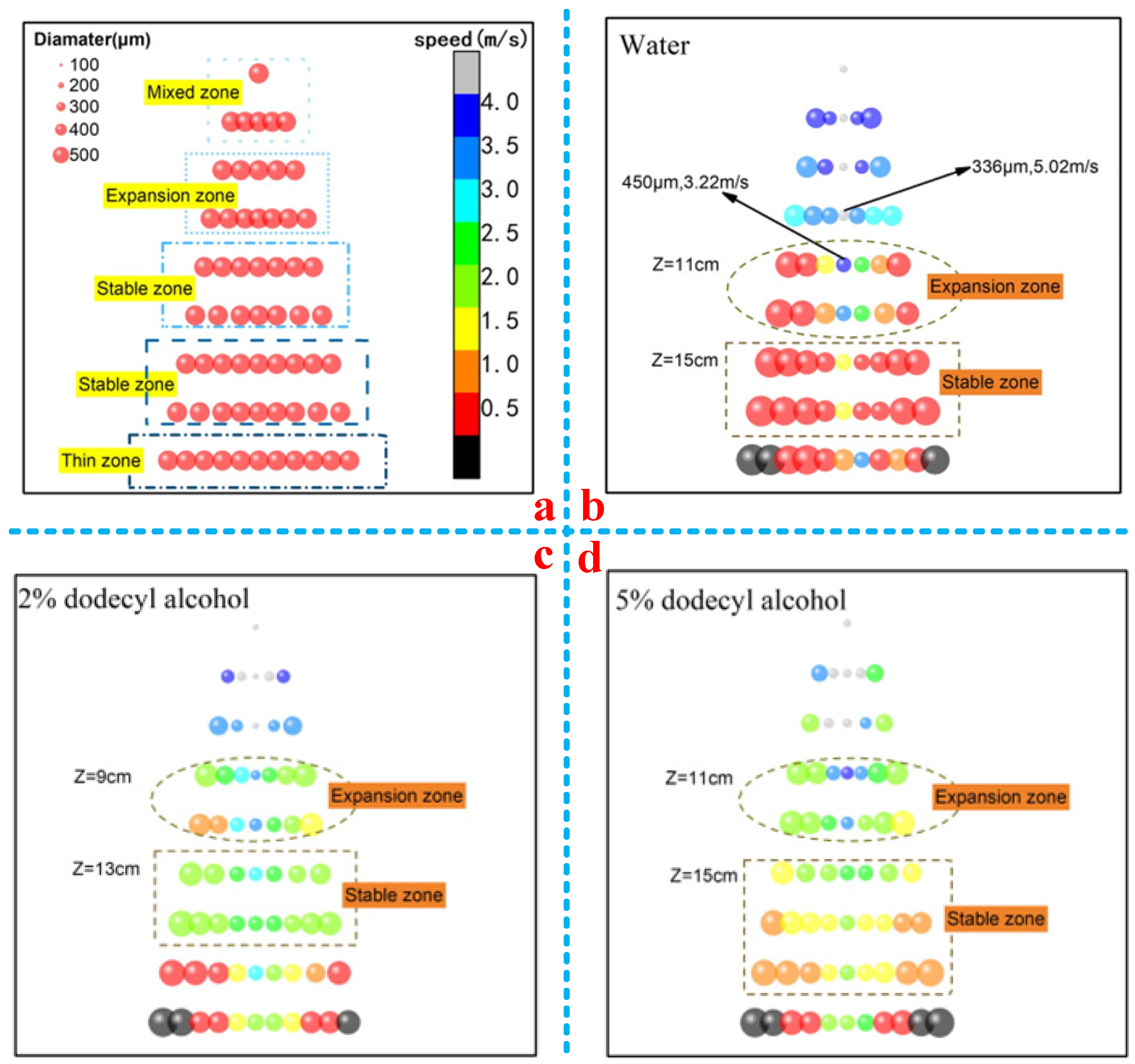
4.3. Joint Distribution Law of Droplet Size and Velocity
5. Dust Suppression Experiment
6. Research Conclusions
- (1)
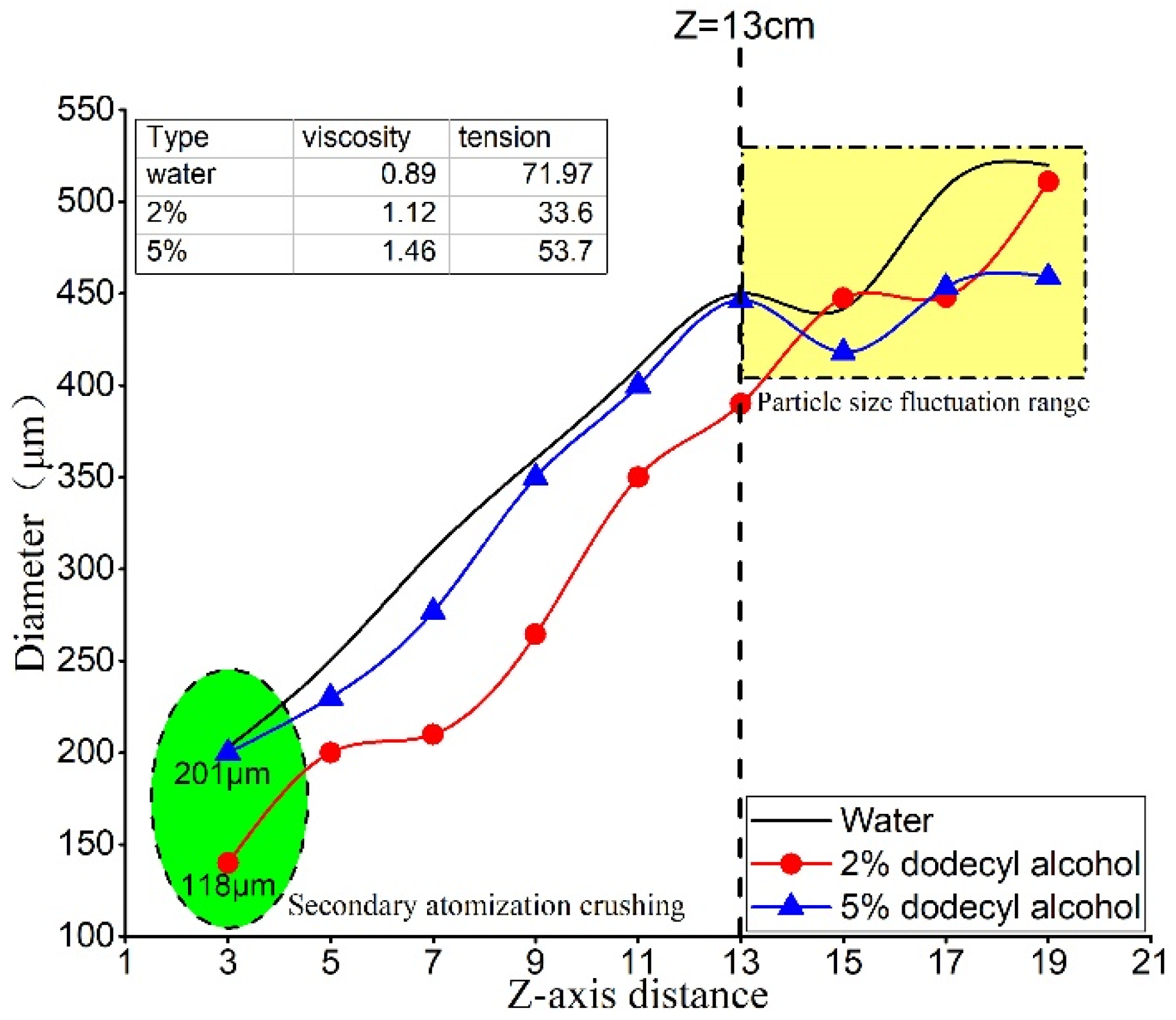
- It is crucial to ensure that the dust-fog coupling is situated in the core area of the fog field, where alterations in surface tension and viscosity significantly affect droplet size and velocity, facilitating better merging with dust particles for sedimentation. Along the axial direction of the fog field, modifying surface tension is more effective than modifying viscosity in achieving droplet size and velocity matching with dust particles. In the radial direction, reducing surface tension and increasing viscosity will cause uneven distribution of droplet size and velocity in the radial section.
- (2)
- To achieve a uniform fog field for effective dust suppression, reducing surface tension is necessary to promote the expansion of the fog field area closer to the nozzle, while increasing viscosity is necessary to ensure the stability of the fog field in the stable region.
- (3)
- It has been indicated by the experimental results that the dust reduction efficiency of respirable dust compared to total dust can be significantly enhanced by altering the surface tension and viscosity of the solution in the solid cone nozzle. Therefore, it is necessary to optimize the surface tension and viscosity of the dust reduction solution in the respiratory dust collection zone to improve the working environment during actual production operations.
Author Contributions
Funding
Informed Consent Statement
Data Availability Statement
Conflicts of Interest
References
- Beck, T.W.; Seaman, C.E.; Shahan, M.R.; Mischler, S.E. Open-air sprays for capturing and controlling airborne float coal dust on longwall faces. Min. Eng. 2018, 70, 42–48. [Google Scholar] [CrossRef] [Scilit] [PubMed]
- Wang, P.; Han, H.; Tian, C.; Liu, R.; Jiang, Y. Experimental study on dust reduction via spraying using surfactant solution. Atmos. Pollut. Res. 2020, 11, 32–42. [Google Scholar] [CrossRef] [Scilit]
- Zhao, X.; Zhao, X.; Han, F.; Song, Z.; Wang, D.; Fan, J.; Jia, Z.; Jiang, G. A research on dust suppression mechanism and application technology in mining and loading process of burnt rock open pit coal mines. J. Air Waste Manag. Assoc. 2021, 71, 1568–1584. [Google Scholar] [CrossRef] [Scilit] [PubMed]
- Soni, S.K.; Kolhe, P.S. Liquid jet breakup and spray formation with annular swirl air. Int. J. Multiph. Flow 2021, 134, 103474. [Google Scholar] [CrossRef] [Scilit]
- Wang, P.; Tan, X.; Zhang, L.; Li, Y.; Liu, R. Influence of particle diameter on the wettability of coal dust and the dust suppression efficiency via spraying. Process Saf. Environ. Prot. 2019, 132, 189–199. [Google Scholar] [CrossRef] [Scilit]
- Ma, Q.; Nie, W.; Yang, S.; Xu, C.; Peng, H.; Liu, Z.; Guo, C.; Cai, X. Effect of spraying on coal dust diffusion in a coal mine based on a numerical simulation. Environ. Pollut. 2020, 264, 114717. [Google Scholar] [CrossRef] [Scilit]
- Nie, W.; Ma, X.; Cheng, W.; Liu, Y.; Xin, L.; Peng, H.; Wei, W. A novel spraying/negative-pressure secondary dust suppression device used in fully mechanized mining face: A case study. Process Saf. Environ. Prot. 2016, 103, 126–135. [Google Scholar] [CrossRef] [Scilit]
- Yinshui, L.; Zhuo, J.; Dan, W.; Xiaohui, L. Experimental research on the water mist fire suppression performance in an enclosed space by changing the characteristics of nozzles. Exp. Therm. Fluid Sci. 2014, 52, 174–181. [Google Scholar] [CrossRef] [Scilit]
- Wang, H.; Wu, J.; Du, Y.; Wang, D. Investigation on the atomization characteristics of a solid-cone spray for dust reduction at low and medium pressures. Adv. Powder Technol. 2019, 30, 903–910. [Google Scholar] [CrossRef] [Scilit]
- Goren, S.L.; Gottlieb, M. Surface-tension-driven breakup of viscoelastic liquid threads. J. Fluid Mech. 1982, 120, 245–266. [Google Scholar] [CrossRef] [Scilit]
- Soboleva, O.A.; Tsarkova, L.A. Surface Properties of Aqueous Solutions of Mixtures of Sodium Dodecyl Sulphate and Linalool under Equilibrium and Dynamic Conditions. Colloid J. 2020, 82, 437–447. [Google Scholar] [CrossRef] [Scilit]
- Sun, D.; Cai, W.; Li, C.; Lu, J. Experimental study on atomization characteristics of high-energy-density fuels using a fuel slinger. Energy 2021, 234, 121222. [Google Scholar] [CrossRef] [Scilit]
- Wang, J.; Xu, C.; Zhou, G.; Zhang, Y. Spray Structure and Characteristics of a Pressure-Swirl Dust Suppression Nozzle Using a Phase Doppler Particle Analyze. Processes 2020, 8, 1127. [Google Scholar] [CrossRef] [Scilit]
- Kovalchuk, N.M.; Simmons, M.J.H. Effect of soluble surfactant on regime transitions at drop formation. Colloids Surf. Physicochem. Eng. Asp. 2018, 545, 1–7. [Google Scholar] [CrossRef] [Scilit]
- Yang, L.; Ge, S.; Huang, Z.; Jing, D.; Chen, X. The influence of surfactant on the wettability of coal dust and dust reduction efficiency. Arab. J. Geosci. 2021, 14, 1336. [Google Scholar] [CrossRef] [Scilit]
- George, J.E.; Chidangil, S.; George, S.D. A study on air bubble wetting: Role of surface wettability, surface tension, and ionic surfactants. Appl. Surf. Sci. 2017, 410, 117–125. [Google Scholar] [CrossRef] [Scilit]
- Butler Ellis, M.C.; Tuck, C.R.; Miller, P.C.H. How surface tension of surfactant solutions influences the characteristics of sprays produced by hydraulic nozzles used for pesticide application. Colloids Surf. Physicochem. Eng. Asp. 2001, 180, 267–276. [Google Scholar] [CrossRef] [Scilit]
- Wang, R.; Dorr, G.; Hewitt, A.; Cooper-White, J. Impacts of polymer/surfactant interactions on spray drift. Colloids Surf. Physicochem. Eng. Asp. 2016, 500, 88–97. [Google Scholar] [CrossRef] [Scilit]
- Dodge, L.G.; Rhodes, D.J.; Reitz, R.D. Drop-size measurement techniques for sprays: Comparison of Malvern laser-diffraction and Aerometrics phase/Doppler. Appl. Opt. 1987, 26, 2144–2154. [Google Scholar] [CrossRef] [Scilit]
- Choo, Y.J.; Seon, K.B. Development of holographic Particle Velocimetry System an Its Application to Spay Droplets. J. ILASS Korea 2005, 10, 17–28. [Google Scholar]
- Wang, X.; Wu, X.; Liao, G.; Wei, Y.; Qin, J. Characterization of a water mist based on digital particle images. Exp. Fluids 2002, 33, 587–593. [Google Scholar] [CrossRef] [Scilit]
- Mallik, A.K.; Sarma, T.P.; Roy, A.; Panchagnula, M.V.; Seshadri, S. Phase Doppler Particle Analyser (Pdpa) Characterization and Modeling of Sprays from Orthogonally Interacting Water and Air Jets. J. Flow Vis. Image Process. 2020, 27, 199–217. [Google Scholar] [CrossRef] [Scilit]
- Wang, H.; Du, Y.; Wei, X.; He, X. An experimental comparison of the spray performance of typical water-based dust reduction media. Powder Technol. 2019, 345, 580–588. [Google Scholar] [CrossRef] [Scilit]
- Nuyttens, D.; Baetens, K.; De Schampheleire, M.; Sonck, B. Effect of nozzle type, size and pressure on spray droplet characteristics. Biosyst. Eng. 2007, 97, 333–345. [Google Scholar] [CrossRef] [Scilit]
- Murugan, R.; Balusamy, S.; Kolhe, P. Experimental Study of Liquid Spray Mode of Twin Fluid Atomizer Using Optical Diagnostic Tool. Flow Turbul. Combust. 2021, 106, 261–289. [Google Scholar] [CrossRef] [Scilit]
- Shin, J.; Kim, D.; Seo, J.; Park, S. Effects of the physical properties of fuel on spray characteristics from a gas turbine nozzle. Energy 2020, 205, 118090. [Google Scholar] [CrossRef] [Scilit]
- Cheng, W.; Ma, Y.; Yang, J.; Sun, B. Effects of atomization parameters of dust removal nozzles on the de-dusting results for different dust sources. Int. J. Min. Sci. Technol. 2016, 26, 1025–1032. [Google Scholar] [CrossRef] [Scilit]
- Yu, Y.; Li, G.; Wang, Y.; Ding, J. Modeling the atomization of high-pressure fuel spray by using a new breakup model. Appl. Math. Model. 2016, 40, 268–283. [Google Scholar] [CrossRef] [Scilit]
- Husted, B.P.; Petersson, P.; Lund, I.; Holmstedt, G. Comparison of PIV and PDA droplet velocity measurement techniques on two high-pressure water mist nozzles. Fire Saf. J. 2009, 44, 1030–1045. [Google Scholar] [CrossRef] [Scilit]
- Lai, W.T.; Zhang, X.; Yan, T.; Xu, D. Measurements of velocity and droplet sizing in industrial applications using non-invasive laser systems. J. Phys. Conf. Ser. 2020, 1600, 012026. [Google Scholar] [CrossRef] [Scilit]
- McDermott, K.; Oakley, J.G. Droplet Size and Distribution of Nebulized 3% Sodium Chloride, Albuterol, and Epoprostenol by Phase Doppler Particle Analyzer. Curr. Ther. Res. 2021, 94, 100623. [Google Scholar] [CrossRef] [Scilit] [PubMed]
- Chen, B.; Gao, D.; Li, Y.; Chen, C.; Yuan, X.; Wang, Z.; Sun, P. Investigation of the droplet characteristics and size distribution during the collaborative atomization process of a twin-fluid nozzle. Int. J. Adv. Manuf. Technol. 2020, 107, 1625–1639. [Google Scholar] [CrossRef] [Scilit]
- Chang, M.; Yu, Y.S.; Park, S.; Park, S. Spray dynamics and atomization characteristics of multi-hole GDI injectors under flash boiling conditions. Appl. Therm. Eng. 2022, 200, 117626. [Google Scholar] [CrossRef] [Scilit]
- Wu, H.; Zhang, F.; Zhang, Z.; Hou, L. Atomization and droplet dynamics of a gas-liquid two-phase jet under different mass loading ratios. Int. J. Multiph. Flow 2022, 151, 104043. [Google Scholar] [CrossRef] [Scilit]
- Babinsky, E.; Sojka, P.E. Modeling drop size distributions. Prog. Energy Combust. Sci. 2002, 28, 303–329. [Google Scholar] [CrossRef] [Scilit]
- Mugele, R.A.; Evans, H.D. Droplet Size Distribution in Sprays. Ind. Eng. Chem. 1951, 43, 1317–1324. [Google Scholar] [CrossRef] [Scilit]
- Feng, Z.; Tong, S.; Tang, C.; Zhan, C.; Nishida, K.; Huang, Z. Decoupling the Effect of Surface Tension and Viscosity on Spray Characteristics Under Different Ambient Pressures: Near-Nozzle Behavior and Macroscopic Characteristics. At. Sprays 2019, 29, 629–654. [Google Scholar] [CrossRef] [Scilit]
- Fansler, T.D.; Parrish, S.E. Spray measurement technology: A review. Meas. Sci. Technol. 2015, 26, 012002. [Google Scholar] [CrossRef] [Scilit]
- Deshpande, S.; Gao, J.; Trujillo, M.F. Characteristics of Hollow Cone Sprays in Crossflow. At. Sprays 2011, 21, 349–361. [Google Scholar] [CrossRef] [Scilit]






| Solution Type | Surface Tension (mN·m−1) | Viscosity (10−3 Pa·s) | Before Spraying (mg/m3) | After Spraying (mg/m3) | Dust Suppression Efficiency (%) | |||
|---|---|---|---|---|---|---|---|---|
| Total Dust | Respirable Dust | Total Dust | Respirable Dust | Total Dust | Respirable Dust | |||
| Pure water | 71.97 | 0.89 | 19.45 | 4.70 | 6.50 | 1.53 | 66.52 | 67.44 |
| 2% dodecyl solution | 33.60 | 1.12 | 19.45 | 4.70 | 3.70 | 0.70 | 80.10 | 85.11 |
| 5% dodecyl solution | 53.70 | 1.46 | 19.45 | 4.70 | 4.80 | 1.00 | 75.32 | 78.72 |
Disclaimer/Publisher’s Note: The statements, opinions and data contained in all publications are solely those of the individual author(s) and contributor(s) and not of MDPI and/or the editor(s). MDPI and/or the editor(s) disclaim responsibility for any injury to people or property resulting from any ideas, methods, instructions or products referred to in the content. |
© 2023 by the authors. Licensee MDPI, Basel, Switzerland. This article is an open access article distributed under the terms and conditions of the Creative Commons Attribution (CC BY) license (https://creativecommons.org/licenses/by/4.0/).
Share and Cite
Li, M.; Yang, H.; Wang, J.; Li, G.; Tang, J. An Experimental Investigation of the Impact of Surface Tension and Viscosity on the Atomization Effect of a Solid Cone Nozzle. Appl. Sci. 2023, 13, 4522. https://doi.org/10.3390/app13074522
Li M, Yang H, Wang J, Li G, Tang J. An Experimental Investigation of the Impact of Surface Tension and Viscosity on the Atomization Effect of a Solid Cone Nozzle. Applied Sciences. 2023; 13(7):4522. https://doi.org/10.3390/app13074522
Chicago/Turabian StyleLi, Ming, Huaizhen Yang, Junjian Wang, Gang Li, and Jiao Tang. 2023. "An Experimental Investigation of the Impact of Surface Tension and Viscosity on the Atomization Effect of a Solid Cone Nozzle" Applied Sciences 13, no. 7: 4522. https://doi.org/10.3390/app13074522
APA StyleLi, M., Yang, H., Wang, J., Li, G., & Tang, J. (2023). An Experimental Investigation of the Impact of Surface Tension and Viscosity on the Atomization Effect of a Solid Cone Nozzle. Applied Sciences, 13(7), 4522. https://doi.org/10.3390/app13074522