Article

Deriving Ground Truth Labels for Regression Problems Using Annotator Precision †

by
Benjamin Johnston
1,2,* and
Philip de Chazal
1
1
Sleep Research Group, Charles Perkins Centre, School of Biomedical Engineering, University of Sydney, Sydney, NSW 2050, Australia
2
Franklin.ai, Sydney, NSW 2000, Australia
*
Author to whom correspondence should be addressed.
This paper is an extended version of our paper published in B. Johnston and P. de Chazal. A Method for Identifying Ground Truth Labels in Regression Problems using Annotator Precision. In Proceedings of the 2021 43rd Annual International Conference of the IEEE Engineering in Medicine & Biology Society (EMBC), Mexico, 1–5 November 2021; pp. 3181–3184.
Appl. Sci. 2023, 13(16), 9130; https://doi.org/10.3390/app13169130
Submission received: 5 March 2023 / Revised: 9 July 2023 / Accepted: 7 August 2023 / Published: 10 August 2023
(This article belongs to the Section Computing and Artificial Intelligence)

Abstract

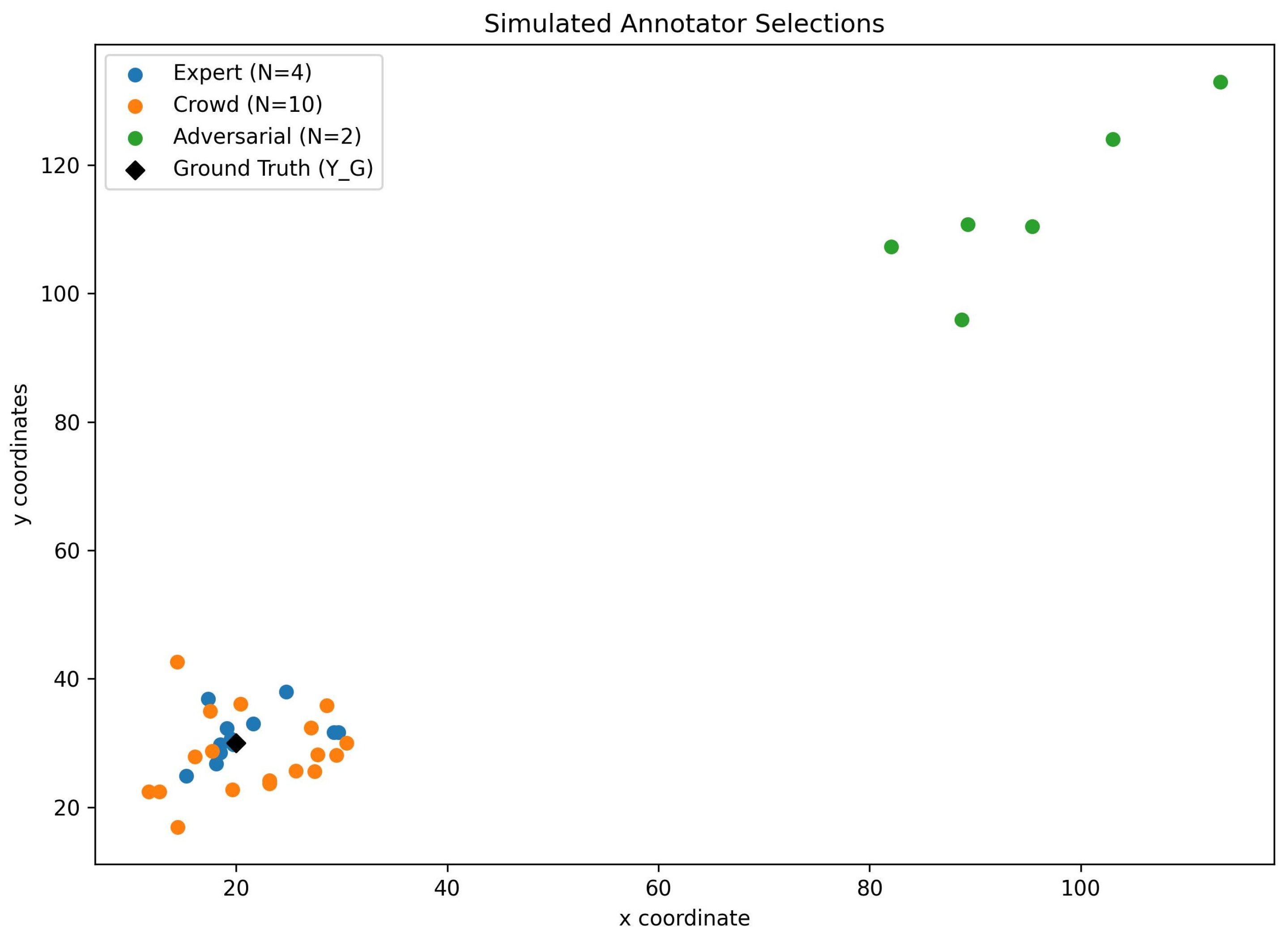
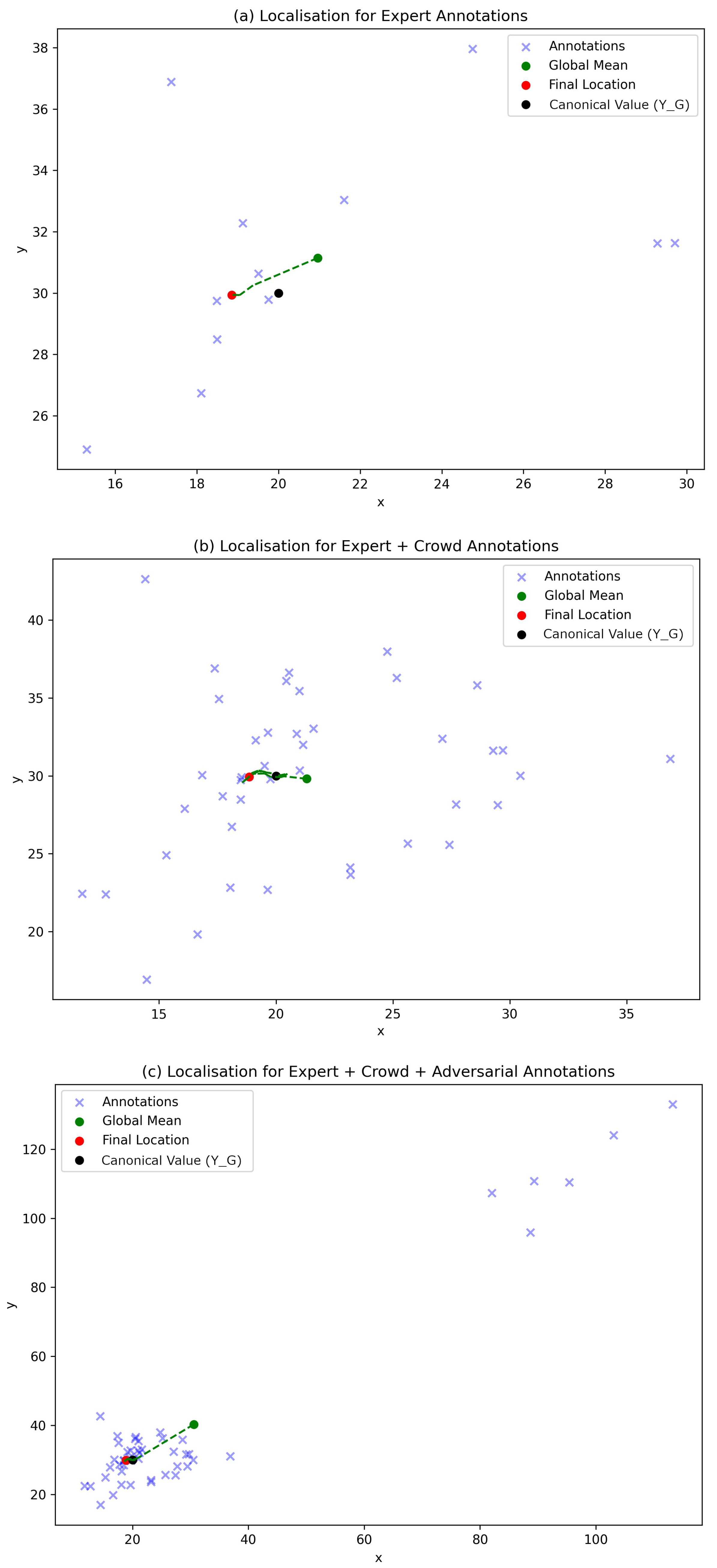
When training machine learning models with practical applications, a quality ground truth dataset is critical. Unlike in classification problems, there is currently no effective method for determining a single ground truth value or landmark from a set of annotations in regression problems. We propose a novel method for deriving ground truth labels in regression problems that considers the performance and precision of individual annotators when identifying each label separately. In contrast to the commonly accepted method of computing the global mean, our method does not assume each annotator to be equally capable of completing the specified task, but rather ensures that higher-performing annotators have a greater contribution to the final result. The ground truth selection method described within this paper provides a means of improving the quality of input data for machine learning model development by removing lower-quality labels. In this study, we objectively demonstrate the improved performance by applying the method to a simulated dataset where a canonical ground truth position can be known, as well as to a sample of data collected from crowd-sourced labels.
Keywords: ground truth; landmarks; localisation; crowd sourced; machine learning; AI; annotation; labelling ground truth; landmarks; localisation; crowd sourced; machine learning; AI; annotation; labelling