Article

SF-ECG: Source-Free Intersubject Domain Adaptation for Electrocardiography-Based Arrhythmia Classification


Department of Computer Engineering, Hallym University, Chuncheon 24252, Republic of Korea
*
Author to whom correspondence should be addressed.
This work has been done during this author’s work at Hallym University.
Appl. Sci. 2023, 13(14), 8551; https://doi.org/10.3390/app13148551
Submission received: 2 July 2023 / Revised: 20 July 2023 / Accepted: 21 July 2023 / Published: 24 July 2023
(This article belongs to the Section Biomedical Engineering)

Abstract

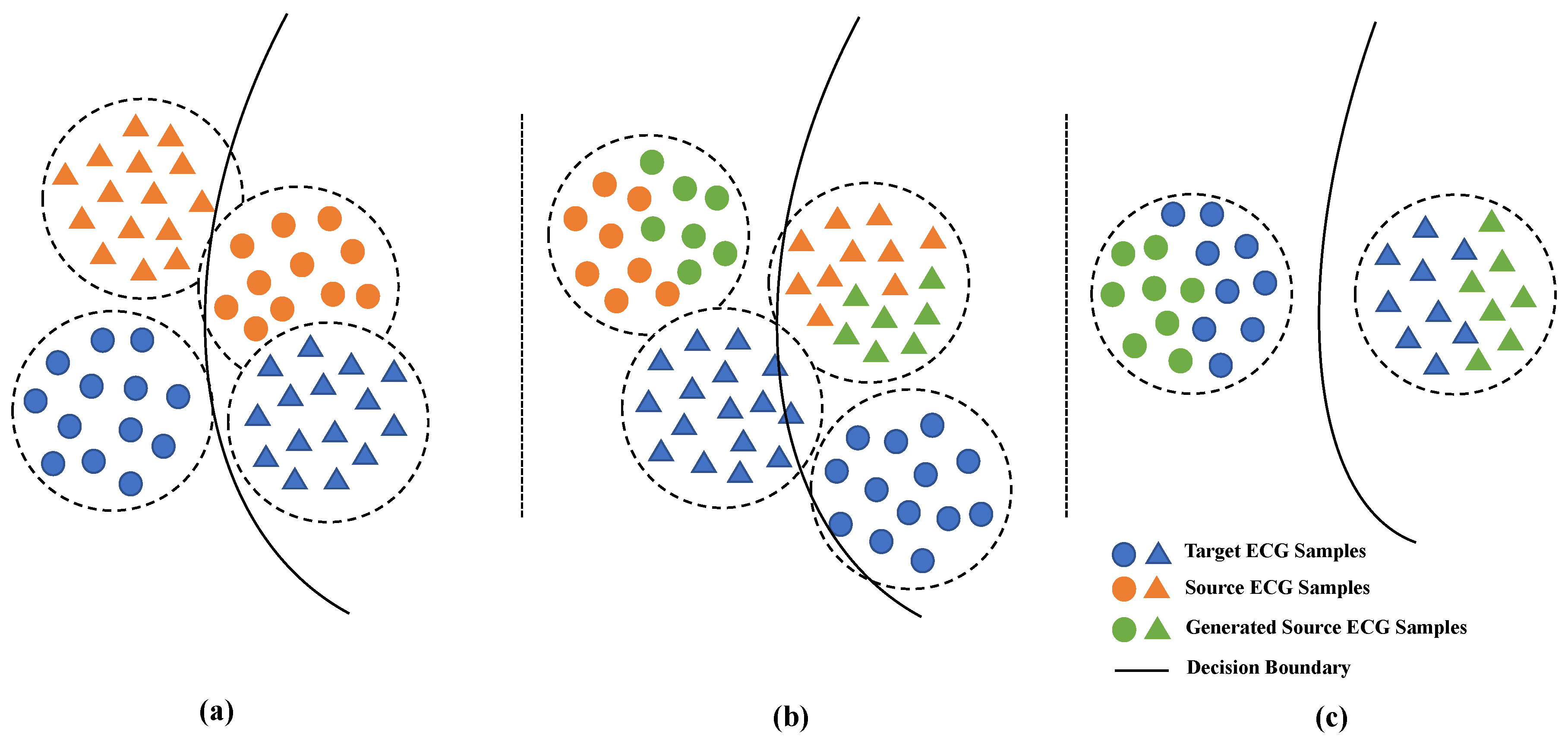
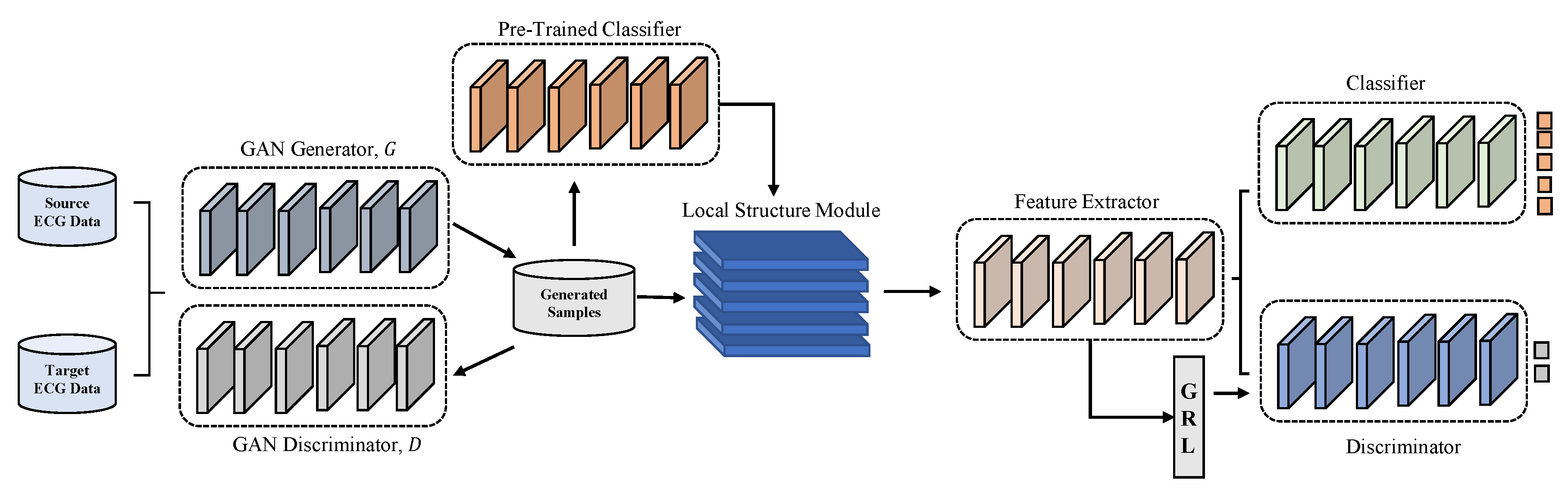
Electrocardiography (ECG)-based arrhythmia classification intends to have a massive role in cardiovascular disease monitoring and early diagnosis. However, ECG datasets are mostly imbalanced and have regularization to use real-time patient data due to privacy concerns. Traditional models do not generalize on unseen cases and are also unable to preserve data privacy. Which incentivizes performance degradation in existing models with privacy limitations. To tackle generalization and privacy issues together, we introduce the framework SF-ECG, a source-free domain adaptation approach for patient-specific ECG classification. This framework does not require source data during adaptation, which solves the privacy issue during adaptation. We adopt a generative model (GAN) that learns to synthesize patient-specific ECG data in data-inefficient classes to make additional source data for imbalanced classes. Then, we use the local structure clustering method to strongly align target ECG features with similar neighbors. After seizing clustered target features, we use a classifier that is trained on source data with generated source samples, which makes the model generalizable in classifying unseen data. Empirical results under different experimental conditions in various interdomain datasets prove that the proposed framework achieves 0.8% improvements in UDA settings, along with preserving privacy and generalizability.
Keywords: electrocardiography; source-free domain adaptation; generative adversarial networks electrocardiography; source-free domain adaptation; generative adversarial networks