


Abstract
This paper presents a detailed study in the critical region around the Curie temperature to determine the universality class of the SmNi intermetallic compound. The magnetocaloric effect has been studied on the basis of experimental measurements of magnetization. Maxwell’s relation and a phenomenological model are employed to find the change in magnetic entropy. The compound SmNi presents a variation in entropy with a moderate maximum and a wide range of operating temperatures. Numerous approaches have been used to explore the spontaneous magnetization behaviour and inverse of the susceptibility, including the modified Arrott technique, the Kouvel–Fisher approach, and the fitting of the critical isotherm. The scaling hypothesis has been used to confirm the validity and interdependence of the critical exponents associated with these phenomena.
1. Introduction
Giauque and MacDougall achieved the first experimental demonstration of adiabatic demagnetization of paramagnetic salts, such as Gd(SO)-8HO, reaching a temperature of 0.25 K [1], after the discovery of the magnetocaloric effect (MCE) by Weiss and Piccard [2] around the Curie temperature () of Ni. Later, Nikitin et al. [3] reported the largest MCE for FeRh. Subsequently, several promising materials, including Gd(Ge,Si) [4,5,6,7], FeP [8,9,10,11], and manganites RAMnO [12,13,14,15], have been extensively studied for their magnetocaloric properties around the ordering temperature (). To this day, the investigation of magnetocaloric materials remains an area of interest for researchers. Recently, several studies have been published showing an interesting magnetocaloric effect over a range of operating temperatures [16,17,18].
Rare earth (R) and transition metal (M) intermetallics have been thoroughly studied in recent years for their performance as permanent magnets, including RFeM′ (M = Al, Ga, Si) [19], RM [20], RM [21], RMM (M = Ga, Ti, Co) [22], and recently for their magnetocaloric properties, e.g., La(Fe,Co,Si)(H,C), RFe [23,24,25,26,27,28,29,30,31,32,33,34,35].
It has been shown that the RNi systems (R = Gd, Tb, Dy, Ho, Er, Tm) crystallize in the hexagonal ThNi phase in the space group and are ferrimagnetic for a temperature lower than the Curie temperature (), whereas the R = Y, Sm, and Lu compounds are ferromagnetic [36,37,38,39]. Nevertheless, In contract to Carfagna and Wallace [36], all Curie temperatures have been found to be lower than 200 K [36,37,38,39].
The RM intermetallic compounds have been identified as promising candidates for MCE compounds because of their ease of synthesis and their moderate price. For the binary RM, the substitution of R and/or M has the potential to enhance the modest magnetocaloric effect that characterizes these systems [40,41,42].
Recently, researchers have focused on the search for new magnetocaloric materials with good low-temperature performance, particularly those exhibiting second-order magnetic transitions (SOMT). SOMT materials are known to have a relatively high cooling capacity, although they typically do not have a very large magnetic entropy change (). Other positive characteristics of SOMT materials include low magnetic hysteresis and an adjustable Curie temperature () by varying the composition [43,44].
In this work, we have studied the MCE of SmNi around . We have derived the MCE, the temperature-averaged entropy change (), and the relative cooling power (). Furthermore, we derived the critical exponent near to determine the universality class of the studied compound.
2. Experiments
The compound SmNi was arc-melted several times under a purified argon environment using high-purity elements (Sm (99.98%) and Ni (99.9%)). Afterwards, the ingot produced was enveloped by Ta foil and deposited inside a tube sealed under conditions of bar [45,46]. The ingot was heat-treated for seven days at T = 1073 K, followed by water quenching [47,48]. X-ray diffraction (XRD) was performed with a scan geometry between using a D8 Brucker diffractometer at 298 K, with Cu K radiation. The results of X-ray diffraction coupled with Rietveld refinement [49,50] using the Fullprof program [51] are perfectly presented in our work, aiming to establish a ternary phase diagram in Ref. [52]. Isotherms at low temperatures were measured using the Quantum Design PPMS magnetometer with an applied magnetic field () up to 5 T, around , with a step of 2 K. To obtain the internal field, we used , with as the demagnetization constant derived from the M versus plot [53].
3. Results and Discussion
3.1. Structural Properties
Figure 1 shows the XRD and Rietveld analysis for the SmFe compound. One can see that the calculated and experimental patterns are in good agreement. The lattice parameters determined from the Rietveld refinement of the XRDs are a = 8.341(4) and c = 8.062(4). This refinement show that the SmNi compound crystallizes in the hexagonal ThNi-type structure of the space group.
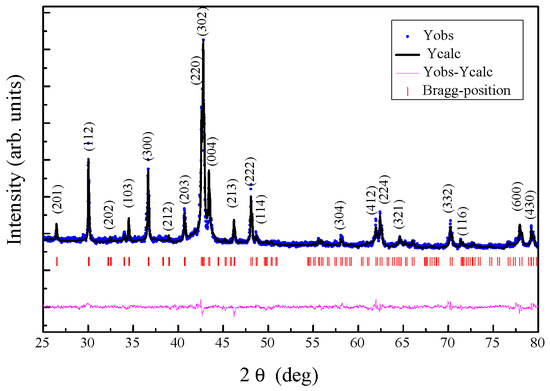
Figure 1.
X-ray diffraction and Rietrveld refinement of SmNi.
The analysis shows that all the peaks are indexed and correspond to Bragg positions of a and with no secondary phases. It should be remembered that this arrangement of CaCu is different from that of ThZn (), in which dumbbells replace some rare-earth atoms. In this structure, the Ni atoms occupy four crystallographic sites , 12j, 6g, and 4f, while the Sm atoms occupy two sites, and .
3.2. FM–PM Transition
Figure 2 shows the magnetization versus the temperature using . The SmNi alloy undergoes a wide ordered–disordered transition. is derived from the extremum of the magnetization derivative () (Figure 2), found to be 160 K. The obtained is comparatively lower than that observed in pure nickel. In rare-earth transition metal compounds, is linked to the exchange interaction. The strength of this interaction is influenced by the distance of the magnetic moment. From the evolution of the hyperfine field versus temperature for SmFe, Morrish et al. [54] deduced that the exchange interaction integrals, for each Fe site, depend on the interatomic iron–iron distances. They observed both negative and positive interactions in SmFe. As the distance between the iron pairs increased, the amplitude of the exchange integrals increased significantly, resulting in a higher Curie temperature. Conversely, decreasing the distance lowered the Curie temperature. Therefore, the low in RM compounds is mainly due to negative exchange interactions.
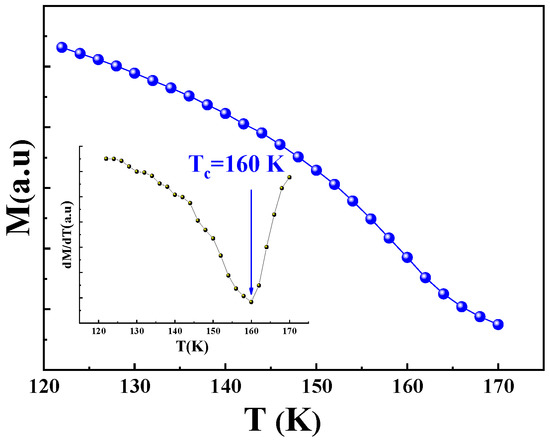
Figure 2.
Variation in M versus T at 0.1 T for the SmNi alloy. The inset is the versus T plot.
Figure 3 shows the magnetization (M) plotted as a function of the magnetic field (0–5 T) at temperatures between 120 and 170 K with a step of 2 K. We clearly obtain an FM state for and a PM state for .
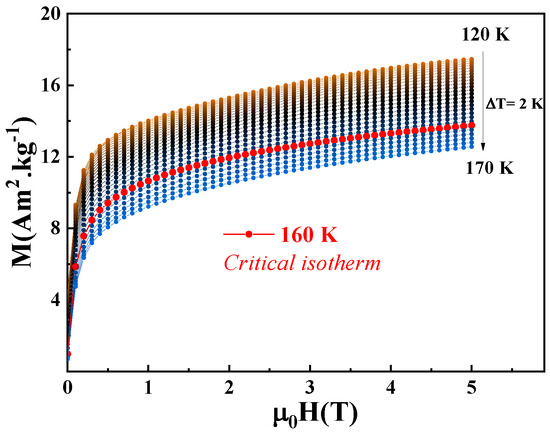
Figure 3.
Magnetization versus (0–5 T) with temperatures ranging from 120 to 170 K for SmNi.
3.3. Magnetocaloric Properties of SmNi
When a magnetic material is under an applied magnetic field, its temperature is affected, this phenomenon is called the MCE. Calculating the change in magnetic entropy () is important to study the magnetocaloric effect because it provides a quantitative measure of the effect’s magnitude in a given material, which is essential for optimizing the design and performance of magnetocaloric devices for refrigeration and energy conversion applications. The integration of the Maxwell relation is used to calculate the change in magnetic entropy that occurs as a result of the application of a magnetic field:
From the experimental measurements (Figure 3), we derive versus temperature using the following expression [55]:
where and refer to the magnetization at and , respectively under an increased .
Figure 4 shows the magnetic entropy variation as a function of temperature and the applied magnetic field, especially near the FM–PM transition. It is obvious that the maximum occurs near the Curie temperature, with the peak value heavily reliant on the strength of the magnetic field. Although the maximum is moderate for the studied compounds, the width at mid-height is relatively large ∼45 K for 5 T.
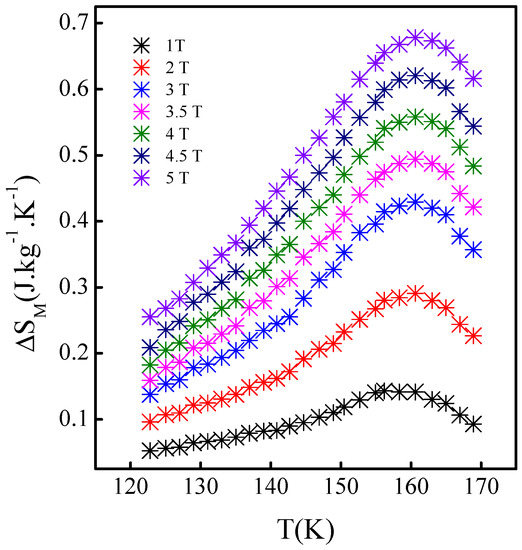
Figure 4.
versus temperature for SmNi with different applied . curves are deduced from magnetic isotherms using the Maxwell relation.
The graphical method commonly used to determine magnetocaloric parameters, such as the magnetic entropy maximum (), width at half-maximum (), and temperature-averaged entropy change (), are generally not precise enough. Therefore, in the following section, we use a phenomenological model that allows for more accurate estimates of these parameters. In particular, this model allows for the prediction of a material’s magnetocaloric effect from a single thermomagnetic measurement at low-applied magnetic fields, thus enhancing its utility.
A phenomenological model is used to simulate the relationship between magnetization and temperature. This simulation is performed assuming adiabatic conditions, under an applied magnetic field, and the model is tuned to closely match the experimental data. The relationship between magnetization, temperature changes, and can be described as follows [56]:
The parameters and can be determined using the following equations:
where M represents the initial magnetization value around and M represents the final magnetization value at the same transition.
In Figure 5, it is evident that the magnetization variations in SmNi, as modelled and measured against temperature, show strong agreement. The experimental data are represented by (∗) in the figure, while the simulated magnetization is shown by the red line.
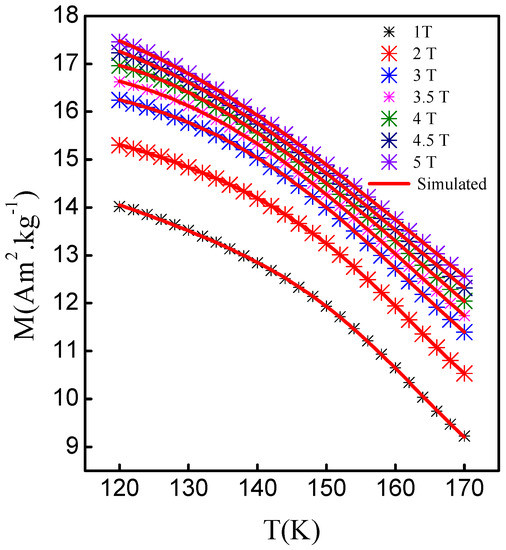
Figure 5.
Modelled and experimental magnetization measured under several plotted against temperature for SmNi.
The magnetization sensitivity in the ordered magnetic state is represented by , while at it is denoted by .
To obtain of a compound undergoing adiabatic variation of the external magnetic excitation from 0 to a final value of the internal magnetic field (), the following equation can be used:
Equation (2) indicates that a large observed is due to the presence of high magnetization for and a rapid decrease in magnetization for . Therefore, the maximum value of , denoted as , can be derived using Equation (2). At , is equivalent to , expressed as follows:
Furthermore, the determination of the half-value width, , of can be determined using the following approach:
The relative cooling power () is a crucial parameter in the application of magnetocaloric materials, which is related to and FWHM for the variation in with temperature, as stated in [24].
The expression for is given by the following equation:
Using the phenomenological model, it is possible to calculate key parameters such as , and for SmNi compounds while considering variations in the applied magnetic field.
Another important parameter, known as the temperature-averaged entropy change (), has been used in addition to to evaluate the suitability of materials for magnetic refrigeration applications. Introduced by L. D. Griffith et al. in [57], can be computed from the magnetic entropy change data according to the following expression:
is the temperature range of the measurement apparatus and reflects the difference between hot and cold heat exchangers. is the temperature at the centre of where is maximized.
The magnetic entropy variation obtained from the phenomenological model and Maxwell’s relation for different applied magnetic fields is compared in Figure 6a. The agreement between the experimental and simulated curves is obvious. This suggests that the phenomenological model is a reliable tool for evaluating the magnetocaloric effect. Moreover, this model can predict the curve based on a magnetization curve measured under a single low magnetic field value, saving time and cost in the measurement process.
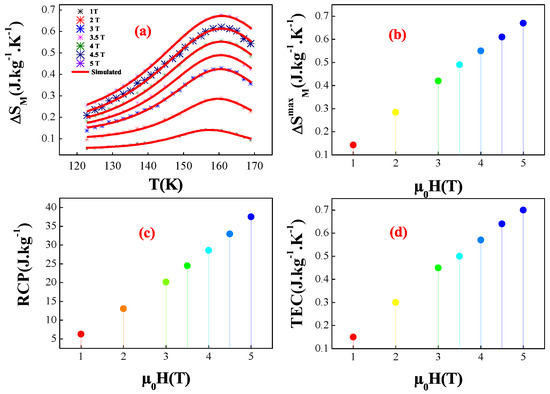
Figure 6.
(a) Experimental and simulated magnetic entropy change versus temperature for SmNi under several magnetic fields. (b) Maximum magnetic entropy change plotted against the applied magnetic field. (c) Relative cooling power plotted against applied magnetic field. (d) Temperature-averaged entropy change versus applied magnetic field for = 5 K.
In Table 1, we compare the maximum entropy variation values with the values for different magnetocaloric intermetallic materials. The SmNi compound studied in this work exhibits a of 0.7 J(kg·K) and a relatively large mean height width of 45 K. The product of these values yields an of 37 J·kg. This is comparable with Pr(Co,Cu) calculated around the spin reorientation temperature, higher than ErNi, SmNi, PrCo, PrCo, FeNi, and GdFe. However, it is approximately four times lower than the PrCoCu compound.

Table 1.
Comparison of and of SmNi and other materials.
3.4. Critical Phenomenon and Spin Interaction
3.4.1. Arrott Plot
The characteristics of the FM–PM transition in this sample were evaluated using the Arrott plots. Figure 7 displays the Arrott plots obtained from the M( H) curves by plotting the squared magnetization () against . Based on the Banerjee criterion [64], if the Arrott plot slope of the linear curve near the Curie temperature is negative, the FM–PM transition is a first-order magnetic (FOM) transition; conversely, a second-order magnetic transition occurs when the plot has a positive slope. Therefore, the Arrott plots of the SmNi alloy imply an SOMT. The Arrott plot method is utilized to derive the critical exponents and the Curie temperature, assuming = 1.0 and = 0.5. This case corresponds to the mean-field model (MFM) critical exponents. The proposed method has been widely explained in the literature [65], involving plotting versus in the high-field zone exhibiting linear behaviour, and at T, where the isotherm is a line intersecting the origin. In contrast, the high magnetic field curves for the SmNi compound shown in Figure 7 do not exhibit parallel behaviour near the transition temperature. This finding indicates that the MFM is inadequate to describe the magnetic phase transition of our compound; therefore, to identify the universality class of the studied compound we use a method based on modified Arrott plots (MAP).
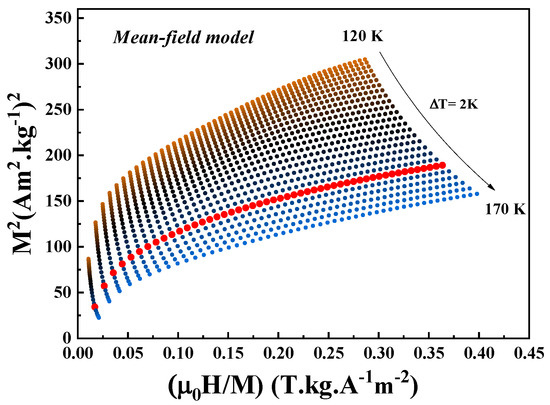
Figure 7.
Arrott plots for versus for temperature ranging from 120 to 170 K with K.
To examine other possible exponent pairs ( and ) the generalized Arrott equation must be used [66].
To determine the appropriate model to describe this phase transition we will use the and couples of the three-dimensional theoretical model commonly used in the literature, such as the tricritical-MFM ( = 0.25 and = 1.0, Figure 8a), the three-dimensional Ising model ( = 0.325 and = 1.241, Figure 8b), the three-dimensional Heisenberg model ( = 0.365 and = 1.386, Figure 8c) and the three-dimensional XY model ( = 0.345 and = 1.316, Figure 8d) to make the MAPs ( versus ).
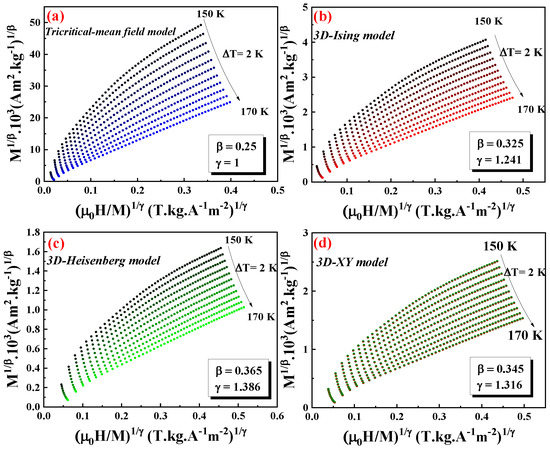
Figure 8.
The modified Arrott plots (MAP) of against , with various exponent pairs ( and ).
None of the above universality classes seem suitable to directly describe the critical properties of our compound. Since we are dealing with a problem that has two parameters, we employ a method that involves performing multiple iterations, as described below: In the high field data in the three-dimensional Heisenberg model, the initial values of and are determined by linear extrapolation, where and are the Y and X intercepts, respectively.
By fitting the data according to Equations (4) and (5) [67], we obtain a set of and values.
where is the reduced temperature, while the critical amplitudes are represented by and for spontaneous magnetization and the inverse susceptibility, respectively.
To rebuild a new modified Arrott plot, we employed the derived and . As a consequence, a new and pair are obtained from the deduced and , until the iterations converge and the derived and yield stable values [65]. Using the final values of and (Figure 9), Equation (4) gives = 0.26(1) and = 160.6(1) K, and Equation (5) gives = 1.38(1) and K.
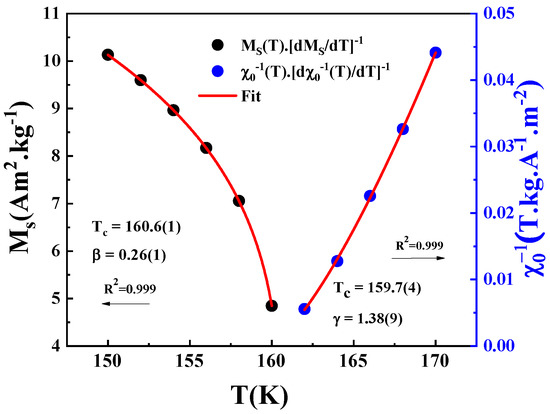
Figure 9.
(left) The spontaneous magnetization versus temperature and (right) the inverse of initial susceptibility versus temperature. The solid lines represent the fit.
3.4.2. Kouvel–Fisher Plot
We have utilized the Kouvel–Fisher (KF) technique as our next approach in order to derive more precise sets of , , and in the scaling analysis. The functions employed in this method are described by the following two equations [68]:
By applying the KF approach, and exhibit linear behaviour as a function of T, with slopes and , respectively. The linear fitting shown in Figure 10 using Equation (6) provides K and . In the same way, Equation (7) gives K and , which is in agreement with those obtained from the MAP. In Table 2, we have summarized the critical exponents of SmNi and those corresponding to the well-known universality classes. One can see that and the critical exponent’s values derived using the KF method are in agreement with those derived utilizing the MAP. This implies that the obtained values are consistent and unequivocal. The final critical exponents, obtained through the KF method, were used to plot the final Arrott plots shown in Figure 11.
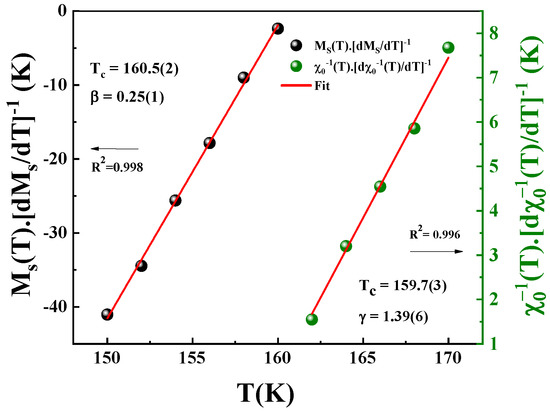
Figure 10.
The Kouvel–Fisher (KF) plot displays the temperature-dependent behaviour of spontaneous magnetization and the inverse of susceptibility , plotted against temperature.
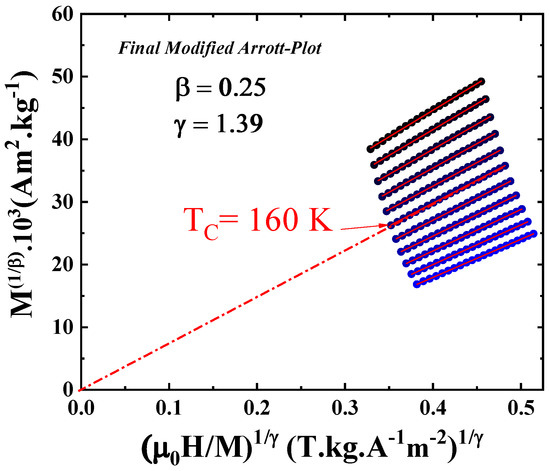
Figure 11.
The final MAP using critical exponents, obtained through the KF method.
The resulting plot revealed a series of parallel lines in the strong field region and confirmed the critical isotherm passing through the origin. These observations provide visual confirmation of the validity of the critical exponents. However, to further verify the accuracy of the and values, a method based on the scaling equation is employed at the end of this section.
The determination of the third critical exponent involves critical isotherm analysis, requiring the magnetization at K as versus to be plotted, as illustrated in Figure 12. The equation relating M and at is [69]:
where D is the amplitude and the exponent describes the curvature of at . Based on Equation (8), a linear line with a slope of can be derived through linear regression of as a function of at the critical temperature. As depicted in the inset of Figure 12, our analysis using this method yielded a value of . By applying the Widom scaling equation () [70], with and derived from the KF and MAP plot, and was obtained, respectively. These values are consistent with the critical isothermal analysis, demonstrating that the critical exponents obtained are both precise and dependable within the bounds of experimental precision. Finally, the two methods give values close to justifying the validity of this value and confirming that the FM–PM phase transition does not belong to any universality class.
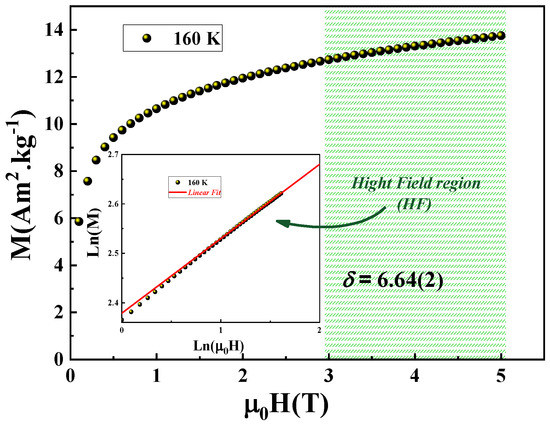
Figure 12.
The critical isothermal magnetization curve against the applied magnetic field. The inset shows the same plot in ln–ln scale.
Table 2.
The obtained critical exponents of SmNi (our work) compared to those obtained for comparable materials and those corresponding to the main universality classes.
Table 2.
The obtained critical exponents of SmNi (our work) compared to those obtained for comparable materials and those corresponding to the main universality classes.
| Composition | Technique | Ref. | ||||
|---|---|---|---|---|---|---|
| SmNi | MAP | 160.6(1) | 0.26(1) | 1.38(9) | 6.36(6) | Our Work |
| KF | 160.5(2) | 0.25(1) | 1.39(6) | 6.50(4) | ||
| CI | 160 | 6.64(2) | ||||
| Mean-field | Theory | - | 1 | 3 | [71] | |
| 3D Heisenberg | Theory | - | 0.37(1) | 1.39(1) | 4.80(4) | [71] |
| 3D Ising | Theory | - | 0.33(1) | 1.24(1) | 4.82(2) | [71] |
| 3D XY | Theory | - | 0.35 | 1.32 | 4.81 | [71] |
| Tricritical mean-field | Theory | - | 0.25 | 1 | 5 | [71] |
| PrFeAl | MAP | 357.5 | 0.37(1) | 1.34(1) | 4.62(3) | [72] |
| KF | 358.1 | 0.37(1) | 1.35(1) | 4.67(1) | ||
| CI | 358 | 4.72(2) | ||||
| SmNiFe | MAP | 0.38(1) | 1.30(1) | 4.45(4) | [73] | |
| KF | 239.8 | 0.38(1) | 1.30(1) | 4.43(8) | ||
| CI | 239 | 4.63(3) | ||||
| CeCoB | MAP | 128 | 0.39(1) | 1.39(1) | 4.60 | [74] |
| KF | 128 | 0.37(1) | 1.38(1) | 4.77 |
It is crucial to check if the obtained and critical exponents produce a scaling equation of state for the system. The magnetic equation of state is stated under the scaling assumption in the asymptotic critical area as follows:
where for and for are regular analytic functions.
By utilizing the and obtained through the KF method, we plotted the scaled quantity as a function of , as shown in Figure 13.
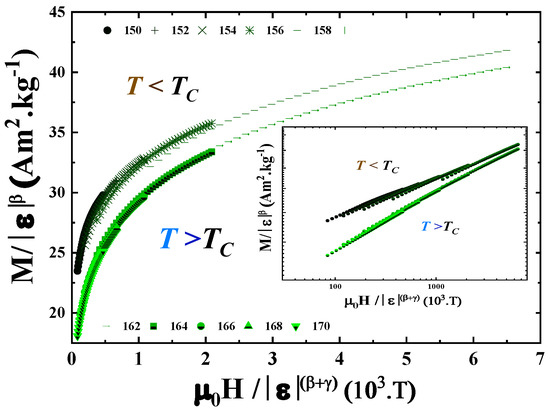
Figure 13.
Scaling plots above and below T for the SmNi alloy. The inset shows the same plot in the ln-ln scale.
The resulting graph shows the collapse of all data into two distinct strands below and above the critical temperature . This observation is compelling evidence of our research findings’ reliability and robustness. The critical coefficients of our compound obtained in this work together with the theoretical models are compared in Table 2. It can be seen that the experimentally generated coefficients cannot be listed in any of the conventional universality class. The exponent converges towards the value predicted by the tricritical MFM, while exhibits proximity to the value anticipated by the 3D Heisenberg model.
3.4.3. Spin Interaction
Comprehending the interaction range and characteristics of this material is crucial. The universality class of the magnetic phase transition in a homogeneous magnet is determined by , the exchange interaction. Based on analysis of the re-normalization group theory, is expected to decline as the distance increases, and specifically, it follows a pattern of . In this formula d stands for the dimension of the system. At the same time, represents the scope or extent of the interaction, and it is known to be greater than zero [75]. In addition, Fisher et al. suggested that the range of and meet the re-normalization group approach as follows [76]:
where n is the dimension of the spin and and .
As per this model, the extent of the spin interaction is contingent upon the value of (), indicating whether it is long- or short-ranged, where in a 3D isotropic system, if , may decline quicker than with short-range spin interactions. Whereas if , decays more slowly than with long-range spin interactions; thus, the MFM is the applicable model. In the intermediate range, , decays slower than and faster than , implying the system exhibits characteristics of different classes, with coefficients assuming intermediate values that depend on the value of .
We have used all possible combinations of n and d, and for each combination we look for the value so that the values are the same as determined by conventional methods. The values of , , and found for different pairs of n and d are given in Table 3.
Table 3.
The value of the critical coefficients with the different sets of d and n for the SmNi alloy.
In this case, is found, resulting in spin interactions decayed as , which is a short-range spin interaction.
4. Conclusions
In this study, the purity and nature of the crystalline phase of the intermetallic compound SmNi were verified by XRD coupled with Rietveld refinement, and the lattice parameters were determined. The measurement of the thermomagnetic properties shows that the studied compound passes from an ordered state to a disordered state when at temperatures equal to 160 K. The relative cooling power, maximum magnetic entropy change, and width at half-maximum of the magnetic entropy change are derived. The phenomenological model is found to agree with the experimental method. A rapid characterization of the magnetocaloric effect is possible with the derived phenomenological model. We investigated the critical behaviour of SmNi near the transition temperature from the FM–PM state. Using the Banerjee criterion, this transition was found to be of the second-order. The critical coefficients , , and were obtained from different techniques, the exponent = 0.25 (KF) converges towards the value predicted by the tricritical MFM, while = 1.39 (KF) exhibits proximity to the value predicted by the 3D Heisenberg model. Using these exponents, the experimental data show a clear pattern of collapsing into two distinct curves, with one curve observed below and the other above . This behaviour suggests that the interactions are effectively re-normalized in a critical mode, in accordance with the scaling state equation. In our case, was found, resulting in a short-range spin interaction where decayed as .
Author Contributions
Conceptualization, all authors; methodology, J.H., H.J. and K.N.; software, J.H., H.J. and K.N.; formal analysis, all authors; data curation, all authors; writing—original draft preparation, J.H. and H.J.; writing—review and editing, all authors. All authors have read and agreed to the published version of the manuscript.
Funding
This research received no external funding.
Institutional Review Board Statement
Not applicable.
Informed Consent Statement
Not applicable.
Data Availability Statement
Not applicable.
Acknowledgments
This work was supported by the “Centre National de la Recherche Scientifique (CNRS)”, France, by the “Ministére de l’Enseignement Supérieur et de la Recherche Scientifique” LMOP LR99ES17 Laboratory Tunis, LPA Laboratory Sfax, Tunisia, and by Qassim University.
Conflicts of Interest
The authors declare no conflict of interest.
References
- Giauque, W.F.; MacDougall, D.P. Attainment of Temperatures Below 1° Absolute by Demagnetization of Gd2(SO4)3·8 H2O. Phys. Rev. 1933, 43, 768. [Google Scholar] [CrossRef]
- Weiss, P.; Piccard, A. Le phénomène magnétocalorique. J. Phys. Theor. Appl. 1917, 7, 103–109. [Google Scholar] [CrossRef]
- Nikitin, S.A.; Myalikgulyev, G.; Tishin, A.M.; Annaorazov, M.P.; Asatryan, K.A.; Tyurin, A.L. The magnetocaloric effect in Fe49Rh51 compound. Phys. Lett. A 1990, 148, 363–366. [Google Scholar] [CrossRef]
- Pecharsky, V.K.; Gschneidner, K.A., Jr. Giant magnetocaloric effect in Gd5(Si2Ge2). Phys. Rev. Lett. 1997, 78, 4494. [Google Scholar] [CrossRef]
- Pecharsky, V.K.; Gschneidner, K.A., Jr. Effect of alloying on the giant magnetocaloric effect of Gd5(Si2Ge2). Phys. Rev. Lett. 1997, 167, L179–L184. [Google Scholar] [CrossRef]
- Gschneidner, K.A.; Pecharsky, V.K.; Brück, E.; Duijn, H.G.M.; Levin, E.M. Comment on “Direct Measurement of the ‘Giant’ Adiabatic Temperature Change in Gd5Si2Ge2”. Phys. Rev. Lett. 2000, 85, 4190. [Google Scholar] [CrossRef] [PubMed]
- Tang, H.; Pecharsky, V.K.; Samolyuk, G.D.; Zou, M.; Gschneidner, K.A., Jr.; Antropov, V.P.; Schlagel, D.L.; Lograsso, T.A. Anisotropy of the Magnetoresistance in Gd5Si2Ge2. Phys. Rev. Lett. 2004, 93, 237203. [Google Scholar] [CrossRef]
- Tegus, O.; Fuquan, B.; Dagula, W.; Zhang, L.; Brück, E.; Si, P.Z.; De Boer, F.R.; Buschow, K.H.J. Magnetic-entropy change in Mn1.1Fe0.9P0.7As0.3−xGex. J. Alloys Compd. 2005, 396, 6–9. [Google Scholar] [CrossRef]
- Bartok, A.; Kuepferling, M.; Curcio, C.; Basso, V.; Pasko, A.; Zehani, K.; Bessais, L.; Mazaleyrat, F.; Lobue, M. Influence of particle size on the magnetocaloric properties of Mn1.30Fe0.65P0.5Si0.5 powders. In Proceedings of the 7th International Conference on Magnetic Refrigeration at Room Temperature (Thermag VII), Turin, Italy, 11–14 September 2016; Volume 400, pp. 333–338. [Google Scholar]
- Bartok, A.; Kustov, M.; Cohen, L.F.; Pasko, A.; Zehani, K.; Bessais, L.; Mazaleyrat, F.; Lobue, M. Study of the first paramagnetic to ferromagnetic transition in as prepared samples of Mn–Fe–P–Si magnetocaloric compounds prepared by different synthesis routes. J. Magn. Magn. Mater. 2016, 400, 333–338. [Google Scholar] [CrossRef]
- Pasko, A.; Bartok, A.; Zehani, K.; Bessais, L.; Mazaleyrat, F.; Lobue, M. X-ray diffraction analysis of the magnetoelastic phase transition in the Mn-Fe-P-Si magnetocaloric alloy. AIP Adv. 2016, 6, 056204. [Google Scholar] [CrossRef]
- Dinesen, A.R.; Linderoth, S.; Mørup, S. Direct and indirect measurement of the magnetocaloric effect in La0.67Ca0.33−xSrxMnO3±δ. J. Phys. Condens. Matter. 2005, 6, 056204. [Google Scholar] [CrossRef]
- Zhong, W.; Au, C.-T.; Du, Y.-W. Review of magnetocaloric effect in perovskite-type oxides. Chin. Phys. B 2013, 22, 057501. [Google Scholar] [CrossRef]
- Felhi, H.; Smari, M.; Bajorek, A.; Nouri, K.; Dhahri, E.; Bessais, L. Controllable synthesis, XPS investigation and magnetic property of multiferroic BiMn2O5 system: The role of neodymium doping. Chin. Phys. B 2019, 29, 198–209. [Google Scholar] [CrossRef]
- Ameur, N.; Elleuch, F.; Triki, M.; Dhahri, E.; Bessais, L.; Hlil, E.K. Effect of A-site deficiency on the structural and magnetic properties of La0.8−x□xNa0.2−x□xMnO3 oxides and estimation of the magnetocaloric behavior. Solid State Commun. 2019, 29, 198–209. [Google Scholar] [CrossRef]
- Guo, D.; Moreno-Ramírez, L.M.; Law, J.Y.; Zhang, Y.; Franco, V. Excellent cryogenic magnetocaloric properties in heavy rare-earth based HRENiGa2 (HRE = Dy, Ho, or Er) compounds. Sci. China Mater. 2023, 66, 249–256. [Google Scholar] [CrossRef]
- Zhang, Y.; Tian, Y.; Zhang, Z.; Jia, Y.; Zhang, B.; Jiang, M.; Wang, J.; Ren, Z. Magnetic properties and giant cryogenic magnetocaloric effect in B-site ordered antiferromagnetic Gd2MgTiO6 double perovskite oxide. Acta Mater. 2023, 226, 117669. [Google Scholar] [CrossRef]
- Zhang, Y.; Xu, P.; Zhu, J.; Yan, S.; Zhang, J.; Li, L. The emergence of considerable room temperature magnetocaloric performances in the transition metal high-entropy alloys. Mater. Today Phys. 2023, 32, 101031. [Google Scholar] [CrossRef]
- Zeng, Y.; Lu, Z.; Tang, N.; Li, X.; Zhao, R.W.; Yang, F.M. Structural, magnetic and microscopic physical properties of (Sm,Pr)2Fe17 and their nitrides. J. Magn. Magn. Mater. 1995, 139, 11–18. [Google Scholar]
- Younsi, K.; Russier, V.; Bessais, L. Structure and magnetic properties of nanocrystalline PrCo3 compound. J. Appl. Phys. 2010, 107, 083916. [Google Scholar] [CrossRef]
- Bouzidi, W.; Mliki, N.; Bessais, L. Structural and magnetic properties of new uniaxial nanocrystalline Pr5Co19 compound. J. Magn. Magn. Mater. 2017, 441, 566–571. [Google Scholar] [CrossRef]
- Srinithi, A.K.; Sepehri-Amin, H.; Tang, X.; Tozman, P.; Li, J.; Zhang, J.; Kobayashi, S.; Ohkubo, T.; Nakamura, T.; Hono, K. Phase relations and extrinsic magnetic properties of Sm–(Fe,Co)–Ti– (Ga)-based alloys for ThMn12-type permanent magnets. J. Magn. Magn. Mater. 2021, 529, 167866. [Google Scholar] [CrossRef]
- Fujieda, S.; Fujita, A.; Fukamichi, K. Large magnetocaloric effect in La(FexSi1−x)13 itinerant-electron metamagnetic compounds. App. Phys. Lett. 2002, 81, 1276–1278. [Google Scholar] [CrossRef]
- Fujieda, S.; Fujita, A.; Fukamichi, K. Relative cooling power of La(FexSi1−x)13 after controlling the Curie temperature by hydrogenation and partial substitution of Ce. J. Magn. Magn. Mater. 2007, 310, e1006–e1007. [Google Scholar] [CrossRef]
- Boutahar, A.; Phejar, M.; Paul-Boncour, V.; Bessais, L.; Lassri, H. Theoretical work in magnetocaloric effect of LaFe13−xSix compounds. J. Supercond. Nov. Magn. 2014, 27, 1795–1800. [Google Scholar] [CrossRef]
- Phejar, M.; Paul-Boncour, V.; Bessais, L. Investigation on Structural and Magnetocaloric Properties of LaFe13−xSix(H,C)y Compounds. J. Solid State Chem. 2016, 16, 95–102. [Google Scholar] [CrossRef]
- Phejar, M.; Paul-Boncour, V.; Bessais, L. Structural and magnetic properties of magnetocaloric LaFe13−xSix compounds synthesized by high energy ball-milling. Intermetallics 2016, 18, 2301. [Google Scholar] [CrossRef]
- Dan’Kov, S.Y.; Ivtchenko, V.V.; Tishin, A.M.; Gschneidner, K.A.; Pecharsky, V.K. Magnetocaloric Effect in GdAl2 and Nd2Fe17. Adv. Cryog. Eng. 2000, 46, 397–404. [Google Scholar]
- Tishin, A.M.; Spichkin, Y.I. The Magnetocaloric Effect and Its Applications, 1st ed.; Institute of Physics Publishing: Bristol, UK, 2003; ISBN 9780429141379. [Google Scholar]
- Mandal, K.; Yan, A.; Kerschl, P.; Handstein, A.; Gutfleisch, O.; Müller, K.H. The study of magnetocaloric effect in R2Fe17 (R= Y, Pr) alloys. J. Phys. D Appl. Phys. 2004, 37, 2628. [Google Scholar] [CrossRef]
- Chen, H.; Zhang, Y.; Han, J.; Du, H.; Wang, C.; Yang, Y. Magnetocaloric effect in R2Fe17 (R = Sm, Gd, Tb, Dy, Er). J. Magn. Magn. Mater. 2008, 320, 1382–1384. [Google Scholar] [CrossRef]
- Gorria, P.; Álvarez, P.; Marcos, J.S.; Llamazares, J.L.S.; Pérez, M.J.; Blanco, J.A. Crystal structure, magnetocaloric effect and magnetovolume anomalies in nanostructured Pr2Fe17. Act. Mater. 2009, 57, 1724–1733. [Google Scholar] [CrossRef]
- Alvarez, P.; Gorria, P.; Franco, V.; Marcos, J.S.; Perez, M.J.; Sanchez-Llamazares, J.; Puente-Orench, I.; Blanco, J.J. Nanocrystalline Nd2Fe17 synthesized by high-energy ball milling: Crystal structure, microstructure and magnetic properties. J. Phys. Condens. Mater. 2010, 22, 216005. [Google Scholar] [CrossRef]
- Saidi, M.; Nouri, K.; Walha, S.; Dhahri, E.; Kabadou, A.; Jemmali, M.; Bessais, L. Structural, Magnetic, Magnetocaloric and Mössbauer Spectrometry Study of Gd2Fe17−xCux (x = 0, 0.5, 1 and 1.5) Compounds. J. Electron. Mater. 2019, 48, 2242–2253. [Google Scholar] [CrossRef]
- Bouzidi, W.; Nouri, K.; Bartoli, T.; Sedek, R.; Lassri, H.; Moscovici, J.; Bessais, L. Study of the magnetic and magnetocaloric properties at low-field in Nd2Fe17−xSix intermetallics. J. Magn. Magn. Mater. 2020, 497, 166018. [Google Scholar] [CrossRef]
- Carfagna, P.D.; Wallace, W.E. Magnetic Characteristics of 2–17 Lanthanide-Nickel Compounds. J. Appl. Phys. 1968, 39, 5259–5262. [Google Scholar] [CrossRef]
- Zhong, X.P.; de Boer, F.R.; Jacobs, T.H.; Buschow, K.H.J. Magnetic coupling in rare-earth compounds of type R2Ni17. J. Magn. Magn. Mater. 1990, 92, 46–52. [Google Scholar] [CrossRef]
- Moze, O.; Cadogan, J.M.; Kennedy, S.J.; Buschow, K.H.J. Magnetic order in R2Ni17 intermetallics: A neutron-diffraction investigation. Physica B 2002, 319, 35–44. [Google Scholar] [CrossRef]
- Banerjee, D.; Kumar, P.; Suresh, K.G.; Nigam, A.K. Anomalous magnetic and magnetocaloric properties of Er2Ni17. J. Phys. D Appl. Phys. 2007, 40, 2691–2694. [Google Scholar] [CrossRef]
- Osterreicher, H.; Parker, F.T. Magnetic cooling near Curie temperatures above 300 K. J. Appl. Phys. 1984, 55, 4334. [Google Scholar] [CrossRef]
- Jin, S.G.; Liu, L.M.; Wang, Y.L.; Chen, B.X. Research for room-temperature magnetic refrigerants in RxCe2−xFe17 series. J. Appl. Phys. 1991, 70, 6275. [Google Scholar] [CrossRef]
- Pawlik, K.; Skorvanek, I.; Kovac, J.; Pawlik, P.; Wyslacki, J.J.; Bodak, O.I. Phase structure and magnetocaloric effect in binary Pr–Fe alloys. J. Magn. Magn. Mater. 2006, 304, e510. [Google Scholar] [CrossRef]
- Gschneidner, K.A., Jr.; Pecharsky, V.K.; Tsokol, A.O. Recent developments in magnetocaloric materials. Rep. Prog. Phys. 2005, 68, 1479. [Google Scholar] [CrossRef]
- Mikheev, M.; Iwasieczko, W.; Platonov, S.P. The magnetocaloric effect in R2Fe17 intermetallics with different types of magnetic phase transition. Low Temp. Phys. 2015, 41, 985. [Google Scholar]
- Bessais, L.; Dorolti, E.; Djega-Mariadassou, C. High coercivity in nanocrystalline carbides Sm (Fe, Ga)9 C. Appl. Phys. Lett. 2005, 87, 192503. [Google Scholar] [CrossRef]
- Khazzan, S.; Mliki, N.; Bessais, L.; Djega-Mariadassou, C. Rare-earth iron-based intermetallic compounds and their carbides: Structure and magnetic behaviors. J. Magn. Magn. Mater. 2010, 322, 224–229. [Google Scholar] [CrossRef]
- Bensalem, R.; Tebib, W.; Alleg, S.; Sunol, J.J.; Bessais, L.; Greneche, J.M. Magnetic properties of nanostructured Fe92P8 powder mixture. J. Alloys Compd. 2009, 471, 24–27. [Google Scholar] [CrossRef]
- Hamrita, A.; Slimani, Y.; Salem, M.K.B.; Hannachi, E.; Bessais, L.; Azzouz, F.B.; Salem, M.B. Superconducting properties of polycrystalline YBa2Cu3O7−d prepared by sintering of ball-milled precursor powder. Ceram. Int. 2014, 40, 1461–1470. [Google Scholar] [CrossRef]
- Rietveld, H.M. Line profiles of neutron powder-diffraction peaks for structure refinement. Acta Crystallogr. 1967, 22, 151–152. [Google Scholar] [CrossRef]
- Rietveld, H.M. A Profile Refinement Method for Nuclear and Magnetic Structures. J. Appl. Crystallogr. 1969, 2, 65–71. [Google Scholar] [CrossRef]
- Rodríguez-Carvajal, J. Recent advances in magnetic structure determination by neutron powder diffraction. J. Phys. B 1993, 192, 55–69. [Google Scholar] [CrossRef]
- Nouri, K.; Jemmali, M.; Walha, S.; Zehani, K.; Bessais, L.; Salah, A.B. The isothermal section phase diagram of the Sm-Fe-Ni ternary system at 800 °C. J. Alloys Compd. 2016, 661, 508–515. [Google Scholar] [CrossRef]
- Pramanik, A.K.; Banerjee, A. Phase separation and the effect of quenched disorder in Pr0.5Sr0.5MnO3. J. Phys. Condens. Matter 2008, 20, 275207. [Google Scholar] [CrossRef]
- Li, Z.W.; Morrish, A.H. Negative exchange interactions and Curie temperatures for Sm2Fe17 and Sm2Fe17. Phys. Rev. B 1997, 55, 3670–3676. [Google Scholar] [CrossRef]
- Foldeaki, M.; Chahine, R.; Bose, T.K. Magnetic measurements: A powerful tool in magnetic refrigerator design. J. Appl. Phys. 1995, 77, 3528–3537. [Google Scholar] [CrossRef]
- Hamad, M.A. Theoretical work on magnetocaloric effect in La0.75Ca0.25MnO3. Adv. Ceram. 2012, 1, 290–295. [Google Scholar] [CrossRef]
- Griffith, L.D.; Mudryk, Y.; Slaughter, J.; Pecharsky, V.K. Material-based figure of merit for caloric materials. J. Appl. Phys. 2018, 123, 034902. [Google Scholar] [CrossRef]
- Nouri, K.; Jemmali, M.; Walha, S.; Zehani, K.; Ben Salah, A.; Bessais, L. Structural, atomic Hirschfeld surface, magnetic and magnetocaloric properties of SmNi5 compound. J. Alloys Compd. 2016, 672, 440–448. [Google Scholar] [CrossRef]
- Fersi, R.; Bouzidi, W.; Mliki, N.; Bessais, L. Effect of stacking blocks on the low field magnetic refrigeration in nanocrystalline Pr2Co7 compound. Intermetallics 2018, 100, 181–187. [Google Scholar] [CrossRef]
- Bouzidi, W.; Mliki, N.; Bessais, L. Second-Order Magnetic Transition and Low Field Magnetocaloric Effect in Nanocrystalline Pr5Co19 Compound. J. Electron. Mater. 2018, 47, 2776–2781. [Google Scholar] [CrossRef]
- Sharma, M.K.; Kumar, A.; Kumari, K.; Park, S.J.; Yadav, N.; Huh, S.H.; Koo, B.H. Structural, Magnetic, and Magnetocaloric Studies of Ball-Milled Fe100−xTx (T = Ni and Mn) Alloy. Appl. Sci. 2022, 12, 9098. [Google Scholar] [CrossRef]
- Saidi, M.; Bessais, L.; Jemmali, M. Review of the influence of copper and chromium substitution on crystal structure, magnetic properties and magnetocaloric effect of GdFe2−x(Cu, Cr)x (x = 0, 0.1, 0.15 and 0.2) intermetallic compounds. J. Phys. Chem. Solids 2022, 160, 110343. [Google Scholar] [CrossRef]
- Jaballah, H.; Charbonnier, V.; Bessais, L.; Mliki, N. Investigation of Spin Reorientation and Magnetocaloric Behavior in PrCo5−xCux Compounds. Mater. Res. Bull. 2023, 165, 112326. [Google Scholar] [CrossRef]
- Banerjee, B.K. On a generalised approach to first and second order magnetic transitions. Phys. Lett. 1964, 2, 16–17. [Google Scholar] [CrossRef]
- Pramanik, A.K.; Banerjee, A. Critical behavior at paramagnetic to ferromagnetic phase transition in Pr0.5Sr0.5MnO3: A bulk magnetization study. Phys. Rev. B 2009, 79, 214426. [Google Scholar] [CrossRef]
- Arrott, A.; Noakes, J.E. Approximate equation of state for nickel near its critical temperature. Phys. Rev. Lett. 1967, 19, 786. [Google Scholar] [CrossRef]
- Liu, Y.; Koch, R.J.; Hu, Z.; Aryal, N.; Stavitski, E.; Tong, X.; Attenkofer, K.; Bozin, E.S.; Yin, W.; Petrovic, C. Three-dimensional Ising ferrimagnetism of Cr-Fe-Cr trimers in FeCr2Te4. Phys. Rev. B 2020, 102, 085158. [Google Scholar] [CrossRef]
- Kouvel, J.S.; Fisher, M.E. Detailed magnetic behavior of nickel near its Curie point. Phys. Rev. 1964, 136, A1626. [Google Scholar] [CrossRef]
- Fisher, M.E. The theory of equilibrium critical phenomena. Rep. Prog. Phys. 1967, 30, 615. [Google Scholar] [CrossRef]
- Widom, B. Equation of state in the neighborhood of the critical point. J. Chem. Phys. 1965, 43, 3898–3905. [Google Scholar] [CrossRef]
- Zhang, L.; Menzel, D.; Jin, C.; Du, H.; Ge, M.; Zhang, C.; Pi, L.; Tian, M.; Zhang, Y. Critical behavior of the single-crystal helimagnet MnSi. Phys. Rev. B 2015, 91, 024403. [Google Scholar] [CrossRef]
- Jaballah, H.; Guetari, R.; Mliki, N.; Bessais, L. Magnetic properties, critical behavior and magnetocaloric effect in the nanocrystalline Pr2Fe16Al. J. Phys. Chem. Solids 2022, 169, 024403. [Google Scholar] [CrossRef]
- Jaballah, H.; Nouri, K.; Mliki, N.; Bessais, L.; Jemmali, M. Universality class change from Mean-Field to 3D-Heisenberg in magnetocaloric compounds SmNi3−xFex. Chem. Phys. Lett. 2022, 787, 139260. [Google Scholar] [CrossRef]
- Ma, Z.; Xu, P.; Ying, J.; Zhang, Y.; Li, L. Insight into the structural and magnetic properties of RECo12B6 (RE = Ce, Pr, Nd) compounds: A combined experimental and theoretical investigation. Acta Mater. 2023, 247, 118757. [Google Scholar] [CrossRef]
- Fischer, S.F.; Kaul, S.N.; Kronmüller, H. Critical magnetic properties of disordered polycrystalline Cr75Fe25 and Cr70Fe30 alloys. Phys. Rev. B 2002, 65, 064443. [Google Scholar] [CrossRef]
- Fisher, M.E.; Ma, S.K.; Nickel, B.G. Critical exponents for long-range interactions. Phys. Rev. Lett. 1972, 29, 917. [Google Scholar] [CrossRef]
Disclaimer/Publisher’s Note: The statements, opinions and data contained in all publications are solely those of the individual author(s) and contributor(s) and not of MDPI and/or the editor(s). MDPI and/or the editor(s) disclaim responsibility for any injury to people or property resulting from any ideas, methods, instructions or products referred to in the content. |
© 2023 by the authors. Licensee MDPI, Basel, Switzerland. This article is an open access article distributed under the terms and conditions of the Creative Commons Attribution (CC BY) license (https://creativecommons.org/licenses/by/4.0/).