Abstract
Brain tumor is a severe cancer and a life-threatening disease. Thus, early detection is crucial in the process of treatment. Recent progress in the field of deep learning has contributed enormously to the health industry medical diagnosis. Convolutional neural networks (CNNs) have been intensively used as a deep learning approach to detect brain tumors using MRI images. Due to the limited dataset, deep learning algorithms and CNNs should be improved to be more efficient. Thus, one of the most known techniques used to improve model performance is Data Augmentation. This paper presents a detailed review of various CNN architectures and highlights the characteristics of particular models such as ResNet, AlexNet, and VGG. After that, we provide an efficient method for detecting brain tumors using magnetic resonance imaging (MRI) datasets based on CNN and data augmentation. Evaluation metrics values of the proposed solution prove that it succeeded in being a contribution to previous studies in terms of both deep architectural design and high detection success.
1. Introduction
In 2020, it was estimated that 308,102 people were diagnosed with a primary brain or spinal cord tumor in the world [1]. Brain tumors are the 10th leading cause of death worldwide [2]. It is caused by tissue abnormality that develops within the brain or the central spine. As a result, it disrupts the proper operation of the brain. The causes of brain tumors are unknown; nevertheless, the risk can be enhanced by exposure to radiation and family history [3]. Consequently, detection and identification of brain tumors at an early phase is key to successful treatment. Indeed, it plays an indispensable role in improving treatment and ensuring a higher gain of survival possibility. There are several medical imaging techniques and diagnostic methods used to acquire information about tumors, such as Computed Tomography (CT) scans and Magnetic Resonance Imaging (MRI) scans that can distinguish between normal and abnormal cells that grow in the brain [4]. The medical science field has, in the past few years, seen striking progress leading to accurate classification of brain tumors thanks to AI and deep learning. CNN is used in image processing techniques to segment, identify, and classify MRI images as well as to classify and detect brain tumors. These image processing techniques can be based on the image content analysis described in [5,6,7], which plays a dynamic role in various computer vision applications. Recent advances in AI, and in particular in machine learning and deep learning, have contributed to the development of autonomous objects, such as robots, drones, and cars. This has allowed it to become the most important innovation driving force in the fields of technology and industry. The last few years have been marked by the growing interest in the healthcare sector and diseases detection to enhance the implementations of E-Health services. Deep Learning has recently become an active field of interest that attracts researchers, mostly in the field of medical sciences. It has significantly impacted the study of diseases in numerous ways: in the detection, prediction, and diagnosis of diseases. In [8,9], the author’s proposed solutions and new techniques to impact image reconstruction and recognition performance. Computer science scientists have developed many deep learning algorithms to detect and diagnose diseases such as cancer, lung diseases, diabetes, heart diseases, Alzheimer’s disease, hepatitis, liver disease, among others. The attentiveness to deep learning is raised to convolutional neural networks (CNN), a powerful way to learn useful representations mainly of images and other structured data. Convolutional neural networks (CNN) are deep artificial neural networks majorly used in image classification, image segmentation, and objection detection. CNN has shown significant advantages in image recognition [10,11]. Currently, it is attracting interest in a variety of domains and has achieved a huge advancement in various fields. Recently, new technologies have also taken an interest in other medical fields, such as neurosurgery. In [12,13], authors showed that Augmented Reality (AR) and mobile devices could help in the operating room. In [14], authors developed a new approach based on deep learning techniques to classify White Blood Cells for disease diagnosing. Experimental results showed that the classification of the modified images is more significant than the classification of the original ones. Authors, in [15,16], proposed to identify and classify liver diseases by using a deep supervised learning method based on CNN architecture. A classification framework was proposed in [15] and consists of improving the processing images and a segmentation of the liver lesions. In [16], the authors developed a two-step classification approach. The first step is the collection of a sufficient number of isolated training samples. The second step is to train two CNN with the same architecture but employing different optimization algorithms. The architectures described in [15,16] have reached a classification accuracy of 95%. Recently, with the COVID-19 pandemic, the world is facing a virus with unknown behavior. Therefore, several studies have been initiated to detect people attacked by this virus [17]. In [18], the author introduced a study to identify the presence or absence of malaria parasites in the blood smears of people by using a deep learning algorithm. The Convolutional Neural Network algorithm has successfully achieved an accuracy rate of 96%. As for Ghulam [19], he suggested a study based on deep learning to develop an accurate classification model to classify Breast Cancer into eight subtypes. In [20], authors stated a deep learning survey for detecting lung disease.
Contribution
Convolutional Neural Networks (CNNs) have demonstrated indisputable effectiveness in detecting many diseases and are widely used in medical image analysis. These networks are especially being used for the detection, classification, and segmentation of brain tumors in MRI datasets. The main objectives of our approach are
- Detecting brain tumors from MRI datasets using deep learning and convolutional neural networks.
- Sometimes, we face issues like limited data, so we are extremely interested in the data augmentation technique. This technique allows us to implement the detection algorithms we plan to develop.
- In our paper, we used data augmentation techniques to improve the detection of brain tumors by using the VGG-16 model.
- Experimental results showed that expanding a dataset by using flipping, rotation, and translation techniques is very useful to train the VGG model.
In fact, when we have limited data, deep learning algorithms and CNNs should be improved to be more efficient. The data augmentation technique exploits various transformations of the original data, such as affine image transformations, elastic transformations, and pixel-level transformations. In the literature, data augmentation approaches have been applied to enrich the size of training sets to allow developers to benefit from more representative training data.
2. Related Works
In [21,22], the authors provided an overview of some potential clinical use cases using deep learning techniques by defining the steps to undertake a deep learning project in radiology. The main idea of these two papers is to discuss opportunities and challenges for incorporating deep learning in the radiology practice of the future. The effectiveness of existing applications in radiology are not yet encouraging to say that the DL can replace a radiologist in all of his diagnostic work. However, radiologists and DL can help each other to give better results. Hence, several works have been done on the classification and segmentation of the brain using MRI images. El Abbadi et al. proposed a new method using SVD as a classifier to classify brain tumors. At the first level, the algorithm had been trained with normal brain MR images. Then, at the second level, it became capable of classifying the brain images into healthy and non-healthy images. The accuracy of this method reached up to 97%. In [23], Sheikh Basheera et al. focused on brain tumor classification in MRI images using a classifier based on Convolutional Neural Networks (CNN). The main idea of the proposed approach is based on two steps. The first one is the tumor region segmentation using an ICA mixture mode model (Independent Component Analysis). The second step is the extraction of deep features. In [24], Muhammad Sajjad et al. proposed a novel convolutional neural network (CNN) based multi-grade brain tumor classification system. The first step consists of segmenting the tumor regions from an MR image using a deep learning technique. After that, they employed extensive data augmentation to train the system effectively. Finally, a pre-trained VGG-19 CNN model is fine-tuned using augmented data for brain tumor grade classification. Sunanda Das et al. [25] trained a CNN model with an image processing technique to identify various brain tumor types and achieved 94.39% accuracy with an average precision of 93.33%. In [26], Muhammed Talo et al. used deep transfer learning to classify normal and abnormal brain MR images automatically. The proposed model that used ResNet34 has achieved a 5-fold classification accuracy of 100% on 613 MR images. Ahmet Inner et al., in [27], used the ResNet50 pre-trained model, and they removed the last 5 layers of the model, then they added 8 new layers. Then, comparing its accuracy with other pre-trained models such as GoogleNet, AlexNet, and ResNet50. The modified ResNet50 model showed effective results by achieving 97.2% accuracy. He obtained a 90% accuracy in the classified images as normal and abnormal in his proposed machine learning method. The authors in [28], proposed a modified AlexNet for the detection and classification of brain tumor images and obtained 91.6% of average classification accuracy. Another approach based on a modified ResNet50 model for brain tumor detection was developed in [29]. The proposed architecture is based on the ResNet50 model with a modified layer model including five convolutional layers and three fully connected layers. In [30], researchers proposed a brain tumor detection and classification. The main idea of their approach is to use a biologically inspired orthogonal wavelet transform and deep learning techniques. Techniques of graph theory were used [31] to detect abnormalities in brains. A VGG16 architecture was the main model to classify brain images in [32]. In this research paper, the authors described their approach based on the Mask R-CNN model to detect and identify brain tumors with improved precision.
Limited datasets are a particularly common challenge in medical image analysis. Most computer vision tasks could use more data and data augmentation is one of the techniques often used to enhance the performance of computer vision systems. To overcome this limitation, many approaches based on deep learning have been proposed and detailed in the literature. One of the first applications of data augmentation was proposed in LeNet-5 [33] to classify the handwritten digit. In 2012, Krizhevsky et al. [34] boosted image classification by the data augmentation techniques on the ImageNet dataset. The goal of the proposed approach is to increase the dataset size. The authors used in their experiments random cropping patches from the original images, flipping them horizontally, and changing the pixel intensity. Experimental results showed that the data augmentation reduced the error rate by over 1%. After the appearance of several research works using different data augmentation techniques, we can categorize them into two main categories [35]. (1): Traditional transformations, which are based on the combination of the affine image transformation and color modification. (2): Generative Adversarial Networks (GANs), a tool based on an unsupervised generation of new images using min-max strategy [36]. GANs were introduced in 2014 in [37] and it consists of generating a new dataset. The new dataset is indistinguishable from the original one. In [38], authors combined data augmentation with min-max normalization to increase the contrast of tumor cells. In the experimental results part, the proposed model was 99.97% accurate during training and 98.78% accurate during testing. A novel generative adversarial model based on cancer genes was developed in [39]. A deep multi-scale 3D Convolutional Neural Network for MRI Gliomas brain tumor classification was developed in [40]. Researchers showed that using data augmentation techniques enhanced the proposed approach, which achieved 96.49% of accuracy.
3. A Taxonomy of Deep Convolutional Neural Networks
3.1. LeNet
The LeNet model is a classic CNN model proposed by Yann LeCun et al. [41]. It has a wide range of applications in image classification [42,43,44]. The LeNet-5 usually uses the ReLU function or the Sigmoid function as an activation function. It consists of an input layer, two convolutional layers, two pooling layers, two fully connected layers, and an output layer.
3.2. AlexNet
This architecture was developed by Alex Krizhevsky, Ilya Sutskever, and Geoff Hinton, and it is considered the first convolutional network to popularize it in the field of computer vision [34]. The AlexNet architecture consists of five convolutional layers (conv), three pooling layers (Pool) which are followed by three fully connected layers (FC). Compared to LeNet, this network is much bigger and deeper.
3.3. GoogleNet
In 2015, Google released GoogleNet, a deep neural network, which is a convolutional neural network that is 22 layers deep. Parallelization was introduced in this architecture. Indeed, it is characterized by an inception block that comprises a 1 × 1, 3 × 3, and a 5 × 5 convolution filter in addition to a 3 × 3 max-pooling layer [45].
3.4. ResNet
He et al. initialized ResNet models that rely on deep architectures that have demonstrated convincing precision and convergence behaviors of high quality. ResNet was conceived through numerous stacked residual units and evolved using different numbers of layers: 18, 34, 50, 101, 152, and 1202. The main disadvantage of this network is that it is very expensive to evaluate due to a large number of parameters [46].
3.5. VGGNet
VGGNet is an abbreviation of Visual Geometry Group; it is a convolutional neural network architecture proposed by Karen Simonyan and Andrew Zisserman of the University of Oxford in 2014 [47]. Its main contribution was to show that the depth of the network is a critical component to achieve better recognition or classification accuracy in CNNs.
3.6. DenseNet
In 2017, Huang et al. developed DenseNet [48]. DenseNet uses dense connections between layers via dense blocks [49,50,51,52]. DenseNet basically connects every layer to every other layer. This is extremely powerful. The entry of a layer in DenseNet is the concatenation of feature maps from previous layers. By connecting in this way, DenseNet requires fewer parameters than an equivalent traditional CNN, as there is no need to learn redundant feature maps.
3.7. SqueezeNet
SqueezeNet was designed as a more compact replacement for AlexNet. It is a smaller network that has almost 50 times fewer parameters than AlexNet, but it runs 3 times faster [53]. To reduce the size of the model, SqueezeNet was designed with three strategies:
- Reduction of the filter size with the use of 1 × 1 filter instead of 3 × 3.
- Reduction of the input channels to 3 × 3 filters.
- Downsampling at the end of the array so that the convolutional layers have large activation maps.
3.8. MobileNet
MobileNet is an architecture of CNN. It is efficient for mobile and embedded vision systems [54]. Its model is designed to be used in mobile applications and it is the first mobile computer vision model based on TensorFlow. In MobileNet, the convolution is replaced by a “Depthwise Separable Convolution” which is carried out in two stages:
- Depthwise Convolution or Convolution in depth.
- Pointwise Convolution or Point Convolution.
The Depthwise Convolution applies a filter to each channel, unlike conventional convolution, which applies a filter to all channels. The Pointwise Convolution consists of combining the outputs of the Depthwise Convolution. It is also called 1 × 1 convolution.
4. Methodology
4.1. Deep Convolutional Neural Network
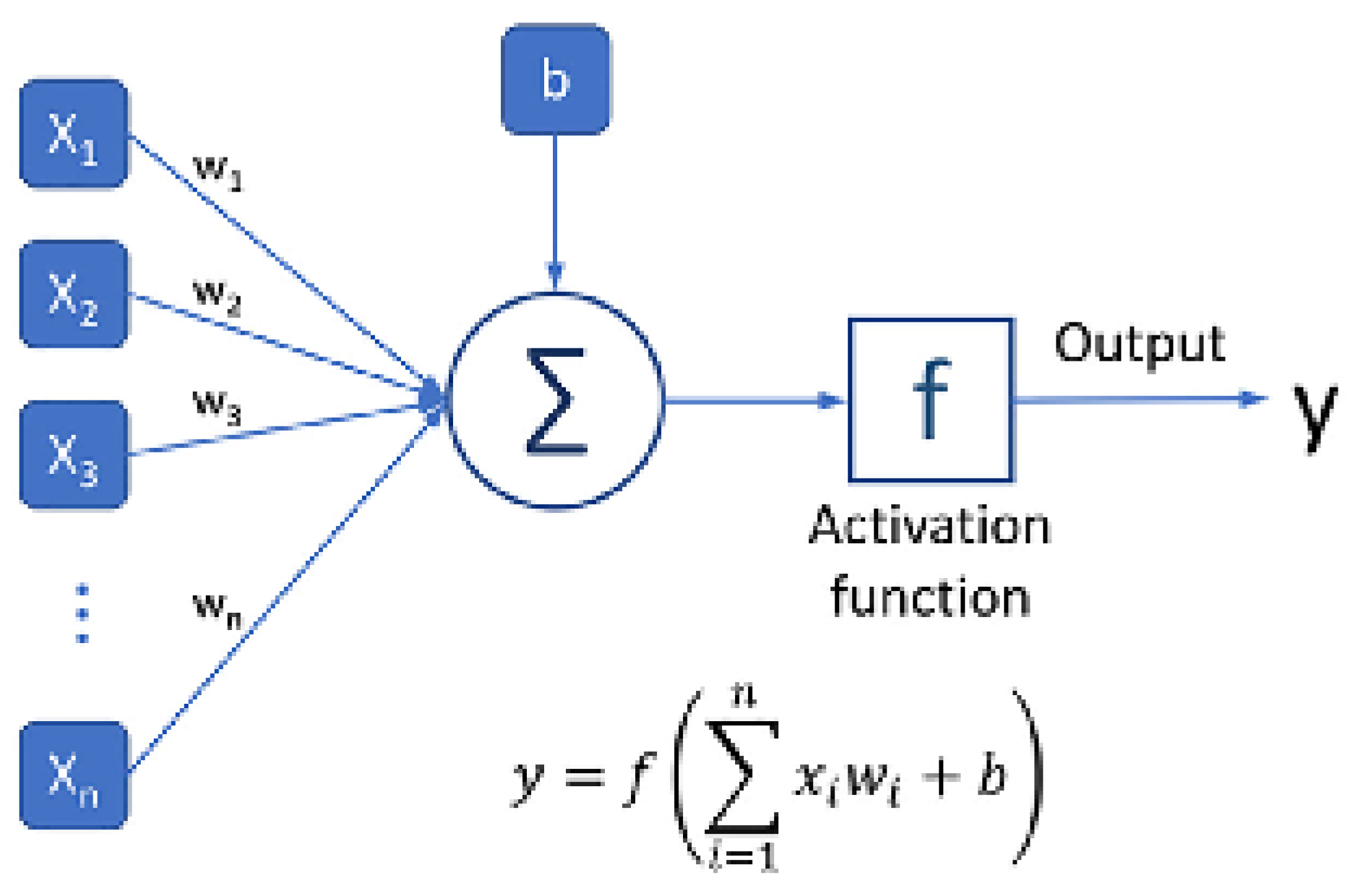
A Convolution Neural Network contains neurons with some weights and biases. These neurons capture inputs from the anterior layers (Figure 1). CNN gives a high-speed and accurate algorithm that displays excellent performance in detection and classification compared to classical neural networks [55,56]. The classification of the most well-known and used image databases, such as MNIST [57,58] and CIFAR 10 [59,60] has been improved by the use of CNNs.
Figure 1.
Basic concepts of artificial neural network.
4.1.1. Convolution Layer
The basic architecture of a CNN consists of different convolutional layers, in addition to pooling layers and fully connected layers. The convolutional layer aims at taking or extracting features from the input data. To achieve the featured maps, we reiterate the process starting from the input image and then calculating the dot product considering the weights and biases. The formula for computing a single output matrix is described as follows in Equation (1):
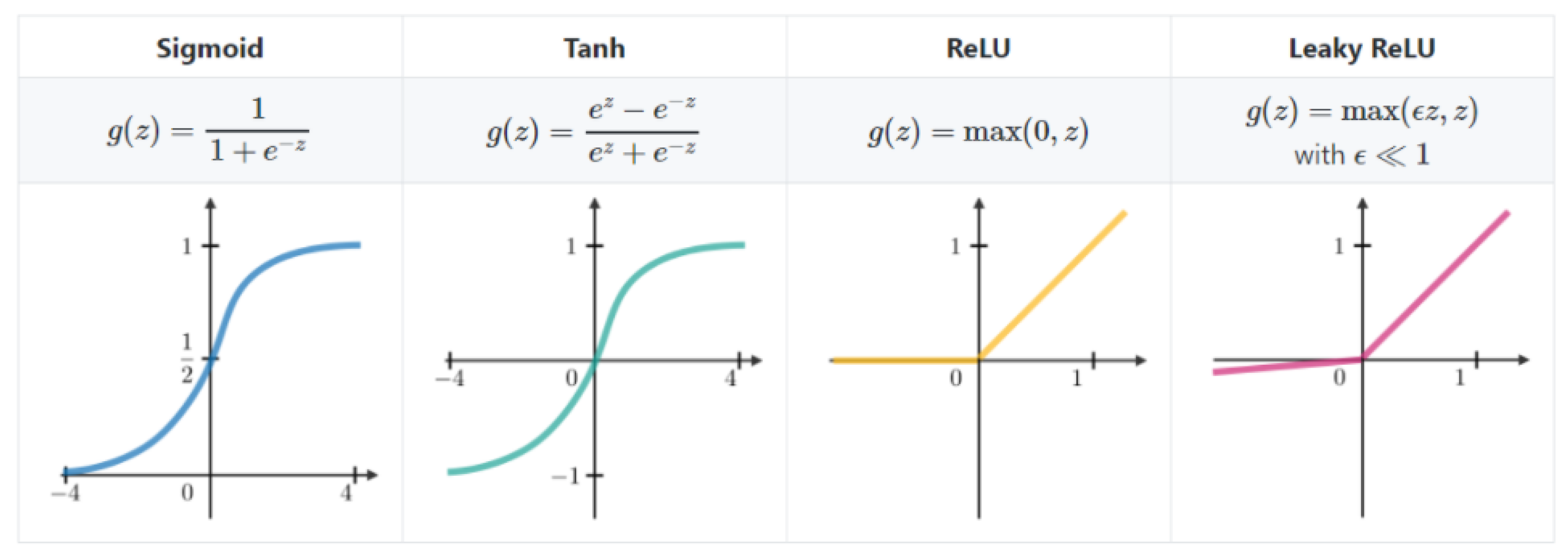
where I is an input vector, and K is the corresponding convolution kernel with the size of . N is the input size and is the bias value. f is a non-linear activation function such as Sigmoid, Tanh, ReLu and Leaky ReLu (Figure 2).
Figure 2.
Activation functions.
The activation function used in our work is the one used in [61]. Its formula is as follows (Equation (2)).
4.1.2. Back Propagation
The main objective of our experiment is to study the efficiency of the chosen model in the classification of brain tumors. To minimize the loss function, we need to calculate optimal parameter values in the backpropagation phase. Kernels and biases are the main parameters in a Convolutional Neural Network. To find optimal values of parameters, we will apply the Stochastic Gradient Descent algorithm. The model is based on a very small convolutional filter the size of (3 × 3) to deal with large-scale images. Each block of the model is a sequence of convolutional layers. These layers are followed by a max-pooling layer. We applied a kernel of size (3 × 3) overall to the model. Then, a max-pooling of size 2 × 2 with strides of 2 is also applied to divide equally the resolution after each block. A VGG model has two fully connected hidden layers and one fully connected output layer.
The structure of the selected model is described in Table 1.
Table 1.
Description of the selected model.
5. Database and Dataset
5.1. DataBase Collection
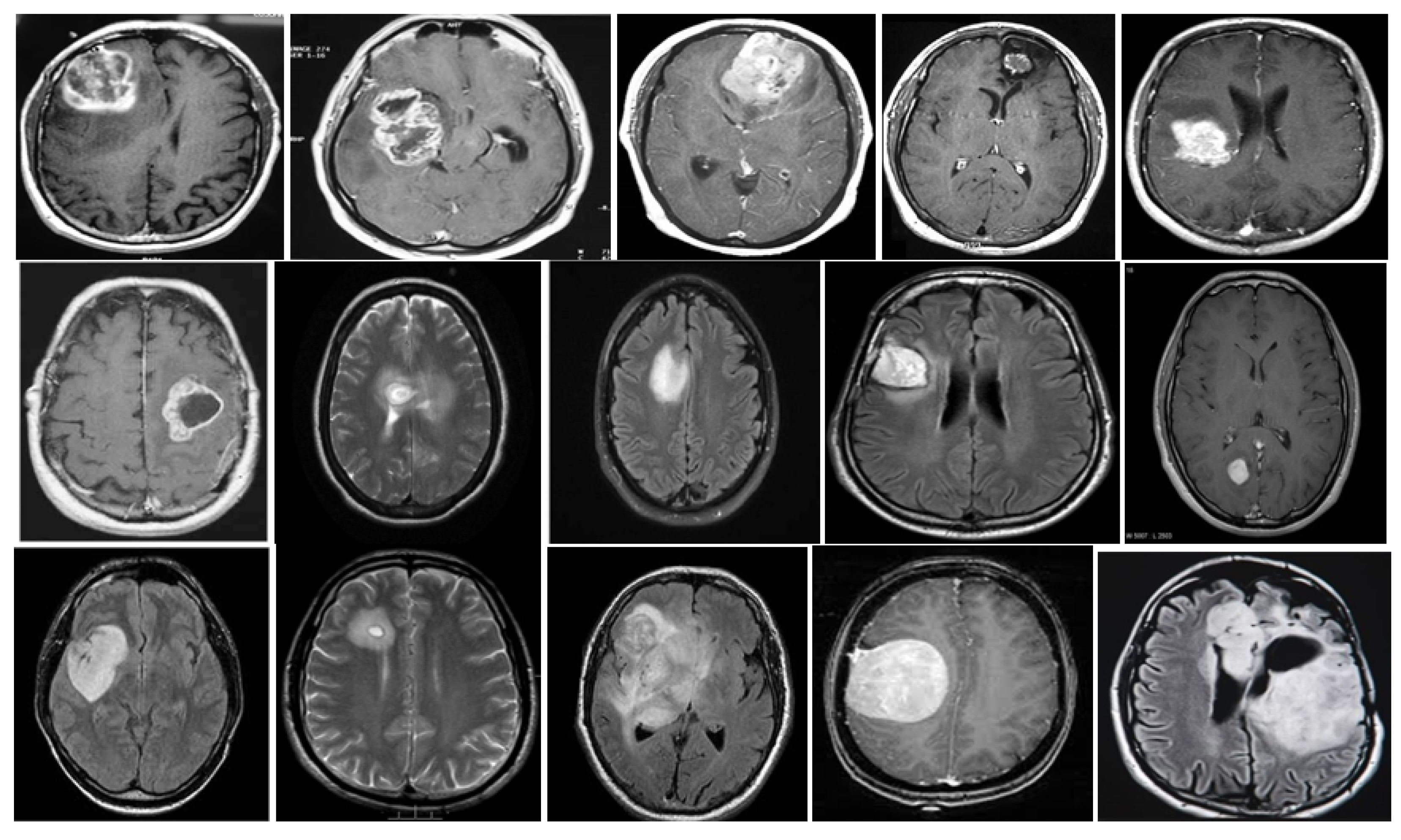
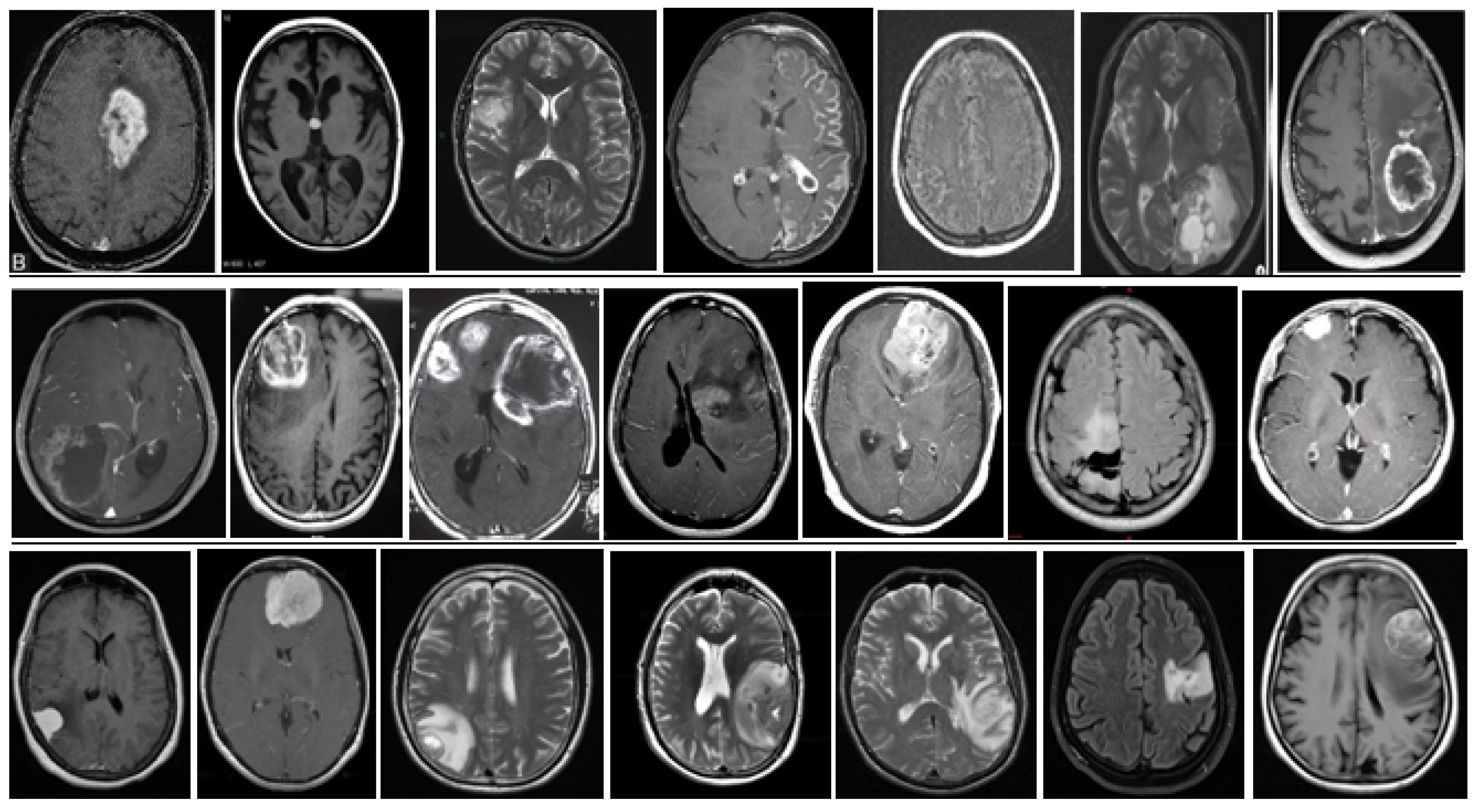
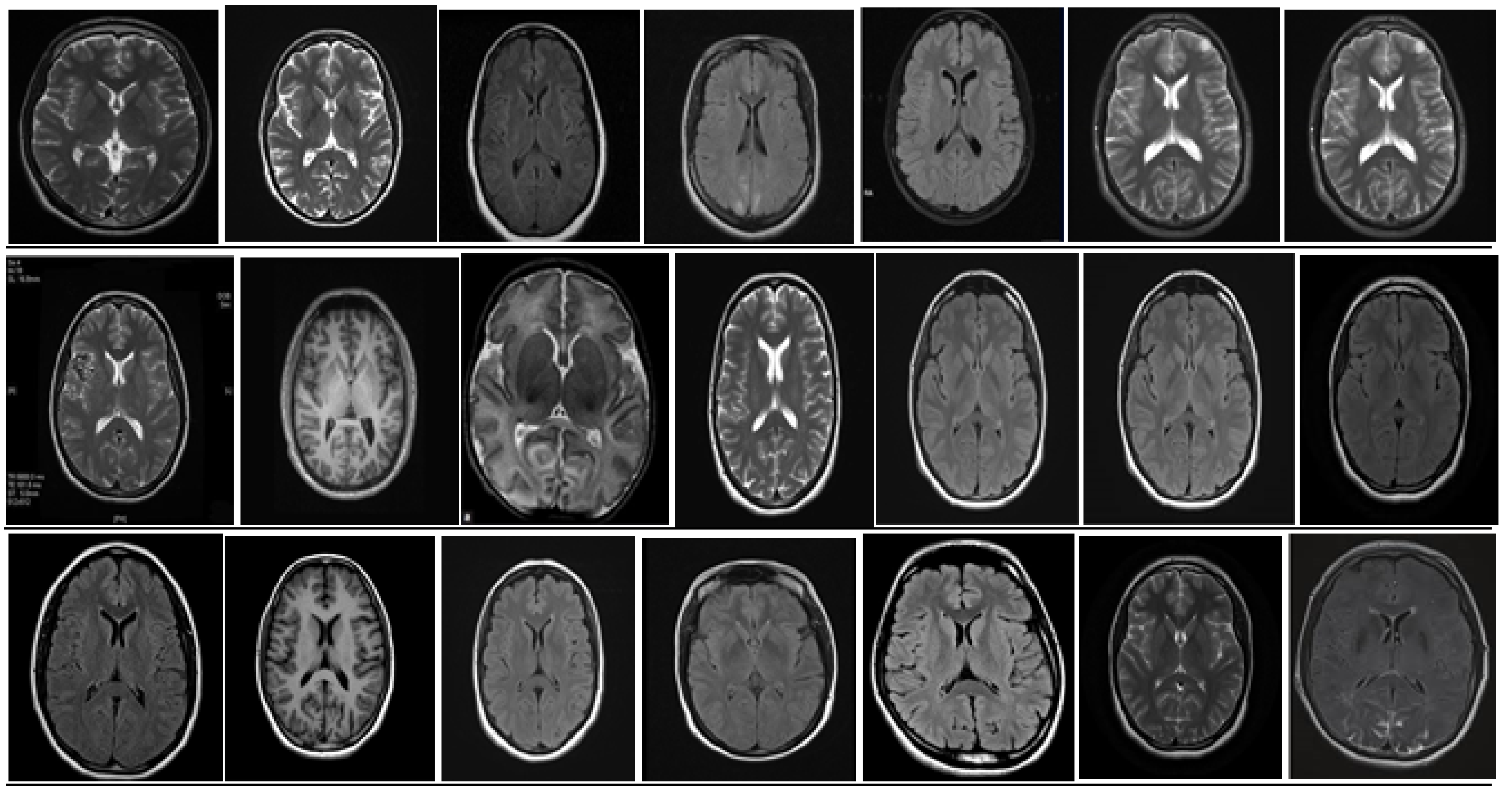
In this work, we suggest a classification model that would allow us to consider MRI images of the patient as input and compute to detect whether there is a tumor in the brain or not, as an output. We relied on Kaggle, which publicly provides brain MRI images. The dataset we selected contains 253 brain MRI images. The yes folder contains 155 tumor brain MRI images and the no folder contains 98 non-tumor MRI images. This shows that 61% (155 images) of the data are positive examples (Figure 3) while 39% (98 images) are negative examples (Figure 4).
Figure 3.
Abnormal brain images.
Figure 4.
Normal brain images.
5.2. Database Augmentation
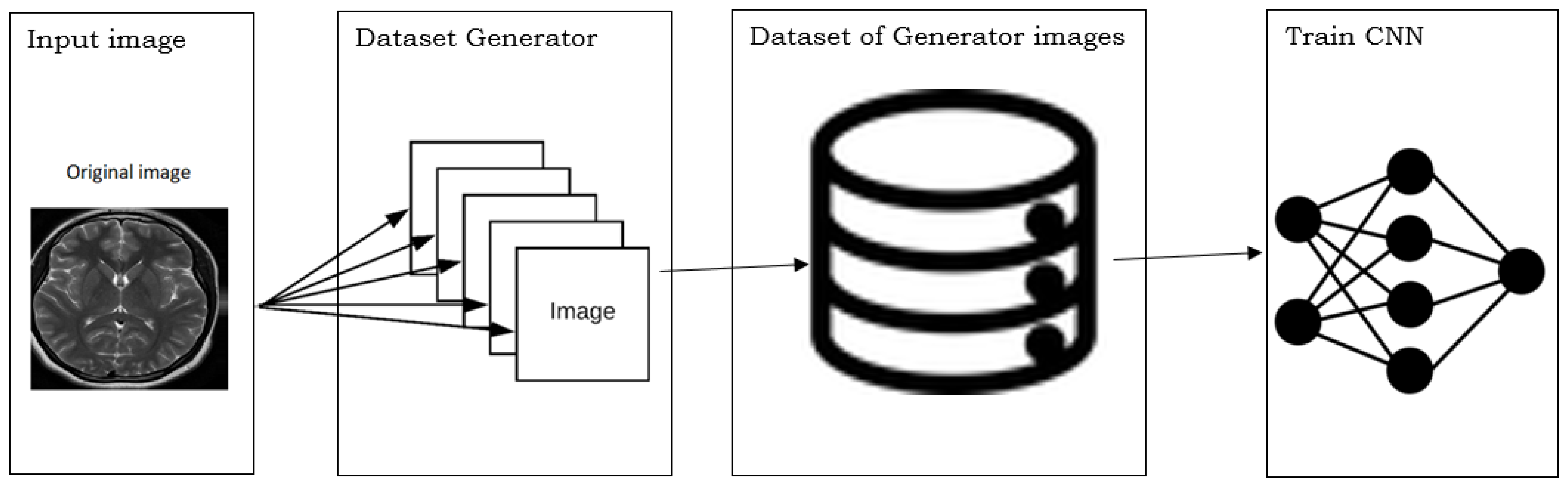
Data augmentation is a solution to increase the quantity and complexity of existing data artificially [62]. Data augmentation approaches have been applied to enrich the size of training sets, to allow developers to benefit from more representative training data [63,64]. The main principle is to increase, artificially, the number of training examples. It can act as a regularizer in preventing overfitting in neural networks. In literature, we can classify data augmentation techniques into three types:
- Dataset generation and expanding an existing dataset (Figure 5)
Figure 5. Dataset generation and expanding an existing dataset. - In-place/on-the-fly data augmentation
- Combining dataset generation and in-place augmentation.
The most known techniques are
- Flipping: creates a mirror reflection of an original image,
- Rotation: rotating an image by an angle around the center pixel,
- Translation: involves moving the image along the X or Y direction or both.
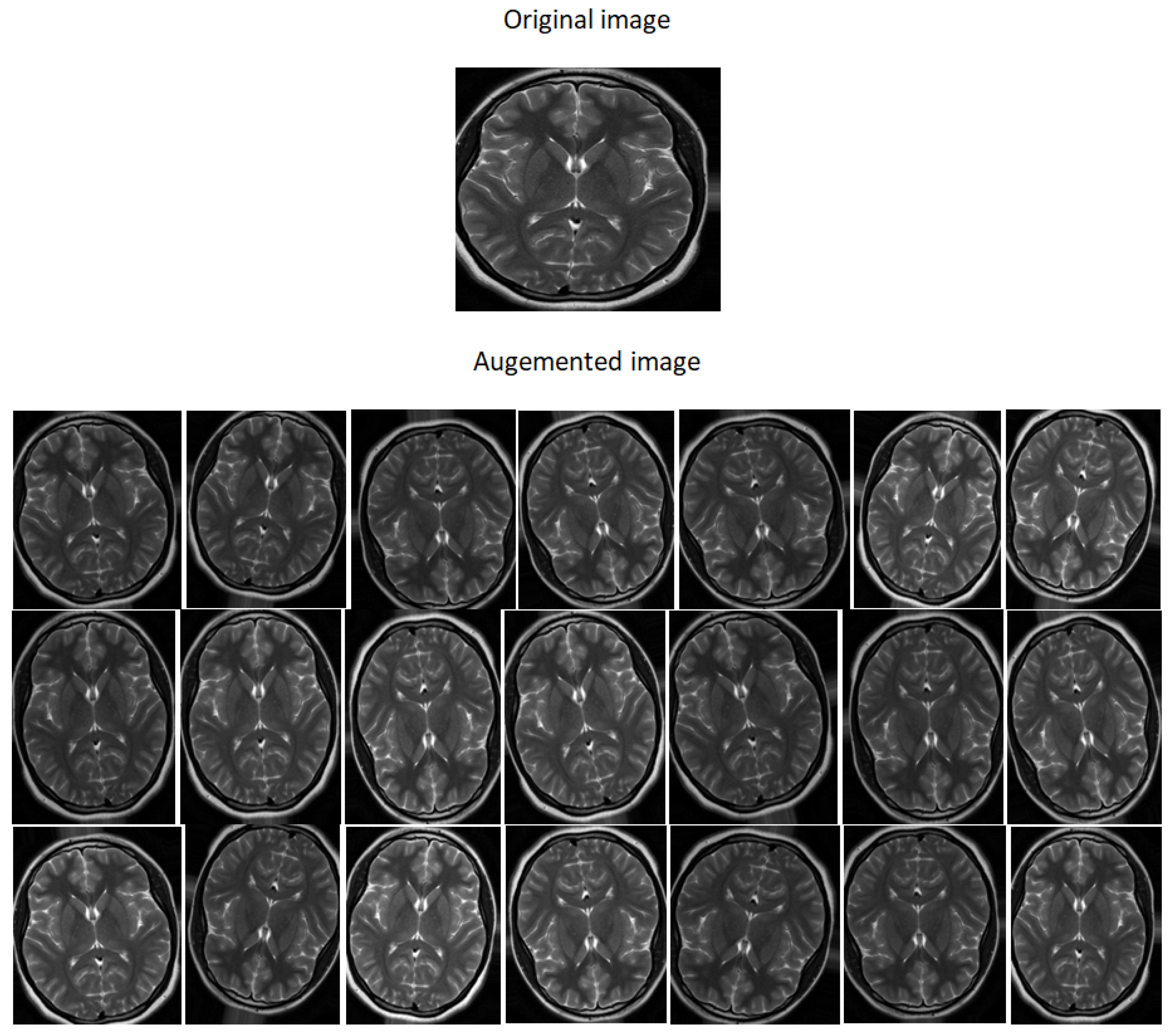
In our case, we applied changes using flipping, rotation, and translation techniques (Figure 6 and Algorithm 1).
| Algorithm 1: Data Augmentation |
| Input: DataSet (DS) Output: Augmented images 1 DataAugmentation 2 number of images in DS 3 4 while do ![]() 20 end |
Figure 6.
Database augmentation.
In Table 2, we detailed the performances of three models that were initially trained on a dataset without augmentation and then on a dataset with augmentation. This study was proposed in [65] and the main idea was that Cascaded Net segments the tumor following three stages: (1) locate and pick out the whole brain tumor area. (2) Remove the useless surrounding tissue area and crop a square tumor region as the input to the next network to segment the tumor core. (3) The third network divides the tumor core into an enhanced region and a non-enhanced region. The mean value is the Dice score that is mainly used to quantify the performance of image segmentation methods [66].
Table 2.
Comparison of the dice score of different networks (with/without) augmentation.
As shown in Table 2, the mean values were enhanced by 2% or 3% for each of the three models. Thus, we can conclude that models with data augmentation outperformed those without augmentation.
6. Results and Discussions
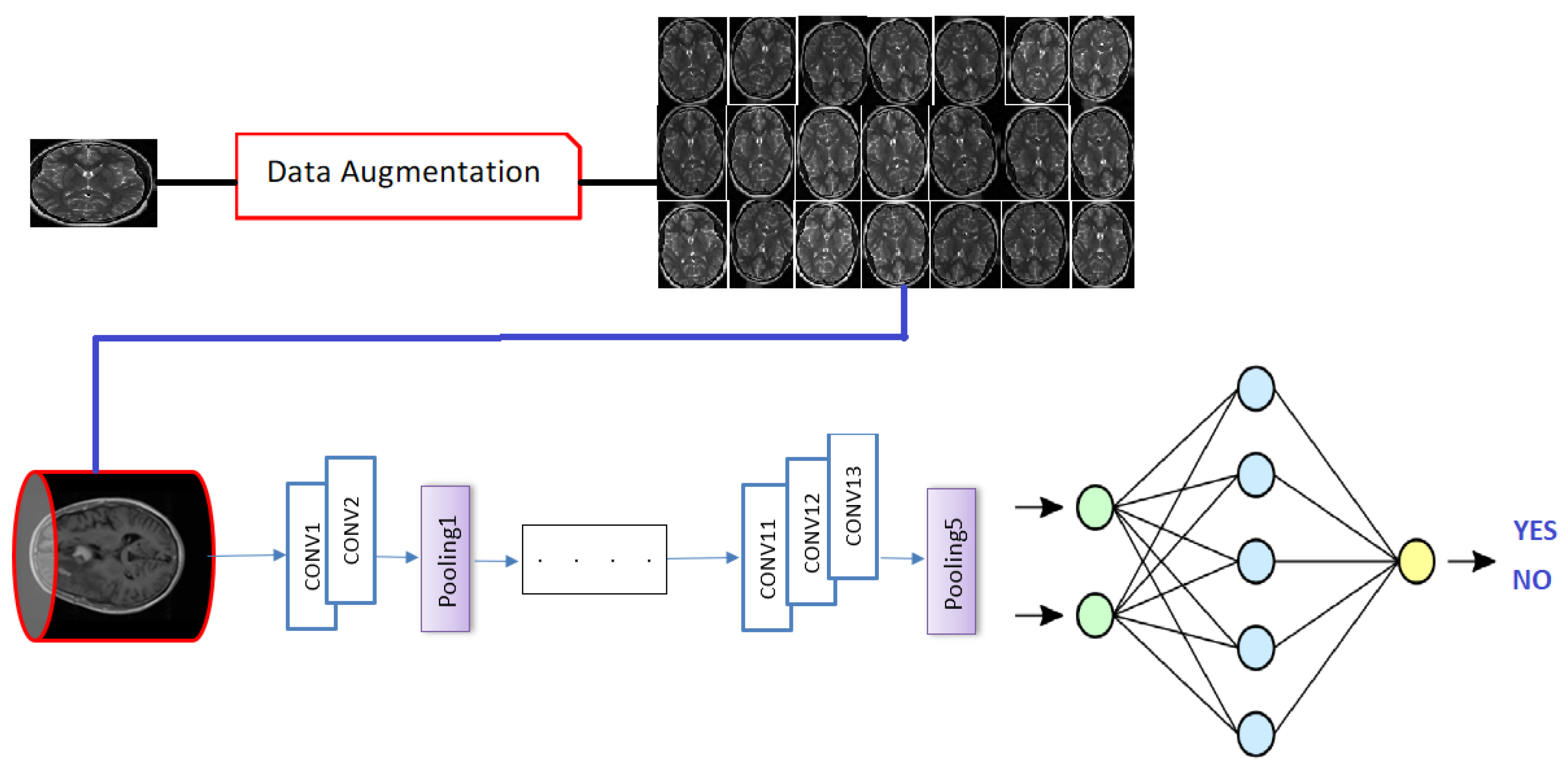
VGG-16 is a very good architecture for benchmarking a particular task. Also, pre-trained networks for VGG are available freely on the internet, so it is commonly used out of the box for various applications. Although VGG-16 represented the acquired features effectively, deep structure and supervised learning may cause overproduction when the quantity of training data is restricted. It is the case with many medical situations where there is limited data, and the VGG-16 model, which is characterized by many parameters, may lead to over-fitting. In the VGG-16 model, there are thirteen convolution layers, five pooling layers, and always uses a 3 × 3 Kernel for convolution and 2 × 2 size of the max-pooling layer. In our work, we create a CNN architecture using Tensorflow, Keras, and jupyter. We train the model on an MRI brain image database. A block diagram of our solution is described in Figure 7. The output of the model is “YES” for the abnormal brain (Figure 8) or “NO” for the normal brain (Figure 9).
Figure 7.
Flowchart of the algorithm.
Figure 8.
Abnormal brains.
Figure 9.
Normal brains.
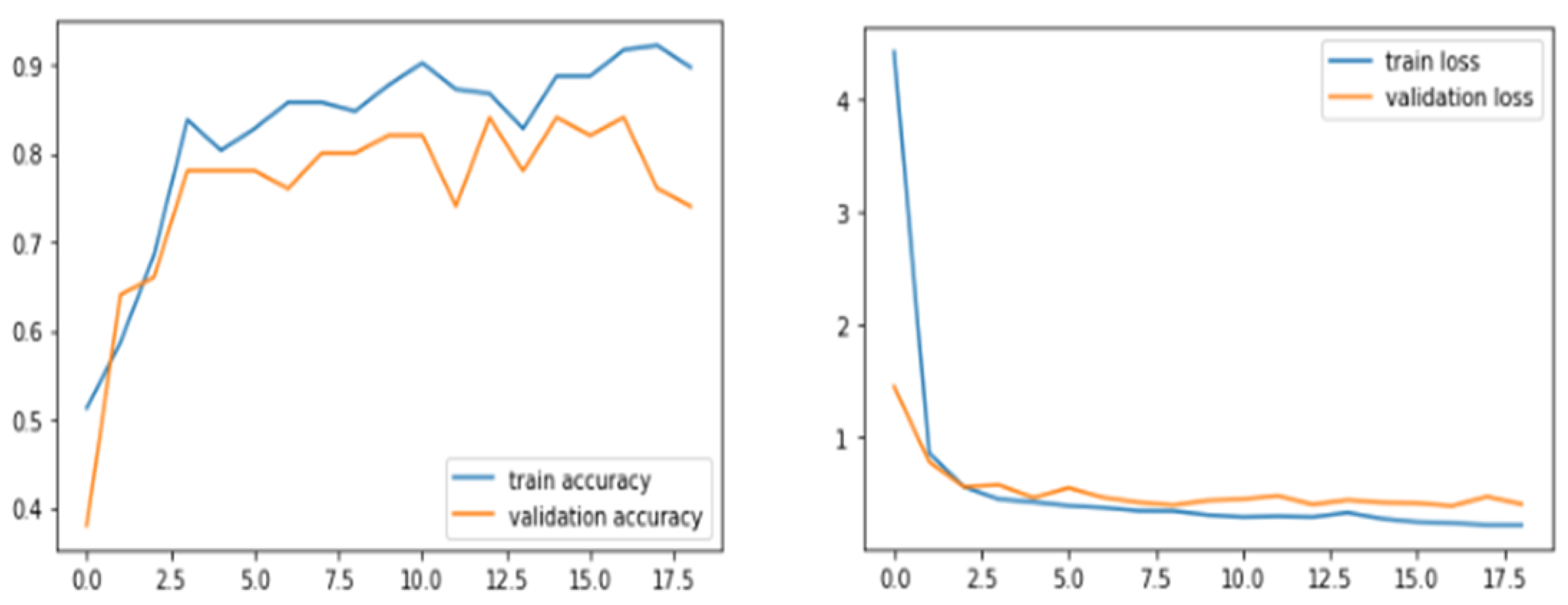
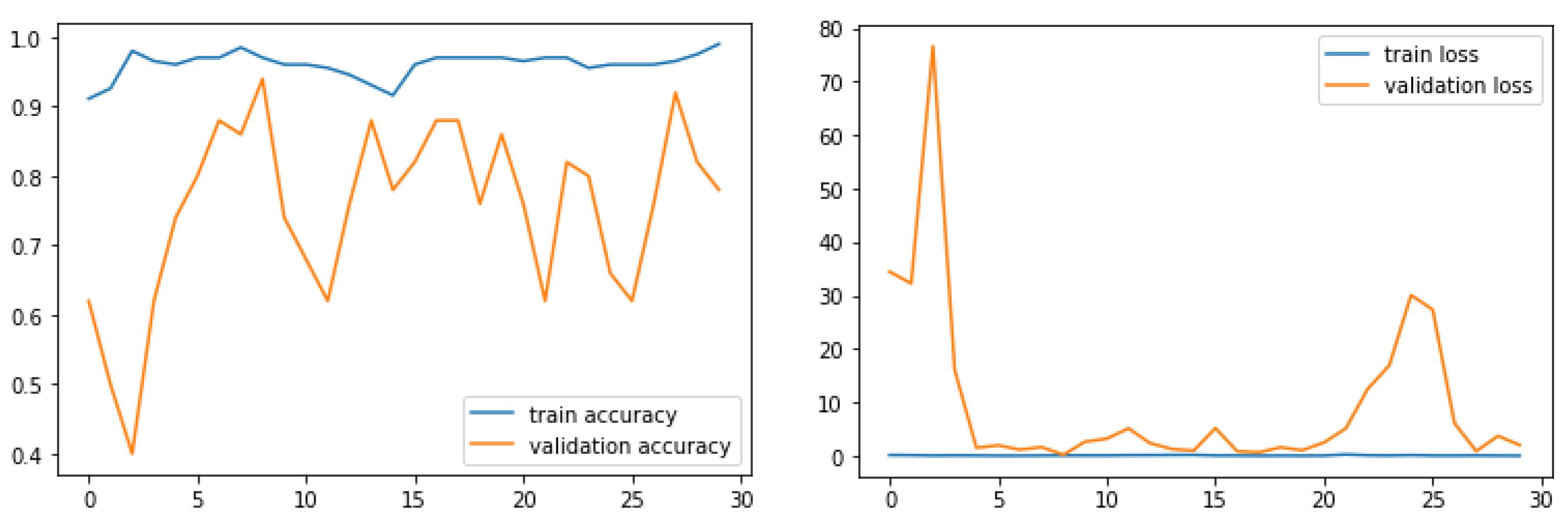
The running time is about 300 (s). The results demonstrate the model’s ability and accuracy in classifying images (Figure 10). To confirm the obtained results, we evaluated our model on a second Kaggle dataset. Its accuracy is shown in Figure 11.
Figure 10.
Accuracy and loss for training and validation.
Figure 11.
Accuracy and loss for training and validation (Dataset 2).
As shown in Table 3, the used dataset of brain tumors consists of 253 real brain images (Kaggle platform). Data are divided into training (185 images), validation (48 images), and testing (20 images). Then, this dataset of 253 images was augmented to produce 3700 new images. The proposed model was trained using the augmented dataset and the results are described in Table 4.
Table 3.
Dataset before and after augmentation.
The number of epochs = 15 and the Batch size = 32. To evaluate the proposed model’s efficiency, we relied on ten models of machine learning methods. The comparison between the proposed VGG-16 model and the other models was based on the following values [67,68]:
For comparison purposes, true positive (TP), true negative (TN), false positive (FP), and false negative (FN) are used to assess the performance of the proposed model, on the one hand, and ten machine learning models, on the other. Table 4 illustrates the comparison between the different models.
Table 4.
Comparison table between different models.
Table 4.
Comparison table between different models.
| Model | Accuracy | Precision | Recall | F1-Score |
|---|---|---|---|---|
| VGG16 | 0.96 | 0.93 | 1.0 | 0.97 |
| ResNet-50 | 0.89 | 0.87 | 0.93 | 0.90 |
| VGG-19 | 0.93 | 0.94 | 0.93 | 0.93 |
| Inception-V3 | 0.75 | 0.77 | 0.71 | 0.74 |
| ResNet-101 | 0.74 | 0.74 | 0.74 | 0.73 |
| DenseNet121 | 0.49 | 0.50 | 0.48 | 0.49 |
| [69] | 0.97 | 0.98 | 0.95 | 0.96 |
| [70] | 0.96 | 0.96 | 0.98 | 0.95 |
| [71] | 0.97 | 0.97 | 0.97 | 0.97 |
| [72] | 0.79 | 0.76 | 0.86 | 0.81 |
| [73] | 0.96 | 0.97 | 0.80 | 0.88 |
The VGG16 model accomplished the best values of Accuracy, Precision, Recall, and F1-score.
7. Conclusions
In this paper, a brain tumor classification was implemented based on the Convolutional Neural Network and data augmentation technique. We presented a detailed review of various CNN architectures and their limitation if we have a limited dataset. The goal is to overcome this problem. Then, we presented that we can improve performances on limited brain tumor datasets by enriching them using data augmentation. Experimental results showed that the model’s ability and accuracy in classifying images are very motivating. Our data augmentation-based solution has shown high detection efficiency and good evaluation metrics value even in a limited MRI dataset. In future work, we plan to explore more complex architecture, more varied datasets, and more data augmentation techniques.
Author Contributions
Supervision and funding acquisition, B.M.A.; writing—original draft and writing—review and editing, R.G. and L.B.; methodology, T.G. and T.H.; resources and validation, H.A. and A.A. All authors have read and agreed to the published version of the manuscript.
Funding
This research was funded by the Deanship of the Scientific Research of the University of Ha’il, Saudi Arabia (project: RG-20091).
Data Availability Statement
Dataset of brain tumors: https://www.kaggle.com/datasets/navoneel/brain-mri-images-for-brain-tumor-detection, accessed on 20 February 2022.
Conflicts of Interest
The authors declare no conflict of interest.
References
- Sung, H.; Ferlay, J.; Siegel, R.L.; Laversanne, M.; Soerjomataram, I.; Jemal, A.; Bray, F. Global cancer statistics 2020: GLOBOCAN estimates of incidence and mortality worldwide for 36 cancers in 185 countries. CA A Cancer J. Clin. 2021, 71, 209–249. [Google Scholar] [CrossRef] [PubMed]
- Toufiq, D.M.; Ali Makki Sagheer, H. A Review on Brain Tumor Classification in MRI Images. Turk. J. Comput. Math. Educ. (TURCOMAT) 2021, 12, 1958–1969. [Google Scholar]
- Magadza, T.; Viriri, S. Deep Learning for Brain Tumor Segmentation: A Survey of State-of-the-Art. J. Imaging 2021, 7, 19. [Google Scholar] [CrossRef] [PubMed]
- Chauhan, S.; More, A.; Uikey, R.; Malviya, P.; Moghe, A. Brain tumor detection and classification in MRI images using image and data mining. In Proceedings of the 2017 International Conference on Recent Innovations in Signal Processing and Embedded Systems (RISE), Bhopal, India, 27–29 October 2017; IEEE: Piscataway, NJ, USA, 2017; pp. 223–231. [Google Scholar]
- Wang, X.; Wang, Z. The method for image retrieval based on multi-factors correlation utilizing block truncation coding. Pattern Recognit. 2014, 47, 3293–3303. [Google Scholar] [CrossRef]
- Unar, S.; Wang, X.; Wang, C.; Wang, Y. A decisive content based image retrieval approach for feature fusion in visual and textual images. Knowl.-Based Syst. 2019, 179, 8–20. [Google Scholar] [CrossRef]
- Wang, X.y.; Chen, Z.f.; Yun, J.j. An effective method for color image retrieval based on texture. Comput. Stand. Interfaces 2012, 34, 31–35. [Google Scholar] [CrossRef]
- Wang, C.; Wang, X.; Xia, Z.; Ma, B.; Shi, Y.Q. Image description with polar harmonic Fourier moments. IEEE Trans. Circuits Syst. Video Technol. 2019, 30, 4440–4452. [Google Scholar] [CrossRef]
- Wang, C.; Wang, X.; Xia, Z.; Zhang, C. Ternary radial harmonic Fourier moments based robust stereo image zero-watermarking algorithm. Inf. Sci. 2019, 470, 109–120. [Google Scholar] [CrossRef]
- Bhoi, A.K.; Mallick, P.K.; Liu, C.M.; Balas, V.E. Bio-Inspired Neurocomputing; Springer: Berlin/Heidelberg, Germany, 2021. [Google Scholar]
- Jyotiyana, M.; Kesswani, N. A Study on Deep Learning in Neurodegenerative Diseases and Other Brain Disorders. In Rising Threats in Expert Applications and Solutions; Springer: Berlin/Heidelberg, Germany, 2021; pp. 791–799. [Google Scholar]
- Montemurro, N.; Condino, S.; Cattari, N.; D’Amato, R.; Ferrari, V.; Cutolo, F. Augmented Reality-Assisted Craniotomy for Parasagittal and Convexity En Plaque Meningiomas and Custom-Made Cranio-Plasty: A Preliminary Laboratory Report. Int. J. Environ. Res. Public Health 2021, 18, 9955. [Google Scholar] [CrossRef]
- Condino, S.; Montemurro, N.; Cattari, N.; D’Amato, R.; Thomale, U.; Ferrari, V.; Cutolo, F. Evaluation of a wearable AR platform for guiding complex craniotomies in neurosurgery. Ann. Biomed. Eng. 2021, 49, 2590–2605. [Google Scholar] [CrossRef]
- Yildirim, M.; Cinar, A.C. Classification of White Blood Cells by Deep Learning Methods for Diagnosing Disease. Rev. D’Intell. Artif. 2019, 33, 335–340. [Google Scholar] [CrossRef]
- Hassan, T.M.; Elmogy, M.; Sallam, E.S. Diagnosis of focal liver diseases based on deep learning technique for ultrasound images. Arab. J. Sci. Eng. 2017, 42, 3127–3140. [Google Scholar] [CrossRef]
- Arjmand, A.; Angelis, C.T.; Christou, V.; Tzallas, A.T.; Tsipouras, M.G.; Glavas, E.; Forlano, R.; Manousou, P.; Giannakeas, N. Training of deep convolutional neural networks to identify critical liver alterations in histopathology image samples. Appl. Sci. 2020, 10, 42. [Google Scholar] [CrossRef] [Green Version]
- Tabrizchi, H.; Mosavi, A.; Szabo-Gali, A.; Felde, I.; Nadai, L. Rapid COVID-19 diagnosis using deep learning of the computerized tomography Scans. In Proceedings of the 2020 IEEE 3rd International Conference and Workshop in Óbuda on Electrical and Power Engineering (CANDO-EPE), Budapest, Hungary, 18–19 November 2020; IEEE: Piscataway, NJ, USA, 2020; pp. 000173–000178. [Google Scholar]
- Sandhya, Y.; Sahoo, P.K.; Eswaran, K. Malaria Disease Detection Using Deep Learning Technique. Int. J. Adv. Sci. Technol. 2020, 29, 7736–7745. [Google Scholar]
- Murtaza, G.; Shuib, L.; Mujtaba, G.; Raza, G. Breast cancer multi-classification through deep neural network and hierarchical classification approach. Multimed. Tools Appl. 2020, 79, 15481–15511. [Google Scholar] [CrossRef]
- Kieu, S.T.H.; Bade, A.; Hijazi, M.H.A.; Kolivand, H. A Survey of Deep Learning for Lung Disease Detection on Medical Images: State-of-the-Art, Taxonomy, Issues and Future Directions. J. Imaging 2020, 6, 131. [Google Scholar] [CrossRef]
- McBee, M.P.; Awan, O.A.; Colucci, A.T.; Ghobadi, C.W.; Kadom, N.; Kansagra, A.P.; Tridandapani, S.; Auffermann, W.F. Deep learning in radiology. Acad. Radiol. 2018, 25, 1472–1480. [Google Scholar] [CrossRef] [Green Version]
- Mazurowski, M.A.; Buda, M.; Saha, A.; Bashir, M.R. Deep learning in radiology: An overview of the concepts and a survey of the state of the art. arXiv 2018, arXiv:1802.08717. [Google Scholar] [CrossRef]
- Basheera, S.; Ram, M.S.S. Classification of brain tumors using deep features extracted using CNN. In Journal of Physics: Conference Series; IOP Publishing: Secunderabad, India, 2019; Volume 1172, p. 012016. [Google Scholar]
- Sajjad, M.; Khan, S.; Muhammad, K.; Wu, W.; Ullah, A.; Baik, S.W. Multi-grade brain tumor classification using deep CNN with extensive data augmentation. J. Comput. Sci. 2019, 30, 174–182. [Google Scholar] [CrossRef]
- Das, S.; Aranya, O.R.R.; Labiba, N.N. Brain tumor classification using convolutional neural network. In Proceedings of the 2019 1st International Conference on Advances in Science, Engineering and Robotics Technology (ICASERT), Dhaka, Bangladesh, 3–5 May 2019; IEEE: Piscataway, NJ, USA, 2019; pp. 1–5. [Google Scholar]
- Talo, M.; Baloglu, U.B.; Yıldırım, Ó.; Acharya, U.R. Application of deep transfer learning for automated brain abnormality classification using MR images. Cogn. Syst. Res. 2019, 54, 176–188. [Google Scholar] [CrossRef]
- Çinar, A.; Yildirim, M. Detection of tumors on brain MRI images using the hybrid convolutional neural network architecture. Med. Hypotheses 2020, 139, 109684. [Google Scholar] [CrossRef] [PubMed]
- Khawaldeh, S.; Pervaiz, U.; Rafiq, A.; Alkhawaldeh, R.S. Noninvasive grading of glioma tumor using magnetic resonance imaging with convolutional neural networks. Appl. Sci. 2017, 8, 27. [Google Scholar] [CrossRef] [Green Version]
- Sharma, A.K.; Nandal, A.; Dhaka, A.; Koundal, D.; Bogatinoska, D.C.; Alyami, H. Enhanced Watershed Segmentation Algorithm-Based Modified ResNet50 Model for Brain Tumor Detection. BioMed Res. Int. 2022, 2022, 7348344. [Google Scholar] [CrossRef] [PubMed]
- Arif, M.; Ajesh, F.; Shamsudheen, S.; Geman, O.; Izdrui, D.; Vicoveanu, D. Brain Tumor Detection and Classification by MRI Using Biologically Inspired Orthogonal Wavelet Transform and Deep Learning Techniques. J. Healthc. Eng. 2022, 2022, 2693621. [Google Scholar] [CrossRef] [PubMed]
- Mamatha, S.; Krishnappa, H.; Shalini, N. Graph Theory Based Segmentation of Magnetic Resonance Images for Brain Tumor Detection. Pattern Recognit. Image Anal. 2022, 32, 153–161. [Google Scholar] [CrossRef]
- Belfin, R.; Anitha, J.; Nainan, A.; Thomas, L. An Efficient Approach for Brain Tumor Detection Using Deep Learning Techniques. In Proceedings of the International Conference on Innovative Computing and Communications, Singapore, 12–13 July 2022; Springer: Berlin/Heidelberg, Germany, 2022; pp. 297–312. [Google Scholar]
- LeCun, Y.; Bottou, L.; Bengio, Y.; Haffner, P. Gradient-based learning applied to document recognition. Proc. IEEE 1998, 86, 2278–2324. [Google Scholar] [CrossRef] [Green Version]
- Krizhevsky, A.; Sutskever, I.; Hinton, G.E. Imagenet classification with deep convolutional neural networks. Adv. Neural Inf. Process. Syst. 2012, 25, 1097–1105. [Google Scholar] [CrossRef]
- Mikołajczyk, A.; Grochowski, M. Data augmentation for improving deep learning in image classification problem. In Proceedings of the 2018 International Interdisciplinary PhD Workshop (IIPhDW), Swinoujscie, Poland, 9–12 May 2018; IEEE: Piscataway, NJ, USA, 2018; pp. 117–122. [Google Scholar]
- Engstrom, L.; Tran, B.; Tsipras, D.; Schmidt, L.; Madry, A. A Rotation and a Translation Suffice: Fooling CNNs with Simple Transformations. 2018. Available online: https://openreview.net/forum?id=BJfvknCqFQ (accessed on 20 February 2022).
- Goodfellow, I.; Pouget-Abadie, J.; Mirza, M.; Xu, B.; Warde-Farley, D.; Ozair, S.; Courville, A.; Bengio, Y. Generative adversarial nets. Adv. Neural Inf. Process. Syst. 2014, 27. [Google Scholar] [CrossRef]
- Nayak, D.R.; Padhy, N.; Mallick, P.K.; Zymbler, M.; Kumar, S. Brain Tumor Classification Using Dense Efficient-Net. Axioms 2022, 11, 34. [Google Scholar] [CrossRef]
- Wei, K.; Li, T.; Huang, F.; Chen, J.; He, Z. Cancer classification with data augmentation based on generative adversarial networks. Front. Comput. Sci. 2022, 16, 162601. [Google Scholar] [CrossRef]
- Mzoughi, H.; Njeh, I.; Wali, A.; Slima, M.B.; BenHamida, A.; Mhiri, C.; Mahfoudhe, K.B. Deep multi-scale 3D convolutional neural network (CNN) for MRI gliomas brain tumor classification. J. Digit. Imaging 2020, 33, 903–915. [Google Scholar] [CrossRef] [PubMed]
- LeCun, Y.; Jackel, L.; Bottou, L.; Brunot, A.; Cortes, C.; Denker, J.; Drucker, H.; Guyon, I.; Muller, U.; Sackinger, E.; et al. Comparison of learning algorithms for handwritten digit recognition. In Proceedings of the International Conference on Artificial Neural Networks, Perth, Australia, 27 November–1 December 1995; Volume 60, pp. 53–60. [Google Scholar]
- Wang, G.; Gong, J. Facial expression recognition based on improved LeNet-5 CNN. In Proceedings of the 2019 Chinese Control And Decision Conference (CCDC), Nanchang, China, 3–5 June 2019; IEEE: Piscataway, NJ, USA, 2019; pp. 5655–5660. [Google Scholar]
- Zhang, Z.H.; Yang, Z.; Sun, Y.; Wu, Y.F.; Xing, Y.D. Lenet-5 Convolution Neural Network with Mish Activation Function and Fixed Memory Step Gradient Descent Method. In Proceedings of the 2019 16th International Computer Conference on Wavelet Active Media Technology and Information Processing, Chengdu, China, 13–15 December 2019; IEEE: Piscataway, NJ, USA, 2019; pp. 196–199. [Google Scholar]
- Rongshi, D.; Yongming, T. Accelerator implementation of Lenet-5 convolution neural network based on FPGA with HLS. In Proceedings of the 2019 3rd International Conference on Circuits, System and Simulation (ICCSS), Nanjing, China, 20–22 July 2019; IEEE: Piscataway, NJ, USA, 2019; pp. 64–67. [Google Scholar]
- Szegedy, C.; Liu, W.; Jia, Y.; Sermanet, P.; Reed, S.; Anguelov, D.; Erhan, D.; Vanhoucke, V.; Rabinovich, A. Going deeper with convolutions. In Proceedings of the IEEE Conference on Computer Vision and Pattern Recognition, Boston, MA, USA, 7–12 June 2015; pp. 1–9. [Google Scholar]
- He, K.; Zhang, X.; Ren, S.; Sun, J. Deep residual learning for image recognition. In Proceedings of the IEEE Conference on Computer Vision and Pattern Recognition, Las Vegas, NV, USA, 27–30 June 2016; pp. 770–778. [Google Scholar]
- Simonyan, K.; Zisserman, A. Very deep convolutional networks for large-scale image recognition. arXiv 2014, arXiv:1409.1556. [Google Scholar]
- Huang, G.; Liu, Z.; Van Der Maaten, L.; Weinberger, K.Q. Densely connected convolutional networks. In Proceedings of the IEEE Conference on Computer Vision and Pattern Recognition, Honolulu, HI, USA, 21–26 July 2017; pp. 4700–4708. [Google Scholar]
- Shah, U.; Harpale, A. A Review of Deep Learning Models for Computer Vision. In Proceedings of the 2018 IEEE Punecon, Pune, India 2018 IEEE, Piscataway, NJ, USA, 30 November–2 December 2018; pp. 1–6. [Google Scholar]
- Peters, J.F. Foundations of Computer Vision: Computational Geometry, Visual Image Structures and Object Shape Detection; Springer: Berlin/Heidelberg, Germany, 2017; Volume 124. [Google Scholar]
- Li, Y.H.; Aslam, M.S.; Yang, K.L.; Kao, C.A.; Teng, S.Y. Classification of body constitution based on TCM philosophy and deep learning. Symmetry 2020, 12, 803. [Google Scholar] [CrossRef]
- Chen, Q.; Xie, Q.; Yuan, Q.; Huang, H.; Li, Y. Research on a real-time monitoring method for the wear state of a tool based on a convolutional bidirectional LSTM model. Symmetry 2019, 11, 1233. [Google Scholar] [CrossRef] [Green Version]
- Iandola, F.N.; Han, S.; Moskewicz, M.W.; Ashraf, K.; Dally, W.J.; Keutzer, K. SqueezeNet: AlexNet-level accuracy with 50x fewer parameters and <0.5 MB model size. arXiv 2016, arXiv:1602.07360. [Google Scholar]
- Howard, A.G.; Zhu, M.; Chen, B.; Kalenichenko, D.; Wang, W.; Weyand, T.; Andreetto, M.; Adam, H. Mobilenets: Efficient convolutional neural networks for mobile vision applications. arXiv 2017, arXiv:1704.04861. [Google Scholar]
- Wang, N.; Li, Y.; Liu, H. Reinforced Neighbour Feature Fusion Object Detection with Deep Learning. Symmetry 2021, 13, 1623. [Google Scholar] [CrossRef]
- Zhang, J.; Liu, J.; Wang, Z. Convolutional Neural Network for Crowd Counting on Metro Platforms. Symmetry 2021, 13, 703. [Google Scholar] [CrossRef]
- LeCun, Y.; Jackel, L.D.; Bottou, L.; Cortes, C.; Denker, J.S.; Drucker, H.; Guyon, I.; Muller, U.A.; Sackinger, E.; Simard, P.; et al. Learning algorithms for classification: A comparison on handwritten digit recognition. Neural Netw. Stat. Mech. Perspect. 1995, 261, 2. [Google Scholar]
- Deng, L. The mnist database of handwritten digit images for machine learning research [best of the web]. IEEE Signal Process. Mag. 2012, 29, 141–142. [Google Scholar] [CrossRef]
- Zhu, X.; Bain, M. B-CNN: Branch convolutional neural network for hierarchical classification. arXiv 2017, arXiv:1709.09890. [Google Scholar]
- Kanwal, K.; Ahmad, K.T.; Khan, R.; Abbasi, A.T.; Li, J. Deep learning using symmetry, fast scores, shape-based filtering and spatial mapping integrated with cnn for large scale image retrieval. Symmetry 2020, 12, 612. [Google Scholar] [CrossRef]
- Abd El Kader, I.; Xu, G.; Shuai, Z.; Saminu, S.; Javaid, I.; Salim Ahmad, I. Differential deep convolutional neural network model for brain tumor classification. Brain Sci. 2021, 11, 352. [Google Scholar] [CrossRef] [PubMed]
- Perez, L.; Wang, J. The effectiveness of data augmentation in image classification using deep learning. arXiv 2017, arXiv:1712.04621. [Google Scholar]
- Wong, S.C.; Gatt, A.; Stamatescu, V.; McDonnell, M.D. Understanding data augmentation for classification: When to warp? In Proceedings of the 2016 International Conference on Digital Image Computing: Techniques and Applications (DICTA), Gold Coast, Australia, 30 November–2 December 2016; IEEE: Piscataway, NJ, USA, 2016; pp. 1–6. [Google Scholar]
- Khan, H.A.; Jue, W.; Mushtaq, M.; Mushtaq, M.U. Brain tumor classification in MRI image using convolutional neural network. Math. Biosci. Eng. 2020, 17, 6203. [Google Scholar] [CrossRef] [PubMed]
- Li, Q.; Yu, Z.; Wang, Y.; Zheng, H. TumorGAN: A multi-modal data augmentation framework for brain tumor segmentation. Sensors 2020, 20, 4203. [Google Scholar] [CrossRef] [PubMed]
- Işın, A.; Direkoğlu, C.; Şah, M. Review of MRI-based brain tumor image segmentation using deep learning methods. Procedia Comput. Sci. 2016, 102, 317–324. [Google Scholar] [CrossRef] [Green Version]
- Aslan, M.F.; Unlersen, M.F.; Sabanci, K.; Durdu, A. CNN-based transfer learning–BiLSTM network: A novel approach for COVID-19 infection detection. Appl. Soft Comput. 2021, 98, 106912. [Google Scholar] [CrossRef]
- Aslan, M.F.; Sabanci, K.; Durdu, A.; Unlersen, M.F. COVID-19 diagnosis using state-of-the-art CNN architecture features and Bayesian Optimization. Comput. Biol. Med. 2022, 2022, 105244. [Google Scholar] [CrossRef]
- Sujit, S.J.; Bonfante, E.; Aein, A.; Coronado, I.; Riascos-Castaneda, R.; Giancardo, L. Deep learning enabled brain shunt valve identification using mobile phones. Comput. Methods Programs Biomed. 2021, 210, 106356. [Google Scholar] [CrossRef]
- Ghosh, A.; Soni, B. An Automatic Tumor Identification Process to Classify MRI Brain Images. In Data Science; Springer: Berlin/Heidelberg, Germany, 2021; pp. 315–327. [Google Scholar]
- Hossain, M.F.; Islam, M.A.; Hussain, S.N.; Das, D.; Amin, R.; Alam, M.S. Brain Tumor Classification from MRI Images Using Convolutional Neural Network. In Proceedings of the 2021 IEEE International Conference on Artificial Intelligence in Engineering and Technology (IICAIET), Kota Kinabalu, Malaysia, 13–15 September 2021; IEEE: Piscataway, NJ, USA, 2021; pp. 1–6. [Google Scholar]
- Wahid, R.R.; Anggraeni, F.T.; Nugroho, B. Brain Tumor Classification with Hybrid Algorithm Convolutional Neural Network-Extreme Learning Machine. Ijconsist J. 2021, 3, 29–33. [Google Scholar] [CrossRef]
- Zhaputri, A.; Hayaty, M.; Laksito, A.D. Classification of Brain Tumour MRI Images using Efficient Network. In Proceedings of the 2021 4th International Conference on Information and Communications Technology (ICOIACT), Virtually, 30–31 August 2021; IEEE: Piscataway, NJ, USA, 2021; pp. 108–113. [Google Scholar]
Publisher’s Note: MDPI stays neutral with regard to jurisdictional claims in published maps and institutional affiliations. |
© 2022 by the authors. Licensee MDPI, Basel, Switzerland. This article is an open access article distributed under the terms and conditions of the Creative Commons Attribution (CC BY) license (https://creativecommons.org/licenses/by/4.0/).