1. Introduction
In recent years, cloud computing has been one of the most important topics in the field of information technology (IT) [
1]. Every day, many organizations and companies are migrating their services over the cloud [
2]. However, a primary obstacle in moving their systems to the cloud concerns the security and the continuously increasing number of digital crimes occurring in cloud environments [
1]. Ensuring data integrity in any system is currently an imperative requirement. Stored data can be vulnerable to manipulation, intentionally or not, even more when placed in the cloud. Data integrity is a fundamental aspect of storage security and reliability [
3]. It consists of protecting information against modifications or inappropriate destruction.
Policies, regulations, and secure mechanisms should be developed to protect people from being deceived; cloud forensics is a step forward in dealing with it [
1]. A fundamental mechanism for digital forensics is auditing the logs; they are used to keep track of important activities. Logs have been used to provide information about past events and, therefore, show the path of the state of a system [
4].
“Ensuring” logs from improper users has been reviewed by many researchers in different areas, such as distributed systems [
4,
5], cloud computing [
6,
7], and services [
8,
9,
10,
11]. These system solutions have been developed to be adapted for TCP/IP internet infrastructures. The internet was built to guarantee communication, not to guarantee information security properties. Thus, TCP/IP-based solutions layered on the internet have raised significant trust and privacy concerns.
Blockchain seems to be a suited technology for dealing with cloud system data integrity, because blockchain is characterized by features, such as transparency, traceability, and security [
12]. These features make the adoption of blockchain attractive toward enhancing information security, privacy, and trustworthiness in very different contexts. Firstly, this technology was developed to improve integrity in the Bitcoin network [
13]; then, it gave way to other cryptocurrencies. Recently, blockchain and the smart contract extension have permitted considering other use cases, such as the supply chain, Internet of Things, healthcare systems, digital right management, insurance, financial systems, and real estate systems [
14]. These implementations share a very important characteristic related to trust—a crucial element of blockchain technology [
15,
16].
Blockchain applies cryptography and hash functions to chain the blocks, along with a decentralized structure, making it very difficult for third parties to manipulate the information compared to traditional databases. Its potential is enormous in information transactions, such as cloud storage. Blockchain technology itself already has the strengths of including logging and traceability mechanisms. However, the reality is that most organizations were born without it, and their storage information is executed via traditional databases (off-chain). A complete migration could imply very high economic costs since systems with high information content would require too much computational costs deploying their transactions on the blockchain network [
17].
In this article, blockchain technology is used as a repository to store all events that can arise in an external system, ensuring its integrity. We provide an audit mechanism, propose a hybrid solution architecture on a permissionless blockchain with smart contract support. Each event, before being stored, is transformed in a log containing the attribute tags that respond to the following questions: how was the event generated? Who generated it? What included the event? Where was it generated? When was the event generated? The log is stored in the blockchain by executing smart contracts. This will allow validating and knowing the traceability of any data modification, guaranteeing if the information provides integrity or not, i.e., knowing the possible alterations by third parties.
On the other hand, following the new technological demands, in terms of software development, we identified that the microservice approach offers an evolutionary step concerning monolithic ones. Thus, we provided an architecture following the microservice approach. However, a microservice system design remains challenging since it can be independently deployed, has lower coupling, and is self-contained. For cloud applications development, microservice allows more freedom to evolve and requires a mechanism to inform others about what has changed or to track past events in the system. With the highly decentralized development and design of microservices, it becomes difficult to maintain a centralized architectural design reference [
18]. As a result, the system might be vulnerable to data integrity attacks. Hence, this paper aims to provide a decentralized architecture with two general services. Firstly, a data integrity mechanism in which all events (records) triggered by a cloud system are stored within a blockchain in a hashed form. Secondly, a verifiability process that checks the data integrity. The mechanism was built through a microservice architecture to be integrated with any system as a service.
We implemented our architecture, and our experiments show that it can be successfully suited within other cloud systems. Our main contributions are listed as follows:
A mechanism for auditing issues storing logs from the initialization phase of a system until the execution of user transactions guaranteed by blockchain strengths concerning integrity.
A consulting mechanism that provides certainty about the integrity of the logs stored in the blockchain.
Traceability of each log transaction carried out by the corresponding users of a cloud system in distributed environments.
An auditing mechanism where cloud systems (following the microservice architecture) can plug it.
Our proposal falls in a design science research in the information systems area [
19]; specifically, in the software engineering topic. The methodology of our work follows that proposed in [
20], commonly applied in engineering. Such a methodology comprehends the following steps: (a) Motivation and problem identification; (b) Objectives; (c) Design; (d) Development; and (e) Demonstration and validation.
Following the methodology described previously, we structured the paper as follows: (Step a) is deepened in
Section 2, which also grounds some technologies used throughout the document and some related works;
Section 3 raises the objectives (Step b) and describes our general architecture (Step c) and main components;
Section 4 and
Section 5 detail the design of our architecture (continuing Step c);
Section 6 explains our prototype (Step d), together with a case study shown in
Section 7; some demonstrations and validations (Step e) are provided in
Section 8. Finally, we outline our discussion and conclusions in
Section 9.
3. The Architecture Model
This work provides an architecture able to store all events (logs) within a blockchain in a hashed form; then, we give a verifiability process to check the data integrity. This architecture can be adapted to cloud systems that generate HTTP events. These events must be triggered to the architecture to be saved.
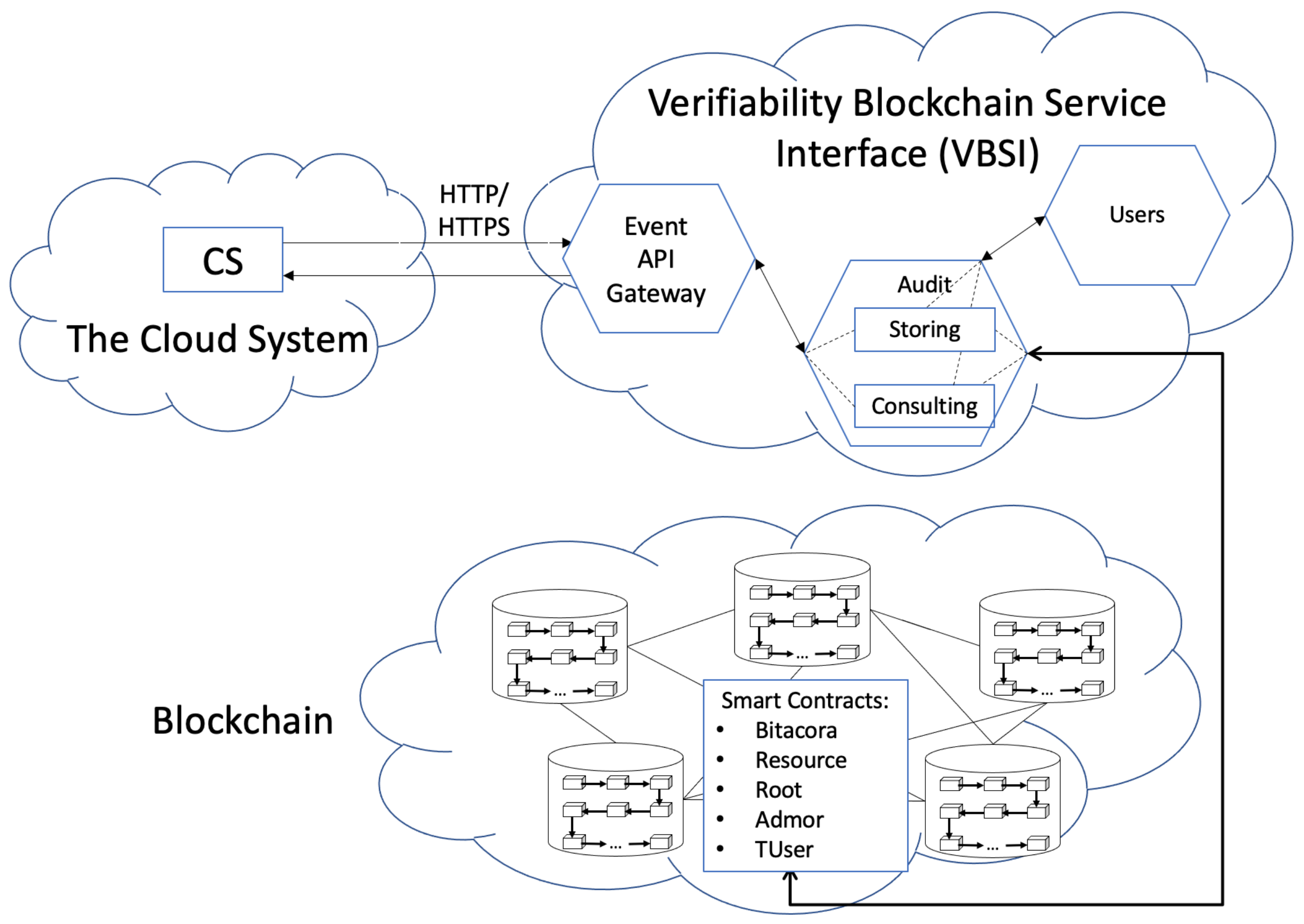
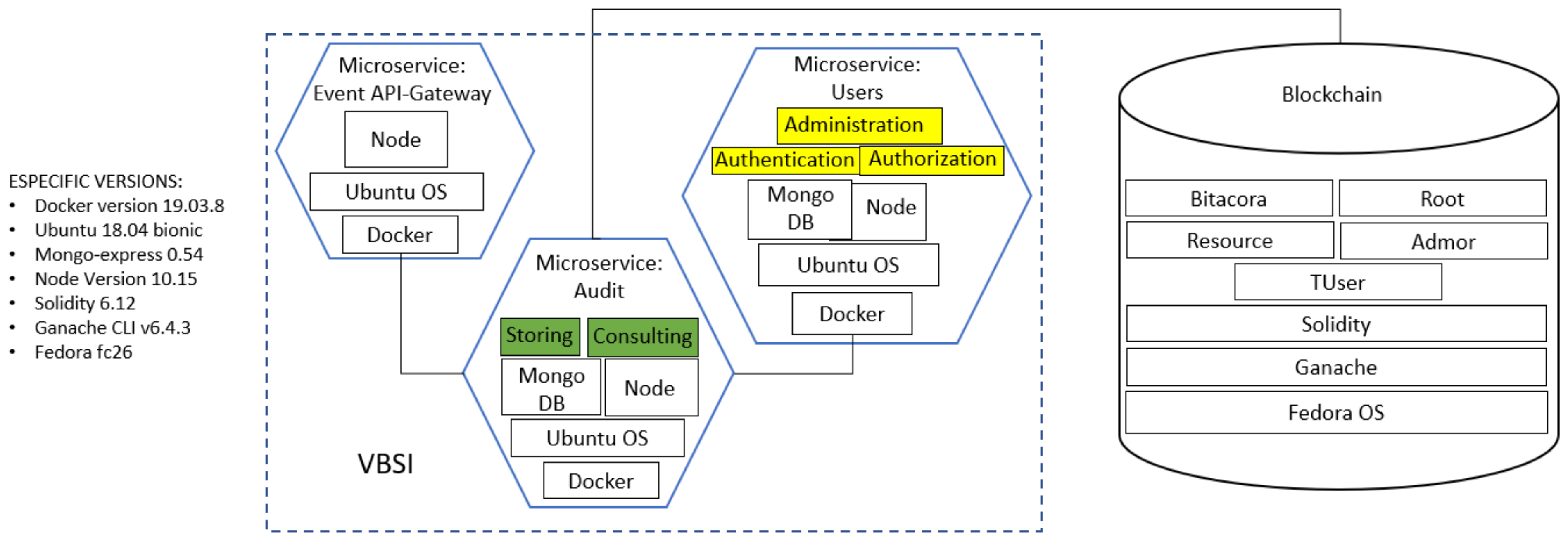
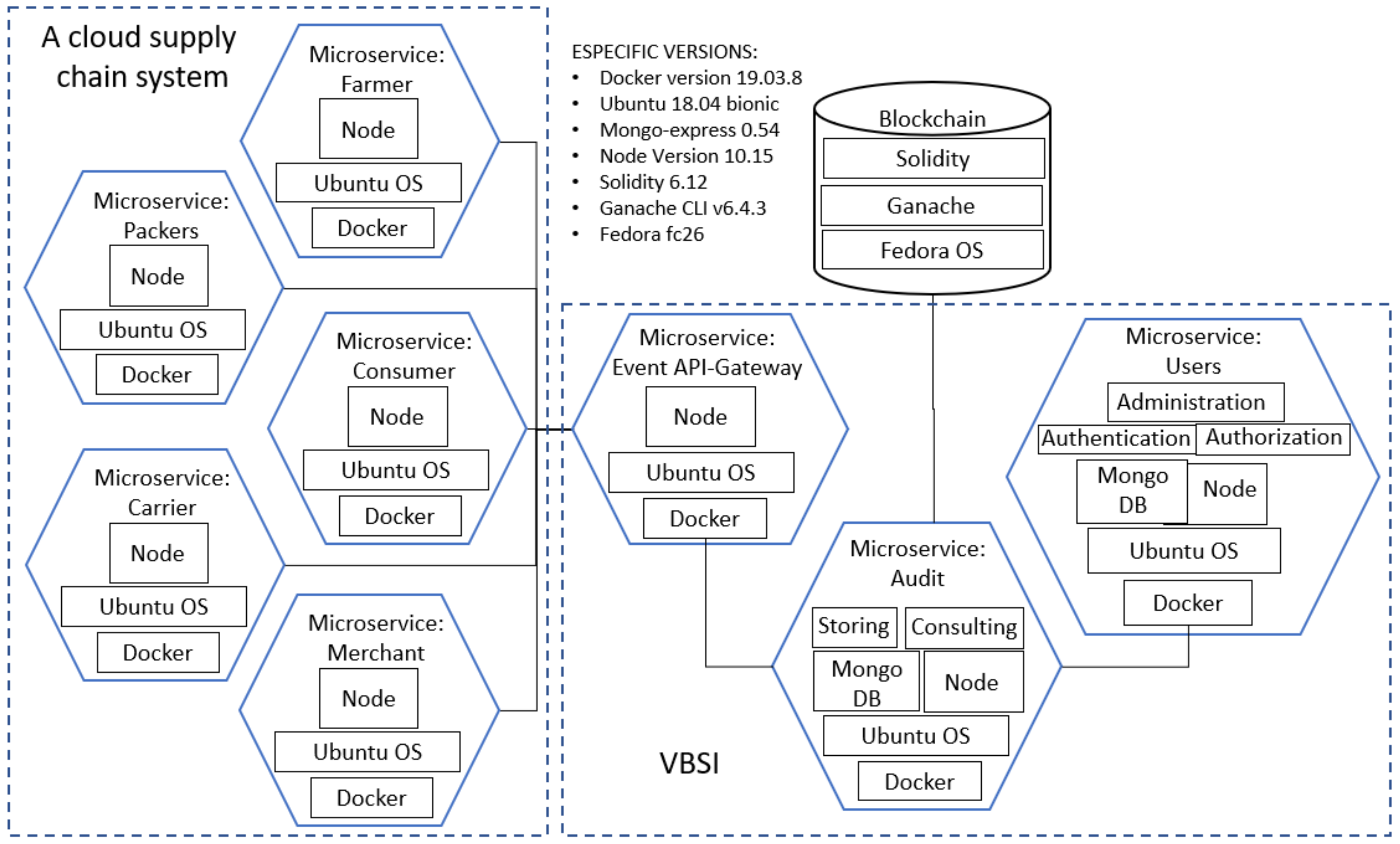
Figure 1 illustrates an outline of our model. The Cloud System, denoted as
, is illustrated in the left part of
Figure 1. CS must establish communication with The Verifiability Blockchain Service Interface, abbreviated as VBSI, for both to store each event that occurs internally within
and to provide reliability by means of a consulting process. VBSI is an intermediary between CS and the blockchain part. Blockchain acts as a software connector [
37], where all events are registered. The following subsections outline the general operability of these three parts:
, VBSI and the blockchain.
3.1. The Cloud System
From the final user perspective, cloud computing can be divided into two parts: the client and the server [
38]. The client part comprises the software used by the final user. The user does not have to install complex software to use services provided by the cloud; usually, a web browser, mobile application, or terminal are used. The server side has to do with the back-end, it is an abstract layer with the hardware and the connectivity; it means various computers, servers, and data storage.
On the other hand, according to Zhang et al. [
39], the cloud computing architecture consists of four layers: the hardware, the infrastructure, the platform, and the application. The hardware layer, typically implemented in data centers, manages the physical resources such as servers, routers, switches, power, cooling systems, etc. The infrastructure layer shares physical resources using virtual technologies, such as VMware, XEN, and KVM. The platform layer consists of operating systems and application frameworks. The application is the highest layer consisting of the cloud applications; it is the view of the final user.
In the case of our model, we locate The Cloud System in the platform layer according to cloud computing architecture of Zhang et al. [
39]. The Cloud System will establish communication with VBSI using the TCP/IP protocol. In particular, it will be over the hypertext transfer protocol (HTTP) [
40], and its secure version HTTPS [
41]. The methods that The Cloud System will be requesting to VBSI will be GET, POST, PUT and DELETE.
3.2. Microservices of VBSI
Considering that our model might be implemented as an extension in systems requiring audit data characteristics, we designed it following a software scheme as a service using a microservice architecture. This architecture was introduced as a new alternative, reference [
42], over the monolithic approach. Microservices were developed as small, well-defined purposes, and autonomous services, deployed independently [
23,
43]. Currently, organizations tend to upload their services to the cloud, and this architecture is usually recommended.
Figure 1 illustrates three general microservices:
Event API-Gateway,
Audit and
Users, as illustrated at the top-right of
Figure 1. VBSI is the interface of our model, dedicated to interacting with The Cloud System.
sends HTTP (respectively HTTPS) request methods to trigger events. These events are received by the
Event API-Gateway, which assorts the events and resends to one of the following types of services: (a) Storing data (it involves submitting, updating, or deleting information) in a hashed way; or (b) Consulting information for audit issues. Any of these services must check the suited permissions with the
Users service. The answer sent to The Cloud System depends on the processed operation in the blockchain. Details of the global mechanism of VBSI will be explained in
Section 4.
3.3. Participants as Smart Contracts
The
blockchain part stores events in order to validate the information stored in the The Cloud System. Our proposal of including blockchain as a verification procedure coincides with [
35,
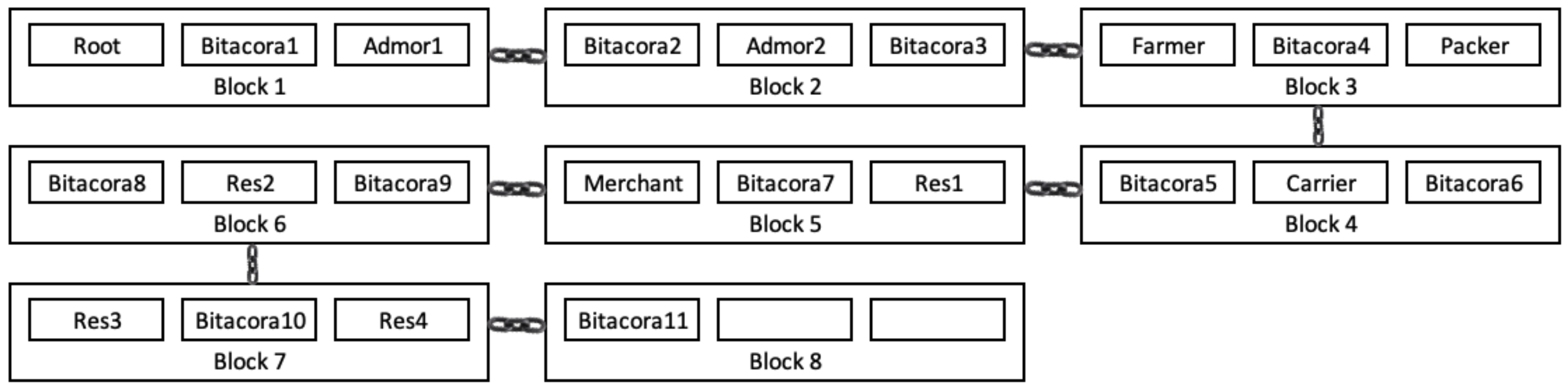
44]. Each event in the system is marshaled in hashing data to be stored by smart contract named Bitacora.
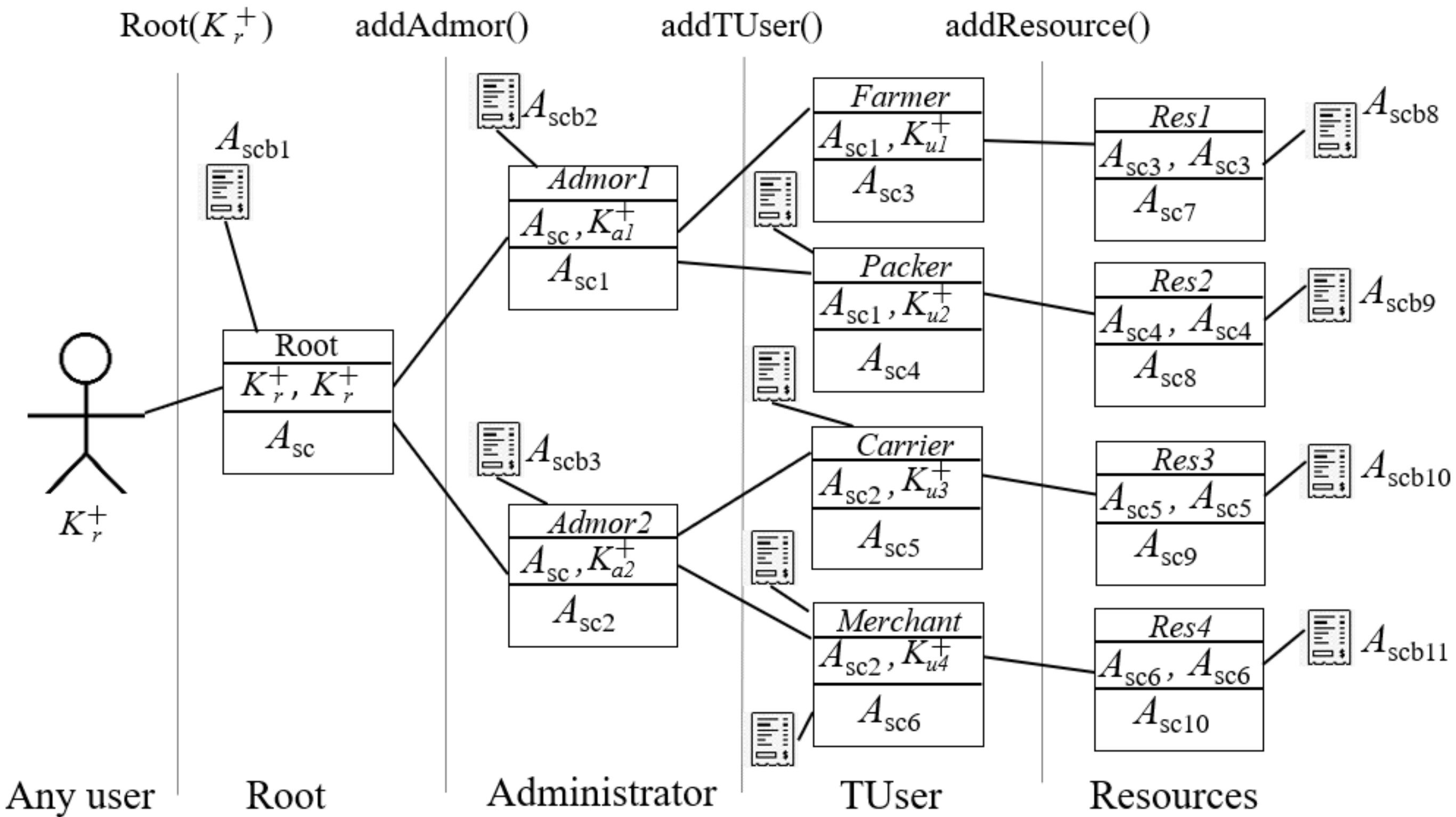
To execute, this smart contract is required to be called by a specific type of user. We created three types of users (root, administrator and transaction users), these type of users are represented in the blockchain as smart contracts. The general overview is as follows:
Root: It is a crucial role, which is formed at the time that the system is initiated. Our model trusts in the root, and a smart contract Root is created the first time when the architecture is started. Hence, all subsequent operations are chained to this contract. The creation of the root is carried out following [
36].
Administrator: It is created by the root. An independent smart contract is created for each administrator. In our model, the administrator can add TUsers.
TUser: When an administrator adds a new user, creates a TUser smart contract, and also generates a Resource smart contract. TUser is a transactional user who can store hash data in the blockchain through a smart contract called Resource.
Details of the global mechanism of the smart contracts will be explained in
Section 5.
4. The Verifiability Blockchain Service Interface (VBSI)
VBSI interacts with two external entities: The Cloud System and the blockchain. The interaction with The Cloud System is performed through the Event API-Gateway, while the interaction with the blockchain is carried out by the Audit microservice. Internally, all operations must be "permissioned" by a microservice, so-called Users. In the following sub-sections, we will explain them in detail.
Table 1 gives a general abstract of some notations and abbreviations that can be found throughout the paper. The last column pinpoints the reference formula where it can be found.
4.1. Event API-Gateway
This follows the API-Gateway architecture of Gadge et al. [
45]. The Event API-Gateway is the main controller of the backend. The Event API-Gateway is a server that is the single entry point into the system. It receives events requested by The Cloud System and emits a comeback answer. Such events are denoted as
and involve the following CRUD (Create, Read, Update and Delete) operations. These operations are HTTP methods (POST, GET, PUT and DELETE, respectively). It means that an
is a polymorphic function, hence, it could refer to any of the following forms:
Table 2 represents how the Event API-Gateway receives an HTTP (HTTPS, respectively) request method, and it specifies what is the corresponding interface played in the Audit service. For example, if a Create operation is requested, it is carried out using a POST method, then Storing interface is executed, meaning that a new operation is requested. In case an Update or Delete operation is requested, Audit service interprets it as an Update operation since no element is deleted.
The Event API-Gateway communicates internally with Audit and Users and can also communicate externally with other microservices through another API-Gateway or cloud services directly.
The Event API-Gateway encapsulates the internal system architecture and provides an API that is tailored to each client. One of its responsibilities is to identify the following services: user administration, user authentication, user authorization, audit-storing, and audit-consulting. Other responsibilities are monitoring, load balancing, and caching.
4.2. Audit: Storing
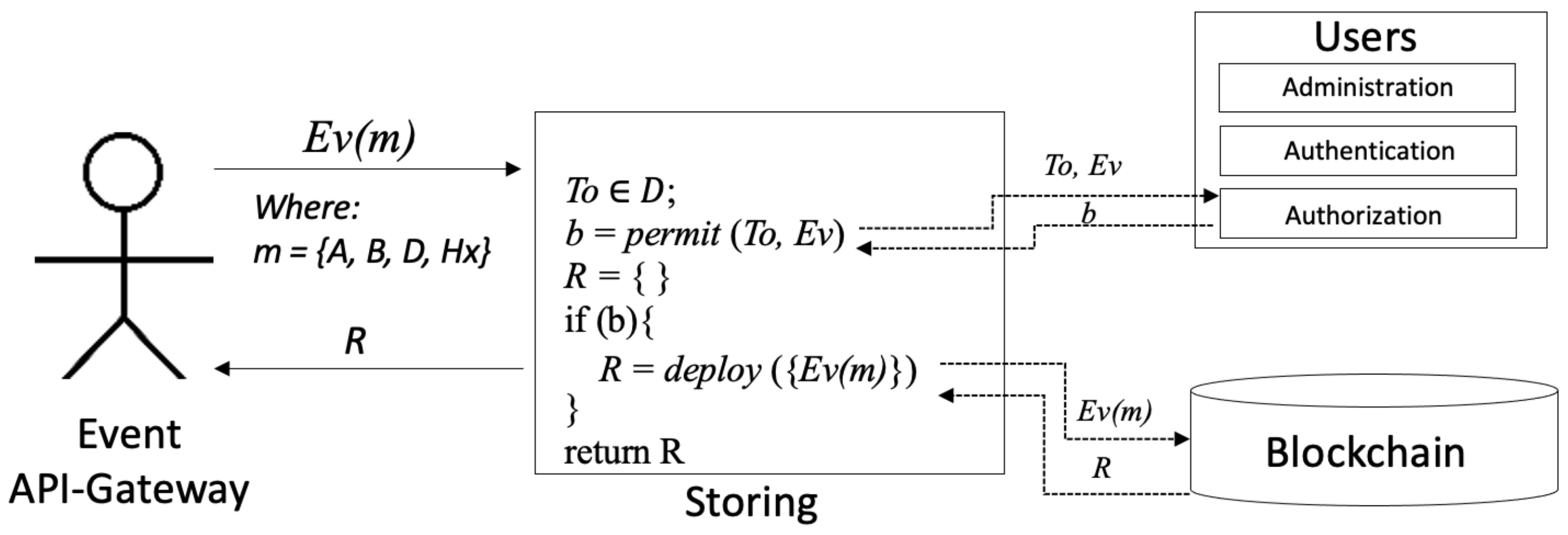
Figure 2 illustrates the process of receiving an event and data storing in the blockchain. Let us assume that the Event API-Gateway receives an event
with message
to be stored within VBSI. The message is composed of:
denotes who is sending the message;
who is the receiver;
a set of data required to be stored in the blockchain; and
is a hashed of the previous messages, as follows:
Token
(
Section 4.4 for more details) is obtained from
:
Figure 2.
Storing operation, illustrating communication between Event API-Gateway, Storing, Users-Authorization service and the blockchain.
Figure 2.
Storing operation, illustrating communication between Event API-Gateway, Storing, Users-Authorization service and the blockchain.
Storing service involves the following off-chain operations:
Verify with the Users-Authorization service if has enough permissions to execute event , using Boolean function . Returning true if it has privileges to store the event in the blockchain; otherwise, it returns false.
Send the event to the blockchain, using function . Returning , which is a tuple (calculated in the blockchain) of three elements, : (a) the token; (b) a transaction address and (c) a smart contract address.
Storing service can work under two scenarios: (a) Creating users; or (b) Executing operations over resources. Both will be explained in detail in
Section 4.4.
4.3. Audit: Consulting
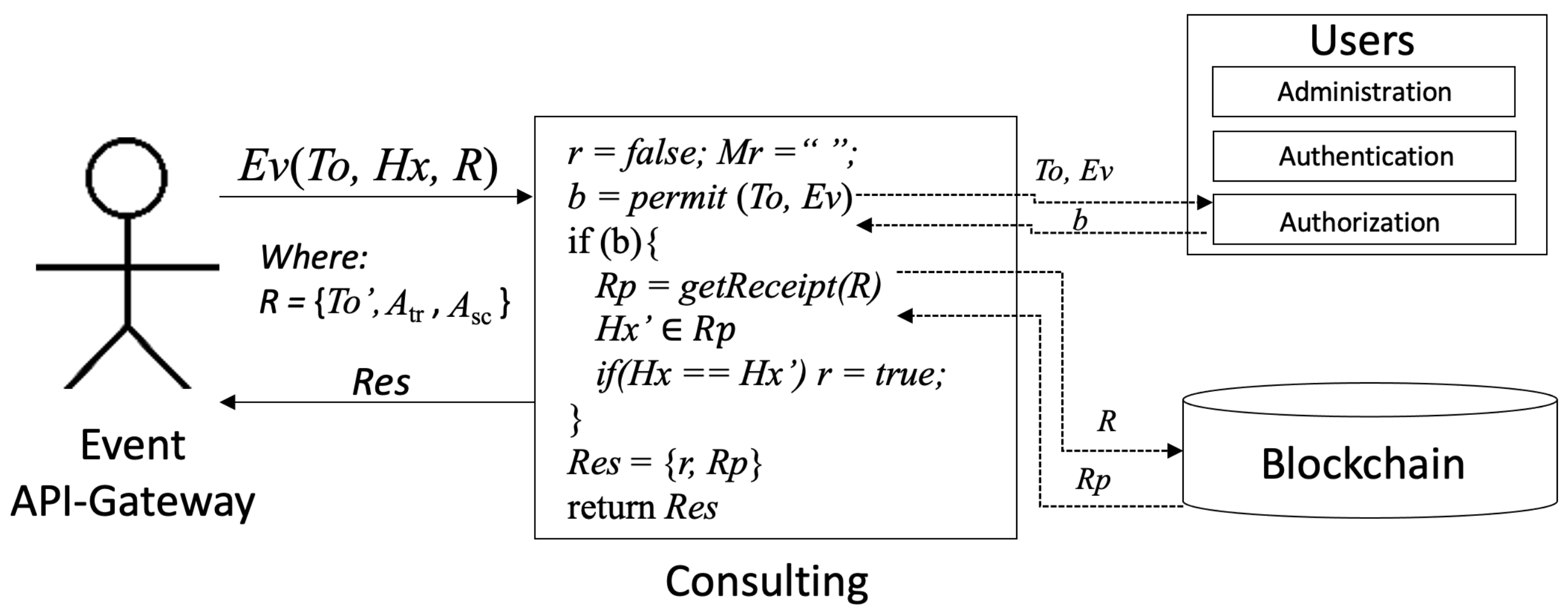
In order to consult information, Audit has another service,
consulting, see
Figure 3. Let us assume that the Event API-Gateway receives an event
to consult a data that previously was stored within VBSI. There,
is provided by the authorization service; and
In this case,
is the receipt received when the storing action was carried out (it is the same as explained in
Section 4.2); note that
was the token id approved in the transaction
for the smart contract address
.
Consulting service involves the following off-chain operations:
Verify with the authorization service that
has enough permissions to execute
; it is used with
function, which is detailed in Equation (
9).
If
b is true, then it calls to the following remote function:
There, states for the receipt details consulted with the blockchain and is the hashed information previously stored within the blockchain.
Then, it is compared with , if they are the same, r variable is changed to .
A tuple
is returned, where:
can be one of two options according to the previous steps: (a) and the detailed receipt when integrity is noted; otherwise, (b) it returns and an empty receipt.
4.4. Users
As one can see in
Figure 1, the
Users microservice has direct communication with the
Audit microservice and the event API gateway. It means that
Audit or the Event API-Gateway must verify with
Users whether or not the requests received can be executed or not. This service acts as an access control service management. Although an alternative solution could be to consume an external system (e.g., software as a service, SaaS) provided by trusted third parties, as some proposed in the literature [
46,
47]; we preferred developing our solution to take better control of the logs.
Following some proposals in the literature about how to deal with access control management systems [
48,
49,
50],
Users microservices provide the following services: administration, authentication, and authorization.
Table 3 illustrates all operations. The input column specifies the parameters received, whereas the output column, the answer. Column
storing pinpoints if the service deserves (
√)
audit:storing operation in the blockchain; however, according to the user’s convenience, it could be modified. For example, each time a request involves an authentication process, we configured that functions
and
must register a storing operation (
√) in the blockchain. However, any other implementation could lighten it up and omit it, arguing that it is unnecessary.
4.4.1. Administration
It provides the four CRUD operations: creation, read, update, and delete. When a request is received to create a user, function
is processed. Where:
Let
be credentials related with personal information of the user to be created, such as
username,
email, and a hashed
password;
be the type of user to be created;
be the public key of the user;
is the value required to execute the transaction in the blockchain;
be a set of permissions that the user will be granted expressed in
JSON format (
Section 4.4.3 explains more about the permissions); and
be the hashed of the previous messages. When a user is created, it also requires to create its smart contract, calling a
storing operation (see
Section 4.2), receiving
and it is returned also.
When update and delete are requested ( and respectively), it is assumed that each user has its own smart contract, as it was previously created. These operations require generating new transactions over the existing smart contract, returning a new answer of the blockchain . These operations internally call for the storing service.
Our model follows the idea of [
51], which is designed with three general types of users:
Root,
Administrators and
TUsers. The following conditions are followed to build a tree structure:
The system must have only one root, it follows the idea of [
36].
A public key must be used for only one type of user (validated via off-chain).
The root user can create administrators (validated via off-chain and blockchain).
Administrators can create other administrators and TUsers (validated via off-chain and blockchain).
When a TUser is created, also a Resource smart contract is created (instruction sent via off-chain to the blockchain).
4.4.2. Authentication
This service provides three operations:
; this function receives the user’s credentials, type of user and type of event. Returning a token as a result;
; this function receives a token and returns an updated token. This function is used when a token is about to expire.
; this function receives a token and evaluates if the token is valid or not, returning a Boolean result.
4.4.3. Authorization
This service provides two main operations (
9) and (
10):
This function receives a token, an event, and a resource. The function verifies if the token
supplied previously to some type of user has permissions to execute event
on resource
. The following is an
example in JSON format:
          {
            "resource":       "RootCreation",
            "event":          "POST",
            "permitAccessTo": {
               "Root": "true",
               "Administrator": "false",
               "TUser": "false"
              },
            "description":    "Root is the user permitted to create a root"
          }
This resource is called RootCreation, whose event POST is permitted only by the root user; the other users are not permitted; a description is also included.
On the other hand, the following function:
receives a token and returns a
JSON format
pinpointing a set of permissions that a user, linked with the token, has available to execute. The following is a permission example
:
          {
            "stage": "users",
            "serviceName": "hasAccess",
            "typeOfOperation": "delete",
            "nameOfOperation": "deleteMe",
            "permitAccessTo": {
               "Root": "true",
               "Administrator": "true",
               "TUser": "true",
               "NameType": "Consumer"
            },
            "description": "Delete personal data"
         }
which, it is a transaction user with type named “Consumer” can delete its own personal information; the types of users root and administrator have the same privileges.
5. The Smart Contracts
Trust in data integrity is one of the primary concerns in computer systems. To remove that worry, we will register all events in a trustworthy architecture, such as blockchain. We consider that events are triggered by different types of users. These users will store events through smart contracts.
We established some particular user roles to limit the operations that each user can execute within the blockchain: Root, Administrator, and a Transaction User (TUser for shorter). TUsers are a generalization of more specialized transactional users. We designed these roles, such as smart contracts.
Our model establishes that any event generated by one of the role users must be registered in a Bitacora and the transactional users have Resources and any action or event over the resources must be registered in their own Bitacora.
5.1. Notation
The notation to be used to represent smart contracts will be similar to classes in object-oriented languages. A smart contract is composed of attributes and methods, which can be public (+) or private (−); prefix (*) denotes an attribute internally calculated. To provide encapsulation, all private attributes can be accessed using the corresponding getter method get[Attribute](); for example, let X be an attribute, its corresponding getter method would be getX().
A contract also has a constructor, which is a method that uses the same name as the contract and is used to create the contract.
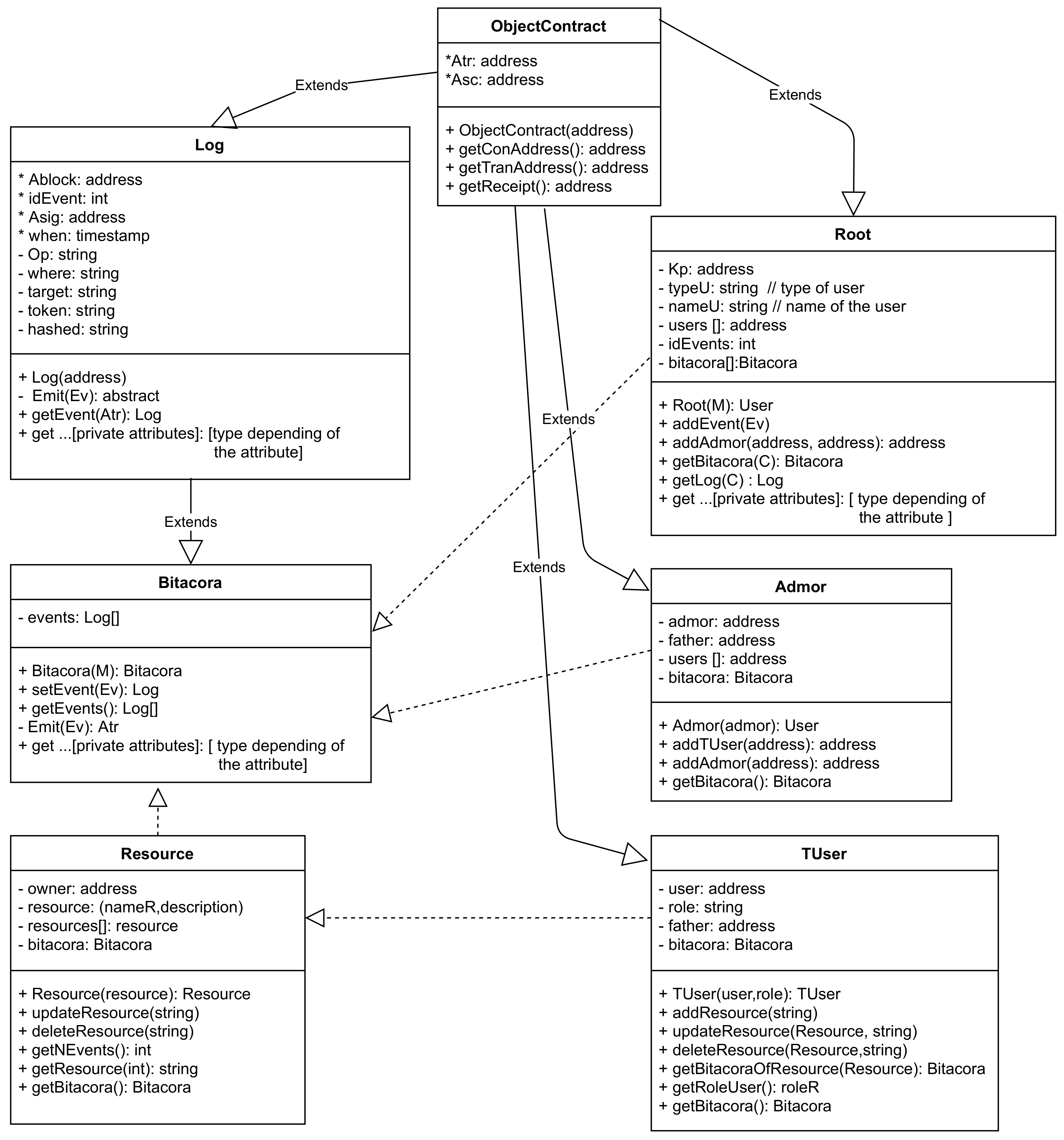
Figure 4 illustrates the smart contracts as class diagrams. Private methods can only be called within the contract, as long as public methods are still accessible from other contracts. Abstract methods are not implemented in such a contract. If a smart contract includes at least one abstract method, such a contract is also considered abstract and can only be deployed when abstract methods are implemented. The figure also illustrates some relations of a contract with others, for example: inheritance (
extends arrow); and use dependency (dotted arrow).
5.2. Objectcontract, Log, Bitacora and Root
The base model of the contracts
Objectcontract,
Log,
Bitacora and
Root were taken from [
36], here were used to engage with smart contracts
Admor,
TUser and
Resource as illustrated in
Figure 4.
The explanation is as follows:
ObjectContract denotes the parent of all contracts. It contains two attributes: contract address and transaction address . When a contract is created, these attributes are generated and can be accessed publicly by methods and , respectively. Method is used to obtain the receipt of a transaction. Contract address is used to identify the contract in the blockchain and the transaction address to identify the event.
Log inherits from
ObjectContract, you can see a description of the attributes in
Table 4. All of such attributes are stored in the blockchain when method
is called. Attributes marked with ∗ are auto-generated within the smart contract; the rest are obtained from
.
is an abstract method, which must be implemented in a specialized smart contract, such as
Bitacora. A particular log event can be obtained using
.
Bitacora inherits all attributes and methods of smart contract Log. Events are registered in this smart contract. The constructor is created when it is called the first time, from , data are extracted to form , and it calls , which is a private method, inherited from Log. This method stores in the Log. is another method, which can add events with information by calling to be stored in the Log. All log events can be obtained using method .
Root smart contract is created executing constructor The constructor creates its Bitacora and the first Log. Let be a user wanting to become a root; be a receiver user or target; be a token identifier to identify the transaction; and is composed of two set of messages and . is formed by , where is the user public key, which will be the owner of the contract, and the key address will be used to execute the next transactions; represents the cost necessary to perform transactions; credentials is related with root’s secret information, such as username, email, and a hashed password. With is possible to store extra information of the root.
As a result of executing constructor
, it is generated a blockchain transaction answer
, see Formula (
5) for more details about
.
Smart contract can add events, using method addEvent(Ev). This method calls of smart contract Bitacora. This transaction generates another transaction, ; however, the smart contract address is still the same since this method does not create a new smart contract.
In order to consult a Bitacora and a specific log, smart contract contains methods and respectively. Being the answer to the root after triggering an event.
Some modifications were carried out within the smart contract of the Root. We added method , which the Root can add administrators and to store in its private attribute called . requires to specify the smart contract key of the creator (in this case the smart contract of the root in the first parameter) and the key address of the new administrator.
5.3. Admor, TUser and Resource
Admor is an abbreviation of Administrator. An administrator is a special type of user that can add TUser’s (); add other administrators (, specifying the smart contract key of the creator and the key address of the new administrator); and obtain its Bitacora ().
TUser is an abbreviation of transactional user. In our model TUser is the operative type of user of a system able to execute CRUD transactions over some specified module or resource. Neither root nor administrators can deal with resources directly. Thus, tasks related to resources have to do with TUsers.
TUser is a generalization type of user, when created (in its constructor ) is required to pass: the specific role that it will be playing, which can be recovered via ; and an address key of the user. TUser can create, update, and delete resources by executing methods , , respectively. TUsers can also obtain their own Bitacora and the Bitacora of its Resource .
On the other hand, smart contract
Resource is only created by a
TUser, being its owner, and can only be accessed by it. When a resource is created (constructor
), an
owner is assigned, in this case, the smart contract of the
TUser accomplishes this role. The owner of the resource must be the only one that can update it or/and delete it, using its respective methods, see
Figure 4.
8. Validation and Proofs
This section provides some validations to our prototype and the case study to give certainty about its viability. They consist in setting two types of agents: friendly and unfriendly. Both types of agents, acting their corresponding roles, attempt to execute transactions. Each of the executed transactions must be registered within the blockchain and must generate a log.
We explain the behavior of the agents, some results about their implementations; a data integrity verifiability example interface; and the system complexity by stating a run showing the latency and processing time of the system.
8.1. Friendly and Unfriendly Agents
Friendly agents consist of a set of compliant agents following the rules of expected behavior. This type of agent aims to identify programming errors under normal situations. These situations mean that if a request contains
n fields, and each field is configured with a specific type, then friendly agents send
n fields without changing the types. On the other hand, unfriendly agents are non-compliant. They do not follow the rules, can change types, and change an unexpected behavior.
Table 6 describes the behavior of the unfriendly agents.
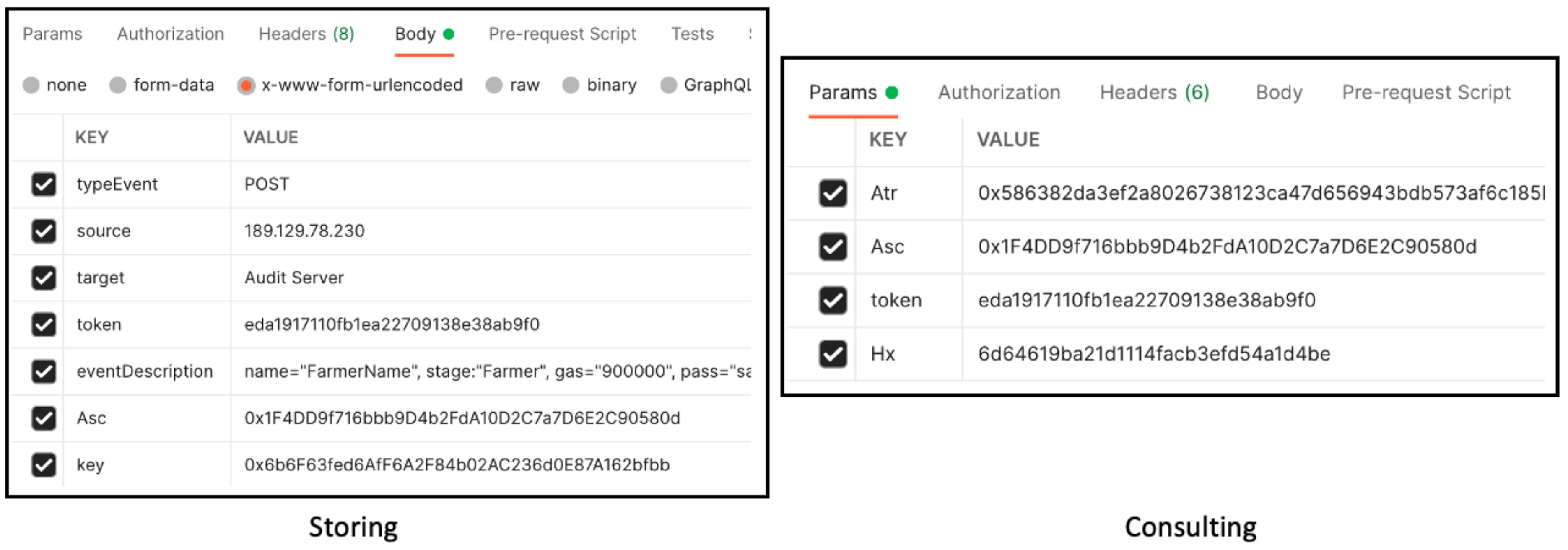
Currently, there exist tools that can help with the software development process as a tester in the requests, e.g., the Postman application, which we also used. However, to implement the behavior of
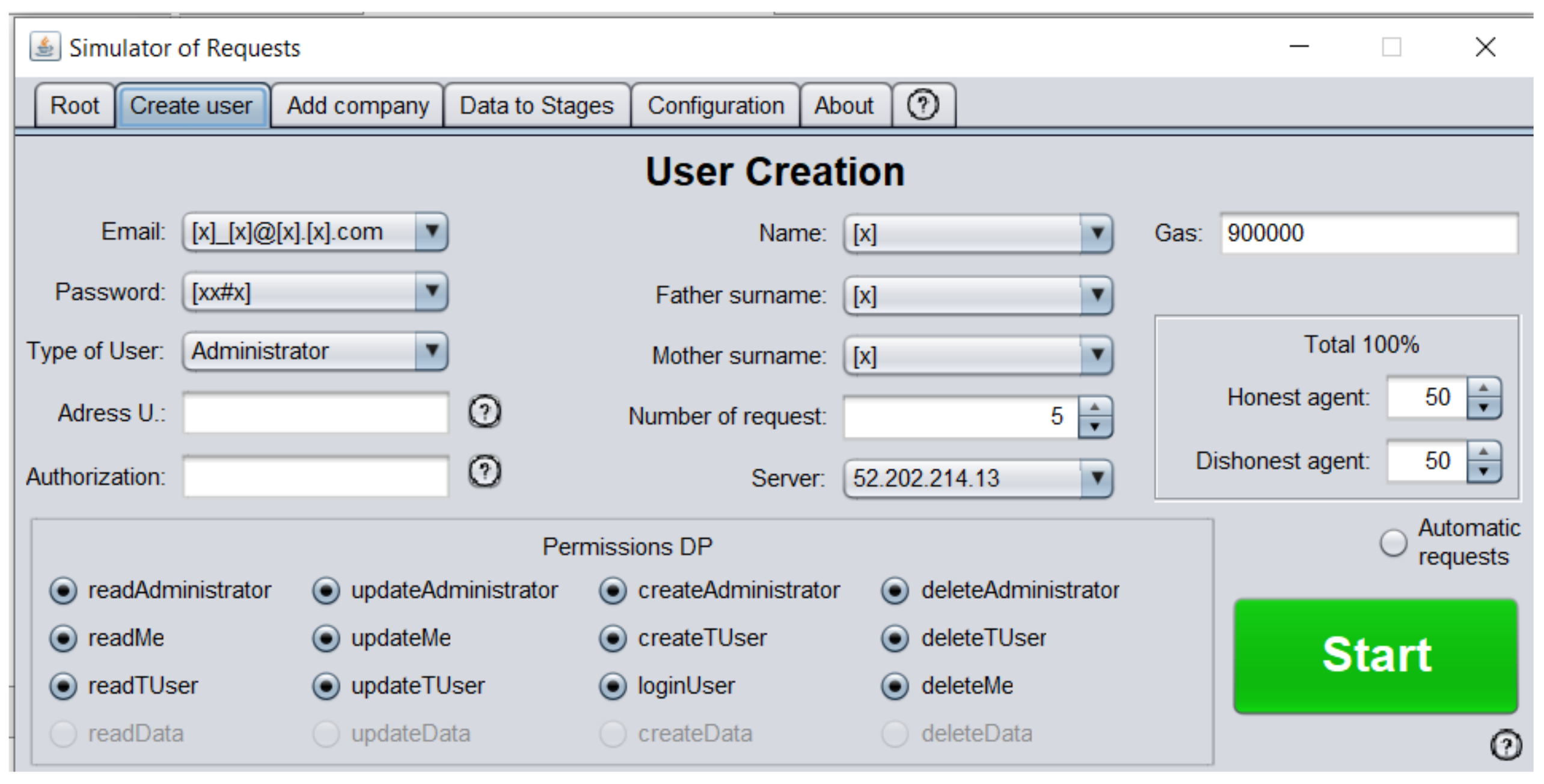
Table 6, was necessary to develop a tool with Java threads using an interface as shown in
Figure 11. At the top of the figure can be seen some
Resources of the first column of
Table 6, among other things. Each tab of the figure was configured to execute automatic or manual requests. The number of requests must be input and the amount of friendly and unfriendly agents (honest or dishonest in the figure). Depending on the number
N of agents, internally, the simulator creates
N threads acting the corresponding role of the agents. Each friendly request must send the data as you can see in the input fields of the figure; note that some fields are required to be introduced manually, and others follow a regular expression to calculate random and automatic data fields.
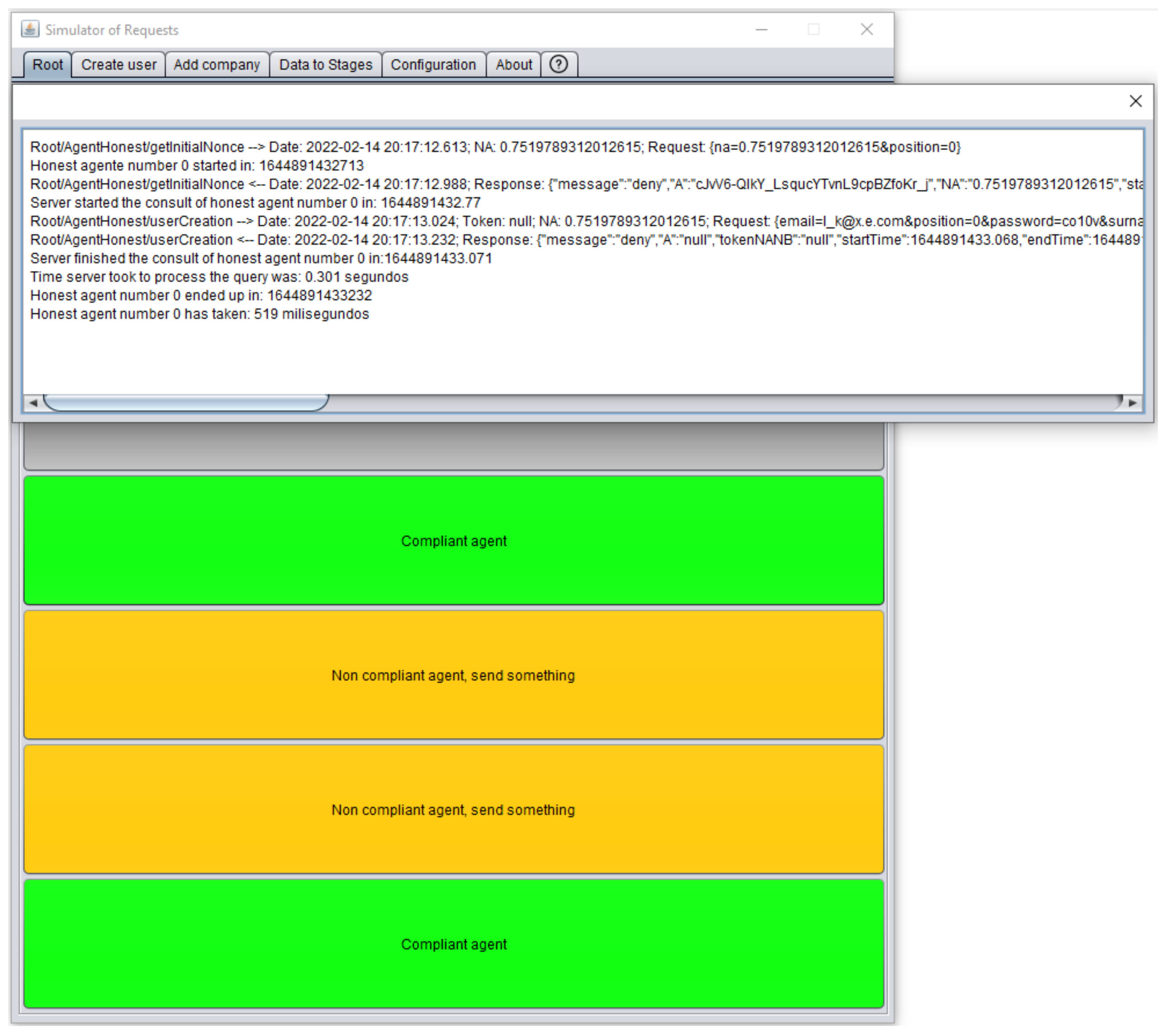
At the end of each run, the system generates a detailed description as you can see in
Figure 12. A version of the tool can be downloaded from GitHub:
https://git.io/JDtin, accessed on 4 February 2022.
We executed multiple stress proofs with this customized application and configured a malicious scenario. The following list describes the aspects of this tool and the prototype, which helped in the design of our proposal:
Programming: we corrected some programming errors. It involved fixing from simple validations during the development process until more complex troubles, such as distributed and concurrent programming that sometimes are very difficult to detect.
Adjustment to the smart contracts: although our smart contracts are illustrated as class diagrams to give a general representation, they were implemented on solidity programming language.
Adjustment to the architecture: developing the prototype and the tester tool was more clear to make some adjustments to the proposed architecture.
8.2. A Data Integrity Verifiability Example Interface
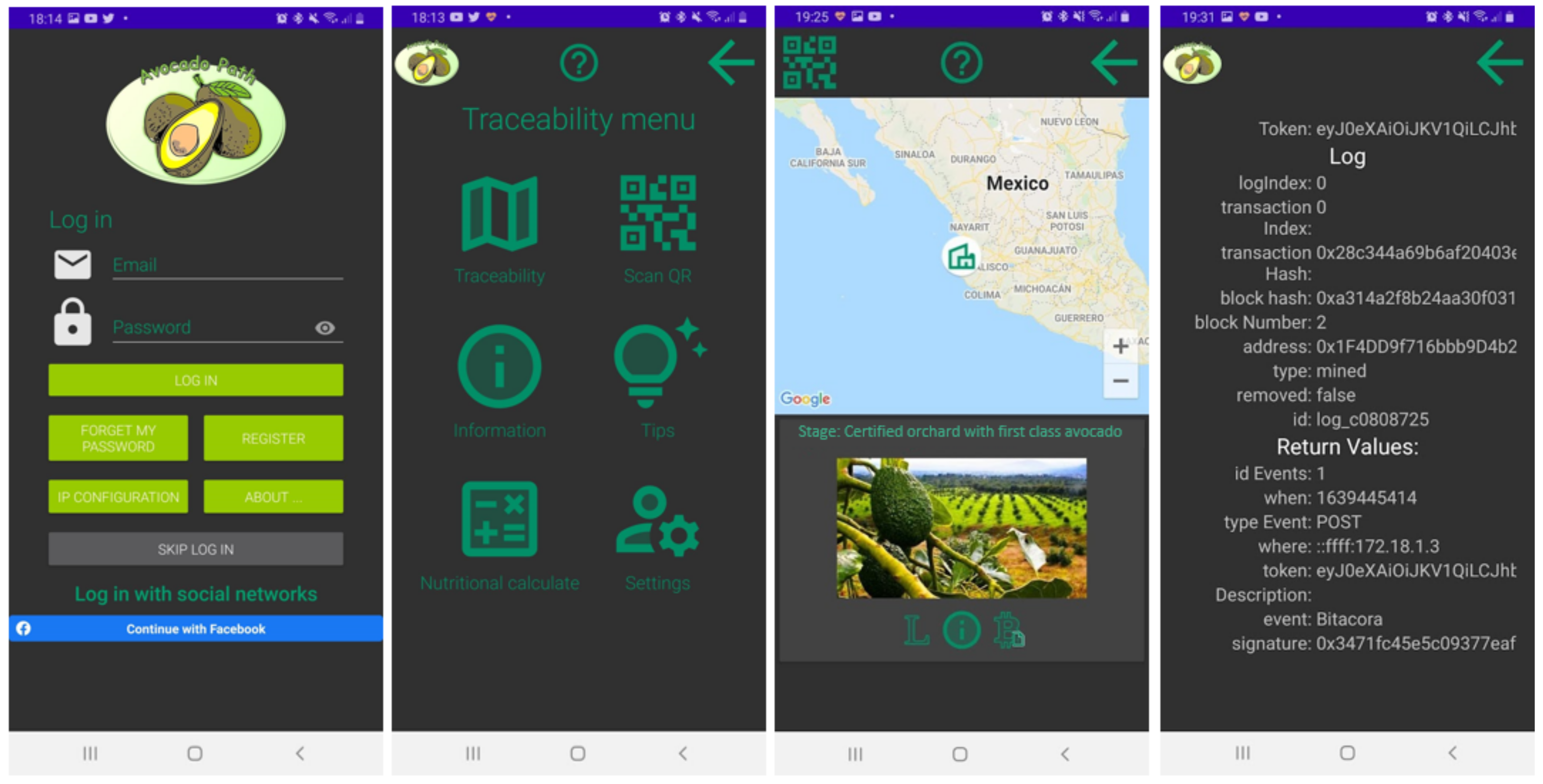
Figure 13 shows the outstanding interfaces from a mobile application we developed to verify the integrity of data previously stored within a blockchain. The figure contains four images, from left to right: (1) Login interface: where the user might sign in by a previous register or by social networks; (2) A menu option with the possibility to scan QR codes to see the traceability of the avocado supply chain that the user wants to buy; (3) The traceability interface with a specific location in Google maps, and options such as stage details forward and backward arrow navigation, among others; and (4) The evidence log taken from the blockchain illustrates the interface that the final user can see to verify the details stored in the blockchain, otherwise, such details would not be shown.
8.3. System Complexity
We carried out some tests with respect to the amount of resources required to run the storing and consulting services. The tests were latency and processing time. Latency is the time any supply chain microservice takes to reach its destination and return, taking into account an HTTP request. The processing time is the time in milliseconds (ms) that the API Gateway takes to execute a request since it arrives until it is processed and returned to the requester.
Table 7 shows some details of one of the runs. The first column states the stage of the cloud supply chain microservice from where the request was established. The following three columns state the transaction latency (
Start,
End) that the request takes (
Time) to reach its destination and return to the microservice. The fifth column pinpoints the HTTP method executed (POST, PUT, DELETE, or GET). The next three columns state the processing time within the Event API-Server. The last column is a brief description about the type of request. Note that
Start and
End columns are expressed in epoch Linux time, and column
Time is expressed in milliseconds, being it the difference between
End and
Start.
We can analyze that methods POST, PUT, and DELETE, which correspond to storing information within the blockchain, are very similar and took 6646 ms latency on average, respectively, a 1768 ms processing time. On the other hand, consulting information took 2516 ms latency on average, respectively 979 ms in processing time. These statistics could oscillate using another blockchain platform. The average transmission rate from the microservices was a 1.91 Mbps upload and 29.78 Mbps download.
9. Discussion and Conclusions
The work presented in this article is closely related with [
35,
36]; in this section, firstly, we discuss the main differences with our work, highlighting the extensions and our main contributions, then we give the conclusions.
9.1. Discussion
Table 8 shows, with a ✓, the main characteristics supported in the works [
35,
36] and our proposal model. We coincide in both works in prevailing characteristics of data integrity, blockchain technology, auditing and traceability services, and implementing the microservice architecture. However, reference [
35] focuses exclusively to supply chain systems resulting in very bounded implementations, so, in this work, we decide to include a more generalized solution for cloud systems. In contrast with [
35], our proposal starts with the security suggestion of [
36] concerning the auditing mechanism from when a Root user is created in a decentralized environment.
On the other hand, we propose a decentralized architecture that extends both works [
35,
36], presenting a general solution for cloud computing services; and considering the creation of several types of users and roles; respectively, making scalable and modular the audit mechanism proposed. Thus, we can integrate more services through smart contracts (as shown in
Figure 4) and traceability with the processing time and latency shown in
Section 8.3. A critical remark is that we can provide information by consulting the log stored in the blockchain provided by the smart contracts about
how an event was generated,
who generated it,
what included the event,
where was it generated, and
when was the event generated.
9.2. Conclusions
Organizations tend to move their information systems to the cloud. Increasingly, one of the questions from users is about the integrity of storing data. Thus, providing data integrity is an essential activity that adds value to organizations. If this activity is provided using the appropriate technologies, it generates more value.
In this paper, we described a data integrity verifiability architecture comprised of the following:
- (a)
An event API-gateway able to receive HTTP requests and to decide if it is addressed to an administrative user, for storing hashed data, or for consulting (audit) issues;
- (b)
An administrative user service, able to register different types of users, authentication service able to provide tokens and authorization service, able to decide the permissiveness of the requester;
- (c)
A storing service that saves hashed messages that later will be used as an audit process; and
- (d)
A consulting mechanism that provides certainty about the integrity of previously stored data.
We described each of the components, and to give a better idea about implementations details, we supplied a prototype description. We also developed a pair of tools to validate our proposal, consisting of a tester tool and a mobile application to be used for end-users. In addition, as shown in this research, a distributed system connected to a public blockchain induces high transaction times due to processing and, hence, a longer latency.
This architecture can be replicated in different applications that do not natively have blockchain technology built-in as an extension for those systems requiring modular and scalable audit characteristics. Our solution has been built using a microservice architecture because, currently, this approach is the tendency in the software development area.
This is an ongoing work, we are looking for performance statistics, and it has been implemented under the Ethereum platform. Still, it could be interesting to compare other platforms, for example, Hyperledger.



 ,
,