Article

Control Strategies for Gait Tele-Rehabilitation System Based on Parallel Robotics
1
Electrical Engineering Department, University of Brasilia, Brasilia 70910-900, Brazil
2
Department of Computer Aided Medical Procedures and Augmented Reality, Technische Universität München, 80333 München, Germany
3
Department of Physics, Catholic University of America, Washington, DC 20064, USA
4
NASA Goddard Space Flight Center, Greenbelt, MD 20771, USA
5
French Institute for Research in Computer Science and Automation (INRIA), 78150 Paris, France
6
Laboratory of Research in Biomechanics and Applied Robotics, Mechanical Engineering Department, Pontificia Universidad Católica del Perú (PUCP), Lima 15088, Peru
*
Author to whom correspondence should be addressed.
Current address: School of Information Technology and Electrical Engineering, The University of Queensland, Brisbane, QLD 4072, Australia.
Current address: Department of Robotics, Graduate School of Engineering, Tohoku University, Miyagi 980-8577, Japan.
Appl. Sci. 2021, 11(23), 11095; https://doi.org/10.3390/app112311095
Submission received: 22 October 2021 / Revised: 12 November 2021 / Accepted: 15 November 2021 / Published: 23 November 2021
(This article belongs to the Special Issue Tele-Rehabilitation Robotics)

Abstract

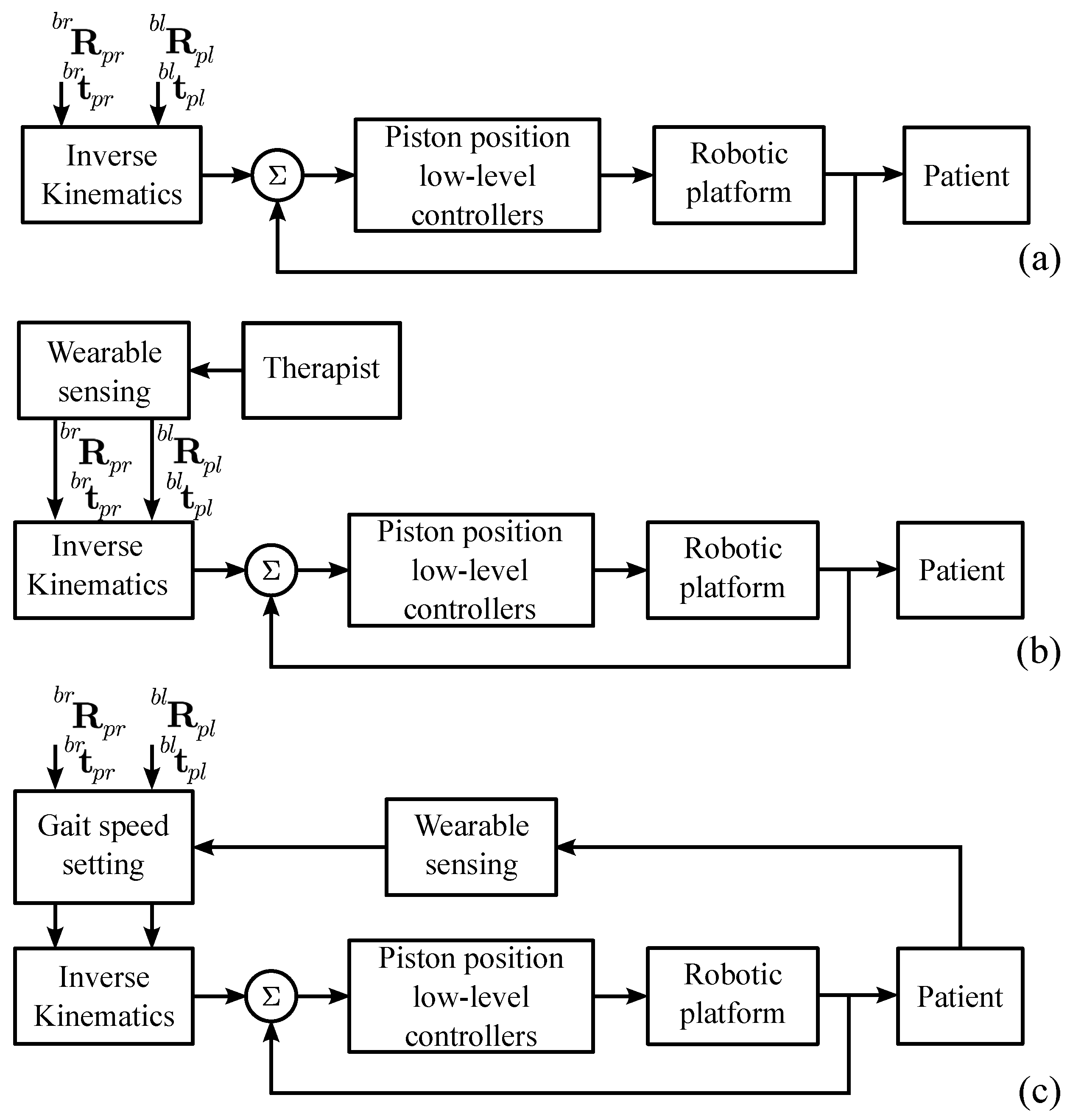
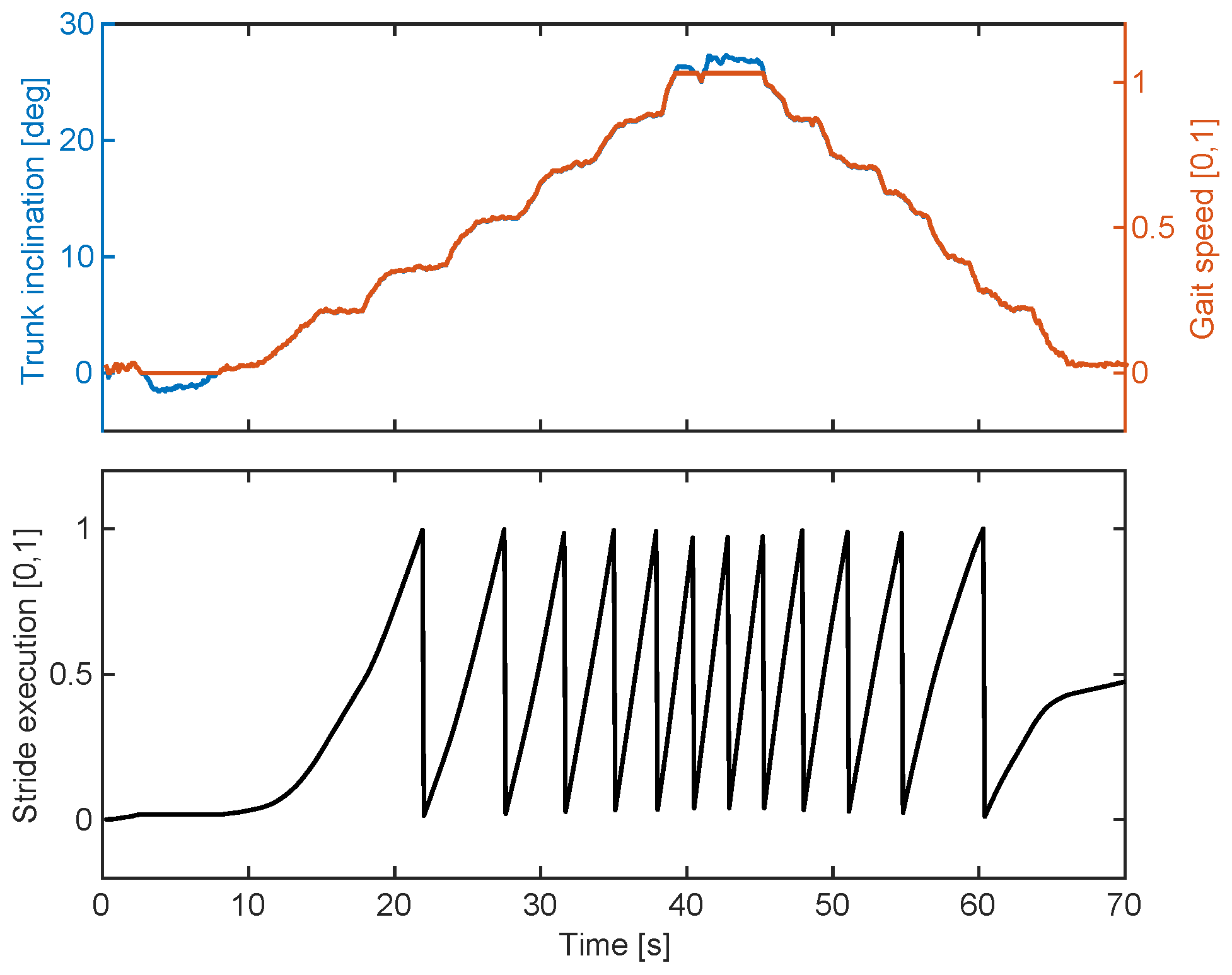
Among end-effector robots for lower limb rehabilitation, systems based on Stewart–Gough platforms enable independent movement of each foot in six degrees of freedom. Nevertheless, control strategies described in recent literature have not been able to fully explore the potential of such a mechatronic system. In this work, we propose two novel approaches for controlling a gait simulator based on Stewart–Gough platforms. The first strategy provides the therapist direct control of each platform using movement data measured by wearable sensors. The following scheme is designed to improve the level of engagement of the patient by enabling a limited degree of control based on trunk inclination. Both strategies are designed to facilitate future studies in tele-rehabilitation settings. Experimental results have illustrated the feasibility of both control interfaces, either in terms of system performance or user subjective evaluation. Technical capacity to deploy in tele-rehabilitation was also verified in this work.
Keywords: gait simulator; Stewart–Gough platforms; inertial sensing; tele-rehabilitation gait simulator; Stewart–Gough platforms; inertial sensing; tele-rehabilitation