Article

Biomechanical Analysis of Gait Compensation Strategies as a Result of Muscle Restriction
1
Department of Mechanical Systems Engineering, Mechano-Informatics and Systems, Nagoya University, Nagoya 464-8603, Japan
2
Department of Computer Sciences, Tokyo Metropolitan University, Hino, Tokyo 191-0065, Japan
*
Author to whom correspondence should be addressed.
Appl. Sci. 2021, 11(18), 8344; https://doi.org/10.3390/app11188344
Submission received: 28 July 2021 / Revised: 18 August 2021 / Accepted: 2 September 2021 / Published: 8 September 2021
(This article belongs to the Section Applied Biosciences and Bioengineering)

Abstract

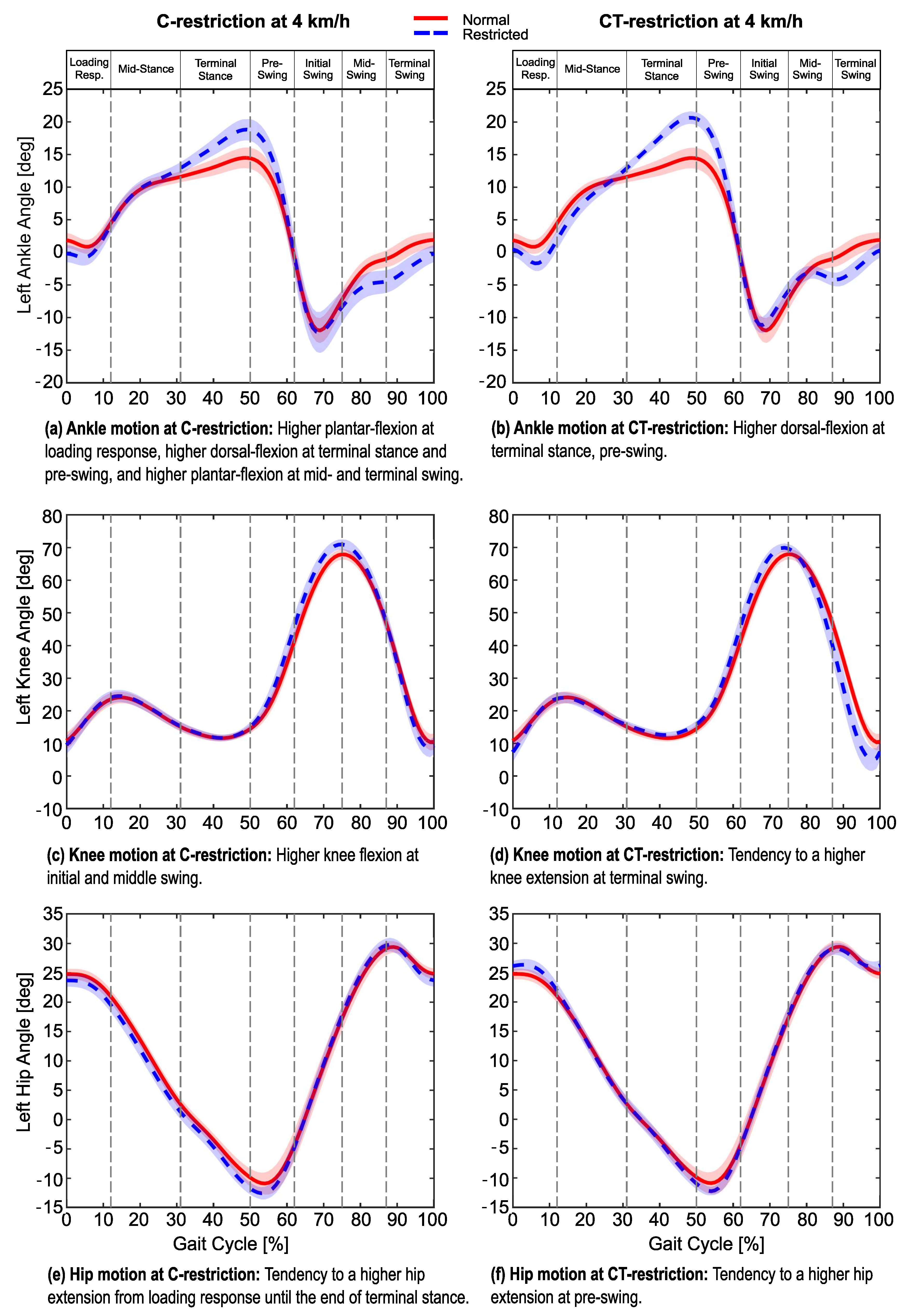
The loss of muscle mass with aging and consequent muscle weakness results in compensatory gait motions. Although these compensatory motions increase the cost of walking, they appear to be an attempt by the elderly to maintain safe ambulation. However, the relationship between the affected muscles and compensatory motions in the gait cycle is unclear. This study examined gait compensation in young subjects whose muscles were weakened with Muscle Activity Restriction Taping Technique, which restricts the muscle’s belly by tightening the lower limb(s). The study included different walking speeds (regular/slow) and restrictions (calf muscles/both calf and thigh muscles). It revealed that there was an active kinematic compensation chain, in which the non-restricted or less-restricted joints compensated for the affected joint to prevent foot drop, knee hyperextension in the terminal stance phase, and knee hyperflexion in the loading response phase, and to maintain the step length. Furthermore, joints could compensate for themselves when the muscles acting on the other joints were unable to assist, as observed on an ankle joint that compensated for itself to prevent foot drop when the knee and hip flexor muscles were restricted. Moreover, the observed compensation strategies agreed with a previously reported simulation on the gait compensations appearing along with muscle weakness. This study includes a comparison of these compensation strategies with those reported for the elderly. The results of this study provide an understanding of the mechanisms of gait compensation against limitations of gait ability.
Keywords: muscle restriction; joint compensation; gait analysis muscle restriction; joint compensation; gait analysis